Can Treasury Inflation Protected
Securities (TIPS) predict Inflation?
Gaetan Lion, March 3, 2022
Treasuries Yield – TIPS Yield = Inflation Expectation
The equality above is why TIPS are very interesting. They reflect the bond market’s
inflation expectation over different terms including: 5, 7, and 10 years. This is since there
are regular Treasuries and TIPS of such maturities (or adjusted constant maturity) that we
can readily match and compare to derive the related inflation expectation over the
mentioned terms.
Unfortunately, TIPS data is very limited as it goes back only to 2003.
The source of the data is the Federal Reserve H.15 Selected Interest Rates.
2
What we are looking at
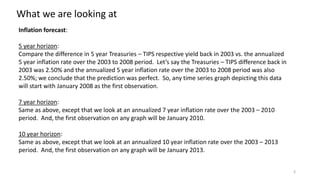
Inflation forecast:
5 year horizon:
Compare the difference in 5 year Treasuries – TIPS respective yield back in 2003 vs. the annualized
5 year inflation rate over the 2003 to 2008 period. Let’s say the Treasuries – TIPS difference back in
2003 was 2.50% and the annualized 5 year inflation rate over the 2003 to 2008 period was also
2.50%; we conclude that the prediction was perfect. So, any time series graph depicting this data
will start with January 2008 as the first observation.
7 year horizon:
Same as above, except that we look at an annualized 7 year inflation rate over the 2003 – 2010
period. And, the first observation on any graph will be January 2010.
10 year horizon:
Same as above, except that we look at an annualized 10 year inflation rate over the 2003 – 2013
period. And, the first observation on any graph will be January 2013.
3
4
5 Year Inflation Expectation
5
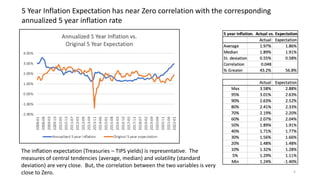
5 Year Inflation Expectation has near Zero correlation with the corresponding
annualized 5 year inflation rate
The inflation expectation (Treasuries – TIPS yields) is representative. The
measures of central tendencies (average, median) and volatility (standard
deviation) are very close. But, the correlation between the two variables is very
close to Zero.
6
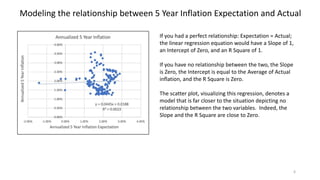
Modeling the relationship between 5 Year Inflation Expectation and Actual
If you had a perfect relationship: Expectation = Actual;
the linear regression equation would have a Slope of 1,
an Intercept of Zero, and an R Square of 1.
If you have no relationship between the two, the Slope
is Zero, the Intercept is equal to the Average of Actual
inflation, and the R Square is Zero.
The scatter plot, visualizing this regression, denotes a
model that is far closer to the situation depicting no
relationship between the two variables. Indeed, the
Slope and the R Square are close to Zero.
7
7 Year Inflation Expectation
8
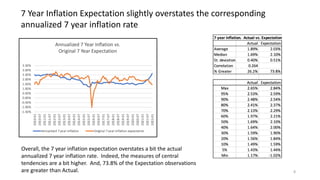
7 Year Inflation Expectation slightly overstates the corresponding
annualized 7 year inflation rate
Overall, the 7 year inflation expectation overstates a bit the actual
annualized 7 year inflation rate. Indeed, the measures of central
tendencies are a bit higher. And, 73.8% of the Expectation observations
are greater than Actual.
9
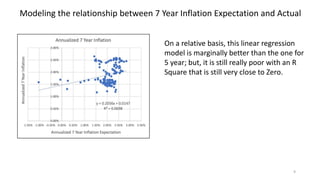
Modeling the relationship between 7 Year Inflation Expectation and Actual
On a relative basis, this linear regression
model is marginally better than the one for
5 year; but, it is still really poor with an R
Square that is still very close to Zero.
10
10 Year Inflation Expectation
11
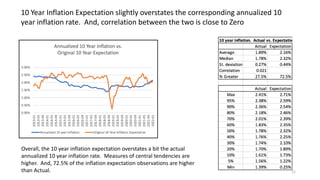
10 Year Inflation Expectation slightly overstates the corresponding annualized 10
year inflation rate. And, correlation between the two is close to Zero
Overall, the 10 year inflation expectation overstates a bit the actual
annualized 10 year inflation rate. Measures of central tendencies are
higher. And, 72.5% of the inflation expectation observations are higher
than Actual.
12
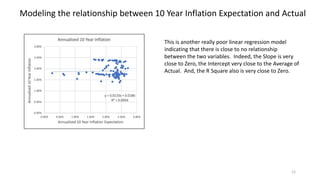
Modeling the relationship between 10 Year Inflation Expectation and Actual
This is another really poor linear regression model
indicating that there is close to no relationship
between the two variables. Indeed, the Slope is very
close to Zero, the Intercept very close to the Average of
Actual. And, the R Square also is very close to Zero.
Looking at all three horizons (5, 7, and 10 Year) together
13
14
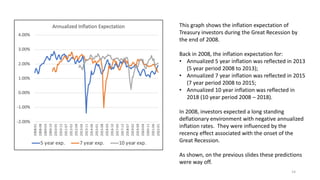
This graph shows the inflation expectation of
Treasury investors during the Great Recession by
the end of 2008.
Back in 2008, the inflation expectation for:
• Annualized 5 year inflation was reflected in 2013
(5 year period 2008 to 2013);
• Annualized 7 year inflation was reflected in 2015
(7 year period 2008 to 2015;
• Annualized 10 year inflation was reflected in
2018 (10 year period 2008 – 2018).
In 2008, investors expected a long standing
deflationary environment with negative annualized
inflation rates. They were influenced by the
recency effect associated with the onset of the
Great Recession.
As shown, on the previous slides these predictions
were way off.
15
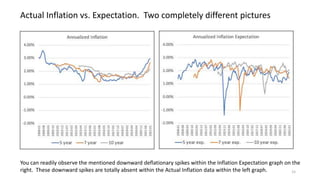
Actual Inflation vs. Expectation. Two completely different pictures
You can readily observe the mentioned downward deflationary spikes within the Inflation Expectation graph on the
right. These downward spikes are totally absent within the Actual Inflation data within the left graph.
16
Considerations
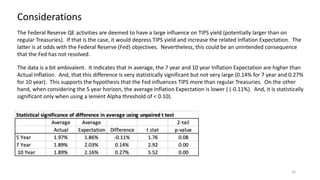
The Federal Reserve QE activities are deemed to have a large influence on TIPS yield (potentially larger than on
regular Treasuries). If that is the case, it would depress TIPS yield and increase the related Inflation Expectation. The
latter is at odds with the Federal Reserve (Fed) objectives. Nevertheless, this could be an unintended consequence
that the Fed has not resolved.
The data is a bit ambivalent. It indicates that in average, the 7 year and 10 year Inflation Expectation are higher than
Actual Inflation. And, that this difference is very statistically significant but not very large (0.14% for 7 year and 0.27%
for 10 year). This supports the hypothesis that the Fed influences TIPS more than regular Treasuries. On the other
hand, when considering the 5 year horizon, the average Inflation Expectation is lower ( (-0.11%). And, it is statistically
significant only when using a lenient Alpha threshold of < 0.10).

Can Treasury Inflation Protected Securities predict Inflation?

  • 1.
    Can Treasury InflationProtected Securities (TIPS) predict Inflation? Gaetan Lion, March 3, 2022
  • 2.
    Treasuries Yield –TIPS Yield = Inflation Expectation The equality above is why TIPS are very interesting. They reflect the bond market’s inflation expectation over different terms including: 5, 7, and 10 years. This is since there are regular Treasuries and TIPS of such maturities (or adjusted constant maturity) that we can readily match and compare to derive the related inflation expectation over the mentioned terms. Unfortunately, TIPS data is very limited as it goes back only to 2003. The source of the data is the Federal Reserve H.15 Selected Interest Rates. 2
  • 3.
    What we arelooking at Inflation forecast: 5 year horizon: Compare the difference in 5 year Treasuries – TIPS respective yield back in 2003 vs. the annualized 5 year inflation rate over the 2003 to 2008 period. Let’s say the Treasuries – TIPS difference back in 2003 was 2.50% and the annualized 5 year inflation rate over the 2003 to 2008 period was also 2.50%; we conclude that the prediction was perfect. So, any time series graph depicting this data will start with January 2008 as the first observation. 7 year horizon: Same as above, except that we look at an annualized 7 year inflation rate over the 2003 – 2010 period. And, the first observation on any graph will be January 2010. 10 year horizon: Same as above, except that we look at an annualized 10 year inflation rate over the 2003 – 2013 period. And, the first observation on any graph will be January 2013. 3
  • 4.
    4 5 Year InflationExpectation
  • 5.
    5 5 Year InflationExpectation has near Zero correlation with the corresponding annualized 5 year inflation rate The inflation expectation (Treasuries – TIPS yields) is representative. The measures of central tendencies (average, median) and volatility (standard deviation) are very close. But, the correlation between the two variables is very close to Zero.
  • 6.
    6 Modeling the relationshipbetween 5 Year Inflation Expectation and Actual If you had a perfect relationship: Expectation = Actual; the linear regression equation would have a Slope of 1, an Intercept of Zero, and an R Square of 1. If you have no relationship between the two, the Slope is Zero, the Intercept is equal to the Average of Actual inflation, and the R Square is Zero. The scatter plot, visualizing this regression, denotes a model that is far closer to the situation depicting no relationship between the two variables. Indeed, the Slope and the R Square are close to Zero.
  • 7.
    7 7 Year InflationExpectation
  • 8.
    8 7 Year InflationExpectation slightly overstates the corresponding annualized 7 year inflation rate Overall, the 7 year inflation expectation overstates a bit the actual annualized 7 year inflation rate. Indeed, the measures of central tendencies are a bit higher. And, 73.8% of the Expectation observations are greater than Actual.
  • 9.
    9 Modeling the relationshipbetween 7 Year Inflation Expectation and Actual On a relative basis, this linear regression model is marginally better than the one for 5 year; but, it is still really poor with an R Square that is still very close to Zero.
  • 10.
  • 11.
    11 10 Year InflationExpectation slightly overstates the corresponding annualized 10 year inflation rate. And, correlation between the two is close to Zero Overall, the 10 year inflation expectation overstates a bit the actual annualized 10 year inflation rate. Measures of central tendencies are higher. And, 72.5% of the inflation expectation observations are higher than Actual.
  • 12.
    12 Modeling the relationshipbetween 10 Year Inflation Expectation and Actual This is another really poor linear regression model indicating that there is close to no relationship between the two variables. Indeed, the Slope is very close to Zero, the Intercept very close to the Average of Actual. And, the R Square also is very close to Zero.
  • 13.
    Looking at allthree horizons (5, 7, and 10 Year) together 13
  • 14.
    14 This graph showsthe inflation expectation of Treasury investors during the Great Recession by the end of 2008. Back in 2008, the inflation expectation for: • Annualized 5 year inflation was reflected in 2013 (5 year period 2008 to 2013); • Annualized 7 year inflation was reflected in 2015 (7 year period 2008 to 2015; • Annualized 10 year inflation was reflected in 2018 (10 year period 2008 – 2018). In 2008, investors expected a long standing deflationary environment with negative annualized inflation rates. They were influenced by the recency effect associated with the onset of the Great Recession. As shown, on the previous slides these predictions were way off.
  • 15.
    15 Actual Inflation vs.Expectation. Two completely different pictures You can readily observe the mentioned downward deflationary spikes within the Inflation Expectation graph on the right. These downward spikes are totally absent within the Actual Inflation data within the left graph.
  • 16.
    16 Considerations The Federal ReserveQE activities are deemed to have a large influence on TIPS yield (potentially larger than on regular Treasuries). If that is the case, it would depress TIPS yield and increase the related Inflation Expectation. The latter is at odds with the Federal Reserve (Fed) objectives. Nevertheless, this could be an unintended consequence that the Fed has not resolved. The data is a bit ambivalent. It indicates that in average, the 7 year and 10 year Inflation Expectation are higher than Actual Inflation. And, that this difference is very statistically significant but not very large (0.14% for 7 year and 0.27% for 10 year). This supports the hypothesis that the Fed influences TIPS more than regular Treasuries. On the other hand, when considering the 5 year horizon, the average Inflation Expectation is lower ( (-0.11%). And, it is statistically significant only when using a lenient Alpha threshold of < 0.10).