Global warming is the observed century-scale rise in the average temperature 
of Earth’s Climate system. 
Since 1971, 90% of the increased energy has been stored in the oceans, mostly in 
the 0 to 700m region. Despite the oceans' dominant role in energy storage, the 
term "global warming" is also used to refer to increases in average temperature of 
theair and sea at Earth's surface . Since the early 20th century, the global air 
and sea surface temperature has increased about 0.8 °C (1.4 °F), with about two-thirds 
of the increase occurring since 1980.
Global warming is primarily a problem of too much carbon 
dioxide (CO2) in the atmosphere—which acts as a blanket, 
trapping heat and warming the planet. As we burn fossil fuels like coal, oil and 
natural gas for energy or cut down and burn forests to create pastures and 
plantations ,carbon accumulates and overloads our atmosphere. Certain waste 
management and agricultural practices aggravate the problem by releasing other 
potent global warming gases, such as methane and nitrous oxide
The Effects of Global Warming are the environmental and social changes 
caused (directly or indirectly) by human emissions of greenhouse gases. There is 
a scientific consensus that climate change is occurring, and that human activities 
are the primary driver. Many impacts of climate change have already been 
observed, including glacier retreat, changes in the timing of seasonal events (e.g., 
earlier flowering of plants), and changes in agricultural productivity.
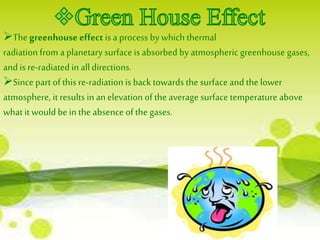
The greenhouse effect is a process by which thermal 
radiation from a planetary surface is absorbed by atmospheric greenhouse gases, 
and is re-radiated in all directions. 
Since part of this re-radiation is back towards the surface and the lower 
atmosphere, it results in an elevation of the average surface temperature above 
what it would be in the absence of the gases.
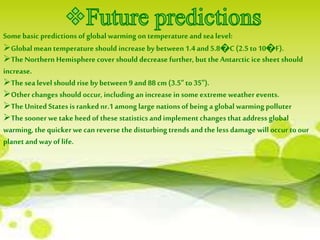
Some basic predictions of global warming on temperature and sea level: 
Global mean temperature should increase by between 1.4 and 5.8೦C (2.5 to 10೦F). 
The Northern Hemisphere cover should decrease further, but the Antarctic ice sheet should 
increase. 
The sea level should rise by between 9 and 88 cm (3.5" to 35"). 
Other changes should occur, including an increase in some extreme weather events. 
The United States is ranked nr.1 among large nations of being a global warming polluter 
The sooner we take heed of these statistics and implement changes that address global 
warming, the quicker we can reverse the disturbing trends and the less damage will occur to our 
planet and way of life.
Useless usage of AC's and Refrigerators should be stopped 
because from them harmful rays cfc's are emitted which results in 
depletion of ozone layer and from that hole UV rays of Sun comes to 
the earth and cause many diseases to both animals and plants i.e. 
Skin cancer etc. , CNG and hydrogen operated vehicles should be 
used, more no. of trees should be planted, Chimneys in the Industries 
should be upgraded so that most of the effluents should get filtered 
down there.
The ozone layer protects the Earth from the ultraviolet rays 
sent down by the sun. If the ozone layer is depleted by 
human action, the effects on the planet could be catastro- 
-phic. 
Ozone is a bluish gas that is formed by three atoms of 
oxygen. The form of oxygen that humans breathe in 
consists of two oxygen atoms, O2. When found on the 
surface of the planet, ozone is considered a dangerous 
pollutant and is one substance responsible for producing 
the greenhouse effect.
Global warming
Global warming

Global warming

  • 2.
    Global warming isthe observed century-scale rise in the average temperature of Earth’s Climate system. Since 1971, 90% of the increased energy has been stored in the oceans, mostly in the 0 to 700m region. Despite the oceans' dominant role in energy storage, the term "global warming" is also used to refer to increases in average temperature of theair and sea at Earth's surface . Since the early 20th century, the global air and sea surface temperature has increased about 0.8 °C (1.4 °F), with about two-thirds of the increase occurring since 1980.
  • 3.
    Global warming isprimarily a problem of too much carbon dioxide (CO2) in the atmosphere—which acts as a blanket, trapping heat and warming the planet. As we burn fossil fuels like coal, oil and natural gas for energy or cut down and burn forests to create pastures and plantations ,carbon accumulates and overloads our atmosphere. Certain waste management and agricultural practices aggravate the problem by releasing other potent global warming gases, such as methane and nitrous oxide
  • 4.
    The Effects ofGlobal Warming are the environmental and social changes caused (directly or indirectly) by human emissions of greenhouse gases. There is a scientific consensus that climate change is occurring, and that human activities are the primary driver. Many impacts of climate change have already been observed, including glacier retreat, changes in the timing of seasonal events (e.g., earlier flowering of plants), and changes in agricultural productivity.
  • 5.
    The greenhouse effectis a process by which thermal radiation from a planetary surface is absorbed by atmospheric greenhouse gases, and is re-radiated in all directions. Since part of this re-radiation is back towards the surface and the lower atmosphere, it results in an elevation of the average surface temperature above what it would be in the absence of the gases.
  • 6.
    Some basic predictionsof global warming on temperature and sea level: Global mean temperature should increase by between 1.4 and 5.8೦C (2.5 to 10೦F). The Northern Hemisphere cover should decrease further, but the Antarctic ice sheet should increase. The sea level should rise by between 9 and 88 cm (3.5" to 35"). Other changes should occur, including an increase in some extreme weather events. The United States is ranked nr.1 among large nations of being a global warming polluter The sooner we take heed of these statistics and implement changes that address global warming, the quicker we can reverse the disturbing trends and the less damage will occur to our planet and way of life.
  • 7.
    Useless usage ofAC's and Refrigerators should be stopped because from them harmful rays cfc's are emitted which results in depletion of ozone layer and from that hole UV rays of Sun comes to the earth and cause many diseases to both animals and plants i.e. Skin cancer etc. , CNG and hydrogen operated vehicles should be used, more no. of trees should be planted, Chimneys in the Industries should be upgraded so that most of the effluents should get filtered down there.
  • 8.
    The ozone layerprotects the Earth from the ultraviolet rays sent down by the sun. If the ozone layer is depleted by human action, the effects on the planet could be catastro- -phic. Ozone is a bluish gas that is formed by three atoms of oxygen. The form of oxygen that humans breathe in consists of two oxygen atoms, O2. When found on the surface of the planet, ozone is considered a dangerous pollutant and is one substance responsible for producing the greenhouse effect.