Development Model for Knowledge Intensive
                           Organizations for Global Product Development


                                                               Jouni Pirhonen
jouni.pirhonen@gmail.com
                                                   Jouni.pirhonen@gmail.com
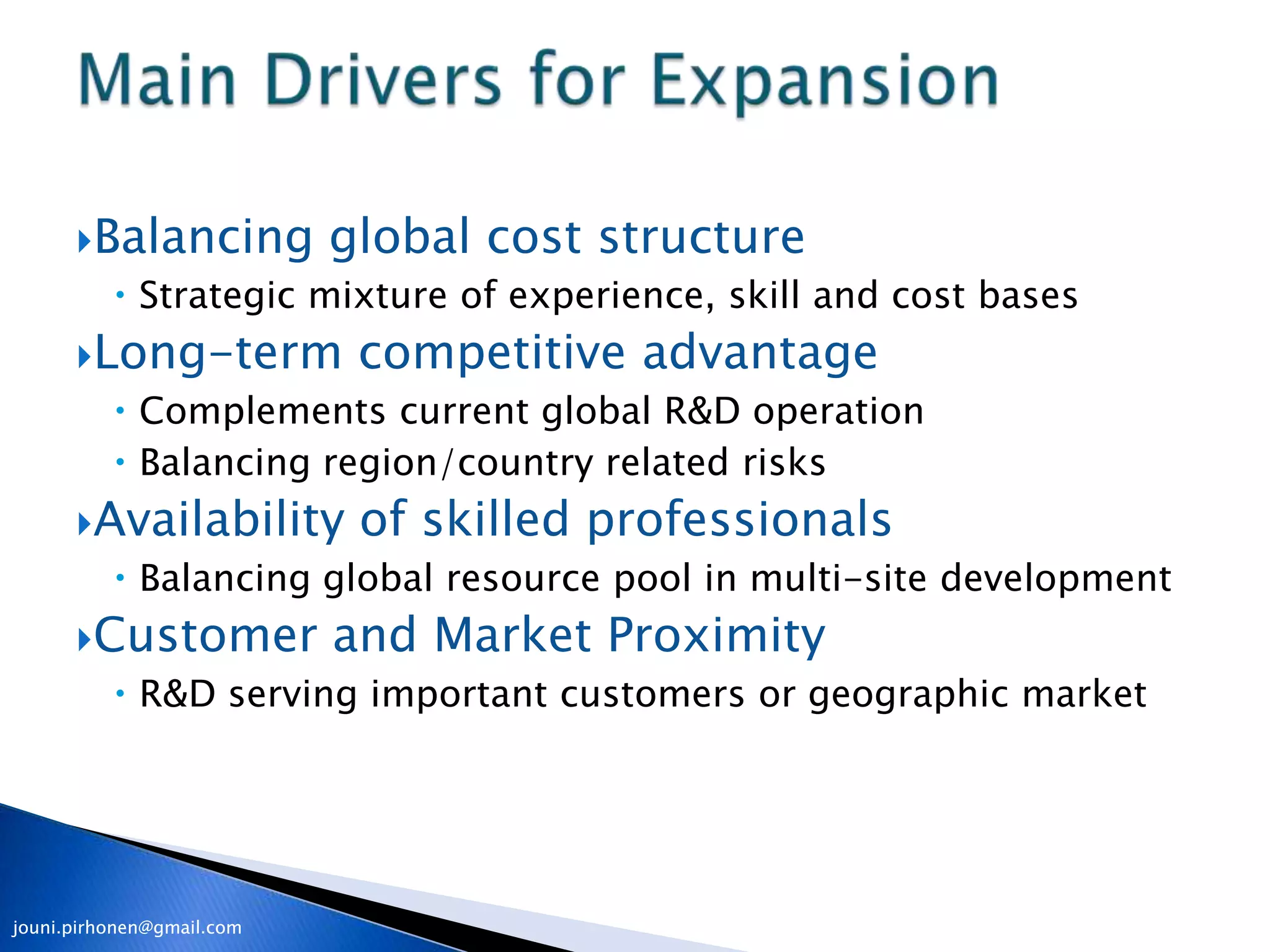
Balancing           global cost structure
           Strategic mixture of experience, skill and cost bases
      Long-term            competitive advantage
           Complements current global R&D operation
           Balancing region/country related risks
      Availability         of skilled professionals
           Balancing global resource pool in multi-site development
      Customer            and Market Proximity
           R&D serving important customers or geographic market


jouni.pirhonen@gmail.com
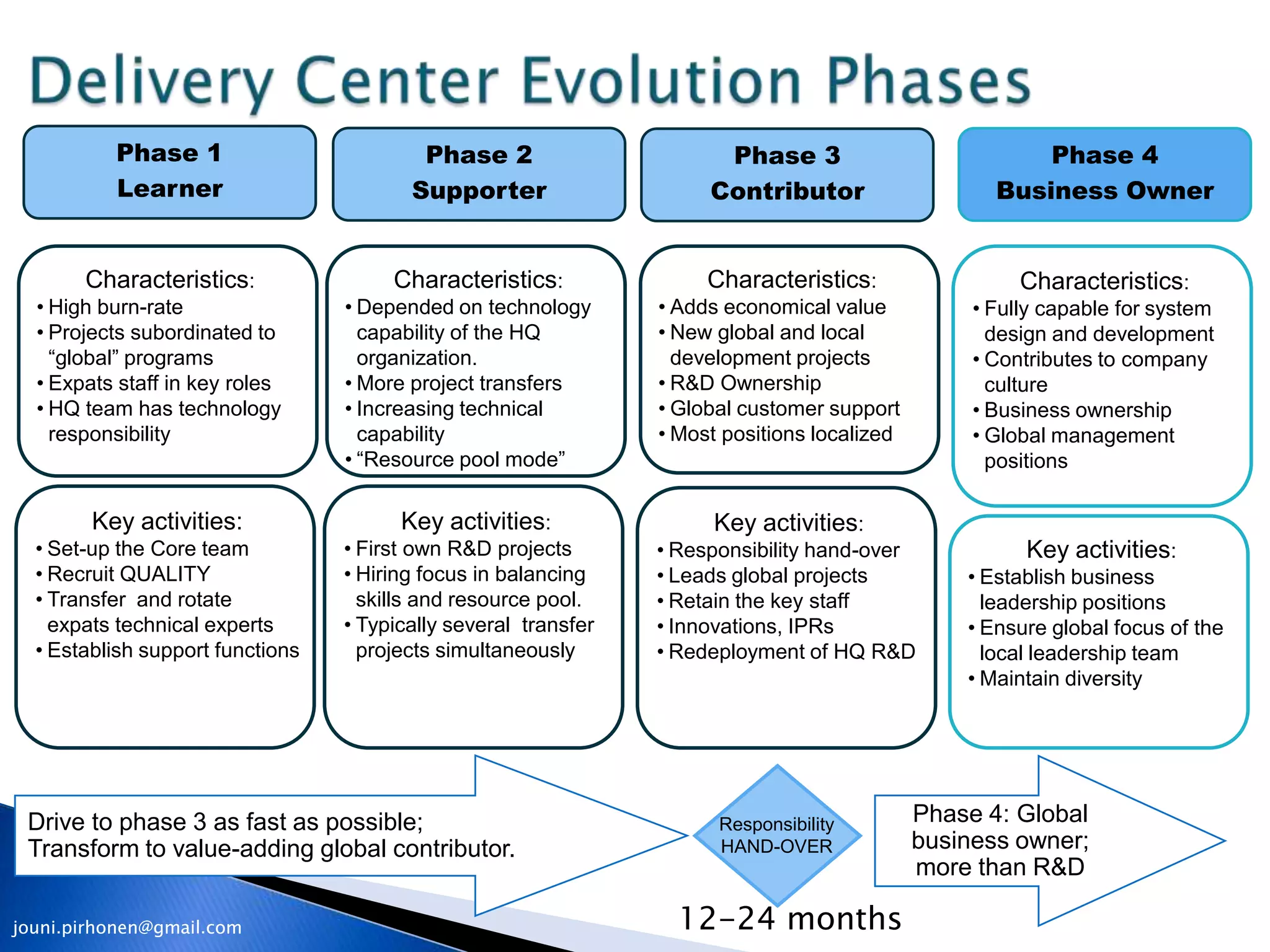
Phase 1                         Phase 2                      Phase 3                           Phase 4
          Learner                        Supporter                    Contributor                    Business Owner


       Characteristics:                Characteristics:               Characteristics:                   Characteristics:
  • High burn-rate                • Depended on technology       • Adds economical value           • Fully capable for system
  • Projects subordinated to        capability of the HQ         • New global and local              design and development
    “global” programs               organization.                  development projects            • Contributes to company
  • Expats staff in key roles     • More project transfers       • R&D Ownership                     culture
  • HQ team has technology        • Increasing technical         • Global customer support         • Business ownership
    responsibility                  capability                   • Most positions localized        • Global management
                                  • “Resource pool mode”                                             positions

        Key activities:                   Key activities:             Key activities:
  • Set-up the Core team          • First own R&D projects       • Responsibility hand-over               Key activities:
  • Recruit QUALITY               • Hiring focus in balancing    • Leads global projects          • Establish business
  • Transfer and rotate             skills and resource pool.    • Retain the key staff             leadership positions
    expats technical experts      • Typically several transfer   • Innovations, IPRs              • Ensure global focus of the
  • Establish support functions     projects simultaneously      • Redeployment of HQ R&D           local leadership team
                                                                                                  • Maintain diversity


 Drive to phase 3 as fast as possible;                                 Responsibility         Phase 4: Global
 Transform to value-adding global contributor.                         HAND-OVER              business owner;
                                                                                              more than R&D

jouni.pirhonen@gmail.com                                           12-24 months
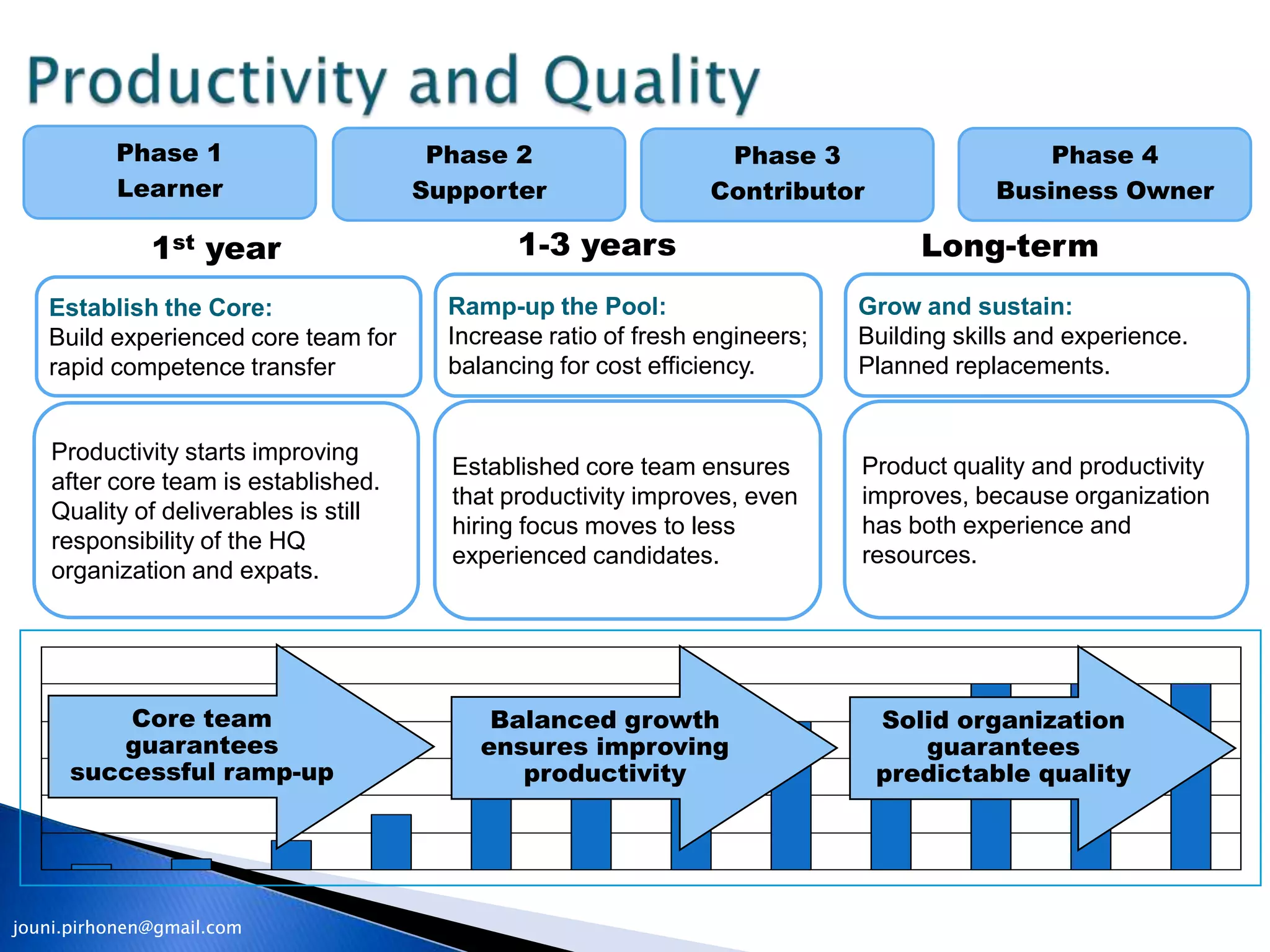
Phase 1                       Phase 2                   Phase 3                     Phase 4
          Learner                      Supporter                 Contributor              Business Owner

              1st year                         1-3 years                           Long-term
   Establish the Core:                   Ramp-up the Pool:                    Grow and sustain:
   Build experienced core team for       Increase ratio of fresh engineers;   Building skills and experience.
   rapid competence transfer             balancing for cost efficiency.       Planned replacements.


    Productivity starts improving
                                         Established core team ensures        Product quality and productivity
    after core team is established.
                                         that productivity improves, even     improves, because organization
    Quality of deliverables is still
                                         hiring focus moves to less           has both experience and
    responsibility of the HQ
                                         experienced candidates.              resources.
    organization and expats.


         Core team                           Balanced growth                   Solid organization
        guarantees                          ensures improving                     guarantees
     successful ramp-up                        productivity                    predictable quality


jouni.pirhonen@gmail.com
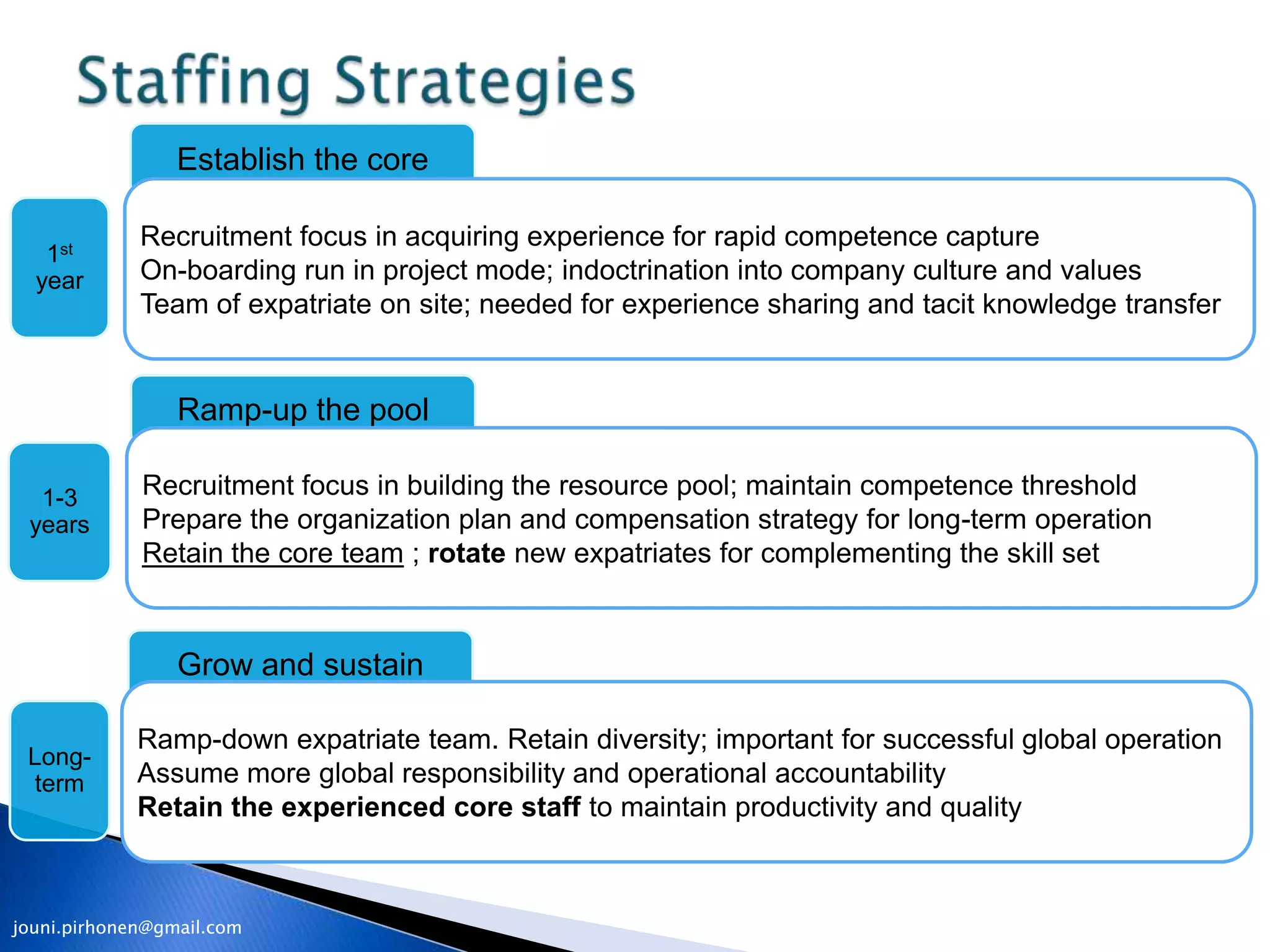
Establish the core

             Recruitment focus in acquiring experience for rapid competence capture
   1st
  year       On-boarding run in project mode; indoctrination into company culture and values
             Team of expatriate on site; needed for experience sharing and tacit knowledge transfer


                 Ramp-up the pool

  1-3        Recruitment focus in building the resource pool; maintain competence threshold
 years       Prepare the organization plan and compensation strategy for long-term operation
             Retain the core team ; rotate new expatriates for complementing the skill set


                 Grow and sustain

             Ramp-down expatriate team. Retain diversity; important for successful global operation
 Long-
 term        Assume more global responsibility and operational accountability
             Retain the experienced core staff to maintain productivity and quality


jouni.pirhonen@gmail.com
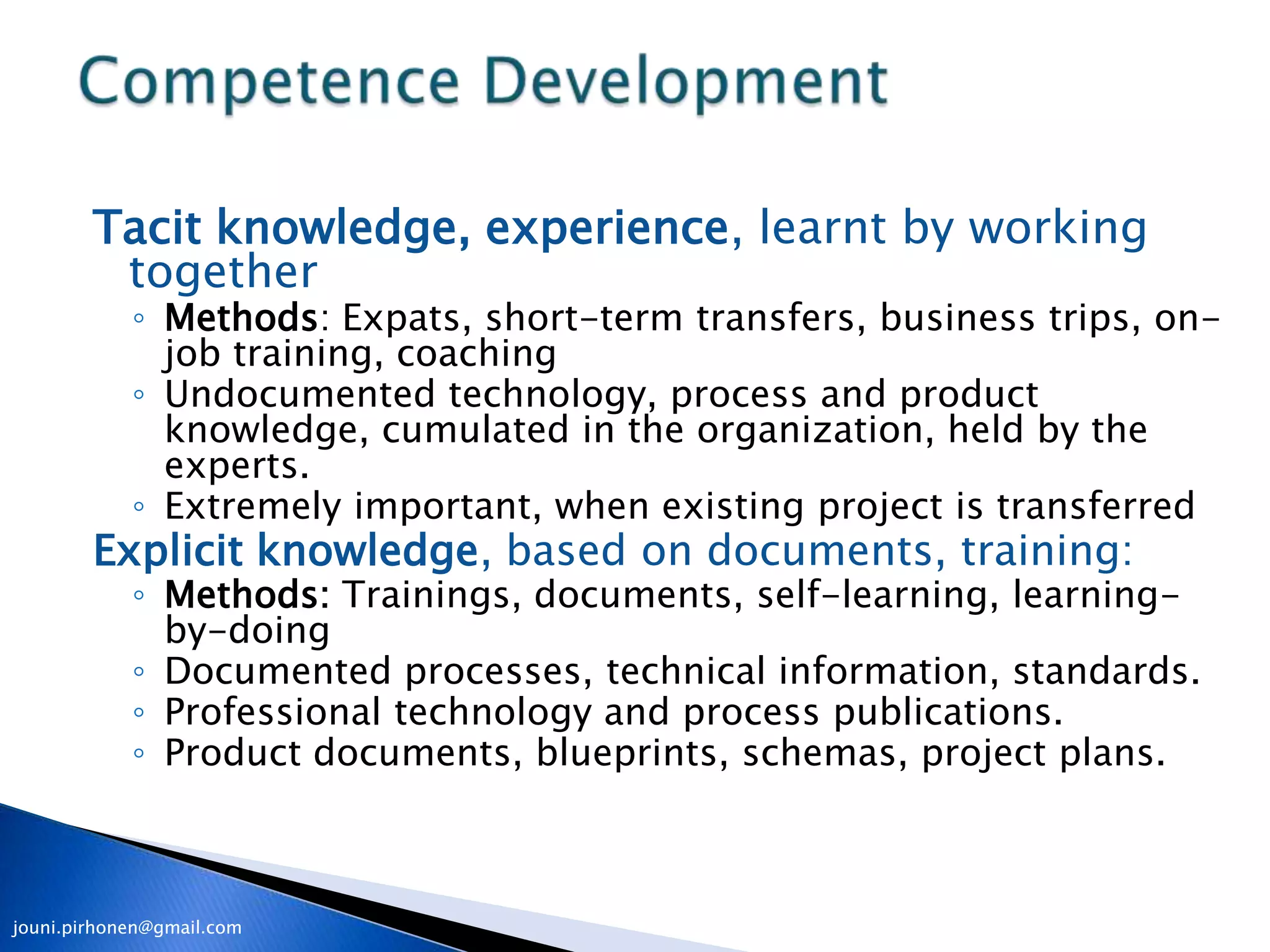
Tacit knowledge, experience, learnt by working
         together
            ◦ Methods: Expats, short-term transfers, business trips, on-
              job training, coaching
            ◦ Undocumented technology, process and product
              knowledge, cumulated in the organization, held by the
              experts.
            ◦ Extremely important, when existing project is transferred
        Explicit knowledge, based on documents, training:
            ◦ Methods: Trainings, documents, self-learning, learning-
              by-doing
            ◦ Documented processes, technical information, standards.
            ◦ Professional technology and process publications.
            ◦ Product documents, blueprints, schemas, project plans.


jouni.pirhonen@gmail.com
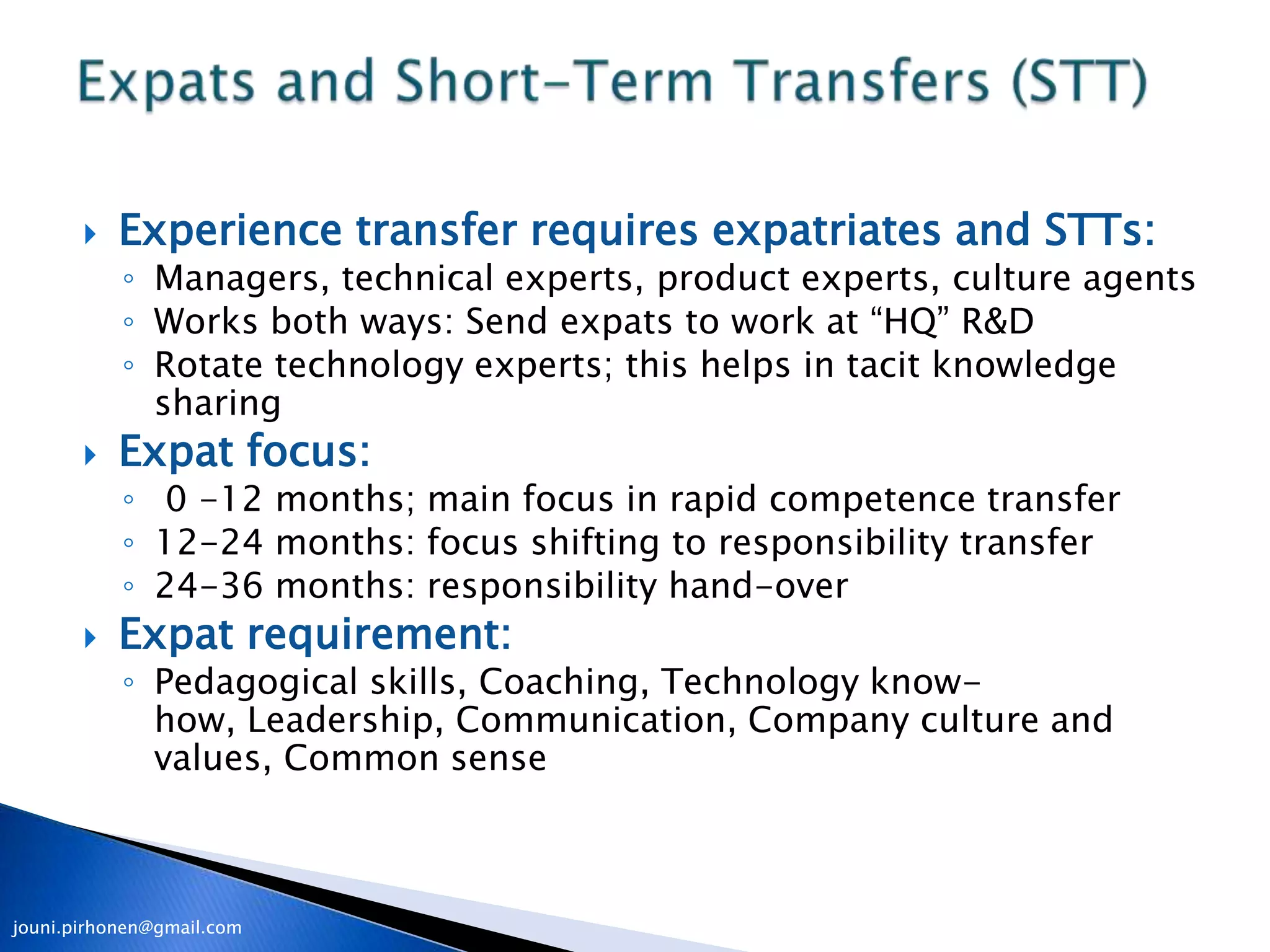
   Experience transfer requires expatriates and STTs:
           ◦ Managers, technical experts, product experts, culture agents
           ◦ Works both ways: Send expats to work at “HQ” R&D
           ◦ Rotate technology experts; this helps in tacit knowledge
             sharing
          Expat focus:
           ◦ 0 -12 months; main focus in rapid competence transfer
           ◦ 12-24 months: focus shifting to responsibility transfer
           ◦ 24-36 months: responsibility hand-over
          Expat requirement:
           ◦ Pedagogical skills, Coaching, Technology know-
             how, Leadership, Communication, Company culture and
             values, Common sense


jouni.pirhonen@gmail.com
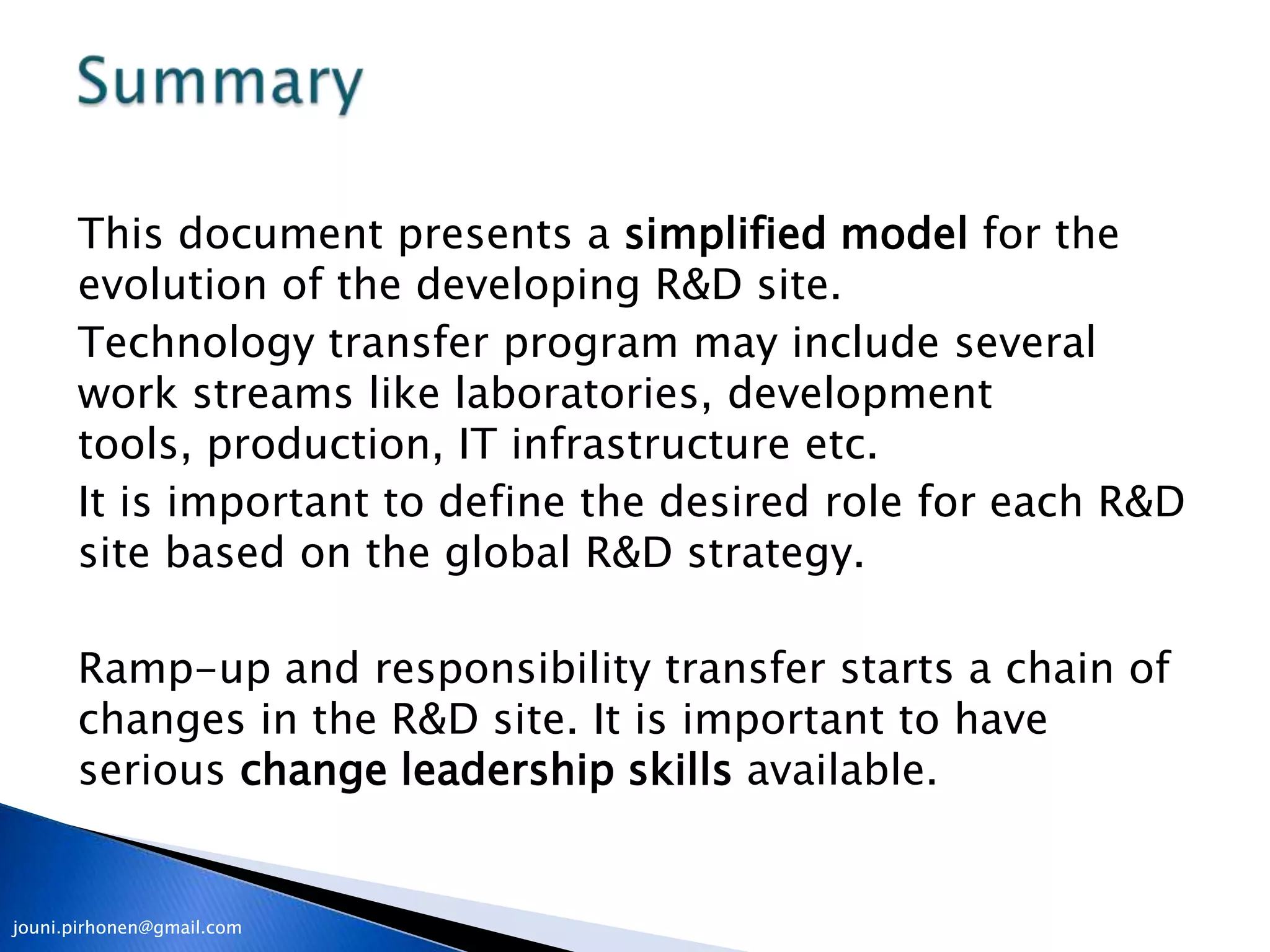
This document presents a simplified model for the
      evolution of the developing R&D site.
      Technology transfer program may include several
      work streams like laboratories, development
      tools, production, IT infrastructure etc.
      It is important to define the desired role for each R&D
      site based on the global R&D strategy.

      Ramp-up and responsibility transfer starts a chain of
      changes in the R&D site. It is important to have
      serious change leadership skills available.


jouni.pirhonen@gmail.com

Global r&d development model

  • 1.
    Development Model forKnowledge Intensive Organizations for Global Product Development Jouni Pirhonen jouni.pirhonen@gmail.com Jouni.pirhonen@gmail.com
  • 2.
    Balancing global cost structure  Strategic mixture of experience, skill and cost bases Long-term competitive advantage  Complements current global R&D operation  Balancing region/country related risks Availability of skilled professionals  Balancing global resource pool in multi-site development Customer and Market Proximity  R&D serving important customers or geographic market jouni.pirhonen@gmail.com
  • 3.
    Phase 1 Phase 2 Phase 3 Phase 4 Learner Supporter Contributor Business Owner Characteristics: Characteristics: Characteristics: Characteristics: • High burn-rate • Depended on technology • Adds economical value • Fully capable for system • Projects subordinated to capability of the HQ • New global and local design and development “global” programs organization. development projects • Contributes to company • Expats staff in key roles • More project transfers • R&D Ownership culture • HQ team has technology • Increasing technical • Global customer support • Business ownership responsibility capability • Most positions localized • Global management • “Resource pool mode” positions Key activities: Key activities: Key activities: • Set-up the Core team • First own R&D projects • Responsibility hand-over Key activities: • Recruit QUALITY • Hiring focus in balancing • Leads global projects • Establish business • Transfer and rotate skills and resource pool. • Retain the key staff leadership positions expats technical experts • Typically several transfer • Innovations, IPRs • Ensure global focus of the • Establish support functions projects simultaneously • Redeployment of HQ R&D local leadership team • Maintain diversity Drive to phase 3 as fast as possible; Responsibility Phase 4: Global Transform to value-adding global contributor. HAND-OVER business owner; more than R&D jouni.pirhonen@gmail.com 12-24 months
  • 4.
    Phase 1 Phase 2 Phase 3 Phase 4 Learner Supporter Contributor Business Owner 1st year 1-3 years Long-term Establish the Core: Ramp-up the Pool: Grow and sustain: Build experienced core team for Increase ratio of fresh engineers; Building skills and experience. rapid competence transfer balancing for cost efficiency. Planned replacements. Productivity starts improving Established core team ensures Product quality and productivity after core team is established. that productivity improves, even improves, because organization Quality of deliverables is still hiring focus moves to less has both experience and responsibility of the HQ experienced candidates. resources. organization and expats. Core team Balanced growth Solid organization guarantees ensures improving guarantees successful ramp-up productivity predictable quality jouni.pirhonen@gmail.com
  • 5.
    Establish the core Recruitment focus in acquiring experience for rapid competence capture 1st year On-boarding run in project mode; indoctrination into company culture and values Team of expatriate on site; needed for experience sharing and tacit knowledge transfer Ramp-up the pool 1-3 Recruitment focus in building the resource pool; maintain competence threshold years Prepare the organization plan and compensation strategy for long-term operation Retain the core team ; rotate new expatriates for complementing the skill set Grow and sustain Ramp-down expatriate team. Retain diversity; important for successful global operation Long- term Assume more global responsibility and operational accountability Retain the experienced core staff to maintain productivity and quality jouni.pirhonen@gmail.com
  • 6.
    Tacit knowledge, experience,learnt by working together ◦ Methods: Expats, short-term transfers, business trips, on- job training, coaching ◦ Undocumented technology, process and product knowledge, cumulated in the organization, held by the experts. ◦ Extremely important, when existing project is transferred Explicit knowledge, based on documents, training: ◦ Methods: Trainings, documents, self-learning, learning- by-doing ◦ Documented processes, technical information, standards. ◦ Professional technology and process publications. ◦ Product documents, blueprints, schemas, project plans. jouni.pirhonen@gmail.com
  • 7.
    Experience transfer requires expatriates and STTs: ◦ Managers, technical experts, product experts, culture agents ◦ Works both ways: Send expats to work at “HQ” R&D ◦ Rotate technology experts; this helps in tacit knowledge sharing  Expat focus: ◦ 0 -12 months; main focus in rapid competence transfer ◦ 12-24 months: focus shifting to responsibility transfer ◦ 24-36 months: responsibility hand-over  Expat requirement: ◦ Pedagogical skills, Coaching, Technology know- how, Leadership, Communication, Company culture and values, Common sense jouni.pirhonen@gmail.com
  • 8.
    This document presentsa simplified model for the evolution of the developing R&D site. Technology transfer program may include several work streams like laboratories, development tools, production, IT infrastructure etc. It is important to define the desired role for each R&D site based on the global R&D strategy. Ramp-up and responsibility transfer starts a chain of changes in the R&D site. It is important to have serious change leadership skills available. jouni.pirhonen@gmail.com