Global 1 Third Marking
     Period Test
       Mrs. Kantz’s class
       Ppt. by David Fan
GREECE
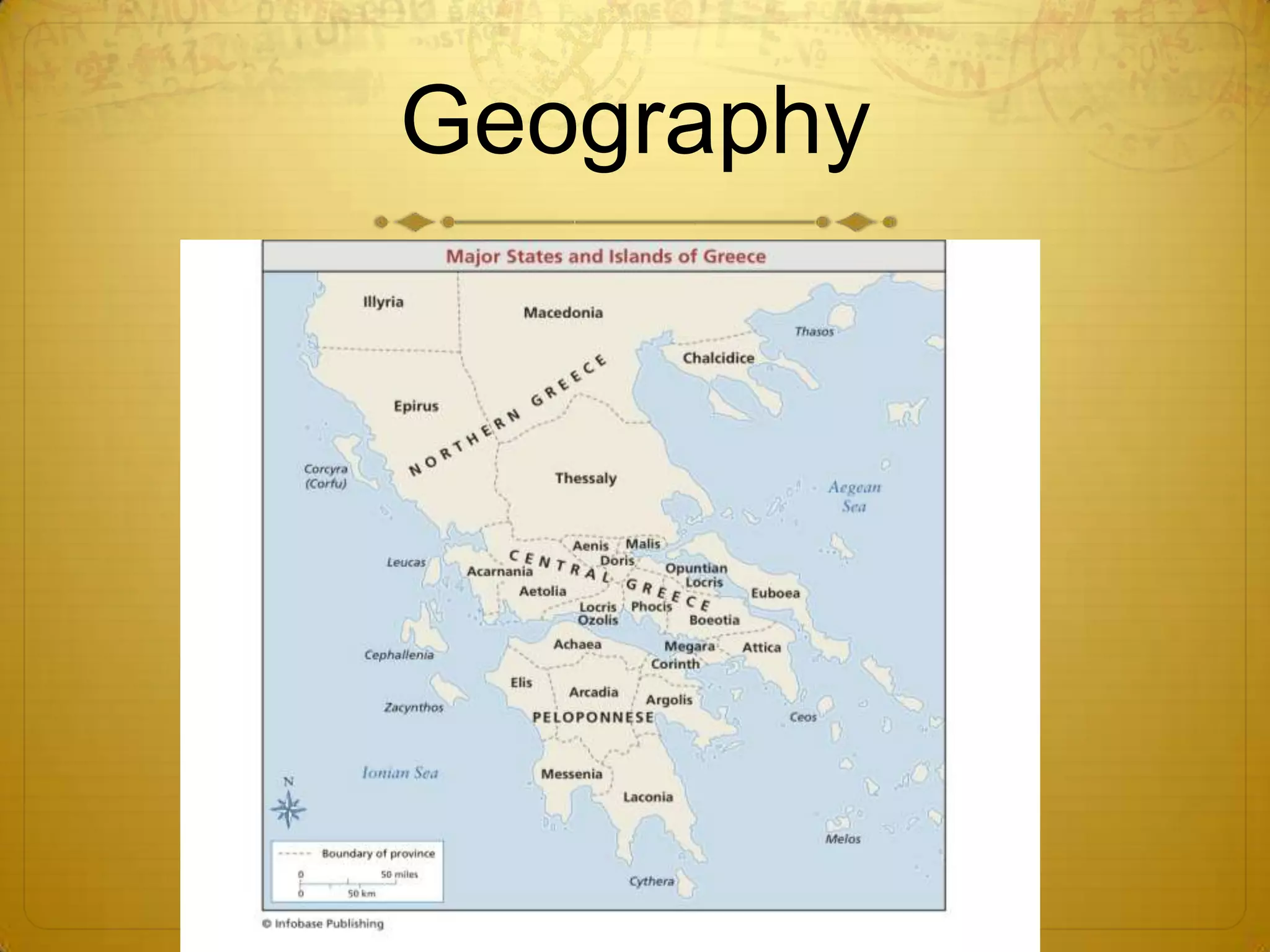
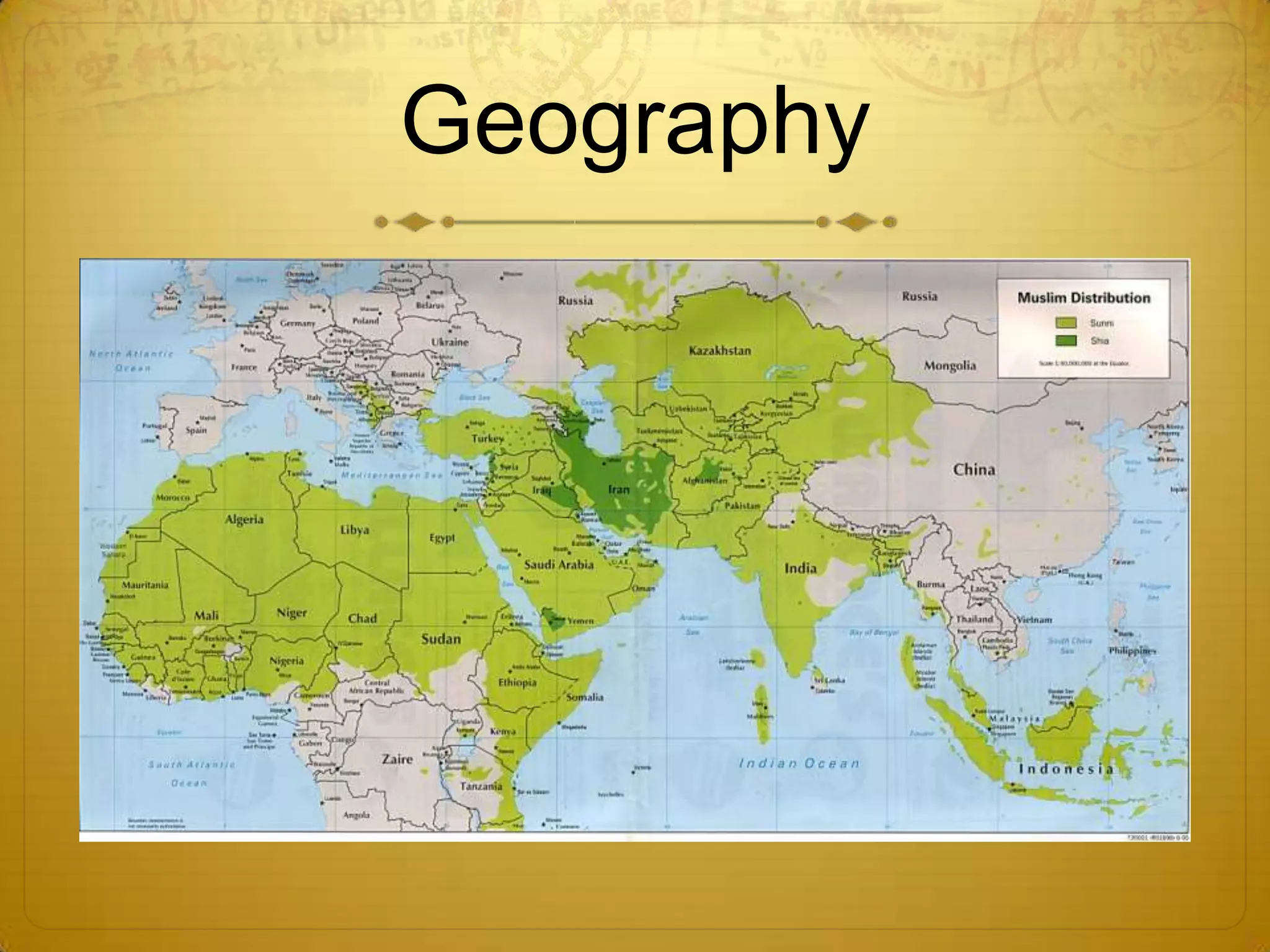
Geography
Geography
Movement                                          Place
Pull factors: fishing; harbors                       Mountainous
Push factors: Little farming land; poor roads;       Seafood
political fragments (city-states instead of one
unified Greece)
                                                     Fresh drinking water
Region
                                                     Small; isolated
     Mountainous
                                                     Dried up rivers
     Good harbors
                                                     Peninsula
     Divided by mountains
                                                     Islands
     Trade
                                                     Barren
     Peninsula
                                                     Rocky
     Mt. Olympus
     City states                                    Not good for farming
Geography
Location                   Interaction
 Aegean Sea                Harbors
 Mediterranean Sea         Fishing
 Europe                    Trade
 West of Persian Empire    Fresh Drinking Water
                            Terrace Farming
Geography
Impact of geography on Greece
 The Greeks were sailors rather than farmers.

 Harbors encouraged trade and communication with Egypt and
  Middle Eastern Civilizations.

 Mountains divided Greece leading to City-States. The mountains
  of Greece divided it into many small pockets.
 As a result of the geological fragmentation, Greeks felt more unity
  with their individual City-States rather than with Greece as a
  country.
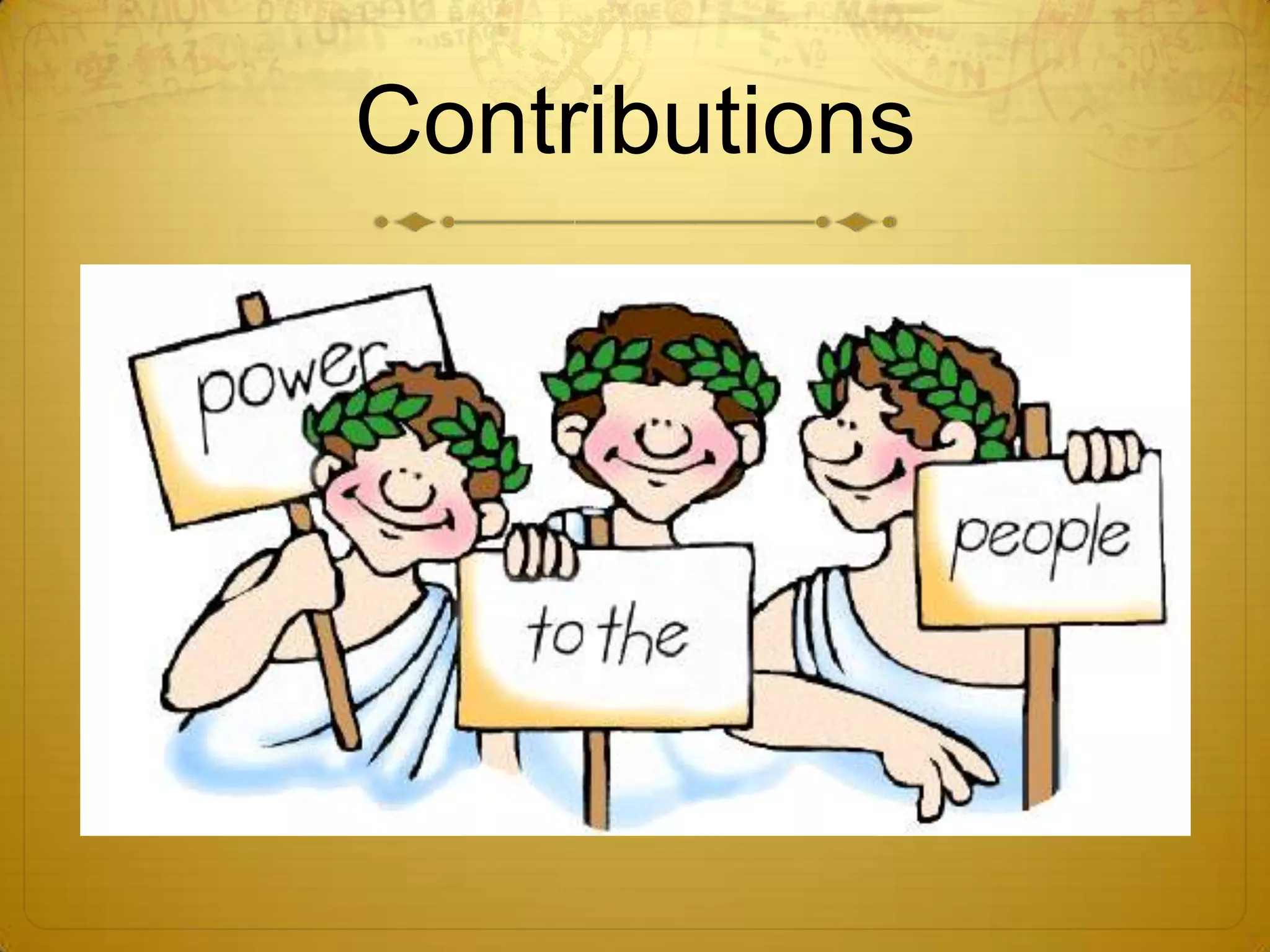
Contributions
Government
City-State                                               Oligarchy
A self governing, independent community.                    Ruling power is in the hands of a few leaders
Developed because of geography. Varied in
prosperity and government systems.                          Small groups shared power and military
                                                             support
Monarchy
                                                            Ruled by wealthy individuals; Aristocrats
     Ruling power is in the hands of one person;
      Kings                                                 Practiced in:

     Kings lived in a palace on tax money                         Corinth
                                                                   Athens
     Practiced by the Mycenaeans
                                                            Funded by taxes
     Oldest son would succeed his father as king
                                                            Citizens had no vote
     Soldiers protected king, enforced laws,
      obeyed laws, and collected taxes                      Decline: increase of population, powerful
                                                             individuals hired hoplite arrays, overthrown by
     Decline: Trade routes closed, internal fighting,       the people
      invaded by Dorians.
Government
Tyranny                                  Democracy
   Ruling power is in the hands of an      Ruling power is in the hands of all
    individual often by illegal means        the people

   Military leaders, backed by middle      Citizens Assembly
    class, seized power
                                            Executive group- Council of 500
   Practiced in Athens
                                            Practiced in Athens
   Decline: Athenians were unhappy,
    Spartan invasions                       Decline: Fall of Athens
Philosophy
 Socrates

 Plato

 Aristotle

 REMEMBER: Legacy of Greece Debate
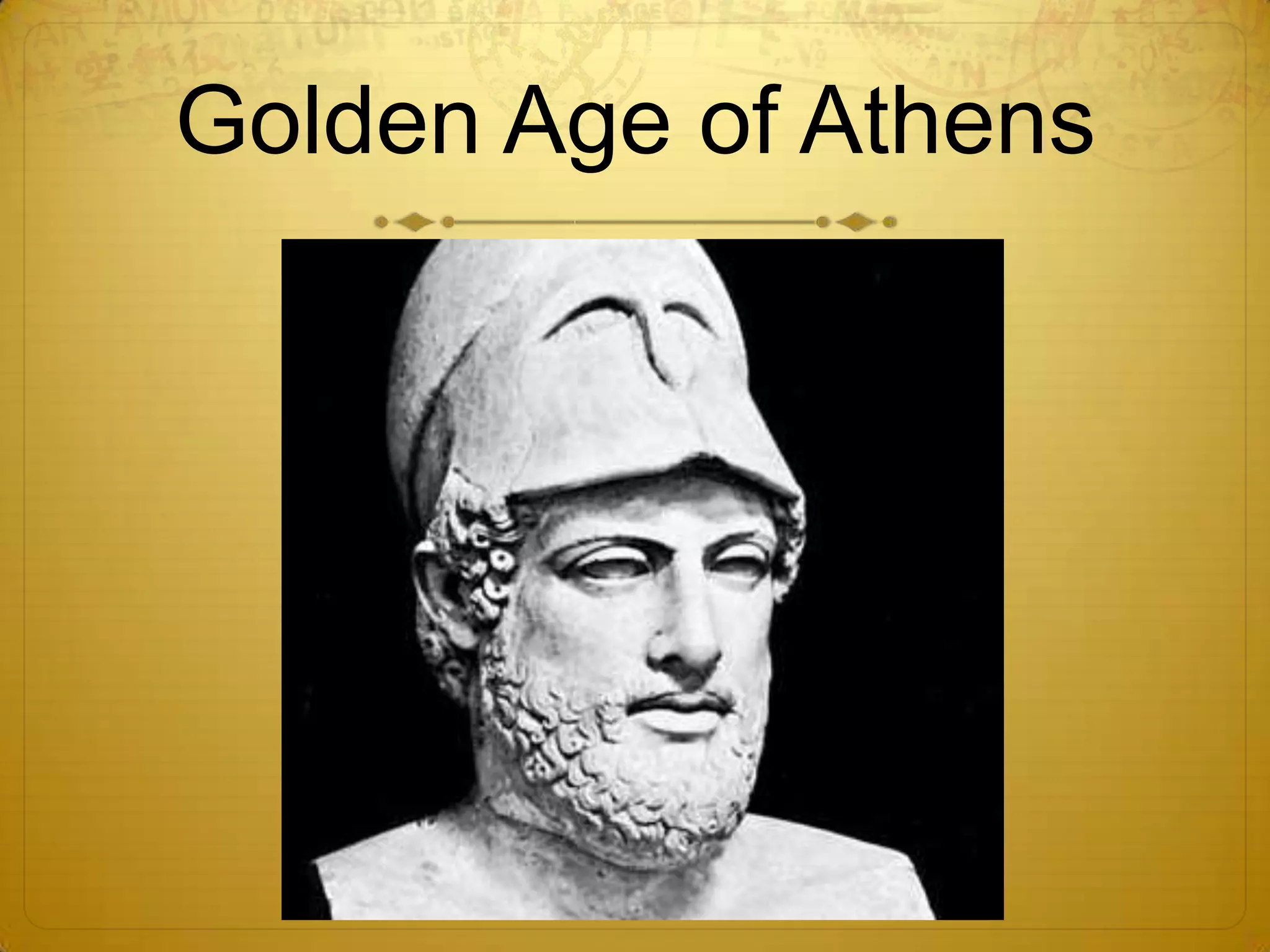
Golden Age of Athens
 480-430 BCE                  Three Goals
 Overseen by Pericles         1. Strengthen Democracy
 Pericles- Leader from 461-         Increased number of public
  429 BCE                             officials on paid salaries
                                     Direct democracy- Citizens
                                      rule directly, not through
                                      representatives
Golden Age of Athens
2. Maintain Empire                3. Glorify Athens
      Delian League: Athens            Used money from the
       received tributes from            Delian League to buy
       over 200 city-states in           gold, ivory, and marble
       return for protection
                                        Paid artists, architects,
      Made Athens’s navy the            and workers to use the
       strongest in the                  materials.
       Mediterranean
      Gained access to
       surrounding trade routes
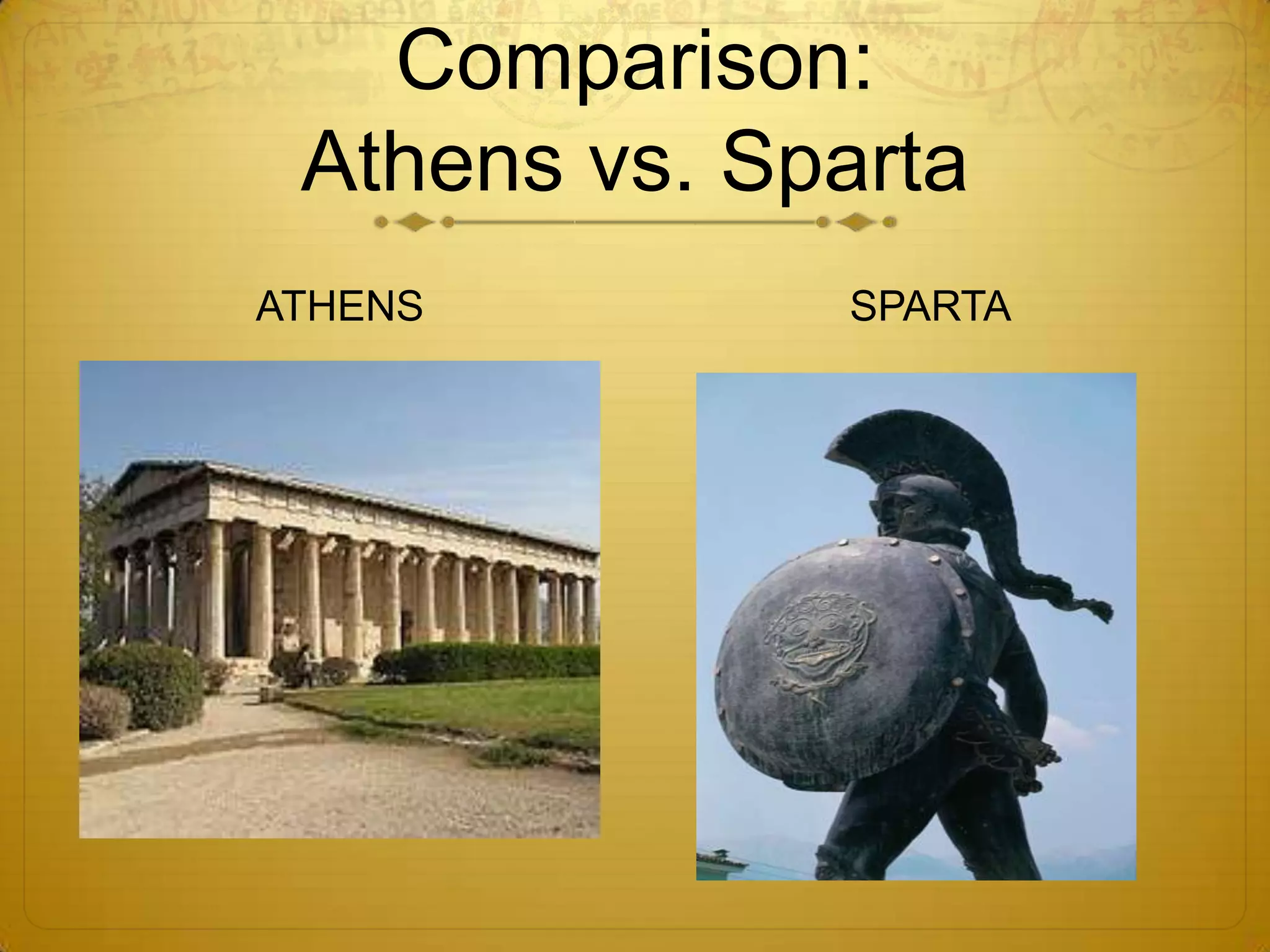
Comparison:
 Athens vs. Sparta
ATHENS        SPARTA
Comparison:
            Athens vs. Sparta
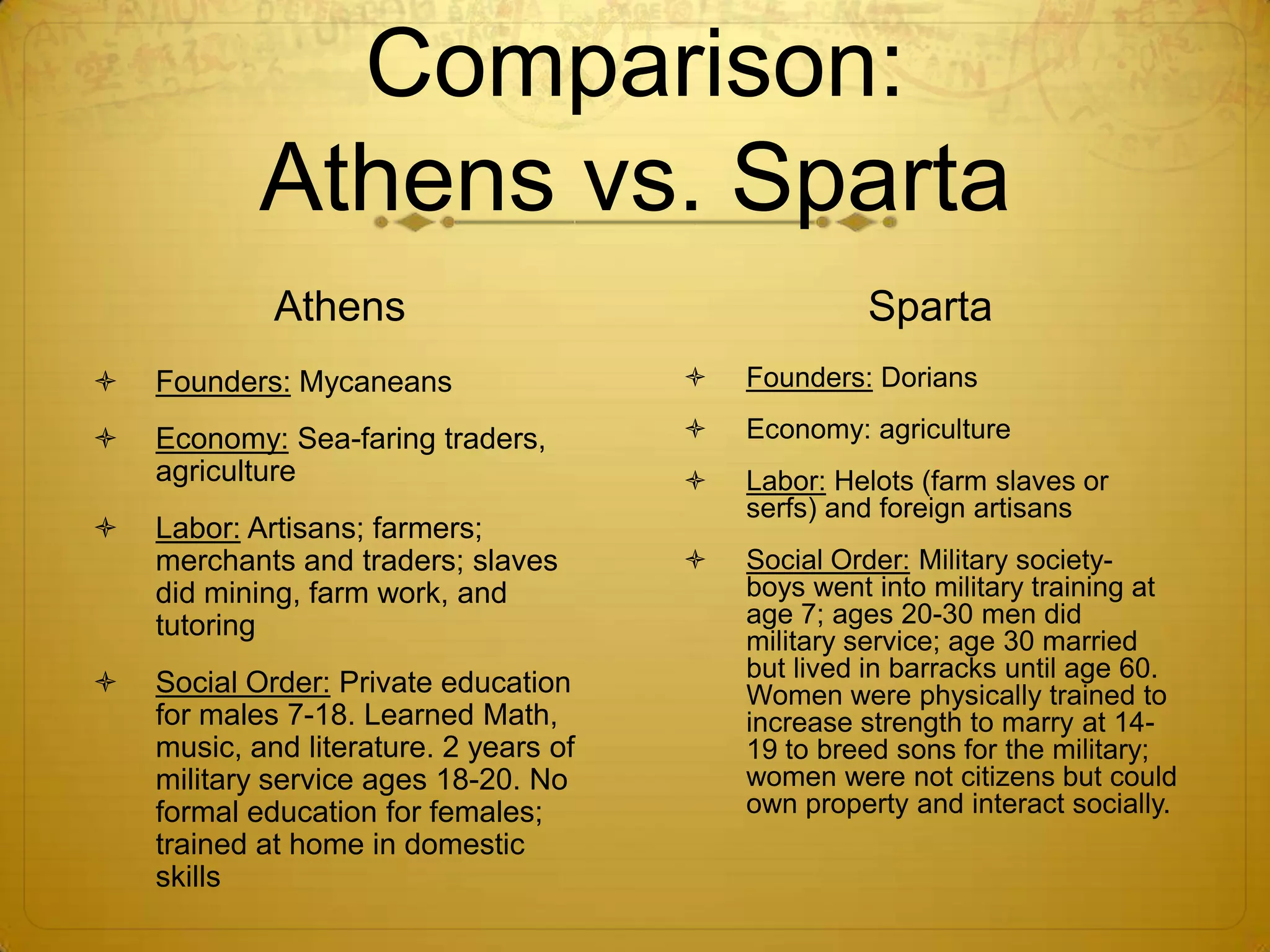
             Athens                                  Sparta
   Founders: Mycaneans                    Founders: Dorians

   Economy: Sea-faring traders,           Economy: agriculture
    agriculture                            Labor: Helots (farm slaves or
                                            serfs) and foreign artisans
   Labor: Artisans; farmers;
    merchants and traders; slaves          Social Order: Military society-
    did mining, farm work, and              boys went into military training at
    tutoring                                age 7; ages 20-30 men did
                                            military service; age 30 married
                                            but lived in barracks until age 60.
   Social Order: Private education         Women were physically trained to
    for males 7-18. Learned Math,           increase strength to marry at 14-
    music, and literature. 2 years of       19 to breed sons for the military;
    military service ages 18-20. No         women were not citizens but could
    formal education for females;           own property and interact socially.
    trained at home in domestic
    skills
Comparison:
           Athens vs. Sparta
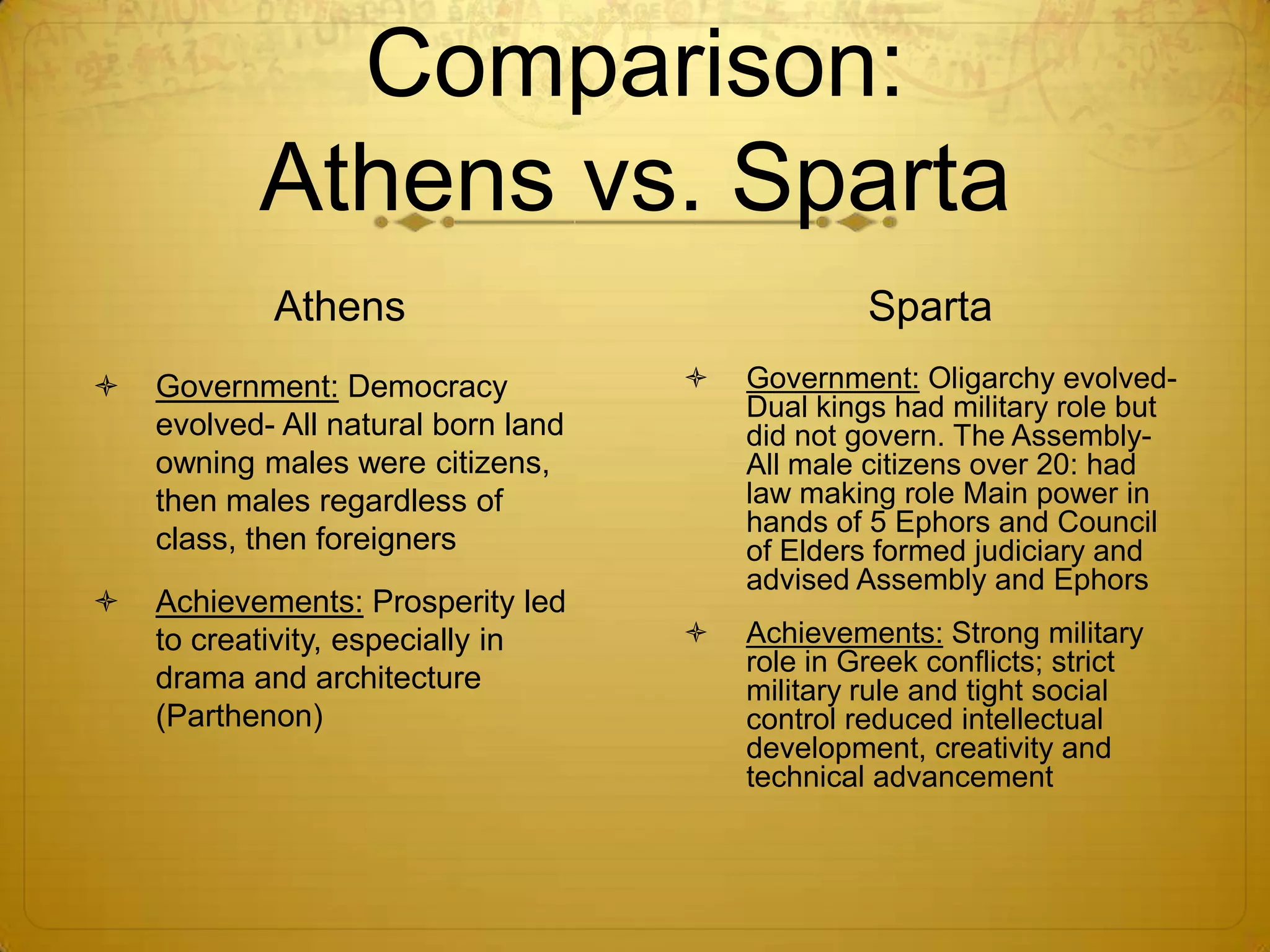
            Athens                                Sparta
   Government: Democracy               Government: Oligarchy evolved-
                                         Dual kings had military role but
    evolved- All natural born land       did not govern. The Assembly-
    owning males were citizens,          All male citizens over 20: had
    then males regardless of             law making role Main power in
                                         hands of 5 Ephors and Council
    class, then foreigners               of Elders formed judiciary and
                                         advised Assembly and Ephors
   Achievements: Prosperity led
    to creativity, especially in        Achievements: Strong military
                                         role in Greek conflicts; strict
    drama and architecture               military rule and tight social
    (Parthenon)                          control reduced intellectual
                                         development, creativity and
                                         technical advancement
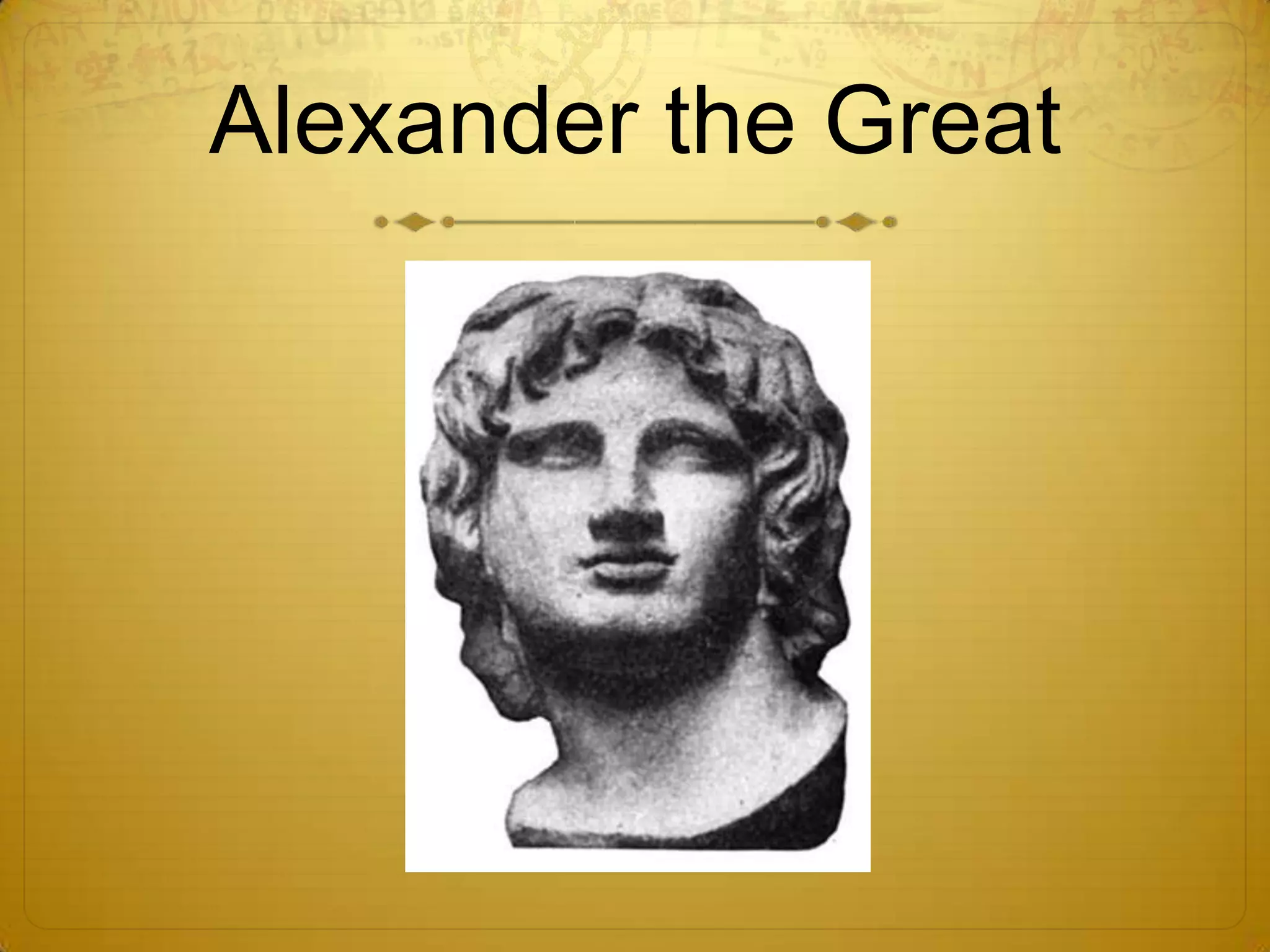
Alexander the Great
Alexander the Great
 Son of Philip II
 Became king of Macedonia at age 20
 Taught by Aristotle (science, geography, and literature)
 Influenced by Homer’s Illiad
 Preserved and Spread Greek Culture
 Conquered Persia, Egypt, India
 Spread Hellenistic Culture throughout his empire
 Died young at age 33 in India
Hellenism
 Combination of cultures conquered by Alexander the
  Great

 Hellenism=Greek+Egyptian+Persian+Indian

 Achievements in: Astronomy; philosophy; math; and
  art
ROME
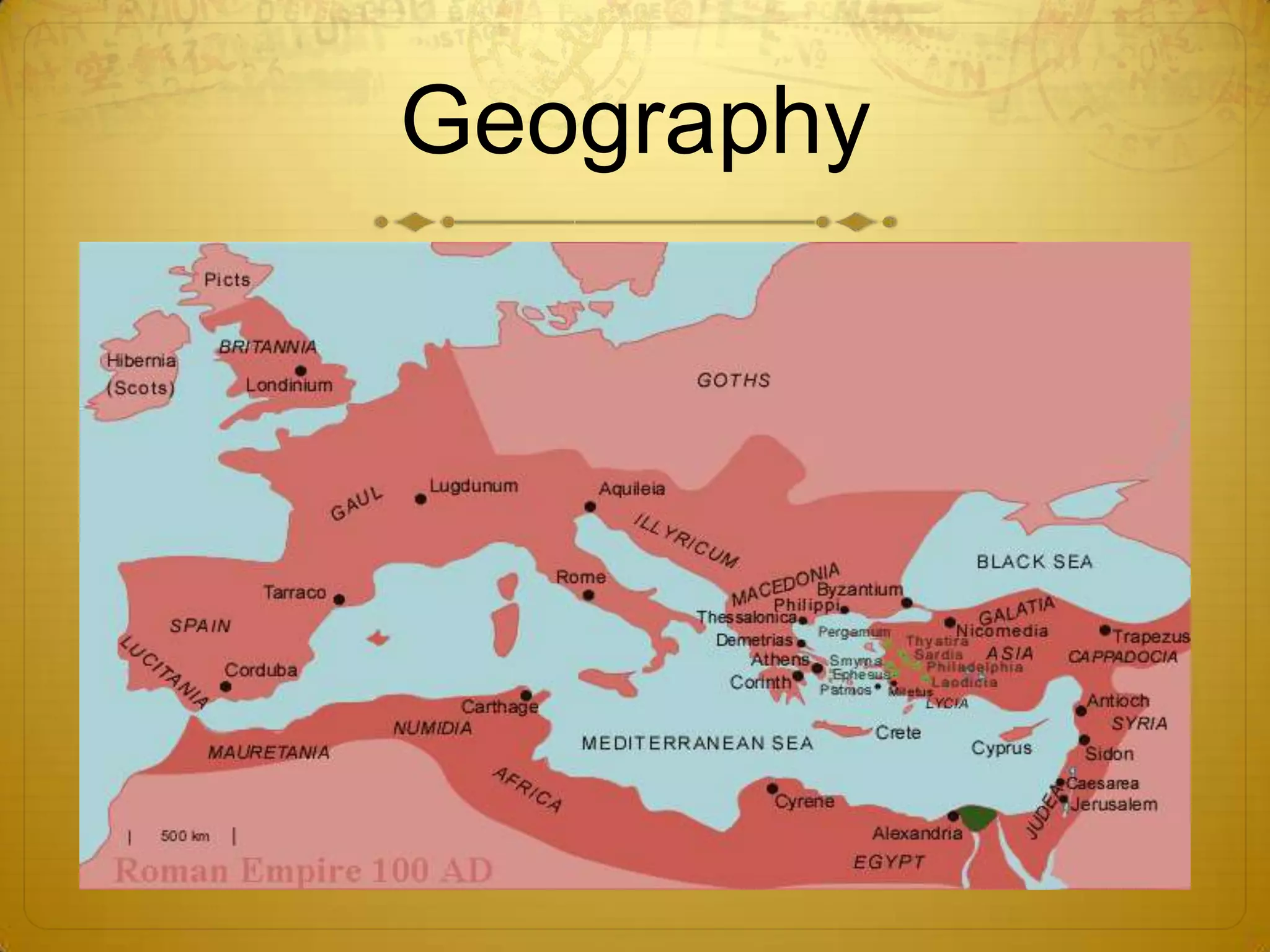
Geography
Geography
Movement                                       Place
   Push: Little rivers unsuitable for            Mediterranean
    shipping; not a large amount of farm
    land                                          Alps
   Pull: Natural defense; fertile; Po river      Po River Valley- Tiber river
    valley
                                                  Mountainous land
Region
                                               Location
   “The boot shaped country”
                                                  West of Greece
   Alps
                                                  Sicily
   Po River Valley
                                                  Divides the Mediterranean in half
   Swine
                                                  Alps
   Subtropical climate
Geography
      Interaction

  Killed forest swine

 Fertile soil – Farming

   Source of Water
Contributions
Law
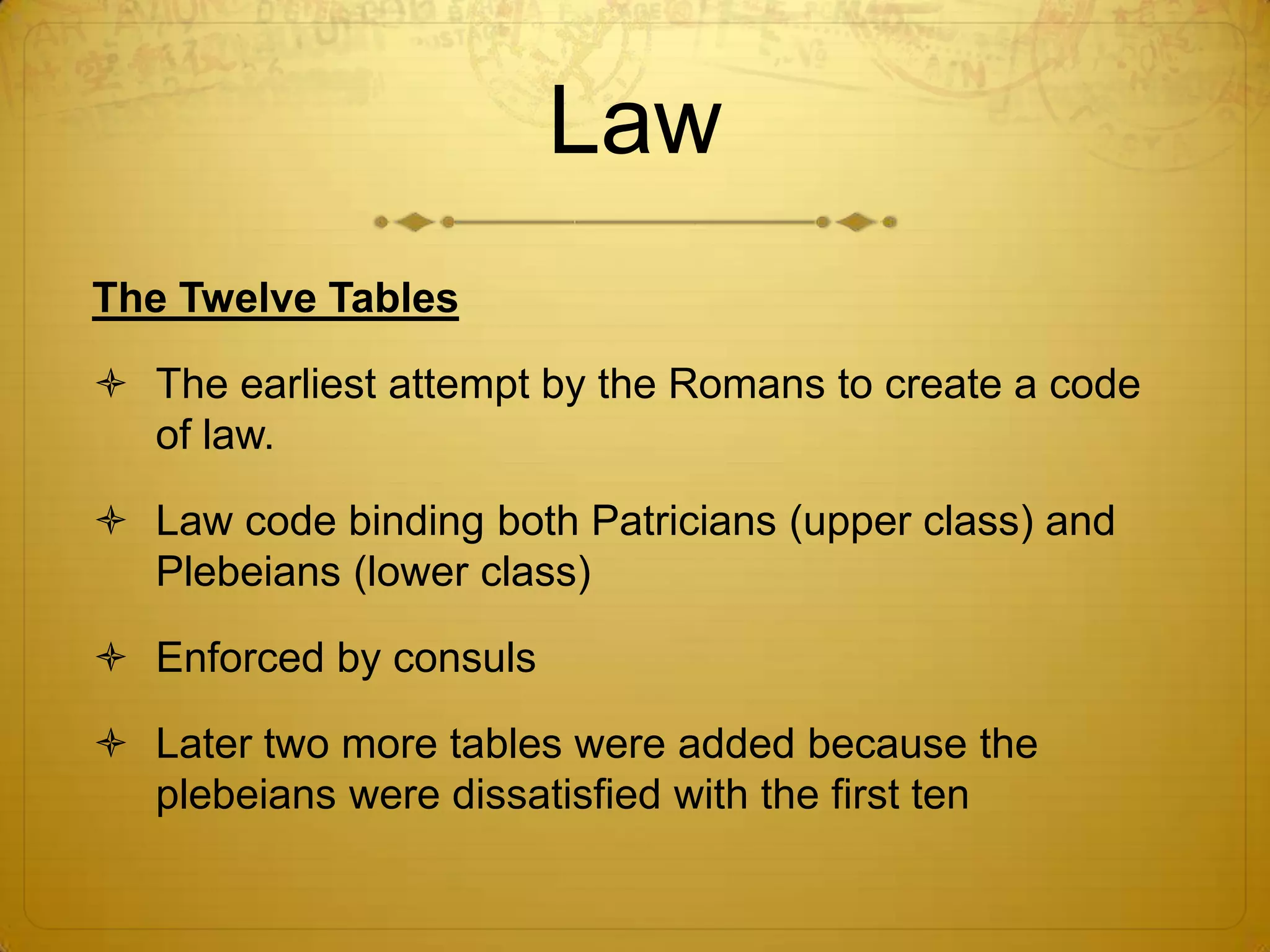
The Twelve Tables

 The earliest attempt by the Romans to create a code
  of law.

 Law code binding both Patricians (upper class) and
  Plebeians (lower class)

 Enforced by consuls

 Later two more tables were added because the
  plebeians were dissatisfied with the first ten
Government
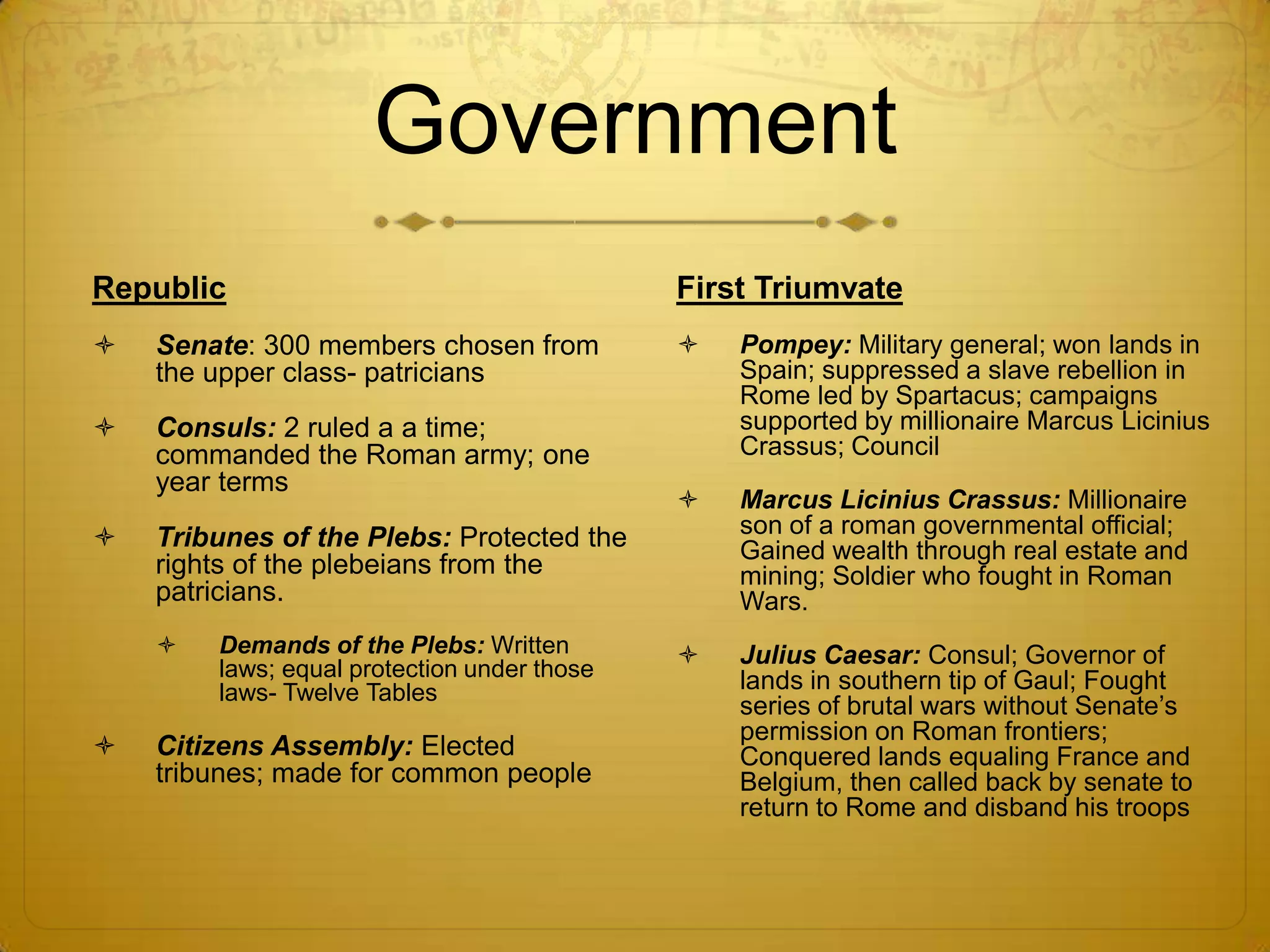
Republic                                     First Triumvate
   Senate: 300 members chosen from             Pompey: Military general; won lands in
    the upper class- patricians                  Spain; suppressed a slave rebellion in
                                                 Rome led by Spartacus; campaigns
   Consuls: 2 ruled a a time;                   supported by millionaire Marcus Licinius
    commanded the Roman army; one                Crassus; Council
    year terms
                                                Marcus Licinius Crassus: Millionaire
   Tribunes of the Plebs: Protected the         son of a roman governmental official;
                                                 Gained wealth through real estate and
    rights of the plebeians from the             mining; Soldier who fought in Roman
    patricians.                                  Wars.
       Demands of the Plebs: Written           Julius Caesar: Consul; Governor of
        laws; equal protection under those       lands in southern tip of Gaul; Fought
        laws- Twelve Tables
                                                 series of brutal wars without Senate’s
                                                 permission on Roman frontiers;
   Citizens Assembly: Elected                   Conquered lands equaling France and
    tribunes; made for common people             Belgium, then called back by senate to
                                                 return to Rome and disband his troops
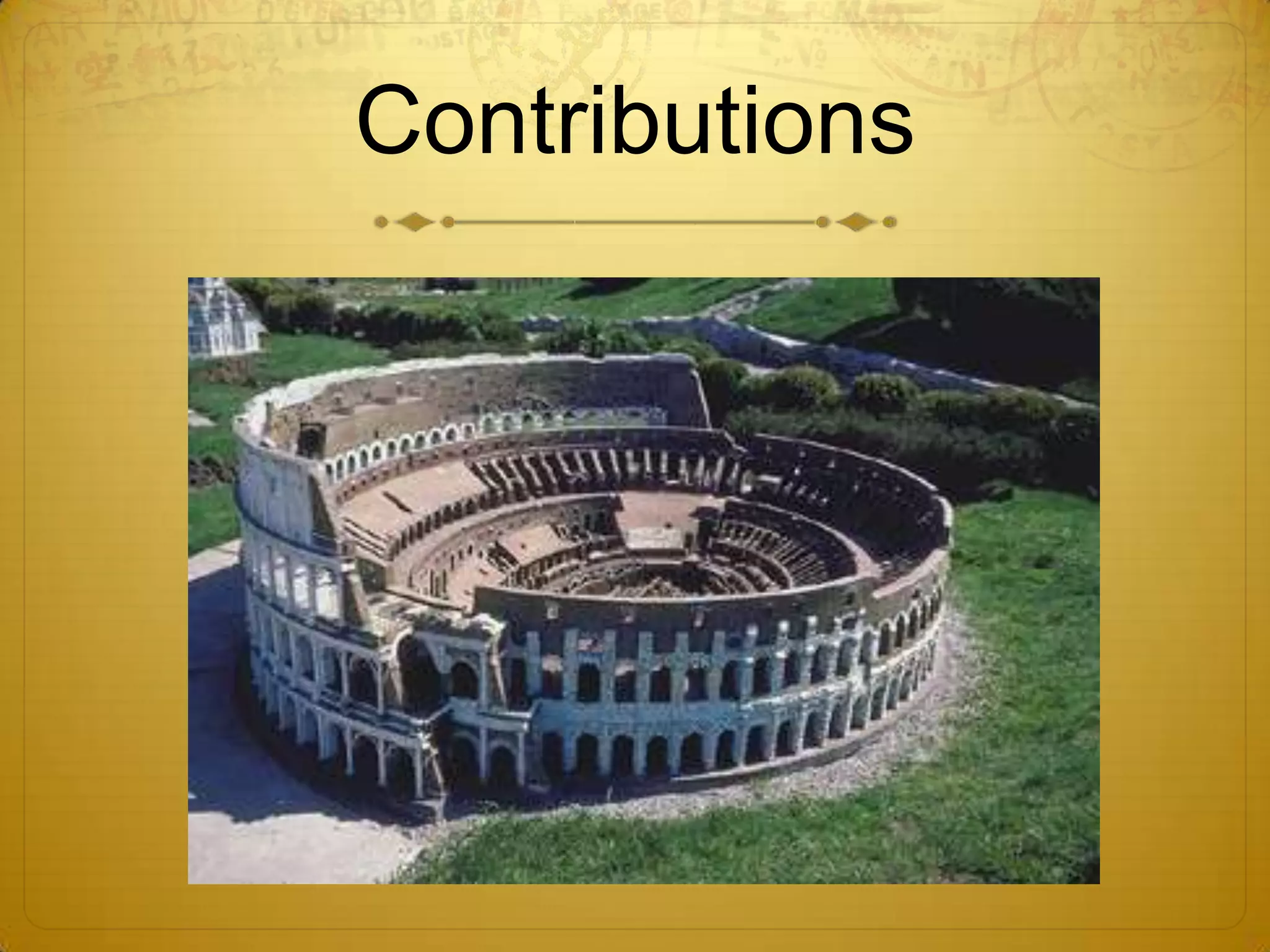
Architecture
 Coliseum

 Roads

 Aqueducts

 Bridges
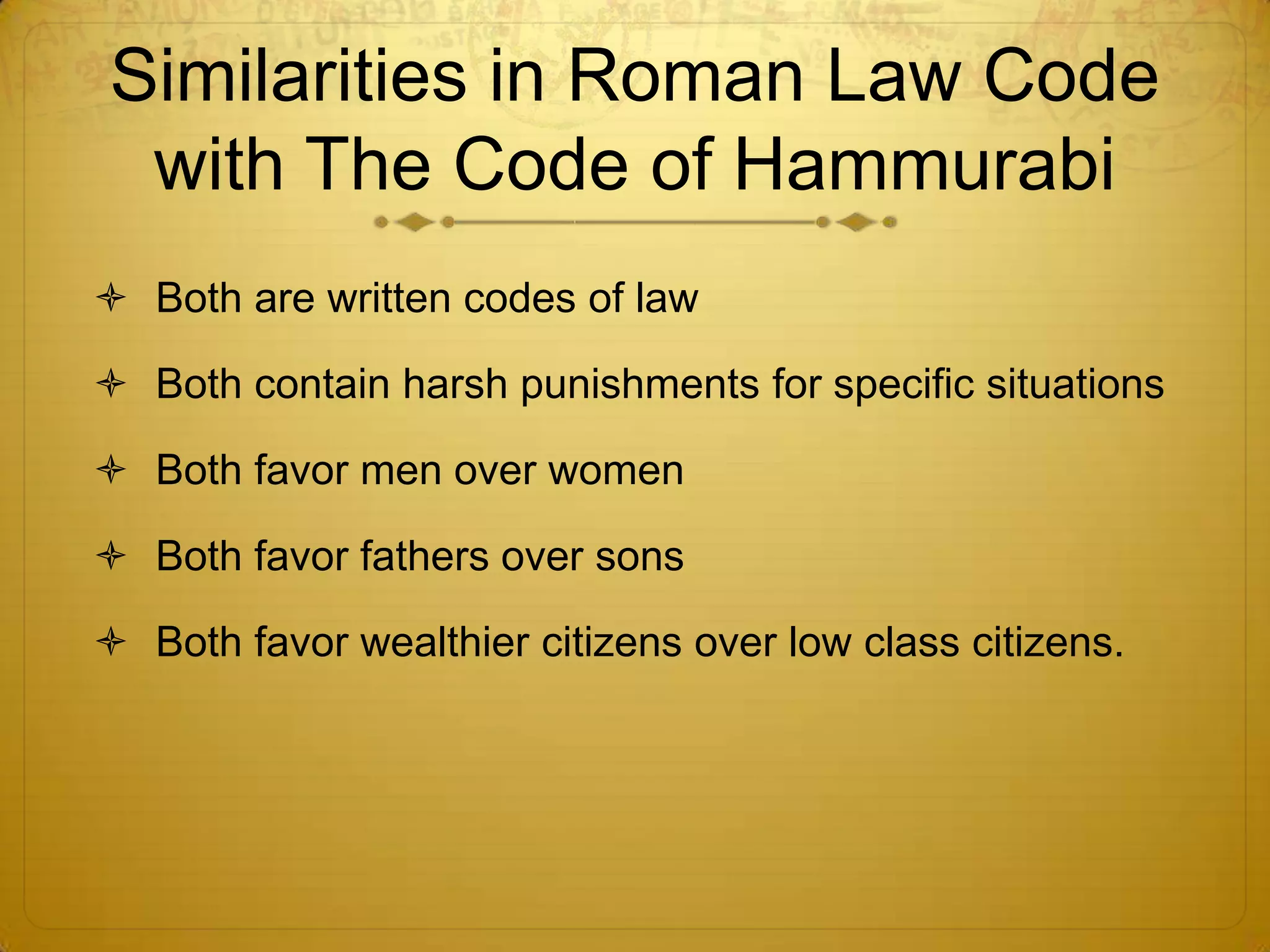
Similarities in Roman Law Code
 with The Code of Hammurabi
 Both are written codes of law

 Both contain harsh punishments for specific situations

 Both favor men over women

 Both favor fathers over sons

 Both favor wealthier citizens over low class citizens.
Reasons for Decline
 Barbarian Invasions       Inferior Technology
 Decline in Morals and     Inflation
  values
                            Political corruption
 Environmental and
  Public Health Problems    Rise in Christianity

 Excessive Military        Unemployment
  Spending to Defend the    Urban Decay
  Empire
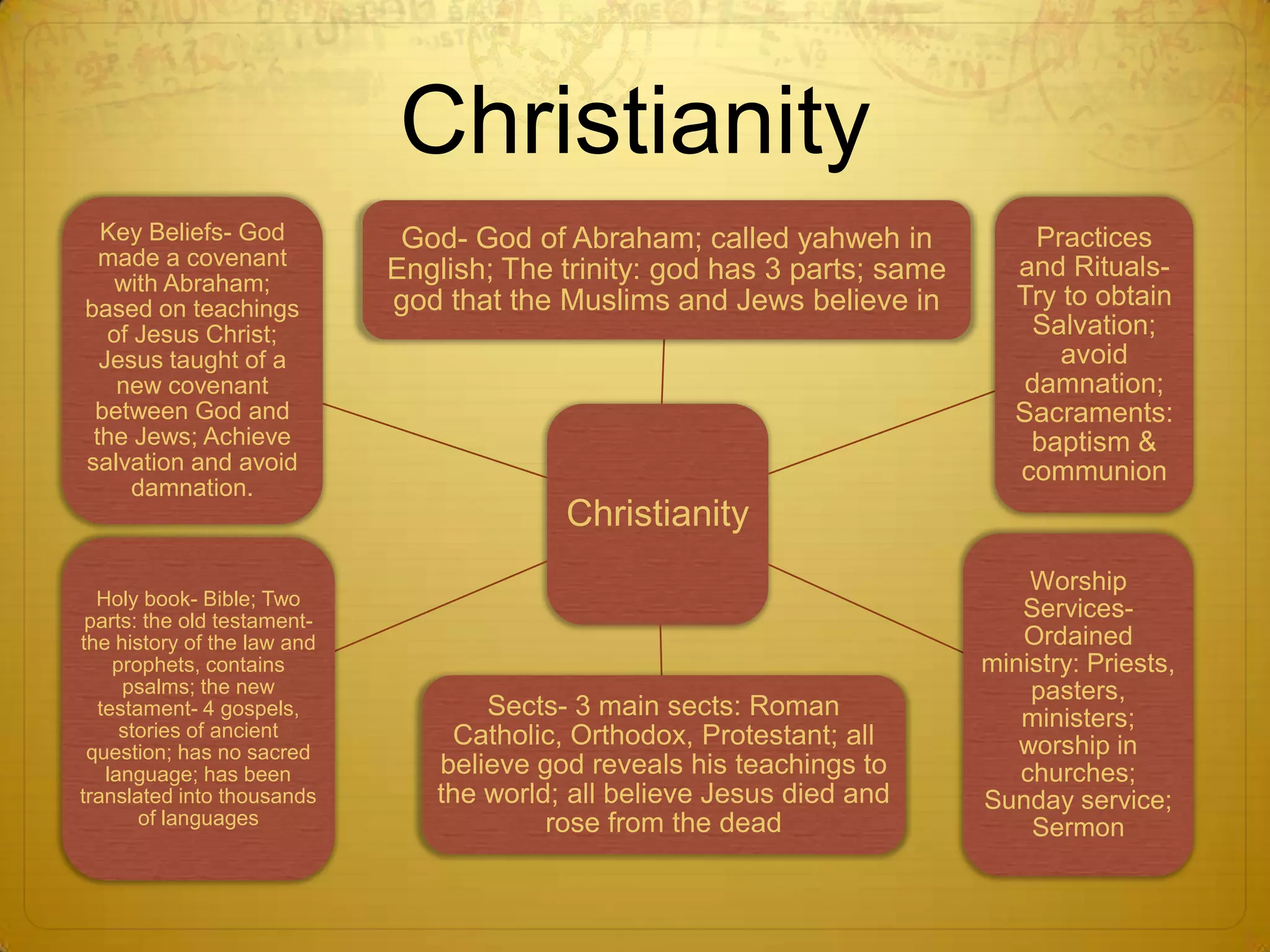
Christianity
  Key Beliefs- God            God- God of Abraham; called yahweh in             Practices
  made a covenant                                                             and Rituals-
    with Abraham;
                             English; The trinity: god has 3 parts; same
based on teachings           god that the Muslims and Jews believe in         Try to obtain
   of Jesus Christ;                                                            Salvation;
  Jesus taught of a                                                               avoid
    new covenant                                                               damnation;
 between God and                                                              Sacraments:
 the Jews; Achieve                                                             baptism &
salvation and avoid                                                           communion
     damnation.
                                          Christianity
                                                                               Worship
  Holy book- Bible; Two
 parts: the old testament-
                                                                              Services-
the history of the law and                                                    Ordained
    prophets, contains                                                     ministry: Priests,
     psalms; the new                                                           pasters,
  testament- 4 gospels,             Sects- 3 main sects: Roman                ministers;
     stories of ancient           Catholic, Orthodox, Protestant; all
 question; has no sacred                                                      worship in
   language; has been           believe god reveals his teachings to          churches;
translated into thousands       the world; all believe Jesus died and      Sunday service;
       of languages                      rose from the dead                    Sermon
BYZANTINE EMPIRE
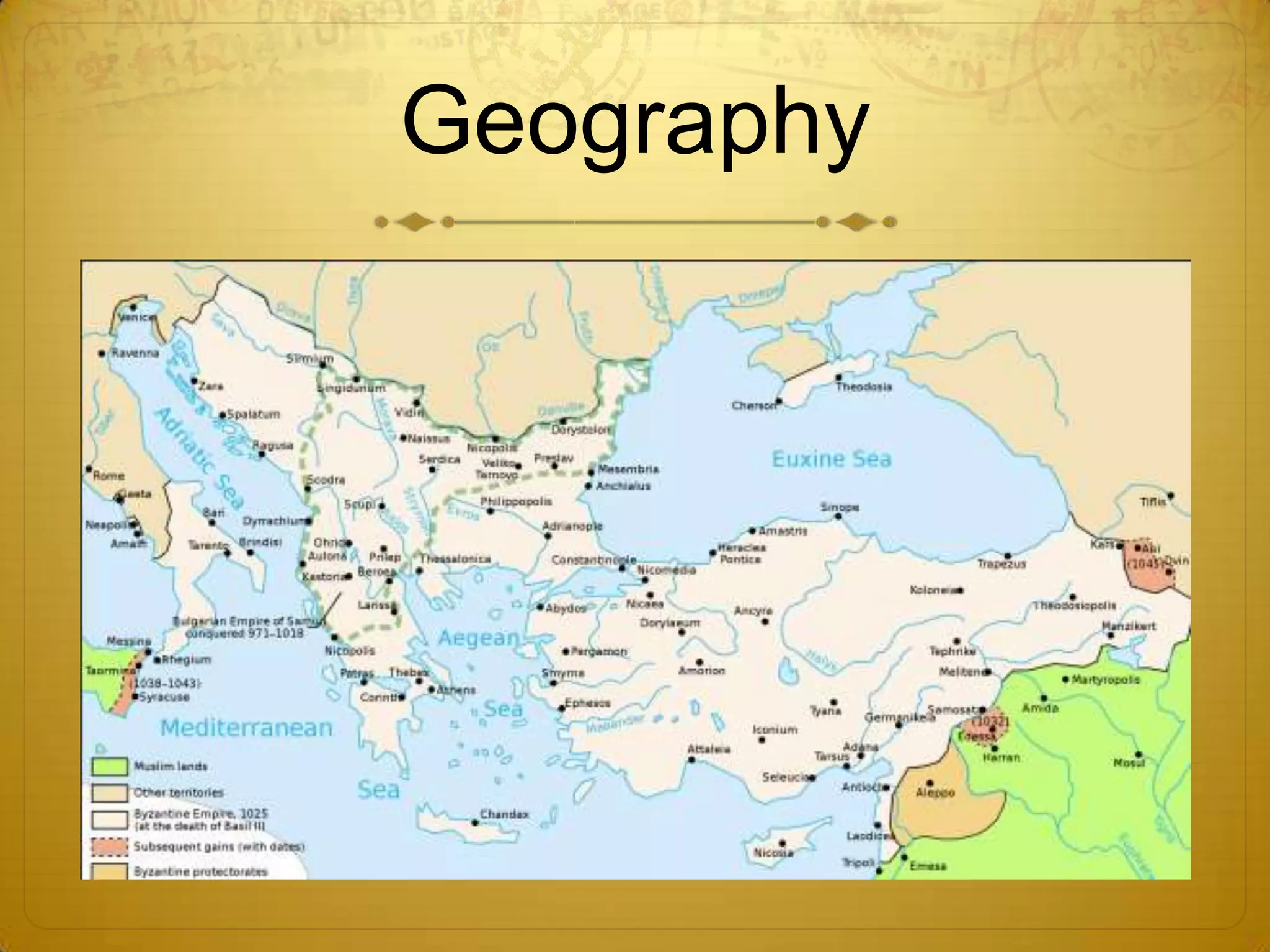
Geography
Geography
 Eastern Provinces of the Roman Empire.
 Capitol city: Constantinople
 Bosporus Strait
 Eastern Part of the Mediterranean
 Italy, Greece, Egypt, Turkey, Middle east
Contributions
Law
Justinian’s Code
 A summation of all Roman law since the second century

 Effected law in western Europe and early Russia

 Sections:

      The digest
      The Institutes
      The novels
Government
 Successors of Constantine

 Justinian- viewed himself as a new Constantine;
  Christian emperor

 Theodora- Wife of Justinian- 20-25 years younger;
  was a prostitute; came from a poor family; very
  intelligent; ability to read people

 Tried to re-unite Rome but failed
Architecture
 Beautify Constantinople (same goal in Athens)
 Domes, arches, columns
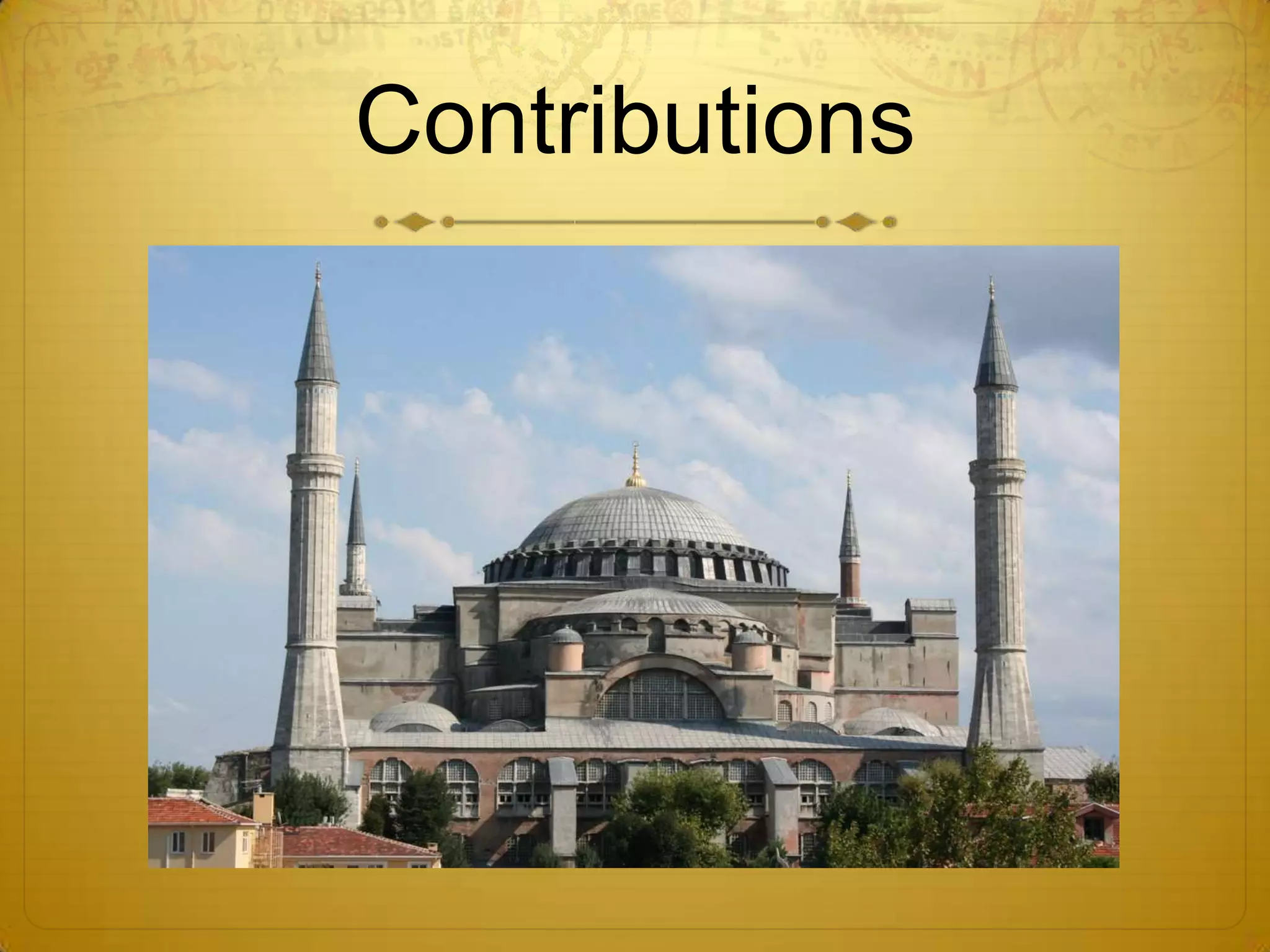
 Hagia Sophia
 Blue Mosque- mix of Byzantine and Turkish elements
 Topica Palace- mix of buildings and gardens
 Hippodrome- stadiums
 Moats
 Stonewalls
Religion
Eastern Orthodox
   Emperor claims authority over church

   Do not follow Pope

   Used Icons-holy images

   Mass in Greek

   Priests could marry

   Divorce was permitted in certain cases

   Created after the Great Schism in 1054: the division of the Christian church
    into Roman Catholics (Western Rome) and Eastern Orthodox (Eastern
    Rome)
ISLAM
Geography
Geography
Istanbul
 Bosporus Straight; bridge between Asia and Europe

 Favorable characteristics:
              Peninsula
              Natural harbor
              Flat
              Fertile
              Well watered
              Built on Bosporus Strait
Geography
Impact
 Deserts- minimal water and farm land

 Oases- Water in the desert; fertile

 Coastal Plain- good for farming

 Mountains- Goats; limited water and farmland
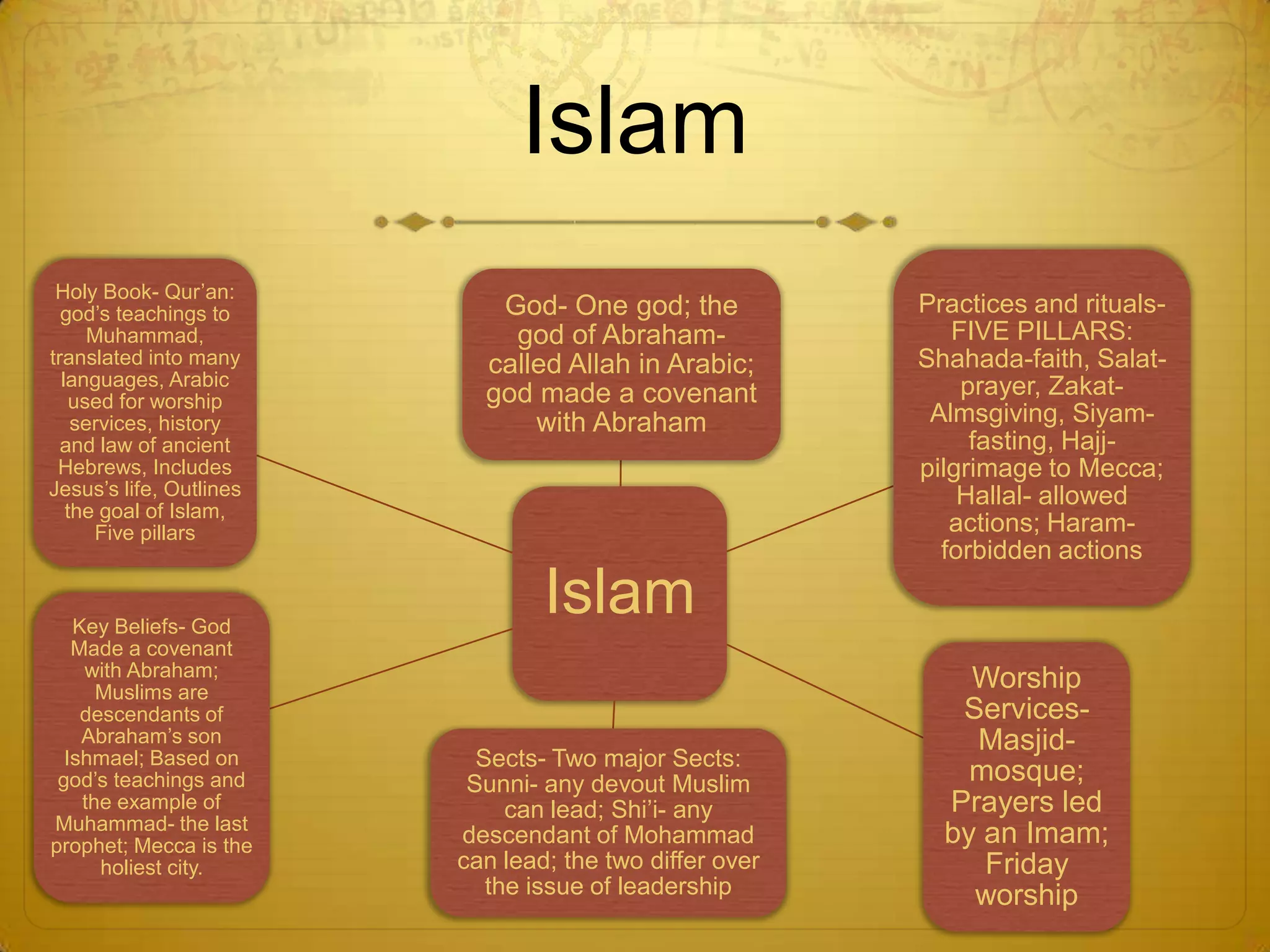
Islam
 Holy Book- Qur’an:
  god’s teachings to        God- One god; the            Practices and rituals-
      Muhammad,              god of Abraham-                FIVE PILLARS:
translated into many       called Allah in Arabic;       Shahada-faith, Salat-
  languages, Arabic                                          prayer, Zakat-
    used for worship       god made a covenant
    services, history          with Abraham               Almsgiving, Siyam-
  and law of ancient                                          fasting, Hajj-
 Hebrews, Includes                                       pilgrimage to Mecca;
Jesus’s life, Outlines                                       Hallal- allowed
   the goal of Islam,
      Five pillars                                          actions; Haram-
                                                           forbidden actions

   Key Beliefs- God
                                 Islam
   Made a covenant
    with Abraham;                                            Worship
      Muslims are
    descendants of                                          Services-
    Abraham’s son                                            Masjid-
  Ishmael; Based on        Sects- Two major Sects:
 god’s teachings and      Sunni- any devout Muslim           mosque;
    the example of            can lead; Shi’i- any         Prayers led
Muhammad- the last
prophet; Mecca is the    descendant of Mohammad            by an Imam;
      holiest city.      can lead; the two differ over        Friday
                            the issue of leadership          worship
The Golden Age of Islam
 The House of Wisdom    Zoology
 Herbal Medicines       Bookmaking
 Astronomy              Chess
 Polo                   Hospitals
 Music                  Geometric and floral
                          designs


   REVIEW: Golden Age of Islamic
   Culture Travelogue
THE MIDDLE AGES
Impact of the fall of Rome
       Roman Empire                      Germanic Tribes
   Emphasis on learning,             Oral traditions, song and
    knowledge of Greek, literate       legends little knowledge of
    citizenry                          Greek, not literate, no written
                                       language
   Official language: Latin
                                      Developed dialects of Latin:
   Political Unit: Roman              French and Spanish
    Provinces
                                      Germanic Kingdoms- borders
   Government based on written        change as result of warfare
    law and public government
                                      Loyalty to small communities
                                       unwritten rules and traditions
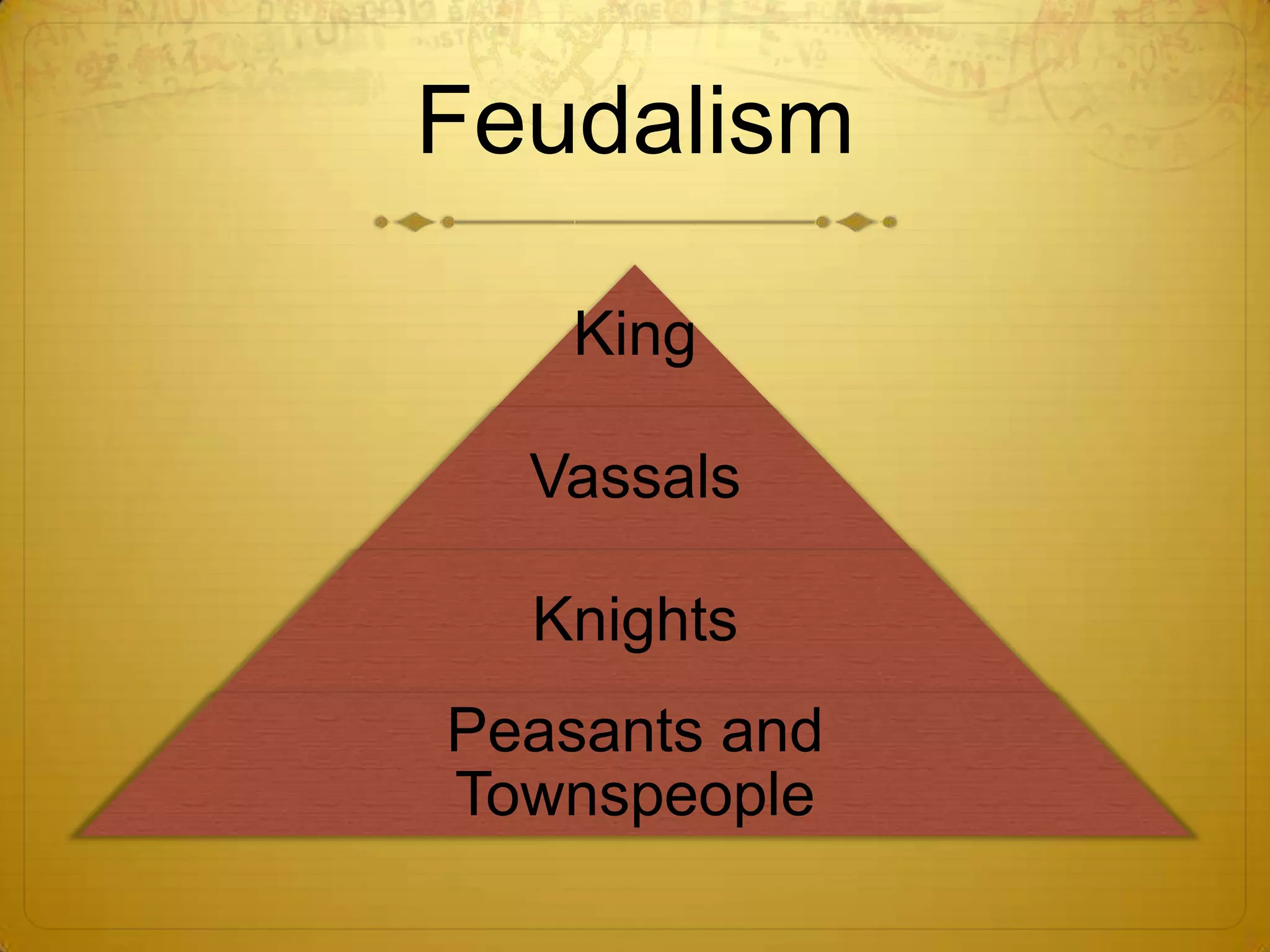
Feudalism

    King

  Vassals

  Knights
Peasants and
Townspeople
Feudalism
King                                  Vassals
   Highest power                        Nobles, but less powerful than
                                          lords
   Roman Catholic- Religious
    leader                               Trained knights and lived by
                                          the code of chivalry
   Owns all land
                                         Promised to protect land and
Nobles a.k.a. Lords                       kingdom
   Jobs: hunting, fight in battle,      Promised to pay ransom
    oversee surfs.                        money if lord is kidnapped
   Ruled over King’s land               Received Fiefs at Ceremony
                                          of Homage
   Lived on manor in castle
Feudalism
Knights                                 Peasants and Townspeople
                                        Surfs
   Fighting force
                                               NOT SLAVES
   Code of Chivalry: code of
                                               Tied to the land
    honor; set of ideals for
    knights; knights must serve                Property of kingdom, not king.
    their lord, their god, and their
                                               Lived in small cottages.
    wife; they must protect people
    in trouble; fight fairly; protect          Couldn’t do anything without the lords
    women                                       permission
                                               Not required to fight
   Similar to the Samurai and
    their Code of Bushido               Freeman
                                               Skilled craftsmen

                                               Paid rent to the lord

                                               Could leave the manor

                                               Could be evicted
The Church
 Provided poor peasants with a dream of an eternal
  peace

 Hosted feasts

 Had complete power over kings

 One priest on each manor

Global marking period 3 test

  • 1.
    Global 1 ThirdMarking Period Test Mrs. Kantz’s class Ppt. by David Fan
  • 2.
  • 3.
  • 4.
    Geography Movement Place Pull factors: fishing; harbors  Mountainous Push factors: Little farming land; poor roads;  Seafood political fragments (city-states instead of one unified Greece)  Fresh drinking water Region  Small; isolated  Mountainous  Dried up rivers  Good harbors  Peninsula  Divided by mountains  Islands  Trade  Barren  Peninsula  Rocky  Mt. Olympus  City states  Not good for farming
  • 5.
    Geography Location Interaction  Aegean Sea  Harbors  Mediterranean Sea  Fishing  Europe  Trade  West of Persian Empire  Fresh Drinking Water  Terrace Farming
  • 6.
    Geography Impact of geographyon Greece  The Greeks were sailors rather than farmers.  Harbors encouraged trade and communication with Egypt and Middle Eastern Civilizations.  Mountains divided Greece leading to City-States. The mountains of Greece divided it into many small pockets.  As a result of the geological fragmentation, Greeks felt more unity with their individual City-States rather than with Greece as a country.
  • 7.
  • 8.
    Government City-State Oligarchy A self governing, independent community.  Ruling power is in the hands of a few leaders Developed because of geography. Varied in prosperity and government systems.  Small groups shared power and military support Monarchy  Ruled by wealthy individuals; Aristocrats  Ruling power is in the hands of one person; Kings  Practiced in:  Kings lived in a palace on tax money  Corinth  Athens  Practiced by the Mycenaeans  Funded by taxes  Oldest son would succeed his father as king  Citizens had no vote  Soldiers protected king, enforced laws, obeyed laws, and collected taxes  Decline: increase of population, powerful individuals hired hoplite arrays, overthrown by  Decline: Trade routes closed, internal fighting, the people invaded by Dorians.
  • 9.
    Government Tyranny Democracy  Ruling power is in the hands of an  Ruling power is in the hands of all individual often by illegal means the people  Military leaders, backed by middle  Citizens Assembly class, seized power  Executive group- Council of 500  Practiced in Athens  Practiced in Athens  Decline: Athenians were unhappy, Spartan invasions  Decline: Fall of Athens
  • 10.
    Philosophy  Socrates  Plato Aristotle  REMEMBER: Legacy of Greece Debate
  • 11.
  • 12.
    Golden Age ofAthens  480-430 BCE Three Goals  Overseen by Pericles 1. Strengthen Democracy  Pericles- Leader from 461-  Increased number of public 429 BCE officials on paid salaries  Direct democracy- Citizens rule directly, not through representatives
  • 13.
    Golden Age ofAthens 2. Maintain Empire 3. Glorify Athens  Delian League: Athens  Used money from the received tributes from Delian League to buy over 200 city-states in gold, ivory, and marble return for protection  Paid artists, architects,  Made Athens’s navy the and workers to use the strongest in the materials. Mediterranean  Gained access to surrounding trade routes
  • 14.
    Comparison: Athens vs.Sparta ATHENS SPARTA
  • 15.
    Comparison: Athens vs. Sparta Athens Sparta  Founders: Mycaneans  Founders: Dorians  Economy: Sea-faring traders,  Economy: agriculture agriculture  Labor: Helots (farm slaves or serfs) and foreign artisans  Labor: Artisans; farmers; merchants and traders; slaves  Social Order: Military society- did mining, farm work, and boys went into military training at tutoring age 7; ages 20-30 men did military service; age 30 married but lived in barracks until age 60.  Social Order: Private education Women were physically trained to for males 7-18. Learned Math, increase strength to marry at 14- music, and literature. 2 years of 19 to breed sons for the military; military service ages 18-20. No women were not citizens but could formal education for females; own property and interact socially. trained at home in domestic skills
  • 16.
    Comparison: Athens vs. Sparta Athens Sparta  Government: Democracy  Government: Oligarchy evolved- Dual kings had military role but evolved- All natural born land did not govern. The Assembly- owning males were citizens, All male citizens over 20: had then males regardless of law making role Main power in hands of 5 Ephors and Council class, then foreigners of Elders formed judiciary and advised Assembly and Ephors  Achievements: Prosperity led to creativity, especially in  Achievements: Strong military role in Greek conflicts; strict drama and architecture military rule and tight social (Parthenon) control reduced intellectual development, creativity and technical advancement
  • 17.
  • 18.
    Alexander the Great Son of Philip II  Became king of Macedonia at age 20  Taught by Aristotle (science, geography, and literature)  Influenced by Homer’s Illiad  Preserved and Spread Greek Culture  Conquered Persia, Egypt, India  Spread Hellenistic Culture throughout his empire  Died young at age 33 in India
  • 19.
    Hellenism  Combination ofcultures conquered by Alexander the Great  Hellenism=Greek+Egyptian+Persian+Indian  Achievements in: Astronomy; philosophy; math; and art
  • 20.
  • 21.
  • 22.
    Geography Movement Place  Push: Little rivers unsuitable for  Mediterranean shipping; not a large amount of farm land  Alps  Pull: Natural defense; fertile; Po river  Po River Valley- Tiber river valley  Mountainous land Region Location  “The boot shaped country”  West of Greece  Alps  Sicily  Po River Valley  Divides the Mediterranean in half  Swine  Alps  Subtropical climate
  • 23.
    Geography Interaction  Killed forest swine  Fertile soil – Farming  Source of Water
  • 24.
  • 25.
    Law The Twelve Tables The earliest attempt by the Romans to create a code of law.  Law code binding both Patricians (upper class) and Plebeians (lower class)  Enforced by consuls  Later two more tables were added because the plebeians were dissatisfied with the first ten
  • 26.
    Government Republic First Triumvate  Senate: 300 members chosen from  Pompey: Military general; won lands in the upper class- patricians Spain; suppressed a slave rebellion in Rome led by Spartacus; campaigns  Consuls: 2 ruled a a time; supported by millionaire Marcus Licinius commanded the Roman army; one Crassus; Council year terms  Marcus Licinius Crassus: Millionaire  Tribunes of the Plebs: Protected the son of a roman governmental official; Gained wealth through real estate and rights of the plebeians from the mining; Soldier who fought in Roman patricians. Wars.  Demands of the Plebs: Written  Julius Caesar: Consul; Governor of laws; equal protection under those lands in southern tip of Gaul; Fought laws- Twelve Tables series of brutal wars without Senate’s permission on Roman frontiers;  Citizens Assembly: Elected Conquered lands equaling France and tribunes; made for common people Belgium, then called back by senate to return to Rome and disband his troops
  • 27.
  • 28.
    Similarities in RomanLaw Code with The Code of Hammurabi  Both are written codes of law  Both contain harsh punishments for specific situations  Both favor men over women  Both favor fathers over sons  Both favor wealthier citizens over low class citizens.
  • 29.
    Reasons for Decline Barbarian Invasions  Inferior Technology  Decline in Morals and  Inflation values  Political corruption  Environmental and Public Health Problems  Rise in Christianity  Excessive Military  Unemployment Spending to Defend the  Urban Decay Empire
  • 30.
    Christianity KeyBeliefs- God God- God of Abraham; called yahweh in Practices made a covenant and Rituals- with Abraham; English; The trinity: god has 3 parts; same based on teachings god that the Muslims and Jews believe in Try to obtain of Jesus Christ; Salvation; Jesus taught of a avoid new covenant damnation; between God and Sacraments: the Jews; Achieve baptism & salvation and avoid communion damnation. Christianity Worship Holy book- Bible; Two parts: the old testament- Services- the history of the law and Ordained prophets, contains ministry: Priests, psalms; the new pasters, testament- 4 gospels, Sects- 3 main sects: Roman ministers; stories of ancient Catholic, Orthodox, Protestant; all question; has no sacred worship in language; has been believe god reveals his teachings to churches; translated into thousands the world; all believe Jesus died and Sunday service; of languages rose from the dead Sermon
  • 31.
  • 32.
  • 33.
    Geography  Eastern Provincesof the Roman Empire.  Capitol city: Constantinople  Bosporus Strait  Eastern Part of the Mediterranean  Italy, Greece, Egypt, Turkey, Middle east
  • 34.
  • 35.
    Law Justinian’s Code  Asummation of all Roman law since the second century  Effected law in western Europe and early Russia  Sections:  The digest  The Institutes  The novels
  • 36.
    Government  Successors ofConstantine  Justinian- viewed himself as a new Constantine; Christian emperor  Theodora- Wife of Justinian- 20-25 years younger; was a prostitute; came from a poor family; very intelligent; ability to read people  Tried to re-unite Rome but failed
  • 37.
    Architecture  Beautify Constantinople(same goal in Athens)  Domes, arches, columns  Hagia Sophia  Blue Mosque- mix of Byzantine and Turkish elements  Topica Palace- mix of buildings and gardens  Hippodrome- stadiums  Moats  Stonewalls
  • 38.
    Religion Eastern Orthodox  Emperor claims authority over church  Do not follow Pope  Used Icons-holy images  Mass in Greek  Priests could marry  Divorce was permitted in certain cases  Created after the Great Schism in 1054: the division of the Christian church into Roman Catholics (Western Rome) and Eastern Orthodox (Eastern Rome)
  • 39.
  • 40.
  • 41.
    Geography Istanbul  Bosporus Straight;bridge between Asia and Europe  Favorable characteristics:  Peninsula  Natural harbor  Flat  Fertile  Well watered  Built on Bosporus Strait
  • 42.
    Geography Impact  Deserts- minimalwater and farm land  Oases- Water in the desert; fertile  Coastal Plain- good for farming  Mountains- Goats; limited water and farmland
  • 43.
    Islam Holy Book-Qur’an: god’s teachings to God- One god; the Practices and rituals- Muhammad, god of Abraham- FIVE PILLARS: translated into many called Allah in Arabic; Shahada-faith, Salat- languages, Arabic prayer, Zakat- used for worship god made a covenant services, history with Abraham Almsgiving, Siyam- and law of ancient fasting, Hajj- Hebrews, Includes pilgrimage to Mecca; Jesus’s life, Outlines Hallal- allowed the goal of Islam, Five pillars actions; Haram- forbidden actions Key Beliefs- God Islam Made a covenant with Abraham; Worship Muslims are descendants of Services- Abraham’s son Masjid- Ishmael; Based on Sects- Two major Sects: god’s teachings and Sunni- any devout Muslim mosque; the example of can lead; Shi’i- any Prayers led Muhammad- the last prophet; Mecca is the descendant of Mohammad by an Imam; holiest city. can lead; the two differ over Friday the issue of leadership worship
  • 44.
    The Golden Ageof Islam  The House of Wisdom  Zoology  Herbal Medicines  Bookmaking  Astronomy  Chess  Polo  Hospitals  Music  Geometric and floral designs REVIEW: Golden Age of Islamic Culture Travelogue
  • 45.
  • 46.
    Impact of thefall of Rome Roman Empire Germanic Tribes  Emphasis on learning,  Oral traditions, song and knowledge of Greek, literate legends little knowledge of citizenry Greek, not literate, no written language  Official language: Latin  Developed dialects of Latin:  Political Unit: Roman French and Spanish Provinces  Germanic Kingdoms- borders  Government based on written change as result of warfare law and public government  Loyalty to small communities unwritten rules and traditions
  • 47.
    Feudalism King Vassals Knights Peasants and Townspeople
  • 48.
    Feudalism King Vassals  Highest power  Nobles, but less powerful than lords  Roman Catholic- Religious leader  Trained knights and lived by the code of chivalry  Owns all land  Promised to protect land and Nobles a.k.a. Lords kingdom  Jobs: hunting, fight in battle,  Promised to pay ransom oversee surfs. money if lord is kidnapped  Ruled over King’s land  Received Fiefs at Ceremony of Homage  Lived on manor in castle
  • 49.
    Feudalism Knights Peasants and Townspeople Surfs  Fighting force  NOT SLAVES  Code of Chivalry: code of  Tied to the land honor; set of ideals for knights; knights must serve  Property of kingdom, not king. their lord, their god, and their  Lived in small cottages. wife; they must protect people in trouble; fight fairly; protect  Couldn’t do anything without the lords women permission  Not required to fight  Similar to the Samurai and their Code of Bushido Freeman  Skilled craftsmen  Paid rent to the lord  Could leave the manor  Could be evicted
  • 50.
    The Church  Providedpoor peasants with a dream of an eternal peace  Hosted feasts  Had complete power over kings  One priest on each manor