Global economic forecast
June 10th 2011
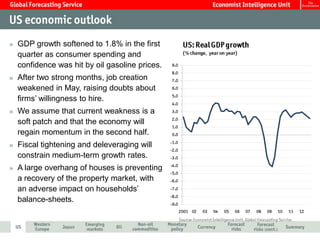
GDP growth softened to 1.8% in the first
quarter as consumer spending and
confidence was hit by oil gasoline prices.
After two strong months, job creation
weakened in May, raising doubts about
firms’ willingness to hire.
We assume that current weakness is a
soft patch and that the economy will
regain momentum in the second half.
Fiscal tightening and deleveraging will
constrain medium-term growth rates.
A large overhang of houses is preventing
a recovery of the property market, with
an adverse impact on households’
balance-sheets.
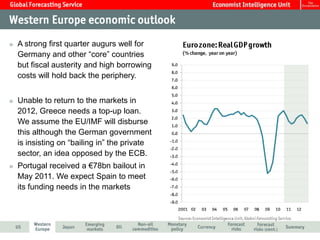
A strong first quarter augurs well for
Germany and other “core” countries
but fiscal austerity and high borrowing
costs will hold back the periphery.


Unable to return to the markets in
2012, Greece needs a top-up loan.
We assume the EU/IMF will disburse
this although the German government
is insisting on “bailing in” the private
sector, an idea opposed by the ECB.
Portugal received a €78bn bailout in
May 2011. We expect Spain to meet
its funding needs in the markets
The March 11th earthquake and tsunami
are having a servere impact on power
supplies and supply chains


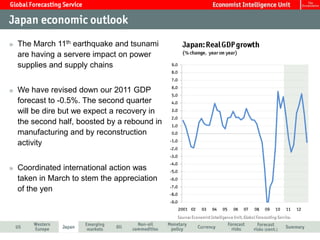
We have revised down our 2011 GDP
forecast to -0.5%. The second quarter
will be dire but we expect a recovery in
the second half, boosted by a rebound in
manufacturing and by reconstruction
activity


Coordinated international action was
taken in March to stem the appreciation
of the yen
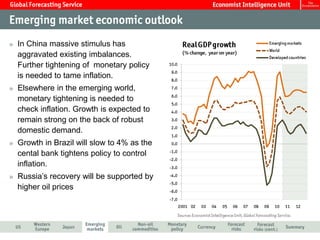
In China massive stimulus has
aggravated existing imbalances.
Further tightening of monetary policy
is needed to tame inflation.
Elsewhere in the emerging world,
monetary tightening is needed to
check inflation. Growth is expected to
remain strong on the back of robust
domestic demand.
Growth in Brazil will slow to 4% as the
cental bank tightens policy to control
inflation.
Russia’s recovery will be supported by
higher oil prices
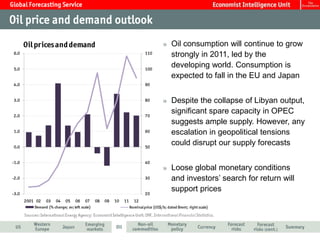
Oil consumption will continue to grow
strongly in 2011, led by the
developing world. Consumption is
expected to fall in the EU and Japan


Despite the collapse of Libyan output,
significant spare capacity in OPEC
suggests ample supply. However, any
escalation in geopolitical tensions
could disrupt our supply forecasts


Loose global monetary conditions
and investors’ search for return will
support prices
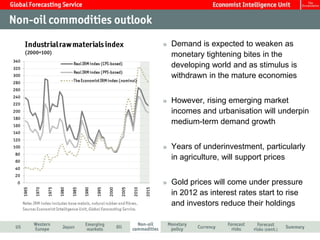
Demand is expected to weaken as
monetary tightening bites in the
developing world and as stimulus is
withdrawn in the mature economies


However, rising emerging market
incomes and urbanisation will underpin
medium-term demand growth


Years of underinvestment, particularly
in agriculture, will support prices


Gold prices will come under pressure
in 2012 as interest rates start to rise
and investors reduce their holdings
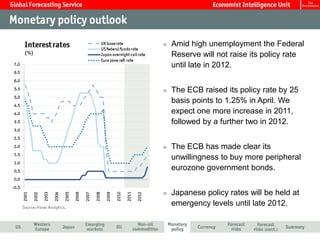
Amid high unemployment the Federal
Reserve will not raise its policy rate
until late in 2012.


The ECB raised its policy rate by 25
basis points to 1.25% in April. We
expect one more increase in 2011,
followed by a further two in 2012.


The ECB has made clear its
unwillingness to buy more peripheral
eurozone government bonds.


Japanese policy rates will be held at
emergency levels until late 2012.
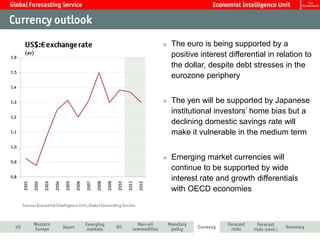
The euro is being supported by a
positive interest differential in relation to
the dollar, despite debt stresses in the
eurozone periphery


The yen will be supported by Japanese
institutional investors’ home bias but a
declining domestic savings rate will
make it vulnerable in the medium term


Emerging market currencies will
continue to be supported by wide
interest rate and growth differentials
with OECD economies
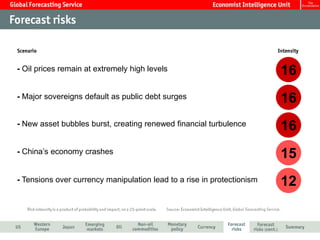
- Oil prices remain at extremely high levels                            16
- Major sovereigns default as public debt surges                        16
- New asset bubbles burst, creating renewed financial turbulence        16
- China’s economy crashes                                               15
- Tensions over currency manipulation lead to a rise in protectionism   12
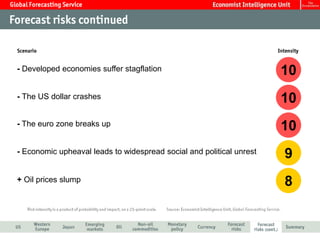
- Developed economies suffer stagflation                              10
- The US dollar crashes                                               10
- The euro zone breaks up                                             10
- Economic upheaval leads to widespread social and political unrest   9
+ Oil prices slump                                                    8
Global Financial Forecast

Global Financial Forecast

  • 1.
  • 2.
    GDP growth softenedto 1.8% in the first quarter as consumer spending and confidence was hit by oil gasoline prices. After two strong months, job creation weakened in May, raising doubts about firms’ willingness to hire. We assume that current weakness is a soft patch and that the economy will regain momentum in the second half. Fiscal tightening and deleveraging will constrain medium-term growth rates. A large overhang of houses is preventing a recovery of the property market, with an adverse impact on households’ balance-sheets.
  • 3.
    A strong firstquarter augurs well for Germany and other “core” countries but fiscal austerity and high borrowing costs will hold back the periphery. Unable to return to the markets in 2012, Greece needs a top-up loan. We assume the EU/IMF will disburse this although the German government is insisting on “bailing in” the private sector, an idea opposed by the ECB. Portugal received a €78bn bailout in May 2011. We expect Spain to meet its funding needs in the markets
  • 4.
    The March 11thearthquake and tsunami are having a servere impact on power supplies and supply chains We have revised down our 2011 GDP forecast to -0.5%. The second quarter will be dire but we expect a recovery in the second half, boosted by a rebound in manufacturing and by reconstruction activity Coordinated international action was taken in March to stem the appreciation of the yen
  • 5.
    In China massivestimulus has aggravated existing imbalances. Further tightening of monetary policy is needed to tame inflation. Elsewhere in the emerging world, monetary tightening is needed to check inflation. Growth is expected to remain strong on the back of robust domestic demand. Growth in Brazil will slow to 4% as the cental bank tightens policy to control inflation. Russia’s recovery will be supported by higher oil prices
  • 6.
    Oil consumption willcontinue to grow strongly in 2011, led by the developing world. Consumption is expected to fall in the EU and Japan Despite the collapse of Libyan output, significant spare capacity in OPEC suggests ample supply. However, any escalation in geopolitical tensions could disrupt our supply forecasts Loose global monetary conditions and investors’ search for return will support prices
  • 7.
    Demand is expectedto weaken as monetary tightening bites in the developing world and as stimulus is withdrawn in the mature economies However, rising emerging market incomes and urbanisation will underpin medium-term demand growth Years of underinvestment, particularly in agriculture, will support prices Gold prices will come under pressure in 2012 as interest rates start to rise and investors reduce their holdings
  • 8.
    Amid high unemploymentthe Federal Reserve will not raise its policy rate until late in 2012. The ECB raised its policy rate by 25 basis points to 1.25% in April. We expect one more increase in 2011, followed by a further two in 2012. The ECB has made clear its unwillingness to buy more peripheral eurozone government bonds. Japanese policy rates will be held at emergency levels until late 2012.
  • 9.
    The euro isbeing supported by a positive interest differential in relation to the dollar, despite debt stresses in the eurozone periphery The yen will be supported by Japanese institutional investors’ home bias but a declining domestic savings rate will make it vulnerable in the medium term Emerging market currencies will continue to be supported by wide interest rate and growth differentials with OECD economies
  • 10.
    - Oil pricesremain at extremely high levels 16 - Major sovereigns default as public debt surges 16 - New asset bubbles burst, creating renewed financial turbulence 16 - China’s economy crashes 15 - Tensions over currency manipulation lead to a rise in protectionism 12
  • 11.
    - Developed economiessuffer stagflation 10 - The US dollar crashes 10 - The euro zone breaks up 10 - Economic upheaval leads to widespread social and political unrest 9 + Oil prices slump 8