Global digital advertising
Q1 2012 update


Adobe® Digital Index
Adobe Digital Index Update


                               Global digital advertising update

Table of contents
                               Q1 2012 executive summary
1: Q1 2012 executive summary
2: Outlook for Q2-Q4 2012      Digital advertising in Q1 2012 continues to show growth across all channels. Search remains the biggest
3: Search: United States       driver of return on investment (ROI) for marketers absorbing the majority of biddable digital advertising
6: Search: International       spend. Search continues to grow rapidly, increasing 16 percent year on year during Q1 2012. As traffic on
7: Mobile: United States       mobile devices, specifically tablets, increases four-fold year on year, advertisers are adding search
8: Mobile: United Kingdom      investments to these devices. This indicates that search on mobile and tablets is just as strong of an
9: Social Media: Facebook
                               emerging market as social media, and will continue to positively influence the growth in search spend
                               globally.
10: Methodology
                               Search spend increased year over year 16 percent in the U.S. and 3 percent in the U.K.—In the U.S., ROI
                               increased by 11 percent year on year indicating there is room to increase search spend. Industry sectors,
                               such as finance and automotive, showed large increases in year on year spend, while the retail sector
                               dropped 5 percent. The minimal increase in U.K. search spend levels reflect the fragile state of the
                               European economic recovery.

                               Mobile spend on search has grown year over year by 250 percent in the U.K.—In Q1, mobile spend
                               reached 8 percent of all search spend in the U.S. and 11 percent in the U.K. Of this, tablets alone accounted
                               for 4.25 percent of search spend. Because costs per click (CPC) on tablets are disproportionately low
                               compared to desktop CPCs (despite comparable conversion rates), mobile and tablet advertising
                               investments will become more appealing to advertisers in the short term.

                               Google CPC fell by 5 percent year on year—Bing/Yahoo CPC rates increased by 18 percent year on year
                               as marketers took advantage of better return per click (RPC) rates. As a result, the Bing/Yahoo ROI
                               advantage over Google no longer exists. Note that when Yahoo Japan converted to the Google ad serving
                               platform from Bing/Yahoo, CPC rates dropped significantly. This indicates that Google, on average, charges
                               a lower premium to search advertisers.

                               Google search algorithmic changes contribute to growth in search spend—Increases in search spend are
                               a result of increased click volume rather than increased CPC rates. This has been true for the past two
                               quarters, but is contradictory to trends in prior quarters. Algorithmic changes to Google in Q4 2011, such as
                               increased site links, have led to a greater proportion of branded traffic that does not impact CPC rates.

                               Google spend and click share rose to 93 percent in the U.K.—This is up from about 90 percent in Q4
                               2011. Google also continues to dominate market share in other European markets.

                               Facebook post engagement increased 176 percent year on year—Engagement in the brands’ Facebook
                               posts have increased dramatically since the beginning of this year. This may be due to the new platform
                               changes Facebook has made in the last two quarters. The most significant lifts were seen immediately after
                               the release of Facebook Timeline for brands.

                               Facebook spend has grown by 93 percent year on year—On a relative basis, this represents 3 to 5
                               percent of search spend—indicating that social media continues to be a strong, digital advertising channel.

                               Display advertising continues to increase in strength—Google DoubleClick Ad Exchange continues to
                               capture market share from Right Media Exchange.
Outlook for Q2-Q4 2012
Tablets and mobile devices will continue to assume a larger percentage of overall search spend,
reaching 15 to 20 percent by the end of this year. Mobile growth is driven by advertisers’ interest in
other digital marketing channels that yield desktop search ROI with lower CPC rates for maximizing
returns. Also, as more brands maximize the new Facebook Timeline for brands, we expect to see
increases in postengagement, resulting in lifts in Facebook ad spend from those advertisers looking
for more engagement with their social audiences.

Search spend in the U.S. will increase 10 to 15 percent for the rest of 2012—This rate is consistent
with macro trends. Search spend is typically indicative of the current state of the economy—as the
medium allows advertisers to react quickly to marketplace changes—thus providing a positive
outlook for both search and the U.S. economy.

Tablet and mobile spend will make up 15 to 20 percent of all search spend by the end of 2012—
Marketers should focus on tablet and mobile markets as they still appear to be underinvested
opportunities. Investments in tablet advertising will increase because tablet visitors are rapidly
growing, as shown in a recent Adobe Digital Index study. Retail websites’ share of total visits
increased from 1 percent to 4 percent in just 12 months. Conversion rates on mobile devices are
comparable to desktop performance, even though mobile CPC rates are 30 percent lower. In a
rational marketplace, the CPC rates on tablets should be identical to desktop CPC rates if the
conversion rates are comparable. Furthermore, current trends indicate that tablets may cannibalize
smartphone and desktop search spend as investments continue to shift to tablet devices.

Facebook CPC rates are expected to decelerate—While Facebook ad CPC rates have increased 40
percent quarter over quarter for the past three quarters, CPC rates on Sponsored Stories tend to be
lower than Marketplace Ads, which may contribute to temporary decreases in CPC rates.

Facebook engagement rates will grow as more brands convert to and maximize Facebook
Timeline for brands—Brands that measure success of Facebook via engagement will probably spend
more on Facebook advertising to build their audiences and engage with fans in a meaningful way.


                                                                              Adobe Digital Index Update 2
Search: United States


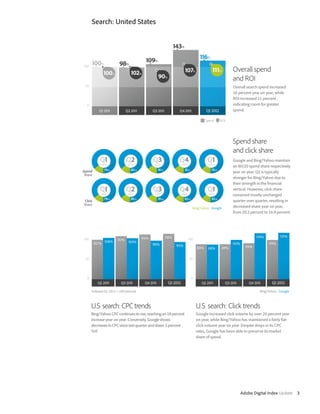
                                                                                       Overall spend
                                                                                       and ROI
                                                                                       Overall search spend increased
                                                                                       16 percent year on year, while
                                                                                       ROI increased 11 percent ,
                                                                                       indicating room for greater
                                                                                       spend.


                                                                                       Spend share
                                                                                       and click share
                                                                                       Google and Bing/Yahoo maintain
                                                                                       an 80/20 spend share respectively
Spend                                                                                  year on year. Q1 is typically
 Share
                                                                                       stronger for Bing/Yahoo due to
                                                                                       their strength in the financial
                                                                                       vertical. However, click share
                                                                                       remained mostly unchanged
 Click                                                                                 quarter over quarter, resulting in
Share
                                                                Bing/Yahoo Google      decreased share year on year,
                                                                                       from 20.2 percent to 16.9 percent.


     Indexed Q1 2011 = 100 percent                                                                    Bing/Yahoo Google


     U.S. search: CPC trends                                      U.S. search: Click trends
     Bing/Yahoo CPC continues to rise, reaching an 18 percent     Google increased click volume by over 20 percent year
     increase year on year. Conversely, Google shows              on year, while Bing/Yahoo has maintained a fairly flat
     decreases in CPC since last quarter and down 5 percent       click volume year on year. Despite drops in its CPC
     YoY.                                                         rates, Google has been able to preserve its market
                                                                  share of spend.


                                                                                           Adobe Digital Index Update 3
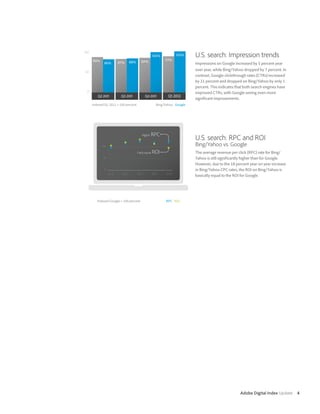
U.S. search: Impression trends
                                                      Impressions on Google increased by 5 percent year
                                                      over year, while Bing/Yahoo dropped by 7 percent. In
                                                      contrast, Google clickthrough rates (CTRs) increased
                                                      by 21 percent and dropped on Bing/Yahoo by only 1
                                                      percent. This indicates that both search engines have
                                                      improved CTRs, with Google seeing even more
                                                      significant improvements.
Indexed Q1 2011 = 100 percent     Bing/Yahoo Google


                                                      U.S. search: RPC and ROI
                                                      Bing/Yahoo vs. Google
                                                      The average revenue per click (RPC) rate for Bing/
                                                      Yahoo is still significantly higher than for Google.
                                                      However, due to the 18 percent year on year increase
                                                      in Bing/Yahoo CPC rates, the ROI on Bing/Yahoo is
                                                      basically equal to the ROI for Google.


   Indexed Google = 100 percent        RPC ROI


                                                                                Adobe Digital Index Update 4
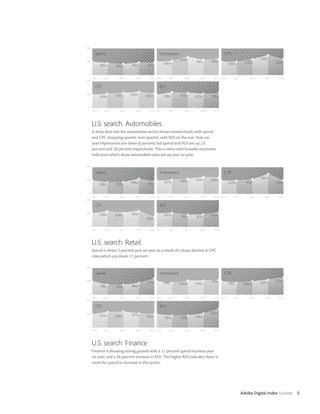
U.S. search: Automobiles
A deep dive into the automotive sector shows mixed results with spend
and CPC dropping quarter over quarter, with ROI on the rise. Year-on-
year impressions are down 8 percent, but spend and ROI are up 23
percent and 18 percent respectively. This is inline with broader economic
indicators which show automobile sales are up year on year.


U.S. search: Retail
Spend is down 5 percent year on year as a result of a sharp decline in CPC
rates which are down 17 percent..


U.S. search: Finance
Finance is showing strong growth with a 17 percent spend increase year
on year, and a 36 percent increase in ROI. The higher ROI indicates there is
room for spend to increase in this sector.


                                                                               Adobe Digital Index Update 5
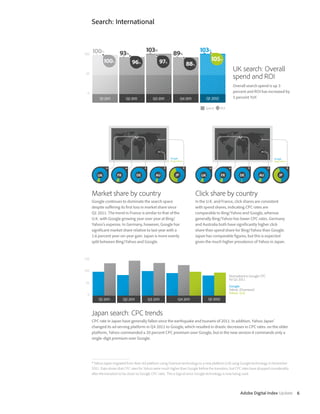
Search: International


                                                                                               UK search: Overall
                                                                                               spend and ROI
                                                                                               Overall search spend is up 3
                                                                                               percent and ROI has increased by
                                                                                               5 percent YoY.


                                                     Google                                                                Google
                                                     Bing/Yahoo                                                            Bing/Yahoo


Market share by country                                              Click share by country
Google continues to dominate the search space                        In the U.K. and France, click shares are consistent
despite suffering its first loss in market share since               with spend shares, indicating CPC rates are
Q1 2011. The trend in France is similar to that of the               comparable to Bing/Yahoo and Google, whereas
U.K. with Google growing year over year at Bing/                     generally Bing/Yahoo has lower CPC rates. Germany
Yahoo’s expense. In Germany, however, Google has                     and Australia both have significantly higher click
significant market share relative to last year with a                share than spend share for Bing/Yahoo than Google.
1.6 percent year-on-year gain. Japan is more evenly                  Japan has comparable figures, but this is expected
split between Bing/Yahoo and Google.                                 given the much higher prevalence of Yahoo in Japan.


                                                                                            Normalized to Google CPC
                                                                                            for Q1 2011

                                                                                            Google
                                                                                            Yahoo (Overture)
                                                                                            Yahoo (v3)


Japan search: CPC trends
CPC rate in Japan have generally fallen since the earthquake and tsunami of 2011. In addition, Yahoo Japan*
changed its ad serving platform in Q4 2011 to Google, which resulted in drastic decreases in CPC rates. on the older
platform, Yahoo commanded a 20 percent CPC premium over Google, but in the new version it commands only a
single-digit premium over Google.


* Yahoo Japan migrated from their old platform using Overture technology to a new platform (v3) using Google technology in November
2011. Data shows that CPC rates for Yahoo were much higher than Google before the transition, but CPC rates have dropped considerably
after the transition to be closer to Google CPC rates. This is logical since Google technology is now being used.


                                                                                                    Adobe Digital Index Update 6
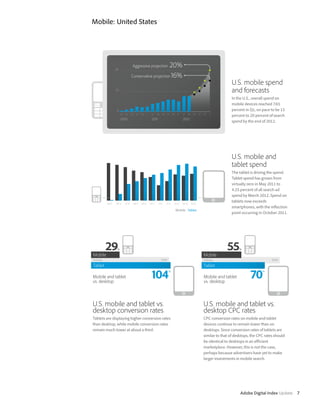
Mobile: United States


                                                                                  U.S. mobile spend
                                                                                  and forecasts
                                                                                  In the U.S., overall spend on
                                                                                  mobile devices reached 7.65
                                                                                  percent in Q1, on pace to be 15
                                                                                  percent to 20 percent of search
                                                                                  spend by the end of 2012.


                                                                                  U.S. mobile and
                                                                                  tablet spend
                                                                                  The tablet is driving the spend.
                                                                                  Tablet spend has grown from
                                                                                  virtually zero in May 2011 to
                                                                                  4.25 percent of all search ad
                                                                                  spend by March 2012. Spend on
                                                                                  tablets now exceeds
                                                                                  smartphones, with the inflection
                                                 Mobile Tablet
                                                                                  point occurring in October 2011.


Mobile and tablet                                                Mobile and tablet
vs. desktop                                                      vs. desktop


U.S. mobile and tablet vs.                                       U.S. mobile and tablet vs.
desktop conversion rates                                         desktop CPC rates
Tablets are displaying higher conversion rates                   CPC conversion rates on mobile and tablet
than desktop, while mobile conversion rates                      devices continue to remain lower than on
remain much lower at about a third.                              desktops. Since conversion rates of tablets are
                                                                 similar to that of desktops, the CPC rates should
                                                                 be identical to desktops in an efficient
                                                                 marketplace. However, this is not the case,
                                                                 perhaps because advertisers have yet to make
                                                                 larger investments in mobile search.


                                                                                       Adobe Digital Index Update 7
Mobile: United Kingdom


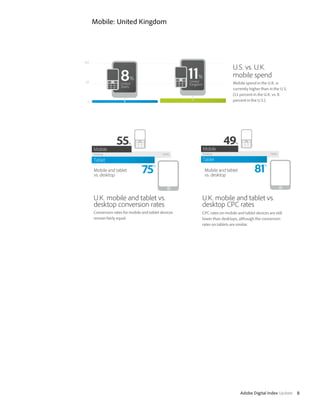
                                                                   U.S. vs. U.K.
                                                                   mobile spend
                                                                   Mobile spend in the U.K. is
                                                                   currently higher than in the U.S.
                                                                   (11 percent in the U.K. vs. 8
                                                                   percent in the U.S.).


Mobile and tablet                                 Mobile and tablet
vs. desktop                                       vs. desktop


U.K. mobile and tablet vs.                       U.K. mobile and tablet vs.
desktop conversion rates                         desktop CPC rates
Conversion rates for mobile and tablet devices   CPC rates on mobile and tablet devices are still
remain fairly equal.                             lower than desktops, although the conversion
                                                 rates on tablets are similar.


                                                                       Adobe Digital Index Update 8
Social Media: Facebook


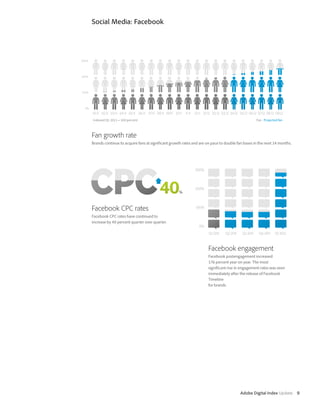
Indexed Q1 2011 = 100 percent                                                                    Fan Projected fan


Fan growth rate
Brands continue to acquire fans at significant growth rates and are on pace to double fan bases in the next 14 months.


Facebook CPC rates
Facebook CPC rates have continued to
increase by 40 percent quarter over quarter.


                                                                    Facebook engagement
                                                                    Facebook postengagement increased
                                                                    176 percent year on year. The most
                                                                    significant rise in engagement rates was seen
                                                                    immediately after the release of Facebook
                                                                    Timeline
                                                                    for brands.


                                                                                       Adobe Digital Index Update 9
Definitions
                             Click share—The amount of share received by a particular engine of all paid clicks as calculated by
                             this formula: paid clicks on a particular search engine/total paid clicks across all engines.

                             Cost per click (CPC)—The amount paid by a marketer per user click on a paid search ad. CPC is
                             determined by an auctioning process and is a good indicator of market conditions. Increases in CPC
                             indicate advertisers are willing to spend more on advertising, and a decrease indicates that
                             advertisers are willing to spend less.

                             Impressions—The number of views of an ad by a consumer on a particular search engine.
                             Impressions indicate consumer interest in a product. The more consumers search the higher the
                             impression volume, the less consumers search the lower the impression volume.

                             Return on ad spend (ROAS)—A measure of profitability based on how much an advertiser
                             received in terms of results compared to how much ad budget was spent.

                             Return on investment (ROI)—A measure of profitability based on how much a marketer received
                             in terms of results compared to how much was invested. Also known as a measure of efficiency.

                             Spend share—The amount of share that marketers spend buying paid search on a particular search
                             engine as calculated by this formula: particular search engine spend/total search engine marketing
                             spend.


                             Methodology
                             Our analysis of digital marketing and Facebook performance is based on data derived from
                             technology Adobe acquired from Efficient Frontier and Context Optional, which is now part of the
                             Adobe® Digital Marketing Suite (DMS). We built a client index representing over 15 advertisers and 20
                             million fans from a multitude of verticals including retail, entertainment, CPG, and finance from a
                             subset of advertisers, brands, and fans managed through the platforms. We then analyzed advertiser
                             and user behavior for three quarters, beginning in Q2 2011.


                             Adobe Digital Marketing Suite
                             Adobe Digital Marketing Suite offers an integrated and open platform for online business
                             optimization, a strategy for using customer insight to drive innovation throughout the business and
                             enhance marketing efficiency. The DMS consists of integrated applications to collect and unleash the
                             power of customer insight to optimize customer acquisition, conversion and retention efforts, as well
                             as the creation and distribution of content. For example, using the DMS, marketers can identify the
                             most effective marketing strategies and ad placements as well as create relevant, personalized, and
                             consistent customer experiences across digital marketing channels, such as onsite, display, email,
                             social media, video, and mobile. The DMS enables marketers to make quick adjustments, automate
                             certain customer interactions, and better maximize marketing ROI, which, ultimately, can positively
                             impact the bottom line.


                             Adobe Digital Index
                             Adobe Digital Index publishes research on digital marketing and other topics of interest to senior
                             marketing and e-commerce executives across industries. Research is based on the analysis of select,
                             anonymous, and aggregated data from over 5,000 companies worldwide that use the Adobe Digital
                             Marketing Suite, powered by Adobe technology and solutions, to obtain real-time data and analysis
                             of activity on their websites.
                             For additional information about this report, contact Austin Bankhead, Director, Adobe Digital Index,
                             at DigIndex@adobe.com.


                             Adobe and the Adobe logo are either registered trademarks or trademarks of Adobe Systems Incorporated in the United States and/or other countries. All
Adobe Systems Incorporated   other trademarks are the property of their respective owners.
345 Park Avenue
San Jose, CA 95110-2704      © 2012 Adobe Systems Incorporated. All rights reserved. Printed in the USA.
USA
www.adobe.com                4/12                                                                                                                                                     10

Global advertising update_q12012

  • 1.
    Global digital advertising Q12012 update Adobe® Digital Index
  • 2.
    Adobe Digital IndexUpdate Global digital advertising update Table of contents Q1 2012 executive summary 1: Q1 2012 executive summary 2: Outlook for Q2-Q4 2012 Digital advertising in Q1 2012 continues to show growth across all channels. Search remains the biggest 3: Search: United States driver of return on investment (ROI) for marketers absorbing the majority of biddable digital advertising 6: Search: International spend. Search continues to grow rapidly, increasing 16 percent year on year during Q1 2012. As traffic on 7: Mobile: United States mobile devices, specifically tablets, increases four-fold year on year, advertisers are adding search 8: Mobile: United Kingdom investments to these devices. This indicates that search on mobile and tablets is just as strong of an 9: Social Media: Facebook emerging market as social media, and will continue to positively influence the growth in search spend globally. 10: Methodology Search spend increased year over year 16 percent in the U.S. and 3 percent in the U.K.—In the U.S., ROI increased by 11 percent year on year indicating there is room to increase search spend. Industry sectors, such as finance and automotive, showed large increases in year on year spend, while the retail sector dropped 5 percent. The minimal increase in U.K. search spend levels reflect the fragile state of the European economic recovery. Mobile spend on search has grown year over year by 250 percent in the U.K.—In Q1, mobile spend reached 8 percent of all search spend in the U.S. and 11 percent in the U.K. Of this, tablets alone accounted for 4.25 percent of search spend. Because costs per click (CPC) on tablets are disproportionately low compared to desktop CPCs (despite comparable conversion rates), mobile and tablet advertising investments will become more appealing to advertisers in the short term. Google CPC fell by 5 percent year on year—Bing/Yahoo CPC rates increased by 18 percent year on year as marketers took advantage of better return per click (RPC) rates. As a result, the Bing/Yahoo ROI advantage over Google no longer exists. Note that when Yahoo Japan converted to the Google ad serving platform from Bing/Yahoo, CPC rates dropped significantly. This indicates that Google, on average, charges a lower premium to search advertisers. Google search algorithmic changes contribute to growth in search spend—Increases in search spend are a result of increased click volume rather than increased CPC rates. This has been true for the past two quarters, but is contradictory to trends in prior quarters. Algorithmic changes to Google in Q4 2011, such as increased site links, have led to a greater proportion of branded traffic that does not impact CPC rates. Google spend and click share rose to 93 percent in the U.K.—This is up from about 90 percent in Q4 2011. Google also continues to dominate market share in other European markets. Facebook post engagement increased 176 percent year on year—Engagement in the brands’ Facebook posts have increased dramatically since the beginning of this year. This may be due to the new platform changes Facebook has made in the last two quarters. The most significant lifts were seen immediately after the release of Facebook Timeline for brands. Facebook spend has grown by 93 percent year on year—On a relative basis, this represents 3 to 5 percent of search spend—indicating that social media continues to be a strong, digital advertising channel. Display advertising continues to increase in strength—Google DoubleClick Ad Exchange continues to capture market share from Right Media Exchange.
  • 3.
    Outlook for Q2-Q42012 Tablets and mobile devices will continue to assume a larger percentage of overall search spend, reaching 15 to 20 percent by the end of this year. Mobile growth is driven by advertisers’ interest in other digital marketing channels that yield desktop search ROI with lower CPC rates for maximizing returns. Also, as more brands maximize the new Facebook Timeline for brands, we expect to see increases in postengagement, resulting in lifts in Facebook ad spend from those advertisers looking for more engagement with their social audiences. Search spend in the U.S. will increase 10 to 15 percent for the rest of 2012—This rate is consistent with macro trends. Search spend is typically indicative of the current state of the economy—as the medium allows advertisers to react quickly to marketplace changes—thus providing a positive outlook for both search and the U.S. economy. Tablet and mobile spend will make up 15 to 20 percent of all search spend by the end of 2012— Marketers should focus on tablet and mobile markets as they still appear to be underinvested opportunities. Investments in tablet advertising will increase because tablet visitors are rapidly growing, as shown in a recent Adobe Digital Index study. Retail websites’ share of total visits increased from 1 percent to 4 percent in just 12 months. Conversion rates on mobile devices are comparable to desktop performance, even though mobile CPC rates are 30 percent lower. In a rational marketplace, the CPC rates on tablets should be identical to desktop CPC rates if the conversion rates are comparable. Furthermore, current trends indicate that tablets may cannibalize smartphone and desktop search spend as investments continue to shift to tablet devices. Facebook CPC rates are expected to decelerate—While Facebook ad CPC rates have increased 40 percent quarter over quarter for the past three quarters, CPC rates on Sponsored Stories tend to be lower than Marketplace Ads, which may contribute to temporary decreases in CPC rates. Facebook engagement rates will grow as more brands convert to and maximize Facebook Timeline for brands—Brands that measure success of Facebook via engagement will probably spend more on Facebook advertising to build their audiences and engage with fans in a meaningful way. Adobe Digital Index Update 2
  • 4.
    Search: United States Overall spend and ROI Overall search spend increased 16 percent year on year, while ROI increased 11 percent , indicating room for greater spend. Spend share and click share Google and Bing/Yahoo maintain an 80/20 spend share respectively Spend year on year. Q1 is typically Share stronger for Bing/Yahoo due to their strength in the financial vertical. However, click share remained mostly unchanged Click quarter over quarter, resulting in Share Bing/Yahoo Google decreased share year on year, from 20.2 percent to 16.9 percent. Indexed Q1 2011 = 100 percent Bing/Yahoo Google U.S. search: CPC trends U.S. search: Click trends Bing/Yahoo CPC continues to rise, reaching an 18 percent Google increased click volume by over 20 percent year increase year on year. Conversely, Google shows on year, while Bing/Yahoo has maintained a fairly flat decreases in CPC since last quarter and down 5 percent click volume year on year. Despite drops in its CPC YoY. rates, Google has been able to preserve its market share of spend. Adobe Digital Index Update 3
  • 5.
    U.S. search: Impressiontrends Impressions on Google increased by 5 percent year over year, while Bing/Yahoo dropped by 7 percent. In contrast, Google clickthrough rates (CTRs) increased by 21 percent and dropped on Bing/Yahoo by only 1 percent. This indicates that both search engines have improved CTRs, with Google seeing even more significant improvements. Indexed Q1 2011 = 100 percent Bing/Yahoo Google U.S. search: RPC and ROI Bing/Yahoo vs. Google The average revenue per click (RPC) rate for Bing/ Yahoo is still significantly higher than for Google. However, due to the 18 percent year on year increase in Bing/Yahoo CPC rates, the ROI on Bing/Yahoo is basically equal to the ROI for Google. Indexed Google = 100 percent RPC ROI Adobe Digital Index Update 4
  • 6.
    U.S. search: Automobiles Adeep dive into the automotive sector shows mixed results with spend and CPC dropping quarter over quarter, with ROI on the rise. Year-on- year impressions are down 8 percent, but spend and ROI are up 23 percent and 18 percent respectively. This is inline with broader economic indicators which show automobile sales are up year on year. U.S. search: Retail Spend is down 5 percent year on year as a result of a sharp decline in CPC rates which are down 17 percent.. U.S. search: Finance Finance is showing strong growth with a 17 percent spend increase year on year, and a 36 percent increase in ROI. The higher ROI indicates there is room for spend to increase in this sector. Adobe Digital Index Update 5
  • 7.
    Search: International UK search: Overall spend and ROI Overall search spend is up 3 percent and ROI has increased by 5 percent YoY. Google Google Bing/Yahoo Bing/Yahoo Market share by country Click share by country Google continues to dominate the search space In the U.K. and France, click shares are consistent despite suffering its first loss in market share since with spend shares, indicating CPC rates are Q1 2011. The trend in France is similar to that of the comparable to Bing/Yahoo and Google, whereas U.K. with Google growing year over year at Bing/ generally Bing/Yahoo has lower CPC rates. Germany Yahoo’s expense. In Germany, however, Google has and Australia both have significantly higher click significant market share relative to last year with a share than spend share for Bing/Yahoo than Google. 1.6 percent year-on-year gain. Japan is more evenly Japan has comparable figures, but this is expected split between Bing/Yahoo and Google. given the much higher prevalence of Yahoo in Japan. Normalized to Google CPC for Q1 2011 Google Yahoo (Overture) Yahoo (v3) Japan search: CPC trends CPC rate in Japan have generally fallen since the earthquake and tsunami of 2011. In addition, Yahoo Japan* changed its ad serving platform in Q4 2011 to Google, which resulted in drastic decreases in CPC rates. on the older platform, Yahoo commanded a 20 percent CPC premium over Google, but in the new version it commands only a single-digit premium over Google. * Yahoo Japan migrated from their old platform using Overture technology to a new platform (v3) using Google technology in November 2011. Data shows that CPC rates for Yahoo were much higher than Google before the transition, but CPC rates have dropped considerably after the transition to be closer to Google CPC rates. This is logical since Google technology is now being used. Adobe Digital Index Update 6
  • 8.
    Mobile: United States U.S. mobile spend and forecasts In the U.S., overall spend on mobile devices reached 7.65 percent in Q1, on pace to be 15 percent to 20 percent of search spend by the end of 2012. U.S. mobile and tablet spend The tablet is driving the spend. Tablet spend has grown from virtually zero in May 2011 to 4.25 percent of all search ad spend by March 2012. Spend on tablets now exceeds smartphones, with the inflection Mobile Tablet point occurring in October 2011. Mobile and tablet Mobile and tablet vs. desktop vs. desktop U.S. mobile and tablet vs. U.S. mobile and tablet vs. desktop conversion rates desktop CPC rates Tablets are displaying higher conversion rates CPC conversion rates on mobile and tablet than desktop, while mobile conversion rates devices continue to remain lower than on remain much lower at about a third. desktops. Since conversion rates of tablets are similar to that of desktops, the CPC rates should be identical to desktops in an efficient marketplace. However, this is not the case, perhaps because advertisers have yet to make larger investments in mobile search. Adobe Digital Index Update 7
  • 9.
    Mobile: United Kingdom U.S. vs. U.K. mobile spend Mobile spend in the U.K. is currently higher than in the U.S. (11 percent in the U.K. vs. 8 percent in the U.S.). Mobile and tablet Mobile and tablet vs. desktop vs. desktop U.K. mobile and tablet vs. U.K. mobile and tablet vs. desktop conversion rates desktop CPC rates Conversion rates for mobile and tablet devices CPC rates on mobile and tablet devices are still remain fairly equal. lower than desktops, although the conversion rates on tablets are similar. Adobe Digital Index Update 8
  • 10.
    Social Media: Facebook IndexedQ1 2011 = 100 percent Fan Projected fan Fan growth rate Brands continue to acquire fans at significant growth rates and are on pace to double fan bases in the next 14 months. Facebook CPC rates Facebook CPC rates have continued to increase by 40 percent quarter over quarter. Facebook engagement Facebook postengagement increased 176 percent year on year. The most significant rise in engagement rates was seen immediately after the release of Facebook Timeline for brands. Adobe Digital Index Update 9
  • 11.
    Definitions Click share—The amount of share received by a particular engine of all paid clicks as calculated by this formula: paid clicks on a particular search engine/total paid clicks across all engines. Cost per click (CPC)—The amount paid by a marketer per user click on a paid search ad. CPC is determined by an auctioning process and is a good indicator of market conditions. Increases in CPC indicate advertisers are willing to spend more on advertising, and a decrease indicates that advertisers are willing to spend less. Impressions—The number of views of an ad by a consumer on a particular search engine. Impressions indicate consumer interest in a product. The more consumers search the higher the impression volume, the less consumers search the lower the impression volume. Return on ad spend (ROAS)—A measure of profitability based on how much an advertiser received in terms of results compared to how much ad budget was spent. Return on investment (ROI)—A measure of profitability based on how much a marketer received in terms of results compared to how much was invested. Also known as a measure of efficiency. Spend share—The amount of share that marketers spend buying paid search on a particular search engine as calculated by this formula: particular search engine spend/total search engine marketing spend. Methodology Our analysis of digital marketing and Facebook performance is based on data derived from technology Adobe acquired from Efficient Frontier and Context Optional, which is now part of the Adobe® Digital Marketing Suite (DMS). We built a client index representing over 15 advertisers and 20 million fans from a multitude of verticals including retail, entertainment, CPG, and finance from a subset of advertisers, brands, and fans managed through the platforms. We then analyzed advertiser and user behavior for three quarters, beginning in Q2 2011. Adobe Digital Marketing Suite Adobe Digital Marketing Suite offers an integrated and open platform for online business optimization, a strategy for using customer insight to drive innovation throughout the business and enhance marketing efficiency. The DMS consists of integrated applications to collect and unleash the power of customer insight to optimize customer acquisition, conversion and retention efforts, as well as the creation and distribution of content. For example, using the DMS, marketers can identify the most effective marketing strategies and ad placements as well as create relevant, personalized, and consistent customer experiences across digital marketing channels, such as onsite, display, email, social media, video, and mobile. The DMS enables marketers to make quick adjustments, automate certain customer interactions, and better maximize marketing ROI, which, ultimately, can positively impact the bottom line. Adobe Digital Index Adobe Digital Index publishes research on digital marketing and other topics of interest to senior marketing and e-commerce executives across industries. Research is based on the analysis of select, anonymous, and aggregated data from over 5,000 companies worldwide that use the Adobe Digital Marketing Suite, powered by Adobe technology and solutions, to obtain real-time data and analysis of activity on their websites. For additional information about this report, contact Austin Bankhead, Director, Adobe Digital Index, at DigIndex@adobe.com. Adobe and the Adobe logo are either registered trademarks or trademarks of Adobe Systems Incorporated in the United States and/or other countries. All Adobe Systems Incorporated other trademarks are the property of their respective owners. 345 Park Avenue San Jose, CA 95110-2704 © 2012 Adobe Systems Incorporated. All rights reserved. Printed in the USA. USA www.adobe.com 4/12 10