SHAREABLE BY DESIGN 
Making Research Data available for access 
This work is licensed under aCreative Commons Attribution 2.0 UK: England & Wales License 
Hashtag #lshtmdata 
12 November 2014
Data Sharing in the Sciences 
•Data sharing has always taken place in some form 
•Enlightenment during 17 –18thcentury built upon open debate and sharing of knowledge 
•Science depends on openness and transparency to advance 
–Replicate results 
–Correct errors & address bia 
•Negative as well as positive findings need to be in the public domain 
“Systematic Dictionary of the Sciences, Arts, and Crafts” 
Diderot & d'Alembert(1751 onwards) 
“Sharing Research Data” 
Fienberg et al (1985). http://books.google.co.uk/books? id=ijUrAAAAYAAJ 
http://en.wikipedia.org/wiki/Encyclop%C3%A9die
Recent Developments 
“Publicly funded research data are a public good, produced in the public interest, which should be made openly available… in a timely and responsible manner” 
RCUK Common Principles on Data Policy 
http://www.rcuk.ac.uk/research/datapolicy/ 
“Research data that substantiate research findings should be made available for access and use in a timely manner, within the boundaries of conditions established by contractual, legislative, ethical, or other requirements 
LSHTM Research Data Management Policy. Principle 7 
http://www.lshtm.ac.uk/research/researchdataman/rdm_policy_summary.html
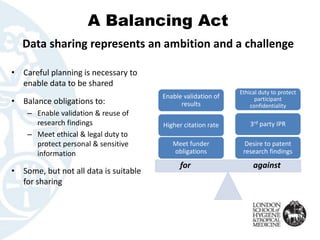
A Balancing Act 
•Careful planning is necessary to enable data to be shared 
•Balance obligations to: 
–Enable validation & reuse of research findings 
–Meet ethical & legal duty to protect personal & sensitive information 
•Some, but not all data is suitable for sharing 
Desire to patent research findings 
Concern about low response rate 
3rdparty IPR 
Ethical duty to protect participant confidentiality 
Meet funder obligations 
Higher citation rate 
Enable validation of results 
against 
for 
Data sharing represents an ambition and a challenge

Shareable by Design: Making Research Data available for access

  • 1.
    SHAREABLE BY DESIGN Making Research Data available for access This work is licensed under aCreative Commons Attribution 2.0 UK: England & Wales License Hashtag #lshtmdata 12 November 2014
  • 2.
    Data Sharing inthe Sciences •Data sharing has always taken place in some form •Enlightenment during 17 –18thcentury built upon open debate and sharing of knowledge •Science depends on openness and transparency to advance –Replicate results –Correct errors & address bia •Negative as well as positive findings need to be in the public domain “Systematic Dictionary of the Sciences, Arts, and Crafts” Diderot & d'Alembert(1751 onwards) “Sharing Research Data” Fienberg et al (1985). http://books.google.co.uk/books? id=ijUrAAAAYAAJ http://en.wikipedia.org/wiki/Encyclop%C3%A9die
  • 3.
    Recent Developments “Publiclyfunded research data are a public good, produced in the public interest, which should be made openly available… in a timely and responsible manner” RCUK Common Principles on Data Policy http://www.rcuk.ac.uk/research/datapolicy/ “Research data that substantiate research findings should be made available for access and use in a timely manner, within the boundaries of conditions established by contractual, legislative, ethical, or other requirements LSHTM Research Data Management Policy. Principle 7 http://www.lshtm.ac.uk/research/researchdataman/rdm_policy_summary.html
  • 4.
    A Balancing Act •Careful planning is necessary to enable data to be shared •Balance obligations to: –Enable validation & reuse of research findings –Meet ethical & legal duty to protect personal & sensitive information •Some, but not all data is suitable for sharing Desire to patent research findings Concern about low response rate 3rdparty IPR Ethical duty to protect participant confidentiality Meet funder obligations Higher citation rate Enable validation of results against for Data sharing represents an ambition and a challenge