ands.org.au/fair
Welcome
The webinar will commence at
12 noon AEST
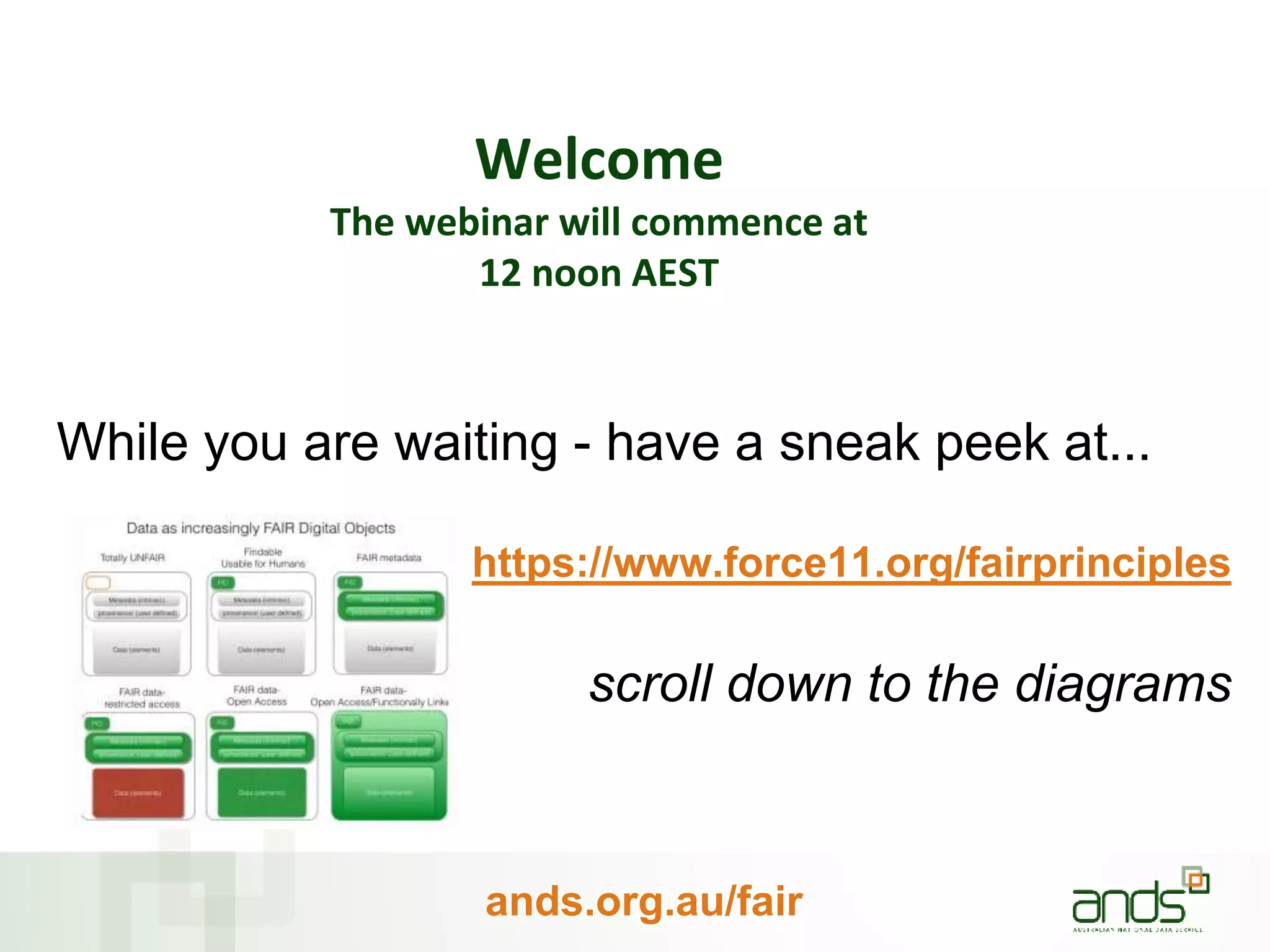
While you are waiting - have a sneak peek at...
https://www.force11.org/fairprinciples
scroll down to the diagrams
FAIR Webinar Series
30 August 2017
#1 An introduction to FAIR
and F is Findable
Getting involved
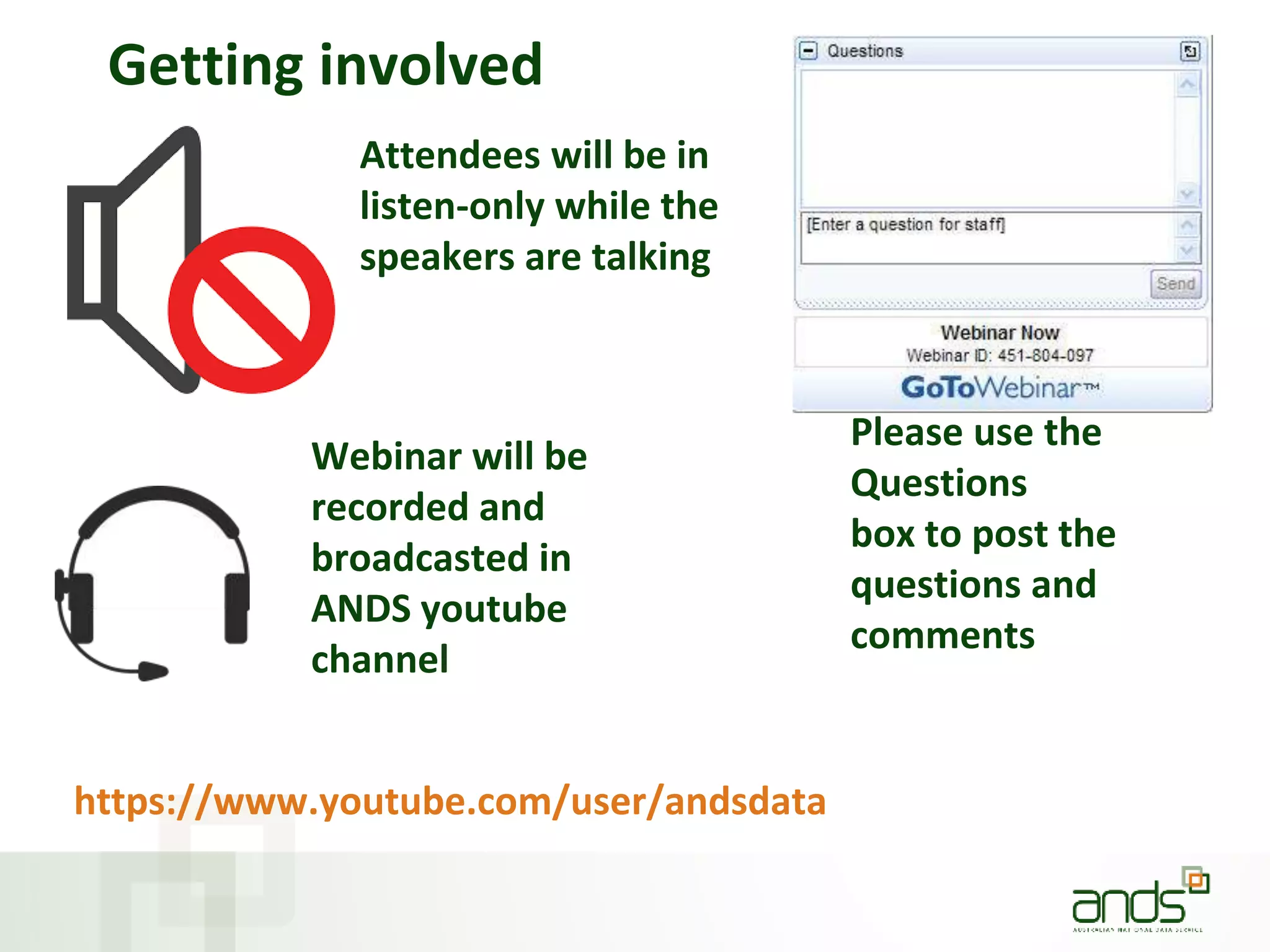
Please use the
Questions
box to post the
questions and
comments
Attendees will be in
listen-only while the
speakers are talking
https://www.youtube.com/user/andsdata
Webinar will be
recorded and
broadcasted in
ANDS youtube
channel
Our speakers are..
Keith Russell
ANDS
An introduction to the FAIR Data Principles
Nick Thieberger
Director, Paradisec
Paradisec has made their data findable via rich metadata and identifiers
What are the FAIR principles?
• Drafted by Force11 in 2015
• Received international recognition
• Human readable and machine readable
• Technology agnostic
• Discipline independent
• Both the data and the metadata
Findable, Accessible, Interoperable and Re-usable
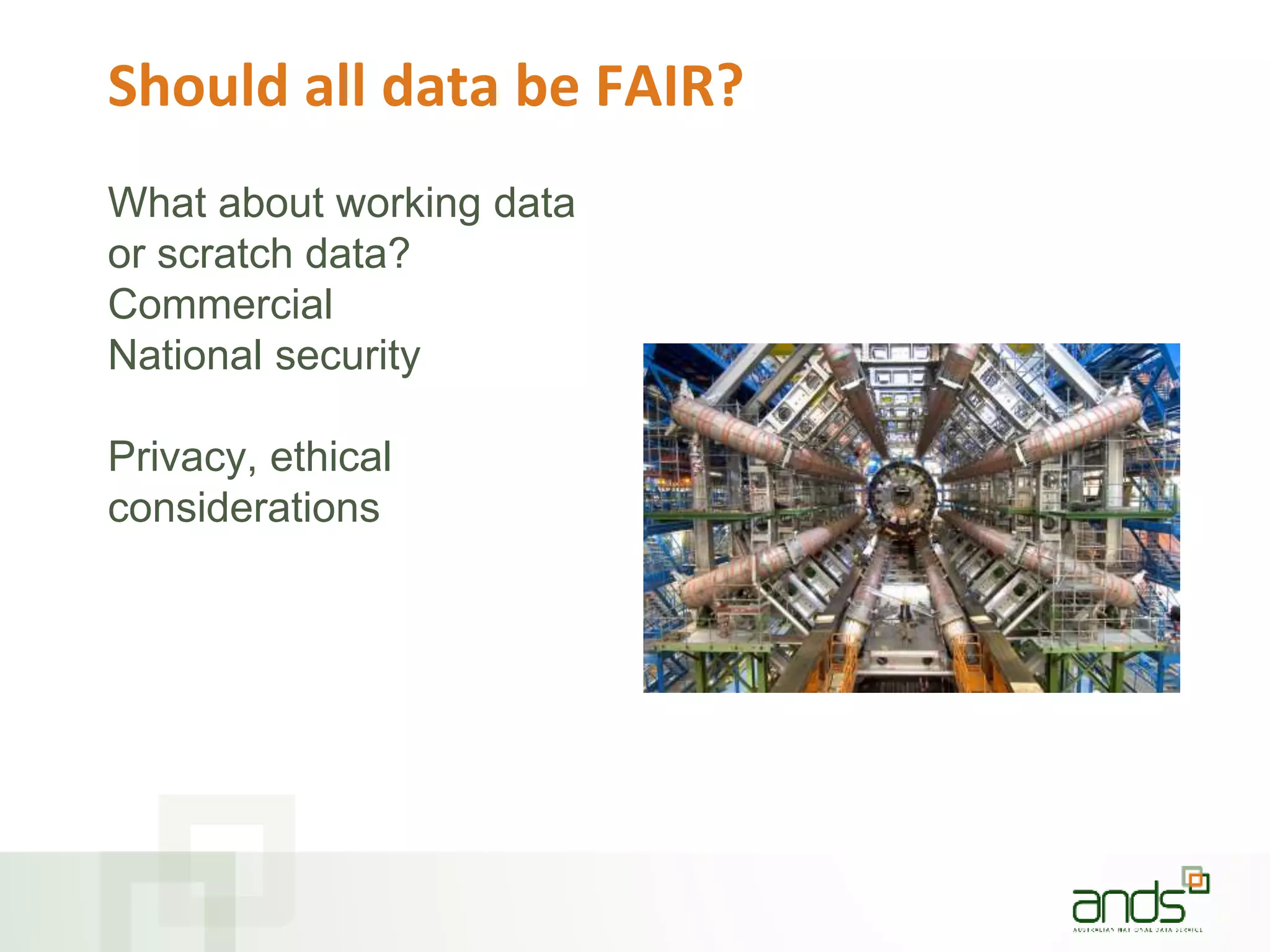
Should all data be FAIR?
What about working data
or scratch data?
Commercial
National security
Privacy, ethical
considerations
What FAIR is not
• Not to be confused with fair use and fair
dealing
• Not the fair data mark
• FAIR is not a standard
Not just about the data
Requires underlying infrastructure
• Policies, procedures, guidelines
• Tools, platforms, software
• Skills
Why are the FAIR principles
useful?
• Internationally recognised
• Contain detail
• Discipline independent
• Not as hard as Open
• Hard to measure though
Flow on initiatives
EU: HLEG European Open Science Cloud
and the H2020 Guidelines for Data Management
US: NIH data commons pilot
NL: GO FAIR initiative and related work
UK: Jisc FAIR in practice
AGU: Open and FAIR data in Earth and Space
Sciences
AU: FAIR Access to research outputs policy
statement
Findable
To be Findable:
F1. (meta)data are assigned a globally unique
and eternally persistent identifier.
F2. data are described with rich metadata.
F3. (meta)data are registered or indexed in a
searchable resource.
F4. metadata specify the data identifier.
Example of Findable in practice
Nick Thieberger
Director, Paradisec
Paradisec has made their data findable via rich metadata and identifiers
Resources on Findable
DOI/Handle minting
Metadata Standards Directories
Research Data Australia
Re3Data
Thing 4: Data Discovery
Thing 8: Citation metrics for data
Thing 11: What's my metadata schema?
www.ands.org.au/fair
Next week: #2 Accessible FAIR principles 6 Sept
Keith Russell
ANDS
Accessible
David Fitzgerald
Data Manager, Aust Longitudinal Study of Women’s Health
How ALSWH makes a nationally significant longitudinal study with highly
sensitive data accessible for others to reuse.
Jingbo Wang
Data Collections Manager, NCI
How NCI makes data accessible through services over the data so they can be
interrogated and used by humans and machines
keith.russell@ands.org.au
Keith Russell
With the exception of third party images or where otherwise indicated, this work
is licensed under the Creative Commons 4.0 International Attribution Licence.
ANDS is supported by the Australian
Government through the National Collaborative
Research Infrastructure Strategy Program.
Monash University leads the partnership with
the Australian National University and CSIRO.

#1 FAIR: Into to FAIR and F for Findable

  • 1.
    ands.org.au/fair Welcome The webinar willcommence at 12 noon AEST While you are waiting - have a sneak peek at... https://www.force11.org/fairprinciples scroll down to the diagrams
  • 2.
    FAIR Webinar Series 30August 2017 #1 An introduction to FAIR and F is Findable
  • 4.
    Getting involved Please usethe Questions box to post the questions and comments Attendees will be in listen-only while the speakers are talking https://www.youtube.com/user/andsdata Webinar will be recorded and broadcasted in ANDS youtube channel
  • 5.
    Our speakers are.. KeithRussell ANDS An introduction to the FAIR Data Principles Nick Thieberger Director, Paradisec Paradisec has made their data findable via rich metadata and identifiers
  • 6.
    What are theFAIR principles? • Drafted by Force11 in 2015 • Received international recognition • Human readable and machine readable • Technology agnostic • Discipline independent • Both the data and the metadata Findable, Accessible, Interoperable and Re-usable
  • 7.
    Should all databe FAIR? What about working data or scratch data? Commercial National security Privacy, ethical considerations
  • 8.
    What FAIR isnot • Not to be confused with fair use and fair dealing • Not the fair data mark • FAIR is not a standard
  • 9.
    Not just aboutthe data Requires underlying infrastructure • Policies, procedures, guidelines • Tools, platforms, software • Skills
  • 10.
    Why are theFAIR principles useful? • Internationally recognised • Contain detail • Discipline independent • Not as hard as Open • Hard to measure though
  • 11.
    Flow on initiatives EU:HLEG European Open Science Cloud and the H2020 Guidelines for Data Management US: NIH data commons pilot NL: GO FAIR initiative and related work UK: Jisc FAIR in practice AGU: Open and FAIR data in Earth and Space Sciences AU: FAIR Access to research outputs policy statement
  • 12.
    Findable To be Findable: F1.(meta)data are assigned a globally unique and eternally persistent identifier. F2. data are described with rich metadata. F3. (meta)data are registered or indexed in a searchable resource. F4. metadata specify the data identifier.
  • 13.
    Example of Findablein practice Nick Thieberger Director, Paradisec Paradisec has made their data findable via rich metadata and identifiers
  • 14.
    Resources on Findable DOI/Handleminting Metadata Standards Directories Research Data Australia Re3Data Thing 4: Data Discovery Thing 8: Citation metrics for data Thing 11: What's my metadata schema? www.ands.org.au/fair
  • 15.
    Next week: #2Accessible FAIR principles 6 Sept Keith Russell ANDS Accessible David Fitzgerald Data Manager, Aust Longitudinal Study of Women’s Health How ALSWH makes a nationally significant longitudinal study with highly sensitive data accessible for others to reuse. Jingbo Wang Data Collections Manager, NCI How NCI makes data accessible through services over the data so they can be interrogated and used by humans and machines
  • 16.
    keith.russell@ands.org.au Keith Russell With theexception of third party images or where otherwise indicated, this work is licensed under the Creative Commons 4.0 International Attribution Licence. ANDS is supported by the Australian Government through the National Collaborative Research Infrastructure Strategy Program. Monash University leads the partnership with the Australian National University and CSIRO.