Accessing data for research: data
publishing pathways and the Five Safes
Louise Corti
UK Data Service
Assessing Disclosure Risk in Population Research
Data and Outputs
Children of the 90s (ALSPAC)
Bristol Medical School
24 January 2020
Our organisation: the UK Data Archive
• Department of the University of Essex
• Founded 1967 by ESRC as a ‘Data Bank’ for science
science
• Over 50 years of curating and providing access to data
for research and teaching
• A Trusted Digital Repository (TDR) and accredited to
ISO27001 Info Security Management standard
• Lead the national UK Data Service
• Work closely with research funders and data producers
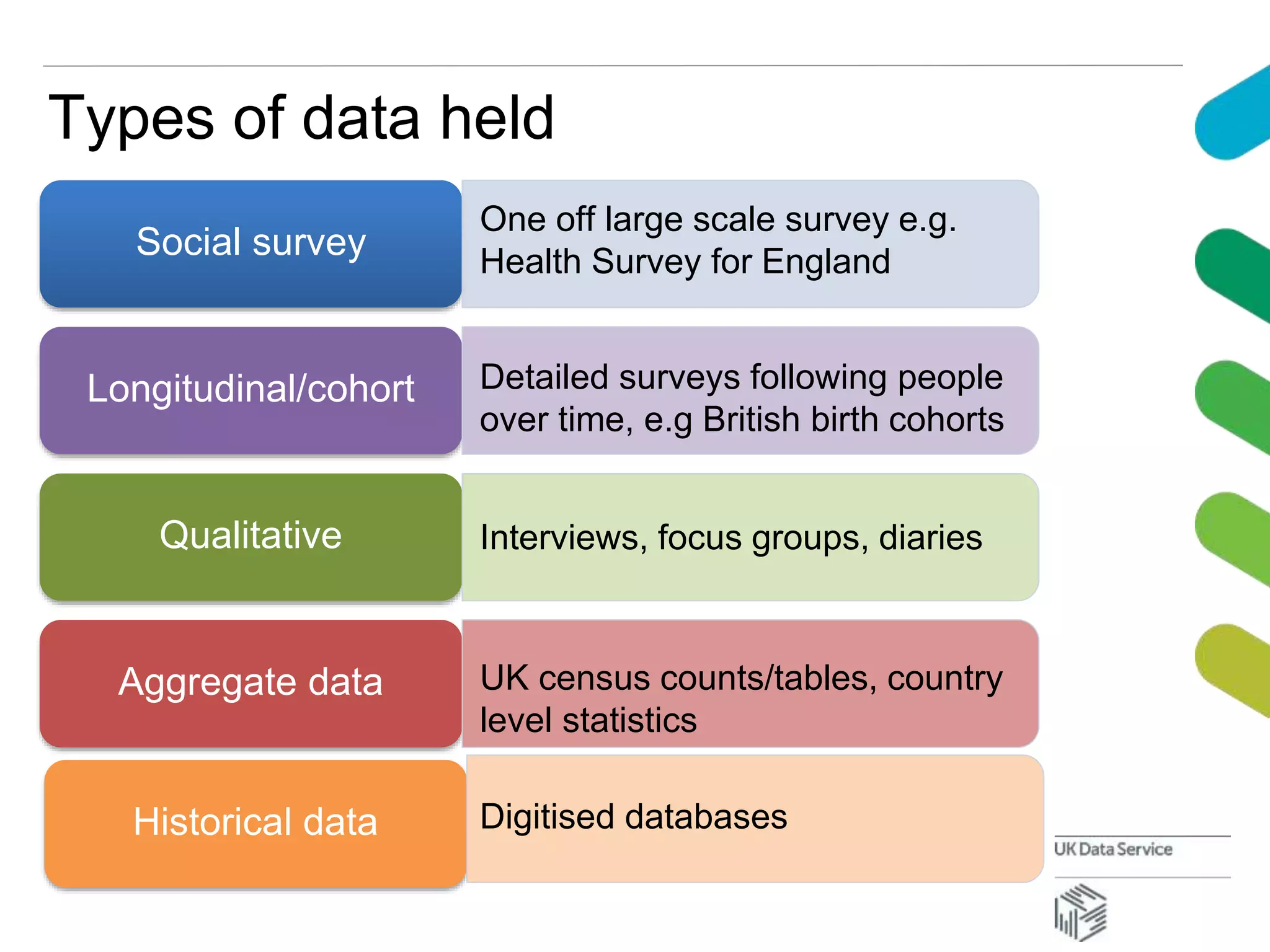
Types of data held
Social survey
One off large scale survey e.g.
Health Survey for England
Longitudinal/cohort Detailed surveys following people
over time, e.g British birth cohorts
Qualitative Interviews, focus groups, diaries
Aggregate data UK census counts/tables, country
level statistics
Historical data Digitised databases
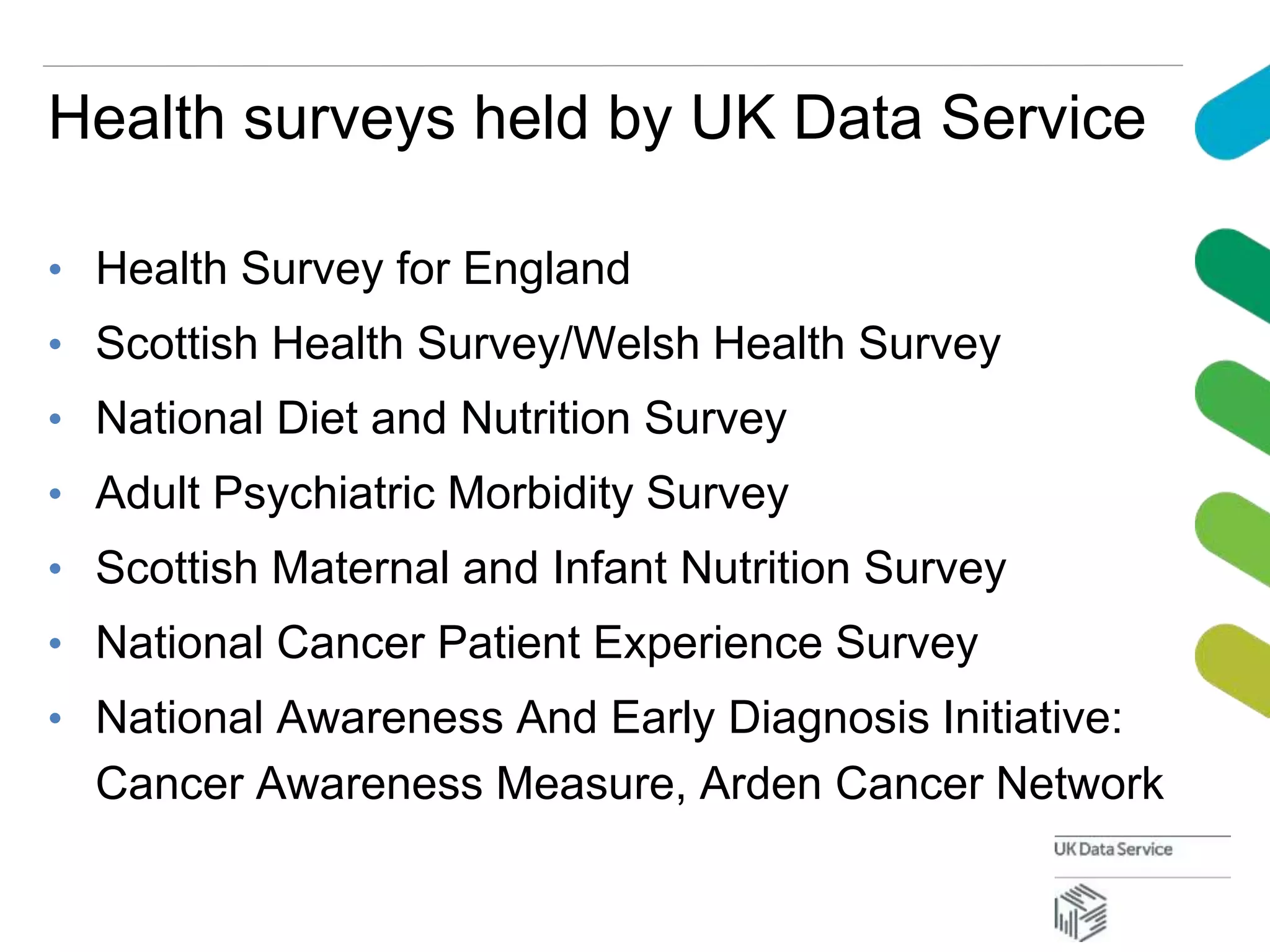
Health surveys held by UK Data Service
• Health Survey for England
• Scottish Health Survey/Welsh Health Survey
• National Diet and Nutrition Survey
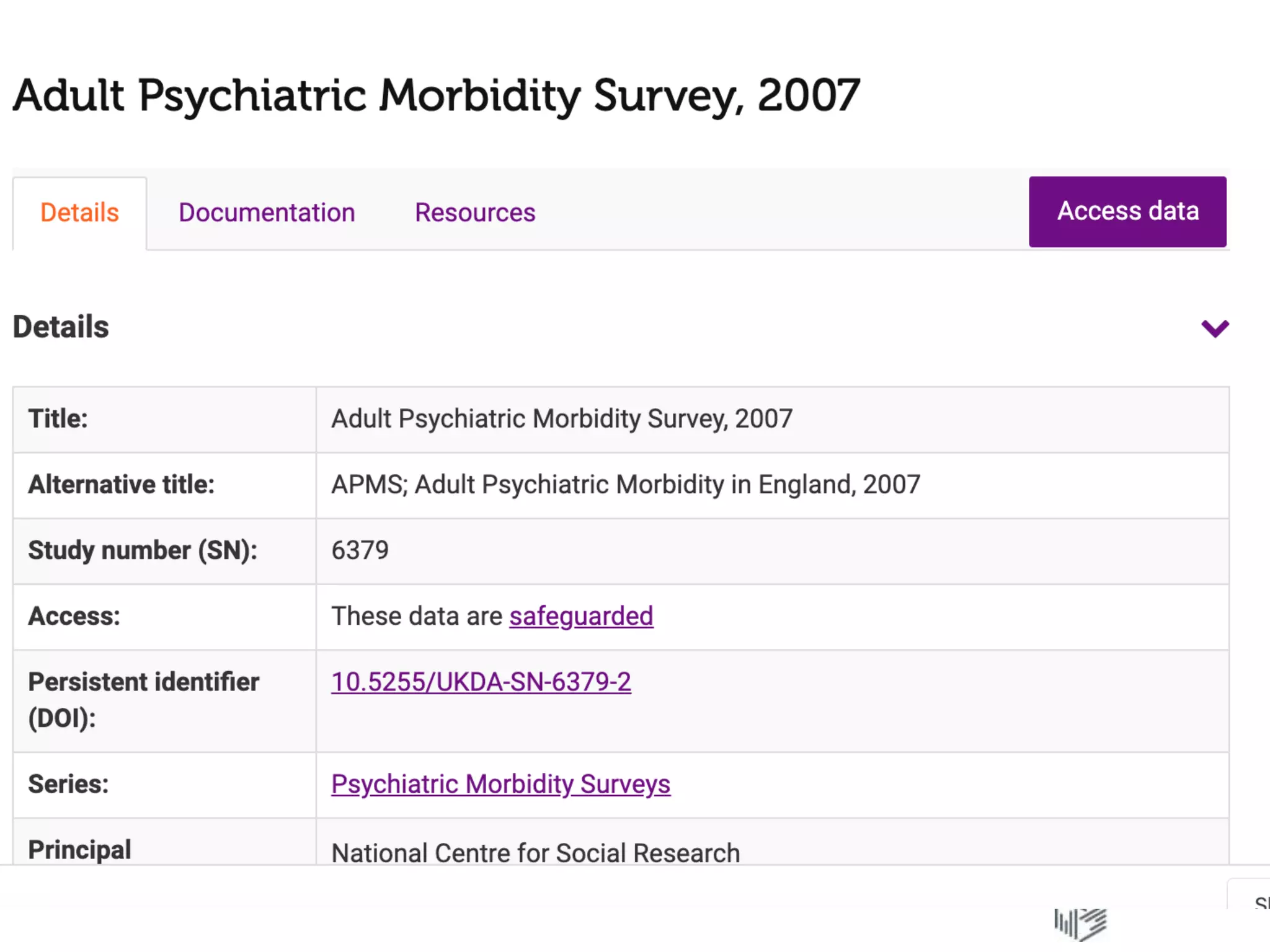
• Adult Psychiatric Morbidity Survey
• Scottish Maternal and Infant Nutrition Survey
• National Cancer Patient Experience Survey
• National Awareness And Early Diagnosis Initiative:
Cancer Awareness Measure, Arden Cancer Network
ESRC birth/cohort & longitudinal studies
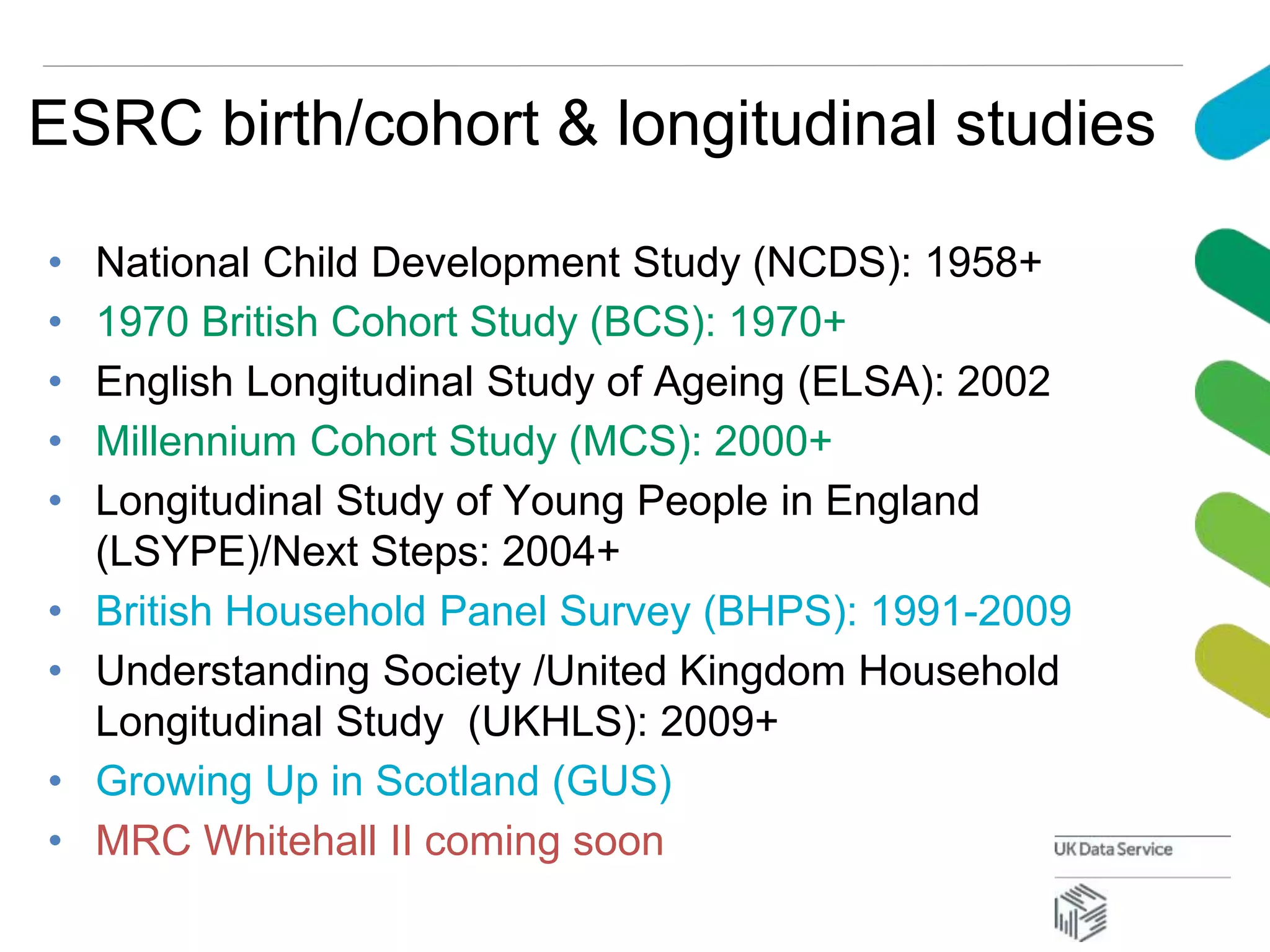
• National Child Development Study (NCDS): 1958+
• 1970 British Cohort Study (BCS): 1970+
• English Longitudinal Study of Ageing (ELSA): 2002
• Millennium Cohort Study (MCS): 2000+
• Longitudinal Study of Young People in England
(LSYPE)/Next Steps: 2004+
• British Household Panel Survey (BHPS): 1991-2009
• Understanding Society /United Kingdom Household
Longitudinal Study (UKHLS): 2009+
• Growing Up in Scotland (GUS)
• MRC Whitehall II coming soon
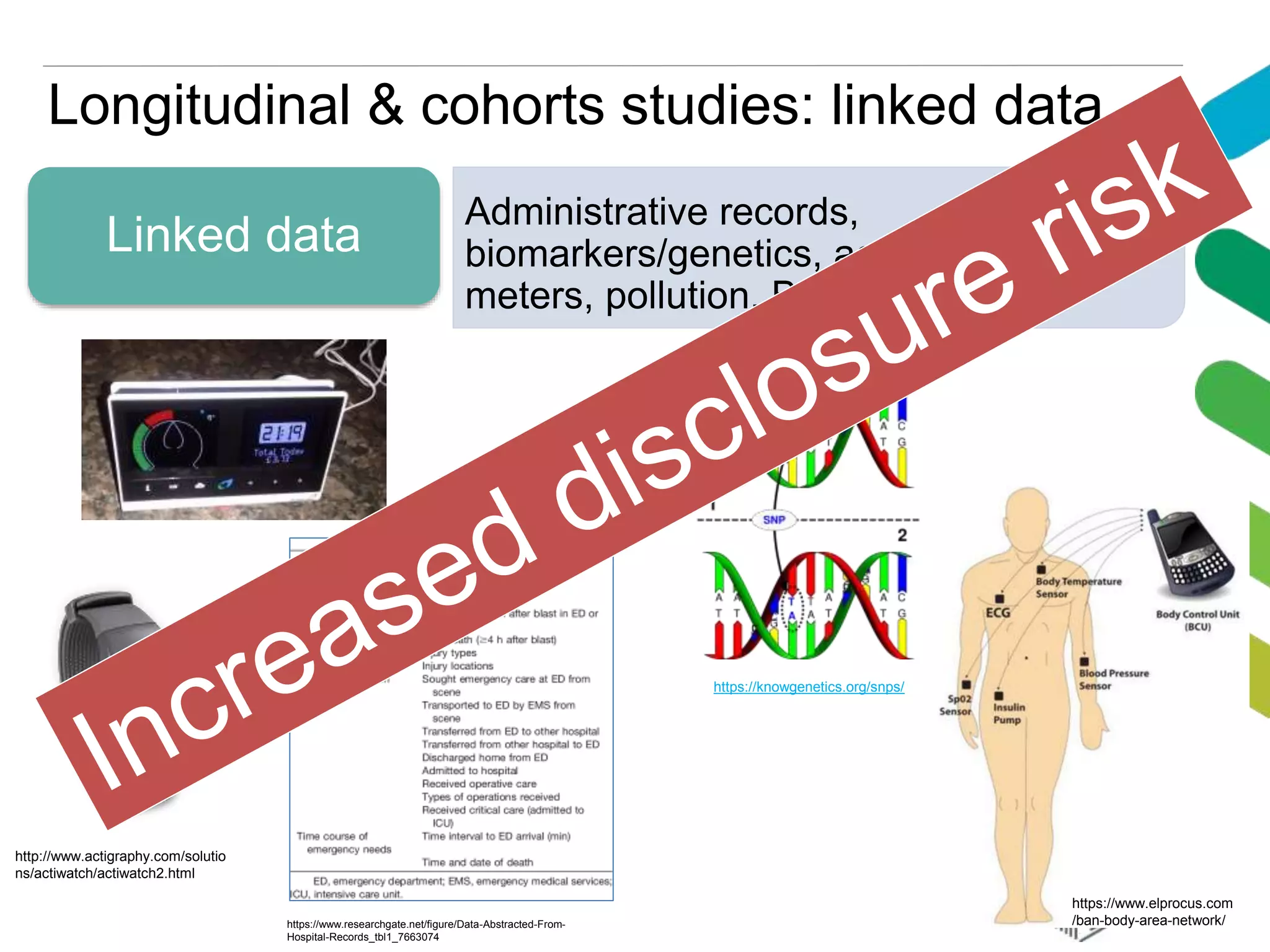
Longitudinal & cohorts studies: linked data
Linked data
Administrative records,
biomarkers/genetics, actigraphy, smart
meters, pollution, BAN etc.
https://www.researchgate.net/figure/Data-Abstracted-From-
Hospital-Records_tbl1_7663074
https://www.elprocus.com
/ban-body-area-network/
http://www.actigraphy.com/solutio
ns/actiwatch/actiwatch2.html
https://knowgenetics.org/snps/
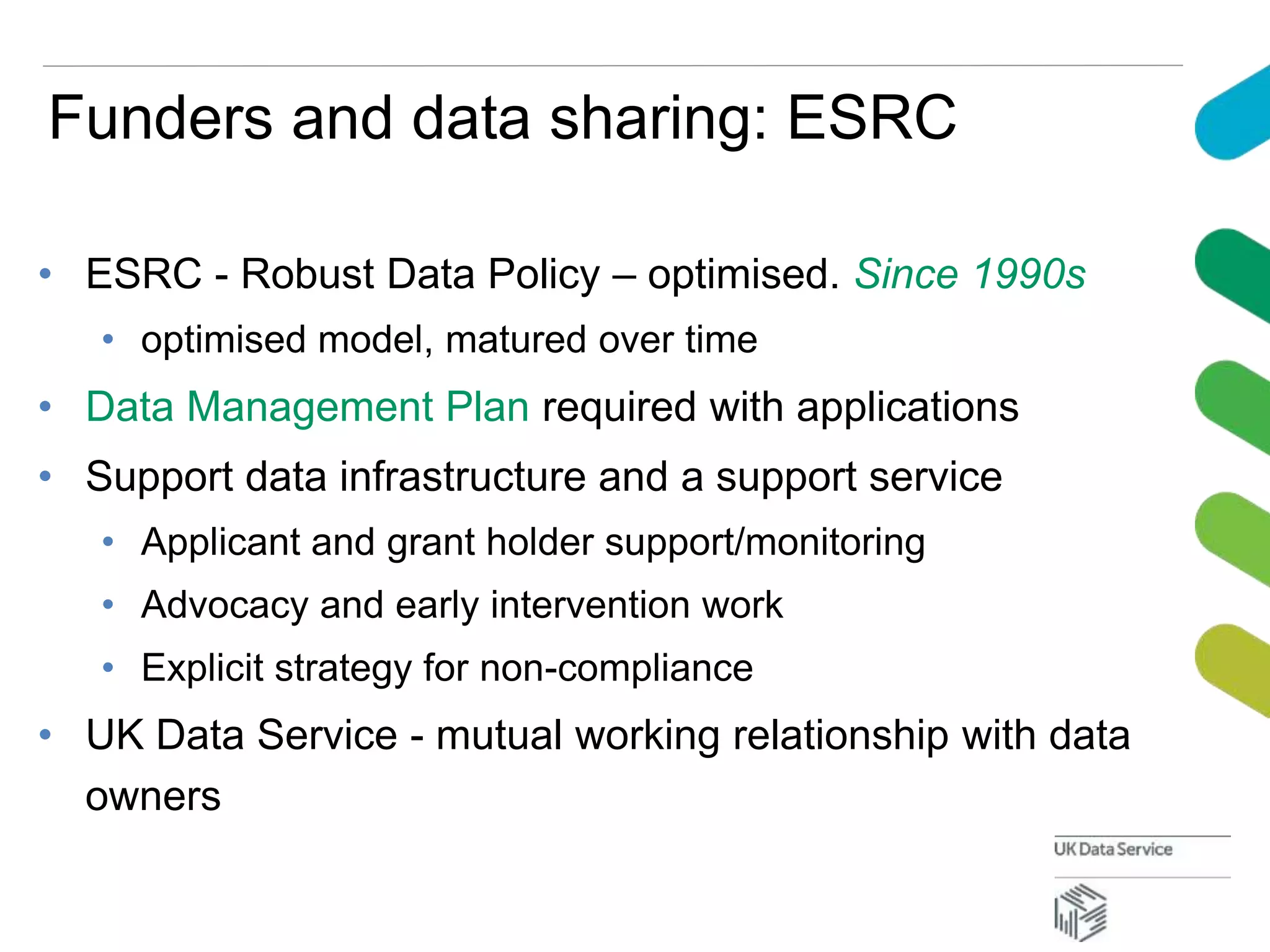
Funders and data sharing: ESRC
• ESRC - Robust Data Policy – optimised. Since 1990s
• optimised model, matured over time
• Data Management Plan required with applications
• Support data infrastructure and a support service
• Applicant and grant holder support/monitoring
• Advocacy and early intervention work
• Explicit strategy for non-compliance
• UK Data Service - mutual working relationship with data
owners
Basic data publishing requisites
✔ Usable format
✔ Long-term preserved/backed-up
✔ Self-explanatory for users
✔ Non disclosive where promised
✔ Rights are in place to redistribute
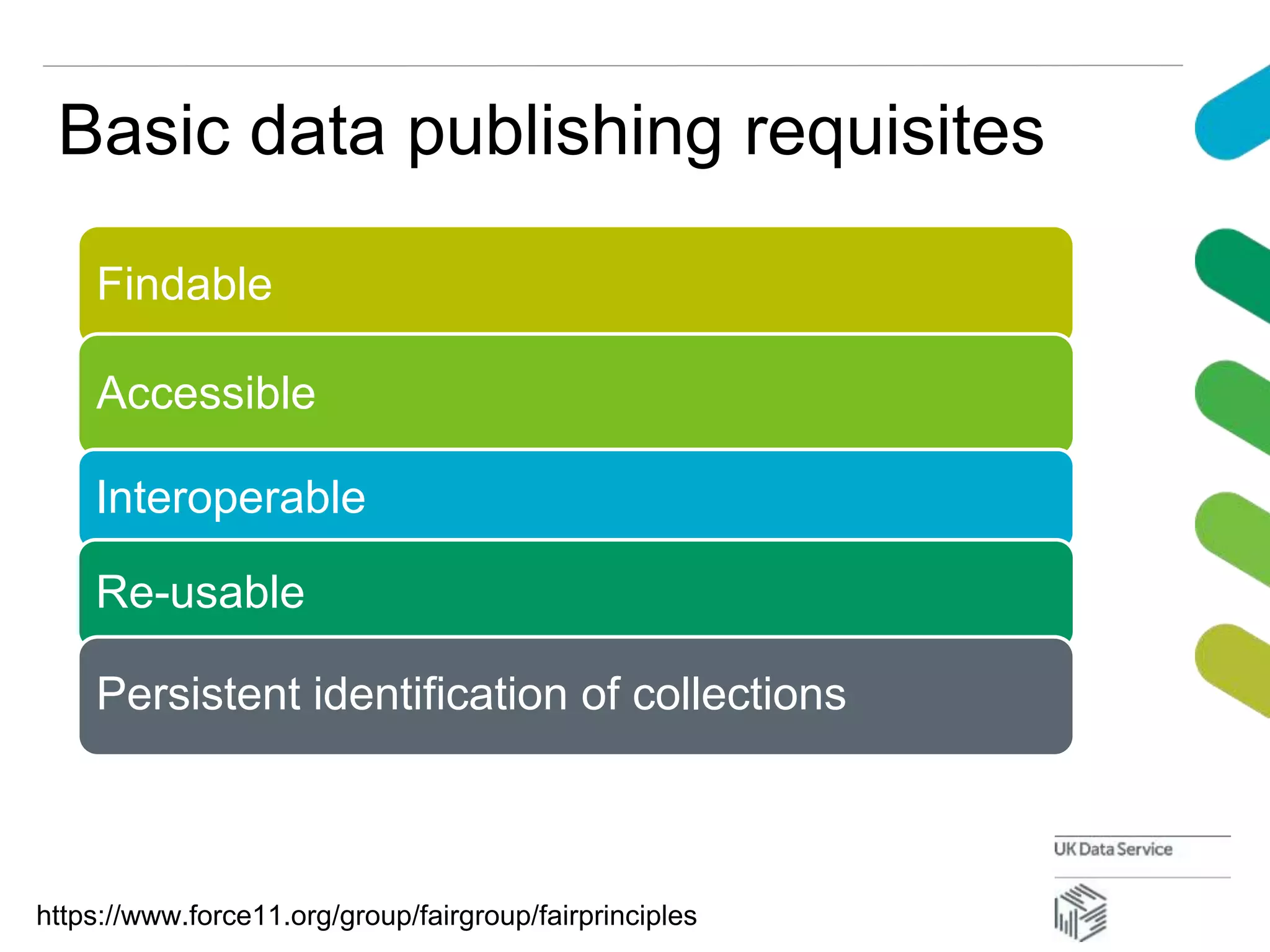
Meeting the FAIR Principles
Findable
Accessible
Interoperable
Re-usable
Persistent identification of collections
https://www.force11.org/group/fairgroup/fairprinciples
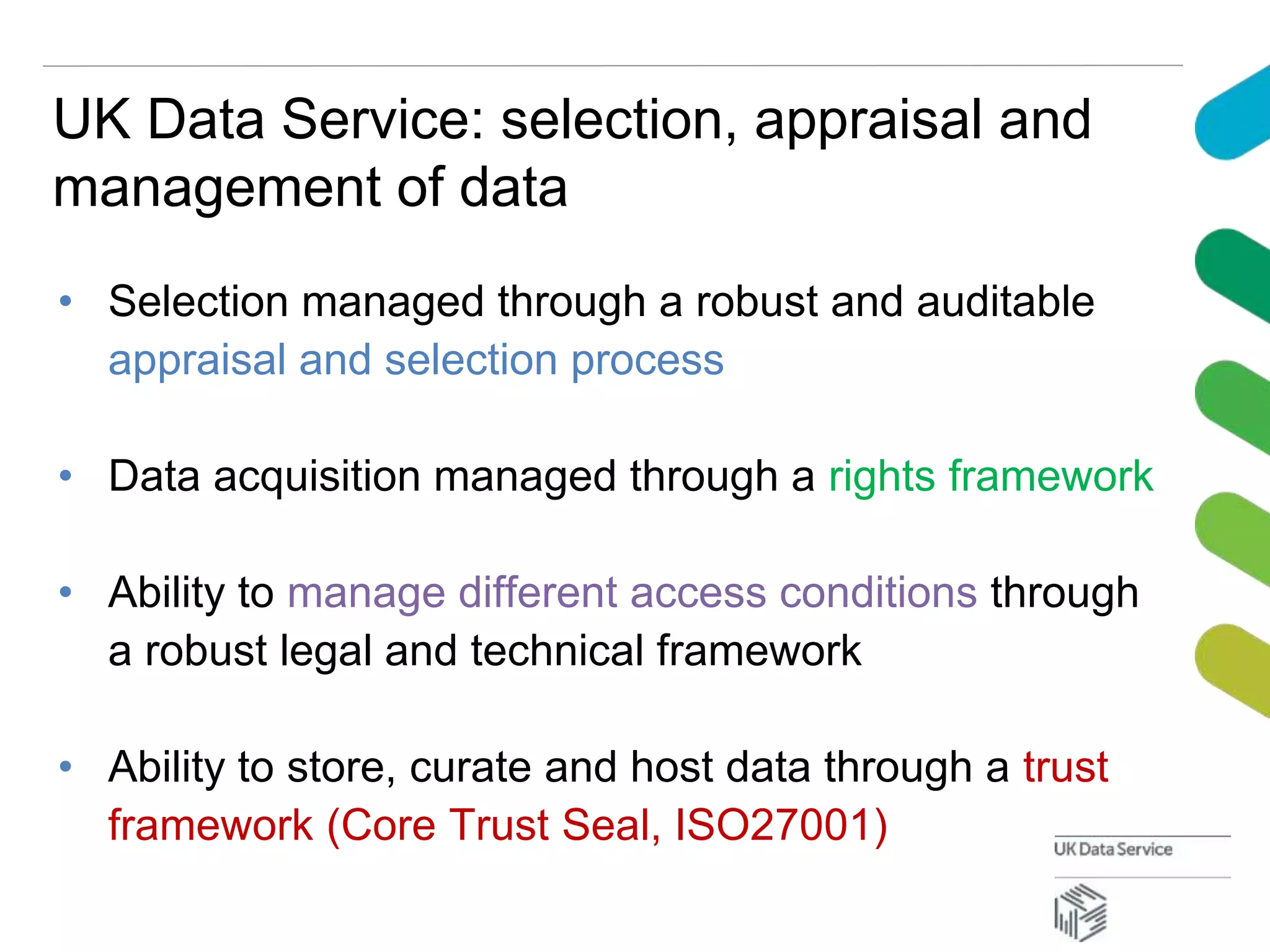
UK Data Service: selection, appraisal and
management of data
• Selection managed through a robust and auditable
appraisal and selection process
• Data acquisition managed through a rights framework
• Ability to manage different access conditions through
a robust legal and technical framework
• Ability to store, curate and host data through a trust
framework (Core Trust Seal, ISO27001)
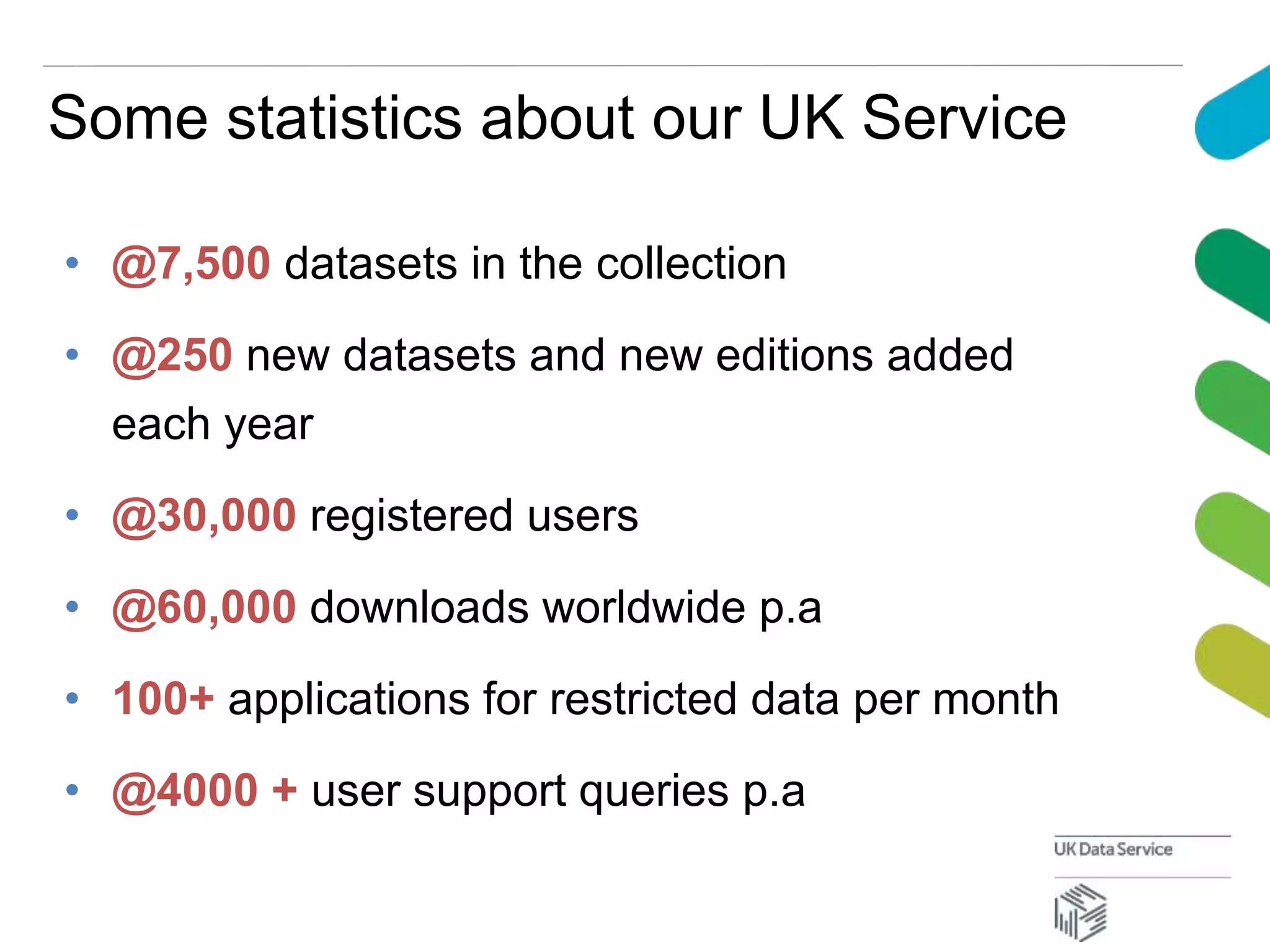
Some statistics about our UK Service
• @7,500 datasets in the collection
• @250 new datasets and new editions added
each year
• @30,000 registered users
• @60,000 downloads worldwide p.a
• 100+ applications for restricted data per month
• @4000 + user support queries p.a
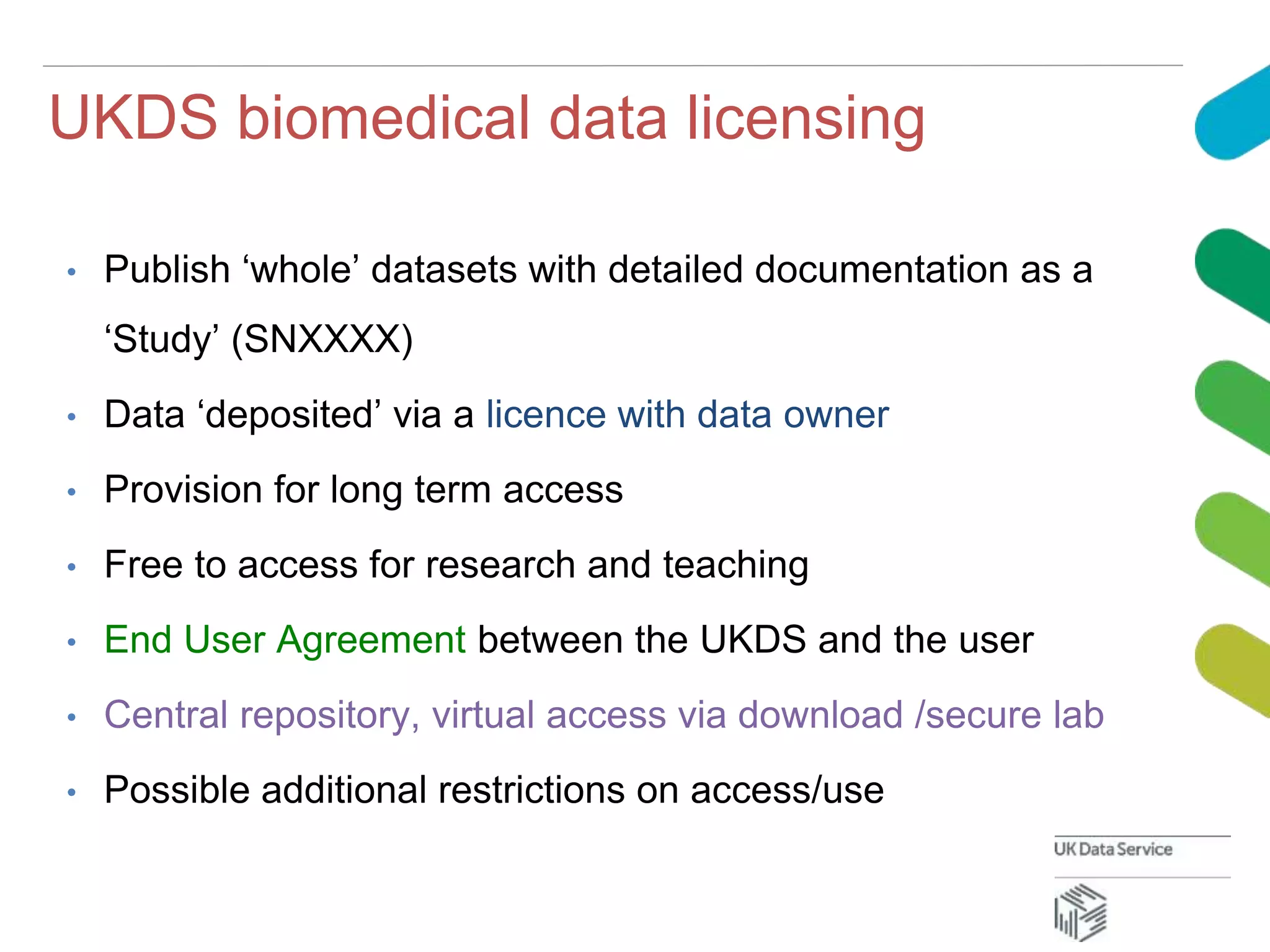
UKDS biomedical data licensing
• Publish ‘whole’ datasets with detailed documentation as a
‘Study’ (SNXXXX)
• Data ‘deposited’ via a licence with data owner
• Provision for long term access
• Free to access for research and teaching
• End User Agreement between the UKDS and the user
• Central repository, virtual access via download /secure lab
• Possible additional restrictions on access/use
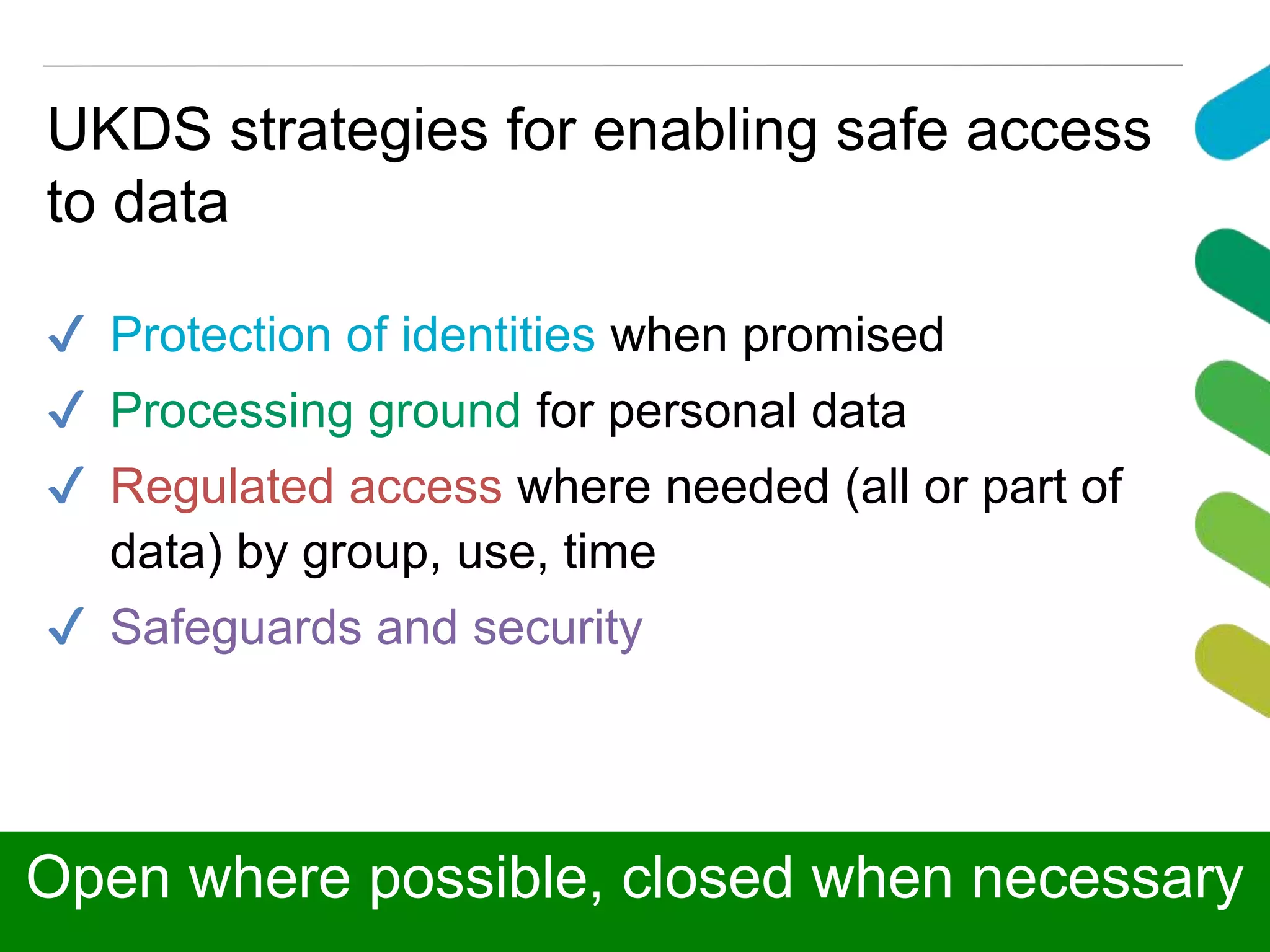
UKDS strategies for enabling safe access
to data
✔ Protection of identities when promised
✔ Processing ground for personal data
✔ Regulated access where needed (all or part of
data) by group, use, time
✔ Safeguards and security
Open where possible, closed when necessary
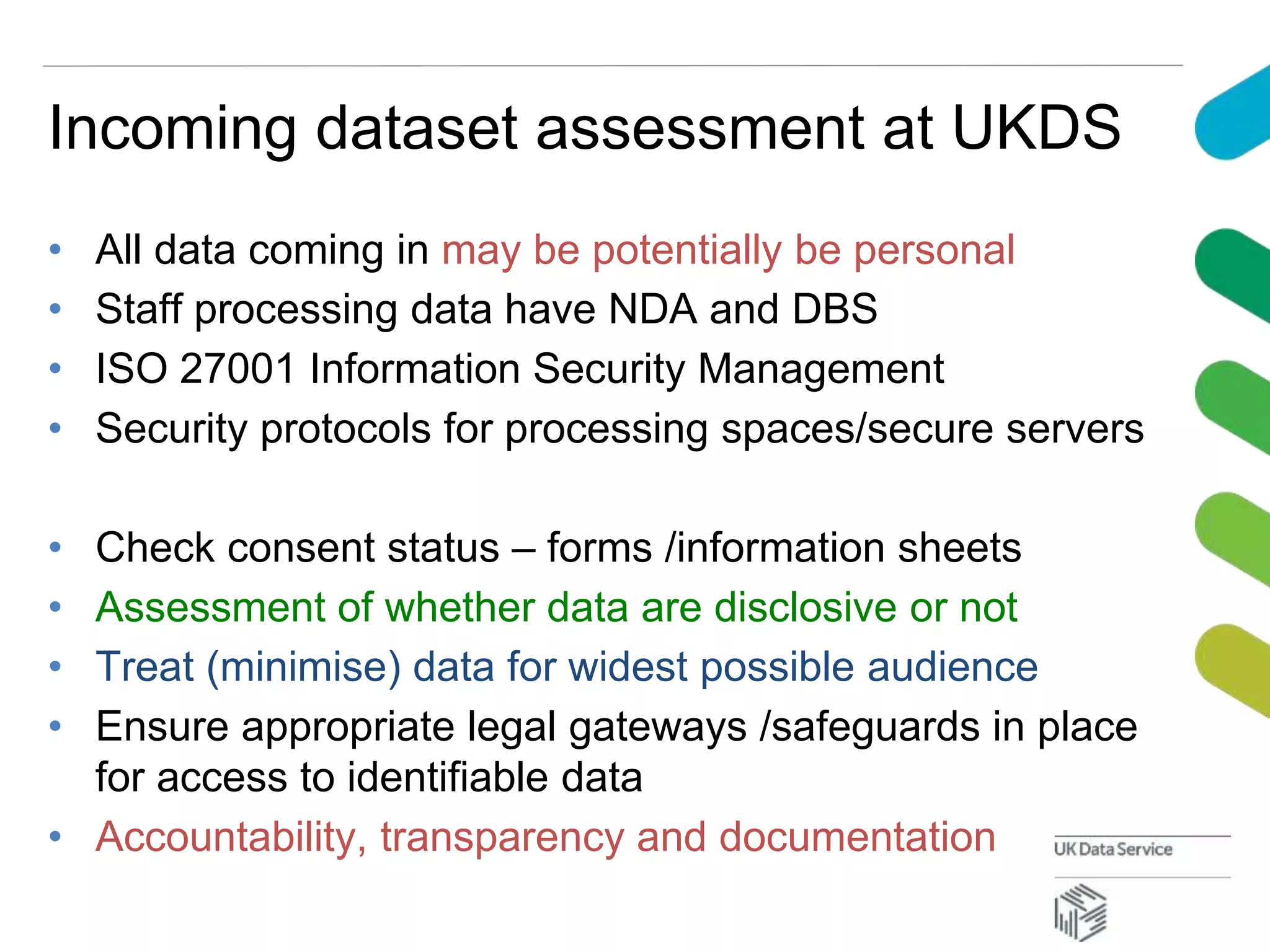
Incoming dataset assessment at UKDS
• All data coming in may be potentially be personal
• Staff processing data have NDA and DBS
• ISO 27001 Information Security Management
• Security protocols for processing spaces/secure servers
• Check consent status – forms /information sheets
• Assessment of whether data are disclosive or not
• Treat (minimise) data for widest possible audience
• Ensure appropriate legal gateways /safeguards in place
for access to identifiable data
• Accountability, transparency and documentation
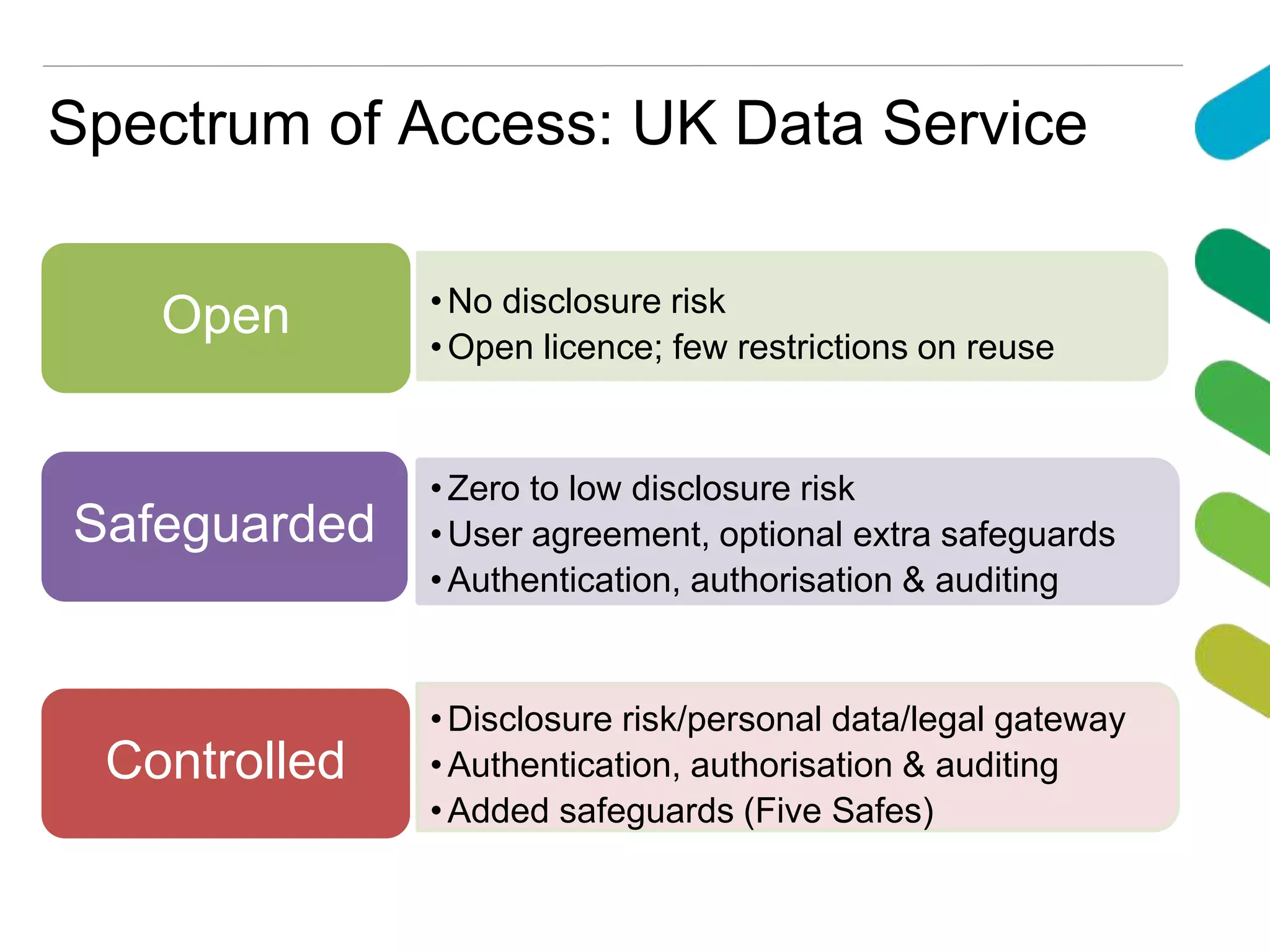
Spectrum of Access: UK Data Service
Open •No disclosure risk
•Open licence; few restrictions on reuse
Safeguarded
•Zero to low disclosure risk
•User agreement, optional extra safeguards
•Authentication, authorisation & auditing
Controlled
•Disclosure risk/personal data/legal gateway
•Authentication, authorisation & auditing
•Added safeguards (Five Safes)
The challenges of personal identification
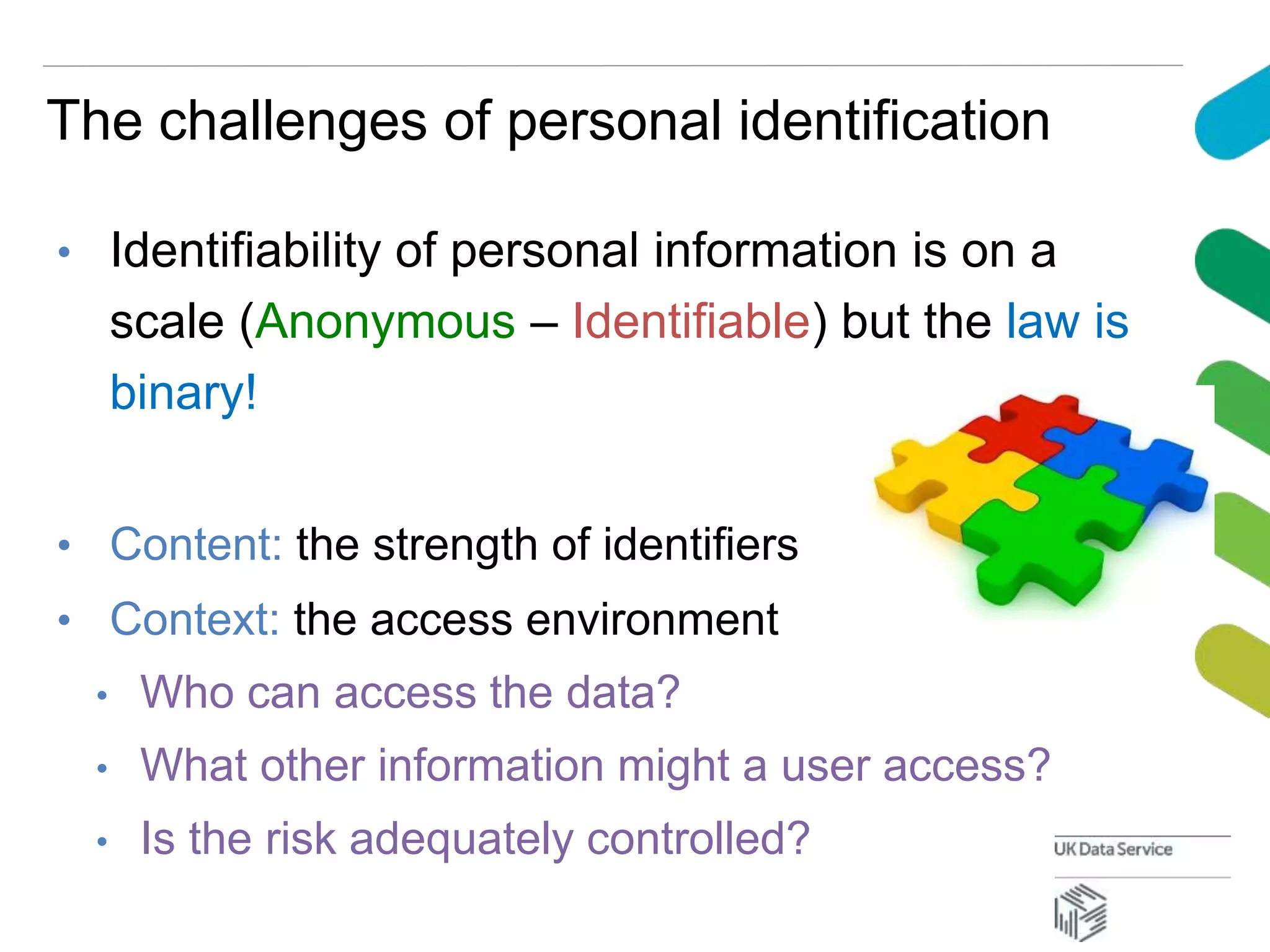
• Identifiability of personal information is on a
scale (Anonymous – Identifiable) but the law is
binary!
• Content: the strength of identifiers
• Context: the access environment
• Who can access the data?
• What other information might a user access?
• Is the risk adequately controlled?
The problem with classifying risk
• Data access must involve reduction of risk in a manner
acceptable to the data owner
• Risk is mitigated by legal gateways and appropriate
safeguards
• We seek to control context making identification not
‘reasonably likely’ by any likely means
• ICO: ‘Reasonable likelihood’ is the test vs. hypothetical
risk
……More from Cristina later
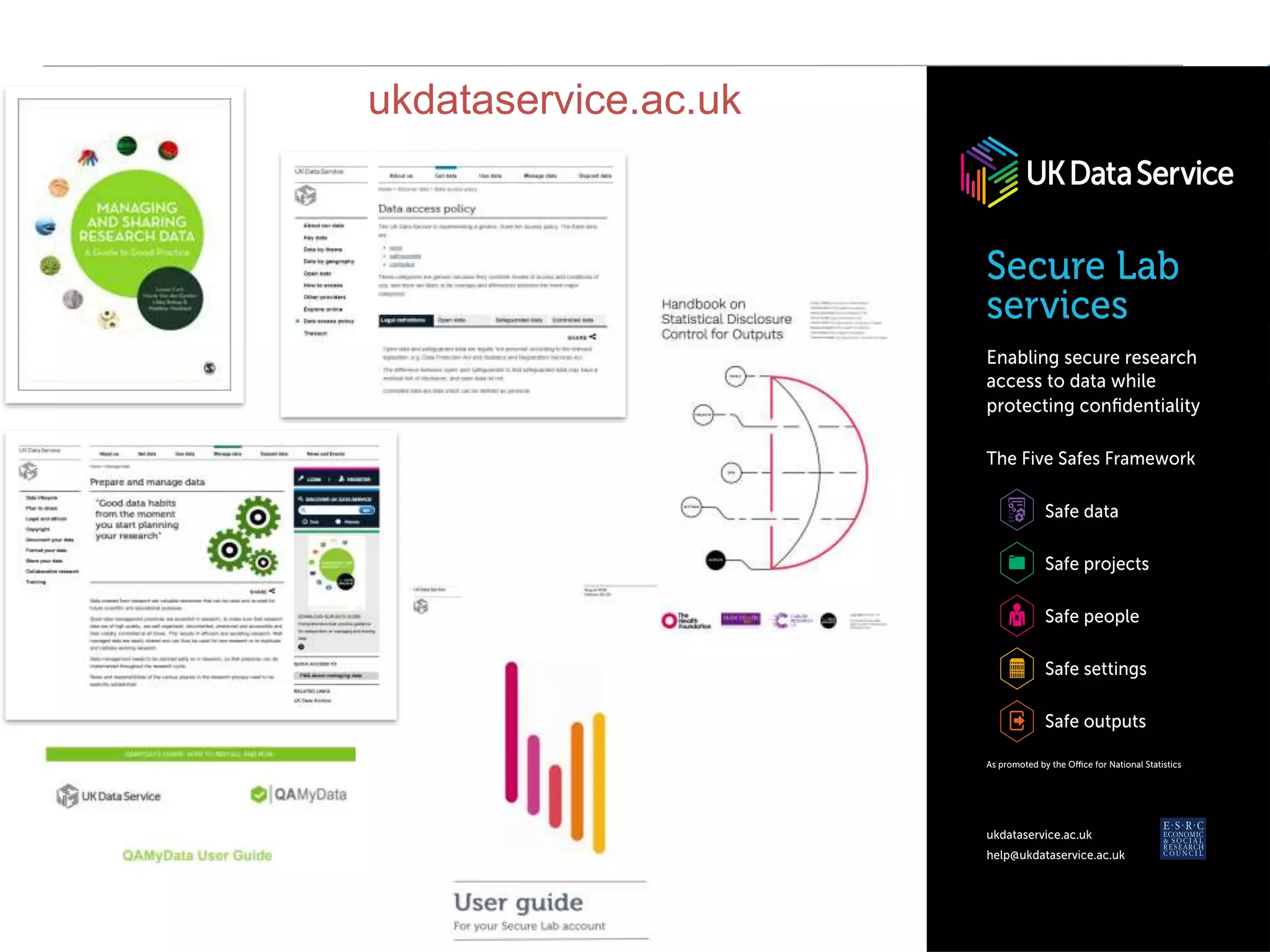
Safeguards: use of the Fives Safes Framework
Fives Safes enables safe access to data that meet
the needs of data protection yet fulfils the demands
for open science and transparency
• Safe data - treat data to protect confidentiality
• Safe people - educate researchers to use data safely
• Safe projects - research projects for ‘public good’
• Safe settings – Secure Lab environment for personal data
• Safe outputs – Secure Lab projects outputs screened
5 Safes Animation
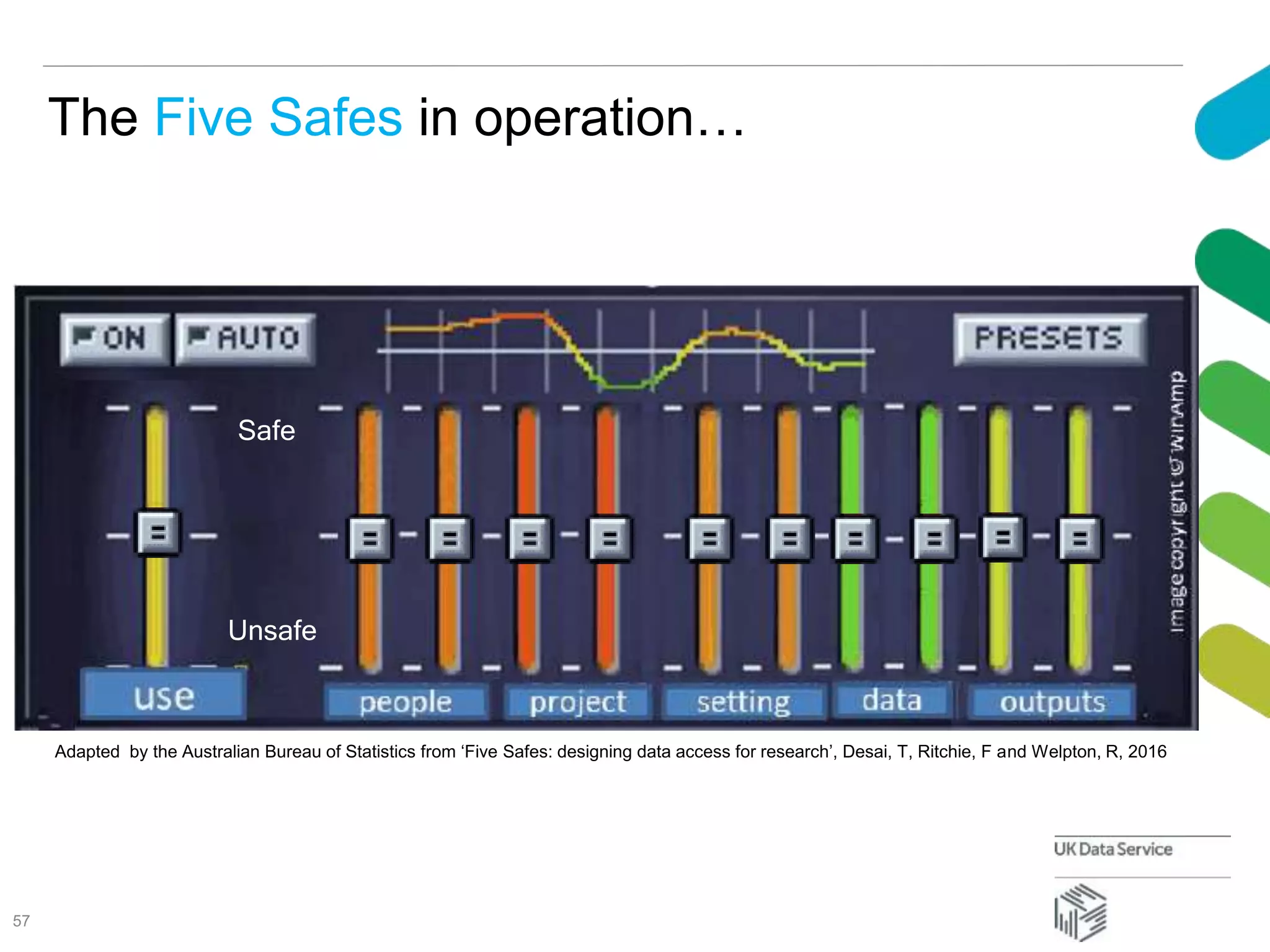
The Five Safes in operation…
Adapted by the Australian Bureau of Statistics from ‘Five Safes: designing data access for research’, Desai, T, Ritchie, F and Welpton, R, 2016
Safe
Unsafe
57
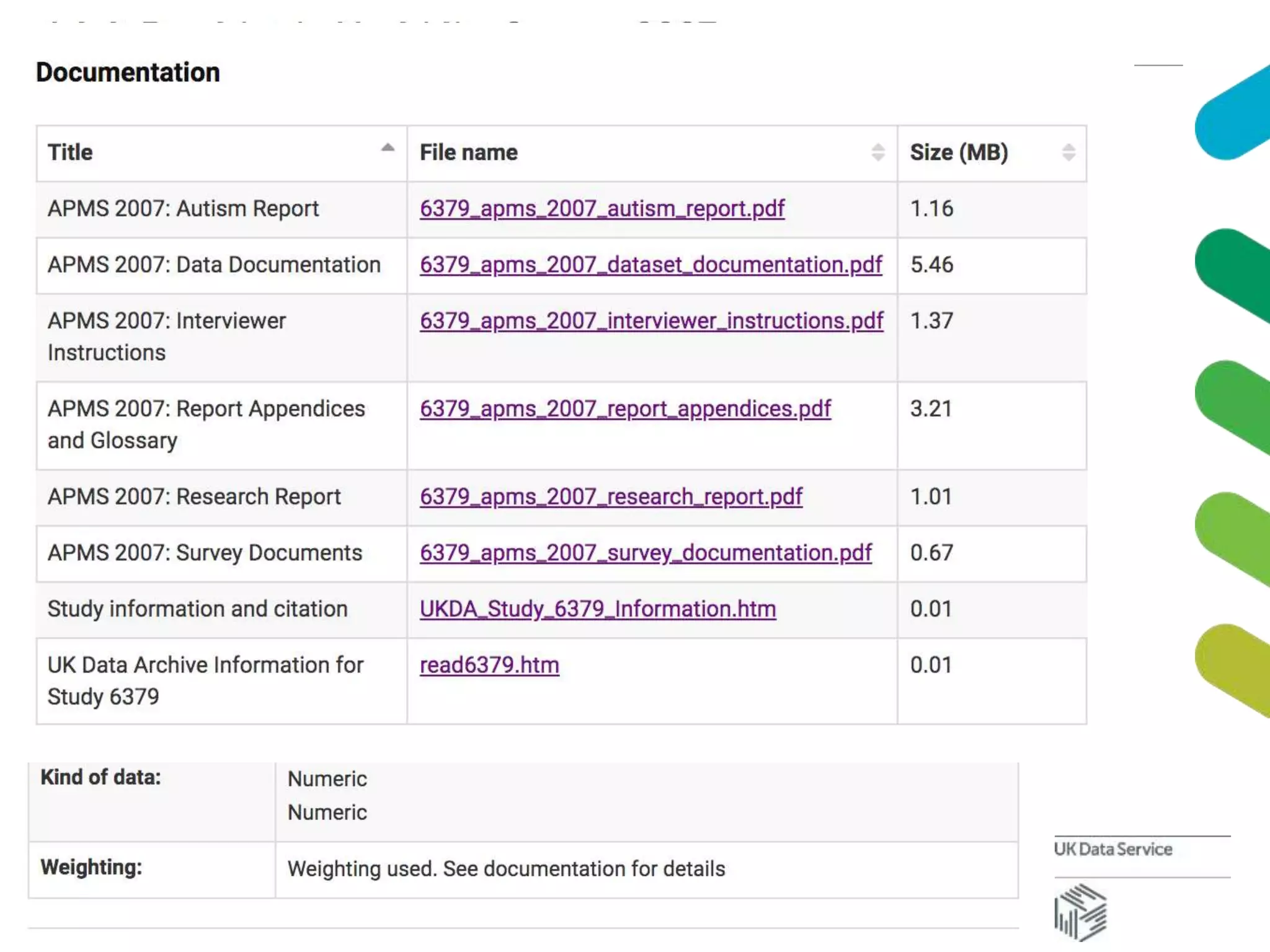
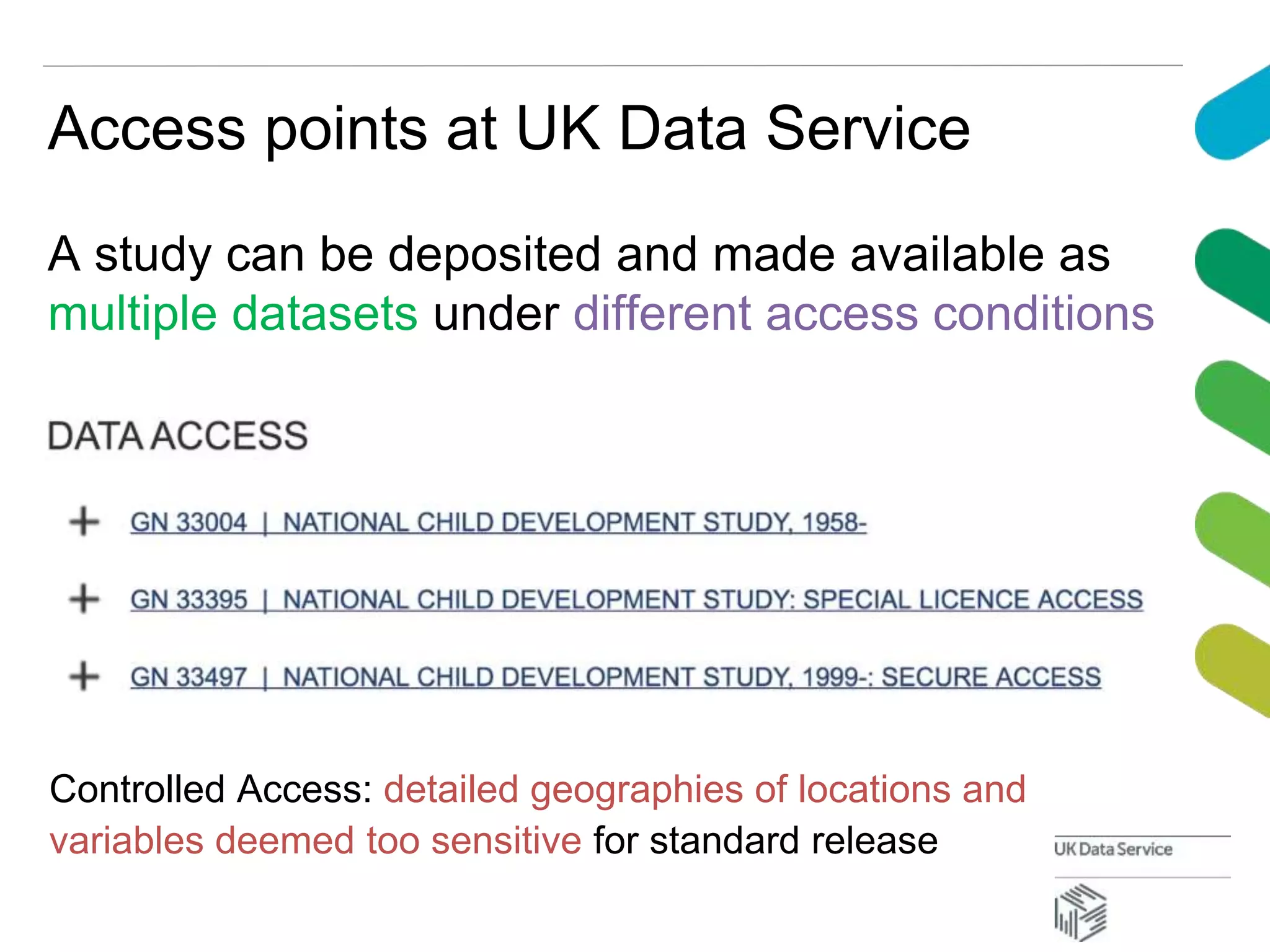
Access points at UK Data Service
A study can be deposited and made available as
multiple datasets under different access conditions
Controlled Access: detailed geographies of locations and
variables deemed too sensitive for standard release
Consent forms wording – legacy studies
Processing personal data in the spirit of ‘reasonable
expectations’
Tests for reasonable expectations
• Is the intended processing compatible with the consent
gained and promises made?
• Implications of wording for future work/prospective
studies
• Would the participants have a reasonable understanding
of what was going to happen in the future?
ukdataservice.ac.uk
Contact:
dcmagd@essex.ac.uk
@ChristinaMagder
corti@essex.ac.uk
@LouiseCorti
@UKDataService
@UKDSRDM
#sdc-microdata

Accessing data for research: data publishing pathways and the Five Safes

  • 1.
    Accessing data forresearch: data publishing pathways and the Five Safes Louise Corti UK Data Service Assessing Disclosure Risk in Population Research Data and Outputs Children of the 90s (ALSPAC) Bristol Medical School 24 January 2020
  • 2.
    Our organisation: theUK Data Archive • Department of the University of Essex • Founded 1967 by ESRC as a ‘Data Bank’ for science science • Over 50 years of curating and providing access to data for research and teaching • A Trusted Digital Repository (TDR) and accredited to ISO27001 Info Security Management standard • Lead the national UK Data Service • Work closely with research funders and data producers
  • 3.
    Types of dataheld Social survey One off large scale survey e.g. Health Survey for England Longitudinal/cohort Detailed surveys following people over time, e.g British birth cohorts Qualitative Interviews, focus groups, diaries Aggregate data UK census counts/tables, country level statistics Historical data Digitised databases
  • 4.
    Health surveys heldby UK Data Service • Health Survey for England • Scottish Health Survey/Welsh Health Survey • National Diet and Nutrition Survey • Adult Psychiatric Morbidity Survey • Scottish Maternal and Infant Nutrition Survey • National Cancer Patient Experience Survey • National Awareness And Early Diagnosis Initiative: Cancer Awareness Measure, Arden Cancer Network
  • 5.
    ESRC birth/cohort &longitudinal studies • National Child Development Study (NCDS): 1958+ • 1970 British Cohort Study (BCS): 1970+ • English Longitudinal Study of Ageing (ELSA): 2002 • Millennium Cohort Study (MCS): 2000+ • Longitudinal Study of Young People in England (LSYPE)/Next Steps: 2004+ • British Household Panel Survey (BHPS): 1991-2009 • Understanding Society /United Kingdom Household Longitudinal Study (UKHLS): 2009+ • Growing Up in Scotland (GUS) • MRC Whitehall II coming soon
  • 6.
    Longitudinal & cohortsstudies: linked data Linked data Administrative records, biomarkers/genetics, actigraphy, smart meters, pollution, BAN etc. https://www.researchgate.net/figure/Data-Abstracted-From- Hospital-Records_tbl1_7663074 https://www.elprocus.com /ban-body-area-network/ http://www.actigraphy.com/solutio ns/actiwatch/actiwatch2.html https://knowgenetics.org/snps/
  • 7.
    Funders and datasharing: ESRC • ESRC - Robust Data Policy – optimised. Since 1990s • optimised model, matured over time • Data Management Plan required with applications • Support data infrastructure and a support service • Applicant and grant holder support/monitoring • Advocacy and early intervention work • Explicit strategy for non-compliance • UK Data Service - mutual working relationship with data owners
  • 8.
    Basic data publishingrequisites ✔ Usable format ✔ Long-term preserved/backed-up ✔ Self-explanatory for users ✔ Non disclosive where promised ✔ Rights are in place to redistribute Meeting the FAIR Principles Findable Accessible Interoperable Re-usable Persistent identification of collections https://www.force11.org/group/fairgroup/fairprinciples
  • 9.
    UK Data Service:selection, appraisal and management of data • Selection managed through a robust and auditable appraisal and selection process • Data acquisition managed through a rights framework • Ability to manage different access conditions through a robust legal and technical framework • Ability to store, curate and host data through a trust framework (Core Trust Seal, ISO27001)
  • 10.
    Some statistics aboutour UK Service • @7,500 datasets in the collection • @250 new datasets and new editions added each year • @30,000 registered users • @60,000 downloads worldwide p.a • 100+ applications for restricted data per month • @4000 + user support queries p.a
  • 11.
    UKDS biomedical datalicensing • Publish ‘whole’ datasets with detailed documentation as a ‘Study’ (SNXXXX) • Data ‘deposited’ via a licence with data owner • Provision for long term access • Free to access for research and teaching • End User Agreement between the UKDS and the user • Central repository, virtual access via download /secure lab • Possible additional restrictions on access/use
  • 14.
    UKDS strategies forenabling safe access to data ✔ Protection of identities when promised ✔ Processing ground for personal data ✔ Regulated access where needed (all or part of data) by group, use, time ✔ Safeguards and security Open where possible, closed when necessary
  • 15.
    Incoming dataset assessmentat UKDS • All data coming in may be potentially be personal • Staff processing data have NDA and DBS • ISO 27001 Information Security Management • Security protocols for processing spaces/secure servers • Check consent status – forms /information sheets • Assessment of whether data are disclosive or not • Treat (minimise) data for widest possible audience • Ensure appropriate legal gateways /safeguards in place for access to identifiable data • Accountability, transparency and documentation
  • 16.
    Spectrum of Access:UK Data Service Open •No disclosure risk •Open licence; few restrictions on reuse Safeguarded •Zero to low disclosure risk •User agreement, optional extra safeguards •Authentication, authorisation & auditing Controlled •Disclosure risk/personal data/legal gateway •Authentication, authorisation & auditing •Added safeguards (Five Safes)
  • 17.
    The challenges ofpersonal identification • Identifiability of personal information is on a scale (Anonymous – Identifiable) but the law is binary! • Content: the strength of identifiers • Context: the access environment • Who can access the data? • What other information might a user access? • Is the risk adequately controlled?
  • 18.
    The problem withclassifying risk • Data access must involve reduction of risk in a manner acceptable to the data owner • Risk is mitigated by legal gateways and appropriate safeguards • We seek to control context making identification not ‘reasonably likely’ by any likely means • ICO: ‘Reasonable likelihood’ is the test vs. hypothetical risk ……More from Cristina later
  • 19.
    Safeguards: use ofthe Fives Safes Framework Fives Safes enables safe access to data that meet the needs of data protection yet fulfils the demands for open science and transparency • Safe data - treat data to protect confidentiality • Safe people - educate researchers to use data safely • Safe projects - research projects for ‘public good’ • Safe settings – Secure Lab environment for personal data • Safe outputs – Secure Lab projects outputs screened 5 Safes Animation
  • 20.
    The Five Safesin operation… Adapted by the Australian Bureau of Statistics from ‘Five Safes: designing data access for research’, Desai, T, Ritchie, F and Welpton, R, 2016 Safe Unsafe 57
  • 21.
    Access points atUK Data Service A study can be deposited and made available as multiple datasets under different access conditions Controlled Access: detailed geographies of locations and variables deemed too sensitive for standard release
  • 22.
    Consent forms wording– legacy studies Processing personal data in the spirit of ‘reasonable expectations’ Tests for reasonable expectations • Is the intended processing compatible with the consent gained and promises made? • Implications of wording for future work/prospective studies • Would the participants have a reasonable understanding of what was going to happen in the future?
  • 23.
  • 24.