© 2008 Thomson South-Western
CHAPTER 4CHAPTER 4
MANAGING YOURMANAGING YOUR
CASH AND SAVINGSCASH AND SAVINGS
4-2
Role of Cash Management in
Personal Financial Planning
 Cash management deals with the
routine, day-to-day use of liquid
assets.
–Liquid assets consist of cash and
other assets that can be converted
easily to cash with little or no loss in
value.
4-3
Examples of Liquid Assets
 Cash
 Checking Accounts
 Savings Accounts
 Money Market Deposit Accounts
 Money Market Mutual Funds
 U.S. Treasury Bills
 EE Savings Bonds
 Certificates of Deposit (shorter-
term)
4-4
The Financial Services
Marketplace
 Financial products
– checking and
savings accounts
– credit cards
– loans and
mortgages
– insurance
– mutual funds
 Financial services
– financial planning
– tax preparation
– brokerage services
– real estate
– trusts
– retirement
– estate planning
The financial services industry markets:
4-5
Types of Financial
Institutions
 Depository
 Nondepository
4-6
Types of Depository
Financial Institutions
 Commercial Banks
–Largest type of traditional
financial institution.
–Offer full array of financial
services.
–Only type of financial institution
that can offer noninterest-paying
checking accounts.
4-7
Savings and Loan Associations
–Offer many of the same services as
commercial banks.
–Typically pay slightly more on savings
deposits.
–Channel depositors’ savings into mortgage
loans for purchasing and improving homes.
–Some are mutual associations.
4-8
Savings Banks
–Similar to savings and loan associations.
–Located primarily in New England states.
–Offer interest-paying checking accounts.
–Typically offer savings rates similar to those of
savings and loan associations.
–Most are mutual associations.
4-9
Credit Unions
– Provide financial products and services to specific groups of people who have a common tie.
– Qualified persons become members by purchasing a share of ownership.
– All are mutual associations; owned and sometimes operated by members.
– Typically pay interest rates higher than those of other financial institutions.
4-10
Internet Banks
–Offer online banking services.
–Feature lower fees and higher yields
than “brick-and-mortar banks.”
–Suitable for people who do not need
to physically go to a bank.
4-11
Types of Nondepository
Financial Institutions
–Stockbrokerage firms—offer cash management accounts,
money market mutual funds, wrap accounts, credit cards
–Mutual funds—offer money market mutual funds
–Life insurance companies
–Finance companies
4-12
How Safe is Your Money?
Almost all financial institutions are federally insured
by either:
 Federal Deposit Insurance Corporation (FDIC)
insures accounts at banks, savings banks, and
S&Ls.
 National Credit Union Administration (NCUA) insures
accounts at credit unions.
 Both provide government insurance up to $100,000
per depositor.
4-13
Truth-in-Savings Act of
1993
 Helps consumers evaluate terms and
costs of banking products.
 Fees, interest rates, and terms of
both checking and savings accounts
must be fully and clearly disclosed.
 Places strict controls on advertising
and what constitutes a free account.
 Standard formula for annual
percentage yield (APY) must used.
4-14
Cash Management Products
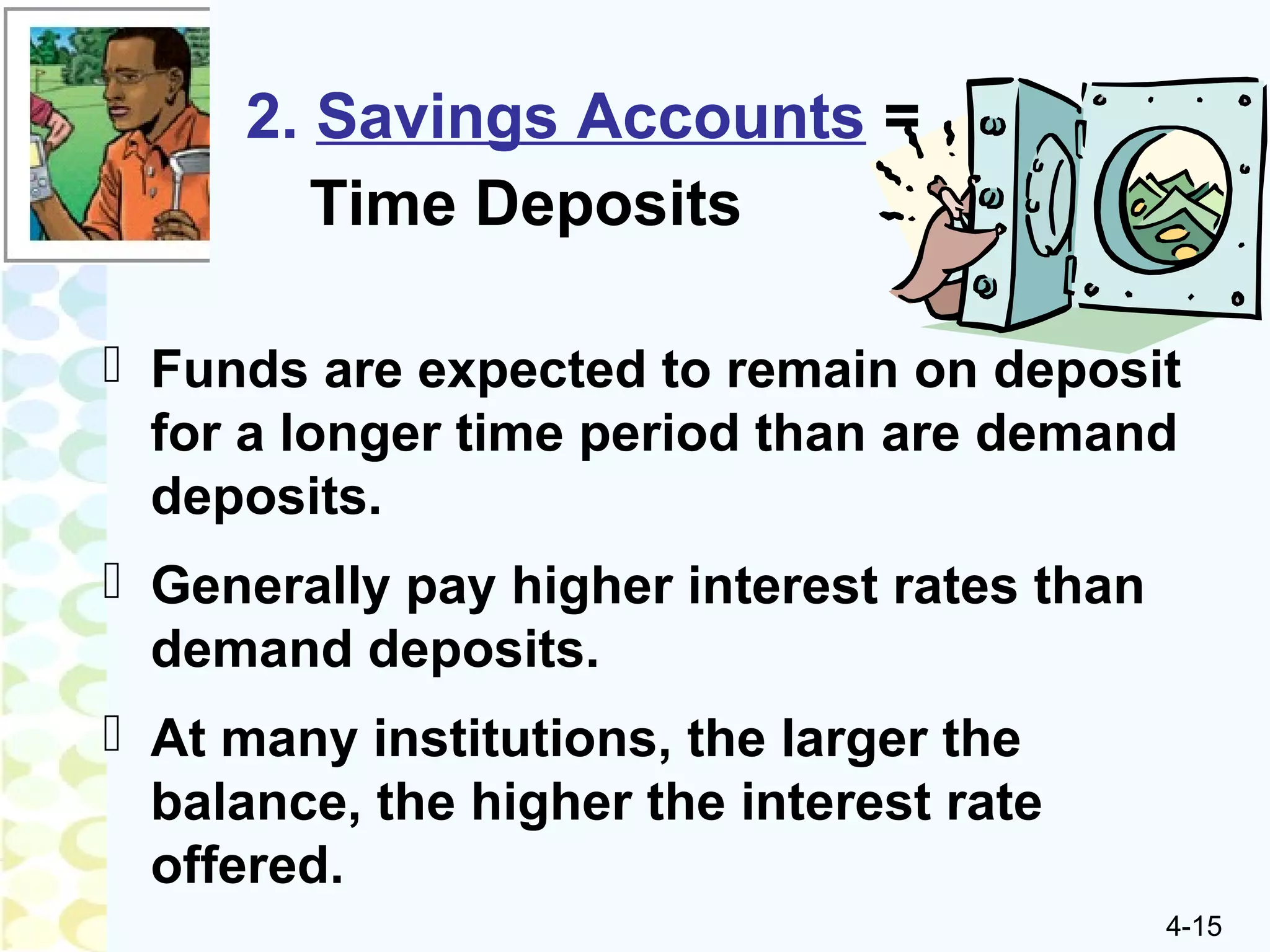
With sufficient funds,
banks must immediately
pay the amount of your
check or ATM withdrawal.
1. Checking Accounts =
Demand Deposits
4-15
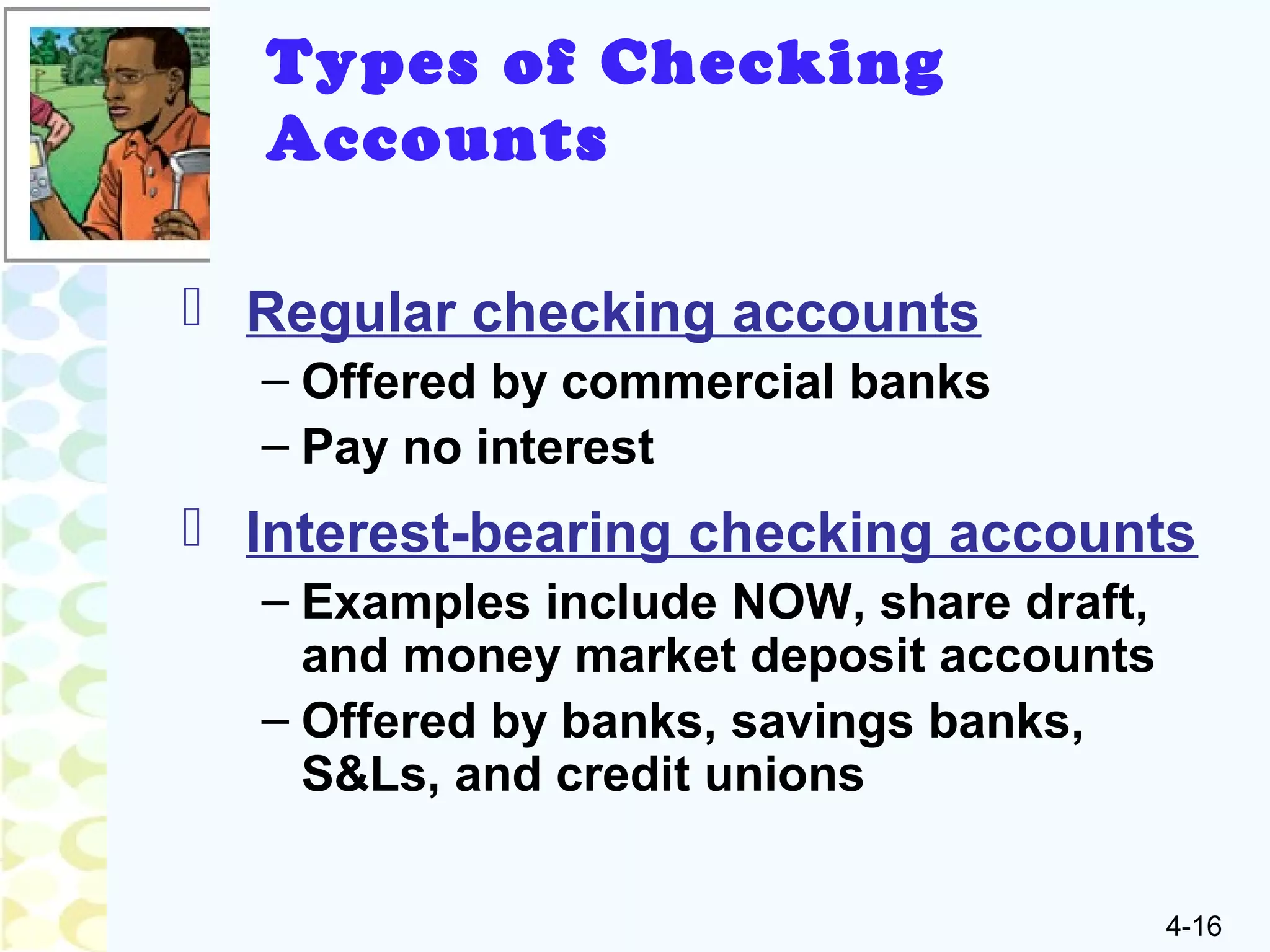
 Funds are expected to remain on deposit
for a longer time period than are demand
deposits.
 Generally pay higher interest rates than
demand deposits.
 At many institutions, the larger the
balance, the higher the interest rate
offered.
2. Savings Accounts =
Time Deposits
4-16
Types of Checking
Accounts
 Regular checking accounts
– Offered by commercial banks
– Pay no interest
 Interest-bearing checking accounts
– Examples include NOW, share draft,
and money market deposit accounts
– Offered by banks, savings banks,
S&Ls, and credit unions
4-17
– Offered by investment (mutual
fund) companies
– Not federally insured; trade on
open market
– Interest bearing; limited checks
Money Market Mutual Funds
4-18
– Primarily offered by brokerage
firms; consolidate financial
activities
– Not covered by deposit insurance
(protected by SIPC); open market
– Interest bearing; check writing
privileges
Asset Management Accounts
4-19
Other Money
Management Services
 Electronic Banking Services
Electronic Funds Transfer Systems (EFTS)
make possible
– ATM service
– Debit cards—linked to your checking account
– Pre-authorized deposits and payments
– Banking by phone
– Online banking and bill payment services
4-20
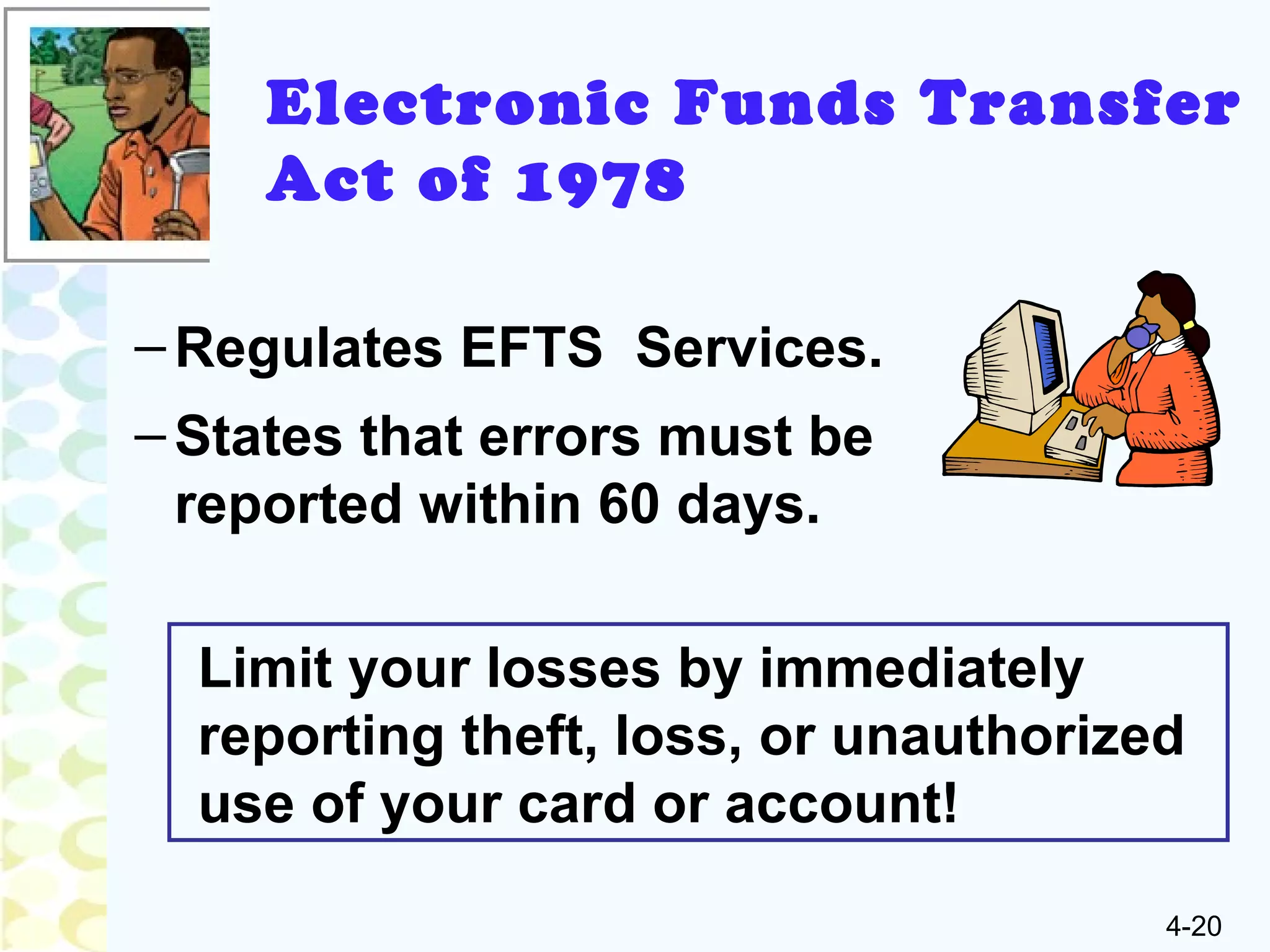
–Regulates EFTS Services.
–States that errors must be
reported within 60 days.
Electronic Funds Transfer
Act of 1978
Limit your losses by immediately
reporting theft, loss, or unauthorized
use of your card or account!
4-21
Other Bank Services
 Safe Deposit Boxes
 Trust Services—provide
investment and estate planning
advice and management for trust
accounts.
4-22
Maintaining a Checking
Account
 Determine services needed.
 Consider costs involved.
 Keep track of checks written, automatic
deposits, and ATM withdrawals.
 Don’t write checks for more than you
have in the account.
 Arrange for overdraft protection.
 Know how to stop a payment.
 Reconcile your account monthly.
4-23
Special Types of
Checks
When personal checks are not accepted,
special checks can be used to guarantee
payment.
 Cashier’s—drawn on the bank.
 Traveler’s—used for making
purchases worldwide.
 Certified—drawn on your account but
guaranteed by the bank.
4-24
Establishing A Savings
Program
 PAY YOURSELF FIRST: On payday, write
yourself a check and deposit it into a
savings account, or transfer a set amount
to savings through your debit card.
 Establish an emergency fund.
 Regularly set aside funds for financial
goals.
 Utilize direct deposits and automatic
transfers.
 Choose instruments best suited to your
goals and time horizon.
4-25
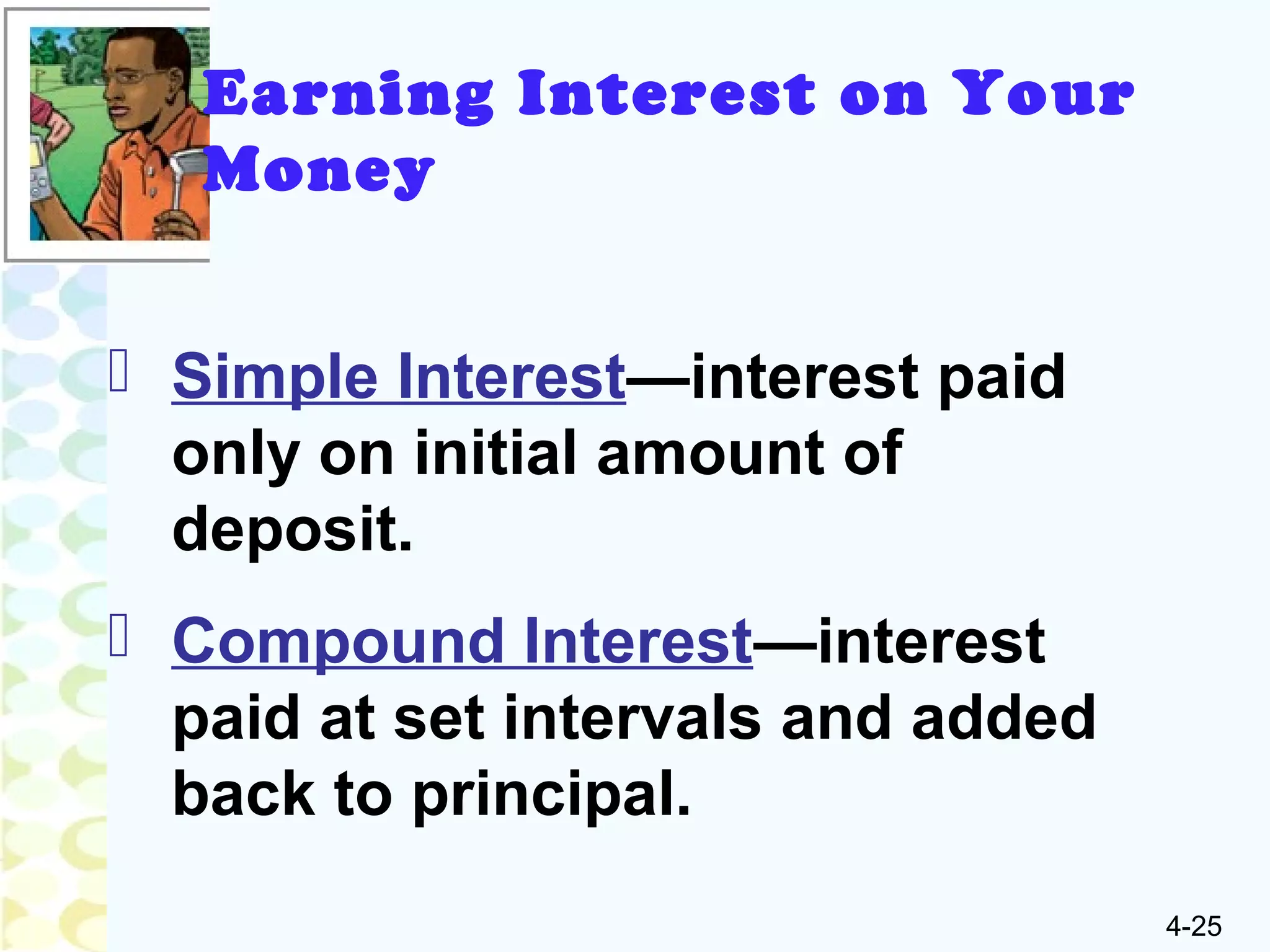
 Simple Interest—interest paid
only on initial amount of
deposit.
 Compound Interest—interest
paid at set intervals and added
back to principal.
Earning Interest on Your
Money
4-26
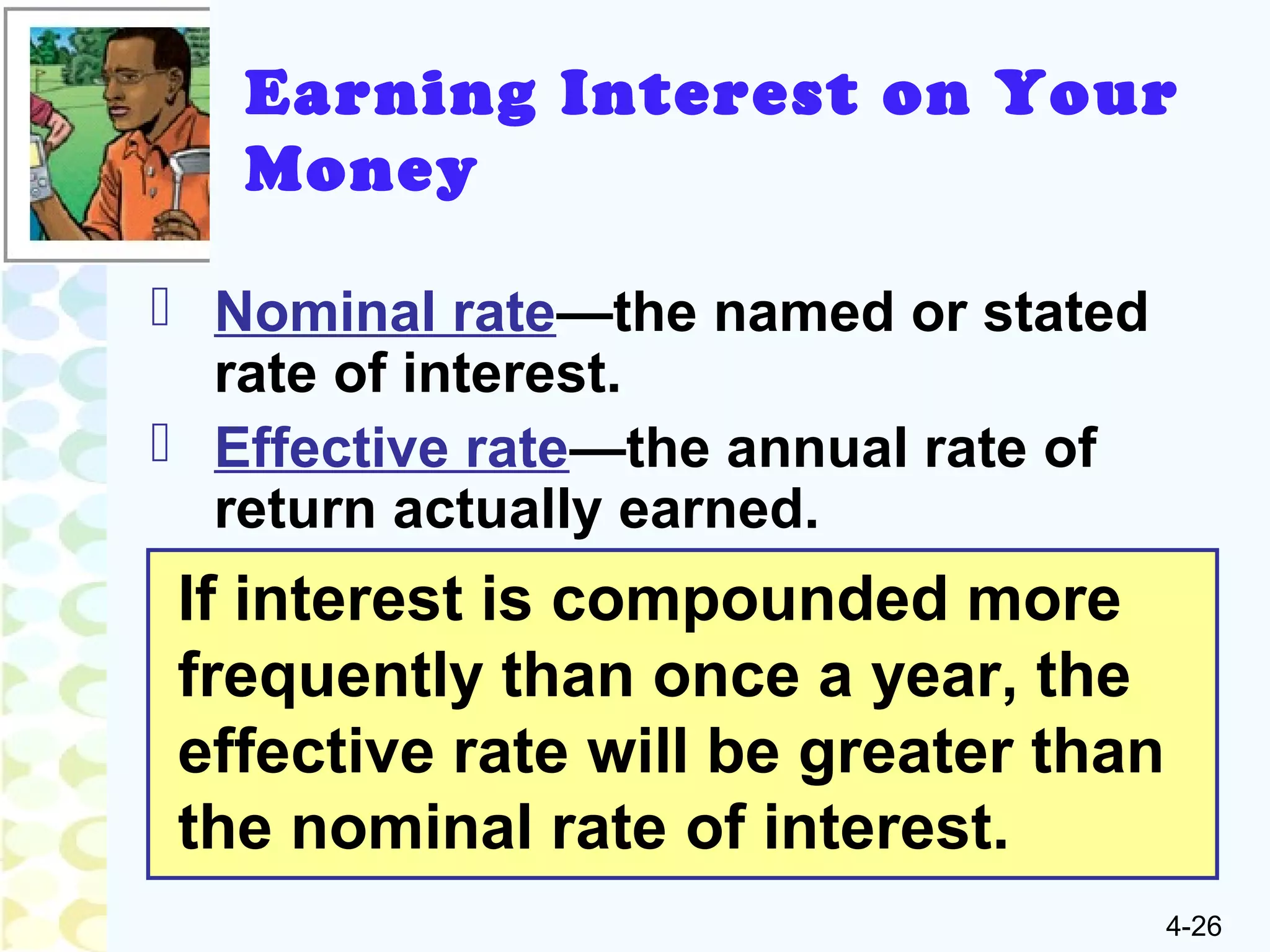
 Nominal rate—the named or stated
rate of interest.
 Effective rate—the annual rate of
return actually earned.
If interest is compounded more
frequently than once a year, the
effective rate will be greater than
the nominal rate of interest.
Earning Interest on Your
Money
4-27
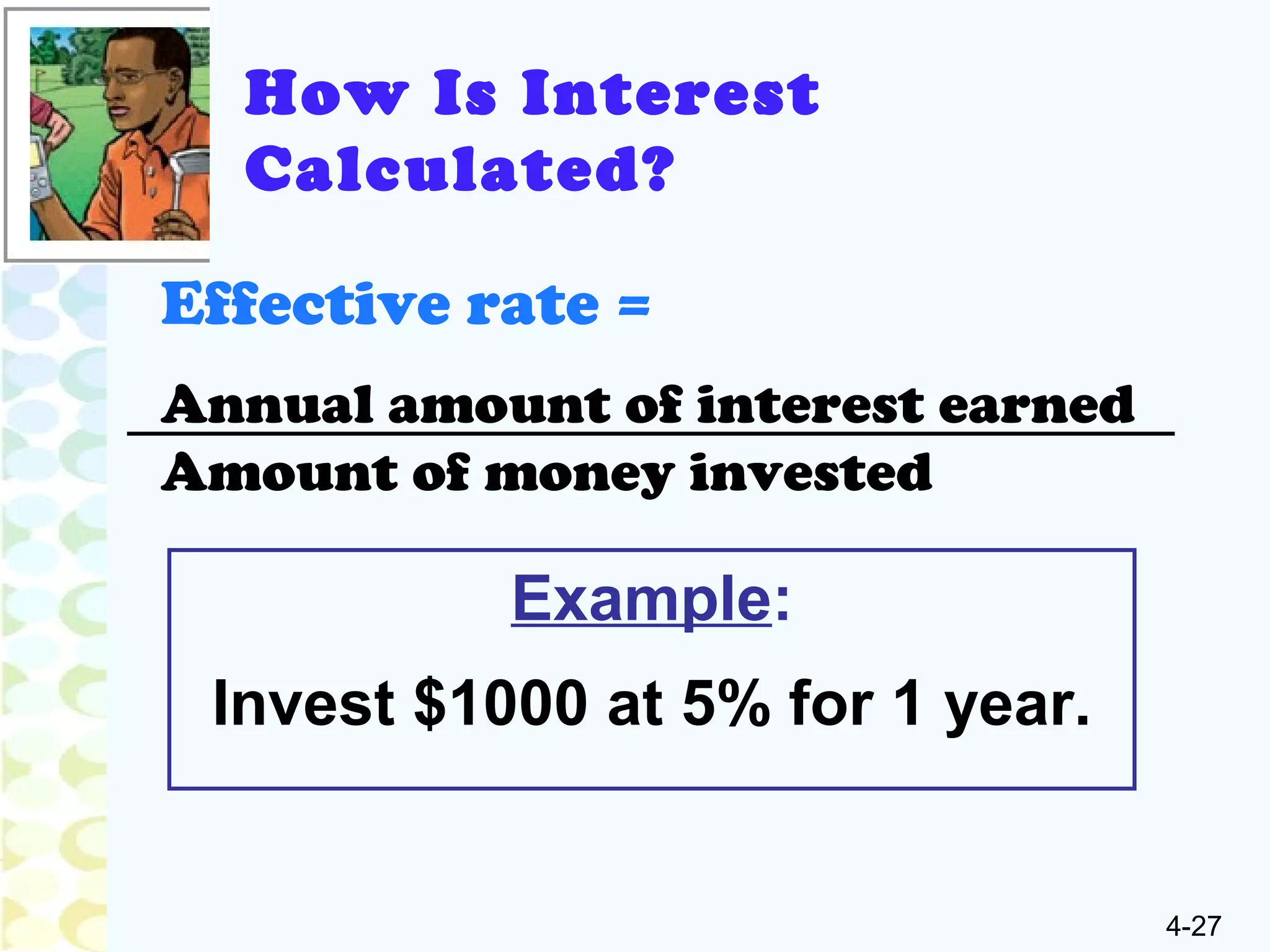
Effective rate =
Annual amount of interest earned
Amount of money invested
Example:
Invest $1000 at 5% for 1 year.
How Is Interest
Calculated?
4-28
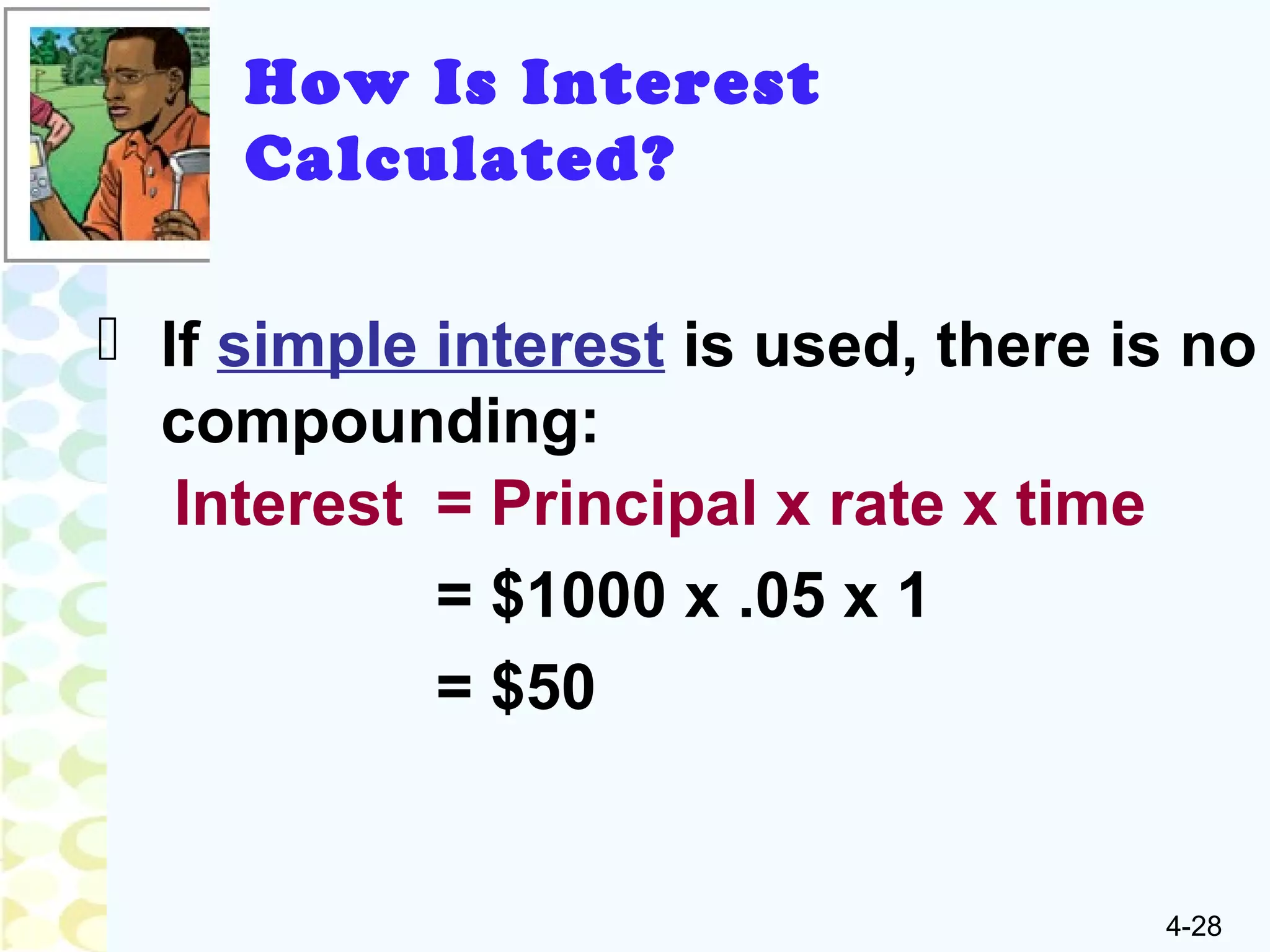
 If simple interest is used, there is no
compounding:
Interest = Principal x rate x time
= $1000 x .05 x 1
= $50
How Is Interest
Calculated?
4-29
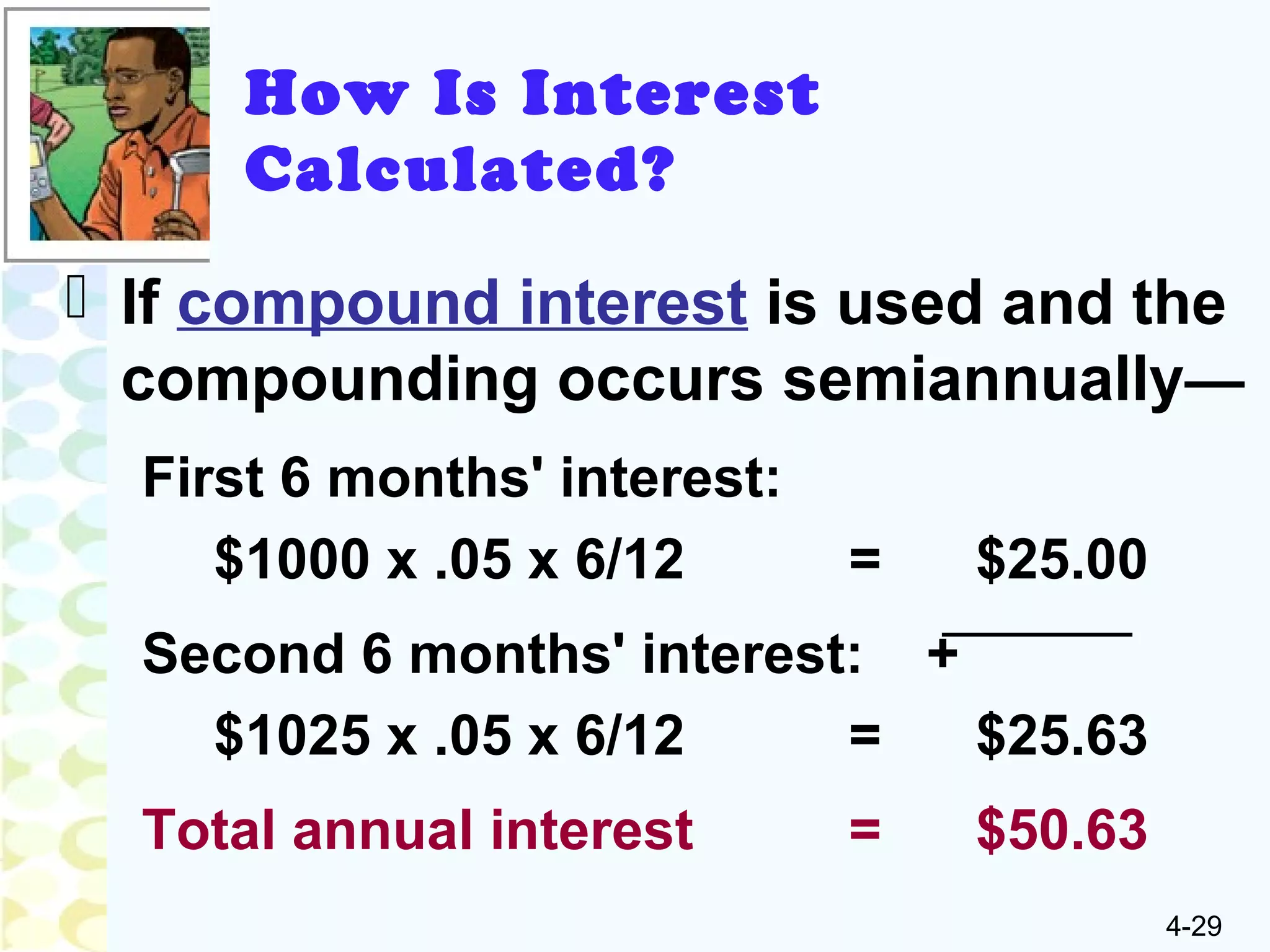
 If compound interest is used and the
compounding occurs semiannually—
First 6 months' interest:
$1000 x .05 x 6/12 = $25.00
Second 6 months' interest: +
$1025 x .05 x 6/12 = $25.63
Total annual interest = $50.63
How Is Interest
Calculated?
4-30
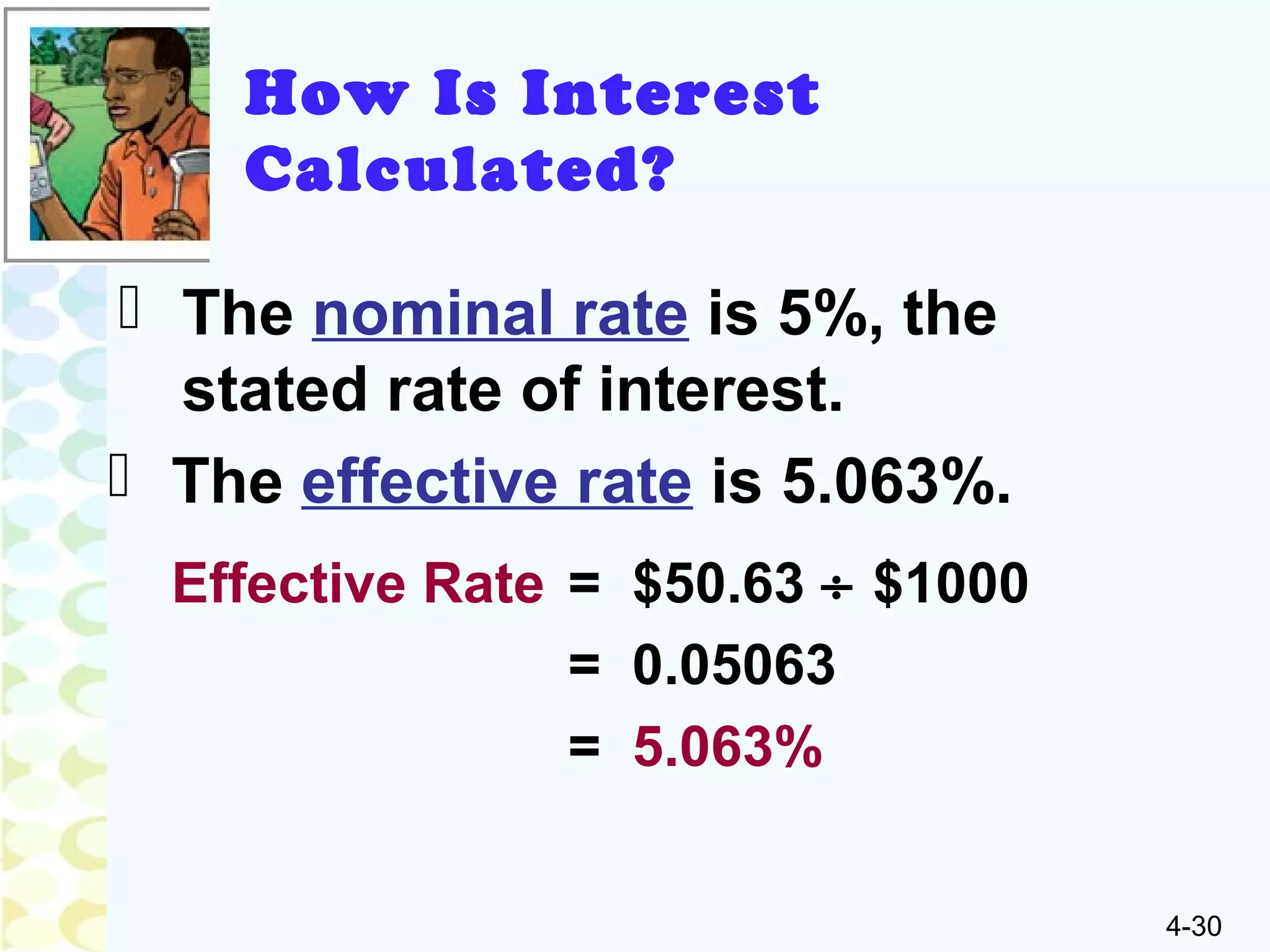
 The nominal rate is 5%, the
stated rate of interest.
Effective Rate = $50.63 ÷ $1000
= 0.05063
= 5.063%
 The effective rate is 5.063%.
How Is Interest
Calculated?
4-31
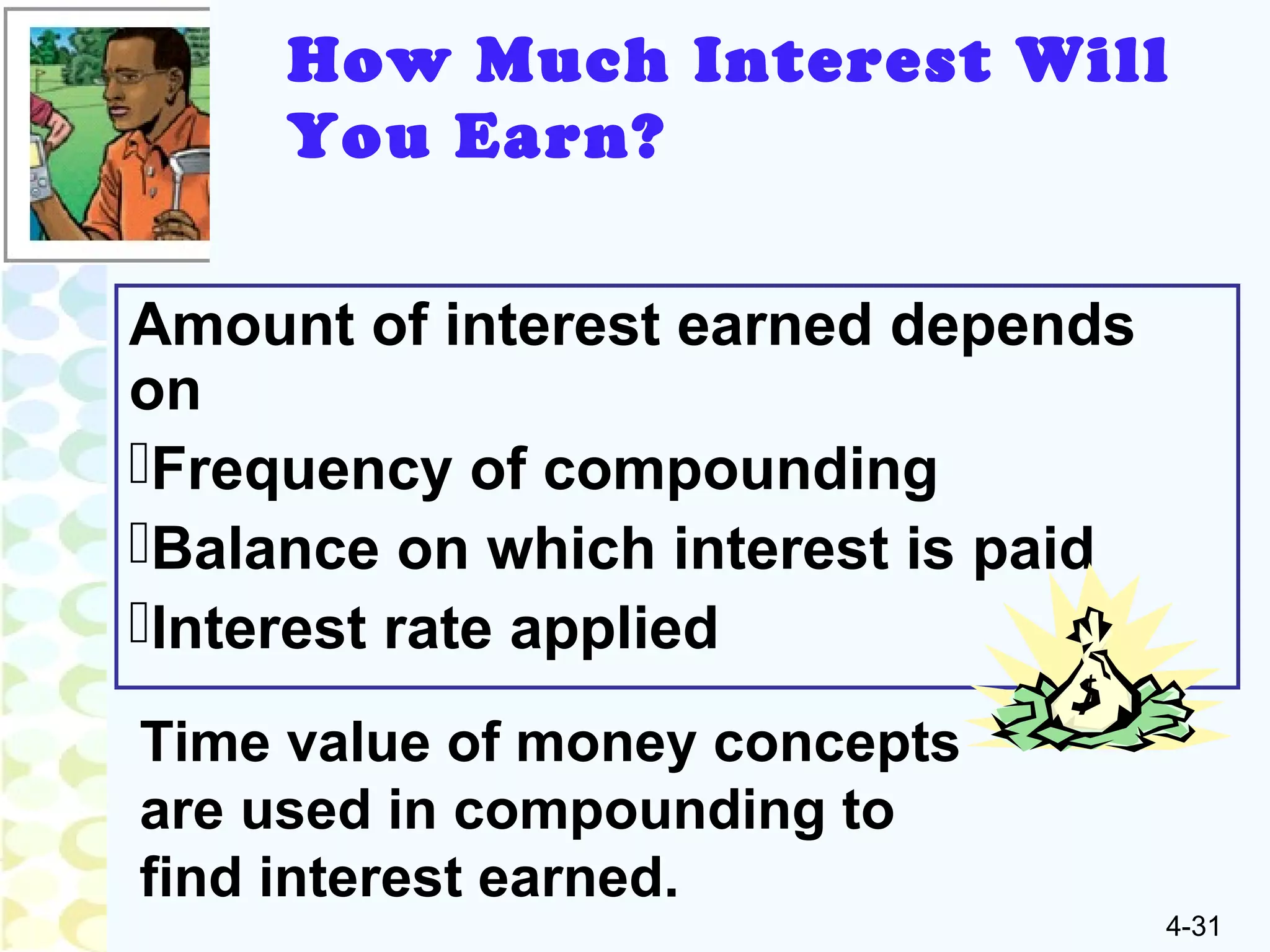
Amount of interest earned depends
on
Frequency of compounding
Balance on which interest is paid
Interest rate applied
How Much Interest Will
You Earn?
Time value of money concepts
are used in compounding to
find interest earned.
4-32
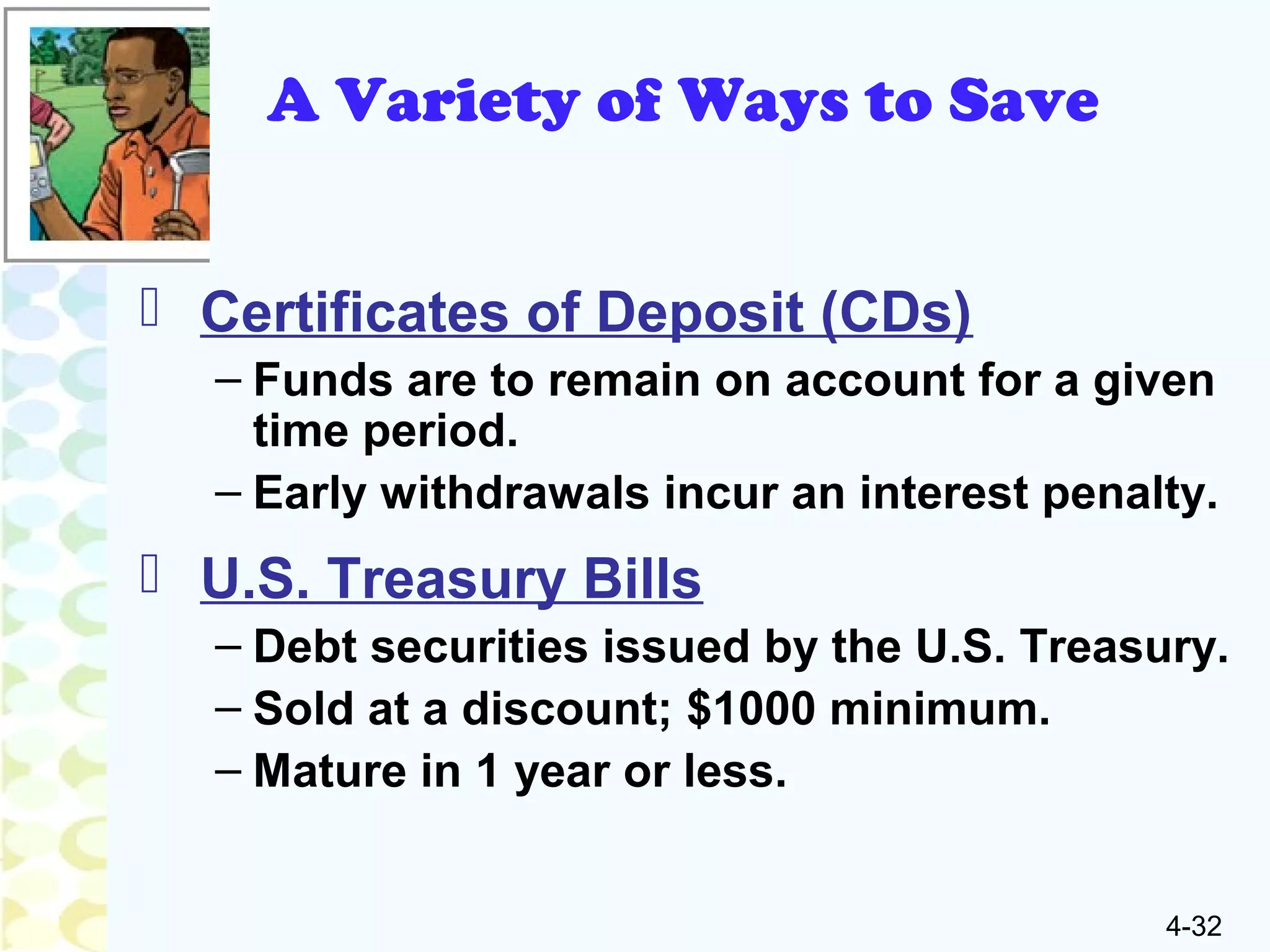
A Variety of Ways to Save
 Certificates of Deposit (CDs)
– Funds are to remain on account for a given
time period.
– Early withdrawals incur an interest penalty.
 U.S. Treasury Bills
– Debt securities issued by the U.S. Treasury.
– Sold at a discount; $1000 minimum.
– Mature in 1 year or less.
4-33
A Variety of Ways to
Save
 Series EE Bonds
– Purchased at 1/2 face value.
– Interest paid when bonds redeemed.
– Newly purchased bonds must be held at least
12 months; actual maturity date unspecified.
– Taxes not paid until bonds redeemed.
– Exempt from state and local taxes.
– If redeemed for educational purposes, income
taxes may be avoided.

Gj11e ch04

  • 1.
    © 2008 ThomsonSouth-Western CHAPTER 4CHAPTER 4 MANAGING YOURMANAGING YOUR CASH AND SAVINGSCASH AND SAVINGS
  • 2.
    4-2 Role of CashManagement in Personal Financial Planning  Cash management deals with the routine, day-to-day use of liquid assets. –Liquid assets consist of cash and other assets that can be converted easily to cash with little or no loss in value.
  • 3.
    4-3 Examples of LiquidAssets  Cash  Checking Accounts  Savings Accounts  Money Market Deposit Accounts  Money Market Mutual Funds  U.S. Treasury Bills  EE Savings Bonds  Certificates of Deposit (shorter- term)
  • 4.
    4-4 The Financial Services Marketplace Financial products – checking and savings accounts – credit cards – loans and mortgages – insurance – mutual funds  Financial services – financial planning – tax preparation – brokerage services – real estate – trusts – retirement – estate planning The financial services industry markets:
  • 5.
    4-5 Types of Financial Institutions Depository  Nondepository
  • 6.
    4-6 Types of Depository FinancialInstitutions  Commercial Banks –Largest type of traditional financial institution. –Offer full array of financial services. –Only type of financial institution that can offer noninterest-paying checking accounts.
  • 7.
    4-7 Savings and LoanAssociations –Offer many of the same services as commercial banks. –Typically pay slightly more on savings deposits. –Channel depositors’ savings into mortgage loans for purchasing and improving homes. –Some are mutual associations.
  • 8.
    4-8 Savings Banks –Similar tosavings and loan associations. –Located primarily in New England states. –Offer interest-paying checking accounts. –Typically offer savings rates similar to those of savings and loan associations. –Most are mutual associations.
  • 9.
    4-9 Credit Unions – Providefinancial products and services to specific groups of people who have a common tie. – Qualified persons become members by purchasing a share of ownership. – All are mutual associations; owned and sometimes operated by members. – Typically pay interest rates higher than those of other financial institutions.
  • 10.
    4-10 Internet Banks –Offer onlinebanking services. –Feature lower fees and higher yields than “brick-and-mortar banks.” –Suitable for people who do not need to physically go to a bank.
  • 11.
    4-11 Types of Nondepository FinancialInstitutions –Stockbrokerage firms—offer cash management accounts, money market mutual funds, wrap accounts, credit cards –Mutual funds—offer money market mutual funds –Life insurance companies –Finance companies
  • 12.
    4-12 How Safe isYour Money? Almost all financial institutions are federally insured by either:  Federal Deposit Insurance Corporation (FDIC) insures accounts at banks, savings banks, and S&Ls.  National Credit Union Administration (NCUA) insures accounts at credit unions.  Both provide government insurance up to $100,000 per depositor.
  • 13.
    4-13 Truth-in-Savings Act of 1993 Helps consumers evaluate terms and costs of banking products.  Fees, interest rates, and terms of both checking and savings accounts must be fully and clearly disclosed.  Places strict controls on advertising and what constitutes a free account.  Standard formula for annual percentage yield (APY) must used.
  • 14.
    4-14 Cash Management Products Withsufficient funds, banks must immediately pay the amount of your check or ATM withdrawal. 1. Checking Accounts = Demand Deposits
  • 15.
    4-15  Funds areexpected to remain on deposit for a longer time period than are demand deposits.  Generally pay higher interest rates than demand deposits.  At many institutions, the larger the balance, the higher the interest rate offered. 2. Savings Accounts = Time Deposits
  • 16.
    4-16 Types of Checking Accounts Regular checking accounts – Offered by commercial banks – Pay no interest  Interest-bearing checking accounts – Examples include NOW, share draft, and money market deposit accounts – Offered by banks, savings banks, S&Ls, and credit unions
  • 17.
    4-17 – Offered byinvestment (mutual fund) companies – Not federally insured; trade on open market – Interest bearing; limited checks Money Market Mutual Funds
  • 18.
    4-18 – Primarily offeredby brokerage firms; consolidate financial activities – Not covered by deposit insurance (protected by SIPC); open market – Interest bearing; check writing privileges Asset Management Accounts
  • 19.
    4-19 Other Money Management Services Electronic Banking Services Electronic Funds Transfer Systems (EFTS) make possible – ATM service – Debit cards—linked to your checking account – Pre-authorized deposits and payments – Banking by phone – Online banking and bill payment services
  • 20.
    4-20 –Regulates EFTS Services. –Statesthat errors must be reported within 60 days. Electronic Funds Transfer Act of 1978 Limit your losses by immediately reporting theft, loss, or unauthorized use of your card or account!
  • 21.
    4-21 Other Bank Services Safe Deposit Boxes  Trust Services—provide investment and estate planning advice and management for trust accounts.
  • 22.
    4-22 Maintaining a Checking Account Determine services needed.  Consider costs involved.  Keep track of checks written, automatic deposits, and ATM withdrawals.  Don’t write checks for more than you have in the account.  Arrange for overdraft protection.  Know how to stop a payment.  Reconcile your account monthly.
  • 23.
    4-23 Special Types of Checks Whenpersonal checks are not accepted, special checks can be used to guarantee payment.  Cashier’s—drawn on the bank.  Traveler’s—used for making purchases worldwide.  Certified—drawn on your account but guaranteed by the bank.
  • 24.
    4-24 Establishing A Savings Program PAY YOURSELF FIRST: On payday, write yourself a check and deposit it into a savings account, or transfer a set amount to savings through your debit card.  Establish an emergency fund.  Regularly set aside funds for financial goals.  Utilize direct deposits and automatic transfers.  Choose instruments best suited to your goals and time horizon.
  • 25.
    4-25  Simple Interest—interestpaid only on initial amount of deposit.  Compound Interest—interest paid at set intervals and added back to principal. Earning Interest on Your Money
  • 26.
    4-26  Nominal rate—thenamed or stated rate of interest.  Effective rate—the annual rate of return actually earned. If interest is compounded more frequently than once a year, the effective rate will be greater than the nominal rate of interest. Earning Interest on Your Money
  • 27.
    4-27 Effective rate = Annualamount of interest earned Amount of money invested Example: Invest $1000 at 5% for 1 year. How Is Interest Calculated?
  • 28.
    4-28  If simpleinterest is used, there is no compounding: Interest = Principal x rate x time = $1000 x .05 x 1 = $50 How Is Interest Calculated?
  • 29.
    4-29  If compoundinterest is used and the compounding occurs semiannually— First 6 months' interest: $1000 x .05 x 6/12 = $25.00 Second 6 months' interest: + $1025 x .05 x 6/12 = $25.63 Total annual interest = $50.63 How Is Interest Calculated?
  • 30.
    4-30  The nominalrate is 5%, the stated rate of interest. Effective Rate = $50.63 ÷ $1000 = 0.05063 = 5.063%  The effective rate is 5.063%. How Is Interest Calculated?
  • 31.
    4-31 Amount of interestearned depends on Frequency of compounding Balance on which interest is paid Interest rate applied How Much Interest Will You Earn? Time value of money concepts are used in compounding to find interest earned.
  • 32.
    4-32 A Variety ofWays to Save  Certificates of Deposit (CDs) – Funds are to remain on account for a given time period. – Early withdrawals incur an interest penalty.  U.S. Treasury Bills – Debt securities issued by the U.S. Treasury. – Sold at a discount; $1000 minimum. – Mature in 1 year or less.
  • 33.
    4-33 A Variety ofWays to Save  Series EE Bonds – Purchased at 1/2 face value. – Interest paid when bonds redeemed. – Newly purchased bonds must be held at least 12 months; actual maturity date unspecified. – Taxes not paid until bonds redeemed. – Exempt from state and local taxes. – If redeemed for educational purposes, income taxes may be avoided.