Understanding the Financial Planning Process #1
The Rewards of  Sound Financial Planning Maintain and improve  standard of living Control spending in order to  live well today  and  tomorrow Accumulate wealth
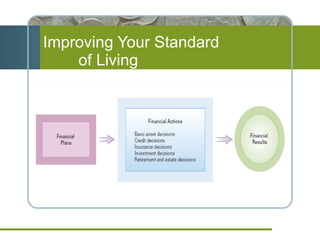
Improving Your Standard  of Living
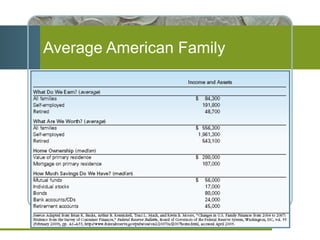
Average American Family
The Personal Financial  Planning Process S ystematic process that considers important elements of an individual’s financial  affairs in order to  fulfill financial goals
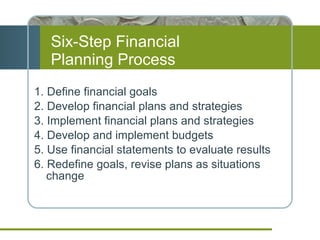
Six-Step Financial  Planning Process 1. Define financial goals 2. Develop financial plans and strategies 3. Implement financial plans and strategies 4. Develop and implement budgets 5. Use financial statements to evaluate results 6. Redefine goals, revise plans as situations change
The Role of Money Medium of exchange   used to  measure value Utility  amount of satisfaction  derived from purchases  versus cost Link to personal  psychological  concepts  and key role in personal relationships
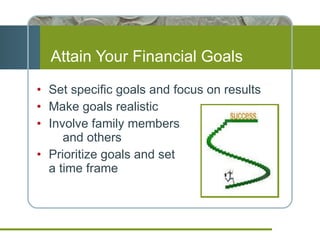
Attain Your Financial Goals Set specific goals and focus on results Make goals realistic Involve family members  and others Prioritize goals and set  a time frame
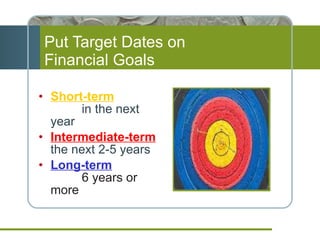
Put Target Dates on  Financial Goals Short-term   in the next year Intermediate-term   the next 2-5 years Long-term   6 years or more
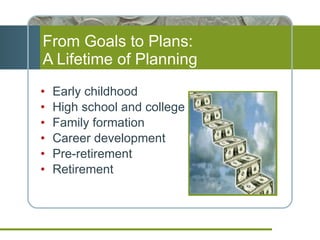
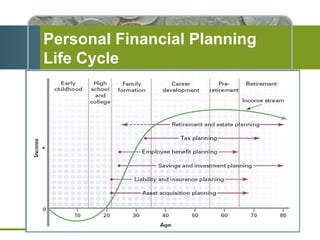
From Goals to Plans: A Lifetime of Planning Early childhood High school and college Family formation Career development Pre-retirement Retirement
Personal Financial Planning Life Cycle
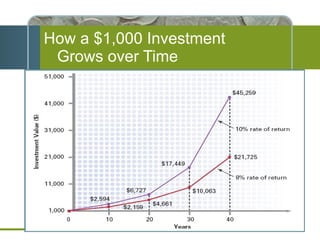
How a $1,000 Investment  Grows over Time
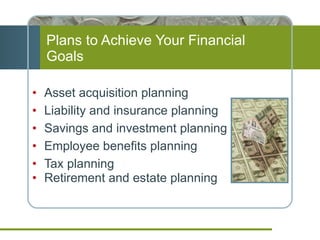
Plans to Achieve Your Financial Goals Asset acquisition planning Liability and insurance planning  Savings and investment planning Employee benefits planning Tax planning Retirement and estate planning
Using Professional Financial Planners Types of planners  Commission-based   – earn commission on financial products sold Fee-only   – charge fees based on complexity of the plan
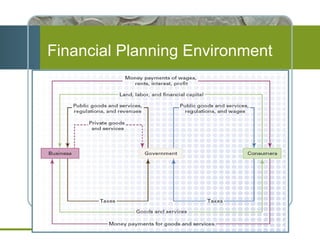
The Planning Environment Financial planning takes place in a dynamic economic environment created by the actions of Government Business Consumers
Financial Planning Environment
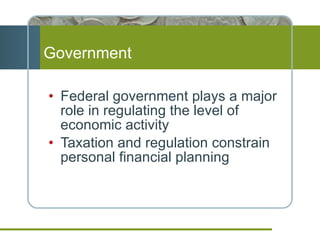
Government Federal government plays a major role in regulating the level of economic activity Taxation and regulation constrain personal financial planning
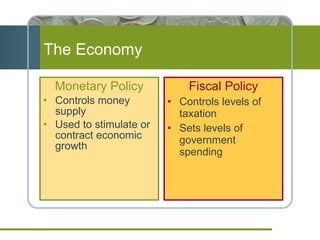
The Economy Monetary Policy Controls money supply Used to stimulate or contract economic growth Fiscal Policy Controls levels of taxation Sets levels of government spending
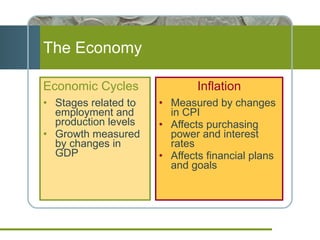
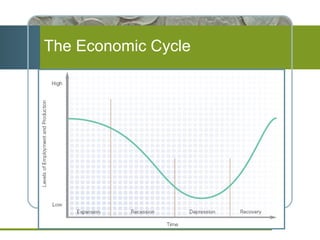
The Economy Economic Cycles Stages related to employment and production levels Growth measured by changes in GDP Inflation Measured by changes in CPI Affects purchasing power and interest rates Affects financial plans and goals
The Economic Cycle
What Determines Your Personal Income? Demographics and income Age, marital status Education Where you live Career

Chap 1 pfin

  • 1.
    Understanding the FinancialPlanning Process #1
  • 2.
    The Rewards of Sound Financial Planning Maintain and improve standard of living Control spending in order to live well today and tomorrow Accumulate wealth
  • 3.
  • 4.
  • 5.
    The Personal Financial Planning Process S ystematic process that considers important elements of an individual’s financial affairs in order to fulfill financial goals
  • 6.
    Six-Step Financial Planning Process 1. Define financial goals 2. Develop financial plans and strategies 3. Implement financial plans and strategies 4. Develop and implement budgets 5. Use financial statements to evaluate results 6. Redefine goals, revise plans as situations change
  • 7.
    The Role ofMoney Medium of exchange used to measure value Utility amount of satisfaction derived from purchases versus cost Link to personal psychological concepts and key role in personal relationships
  • 8.
    Attain Your FinancialGoals Set specific goals and focus on results Make goals realistic Involve family members and others Prioritize goals and set a time frame
  • 9.
    Put Target Dateson Financial Goals Short-term in the next year Intermediate-term the next 2-5 years Long-term 6 years or more
  • 10.
    From Goals toPlans: A Lifetime of Planning Early childhood High school and college Family formation Career development Pre-retirement Retirement
  • 11.
  • 12.
    How a $1,000Investment Grows over Time
  • 13.
    Plans to AchieveYour Financial Goals Asset acquisition planning Liability and insurance planning Savings and investment planning Employee benefits planning Tax planning Retirement and estate planning
  • 14.
    Using Professional FinancialPlanners Types of planners Commission-based – earn commission on financial products sold Fee-only – charge fees based on complexity of the plan
  • 15.
    The Planning EnvironmentFinancial planning takes place in a dynamic economic environment created by the actions of Government Business Consumers
  • 16.
  • 17.
    Government Federal governmentplays a major role in regulating the level of economic activity Taxation and regulation constrain personal financial planning
  • 18.
    The Economy MonetaryPolicy Controls money supply Used to stimulate or contract economic growth Fiscal Policy Controls levels of taxation Sets levels of government spending
  • 19.
    The Economy EconomicCycles Stages related to employment and production levels Growth measured by changes in GDP Inflation Measured by changes in CPI Affects purchasing power and interest rates Affects financial plans and goals
  • 20.
  • 21.
    What Determines YourPersonal Income? Demographics and income Age, marital status Education Where you live Career