Banking
Keep your money safe!
Banking
• You started your business, now what do
you do with your money? Where do you
get that loan to expand your business?
Where do you save for college or
retirement?
• Banks of Course!
Commercial Banks
• Def. Businesses which make money by
charging interest on loans as well as other
fees for services. They are for profit
businesses.
• Ex. Citi Bank, Chase, Bank of America,
Fleet Bank
Advantages of Commercial Banks
1. Many well located branches
2. Offer a full range of banking services
3. Deposits insured by FDIC for up to
$250,000.
4. FDIC: Federal Deposit Insurance
Corporation (If the bank goes bankrupt,
the government will pay you all the
money you lose up to $250,000).
Disadvantages of Commercial
Banks
1. Banking fees usually the highest
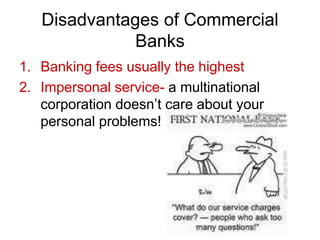
2. Impersonal service- a multinational
corporation doesn’t care about your
personal problems!
Savings and Loans Banks (S&L)
• Banks that specialize in offering long term
financing for homes and small businesses.
Advantages of S&L
1. Lower fees than Commercial Banks
2. More personal service
3. Open longer hours and weekends
Disadvantages of S&L
1. May require you to notify them before
withdrawing from an account
2. Only a few branches
3. Using an ATM card may be difficult
4. May not offer some banking services
Credit Unions
• Nonprofit banks owned by members, who
are often from a single organization or
trade union.
• Ex. Advantage Federal Credit Union
(teachers)
• Eastman Savings and Loan (Kodak
employees)
Advantages of Credit Unions
1. Fees and loan rates are lower than
commercial banks
2. Not for profit, so any earnings are paid to
member accounts.
Disadvantages of Credit Unions
1. Most are not insured by FDIC
2. Only a few branches
3. ATM less convenient
Services offered by Banks
1. Direct Deposit: money from paycheck or
govt. check is put directly into your
account.
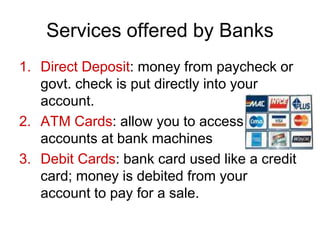
2. ATM Cards: allow you to access
accounts at bank machines
3. Debit Cards: bank card used like a credit
card; money is debited from your
account to pay for a sale.
Bank Services cont.
4. Stored Value Cards: cards for specific
dollar amounts for specific products or
stores (gift cards, phone cards, etc.)
5. Overdraft Privileges: bank pays amount
of a check even if there is not enough
money in the account
6. Online Banking: ability to check
accounts, transfer money and pay bills
over internet
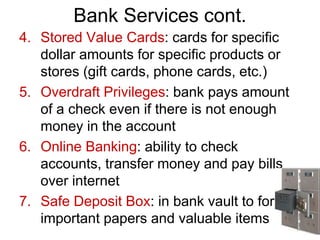
7. Safe Deposit Box: in bank vault to for
important papers and valuable items
Banking Fees
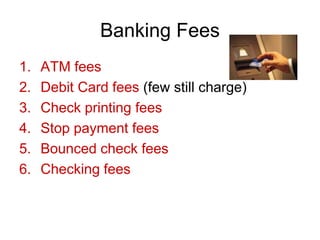
1. ATM fees
2. Debit Card fees (few still charge)
3. Check printing fees
4. Stop payment fees
5. Bounced check fees
6. Checking fees
Types of Accounts
• Checking Accounts
• Savings Accounts
• Certificate off Deposits (CDs)
• Money Market Accounts
Checking Accounts
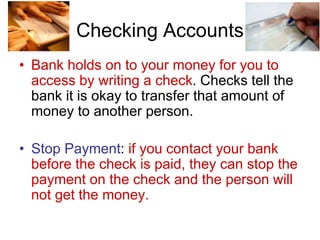
• Bank holds on to your money for you to
access by writing a check. Checks tell the
bank it is okay to transfer that amount of
money to another person.
• Stop Payment: if you contact your bank
before the check is paid, they can stop the
payment on the check and the person will
not get the money.
Advantages/Disadvantages of
Checking Accounts
• Adv.
1. Easy access to money via. Check or
ATM/Debit card
2. Money is safe, no need to carry large
sums of cash
• Dis.
– Most checking accounts do not earn
interest. As inflation increases, the
value of your money decreases.
Bounced Check
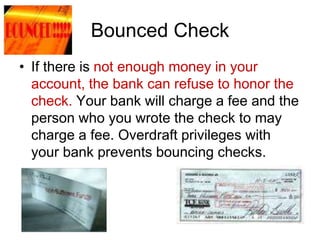
• If there is not enough money in your
account, the bank can refuse to honor the
check. Your bank will charge a fee and the
person who you wrote the check to may
charge a fee. Overdraft privileges with
your bank prevents bouncing checks.
Special Checks
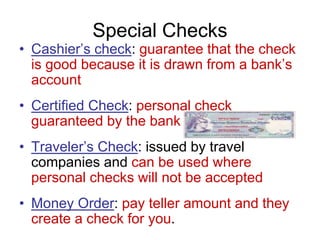
• Cashier’s check: guarantee that the check
is good because it is drawn from a bank’s
account
• Certified Check: personal check
guaranteed by the bank
• Traveler’s Check: issued by travel
companies and can be used where
personal checks will not be accepted
• Money Order: pay teller amount and they
create a check for you.
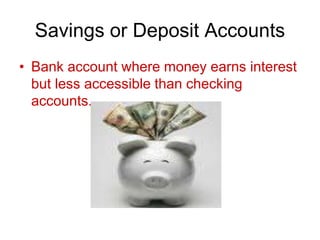
Savings or Deposit Accounts
• Bank account where money earns interest
but less accessible than checking
accounts.
Advantages/Disadvantages of
Savings Accounts
• Adv.
1. Deposited money earns interest (1-
2%)
2. Money is safe and relatively easy to
access
• Dis.
1. Interest earned is low, often lower than
inflation.
2. Cannot access with checks
Certificate of Deposit (CD)
• Person deposits money with a bank and
promises they will not withdraw money for
a set period of time (6 months, a year)
• Money withdrawn early is charged a fee.
Advantages/Disadvantages of CDs.
• Adv.
1. Earns a higher interest rate than
savings account or inflation
2. No fees
3. Money is safe form changes in the
economy
• Dis.
1. Money is locked into set interest rate. If
other interest rates go up, still stuck
with lower one.
2. Cannot access money until set period
of time. Penalty fees for taking money
out early.
Why do banks pay interest?
• Interest is payment by the bank for use of
your money.
• Banks take deposits made and use them a
loans for homes, cars, etc. Money that is
more likely to remain in the bank earns a
higher rate of interest (CDs), while money
that may be used receive little to no
interest (Savings/Checking accounts)
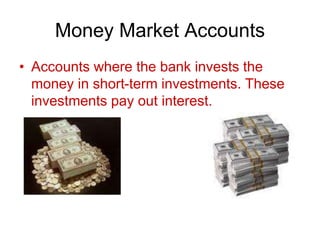
Money Market Accounts
• Accounts where the bank invests the
money in short-term investments. These
investments pay out interest.
Advantages/Disadvantages of Money
Market Accounts
• Adv.
– Pay out more interest than CDs or
other accounts
• Dis.
1. They require a high minimum deposit
to open, usually between $1000 and
$10,000 and must keep a high
balance to avoid fees
2. Subject to change in market/interest
rates
3. Strict limits on the number of checks
that access these accounts.

Banking.pptasddddddddddddddddddddddddddd

  • 1.
  • 2.
    Banking • You startedyour business, now what do you do with your money? Where do you get that loan to expand your business? Where do you save for college or retirement? • Banks of Course!
  • 3.
    Commercial Banks • Def.Businesses which make money by charging interest on loans as well as other fees for services. They are for profit businesses. • Ex. Citi Bank, Chase, Bank of America, Fleet Bank
  • 4.
    Advantages of CommercialBanks 1. Many well located branches 2. Offer a full range of banking services 3. Deposits insured by FDIC for up to $250,000. 4. FDIC: Federal Deposit Insurance Corporation (If the bank goes bankrupt, the government will pay you all the money you lose up to $250,000).
  • 5.
    Disadvantages of Commercial Banks 1.Banking fees usually the highest 2. Impersonal service- a multinational corporation doesn’t care about your personal problems!
  • 6.
    Savings and LoansBanks (S&L) • Banks that specialize in offering long term financing for homes and small businesses.
  • 7.
    Advantages of S&L 1.Lower fees than Commercial Banks 2. More personal service 3. Open longer hours and weekends
  • 8.
    Disadvantages of S&L 1.May require you to notify them before withdrawing from an account 2. Only a few branches 3. Using an ATM card may be difficult 4. May not offer some banking services
  • 9.
    Credit Unions • Nonprofitbanks owned by members, who are often from a single organization or trade union. • Ex. Advantage Federal Credit Union (teachers) • Eastman Savings and Loan (Kodak employees)
  • 10.
    Advantages of CreditUnions 1. Fees and loan rates are lower than commercial banks 2. Not for profit, so any earnings are paid to member accounts.
  • 11.
    Disadvantages of CreditUnions 1. Most are not insured by FDIC 2. Only a few branches 3. ATM less convenient
  • 12.
    Services offered byBanks 1. Direct Deposit: money from paycheck or govt. check is put directly into your account. 2. ATM Cards: allow you to access accounts at bank machines 3. Debit Cards: bank card used like a credit card; money is debited from your account to pay for a sale.
  • 13.
    Bank Services cont. 4.Stored Value Cards: cards for specific dollar amounts for specific products or stores (gift cards, phone cards, etc.) 5. Overdraft Privileges: bank pays amount of a check even if there is not enough money in the account 6. Online Banking: ability to check accounts, transfer money and pay bills over internet 7. Safe Deposit Box: in bank vault to for important papers and valuable items
  • 14.
    Banking Fees 1. ATMfees 2. Debit Card fees (few still charge) 3. Check printing fees 4. Stop payment fees 5. Bounced check fees 6. Checking fees
  • 15.
    Types of Accounts •Checking Accounts • Savings Accounts • Certificate off Deposits (CDs) • Money Market Accounts
  • 16.
    Checking Accounts • Bankholds on to your money for you to access by writing a check. Checks tell the bank it is okay to transfer that amount of money to another person. • Stop Payment: if you contact your bank before the check is paid, they can stop the payment on the check and the person will not get the money.
  • 17.
    Advantages/Disadvantages of Checking Accounts •Adv. 1. Easy access to money via. Check or ATM/Debit card 2. Money is safe, no need to carry large sums of cash • Dis. – Most checking accounts do not earn interest. As inflation increases, the value of your money decreases.
  • 18.
    Bounced Check • Ifthere is not enough money in your account, the bank can refuse to honor the check. Your bank will charge a fee and the person who you wrote the check to may charge a fee. Overdraft privileges with your bank prevents bouncing checks.
  • 19.
    Special Checks • Cashier’scheck: guarantee that the check is good because it is drawn from a bank’s account • Certified Check: personal check guaranteed by the bank • Traveler’s Check: issued by travel companies and can be used where personal checks will not be accepted • Money Order: pay teller amount and they create a check for you.
  • 20.
    Savings or DepositAccounts • Bank account where money earns interest but less accessible than checking accounts.
  • 21.
    Advantages/Disadvantages of Savings Accounts •Adv. 1. Deposited money earns interest (1- 2%) 2. Money is safe and relatively easy to access • Dis. 1. Interest earned is low, often lower than inflation. 2. Cannot access with checks
  • 22.
    Certificate of Deposit(CD) • Person deposits money with a bank and promises they will not withdraw money for a set period of time (6 months, a year) • Money withdrawn early is charged a fee.
  • 23.
    Advantages/Disadvantages of CDs. •Adv. 1. Earns a higher interest rate than savings account or inflation 2. No fees 3. Money is safe form changes in the economy • Dis. 1. Money is locked into set interest rate. If other interest rates go up, still stuck with lower one. 2. Cannot access money until set period of time. Penalty fees for taking money out early.
  • 24.
    Why do bankspay interest? • Interest is payment by the bank for use of your money. • Banks take deposits made and use them a loans for homes, cars, etc. Money that is more likely to remain in the bank earns a higher rate of interest (CDs), while money that may be used receive little to no interest (Savings/Checking accounts)
  • 25.
    Money Market Accounts •Accounts where the bank invests the money in short-term investments. These investments pay out interest.
  • 26.
    Advantages/Disadvantages of Money MarketAccounts • Adv. – Pay out more interest than CDs or other accounts • Dis. 1. They require a high minimum deposit to open, usually between $1000 and $10,000 and must keep a high balance to avoid fees 2. Subject to change in market/interest rates 3. Strict limits on the number of checks that access these accounts.