ICAP Tanzania Experience Presented by Mihayo M. Bupamba ICAPAM - Kigali 19 th  – 22 nd  Oct. 09
 
Peer Education (PE) program is among the four (4) strategies applied by ICAP to maximize adherence & psychosocial support to PLHIV Increase knowledge and skills of HCWs on adherence Establish peer education Establish facility-community partnership Decentralize adherence support activities at different level Coverage is 180 PE in Kigoma, Kagera, Pwani and Zanzibar in 35 C&T sites
To implement the UNAIDS/WHO declaration of Meaningful Involvement of People living with HIV/AIDS (MIPA) Goal Increase engagement of PLHIV to deliver services in clinical settings and integrate in communities.
Sensitization to stakeholders (RHMT, CHMT, Facilities, CMAC) Selection of PE based on set criteria Training for 10 days with supervised practicum Define PE roles at CTC, PMTCT and community Provide working tools/non-monetary incentives: (bicycles, T-shirts, raincoats, gum-boots, bags and torch) Monthly stipends of 30,000Tsh Supportive supervision, M&E Data collection and reporting
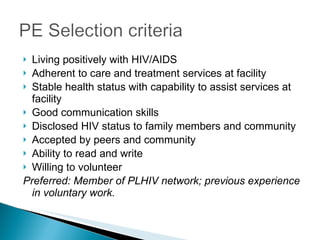
Living positively with HIV/AIDS Adherent to care and treatment services at facility Stable health status with capability to assist services at facility Good communication skills Disclosed HIV status to family members and community Accepted by peers and community Ability to read and write Willing to volunteer Preferred: Member of PLHIV network; previous experience in voluntary work.
10-day training is conducted based on ICAP manual, modified to suit Tanzanian context Facilitators guide Participant manual in both English and Kiswahili Data collection tools Scope of Work for Peer educator and involved parties (HCWs, NGO, ICAP) Database is been developed
Welcome patients and reassure them Give structured Health talks/testimonials at CTC  Provide additional adherence counselling to patients Reinforce correct messages on ARV, side effects,  etc Promote positive living, disclosure, condom use  Help patients to: cope with HIV; TB infection control measures and encourage disclosure Assist non-clinical activities (sorting files, tracking defaulters) Escort patients during internal referrals Keep records in their tools Represent PLHIV in MDT meetings
 
Give health talks/testimonies at RCHS to encourage testing and positive living Assist on non technical PMTCT-related activities at RCHS (appointment books, escorting internal referrals CTC) Support newly diagnosed pregnant mothers (immediately) to cope/accept status, disclosure, safer sex, condom distribution  Reinforce correct messages on infant feeding, SD-NVP, AZT Efficacious regimens etc. Link mothers post-FSG to existing support groups in community Sensitization for male involvement, EID, couple & siblings testing ,and stigma reduction Track and trace defaulters  (missed appt)including HEI/AZT
Trace missed appointments and patients lost to follow up Link patients with community-based support services Establish/strengthen support groups Community sensitization and mobilization Stigma reduction
Smooth mechanisms for tracking and tracing LTFU in place  180 PE in 35 sites have established more than 100 peer support groups Conducting monthly meetings for care and treatment clients in facilities District councils involvement in APSS: PLHIV members in CMAC, WMAC and VMAC 16 district councils are supporting PE groups and individual PEs District councils are coordinating partnership meetings Facility-community partnership established and strengthened (referral mechanisms) Local PLHIV NGO managing elements of program (SHDEPHA+ in Pwani and ZAPHA+ in Zanzibar)
Defaulters Missed Appointments 455 Lost to Follow up 786 Total Defaulters 1,241 Found Alive 616  Died 140 Could not be traced 485
Region # missed appointment or LTFU # found alive # not found # died Kagera 539 110 154 110 Kigoma 486 278 185 23 Pwani 192 53 133 6 Zanzibar 24 10 13 1 TOTAL 1,241 616 485 140
Results of Defaulter Tracing N= 1,241
 
Region # found alive # restarted on ART % restarted on ART Kagera 275 60 22% Kigoma 278 152 55% Pwani 53 18 30% Zanzibar 10 3 34%
 
Improved self-esteem, quality of services & customer care!   PE ,“   We have been accepted by HCW and clients attending CTC , and community by providing ,testimonies, and we have been helping some at Facilities by sorting files and weighing clients. (PE from Utete Hospital) HCW , “we are supposed to be 7HWs at our CTC but hardly you will find 4or 3 to attend all patients .peer educators are now helping us with non technical work then HWs timely and properly deal with treatment aspect”.  Nyakahanga health worker Pts ,  “We feel free to talk to PE, their testimonies are very helpful in encouraging disclosure” (patient from Miono HC)
Shortage of HR to support PE at facilities  Demand in C&T and PMTCT sites is huge Distance hinders PE to follow-up patients  No policy to support the intervention in HFs Building capacity of PLHIV NGO to manage some elements of the program
PE program increase clients’ adherence to care and treatment as well as enhance utilization of care & treatment services PE reduces workload to HCWs PE programs increase self-esteem among PLHIV; reduce stigma, and enhance smooth defaulter tracing PE demonstrate the success of ART,  PLHIV NGO are capable to deliver non-clinical care services Sustainability requires working with other entities and retraining District councils are willing to fund PLHIV work within the clinical settings
 
ASANTENI SANA!

GIPA/MIPA in ICAP-Tanzania

  • 1.
    ICAP Tanzania ExperiencePresented by Mihayo M. Bupamba ICAPAM - Kigali 19 th – 22 nd Oct. 09
  • 2.
  • 3.
    Peer Education (PE)program is among the four (4) strategies applied by ICAP to maximize adherence & psychosocial support to PLHIV Increase knowledge and skills of HCWs on adherence Establish peer education Establish facility-community partnership Decentralize adherence support activities at different level Coverage is 180 PE in Kigoma, Kagera, Pwani and Zanzibar in 35 C&T sites
  • 4.
    To implement theUNAIDS/WHO declaration of Meaningful Involvement of People living with HIV/AIDS (MIPA) Goal Increase engagement of PLHIV to deliver services in clinical settings and integrate in communities.
  • 5.
    Sensitization to stakeholders(RHMT, CHMT, Facilities, CMAC) Selection of PE based on set criteria Training for 10 days with supervised practicum Define PE roles at CTC, PMTCT and community Provide working tools/non-monetary incentives: (bicycles, T-shirts, raincoats, gum-boots, bags and torch) Monthly stipends of 30,000Tsh Supportive supervision, M&E Data collection and reporting
  • 6.
    Living positively withHIV/AIDS Adherent to care and treatment services at facility Stable health status with capability to assist services at facility Good communication skills Disclosed HIV status to family members and community Accepted by peers and community Ability to read and write Willing to volunteer Preferred: Member of PLHIV network; previous experience in voluntary work.
  • 7.
    10-day training isconducted based on ICAP manual, modified to suit Tanzanian context Facilitators guide Participant manual in both English and Kiswahili Data collection tools Scope of Work for Peer educator and involved parties (HCWs, NGO, ICAP) Database is been developed
  • 8.
    Welcome patients andreassure them Give structured Health talks/testimonials at CTC Provide additional adherence counselling to patients Reinforce correct messages on ARV, side effects, etc Promote positive living, disclosure, condom use Help patients to: cope with HIV; TB infection control measures and encourage disclosure Assist non-clinical activities (sorting files, tracking defaulters) Escort patients during internal referrals Keep records in their tools Represent PLHIV in MDT meetings
  • 9.
  • 10.
    Give health talks/testimoniesat RCHS to encourage testing and positive living Assist on non technical PMTCT-related activities at RCHS (appointment books, escorting internal referrals CTC) Support newly diagnosed pregnant mothers (immediately) to cope/accept status, disclosure, safer sex, condom distribution Reinforce correct messages on infant feeding, SD-NVP, AZT Efficacious regimens etc. Link mothers post-FSG to existing support groups in community Sensitization for male involvement, EID, couple & siblings testing ,and stigma reduction Track and trace defaulters (missed appt)including HEI/AZT
  • 11.
    Trace missed appointmentsand patients lost to follow up Link patients with community-based support services Establish/strengthen support groups Community sensitization and mobilization Stigma reduction
  • 12.
    Smooth mechanisms fortracking and tracing LTFU in place 180 PE in 35 sites have established more than 100 peer support groups Conducting monthly meetings for care and treatment clients in facilities District councils involvement in APSS: PLHIV members in CMAC, WMAC and VMAC 16 district councils are supporting PE groups and individual PEs District councils are coordinating partnership meetings Facility-community partnership established and strengthened (referral mechanisms) Local PLHIV NGO managing elements of program (SHDEPHA+ in Pwani and ZAPHA+ in Zanzibar)
  • 13.
    Defaulters Missed Appointments455 Lost to Follow up 786 Total Defaulters 1,241 Found Alive 616 Died 140 Could not be traced 485
  • 14.
    Region # missedappointment or LTFU # found alive # not found # died Kagera 539 110 154 110 Kigoma 486 278 185 23 Pwani 192 53 133 6 Zanzibar 24 10 13 1 TOTAL 1,241 616 485 140
  • 15.
    Results of DefaulterTracing N= 1,241
  • 16.
  • 17.
    Region # foundalive # restarted on ART % restarted on ART Kagera 275 60 22% Kigoma 278 152 55% Pwani 53 18 30% Zanzibar 10 3 34%
  • 18.
  • 19.
    Improved self-esteem, qualityof services & customer care! PE ,“ We have been accepted by HCW and clients attending CTC , and community by providing ,testimonies, and we have been helping some at Facilities by sorting files and weighing clients. (PE from Utete Hospital) HCW , “we are supposed to be 7HWs at our CTC but hardly you will find 4or 3 to attend all patients .peer educators are now helping us with non technical work then HWs timely and properly deal with treatment aspect”. Nyakahanga health worker Pts , “We feel free to talk to PE, their testimonies are very helpful in encouraging disclosure” (patient from Miono HC)
  • 20.
    Shortage of HRto support PE at facilities Demand in C&T and PMTCT sites is huge Distance hinders PE to follow-up patients No policy to support the intervention in HFs Building capacity of PLHIV NGO to manage some elements of the program
  • 21.
    PE program increaseclients’ adherence to care and treatment as well as enhance utilization of care & treatment services PE reduces workload to HCWs PE programs increase self-esteem among PLHIV; reduce stigma, and enhance smooth defaulter tracing PE demonstrate the success of ART, PLHIV NGO are capable to deliver non-clinical care services Sustainability requires working with other entities and retraining District councils are willing to fund PLHIV work within the clinical settings
  • 22.
  • 23.