2012 Navajo Area IHS
      HIV Program
 Jonathan Vilasier Iralu, MD, FACP
Indian Health Service Chief Clinical
 Consultant for Infectious Diseases
Case Presentation
• A 40 year-old man presents to the Urgent Care
  Clinic in March with fever, diarrhea, rash and
  headache. Physical exam is notable for low
  grade fever and tachycardia. He is felt to have
  a viral syndrome and is discharged home after
  IV hydration. He is eventually seen 4 times for
  the same syndrome and receives the same
  diagnosis and treatment at every visit.
Case Presentation
• On the fourth visit, the UCC physician notes
  thrush and a diffuse macular rash. She calls
  the HIV Program for a rapid HIV test. The rapid
  test is positive. An HIV serology at one of the
  earlier visits shows a positive EIA and negative
  western blot.
Case Presentation
• What is the diagnosis?


• Why did it take 4 visits to make this diagnosis
Case Presentation
• The patient is admitted to the hospital with
  the diagnosis of Acute Retroviral Syndrome
  and candida esophagitis. An HIV EIA from
  admission is positive but Western blot is
  positive only for gp24. The CD4 count is 376
  /ml and the viral load is > 10 million
  copies/ml. Lumbar Puncture reveals 21 WBC
  and 0 RBC.
Case Presentation
• The patient states that he is bisexual. He
  recently began using a popular internet social
  networking site to meet new sexual partners.
  He recently had contact with 3 male partners.
Case Presentation
• When the patient learns of his diagnosis, he is
  devastated. He begins to express suicidal
  ideation. The HIV Nurse Specialist is called to
  the floor called to provide support.
GIMC HIV Nurse Specialist
• Position funded by MAI grant
• Staffed since April 2009
  – Dimitri Chapman
  – Bill Monroe
• Position Requirements
  – Case management training not required, but HIV
    experience is
  – Training via the AETC and ACRN prep course
  – ACRN credentialing strongly encouraged
GIMC HIV Nurse Specialist Duties
• Orchestrate clinic flow for 2 HIV physicians
  – Pre clinic “To-Do” lists
  – Phlebotomy and vaccination standing orders
  – Medication administration and admission coordination
• See patients independently in HIV RN clinic
  –   STD treatments
  –   Vaccine updates
  –   Rapid HIV test partners
  –   Counseling
GIMC HIV Nurse Specialist Duties
• Field Visits
   – Drive hundreds of miles per week
   – Home assessments
   – Medication monitoring and delivery
   – Rapid HIV testing of partners at home site
   – Family counseling and emotional support
   – Adherence counseling
GIMC HIV Nurse Specialist Duties
• Database management
• Supervise the HIV Health Technician
• Detox center visits for new or challenging
  cases
• Community Outreach
  – Health Fairs
  – Gallup Pride
  – Navajo AIDS Network events
• Run HIV Screening Outreach
Case Presentation
• The patient is discharged home on treatment
  for candida esophagitis and PCP prophylaxis.
  The HIV Nurse Specialist makes several home
  visits in the 2 weeks after discharge. He
  comes back for F/U in the Special ID clinic…
2011 Active Cases
• 167 cases seen in NAIHS/638 facilities in 2011
• No HIV positive pregnancies
• 118 followed at GIMC Special ID Clinic
How Special ID Clinic Works
• The patient checks in and is screened by the
  HIV Health Technician.
• The patient is placed in a room and is next
  seen by one of the four HIV pharmacists.
• The patient is next seen by one of the 2 HIV
  physicians.
• The Health Tech and HIV Nurse Specialist
  close out the visit
HIV Pharmacy Program
• Key Elements:
  – Adherence review & teaching at each visit
  – Monthly HIV “Fill” with monthly letter
  – Manage lipids in conjunction with physician
  – Home visits when appropriate
  – Report on adherence at monthly Care Team
    Meeting
  – Hepatitis C co-infection treatment coming soon!
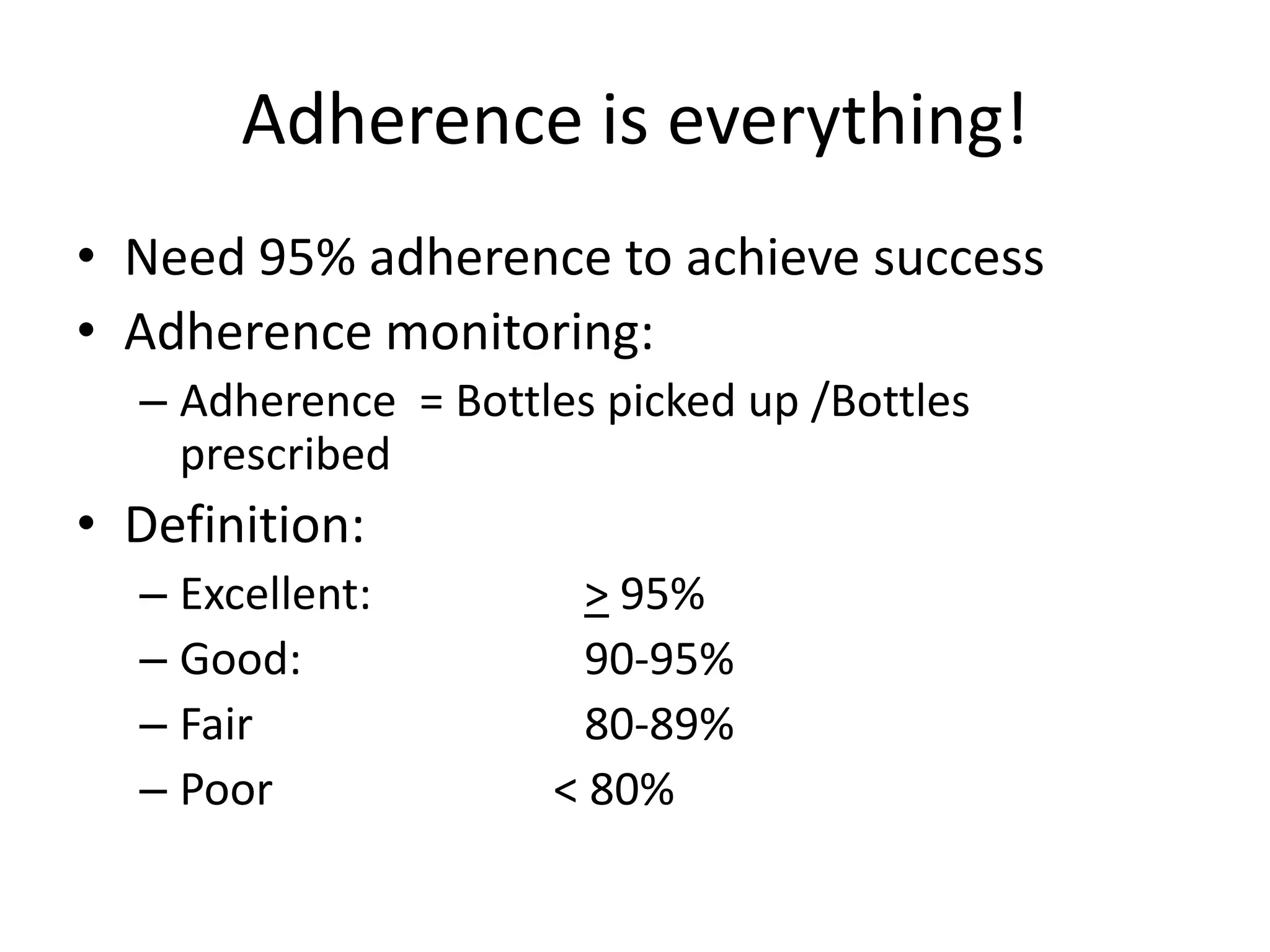
Adherence is everything!
• Need 95% adherence to achieve success
• Adherence monitoring:
  – Adherence = Bottles picked up /Bottles
    prescribed
• Definition:
  – Excellent:         > 95%
  – Good:              90-95%
  – Fair               80-89%
  – Poor             < 80%
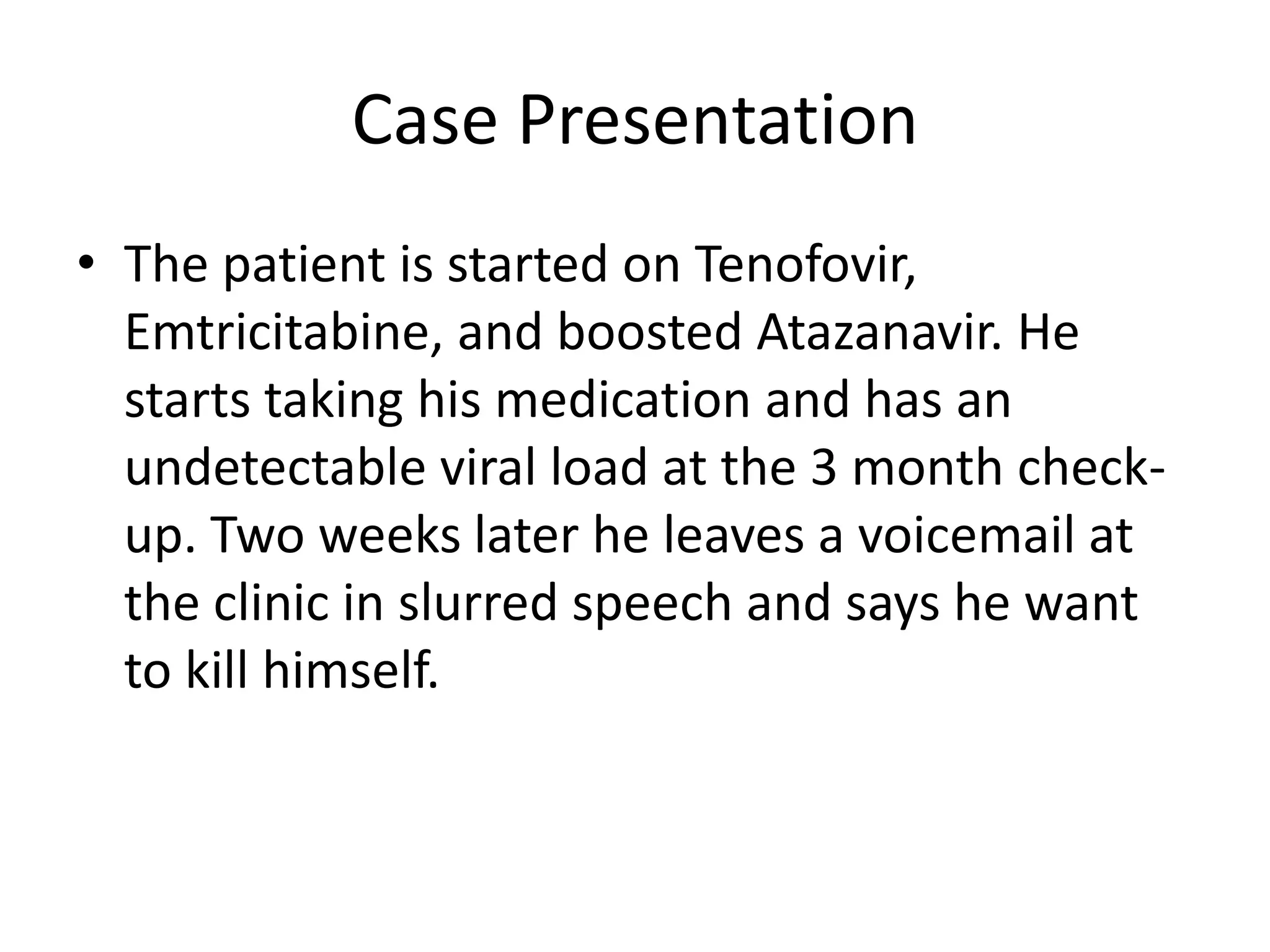
Case Presentation
• The patient is started on Tenofovir,
  Emtricitabine, and boosted Atazanavir. He
  starts taking his medication and has an
  undetectable viral load at the 3 month check-
  up. Two weeks later he leaves a voicemail at
  the clinic in slurred speech and says he want
  to kill himself.
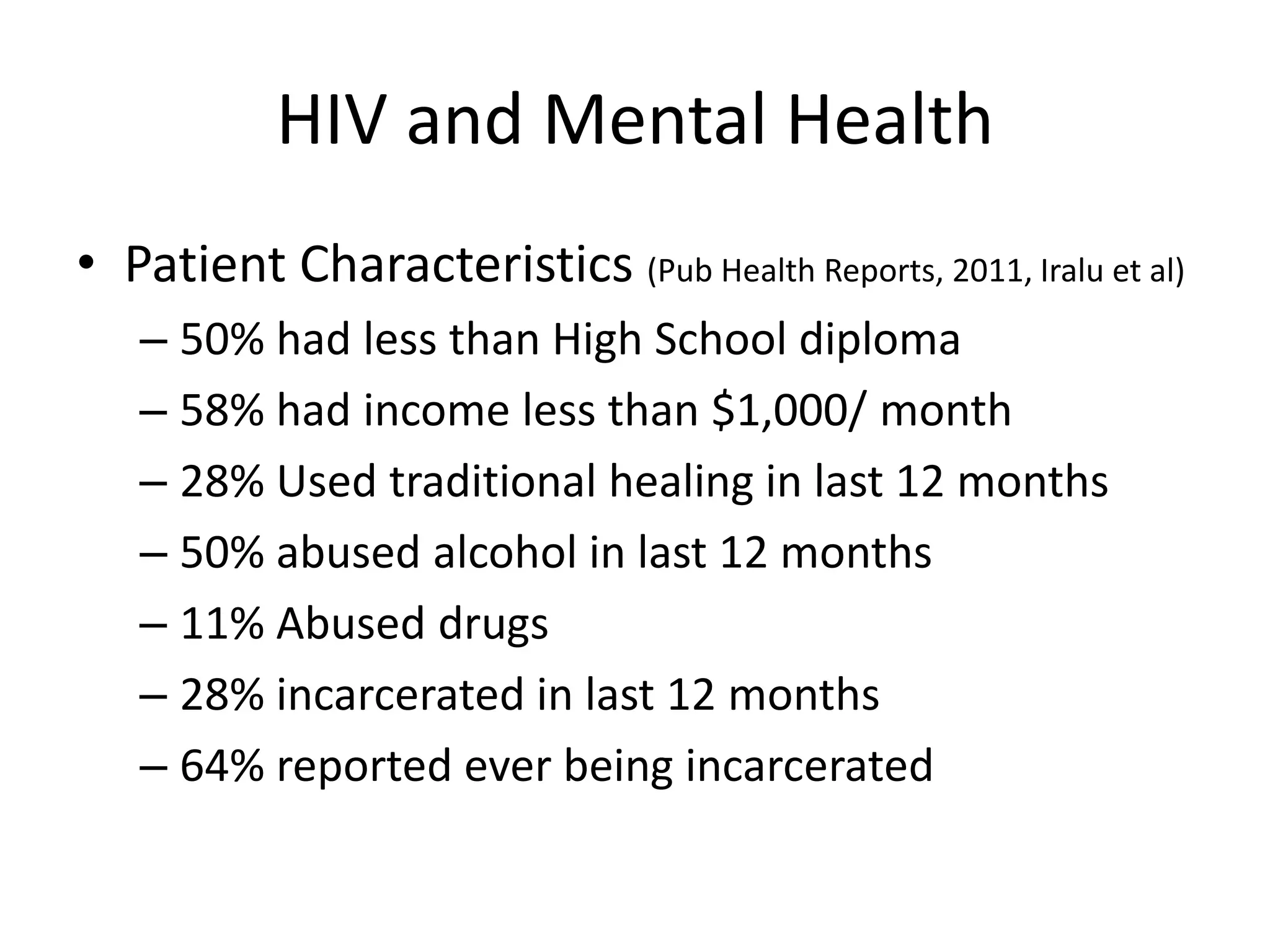
HIV and Mental Health
• Patient Characteristics (Pub Health Reports, 2011, Iralu et al)
   – 50% had less than High School diploma
   – 58% had income less than $1,000/ month
   – 28% Used traditional healing in last 12 months
   – 50% abused alcohol in last 12 months
   – 11% Abused drugs
   – 28% incarcerated in last 12 months
   – 64% reported ever being incarcerated
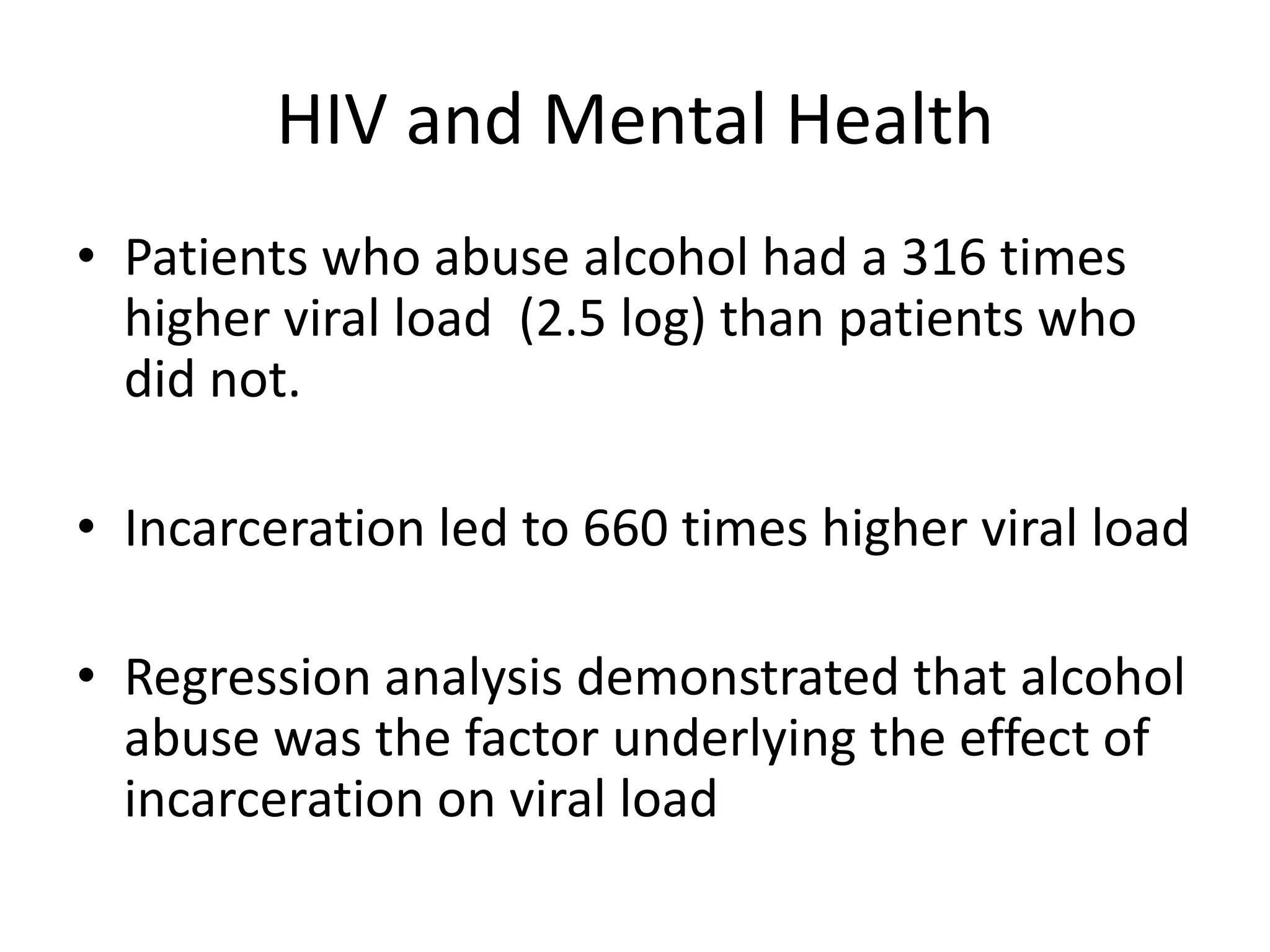
HIV and Mental Health
• Patients who abuse alcohol had a 316 times
  higher viral load (2.5 log) than patients who
  did not.

• Incarceration led to 660 times higher viral load

• Regression analysis demonstrated that alcohol
  abuse was the factor underlying the effect of
  incarceration on viral load
Mental Health Program
•   Designated HIV Nurse Psychologist
•   Direct referrals for counseling
•   Psych is available on call for clinic visits
•   Participate in HIV Care Team Rounds
•   Emergency Home visits
Case Presentation
• The patient is referred to the psychologist on
  call but fails to show for his appointment. The
  psychologist makes a home visit with the HIV
  Nurse Specialist. The patient contracts for
  safety and begins counseling in the Four
  Directions Counseling Service. After several
  sessions the patient expresses an interest in
  traditional healing.
GIMC HIV Traditional Healing
• Traditional healer trained in Navajo traditional
  medicine and Western style counseling
• Accepts regular hospital referrals and makes
  appointments with patients referred
• Patients offered both traditional and western
  approaches to healing
• Home visits are an option
GIMC HIV Traditional Healing
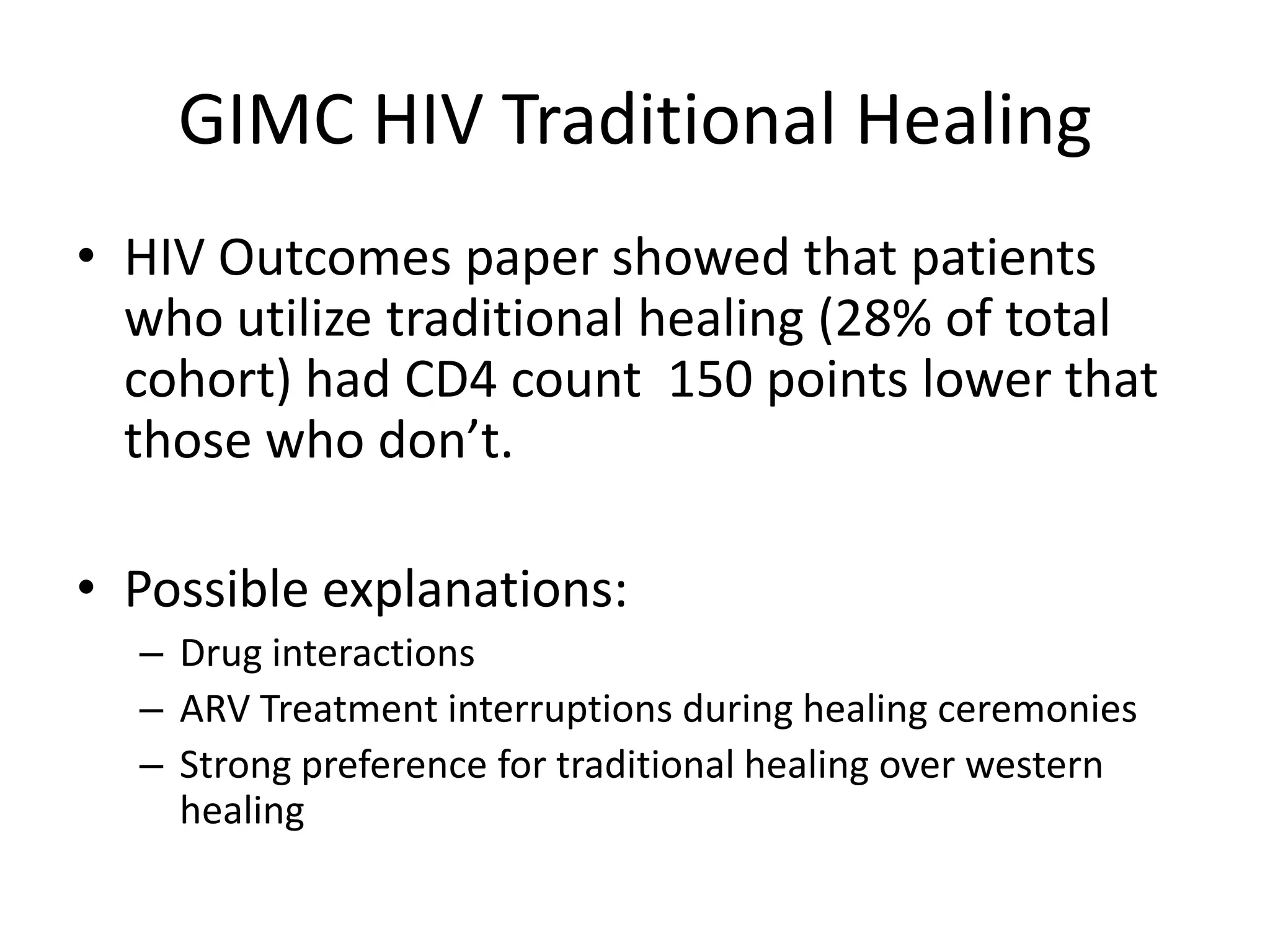
• HIV Outcomes paper showed that patients
  who utilize traditional healing (28% of total
  cohort) had CD4 count 150 points lower that
  those who don’t.

• Possible explanations:
  – Drug interactions
  – ARV Treatment interruptions during healing ceremonies
  – Strong preference for traditional healing over western
    healing
“Doctor, we Navajos only come to
see you IHS doctors as a last resort.”
Traditional Medicine and HIV
• Goal:
  – Enroll patients early in both western and
    traditional healing

  – Enhance communication between traditional
    healers and the western practitioners from the
    beginning of care.
Case Presentation
• The patient missed his next clinic visit. He is
  visited by the HIV technician who discovers
  that the patient has been binge drinking. The
  patient is enrolled in the high risk program
  and begins weekly visits for Directly Monitory
  Therapy
HIV Technician
• Assists with clinic care
• Home Visits
  – Teaching using HOPE program flip charts
  – Pill counts
  – Distribute and monitor pre-filled medi-planners
  – Data entry and charting
Project HOPE:
HIV Outreach Patient Empowerment


If you want to learn more, please attend Dr
         Shin’s afternoon session.
Case Presentation
• The patient stops drinking and has much
  better adherence. His CD4 count rises to
  greater than 500 and his viral load becomes
  undetectable. He gets a job at McDonalds and
  gains 60 pounds. A random glucose level in
  the clinic is now 256.
HIV Nutritionist
• Designated HIV Nutritionist
• Schedules appointments for high risk patients
  the same day as their quarterly HIV check up.
• Developed flip charts for patient education
• Provide dietary supplements for the
  underweight
Case Presentation
• The patient takes all his pills and is thriving.
  The HIV nurse specialist finally has time to
  work on Brigg’s HIV screening project…
Seven things Brigg Wants You to Do…
1.   Test everyone for HIV
2.   Test everyone for HIV
3.   Test everyone for HIV
4.   Test everyone for HIV
5.   Test everyone for HIV
6.   Test everyone for HIV
7.   Test everyone for HIV
HIV Screening:
         What needs to be done
•   Screen every pregnant woman
•   Screen every STD patient you encounter
•   Screen all alcoholics
•   Screen every admission to your hospital
Ultimate Goal
• Offer screening to every American Indian
  patient at least once in their life.
How to enhance screening
• Nurse Driven Inpatient screening program

• EHR reminder every 5 years

• Change the IHS “culture”

• Make the community aware
2011: What needs to be done
• NAIHS HIV Program
  – Movie Theater Ads
  – Radio station PSAs (Local NPR station)
  – Billboard Ads
  – Bus Ads
  – Internet social media campaign
The Ultimate Goal…
• Make Testing Routine and Universal

• Destigmatize HIV
Summary
• You can create an HIV care team in any IHS facility
  with minimal resources.

• Early diagnosis and treatment will improve health
  and may help halt the spread of HIV in Indian
  country.

• You can change IHS HIV testing culture and possibly
  de-stigmatize HIV in your community.
Keynote Iralu

Keynote Iralu

  • 1.
    2012 Navajo AreaIHS HIV Program Jonathan Vilasier Iralu, MD, FACP Indian Health Service Chief Clinical Consultant for Infectious Diseases
  • 2.
    Case Presentation • A40 year-old man presents to the Urgent Care Clinic in March with fever, diarrhea, rash and headache. Physical exam is notable for low grade fever and tachycardia. He is felt to have a viral syndrome and is discharged home after IV hydration. He is eventually seen 4 times for the same syndrome and receives the same diagnosis and treatment at every visit.
  • 3.
    Case Presentation • Onthe fourth visit, the UCC physician notes thrush and a diffuse macular rash. She calls the HIV Program for a rapid HIV test. The rapid test is positive. An HIV serology at one of the earlier visits shows a positive EIA and negative western blot.
  • 4.
    Case Presentation • Whatis the diagnosis? • Why did it take 4 visits to make this diagnosis
  • 5.
    Case Presentation • Thepatient is admitted to the hospital with the diagnosis of Acute Retroviral Syndrome and candida esophagitis. An HIV EIA from admission is positive but Western blot is positive only for gp24. The CD4 count is 376 /ml and the viral load is > 10 million copies/ml. Lumbar Puncture reveals 21 WBC and 0 RBC.
  • 6.
    Case Presentation • Thepatient states that he is bisexual. He recently began using a popular internet social networking site to meet new sexual partners. He recently had contact with 3 male partners.
  • 7.
    Case Presentation • Whenthe patient learns of his diagnosis, he is devastated. He begins to express suicidal ideation. The HIV Nurse Specialist is called to the floor called to provide support.
  • 8.
    GIMC HIV NurseSpecialist • Position funded by MAI grant • Staffed since April 2009 – Dimitri Chapman – Bill Monroe • Position Requirements – Case management training not required, but HIV experience is – Training via the AETC and ACRN prep course – ACRN credentialing strongly encouraged
  • 9.
    GIMC HIV NurseSpecialist Duties • Orchestrate clinic flow for 2 HIV physicians – Pre clinic “To-Do” lists – Phlebotomy and vaccination standing orders – Medication administration and admission coordination • See patients independently in HIV RN clinic – STD treatments – Vaccine updates – Rapid HIV test partners – Counseling
  • 10.
    GIMC HIV NurseSpecialist Duties • Field Visits – Drive hundreds of miles per week – Home assessments – Medication monitoring and delivery – Rapid HIV testing of partners at home site – Family counseling and emotional support – Adherence counseling
  • 11.
    GIMC HIV NurseSpecialist Duties • Database management • Supervise the HIV Health Technician • Detox center visits for new or challenging cases • Community Outreach – Health Fairs – Gallup Pride – Navajo AIDS Network events • Run HIV Screening Outreach
  • 12.
    Case Presentation • Thepatient is discharged home on treatment for candida esophagitis and PCP prophylaxis. The HIV Nurse Specialist makes several home visits in the 2 weeks after discharge. He comes back for F/U in the Special ID clinic…
  • 13.
    2011 Active Cases •167 cases seen in NAIHS/638 facilities in 2011 • No HIV positive pregnancies • 118 followed at GIMC Special ID Clinic
  • 14.
    How Special IDClinic Works • The patient checks in and is screened by the HIV Health Technician. • The patient is placed in a room and is next seen by one of the four HIV pharmacists. • The patient is next seen by one of the 2 HIV physicians. • The Health Tech and HIV Nurse Specialist close out the visit
  • 15.
    HIV Pharmacy Program •Key Elements: – Adherence review & teaching at each visit – Monthly HIV “Fill” with monthly letter – Manage lipids in conjunction with physician – Home visits when appropriate – Report on adherence at monthly Care Team Meeting – Hepatitis C co-infection treatment coming soon!
  • 16.
    Adherence is everything! •Need 95% adherence to achieve success • Adherence monitoring: – Adherence = Bottles picked up /Bottles prescribed • Definition: – Excellent: > 95% – Good: 90-95% – Fair 80-89% – Poor < 80%
  • 17.
    Case Presentation • Thepatient is started on Tenofovir, Emtricitabine, and boosted Atazanavir. He starts taking his medication and has an undetectable viral load at the 3 month check- up. Two weeks later he leaves a voicemail at the clinic in slurred speech and says he want to kill himself.
  • 18.
    HIV and MentalHealth • Patient Characteristics (Pub Health Reports, 2011, Iralu et al) – 50% had less than High School diploma – 58% had income less than $1,000/ month – 28% Used traditional healing in last 12 months – 50% abused alcohol in last 12 months – 11% Abused drugs – 28% incarcerated in last 12 months – 64% reported ever being incarcerated
  • 19.
    HIV and MentalHealth • Patients who abuse alcohol had a 316 times higher viral load (2.5 log) than patients who did not. • Incarceration led to 660 times higher viral load • Regression analysis demonstrated that alcohol abuse was the factor underlying the effect of incarceration on viral load
  • 20.
    Mental Health Program • Designated HIV Nurse Psychologist • Direct referrals for counseling • Psych is available on call for clinic visits • Participate in HIV Care Team Rounds • Emergency Home visits
  • 21.
    Case Presentation • Thepatient is referred to the psychologist on call but fails to show for his appointment. The psychologist makes a home visit with the HIV Nurse Specialist. The patient contracts for safety and begins counseling in the Four Directions Counseling Service. After several sessions the patient expresses an interest in traditional healing.
  • 22.
    GIMC HIV TraditionalHealing • Traditional healer trained in Navajo traditional medicine and Western style counseling • Accepts regular hospital referrals and makes appointments with patients referred • Patients offered both traditional and western approaches to healing • Home visits are an option
  • 23.
    GIMC HIV TraditionalHealing • HIV Outcomes paper showed that patients who utilize traditional healing (28% of total cohort) had CD4 count 150 points lower that those who don’t. • Possible explanations: – Drug interactions – ARV Treatment interruptions during healing ceremonies – Strong preference for traditional healing over western healing
  • 24.
    “Doctor, we Navajosonly come to see you IHS doctors as a last resort.”
  • 25.
    Traditional Medicine andHIV • Goal: – Enroll patients early in both western and traditional healing – Enhance communication between traditional healers and the western practitioners from the beginning of care.
  • 26.
    Case Presentation • Thepatient missed his next clinic visit. He is visited by the HIV technician who discovers that the patient has been binge drinking. The patient is enrolled in the high risk program and begins weekly visits for Directly Monitory Therapy
  • 27.
    HIV Technician • Assistswith clinic care • Home Visits – Teaching using HOPE program flip charts – Pill counts – Distribute and monitor pre-filled medi-planners – Data entry and charting
  • 28.
    Project HOPE: HIV OutreachPatient Empowerment If you want to learn more, please attend Dr Shin’s afternoon session.
  • 29.
    Case Presentation • Thepatient stops drinking and has much better adherence. His CD4 count rises to greater than 500 and his viral load becomes undetectable. He gets a job at McDonalds and gains 60 pounds. A random glucose level in the clinic is now 256.
  • 30.
    HIV Nutritionist • DesignatedHIV Nutritionist • Schedules appointments for high risk patients the same day as their quarterly HIV check up. • Developed flip charts for patient education • Provide dietary supplements for the underweight
  • 31.
    Case Presentation • Thepatient takes all his pills and is thriving. The HIV nurse specialist finally has time to work on Brigg’s HIV screening project…
  • 32.
    Seven things BriggWants You to Do… 1. Test everyone for HIV 2. Test everyone for HIV 3. Test everyone for HIV 4. Test everyone for HIV 5. Test everyone for HIV 6. Test everyone for HIV 7. Test everyone for HIV
  • 33.
    HIV Screening: What needs to be done • Screen every pregnant woman • Screen every STD patient you encounter • Screen all alcoholics • Screen every admission to your hospital
  • 34.
    Ultimate Goal • Offerscreening to every American Indian patient at least once in their life.
  • 35.
    How to enhancescreening • Nurse Driven Inpatient screening program • EHR reminder every 5 years • Change the IHS “culture” • Make the community aware
  • 36.
    2011: What needsto be done • NAIHS HIV Program – Movie Theater Ads – Radio station PSAs (Local NPR station) – Billboard Ads – Bus Ads – Internet social media campaign
  • 37.
    The Ultimate Goal… •Make Testing Routine and Universal • Destigmatize HIV
  • 38.
    Summary • You cancreate an HIV care team in any IHS facility with minimal resources. • Early diagnosis and treatment will improve health and may help halt the spread of HIV in Indian country. • You can change IHS HIV testing culture and possibly de-stigmatize HIV in your community.