

Notes from the Field:  Practicing HIV Research in Kenya Michael H. Chung, MD, MPH
Fieldwork in Kenya Living and working in Nairobi, Kenya since 2002 Arrived as UW fellow in Infectious Diseases to implement randomized clinical trials examining perinatal HIV-1 transmission Propose to explore how academic medicine interacts with global health from perspective of being in the field
Academic medicine and global health How can Western-based academic medical institutions address global health issues? Should academic medicine have a role in directly impacting local care? Is it useful to be based in a resource-limited setting to conduct academic activities?
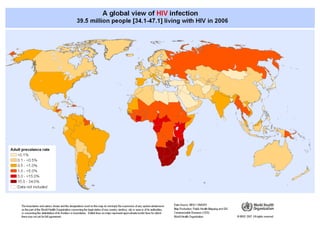
H *** H  – HIV/AIDS
 
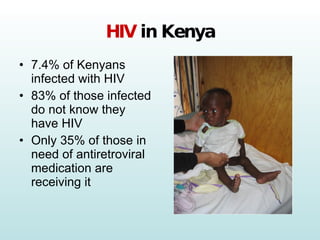
HIV  in Kenya 7.4% of Kenyans infected with HIV 83% of those infected do not know they have HIV Only 35% of those in need of antiretroviral medication are receiving it
H O ** H  – HIV/AIDS O  – Observe, study, research
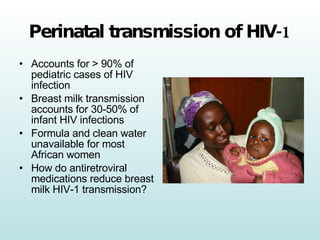
Perinatal transmission of HIV-1 Accounts for > 90% of pediatric cases of HIV infection Breast milk transmission accounts for 30-50% of infant HIV infections Formula and clean water unavailable for most African women How do antiretroviral medications reduce breast milk HIV-1 transmission?
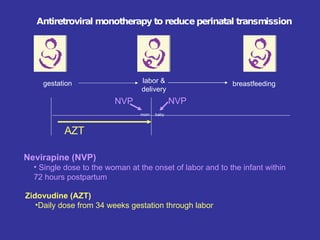
Antiretroviral monotherapy to reduce perinatal transmission gestation labor & delivery breastfeeding Zidovudine (AZT) Daily dose from 34 weeks gestation through labor AZT Nevirapine (NVP)  Single dose to the woman at the onset of labor and to the infant within 72 hours postpartum NVP mom NVP baby
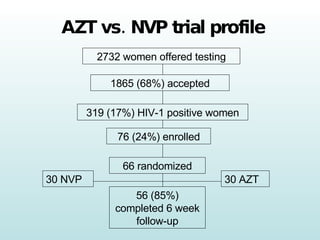
AZT vs. NVP trial profile 2732 women offered testing 1865 (68%) accepted 319 (17%) HIV-1 positive women 76 (24%) enrolled 66 randomized 56 (85%) completed 6 week follow-up 30 NVP 30 AZT
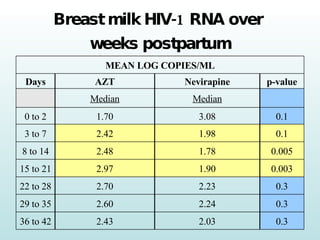
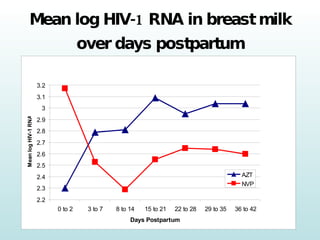
Breast milk HIV-1 RNA over  weeks postpartum 0.3 2.03 2.43 36 to 42 0.3 2.24 2.60 29 to 35  0.3 2.23 2.70 22 to 28 0.003 1.90 2.97 15 to 21 0.005 1.78 2.48 8 to 14 0.1 1.98 2.42 3 to 7 0.1 3.08 1.70 0 to 2 Median Median p-value Nevirapine AZT Days MEAN LOG COPIES/ML
Mean log HIV-1 RNA in breast milk over days postpartum
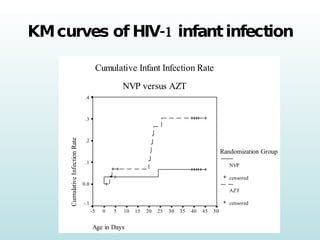
KM curves of HIV-1 infant infection
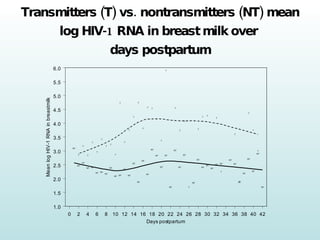
Transmitters (T) vs. nontransmitters (NT) mean log HIV-1 RNA in breast milk over  days postpartum
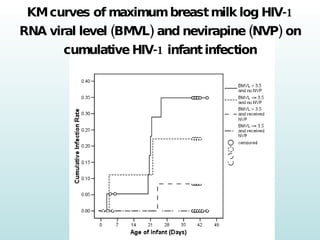
KM curves of maximum breast milk log HIV-1 RNA viral level (BMVL) and nevirapine (NVP) on cumulative HIV-1 infant infection
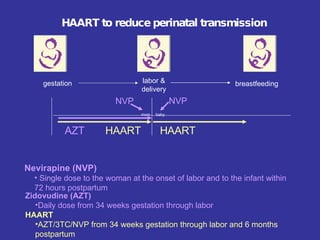
HAART to reduce perinatal transmission gestation labor & delivery breastfeeding Zidovudine (AZT) Daily dose from 34 weeks gestation through labor HAART AZT/3TC/NVP from 34 weeks gestation through labor and 6 months postpartum AZT    HAART Nevirapine (NVP)  Single dose to the woman at the onset of labor and to the infant within 72 hours postpartum NVP mom NVP baby HAART
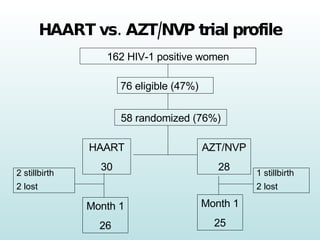
HAART vs. AZT/NVP trial profile 162 HIV-1 positive women 76 eligible (47%) 58 randomized (76%) HAART 30 AZT/NVP 28 Month 1 26 Month 1 25 2 stillbirth 2 lost 1 stillbirth 2 lost
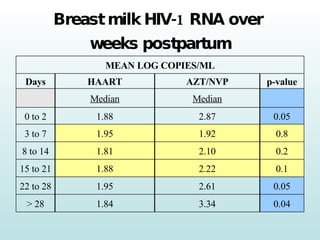
Breast milk HIV-1 RNA over  weeks postpartum 0.04 3.34 1.84 > 28 0.05 2.61 1.95 22 to 28 0.1 2.22 1.88 15 to 21 0.2 2.10 1.81 8 to 14 0.8 1.92 1.95 3 to 7 0.05 2.87 1.88 0 to 2 Median Median p-value AZT/NVP HAART Days MEAN LOG COPIES/ML
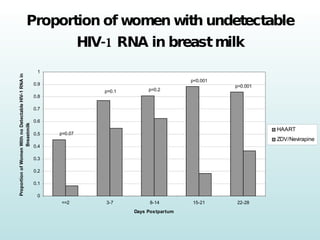
Proportion of women with undetectable HIV-1 RNA in breast milk
Antiretroviral medications on breast milk shedding of HIV-1 RNA Nevirapine is associated with significantly lower breast milk HIV-1 RNA virus for 21 days postpartum compared to AZT  Nevirapine is comparable in effect to HAART on breast milk HIV-1 shedding in the first 2 weeks postpartum Knowledge is relevant in understanding the mechanism of action of nevirapine and informing future choices of perinatal antiretroviral therapy
Observation Studying simple drug regimens to prevent perinatal HIV transmission are vital to the health problems facing mothers who live without access to free formula or clean water Research guides clinical practice relevant to local health needs and problems Rigorous research contributes to interventions that can have a broadly beneficial effect
HO P * H  – HIV/AIDS O  – Observe, research, study P  – Practice, putting knowledge into   clinical action, direct intervention
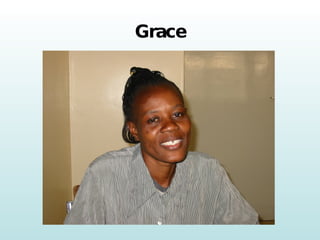
Grace
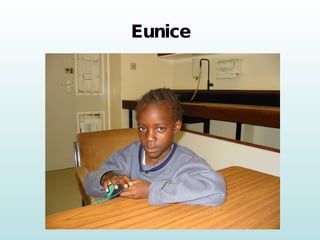
Eunice
Based in Bellingham, WA Donated $2,000 to help Grace and Eunice receive treatment
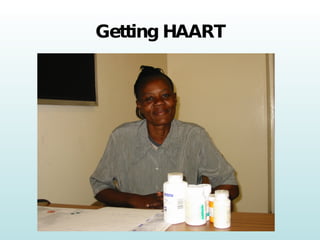
Getting HAART
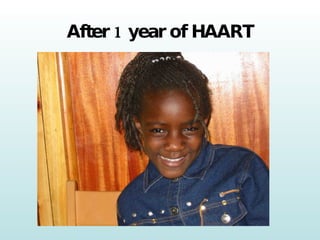
After 1 year of HAART
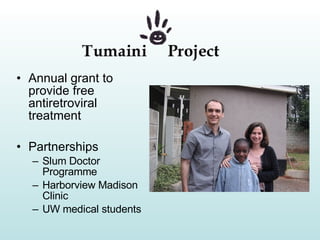
Annual grant to provide free antiretroviral treatment Partnerships Slum Doctor Programme Harborview Madison Clinic UW medical students
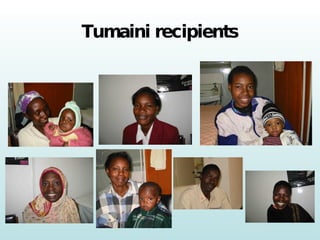
Tumaini recipients
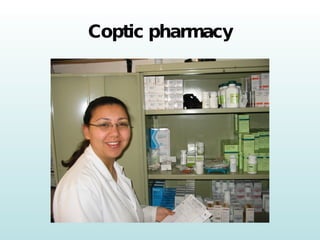
Coptic pharmacy
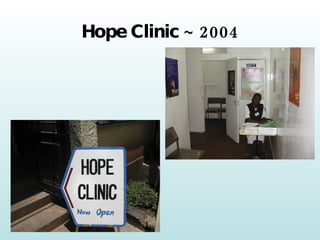
Hope Clinic ~ 2004
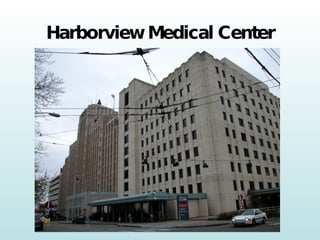
Harborview Medical Center
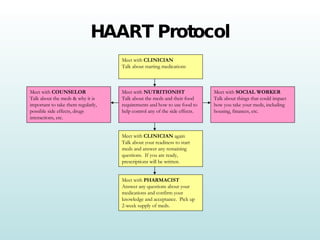
HAART Protocol Meet with  CLINICIAN Talk about starting medications Meet with  COUNSELOR Talk about the meds & why it is important to take them regularly, possible side effects, drugs interactions, etc. Meet with  NUTRITIONIST Talk about the meds and their food requirements and how to use food to help control any of the side effects. Meet with  SOCIAL WORKER Talk about things that could impact how you take your meds, including housing, finances, etc. Meet with  CLINICIAN  again Talk about your readiness to start meds and answer any remaining questions.  If you are ready, prescriptions will be written. Meet with  PHARMACIST Answer any questions about your medications and confirm your knowledge and acceptance.  Pick up 2-week supply of meds.
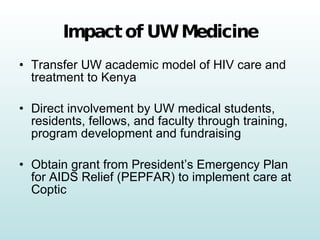
Impact of UW Medicine Transfer UW academic model of HIV care and treatment to Kenya Direct involvement by UW medical students, residents, fellows, and faculty through training, program development and fundraising Obtain grant from President’s Emergency Plan for AIDS Relief (PEPFAR) to implement care at Coptic
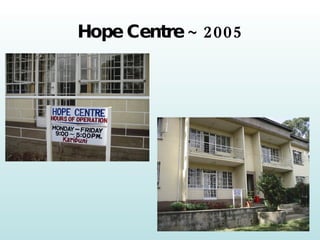
Hope Centre ~ 2005
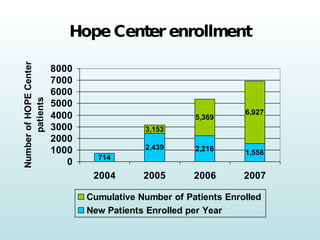
Hope Center enrollment
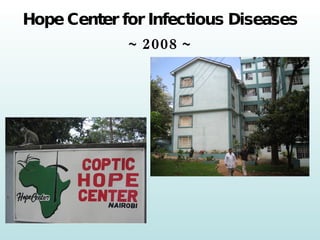
Hope Center for Infectious Diseases ~ 2008 ~
Practice Focuses on individuals and puts a name and face on those who are suffering Can have an immediate impact on saving lives and decreasing morbidity Organizes the academic community around obvious global health needs Nurtures altruistic ethical values of medical students and residents in training
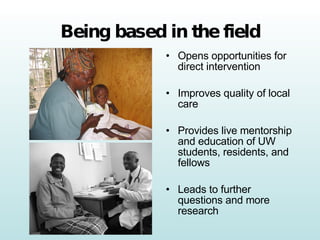
Being based in the field Opens opportunities for direct intervention Improves quality of local care Provides live mentorship and education of UW students, residents, and fellows Leads to further questions and more research
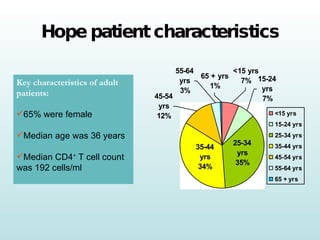
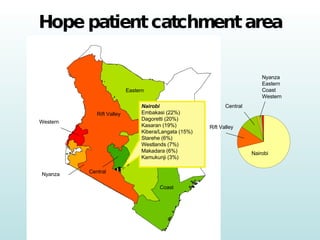
Hope patient characteristics Key characteristics of adult patients: 65% were female Median age was 36 years Median CD4 +  T cell count was 192 cells/ml
Hope patient catchment area Rift Valley Eastern Western Nyanza Central Coast Nairobi Embakasi (22%) Dagoretti (20%) Kasaran (19%) Kibera/Langata (15%) Starehe (6%) Westlands (7%) Makadara (6%) Kamukunji (3%) Nairobi Central Rift Valley Nyanza Eastern Coast Western
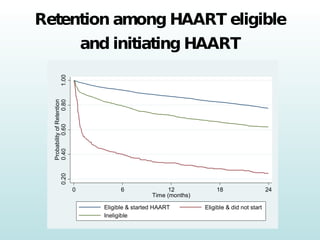
Retention among HAART eligible and initiating HAART
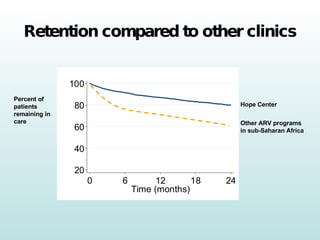
Retention compared to other clinics Percent of patients remaining in care Hope Center Other ARV programs in sub-Saharan Africa
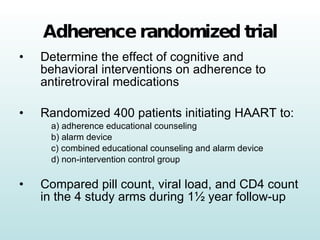
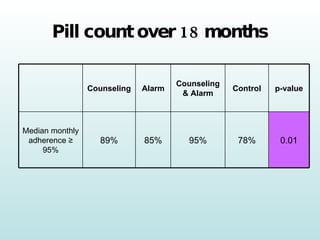
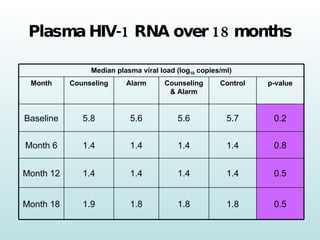
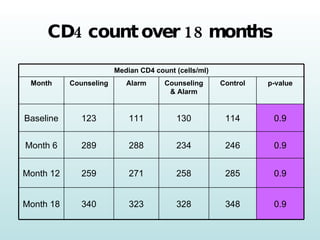
Adherence randomized trial Determine the effect of cognitive and behavioral interventions on adherence to antiretroviral medications Randomized 400 patients initiating HAART to:  a) adherence educational counseling b) alarm device c) combined educational counseling and alarm device d) non-intervention control group Compared pill count, viral load, and CD4 count in the 4 study arms during 1½ year follow-up
Pill count over 18 months 0.01 78% 95% 85% 89% Median monthly adherence  ≥ 95% p-value Control Counseling & Alarm Alarm Counseling
Plasma HIV-1 RNA over 18 months 0.2 5.7 5.6 5.6 5.8 Baseline Median  plasma viral load (log 10  copies/ml) 0.5 1.8 1.8 1.8 1.9 Month 18 0.5 1.4 1.4 1.4 1.4 Month 12 0.8 1.4 1.4 1.4 1.4 Month 6 p-value Control Counseling & Alarm Alarm Counseling Month
CD4 count over 18 months 0.9 114 130 111 123 Baseline Median CD4 count (cells/ml) 0.9 348 328 323 340 Month 18 0.9 285 258 271 259 Month 12 0.9 246 234 288 289 Month 6 p-value Control Counseling & Alarm Alarm Counseling Month
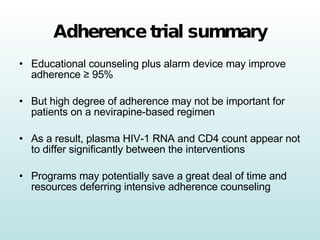
Adherence trial summary Educational counseling plus alarm device may improve adherence  ≥ 95% But high degree of adherence may not be important for patients on a nevirapine-based regimen As a result, plasma HIV-1 RNA and CD4 count appear not to differ significantly between the interventions Programs may potentially save a great deal of time and resources deferring intensive adherence counseling
Other research developed from field-based practice Examining the Coptic database: Growth in children with HIV on HAART CD4 recovery in older patients Factors associated with treatment failure Retention and antiretroviral experience Cervical cancer screening Visual inspection vs. Pap smear LEEP vs. cryotherapy  Co-infection with HIV and Hepatitis B
HOP E H  – HIV/AIDS O  – Observe, research, study P  – Practice, putting knowledge into   clinical practice, direct intervention E  – Educate, share knowledge to improve   quality, train and teach what is learned   through research and practice
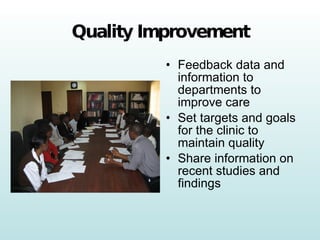
Quality Improvement Feedback data and information to departments to improve care Set targets and goals for the clinic to maintain quality Share information on recent studies and findings
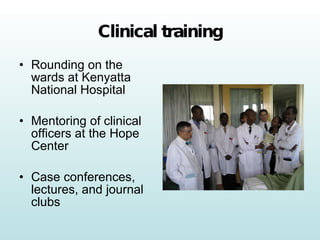
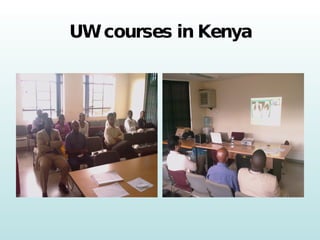
Clinical training Rounding on the wards at Kenyatta National Hospital Mentoring of clinical officers at the Hope Center Case conferences, lectures, and journal clubs
UW courses in Kenya
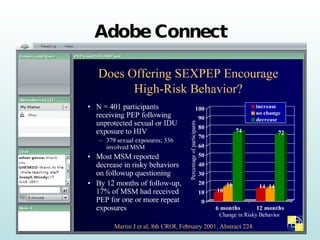
Adobe Connect
UW fellows, residents, and students in Kenya
Their amazing contributions Raised money to buy drugs for patients Helped found the Hope Center Created one of Kenya’s foremost cervical cancer screening programs for HIV-positive women Taught nurses, counselors, and clinical officers Treated patients and raised the standard of medical care at the clinic Inspired their patients and their Kenyan colleagues
Education Disseminates results and best practices to improve quality Increases the local capacity to deliver evidence-based care and treatment Trains the next generation of practitioners and medical leaders in both Kenya and America
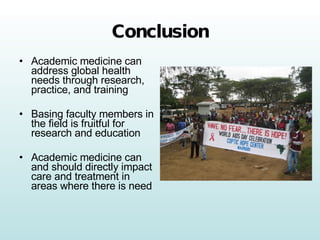
Conclusion Academic medicine can address global health needs through research, practice, and training Basing faculty members in the field is fruitful for research and education Academic medicine can and should directly impact care and treatment in areas where there is need
Acknowledgments University of Washington Grace John-Stewart Barbra Richardson Julie Overbaugh Jane Simoni Jonathan Mayer Dara Lehman Sandy Emery Bill Reidy Sarah Benki Christine McGrath Margaret Barrett Chris Kealy Eileen Seese King Holmes University of Nairobi James Kiarie John Kinuthia Nelly Mugo Tony Etyang Julia Njoroge Study staff and patients Coptic Hospital Samah Sakr Aida Samir Mena Attwa Nadia Kist Joan Thiga  Bishop Paul Hope staff and patients
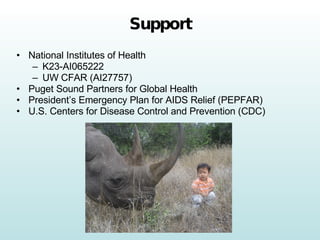
Support National Institutes of Health K23-AI065222 UW CFAR (AI27757) Puget Sound Partners for Global Health President’s Emergency Plan for AIDS Relief (PEPFAR) U.S. Centers for Disease Control and Prevention (CDC)

DGH Lecture Series: Michael Chung

  • 1.
    Notes from theField: Practicing HIV Research in Kenya Michael H. Chung, MD, MPH
  • 2.
    Fieldwork in KenyaLiving and working in Nairobi, Kenya since 2002 Arrived as UW fellow in Infectious Diseases to implement randomized clinical trials examining perinatal HIV-1 transmission Propose to explore how academic medicine interacts with global health from perspective of being in the field
  • 3.
    Academic medicine andglobal health How can Western-based academic medical institutions address global health issues? Should academic medicine have a role in directly impacting local care? Is it useful to be based in a resource-limited setting to conduct academic activities?
  • 4.
    H *** H – HIV/AIDS
  • 5.
  • 6.
    HIV inKenya 7.4% of Kenyans infected with HIV 83% of those infected do not know they have HIV Only 35% of those in need of antiretroviral medication are receiving it
  • 7.
    H O **H – HIV/AIDS O – Observe, study, research
  • 8.
    Perinatal transmission ofHIV-1 Accounts for > 90% of pediatric cases of HIV infection Breast milk transmission accounts for 30-50% of infant HIV infections Formula and clean water unavailable for most African women How do antiretroviral medications reduce breast milk HIV-1 transmission?
  • 9.
    Antiretroviral monotherapy toreduce perinatal transmission gestation labor & delivery breastfeeding Zidovudine (AZT) Daily dose from 34 weeks gestation through labor AZT Nevirapine (NVP) Single dose to the woman at the onset of labor and to the infant within 72 hours postpartum NVP mom NVP baby
  • 10.
    AZT vs. NVPtrial profile 2732 women offered testing 1865 (68%) accepted 319 (17%) HIV-1 positive women 76 (24%) enrolled 66 randomized 56 (85%) completed 6 week follow-up 30 NVP 30 AZT
  • 11.
    Breast milk HIV-1RNA over weeks postpartum 0.3 2.03 2.43 36 to 42 0.3 2.24 2.60 29 to 35 0.3 2.23 2.70 22 to 28 0.003 1.90 2.97 15 to 21 0.005 1.78 2.48 8 to 14 0.1 1.98 2.42 3 to 7 0.1 3.08 1.70 0 to 2 Median Median p-value Nevirapine AZT Days MEAN LOG COPIES/ML
  • 12.
    Mean log HIV-1RNA in breast milk over days postpartum
  • 13.
    KM curves ofHIV-1 infant infection
  • 14.
    Transmitters (T) vs.nontransmitters (NT) mean log HIV-1 RNA in breast milk over days postpartum
  • 15.
    KM curves ofmaximum breast milk log HIV-1 RNA viral level (BMVL) and nevirapine (NVP) on cumulative HIV-1 infant infection
  • 16.
    HAART to reduceperinatal transmission gestation labor & delivery breastfeeding Zidovudine (AZT) Daily dose from 34 weeks gestation through labor HAART AZT/3TC/NVP from 34 weeks gestation through labor and 6 months postpartum AZT HAART Nevirapine (NVP) Single dose to the woman at the onset of labor and to the infant within 72 hours postpartum NVP mom NVP baby HAART
  • 17.
    HAART vs. AZT/NVPtrial profile 162 HIV-1 positive women 76 eligible (47%) 58 randomized (76%) HAART 30 AZT/NVP 28 Month 1 26 Month 1 25 2 stillbirth 2 lost 1 stillbirth 2 lost
  • 18.
    Breast milk HIV-1RNA over weeks postpartum 0.04 3.34 1.84 > 28 0.05 2.61 1.95 22 to 28 0.1 2.22 1.88 15 to 21 0.2 2.10 1.81 8 to 14 0.8 1.92 1.95 3 to 7 0.05 2.87 1.88 0 to 2 Median Median p-value AZT/NVP HAART Days MEAN LOG COPIES/ML
  • 19.
    Proportion of womenwith undetectable HIV-1 RNA in breast milk
  • 20.
    Antiretroviral medications onbreast milk shedding of HIV-1 RNA Nevirapine is associated with significantly lower breast milk HIV-1 RNA virus for 21 days postpartum compared to AZT Nevirapine is comparable in effect to HAART on breast milk HIV-1 shedding in the first 2 weeks postpartum Knowledge is relevant in understanding the mechanism of action of nevirapine and informing future choices of perinatal antiretroviral therapy
  • 21.
    Observation Studying simpledrug regimens to prevent perinatal HIV transmission are vital to the health problems facing mothers who live without access to free formula or clean water Research guides clinical practice relevant to local health needs and problems Rigorous research contributes to interventions that can have a broadly beneficial effect
  • 22.
    HO P *H – HIV/AIDS O – Observe, research, study P – Practice, putting knowledge into clinical action, direct intervention
  • 23.
  • 24.
  • 25.
    Based in Bellingham,WA Donated $2,000 to help Grace and Eunice receive treatment
  • 26.
  • 27.
    After 1 yearof HAART
  • 28.
    Annual grant toprovide free antiretroviral treatment Partnerships Slum Doctor Programme Harborview Madison Clinic UW medical students
  • 29.
  • 30.
  • 31.
  • 32.
  • 33.
    HAART Protocol Meetwith CLINICIAN Talk about starting medications Meet with COUNSELOR Talk about the meds & why it is important to take them regularly, possible side effects, drugs interactions, etc. Meet with NUTRITIONIST Talk about the meds and their food requirements and how to use food to help control any of the side effects. Meet with SOCIAL WORKER Talk about things that could impact how you take your meds, including housing, finances, etc. Meet with CLINICIAN again Talk about your readiness to start meds and answer any remaining questions. If you are ready, prescriptions will be written. Meet with PHARMACIST Answer any questions about your medications and confirm your knowledge and acceptance. Pick up 2-week supply of meds.
  • 34.
    Impact of UWMedicine Transfer UW academic model of HIV care and treatment to Kenya Direct involvement by UW medical students, residents, fellows, and faculty through training, program development and fundraising Obtain grant from President’s Emergency Plan for AIDS Relief (PEPFAR) to implement care at Coptic
  • 35.
  • 36.
  • 37.
    Hope Center forInfectious Diseases ~ 2008 ~
  • 38.
    Practice Focuses onindividuals and puts a name and face on those who are suffering Can have an immediate impact on saving lives and decreasing morbidity Organizes the academic community around obvious global health needs Nurtures altruistic ethical values of medical students and residents in training
  • 39.
    Being based inthe field Opens opportunities for direct intervention Improves quality of local care Provides live mentorship and education of UW students, residents, and fellows Leads to further questions and more research
  • 40.
    Hope patient characteristicsKey characteristics of adult patients: 65% were female Median age was 36 years Median CD4 + T cell count was 192 cells/ml
  • 41.
    Hope patient catchmentarea Rift Valley Eastern Western Nyanza Central Coast Nairobi Embakasi (22%) Dagoretti (20%) Kasaran (19%) Kibera/Langata (15%) Starehe (6%) Westlands (7%) Makadara (6%) Kamukunji (3%) Nairobi Central Rift Valley Nyanza Eastern Coast Western
  • 42.
    Retention among HAARTeligible and initiating HAART
  • 43.
    Retention compared toother clinics Percent of patients remaining in care Hope Center Other ARV programs in sub-Saharan Africa
  • 44.
    Adherence randomized trialDetermine the effect of cognitive and behavioral interventions on adherence to antiretroviral medications Randomized 400 patients initiating HAART to: a) adherence educational counseling b) alarm device c) combined educational counseling and alarm device d) non-intervention control group Compared pill count, viral load, and CD4 count in the 4 study arms during 1½ year follow-up
  • 45.
    Pill count over18 months 0.01 78% 95% 85% 89% Median monthly adherence ≥ 95% p-value Control Counseling & Alarm Alarm Counseling
  • 46.
    Plasma HIV-1 RNAover 18 months 0.2 5.7 5.6 5.6 5.8 Baseline Median plasma viral load (log 10 copies/ml) 0.5 1.8 1.8 1.8 1.9 Month 18 0.5 1.4 1.4 1.4 1.4 Month 12 0.8 1.4 1.4 1.4 1.4 Month 6 p-value Control Counseling & Alarm Alarm Counseling Month
  • 47.
    CD4 count over18 months 0.9 114 130 111 123 Baseline Median CD4 count (cells/ml) 0.9 348 328 323 340 Month 18 0.9 285 258 271 259 Month 12 0.9 246 234 288 289 Month 6 p-value Control Counseling & Alarm Alarm Counseling Month
  • 48.
    Adherence trial summaryEducational counseling plus alarm device may improve adherence ≥ 95% But high degree of adherence may not be important for patients on a nevirapine-based regimen As a result, plasma HIV-1 RNA and CD4 count appear not to differ significantly between the interventions Programs may potentially save a great deal of time and resources deferring intensive adherence counseling
  • 49.
    Other research developedfrom field-based practice Examining the Coptic database: Growth in children with HIV on HAART CD4 recovery in older patients Factors associated with treatment failure Retention and antiretroviral experience Cervical cancer screening Visual inspection vs. Pap smear LEEP vs. cryotherapy Co-infection with HIV and Hepatitis B
  • 50.
    HOP E H – HIV/AIDS O – Observe, research, study P – Practice, putting knowledge into clinical practice, direct intervention E – Educate, share knowledge to improve quality, train and teach what is learned through research and practice
  • 51.
    Quality Improvement Feedbackdata and information to departments to improve care Set targets and goals for the clinic to maintain quality Share information on recent studies and findings
  • 52.
    Clinical training Roundingon the wards at Kenyatta National Hospital Mentoring of clinical officers at the Hope Center Case conferences, lectures, and journal clubs
  • 53.
  • 54.
  • 55.
    UW fellows, residents,and students in Kenya
  • 56.
    Their amazing contributionsRaised money to buy drugs for patients Helped found the Hope Center Created one of Kenya’s foremost cervical cancer screening programs for HIV-positive women Taught nurses, counselors, and clinical officers Treated patients and raised the standard of medical care at the clinic Inspired their patients and their Kenyan colleagues
  • 57.
    Education Disseminates resultsand best practices to improve quality Increases the local capacity to deliver evidence-based care and treatment Trains the next generation of practitioners and medical leaders in both Kenya and America
  • 58.
    Conclusion Academic medicinecan address global health needs through research, practice, and training Basing faculty members in the field is fruitful for research and education Academic medicine can and should directly impact care and treatment in areas where there is need
  • 59.
    Acknowledgments University ofWashington Grace John-Stewart Barbra Richardson Julie Overbaugh Jane Simoni Jonathan Mayer Dara Lehman Sandy Emery Bill Reidy Sarah Benki Christine McGrath Margaret Barrett Chris Kealy Eileen Seese King Holmes University of Nairobi James Kiarie John Kinuthia Nelly Mugo Tony Etyang Julia Njoroge Study staff and patients Coptic Hospital Samah Sakr Aida Samir Mena Attwa Nadia Kist Joan Thiga Bishop Paul Hope staff and patients
  • 60.
    Support National Institutesof Health K23-AI065222 UW CFAR (AI27757) Puget Sound Partners for Global Health President’s Emergency Plan for AIDS Relief (PEPFAR) U.S. Centers for Disease Control and Prevention (CDC)