TECHNOLOGY ENABLED CARE SERVICES
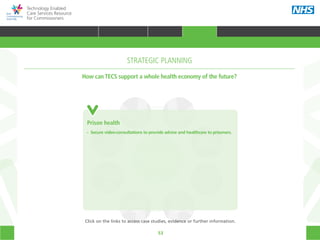
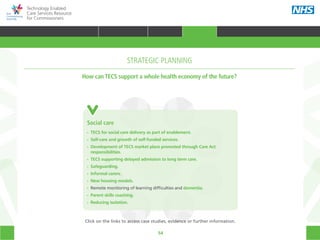
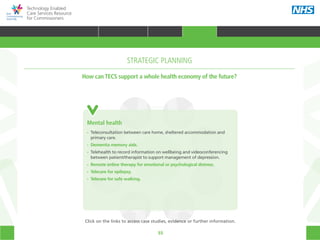
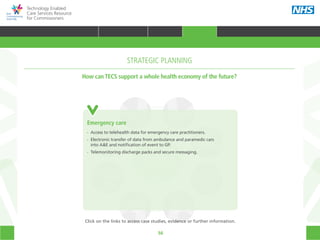
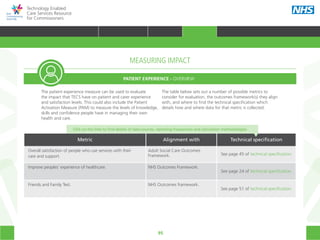
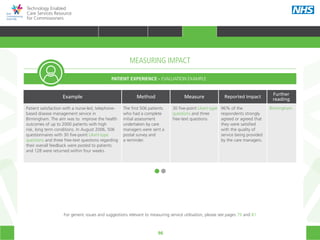
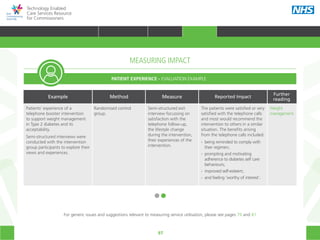
Resource for Commissioners
January 2015
Technology Enabled
Care Services Resource
for Commissioners
2
HOME
4 Forewords 	
6 Audience and purpose 	
8 Policy context	
	
21 What is TECS?	
22 How can TECS support
	 commissioning ambitions	
23 How can TECS deliver
	 integrated health and
	 social care? 	
25 Who should be engaged
	 in a TECS initiative?	
26 How can TECS support
	 commissioning priorities?	
35 How could TECS
	 improve a care pathway?
49 Strategic planning 	
69 Procurement 	
72 Implementing TECS 	
76 Measuring impact 	
107 Continuous
improvement 	
111 References and
	 further reading 	
121 Abbreviations and
Glossary	
122 Acknowledgements
	 and contact	
INTRODUCTION WHY? HOW? RESOURCES
HOW DOES TECS RELATE TO THE
COMMISSIONING CYCLE?
INTRODUCTION WHY IS TECS RELEVANT TO
COMMISSIONERS?
WHAT RESOURCES SUPPORT
THE COMMISSIONING OF TECS?
3
Technology Enabled
Care Services Resource
for Commissioners
INTRODUCTION
HOME INTRODUCTION WHY? HOW? RESOURCES
FOREWORD AUDIENCE AND PURPOSE POLICY CONTEXT
Forewords
Audience & purpose
Policy context
4
Technology Enabled
Care Services Resource
for Commissioners
NHS COMMISSIONING ASSEMBLY FOREWORD
Our ambition as commissioners is to secure high quality
care for all – now and for future generations. As demand
for health and social care continues to rise, we know
that to achieve this the NHS needs to evolve and develop
new models of care that provide better coordinated and
integrated primary, community, hospital and social
care services.
NHS England’s Five Year Forward View sets out the changes
we need to make to provide high quality care for patients,
promote wellbeing, prevent ill health and reduce health
inequalities. And for the first time, we as commissioners
have been asked to plan on a five year trajectory, enabling
us to take a long term strategic approach to developing
commissioning plans. This gives us the opportunity to be
innovative and ambitious in how we plan to help all people
to stay healthy and avoid complications. Technology enabled
care services can be an effective tool in supporting people to
manage their own health and enabling better coordination of
care, personalisation and prevention.
Technology alone can’t deliver a transformation in care, but
when embedded in a wider package of care and new ways of
working, the combined innovation can have a powerful impact
on improving patient outcomes and reducing inequality. That
is why planning for technology enabled care services needs to
take place at a whole health economy level and involve health,
social care, voluntary services, patients and carers.
As commissioners, we want the opportunity to innovate and
improve services to achieve the best outcomes for the people
we serve. To do this, we need support and information about
how to develop and design services that take advantage of
new and emerging technologies – that is what this TECS
commissioning toolkit provides.
This resource, developed by commissioners from the Quality
Working Group of the Commissioning Assembly, will I hope
encourage all of us – health and social care commissioners at
a local and national level – to learn from each other and work
together to secure better value for money services and achieve
improved outcomes and reduced inequalities for patients,
citizens and carers.
Dr Peter Melton
Co-Chair NHS Commissioning Assembly
HOME INTRODUCTION WHY? HOW? RESOURCES
FOREWORD AUDIENCE AND PURPOSE POLICY CONTEXTFOREWORD
5
Technology Enabled
Care Services Resource
for Commissioners
NHS ENGLAND FOREWORD
The Technology Enabled Care Services Resource for
Commissioners has been developed by NHS commissioners
to identify practical tools that can help maximise the value
of technology enabled care services for patients, carers,
commissioners and the whole health economy.
Technology has the power to radically transform the way
we deliver healthcare by enabling all patients to take a
more active role in their own health and increase prevention
through supported self-care. By capitalising on new and
emerging technology we have the opportunity to provide a
modern model of continuous, coordinated care centered on
the individual, with professionals acting in partnership with
the person to improve their health and wellbeing. The
National Information Board’s Framework for Action -
Personalised Health and Care 2020 sets out the ambition
to harness the power of technology to provide better, safer
and sustainable care.
I believe that by embracing rapidly emerging mobile and health
care we can empower millions of patients to own their own
care and transform the way we plan and deliver services to
create a sustainable NHS for the future.
Professor Sir Bruce Keogh KBE 			
National Medical Director, NHS England
HOME INTRODUCTION WHY? HOW? RESOURCES
FOREWORD AUDIENCE AND PURPOSE POLICY CONTEXTFOREWORD
6
Technology Enabled
Care Services Resource
for Commissioners
AUDIENCE AND PURPOSE
What is TECS?
The term ‘technology enabled care services’ (TECS) refers
to technologies (such as telecare, telehealth, telemedicine/
teleconsultation and self care apps) that help people to
manage and control chronic illness and sustain independence.
They enable the remote exchange of information, primarily
between a patient or citizen and a health or care professional,
to assist in diagnosing or monitoring health status or
promoting good health. The TECS programme aims to
empower patients and citizens and support them to take
greater control of their own health and care, working in
partnership with health and care professionals, families,
carers and the voluntary sector. Some TECS, such as telecare,
are already well established within the social care and housing
sectors. These are often supported through Integrated
Community Equipment Services (ICES) schemes, although
many are increasingly self-funded.
The Better Care Fund and the Care Act bring new
opportunities for collaboration, earlier assessment,
information, advice and guidance in the delivery of high
quality social care services. This will include supporting
people to self-care and self-manage through use of their
own resources, developing the retail market as well as
encouraging the use of personal health budgets for TECS.
NHS England has set out plans for the new Integrated
Personal Commissioning Pilots which will be available
from April 2015.
Who is this toolkit for?
This toolkit is for all commissioners of health and care
services, including NHS England, clinical commissioning
groups (CCGs) and local authorities and providers of health
and social care. Commissioners will work with their provider
community to define the types of services their populations
need, including those enabled by information technology.
They can also play an important role in joint planning and
investment in technology across a local health economy
(LHE). Commissioners should work with providers to ensure
eligible patients with long term conditions (LTCs) are offered a
personalised care plan which may outline the need for access
to digital information and TECS. 
The toolkit will also be of interest to people working in
partnership and providing support to commissioners, including
health and wellbeing boards, Commissioning Support Units
(CSUs) and providers of health and social care, who have plans
for TECS and wish to seek support from their commissioner.
HOME INTRODUCTION WHY? HOW? RESOURCES
FOREWORD AUDIENCE AND PURPOSE POLICY CONTEXTAUDIENCE AND PURPOSE
7
Technology Enabled
Care Services Resource
for Commissioners
What is this toolkit for?
This toolkit is the first component of a suite of resources
we are developing on implementation, procurement,
measurement and improvement. It provides practical tools
to help commissioners and their delivery partners to:
•• Select, procure, deploy and measure TECS effectively to
	 transform care pathways and deliver the most appropriate 		
	 care for patients.
•• Map, understand and harness the potential of resources
	 already available within the local health economy.
•• Implement local innovation and commissioning practices 		
	 that are responsive to rapid advances in technology and 		
	 enable increasing digital maturity.
The advice in this toolkit aligns with the steps
in a typical commissioning cycle. It tackles the
following questions:
•• How can commissioners maximise the benefits of TECS to
	 achieve levels of ambition in improved social care and health
	 outcomes, particularly in preventing and managing chronic
	 illness, effectively sustaining independence as people age and
	 averting admission to acute and institutional care?
•• How can TECS be used to meet the changing needs of current
	 and future patients and their carers?
•• How can TECS support new models of care that deliver
	 transformation in quality and efficiency?
•• How can TECS enable a commissioning model that empowers 	
	 patients and citizens to manage their own care in a way that		
	 best suits them?
•• What opportunities does TECS present in the commissioning
	 and delivery of primary care?
How will this toolkit help me?
TECS can help deliver NHS, local authority and voluntary and
independent sector services more effectively and efficiently.
The toolkit equips commissioners to:
•• Be aware of the wide range of TECS available, how they 		
support commissioning intentions, and the benefits they 		
	 can bring to patients, commissioners, families, health and care 	
		professionals and provider managers.
•• Collaborate with their provider communities to unlock the 		
	 potential of TECS in supporting continuous improvement in the 	
	 quality of care.
•• Set the TECS strategy in their locality, oversee and scrutinise 		
	 TECS implementation plans, ask the right questions to seek 		
	 assurance, provide focused advice and guidance on delivery 		
	 and ensure effective evaluation.
AUDIENCE AND PURPOSE
HOME INTRODUCTION WHY? HOW? RESOURCES
FOREWORD AUDIENCE AND PURPOSE POLICY CONTEXTAUDIENCE AND PURPOSE
8
Technology Enabled
Care Services Resource
for Commissioners
HEALTHCARE
SOCIAL CARE
GOALS
SELF CARE
POLICY CONTEXT
HOME INTRODUCTION WHY? HOW? RESOURCES
FOREWORD AUDIENCE AND PURPOSE POLICY CONTEXT
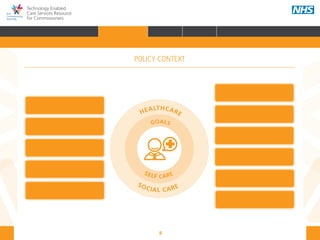
NHS and Adult Social Care
Outcomes Frameworks
New models of primary care
Urgent and Emergency
Care Review
7-Day Service
Health and social
care integration
The Care Act
Personal health budgets
The Better Care Fund
Personalisation of care
The NHS Five Year Forward View
POLICY CONTEXT
Personalised Health and
Care 2020
9
Technology Enabled
Care Services Resource
for Commissioners
NHS and Adult Social Care
Outcomes Frameworks
New models of primary care
Urgent and Emergency
Care Review
7-Day Service
The NHS Five Year Forward View
The Care Act
Personal health budgets
The Better Care Fund
Personalisation of care
Health and social
care integration
Personalised Health and
Care 2020
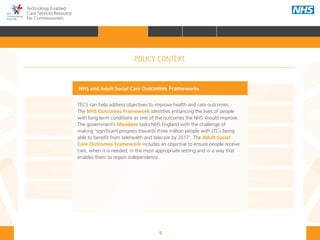
NHS and Adult Social Care Outcomes Frameworks
TECS can help address objectives to improve health and care outcomes.
The NHS Outcomes Framework identifies enhancing the lives of people
with long term conditions as one of the outcomes the NHS should improve.
The government’s Mandate tasks NHS England with the challenge of
making ‘significant progress towards three million people with LTCs being
able to benefit from telehealth and telecare by 2017’. The Adult Social
Care Outcomes Framework includes an objective to ensure people receive
care, when it is needed, in the most appropriate setting and in a way that
enables them to regain independence.
POLICY CONTEXT
HOME INTRODUCTION WHY? HOW? RESOURCES
FOREWORD AUDIENCE AND PURPOSE POLICY CONTEXTPOLICY CONTEXT
10
Technology Enabled
Care Services Resource
for Commissioners
NHS and Adult Social Care
Outcomes Frameworks
New models of primary care
Urgent and Emergency
Care Review
7-Day Service
The NHS Five Year Forward View
The Care Act
Personal health budgets
The Better Care Fund
Personalisation of care
Health and social
care integration
Personalised Health and
Care 2020
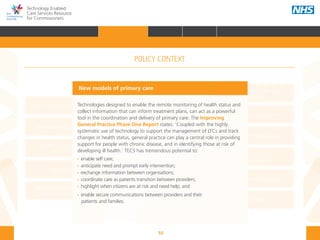
Technologies designed to enable the remote monitoring of health status and
collect information that can inform treatment plans, can act as a powerful
tool in the coordination and delivery of primary care. The Improving
General Practice Phase One Report states: ‘Coupled with the highly
systematic use of technology to support the management of LTCs and track
changes in health status, general practice can play a central role in providing
support for people with chronic disease, and in identifying those at risk of
developing ill health.’ TECS has tremendous potential to:
•• enable self care;
•• anticipate need and prompt early intervention;
•• exchange information between organisations;
•• coordinate care as patients transition between providers;
•• highlight when citizens are at risk and need help; and
•• enable secure communications between providers and their 		 	
patients and families.
New models of primary care
POLICY CONTEXT
HOME INTRODUCTION WHY? HOW? RESOURCES
FOREWORD AUDIENCE AND PURPOSE POLICY CONTEXTPOLICY CONTEXT
11
Technology Enabled
Care Services Resource
for Commissioners
NHS and Adult Social Care
Outcomes Frameworks
New models of primary care
Urgent and Emergency
Care Review
7-Day Service
The NHS Five Year Forward View
The Care Act
Personal health budgets
The Better Care Fund
Personalisation of care
Health and social
care integration
Personalised Health and
Care 2020
Urgent and Emergency Care Review
When used as part of the right package of care, TECS can support
people in such a way that unnecessary visits to urgent and emergency
care departments and admissions to hospital are avoided. This enables
professionals to care for those most in need.
POLICY CONTEXT
HOME INTRODUCTION WHY? HOW? RESOURCES
FOREWORD AUDIENCE AND PURPOSE POLICY CONTEXTPOLICY CONTEXT
12
Technology Enabled
Care Services Resource
for Commissioners
NHS and Adult Social Care
Outcomes Frameworks
New models of primary care
Urgent and Emergency
Care Review
7-Day Service
The NHS Five Year Forward View
The Care Act
Personal health budgets
The Better Care Fund
Personalisation of care
Health and social
care integration
Personalised Health and
Care 2020
7-Day Service
TECS offers an opportunity to deliver care to people in more efficient ways,
particularly those that live in remote and rural areas. It can support the shift
towards providing patients with access to some health and care services,
seven days a week to reduce variation when patients recieve care1
.
1
See NHS Everyday for more information about how NHS England is moving towards routine NHS 	
services being made available seven days a week.
POLICY CONTEXT
HOME INTRODUCTION WHY? HOW? RESOURCES
FOREWORD AUDIENCE AND PURPOSE POLICY CONTEXTPOLICY CONTEXT
13
Technology Enabled
Care Services Resource
for Commissioners
NHS and Adult Social Care
Outcomes Frameworks
New models of primary care
Urgent and Emergency
Care Review
7-Day Service
The NHS Five Year Forward View
The Care Act
Personal health budgets
The Better Care Fund
Personalisation of care
Health and social
care integration
Personalised Health and
Care 2020
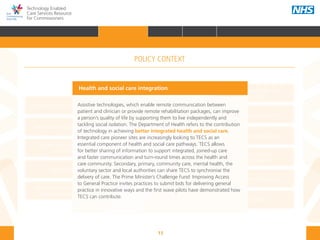
Health and social care integration
Assistive technologies, which enable remote communication between
patient and clinician or provide remote rehabilitation packages, can improve
a person’s quality of life by supporting them to live independently and
tackling social isolation. The Department of Health refers to the contribution
of technology in achieving better integrated health and social care.
Integrated care pioneer sites are increasingly looking to TECS as an
essential component of health and social care pathways. TECS allows
for better sharing of information to support integrated, joined-up care
and faster communication and turn-round times across the health and
care community. Secondary, primary, community care, mental health, the
voluntary sector and local authorities can share TECS to synchronise the
delivery of care. The Prime Minister’s Challenge Fund: Improving Access
to General Practice invites practices to submit bids for delivering general
practice in innovative ways and the first wave pilots have demonstrated how
TECS can contribute.
POLICY CONTEXT
HOME INTRODUCTION WHY? HOW? RESOURCES
FOREWORD AUDIENCE AND PURPOSE POLICY CONTEXTPOLICY CONTEXT
14
Technology Enabled
Care Services Resource
for Commissioners
NHS and Adult Social Care
Outcomes Frameworks
New models of primary care
Urgent and Emergency
Care Review
7-Day Service
The NHS Five Year Forward View
The Care Act
Personal health budgets
The Better Care Fund
Personalisation of care
Health and social
care integration
Personalised Health and
Care 2020
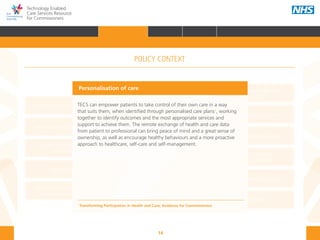
Personalisation of care
TECS can empower patients to take control of their own care in a way
that suits them, when identified through personalised care plans1
, working
together to identify outcomes and the most appropriate services and
support to achieve them. The remote exchange of health and care data
from patient to professional can bring peace of mind and a great sense of
ownership, as well as encourage healthy behaviours and a more proactive
approach to healthcare, self-care and self-management.
1
Transforming Participation in Health and Care, Guidance for Commissioners
POLICY CONTEXT
HOME INTRODUCTION WHY? HOW? RESOURCES
FOREWORD AUDIENCE AND PURPOSE POLICY CONTEXTPOLICY CONTEXT
15
Technology Enabled
Care Services Resource
for Commissioners
NHS and Adult Social Care
Outcomes Frameworks
New models of primary care
Urgent and Emergency
Care Review
7-Day Service
The NHS Five Year Forward View
The Care Act
Personal health budgets
The Better Care Fund
Personalisation of care
Health and social
care integration
Personalised Health and
Care 2020
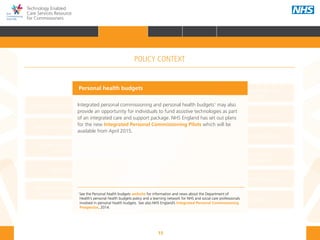
Personal health budgets
Integrated personal commissioning and personal health budgets1
may also
provide an opportunity for individuals to fund assistive technologies as part
of an integrated care and support package. NHS England has set out plans
for the new Integrated Personal Commissioning Pilots which will be
available from April 2015.
1
See the Personal health budgets website for information and news about the Department of 	 	
Health’s personal health budgets policy and a learning network for NHS and social care professionals 	
involved in personal health budgets. See also NHS England’s Integrated Personal Commissioning 	
Prospectus, 2014.
POLICY CONTEXT
HOME INTRODUCTION WHY? HOW? RESOURCES
FOREWORD AUDIENCE AND PURPOSE POLICY CONTEXTPOLICY CONTEXT
16
Technology Enabled
Care Services Resource
for Commissioners
NHS and Adult Social Care
Outcomes Frameworks
New models of primary care
Urgent and Emergency
Care Review
7-Day Service
The NHS Five Year Forward View
The Care Act
Personal health budgets
The Better Care Fund
Personalisation of care
Health and social
care integration
Personalised Health and
Care 2020
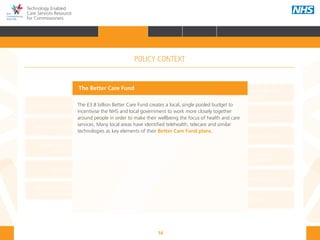
The Better Care Fund
The £3.8 billion Better Care Fund creates a local, single pooled budget to
incentivise the NHS and local government to work more closely together
around people in order to make their wellbeing the focus of health and care
services. Many local areas have identified telehealth, telecare and similar
technologies as key elements of their Better Care Fund plans.
POLICY CONTEXT
HOME INTRODUCTION WHY? HOW? RESOURCES
FOREWORD AUDIENCE AND PURPOSE POLICY CONTEXTPOLICY CONTEXT
17
Technology Enabled
Care Services Resource
for Commissioners
NHS and Adult Social Care
Outcomes Frameworks
New models of primary care
Urgent and Emergency
Care Review
7-Day Service
The NHS Five Year Forward View
The Care Act
Personal health budgets
The Better Care Fund
Personalisation of care
Health and social
care integration
Personalised Health and
Care 2020
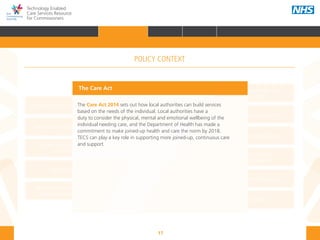
The Care Act 2014 sets out how local authorities can build services
based on the needs of the individual. Local authorities have a
duty to consider the physical, mental and emotional wellbeing of the
individual needing care, and the Department of Health has made a
commitment to make joined-up health and care the norm by 2018.
TECS can play a key role in supporting more joined-up, continuous care
and support.
The Care Act
POLICY CONTEXT
HOME INTRODUCTION WHY? HOW? RESOURCES
FOREWORD AUDIENCE AND PURPOSE POLICY CONTEXTPOLICY CONTEXT
18
Technology Enabled
Care Services Resource
for Commissioners
NHS and Adult Social Care
Outcomes Frameworks
New models of primary care
Urgent and Emergency
Care Review
7-Day Service
The NHS Five Year Forward View
The Care Act
Personal health budgets
The Better Care Fund
Personalisation of care
Health and social
care integration
Personalised Health and
Care 2020
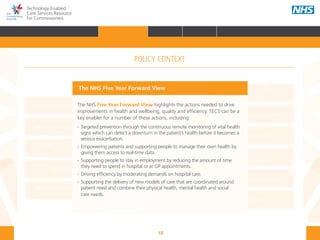
The NHS Five Year Forward View highlights the actions needed to drive
improvements in health and wellbeing, quality and efficiency. TECS can be a
key enabler for a number of these actions, including:
•• Targeted prevention through the continuous remote monitoring of vital health 	
	 signs which can detect a downturn in the patient’s health before it becomes a 	
	 serious exacerbation.
•• 	Empowering patients and supporting people to manage their own health by 	
	 giving them access to real-time data.
•• Supporting people to stay in employment by reducing the amount of time 		
	 they need to spend in hospital or at GP appointments.
•• 	Driving efficiency by moderating demands on hospital care.
•• Supporting the delivery of new models of care that are coordinated around 		
	 patient need and combine their physical health, mental health and social 		
	 care needs.
The NHS Five Year Forward View
POLICY CONTEXT
HOME INTRODUCTION WHY? HOW? RESOURCES
FOREWORD AUDIENCE AND PURPOSE POLICY CONTEXTPOLICY CONTEXT
19
Technology Enabled
Care Services Resource
for Commissioners
NHS and Adult Social Care
Outcomes Frameworks
New models of primary care
Urgent and Emergency
Care Review
7-Day Service
The NHS Five Year Forward View
The Care Act
Personal health budgets
The Better Care Fund
Personalisation of care
Health and social
care integration
Personalised Health and
Care 2020
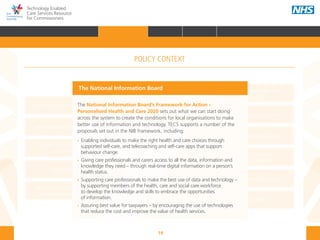
The National Information Board’s Framework for Action -
Personalised Health and Care 2020 sets out what we can start doing
across the system to create the conditions for local organisations to make
better use of information and technology. TECS supports a number of the
proposals set out in the NIB framework, including:
•• Enabling individuals to make the right health and care choices through 		
	 supported self-care, and telecoaching and self-care apps that support 			
	 behaviour change.
•• 	Giving care professionals and carers access to all the data, information and 		
	 knowledge they need – through real-time digital information on a person’s 		
		health status.
•• Supporting care professionals to make the best use of data and technology – 	
	 by supporting members of the health, care and social care workforce 			
	 to develop the knowledge and skills to embrace the opportunities 			
	 of information.
•• Assuring best value for taxpayers – by encouraging the use of technologies 		
	 that reduce the cost and improve the value of health services.
The National Information Board
POLICY CONTEXT
HOME INTRODUCTION WHY? HOW? RESOURCES
FOREWORD AUDIENCE AND PURPOSE POLICY CONTEXTPOLICY CONTEXT
Technology Enabled
Care Services Resource
for Commissioners
20
WHY IS TECS RELEVANT
TO COMMISSIONERS?
What is TECS?
How can TECS support
commissioning ambitions?
How can TECS deliver integrated
health and social care?
Who should be engaged in a TECS initiative?
How can TECS support commissioning priorities?
How could TECS improve a care pathway?
WHAT IS TECS? COMMISSIONING AMBITIONS INTEGRATION STAKEHOLDER ENGAGEMENT COMMISSIONING PRIORITIES CARE PATHWAY
HOME WHY?INTRODUCTION HOW? RESOURCES
21
Technology Enabled
Care Services Resource
for Commissioners
WHAT IS TECS?
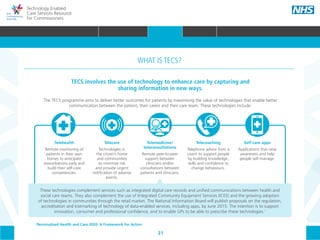
TECS involves the use of technology to enhance care by capturing and
sharing information in new ways.
The TECS programme aims to deliver better outcomes for patients by maximising the value of technologies that enable better
communication between the patient, their carers and their care team. These technologies include:
Telehealth
Remote monitoring of
patients in their own
homes to anticipate
exacerbations early and
build their self-care
competencies.
Telecare
Technologies in
the citizen’s home
and communities
to minimise risk
and provide urgent
notification of adverse
events.
Telemedicine/
teleconsultations
Remote peer-to-peer
support between
clinicians and/or
consultations between
patients and clinicians.
Telecoaching
Telephone advice from a
coach to support people
by building knowledge,
skills and confidence to
change behaviours.
Self-care apps
Applications that raise
awareness and help
people self-manage.
These technologies complement services such as integrated digital care records and unified communications between health and
social care teams. They also complement the use of Integrated Community Equipment Services (ICES) and the growing adoption
of technologies in communities through the retail market. The National Information Board will publish proposals on the regulation,
accreditation and kitemarking of technology of data-enabled services, including apps, by June 2015. The intention is to support
innovation, consumer and professional confidence, and to enable GPs to be able to prescribe these technologies.1
1
Personalised Health and Care 2020: A Framework for Action
HOME WHY?INTRODUCTION HOW? RESOURCES
WHAT IS TECS? COMMISSIONING AMBITIONS INTEGRATION STAKEHOLDER ENGAGEMENT COMMISSIONING PRIORITIES CARE PATHWAYWHAT IS TECS?
22
Technology Enabled
Care Services Resource
for Commissioners
Increasing the number of people with mental and
physical health conditions having a positive experience
of hospital care.
Increasing the number of people with mental
and physical health conditions having a positive
experience of care outside hospital, in general practice
and in the community.
Making significant progress towards eliminating
avoidable deaths in our hospitals caused by problems
in care.
Securing additional years of life for the people
of England with treatable mental and physical
health conditions.
Improving the health-related quality of life of the
more than 15 million people with one or more LTCs,
including mental health conditions.
Reducing the amount of avoidable time people spend
in hospital through better and more integrated care
in the community, outside of hospital.
Increasing the proportion of older people living
independently at home following discharge
from hospital.
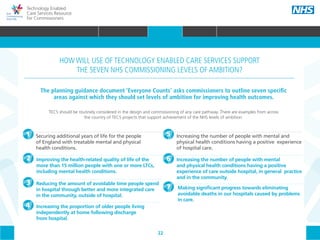
The planning guidance document ‘Everyone Counts’ asks commissioners to outline seven specific
areas against which they should set levels of ambition for improving health outcomes.
TECS should be routinely considered in the design and commissioning of any care pathway. There are examples from across
the country of TECS projects that support achievement of the NHS levels of ambition.
HOW WILL USE OF TECHNOLOGY ENABLED CARE SERVICES SUPPORT
THE SEVEN NHS COMMISSIONING LEVELS OF AMBITION?
HOME WHY?INTRODUCTION HOW? RESOURCES
WHAT IS TECS? COMMISSIONING AMBITIONS INTEGRATION STAKEHOLDER ENGAGEMENT COMMISSIONING PRIORITIES CARE PATHWAYCOMMISSIONING AMBITIONS
23
Technology Enabled
Care Services Resource
for Commissioners
Wellness Complex Multiple Long Term Conditions
Pregnancy &
first year of life
Conception to age 1
700,000 births
Childhood
Age 1 – 11
6.5m people
Adolescence
Age 12 – 16
3m people
Young Adulthood
Age 17 – 39
16m people
Middle Age
Age 40 – 64
17.4m people
Older Years
Age 65+
9.3m people
Telehealth to
support management
of multiple LTCs and
rehabilitation.
Telecare to maintain
independence and
provide carer support.
Teleconsultation to
facilitate contact with
friends and family to
reduce loneliness.
Telehealth
monitoring of high-
risk pregnancy.
Telecoaching to
stop smoking.
Telecoaching for
obesity, parental skills
and exercise.
Apps to help with
management of LTCs.
Telecare supporting
parents of disabled
children.
Apps for advice on
diet and nutrition.
Telecoaching for
early smoking/
drinking/sex.
Text reminders.
Teleconsultation
supporting Child
and Mental health
Services (CAMHS).
Teleconsultation to
facilitate access to
services.
Mobile telehealth
for LTCs.
Telecare supporting
independence of
adults with physical and
learning disabilities.
Teleconsultation for
convenient access to
mental health specialists.
Telehealth to manage
LTCs such as COPD, CHF
and other early onset
chronic conditions and
support carers’ health.
TECS for screening.
Apps and telecare
providing advice,
support and reassurance
to carers.
Teleconsultation to
support familial and
carer contact.
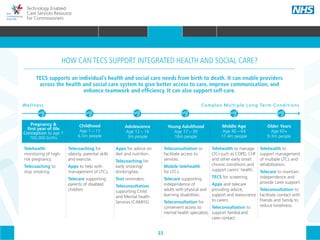
TECS supports an individual’s health and social care needs from birth to death. It can enable providers
across the health and social care system to give better access to care, improve communication, and
enhance teamwork and efficiency. It can also support self-care.
HOW CAN TECS SUPPORT INTEGRATED HEALTH AND SOCIAL CARE?
HOME WHY?INTRODUCTION HOW? RESOURCES
WHAT IS TECS? COMMISSIONING AMBITIONS INTEGRATION STAKEHOLDER ENGAGEMENT COMMISSIONING PRIORITIES CARE PATHWAYINTEGRATION
24
Technology Enabled
Care Services Resource
for Commissioners
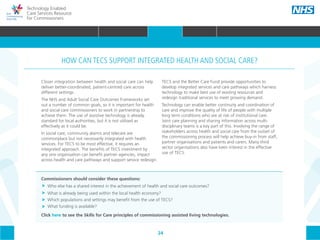
Closer integration between health and social care can help
deliver better-coordinated, patient-centred care across
different settings.
The NHS and Adult Social Care Outcomes Frameworks set
out a number of common goals, so it is important for health
and social care commissioners to work in partnership to
achieve them. The use of assistive technology is already
standard for local authorities, but it is not utilised as
effectively as it could be.
In social care, community alarms and telecare are
commonplace but not necessarily integrated with health
services. For TECS to be most effective, it requires an
integrated approach. The benefits of TECS investment by
any one organisation can benefit partner agencies, impact
across health and care pathways and support service redesign.
Commissioners should consider these questions:
Who else has a shared interest in the achievement of health and social care outcomes?
What is already being used within the local health economy?
Which populations and settings may benefit from the use of TECS?
What funding is available?
Click here to see the Skills for Care principles of commissioning assisted living technologies.
					
TECS and the Better Care Fund provide opportunities to
develop integrated services and care pathways which harness
technology to make best use of existing resources and
redesign traditional services to meet growing demand.
Technology can enable better continuity and coordination of
care and improve the quality of life of people with multiple
long term conditions who are at risk of institutional care.
Joint care planning and sharing information across multi-
disciplinary teams is a key part of this. Involving the range of
stakeholders across health and social care from the outset of
the commissioning process will help achieve buy-in from staff,
partner organisations and patients and carers. Many third
sector organisations also have keen interest in the effective
use of TECS. 				
HOW CAN TECS SUPPORT INTEGRATED HEALTH AND SOCIAL CARE?
HOME WHY?INTRODUCTION HOW? RESOURCES
WHAT IS TECS? COMMISSIONING AMBITIONS INTEGRATION STAKEHOLDER ENGAGEMENT COMMISSIONING PRIORITIES CARE PATHWAYINTEGRATION
25
Technology Enabled
Care Services Resource
for Commissioners
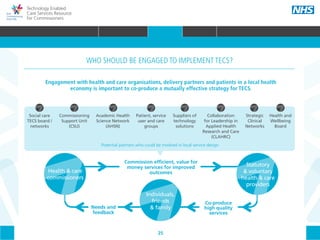
Engagement with health and care organisations, delivery partners and patients in a local health
economy is important to co-produce a mutually effective strategy for TECS.
Commission efficient, value for
money services for improved
outcomes
Needs and
feedback
Co-produce
high quality
services
Social care
TECS board /
networks
Commissioning
Support Unit
(CSU)
Academic Health
Science Network
(AHSN)
Patient, service
user and care
groups
Suppliers of
technology
solutions
Collaboration
for Leadership in
Applied Health
Research and Care
(CLAHRC)
Strategic
Clinical
Networks
Health and
Wellbeing
Board
Individuals,
friends
& family
Statutory
& voluntary
health & care
providers
Potential partners who could be involved in local service design
Health & care
commissioners
WHO SHOULD BE ENGAGED TO IMPLEMENT TECS?
HOME WHY?INTRODUCTION HOW? RESOURCES
WHAT IS TECS? COMMISSIONING AMBITIONS INTEGRATION STAKEHOLDER ENGAGEMENT COMMISSIONING PRIORITIES CARE PATHWAYSTAKEHOLDER ENGAGEMENT
26
Technology Enabled
Care Services Resource
for Commissioners
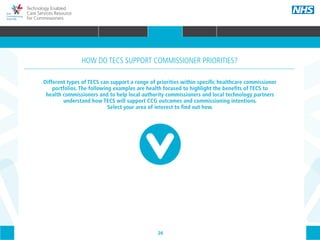
Different types of TECS can support a range of priorities within specific healthcare commissioner
portfolios. The following examples are health focused to highlight the benefits of TECS to
health commissioners and to help local authority commissioners and local technology partners
understand how TECS will support CCG outcomes and commissioning intentions.
Select your area of interest to find out how.
HOW DO TECS SUPPORT COMMISSIONER PRIORITIES?
HOME WHY?INTRODUCTION HOW? RESOURCES
WHAT IS TECS? COMMISSIONING AMBITIONS INTEGRATION STAKEHOLDER ENGAGEMENT COMMISSIONING PRIORITIES CARE PATHWAY
Primary
care
Community
care
Reablement
Acute
elective
Urgent &
emergency
care
Long term
conditions
Maternity
& children
Mental
health
COMMISSIONING PRIORITIES
27
Technology Enabled
Care Services Resource
for Commissioners
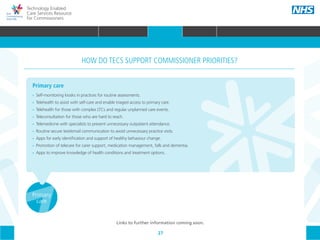
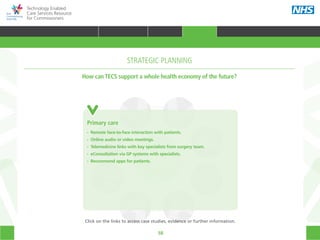
Primary care
•• 	Self-monitoring kiosks in practices for routine assessments.
•• 	Telehealth to assist with self-care and enable triaged access to primary care.
•• 	Telehealth for those with complex LTCs and regular unplanned care events.
•• 	Teleconsultation for those who are hard to reach.
•• 	Telemedicine with specialists to prevent unnecessary outpatient attendance.
•• 	Routine secure text/email communication to avoid unnecessary practice visits.
•• 	Apps for early identification and support of healthy behaviour change.
•• 	Promotion of telecare for carer support, medication management, falls and dementia.
•• Apps to improve knowledge of health conditions and treatment options.
Primary
care
HOW DO TECS SUPPORT COMMISSIONER PRIORITIES?
Links to further information coming soon.
HOME WHY?INTRODUCTION HOW? RESOURCES
WHAT IS TECS? COMMISSIONING AMBITIONS INTEGRATION STAKEHOLDER ENGAGEMENT COMMISSIONING PRIORITIES CARE PATHWAY
Urgent &
emergency
care
Long term
conditions
(LTCs)
Maternity
& children
Mental
health
Acute
electiveReablementCommunity
care
COMMISSIONING PRIORITIES
28
Technology Enabled
Care Services Resource
for Commissioners
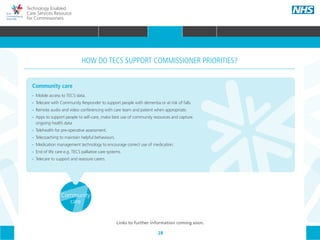
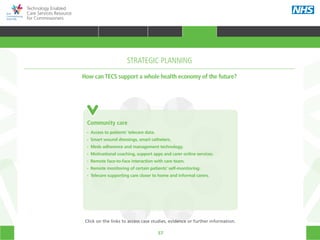
Community
care
Community care
•• 	Mobile access to TECS data.
•• Telecare with Community Responder to support people with dementia or at risk of falls.
•• Remote audio and video conferencing with care team and patient when appropriate.
•• Apps to support people to self-care, make best use of community resources and capture.
	 ongoing health data
•• Telehealth for pre-operative assessment.
•• Telecoaching to maintain helpful behaviours.
•• Medication management technology to encourage correct use of medication.
•• End of life care e.g. TECS palliative care systems.
•• Telecare to support and reassure carers.
HOW DO TECS SUPPORT COMMISSIONER PRIORITIES?
Links to further information coming soon.
HOME WHY?INTRODUCTION HOW? RESOURCES
WHAT IS TECS? COMMISSIONING AMBITIONS INTEGRATION STAKEHOLDER ENGAGEMENT COMMISSIONING PRIORITIES CARE PATHWAY
Urgent &
emergency
care
Long term
conditions
(LTCs)
Maternity
& children
Mental
health
Acute
electiveReablementPrimary
care
COMMISSIONING PRIORITIES
29
Technology Enabled
Care Services Resource
for Commissioners
Reablement
Reablement
•• 	Telecare and telehealth to support rehabilitation e.g. stroke.
•• 	Telehealth for post-operative recovery assessment.
•• 	Digital imaging to inform rehabiliation tailored to home environments.
•• 	Wounds management digital imaging.
•• 	Internet-based therapeutic interventions.
•• 	More effective use of ICES.
•• Telecare to support and reassure carers.
HOW DO TECS SUPPORT COMMISSIONER PRIORITIES?
Links to further information coming soon.
HOME WHY?INTRODUCTION HOW? RESOURCES
WHAT IS TECS? COMMISSIONING AMBITIONS INTEGRATION STAKEHOLDER ENGAGEMENT COMMISSIONING PRIORITIES CARE PATHWAY
Urgent &
emergency
care
Long term
conditions
(LTCs)
Maternity
& children
Mental
health
Acute
elective
Community
care
Primary
care
COMMISSIONING PRIORITIES
30
Technology Enabled
Care Services Resource
for Commissioners
Acute
elective
Acute elective
•• 	Text and email appointment reminders.
•• 	Web portals for pre-operative patient health checks and FAQs.
•• 	Telehealth for detailed pre-operative assessment.
•• 	Telecoaching to maintain pre-operative behaviours e.g. smoking/drinking cessation, meds adherence
	 and exercise adherence.
•• 	Telecare to support earlier discharge.
•• Telehealth for operative assessment.
HOW DO TECS SUPPORT COMMISSIONER PRIORITIES?
Links to further information coming soon.
HOME WHY?INTRODUCTION HOW? RESOURCES
WHAT IS TECS? COMMISSIONING AMBITIONS INTEGRATION STAKEHOLDER ENGAGEMENT COMMISSIONING PRIORITIES CARE PATHWAY
Urgent &
emergency
care
Long term
conditions
(LTCs)
Maternity
& children
Mental
health
ReablementCommunity
care
Primary
care
COMMISSIONING PRIORITIES
31
Technology Enabled
Care Services Resource
for Commissioners
Urgent &
emergency
care
Urgent and emergency care
•• 111 could link to patient records/care plans, telehealth and telecare data.
•• Telecare service to triage alarm calls to the most appropriate responders, which can reduce
	 emergency service activity.
•• Secure messaging from patients to specialists post-discharge (especially for tertiary and
	 quaternary care).
•• Telehealth for post-operative assessment.
•• Teleconsultation between community, ambulance service and acute care.
•• Short-term telehealth monitoring by ambulance service of patients not transported to hospital.
•• Telecoaching to maintain post-discharge behaviours e.g. smoking/drinking cessation,
	 medication adherence, exercise adherence.
•• Telecare for assessment and design of optimum care packages.
•• Telehealth for operative assessment.
HOW DO TECS SUPPORT COMMISSIONER PRIORITIES?
Links to further information coming soon.
HOME WHY?INTRODUCTION HOW? RESOURCES
WHAT IS TECS? COMMISSIONING AMBITIONS INTEGRATION STAKEHOLDER ENGAGEMENT COMMISSIONING PRIORITIES CARE PATHWAY
Long term
conditions
(LTCs)
Maternity
& children
Mental
health
Acute
electiveReablementCommunity
care
Primary
care
COMMISSIONING PRIORITIES
32
Technology Enabled
Care Services Resource
for Commissioners
Long term
conditions
(LTCs)
Long term conditions (LTCs)1
•• Self-care apps to promote understanding of condition and better self-management.
•• Health and care focused social networking for people with similar conditions.
•• Carer support apps and web portals to reduce carer burden.
•• Telehealth for LTCs (initial diagnosis, titration of medication for newly diagnosed/unstable
	 patients, annual reviews for stable patients).
•• Telecare to help people remain independent in their own homes.
•• Teleconsultation between primary and acute settings.
•• Secure messaging for selected patients to their care team.
•• Telecare for at-risk groups e.g. falls monitors, pendant alarms, environmental controls/alarms.
HOW DO TECS SUPPORT COMMISSIONER PRIORITIES?
1
The Long Term Conditions Dashboard provides population level indicators related to LTCs which can help commissioners to consider what their overall need is for LTCs,
what the quality of the service they provide is and what impact this has on the overall health and social care economy.
Links to further information coming soon.
HOME WHY?INTRODUCTION HOW? RESOURCES
WHAT IS TECS? COMMISSIONING AMBITIONS INTEGRATION STAKEHOLDER ENGAGEMENT COMMISSIONING PRIORITIES CARE PATHWAY
Urgent &
emergency
care
Maternity
& children
Mental
health
Acute
electiveReablementCommunity
care
Primary
care
COMMISSIONING PRIORITIES
33
Technology Enabled
Care Services Resource
for Commissioners
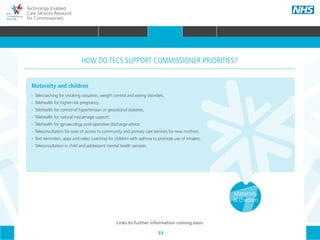
Maternity and children
•• 	Telecoaching for smoking cessation, weight control and eating disorders.
•• 	Telehealth for higher-risk pregnancy.
•• 	Telehealth for control of hypertension or gestational diabetes.
•• 	Telehealth for natural miscarriage support.
•• 	Telehealth for gynaecology post-operative discharge advice.
•• 	Teleconsultation for ease of access to community and primary care services for new mothers.
•• 	Text reminders, apps and video coaching for children with asthma to promote use of inhalers.
•• Teleconsultation in child and adolescent mental health services.
HOW DO TECS SUPPORT COMMISSIONER PRIORITIES?
Maternity
& children
Links to further information coming soon.
HOME WHY?INTRODUCTION HOW? RESOURCES
WHAT IS TECS? COMMISSIONING AMBITIONS INTEGRATION STAKEHOLDER ENGAGEMENT COMMISSIONING PRIORITIES CARE PATHWAY
Urgent &
emergency
care
Long term
conditions
(LTCs)
Mental
health
Acute
electiveReablementCommunity
care
Primary
care
COMMISSIONING PRIORITIES
34
Technology Enabled
Care Services Resource
for Commissioners
Mental
health
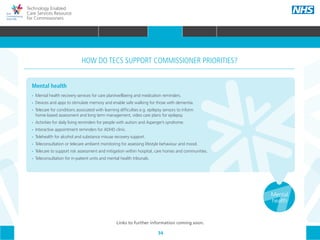
Mental health
•• 	Mental health recovery services for care plan/wellbeing and medication reminders.
•• 	Devices and apps to stimulate memory and enable safe walking for those with dementia.
•• 	Telecare for conditions associated with learning difficulties e.g. epilepsy sensors to inform
	 home-based assessment and long term management, video care plans for epilepsy.
•• 	Activities for daily living reminders for people with autism and Asperger’s syndrome.
•• 	Interactive appointment reminders for ADHD clinic.
•• 	Telehealth for alcohol and substance misuse recovery support.
•• 	Teleconsultation or telecare ambient monitoring for assessing lifestyle behaviour and mood.
•• 	Telecare to support risk assessment and mitigation within hospital, care homes and communities.
•• Teleconsultation for in-patient units and mental health tribunals.
HOW DO TECS SUPPORT COMMISSIONER PRIORITIES?
Links to further information coming soon.
HOME WHY?INTRODUCTION HOW? RESOURCES
WHAT IS TECS? COMMISSIONING AMBITIONS INTEGRATION STAKEHOLDER ENGAGEMENT COMMISSIONING PRIORITIES CARE PATHWAY
Long term
conditions
(LTCs)
Maternity
& children
Acute
electiveReablementCommunity
care
Primary
care
Urgent &
emergency
care
COMMISSIONING PRIORITIES
Technology Enabled
Care Services Resource
for Commissioners
Patient commences
medication but fails to
adhere to course
Patient has
exacerbation of
COPD and contacts
GP for appointment
Patient
Telehealth
Key
Teleconsultation
Telecare
Telemedicine
Telerehabilitation
Please click on the
icons to see how
TECS can improve the
patient’s journey
Primary
Care
Ambulance
service
Community
provider
Socialcare
provider
Acute
provider
Evidence
Carer/
Family
COPD is an Ambulatory Care
Sensitive Condition (ACSC) where
primary care interventions should avoid
a hospital admission
A recent systematic review of the
literature found non-adherence to
medication in COPD to be high (1)
COPD average length of inpatient
episode is 9 days (NICE 2010) (2)
Supporting paramedics to make the
decision whether or not to convey
patients to an emergency department
can reduce admissions (3)
Approximately one third of patients
with a main diagnosis of COPD will
readmit within a month of discharge
(4). Providers will not be paid for
readmissions within 30 days of discharge
Research suggests where possible
people prefer to stay in their home
rather than move into residential care (6)
NO
ADMISSION
EVIDENCE
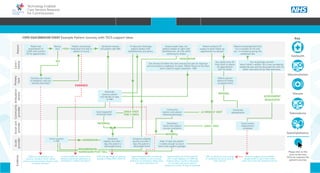
COPD EXACERBATION EVENT Example Patient Journey with TECS support ideas
38% of admissions into nursing
or residential care are a result of
carer stress (5)
Practice visit- course
of antibiotics and oral
steroids prescribed
Patient assessed
in A&E
Symptoms worsen
and patient calls 999
Rescue
Pack
Symptoms
stabilise and after 7
days the patient is
discharged home
READMISSION
ADMISSION POST FALL
Symptoms stabilise
quickly and after 2
days the patient is
discharged home
REFERRAL
DAILY VISIT
x3 WEEKLY VISIT
Domiciliary
home care support
services commence
After 15 days the patient
is stable enough to return
home with support package
Community
matron visits patient
following discharge
14 days post discharge
patient awakes with
breathlessness and panics
REFERRAL
Son phones his father the next morning but gets no response
and so contacts a neighbour to check. Patient found on the floor
and in need of urgent treatment - 999
NEIGHBOUR
Paramedic
assesses patient
and decides to take
to A&E
DAILY VISIT
FOR 7 DAYS
Several weeks later, the
patient awakes at night with
breathlessness. He falls whilst
retrieving his inhaler
Son agrees time off
from work to attend
GP appointment
with his father
Patient and son
attend GP follow
up appointment
REFERAL
Pulmonary
Rehabilitation
Son increasingly worried
about father’s welfare. He is now considering
residential care and has discussed this with his
father who feels he has little alternative
Social worker
reassessment
scheduled
ASSESSMENT
REQUESTED
Patient increasingly feels that
he is a burden on his only
son. Is considering going into
residential care
Patient contacts GP
surgery to book follow up
appointment as advised
Early Supported
Discharge Team
YES
HOME WHY?INTRODUCTION HOW? RESOURCES
CARE PATHWAYCOMMISSIONING PRIORITIESSTAKEHOLDER ENGAGEMENTINTEGRATIONCOMMISSIONING AMBITIONSWHAT IS TECS? CARE PATHWAY
Technology Enabled
Care Services Resource
for Commissioners
Patient commences
medication but fails to
adhere to course
Patient has
exacerbation of
COPD and contacts
GP for appointment
Patient
Telehealth
Key
Teleconsultation
Telecare
Telemedicine
Telerehabilitation
Please click on the
icons to see how
TECS can improve the
patient’s journey
Primary
Care
Ambulance
service
Community
provider
Socialcare
provider
Acute
provider
Evidence
Carer/
Family
COPD is an Ambulatory Care
Sensitive Condition (ACSC) where
primary care interventions should avoid
a hospital admission
A recent systematic review of the
literature found non-adherence to
medication in COPD to be high (1)
COPD average length of inpatient
episode is 9 days (NICE 2010) (2)
Supporting paramedics to make the
decision whether or not to convey
patients in an emergency department
can reduce admissions (3)
Approximately one third of patients
with a main diagnosis of COPD will
readmit within a month of discharge
(4). Providers will not be paid for
readmissions within 30 days of discharge
Research suggests where possible
people prefer to stay in their home
rather than move into residential care (6)
NO
ADMISSION
EVIDENCE
COPD EXACERBATION EVENT Example Patient Journey with TECS support ideas
38% of admissions into nursing
or residential care are a result of
Carer stress (5)
Practice visit- course
of antibiotics and oral
steroids prescribed
Patient assessed
in A&E
Symptoms worsen
and patient calls 999
Rescue
Pack
Symptoms
stabilise and after 7
days the patient is
discharged home
READMISSION
ADMISSION POST FALL
Symptoms stabilise
quickly and after 2
days the patient is
discharged home
REFERALL
DAILY VISIT
x3 WEEKLY VISIT
Domiciliary
home care support
services commences
After 15 days the patient
is stable enough to return
home with support package
Community
matron visits patient
following discharge
14 days post discharge
patient awakes with
breathlessness and panics
REFERALL
Son phones his father the next morning but gets no response
and so contacts a neighbour to check . Patient found on the floor
and in need of urgent treatment - 999
NEIGHBOUR
Paramedic
assesses patient
and decides to take
to A&E
DAILY VISIT
FOR 7 DAYS
Several weeks later, the
patient awakes at night with
breathlessness. He falls whilst
retrieving his inhaler
Son agrees time off
from work to attend
GP appointment
with his father.
Patient and son
attend GP follow
up appointment
REFERALL
Pulmonary
Rehabilitation
Son increasingly worried
about fathers welfare. He is now considering
residential care and has discussed this with his
father who feels has little alternative
Social worker
reassessment
scheduled
ASSESSMENT
REQUESTED
Patient increasingly feels that
he is a burden on his only
son. Is considering going into
residential care
Patient contacts GP
surgery to book follow up
appointment as advised
Early Supported
Discharge Team
YES
PATIENT
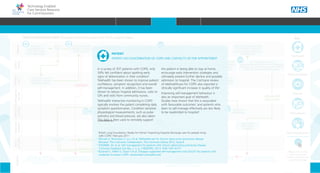
PATIENT HAS EXACERBATION OF COPD AND CONTACTS GP FOR APPOINTMENT
In a survey of 307 patients with COPD, only
34% felt confident about spotting early
signs of deterioration in their condition1
.
Telehealth has been shown to improve patient
confidence, symptom recognition and overall
self-management. In addition, it has been
shown to reduce hospital admissions, visits to
GPs and visits from community nurses.
Telehealth interactive monitoring in COPD
typically involves the patient completing daily
symptom questionnaires. Condition sensitive
physiological measurements, such as pulse
oximetry and blood pressure, are also taken.
This data is then used to remotely support
the patient in being able to stay at home,
encourage early intervention strategies and
ultimately prevent further decline and possible
admission to hospital. The Cochrane review
of telehealthcare for COPD also reported a
clinically significant increase in quality of life2
.
Improving self-management behaviour is
also an important goal of telehealth.
Studies have shown that this is associated
with favourable outcomes3
and patients who
learn to self-manage effectively are less likely
to be readmitted to hospital4
.
1
British Lung Foundation, Ready for Home? Improving hospital discharge care for people living
	 with COPD. February 2011
2
McLean S, Nurmatov U, Liu J et al. Telehealthcare for chronic obstructive pulmonary disease
	 (Review). The Cochrane Collaboration, The Cochrane Library 2012, Issue 8.
3
ZWERINK, M. et al. Self management for patients with chronic obstructive pulmonary disease
	 Cochrane Database Syst Rev, v. 3, p. Cd002990, 2014. ISSN 1361-6137.
4
Bucknall C, Miller G, Lloyd S et al. Glasgow supported self-management trial (GSuST) for patients with
	 moderate to severe COPD: randomised controlled trial.
HOME WHY?INTRODUCTION HOW? RESOURCES
CARE PATHWAYCOMMISSIONING PRIORITIESSTAKEHOLDER ENGAGEMENTINTEGRATIONCOMMISSIONING AMBITIONSWHAT IS TECS? CARE PATHWAY
Technology Enabled
Care Services Resource
for Commissioners
Patient commences
medication but fails to
adhere to course
Patient has
exacerbation of
COPD and contacts
GP for appointment
Patient
Telehealth
Key
Teleconsultation
Telecare
Telemedicine
Telerehabilitation
Please click on the
icons to see how
TECS can improve the
patient’s journey
Primary
Care
Ambulance
service
Community
provider
Socialcare
provider
Acute
provider
Evidence
Carer/
Family
COPD is an Ambulatory Care
Sensitive Condition (ACSC) where
primary care interventions should avoid
a hospital admission
A recent systematic review of the
literature found non-adherence to
medication in COPD to be high (1)
COPD average length of inpatient
episode is 9 days (NICE 2010) (2)
Supporting paramedics to make the
decision whether or not to convey
patients in an emergency department
can reduce admissions (3)
Approximately one third of patients
with a main diagnosis of COPD will
readmit within a month of discharge
(4). Providers will not be paid for
readmissions within 30 days of discharge
Research suggests where possible
people prefer to stay in their home
rather than move into residential care (6)
NO
ADMISSION
EVIDENCE
COPD EXACERBATION EVENT Example Patient Journey with TECS support ideas
38% of admissions into nursing
or residential care are a result of
Carer stress (5)
Practice visit- course
of antibiotics and oral
steroids prescribed
Patient assessed
in A&E
Symptoms worsen
and patient calls 999
Rescue
Pack
Symptoms
stabilise and after 7
days the patient is
discharged home
READMISSION
ADMISSION POST FALL
Symptoms stabilise
quickly and after 2
days the patient is
discharged home
REFERALL
DAILY VISIT
x3 WEEKLY VISIT
Domiciliary
home care support
services commences
After 15 days the patient
is stable enough to return
home with support package
Community
matron visits patient
following discharge
14 days post discharge
patient awakes with
breathlessness and panics
REFERALL
Son phones his father the next morning but gets no response
and so contacts a neighbour to check . Patient found on the floor
and in need of urgent treatment - 999
NEIGHBOUR
Paramedic
assesses patient
and decides to take
to A&E
DAILY VISIT
FOR 7 DAYS
Several weeks later, the
patient awakes at night with
breathlessness. He falls whilst
retrieving his inhaler
Son agrees time off
from work to attend
GP appointment
with his father.
Patient and son
attend GP follow
up appointment
REFERALL
Pulmonary
Rehabilitation
Son increasingly worried
about fathers welfare. He is now considering
residential care and has discussed this with his
father who feels has little alternative
Social worker
reassessment
scheduled
ASSESSMENT
REQUESTED
Patient increasingly feels that
he is a burden on his only
son. Is considering going into
residential care
Patient contacts GP
surgery to book follow up
appointment as advised
Early Supported
Discharge Team
YES
PATIENT
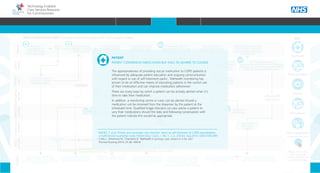
PATIENT COMMENCES MEDICATION BUT FAILS TO ADHERE TO COURSE
The appropriateness of providing rescue medication to COPD patients is
influenced by adequate patient education and ongoing communication
with regard to use of self-treatment packs1
. Telehealth monitoring has
proven to be an effective means of educating patients in the correct use
of their medication and can improve medication adherence2
.
There are many ways by which a patient can be actively alerted when it’s
time to take their medication.
In addition, a monitoring centre or carer can be alerted should a
medication not be removed from the dispenser by the patient at the
scheduled time. Qualified triage clinicians can also advise a patient to
vary their medications should the data and following conversation with
the patient indicate this would be appropriate.
1
DAVIES, F. et al. Primary and secondary care clinicians’ views on self-treatment of COPD exacerbations:
	 a multinational qualitative study. Patient Educ Couns, v. 96, n. 2, p. 256-63, Aug 2014. ISSN 0738-3991.
2
Collis L, Whitmore M, Chambers R. Telehealth in primary care: what’s in it for me?
	 Practice Nursing 2014; 25 (8): 406-8.
HOME WHY?INTRODUCTION HOW? RESOURCES
CARE PATHWAYCOMMISSIONING PRIORITIESSTAKEHOLDER ENGAGEMENTINTEGRATIONCOMMISSIONING AMBITIONSWHAT IS TECS? CARE PATHWAY
Technology Enabled
Care Services Resource
for Commissioners
Patient commences
medication but fails to
adhere to course
Patient has
exacerbation of
COPD and contacts
GP for appointment
Patient
Telehealth
Key
Teleconsultation
Telecare
Telemedicine
Telerehabilitation
Please click on the
icons to see how
TECS can improve the
patient’s journey
Primary
Care
Ambulance
service
Community
provider
Socialcare
provider
Acute
provider
Evidence
Carer/
Family
COPD is an Ambulatory Care
Sensitive Condition (ACSC) where
primary care interventions should avoid
a hospital admission
A recent systematic review of the
literature found non-adherence to
medication in COPD to be high (1)
COPD average length of inpatient
episode is 9 days (NICE 2010) (2)
Supporting paramedics to make the
decision whether or not to convey
patients in an emergency department
can reduce admissions (3)
Approximately one third of patients
with a main diagnosis of COPD will
readmit within a month of discharge
(4). Providers will not be paid for
readmissions within 30 days of discharge
Research suggests where possible
people prefer to stay in their home
rather than move into residential care (6)
NO
ADMISSION
EVIDENCE
COPD EXACERBATION EVENT Example Patient Journey with TECS support ideas
38% of admissions into nursing
or residential care are a result of
Carer stress (5)
Practice visit- course
of antibiotics and oral
steroids prescribed
Patient assessed
in A&E
Symptoms worsen
and patient calls 999
Rescue
Pack
Symptoms
stabilise and after 7
days the patient is
discharged home
READMISSION
ADMISSION POST FALL
Symptoms stabilise
quickly and after 2
days the patient is
discharged home
REFERALL
DAILY VISIT
x3 WEEKLY VISIT
Domiciliary
home care support
services commences
After 15 days the patient
is stable enough to return
home with support package
Community
matron visits patient
following discharge
14 days post discharge
patient awakes with
breathlessness and panics
REFERALL
Son phones his father the next morning but gets no response
and so contacts a neighbour to check . Patient found on the floor
and in need of urgent treatment - 999
NEIGHBOUR
Paramedic
assesses patient
and decides to take
to A&E
DAILY VISIT
FOR 7 DAYS
Several weeks later, the
patient awakes at night with
breathlessness. He falls whilst
retrieving his inhaler
Son agrees time off
from work to attend
GP appointment
with his father.
Patient and son
attend GP follow
up appointment
REFERALL
Pulmonary
Rehabilitation
Son increasingly worried
about fathers welfare. He is now considering
residential care and has discussed this with his
father who feels has little alternative
Social worker
reassessment
scheduled
ASSESSMENT
REQUESTED
Patient increasingly feels that
he is a burden on his only
son. Is considering going into
residential care
Patient contacts GP
surgery to book follow up
appointment as advised
Early Supported
Discharge Team
YES
PATIENT
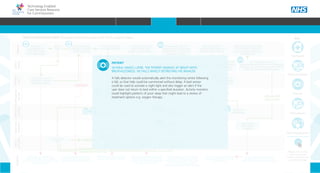
SEVERAL WEEKS LATER, THE PATIENT AWAKES AT NIGHT WITH
BREATHLESSNESS. HE FALLS WHILST RETRIEVING HIS INHALER.
A falls detector would automatically alert the monitoring centre following
a fall, so that help could be summoned without delay. A bed sensor
could be used to activate a night light and also trigger an alert if the
user does not return to bed within a specified duration. Activity monitors
could highlight patterns of poor sleep that might lead to a review of
treatment options e.g. oxygen therapy.
HOME WHY?INTRODUCTION HOW? RESOURCES
CARE PATHWAYCOMMISSIONING PRIORITIESSTAKEHOLDER ENGAGEMENTINTEGRATIONCOMMISSIONING AMBITIONSWHAT IS TECS? CARE PATHWAY
Technology Enabled
Care Services Resource
for Commissioners
Patient commences
medication but fails to
adhere to course
Patient has
exacerbation of
COPD and contacts
GP for appointment
Patient
Telehealth
Key
Teleconsultation
Telecare
Telemedicine
Telerehabilitation
Please click on the
icons to see how
TECS can improve the
patient’s journey
Primary
Care
Ambulance
service
Community
provider
Socialcare
provider
Acute
provider
Evidence
Carer/
Family
COPD is an Ambulatory Care
Sensitive Condition (ACSC) where
primary care interventions should avoid
a hospital admission
A recent systematic review of the
literature found non-adherence to
medication in COPD to be high (1)
COPD average length of inpatient
episode is 9 days (NICE 2010) (2)
Supporting paramedics to make the
decision whether or not to convey
patients in an emergency department
can reduce admissions (3)
Approximately one third of patients
with a main diagnosis of COPD will
readmit within a month of discharge
(4). Providers will not be paid for
readmissions within 30 days of discharge
Research suggests where possible
people prefer to stay in their home
rather than move into residential care (6)
NO
ADMISSION
EVIDENCE
COPD EXACERBATION EVENT Example Patient Journey with TECS support ideas
38% of admissions into nursing
or residential care are a result of
Carer stress (5)
Practice visit- course
of antibiotics and oral
steroids prescribed
Patient assessed
in A&E
Symptoms worsen
and patient calls 999
Rescue
Pack
Symptoms
stabilise and after 7
days the patient is
discharged home
READMISSION
ADMISSION POST FALL
Symptoms stabilise
quickly and after 2
days the patient is
discharged home
REFERALL
DAILY VISIT
x3 WEEKLY VISIT
Domiciliary
home care support
services commences
After 15 days the patient
is stable enough to return
home with support package
Community
matron visits patient
following discharge
14 days post discharge
patient awakes with
breathlessness and panics
REFERALL
Son phones his father the next morning but gets no response
and so contacts a neighbour to check . Patient found on the floor
and in need of urgent treatment - 999
NEIGHBOUR
Paramedic
assesses patient
and decides to take
to A&E
DAILY VISIT
FOR 7 DAYS
Several weeks later, the
patient awakes at night with
breathlessness. He falls whilst
retrieving his inhaler
Son agrees time off
from work to attend
GP appointment
with his father.
Patient and son
attend GP follow
up appointment
REFERALL
Pulmonary
Rehabilitation
Son increasingly worried
about fathers welfare. He is now considering
residential care and has discussed this with his
father who feels has little alternative
Social worker
reassessment
scheduled
ASSESSMENT
REQUESTED
Patient increasingly feels that
he is a burden on his only
son. Is considering going into
residential care
Patient contacts GP
surgery to book follow up
appointment as advised
Early Supported
Discharge Team
YES
CARER/FAMILY
SON INCREASINGLY WORRIED ABOUT FATHER’S WELFARE. HE IS NOW
CONSIDERING RESIDENTIAL CARE AND HAS DISCUSSED THIS WITH HIS FATHER
WHO FEELS HE HAS LITTLE ALTERNATIVE.
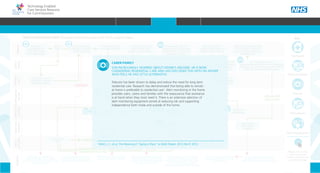
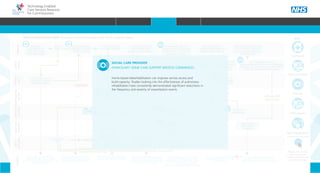
Telecare has been shown to delay and reduce the need for long term
residential care. Research has demonstrated that being able to remain
at home is preferable to residential care1
. Alert monitoring in the home
provides users, carers and families with the reassurance that assistance
is at hand when they most need it. There is an extensive selection of
alert monitoring equipment aimed at reducing risk and supporting
independence both inside and outside of the home.
1
WILES, J. L. et al. The Meaning of “Aging in Place” to Older People. 2012-06-01 2012.
HOME WHY?INTRODUCTION HOW? RESOURCES
CARE PATHWAYCOMMISSIONING PRIORITIESSTAKEHOLDER ENGAGEMENTINTEGRATIONCOMMISSIONING AMBITIONSWHAT IS TECS? CARE PATHWAY
Technology Enabled
Care Services Resource
for Commissioners
Patient commences
medication but fails to
adhere to course
Patient has
exacerbation of
COPD and contacts
GP for appointment
Patient
Telehealth
Key
Teleconsultation
Telecare
Telemedicine
Telerehabilitation
Please click on the
icons to see how
TECS can improve the
patient’s journey
Primary
Care
Ambulance
service
Community
provider
Socialcare
provider
Acute
provider
Evidence
Carer/
Family
COPD is an Ambulatory Care
Sensitive Condition (ACSC) where
primary care interventions should avoid
a hospital admission
A recent systematic review of the
literature found non-adherence to
medication in COPD to be high (1)
COPD average length of inpatient
episode is 9 days (NICE 2010) (2)
Supporting paramedics to make the
decision whether or not to convey
patients in an emergency department
can reduce admissions (3)
Approximately one third of patients
with a main diagnosis of COPD will
readmit within a month of discharge
(4). Providers will not be paid for
readmissions within 30 days of discharge
Research suggests where possible
people prefer to stay in their home
rather than move into residential care (6)
NO
ADMISSION
EVIDENCE
COPD EXACERBATION EVENT Example Patient Journey with TECS support ideas
38% of admissions into nursing
or residential care are a result of
Carer stress (5)
Practice visit- course
of antibiotics and oral
steroids prescribed
Patient assessed
in A&E
Symptoms worsen
and patient calls 999
Rescue
Pack
Symptoms
stabilise and after 7
days the patient is
discharged home
READMISSION
ADMISSION POST FALL
Symptoms stabilise
quickly and after 2
days the patient is
discharged home
REFERALL
DAILY VISIT
x3 WEEKLY VISIT
Domiciliary
home care support
services commences
After 15 days the patient
is stable enough to return
home with support package
Community
matron visits patient
following discharge
14 days post discharge
patient awakes with
breathlessness and panics
REFERALL
Son phones his father the next morning but gets no response
and so contacts a neighbour to check . Patient found on the floor
and in need of urgent treatment - 999
NEIGHBOUR
Paramedic
assesses patient
and decides to take
to A&E
DAILY VISIT
FOR 7 DAYS
Several weeks later, the
patient awakes at night with
breathlessness. He falls whilst
retrieving his inhaler
Son agrees time off
from work to attend
GP appointment
with his father.
Patient and son
attend GP follow
up appointment
REFERALL
Pulmonary
Rehabilitation
Son increasingly worried
about fathers welfare. He is now considering
residential care and has discussed this with his
father who feels has little alternative
Social worker
reassessment
scheduled
ASSESSMENT
REQUESTED
Patient increasingly feels that
he is a burden on his only
son. Is considering going into
residential care
Patient contacts GP
surgery to book follow up
appointment as advised
Early Supported
Discharge Team
YES
PRIMARY CARE
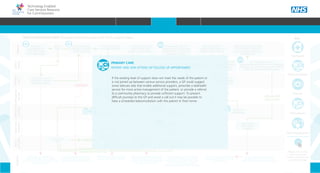
PATIENT AND SON ATTEND GP FOLLOW UP APPOINTMENT.
If the existing level of support does not meet the needs of the patient or
is not joined up between various service providers, a GP could suggest
some telecare aids that enable additional support, prescribe a telehealth
service for more active management of the patient, or provide a referral
to a community pharmacy to provide sufficient support. To prevent
difficult journeys to the GP and avoid a call out it may be possible to
have a scheduled teleconsultation with the patient in their home.
HOME WHY?INTRODUCTION HOW? RESOURCES
CARE PATHWAYCOMMISSIONING PRIORITIESSTAKEHOLDER ENGAGEMENTINTEGRATIONCOMMISSIONING AMBITIONSWHAT IS TECS? CARE PATHWAY
Technology Enabled
Care Services Resource
for Commissioners
Patient commences
medication but fails to
adhere to course
Patient has
exacerbation of
COPD and contacts
GP for appointment
Patient
Telehealth
Key
Teleconsultation
Telecare
Telemedicine
Telerehabilitation
Please click on the
icons to see how
TECS can improve the
patient’s journey
Primary
Care
Ambulance
service
Community
provider
Socialcare
provider
Acute
provider
Evidence
Carer/
Family
COPD is an Ambulatory Care
Sensitive Condition (ACSC) where
primary care interventions should avoid
a hospital admission
A recent systematic review of the
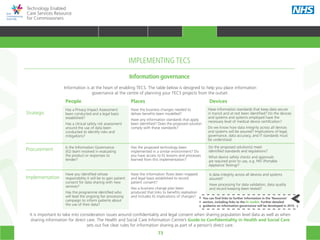
literature found non-adherence to
medication in COPD to be high (1)
COPD average length of inpatient
episode is 9 days (NICE 2010) (2)
Supporting paramedics to make the
decision whether or not to convey
patients in an emergency department
can reduce admissions (3)
Approximately one third of patients
with a main diagnosis of COPD will
readmit within a month of discharge
(4). Providers will not be paid for
readmissions within 30 days of discharge
Research suggests where possible
people prefer to stay in their home
rather than move into residential care (6)
NO
ADMISSION
EVIDENCE
COPD EXACERBATION EVENT Example Patient Journey with TECS support ideas
38% of admissions into nursing
or residential care are a result of
Carer stress (5)
Practice visit- course
of antibiotics and oral
steroids prescribed
Patient assessed
in A&E
Symptoms worsen
and patient calls 999
Rescue
Pack
Symptoms
stabilise and after 7
days the patient is
discharged home
READMISSION
ADMISSION POST FALL
Symptoms stabilise
quickly and after 2
days the patient is
discharged home
REFERALL
DAILY VISIT
x3 WEEKLY VISIT
Domiciliary
home care support
services commences
After 15 days the patient
is stable enough to return
home with support package
Community
matron visits patient
following discharge
14 days post discharge
patient awakes with
breathlessness and panics
REFERALL
Son phones his father the next morning but gets no response
and so contacts a neighbour to check . Patient found on the floor
and in need of urgent treatment - 999
NEIGHBOUR
Paramedic
assesses patient
and decides to take
to A&E
DAILY VISIT
FOR 7 DAYS
Several weeks later, the
patient awakes at night with
breathlessness. He falls whilst
retrieving his inhaler
Son agrees time off
from work to attend
GP appointment
with his father.
Patient and son
attend GP follow
up appointment
REFERALL
Pulmonary
Rehabilitation
Son increasingly worried
about fathers welfare. He is now considering
residential care and has discussed this with his
father who feels has little alternative
Social worker
reassessment
scheduled
ASSESSMENT
REQUESTED
Patient increasingly feels that
he is a burden on his only
son. Is considering going into
residential care
Patient contacts GP
surgery to book follow up
appointment as advised
Early Supported
Discharge Team
YES
AMBULANCE SERVICE
PARAMEDIC ASSESSES PATIENT AND DECIDES TO TAKE TO A&E
Telemedicine and teleconsultation could be used to direct and support
treatment decisions1
. Paramedics need to be confident when deciding
not to convey patients to A&E. The ability to teleconsult with an A&E
doctor or nurse or with the telehealth triage nurse where a decision
to transfer the patient to A&E is borderline, supports shared decision
making and reduces the risk of getting it wrong. In some cases
temporary telehealth could be provided to reduce anxiety and help
manage risk for those who frequently access urgent and emergency
care services.
1
MOTTI, J. Mobile video pilot aims to reduce ambulance, hospital admission costs. 2014.
HOME WHY?INTRODUCTION HOW? RESOURCES
CARE PATHWAYCOMMISSIONING PRIORITIESSTAKEHOLDER ENGAGEMENTINTEGRATIONCOMMISSIONING AMBITIONSWHAT IS TECS? CARE PATHWAY
Technology Enabled
Care Services Resource
for Commissioners
Patient commences
medication but fails to
adhere to course
Patient has
exacerbation of
COPD and contacts
GP for appointment
Patient
Telehealth
Key
Teleconsultation
Telecare
Telemedicine
Telerehabilitation
Please click on the
icons to see how
TECS can improve the
patient’s journey
Primary
Care
Ambulance
service
Community
provider
Socialcare
provider
Acute
provider
Evidence
Carer/
Family
COPD is an Ambulatory Care
Sensitive Condition (ACSC) where
primary care interventions should avoid
a hospital admission
A recent systematic review of the
literature found non-adherence to
medication in COPD to be high (1)
COPD average length of inpatient
episode is 9 days (NICE 2010) (2)
Supporting paramedics to make the
decision whether or not to convey
patients in an emergency department
can reduce admissions (3)
Approximately one third of patients
with a main diagnosis of COPD will
readmit within a month of discharge
(4). Providers will not be paid for
readmissions within 30 days of discharge
Research suggests where possible
people prefer to stay in their home
rather than move into residential care (6)
NO
ADMISSION
EVIDENCE
COPD EXACERBATION EVENT Example Patient Journey with TECS support ideas
38% of admissions into nursing
or residential care are a result of
Carer stress (5)
Practice visit- course
of antibiotics and oral
steroids prescribed
Patient assessed
in A&E
Symptoms worsen
and patient calls 999
Rescue
Pack
Symptoms
stabilise and after 7
days the patient is
discharged home
READMISSION
ADMISSION POST FALL
Symptoms stabilise
quickly and after 2
days the patient is
discharged home
REFERALL
DAILY VISIT
x3 WEEKLY VISIT
Domiciliary
home care support
services commences
After 15 days the patient
is stable enough to return
home with support package
Community
matron visits patient
following discharge
14 days post discharge
patient awakes with
breathlessness and panics
REFERALL
Son phones his father the next morning but gets no response
and so contacts a neighbour to check . Patient found on the floor
and in need of urgent treatment - 999
NEIGHBOUR
Paramedic
assesses patient
and decides to take
to A&E
DAILY VISIT
FOR 7 DAYS
Several weeks later, the
patient awakes at night with
breathlessness. He falls whilst
retrieving his inhaler
Son agrees time off
from work to attend
GP appointment
with his father.
Patient and son
attend GP follow
up appointment
REFERALL
Pulmonary
Rehabilitation
Son increasingly worried
about fathers welfare. He is now considering
residential care and has discussed this with his
father who feels has little alternative
Social worker
reassessment
scheduled
ASSESSMENT
REQUESTED
Patient increasingly feels that
he is a burden on his only
son. Is considering going into
residential care
Patient contacts GP
surgery to book follow up
appointment as advised
Early Supported
Discharge Team
YES
COMMUNITY PROVIDER
EARLY SUPPORTED DISCHARGE TEAM
Patients would typically receive daily visits at home to monitor recovery,
reinforce self-management plans and to ensure their home circumstances
are adequate, which should include an environmental check and
assessment to reduce risk factors.
Telecare and Telehealth have been used to support early discharge from
hospital. As the patient is shown to be able to manage themselves in a
stable way, then as part of a step down programme, the level of support
might be reduced in frequency.
HOME WHY?INTRODUCTION HOW? RESOURCES
CARE PATHWAYCOMMISSIONING PRIORITIESSTAKEHOLDER ENGAGEMENTINTEGRATIONCOMMISSIONING AMBITIONSWHAT IS TECS? CARE PATHWAY
Technology Enabled
Care Services Resource
for Commissioners
Patient commences
medication but fails to
adhere to course
Patient has
exacerbation of
COPD and contacts
GP for appointment
Patient
Telehealth
Key
Teleconsultation
Telecare
Telemedicine
Telerehabilitation
Please click on the
icons to see how
TECS can improve the
patient’s journey
Primary
Care
Ambulance
service
Community
provider
Socialcare
provider
Acute
provider
Evidence
Carer/
Family
COPD is an Ambulatory Care
Sensitive Condition (ACSC) where
primary care interventions should avoid
a hospital admission
A recent systematic review of the
literature found non-adherence to
medication in COPD to be high (1)
COPD average length of inpatient
episode is 9 days (NICE 2010) (2)
Supporting paramedics to make the
decision whether or not to convey
patients in an emergency department
can reduce admissions (3)
Approximately one third of patients
with a main diagnosis of COPD will
readmit within a month of discharge
(4). Providers will not be paid for
readmissions within 30 days of discharge
Research suggests where possible
people prefer to stay in their home
rather than move into residential care (6)
NO
ADMISSION
EVIDENCE
COPD EXACERBATION EVENT Example Patient Journey with TECS support ideas
38% of admissions into nursing
or residential care are a result of
Carer stress (5)
Practice visit- course
of antibiotics and oral
steroids prescribed
Patient assessed
in A&E
Symptoms worsen
and patient calls 999
Rescue
Pack
Symptoms
stabilise and after 7
days the patient is
discharged home
READMISSION
ADMISSION POST FALL
Symptoms stabilise
quickly and after 2
days the patient is
discharged home
REFERALL
DAILY VISIT
x3 WEEKLY VISIT
Domiciliary
home care support
services commences
After 15 days the patient
is stable enough to return
home with support package
Community
matron visits patient
following discharge
14 days post discharge
patient awakes with
breathlessness and panics
REFERALL
Son phones his father the next morning but gets no response
and so contacts a neighbour to check . Patient found on the floor
and in need of urgent treatment - 999
NEIGHBOUR
Paramedic
assesses patient
and decides to take
to A&E
DAILY VISIT
FOR 7 DAYS
Several weeks later, the
patient awakes at night with
breathlessness. He falls whilst
retrieving his inhaler
Son agrees time off
from work to attend
GP appointment
with his father.
Patient and son
attend GP follow
up appointment
REFERALL
Pulmonary
Rehabilitation
Son increasingly worried
about fathers welfare. He is now considering
residential care and has discussed this with his
father who feels has little alternative
Social worker
reassessment
scheduled
ASSESSMENT
REQUESTED
Patient increasingly feels that
he is a burden on his only
son. Is considering going into
residential care
Patient contacts GP
surgery to book follow up
appointment as advised
Early Supported
Discharge Team
YES
Telehealth has been shown to reduce the number and frequency of home
nursing visits. Video or telephone consultation can be used to provide support
in place of a physical visit. These enabling technologies allow nurses to prioritise
their work more effectively, freeing them up to focus on those patients with
more complex care needs. There is evidence that community nurses can increase
the number of patients they are supporting by 25% by reducing visits that turn
out to be unnecessary.
COMMUNITY PROVIDER
COMMUNITY MATRON VISITS PATIENT FOLLOWING DISCHARGE
HOME WHY?INTRODUCTION HOW? RESOURCES
CARE PATHWAYCOMMISSIONING PRIORITIESSTAKEHOLDER ENGAGEMENTINTEGRATIONCOMMISSIONING AMBITIONSWHAT IS TECS? CARE PATHWAY
Technology Enabled
Care Services Resource
for Commissioners
Patient commences
medication but fails to
adhere to course
Patient has
exacerbation of
COPD and contacts
GP for appointment
Patient
Telehealth
Key
Teleconsultation
Telecare
Telemedicine
Telerehabilitation
Please click on the
icons to see how
TECS can improve the
patient’s journey
Primary
Care
Ambulance
service
Community
provider
Socialcare
provider
Acute
provider
Evidence
Carer/
Family
COPD is an Ambulatory Care
Sensitive Condition (ACSC) where
primary care interventions should avoid
a hospital admission
A recent systematic review of the
literature found non-adherence to
medication in COPD to be high (1)
COPD average length of inpatient
episode is 9 days (NICE 2010) (2)
Supporting paramedics to make the
decision whether or not to convey
patients in an emergency department
can reduce admissions (3)
Approximately one third of patients
with a main diagnosis of COPD will
readmit within a month of discharge
(4). Providers will not be paid for
readmissions within 30 days of discharge
Research suggests where possible
people prefer to stay in their home
rather than move into residential care (6)
NO
ADMISSION
EVIDENCE
COPD EXACERBATION EVENT Example Patient Journey with TECS support ideas
38% of admissions into nursing
or residential care are a result of
Carer stress (5)
Practice visit- course
of antibiotics and oral
steroids prescribed
Patient assessed
in A&E
Symptoms worsen
and patient calls 999
Rescue
Pack
Symptoms
stabilise and after 7
days the patient is
discharged home
READMISSION
ADMISSION POST FALL
Symptoms stabilise
quickly and after 2
days the patient is
discharged home
REFERALL
DAILY VISIT
x3 WEEKLY VISIT
Domiciliary
home care support
services commences
After 15 days the patient
is stable enough to return
home with support package
Community
matron visits patient
following discharge
14 days post discharge
patient awakes with
breathlessness and panics
REFERALL
Son phones his father the next morning but gets no response
and so contacts a neighbour to check . Patient found on the floor
and in need of urgent treatment - 999
NEIGHBOUR
Paramedic
assesses patient
and decides to take
to A&E
DAILY VISIT
FOR 7 DAYS
Several weeks later, the
patient awakes at night with
breathlessness. He falls whilst
retrieving his inhaler
Son agrees time off
from work to attend
GP appointment
with his father.
Patient and son
attend GP follow
up appointment
REFERALL
Pulmonary
Rehabilitation
Son increasingly worried
about fathers welfare. He is now considering
residential care and has discussed this with his
father who feels has little alternative
Social worker
reassessment
scheduled
ASSESSMENT
REQUESTED
Patient increasingly feels that
he is a burden on his only
son. Is considering going into
residential care
Patient contacts GP
surgery to book follow up
appointment as advised
Early Supported
Discharge Team
YES
Telemedicine and teleconsultation could be used to direct and support
treatment decisions1
. Paramedics need to be confident when deciding
not to convey patients to A&E. The ability to teleconsult with an A&E
doctor or nurse or with the telehealth triage nurse where a decision
to transfer the patient to A&E is borderline, supports shared decision
making and reduces the risk of getting it wrong.
COMMUNITY PROVIDER
PULMONARY REHABILITATION
1
MOTTI, J. Mobile video pilot aims to reduce ambulance, hospital admission costs. 2014.
HOME WHY?INTRODUCTION HOW? RESOURCES
CARE PATHWAYCOMMISSIONING PRIORITIESSTAKEHOLDER ENGAGEMENTINTEGRATIONCOMMISSIONING AMBITIONSWHAT IS TECS? CARE PATHWAY
Technology Enabled
Care Services Resource
for Commissioners
Patient commences
medication but fails to
adhere to course
Patient has
exacerbation of
COPD and contacts
GP for appointment
Patient
Telehealth
Key
Teleconsultation
Telecare
Telemedicine
Telerehabilitation
Please click on the
icons to see how
TECS can improve the
patient’s journey
Primary
Care
Ambulance
service
Community
provider
Socialcare
provider
Acute
provider
Evidence
Carer/
Family
COPD is an Ambulatory Care
Sensitive Condition (ACSC) where
primary care interventions should avoid
a hospital admission
A recent systematic review of the
literature found non-adherence to
medication in COPD to be high (1)
COPD average length of inpatient
episode is 9 days (NICE 2010) (2)
Supporting paramedics to make the
decision whether or not to convey
patients in an emergency department
can reduce admissions (3)
Approximately one third of patients
with a main diagnosis of COPD will
readmit within a month of discharge
(4). Providers will not be paid for
readmissions within 30 days of discharge
Research suggests where possible
people prefer to stay in their home
rather than move into residential care (6)
NO
ADMISSION
EVIDENCE
COPD EXACERBATION EVENT Example Patient Journey with TECS support ideas
38% of admissions into nursing
or residential care are a result of
Carer stress (5)
Practice visit- course
of antibiotics and oral
steroids prescribed
Patient assessed
in A&E
Symptoms worsen
and patient calls 999
Rescue
Pack
Symptoms
stabilise and after 7
days the patient is
discharged home
READMISSION
ADMISSION POST FALL
Symptoms stabilise
quickly and after 2
days the patient is
discharged home
REFERALL
DAILY VISIT
x3 WEEKLY VISIT
Domiciliary
home care support
services commences
After 15 days the patient
is stable enough to return
home with support package
Community
matron visits patient
following discharge
14 days post discharge
patient awakes with
breathlessness and panics
REFERALL
Son phones his father the next morning but gets no response
and so contacts a neighbour to check . Patient found on the floor
and in need of urgent treatment - 999
NEIGHBOUR
Paramedic
assesses patient
and decides to take
to A&E
DAILY VISIT
FOR 7 DAYS
Several weeks later, the
patient awakes at night with
breathlessness. He falls whilst
retrieving his inhaler
Son agrees time off
from work to attend
GP appointment
with his father.
Patient and son
attend GP follow
up appointment
REFERALL
Pulmonary
Rehabilitation
Son increasingly worried
about fathers welfare. He is now considering
residential care and has discussed this with his
father who feels has little alternative
Social worker
reassessment
scheduled
ASSESSMENT
REQUESTED
Patient increasingly feels that
he is a burden on his only
son. Is considering going into
residential care
Patient contacts GP
surgery to book follow up
appointment as advised
Early Supported
Discharge Team
YES
Home based telerehabilitation can improve service access and
build capacity. Studies looking into the effectiveness of pulmonary
rehabilitation have consistently demonstrated significant reductions in
the frequency and severity of exacerbation events.
SOCIAL CARE PROVIDER
DOMICILIARY HOME CARE SUPPORT SERVICES COMMENCES
HOME WHY?INTRODUCTION HOW? RESOURCES
CARE PATHWAYCOMMISSIONING PRIORITIESSTAKEHOLDER ENGAGEMENTINTEGRATIONCOMMISSIONING AMBITIONSWHAT IS TECS? CARE PATHWAY
Technology Enabled
Care Services Resource
for Commissioners
Patient commences
medication but fails to
adhere to course
Patient has
exacerbation of
COPD and contacts
GP for appointment
Patient
Telehealth
Key
Teleconsultation
Telecare
Telemedicine
Telerehabilitation
Please click on the
icons to see how
TECS can improve the
patient’s journey
Primary
Care
Ambulance
service
Community
provider
Socialcare
provider
Acute
provider
Evidence
Carer/
Family
COPD is an Ambulatory Care
Sensitive Condition (ACSC) where
primary care interventions should avoid
a hospital admission
A recent systematic review of the
literature found non-adherence to
medication in COPD to be high (1)
COPD average length of inpatient
episode is 9 days (NICE 2010) (2)
Supporting paramedics to make the
decision whether or not to convey
patients in an emergency department
can reduce admissions (3)
Approximately one third of patients
with a main diagnosis of COPD will
readmit within a month of discharge
(4). Providers will not be paid for
readmissions within 30 days of discharge
Research suggests where possible
people prefer to stay in their home
rather than move into residential care (6)
NO
ADMISSION
EVIDENCE
COPD EXACERBATION EVENT Example Patient Journey with TECS support ideas
38% of admissions into nursing
or residential care are a result of
Carer stress (5)
Practice visit- course
of antibiotics and oral
steroids prescribed
Patient assessed
in A&E
Symptoms worsen
and patient calls 999
Rescue
Pack
Symptoms
stabilise and after 7
days the patient is
discharged home
READMISSION
ADMISSION POST FALL
Symptoms stabilise
quickly and after 2
days the patient is
discharged home
REFERALL
DAILY VISIT
x3 WEEKLY VISIT
Domiciliary
home care support
services commences
After 15 days the patient
is stable enough to return
home with support package
Community
matron visits patient
following discharge
14 days post discharge
patient awakes with
breathlessness and panics
REFERALL
Son phones his father the next morning but gets no response
and so contacts a neighbour to check . Patient found on the floor
and in need of urgent treatment - 999
NEIGHBOUR
Paramedic
assesses patient
and decides to take
to A&E
DAILY VISIT
FOR 7 DAYS
Several weeks later, the
patient awakes at night with
breathlessness. He falls whilst
retrieving his inhaler
Son agrees time off
from work to attend
GP appointment
with his father.
Patient and son
attend GP follow
up appointment
REFERALL
Pulmonary
Rehabilitation
Son increasingly worried
about fathers welfare. He is now considering
residential care and has discussed this with his
father who feels has little alternative
Social worker
reassessment
scheduled
ASSESSMENT
REQUESTED
Patient increasingly feels that
he is a burden on his only
son. Is considering going into
residential care
Patient contacts GP
surgery to book follow up
appointment as advised
Early Supported
Discharge Team
YES
The average length of stay (LOS) for COPD is 8.6 days. Telehealth has
been shown to reduce LOS by 1-2 or more days as part of a supported
discharge pathway.
ACUTE PROVIDER
SYMPTOMS STABILISE AND AFTER 7 DAYS THE PATIENT IS
DISCHARGED HOME
HOME WHY?INTRODUCTION HOW? RESOURCES
CARE PATHWAYCOMMISSIONING PRIORITIESSTAKEHOLDER ENGAGEMENTINTEGRATIONCOMMISSIONING AMBITIONSWHAT IS TECS? CARE PATHWAY
47
Technology Enabled
Care Services Resource
for Commissioners
HOW DOES TECS RELATE TO
THE COMMISSIONING CYCLE?
What is TECS?
HOME WHY?INTRODUCTION HOW? RESOURCES
TRANSFORMING HEALTH & CARE STRATEGIC PLANNING PROCUREMENT IMPLEMENTING TECS MEASURING IMPACT CONTINUOUS IMPROVEMENT
Transforming health and care through
the use of TECS
Strategic planning
Procurement
Implementing TECS: putting TECS in context
Measuring impact
Continuous improvement
48
Technology Enabled
Care Services Resource
for Commissioners
Overview
Approaches to evaluation
Evaluation issues and suggestions
TECS evaluation framework
Capturing costs
Overview, evaluation examples,
and issues for each measure of
the framework
Cost benefit analysis example
Commissioners’ evaluation checklist
We can build short, medium and long term plans for TECS into the routine commissioning cycle.
This section provides links to supporting information that aligns with the commissioning cycle.
STRATEGIC
PLANNING
PROCUREMENT IMPLEMENTING
TECS
MEASURING
IMPACT
IMPROVEMENT
Existing practice
A whole health economy of
the future
Risk stratification, case finding
and personalised care planning
Benefits of TECS
Investment and funding
Experiences implementing
and using TECS
Commissioners’
planning checklist
Commercial tools
Selecting the right
technology
Commissioners’
procurement checklist
Case studies
Commissioners’
improvement checklist
What’s next?
Putting TECS in context
Information governance
Implementation key steps
Commissioners’
implementation checklist
TRANSFORMING HEALTH AND CARE THROUGH THE USE OF TECS
HOME WHY?INTRODUCTION HOW? RESOURCES
TRANSFORMING HEALTH & CARE STRATEGIC PLANNING PROCUREMENT IMPLEMENTING TECS MEASURING IMPACT CONTINUOUS IMPROVEMENTTRANSFORMING HEALTH & CARE
49
Technology Enabled
Care Services Resource
for Commissioners
You can use the TECS maps to identify what types of TECS are
being commissioned and delivered in your local area. This can
help you to collaborate and form partnerships across health
and social care.
Since telehealth, telecare and teleconsultation services first
became available in the UK, the cost of technology and
communications infrastructure has reduced and many pilot
sites have developed an understanding of what factors are
critical to success.
However, it is not uncommon for neighbouring regions
and providers to be unaware of the TECS activity of their
delivery partners and the learning they could take from their
neighbours.
These interactive maps show where CCGs, local authorities
and NHS trusts are using telecare and telehealth and provide
links to further information. You can also add information
about your local TECS activities by accessing these maps.
Existing practice
STRATEGIC PLANNING
HOME WHY?INTRODUCTION HOW? RESOURCES
TRANSFORMING HEALTH & CARE STRATEGIC PLANNING PROCUREMENT IMPLEMENTING TECS MEASURING IMPACT CONTINUOUS IMPROVEMENTSTRATEGIC PLANNING
50
Technology Enabled
Care Services Resource
for Commissioners
Click each circle
to find out more
Click each circle
to find out more
STRATEGIC PLANNING
How can TECS support a whole health economy of the future?
Patient
TRANSFORMING HEALTH & CARE STRATEGIC PLANNING PROCUREMENT IMPLEMENTING TECS MEASURING IMPACT CONTINUOUS IMPROVEMENT
HOME WHY?INTRODUCTION HOW? RESOURCES
Acute care Commissioner
Prison
health
Social care
Mental
health
Emergency
care
Community
care
Primary
care
STRATEGIC PLANNING
51
Technology Enabled
Care Services Resource
for Commissioners
Prison
Health
Mental
health
Social care
Patient
CommissionerAcute care
Primary
care
Community
care
Emergency
care
Patient
•• TECS for self-care and empowerment.
•• TECS link to integrated digital care record.
•• Telemonitoring, telecoaching and telecare as necessary.
•• Access to prescribed apps and websites.
•• Remote face-to-face interaction with care team.
•• Remote monitoring of certain patients’ self-monitoring.
•• Telecare supporting care closer to home and informal carers.
How can TECS support a whole health economy of the future?
STRATEGIC PLANNING
Click on the links to access case studies, evidence or further information.
TRANSFORMING HEALTH & CARE STRATEGIC PLANNING PROCUREMENT IMPLEMENTING TECS MEASURING IMPACT CONTINUOUS IMPROVEMENT
HOME WHY?INTRODUCTION HOW? RESOURCES
STRATEGIC PLANNING
52
Technology Enabled
Care Services Resource
for Commissioners
Prison
Health
Mental
health
Social care
Patient
CommissionerAcute care
Primary
care
Community
care
Emergency
care
Commissioner
•• System-wide online meeting capability.
•• Access to TECS evidence repository.
•• TECS for multi-agency care delivery for complex patients.
STRATEGIC PLANNING
How can TECS support a whole health economy of the future?
Click on the links to access case studies, evidence or further information.
TRANSFORMING HEALTH & CARE STRATEGIC PLANNING PROCUREMENT IMPLEMENTING TECS MEASURING IMPACT CONTINUOUS IMPROVEMENT
HOME WHY?INTRODUCTION HOW? RESOURCES
STRATEGIC PLANNING
53
Technology Enabled
Care Services Resource
for Commissioners
Prison
Health
Mental
health
Social care
Patient
CommissionerAcute care
Primary
care
Community
care
Emergency
care
Prison health
•• Secure video-consultations to provide advice and healthcare to prisoners.
STRATEGIC PLANNING
How can TECS support a whole health economy of the future?
Click on the links to access case studies, evidence or further information.
TRANSFORMING HEALTH & CARE STRATEGIC PLANNING PROCUREMENT IMPLEMENTING TECS MEASURING IMPACT CONTINUOUS IMPROVEMENT
HOME WHY?INTRODUCTION HOW? RESOURCES
STRATEGIC PLANNING
54
Technology Enabled
Care Services Resource
for Commissioners
Prison
Health
Mental
health
Social care
Patient
CommissionerAcute care
Primary
care
Community
care
Emergency
care
Social care
•• TECS for social care delivery as part of enablement.
•• Self-care and growth of self-funded services.
•• Development of TECS market place promoted through Care Act 		
	responsibilities.
•• TECS supporting delayed admission to long term care.
•• Safeguarding.
•• Informal carers.
•• New housing models.
•• Remote monitoring of learning difficulties and dementia.
•• Parent skills coaching.
•• Reducing isolation.
STRATEGIC PLANNING
How can TECS support a whole health economy of the future?
Click on the links to access case studies, evidence or further information.
TRANSFORMING HEALTH & CARE STRATEGIC PLANNING PROCUREMENT IMPLEMENTING TECS MEASURING IMPACT CONTINUOUS IMPROVEMENT
HOME WHY?INTRODUCTION HOW? RESOURCES
STRATEGIC PLANNING
55
Technology Enabled
Care Services Resource
for Commissioners
Prison
Health
Mental
health
Social care
Patient
CommissionerAcute care
Primary
care
Community
care
Emergency
care
Mental health
•• Teleconsultation between care home, sheltered accommodation and
	 primary care.
•• Dementia memory aids.
•• Telehealth to record information on wellbeing and videoconferencing
	 between patient/therapist to support management of depression.
•• Remote online therapy for emotional or psychological distress.
•• Telecare for epilepsy.
•• Telecare for safe walking.
STRATEGIC PLANNING
How can TECS support a whole health economy of the future?
Click on the links to access case studies, evidence or further information.
TRANSFORMING HEALTH & CARE STRATEGIC PLANNING PROCUREMENT IMPLEMENTING TECS MEASURING IMPACT CONTINUOUS IMPROVEMENT
HOME WHY?INTRODUCTION HOW? RESOURCES
STRATEGIC PLANNING
56
Technology Enabled
Care Services Resource
for Commissioners
Prison
Health
Mental
health
Social care
Patient
CommissionerAcute care
Primary
care
Community
care
Emergency
care
Emergency care
•• Access to telehealth data for emergency care practitioners.
•• Electronic transfer of data from ambulance and paramedic cars 		
into A&E and notification of event to GP.
•• Telemonitoring discharge packs and secure messaging.
STRATEGIC PLANNING
How can TECS support a whole health economy of the future?
Click on the links to access case studies, evidence or further information.
TRANSFORMING HEALTH & CARE STRATEGIC PLANNING PROCUREMENT IMPLEMENTING TECS MEASURING IMPACT CONTINUOUS IMPROVEMENT
HOME WHY?INTRODUCTION HOW? RESOURCES
STRATEGIC PLANNING
57
Technology Enabled
Care Services Resource
for Commissioners
Prison
Health
Mental
health
Social care
Patient
CommissionerAcute care
Primary
care
Community
care
Emergency
care
Community care
•• Access to patients’ telecare data.
•• Smart wound dressings, smart catheters.
•• Meds adherence and management technology.
•• Motivational coaching, support apps and carer online services.
•• Remote face-to-face interaction with care team.
•• Remote monitoring of certain patients’ self-monitoring.
•• Telecare supporting care closer to home and informal carers.
STRATEGIC PLANNING
How can TECS support a whole health economy of the future?
Click on the links to access case studies, evidence or further information.
TRANSFORMING HEALTH & CARE STRATEGIC PLANNING PROCUREMENT IMPLEMENTING TECS MEASURING IMPACT CONTINUOUS IMPROVEMENT
HOME WHY?INTRODUCTION HOW? RESOURCES
STRATEGIC PLANNING
58
Technology Enabled
Care Services Resource
for Commissioners
Prison
Health
Mental
health
Social care
Patient
CommissionerAcute care
Primary
care
Community
care
Emergency
care
Primary care
•• Remote face-to-face interaction with patients.
•• Online audio or video meetings.
•• Telemedicine links with key specialists from surgery team.
•• eConsultation via GP systems with specialists.
•• Recommend apps for patients.
STRATEGIC PLANNING
How can TECS support a whole health economy of the future?
Click on the links to access case studies, evidence or further information.
TRANSFORMING HEALTH & CARE STRATEGIC PLANNING PROCUREMENT IMPLEMENTING TECS MEASURING IMPACT CONTINUOUS IMPROVEMENT
HOME WHY?INTRODUCTION HOW? RESOURCES
STRATEGIC PLANNING
59
Technology Enabled
Care Services Resource
for Commissioners
Prison
Health
Mental
health
Social care
Patient
CommissionerAcute care
Primary
care
Community
care
Emergency
care
Acute care
•• Pre-op and post-op telehealth.
•• Telemedicine clinics with primary care, community staff and patients.
•• eConsultations via GP systems.
•• Telecare supporting discharge and admissions avoidance.
•• Ambulance based telemedicine.
STRATEGIC PLANNING
How can TECS support a whole health economy of the future?
Click on the links to access case studies, evidence or further information.
TRANSFORMING HEALTH & CARE STRATEGIC PLANNING PROCUREMENT IMPLEMENTING TECS MEASURING IMPACT CONTINUOUS IMPROVEMENT
HOME WHY?INTRODUCTION HOW? RESOURCES
STRATEGIC PLANNING
Technology Enabled
Care Services Resource
for Commissioners
60
TECS vary in complexity and cost. Individuals who may benefit from TECS can be identified through risk stratification and case
finding. A health or social care professional can match the needs of the individual with the most appropriate and beneficial
interventions conducting an assessment. Increasingly, people will be using some level of TECS in everyday life.
RISK STRATIFICATION1
AND CASE FINDING
Need to ensure workforce understands
and promotes TECS. Identify which
patients need anticipatory interventions
to prevent predicted exacerbations.
Commissioners should already have
access to risk stratification tools that
identify people with complex needs. In
many cases, CSUs already provide risk
stratification services for CCGs.
1
Further information on risk stratification
can be found here.
TECS APTITUDE ASSESSMENT
Determine the patient’s beliefs and
aptitude to benefit from TECS and
their state of readiness to adopt the
necessary level of support. Link to
local support groups if required.
TECS SERVICE ASSESSMENT
Understand the patient’s motivation
and preferred type of technology. What
do they already use?
Share decision-making with the patient
to determine which TECS can provide
the most benefit to the individual.
Review appropriateness regularly.
PERSONALISED CARE PLAN
Risk stratification, case finding and personalised care planning
STRATEGIC PLANNING
It is important to take into consideration issues around confidentiality and legal consent when
sharing population level data as well as when sharing information for direct care. The Health
and Social Care Information Centre’s Guide to Confidentiality in Health and Social Care
sets out five clear rules for information sharing as part of a person’s direct care.
STRATEGIC PLANNINGTRANSFORMING HEALTH & CARE PROCUREMENT IMPLEMENTING TECS MEASURING IMPACT CONTINUOUS IMPROVEMENT
HOME WHY?INTRODUCTION HOW? RESOURCES
61
Technology Enabled
Care Services Resource
for Commissioners
Improved ability to self-care and
reduced anxiety
Early anticipation of exacerbations
Better informed out-of-hours service
Reduced emergency attendances and
hospital admissions
Greater patient convenience and
reduced travel
Reduced missed doses of medicines
Richer baseline data to inform
clinical decisions
Reduced need for out-patient
attendances
Free up clinical/nurse time spent
on routine checks
OUTCOMESSOLUTIONS
Benefits
STRATEGIC PLANNING
BENEFITS
Lower costs
which means we spend less
Better citizen experience
that improves patient experience
Faster intervention/treatment
that improves outcomes & experience
More effective treatment
that improves safety & outcomes
Higher productivity
so we can do more with the same
The diagram below shows the outcomes and benefits linked to different TECS solutions.
Use it to help develop your business case for TECS.
TRANSFORMING HEALTH & CARE STRATEGIC PLANNING PROCUREMENT IMPLEMENTING TECS MEASURING IMPACT CONTINUOUS IMPROVEMENT
HOME WHY?INTRODUCTION HOW? RESOURCES
TELEHEALTH
TELEMEDICINE/
TELECONSULTATION
TELECARE
SELF-CARE
APPS
TELECOACHING
TELEHEALTH
STRATEGIC PLANNING
62
Technology Enabled
Care Services Resource
for Commissioners
STRATEGIC PLANNING
Reduced need for out-patient
attendances
Free up clinical/nurse time spent on
routine checks
Remote access to expert opinion
Ability to reduce inequalities for
rural settings
Care at or closer to home
OUTCOMESSOLUTIONS
Benefits
The diagram below shows the outcomes and benefits linked to different TECS solutions.
Use it to help develop your business case for TECS.
TELEHEALTH
TELECOACHING
HEALTH &
WELLBEING APPS
TELECARE
BENEFITS
Lower costs
which means we spend less
Better citizen experience
that improves patient experience
Faster intervention/treatment
that improves outcomes & experience
More effective treatment
that improves safety & outcomes
Higher productivity
so we can do more with the same
TRANSFORMING HEALTH & CARE STRATEGIC PLANNING PROCUREMENT IMPLEMENTING TECS MEASURING IMPACT CONTINUOUS IMPROVEMENT
HOME WHY?INTRODUCTION HOW? RESOURCES
TELEHEALTH
TELEMEDICINE/
TELECONSULTATION
TELECARE
SELF-CARE
APPS
TELECOACHING
TELEMEDICINE/
TELCONSULTATION
STRATEGIC PLANNING
63
Technology Enabled
Care Services Resource
for Commissioners
STRATEGIC PLANNING
Improved ability to self-care and
reduced anxiety
Reduced emergency attendances and
hospital admissions
Reduced missed doses of medicines
Remote access to expert opinion
Care at or closer to home
Immediate notification of risky situations
Carer respite and support
Less time needed to respond
to emergencies
Greater citizen confidence and
independence
Benefits
The diagram below shows the outcomes and benefits linked to different TECS solutions.
Use it to help develop your business case for TECS.
TELEHEALTH
TELECOACHING
HEALTH &
WELLBEING APPS
TELEMEDICINE
OUTCOMESSOLUTIONS BENEFITS
Lower costs
which means we spend less
Better citizen experience
that improves patient experience
Faster intervention/treatment
that improves outcomes & experience
More effective treatment
that improves safety & outcomes
Higher productivity
so we can do more with the same
TRANSFORMING HEALTH & CARE STRATEGIC PLANNING PROCUREMENT IMPLEMENTING TECS MEASURING IMPACT CONTINUOUS IMPROVEMENT
HOME WHY?INTRODUCTION HOW? RESOURCES
TELEHEALTH
TELEMEDICINE/
TELECONSULTATION
TELECARE
SELF-CARE
APPS
TELECOACHING
TELECARE
STRATEGIC PLANNING
64
Technology Enabled
Care Services Resource
for Commissioners
STRATEGIC PLANNING
Self-service
Reduced professional contact for
routine information
Improved ability to self-care
Ability to have more informed
discussion with clinicians
Greater knowledge of available services
Immediate notification of risky situations
Privacy, confidentiality and security
Optional access to network of people
with similar issues
Reduced carer burden
Improved motivation to
change behaviour
Benefits
The diagram below shows the outcomes and benefits linked to different TECS solutions.
Use it to help develop your business case for TECS.
TELEHEALTH
TELECOACHING
TELECARE
TELEMEDICINE
OUTCOMESSOLUTIONS BENEFITS
Lower costs
which means we spend less
Better citizen experience
that improves patient experience
Faster intervention/treatment
that improves outcomes & experience
More effective treatment
that improves safety & outcomes
Higher productivity
so we can do more with the same
TRANSFORMING HEALTH & CARE STRATEGIC PLANNING PROCUREMENT IMPLEMENTING TECS MEASURING IMPACT CONTINUOUS IMPROVEMENT
HOME WHY?INTRODUCTION HOW? RESOURCES
TELEHEALTH
TELEMEDICINE/
TELECONSULTATION
TELECARE
SELF-CARE
APPS
TELECOACHING
SELF-CARE
APPS
STRATEGIC PLANNING
65
Technology Enabled
Care Services Resource
for Commissioners
STRATEGIC PLANNING
Reduced carer burden
Privacy, confidentiality and security
Interventions at a convenient time
Independent feedback on progress
Help in self-determination
One coach to many recipients
Greater citizen confidence
and independence
Carer respite and support
Care at or closer to home
Benefits
The diagram below shows the outcomes and benefits linked to different TECS solutions.
Use it to help develop your business case for TECS.
TELEHEALTH
HEALTH &
WELLBEING APPS
TELECARE
TELEMEDICINE
OUTCOMESSOLUTIONS BENEFITS
Lower costs
which means we spend less
Better citizen experience
that improves patient experience
Faster intervention/treatment
that improves outcomes & experience
More effective treatment
that improves safety & outcomes
Higher productivity
so we can do more with the same
TRANSFORMING HEALTH & CARE STRATEGIC PLANNING PROCUREMENT IMPLEMENTING TECS MEASURING IMPACT CONTINUOUS IMPROVEMENT
HOME WHY?INTRODUCTION HOW? RESOURCES
TELEHEALTH
TELEMEDICINE/
TELECONSULTATION
TELECARE
SELF-CARE
APPS
TELECOACHINGTELECOACHING
STRATEGIC PLANNING
Technology Enabled
Care Services Resource
for Commissioners
66
Commissioners should model the financial impact on different organisations in their locality to provide inputs for a robust business
case. Some stakeholders have highlighted that financial levers could be adjusted to enable and encourage the wider uptake of TECS
solutions. NHS England intends to explore the ways in which tariff could support better delivery of TECS and encourage prevention.
Questions to consider when building your financial case:
Investment and funding
STRATEGIC PLANNING
•• What is the current investment in TECS? Who benefits?
•• What are the demographic concerns and the scale and nature 	
	 of likely demand for different services in your locality?
•• What are the current costs of primary, secondary, community
	 and social care? Where are the opportunities to reduce these 	
	 costs through the use of TECS?’
•• What are the existing financial flows between the organisations
	 that provide services in your area?
•• How would the financial flows change if TECS was
	 implemented and who would see the financial benefits?
•• What are the financial costs to patients and carers of
	 the way in which services are currently organised in
	 terms of travel time and cost or lost work hours?
•• What is the wider societal impact, for example on patient
	 and carer employment, and how can TECS modify these?
There are a number of potential sources of investment and funding for TECS initiatives:
•• Better Care Fund
•• Prime Minister’s Challenge Fund:
	 Improving Access to General Practice
•• Future Regional Innovation Funds
•• InnovateUK (Technology Strategy Board) Funding
•• Self-funded care
STRATEGIC PLANNINGTRANSFORMING HEALTH & CARE PROCUREMENT IMPLEMENTING TECS MEASURING IMPACT CONTINUOUS IMPROVEMENT
HOME WHY?INTRODUCTION HOW? RESOURCES
67
Technology Enabled
Care Services Resource
for Commissioners
Examples of people’s experiences of implementing and using TECS
Commissioners who have invested in TECS, and patients and clinicians who have used TECS share their experiences.
STRATEGIC PLANNING
HOME WHY?INTRODUCTION HOW? RESOURCES
TRANSFORMING HEALTH & CARE STRATEGIC PLANNING PROCUREMENT IMPLEMENTING TECS MEASURING IMPACT CONTINUOUS IMPROVEMENTSTRATEGIC PLANNING
NHS England Director for Long Term
Conditions: The future of care for
patients with long term conditions
Telehealth for COPD in Stoke: NHS
commissioner perspective
Telehealth for COPD in Stoke: patient
and nurse perspective
Telecare to support independent living
in Coventry
Telehealth for mental health support
and therapy in Surrey: Social care
commissioner perspective
Telehealth for mental health support
and therapy in Surrey: NHS
commissioner perspective
Telehealth to support independent
living in Liverpool: NHS commissioner
perspective
68
Technology Enabled
Care Services Resource
for Commissioners
Do we have a forum to discuss this e.g.
a TECS Board?
Do we know what the current provision
of TECS is?
Do we have clarity around the improvements
we want to achieve within the local/regional
health and social care economy?
Do we have an agreed vision for the service?
Do key stakeholders agree with a single
definition of success, and have those who
may be unconvinced been identified?
Do we understand what TECS can offer?
Do we have clarity around the benefits the
new service will deliver to patients, carers
and the health and social care system?
Have we considered how care pathways
could be redesigned to improve
coordination, quality or efficiency?
Have we set out how TECS will be
integrated into the end-to-end service?
Have clinicians and local clinical leaders
been consulted and involved throughout
the process?
Do we have clinical and managerial
leadership?
Who are the delivery partners in the care
pathway and what arrangements and
flexibilities are there?
Are there opportunities for mutual benefit/
cost sharing between organisations?
Have roles and responsibilities been
defined across all health and social
care partners?
Have we included providers in planning
where change is affecting work place
practices?
Have we conducted a readiness assessment?
Are all organisations ready for the change?
Have relevant standards been taken into
account when commissioning?
(e.g. TSA, BSI, EU standards, ISO2002)
Have we built in regular reviews of both
the service and the implementation?
Have information governance requirements
been taken into account?
This checklist can help you ensure that the right questions have been addressed when planning for TECS.
Commissioners’ planning checklist
STRATEGIC PLANNING
HOME WHY?INTRODUCTION HOW? RESOURCES
TRANSFORMING HEALTH & CARE STRATEGIC PLANNING PROCUREMENT IMPLEMENTING TECS MEASURING IMPACT CONTINUOUS IMPROVEMENTSTRATEGIC PLANNING
69
Technology Enabled
Care Services Resource
for Commissioners
Work on the TECS programme is relevant to a number
of other transformational programmes also focussed on
enabling greater digital engagement.
Closer collaboration and information sharing are key to
improving the quality and consistency of procurement of
TECS. The Integrated Digital Care Fund (IDCF) Commercial
Toolkit has been developed to support the Integrated Digital
Care Record (IDCR) strategy. It can support health and social
care professionals planning to procure TECS by providing a
service that:
•• collates existing best practice commercial and procurement
	 guidance and reference material;
•• makes useful information and documentation accessible and
	 easy to use;
•• improves cross-working and information sharing through
	 ‘peer assist’ tools and networks;
•• identifies gaps where new guidance is required and creates
	 the necessary commercial resources.
Click here to access the IDCF Toolkit. It is also available
on the interactive ICT Workspace on the Department of
Health Centre for Procurement Efficiency portal.
Commercial tools
PROCUREMENT
The IDCF Commercial Toolkit includes:
•• guidance for NHS organisations for complying with
	 procurement processes;
•• a standard contract (and guidance for use);
•• open-source solutions;
•• ePrescribing requirements; and
•• signposting to available buying vehicles relevant to the IDCR.
HOME WHY?INTRODUCTION HOW? RESOURCES
TRANSFORMING HEALTH & CARE STRATEGIC PLANNING PROCUREMENT IMPLEMENTING TECS MEASURING IMPACT CONTINUOUS IMPROVEMENTPROCUREMENT
70
Technology Enabled
Care Services Resource
for Commissioners
Information sources to help select TECS: 
•• Telecare Services Association, ‘Telecare and Telehealth’: An introduction
	 to some of the most widely used telecare and telehealth services today.
•• www.mickshouse.info: This website shows telecare sensors and explains
	 their functionality.
•• Disabled Living Foundation (DLF), ‘Personal alarm systems and telecare
	factsheet’: The factsheet provides first stop information on the type of
	 telecare systems available to help with specific difficulties, and details
	 about the useful features of the technology.
•• www.livingmadeeasy.org.uk: This site can help you identify products
	 for health, independence and wellbeing from some of the UK’s
	 leading companies.
•• The DLF’s ‘AskSARA’ tool offers guided advice to help find the
	 technologies that will best help an individual.
•• ‘AT Dementia’ highlights technologies that support people with
	 dementia and their carers.
•• ‘HFT Personalised Technology’: Highlights technologies that
	 support people with learning disabilities.
•• The HFT’s virtual Smart House shows some of the technologies that a 		
												
PROCUREMENT
	 person with a learning disability may use around their home to improve
	 their independence and increase their safety.
•• Social Care Institute for Excellence, ‘Ethical issues in the use of telecare’.
•• The King’s Fund, ‘Information technologies’: A view of the emerging
	 app market.
•• http://apps.nhs.uk: This website provides NHS-approved apps.
•• http://everyday-life.co.uk: A decision support aid designed to help
	 patients and healthcare professionals to find the right technology
	 solutions based on need.
•• Royal College of Nursing, ‘Telehealth and telecare’: Definitions, potential
	 benefits and impact, and developments across the UK. 
•• Coventry University, ‘Innovation in supporting people at risk of falling’:
	 resources for health and social care professionals and potential fall
	 detector users to raise awareness of falls prevention, detection,
	 response, and best practice for professionals. Includes the FallCheck app
	 for those at risk of falling at home, or their families, friends or carers.
•• Community Gateway CIC, ‘Maximising the potential for the use of
	 Assistive Technology‘: An information toolkit to support people with
	 dementia, their carers and dementia services.
Commercial tools
Commissioners need the tools and resources to compare and select the most appropriate TECS for their local population.
NHS England will consider how the NHS can engage with the TECS market early in the lifecycle and ensure the market develops to deliver the
most appropriate products and services which improve outcomes for patients and value for money to taxpayers.
HOME WHY?INTRODUCTION HOW? RESOURCES
TRANSFORMING HEALTH & CARE STRATEGIC PLANNING PROCUREMENT IMPLEMENTING TECS MEASURING IMPACT CONTINUOUS IMPROVEMENTPROCUREMENT
71
Technology Enabled
Care Services Resource
for Commissioners
Do we know the procurement routes and
their benefits and limitations?
Are there any appropriate procurement
frameworks that will ease the burden of
procuring the services and technology?
What are the ongoing cost and revenue
implications?
How will TECS equipment integrate with
existing information technology systems?
Have we asked suppliers to build data
provision for evaluation into the service?
Have information governance requirements
been taken into account?
Have interoperability requirements been
considered?
Has flexibility been built into the
procurement to enable you to respond to
the rapidly changing market in technology?
What regulatory or medical device standards
are relevant?
Is the service easily scalable and does it have
any limitations?
Can any performance criteria be included
in contracts to ensure a stated level of
performance of the equipment? If so,
what are the criteria and what contractual
penalties can be agreed?
Should equipment be purchased outright or
leased? If leased, for how long?
What duration of equipment warranty
should be purchased (where appropriate)?
What peripherals (e.g. blood pressure cuffs)
should be purchased or leased?
Where peripherals such as weighing scales
are going to be used, can patients use their
own, can low cost ones be purchased or
should approved scales be used which are
calibrated annually?
Should any training, change management
support or subcontract services be externally
purchased? If so, KPIs and deliverables will be
required to support the contract negotiations.
Have the maintenance and service contacts
and costs been defined?
Is it better to buy a fully managed service
(which may be more costly than leasing but
may provide other benefits)?
What level of clinical monitoring is offered?
Have any ongoing communications costs
been defined e.g. 3G tariffs?
This checklist can help you ensure that the right questions have been addressed when procuring TECS.
Commissioners’ procurement checklist
PROCUREMENT
HOME WHY?INTRODUCTION HOW? RESOURCES
TRANSFORMING HEALTH & CARE STRATEGIC PLANNING PROCUREMENT IMPLEMENTING TECS MEASURING IMPACT CONTINUOUS IMPROVEMENTPROCUREMENT
72
Technology Enabled
Care Services Resource
for Commissioners
IMPLEMENTING TECS
TECS can align with other work to transform healthcare through digital enablers. Information management and technology infrastructure
across a local health economy should be aligned to drive improved information flows and better outcomes for patients. Any digital roadmap
developed by commissioners should address all four levels outlined below.
TECHNOLOGY ENABLED CARE
LEVEL 4
Patient enablers – telehealth, telemedicine, teleconsultation, telecare,
telecoaching, self-care apps.
LEVEL 3 Integration enablers – unified communications across
multi-disciplinary teams, shared resource and schedule management.
LEVEL 2LEVEL 2
Core enablers – shared electronic care record, eReferral,
eCorrespondence, ePrescribing.
LEVEL 1 Underlying infrastructure – hardware, networks, storage, security, email.
Putting TECS in context
HOME WHY?INTRODUCTION HOW? RESOURCES
TRANSFORMING HEALTH & CARE STRATEGIC PLANNING PROCUREMENT IMPLEMENTING TECS MEASURING IMPACT CONTINUOUS IMPROVEMENTIMPLEMENTING TECS
73
Technology Enabled
Care Services Resource
for Commissioners
Information is at the heart of enabling TECS. The table below is designed to help you place information
governance at the centre of planning your TECS projects from the outset.
Strategic
People Places Devices
Procurement
Implementation
Has a Privacy Impact Assessment
been conducted and a legal basis
established?
Has a clinical safety risk assessment
around the use of data been
conducted to identify risks and
mitigations?
Is the Information Governance
(IG) team involved in evaluating
the product or responses to
tender?
Have you identified whose
responsibility it will be to gain patient
consent for data sharing with new
services?
Has the programme identified who
will lead the ongoing fair processing
campaign to inform patients about
the use of their data?
Has the proposed technology been
implemented in a similar environment? Do
you have access to IG lessons and processes
learned from this implementation?
Have the information flows been mapped
and legal basis established to record
patient consent?
Has a business change plan been
produced that links to benefits realisation
and includes IG implications of changes?
Do the proposed solution(s) meet
identified standards and regulations?
What device safety checks and approvals
are required prior to use, e.g. PAT (Portable
Appliance Testing)?
Is data integrity across all devices and systems
assured?
Have processing for data validation, data quality
and record keeping been tested?
Have the business changes needed to
deliver benefits been modelled?
Have any information standards that apply
been identified? Does the proposed solution
comply with these standards?
Have information standards that keep data secure
in transit and at rest been identified? Do the devices
and systems and systems employed have the
necessary level of medical device certification?
Do we know how data integrity across all devices
and systems will be assured? Implications of legal,
governance, data accuracy, and IT standards must
be understood.
Information governance
IMPLEMENTING TECS
It is important to take into consideration issues around confidentiality and legal consent when sharing population level data as well as when
sharing information for direct care. The Health and Social Care Information Centre’s Guide to Confidentiality in Health and Social Care
sets out five clear rules for information sharing as part of a person’s direct care.
You can find links to further information in the ‘Resources’
section, including links to the IG toolkit. Further detailed
guidance on information governance will be developed in 2015.
HOME WHY?INTRODUCTION HOW? RESOURCES
TRANSFORMING HEALTH & CARE STRATEGIC PLANNING PROCUREMENT IMPLEMENTING TECS MEASURING IMPACT CONTINUOUS IMPROVEMENTIMPLEMENTING TECS
74
Technology Enabled
Care Services Resource
for Commissioners
Who are the stakeholders
for TECS? What are
their needs?
Does the project have
clinical and social care
leadership? Does this
include finance leads?
What is our strategy for
patient, provider and public
engagement? What training
or support will patients, care
providers and carers need?
How will TECS impact on
the workforce?
What training and change
management are needed?
Who will lead the project?
How will the workforce
be consulted?
Do partners understand
their roles and
responsibilities?
Are appropriate governance
structures in place?
What services should be
included? Is finance in place
across partners? Has benefits
realisation been scoped and
agreed?
Have all partners including
commissioners, clinicians,
patients, carers and suppliers
been involved in redesigning
the new pathway? Have
the revised pathways been
approved and communicated
by all relevant parties?
Have existing resources and
funding streams been mapped
to understand how they can
support delivery of TECS?
Have clinical protocols and
plans to recruit patients
been developed?
Will equipment be
interoperable with existing
technologies? What
infrastructure is required?
What are the risks and how
are they mitigated?
Are the benefits clearly
defined and how will we
know when they
are realised?
How will we move users
off TECS?
Will the evaluation measure
impact on the individual,
the service and the whole
health economy?
What plans are needed
for evaluation?
How will findings feed into
further improvement of the
service?
Key steps
IMPLEMENTING TECS
STEP 1
Establishing
buy-in
STEP 2
Workforce
requirements
STEP 3
Service design
STEP 4:
Implementation
STEP 5
Evaluation
design
HOME WHY?INTRODUCTION HOW? RESOURCES
TRANSFORMING HEALTH & CARE STRATEGIC PLANNING PROCUREMENT IMPLEMENTING TECS MEASURING IMPACT CONTINUOUS IMPROVEMENTIMPLEMENTING TECS
75
Technology Enabled
Care Services Resource
for Commissioners
Who will develop and lead the change
strategy to ensure the correct people are
informed of the forthcoming changes and
drive the agenda through to completion?
How will we win hearts and minds of
clinicians, social care, patients, carers and
key partners?
What are the anticipated barriers to change?
Is there an overview document of the
vision that can be shared with managers,
suppliers, staff and patients?
Has a comprehensive communication plan
been written which details the benefits
to all parties?
Do staff have the necessary skills and
capabilities to deliver what is required?
What training will be required?
Is there a directory of TECS services for
our local health economy/region? Who is
responsible for updating it?
Is there an agreed process for patient
recruitment/referral: who does what, when,
and what information is provided? This
should be clearly defined and replicable.
Who will be responsible for gaining patient
consent for data sharing with new services?
Have clinical governance protocols been
developed?
How will implementation with each patient/
carer be reviewed? How will this impact on
other services?
Has a process for the baseline assessment of
a person’s needs, preferences and existing
assistive technology been established?
How does this fit with social care
eligibility? Where do self-funders fit into
the TECs model?
Has IT system functionality and how it
links to all health and social care systems
been defined?
How will technology be funded, distributed,
installed and maintained?
Have plans been agreed as to how the
TECS programme will be monitored and
managed?
Commissioners’ implementation checklist
IMPLEMENTING TECS
This checklist can help you ensure that the right questions have been addressed when implementing TECS.
HOME WHY?INTRODUCTION HOW? RESOURCES
TRANSFORMING HEALTH & CARE STRATEGIC PLANNING PROCUREMENT IMPLEMENTING TECS MEASURING IMPACT CONTINUOUS IMPROVEMENTIMPLEMENTING TECS
76
Technology Enabled
Care Services Resource
for Commissioners
How good are the services we commission in terms of quality and value?
How do we know how good they are?
MEASURING IMPACT
Purpose of measuring the impact of TECS
Measurement of TECS should demonstrate its value to
patients, commissioners, the NHS, social care, and the
economy. By encouraging the establishment of a robust
evaluation for TECS programmes, we hope to:
•• Enable commissioners to understand the value of the service
	 and whether it is delivering against local ambitions.
•• Enable TECS programmes to be scaled up or adjusted,
	 depending on their ability to deliver the required outcomes.
	 Access to robust data can support wider scale roll out as
	 local decision-makers see the benefits from regular analyses.
	 Evaluation can also provide the evidence for withdrawal or
	 changes to services that are not producing the desired change.
•• Encourage a broad appraisal of TECS initiatives in order to build
	 a more comprehensive evidence base for the use of technology.
•• Support commissioners to build data collection and key
	 performance indicators (KPIs) into procurement specifications.
This section sets out the TECS Evaluation Framework
and metrics, how and where data can be obtained for
evaluation and how to use this to perform a cost-benefit
analysis of TECS programmes.
Overview
HOME WHY?INTRODUCTION HOW? RESOURCES
TRANSFORMING HEALTH & CARE STRATEGIC PLANNING PROCUREMENT IMPLEMENTING TECS MEASURING IMPACT CONTINUOUS IMPROVEMENTMEASURING IMPACT
77
Technology Enabled
Care Services Resource
for Commissioners
Building the TECS evidence base
The evidence base for using technology to enhance
care is large, complex and continuing to grow rapidly.
TECS is a complex intervention involving people, process
and technology, therefore results are dependent on all
these elements. Existing evidence is based on a range of
methodologies and can – in some contexts – provide mixed
messages on the clinical and cost-effectiveness of TECS. This
is why it is crucial to establish the evaluation process from
the outset of a TECS project – to ensure all stakeholders can
see the impact TECS is having in a particular locality. A list of
evidence and recent studies can be found on the NHS England
website and we would like to share your evaluations on this
site to help others see the benefits TECS can deliver and build
the evidence base for these solutions.
The TECS Evaluation Framework
The TECS Evaluation Framework covers six key areas which
encourage a broad evaluation of TECS. We recommend that
commissioners or project managers select a locally tailored
metric or metrics in each of these areas.
To reduce the burden of data collection and ensure alignment
with other measurement priorities, the example metrics have
been mapped against:
•• NHS Outcomes Framework.
•• Adult Social Care Outcomes Framework.
•• Public Health Outcomes Framework.
•• Quality and Outcomes Framework.
•• Better Care Fund Metrics.
Overview
MEASURING IMPACT
HOME WHY?INTRODUCTION HOW? RESOURCES
TRANSFORMING HEALTH & CARE STRATEGIC PLANNING PROCUREMENT IMPLEMENTING TECS MEASURING IMPACT CONTINUOUS IMPROVEMENTMEASURING IMPACT
78
Technology Enabled
Care Services Resource
for Commissioners
•• Compares activity or outcomes
	 before and after implementation
	 of TECS.
•• Can be based around individual
	 patients or service outcomes (e.g.
	 rates of success from a smoking
	 cessation service).
•• Pragmatic, cost efficient and
	 simple, but has some limitations.
•• Comparing TECS patient outcomes
	 against outcomes in a similar group.
•• Level of matching can be very
	 simple or very complex.
•• Robustness depends on accuracy
	 of matching.
Approaches to evaluation
It is important to recognise that any evaluation of TECS should be an evaluation of the overall
performance of a service. It is very difficult to focus solely on the impact of the technology itself and
attribute benefits entirely to the technology component of a service.
•• Randomised controlled trial (RCT)
	 can provide robust evidence.
•• Not always appropriate for complex
	 interventions such as TECS.
•• Expensive and time-consuming;
	 more suited to research than
	evaluation.
Quasi-control
Below are some examples of various approaches to evaluation and an overview of
when they may be appropriate to deploy:
‘Before and after’ Control group
MEASURING IMPACT
HOME WHY?INTRODUCTION HOW? RESOURCES
TRANSFORMING HEALTH & CARE STRATEGIC PLANNING PROCUREMENT IMPLEMENTING TECS MEASURING IMPACT CONTINUOUS IMPROVEMENTMEASURING IMPACT
79
Technology Enabled
Care Services Resource
for Commissioners
Evaluation issues and suggestions
The table below highlights issues to be aware of when designing your TECS evaluation and suggestions on how to address them.
Issues Suggestions
Determining to what extent change can be
attributed to the technology element of the service.
Consider using a randomised control trial or a quasi randomised control trial as this is the
best way to control for other factors.
A randomised control may not be practical. A quasi randomised control trial (e.g. propensity score matching as used in the Bosch
Buddy example or a before and after methodology.
Sample size is important both for statistical
significance and economies of scale.
The sample size needs to be big enough for statistical validity and to allow for economies
of scale, but small enough to take into consideration the inherent risk associated with
testing something that may not work.
Establishing the follow up period. Where possible, quarterly data collection for formative evaluation is recommended to
demonstrate impact and inform continuous improvement to the programme.
A baseline is needed against which to
measure progress.
The comparison could be between the same group of patients before and after an
intervention or between a control and intervention group.
It can be difficult to quantify benefits. Using Quality
Adjusted Life Years (QALYs) may be impractical.
Quality Adjusted Life Years, mortality rates, comparative activity rates and qualitative
feedback from surveys can all be used to compare the IT based service against a baseline.
MEASURING IMPACT
HOME WHY?INTRODUCTION HOW? RESOURCES
TRANSFORMING HEALTH & CARE STRATEGIC PLANNING PROCUREMENT IMPLEMENTING TECS MEASURING IMPACT CONTINUOUS IMPROVEMENTMEASURING IMPACT
80
Technology Enabled
Care Services Resource
for Commissioners
Evaluation issues and suggestions - continued
Issues Suggestions
Potential for high patient drop out rates. When recruiting patients for the evaluation, consider recruiting more patients for
the intervention arm to mitigate potentially high drop out rates.
The need to ensure confidentiality. Using an external interviewer and conducting the interview over the phone may make
the patients feel at ease and assure them that their interview is confidential. Participants
should be informed beforehand of how their interview answers will be used and
reminded about the confidentiality of their data.
Evaluation can be time consuming and
resource intensive.
Group interviews or think tanks may be used to save time and resources. However
it is important to ensure that quieter people are not drowned out and that the
interviewees do not influence each others’ answers. Conducting the interviews over
the phone could save time.
Low response rate. Collect multi channel feedback including online, by phone/text or post.
It is worth sending reminders (through various channels) to patients to complete the
questionnaire and return it. Patients could be asked to complete the questionnaire
while in the waiting room at their next appointment.
People may interpret each question differently and
respond accordingly.
It is worth keeping the questions as simple and uncomplicated as possible.
MEASURING IMPACT
HOME WHY?INTRODUCTION HOW? RESOURCES
TRANSFORMING HEALTH & CARE STRATEGIC PLANNING PROCUREMENT IMPLEMENTING TECS MEASURING IMPACT CONTINUOUS IMPROVEMENTMEASURING IMPACT
Technology Enabled
Care Services Resource
for Commissioners
81
This measures how TECS can
support individuals’ goal attainment
(within the context of their social
care plan and/or LTC). Goals are set
by the individual patient or informal
carer in consultation with their
healthcare professional or social
worker. Specific goals could include
retaining or regaining independence
and confidence, lowering blood
pressure, being able to walk in the
park, or returning to work. This will
test the premise that the appropriate
use of TECS will empower patients,
support carers and improve lives.
2. Key risk indicator
This could measure the effectiveness
of TECS in slowing the progression
of illness, frailty or the loss of
independence; or accelerating
rehabilitation, self-management or
reablement. This measure will test the
premise that appropriate use of TECS
could help reduce dependence on and
use of primary and secondary services,
domiciliary or care home support by
people with LTCs, lifelong disabilities
or frailty.
3. Service utilisation metric
This could measure the effectiveness
of TECS to reduce avoidable or
unplanned service activity by
evaluating the cost avoided and
capacity released as a result of
these technologies. This would
demonstrate the increase in
efficiency of service delivery and the
net-positive cost impact on a local
health economy.
PERSONAL
GOAL METRIC
KEY RISK
INDICATOR
SERVICE
ULTILISATION METRIC
The TECS Evaluation Framework is designed to measure a range of benefits for the individual, commissioner and wider economy.
Click on a measure within the evaluation framework to see suggested metrics and technical specifications, case studies and potential issues
to consider when designing the evaluation. Click here to see an example of how these can be used in a cost-benefit analysis.
The TECS Evaluation Framework
MEASURING IMPACT
TRANSFORMING HEALTH & CARE STRATEGIC PLANNING PROCUREMENT IMPLEMENTING TECS MEASURING IMPACT CONTINUOUS IMPROVEMENT
HOME WHY?INTRODUCTION HOW? RESOURCES
MEASURING IMPACT
Technology Enabled
Care Services Resource
for Commissioners
82
This could provide insight on staff
engagement levels, satisfaction
and views on the value of TECS
which could help to further improve
the service.
This could measure the impact
that TECS have on patient and
carer experience and satisfaction
levels. This could also include the
Patient Activation Measure (PAM) to
measure the levels of knowledge,
skills and confidence people have in
managing their own health and care.
This could demonstrate the wider
societal impact of TECS, by measuring
levels of social contact, happiness or
quality of life of patients and informal
carers using these technologies, for
example. This could also demonstrate
the contribution of TECS to the
UK economy by measuring the
employment levels of patients
and carers.
PATIENT
EXPERIENCE METRIC
STAFF ENGAGEMENT
EVALUATION
SOCIO-ECONOMIC
IMPACT METRIC
The TECS Evaluation Framework - continued
MEASURING IMPACT
TRANSFORMING HEALTH & CARE STRATEGIC PLANNING PROCUREMENT IMPLEMENTING TECS MEASURING IMPACT CONTINUOUS IMPROVEMENT
HOME WHY?INTRODUCTION HOW? RESOURCES
MEASURING IMPACT
83
Technology Enabled
Care Services Resource
for Commissioners
Capturing the costs of the technology enabled care service
When evaluating the impact of a TECS service, as well as capturing the direct costs of the service it is
important to consider costs per patient and how these might vary with the scale of implementation.
Consideration of economies of scale is important before implementation as well as during evaluation.
Direct Costs £
In-house staff costs
Computer hardware
and peripherals
Computer software
Installation
Contract costs/fees to
other organisations
Total Costs
Costs per patient Scenario 1 (£) Scenario 2 (£) Scenario 3 (£)
Equipment costs per
participant
Other direct costs per
participant
(excluding project
management and
contracting costs)
Total Costs
MEASURING IMPACT
HOME WHY?INTRODUCTION HOW? RESOURCES
TRANSFORMING HEALTH & CARE STRATEGIC PLANNING PROCUREMENT IMPLEMENTING TECS MEASURING IMPACT CONTINUOUS IMPROVEMENTMEASURING IMPACT
84
Technology Enabled
Care Services Resource
for Commissioners
Capturing the costs of service utilisation
A technology enabled care service may impact on different health services and costs, so baselines need to be captured
across relevant settings. A technology-based service is likely to lead to demand moving between settings.
The above table covers key care settings. For the evaluation of any specific TECS, this table could be completed for the
key settings affected by service redesign to show how care may increase or decrease in each. Where tariff is available,
cost may be represented as activity multiplied by mean tariff.
Without TECS With TECS Change
Hospital costs
Primary care costs
Care homer respite costs
Community care costs
Mental health care costs
Day care costs
Adaptation costs
Equipment costs
Medication costs
MEASURING IMPACT
HOME WHY?INTRODUCTION HOW? RESOURCES
TRANSFORMING HEALTH & CARE STRATEGIC PLANNING PROCUREMENT IMPLEMENTING TECS MEASURING IMPACT CONTINUOUS IMPROVEMENTMEASURING IMPACT
85
Technology Enabled
Care Services Resource
for Commissioners
The purpose of the personal goal metric is to measure how
technology-based services can support individuals’ goal
attainment (within the context of their social care plan and/or
long term conditions). Individuals set personal goals and their
progress against these is measured.
The table below sets out a number of possible metrics to
consider for evaluation, the outcomes framework(s) they
align with, and where to find the technical specification which
details how and where data for that metric is collected.
Metric Alignment with Technical specification
Proportion of people who use
services who have control of
their daily lives
Adult Social Care Outcomes Framework See page 12 of technical specification
Excess weight in adults Public Health Outcomes Framework See page 68 of technical specification
Smoking prevalence Public Health Outcomes Framework See page 70 of technical specification
MEASURING IMPACT
PERSONAL GOAL METRIC - OVERVIEW
Click on the links to find details of data sources, reporting frequencies and calculation methodologies
HOME WHY?INTRODUCTION HOW? RESOURCES
TRANSFORMING HEALTH & CARE STRATEGIC PLANNING PROCUREMENT IMPLEMENTING TECS MEASURING IMPACT CONTINUOUS IMPROVEMENTMEASURING IMPACT
86
Technology Enabled
Care Services Resource
for Commissioners
MEASURING IMPACT
PERSONAL GOAL METRIC - TESTING ITS USE
The example below suggests that the Goal Attainment Score (GAS) may be used as a responsive instrument for evaluation.
Example Method Measure Reported Impact Further reading
An Individualized Approach to
Outcome Measurement in
Geriatric Rehabilitation.
This study investigated the reliability,
validity, and responsiveness of GAS
as an outcome measure in geriatric
rehabilitation who have control of
their daily lives.
Correlation with other
measures such as the
Mini Mental State
Examination and the
Nottingham Health
Profile.
Correlation with other
measures such as the
Mini Mental State
Examination and the
Nottingham Health
Profile.
GAS appears to be
a feasible, reliable,
valid, and responsive
approach to outcome
measurement in
geriatric
rehabilitation.
GAS for geriatric
rehabilitation.
HOME WHY?INTRODUCTION HOW? RESOURCES
TRANSFORMING HEALTH & CARE STRATEGIC PLANNING PROCUREMENT IMPLEMENTING TECS MEASURING IMPACT CONTINUOUS IMPROVEMENTMEASURING IMPACT
87
Technology Enabled
Care Services Resource
for Commissioners
MEASURING IMPACT
PERSONAL GOAL METRIC - ISSUES AND SUGGESTIONS
The example below suggests that the Goal Attainment Score (GAS) may be used as a responsive instrument for evaluation.
Issues Suggestions
GAS could be an implementation intervention as well an
evaluation measure.
The GAS might be considered as an implementation tool because
using the GAS could in itself result in an improvement in a
patient’s condition.
One approach could be to use another instrument (e.g. EQ5D) and
either a before and after or quasi RCT method to compare the impact
of a technology based service with and without GAS.
Goals are set for individual patients. So, in order to evaluate a TECS
service, scores will need to be aggregated to compare impact for those
with the technology enabled care intervention against those with usual
care. Individuals’ goals may be very different and it is not clear how
the method of aggregation could address this.
Goals could be converted into potential health gains (for example
QALYs) which could then be aggregated.
Using clinician time for goal attainment scoring is resource intensive. To save clinician time, patients could be asked to self-score, or scoring
could be conducted by non-clinical staff.
HOME WHY?INTRODUCTION HOW? RESOURCES
TRANSFORMING HEALTH & CARE STRATEGIC PLANNING PROCUREMENT IMPLEMENTING TECS MEASURING IMPACT CONTINUOUS IMPROVEMENTMEASURING IMPACT
88
Technology Enabled
Care Services Resource
for Commissioners
MEASURING IMPACT
KEY RISK INDICATOR - OVERVIEW
The key risk indicator could measure the effectiveness of
TECS in slowing the progression of illness, frailty or the loss of
independence; or accelerating rehabilitation, self-management
or reablement.
The table below sets out a number of possible metrics to
consider for evaluation, the outcomes framework(s) they align
with, and where to find the technical specification which
details how and where data for that metric is collected.
Metric Alignment with Technical specification
The percentage of patients with coronary heart disease,
hypertension, PAD, STIA, and diabetes in whom the last blood
pressure reading (measured in the preceding 12 months) is
150/90 mmHg or less.
Quality Outcomes framework See page 16 of technical specification
CKD002. The percentage of patients on the CKD register
in whom the last blood pressure reading (measured in the
preceding 12 months) is 140/85 mmHg or less.
DM004. The percentage of patients with diabetes, on the
register, whose last measured total cholesterol (measured
within the preceding 12 months) is 5 mmol/l or less.
DM007-9. The percentage of patients with diabetes, on the
register, in whom the last IFCC-HbA1c is 59, 64 or 75 mmol/
mol or less in the preceding 12 months.
Click on the links to find details of data sources, reporting frequencies and calculation methodologies
HOME WHY?INTRODUCTION HOW? RESOURCES
TRANSFORMING HEALTH & CARE STRATEGIC PLANNING PROCUREMENT IMPLEMENTING TECS MEASURING IMPACT CONTINUOUS IMPROVEMENTMEASURING IMPACT
89
Technology Enabled
Care Services Resource
for Commissioners
MEASURING IMPACT
KEY RISK INDICATOR - EVALUATION EXAMPLE
Example Method Measure Reported Impact Further reading
Evaluation of a mobile phone
telemonitoring system for glycaemic
control in patients with diabetes.
Examining the effectiveness of a sensor
which transmitted blood glucose readings
to a mobile phone via a Bluetooth wireless
link to clinicians on the level of HbA1c in
diabetic patients.
RCT HbA1c In a sub-group analysis of the patients who
completed the study, the telemonitoring
group had a lower HbA1c than those in
the control group: 7.76% and 8.40%,
respectively (P =0.06).
Glycaemic control
study
Mortality risk for diabetes patients in
a care coordination, home-telehealth
programme. Patients in the intervention
group used a messaging device in the
home. Care coordinators monitored the
answers from the devices daily so that
early interventions could be made.
Intervention and
retrospective
control group
Mortality There were significantly more deaths in
the control group (n=102, 26%) compared
with the intervention group (n=75, 19%).
There was longer survival for the
intervention group versus the control
group (mean survival time 1348 vs 1278
days; P=0.015). A multivariate analyses
indicated that the telemonitoring
programme was associated with reduced
4-year all-cause mortality.
Mortality risk
study
HOME WHY?INTRODUCTION HOW? RESOURCES
TRANSFORMING HEALTH & CARE STRATEGIC PLANNING PROCUREMENT IMPLEMENTING TECS MEASURING IMPACT CONTINUOUS IMPROVEMENTMEASURING IMPACT
90
Technology Enabled
Care Services Resource
for Commissioners
MEASURING IMPACT
Issues Suggestions
Risk indicators need to be related to health gains. In the study on ‘mortality risk’, the measurement of mortality is clearly
a health-related measure. However, in the ‘glycaemic’ study the
health gain associated with lower blood sugar is not clearly set out.
Other risks that could be measured include risks of hospitalisation,
exacerbation etc.
KEY RISK INDICATOR - ISSUES AND SUGGESTIONS
HOME WHY?INTRODUCTION HOW? RESOURCES
TRANSFORMING HEALTH & CARE STRATEGIC PLANNING PROCUREMENT IMPLEMENTING TECS MEASURING IMPACT CONTINUOUS IMPROVEMENTMEASURING IMPACT
91
Technology Enabled
Care Services Resource
for Commissioners
MEASURING IMPACT
SERVICE UTILISATION - OVERVIEW
The service utilisation measure can be used to evaluate
whether the implementation of technology enabled care
has supported a reduction in avoidable or unplanned service
activity (for example hospital admissions, GP appointments,
permanent admissions to nursing homes etc.).
The table below sets out a number of possible metrics to
consider for evaluation, the outcomes framework(s) they align
with, and where to find the technical specification which
details how and where data for that metric is collected.
Metric Alignment with Technical specification
Emergency readmissions within 30 days of discharge
from hospital.
Public Health Outcomes Framework
NHS Outcomes Framework
See page 125 of technical specification
Permanent admissions to residential and nursing
homes per 100,000 population.
Adult Social Care Outcomes Framework
Better Care Fund
See page 32 of technical specification
Proportion older people (65+) who were still at home
91 days after discharge from hospital into reablement
/ rehabilitation services.
Adult Social Care Outcomes Framework
NHS Outcomes framework
Better Care Fund
See page 36 of technical specification
Unplanned hospitalisation for chronic ambulatory
care sensitive conditions.
NHS Outcomes Framework
See section 2.31 of technical specification
Emergency admissions for acute conditions that
should not usually require hospital admissions.
NHS Outcomes Framework
See section 3a of technical specification
Click on the links to find details of data sources, reporting frequencies and calculation methodologies
HOME WHY?INTRODUCTION HOW? RESOURCES
TRANSFORMING HEALTH & CARE STRATEGIC PLANNING PROCUREMENT IMPLEMENTING TECS MEASURING IMPACT CONTINUOUS IMPROVEMENTMEASURING IMPACT
92
Technology Enabled
Care Services Resource
for Commissioners
MEASURING IMPACT
SERVICE UTILISATION - EVALUATION EXAMPLES
Example Method Measure Reported Impact
Further
reading
Telehomecare, Chronic Patients and
the Integrated Healthcare System
(TELEKAT).
RCT. Rate of hospital
admissions.
The study was conducted across settings and
patients were recruited from a health centre,
GP or a pulmonary hospital ward. Admission
rates per patient were 0.49 for the tele-
rehabilitation and 1.17 for standard care and
hospitalisation costs for the tele-rehabilitation
group were 3,461 per patient compared with
a cost of 4,576 per patient for standard care.
TELEKAT.
Telehealth used by the elderly with
congestive heart failure (CHF), chronic
obstructive pulmonary disease (COPD)
and/or diabetes mellitus (DM).
Propensity
score
matching
methodology.
Propensity
score matching
methodology.
Reduction in inpatient admissions for those
making recommended use of the Bosch Buddy.
Bosch Buddy.
HOME WHY?INTRODUCTION HOW? RESOURCES
TRANSFORMING HEALTH & CARE STRATEGIC PLANNING PROCUREMENT IMPLEMENTING TECS MEASURING IMPACT CONTINUOUS IMPROVEMENTMEASURING IMPACT
93
Technology Enabled
Care Services Resource
for Commissioners
MEASURING IMPACT
SERVICE UTILISATION - EVALUATION EXAMPLES
Example Method Measure Reported Impact
Further
reading
TELESCOT example is a small sample
sized telehealth study in Scotland.
RCT. Number/duration
of hospital.
Telehealth had little impact on rates of
admission compared with usual care.
TELESCOT
Whole System Demonstrator (WSD). RCT. Analysis of rates
of activity across
a wider range of
settings.
The study looked at impact across a wide
range of settings (e.g see p 76). Although
statistically-significant reductions were found in
the hospital admission proportion and numbers
of emergency admissions, wide confidence
intervals meant that not possible to conclude
telehealth patients incurred lower secondary
care costs.
WSD
HOME WHY?INTRODUCTION HOW? RESOURCES
TRANSFORMING HEALTH & CARE STRATEGIC PLANNING PROCUREMENT IMPLEMENTING TECS MEASURING IMPACT CONTINUOUS IMPROVEMENTMEASURING IMPACT
94
Technology Enabled
Care Services Resource
for Commissioners
MEASURING IMPACT
For generic issues and suggestions relevant to measuring service utilisation, please see pages 79 and 81
Issues Suggestions
Cost changes associated with activity changes are also the indirect
cost associate with the technology enabled care service. It may not be
possible to comprehensively consider services.
It is necessary to focus on rates of activity for those services where
it is anticipated that the IT based service will lead to a shift in care.
These will then feed into the assessment of the overall costs. Page 84
contains a template for service utilisation costs.
SERVICE UTILISATION - ISSUES AND SUGGESTIONS
HOME WHY?INTRODUCTION HOW? RESOURCES
TRANSFORMING HEALTH & CARE STRATEGIC PLANNING PROCUREMENT IMPLEMENTING TECS MEASURING IMPACT CONTINUOUS IMPROVEMENTMEASURING IMPACT
95
Technology Enabled
Care Services Resource
for Commissioners
MEASURING IMPACT
PATIENT EXPERIENCE - OVERVIEW
The patient experience measure can be used to evaluate
the impact that TECS have on patient and carer experience
and satisfaction levels. This could also include the Patient
Activation Measure (PAM) to measure the levels of knowledge,
skills and confidence people have in managing their own
health and care.
The table below sets out a number of possible metrics to
consider for evaluation, the outcomes framework(s) they align
with, and where to find the technical specification which
details how and where data for that metric is collected.
Metric Alignment with Technical specification
Overall satisfaction of people who use services with their
care and support.
Adult Social Care Outcomes
Framework. See page 45 of technical specification.
Improve peoples’ experience of healthcare. NHS Outcomes Framework.
See page 24 of technical specification.
Friends and Family Test. NHS Outcomes framework.
See page 51 of technical specification.
Click on the links to find details of data sources, reporting frequencies and calculation methodologies
HOME WHY?INTRODUCTION HOW? RESOURCES
TRANSFORMING HEALTH & CARE STRATEGIC PLANNING PROCUREMENT IMPLEMENTING TECS MEASURING IMPACT CONTINUOUS IMPROVEMENTMEASURING IMPACT
96
Technology Enabled
Care Services Resource
for Commissioners
MEASURING IMPACT
Example Method Measure Reported Impact
Further
reading
Patient satisfaction with a nurse-led, telephone-
based disease management service in
Birmingham. The aim was to  improve the health
outcomes of up to 2000 patients with high
risk, long term conditions. In August 2006, 506
questionnaires with 30 five-point Likert-type
questions and three free-text questions regarding
their overall feedback were posted to patients
and 128 were returned within four weeks.
The first 506 patients
who had a complete
initial assessment
undertaken by care
managers were sent a
postal survey and
a reminder.
30 five-point Likert-type
questions and three
free-text questions.
96% of the
respondents strongly
agreed or agreed that
they were satisfied
with the quality of
service being provided
by the care managers.
Birmingham.
PATIENT EXPERIENCE - EVALUATION EXAMPLE
For generic issues and suggestions relevant to measuring service utilisation, please see pages 79 and 81
HOME WHY?INTRODUCTION HOW? RESOURCES
TRANSFORMING HEALTH & CARE STRATEGIC PLANNING PROCUREMENT IMPLEMENTING TECS MEASURING IMPACT CONTINUOUS IMPROVEMENTMEASURING IMPACT
97
Technology Enabled
Care Services Resource
for Commissioners
MEASURING IMPACT
PATIENT EXPERIENCE - EVALUATION EXAMPLE
Example Method Measure Reported Impact
Further
reading
Patients’ experience of a
telephone booster intervention
to support weight management
in Type 2 diabetes and its
acceptability.
Semi-structured interviews were
conducted with the intervention
group participants to explore their
views and experiences.
Randomised control
group.
Semi-structured exit
interview focussing on
satisfaction with the
telephone follow-up,
the lifestyle change
during the intervention,
their experiences of the
intervention.
The patients were satisfied or very
satisfied with the telephone calls
and most would recommend the
intervention to others in a similar
situation. The benefits arising
from the telephone calls included:
•• being reminded to comply with
	 their regimen;
•• prompting and motivating
	 adherence to diabetes self care
	behaviours;
•• improved self-esteem;
•• and feeling ‘worthy of interest’.
Weight
management.
For generic issues and suggestions relevant to measuring service utilisation, please see pages 79 and 81
HOME WHY?INTRODUCTION HOW? RESOURCES
TRANSFORMING HEALTH & CARE STRATEGIC PLANNING PROCUREMENT IMPLEMENTING TECS MEASURING IMPACT CONTINUOUS IMPROVEMENTMEASURING IMPACT
98
Technology Enabled
Care Services Resource
for Commissioners
MEASURING IMPACT
SOCIO-ECONOMIC IMPACT - OVERVIEW
The socio-economic metric could demonstrate the wider
societal impact of TECS, by measuring levels of social contact,
happiness or quality of life of patients and informal carers using
these technologies, for example. This could also demonstrate
the contribution to the UK economy made by TECS by
measuring the employment levels of patients and carers.
The table below sets out a number of possible metrics to
consider for evaluation, the outcomes framework(s) they align
with, and where to find the technical specification which details
how and where data for that metric is collected.
Metric Alignment with Technical specification
Health-related quality of life for older people. Public Health
Outcomes Framework.
See 4.13 of technical specification
Proportion of people who use services who have control of
their daily lives.
Adult Social Care
Outcomes Framework.
See 1b of technical specification
Proportion of people who use services and their carers, who
reported that they had as much social contact as they would like.
Adult Social Care
Outcomes Framework .
See 1i of technical specification
Employment of people with LTCs. NHS Outcomes Framework.
See 2.2 of technical specification
Employment for those with an LTC including those with a learning
difficulty/disability or mental illness.
Public Health
Outcomes Framework. See 1.8 of technical specification
Sickness absence rate. Public Health
Outcomes Framework.
See 1.9 of technical specification
Click on the links to find details of data sources, reporting frequencies and calculation methodologies
HOME WHY?INTRODUCTION HOW? RESOURCES
TRANSFORMING HEALTH & CARE STRATEGIC PLANNING PROCUREMENT IMPLEMENTING TECS MEASURING IMPACT CONTINUOUS IMPROVEMENTMEASURING IMPACT
99
Technology Enabled
Care Services Resource
for Commissioners
MEASURING IMPACT
SOCIO-ECONOMIC IMPACT - EVALUATION EXAMPLES
Example Method Measure Reported Impact Further reading
Telemedicine for Reach, Education,
Access, and Treatment (TREAT): Linking
Telemedicine With Diabetes Self-
management Education to Improve
Care in Rural Communities.
Patients were assessed
by survey at baseline and
follow-up.
Bespoke survey. Significant improvement
in empowerment and self-
care.
TREAT.
Internet-delivered cognitive
behavioural therapy for adults with
mild to moderate depression and high
cardiovascular disease risks.
RCT. Depression (PHQ9). A small, but robust,
improvement in depressive
symptoms.
Internet CBT.
Economic evaluation of Manitoba
Health Lines in the management of
congestive heart failure.
RCT. QALYs derived from the
SF36.
Health Contact programme
preferable to standard care.
Manitoba CHF.
Other instruments: Generic: EQ5D, Disease specific: Heart Failure Questionnaire, Heart Failure Index, Anxiety, Respiratory Questionnaire
HOME WHY?INTRODUCTION HOW? RESOURCES
TRANSFORMING HEALTH & CARE STRATEGIC PLANNING PROCUREMENT IMPLEMENTING TECS MEASURING IMPACT CONTINUOUS IMPROVEMENTMEASURING IMPACT
100
Technology Enabled
Care Services Resource
for Commissioners
MEASURING IMPACT
SOCIO-ECONOMIC IMPACT - EVALUATION EXAMPLES
Example Method Measure Reported impact Further reading
A low-cost tele-imaging platform
for developing countries.
No formal method. Low cost delivery. Offers a major opportunity
for telemedicine in
developing countries.
Formal evaluation needed.
Teleimaging.
Evaluation of home telemonitoring. RCT. SF36. No improvement in SF-36
Scores.
RCT
Telemonitoring.
Whole System Demonstrator
Telehealth: Carer outcomes
Telecare Informal Carer oucomes.
Two armed and baseline
and follow up surveys.
Telehealth used SF12
(and other see study)
Telecare used a before and
after questionnaire approach.
No specific impact on
perception of carer burden
nor subjective components
of burden.
WSD
(final report -
see 4.8, 5.4).
Other instruments: Generic: EQ5D, Disease specific: Heart Failure Questionnaire, Heart Failure Index, Anxiety, Respiratory Questionnaire
HOME WHY?INTRODUCTION HOW? RESOURCES
TRANSFORMING HEALTH & CARE STRATEGIC PLANNING PROCUREMENT IMPLEMENTING TECS MEASURING IMPACT CONTINUOUS IMPROVEMENTMEASURING IMPACT
101
Technology Enabled
Care Services Resource
for Commissioners
MEASURING IMPACT
SOCIO-ECONOMIC IMPACT - ISSUES AND SUGGESTIONS
For generic issues and suggestions relevant to measuring service utilisation, please see pages 79 and 81.
Issues Suggestions
There are no examples that directly evaluate the impact on sickness
absence or ability to work.
Questions on the impact on sickness absence and ability to work could
be included in both patient and carer surveys.
Improved management of a condition may translate to modest
improvements in quality of life measures.
TECS are usually used to manage conditions rather than as a cure.
Better management of a condition may lead to relatively modest
improvements in quality of life scores. It is important that scores do
not decrease. Given that any increases may be small, it is important to
look at these scores in the context of wider cost benefit analysis.
A key limitation of instruments is the assumption that equal
improvements in scores are of equal benefit to two different patients.
Patients will have different baseline health status . Instruments
generally assume the same improvements in scores are of equal value
regardless of the baseline health status of the patient. In reality the
same change in scores for two patients with differing baselines may
not be of equal benefit. The patient with the lower baseline may
benefit more. This needs to be taken into account in any evaluation.
HOME WHY?INTRODUCTION HOW? RESOURCES
TRANSFORMING HEALTH & CARE STRATEGIC PLANNING PROCUREMENT IMPLEMENTING TECS MEASURING IMPACT CONTINUOUS IMPROVEMENTMEASURING IMPACT
102
Technology Enabled
Care Services Resource
for Commissioners
MEASURING IMPACT
STAFF ENGAGEMENT EVALUATION - OVERVIEW
A staff engagement evaluation could be used to provide
insight on staff engagement levels, satisfaction and views
on the value of TECS which could help to further improve
the service.
Clinical engagement is a key requirement to build a successful
technology enabled care service. Measurement of staff
engagement levels, satisfaction and views on the value of
TECS can help to further improve the service.
The table below sets out a number of possible metrics to
consider for evaluation, the outcomes framework(s) they align
with, and where to find the technical specification which
details how and where data for that metric is collected.
Metric Alignment with Technical specification
Training and education for staff. Education Outcomes Framework.
See page 13 of technical specification.
Staff contribution to service improvement activities. Education Outcomes Framework.
See page 15 of technical specification.
Staff opinion on the standard of care provided by
their employing organisation.
Education Outcomes Framework.
See page 16 of technical specification.
Click on the links to find details of data sources, reporting frequencies and calculation methodologies
HOME WHY?INTRODUCTION HOW? RESOURCES
TRANSFORMING HEALTH & CARE STRATEGIC PLANNING PROCUREMENT IMPLEMENTING TECS MEASURING IMPACT CONTINUOUS IMPROVEMENTMEASURING IMPACT
103
Technology Enabled
Care Services Resource
for Commissioners
MEASURING IMPACT
STAFF ENGAGEMENT EVALUATION - EVALUATION EXAMPLES
Example Method Measure Reported Impact
Further
reading
To investigate barriers and facilitators
to mainstreaming telehealth in the
community – exploring staff views
and roles at the implementation and
delivery phase.
Case studies and
interviews.
Qualitative
analysis.
Impact of telehealth was affected by staff
acceptance. Effective implementation hinges on
the acceptance of frontline staff, who are the
gatekeepers to patients and telehealth success.
Barnsley.
To investigate telehealth care
for people with LTCs from the
perspective of the front-line health
professional.
Structured interviews
with health professionals.
Qualitative
analysis.
Impact of telehealth was affected by staff
acceptance. Healthcare professionals will need
to develop a shared understanding of patient
self-management through telehealth. This
may require a renegotiation of their roles and
WSD.
To investigate the use of
videoconferencing to share expertise
and surgical knowledge. Three main
factors were assessed: organisational
development, telemedicine activity
and perceptions of the key players.
Open ended interviews. Qualitative
analysis.
Most chief executives of the rural hospitals
were interested in furthering their use of
clinical telemedicine applications. The data also
indicated a great need for education, particularly
of the rural physicians. The overall view of those
surveyed about the telemedicine programme
Michigan.
To investigate the acceptance of
telemedicine in surgery.
Questionnaire. Qualitative
analysis.
Telemedicine in surgery may be advanced by
creating surgical networks for teleconsultation
and tele-education.
Swiss.
HOME WHY?INTRODUCTION HOW? RESOURCES
TRANSFORMING HEALTH & CARE STRATEGIC PLANNING PROCUREMENT IMPLEMENTING TECS MEASURING IMPACT CONTINUOUS IMPROVEMENTMEASURING IMPACT
104
Technology Enabled
Care Services Resource
for Commissioners
Cost benefit analysis
This table shows an illustrative cost benefit analysis for a
telehealth service for diabetes patients. The cost benefit
analysis should help to answer the following questions:
•• Will the proposed technology enabled service lead to
	 reduced costs with at least the same benefits compared
	 with the baseline?
•• Will it lead to the same cost with greater benefits for patients
	 compared with the baseline?
•• Will the costs of the technology enabled care service result
	 in a greater benefit than the same cost of an alternative
	 e.g. extra emergency care resource?
Without TECS With TECS Change
1. Personal goal metric. Patients struggle to achieve
personal goals.
Patients achieve some personal
goals.
Patients feel empowered by the
service.
2. Key risk indicator. High fluctuation in blood sugar
level.
More stable blood sugar levels. Reduced risk of amputation/
blindness.
3. Service utilisation metric. Hospital care high, primary care
low.
Less hospital care and more
primary care.
Reduced cost.
4. Patient experience metric. Frequent emergency admissions. Home monitoring and occasional
GP visits.
Patient feels better supported.
BENEFITS
MEASURING IMPACT
HOME WHY?INTRODUCTION HOW? RESOURCES
TRANSFORMING HEALTH & CARE STRATEGIC PLANNING PROCUREMENT IMPLEMENTING TECS MEASURING IMPACT CONTINUOUS IMPROVEMENTMEASURING IMPACT
105
Technology Enabled
Care Services Resource
for Commissioners
Cost benefit analysis
Without TECS With TECS Change
5. Socio-economic impact metric. Frequent sickness absence
associated with managing their
diabetes.
Almost normal sickness absence. Reduced sickness absence
Improved quality of life score.
6. Staff engagement evaluation. Added pressure for A&E staff. Primary care staff think the
technology enabled care service is
good for them and patients.
Improved overall staff satisfaction.
Overall assessment of benefits. Significant cumulative benefits.
Overall cost of service provision. High cost hospital care Cost of TECS and changes in
costs as care is shifted closer to
home.
Added cost of TECS in the
community is offset by reduced
cost of hospital care.
BENEFITS
MEASURING IMPACT
Summary Cost-Benefit Analysis: There are benefits across all parts of the evaluation framework and the overall technology
enabled care service represents a cost saving compared to the existing service.
HOME WHY?INTRODUCTION HOW? RESOURCES
TRANSFORMING HEALTH & CARE STRATEGIC PLANNING PROCUREMENT IMPLEMENTING TECS MEASURING IMPACT CONTINUOUS IMPROVEMENTMEASURING IMPACT
106
Technology Enabled
Care Services Resource
for Commissioners
Do the major stakeholders agree on the
programme’s metrics?
To what extent are evaluation requirements
built into vendor contracts?
Are data sharing agreements in place to
enable evaluation?
Has a good quality and comprehensive
baseline been established?
Who is responsible for ensuring that
the evaluation procedures are known
by the appropriate staff and that the
required data are being gathered at the
appropriate times?
Is the representation of metrics made more
accessible through use of a dashboard?
Who is going to review data to ensure
the data being gathered are of the required
quality, quantity and frequency?
Are the metrics being viewed by a senior
team in both provider and commissioner
organisations? How will the evaluation
inform continuous improvement?
Are the metrics timely enough to inform
strategic planning and funding decisions?
Are the sample sizes and make-up
sufficiently robust to allow generalisation?
Are the inter-organisational benefits
being assessed with delivery partners?
Are metrics simple and straightforward
to explain?
Do we understand the difference between
performance metrics (which define what
is going on in a process) and diagnostic
metrics (which explain why a process
performs the way it does)? How are changes
to the service recorded to allow subsequent
alignment with service performance metrics?
Is the service being delivered in practice
the same as the one envisaged?
Has a duty for the supplier to capture any
patient-generated data, such as goal-setting
or patient recorded experience measures,
been built into service specifications?
This checklist can help you ensure that the right questions have been addressed when designing the evaluation of TECS.
Commissioners’ evaluation checklist
MEASURING IMPACT
HOME WHY?INTRODUCTION HOW? RESOURCES
TRANSFORMING HEALTH & CARE STRATEGIC PLANNING PROCUREMENT IMPLEMENTING TECS MEASURING IMPACT CONTINUOUS IMPROVEMENTMEASURING IMPACT
107
Technology Enabled
Care Services Resource
for Commissioners
CONTINUOUS IMPROVEMENT
Case studies
These case studies demonstrate how TECS have directly improved outcomes for patients and supported the delivery of cost
effective, patient-centred services through a variety of different technologies, approaches and settings. These successful
initiatives share a number of common themes, including strong clinical advocacy and ownership for the new programme
and a TECS service that has been embedded as part of an end-to-end care pathway.
Click here to learn how Airedale NHS FT deploys
telemedicine in prisons, care homes and in patients’
own  homes to reduce the numbers of vulnerable people
and people with one or more LTC being
admitted unnecessarily to hospital.
Click here to learn how NHS Ayrshire and Arran has
used Medvivo HomePods to connect a widely dispersed
population with specialist COPD care, reducing GP
appointments by 26% and emergency admissions by 70%.
Click here to learn how County Durham and Darlington
CCG implemented remote INR monitoring for patients
using anti-coagulants, delivering a cost-effective, flexible
and popular service.
Click here to learn how Spire Healthcare’s Montefiore
Hospital in Brighton has used Sensium Healthcare to
wirelessly monitor patients’ vital signs and reduced the
cost of their stay by £3k.
Click here to learn how West Midlands AHSN / Stoke-
on-Trent CCG has used the ‘Florence’ SMS text system
to enable interactions between patients and clinicians in
various health and social care settings.
Click here to learn how Kernow CCG and Peninsula
Community Health established a remote blood pressure
monitoring service for patients at risk of falls due to
suspected or confirmed postural hypotension, which has
led to improved diagnosis and treatment.
HOME WHY?INTRODUCTION HOW? RESOURCES
TRANSFORMING HEALTH & CARE STRATEGIC PLANNING PROCUREMENT IMPLEMENTING TECS MEASURING IMPACT CONTINUOUS IMPROVEMENTCONTINUOUS IMPROVEMENT
108
Technology Enabled
Care Services Resource
for Commissioners
Does TECS continue to align with
organisational priorities?
Is our organisation applying TECS
consistently, over a sufficiently long
timescale, with demonstrated, sustained
organisational commitment and support?
Are we routinely analysing the TECS
metrics to inform evolution of the service?
Are we involving health and care
professionals, housing and the third sector,
patients and carers in the evolving design
of TECS services while providing adequate
training and development?
Are we bringing safety and quality benefits
of TECS alive through patient and carer
stories – in person, on video and in
the media?
Are TECS embedded in our cost
improvement initiatives?
How will recommendations from the review
be incorporated into the future funding
decision-making process?
What information on progress should be
put into the public domain and is there an
effective communications campaign with
key stakeholders?
Do stakeholders understand what has
been achieved and what is still required?
How will TECS staff be valued, skills
developed and career opportunities
maintained?
Is the appropriate infrastructure, resource
and finance in place to secure the running
of TECS while future service decisions are
being made?
Who approves service refinement and
what consultation is required: what formal
change control mechanisms are required?
This checklist can help you ensure that the right questions have been addressed when analysing the
lessons learned from TECS.
CONTINUOUS IMPROVEMENT
Commissioners’ checklist
HOME WHY?INTRODUCTION HOW? RESOURCES
TRANSFORMING HEALTH & CARE STRATEGIC PLANNING PROCUREMENT IMPLEMENTING TECS MEASURING IMPACT CONTINUOUS IMPROVEMENTCONTINUOUS IMPROVEMENT
109
Technology Enabled
Care Services Resource
for Commissioners
An exemplar procurement
contract template with
advice on how to build in
interoperability and flexibility.
Simplifying
procurement
Coming in 2015 and what you will find inside:
Continuous improvement
best practice.
Detailed project and change
management support, tools
and templates.
CONTINUOUS IMPROVEMENT
Implementation
and change
management
Improvement
We will publish further subsections to this toolkit in 2015.
These will provide more detailed advice and practical tools.
What’s next?
HOME WHY?INTRODUCTION HOW? RESOURCES
TRANSFORMING HEALTH & CARE STRATEGIC PLANNING PROCUREMENT IMPLEMENTING TECS MEASURING IMPACT CONTINUOUS IMPROVEMENTCONTINUOUS IMPROVEMENT
110
Technology Enabled
Care Services Resource
for Commissioners
RESOURCES
HOME WHY?INTRODUCTION HOW? RESOURCES
REFERENCES AND FURTHER READING GLOSSARY ACKNOWLEDGEMENTS AND CONTACTS
Acknowledgements and contacts
Glossary
References and further reading
111
Technology Enabled
Care Services Resource
for Commissioners
The references and further reading section is structured around the following 5 areas,
with subtopics within each one:
REFERENCES AND FURTHER READING
GLOSSARY ACKNOWLEDGEMENTS AND CONTACTSREFERENCES AND FURTHER READING
HOME WHY?INTRODUCTION HOW? RESOURCES
STRATEGIC
PLANNING
PROCUREMENT IMPLEMENTING
TECS
MEASURING IMPACT IMPROVEMENT
REFERENCES AND FURTHER READING
112
Technology Enabled
Care Services Resource
for Commissioners
GENERAL INFORMATION SOURCES:
Technology Strategy Board 					
https://www.gov.uk/government/organisations/innovate-uk
Telecare Learning and Improvement Network
http://www.telecarelin.org.uk/
The Foundation for Assistive Technology (FAST)
http://www.fastuk.org/home.php
The Kings Fund
http://www.kingsfund.org.uk/topics/telecare-and-telehealth
More Independent (Mi) partnership
http://www.moreindependent.co.uk/
National Information Board’s Framework for Action
Personalised health and Care 2020
https://www.gov.uk/government/news/introducing-
personalised-health-and-care-2020-a-framework-for-action
Practical guidance on the commissioning of technology
enabled care services Tackling Telehealth: How CCGs can
commission successful telehealth services.
http://www.insidecommissioning.co.uk/article/1286743/
ccgs-commission-successful-telehealth-services
.
STRATEGIC PLANNING
The references and further reading section of the toolkit is structured around the following
5 areas, with subtopics within each one:
STRATEGIC
PLANNING
MEASURING IMPACT IMPROVEMENT
IMPLEMENTING
TECS
PROCUREMENT
REFERENCES AND FURTHER READING
GLOSSARY ACKNOWLEDGEMENTS AND CONTACTSREFERENCES AND FURTHER READING
HOME WHY?INTRODUCTION HOW? RESOURCES
REFERENCES AND FURTHER READING
113
Technology Enabled
Care Services Resource
for Commissioners
COPD EVIDENCE:
Telehealthcare for chronic obstructive pulmonary disease: Cochrane review and meta-analysis.
http://www.ncbi.nlm.nih.gov/pmc/articles/PMC3481514/
STRATEGIC PLANNING
EVIDENCE
The evidence base for using technology to enhance care is large, complex and continuing to grow rapidly. TECS is a complex
intervention involving people, process and technology, therefore results are dependent on all these elements. The evidence
is based on a range of methodologies and can – in some contexts – provide mixed messages on the clinical and cost-
effectiveness of TECS. It would therefore be impractical and unhelpful to try and provide a definitive list of all studies on all
TECS in all clinical areas. Instead, we have provided here a single paper for selected clinical areas. The papers are reviews of
the existing evidence base, providing conclusions on where benefits from TECS are most likely to be found. A much wider list
of individual studies can be found on the NHS England website at http://www.england.nhs.uk/ourwork/qual-clin-lead/tecs/
improvement/tecs-cs/.
PLEASE SEE FURTHER EVIDENCE ON THE NEXT PAGE
The references and further reading section of the toolkit is structured around the following
5 areas, with subtopics within each one:
STRATEGIC
PLANNING
MEASURING IMPACT IMPROVEMENT
IMPLEMENTING
TECS
PROCUREMENT
REFERENCES AND FURTHER READING
GLOSSARY ACKNOWLEDGEMENTS AND CONTACTSREFERENCES AND FURTHER READING
HOME WHY?INTRODUCTION HOW? RESOURCES
REFERENCES AND FURTHER READING
114
Technology Enabled
Care Services Resource
for Commissioners
STRATEGIC PLANNING
CHF/CVD EVIDENCE:
Remote monitoring after recent hospital discharge in patients
with heart failure: a systematic review and network meta-
analysis http://heart.bmj.com/content/early/2013/05/15/
heartjnl-2013-303811.abstract
DIABETES EVIDENCE:
Home telehealth for diabetes management: a systematic
review and meta-analysis http://heart.bmj.com/content/
early/2013/05/15/heartjnl-2013-303811.abstract
MENTAL HEALTH EVIDENCE:
Media-delivered cognitive behavioural therapy and
behavioural therapy (self-help) for anxiety disorders in
adults. http://onlinelibrary.wiley.com/doi/10.1002/14651858.
CD005330.pub4/full
HYPERTENSION EVIDENCE:
Clinical usefulness and cost effectiveness of home blood
pressure telemonitoring: meta-analysis of randomized
controlled studies. http://www.ncbi.nlm.nih.gov/
The references and further reading section of the toolkit is structured around the following
5 areas, with subtopics within each one:
STRATEGIC
PLANNING
MEASURING IMPACT IMPROVEMENT
IMPLEMENTING
TECS
PROCUREMENT
REFERENCES AND FURTHER READING
GLOSSARY ACKNOWLEDGEMENTS AND CONTACTSREFERENCES AND FURTHER READING
HOME WHY?INTRODUCTION HOW? RESOURCES
REFERENCES AND FURTHER READING
115
Technology Enabled
Care Services Resource
for Commissioners
POLICY CONTEXT DOCUMENTS:
NHS Outcomes Framework
www.gov.uk/government/uploads/system/uploads/
attachment_data/file/256456/NHS_outcomes.pdf
Government Mandate
www.gov.uk/government/uploads/system/uploads/
attachment_data/file/256406/Mandate_14_15.pdf
Adult Social Care Outcomes Framework
www.gov.uk/government/publications/adult-social-care-
outcomes-framework-2014-to-2015
Improving General Practice Phase One Report
www.england.nhs.uk/wp-content/uploads/2014/03/
emerging-findings-rep.pdf
Urgent and Emergency Care Review
www.england.nhs.uk/2014/08/19/update-uec-review
7-Day Services
www.england.nhs.uk/ourwork/qual-clin-lead/7-day-week/7ds
Integrated Care: Our Shared Commitment
www.gov.uk/government/publications/integrated-care
‘Transforming Participation in Health and Care, Guidance
for Commissioners’, NHS England 2013
http://www.england.nhs.uk/wp-content/uploads/2013/09/
trans-part-hc-guid1.pdf
National Information Board’s (NIB) Personalised Health and
Care 2020 Framework for Action
https://www.gov.uk/government/uploads/system/uploads/
attachment_data/file/376886/NHS_England_NIB_report.pdf
STRATEGIC PLANNING
The references and further reading section of the toolkit is structured around the following
5 areas, with subtopics within each one:
STRATEGIC
PLANNING
MEASURING IMPACT IMPROVEMENT
IMPLEMENTING
TECS
PROCUREMENT
REFERENCES AND FURTHER READING
GLOSSARY ACKNOWLEDGEMENTS AND CONTACTSREFERENCES AND FURTHER READING
HOME WHY?INTRODUCTION HOW? RESOURCES
REFERENCES AND FURTHER READING
116
Technology Enabled
Care Services Resource
for Commissioners
PROCUREMENT TOOLS:
Integrated Digital Care Fund (IDCF) Commercial Toolkit http://
www.england.nhs.uk/ourwork/tsd/sst/tech-fund/applying/
INFORMATION SOURCES TO HELP SELECT TECS:
Telecare Services Association, telecare and telehealth: An
introduction to some of the most widely used telecare and
telehealth services today.
www.mickshouse.info: This website shows telecare sensors
and explains their functionality.
Disabled Living Foundation (DLF), ‘Personal alarm systems
and telecare factsheet’: The factsheet provides first stop
information on the type of telecare systems available to help
with specific difficulties, and details about the useful features
of the technology.
www.livingmadeeasy.org.uk: This site can help you identify
products for health, independence and wellbeing from some
of the UK’s leading companies.
The DLF’s AskSARA tool offers guided advice to help find the
technologies that will best help an individual.
AT Dementia highlights technologies that support people
with dementia and their carers.
‘HFT Personalised Technology’: Highlights technologies that
support people with learning disabilities.
The HFT’s virtual Smart House shows some of the
technologies that a person with a learning disability may
use around their home to improve their independence and
increase their safety.
Social Care Institute for Excellence, Ethical issues in the use of
telecare.
PROCUREMENT
The references and further reading section of the toolkit is structured around the following
5 areas, with subtopics within each one:
STRATEGIC
PLANNING
MEASURING IMPACT IMPROVEMENT
IMPLEMENTING
TECS
PROCUREMENT
REFERENCES AND FURTHER READING
GLOSSARY ACKNOWLEDGEMENTS AND CONTACTSREFERENCES AND FURTHER READING
HOME WHY?INTRODUCTION HOW? RESOURCES
REFERENCES AND FURTHER READING
117
Technology Enabled
Care Services Resource
for Commissioners
INFORMATION SOURCES TO HELP SELECT TECS:
(CONTINUED)
The King’s Fund, Information technologies: a view of the
emerging app market
http://apps.nhs.uk: This website provides NHS-approved apps
http://everyday-life.co.uk: A decision support aid designed to
help patients and healthcare professionals to find the right
technology solutions based on need.
Royal College of Nursing, Telehealth and telecare:
Definitions, potential benefits and impact, and developments
across the UK.
Coventry University, Innovation in supporting people at risk
of falling: Resources for health and social care professionals
and potential fall detector users to raise awareness of
falls prevention, detection, response, and best practice for
professionals. Includes the FallCheck app for those at risk of
falling at home, or their families, friends or carers.
Community Gateway CIC, Maximising the potential for
the use of Assistive Technology: An information toolkit
to support people with dementia, their carers and
dementia services.
PROCUREMENT
The references and further reading section of the toolkit is structured around the following
5 areas, with subtopics within each one:
STRATEGIC
PLANNING
MEASURING IMPACT IMPROVEMENT
IMPLEMENTING
TECS
PROCUREMENT
REFERENCES AND FURTHER READING
GLOSSARY ACKNOWLEDGEMENTS AND CONTACTSREFERENCES AND FURTHER READING
HOME WHY?INTRODUCTION HOW? RESOURCES
REFERENCES AND FURTHER READING
118
Technology Enabled
Care Services Resource
for Commissioners
IMPLEMENTATION TOOLKITS:
Skills for Care Commissioners Guide http://cat.skillsforcare.org.
uk/Commissioners-Guide
Ready, Steady, Go: A telehealth implementation toolkit, National
Institute for Health Research http://clahrc-sy.nihr.ac.uk/images/
resources/Ready%20Steady%20Go%20toolkit.pdf
Assisted Living Technology and Services Learning and
Development Framework, Skills for Care http://www.
skillsforcare.org.uk/Skills/Assisted-Living-Technologies/Assisted-
living-technology.aspx
Telehealth Resources at the Royal College of Nursing http://
www.rcn.org.uk/development/practice/e-health/telehealth_and_
telecare
NHS Scotland Clinical eHealth Toolkit http://www.ehealth.scot.
nhs.uk/wp-content/documents/clinical-ehealth-toolkit-2603092.
pdf
Carers Scotland Carers and Telehealthcare Training Toolkit http://
www.carersuk.org/scotland/training-resources/telehealthcare
Clinical Risk Management: Telehealth / Mobile Health Solutions
- Implementation Guidance http://www.isb.nhs.uk/documents/isb-
0129/amd-39-2012/0129392012tele.pdf
Clinical Safety Guidance http://systems.hscic.gov.uk/clinsafety/intro
Digital Health and Care Alliance: http://www.dhaca.org.uk/index.
html
American Telemedicine Association resources: http://learn.
americantelemed.org/diweb/catalog/t/3104/c/96;jsessionid=D3033
B424F1C307440F47B6745A83697.worker1
Continued on the following page...
IMPLEMENTING TECS
The references and further reading section of the toolkit is structured around the following
5 areas, with subtopics within each one:
STRATEGIC
PLANNING
MEASURING IMPACT IMPROVEMENT
IMPLEMENTING
TECS
PROCUREMENT
REFERENCES AND FURTHER READING
GLOSSARY ACKNOWLEDGEMENTS AND CONTACTSREFERENCES AND FURTHER READING
HOME WHY?INTRODUCTION HOW? RESOURCES
REFERENCES AND FURTHER READING
119
Technology Enabled
Care Services Resource
for Commissioners
Telehealth Resources Centre:
http://www.telehealthresourcecenter.org/
Telehealth and Telecare Aware: http://telecareaware.com/
Yorkshire and Humber Health Innovation and Education Cluster
(HIEC) Telehealth Toolkit: http://yhhiec.org.uk/telehealttoolkit/
Yorkshire and Humber Health Innovation and Education Cluster
(HIEC) Telemonitoring workbook: http://yhhiec.org.uk/wp-
content/uploads/2011/10/11070604_Tele_Moni_Workbk.pdf
Yorkshire and Humber Health Innovation and Education Cluster
(HIEC) Teleconsultation workbook: http://yhhiec.org.uk/wp-
content/uploads/2011/10/11092020_tele_consultation_workbk.
pdf
INFORMATION GOVERNANCE RESOURCES
IG information and support materials: http://www.england.nhs.uk/
ourwork/tsd/ig/
IG support materials on confidentiality, information security, codes
of practice, and the IG Toolkit: http://systems.hscic.gov.uk/infogov
IMPLEMENTING TECS
GLOSSARY ACKNOWLEDGEMENTS AND CONTACTSREFERENCES AND FURTHER READING
HOME WHY?INTRODUCTION HOW? RESOURCES
120
Technology Enabled
Care Services Resource
for Commissioners
SOURCES OF METRICS:
NHS Outcomes Framework https://www.gov.uk/government
/publications/nhs-outcomes-framework-2014-to-2015
Adult Social Care Outcomes Framework https://www.gov.
uk/government/publications/adult-social-care-outcomes-
framework-2014-to-2015
Public Health Outcomes Framework
http://www.phoutcomes.info/
Quality and Outcomes Framework http://www.hscic.gov.uk/qof
Better Care Fund Metrics http://www.england.nhs.uk/
ourwork/part-rel/transformation-fund/bcf-plan/
MEASURING IMPACT
The references and further reading section of the toolkit is structured around the following
5 areas, with subtopics within each one:
STRATEGIC
PLANNING
MEASURING IMPACT IMPROVEMENT
IMPLEMENTING
TECS
PROCUREMENT
REFERENCES AND FURTHER READING
GLOSSARY ACKNOWLEDGEMENTS AND CONTACTSREFERENCES AND FURTHER READING
HOME WHY?INTRODUCTION HOW? RESOURCES
REFERENCES AND FURTHER READING
121
Technology Enabled
Care Services Resource
for Commissioners
CHANGE MANAGEMENT
NHS Change Model
http://www.changemodel.nhs.uk/pg/dashboard
LEARNING FROM INTERNATIONAL EXAMPLES:
The Health Foundation (2014) What can the UK learn from
Healthcare innovation in India? http://www.health.org.
uk/publications/what-can-the-uk-learn-from-healthcare-
innovation-in-india/
Cochrane Library – Special Collection on Telemedicine:
http://www.thecochranelibrary.com/details/
collection/806797/Telemedicine.html
EU’s Medetel Library: EU perspective on telehealth
and telecare evidence http://www.medetel.eu/index.
php?rub=knowledge_resources&page=info
American Telemedicine Association: Headquartered in
Washington DC and promotes telemedicine developments
http://www.americantelemed.org/docs/default-source/policy/
examples-of-research-outcomes---telemedicine’s-impact-on-
healthcare-cost-and-quality.pdf
RESOURCES FOR SUPPLIERS:
Innovation Connect: Support and advice for emerging
healthcare innovations http://www.england.nhs.uk/ourwork/
innovation/innovation-connect/
Innovation Exchange: Interactive resource for anyone
interested in innovation in healthcare to share ideas and
network https://nhs-ihw-colab.induct.no
European Connected Health Alliance: Organisation for the
development of Connected Health markets across Europe
http://www.echalliance.com/
IMPROVEMENT
The references and further reading section of the toolkit is structured around the following
5 areas, with subtopics within each one:
STRATEGIC
PLANNING
MEASURING IMPACT IMPROVEMENT
IMPLEMENTING
TECS
PROCUREMENT
REFERENCES AND FURTHER READING
GLOSSARY ACKNOWLEDGEMENTS AND CONTACTSREFERENCES AND FURTHER READING
HOME WHY?INTRODUCTION HOW? RESOURCES
REFERENCES AND FURTHER READING
Technology Enabled
Care Services Resource
for Commissioners
122
ABBREVIATIONS GLOSSARY
Academic Health Science Network
Attention Deficit Hyperactivity Disorder
Clinical Commissioning Groups
Collaboration for Leadership in Applied Health Research and Care
Chronic Heart Failure
Chronic Obstructive Pulmonary Disease
Commissioning Support Unit
Integrated Digital Care Fund
Integrated Digital Care Record
Long term condition
National Information Board
Technology Enabled Care Services
The use of technology to enable people to live independently in their own homes where they otherwise might not be able to do so. Much
of this technology is to do with monitoring the person’s daily life, such as temperature detectors, flood detectors, gadgets that identify that
a gas hob has been turned on but not lit, and falls detectors. Increasingly, many of these sensors are mobile, meaning that they can be
used outside of the home too. Sensors are linked to call centres and when an alert is sent, this triggers a response from the call centre or
emergency services.
Provides support and guidance to enable patients to manage their own conditions. It covers factors such as lifestyle change, medication
management and access to appropriate services. It can be delivered through a variety of communications channels and methods, such as
mobile phone apps, telehealth home monitoring equipment or structured phone calls with a trained member of staff.
AHSN
ADHD
CCGs
CLAHRC
CHF
COPD
CSU
IDCF
IDCR
LTC
NIB
TECS
TELECARE
TELECOACHING
GLOSSARY ACKNOWLEDGEMENTS AND CONTACTSREFERENCES AND FURTHER READING
HOME WHY?INTRODUCTION HOW? RESOURCES
123
Technology Enabled
Care Services Resource
for Commissioners
ABBREVIATIONS GLOSSARY
Telehealth directly involves clinicians as an integral part of the service. In contrast to telecare, it is usually not linked to an emergency response
service, but is used more for the regular monitoring of vital signs so that unusual activity can be detected before the situation becomes critical.
Telehealth is an important tool for prevention and anticipatory care. Examples include electronic sensors or equipment such as glucometers
for diabetics, blood pressure cuffs, weighing scales and pulse oxymeters that stream data back to a nurse monitoring centre via a hub unit
which could be a smartphone, home computer or tablet device. These technologies monitor vital health signs remotely in your own home or
while on the move and readings are automatically transmitted to an appropriately trained person who can make decisions about potential
interventions in real time, without the patient needing to attend a clinic. Patients normally take their readings on a daily basis and may even
answer tailored questions concerning their mood and general wellbeing. It is important to note that this is not an emergency response service.
The use of video conferencing facilities (or high quality webcams) to enable remote consultations between patients and healthcare
professionals, as well as peer to peer consultations between professionals. This could also be used for wound or pressure sore monitoring, or
stroke support. Some therapy services (such as speech and language services) are also looking to use it to deliver services direct into a patient’s
home (sometimes on a group basis).
TELEHEALTH
TELEMEDICINE &
TELECONSULTATION
HOME WHY?INTRODUCTION HOW? RESOURCES
REFERENCES AND FURTHER READING GLOSSARY ACKNOWLEDGEMENTS AND CONTACTSGLOSSARY
124
Technology Enabled
Care Services Resource
for Commissioners
We would like to give special thanks to Tim Ellis, National Institute for Health Research, Collaboration for Leadership in
Applied Health Research and Care, Yorkshire and Humber (NIHR CLAHRC YH).
We would also like to thank the following individuals and their organisations for their valuable contributions:
ACKNOWLEDGEMENTS AND CONTACTS
This toolkit was developed for and on behalf of the Quality and Outcomes Working
Group of the NHS Commissioning Assembly.
For information about content or any further enquiries please contact: Annie Thompson at anniethompson@nhs.net
or visit our webpage here.
TECS Clinical Advocates Group
Alex Porter NHS England
Alison Rogan Tunstull
Alyson Bell
Telecare Services Association
David Barrett University of Hull
Huw Jones		
Advanced Digital Institute
Jayne Birch-Jones	
Mansfield and Ashfield CCG
Jim Ellam		
Staffordshire County Council
Jo Harding
Staffordshire and Stoke-On-
Trent Partnership NHS Trust
John Brittain NHS England
John Dyson	Medvivo
John Eaglesham
Advanced Digital Institute
Lisa Butland	
North West Coast Academic
Health Science Network
Liz Dymond		
West of England Academic
Health Science Network
Madeleine Starr Carers UK
Neil Calland	NHS England
Nishan Sunthares		
Association of British
Healthcare Industries
Paul Llewllyn BT
Paul Marriott NHS England
Phil O’Connell		
Staffordshire and Lancashire
Commissioning Support Unit
Rachel Flower NHS England
Richard Sewart NHS England
Richard Trusson	 	
Health and Social
Care Information Centre
Dr Ruth Chambers OBE	
Stoke-on-Trent CCG
Sue Wales	
Kent Surrey Sussex Academic
Health Science Network
Liz Ashall-Payne
North West Coast Academic
Health Science Network
Dr Paul Rice PhD NHS England
HOME WHY?INTRODUCTION HOW? RESOURCES
REFERENCES AND FURTHER READING GLOSSARY ACKNOWLEDGEMENTS AND CONTACTSACKNOWLEDGEMENTS AND CONTACTS

Tecs final draft_0901

  • 1.
    TECHNOLOGY ENABLED CARESERVICES Resource for Commissioners January 2015
  • 2.
    Technology Enabled Care ServicesResource for Commissioners 2 HOME 4 Forewords 6 Audience and purpose 8 Policy context 21 What is TECS? 22 How can TECS support commissioning ambitions 23 How can TECS deliver integrated health and social care? 25 Who should be engaged in a TECS initiative? 26 How can TECS support commissioning priorities? 35 How could TECS improve a care pathway? 49 Strategic planning 69 Procurement 72 Implementing TECS 76 Measuring impact 107 Continuous improvement 111 References and further reading 121 Abbreviations and Glossary 122 Acknowledgements and contact INTRODUCTION WHY? HOW? RESOURCES HOW DOES TECS RELATE TO THE COMMISSIONING CYCLE? INTRODUCTION WHY IS TECS RELEVANT TO COMMISSIONERS? WHAT RESOURCES SUPPORT THE COMMISSIONING OF TECS?
  • 3.
    3 Technology Enabled Care ServicesResource for Commissioners INTRODUCTION HOME INTRODUCTION WHY? HOW? RESOURCES FOREWORD AUDIENCE AND PURPOSE POLICY CONTEXT Forewords Audience & purpose Policy context
  • 4.
    4 Technology Enabled Care ServicesResource for Commissioners NHS COMMISSIONING ASSEMBLY FOREWORD Our ambition as commissioners is to secure high quality care for all – now and for future generations. As demand for health and social care continues to rise, we know that to achieve this the NHS needs to evolve and develop new models of care that provide better coordinated and integrated primary, community, hospital and social care services. NHS England’s Five Year Forward View sets out the changes we need to make to provide high quality care for patients, promote wellbeing, prevent ill health and reduce health inequalities. And for the first time, we as commissioners have been asked to plan on a five year trajectory, enabling us to take a long term strategic approach to developing commissioning plans. This gives us the opportunity to be innovative and ambitious in how we plan to help all people to stay healthy and avoid complications. Technology enabled care services can be an effective tool in supporting people to manage their own health and enabling better coordination of care, personalisation and prevention. Technology alone can’t deliver a transformation in care, but when embedded in a wider package of care and new ways of working, the combined innovation can have a powerful impact on improving patient outcomes and reducing inequality. That is why planning for technology enabled care services needs to take place at a whole health economy level and involve health, social care, voluntary services, patients and carers. As commissioners, we want the opportunity to innovate and improve services to achieve the best outcomes for the people we serve. To do this, we need support and information about how to develop and design services that take advantage of new and emerging technologies – that is what this TECS commissioning toolkit provides. This resource, developed by commissioners from the Quality Working Group of the Commissioning Assembly, will I hope encourage all of us – health and social care commissioners at a local and national level – to learn from each other and work together to secure better value for money services and achieve improved outcomes and reduced inequalities for patients, citizens and carers. Dr Peter Melton Co-Chair NHS Commissioning Assembly HOME INTRODUCTION WHY? HOW? RESOURCES FOREWORD AUDIENCE AND PURPOSE POLICY CONTEXTFOREWORD
  • 5.
    5 Technology Enabled Care ServicesResource for Commissioners NHS ENGLAND FOREWORD The Technology Enabled Care Services Resource for Commissioners has been developed by NHS commissioners to identify practical tools that can help maximise the value of technology enabled care services for patients, carers, commissioners and the whole health economy. Technology has the power to radically transform the way we deliver healthcare by enabling all patients to take a more active role in their own health and increase prevention through supported self-care. By capitalising on new and emerging technology we have the opportunity to provide a modern model of continuous, coordinated care centered on the individual, with professionals acting in partnership with the person to improve their health and wellbeing. The National Information Board’s Framework for Action - Personalised Health and Care 2020 sets out the ambition to harness the power of technology to provide better, safer and sustainable care. I believe that by embracing rapidly emerging mobile and health care we can empower millions of patients to own their own care and transform the way we plan and deliver services to create a sustainable NHS for the future. Professor Sir Bruce Keogh KBE National Medical Director, NHS England HOME INTRODUCTION WHY? HOW? RESOURCES FOREWORD AUDIENCE AND PURPOSE POLICY CONTEXTFOREWORD
  • 6.
    6 Technology Enabled Care ServicesResource for Commissioners AUDIENCE AND PURPOSE What is TECS? The term ‘technology enabled care services’ (TECS) refers to technologies (such as telecare, telehealth, telemedicine/ teleconsultation and self care apps) that help people to manage and control chronic illness and sustain independence. They enable the remote exchange of information, primarily between a patient or citizen and a health or care professional, to assist in diagnosing or monitoring health status or promoting good health. The TECS programme aims to empower patients and citizens and support them to take greater control of their own health and care, working in partnership with health and care professionals, families, carers and the voluntary sector. Some TECS, such as telecare, are already well established within the social care and housing sectors. These are often supported through Integrated Community Equipment Services (ICES) schemes, although many are increasingly self-funded. The Better Care Fund and the Care Act bring new opportunities for collaboration, earlier assessment, information, advice and guidance in the delivery of high quality social care services. This will include supporting people to self-care and self-manage through use of their own resources, developing the retail market as well as encouraging the use of personal health budgets for TECS. NHS England has set out plans for the new Integrated Personal Commissioning Pilots which will be available from April 2015. Who is this toolkit for? This toolkit is for all commissioners of health and care services, including NHS England, clinical commissioning groups (CCGs) and local authorities and providers of health and social care. Commissioners will work with their provider community to define the types of services their populations need, including those enabled by information technology. They can also play an important role in joint planning and investment in technology across a local health economy (LHE). Commissioners should work with providers to ensure eligible patients with long term conditions (LTCs) are offered a personalised care plan which may outline the need for access to digital information and TECS.  The toolkit will also be of interest to people working in partnership and providing support to commissioners, including health and wellbeing boards, Commissioning Support Units (CSUs) and providers of health and social care, who have plans for TECS and wish to seek support from their commissioner. HOME INTRODUCTION WHY? HOW? RESOURCES FOREWORD AUDIENCE AND PURPOSE POLICY CONTEXTAUDIENCE AND PURPOSE
  • 7.
    7 Technology Enabled Care ServicesResource for Commissioners What is this toolkit for? This toolkit is the first component of a suite of resources we are developing on implementation, procurement, measurement and improvement. It provides practical tools to help commissioners and their delivery partners to: •• Select, procure, deploy and measure TECS effectively to transform care pathways and deliver the most appropriate care for patients. •• Map, understand and harness the potential of resources already available within the local health economy. •• Implement local innovation and commissioning practices that are responsive to rapid advances in technology and enable increasing digital maturity. The advice in this toolkit aligns with the steps in a typical commissioning cycle. It tackles the following questions: •• How can commissioners maximise the benefits of TECS to achieve levels of ambition in improved social care and health outcomes, particularly in preventing and managing chronic illness, effectively sustaining independence as people age and averting admission to acute and institutional care? •• How can TECS be used to meet the changing needs of current and future patients and their carers? •• How can TECS support new models of care that deliver transformation in quality and efficiency? •• How can TECS enable a commissioning model that empowers patients and citizens to manage their own care in a way that best suits them? •• What opportunities does TECS present in the commissioning and delivery of primary care? How will this toolkit help me? TECS can help deliver NHS, local authority and voluntary and independent sector services more effectively and efficiently. The toolkit equips commissioners to: •• Be aware of the wide range of TECS available, how they support commissioning intentions, and the benefits they can bring to patients, commissioners, families, health and care professionals and provider managers. •• Collaborate with their provider communities to unlock the potential of TECS in supporting continuous improvement in the quality of care. •• Set the TECS strategy in their locality, oversee and scrutinise TECS implementation plans, ask the right questions to seek assurance, provide focused advice and guidance on delivery and ensure effective evaluation. AUDIENCE AND PURPOSE HOME INTRODUCTION WHY? HOW? RESOURCES FOREWORD AUDIENCE AND PURPOSE POLICY CONTEXTAUDIENCE AND PURPOSE
  • 8.
    8 Technology Enabled Care ServicesResource for Commissioners HEALTHCARE SOCIAL CARE GOALS SELF CARE POLICY CONTEXT HOME INTRODUCTION WHY? HOW? RESOURCES FOREWORD AUDIENCE AND PURPOSE POLICY CONTEXT NHS and Adult Social Care Outcomes Frameworks New models of primary care Urgent and Emergency Care Review 7-Day Service Health and social care integration The Care Act Personal health budgets The Better Care Fund Personalisation of care The NHS Five Year Forward View POLICY CONTEXT Personalised Health and Care 2020
  • 9.
    9 Technology Enabled Care ServicesResource for Commissioners NHS and Adult Social Care Outcomes Frameworks New models of primary care Urgent and Emergency Care Review 7-Day Service The NHS Five Year Forward View The Care Act Personal health budgets The Better Care Fund Personalisation of care Health and social care integration Personalised Health and Care 2020 NHS and Adult Social Care Outcomes Frameworks TECS can help address objectives to improve health and care outcomes. The NHS Outcomes Framework identifies enhancing the lives of people with long term conditions as one of the outcomes the NHS should improve. The government’s Mandate tasks NHS England with the challenge of making ‘significant progress towards three million people with LTCs being able to benefit from telehealth and telecare by 2017’. The Adult Social Care Outcomes Framework includes an objective to ensure people receive care, when it is needed, in the most appropriate setting and in a way that enables them to regain independence. POLICY CONTEXT HOME INTRODUCTION WHY? HOW? RESOURCES FOREWORD AUDIENCE AND PURPOSE POLICY CONTEXTPOLICY CONTEXT
  • 10.
    10 Technology Enabled Care ServicesResource for Commissioners NHS and Adult Social Care Outcomes Frameworks New models of primary care Urgent and Emergency Care Review 7-Day Service The NHS Five Year Forward View The Care Act Personal health budgets The Better Care Fund Personalisation of care Health and social care integration Personalised Health and Care 2020 Technologies designed to enable the remote monitoring of health status and collect information that can inform treatment plans, can act as a powerful tool in the coordination and delivery of primary care. The Improving General Practice Phase One Report states: ‘Coupled with the highly systematic use of technology to support the management of LTCs and track changes in health status, general practice can play a central role in providing support for people with chronic disease, and in identifying those at risk of developing ill health.’ TECS has tremendous potential to: •• enable self care; •• anticipate need and prompt early intervention; •• exchange information between organisations; •• coordinate care as patients transition between providers; •• highlight when citizens are at risk and need help; and •• enable secure communications between providers and their patients and families. New models of primary care POLICY CONTEXT HOME INTRODUCTION WHY? HOW? RESOURCES FOREWORD AUDIENCE AND PURPOSE POLICY CONTEXTPOLICY CONTEXT
  • 11.
    11 Technology Enabled Care ServicesResource for Commissioners NHS and Adult Social Care Outcomes Frameworks New models of primary care Urgent and Emergency Care Review 7-Day Service The NHS Five Year Forward View The Care Act Personal health budgets The Better Care Fund Personalisation of care Health and social care integration Personalised Health and Care 2020 Urgent and Emergency Care Review When used as part of the right package of care, TECS can support people in such a way that unnecessary visits to urgent and emergency care departments and admissions to hospital are avoided. This enables professionals to care for those most in need. POLICY CONTEXT HOME INTRODUCTION WHY? HOW? RESOURCES FOREWORD AUDIENCE AND PURPOSE POLICY CONTEXTPOLICY CONTEXT
  • 12.
    12 Technology Enabled Care ServicesResource for Commissioners NHS and Adult Social Care Outcomes Frameworks New models of primary care Urgent and Emergency Care Review 7-Day Service The NHS Five Year Forward View The Care Act Personal health budgets The Better Care Fund Personalisation of care Health and social care integration Personalised Health and Care 2020 7-Day Service TECS offers an opportunity to deliver care to people in more efficient ways, particularly those that live in remote and rural areas. It can support the shift towards providing patients with access to some health and care services, seven days a week to reduce variation when patients recieve care1 . 1 See NHS Everyday for more information about how NHS England is moving towards routine NHS services being made available seven days a week. POLICY CONTEXT HOME INTRODUCTION WHY? HOW? RESOURCES FOREWORD AUDIENCE AND PURPOSE POLICY CONTEXTPOLICY CONTEXT
  • 13.
    13 Technology Enabled Care ServicesResource for Commissioners NHS and Adult Social Care Outcomes Frameworks New models of primary care Urgent and Emergency Care Review 7-Day Service The NHS Five Year Forward View The Care Act Personal health budgets The Better Care Fund Personalisation of care Health and social care integration Personalised Health and Care 2020 Health and social care integration Assistive technologies, which enable remote communication between patient and clinician or provide remote rehabilitation packages, can improve a person’s quality of life by supporting them to live independently and tackling social isolation. The Department of Health refers to the contribution of technology in achieving better integrated health and social care. Integrated care pioneer sites are increasingly looking to TECS as an essential component of health and social care pathways. TECS allows for better sharing of information to support integrated, joined-up care and faster communication and turn-round times across the health and care community. Secondary, primary, community care, mental health, the voluntary sector and local authorities can share TECS to synchronise the delivery of care. The Prime Minister’s Challenge Fund: Improving Access to General Practice invites practices to submit bids for delivering general practice in innovative ways and the first wave pilots have demonstrated how TECS can contribute. POLICY CONTEXT HOME INTRODUCTION WHY? HOW? RESOURCES FOREWORD AUDIENCE AND PURPOSE POLICY CONTEXTPOLICY CONTEXT
  • 14.
    14 Technology Enabled Care ServicesResource for Commissioners NHS and Adult Social Care Outcomes Frameworks New models of primary care Urgent and Emergency Care Review 7-Day Service The NHS Five Year Forward View The Care Act Personal health budgets The Better Care Fund Personalisation of care Health and social care integration Personalised Health and Care 2020 Personalisation of care TECS can empower patients to take control of their own care in a way that suits them, when identified through personalised care plans1 , working together to identify outcomes and the most appropriate services and support to achieve them. The remote exchange of health and care data from patient to professional can bring peace of mind and a great sense of ownership, as well as encourage healthy behaviours and a more proactive approach to healthcare, self-care and self-management. 1 Transforming Participation in Health and Care, Guidance for Commissioners POLICY CONTEXT HOME INTRODUCTION WHY? HOW? RESOURCES FOREWORD AUDIENCE AND PURPOSE POLICY CONTEXTPOLICY CONTEXT
  • 15.
    15 Technology Enabled Care ServicesResource for Commissioners NHS and Adult Social Care Outcomes Frameworks New models of primary care Urgent and Emergency Care Review 7-Day Service The NHS Five Year Forward View The Care Act Personal health budgets The Better Care Fund Personalisation of care Health and social care integration Personalised Health and Care 2020 Personal health budgets Integrated personal commissioning and personal health budgets1 may also provide an opportunity for individuals to fund assistive technologies as part of an integrated care and support package. NHS England has set out plans for the new Integrated Personal Commissioning Pilots which will be available from April 2015. 1 See the Personal health budgets website for information and news about the Department of Health’s personal health budgets policy and a learning network for NHS and social care professionals involved in personal health budgets. See also NHS England’s Integrated Personal Commissioning Prospectus, 2014. POLICY CONTEXT HOME INTRODUCTION WHY? HOW? RESOURCES FOREWORD AUDIENCE AND PURPOSE POLICY CONTEXTPOLICY CONTEXT
  • 16.
    16 Technology Enabled Care ServicesResource for Commissioners NHS and Adult Social Care Outcomes Frameworks New models of primary care Urgent and Emergency Care Review 7-Day Service The NHS Five Year Forward View The Care Act Personal health budgets The Better Care Fund Personalisation of care Health and social care integration Personalised Health and Care 2020 The Better Care Fund The £3.8 billion Better Care Fund creates a local, single pooled budget to incentivise the NHS and local government to work more closely together around people in order to make their wellbeing the focus of health and care services. Many local areas have identified telehealth, telecare and similar technologies as key elements of their Better Care Fund plans. POLICY CONTEXT HOME INTRODUCTION WHY? HOW? RESOURCES FOREWORD AUDIENCE AND PURPOSE POLICY CONTEXTPOLICY CONTEXT
  • 17.
    17 Technology Enabled Care ServicesResource for Commissioners NHS and Adult Social Care Outcomes Frameworks New models of primary care Urgent and Emergency Care Review 7-Day Service The NHS Five Year Forward View The Care Act Personal health budgets The Better Care Fund Personalisation of care Health and social care integration Personalised Health and Care 2020 The Care Act 2014 sets out how local authorities can build services based on the needs of the individual. Local authorities have a duty to consider the physical, mental and emotional wellbeing of the individual needing care, and the Department of Health has made a commitment to make joined-up health and care the norm by 2018. TECS can play a key role in supporting more joined-up, continuous care and support. The Care Act POLICY CONTEXT HOME INTRODUCTION WHY? HOW? RESOURCES FOREWORD AUDIENCE AND PURPOSE POLICY CONTEXTPOLICY CONTEXT
  • 18.
    18 Technology Enabled Care ServicesResource for Commissioners NHS and Adult Social Care Outcomes Frameworks New models of primary care Urgent and Emergency Care Review 7-Day Service The NHS Five Year Forward View The Care Act Personal health budgets The Better Care Fund Personalisation of care Health and social care integration Personalised Health and Care 2020 The NHS Five Year Forward View highlights the actions needed to drive improvements in health and wellbeing, quality and efficiency. TECS can be a key enabler for a number of these actions, including: •• Targeted prevention through the continuous remote monitoring of vital health signs which can detect a downturn in the patient’s health before it becomes a serious exacerbation. •• Empowering patients and supporting people to manage their own health by giving them access to real-time data. •• Supporting people to stay in employment by reducing the amount of time they need to spend in hospital or at GP appointments. •• Driving efficiency by moderating demands on hospital care. •• Supporting the delivery of new models of care that are coordinated around patient need and combine their physical health, mental health and social care needs. The NHS Five Year Forward View POLICY CONTEXT HOME INTRODUCTION WHY? HOW? RESOURCES FOREWORD AUDIENCE AND PURPOSE POLICY CONTEXTPOLICY CONTEXT
  • 19.
    19 Technology Enabled Care ServicesResource for Commissioners NHS and Adult Social Care Outcomes Frameworks New models of primary care Urgent and Emergency Care Review 7-Day Service The NHS Five Year Forward View The Care Act Personal health budgets The Better Care Fund Personalisation of care Health and social care integration Personalised Health and Care 2020 The National Information Board’s Framework for Action - Personalised Health and Care 2020 sets out what we can start doing across the system to create the conditions for local organisations to make better use of information and technology. TECS supports a number of the proposals set out in the NIB framework, including: •• Enabling individuals to make the right health and care choices through supported self-care, and telecoaching and self-care apps that support behaviour change. •• Giving care professionals and carers access to all the data, information and knowledge they need – through real-time digital information on a person’s health status. •• Supporting care professionals to make the best use of data and technology – by supporting members of the health, care and social care workforce to develop the knowledge and skills to embrace the opportunities of information. •• Assuring best value for taxpayers – by encouraging the use of technologies that reduce the cost and improve the value of health services. The National Information Board POLICY CONTEXT HOME INTRODUCTION WHY? HOW? RESOURCES FOREWORD AUDIENCE AND PURPOSE POLICY CONTEXTPOLICY CONTEXT
  • 20.
    Technology Enabled Care ServicesResource for Commissioners 20 WHY IS TECS RELEVANT TO COMMISSIONERS? What is TECS? How can TECS support commissioning ambitions? How can TECS deliver integrated health and social care? Who should be engaged in a TECS initiative? How can TECS support commissioning priorities? How could TECS improve a care pathway? WHAT IS TECS? COMMISSIONING AMBITIONS INTEGRATION STAKEHOLDER ENGAGEMENT COMMISSIONING PRIORITIES CARE PATHWAY HOME WHY?INTRODUCTION HOW? RESOURCES
  • 21.
    21 Technology Enabled Care ServicesResource for Commissioners WHAT IS TECS? TECS involves the use of technology to enhance care by capturing and sharing information in new ways. The TECS programme aims to deliver better outcomes for patients by maximising the value of technologies that enable better communication between the patient, their carers and their care team. These technologies include: Telehealth Remote monitoring of patients in their own homes to anticipate exacerbations early and build their self-care competencies. Telecare Technologies in the citizen’s home and communities to minimise risk and provide urgent notification of adverse events. Telemedicine/ teleconsultations Remote peer-to-peer support between clinicians and/or consultations between patients and clinicians. Telecoaching Telephone advice from a coach to support people by building knowledge, skills and confidence to change behaviours. Self-care apps Applications that raise awareness and help people self-manage. These technologies complement services such as integrated digital care records and unified communications between health and social care teams. They also complement the use of Integrated Community Equipment Services (ICES) and the growing adoption of technologies in communities through the retail market. The National Information Board will publish proposals on the regulation, accreditation and kitemarking of technology of data-enabled services, including apps, by June 2015. The intention is to support innovation, consumer and professional confidence, and to enable GPs to be able to prescribe these technologies.1 1 Personalised Health and Care 2020: A Framework for Action HOME WHY?INTRODUCTION HOW? RESOURCES WHAT IS TECS? COMMISSIONING AMBITIONS INTEGRATION STAKEHOLDER ENGAGEMENT COMMISSIONING PRIORITIES CARE PATHWAYWHAT IS TECS?
  • 22.
    22 Technology Enabled Care ServicesResource for Commissioners Increasing the number of people with mental and physical health conditions having a positive experience of hospital care. Increasing the number of people with mental and physical health conditions having a positive experience of care outside hospital, in general practice and in the community. Making significant progress towards eliminating avoidable deaths in our hospitals caused by problems in care. Securing additional years of life for the people of England with treatable mental and physical health conditions. Improving the health-related quality of life of the more than 15 million people with one or more LTCs, including mental health conditions. Reducing the amount of avoidable time people spend in hospital through better and more integrated care in the community, outside of hospital. Increasing the proportion of older people living independently at home following discharge from hospital. The planning guidance document ‘Everyone Counts’ asks commissioners to outline seven specific areas against which they should set levels of ambition for improving health outcomes. TECS should be routinely considered in the design and commissioning of any care pathway. There are examples from across the country of TECS projects that support achievement of the NHS levels of ambition. HOW WILL USE OF TECHNOLOGY ENABLED CARE SERVICES SUPPORT THE SEVEN NHS COMMISSIONING LEVELS OF AMBITION? HOME WHY?INTRODUCTION HOW? RESOURCES WHAT IS TECS? COMMISSIONING AMBITIONS INTEGRATION STAKEHOLDER ENGAGEMENT COMMISSIONING PRIORITIES CARE PATHWAYCOMMISSIONING AMBITIONS
  • 23.
    23 Technology Enabled Care ServicesResource for Commissioners Wellness Complex Multiple Long Term Conditions Pregnancy & first year of life Conception to age 1 700,000 births Childhood Age 1 – 11 6.5m people Adolescence Age 12 – 16 3m people Young Adulthood Age 17 – 39 16m people Middle Age Age 40 – 64 17.4m people Older Years Age 65+ 9.3m people Telehealth to support management of multiple LTCs and rehabilitation. Telecare to maintain independence and provide carer support. Teleconsultation to facilitate contact with friends and family to reduce loneliness. Telehealth monitoring of high- risk pregnancy. Telecoaching to stop smoking. Telecoaching for obesity, parental skills and exercise. Apps to help with management of LTCs. Telecare supporting parents of disabled children. Apps for advice on diet and nutrition. Telecoaching for early smoking/ drinking/sex. Text reminders. Teleconsultation supporting Child and Mental health Services (CAMHS). Teleconsultation to facilitate access to services. Mobile telehealth for LTCs. Telecare supporting independence of adults with physical and learning disabilities. Teleconsultation for convenient access to mental health specialists. Telehealth to manage LTCs such as COPD, CHF and other early onset chronic conditions and support carers’ health. TECS for screening. Apps and telecare providing advice, support and reassurance to carers. Teleconsultation to support familial and carer contact. TECS supports an individual’s health and social care needs from birth to death. It can enable providers across the health and social care system to give better access to care, improve communication, and enhance teamwork and efficiency. It can also support self-care. HOW CAN TECS SUPPORT INTEGRATED HEALTH AND SOCIAL CARE? HOME WHY?INTRODUCTION HOW? RESOURCES WHAT IS TECS? COMMISSIONING AMBITIONS INTEGRATION STAKEHOLDER ENGAGEMENT COMMISSIONING PRIORITIES CARE PATHWAYINTEGRATION
  • 24.
    24 Technology Enabled Care ServicesResource for Commissioners Closer integration between health and social care can help deliver better-coordinated, patient-centred care across different settings. The NHS and Adult Social Care Outcomes Frameworks set out a number of common goals, so it is important for health and social care commissioners to work in partnership to achieve them. The use of assistive technology is already standard for local authorities, but it is not utilised as effectively as it could be. In social care, community alarms and telecare are commonplace but not necessarily integrated with health services. For TECS to be most effective, it requires an integrated approach. The benefits of TECS investment by any one organisation can benefit partner agencies, impact across health and care pathways and support service redesign. Commissioners should consider these questions: Who else has a shared interest in the achievement of health and social care outcomes? What is already being used within the local health economy? Which populations and settings may benefit from the use of TECS? What funding is available? Click here to see the Skills for Care principles of commissioning assisted living technologies. TECS and the Better Care Fund provide opportunities to develop integrated services and care pathways which harness technology to make best use of existing resources and redesign traditional services to meet growing demand. Technology can enable better continuity and coordination of care and improve the quality of life of people with multiple long term conditions who are at risk of institutional care. Joint care planning and sharing information across multi- disciplinary teams is a key part of this. Involving the range of stakeholders across health and social care from the outset of the commissioning process will help achieve buy-in from staff, partner organisations and patients and carers. Many third sector organisations also have keen interest in the effective use of TECS. HOW CAN TECS SUPPORT INTEGRATED HEALTH AND SOCIAL CARE? HOME WHY?INTRODUCTION HOW? RESOURCES WHAT IS TECS? COMMISSIONING AMBITIONS INTEGRATION STAKEHOLDER ENGAGEMENT COMMISSIONING PRIORITIES CARE PATHWAYINTEGRATION
  • 25.
    25 Technology Enabled Care ServicesResource for Commissioners Engagement with health and care organisations, delivery partners and patients in a local health economy is important to co-produce a mutually effective strategy for TECS. Commission efficient, value for money services for improved outcomes Needs and feedback Co-produce high quality services Social care TECS board / networks Commissioning Support Unit (CSU) Academic Health Science Network (AHSN) Patient, service user and care groups Suppliers of technology solutions Collaboration for Leadership in Applied Health Research and Care (CLAHRC) Strategic Clinical Networks Health and Wellbeing Board Individuals, friends & family Statutory & voluntary health & care providers Potential partners who could be involved in local service design Health & care commissioners WHO SHOULD BE ENGAGED TO IMPLEMENT TECS? HOME WHY?INTRODUCTION HOW? RESOURCES WHAT IS TECS? COMMISSIONING AMBITIONS INTEGRATION STAKEHOLDER ENGAGEMENT COMMISSIONING PRIORITIES CARE PATHWAYSTAKEHOLDER ENGAGEMENT
  • 26.
    26 Technology Enabled Care ServicesResource for Commissioners Different types of TECS can support a range of priorities within specific healthcare commissioner portfolios. The following examples are health focused to highlight the benefits of TECS to health commissioners and to help local authority commissioners and local technology partners understand how TECS will support CCG outcomes and commissioning intentions. Select your area of interest to find out how. HOW DO TECS SUPPORT COMMISSIONER PRIORITIES? HOME WHY?INTRODUCTION HOW? RESOURCES WHAT IS TECS? COMMISSIONING AMBITIONS INTEGRATION STAKEHOLDER ENGAGEMENT COMMISSIONING PRIORITIES CARE PATHWAY Primary care Community care Reablement Acute elective Urgent & emergency care Long term conditions Maternity & children Mental health COMMISSIONING PRIORITIES
  • 27.
    27 Technology Enabled Care ServicesResource for Commissioners Primary care •• Self-monitoring kiosks in practices for routine assessments. •• Telehealth to assist with self-care and enable triaged access to primary care. •• Telehealth for those with complex LTCs and regular unplanned care events. •• Teleconsultation for those who are hard to reach. •• Telemedicine with specialists to prevent unnecessary outpatient attendance. •• Routine secure text/email communication to avoid unnecessary practice visits. •• Apps for early identification and support of healthy behaviour change. •• Promotion of telecare for carer support, medication management, falls and dementia. •• Apps to improve knowledge of health conditions and treatment options. Primary care HOW DO TECS SUPPORT COMMISSIONER PRIORITIES? Links to further information coming soon. HOME WHY?INTRODUCTION HOW? RESOURCES WHAT IS TECS? COMMISSIONING AMBITIONS INTEGRATION STAKEHOLDER ENGAGEMENT COMMISSIONING PRIORITIES CARE PATHWAY Urgent & emergency care Long term conditions (LTCs) Maternity & children Mental health Acute electiveReablementCommunity care COMMISSIONING PRIORITIES
  • 28.
    28 Technology Enabled Care ServicesResource for Commissioners Community care Community care •• Mobile access to TECS data. •• Telecare with Community Responder to support people with dementia or at risk of falls. •• Remote audio and video conferencing with care team and patient when appropriate. •• Apps to support people to self-care, make best use of community resources and capture. ongoing health data •• Telehealth for pre-operative assessment. •• Telecoaching to maintain helpful behaviours. •• Medication management technology to encourage correct use of medication. •• End of life care e.g. TECS palliative care systems. •• Telecare to support and reassure carers. HOW DO TECS SUPPORT COMMISSIONER PRIORITIES? Links to further information coming soon. HOME WHY?INTRODUCTION HOW? RESOURCES WHAT IS TECS? COMMISSIONING AMBITIONS INTEGRATION STAKEHOLDER ENGAGEMENT COMMISSIONING PRIORITIES CARE PATHWAY Urgent & emergency care Long term conditions (LTCs) Maternity & children Mental health Acute electiveReablementPrimary care COMMISSIONING PRIORITIES
  • 29.
    29 Technology Enabled Care ServicesResource for Commissioners Reablement Reablement •• Telecare and telehealth to support rehabilitation e.g. stroke. •• Telehealth for post-operative recovery assessment. •• Digital imaging to inform rehabiliation tailored to home environments. •• Wounds management digital imaging. •• Internet-based therapeutic interventions. •• More effective use of ICES. •• Telecare to support and reassure carers. HOW DO TECS SUPPORT COMMISSIONER PRIORITIES? Links to further information coming soon. HOME WHY?INTRODUCTION HOW? RESOURCES WHAT IS TECS? COMMISSIONING AMBITIONS INTEGRATION STAKEHOLDER ENGAGEMENT COMMISSIONING PRIORITIES CARE PATHWAY Urgent & emergency care Long term conditions (LTCs) Maternity & children Mental health Acute elective Community care Primary care COMMISSIONING PRIORITIES
  • 30.
    30 Technology Enabled Care ServicesResource for Commissioners Acute elective Acute elective •• Text and email appointment reminders. •• Web portals for pre-operative patient health checks and FAQs. •• Telehealth for detailed pre-operative assessment. •• Telecoaching to maintain pre-operative behaviours e.g. smoking/drinking cessation, meds adherence and exercise adherence. •• Telecare to support earlier discharge. •• Telehealth for operative assessment. HOW DO TECS SUPPORT COMMISSIONER PRIORITIES? Links to further information coming soon. HOME WHY?INTRODUCTION HOW? RESOURCES WHAT IS TECS? COMMISSIONING AMBITIONS INTEGRATION STAKEHOLDER ENGAGEMENT COMMISSIONING PRIORITIES CARE PATHWAY Urgent & emergency care Long term conditions (LTCs) Maternity & children Mental health ReablementCommunity care Primary care COMMISSIONING PRIORITIES
  • 31.
    31 Technology Enabled Care ServicesResource for Commissioners Urgent & emergency care Urgent and emergency care •• 111 could link to patient records/care plans, telehealth and telecare data. •• Telecare service to triage alarm calls to the most appropriate responders, which can reduce emergency service activity. •• Secure messaging from patients to specialists post-discharge (especially for tertiary and quaternary care). •• Telehealth for post-operative assessment. •• Teleconsultation between community, ambulance service and acute care. •• Short-term telehealth monitoring by ambulance service of patients not transported to hospital. •• Telecoaching to maintain post-discharge behaviours e.g. smoking/drinking cessation, medication adherence, exercise adherence. •• Telecare for assessment and design of optimum care packages. •• Telehealth for operative assessment. HOW DO TECS SUPPORT COMMISSIONER PRIORITIES? Links to further information coming soon. HOME WHY?INTRODUCTION HOW? RESOURCES WHAT IS TECS? COMMISSIONING AMBITIONS INTEGRATION STAKEHOLDER ENGAGEMENT COMMISSIONING PRIORITIES CARE PATHWAY Long term conditions (LTCs) Maternity & children Mental health Acute electiveReablementCommunity care Primary care COMMISSIONING PRIORITIES
  • 32.
    32 Technology Enabled Care ServicesResource for Commissioners Long term conditions (LTCs) Long term conditions (LTCs)1 •• Self-care apps to promote understanding of condition and better self-management. •• Health and care focused social networking for people with similar conditions. •• Carer support apps and web portals to reduce carer burden. •• Telehealth for LTCs (initial diagnosis, titration of medication for newly diagnosed/unstable patients, annual reviews for stable patients). •• Telecare to help people remain independent in their own homes. •• Teleconsultation between primary and acute settings. •• Secure messaging for selected patients to their care team. •• Telecare for at-risk groups e.g. falls monitors, pendant alarms, environmental controls/alarms. HOW DO TECS SUPPORT COMMISSIONER PRIORITIES? 1 The Long Term Conditions Dashboard provides population level indicators related to LTCs which can help commissioners to consider what their overall need is for LTCs, what the quality of the service they provide is and what impact this has on the overall health and social care economy. Links to further information coming soon. HOME WHY?INTRODUCTION HOW? RESOURCES WHAT IS TECS? COMMISSIONING AMBITIONS INTEGRATION STAKEHOLDER ENGAGEMENT COMMISSIONING PRIORITIES CARE PATHWAY Urgent & emergency care Maternity & children Mental health Acute electiveReablementCommunity care Primary care COMMISSIONING PRIORITIES
  • 33.
    33 Technology Enabled Care ServicesResource for Commissioners Maternity and children •• Telecoaching for smoking cessation, weight control and eating disorders. •• Telehealth for higher-risk pregnancy. •• Telehealth for control of hypertension or gestational diabetes. •• Telehealth for natural miscarriage support. •• Telehealth for gynaecology post-operative discharge advice. •• Teleconsultation for ease of access to community and primary care services for new mothers. •• Text reminders, apps and video coaching for children with asthma to promote use of inhalers. •• Teleconsultation in child and adolescent mental health services. HOW DO TECS SUPPORT COMMISSIONER PRIORITIES? Maternity & children Links to further information coming soon. HOME WHY?INTRODUCTION HOW? RESOURCES WHAT IS TECS? COMMISSIONING AMBITIONS INTEGRATION STAKEHOLDER ENGAGEMENT COMMISSIONING PRIORITIES CARE PATHWAY Urgent & emergency care Long term conditions (LTCs) Mental health Acute electiveReablementCommunity care Primary care COMMISSIONING PRIORITIES
  • 34.
    34 Technology Enabled Care ServicesResource for Commissioners Mental health Mental health •• Mental health recovery services for care plan/wellbeing and medication reminders. •• Devices and apps to stimulate memory and enable safe walking for those with dementia. •• Telecare for conditions associated with learning difficulties e.g. epilepsy sensors to inform home-based assessment and long term management, video care plans for epilepsy. •• Activities for daily living reminders for people with autism and Asperger’s syndrome. •• Interactive appointment reminders for ADHD clinic. •• Telehealth for alcohol and substance misuse recovery support. •• Teleconsultation or telecare ambient monitoring for assessing lifestyle behaviour and mood. •• Telecare to support risk assessment and mitigation within hospital, care homes and communities. •• Teleconsultation for in-patient units and mental health tribunals. HOW DO TECS SUPPORT COMMISSIONER PRIORITIES? Links to further information coming soon. HOME WHY?INTRODUCTION HOW? RESOURCES WHAT IS TECS? COMMISSIONING AMBITIONS INTEGRATION STAKEHOLDER ENGAGEMENT COMMISSIONING PRIORITIES CARE PATHWAY Long term conditions (LTCs) Maternity & children Acute electiveReablementCommunity care Primary care Urgent & emergency care COMMISSIONING PRIORITIES
  • 35.
    Technology Enabled Care ServicesResource for Commissioners Patient commences medication but fails to adhere to course Patient has exacerbation of COPD and contacts GP for appointment Patient Telehealth Key Teleconsultation Telecare Telemedicine Telerehabilitation Please click on the icons to see how TECS can improve the patient’s journey Primary Care Ambulance service Community provider Socialcare provider Acute provider Evidence Carer/ Family COPD is an Ambulatory Care Sensitive Condition (ACSC) where primary care interventions should avoid a hospital admission A recent systematic review of the literature found non-adherence to medication in COPD to be high (1) COPD average length of inpatient episode is 9 days (NICE 2010) (2) Supporting paramedics to make the decision whether or not to convey patients to an emergency department can reduce admissions (3) Approximately one third of patients with a main diagnosis of COPD will readmit within a month of discharge (4). Providers will not be paid for readmissions within 30 days of discharge Research suggests where possible people prefer to stay in their home rather than move into residential care (6) NO ADMISSION EVIDENCE COPD EXACERBATION EVENT Example Patient Journey with TECS support ideas 38% of admissions into nursing or residential care are a result of carer stress (5) Practice visit- course of antibiotics and oral steroids prescribed Patient assessed in A&E Symptoms worsen and patient calls 999 Rescue Pack Symptoms stabilise and after 7 days the patient is discharged home READMISSION ADMISSION POST FALL Symptoms stabilise quickly and after 2 days the patient is discharged home REFERRAL DAILY VISIT x3 WEEKLY VISIT Domiciliary home care support services commence After 15 days the patient is stable enough to return home with support package Community matron visits patient following discharge 14 days post discharge patient awakes with breathlessness and panics REFERRAL Son phones his father the next morning but gets no response and so contacts a neighbour to check. Patient found on the floor and in need of urgent treatment - 999 NEIGHBOUR Paramedic assesses patient and decides to take to A&E DAILY VISIT FOR 7 DAYS Several weeks later, the patient awakes at night with breathlessness. He falls whilst retrieving his inhaler Son agrees time off from work to attend GP appointment with his father Patient and son attend GP follow up appointment REFERAL Pulmonary Rehabilitation Son increasingly worried about father’s welfare. He is now considering residential care and has discussed this with his father who feels he has little alternative Social worker reassessment scheduled ASSESSMENT REQUESTED Patient increasingly feels that he is a burden on his only son. Is considering going into residential care Patient contacts GP surgery to book follow up appointment as advised Early Supported Discharge Team YES HOME WHY?INTRODUCTION HOW? RESOURCES CARE PATHWAYCOMMISSIONING PRIORITIESSTAKEHOLDER ENGAGEMENTINTEGRATIONCOMMISSIONING AMBITIONSWHAT IS TECS? CARE PATHWAY
  • 36.
    Technology Enabled Care ServicesResource for Commissioners Patient commences medication but fails to adhere to course Patient has exacerbation of COPD and contacts GP for appointment Patient Telehealth Key Teleconsultation Telecare Telemedicine Telerehabilitation Please click on the icons to see how TECS can improve the patient’s journey Primary Care Ambulance service Community provider Socialcare provider Acute provider Evidence Carer/ Family COPD is an Ambulatory Care Sensitive Condition (ACSC) where primary care interventions should avoid a hospital admission A recent systematic review of the literature found non-adherence to medication in COPD to be high (1) COPD average length of inpatient episode is 9 days (NICE 2010) (2) Supporting paramedics to make the decision whether or not to convey patients in an emergency department can reduce admissions (3) Approximately one third of patients with a main diagnosis of COPD will readmit within a month of discharge (4). Providers will not be paid for readmissions within 30 days of discharge Research suggests where possible people prefer to stay in their home rather than move into residential care (6) NO ADMISSION EVIDENCE COPD EXACERBATION EVENT Example Patient Journey with TECS support ideas 38% of admissions into nursing or residential care are a result of Carer stress (5) Practice visit- course of antibiotics and oral steroids prescribed Patient assessed in A&E Symptoms worsen and patient calls 999 Rescue Pack Symptoms stabilise and after 7 days the patient is discharged home READMISSION ADMISSION POST FALL Symptoms stabilise quickly and after 2 days the patient is discharged home REFERALL DAILY VISIT x3 WEEKLY VISIT Domiciliary home care support services commences After 15 days the patient is stable enough to return home with support package Community matron visits patient following discharge 14 days post discharge patient awakes with breathlessness and panics REFERALL Son phones his father the next morning but gets no response and so contacts a neighbour to check . Patient found on the floor and in need of urgent treatment - 999 NEIGHBOUR Paramedic assesses patient and decides to take to A&E DAILY VISIT FOR 7 DAYS Several weeks later, the patient awakes at night with breathlessness. He falls whilst retrieving his inhaler Son agrees time off from work to attend GP appointment with his father. Patient and son attend GP follow up appointment REFERALL Pulmonary Rehabilitation Son increasingly worried about fathers welfare. He is now considering residential care and has discussed this with his father who feels has little alternative Social worker reassessment scheduled ASSESSMENT REQUESTED Patient increasingly feels that he is a burden on his only son. Is considering going into residential care Patient contacts GP surgery to book follow up appointment as advised Early Supported Discharge Team YES PATIENT PATIENT HAS EXACERBATION OF COPD AND CONTACTS GP FOR APPOINTMENT In a survey of 307 patients with COPD, only 34% felt confident about spotting early signs of deterioration in their condition1 . Telehealth has been shown to improve patient confidence, symptom recognition and overall self-management. In addition, it has been shown to reduce hospital admissions, visits to GPs and visits from community nurses. Telehealth interactive monitoring in COPD typically involves the patient completing daily symptom questionnaires. Condition sensitive physiological measurements, such as pulse oximetry and blood pressure, are also taken. This data is then used to remotely support the patient in being able to stay at home, encourage early intervention strategies and ultimately prevent further decline and possible admission to hospital. The Cochrane review of telehealthcare for COPD also reported a clinically significant increase in quality of life2 . Improving self-management behaviour is also an important goal of telehealth. Studies have shown that this is associated with favourable outcomes3 and patients who learn to self-manage effectively are less likely to be readmitted to hospital4 . 1 British Lung Foundation, Ready for Home? Improving hospital discharge care for people living with COPD. February 2011 2 McLean S, Nurmatov U, Liu J et al. Telehealthcare for chronic obstructive pulmonary disease (Review). The Cochrane Collaboration, The Cochrane Library 2012, Issue 8. 3 ZWERINK, M. et al. Self management for patients with chronic obstructive pulmonary disease Cochrane Database Syst Rev, v. 3, p. Cd002990, 2014. ISSN 1361-6137. 4 Bucknall C, Miller G, Lloyd S et al. Glasgow supported self-management trial (GSuST) for patients with moderate to severe COPD: randomised controlled trial. HOME WHY?INTRODUCTION HOW? RESOURCES CARE PATHWAYCOMMISSIONING PRIORITIESSTAKEHOLDER ENGAGEMENTINTEGRATIONCOMMISSIONING AMBITIONSWHAT IS TECS? CARE PATHWAY
  • 37.
    Technology Enabled Care ServicesResource for Commissioners Patient commences medication but fails to adhere to course Patient has exacerbation of COPD and contacts GP for appointment Patient Telehealth Key Teleconsultation Telecare Telemedicine Telerehabilitation Please click on the icons to see how TECS can improve the patient’s journey Primary Care Ambulance service Community provider Socialcare provider Acute provider Evidence Carer/ Family COPD is an Ambulatory Care Sensitive Condition (ACSC) where primary care interventions should avoid a hospital admission A recent systematic review of the literature found non-adherence to medication in COPD to be high (1) COPD average length of inpatient episode is 9 days (NICE 2010) (2) Supporting paramedics to make the decision whether or not to convey patients in an emergency department can reduce admissions (3) Approximately one third of patients with a main diagnosis of COPD will readmit within a month of discharge (4). Providers will not be paid for readmissions within 30 days of discharge Research suggests where possible people prefer to stay in their home rather than move into residential care (6) NO ADMISSION EVIDENCE COPD EXACERBATION EVENT Example Patient Journey with TECS support ideas 38% of admissions into nursing or residential care are a result of Carer stress (5) Practice visit- course of antibiotics and oral steroids prescribed Patient assessed in A&E Symptoms worsen and patient calls 999 Rescue Pack Symptoms stabilise and after 7 days the patient is discharged home READMISSION ADMISSION POST FALL Symptoms stabilise quickly and after 2 days the patient is discharged home REFERALL DAILY VISIT x3 WEEKLY VISIT Domiciliary home care support services commences After 15 days the patient is stable enough to return home with support package Community matron visits patient following discharge 14 days post discharge patient awakes with breathlessness and panics REFERALL Son phones his father the next morning but gets no response and so contacts a neighbour to check . Patient found on the floor and in need of urgent treatment - 999 NEIGHBOUR Paramedic assesses patient and decides to take to A&E DAILY VISIT FOR 7 DAYS Several weeks later, the patient awakes at night with breathlessness. He falls whilst retrieving his inhaler Son agrees time off from work to attend GP appointment with his father. Patient and son attend GP follow up appointment REFERALL Pulmonary Rehabilitation Son increasingly worried about fathers welfare. He is now considering residential care and has discussed this with his father who feels has little alternative Social worker reassessment scheduled ASSESSMENT REQUESTED Patient increasingly feels that he is a burden on his only son. Is considering going into residential care Patient contacts GP surgery to book follow up appointment as advised Early Supported Discharge Team YES PATIENT PATIENT COMMENCES MEDICATION BUT FAILS TO ADHERE TO COURSE The appropriateness of providing rescue medication to COPD patients is influenced by adequate patient education and ongoing communication with regard to use of self-treatment packs1 . Telehealth monitoring has proven to be an effective means of educating patients in the correct use of their medication and can improve medication adherence2 . There are many ways by which a patient can be actively alerted when it’s time to take their medication. In addition, a monitoring centre or carer can be alerted should a medication not be removed from the dispenser by the patient at the scheduled time. Qualified triage clinicians can also advise a patient to vary their medications should the data and following conversation with the patient indicate this would be appropriate. 1 DAVIES, F. et al. Primary and secondary care clinicians’ views on self-treatment of COPD exacerbations: a multinational qualitative study. Patient Educ Couns, v. 96, n. 2, p. 256-63, Aug 2014. ISSN 0738-3991. 2 Collis L, Whitmore M, Chambers R. Telehealth in primary care: what’s in it for me? Practice Nursing 2014; 25 (8): 406-8. HOME WHY?INTRODUCTION HOW? RESOURCES CARE PATHWAYCOMMISSIONING PRIORITIESSTAKEHOLDER ENGAGEMENTINTEGRATIONCOMMISSIONING AMBITIONSWHAT IS TECS? CARE PATHWAY
  • 38.
    Technology Enabled Care ServicesResource for Commissioners Patient commences medication but fails to adhere to course Patient has exacerbation of COPD and contacts GP for appointment Patient Telehealth Key Teleconsultation Telecare Telemedicine Telerehabilitation Please click on the icons to see how TECS can improve the patient’s journey Primary Care Ambulance service Community provider Socialcare provider Acute provider Evidence Carer/ Family COPD is an Ambulatory Care Sensitive Condition (ACSC) where primary care interventions should avoid a hospital admission A recent systematic review of the literature found non-adherence to medication in COPD to be high (1) COPD average length of inpatient episode is 9 days (NICE 2010) (2) Supporting paramedics to make the decision whether or not to convey patients in an emergency department can reduce admissions (3) Approximately one third of patients with a main diagnosis of COPD will readmit within a month of discharge (4). Providers will not be paid for readmissions within 30 days of discharge Research suggests where possible people prefer to stay in their home rather than move into residential care (6) NO ADMISSION EVIDENCE COPD EXACERBATION EVENT Example Patient Journey with TECS support ideas 38% of admissions into nursing or residential care are a result of Carer stress (5) Practice visit- course of antibiotics and oral steroids prescribed Patient assessed in A&E Symptoms worsen and patient calls 999 Rescue Pack Symptoms stabilise and after 7 days the patient is discharged home READMISSION ADMISSION POST FALL Symptoms stabilise quickly and after 2 days the patient is discharged home REFERALL DAILY VISIT x3 WEEKLY VISIT Domiciliary home care support services commences After 15 days the patient is stable enough to return home with support package Community matron visits patient following discharge 14 days post discharge patient awakes with breathlessness and panics REFERALL Son phones his father the next morning but gets no response and so contacts a neighbour to check . Patient found on the floor and in need of urgent treatment - 999 NEIGHBOUR Paramedic assesses patient and decides to take to A&E DAILY VISIT FOR 7 DAYS Several weeks later, the patient awakes at night with breathlessness. He falls whilst retrieving his inhaler Son agrees time off from work to attend GP appointment with his father. Patient and son attend GP follow up appointment REFERALL Pulmonary Rehabilitation Son increasingly worried about fathers welfare. He is now considering residential care and has discussed this with his father who feels has little alternative Social worker reassessment scheduled ASSESSMENT REQUESTED Patient increasingly feels that he is a burden on his only son. Is considering going into residential care Patient contacts GP surgery to book follow up appointment as advised Early Supported Discharge Team YES PATIENT SEVERAL WEEKS LATER, THE PATIENT AWAKES AT NIGHT WITH BREATHLESSNESS. HE FALLS WHILST RETRIEVING HIS INHALER. A falls detector would automatically alert the monitoring centre following a fall, so that help could be summoned without delay. A bed sensor could be used to activate a night light and also trigger an alert if the user does not return to bed within a specified duration. Activity monitors could highlight patterns of poor sleep that might lead to a review of treatment options e.g. oxygen therapy. HOME WHY?INTRODUCTION HOW? RESOURCES CARE PATHWAYCOMMISSIONING PRIORITIESSTAKEHOLDER ENGAGEMENTINTEGRATIONCOMMISSIONING AMBITIONSWHAT IS TECS? CARE PATHWAY
  • 39.
    Technology Enabled Care ServicesResource for Commissioners Patient commences medication but fails to adhere to course Patient has exacerbation of COPD and contacts GP for appointment Patient Telehealth Key Teleconsultation Telecare Telemedicine Telerehabilitation Please click on the icons to see how TECS can improve the patient’s journey Primary Care Ambulance service Community provider Socialcare provider Acute provider Evidence Carer/ Family COPD is an Ambulatory Care Sensitive Condition (ACSC) where primary care interventions should avoid a hospital admission A recent systematic review of the literature found non-adherence to medication in COPD to be high (1) COPD average length of inpatient episode is 9 days (NICE 2010) (2) Supporting paramedics to make the decision whether or not to convey patients in an emergency department can reduce admissions (3) Approximately one third of patients with a main diagnosis of COPD will readmit within a month of discharge (4). Providers will not be paid for readmissions within 30 days of discharge Research suggests where possible people prefer to stay in their home rather than move into residential care (6) NO ADMISSION EVIDENCE COPD EXACERBATION EVENT Example Patient Journey with TECS support ideas 38% of admissions into nursing or residential care are a result of Carer stress (5) Practice visit- course of antibiotics and oral steroids prescribed Patient assessed in A&E Symptoms worsen and patient calls 999 Rescue Pack Symptoms stabilise and after 7 days the patient is discharged home READMISSION ADMISSION POST FALL Symptoms stabilise quickly and after 2 days the patient is discharged home REFERALL DAILY VISIT x3 WEEKLY VISIT Domiciliary home care support services commences After 15 days the patient is stable enough to return home with support package Community matron visits patient following discharge 14 days post discharge patient awakes with breathlessness and panics REFERALL Son phones his father the next morning but gets no response and so contacts a neighbour to check . Patient found on the floor and in need of urgent treatment - 999 NEIGHBOUR Paramedic assesses patient and decides to take to A&E DAILY VISIT FOR 7 DAYS Several weeks later, the patient awakes at night with breathlessness. He falls whilst retrieving his inhaler Son agrees time off from work to attend GP appointment with his father. Patient and son attend GP follow up appointment REFERALL Pulmonary Rehabilitation Son increasingly worried about fathers welfare. He is now considering residential care and has discussed this with his father who feels has little alternative Social worker reassessment scheduled ASSESSMENT REQUESTED Patient increasingly feels that he is a burden on his only son. Is considering going into residential care Patient contacts GP surgery to book follow up appointment as advised Early Supported Discharge Team YES CARER/FAMILY SON INCREASINGLY WORRIED ABOUT FATHER’S WELFARE. HE IS NOW CONSIDERING RESIDENTIAL CARE AND HAS DISCUSSED THIS WITH HIS FATHER WHO FEELS HE HAS LITTLE ALTERNATIVE. Telecare has been shown to delay and reduce the need for long term residential care. Research has demonstrated that being able to remain at home is preferable to residential care1 . Alert monitoring in the home provides users, carers and families with the reassurance that assistance is at hand when they most need it. There is an extensive selection of alert monitoring equipment aimed at reducing risk and supporting independence both inside and outside of the home. 1 WILES, J. L. et al. The Meaning of “Aging in Place” to Older People. 2012-06-01 2012. HOME WHY?INTRODUCTION HOW? RESOURCES CARE PATHWAYCOMMISSIONING PRIORITIESSTAKEHOLDER ENGAGEMENTINTEGRATIONCOMMISSIONING AMBITIONSWHAT IS TECS? CARE PATHWAY
  • 40.
    Technology Enabled Care ServicesResource for Commissioners Patient commences medication but fails to adhere to course Patient has exacerbation of COPD and contacts GP for appointment Patient Telehealth Key Teleconsultation Telecare Telemedicine Telerehabilitation Please click on the icons to see how TECS can improve the patient’s journey Primary Care Ambulance service Community provider Socialcare provider Acute provider Evidence Carer/ Family COPD is an Ambulatory Care Sensitive Condition (ACSC) where primary care interventions should avoid a hospital admission A recent systematic review of the literature found non-adherence to medication in COPD to be high (1) COPD average length of inpatient episode is 9 days (NICE 2010) (2) Supporting paramedics to make the decision whether or not to convey patients in an emergency department can reduce admissions (3) Approximately one third of patients with a main diagnosis of COPD will readmit within a month of discharge (4). Providers will not be paid for readmissions within 30 days of discharge Research suggests where possible people prefer to stay in their home rather than move into residential care (6) NO ADMISSION EVIDENCE COPD EXACERBATION EVENT Example Patient Journey with TECS support ideas 38% of admissions into nursing or residential care are a result of Carer stress (5) Practice visit- course of antibiotics and oral steroids prescribed Patient assessed in A&E Symptoms worsen and patient calls 999 Rescue Pack Symptoms stabilise and after 7 days the patient is discharged home READMISSION ADMISSION POST FALL Symptoms stabilise quickly and after 2 days the patient is discharged home REFERALL DAILY VISIT x3 WEEKLY VISIT Domiciliary home care support services commences After 15 days the patient is stable enough to return home with support package Community matron visits patient following discharge 14 days post discharge patient awakes with breathlessness and panics REFERALL Son phones his father the next morning but gets no response and so contacts a neighbour to check . Patient found on the floor and in need of urgent treatment - 999 NEIGHBOUR Paramedic assesses patient and decides to take to A&E DAILY VISIT FOR 7 DAYS Several weeks later, the patient awakes at night with breathlessness. He falls whilst retrieving his inhaler Son agrees time off from work to attend GP appointment with his father. Patient and son attend GP follow up appointment REFERALL Pulmonary Rehabilitation Son increasingly worried about fathers welfare. He is now considering residential care and has discussed this with his father who feels has little alternative Social worker reassessment scheduled ASSESSMENT REQUESTED Patient increasingly feels that he is a burden on his only son. Is considering going into residential care Patient contacts GP surgery to book follow up appointment as advised Early Supported Discharge Team YES PRIMARY CARE PATIENT AND SON ATTEND GP FOLLOW UP APPOINTMENT. If the existing level of support does not meet the needs of the patient or is not joined up between various service providers, a GP could suggest some telecare aids that enable additional support, prescribe a telehealth service for more active management of the patient, or provide a referral to a community pharmacy to provide sufficient support. To prevent difficult journeys to the GP and avoid a call out it may be possible to have a scheduled teleconsultation with the patient in their home. HOME WHY?INTRODUCTION HOW? RESOURCES CARE PATHWAYCOMMISSIONING PRIORITIESSTAKEHOLDER ENGAGEMENTINTEGRATIONCOMMISSIONING AMBITIONSWHAT IS TECS? CARE PATHWAY
  • 41.
    Technology Enabled Care ServicesResource for Commissioners Patient commences medication but fails to adhere to course Patient has exacerbation of COPD and contacts GP for appointment Patient Telehealth Key Teleconsultation Telecare Telemedicine Telerehabilitation Please click on the icons to see how TECS can improve the patient’s journey Primary Care Ambulance service Community provider Socialcare provider Acute provider Evidence Carer/ Family COPD is an Ambulatory Care Sensitive Condition (ACSC) where primary care interventions should avoid a hospital admission A recent systematic review of the literature found non-adherence to medication in COPD to be high (1) COPD average length of inpatient episode is 9 days (NICE 2010) (2) Supporting paramedics to make the decision whether or not to convey patients in an emergency department can reduce admissions (3) Approximately one third of patients with a main diagnosis of COPD will readmit within a month of discharge (4). Providers will not be paid for readmissions within 30 days of discharge Research suggests where possible people prefer to stay in their home rather than move into residential care (6) NO ADMISSION EVIDENCE COPD EXACERBATION EVENT Example Patient Journey with TECS support ideas 38% of admissions into nursing or residential care are a result of Carer stress (5) Practice visit- course of antibiotics and oral steroids prescribed Patient assessed in A&E Symptoms worsen and patient calls 999 Rescue Pack Symptoms stabilise and after 7 days the patient is discharged home READMISSION ADMISSION POST FALL Symptoms stabilise quickly and after 2 days the patient is discharged home REFERALL DAILY VISIT x3 WEEKLY VISIT Domiciliary home care support services commences After 15 days the patient is stable enough to return home with support package Community matron visits patient following discharge 14 days post discharge patient awakes with breathlessness and panics REFERALL Son phones his father the next morning but gets no response and so contacts a neighbour to check . Patient found on the floor and in need of urgent treatment - 999 NEIGHBOUR Paramedic assesses patient and decides to take to A&E DAILY VISIT FOR 7 DAYS Several weeks later, the patient awakes at night with breathlessness. He falls whilst retrieving his inhaler Son agrees time off from work to attend GP appointment with his father. Patient and son attend GP follow up appointment REFERALL Pulmonary Rehabilitation Son increasingly worried about fathers welfare. He is now considering residential care and has discussed this with his father who feels has little alternative Social worker reassessment scheduled ASSESSMENT REQUESTED Patient increasingly feels that he is a burden on his only son. Is considering going into residential care Patient contacts GP surgery to book follow up appointment as advised Early Supported Discharge Team YES AMBULANCE SERVICE PARAMEDIC ASSESSES PATIENT AND DECIDES TO TAKE TO A&E Telemedicine and teleconsultation could be used to direct and support treatment decisions1 . Paramedics need to be confident when deciding not to convey patients to A&E. The ability to teleconsult with an A&E doctor or nurse or with the telehealth triage nurse where a decision to transfer the patient to A&E is borderline, supports shared decision making and reduces the risk of getting it wrong. In some cases temporary telehealth could be provided to reduce anxiety and help manage risk for those who frequently access urgent and emergency care services. 1 MOTTI, J. Mobile video pilot aims to reduce ambulance, hospital admission costs. 2014. HOME WHY?INTRODUCTION HOW? RESOURCES CARE PATHWAYCOMMISSIONING PRIORITIESSTAKEHOLDER ENGAGEMENTINTEGRATIONCOMMISSIONING AMBITIONSWHAT IS TECS? CARE PATHWAY
  • 42.
    Technology Enabled Care ServicesResource for Commissioners Patient commences medication but fails to adhere to course Patient has exacerbation of COPD and contacts GP for appointment Patient Telehealth Key Teleconsultation Telecare Telemedicine Telerehabilitation Please click on the icons to see how TECS can improve the patient’s journey Primary Care Ambulance service Community provider Socialcare provider Acute provider Evidence Carer/ Family COPD is an Ambulatory Care Sensitive Condition (ACSC) where primary care interventions should avoid a hospital admission A recent systematic review of the literature found non-adherence to medication in COPD to be high (1) COPD average length of inpatient episode is 9 days (NICE 2010) (2) Supporting paramedics to make the decision whether or not to convey patients in an emergency department can reduce admissions (3) Approximately one third of patients with a main diagnosis of COPD will readmit within a month of discharge (4). Providers will not be paid for readmissions within 30 days of discharge Research suggests where possible people prefer to stay in their home rather than move into residential care (6) NO ADMISSION EVIDENCE COPD EXACERBATION EVENT Example Patient Journey with TECS support ideas 38% of admissions into nursing or residential care are a result of Carer stress (5) Practice visit- course of antibiotics and oral steroids prescribed Patient assessed in A&E Symptoms worsen and patient calls 999 Rescue Pack Symptoms stabilise and after 7 days the patient is discharged home READMISSION ADMISSION POST FALL Symptoms stabilise quickly and after 2 days the patient is discharged home REFERALL DAILY VISIT x3 WEEKLY VISIT Domiciliary home care support services commences After 15 days the patient is stable enough to return home with support package Community matron visits patient following discharge 14 days post discharge patient awakes with breathlessness and panics REFERALL Son phones his father the next morning but gets no response and so contacts a neighbour to check . Patient found on the floor and in need of urgent treatment - 999 NEIGHBOUR Paramedic assesses patient and decides to take to A&E DAILY VISIT FOR 7 DAYS Several weeks later, the patient awakes at night with breathlessness. He falls whilst retrieving his inhaler Son agrees time off from work to attend GP appointment with his father. Patient and son attend GP follow up appointment REFERALL Pulmonary Rehabilitation Son increasingly worried about fathers welfare. He is now considering residential care and has discussed this with his father who feels has little alternative Social worker reassessment scheduled ASSESSMENT REQUESTED Patient increasingly feels that he is a burden on his only son. Is considering going into residential care Patient contacts GP surgery to book follow up appointment as advised Early Supported Discharge Team YES COMMUNITY PROVIDER EARLY SUPPORTED DISCHARGE TEAM Patients would typically receive daily visits at home to monitor recovery, reinforce self-management plans and to ensure their home circumstances are adequate, which should include an environmental check and assessment to reduce risk factors. Telecare and Telehealth have been used to support early discharge from hospital. As the patient is shown to be able to manage themselves in a stable way, then as part of a step down programme, the level of support might be reduced in frequency. HOME WHY?INTRODUCTION HOW? RESOURCES CARE PATHWAYCOMMISSIONING PRIORITIESSTAKEHOLDER ENGAGEMENTINTEGRATIONCOMMISSIONING AMBITIONSWHAT IS TECS? CARE PATHWAY
  • 43.
    Technology Enabled Care ServicesResource for Commissioners Patient commences medication but fails to adhere to course Patient has exacerbation of COPD and contacts GP for appointment Patient Telehealth Key Teleconsultation Telecare Telemedicine Telerehabilitation Please click on the icons to see how TECS can improve the patient’s journey Primary Care Ambulance service Community provider Socialcare provider Acute provider Evidence Carer/ Family COPD is an Ambulatory Care Sensitive Condition (ACSC) where primary care interventions should avoid a hospital admission A recent systematic review of the literature found non-adherence to medication in COPD to be high (1) COPD average length of inpatient episode is 9 days (NICE 2010) (2) Supporting paramedics to make the decision whether or not to convey patients in an emergency department can reduce admissions (3) Approximately one third of patients with a main diagnosis of COPD will readmit within a month of discharge (4). Providers will not be paid for readmissions within 30 days of discharge Research suggests where possible people prefer to stay in their home rather than move into residential care (6) NO ADMISSION EVIDENCE COPD EXACERBATION EVENT Example Patient Journey with TECS support ideas 38% of admissions into nursing or residential care are a result of Carer stress (5) Practice visit- course of antibiotics and oral steroids prescribed Patient assessed in A&E Symptoms worsen and patient calls 999 Rescue Pack Symptoms stabilise and after 7 days the patient is discharged home READMISSION ADMISSION POST FALL Symptoms stabilise quickly and after 2 days the patient is discharged home REFERALL DAILY VISIT x3 WEEKLY VISIT Domiciliary home care support services commences After 15 days the patient is stable enough to return home with support package Community matron visits patient following discharge 14 days post discharge patient awakes with breathlessness and panics REFERALL Son phones his father the next morning but gets no response and so contacts a neighbour to check . Patient found on the floor and in need of urgent treatment - 999 NEIGHBOUR Paramedic assesses patient and decides to take to A&E DAILY VISIT FOR 7 DAYS Several weeks later, the patient awakes at night with breathlessness. He falls whilst retrieving his inhaler Son agrees time off from work to attend GP appointment with his father. Patient and son attend GP follow up appointment REFERALL Pulmonary Rehabilitation Son increasingly worried about fathers welfare. He is now considering residential care and has discussed this with his father who feels has little alternative Social worker reassessment scheduled ASSESSMENT REQUESTED Patient increasingly feels that he is a burden on his only son. Is considering going into residential care Patient contacts GP surgery to book follow up appointment as advised Early Supported Discharge Team YES Telehealth has been shown to reduce the number and frequency of home nursing visits. Video or telephone consultation can be used to provide support in place of a physical visit. These enabling technologies allow nurses to prioritise their work more effectively, freeing them up to focus on those patients with more complex care needs. There is evidence that community nurses can increase the number of patients they are supporting by 25% by reducing visits that turn out to be unnecessary. COMMUNITY PROVIDER COMMUNITY MATRON VISITS PATIENT FOLLOWING DISCHARGE HOME WHY?INTRODUCTION HOW? RESOURCES CARE PATHWAYCOMMISSIONING PRIORITIESSTAKEHOLDER ENGAGEMENTINTEGRATIONCOMMISSIONING AMBITIONSWHAT IS TECS? CARE PATHWAY
  • 44.
    Technology Enabled Care ServicesResource for Commissioners Patient commences medication but fails to adhere to course Patient has exacerbation of COPD and contacts GP for appointment Patient Telehealth Key Teleconsultation Telecare Telemedicine Telerehabilitation Please click on the icons to see how TECS can improve the patient’s journey Primary Care Ambulance service Community provider Socialcare provider Acute provider Evidence Carer/ Family COPD is an Ambulatory Care Sensitive Condition (ACSC) where primary care interventions should avoid a hospital admission A recent systematic review of the literature found non-adherence to medication in COPD to be high (1) COPD average length of inpatient episode is 9 days (NICE 2010) (2) Supporting paramedics to make the decision whether or not to convey patients in an emergency department can reduce admissions (3) Approximately one third of patients with a main diagnosis of COPD will readmit within a month of discharge (4). Providers will not be paid for readmissions within 30 days of discharge Research suggests where possible people prefer to stay in their home rather than move into residential care (6) NO ADMISSION EVIDENCE COPD EXACERBATION EVENT Example Patient Journey with TECS support ideas 38% of admissions into nursing or residential care are a result of Carer stress (5) Practice visit- course of antibiotics and oral steroids prescribed Patient assessed in A&E Symptoms worsen and patient calls 999 Rescue Pack Symptoms stabilise and after 7 days the patient is discharged home READMISSION ADMISSION POST FALL Symptoms stabilise quickly and after 2 days the patient is discharged home REFERALL DAILY VISIT x3 WEEKLY VISIT Domiciliary home care support services commences After 15 days the patient is stable enough to return home with support package Community matron visits patient following discharge 14 days post discharge patient awakes with breathlessness and panics REFERALL Son phones his father the next morning but gets no response and so contacts a neighbour to check . Patient found on the floor and in need of urgent treatment - 999 NEIGHBOUR Paramedic assesses patient and decides to take to A&E DAILY VISIT FOR 7 DAYS Several weeks later, the patient awakes at night with breathlessness. He falls whilst retrieving his inhaler Son agrees time off from work to attend GP appointment with his father. Patient and son attend GP follow up appointment REFERALL Pulmonary Rehabilitation Son increasingly worried about fathers welfare. He is now considering residential care and has discussed this with his father who feels has little alternative Social worker reassessment scheduled ASSESSMENT REQUESTED Patient increasingly feels that he is a burden on his only son. Is considering going into residential care Patient contacts GP surgery to book follow up appointment as advised Early Supported Discharge Team YES Telemedicine and teleconsultation could be used to direct and support treatment decisions1 . Paramedics need to be confident when deciding not to convey patients to A&E. The ability to teleconsult with an A&E doctor or nurse or with the telehealth triage nurse where a decision to transfer the patient to A&E is borderline, supports shared decision making and reduces the risk of getting it wrong. COMMUNITY PROVIDER PULMONARY REHABILITATION 1 MOTTI, J. Mobile video pilot aims to reduce ambulance, hospital admission costs. 2014. HOME WHY?INTRODUCTION HOW? RESOURCES CARE PATHWAYCOMMISSIONING PRIORITIESSTAKEHOLDER ENGAGEMENTINTEGRATIONCOMMISSIONING AMBITIONSWHAT IS TECS? CARE PATHWAY
  • 45.
    Technology Enabled Care ServicesResource for Commissioners Patient commences medication but fails to adhere to course Patient has exacerbation of COPD and contacts GP for appointment Patient Telehealth Key Teleconsultation Telecare Telemedicine Telerehabilitation Please click on the icons to see how TECS can improve the patient’s journey Primary Care Ambulance service Community provider Socialcare provider Acute provider Evidence Carer/ Family COPD is an Ambulatory Care Sensitive Condition (ACSC) where primary care interventions should avoid a hospital admission A recent systematic review of the literature found non-adherence to medication in COPD to be high (1) COPD average length of inpatient episode is 9 days (NICE 2010) (2) Supporting paramedics to make the decision whether or not to convey patients in an emergency department can reduce admissions (3) Approximately one third of patients with a main diagnosis of COPD will readmit within a month of discharge (4). Providers will not be paid for readmissions within 30 days of discharge Research suggests where possible people prefer to stay in their home rather than move into residential care (6) NO ADMISSION EVIDENCE COPD EXACERBATION EVENT Example Patient Journey with TECS support ideas 38% of admissions into nursing or residential care are a result of Carer stress (5) Practice visit- course of antibiotics and oral steroids prescribed Patient assessed in A&E Symptoms worsen and patient calls 999 Rescue Pack Symptoms stabilise and after 7 days the patient is discharged home READMISSION ADMISSION POST FALL Symptoms stabilise quickly and after 2 days the patient is discharged home REFERALL DAILY VISIT x3 WEEKLY VISIT Domiciliary home care support services commences After 15 days the patient is stable enough to return home with support package Community matron visits patient following discharge 14 days post discharge patient awakes with breathlessness and panics REFERALL Son phones his father the next morning but gets no response and so contacts a neighbour to check . Patient found on the floor and in need of urgent treatment - 999 NEIGHBOUR Paramedic assesses patient and decides to take to A&E DAILY VISIT FOR 7 DAYS Several weeks later, the patient awakes at night with breathlessness. He falls whilst retrieving his inhaler Son agrees time off from work to attend GP appointment with his father. Patient and son attend GP follow up appointment REFERALL Pulmonary Rehabilitation Son increasingly worried about fathers welfare. He is now considering residential care and has discussed this with his father who feels has little alternative Social worker reassessment scheduled ASSESSMENT REQUESTED Patient increasingly feels that he is a burden on his only son. Is considering going into residential care Patient contacts GP surgery to book follow up appointment as advised Early Supported Discharge Team YES Home based telerehabilitation can improve service access and build capacity. Studies looking into the effectiveness of pulmonary rehabilitation have consistently demonstrated significant reductions in the frequency and severity of exacerbation events. SOCIAL CARE PROVIDER DOMICILIARY HOME CARE SUPPORT SERVICES COMMENCES HOME WHY?INTRODUCTION HOW? RESOURCES CARE PATHWAYCOMMISSIONING PRIORITIESSTAKEHOLDER ENGAGEMENTINTEGRATIONCOMMISSIONING AMBITIONSWHAT IS TECS? CARE PATHWAY
  • 46.
    Technology Enabled Care ServicesResource for Commissioners Patient commences medication but fails to adhere to course Patient has exacerbation of COPD and contacts GP for appointment Patient Telehealth Key Teleconsultation Telecare Telemedicine Telerehabilitation Please click on the icons to see how TECS can improve the patient’s journey Primary Care Ambulance service Community provider Socialcare provider Acute provider Evidence Carer/ Family COPD is an Ambulatory Care Sensitive Condition (ACSC) where primary care interventions should avoid a hospital admission A recent systematic review of the literature found non-adherence to medication in COPD to be high (1) COPD average length of inpatient episode is 9 days (NICE 2010) (2) Supporting paramedics to make the decision whether or not to convey patients in an emergency department can reduce admissions (3) Approximately one third of patients with a main diagnosis of COPD will readmit within a month of discharge (4). Providers will not be paid for readmissions within 30 days of discharge Research suggests where possible people prefer to stay in their home rather than move into residential care (6) NO ADMISSION EVIDENCE COPD EXACERBATION EVENT Example Patient Journey with TECS support ideas 38% of admissions into nursing or residential care are a result of Carer stress (5) Practice visit- course of antibiotics and oral steroids prescribed Patient assessed in A&E Symptoms worsen and patient calls 999 Rescue Pack Symptoms stabilise and after 7 days the patient is discharged home READMISSION ADMISSION POST FALL Symptoms stabilise quickly and after 2 days the patient is discharged home REFERALL DAILY VISIT x3 WEEKLY VISIT Domiciliary home care support services commences After 15 days the patient is stable enough to return home with support package Community matron visits patient following discharge 14 days post discharge patient awakes with breathlessness and panics REFERALL Son phones his father the next morning but gets no response and so contacts a neighbour to check . Patient found on the floor and in need of urgent treatment - 999 NEIGHBOUR Paramedic assesses patient and decides to take to A&E DAILY VISIT FOR 7 DAYS Several weeks later, the patient awakes at night with breathlessness. He falls whilst retrieving his inhaler Son agrees time off from work to attend GP appointment with his father. Patient and son attend GP follow up appointment REFERALL Pulmonary Rehabilitation Son increasingly worried about fathers welfare. He is now considering residential care and has discussed this with his father who feels has little alternative Social worker reassessment scheduled ASSESSMENT REQUESTED Patient increasingly feels that he is a burden on his only son. Is considering going into residential care Patient contacts GP surgery to book follow up appointment as advised Early Supported Discharge Team YES The average length of stay (LOS) for COPD is 8.6 days. Telehealth has been shown to reduce LOS by 1-2 or more days as part of a supported discharge pathway. ACUTE PROVIDER SYMPTOMS STABILISE AND AFTER 7 DAYS THE PATIENT IS DISCHARGED HOME HOME WHY?INTRODUCTION HOW? RESOURCES CARE PATHWAYCOMMISSIONING PRIORITIESSTAKEHOLDER ENGAGEMENTINTEGRATIONCOMMISSIONING AMBITIONSWHAT IS TECS? CARE PATHWAY
  • 47.
    47 Technology Enabled Care ServicesResource for Commissioners HOW DOES TECS RELATE TO THE COMMISSIONING CYCLE? What is TECS? HOME WHY?INTRODUCTION HOW? RESOURCES TRANSFORMING HEALTH & CARE STRATEGIC PLANNING PROCUREMENT IMPLEMENTING TECS MEASURING IMPACT CONTINUOUS IMPROVEMENT Transforming health and care through the use of TECS Strategic planning Procurement Implementing TECS: putting TECS in context Measuring impact Continuous improvement
  • 48.
    48 Technology Enabled Care ServicesResource for Commissioners Overview Approaches to evaluation Evaluation issues and suggestions TECS evaluation framework Capturing costs Overview, evaluation examples, and issues for each measure of the framework Cost benefit analysis example Commissioners’ evaluation checklist We can build short, medium and long term plans for TECS into the routine commissioning cycle. This section provides links to supporting information that aligns with the commissioning cycle. STRATEGIC PLANNING PROCUREMENT IMPLEMENTING TECS MEASURING IMPACT IMPROVEMENT Existing practice A whole health economy of the future Risk stratification, case finding and personalised care planning Benefits of TECS Investment and funding Experiences implementing and using TECS Commissioners’ planning checklist Commercial tools Selecting the right technology Commissioners’ procurement checklist Case studies Commissioners’ improvement checklist What’s next? Putting TECS in context Information governance Implementation key steps Commissioners’ implementation checklist TRANSFORMING HEALTH AND CARE THROUGH THE USE OF TECS HOME WHY?INTRODUCTION HOW? RESOURCES TRANSFORMING HEALTH & CARE STRATEGIC PLANNING PROCUREMENT IMPLEMENTING TECS MEASURING IMPACT CONTINUOUS IMPROVEMENTTRANSFORMING HEALTH & CARE
  • 49.
    49 Technology Enabled Care ServicesResource for Commissioners You can use the TECS maps to identify what types of TECS are being commissioned and delivered in your local area. This can help you to collaborate and form partnerships across health and social care. Since telehealth, telecare and teleconsultation services first became available in the UK, the cost of technology and communications infrastructure has reduced and many pilot sites have developed an understanding of what factors are critical to success. However, it is not uncommon for neighbouring regions and providers to be unaware of the TECS activity of their delivery partners and the learning they could take from their neighbours. These interactive maps show where CCGs, local authorities and NHS trusts are using telecare and telehealth and provide links to further information. You can also add information about your local TECS activities by accessing these maps. Existing practice STRATEGIC PLANNING HOME WHY?INTRODUCTION HOW? RESOURCES TRANSFORMING HEALTH & CARE STRATEGIC PLANNING PROCUREMENT IMPLEMENTING TECS MEASURING IMPACT CONTINUOUS IMPROVEMENTSTRATEGIC PLANNING
  • 50.
    50 Technology Enabled Care ServicesResource for Commissioners Click each circle to find out more Click each circle to find out more STRATEGIC PLANNING How can TECS support a whole health economy of the future? Patient TRANSFORMING HEALTH & CARE STRATEGIC PLANNING PROCUREMENT IMPLEMENTING TECS MEASURING IMPACT CONTINUOUS IMPROVEMENT HOME WHY?INTRODUCTION HOW? RESOURCES Acute care Commissioner Prison health Social care Mental health Emergency care Community care Primary care STRATEGIC PLANNING
  • 51.
    51 Technology Enabled Care ServicesResource for Commissioners Prison Health Mental health Social care Patient CommissionerAcute care Primary care Community care Emergency care Patient •• TECS for self-care and empowerment. •• TECS link to integrated digital care record. •• Telemonitoring, telecoaching and telecare as necessary. •• Access to prescribed apps and websites. •• Remote face-to-face interaction with care team. •• Remote monitoring of certain patients’ self-monitoring. •• Telecare supporting care closer to home and informal carers. How can TECS support a whole health economy of the future? STRATEGIC PLANNING Click on the links to access case studies, evidence or further information. TRANSFORMING HEALTH & CARE STRATEGIC PLANNING PROCUREMENT IMPLEMENTING TECS MEASURING IMPACT CONTINUOUS IMPROVEMENT HOME WHY?INTRODUCTION HOW? RESOURCES STRATEGIC PLANNING
  • 52.
    52 Technology Enabled Care ServicesResource for Commissioners Prison Health Mental health Social care Patient CommissionerAcute care Primary care Community care Emergency care Commissioner •• System-wide online meeting capability. •• Access to TECS evidence repository. •• TECS for multi-agency care delivery for complex patients. STRATEGIC PLANNING How can TECS support a whole health economy of the future? Click on the links to access case studies, evidence or further information. TRANSFORMING HEALTH & CARE STRATEGIC PLANNING PROCUREMENT IMPLEMENTING TECS MEASURING IMPACT CONTINUOUS IMPROVEMENT HOME WHY?INTRODUCTION HOW? RESOURCES STRATEGIC PLANNING
  • 53.
    53 Technology Enabled Care ServicesResource for Commissioners Prison Health Mental health Social care Patient CommissionerAcute care Primary care Community care Emergency care Prison health •• Secure video-consultations to provide advice and healthcare to prisoners. STRATEGIC PLANNING How can TECS support a whole health economy of the future? Click on the links to access case studies, evidence or further information. TRANSFORMING HEALTH & CARE STRATEGIC PLANNING PROCUREMENT IMPLEMENTING TECS MEASURING IMPACT CONTINUOUS IMPROVEMENT HOME WHY?INTRODUCTION HOW? RESOURCES STRATEGIC PLANNING
  • 54.
    54 Technology Enabled Care ServicesResource for Commissioners Prison Health Mental health Social care Patient CommissionerAcute care Primary care Community care Emergency care Social care •• TECS for social care delivery as part of enablement. •• Self-care and growth of self-funded services. •• Development of TECS market place promoted through Care Act responsibilities. •• TECS supporting delayed admission to long term care. •• Safeguarding. •• Informal carers. •• New housing models. •• Remote monitoring of learning difficulties and dementia. •• Parent skills coaching. •• Reducing isolation. STRATEGIC PLANNING How can TECS support a whole health economy of the future? Click on the links to access case studies, evidence or further information. TRANSFORMING HEALTH & CARE STRATEGIC PLANNING PROCUREMENT IMPLEMENTING TECS MEASURING IMPACT CONTINUOUS IMPROVEMENT HOME WHY?INTRODUCTION HOW? RESOURCES STRATEGIC PLANNING
  • 55.
    55 Technology Enabled Care ServicesResource for Commissioners Prison Health Mental health Social care Patient CommissionerAcute care Primary care Community care Emergency care Mental health •• Teleconsultation between care home, sheltered accommodation and primary care. •• Dementia memory aids. •• Telehealth to record information on wellbeing and videoconferencing between patient/therapist to support management of depression. •• Remote online therapy for emotional or psychological distress. •• Telecare for epilepsy. •• Telecare for safe walking. STRATEGIC PLANNING How can TECS support a whole health economy of the future? Click on the links to access case studies, evidence or further information. TRANSFORMING HEALTH & CARE STRATEGIC PLANNING PROCUREMENT IMPLEMENTING TECS MEASURING IMPACT CONTINUOUS IMPROVEMENT HOME WHY?INTRODUCTION HOW? RESOURCES STRATEGIC PLANNING
  • 56.
    56 Technology Enabled Care ServicesResource for Commissioners Prison Health Mental health Social care Patient CommissionerAcute care Primary care Community care Emergency care Emergency care •• Access to telehealth data for emergency care practitioners. •• Electronic transfer of data from ambulance and paramedic cars into A&E and notification of event to GP. •• Telemonitoring discharge packs and secure messaging. STRATEGIC PLANNING How can TECS support a whole health economy of the future? Click on the links to access case studies, evidence or further information. TRANSFORMING HEALTH & CARE STRATEGIC PLANNING PROCUREMENT IMPLEMENTING TECS MEASURING IMPACT CONTINUOUS IMPROVEMENT HOME WHY?INTRODUCTION HOW? RESOURCES STRATEGIC PLANNING
  • 57.
    57 Technology Enabled Care ServicesResource for Commissioners Prison Health Mental health Social care Patient CommissionerAcute care Primary care Community care Emergency care Community care •• Access to patients’ telecare data. •• Smart wound dressings, smart catheters. •• Meds adherence and management technology. •• Motivational coaching, support apps and carer online services. •• Remote face-to-face interaction with care team. •• Remote monitoring of certain patients’ self-monitoring. •• Telecare supporting care closer to home and informal carers. STRATEGIC PLANNING How can TECS support a whole health economy of the future? Click on the links to access case studies, evidence or further information. TRANSFORMING HEALTH & CARE STRATEGIC PLANNING PROCUREMENT IMPLEMENTING TECS MEASURING IMPACT CONTINUOUS IMPROVEMENT HOME WHY?INTRODUCTION HOW? RESOURCES STRATEGIC PLANNING
  • 58.
    58 Technology Enabled Care ServicesResource for Commissioners Prison Health Mental health Social care Patient CommissionerAcute care Primary care Community care Emergency care Primary care •• Remote face-to-face interaction with patients. •• Online audio or video meetings. •• Telemedicine links with key specialists from surgery team. •• eConsultation via GP systems with specialists. •• Recommend apps for patients. STRATEGIC PLANNING How can TECS support a whole health economy of the future? Click on the links to access case studies, evidence or further information. TRANSFORMING HEALTH & CARE STRATEGIC PLANNING PROCUREMENT IMPLEMENTING TECS MEASURING IMPACT CONTINUOUS IMPROVEMENT HOME WHY?INTRODUCTION HOW? RESOURCES STRATEGIC PLANNING
  • 59.
    59 Technology Enabled Care ServicesResource for Commissioners Prison Health Mental health Social care Patient CommissionerAcute care Primary care Community care Emergency care Acute care •• Pre-op and post-op telehealth. •• Telemedicine clinics with primary care, community staff and patients. •• eConsultations via GP systems. •• Telecare supporting discharge and admissions avoidance. •• Ambulance based telemedicine. STRATEGIC PLANNING How can TECS support a whole health economy of the future? Click on the links to access case studies, evidence or further information. TRANSFORMING HEALTH & CARE STRATEGIC PLANNING PROCUREMENT IMPLEMENTING TECS MEASURING IMPACT CONTINUOUS IMPROVEMENT HOME WHY?INTRODUCTION HOW? RESOURCES STRATEGIC PLANNING
  • 60.
    Technology Enabled Care ServicesResource for Commissioners 60 TECS vary in complexity and cost. Individuals who may benefit from TECS can be identified through risk stratification and case finding. A health or social care professional can match the needs of the individual with the most appropriate and beneficial interventions conducting an assessment. Increasingly, people will be using some level of TECS in everyday life. RISK STRATIFICATION1 AND CASE FINDING Need to ensure workforce understands and promotes TECS. Identify which patients need anticipatory interventions to prevent predicted exacerbations. Commissioners should already have access to risk stratification tools that identify people with complex needs. In many cases, CSUs already provide risk stratification services for CCGs. 1 Further information on risk stratification can be found here. TECS APTITUDE ASSESSMENT Determine the patient’s beliefs and aptitude to benefit from TECS and their state of readiness to adopt the necessary level of support. Link to local support groups if required. TECS SERVICE ASSESSMENT Understand the patient’s motivation and preferred type of technology. What do they already use? Share decision-making with the patient to determine which TECS can provide the most benefit to the individual. Review appropriateness regularly. PERSONALISED CARE PLAN Risk stratification, case finding and personalised care planning STRATEGIC PLANNING It is important to take into consideration issues around confidentiality and legal consent when sharing population level data as well as when sharing information for direct care. The Health and Social Care Information Centre’s Guide to Confidentiality in Health and Social Care sets out five clear rules for information sharing as part of a person’s direct care. STRATEGIC PLANNINGTRANSFORMING HEALTH & CARE PROCUREMENT IMPLEMENTING TECS MEASURING IMPACT CONTINUOUS IMPROVEMENT HOME WHY?INTRODUCTION HOW? RESOURCES
  • 61.
    61 Technology Enabled Care ServicesResource for Commissioners Improved ability to self-care and reduced anxiety Early anticipation of exacerbations Better informed out-of-hours service Reduced emergency attendances and hospital admissions Greater patient convenience and reduced travel Reduced missed doses of medicines Richer baseline data to inform clinical decisions Reduced need for out-patient attendances Free up clinical/nurse time spent on routine checks OUTCOMESSOLUTIONS Benefits STRATEGIC PLANNING BENEFITS Lower costs which means we spend less Better citizen experience that improves patient experience Faster intervention/treatment that improves outcomes & experience More effective treatment that improves safety & outcomes Higher productivity so we can do more with the same The diagram below shows the outcomes and benefits linked to different TECS solutions. Use it to help develop your business case for TECS. TRANSFORMING HEALTH & CARE STRATEGIC PLANNING PROCUREMENT IMPLEMENTING TECS MEASURING IMPACT CONTINUOUS IMPROVEMENT HOME WHY?INTRODUCTION HOW? RESOURCES TELEHEALTH TELEMEDICINE/ TELECONSULTATION TELECARE SELF-CARE APPS TELECOACHING TELEHEALTH STRATEGIC PLANNING
  • 62.
    62 Technology Enabled Care ServicesResource for Commissioners STRATEGIC PLANNING Reduced need for out-patient attendances Free up clinical/nurse time spent on routine checks Remote access to expert opinion Ability to reduce inequalities for rural settings Care at or closer to home OUTCOMESSOLUTIONS Benefits The diagram below shows the outcomes and benefits linked to different TECS solutions. Use it to help develop your business case for TECS. TELEHEALTH TELECOACHING HEALTH & WELLBEING APPS TELECARE BENEFITS Lower costs which means we spend less Better citizen experience that improves patient experience Faster intervention/treatment that improves outcomes & experience More effective treatment that improves safety & outcomes Higher productivity so we can do more with the same TRANSFORMING HEALTH & CARE STRATEGIC PLANNING PROCUREMENT IMPLEMENTING TECS MEASURING IMPACT CONTINUOUS IMPROVEMENT HOME WHY?INTRODUCTION HOW? RESOURCES TELEHEALTH TELEMEDICINE/ TELECONSULTATION TELECARE SELF-CARE APPS TELECOACHING TELEMEDICINE/ TELCONSULTATION STRATEGIC PLANNING
  • 63.
    63 Technology Enabled Care ServicesResource for Commissioners STRATEGIC PLANNING Improved ability to self-care and reduced anxiety Reduced emergency attendances and hospital admissions Reduced missed doses of medicines Remote access to expert opinion Care at or closer to home Immediate notification of risky situations Carer respite and support Less time needed to respond to emergencies Greater citizen confidence and independence Benefits The diagram below shows the outcomes and benefits linked to different TECS solutions. Use it to help develop your business case for TECS. TELEHEALTH TELECOACHING HEALTH & WELLBEING APPS TELEMEDICINE OUTCOMESSOLUTIONS BENEFITS Lower costs which means we spend less Better citizen experience that improves patient experience Faster intervention/treatment that improves outcomes & experience More effective treatment that improves safety & outcomes Higher productivity so we can do more with the same TRANSFORMING HEALTH & CARE STRATEGIC PLANNING PROCUREMENT IMPLEMENTING TECS MEASURING IMPACT CONTINUOUS IMPROVEMENT HOME WHY?INTRODUCTION HOW? RESOURCES TELEHEALTH TELEMEDICINE/ TELECONSULTATION TELECARE SELF-CARE APPS TELECOACHING TELECARE STRATEGIC PLANNING
  • 64.
    64 Technology Enabled Care ServicesResource for Commissioners STRATEGIC PLANNING Self-service Reduced professional contact for routine information Improved ability to self-care Ability to have more informed discussion with clinicians Greater knowledge of available services Immediate notification of risky situations Privacy, confidentiality and security Optional access to network of people with similar issues Reduced carer burden Improved motivation to change behaviour Benefits The diagram below shows the outcomes and benefits linked to different TECS solutions. Use it to help develop your business case for TECS. TELEHEALTH TELECOACHING TELECARE TELEMEDICINE OUTCOMESSOLUTIONS BENEFITS Lower costs which means we spend less Better citizen experience that improves patient experience Faster intervention/treatment that improves outcomes & experience More effective treatment that improves safety & outcomes Higher productivity so we can do more with the same TRANSFORMING HEALTH & CARE STRATEGIC PLANNING PROCUREMENT IMPLEMENTING TECS MEASURING IMPACT CONTINUOUS IMPROVEMENT HOME WHY?INTRODUCTION HOW? RESOURCES TELEHEALTH TELEMEDICINE/ TELECONSULTATION TELECARE SELF-CARE APPS TELECOACHING SELF-CARE APPS STRATEGIC PLANNING
  • 65.
    65 Technology Enabled Care ServicesResource for Commissioners STRATEGIC PLANNING Reduced carer burden Privacy, confidentiality and security Interventions at a convenient time Independent feedback on progress Help in self-determination One coach to many recipients Greater citizen confidence and independence Carer respite and support Care at or closer to home Benefits The diagram below shows the outcomes and benefits linked to different TECS solutions. Use it to help develop your business case for TECS. TELEHEALTH HEALTH & WELLBEING APPS TELECARE TELEMEDICINE OUTCOMESSOLUTIONS BENEFITS Lower costs which means we spend less Better citizen experience that improves patient experience Faster intervention/treatment that improves outcomes & experience More effective treatment that improves safety & outcomes Higher productivity so we can do more with the same TRANSFORMING HEALTH & CARE STRATEGIC PLANNING PROCUREMENT IMPLEMENTING TECS MEASURING IMPACT CONTINUOUS IMPROVEMENT HOME WHY?INTRODUCTION HOW? RESOURCES TELEHEALTH TELEMEDICINE/ TELECONSULTATION TELECARE SELF-CARE APPS TELECOACHINGTELECOACHING STRATEGIC PLANNING
  • 66.
    Technology Enabled Care ServicesResource for Commissioners 66 Commissioners should model the financial impact on different organisations in their locality to provide inputs for a robust business case. Some stakeholders have highlighted that financial levers could be adjusted to enable and encourage the wider uptake of TECS solutions. NHS England intends to explore the ways in which tariff could support better delivery of TECS and encourage prevention. Questions to consider when building your financial case: Investment and funding STRATEGIC PLANNING •• What is the current investment in TECS? Who benefits? •• What are the demographic concerns and the scale and nature of likely demand for different services in your locality? •• What are the current costs of primary, secondary, community and social care? Where are the opportunities to reduce these costs through the use of TECS?’ •• What are the existing financial flows between the organisations that provide services in your area? •• How would the financial flows change if TECS was implemented and who would see the financial benefits? •• What are the financial costs to patients and carers of the way in which services are currently organised in terms of travel time and cost or lost work hours? •• What is the wider societal impact, for example on patient and carer employment, and how can TECS modify these? There are a number of potential sources of investment and funding for TECS initiatives: •• Better Care Fund •• Prime Minister’s Challenge Fund: Improving Access to General Practice •• Future Regional Innovation Funds •• InnovateUK (Technology Strategy Board) Funding •• Self-funded care STRATEGIC PLANNINGTRANSFORMING HEALTH & CARE PROCUREMENT IMPLEMENTING TECS MEASURING IMPACT CONTINUOUS IMPROVEMENT HOME WHY?INTRODUCTION HOW? RESOURCES
  • 67.
    67 Technology Enabled Care ServicesResource for Commissioners Examples of people’s experiences of implementing and using TECS Commissioners who have invested in TECS, and patients and clinicians who have used TECS share their experiences. STRATEGIC PLANNING HOME WHY?INTRODUCTION HOW? RESOURCES TRANSFORMING HEALTH & CARE STRATEGIC PLANNING PROCUREMENT IMPLEMENTING TECS MEASURING IMPACT CONTINUOUS IMPROVEMENTSTRATEGIC PLANNING NHS England Director for Long Term Conditions: The future of care for patients with long term conditions Telehealth for COPD in Stoke: NHS commissioner perspective Telehealth for COPD in Stoke: patient and nurse perspective Telecare to support independent living in Coventry Telehealth for mental health support and therapy in Surrey: Social care commissioner perspective Telehealth for mental health support and therapy in Surrey: NHS commissioner perspective Telehealth to support independent living in Liverpool: NHS commissioner perspective
  • 68.
    68 Technology Enabled Care ServicesResource for Commissioners Do we have a forum to discuss this e.g. a TECS Board? Do we know what the current provision of TECS is? Do we have clarity around the improvements we want to achieve within the local/regional health and social care economy? Do we have an agreed vision for the service? Do key stakeholders agree with a single definition of success, and have those who may be unconvinced been identified? Do we understand what TECS can offer? Do we have clarity around the benefits the new service will deliver to patients, carers and the health and social care system? Have we considered how care pathways could be redesigned to improve coordination, quality or efficiency? Have we set out how TECS will be integrated into the end-to-end service? Have clinicians and local clinical leaders been consulted and involved throughout the process? Do we have clinical and managerial leadership? Who are the delivery partners in the care pathway and what arrangements and flexibilities are there? Are there opportunities for mutual benefit/ cost sharing between organisations? Have roles and responsibilities been defined across all health and social care partners? Have we included providers in planning where change is affecting work place practices? Have we conducted a readiness assessment? Are all organisations ready for the change? Have relevant standards been taken into account when commissioning? (e.g. TSA, BSI, EU standards, ISO2002) Have we built in regular reviews of both the service and the implementation? Have information governance requirements been taken into account? This checklist can help you ensure that the right questions have been addressed when planning for TECS. Commissioners’ planning checklist STRATEGIC PLANNING HOME WHY?INTRODUCTION HOW? RESOURCES TRANSFORMING HEALTH & CARE STRATEGIC PLANNING PROCUREMENT IMPLEMENTING TECS MEASURING IMPACT CONTINUOUS IMPROVEMENTSTRATEGIC PLANNING
  • 69.
    69 Technology Enabled Care ServicesResource for Commissioners Work on the TECS programme is relevant to a number of other transformational programmes also focussed on enabling greater digital engagement. Closer collaboration and information sharing are key to improving the quality and consistency of procurement of TECS. The Integrated Digital Care Fund (IDCF) Commercial Toolkit has been developed to support the Integrated Digital Care Record (IDCR) strategy. It can support health and social care professionals planning to procure TECS by providing a service that: •• collates existing best practice commercial and procurement guidance and reference material; •• makes useful information and documentation accessible and easy to use; •• improves cross-working and information sharing through ‘peer assist’ tools and networks; •• identifies gaps where new guidance is required and creates the necessary commercial resources. Click here to access the IDCF Toolkit. It is also available on the interactive ICT Workspace on the Department of Health Centre for Procurement Efficiency portal. Commercial tools PROCUREMENT The IDCF Commercial Toolkit includes: •• guidance for NHS organisations for complying with procurement processes; •• a standard contract (and guidance for use); •• open-source solutions; •• ePrescribing requirements; and •• signposting to available buying vehicles relevant to the IDCR. HOME WHY?INTRODUCTION HOW? RESOURCES TRANSFORMING HEALTH & CARE STRATEGIC PLANNING PROCUREMENT IMPLEMENTING TECS MEASURING IMPACT CONTINUOUS IMPROVEMENTPROCUREMENT
  • 70.
    70 Technology Enabled Care ServicesResource for Commissioners Information sources to help select TECS:  •• Telecare Services Association, ‘Telecare and Telehealth’: An introduction to some of the most widely used telecare and telehealth services today. •• www.mickshouse.info: This website shows telecare sensors and explains their functionality. •• Disabled Living Foundation (DLF), ‘Personal alarm systems and telecare factsheet’: The factsheet provides first stop information on the type of telecare systems available to help with specific difficulties, and details about the useful features of the technology. •• www.livingmadeeasy.org.uk: This site can help you identify products for health, independence and wellbeing from some of the UK’s leading companies. •• The DLF’s ‘AskSARA’ tool offers guided advice to help find the technologies that will best help an individual. •• ‘AT Dementia’ highlights technologies that support people with dementia and their carers. •• ‘HFT Personalised Technology’: Highlights technologies that support people with learning disabilities. •• The HFT’s virtual Smart House shows some of the technologies that a PROCUREMENT person with a learning disability may use around their home to improve their independence and increase their safety. •• Social Care Institute for Excellence, ‘Ethical issues in the use of telecare’. •• The King’s Fund, ‘Information technologies’: A view of the emerging app market. •• http://apps.nhs.uk: This website provides NHS-approved apps. •• http://everyday-life.co.uk: A decision support aid designed to help patients and healthcare professionals to find the right technology solutions based on need. •• Royal College of Nursing, ‘Telehealth and telecare’: Definitions, potential benefits and impact, and developments across the UK.  •• Coventry University, ‘Innovation in supporting people at risk of falling’: resources for health and social care professionals and potential fall detector users to raise awareness of falls prevention, detection, response, and best practice for professionals. Includes the FallCheck app for those at risk of falling at home, or their families, friends or carers. •• Community Gateway CIC, ‘Maximising the potential for the use of Assistive Technology‘: An information toolkit to support people with dementia, their carers and dementia services. Commercial tools Commissioners need the tools and resources to compare and select the most appropriate TECS for their local population. NHS England will consider how the NHS can engage with the TECS market early in the lifecycle and ensure the market develops to deliver the most appropriate products and services which improve outcomes for patients and value for money to taxpayers. HOME WHY?INTRODUCTION HOW? RESOURCES TRANSFORMING HEALTH & CARE STRATEGIC PLANNING PROCUREMENT IMPLEMENTING TECS MEASURING IMPACT CONTINUOUS IMPROVEMENTPROCUREMENT
  • 71.
    71 Technology Enabled Care ServicesResource for Commissioners Do we know the procurement routes and their benefits and limitations? Are there any appropriate procurement frameworks that will ease the burden of procuring the services and technology? What are the ongoing cost and revenue implications? How will TECS equipment integrate with existing information technology systems? Have we asked suppliers to build data provision for evaluation into the service? Have information governance requirements been taken into account? Have interoperability requirements been considered? Has flexibility been built into the procurement to enable you to respond to the rapidly changing market in technology? What regulatory or medical device standards are relevant? Is the service easily scalable and does it have any limitations? Can any performance criteria be included in contracts to ensure a stated level of performance of the equipment? If so, what are the criteria and what contractual penalties can be agreed? Should equipment be purchased outright or leased? If leased, for how long? What duration of equipment warranty should be purchased (where appropriate)? What peripherals (e.g. blood pressure cuffs) should be purchased or leased? Where peripherals such as weighing scales are going to be used, can patients use their own, can low cost ones be purchased or should approved scales be used which are calibrated annually? Should any training, change management support or subcontract services be externally purchased? If so, KPIs and deliverables will be required to support the contract negotiations. Have the maintenance and service contacts and costs been defined? Is it better to buy a fully managed service (which may be more costly than leasing but may provide other benefits)? What level of clinical monitoring is offered? Have any ongoing communications costs been defined e.g. 3G tariffs? This checklist can help you ensure that the right questions have been addressed when procuring TECS. Commissioners’ procurement checklist PROCUREMENT HOME WHY?INTRODUCTION HOW? RESOURCES TRANSFORMING HEALTH & CARE STRATEGIC PLANNING PROCUREMENT IMPLEMENTING TECS MEASURING IMPACT CONTINUOUS IMPROVEMENTPROCUREMENT
  • 72.
    72 Technology Enabled Care ServicesResource for Commissioners IMPLEMENTING TECS TECS can align with other work to transform healthcare through digital enablers. Information management and technology infrastructure across a local health economy should be aligned to drive improved information flows and better outcomes for patients. Any digital roadmap developed by commissioners should address all four levels outlined below. TECHNOLOGY ENABLED CARE LEVEL 4 Patient enablers – telehealth, telemedicine, teleconsultation, telecare, telecoaching, self-care apps. LEVEL 3 Integration enablers – unified communications across multi-disciplinary teams, shared resource and schedule management. LEVEL 2LEVEL 2 Core enablers – shared electronic care record, eReferral, eCorrespondence, ePrescribing. LEVEL 1 Underlying infrastructure – hardware, networks, storage, security, email. Putting TECS in context HOME WHY?INTRODUCTION HOW? RESOURCES TRANSFORMING HEALTH & CARE STRATEGIC PLANNING PROCUREMENT IMPLEMENTING TECS MEASURING IMPACT CONTINUOUS IMPROVEMENTIMPLEMENTING TECS
  • 73.
    73 Technology Enabled Care ServicesResource for Commissioners Information is at the heart of enabling TECS. The table below is designed to help you place information governance at the centre of planning your TECS projects from the outset. Strategic People Places Devices Procurement Implementation Has a Privacy Impact Assessment been conducted and a legal basis established? Has a clinical safety risk assessment around the use of data been conducted to identify risks and mitigations? Is the Information Governance (IG) team involved in evaluating the product or responses to tender? Have you identified whose responsibility it will be to gain patient consent for data sharing with new services? Has the programme identified who will lead the ongoing fair processing campaign to inform patients about the use of their data? Has the proposed technology been implemented in a similar environment? Do you have access to IG lessons and processes learned from this implementation? Have the information flows been mapped and legal basis established to record patient consent? Has a business change plan been produced that links to benefits realisation and includes IG implications of changes? Do the proposed solution(s) meet identified standards and regulations? What device safety checks and approvals are required prior to use, e.g. PAT (Portable Appliance Testing)? Is data integrity across all devices and systems assured? Have processing for data validation, data quality and record keeping been tested? Have the business changes needed to deliver benefits been modelled? Have any information standards that apply been identified? Does the proposed solution comply with these standards? Have information standards that keep data secure in transit and at rest been identified? Do the devices and systems and systems employed have the necessary level of medical device certification? Do we know how data integrity across all devices and systems will be assured? Implications of legal, governance, data accuracy, and IT standards must be understood. Information governance IMPLEMENTING TECS It is important to take into consideration issues around confidentiality and legal consent when sharing population level data as well as when sharing information for direct care. The Health and Social Care Information Centre’s Guide to Confidentiality in Health and Social Care sets out five clear rules for information sharing as part of a person’s direct care. You can find links to further information in the ‘Resources’ section, including links to the IG toolkit. Further detailed guidance on information governance will be developed in 2015. HOME WHY?INTRODUCTION HOW? RESOURCES TRANSFORMING HEALTH & CARE STRATEGIC PLANNING PROCUREMENT IMPLEMENTING TECS MEASURING IMPACT CONTINUOUS IMPROVEMENTIMPLEMENTING TECS
  • 74.
    74 Technology Enabled Care ServicesResource for Commissioners Who are the stakeholders for TECS? What are their needs? Does the project have clinical and social care leadership? Does this include finance leads? What is our strategy for patient, provider and public engagement? What training or support will patients, care providers and carers need? How will TECS impact on the workforce? What training and change management are needed? Who will lead the project? How will the workforce be consulted? Do partners understand their roles and responsibilities? Are appropriate governance structures in place? What services should be included? Is finance in place across partners? Has benefits realisation been scoped and agreed? Have all partners including commissioners, clinicians, patients, carers and suppliers been involved in redesigning the new pathway? Have the revised pathways been approved and communicated by all relevant parties? Have existing resources and funding streams been mapped to understand how they can support delivery of TECS? Have clinical protocols and plans to recruit patients been developed? Will equipment be interoperable with existing technologies? What infrastructure is required? What are the risks and how are they mitigated? Are the benefits clearly defined and how will we know when they are realised? How will we move users off TECS? Will the evaluation measure impact on the individual, the service and the whole health economy? What plans are needed for evaluation? How will findings feed into further improvement of the service? Key steps IMPLEMENTING TECS STEP 1 Establishing buy-in STEP 2 Workforce requirements STEP 3 Service design STEP 4: Implementation STEP 5 Evaluation design HOME WHY?INTRODUCTION HOW? RESOURCES TRANSFORMING HEALTH & CARE STRATEGIC PLANNING PROCUREMENT IMPLEMENTING TECS MEASURING IMPACT CONTINUOUS IMPROVEMENTIMPLEMENTING TECS
  • 75.
    75 Technology Enabled Care ServicesResource for Commissioners Who will develop and lead the change strategy to ensure the correct people are informed of the forthcoming changes and drive the agenda through to completion? How will we win hearts and minds of clinicians, social care, patients, carers and key partners? What are the anticipated barriers to change? Is there an overview document of the vision that can be shared with managers, suppliers, staff and patients? Has a comprehensive communication plan been written which details the benefits to all parties? Do staff have the necessary skills and capabilities to deliver what is required? What training will be required? Is there a directory of TECS services for our local health economy/region? Who is responsible for updating it? Is there an agreed process for patient recruitment/referral: who does what, when, and what information is provided? This should be clearly defined and replicable. Who will be responsible for gaining patient consent for data sharing with new services? Have clinical governance protocols been developed? How will implementation with each patient/ carer be reviewed? How will this impact on other services? Has a process for the baseline assessment of a person’s needs, preferences and existing assistive technology been established? How does this fit with social care eligibility? Where do self-funders fit into the TECs model? Has IT system functionality and how it links to all health and social care systems been defined? How will technology be funded, distributed, installed and maintained? Have plans been agreed as to how the TECS programme will be monitored and managed? Commissioners’ implementation checklist IMPLEMENTING TECS This checklist can help you ensure that the right questions have been addressed when implementing TECS. HOME WHY?INTRODUCTION HOW? RESOURCES TRANSFORMING HEALTH & CARE STRATEGIC PLANNING PROCUREMENT IMPLEMENTING TECS MEASURING IMPACT CONTINUOUS IMPROVEMENTIMPLEMENTING TECS
  • 76.
    76 Technology Enabled Care ServicesResource for Commissioners How good are the services we commission in terms of quality and value? How do we know how good they are? MEASURING IMPACT Purpose of measuring the impact of TECS Measurement of TECS should demonstrate its value to patients, commissioners, the NHS, social care, and the economy. By encouraging the establishment of a robust evaluation for TECS programmes, we hope to: •• Enable commissioners to understand the value of the service and whether it is delivering against local ambitions. •• Enable TECS programmes to be scaled up or adjusted, depending on their ability to deliver the required outcomes. Access to robust data can support wider scale roll out as local decision-makers see the benefits from regular analyses. Evaluation can also provide the evidence for withdrawal or changes to services that are not producing the desired change. •• Encourage a broad appraisal of TECS initiatives in order to build a more comprehensive evidence base for the use of technology. •• Support commissioners to build data collection and key performance indicators (KPIs) into procurement specifications. This section sets out the TECS Evaluation Framework and metrics, how and where data can be obtained for evaluation and how to use this to perform a cost-benefit analysis of TECS programmes. Overview HOME WHY?INTRODUCTION HOW? RESOURCES TRANSFORMING HEALTH & CARE STRATEGIC PLANNING PROCUREMENT IMPLEMENTING TECS MEASURING IMPACT CONTINUOUS IMPROVEMENTMEASURING IMPACT
  • 77.
    77 Technology Enabled Care ServicesResource for Commissioners Building the TECS evidence base The evidence base for using technology to enhance care is large, complex and continuing to grow rapidly. TECS is a complex intervention involving people, process and technology, therefore results are dependent on all these elements. Existing evidence is based on a range of methodologies and can – in some contexts – provide mixed messages on the clinical and cost-effectiveness of TECS. This is why it is crucial to establish the evaluation process from the outset of a TECS project – to ensure all stakeholders can see the impact TECS is having in a particular locality. A list of evidence and recent studies can be found on the NHS England website and we would like to share your evaluations on this site to help others see the benefits TECS can deliver and build the evidence base for these solutions. The TECS Evaluation Framework The TECS Evaluation Framework covers six key areas which encourage a broad evaluation of TECS. We recommend that commissioners or project managers select a locally tailored metric or metrics in each of these areas. To reduce the burden of data collection and ensure alignment with other measurement priorities, the example metrics have been mapped against: •• NHS Outcomes Framework. •• Adult Social Care Outcomes Framework. •• Public Health Outcomes Framework. •• Quality and Outcomes Framework. •• Better Care Fund Metrics. Overview MEASURING IMPACT HOME WHY?INTRODUCTION HOW? RESOURCES TRANSFORMING HEALTH & CARE STRATEGIC PLANNING PROCUREMENT IMPLEMENTING TECS MEASURING IMPACT CONTINUOUS IMPROVEMENTMEASURING IMPACT
  • 78.
    78 Technology Enabled Care ServicesResource for Commissioners •• Compares activity or outcomes before and after implementation of TECS. •• Can be based around individual patients or service outcomes (e.g. rates of success from a smoking cessation service). •• Pragmatic, cost efficient and simple, but has some limitations. •• Comparing TECS patient outcomes against outcomes in a similar group. •• Level of matching can be very simple or very complex. •• Robustness depends on accuracy of matching. Approaches to evaluation It is important to recognise that any evaluation of TECS should be an evaluation of the overall performance of a service. It is very difficult to focus solely on the impact of the technology itself and attribute benefits entirely to the technology component of a service. •• Randomised controlled trial (RCT) can provide robust evidence. •• Not always appropriate for complex interventions such as TECS. •• Expensive and time-consuming; more suited to research than evaluation. Quasi-control Below are some examples of various approaches to evaluation and an overview of when they may be appropriate to deploy: ‘Before and after’ Control group MEASURING IMPACT HOME WHY?INTRODUCTION HOW? RESOURCES TRANSFORMING HEALTH & CARE STRATEGIC PLANNING PROCUREMENT IMPLEMENTING TECS MEASURING IMPACT CONTINUOUS IMPROVEMENTMEASURING IMPACT
  • 79.
    79 Technology Enabled Care ServicesResource for Commissioners Evaluation issues and suggestions The table below highlights issues to be aware of when designing your TECS evaluation and suggestions on how to address them. Issues Suggestions Determining to what extent change can be attributed to the technology element of the service. Consider using a randomised control trial or a quasi randomised control trial as this is the best way to control for other factors. A randomised control may not be practical. A quasi randomised control trial (e.g. propensity score matching as used in the Bosch Buddy example or a before and after methodology. Sample size is important both for statistical significance and economies of scale. The sample size needs to be big enough for statistical validity and to allow for economies of scale, but small enough to take into consideration the inherent risk associated with testing something that may not work. Establishing the follow up period. Where possible, quarterly data collection for formative evaluation is recommended to demonstrate impact and inform continuous improvement to the programme. A baseline is needed against which to measure progress. The comparison could be between the same group of patients before and after an intervention or between a control and intervention group. It can be difficult to quantify benefits. Using Quality Adjusted Life Years (QALYs) may be impractical. Quality Adjusted Life Years, mortality rates, comparative activity rates and qualitative feedback from surveys can all be used to compare the IT based service against a baseline. MEASURING IMPACT HOME WHY?INTRODUCTION HOW? RESOURCES TRANSFORMING HEALTH & CARE STRATEGIC PLANNING PROCUREMENT IMPLEMENTING TECS MEASURING IMPACT CONTINUOUS IMPROVEMENTMEASURING IMPACT
  • 80.
    80 Technology Enabled Care ServicesResource for Commissioners Evaluation issues and suggestions - continued Issues Suggestions Potential for high patient drop out rates. When recruiting patients for the evaluation, consider recruiting more patients for the intervention arm to mitigate potentially high drop out rates. The need to ensure confidentiality. Using an external interviewer and conducting the interview over the phone may make the patients feel at ease and assure them that their interview is confidential. Participants should be informed beforehand of how their interview answers will be used and reminded about the confidentiality of their data. Evaluation can be time consuming and resource intensive. Group interviews or think tanks may be used to save time and resources. However it is important to ensure that quieter people are not drowned out and that the interviewees do not influence each others’ answers. Conducting the interviews over the phone could save time. Low response rate. Collect multi channel feedback including online, by phone/text or post. It is worth sending reminders (through various channels) to patients to complete the questionnaire and return it. Patients could be asked to complete the questionnaire while in the waiting room at their next appointment. People may interpret each question differently and respond accordingly. It is worth keeping the questions as simple and uncomplicated as possible. MEASURING IMPACT HOME WHY?INTRODUCTION HOW? RESOURCES TRANSFORMING HEALTH & CARE STRATEGIC PLANNING PROCUREMENT IMPLEMENTING TECS MEASURING IMPACT CONTINUOUS IMPROVEMENTMEASURING IMPACT
  • 81.
    Technology Enabled Care ServicesResource for Commissioners 81 This measures how TECS can support individuals’ goal attainment (within the context of their social care plan and/or LTC). Goals are set by the individual patient or informal carer in consultation with their healthcare professional or social worker. Specific goals could include retaining or regaining independence and confidence, lowering blood pressure, being able to walk in the park, or returning to work. This will test the premise that the appropriate use of TECS will empower patients, support carers and improve lives. 2. Key risk indicator This could measure the effectiveness of TECS in slowing the progression of illness, frailty or the loss of independence; or accelerating rehabilitation, self-management or reablement. This measure will test the premise that appropriate use of TECS could help reduce dependence on and use of primary and secondary services, domiciliary or care home support by people with LTCs, lifelong disabilities or frailty. 3. Service utilisation metric This could measure the effectiveness of TECS to reduce avoidable or unplanned service activity by evaluating the cost avoided and capacity released as a result of these technologies. This would demonstrate the increase in efficiency of service delivery and the net-positive cost impact on a local health economy. PERSONAL GOAL METRIC KEY RISK INDICATOR SERVICE ULTILISATION METRIC The TECS Evaluation Framework is designed to measure a range of benefits for the individual, commissioner and wider economy. Click on a measure within the evaluation framework to see suggested metrics and technical specifications, case studies and potential issues to consider when designing the evaluation. Click here to see an example of how these can be used in a cost-benefit analysis. The TECS Evaluation Framework MEASURING IMPACT TRANSFORMING HEALTH & CARE STRATEGIC PLANNING PROCUREMENT IMPLEMENTING TECS MEASURING IMPACT CONTINUOUS IMPROVEMENT HOME WHY?INTRODUCTION HOW? RESOURCES MEASURING IMPACT
  • 82.
    Technology Enabled Care ServicesResource for Commissioners 82 This could provide insight on staff engagement levels, satisfaction and views on the value of TECS which could help to further improve the service. This could measure the impact that TECS have on patient and carer experience and satisfaction levels. This could also include the Patient Activation Measure (PAM) to measure the levels of knowledge, skills and confidence people have in managing their own health and care. This could demonstrate the wider societal impact of TECS, by measuring levels of social contact, happiness or quality of life of patients and informal carers using these technologies, for example. This could also demonstrate the contribution of TECS to the UK economy by measuring the employment levels of patients and carers. PATIENT EXPERIENCE METRIC STAFF ENGAGEMENT EVALUATION SOCIO-ECONOMIC IMPACT METRIC The TECS Evaluation Framework - continued MEASURING IMPACT TRANSFORMING HEALTH & CARE STRATEGIC PLANNING PROCUREMENT IMPLEMENTING TECS MEASURING IMPACT CONTINUOUS IMPROVEMENT HOME WHY?INTRODUCTION HOW? RESOURCES MEASURING IMPACT
  • 83.
    83 Technology Enabled Care ServicesResource for Commissioners Capturing the costs of the technology enabled care service When evaluating the impact of a TECS service, as well as capturing the direct costs of the service it is important to consider costs per patient and how these might vary with the scale of implementation. Consideration of economies of scale is important before implementation as well as during evaluation. Direct Costs £ In-house staff costs Computer hardware and peripherals Computer software Installation Contract costs/fees to other organisations Total Costs Costs per patient Scenario 1 (£) Scenario 2 (£) Scenario 3 (£) Equipment costs per participant Other direct costs per participant (excluding project management and contracting costs) Total Costs MEASURING IMPACT HOME WHY?INTRODUCTION HOW? RESOURCES TRANSFORMING HEALTH & CARE STRATEGIC PLANNING PROCUREMENT IMPLEMENTING TECS MEASURING IMPACT CONTINUOUS IMPROVEMENTMEASURING IMPACT
  • 84.
    84 Technology Enabled Care ServicesResource for Commissioners Capturing the costs of service utilisation A technology enabled care service may impact on different health services and costs, so baselines need to be captured across relevant settings. A technology-based service is likely to lead to demand moving between settings. The above table covers key care settings. For the evaluation of any specific TECS, this table could be completed for the key settings affected by service redesign to show how care may increase or decrease in each. Where tariff is available, cost may be represented as activity multiplied by mean tariff. Without TECS With TECS Change Hospital costs Primary care costs Care homer respite costs Community care costs Mental health care costs Day care costs Adaptation costs Equipment costs Medication costs MEASURING IMPACT HOME WHY?INTRODUCTION HOW? RESOURCES TRANSFORMING HEALTH & CARE STRATEGIC PLANNING PROCUREMENT IMPLEMENTING TECS MEASURING IMPACT CONTINUOUS IMPROVEMENTMEASURING IMPACT
  • 85.
    85 Technology Enabled Care ServicesResource for Commissioners The purpose of the personal goal metric is to measure how technology-based services can support individuals’ goal attainment (within the context of their social care plan and/or long term conditions). Individuals set personal goals and their progress against these is measured. The table below sets out a number of possible metrics to consider for evaluation, the outcomes framework(s) they align with, and where to find the technical specification which details how and where data for that metric is collected. Metric Alignment with Technical specification Proportion of people who use services who have control of their daily lives Adult Social Care Outcomes Framework See page 12 of technical specification Excess weight in adults Public Health Outcomes Framework See page 68 of technical specification Smoking prevalence Public Health Outcomes Framework See page 70 of technical specification MEASURING IMPACT PERSONAL GOAL METRIC - OVERVIEW Click on the links to find details of data sources, reporting frequencies and calculation methodologies HOME WHY?INTRODUCTION HOW? RESOURCES TRANSFORMING HEALTH & CARE STRATEGIC PLANNING PROCUREMENT IMPLEMENTING TECS MEASURING IMPACT CONTINUOUS IMPROVEMENTMEASURING IMPACT
  • 86.
    86 Technology Enabled Care ServicesResource for Commissioners MEASURING IMPACT PERSONAL GOAL METRIC - TESTING ITS USE The example below suggests that the Goal Attainment Score (GAS) may be used as a responsive instrument for evaluation. Example Method Measure Reported Impact Further reading An Individualized Approach to Outcome Measurement in Geriatric Rehabilitation. This study investigated the reliability, validity, and responsiveness of GAS as an outcome measure in geriatric rehabilitation who have control of their daily lives. Correlation with other measures such as the Mini Mental State Examination and the Nottingham Health Profile. Correlation with other measures such as the Mini Mental State Examination and the Nottingham Health Profile. GAS appears to be a feasible, reliable, valid, and responsive approach to outcome measurement in geriatric rehabilitation. GAS for geriatric rehabilitation. HOME WHY?INTRODUCTION HOW? RESOURCES TRANSFORMING HEALTH & CARE STRATEGIC PLANNING PROCUREMENT IMPLEMENTING TECS MEASURING IMPACT CONTINUOUS IMPROVEMENTMEASURING IMPACT
  • 87.
    87 Technology Enabled Care ServicesResource for Commissioners MEASURING IMPACT PERSONAL GOAL METRIC - ISSUES AND SUGGESTIONS The example below suggests that the Goal Attainment Score (GAS) may be used as a responsive instrument for evaluation. Issues Suggestions GAS could be an implementation intervention as well an evaluation measure. The GAS might be considered as an implementation tool because using the GAS could in itself result in an improvement in a patient’s condition. One approach could be to use another instrument (e.g. EQ5D) and either a before and after or quasi RCT method to compare the impact of a technology based service with and without GAS. Goals are set for individual patients. So, in order to evaluate a TECS service, scores will need to be aggregated to compare impact for those with the technology enabled care intervention against those with usual care. Individuals’ goals may be very different and it is not clear how the method of aggregation could address this. Goals could be converted into potential health gains (for example QALYs) which could then be aggregated. Using clinician time for goal attainment scoring is resource intensive. To save clinician time, patients could be asked to self-score, or scoring could be conducted by non-clinical staff. HOME WHY?INTRODUCTION HOW? RESOURCES TRANSFORMING HEALTH & CARE STRATEGIC PLANNING PROCUREMENT IMPLEMENTING TECS MEASURING IMPACT CONTINUOUS IMPROVEMENTMEASURING IMPACT
  • 88.
    88 Technology Enabled Care ServicesResource for Commissioners MEASURING IMPACT KEY RISK INDICATOR - OVERVIEW The key risk indicator could measure the effectiveness of TECS in slowing the progression of illness, frailty or the loss of independence; or accelerating rehabilitation, self-management or reablement. The table below sets out a number of possible metrics to consider for evaluation, the outcomes framework(s) they align with, and where to find the technical specification which details how and where data for that metric is collected. Metric Alignment with Technical specification The percentage of patients with coronary heart disease, hypertension, PAD, STIA, and diabetes in whom the last blood pressure reading (measured in the preceding 12 months) is 150/90 mmHg or less. Quality Outcomes framework See page 16 of technical specification CKD002. The percentage of patients on the CKD register in whom the last blood pressure reading (measured in the preceding 12 months) is 140/85 mmHg or less. DM004. The percentage of patients with diabetes, on the register, whose last measured total cholesterol (measured within the preceding 12 months) is 5 mmol/l or less. DM007-9. The percentage of patients with diabetes, on the register, in whom the last IFCC-HbA1c is 59, 64 or 75 mmol/ mol or less in the preceding 12 months. Click on the links to find details of data sources, reporting frequencies and calculation methodologies HOME WHY?INTRODUCTION HOW? RESOURCES TRANSFORMING HEALTH & CARE STRATEGIC PLANNING PROCUREMENT IMPLEMENTING TECS MEASURING IMPACT CONTINUOUS IMPROVEMENTMEASURING IMPACT
  • 89.
    89 Technology Enabled Care ServicesResource for Commissioners MEASURING IMPACT KEY RISK INDICATOR - EVALUATION EXAMPLE Example Method Measure Reported Impact Further reading Evaluation of a mobile phone telemonitoring system for glycaemic control in patients with diabetes. Examining the effectiveness of a sensor which transmitted blood glucose readings to a mobile phone via a Bluetooth wireless link to clinicians on the level of HbA1c in diabetic patients. RCT HbA1c In a sub-group analysis of the patients who completed the study, the telemonitoring group had a lower HbA1c than those in the control group: 7.76% and 8.40%, respectively (P =0.06). Glycaemic control study Mortality risk for diabetes patients in a care coordination, home-telehealth programme. Patients in the intervention group used a messaging device in the home. Care coordinators monitored the answers from the devices daily so that early interventions could be made. Intervention and retrospective control group Mortality There were significantly more deaths in the control group (n=102, 26%) compared with the intervention group (n=75, 19%). There was longer survival for the intervention group versus the control group (mean survival time 1348 vs 1278 days; P=0.015). A multivariate analyses indicated that the telemonitoring programme was associated with reduced 4-year all-cause mortality. Mortality risk study HOME WHY?INTRODUCTION HOW? RESOURCES TRANSFORMING HEALTH & CARE STRATEGIC PLANNING PROCUREMENT IMPLEMENTING TECS MEASURING IMPACT CONTINUOUS IMPROVEMENTMEASURING IMPACT
  • 90.
    90 Technology Enabled Care ServicesResource for Commissioners MEASURING IMPACT Issues Suggestions Risk indicators need to be related to health gains. In the study on ‘mortality risk’, the measurement of mortality is clearly a health-related measure. However, in the ‘glycaemic’ study the health gain associated with lower blood sugar is not clearly set out. Other risks that could be measured include risks of hospitalisation, exacerbation etc. KEY RISK INDICATOR - ISSUES AND SUGGESTIONS HOME WHY?INTRODUCTION HOW? RESOURCES TRANSFORMING HEALTH & CARE STRATEGIC PLANNING PROCUREMENT IMPLEMENTING TECS MEASURING IMPACT CONTINUOUS IMPROVEMENTMEASURING IMPACT
  • 91.
    91 Technology Enabled Care ServicesResource for Commissioners MEASURING IMPACT SERVICE UTILISATION - OVERVIEW The service utilisation measure can be used to evaluate whether the implementation of technology enabled care has supported a reduction in avoidable or unplanned service activity (for example hospital admissions, GP appointments, permanent admissions to nursing homes etc.). The table below sets out a number of possible metrics to consider for evaluation, the outcomes framework(s) they align with, and where to find the technical specification which details how and where data for that metric is collected. Metric Alignment with Technical specification Emergency readmissions within 30 days of discharge from hospital. Public Health Outcomes Framework NHS Outcomes Framework See page 125 of technical specification Permanent admissions to residential and nursing homes per 100,000 population. Adult Social Care Outcomes Framework Better Care Fund See page 32 of technical specification Proportion older people (65+) who were still at home 91 days after discharge from hospital into reablement / rehabilitation services. Adult Social Care Outcomes Framework NHS Outcomes framework Better Care Fund See page 36 of technical specification Unplanned hospitalisation for chronic ambulatory care sensitive conditions. NHS Outcomes Framework See section 2.31 of technical specification Emergency admissions for acute conditions that should not usually require hospital admissions. NHS Outcomes Framework See section 3a of technical specification Click on the links to find details of data sources, reporting frequencies and calculation methodologies HOME WHY?INTRODUCTION HOW? RESOURCES TRANSFORMING HEALTH & CARE STRATEGIC PLANNING PROCUREMENT IMPLEMENTING TECS MEASURING IMPACT CONTINUOUS IMPROVEMENTMEASURING IMPACT
  • 92.
    92 Technology Enabled Care ServicesResource for Commissioners MEASURING IMPACT SERVICE UTILISATION - EVALUATION EXAMPLES Example Method Measure Reported Impact Further reading Telehomecare, Chronic Patients and the Integrated Healthcare System (TELEKAT). RCT. Rate of hospital admissions. The study was conducted across settings and patients were recruited from a health centre, GP or a pulmonary hospital ward. Admission rates per patient were 0.49 for the tele- rehabilitation and 1.17 for standard care and hospitalisation costs for the tele-rehabilitation group were 3,461 per patient compared with a cost of 4,576 per patient for standard care. TELEKAT. Telehealth used by the elderly with congestive heart failure (CHF), chronic obstructive pulmonary disease (COPD) and/or diabetes mellitus (DM). Propensity score matching methodology. Propensity score matching methodology. Reduction in inpatient admissions for those making recommended use of the Bosch Buddy. Bosch Buddy. HOME WHY?INTRODUCTION HOW? RESOURCES TRANSFORMING HEALTH & CARE STRATEGIC PLANNING PROCUREMENT IMPLEMENTING TECS MEASURING IMPACT CONTINUOUS IMPROVEMENTMEASURING IMPACT
  • 93.
    93 Technology Enabled Care ServicesResource for Commissioners MEASURING IMPACT SERVICE UTILISATION - EVALUATION EXAMPLES Example Method Measure Reported Impact Further reading TELESCOT example is a small sample sized telehealth study in Scotland. RCT. Number/duration of hospital. Telehealth had little impact on rates of admission compared with usual care. TELESCOT Whole System Demonstrator (WSD). RCT. Analysis of rates of activity across a wider range of settings. The study looked at impact across a wide range of settings (e.g see p 76). Although statistically-significant reductions were found in the hospital admission proportion and numbers of emergency admissions, wide confidence intervals meant that not possible to conclude telehealth patients incurred lower secondary care costs. WSD HOME WHY?INTRODUCTION HOW? RESOURCES TRANSFORMING HEALTH & CARE STRATEGIC PLANNING PROCUREMENT IMPLEMENTING TECS MEASURING IMPACT CONTINUOUS IMPROVEMENTMEASURING IMPACT
  • 94.
    94 Technology Enabled Care ServicesResource for Commissioners MEASURING IMPACT For generic issues and suggestions relevant to measuring service utilisation, please see pages 79 and 81 Issues Suggestions Cost changes associated with activity changes are also the indirect cost associate with the technology enabled care service. It may not be possible to comprehensively consider services. It is necessary to focus on rates of activity for those services where it is anticipated that the IT based service will lead to a shift in care. These will then feed into the assessment of the overall costs. Page 84 contains a template for service utilisation costs. SERVICE UTILISATION - ISSUES AND SUGGESTIONS HOME WHY?INTRODUCTION HOW? RESOURCES TRANSFORMING HEALTH & CARE STRATEGIC PLANNING PROCUREMENT IMPLEMENTING TECS MEASURING IMPACT CONTINUOUS IMPROVEMENTMEASURING IMPACT
  • 95.
    95 Technology Enabled Care ServicesResource for Commissioners MEASURING IMPACT PATIENT EXPERIENCE - OVERVIEW The patient experience measure can be used to evaluate the impact that TECS have on patient and carer experience and satisfaction levels. This could also include the Patient Activation Measure (PAM) to measure the levels of knowledge, skills and confidence people have in managing their own health and care. The table below sets out a number of possible metrics to consider for evaluation, the outcomes framework(s) they align with, and where to find the technical specification which details how and where data for that metric is collected. Metric Alignment with Technical specification Overall satisfaction of people who use services with their care and support. Adult Social Care Outcomes Framework. See page 45 of technical specification. Improve peoples’ experience of healthcare. NHS Outcomes Framework. See page 24 of technical specification. Friends and Family Test. NHS Outcomes framework. See page 51 of technical specification. Click on the links to find details of data sources, reporting frequencies and calculation methodologies HOME WHY?INTRODUCTION HOW? RESOURCES TRANSFORMING HEALTH & CARE STRATEGIC PLANNING PROCUREMENT IMPLEMENTING TECS MEASURING IMPACT CONTINUOUS IMPROVEMENTMEASURING IMPACT
  • 96.
    96 Technology Enabled Care ServicesResource for Commissioners MEASURING IMPACT Example Method Measure Reported Impact Further reading Patient satisfaction with a nurse-led, telephone- based disease management service in Birmingham. The aim was to  improve the health outcomes of up to 2000 patients with high risk, long term conditions. In August 2006, 506 questionnaires with 30 five-point Likert-type questions and three free-text questions regarding their overall feedback were posted to patients and 128 were returned within four weeks. The first 506 patients who had a complete initial assessment undertaken by care managers were sent a postal survey and a reminder. 30 five-point Likert-type questions and three free-text questions. 96% of the respondents strongly agreed or agreed that they were satisfied with the quality of service being provided by the care managers. Birmingham. PATIENT EXPERIENCE - EVALUATION EXAMPLE For generic issues and suggestions relevant to measuring service utilisation, please see pages 79 and 81 HOME WHY?INTRODUCTION HOW? RESOURCES TRANSFORMING HEALTH & CARE STRATEGIC PLANNING PROCUREMENT IMPLEMENTING TECS MEASURING IMPACT CONTINUOUS IMPROVEMENTMEASURING IMPACT
  • 97.
    97 Technology Enabled Care ServicesResource for Commissioners MEASURING IMPACT PATIENT EXPERIENCE - EVALUATION EXAMPLE Example Method Measure Reported Impact Further reading Patients’ experience of a telephone booster intervention to support weight management in Type 2 diabetes and its acceptability. Semi-structured interviews were conducted with the intervention group participants to explore their views and experiences. Randomised control group. Semi-structured exit interview focussing on satisfaction with the telephone follow-up, the lifestyle change during the intervention, their experiences of the intervention. The patients were satisfied or very satisfied with the telephone calls and most would recommend the intervention to others in a similar situation. The benefits arising from the telephone calls included: •• being reminded to comply with their regimen; •• prompting and motivating adherence to diabetes self care behaviours; •• improved self-esteem; •• and feeling ‘worthy of interest’. Weight management. For generic issues and suggestions relevant to measuring service utilisation, please see pages 79 and 81 HOME WHY?INTRODUCTION HOW? RESOURCES TRANSFORMING HEALTH & CARE STRATEGIC PLANNING PROCUREMENT IMPLEMENTING TECS MEASURING IMPACT CONTINUOUS IMPROVEMENTMEASURING IMPACT
  • 98.
    98 Technology Enabled Care ServicesResource for Commissioners MEASURING IMPACT SOCIO-ECONOMIC IMPACT - OVERVIEW The socio-economic metric could demonstrate the wider societal impact of TECS, by measuring levels of social contact, happiness or quality of life of patients and informal carers using these technologies, for example. This could also demonstrate the contribution to the UK economy made by TECS by measuring the employment levels of patients and carers. The table below sets out a number of possible metrics to consider for evaluation, the outcomes framework(s) they align with, and where to find the technical specification which details how and where data for that metric is collected. Metric Alignment with Technical specification Health-related quality of life for older people. Public Health Outcomes Framework. See 4.13 of technical specification Proportion of people who use services who have control of their daily lives. Adult Social Care Outcomes Framework. See 1b of technical specification Proportion of people who use services and their carers, who reported that they had as much social contact as they would like. Adult Social Care Outcomes Framework . See 1i of technical specification Employment of people with LTCs. NHS Outcomes Framework. See 2.2 of technical specification Employment for those with an LTC including those with a learning difficulty/disability or mental illness. Public Health Outcomes Framework. See 1.8 of technical specification Sickness absence rate. Public Health Outcomes Framework. See 1.9 of technical specification Click on the links to find details of data sources, reporting frequencies and calculation methodologies HOME WHY?INTRODUCTION HOW? RESOURCES TRANSFORMING HEALTH & CARE STRATEGIC PLANNING PROCUREMENT IMPLEMENTING TECS MEASURING IMPACT CONTINUOUS IMPROVEMENTMEASURING IMPACT
  • 99.
    99 Technology Enabled Care ServicesResource for Commissioners MEASURING IMPACT SOCIO-ECONOMIC IMPACT - EVALUATION EXAMPLES Example Method Measure Reported Impact Further reading Telemedicine for Reach, Education, Access, and Treatment (TREAT): Linking Telemedicine With Diabetes Self- management Education to Improve Care in Rural Communities. Patients were assessed by survey at baseline and follow-up. Bespoke survey. Significant improvement in empowerment and self- care. TREAT. Internet-delivered cognitive behavioural therapy for adults with mild to moderate depression and high cardiovascular disease risks. RCT. Depression (PHQ9). A small, but robust, improvement in depressive symptoms. Internet CBT. Economic evaluation of Manitoba Health Lines in the management of congestive heart failure. RCT. QALYs derived from the SF36. Health Contact programme preferable to standard care. Manitoba CHF. Other instruments: Generic: EQ5D, Disease specific: Heart Failure Questionnaire, Heart Failure Index, Anxiety, Respiratory Questionnaire HOME WHY?INTRODUCTION HOW? RESOURCES TRANSFORMING HEALTH & CARE STRATEGIC PLANNING PROCUREMENT IMPLEMENTING TECS MEASURING IMPACT CONTINUOUS IMPROVEMENTMEASURING IMPACT
  • 100.
    100 Technology Enabled Care ServicesResource for Commissioners MEASURING IMPACT SOCIO-ECONOMIC IMPACT - EVALUATION EXAMPLES Example Method Measure Reported impact Further reading A low-cost tele-imaging platform for developing countries. No formal method. Low cost delivery. Offers a major opportunity for telemedicine in developing countries. Formal evaluation needed. Teleimaging. Evaluation of home telemonitoring. RCT. SF36. No improvement in SF-36 Scores. RCT Telemonitoring. Whole System Demonstrator Telehealth: Carer outcomes Telecare Informal Carer oucomes. Two armed and baseline and follow up surveys. Telehealth used SF12 (and other see study) Telecare used a before and after questionnaire approach. No specific impact on perception of carer burden nor subjective components of burden. WSD (final report - see 4.8, 5.4). Other instruments: Generic: EQ5D, Disease specific: Heart Failure Questionnaire, Heart Failure Index, Anxiety, Respiratory Questionnaire HOME WHY?INTRODUCTION HOW? RESOURCES TRANSFORMING HEALTH & CARE STRATEGIC PLANNING PROCUREMENT IMPLEMENTING TECS MEASURING IMPACT CONTINUOUS IMPROVEMENTMEASURING IMPACT
  • 101.
    101 Technology Enabled Care ServicesResource for Commissioners MEASURING IMPACT SOCIO-ECONOMIC IMPACT - ISSUES AND SUGGESTIONS For generic issues and suggestions relevant to measuring service utilisation, please see pages 79 and 81. Issues Suggestions There are no examples that directly evaluate the impact on sickness absence or ability to work. Questions on the impact on sickness absence and ability to work could be included in both patient and carer surveys. Improved management of a condition may translate to modest improvements in quality of life measures. TECS are usually used to manage conditions rather than as a cure. Better management of a condition may lead to relatively modest improvements in quality of life scores. It is important that scores do not decrease. Given that any increases may be small, it is important to look at these scores in the context of wider cost benefit analysis. A key limitation of instruments is the assumption that equal improvements in scores are of equal benefit to two different patients. Patients will have different baseline health status . Instruments generally assume the same improvements in scores are of equal value regardless of the baseline health status of the patient. In reality the same change in scores for two patients with differing baselines may not be of equal benefit. The patient with the lower baseline may benefit more. This needs to be taken into account in any evaluation. HOME WHY?INTRODUCTION HOW? RESOURCES TRANSFORMING HEALTH & CARE STRATEGIC PLANNING PROCUREMENT IMPLEMENTING TECS MEASURING IMPACT CONTINUOUS IMPROVEMENTMEASURING IMPACT
  • 102.
    102 Technology Enabled Care ServicesResource for Commissioners MEASURING IMPACT STAFF ENGAGEMENT EVALUATION - OVERVIEW A staff engagement evaluation could be used to provide insight on staff engagement levels, satisfaction and views on the value of TECS which could help to further improve the service. Clinical engagement is a key requirement to build a successful technology enabled care service. Measurement of staff engagement levels, satisfaction and views on the value of TECS can help to further improve the service. The table below sets out a number of possible metrics to consider for evaluation, the outcomes framework(s) they align with, and where to find the technical specification which details how and where data for that metric is collected. Metric Alignment with Technical specification Training and education for staff. Education Outcomes Framework. See page 13 of technical specification. Staff contribution to service improvement activities. Education Outcomes Framework. See page 15 of technical specification. Staff opinion on the standard of care provided by their employing organisation. Education Outcomes Framework. See page 16 of technical specification. Click on the links to find details of data sources, reporting frequencies and calculation methodologies HOME WHY?INTRODUCTION HOW? RESOURCES TRANSFORMING HEALTH & CARE STRATEGIC PLANNING PROCUREMENT IMPLEMENTING TECS MEASURING IMPACT CONTINUOUS IMPROVEMENTMEASURING IMPACT
  • 103.
    103 Technology Enabled Care ServicesResource for Commissioners MEASURING IMPACT STAFF ENGAGEMENT EVALUATION - EVALUATION EXAMPLES Example Method Measure Reported Impact Further reading To investigate barriers and facilitators to mainstreaming telehealth in the community – exploring staff views and roles at the implementation and delivery phase. Case studies and interviews. Qualitative analysis. Impact of telehealth was affected by staff acceptance. Effective implementation hinges on the acceptance of frontline staff, who are the gatekeepers to patients and telehealth success. Barnsley. To investigate telehealth care for people with LTCs from the perspective of the front-line health professional. Structured interviews with health professionals. Qualitative analysis. Impact of telehealth was affected by staff acceptance. Healthcare professionals will need to develop a shared understanding of patient self-management through telehealth. This may require a renegotiation of their roles and WSD. To investigate the use of videoconferencing to share expertise and surgical knowledge. Three main factors were assessed: organisational development, telemedicine activity and perceptions of the key players. Open ended interviews. Qualitative analysis. Most chief executives of the rural hospitals were interested in furthering their use of clinical telemedicine applications. The data also indicated a great need for education, particularly of the rural physicians. The overall view of those surveyed about the telemedicine programme Michigan. To investigate the acceptance of telemedicine in surgery. Questionnaire. Qualitative analysis. Telemedicine in surgery may be advanced by creating surgical networks for teleconsultation and tele-education. Swiss. HOME WHY?INTRODUCTION HOW? RESOURCES TRANSFORMING HEALTH & CARE STRATEGIC PLANNING PROCUREMENT IMPLEMENTING TECS MEASURING IMPACT CONTINUOUS IMPROVEMENTMEASURING IMPACT
  • 104.
    104 Technology Enabled Care ServicesResource for Commissioners Cost benefit analysis This table shows an illustrative cost benefit analysis for a telehealth service for diabetes patients. The cost benefit analysis should help to answer the following questions: •• Will the proposed technology enabled service lead to reduced costs with at least the same benefits compared with the baseline? •• Will it lead to the same cost with greater benefits for patients compared with the baseline? •• Will the costs of the technology enabled care service result in a greater benefit than the same cost of an alternative e.g. extra emergency care resource? Without TECS With TECS Change 1. Personal goal metric. Patients struggle to achieve personal goals. Patients achieve some personal goals. Patients feel empowered by the service. 2. Key risk indicator. High fluctuation in blood sugar level. More stable blood sugar levels. Reduced risk of amputation/ blindness. 3. Service utilisation metric. Hospital care high, primary care low. Less hospital care and more primary care. Reduced cost. 4. Patient experience metric. Frequent emergency admissions. Home monitoring and occasional GP visits. Patient feels better supported. BENEFITS MEASURING IMPACT HOME WHY?INTRODUCTION HOW? RESOURCES TRANSFORMING HEALTH & CARE STRATEGIC PLANNING PROCUREMENT IMPLEMENTING TECS MEASURING IMPACT CONTINUOUS IMPROVEMENTMEASURING IMPACT
  • 105.
    105 Technology Enabled Care ServicesResource for Commissioners Cost benefit analysis Without TECS With TECS Change 5. Socio-economic impact metric. Frequent sickness absence associated with managing their diabetes. Almost normal sickness absence. Reduced sickness absence Improved quality of life score. 6. Staff engagement evaluation. Added pressure for A&E staff. Primary care staff think the technology enabled care service is good for them and patients. Improved overall staff satisfaction. Overall assessment of benefits. Significant cumulative benefits. Overall cost of service provision. High cost hospital care Cost of TECS and changes in costs as care is shifted closer to home. Added cost of TECS in the community is offset by reduced cost of hospital care. BENEFITS MEASURING IMPACT Summary Cost-Benefit Analysis: There are benefits across all parts of the evaluation framework and the overall technology enabled care service represents a cost saving compared to the existing service. HOME WHY?INTRODUCTION HOW? RESOURCES TRANSFORMING HEALTH & CARE STRATEGIC PLANNING PROCUREMENT IMPLEMENTING TECS MEASURING IMPACT CONTINUOUS IMPROVEMENTMEASURING IMPACT
  • 106.
    106 Technology Enabled Care ServicesResource for Commissioners Do the major stakeholders agree on the programme’s metrics? To what extent are evaluation requirements built into vendor contracts? Are data sharing agreements in place to enable evaluation? Has a good quality and comprehensive baseline been established? Who is responsible for ensuring that the evaluation procedures are known by the appropriate staff and that the required data are being gathered at the appropriate times? Is the representation of metrics made more accessible through use of a dashboard? Who is going to review data to ensure the data being gathered are of the required quality, quantity and frequency? Are the metrics being viewed by a senior team in both provider and commissioner organisations? How will the evaluation inform continuous improvement? Are the metrics timely enough to inform strategic planning and funding decisions? Are the sample sizes and make-up sufficiently robust to allow generalisation? Are the inter-organisational benefits being assessed with delivery partners? Are metrics simple and straightforward to explain? Do we understand the difference between performance metrics (which define what is going on in a process) and diagnostic metrics (which explain why a process performs the way it does)? How are changes to the service recorded to allow subsequent alignment with service performance metrics? Is the service being delivered in practice the same as the one envisaged? Has a duty for the supplier to capture any patient-generated data, such as goal-setting or patient recorded experience measures, been built into service specifications? This checklist can help you ensure that the right questions have been addressed when designing the evaluation of TECS. Commissioners’ evaluation checklist MEASURING IMPACT HOME WHY?INTRODUCTION HOW? RESOURCES TRANSFORMING HEALTH & CARE STRATEGIC PLANNING PROCUREMENT IMPLEMENTING TECS MEASURING IMPACT CONTINUOUS IMPROVEMENTMEASURING IMPACT
  • 107.
    107 Technology Enabled Care ServicesResource for Commissioners CONTINUOUS IMPROVEMENT Case studies These case studies demonstrate how TECS have directly improved outcomes for patients and supported the delivery of cost effective, patient-centred services through a variety of different technologies, approaches and settings. These successful initiatives share a number of common themes, including strong clinical advocacy and ownership for the new programme and a TECS service that has been embedded as part of an end-to-end care pathway. Click here to learn how Airedale NHS FT deploys telemedicine in prisons, care homes and in patients’ own  homes to reduce the numbers of vulnerable people and people with one or more LTC being admitted unnecessarily to hospital. Click here to learn how NHS Ayrshire and Arran has used Medvivo HomePods to connect a widely dispersed population with specialist COPD care, reducing GP appointments by 26% and emergency admissions by 70%. Click here to learn how County Durham and Darlington CCG implemented remote INR monitoring for patients using anti-coagulants, delivering a cost-effective, flexible and popular service. Click here to learn how Spire Healthcare’s Montefiore Hospital in Brighton has used Sensium Healthcare to wirelessly monitor patients’ vital signs and reduced the cost of their stay by £3k. Click here to learn how West Midlands AHSN / Stoke- on-Trent CCG has used the ‘Florence’ SMS text system to enable interactions between patients and clinicians in various health and social care settings. Click here to learn how Kernow CCG and Peninsula Community Health established a remote blood pressure monitoring service for patients at risk of falls due to suspected or confirmed postural hypotension, which has led to improved diagnosis and treatment. HOME WHY?INTRODUCTION HOW? RESOURCES TRANSFORMING HEALTH & CARE STRATEGIC PLANNING PROCUREMENT IMPLEMENTING TECS MEASURING IMPACT CONTINUOUS IMPROVEMENTCONTINUOUS IMPROVEMENT
  • 108.
    108 Technology Enabled Care ServicesResource for Commissioners Does TECS continue to align with organisational priorities? Is our organisation applying TECS consistently, over a sufficiently long timescale, with demonstrated, sustained organisational commitment and support? Are we routinely analysing the TECS metrics to inform evolution of the service? Are we involving health and care professionals, housing and the third sector, patients and carers in the evolving design of TECS services while providing adequate training and development? Are we bringing safety and quality benefits of TECS alive through patient and carer stories – in person, on video and in the media? Are TECS embedded in our cost improvement initiatives? How will recommendations from the review be incorporated into the future funding decision-making process? What information on progress should be put into the public domain and is there an effective communications campaign with key stakeholders? Do stakeholders understand what has been achieved and what is still required? How will TECS staff be valued, skills developed and career opportunities maintained? Is the appropriate infrastructure, resource and finance in place to secure the running of TECS while future service decisions are being made? Who approves service refinement and what consultation is required: what formal change control mechanisms are required? This checklist can help you ensure that the right questions have been addressed when analysing the lessons learned from TECS. CONTINUOUS IMPROVEMENT Commissioners’ checklist HOME WHY?INTRODUCTION HOW? RESOURCES TRANSFORMING HEALTH & CARE STRATEGIC PLANNING PROCUREMENT IMPLEMENTING TECS MEASURING IMPACT CONTINUOUS IMPROVEMENTCONTINUOUS IMPROVEMENT
  • 109.
    109 Technology Enabled Care ServicesResource for Commissioners An exemplar procurement contract template with advice on how to build in interoperability and flexibility. Simplifying procurement Coming in 2015 and what you will find inside: Continuous improvement best practice. Detailed project and change management support, tools and templates. CONTINUOUS IMPROVEMENT Implementation and change management Improvement We will publish further subsections to this toolkit in 2015. These will provide more detailed advice and practical tools. What’s next? HOME WHY?INTRODUCTION HOW? RESOURCES TRANSFORMING HEALTH & CARE STRATEGIC PLANNING PROCUREMENT IMPLEMENTING TECS MEASURING IMPACT CONTINUOUS IMPROVEMENTCONTINUOUS IMPROVEMENT
  • 110.
    110 Technology Enabled Care ServicesResource for Commissioners RESOURCES HOME WHY?INTRODUCTION HOW? RESOURCES REFERENCES AND FURTHER READING GLOSSARY ACKNOWLEDGEMENTS AND CONTACTS Acknowledgements and contacts Glossary References and further reading
  • 111.
    111 Technology Enabled Care ServicesResource for Commissioners The references and further reading section is structured around the following 5 areas, with subtopics within each one: REFERENCES AND FURTHER READING GLOSSARY ACKNOWLEDGEMENTS AND CONTACTSREFERENCES AND FURTHER READING HOME WHY?INTRODUCTION HOW? RESOURCES STRATEGIC PLANNING PROCUREMENT IMPLEMENTING TECS MEASURING IMPACT IMPROVEMENT REFERENCES AND FURTHER READING
  • 112.
    112 Technology Enabled Care ServicesResource for Commissioners GENERAL INFORMATION SOURCES: Technology Strategy Board https://www.gov.uk/government/organisations/innovate-uk Telecare Learning and Improvement Network http://www.telecarelin.org.uk/ The Foundation for Assistive Technology (FAST) http://www.fastuk.org/home.php The Kings Fund http://www.kingsfund.org.uk/topics/telecare-and-telehealth More Independent (Mi) partnership http://www.moreindependent.co.uk/ National Information Board’s Framework for Action Personalised health and Care 2020 https://www.gov.uk/government/news/introducing- personalised-health-and-care-2020-a-framework-for-action Practical guidance on the commissioning of technology enabled care services Tackling Telehealth: How CCGs can commission successful telehealth services. http://www.insidecommissioning.co.uk/article/1286743/ ccgs-commission-successful-telehealth-services . STRATEGIC PLANNING The references and further reading section of the toolkit is structured around the following 5 areas, with subtopics within each one: STRATEGIC PLANNING MEASURING IMPACT IMPROVEMENT IMPLEMENTING TECS PROCUREMENT REFERENCES AND FURTHER READING GLOSSARY ACKNOWLEDGEMENTS AND CONTACTSREFERENCES AND FURTHER READING HOME WHY?INTRODUCTION HOW? RESOURCES REFERENCES AND FURTHER READING
  • 113.
    113 Technology Enabled Care ServicesResource for Commissioners COPD EVIDENCE: Telehealthcare for chronic obstructive pulmonary disease: Cochrane review and meta-analysis. http://www.ncbi.nlm.nih.gov/pmc/articles/PMC3481514/ STRATEGIC PLANNING EVIDENCE The evidence base for using technology to enhance care is large, complex and continuing to grow rapidly. TECS is a complex intervention involving people, process and technology, therefore results are dependent on all these elements. The evidence is based on a range of methodologies and can – in some contexts – provide mixed messages on the clinical and cost- effectiveness of TECS. It would therefore be impractical and unhelpful to try and provide a definitive list of all studies on all TECS in all clinical areas. Instead, we have provided here a single paper for selected clinical areas. The papers are reviews of the existing evidence base, providing conclusions on where benefits from TECS are most likely to be found. A much wider list of individual studies can be found on the NHS England website at http://www.england.nhs.uk/ourwork/qual-clin-lead/tecs/ improvement/tecs-cs/. PLEASE SEE FURTHER EVIDENCE ON THE NEXT PAGE The references and further reading section of the toolkit is structured around the following 5 areas, with subtopics within each one: STRATEGIC PLANNING MEASURING IMPACT IMPROVEMENT IMPLEMENTING TECS PROCUREMENT REFERENCES AND FURTHER READING GLOSSARY ACKNOWLEDGEMENTS AND CONTACTSREFERENCES AND FURTHER READING HOME WHY?INTRODUCTION HOW? RESOURCES REFERENCES AND FURTHER READING
  • 114.
    114 Technology Enabled Care ServicesResource for Commissioners STRATEGIC PLANNING CHF/CVD EVIDENCE: Remote monitoring after recent hospital discharge in patients with heart failure: a systematic review and network meta- analysis http://heart.bmj.com/content/early/2013/05/15/ heartjnl-2013-303811.abstract DIABETES EVIDENCE: Home telehealth for diabetes management: a systematic review and meta-analysis http://heart.bmj.com/content/ early/2013/05/15/heartjnl-2013-303811.abstract MENTAL HEALTH EVIDENCE: Media-delivered cognitive behavioural therapy and behavioural therapy (self-help) for anxiety disorders in adults. http://onlinelibrary.wiley.com/doi/10.1002/14651858. CD005330.pub4/full HYPERTENSION EVIDENCE: Clinical usefulness and cost effectiveness of home blood pressure telemonitoring: meta-analysis of randomized controlled studies. http://www.ncbi.nlm.nih.gov/ The references and further reading section of the toolkit is structured around the following 5 areas, with subtopics within each one: STRATEGIC PLANNING MEASURING IMPACT IMPROVEMENT IMPLEMENTING TECS PROCUREMENT REFERENCES AND FURTHER READING GLOSSARY ACKNOWLEDGEMENTS AND CONTACTSREFERENCES AND FURTHER READING HOME WHY?INTRODUCTION HOW? RESOURCES REFERENCES AND FURTHER READING
  • 115.
    115 Technology Enabled Care ServicesResource for Commissioners POLICY CONTEXT DOCUMENTS: NHS Outcomes Framework www.gov.uk/government/uploads/system/uploads/ attachment_data/file/256456/NHS_outcomes.pdf Government Mandate www.gov.uk/government/uploads/system/uploads/ attachment_data/file/256406/Mandate_14_15.pdf Adult Social Care Outcomes Framework www.gov.uk/government/publications/adult-social-care- outcomes-framework-2014-to-2015 Improving General Practice Phase One Report www.england.nhs.uk/wp-content/uploads/2014/03/ emerging-findings-rep.pdf Urgent and Emergency Care Review www.england.nhs.uk/2014/08/19/update-uec-review 7-Day Services www.england.nhs.uk/ourwork/qual-clin-lead/7-day-week/7ds Integrated Care: Our Shared Commitment www.gov.uk/government/publications/integrated-care ‘Transforming Participation in Health and Care, Guidance for Commissioners’, NHS England 2013 http://www.england.nhs.uk/wp-content/uploads/2013/09/ trans-part-hc-guid1.pdf National Information Board’s (NIB) Personalised Health and Care 2020 Framework for Action https://www.gov.uk/government/uploads/system/uploads/ attachment_data/file/376886/NHS_England_NIB_report.pdf STRATEGIC PLANNING The references and further reading section of the toolkit is structured around the following 5 areas, with subtopics within each one: STRATEGIC PLANNING MEASURING IMPACT IMPROVEMENT IMPLEMENTING TECS PROCUREMENT REFERENCES AND FURTHER READING GLOSSARY ACKNOWLEDGEMENTS AND CONTACTSREFERENCES AND FURTHER READING HOME WHY?INTRODUCTION HOW? RESOURCES REFERENCES AND FURTHER READING
  • 116.
    116 Technology Enabled Care ServicesResource for Commissioners PROCUREMENT TOOLS: Integrated Digital Care Fund (IDCF) Commercial Toolkit http:// www.england.nhs.uk/ourwork/tsd/sst/tech-fund/applying/ INFORMATION SOURCES TO HELP SELECT TECS: Telecare Services Association, telecare and telehealth: An introduction to some of the most widely used telecare and telehealth services today. www.mickshouse.info: This website shows telecare sensors and explains their functionality. Disabled Living Foundation (DLF), ‘Personal alarm systems and telecare factsheet’: The factsheet provides first stop information on the type of telecare systems available to help with specific difficulties, and details about the useful features of the technology. www.livingmadeeasy.org.uk: This site can help you identify products for health, independence and wellbeing from some of the UK’s leading companies. The DLF’s AskSARA tool offers guided advice to help find the technologies that will best help an individual. AT Dementia highlights technologies that support people with dementia and their carers. ‘HFT Personalised Technology’: Highlights technologies that support people with learning disabilities. The HFT’s virtual Smart House shows some of the technologies that a person with a learning disability may use around their home to improve their independence and increase their safety. Social Care Institute for Excellence, Ethical issues in the use of telecare. PROCUREMENT The references and further reading section of the toolkit is structured around the following 5 areas, with subtopics within each one: STRATEGIC PLANNING MEASURING IMPACT IMPROVEMENT IMPLEMENTING TECS PROCUREMENT REFERENCES AND FURTHER READING GLOSSARY ACKNOWLEDGEMENTS AND CONTACTSREFERENCES AND FURTHER READING HOME WHY?INTRODUCTION HOW? RESOURCES REFERENCES AND FURTHER READING
  • 117.
    117 Technology Enabled Care ServicesResource for Commissioners INFORMATION SOURCES TO HELP SELECT TECS: (CONTINUED) The King’s Fund, Information technologies: a view of the emerging app market http://apps.nhs.uk: This website provides NHS-approved apps http://everyday-life.co.uk: A decision support aid designed to help patients and healthcare professionals to find the right technology solutions based on need. Royal College of Nursing, Telehealth and telecare: Definitions, potential benefits and impact, and developments across the UK. Coventry University, Innovation in supporting people at risk of falling: Resources for health and social care professionals and potential fall detector users to raise awareness of falls prevention, detection, response, and best practice for professionals. Includes the FallCheck app for those at risk of falling at home, or their families, friends or carers. Community Gateway CIC, Maximising the potential for the use of Assistive Technology: An information toolkit to support people with dementia, their carers and dementia services. PROCUREMENT The references and further reading section of the toolkit is structured around the following 5 areas, with subtopics within each one: STRATEGIC PLANNING MEASURING IMPACT IMPROVEMENT IMPLEMENTING TECS PROCUREMENT REFERENCES AND FURTHER READING GLOSSARY ACKNOWLEDGEMENTS AND CONTACTSREFERENCES AND FURTHER READING HOME WHY?INTRODUCTION HOW? RESOURCES REFERENCES AND FURTHER READING
  • 118.
    118 Technology Enabled Care ServicesResource for Commissioners IMPLEMENTATION TOOLKITS: Skills for Care Commissioners Guide http://cat.skillsforcare.org. uk/Commissioners-Guide Ready, Steady, Go: A telehealth implementation toolkit, National Institute for Health Research http://clahrc-sy.nihr.ac.uk/images/ resources/Ready%20Steady%20Go%20toolkit.pdf Assisted Living Technology and Services Learning and Development Framework, Skills for Care http://www. skillsforcare.org.uk/Skills/Assisted-Living-Technologies/Assisted- living-technology.aspx Telehealth Resources at the Royal College of Nursing http:// www.rcn.org.uk/development/practice/e-health/telehealth_and_ telecare NHS Scotland Clinical eHealth Toolkit http://www.ehealth.scot. nhs.uk/wp-content/documents/clinical-ehealth-toolkit-2603092. pdf Carers Scotland Carers and Telehealthcare Training Toolkit http:// www.carersuk.org/scotland/training-resources/telehealthcare Clinical Risk Management: Telehealth / Mobile Health Solutions - Implementation Guidance http://www.isb.nhs.uk/documents/isb- 0129/amd-39-2012/0129392012tele.pdf Clinical Safety Guidance http://systems.hscic.gov.uk/clinsafety/intro Digital Health and Care Alliance: http://www.dhaca.org.uk/index. html American Telemedicine Association resources: http://learn. americantelemed.org/diweb/catalog/t/3104/c/96;jsessionid=D3033 B424F1C307440F47B6745A83697.worker1 Continued on the following page... IMPLEMENTING TECS The references and further reading section of the toolkit is structured around the following 5 areas, with subtopics within each one: STRATEGIC PLANNING MEASURING IMPACT IMPROVEMENT IMPLEMENTING TECS PROCUREMENT REFERENCES AND FURTHER READING GLOSSARY ACKNOWLEDGEMENTS AND CONTACTSREFERENCES AND FURTHER READING HOME WHY?INTRODUCTION HOW? RESOURCES REFERENCES AND FURTHER READING
  • 119.
    119 Technology Enabled Care ServicesResource for Commissioners Telehealth Resources Centre: http://www.telehealthresourcecenter.org/ Telehealth and Telecare Aware: http://telecareaware.com/ Yorkshire and Humber Health Innovation and Education Cluster (HIEC) Telehealth Toolkit: http://yhhiec.org.uk/telehealttoolkit/ Yorkshire and Humber Health Innovation and Education Cluster (HIEC) Telemonitoring workbook: http://yhhiec.org.uk/wp- content/uploads/2011/10/11070604_Tele_Moni_Workbk.pdf Yorkshire and Humber Health Innovation and Education Cluster (HIEC) Teleconsultation workbook: http://yhhiec.org.uk/wp- content/uploads/2011/10/11092020_tele_consultation_workbk. pdf INFORMATION GOVERNANCE RESOURCES IG information and support materials: http://www.england.nhs.uk/ ourwork/tsd/ig/ IG support materials on confidentiality, information security, codes of practice, and the IG Toolkit: http://systems.hscic.gov.uk/infogov IMPLEMENTING TECS GLOSSARY ACKNOWLEDGEMENTS AND CONTACTSREFERENCES AND FURTHER READING HOME WHY?INTRODUCTION HOW? RESOURCES
  • 120.
    120 Technology Enabled Care ServicesResource for Commissioners SOURCES OF METRICS: NHS Outcomes Framework https://www.gov.uk/government /publications/nhs-outcomes-framework-2014-to-2015 Adult Social Care Outcomes Framework https://www.gov. uk/government/publications/adult-social-care-outcomes- framework-2014-to-2015 Public Health Outcomes Framework http://www.phoutcomes.info/ Quality and Outcomes Framework http://www.hscic.gov.uk/qof Better Care Fund Metrics http://www.england.nhs.uk/ ourwork/part-rel/transformation-fund/bcf-plan/ MEASURING IMPACT The references and further reading section of the toolkit is structured around the following 5 areas, with subtopics within each one: STRATEGIC PLANNING MEASURING IMPACT IMPROVEMENT IMPLEMENTING TECS PROCUREMENT REFERENCES AND FURTHER READING GLOSSARY ACKNOWLEDGEMENTS AND CONTACTSREFERENCES AND FURTHER READING HOME WHY?INTRODUCTION HOW? RESOURCES REFERENCES AND FURTHER READING
  • 121.
    121 Technology Enabled Care ServicesResource for Commissioners CHANGE MANAGEMENT NHS Change Model http://www.changemodel.nhs.uk/pg/dashboard LEARNING FROM INTERNATIONAL EXAMPLES: The Health Foundation (2014) What can the UK learn from Healthcare innovation in India? http://www.health.org. uk/publications/what-can-the-uk-learn-from-healthcare- innovation-in-india/ Cochrane Library – Special Collection on Telemedicine: http://www.thecochranelibrary.com/details/ collection/806797/Telemedicine.html EU’s Medetel Library: EU perspective on telehealth and telecare evidence http://www.medetel.eu/index. php?rub=knowledge_resources&page=info American Telemedicine Association: Headquartered in Washington DC and promotes telemedicine developments http://www.americantelemed.org/docs/default-source/policy/ examples-of-research-outcomes---telemedicine’s-impact-on- healthcare-cost-and-quality.pdf RESOURCES FOR SUPPLIERS: Innovation Connect: Support and advice for emerging healthcare innovations http://www.england.nhs.uk/ourwork/ innovation/innovation-connect/ Innovation Exchange: Interactive resource for anyone interested in innovation in healthcare to share ideas and network https://nhs-ihw-colab.induct.no European Connected Health Alliance: Organisation for the development of Connected Health markets across Europe http://www.echalliance.com/ IMPROVEMENT The references and further reading section of the toolkit is structured around the following 5 areas, with subtopics within each one: STRATEGIC PLANNING MEASURING IMPACT IMPROVEMENT IMPLEMENTING TECS PROCUREMENT REFERENCES AND FURTHER READING GLOSSARY ACKNOWLEDGEMENTS AND CONTACTSREFERENCES AND FURTHER READING HOME WHY?INTRODUCTION HOW? RESOURCES REFERENCES AND FURTHER READING
  • 122.
    Technology Enabled Care ServicesResource for Commissioners 122 ABBREVIATIONS GLOSSARY Academic Health Science Network Attention Deficit Hyperactivity Disorder Clinical Commissioning Groups Collaboration for Leadership in Applied Health Research and Care Chronic Heart Failure Chronic Obstructive Pulmonary Disease Commissioning Support Unit Integrated Digital Care Fund Integrated Digital Care Record Long term condition National Information Board Technology Enabled Care Services The use of technology to enable people to live independently in their own homes where they otherwise might not be able to do so. Much of this technology is to do with monitoring the person’s daily life, such as temperature detectors, flood detectors, gadgets that identify that a gas hob has been turned on but not lit, and falls detectors. Increasingly, many of these sensors are mobile, meaning that they can be used outside of the home too. Sensors are linked to call centres and when an alert is sent, this triggers a response from the call centre or emergency services. Provides support and guidance to enable patients to manage their own conditions. It covers factors such as lifestyle change, medication management and access to appropriate services. It can be delivered through a variety of communications channels and methods, such as mobile phone apps, telehealth home monitoring equipment or structured phone calls with a trained member of staff. AHSN ADHD CCGs CLAHRC CHF COPD CSU IDCF IDCR LTC NIB TECS TELECARE TELECOACHING GLOSSARY ACKNOWLEDGEMENTS AND CONTACTSREFERENCES AND FURTHER READING HOME WHY?INTRODUCTION HOW? RESOURCES
  • 123.
    123 Technology Enabled Care ServicesResource for Commissioners ABBREVIATIONS GLOSSARY Telehealth directly involves clinicians as an integral part of the service. In contrast to telecare, it is usually not linked to an emergency response service, but is used more for the regular monitoring of vital signs so that unusual activity can be detected before the situation becomes critical. Telehealth is an important tool for prevention and anticipatory care. Examples include electronic sensors or equipment such as glucometers for diabetics, blood pressure cuffs, weighing scales and pulse oxymeters that stream data back to a nurse monitoring centre via a hub unit which could be a smartphone, home computer or tablet device. These technologies monitor vital health signs remotely in your own home or while on the move and readings are automatically transmitted to an appropriately trained person who can make decisions about potential interventions in real time, without the patient needing to attend a clinic. Patients normally take their readings on a daily basis and may even answer tailored questions concerning their mood and general wellbeing. It is important to note that this is not an emergency response service. The use of video conferencing facilities (or high quality webcams) to enable remote consultations between patients and healthcare professionals, as well as peer to peer consultations between professionals. This could also be used for wound or pressure sore monitoring, or stroke support. Some therapy services (such as speech and language services) are also looking to use it to deliver services direct into a patient’s home (sometimes on a group basis). TELEHEALTH TELEMEDICINE & TELECONSULTATION HOME WHY?INTRODUCTION HOW? RESOURCES REFERENCES AND FURTHER READING GLOSSARY ACKNOWLEDGEMENTS AND CONTACTSGLOSSARY
  • 124.
    124 Technology Enabled Care ServicesResource for Commissioners We would like to give special thanks to Tim Ellis, National Institute for Health Research, Collaboration for Leadership in Applied Health Research and Care, Yorkshire and Humber (NIHR CLAHRC YH). We would also like to thank the following individuals and their organisations for their valuable contributions: ACKNOWLEDGEMENTS AND CONTACTS This toolkit was developed for and on behalf of the Quality and Outcomes Working Group of the NHS Commissioning Assembly. For information about content or any further enquiries please contact: Annie Thompson at anniethompson@nhs.net or visit our webpage here. TECS Clinical Advocates Group Alex Porter NHS England Alison Rogan Tunstull Alyson Bell Telecare Services Association David Barrett University of Hull Huw Jones Advanced Digital Institute Jayne Birch-Jones Mansfield and Ashfield CCG Jim Ellam Staffordshire County Council Jo Harding Staffordshire and Stoke-On- Trent Partnership NHS Trust John Brittain NHS England John Dyson Medvivo John Eaglesham Advanced Digital Institute Lisa Butland North West Coast Academic Health Science Network Liz Dymond West of England Academic Health Science Network Madeleine Starr Carers UK Neil Calland NHS England Nishan Sunthares Association of British Healthcare Industries Paul Llewllyn BT Paul Marriott NHS England Phil O’Connell Staffordshire and Lancashire Commissioning Support Unit Rachel Flower NHS England Richard Sewart NHS England Richard Trusson Health and Social Care Information Centre Dr Ruth Chambers OBE Stoke-on-Trent CCG Sue Wales Kent Surrey Sussex Academic Health Science Network Liz Ashall-Payne North West Coast Academic Health Science Network Dr Paul Rice PhD NHS England HOME WHY?INTRODUCTION HOW? RESOURCES REFERENCES AND FURTHER READING GLOSSARY ACKNOWLEDGEMENTS AND CONTACTSACKNOWLEDGEMENTS AND CONTACTS