This presentation was held
during the 5th GIB Summit,
May 27-28 2015.
The presentation and more
information on the Global
Infrastructure Basel
Foundation are available on
www.gib-foundation.org
The next GIB Summit will take place in Basel,
May 24-25, 2016.
	
  
The information and views set out in this presenation are those of the author(s) and do not necessarily reflect the opinion of the Global
Infrastructure Basel Foundation. Neither the Global Infrastructure Basel Foundation nor any person acting on its behalf may be held responsible
for the use of the information contained therein. 	
  
Federal Department of the Environment,
Transport, Energy and Communications DETEC
Federal Office for the Environment FOEN
Mitigation – Adaptation –
Sustainable Infrastructure
Challenges for the buildings
sector in Switzerland
GIB, 28th May 2015
Climate Division
Andrea Burkhardt
3Name der Präsentation | Untertitel
Autor
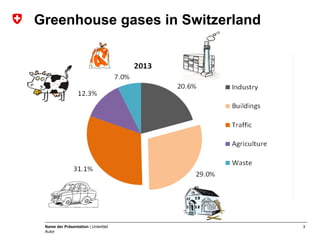
Greenhouse gases in Switzerland
4Presentation name | Subtitle
Author
Mitigation
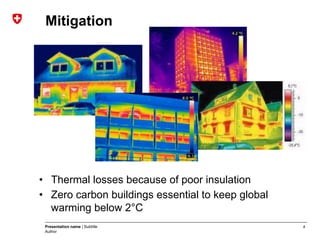
•  Thermal losses because of poor insulation
•  Zero carbon buildings essential to keep global
warming below 2°C
5Presentation name | Subtitle
Author
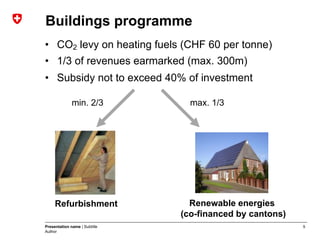
Buildings programme
•  CO2 levy on heating fuels (CHF 60 per tonne)
•  1/3 of revenues earmarked (max. 300m)
•  Subsidy not to exceed 40% of investment
min. 2/3 max. 1/3
Refurbishment Renewable energies
(co-financed by cantons)
6Presentation name | Subtitle
Author
Technology fund
•  Loan guarantees up to CHF 3m for innovative
technologies with positive impact on carbon balance
à less state intervention compared to subsidies
à alters risk profile for lenders and investors
•  Leverage fund deposit according to risk structure,
capital flow to companies exceed fund inflow
•  Eligible e.g. smart buildings solutions, Home Energy
Management, innovative illuminating
•  Instrument operational
since November 2014
7Presentation name | Subtitle
Author
Adaptation
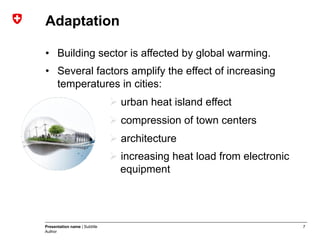
•  Building sector is affected by global warming.
•  Several factors amplify the effect of increasing
temperatures in cities:
Ø urban heat island effect
Ø compression of town centers
Ø architecture
Ø increasing heat load from electronic
equipment
8Presentation name | Subtitle
Author
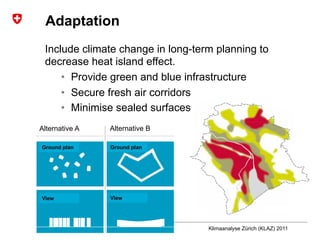
Adaptation
Include climate change in long-term planning to
decrease heat island effect.
•  Provide green and blue infrastructure
•  Secure fresh air corridors
•  Minimise sealed surfaces
Klimaanalyse Zürich (KLAZ) 2011
Alternative A Alternative B
Ground plan Ground plan
View View
9Presentation name | Subtitle
Author
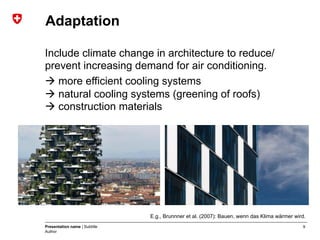
Adaptation
Include climate change in architecture to reduce/
prevent increasing demand for air conditioning.
à more efficient cooling systems
à natural cooling systems (greening of roofs)
à construction materials
E.g., Brunnner et al. (2007): Bauen, wenn das Klima wärmer wird.
10Presentation name | Subtitle
Author
Financing
Mitigation:
•  Regulatory incentives (CO2 levy, building standards)
•  Subsidies to stimulate private investments and
establish best practices (buildings programme)
•  Ease access to debt capital to enhance best
practices (loan guarantees by technology fund)
Adaptation:
•  Support research to increase knowledge base
•  Include adaptation as no-regret / low-cost measures
in mitigation and urban development
11Presentation name | Subtitle
Author
Thank you for your attention

GIB2015_Climate mitigation, Adaptation and Infrastructure_Burkhardt

  • 1.
    This presentation washeld during the 5th GIB Summit, May 27-28 2015. The presentation and more information on the Global Infrastructure Basel Foundation are available on www.gib-foundation.org The next GIB Summit will take place in Basel, May 24-25, 2016.   The information and views set out in this presenation are those of the author(s) and do not necessarily reflect the opinion of the Global Infrastructure Basel Foundation. Neither the Global Infrastructure Basel Foundation nor any person acting on its behalf may be held responsible for the use of the information contained therein.  
  • 2.
    Federal Department ofthe Environment, Transport, Energy and Communications DETEC Federal Office for the Environment FOEN Mitigation – Adaptation – Sustainable Infrastructure Challenges for the buildings sector in Switzerland GIB, 28th May 2015 Climate Division Andrea Burkhardt
  • 3.
    3Name der Präsentation| Untertitel Autor Greenhouse gases in Switzerland
  • 4.
    4Presentation name |Subtitle Author Mitigation •  Thermal losses because of poor insulation •  Zero carbon buildings essential to keep global warming below 2°C
  • 5.
    5Presentation name |Subtitle Author Buildings programme •  CO2 levy on heating fuels (CHF 60 per tonne) •  1/3 of revenues earmarked (max. 300m) •  Subsidy not to exceed 40% of investment min. 2/3 max. 1/3 Refurbishment Renewable energies (co-financed by cantons)
  • 6.
    6Presentation name |Subtitle Author Technology fund •  Loan guarantees up to CHF 3m for innovative technologies with positive impact on carbon balance à less state intervention compared to subsidies à alters risk profile for lenders and investors •  Leverage fund deposit according to risk structure, capital flow to companies exceed fund inflow •  Eligible e.g. smart buildings solutions, Home Energy Management, innovative illuminating •  Instrument operational since November 2014
  • 7.
    7Presentation name |Subtitle Author Adaptation •  Building sector is affected by global warming. •  Several factors amplify the effect of increasing temperatures in cities: Ø urban heat island effect Ø compression of town centers Ø architecture Ø increasing heat load from electronic equipment
  • 8.
    8Presentation name |Subtitle Author Adaptation Include climate change in long-term planning to decrease heat island effect. •  Provide green and blue infrastructure •  Secure fresh air corridors •  Minimise sealed surfaces Klimaanalyse Zürich (KLAZ) 2011 Alternative A Alternative B Ground plan Ground plan View View
  • 9.
    9Presentation name |Subtitle Author Adaptation Include climate change in architecture to reduce/ prevent increasing demand for air conditioning. à more efficient cooling systems à natural cooling systems (greening of roofs) à construction materials E.g., Brunnner et al. (2007): Bauen, wenn das Klima wärmer wird.
  • 10.
    10Presentation name |Subtitle Author Financing Mitigation: •  Regulatory incentives (CO2 levy, building standards) •  Subsidies to stimulate private investments and establish best practices (buildings programme) •  Ease access to debt capital to enhance best practices (loan guarantees by technology fund) Adaptation: •  Support research to increase knowledge base •  Include adaptation as no-regret / low-cost measures in mitigation and urban development
  • 11.
    11Presentation name |Subtitle Author Thank you for your attention