This presentation was
held during the 5th GIB
Summit, May 27-28 2015.
The presentation and
more information on the
Global Infrastructure
Basel Foundation are
available on
www.gib-foundation.org
The next GIB Summit will take place in Basel,
May 24-25, 2016.
	
  
The information and views set out in this presenation are those of the author(s) and do not necessarily reflect the opinion of the Global
Infrastructure Basel Foundation. Neither the Global Infrastructure Basel Foundation nor any person acting on its behalf may be held responsible
for the use of the information contained therein. 	
  
2
Global Infrastructure Basel
2015 Summit
City-led financing of climate infrastructure:
Lessons from
Bus Rapid Transit projects
Robert Kehew
Outline
1.  Introduction – Why spend time on
this topic at GIB Summit –
feasibility of Bus Rapid Transit
2.  Experiences & lessons
3.  Cities Climate Finance Leadership
Alliance
3
1. Introduction – Why spend time on
this topic?
Session Guidance
“…How to make sure
that… sustainable
urban infrastructure
projects… that address
climate change
mitigation are
investable and
bankable becomes
critical.”
4
1. Introduction – Why spend time on
this topic?
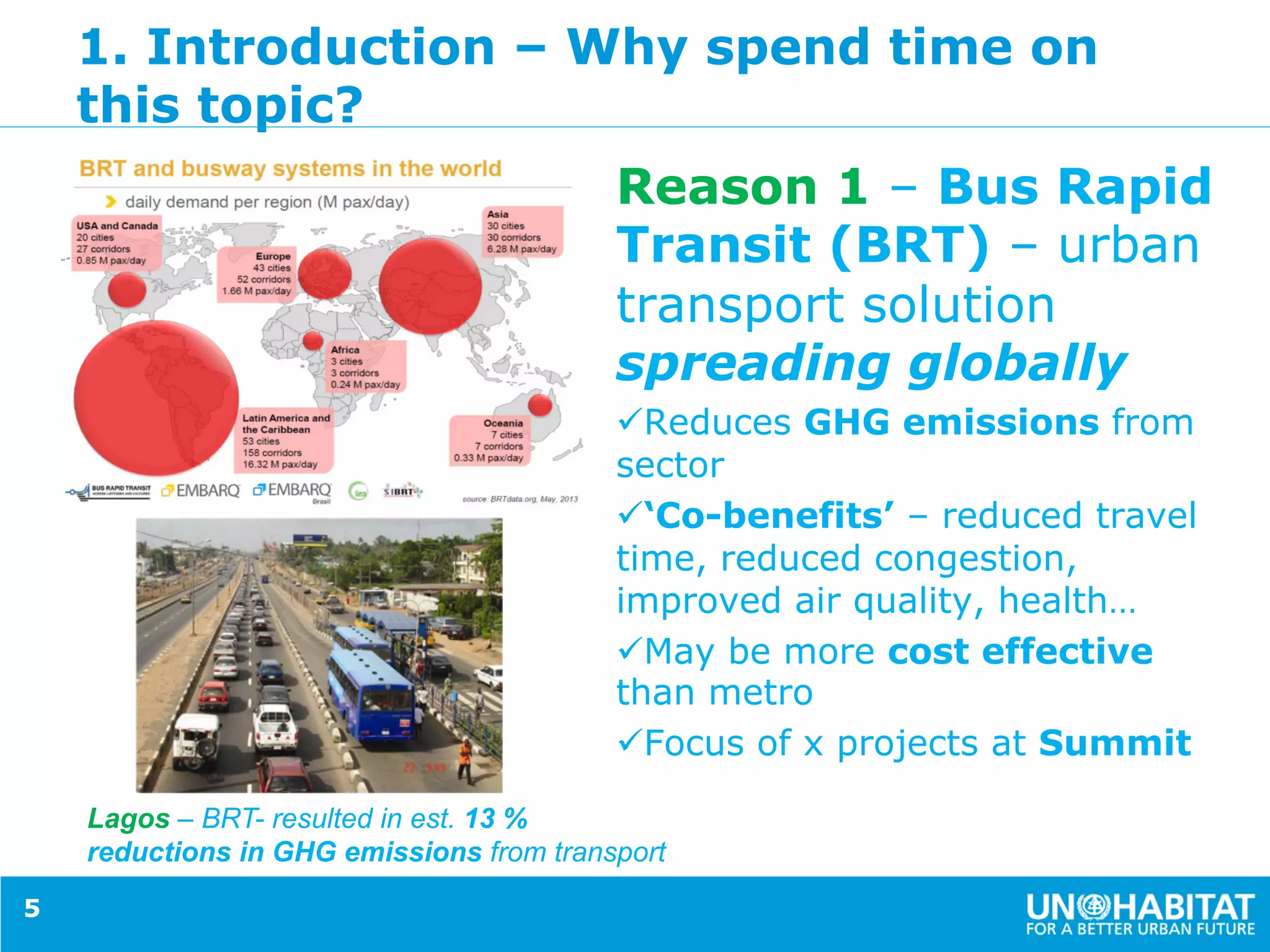
Reason 1 – Bus Rapid
Transit (BRT) – urban
transport solution
spreading globally
ü Reduces GHG emissions from
sector
ü ‘Co-benefits’ – reduced travel
time, reduced congestion,
improved air quality, health…
ü May be more cost effective
than metro
ü Focus of x projects at Summit
5
Lagos – BRT- resulted in est. 13 %
reductions in GHG emissions from transport
1. Introduction – Why spend time on
this topic?
Reason 2 –
Projections of revenues
from pay-for-use
transport facilities may be
wildly inaccurate (even
in OECD countries)
Reason 3 –
Securitized revenues
(from tolls, bus fares)
may underpin credits
(project finance)
6
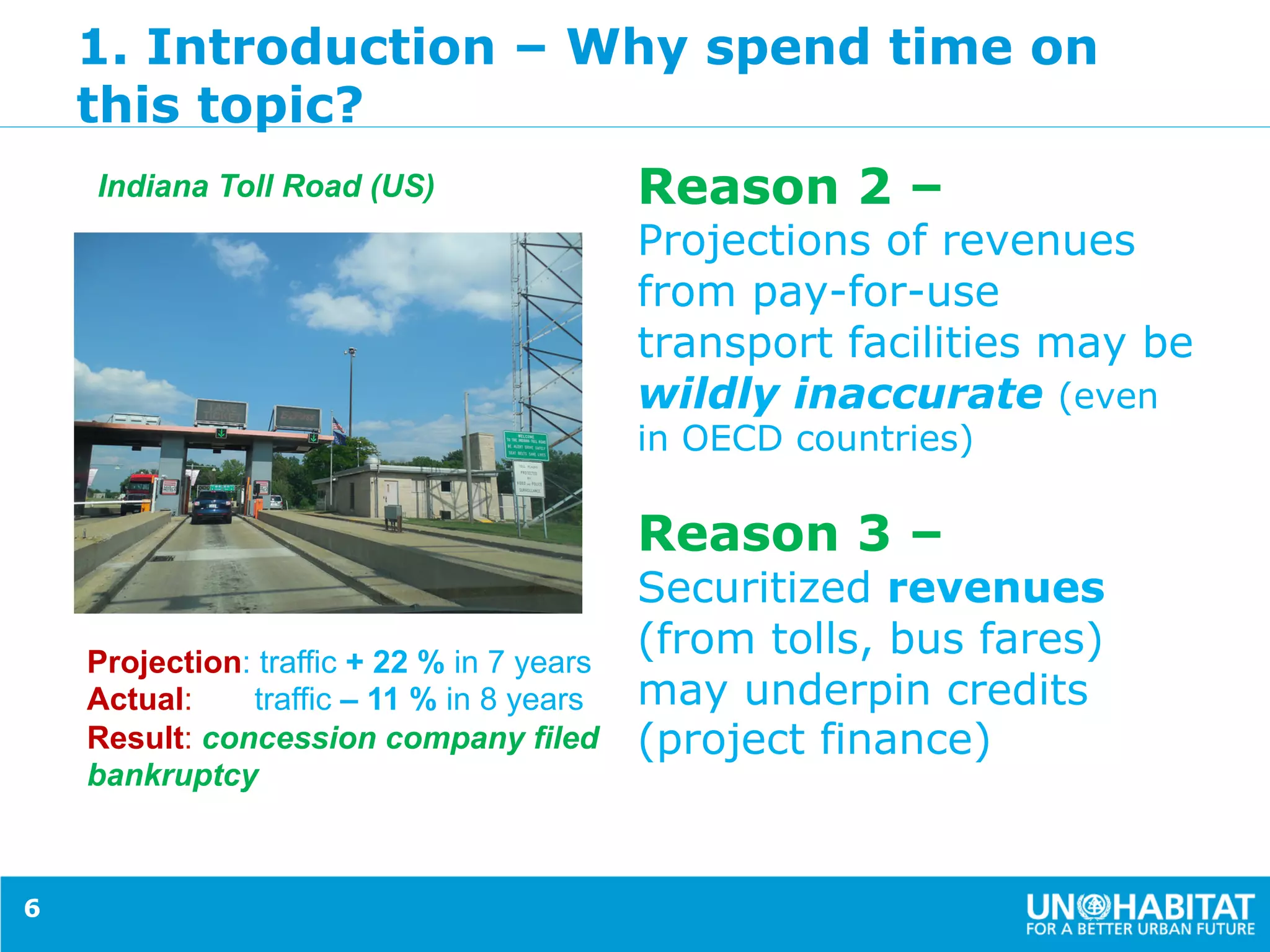
Projection: traffic + 22 % in 7 years
Actual: traffic – 11 % in 8 years
Result: concession company filed
bankruptcy
Indiana Toll Road (US)
1. Introduction – Why spend time on
this topic?
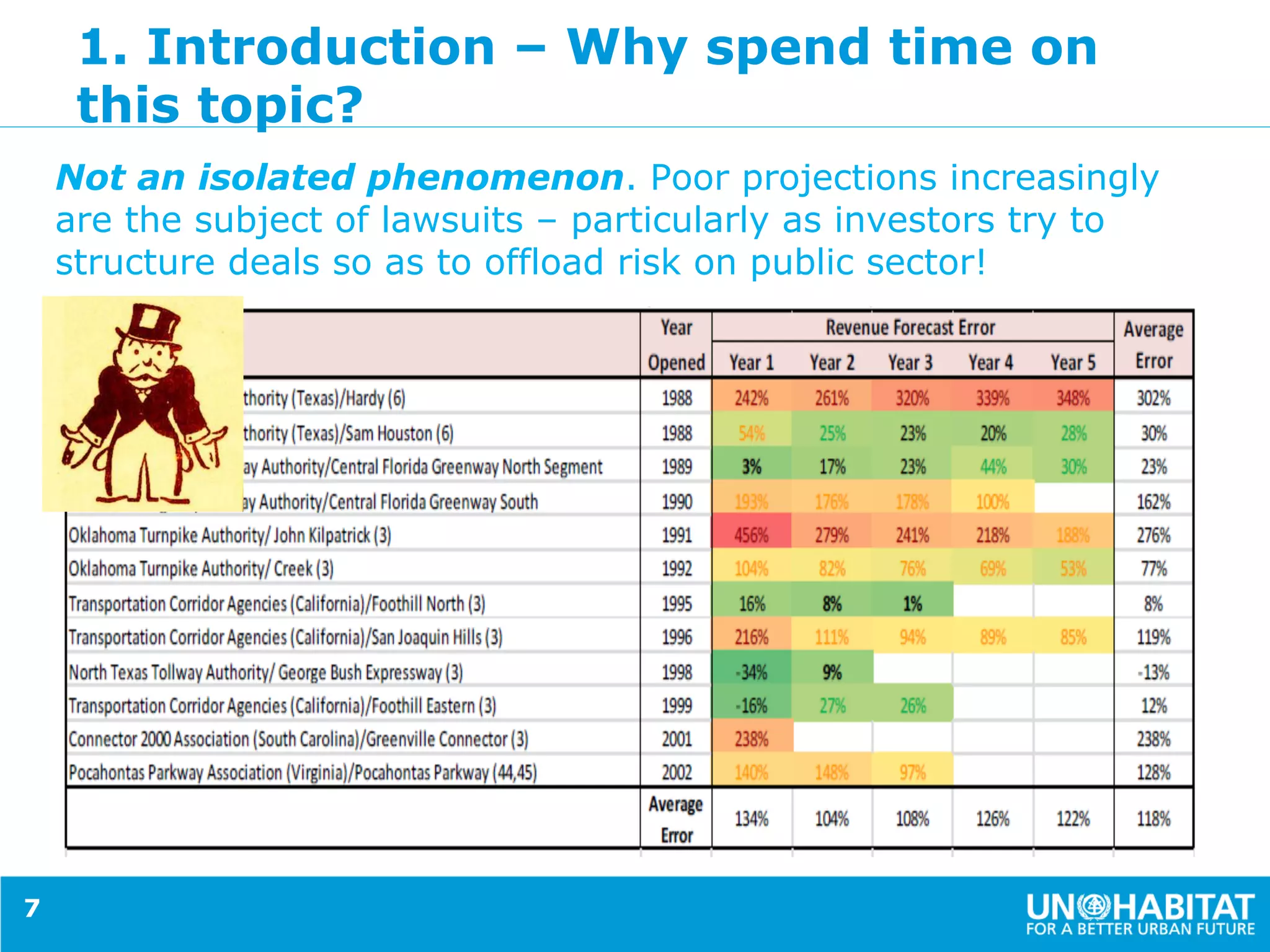
Not an isolated phenomenon. Poor projections increasingly
are the subject of lawsuits – particularly as investors try to
structure deals so as to offload risk on public sector!
7
1. Introduction – Why spend time on
this topic?
Issue: If accuracy of
ridership projections (built
upon current conditions)
is an issue in cities in
developed countries…
What about para-transit?
Little data on…
ü Routes
ü Where people board & alight
ü Frequency
ü # passengers…
8
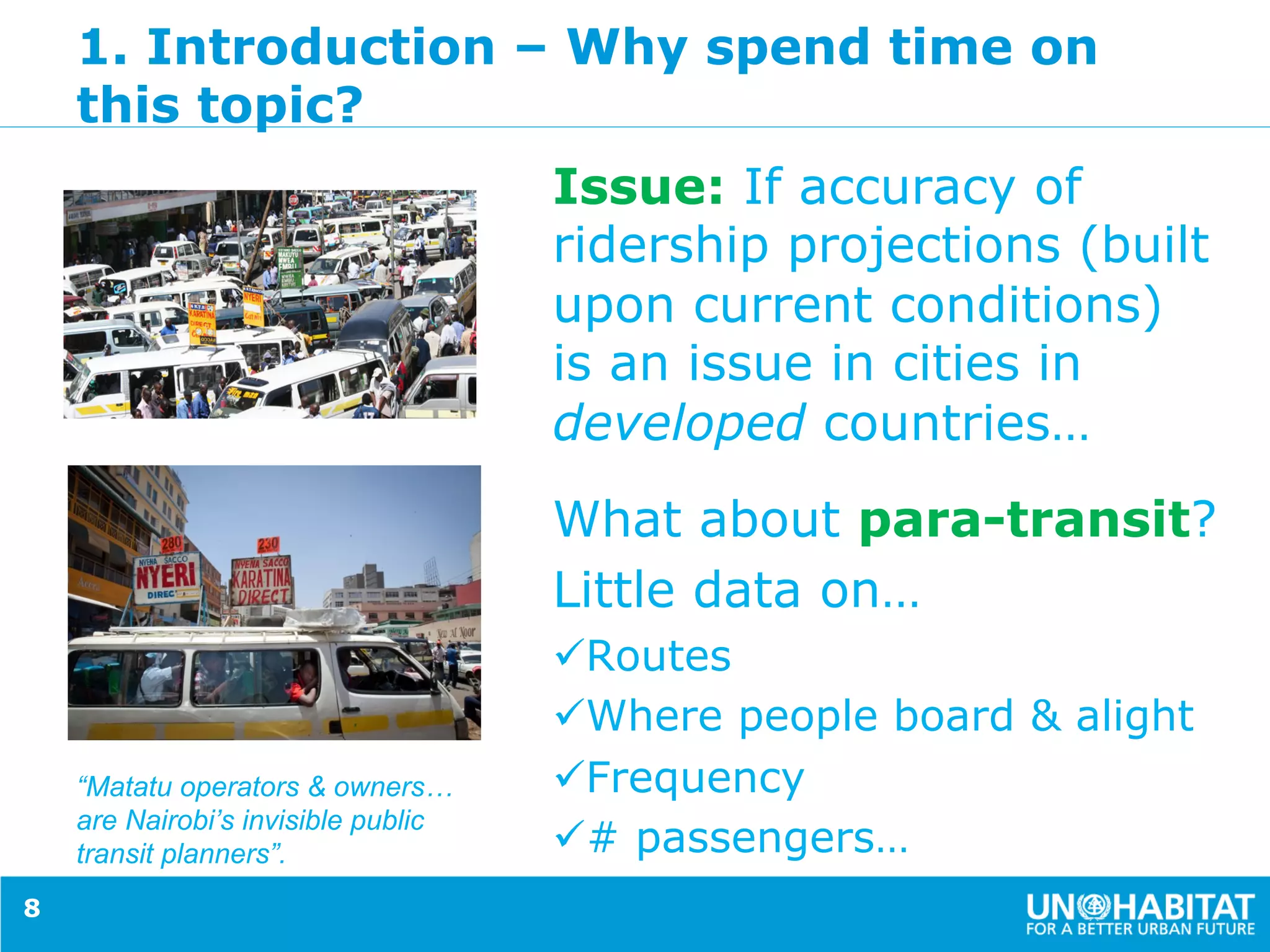
“Matatu operators & owners…
are Nairobi’s invisible public
transit planners”.
2. Experience & lessons
Project: Sustainable Urban Transport
Solutions for East African Cities
Nairobi (Kenya)
Addis Ababa (Ethiopia)
Kampala (Uganda)
BRT Support to Cairo & Giza
9
2. Experience & lessons
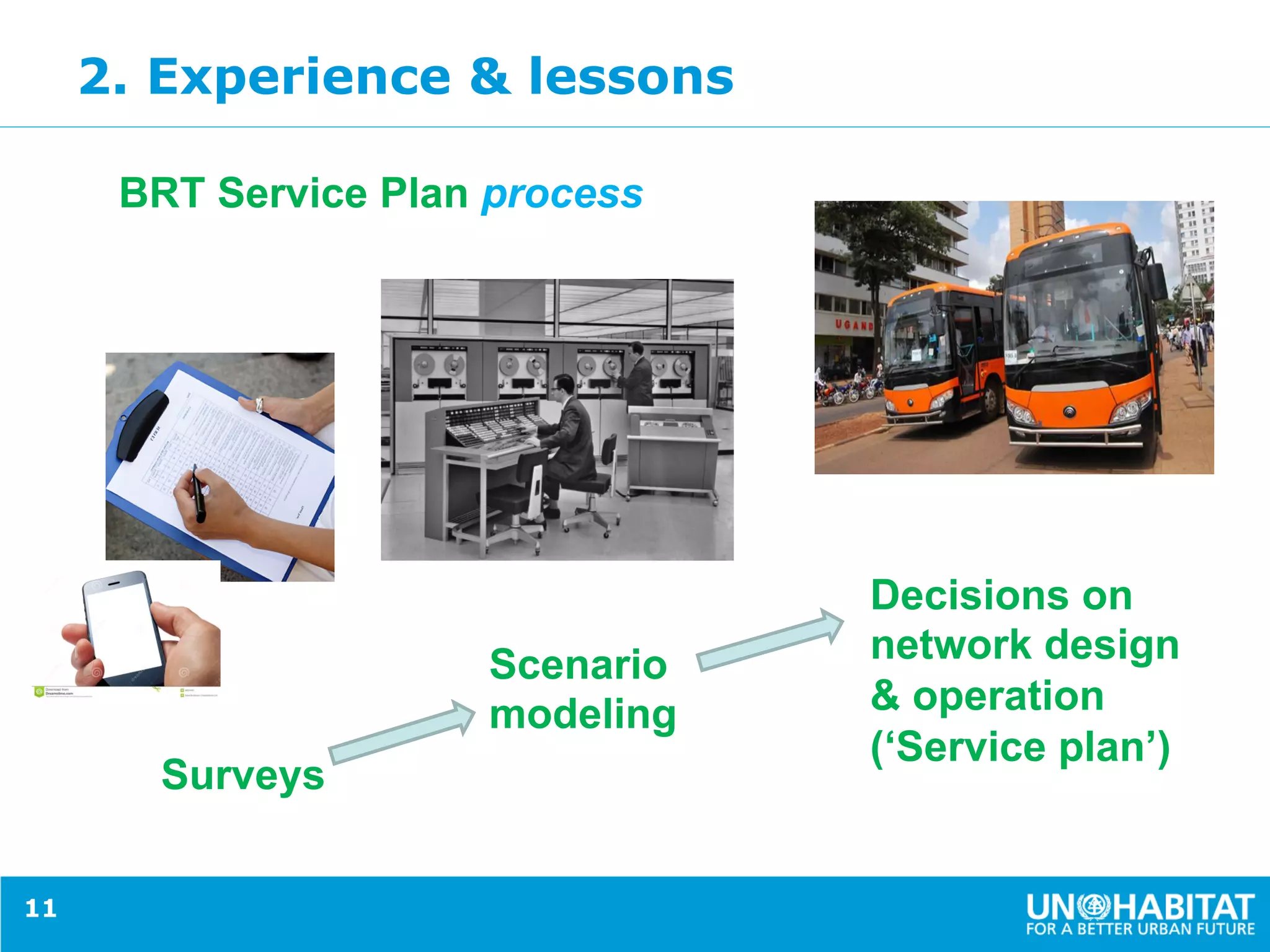
Nairobi – Project took form of support to
World Bank funded National Urban
Transport Improvement Project
1 of 3 Goals: Promote private sector participation in
operation, financing & management of systems
§ 2012 – GOK (with World Bank) invited UN-Habitat/
ITDP to advise on BRT planning under existing
A104 road expansion project
§ 2013 – WB advised GOK: carry out detailed
Service Plan before beginning detailed design
§ 2014 – Bus Rapid Transit Service Plan
10
2. Experience & lessons
11
BRT Service Plan process
Surveys
Scenario
modeling
Decisions on
network design
& operation
(‘Service plan’)
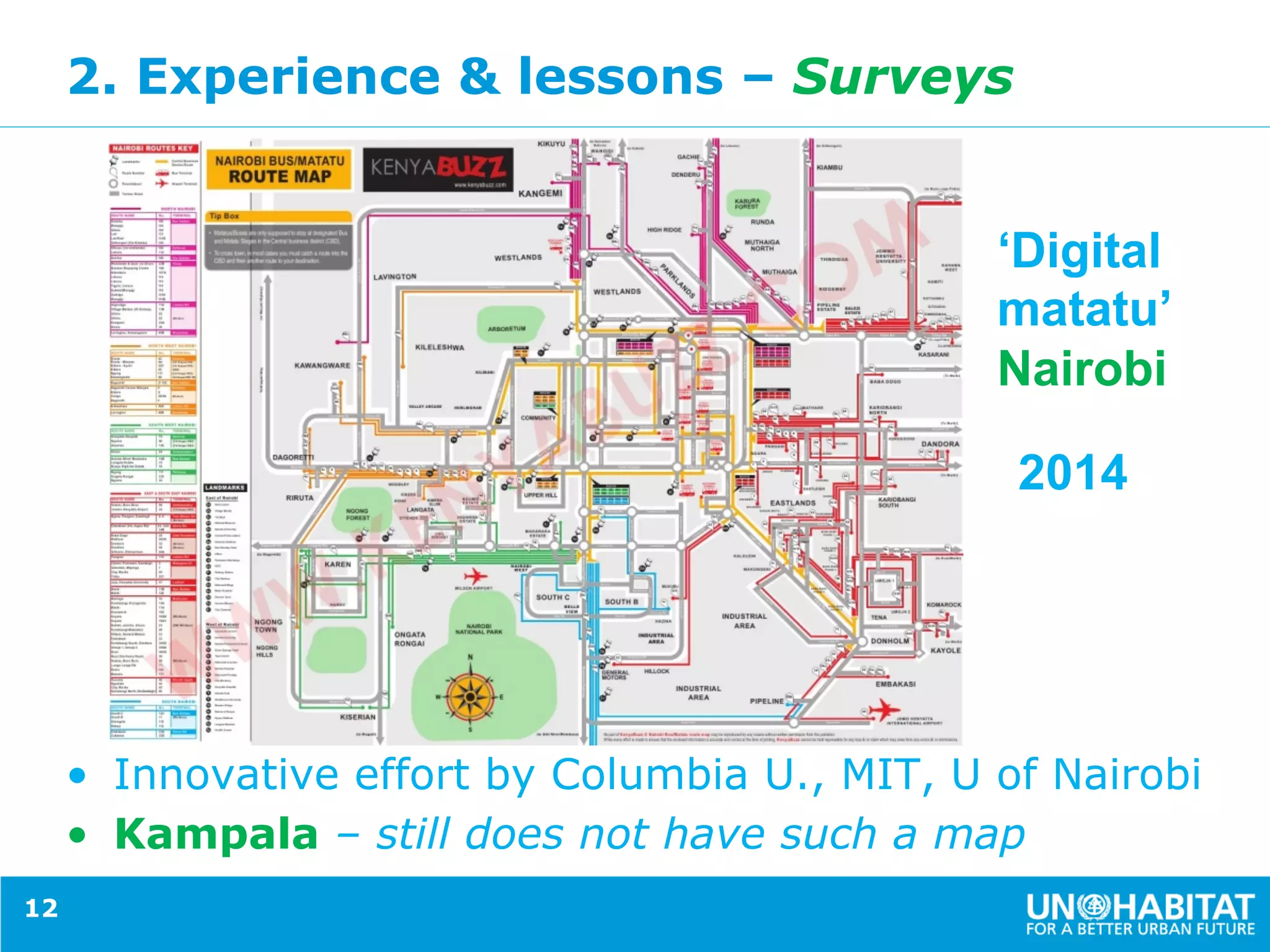
2. Experience & lessons – Surveys
•  Innovative effort by Columbia U., MIT, U of Nairobi
•  Kampala – still does not have such a map
12
‘Digital
matatu’
Nairobi
2014
2. Experience & lessons – Surveys
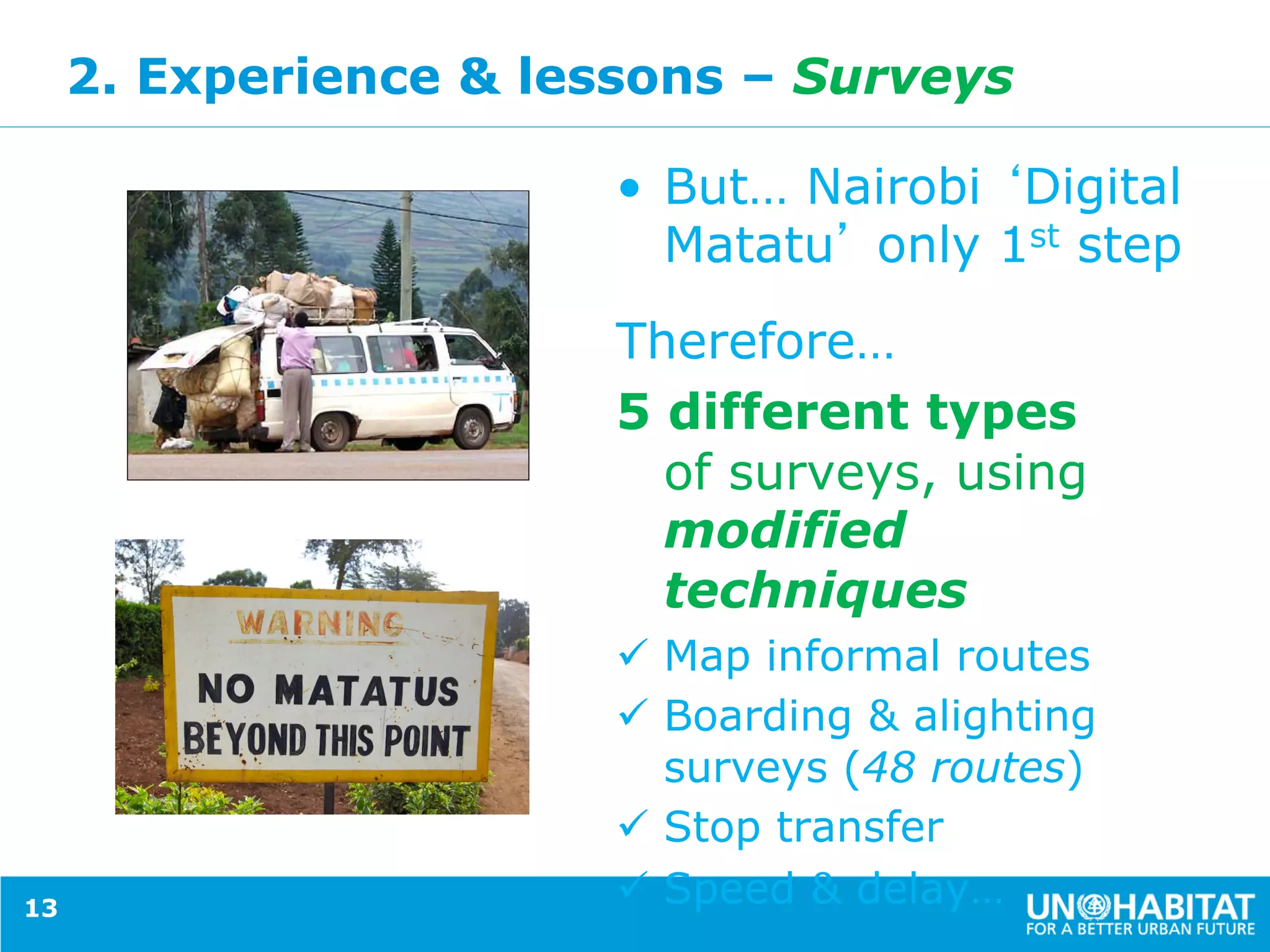
•  But… Nairobi Digital
Matatu only 1st step
Therefore…
5 different types
of surveys, using
modified
techniques
ü  Map informal routes
ü  Boarding & alighting
surveys (48 routes)
ü  Stop transfer
ü  Speed & delay…13
2. Experience & lessons – Modelling
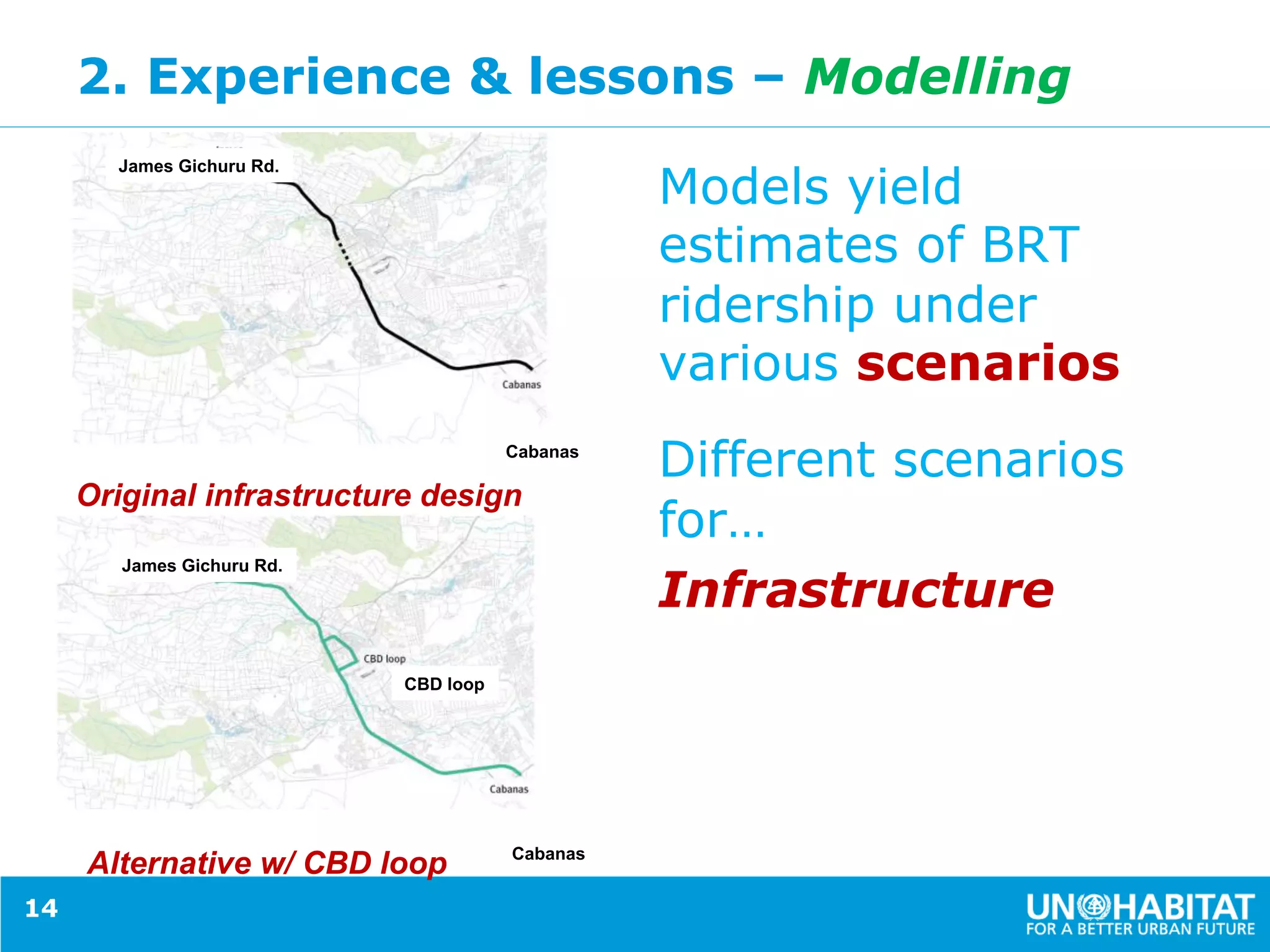
Models yield
estimates of BRT
ridership under
various scenarios
Different scenarios
for…
Infrastructure
14
CBD loop
Cabanas
Cabanas
James Gichuru Rd.
James Gichuru Rd.
Original infrastructure design
Alternative w/ CBD loop
2. Experience & lessons – Modelling
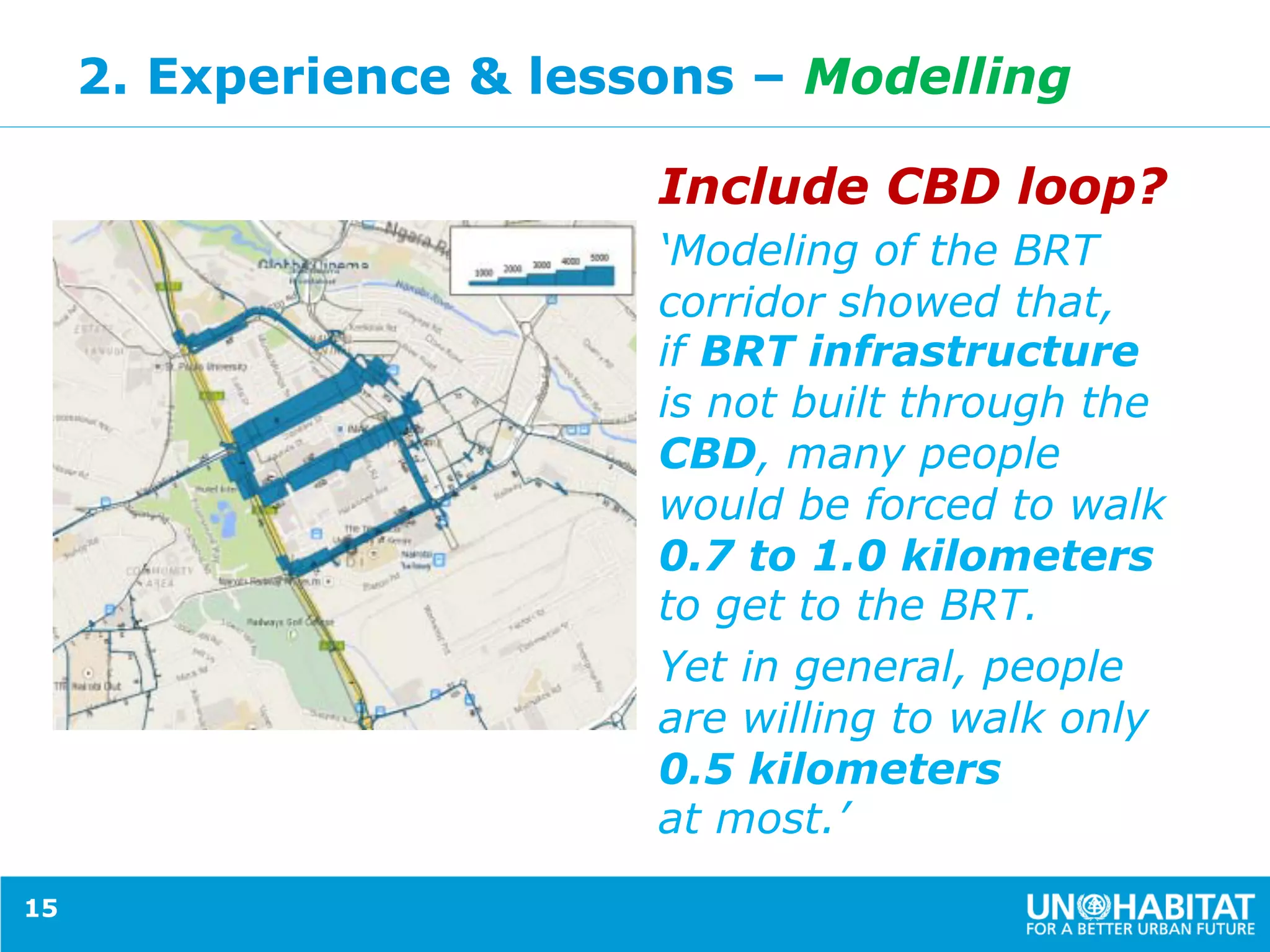
Include CBD loop?
‘Modeling of the BRT
corridor showed that,
if BRT infrastructure
is not built through the
CBD, many people
would be forced to walk
0.7 to 1.0 kilometers
to get to the BRT.
Yet in general, people
are willing to walk only
0.5 kilometers
at most.’
15
2. Experience & lessons – Modelling
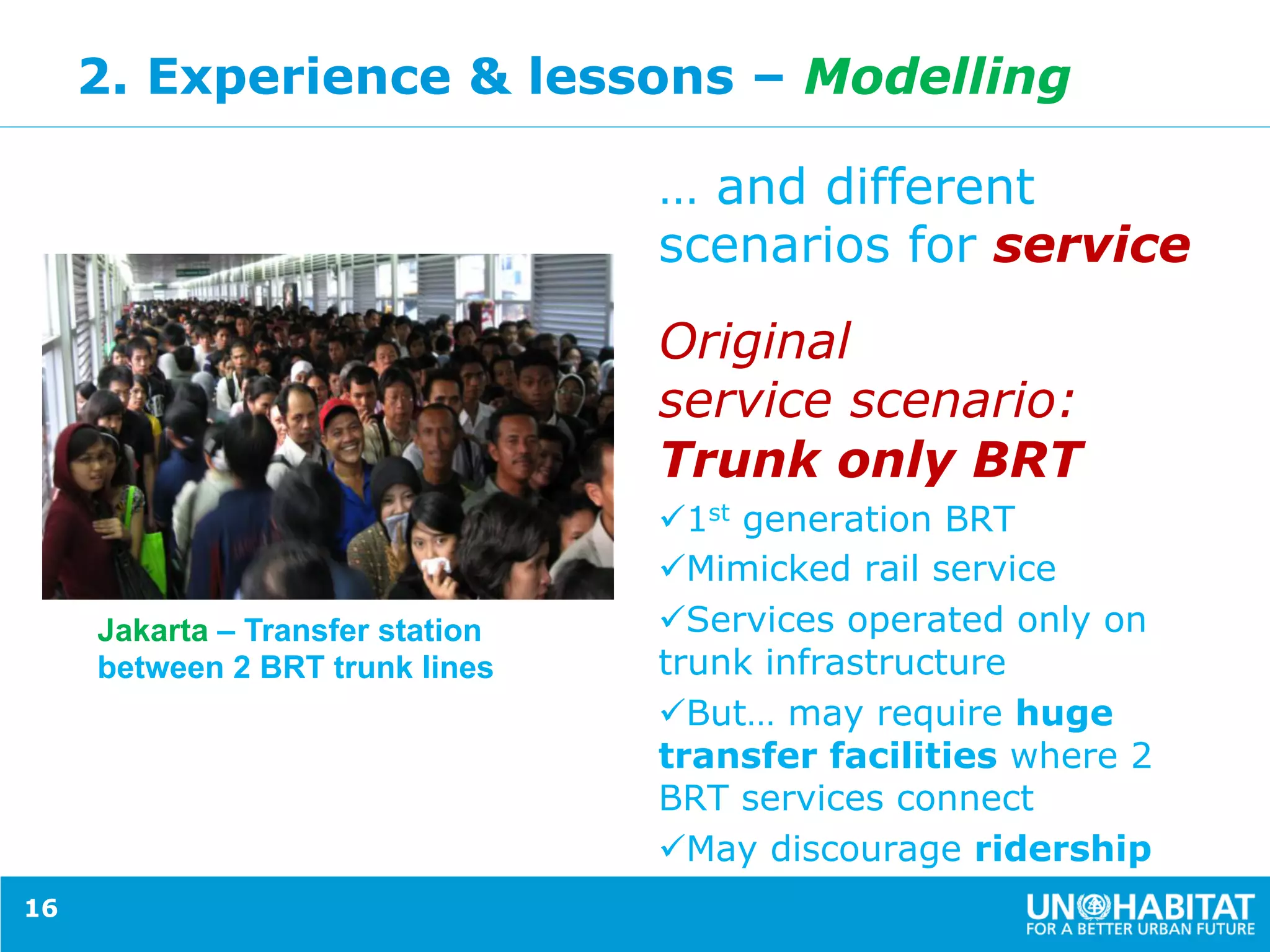
… and different
scenarios for service
Original
service scenario:
Trunk only BRT
ü 1st generation BRT
ü Mimicked rail service
ü Services operated only on
trunk infrastructure
ü But… may require huge
transfer facilities where 2
BRT services connect
ü May discourage ridership
16
Jakarta – Transfer station
between 2 BRT trunk lines
2. Experience & lessons – Modelling
Alternative
service scenario:
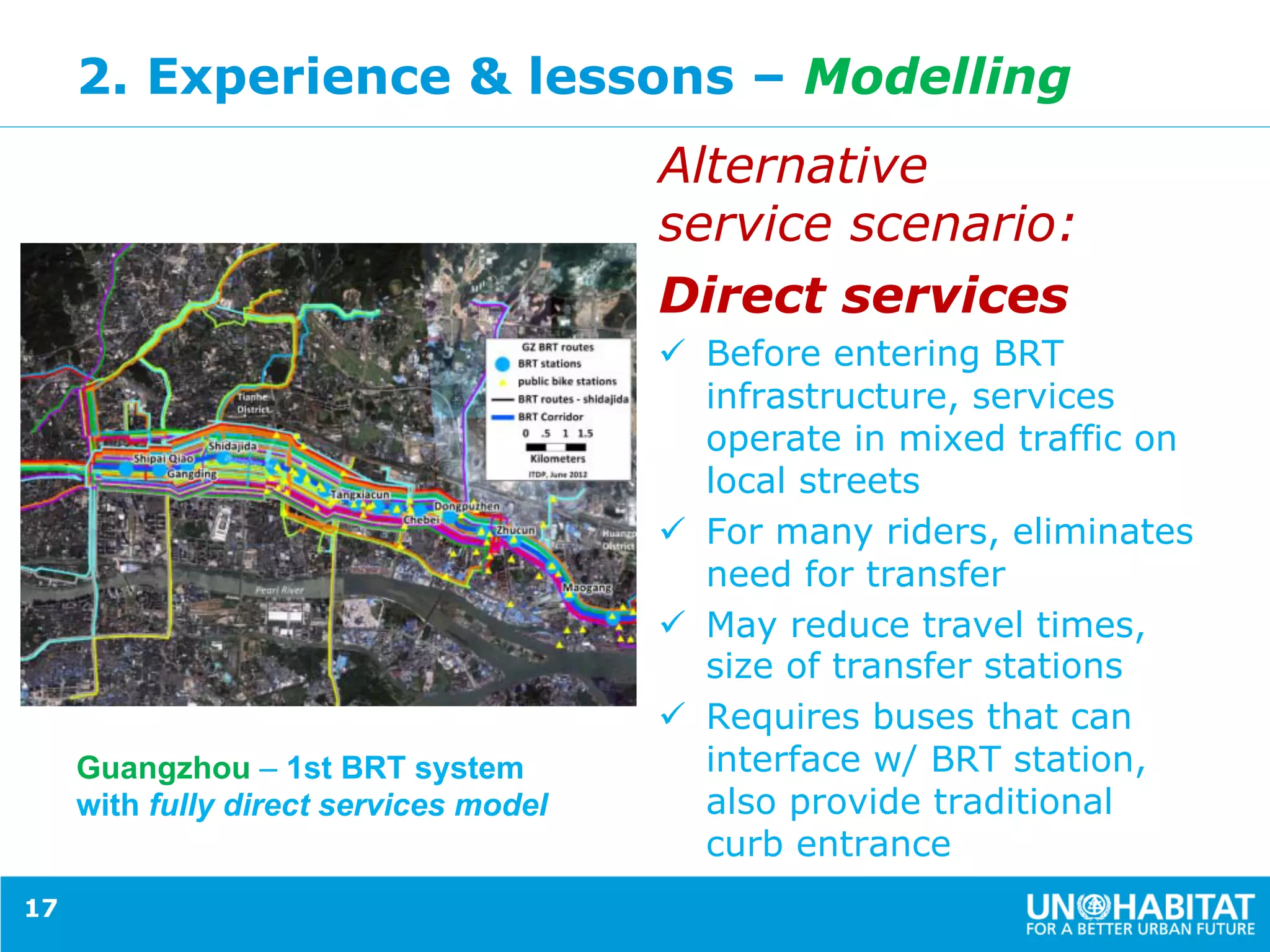
Direct services
ü  Before entering BRT
infrastructure, services
operate in mixed traffic on
local streets
ü  For many riders, eliminates
need for transfer
ü  May reduce travel times,
size of transfer stations
ü  Requires buses that can
interface w/ BRT station,
also provide traditional
curb entrance
17
Guangzhou – 1st BRT system
with fully direct services model
2. Experience & lessons – Modelling
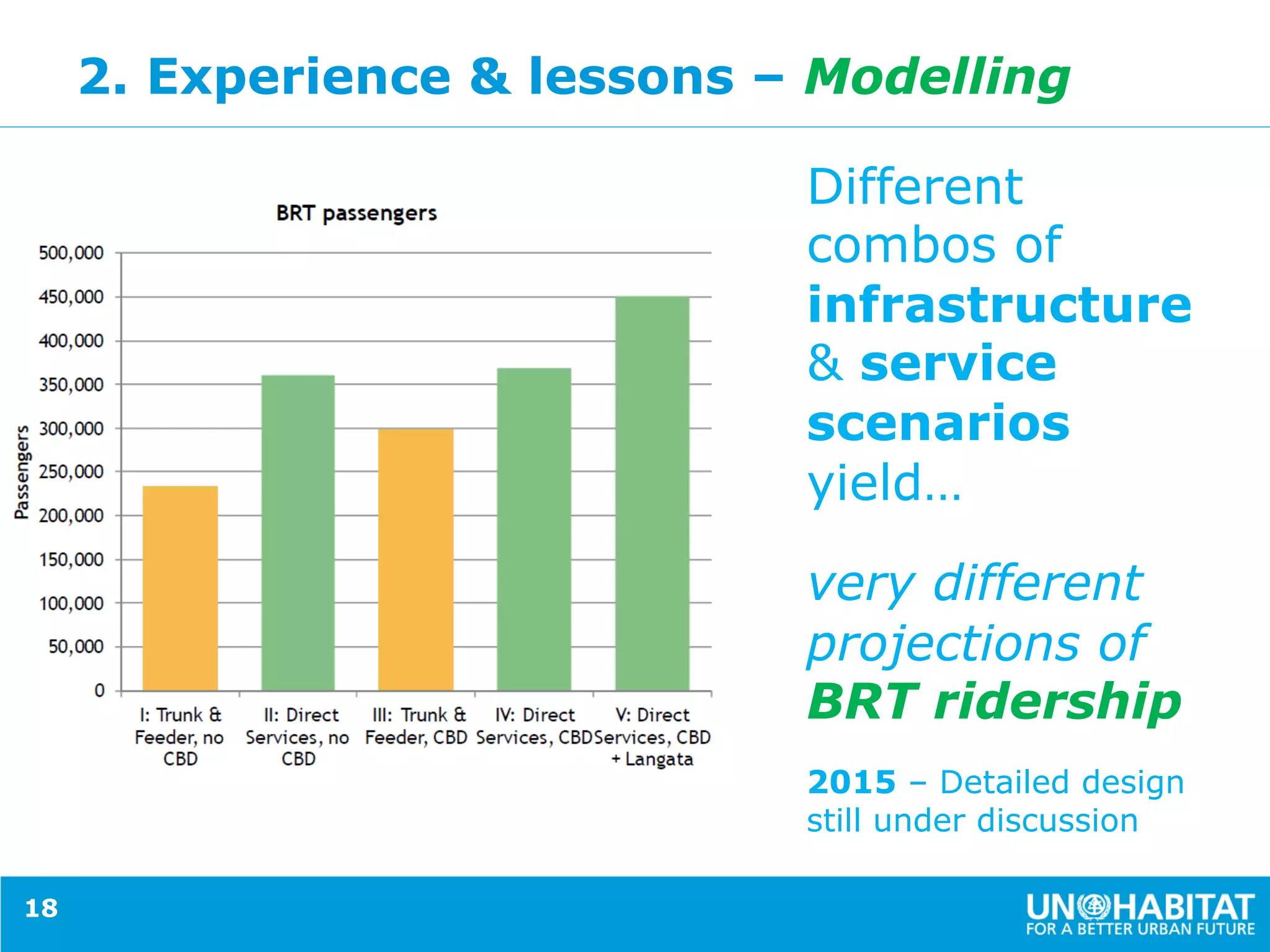
Different
combos of
infrastructure
& service
scenarios
yield…
very different
projections of
BRT ridership
2015 – Detailed design
still under discussion
18
2. Experience & lessons – Lessons
Lesson 1: Changes
in BRT design &
service may have
major impacts on…
Revenues
- Ridership, fare collection
Expenditures
- # of buses needed
- design parameters of buses
- Number, size & location of
transfer stations, etc.
Project feasibility
19
?
2. Experience & lessons – Lessons
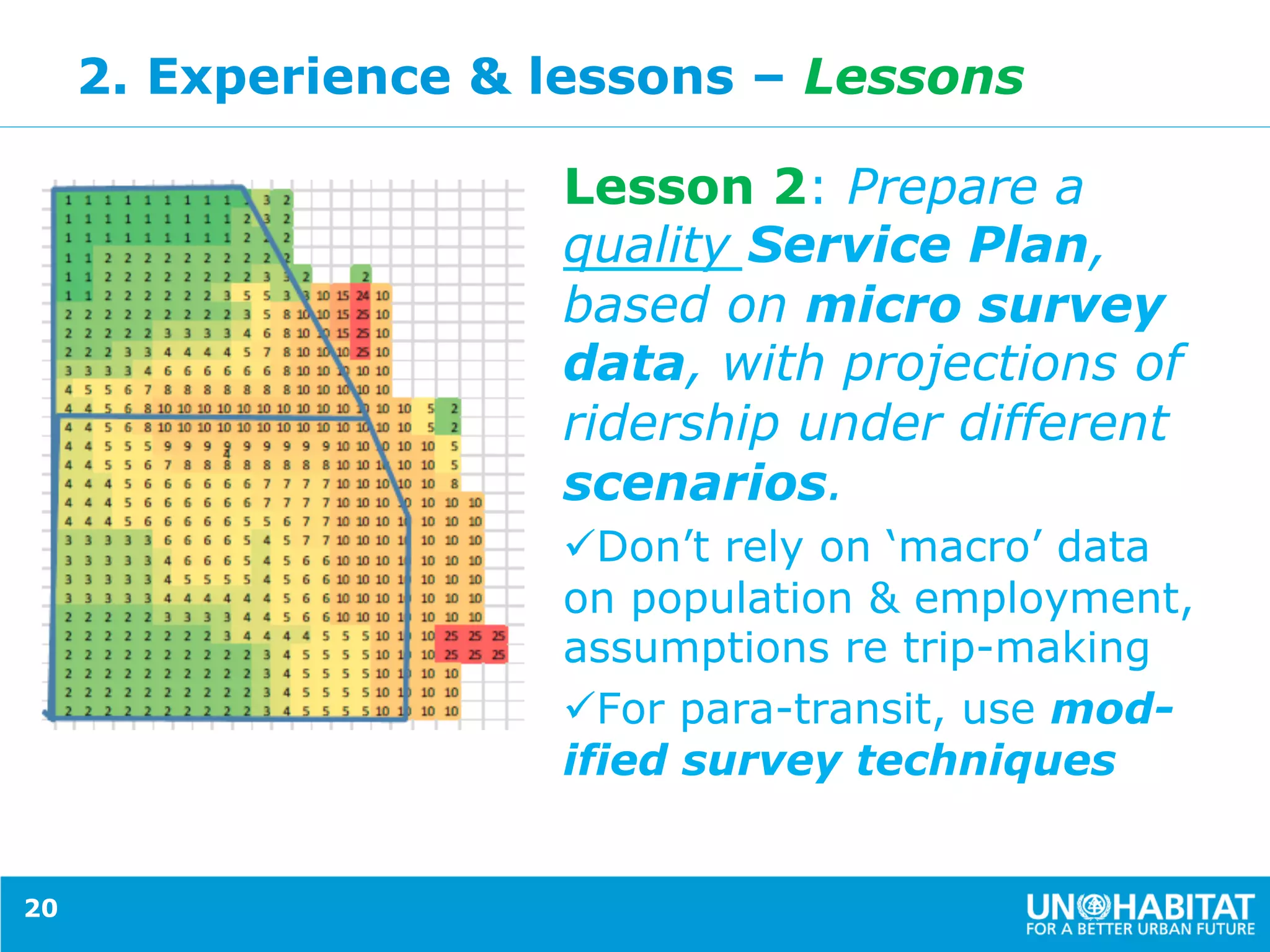
Lesson 2: Prepare a
quality Service Plan,
based on micro survey
data, with projections of
ridership under different
scenarios.
ü Don’t rely on ‘macro’ data
on population & employment,
assumptions re trip-making
ü For para-transit, use mod-
ified survey techniques
20
2. Experience & lessons – Lessons
.
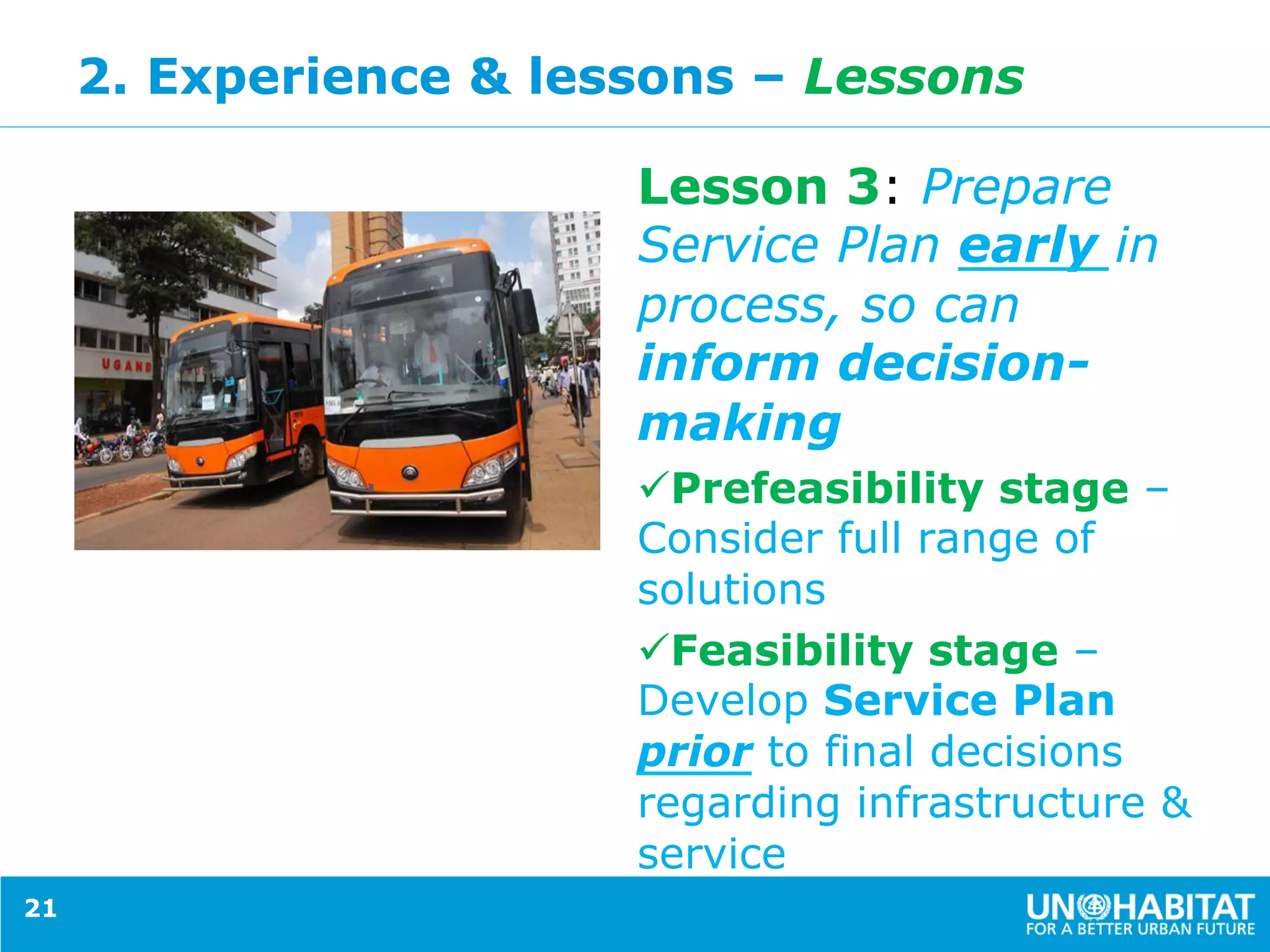
Lesson 3: Prepare
Service Plan early in
process, so can
inform decision-
making
ü Prefeasibility stage –
Consider full range of
solutions
ü Feasibility stage –
Develop Service Plan
prior to final decisions
regarding infrastructure &
service
21
2. Experience & lessons – Lessons
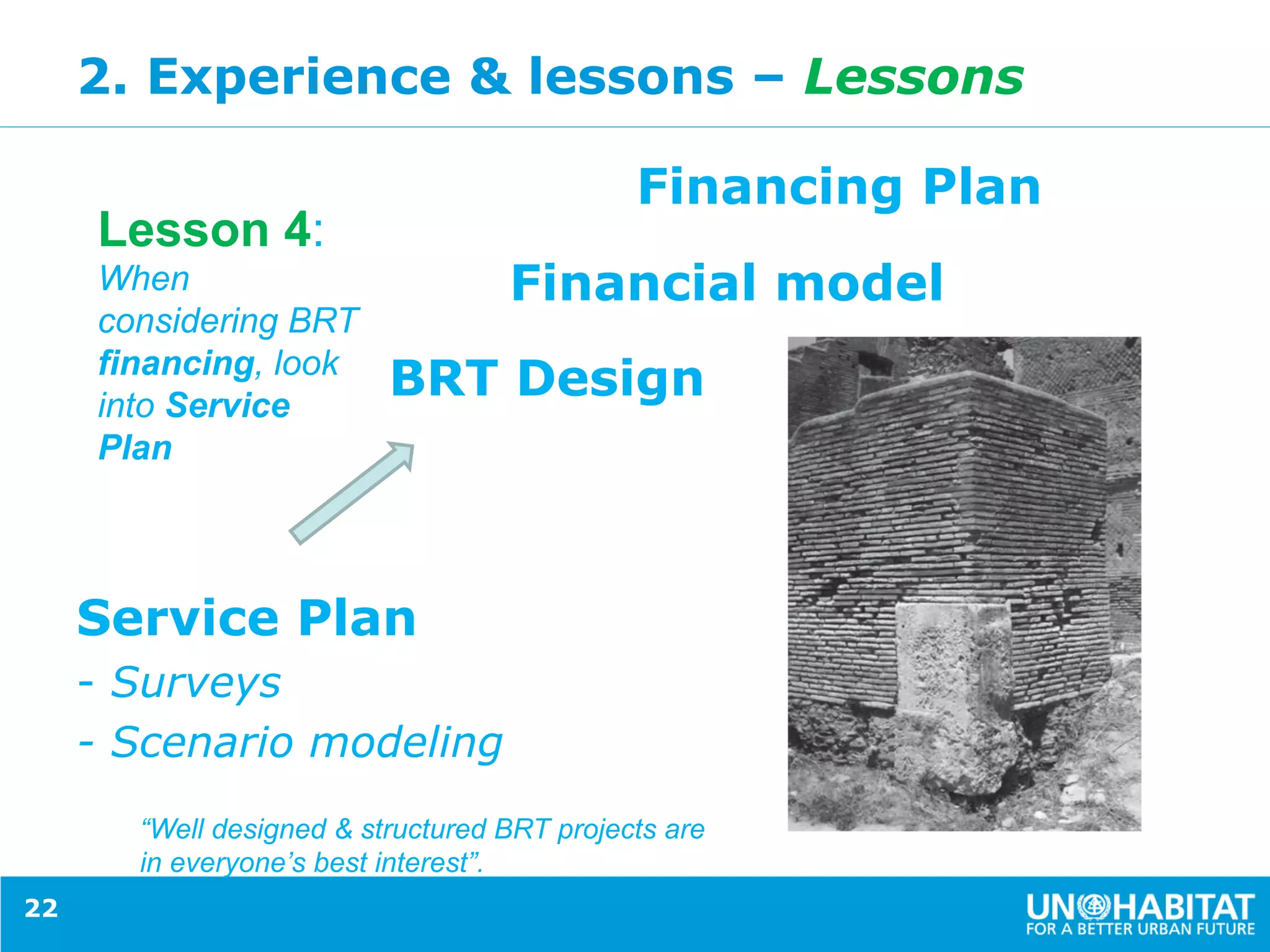
Financing Plan
Financial model
BRT Design
Service Plan
- Surveys
- Scenario modeling
22
Lesson 4:
When
considering BRT
financing, look
into Service
Plan
“Well designed & structured BRT projects are
in everyone’s best interest”.
3. Cities Climate Finance Leadership
Alliance
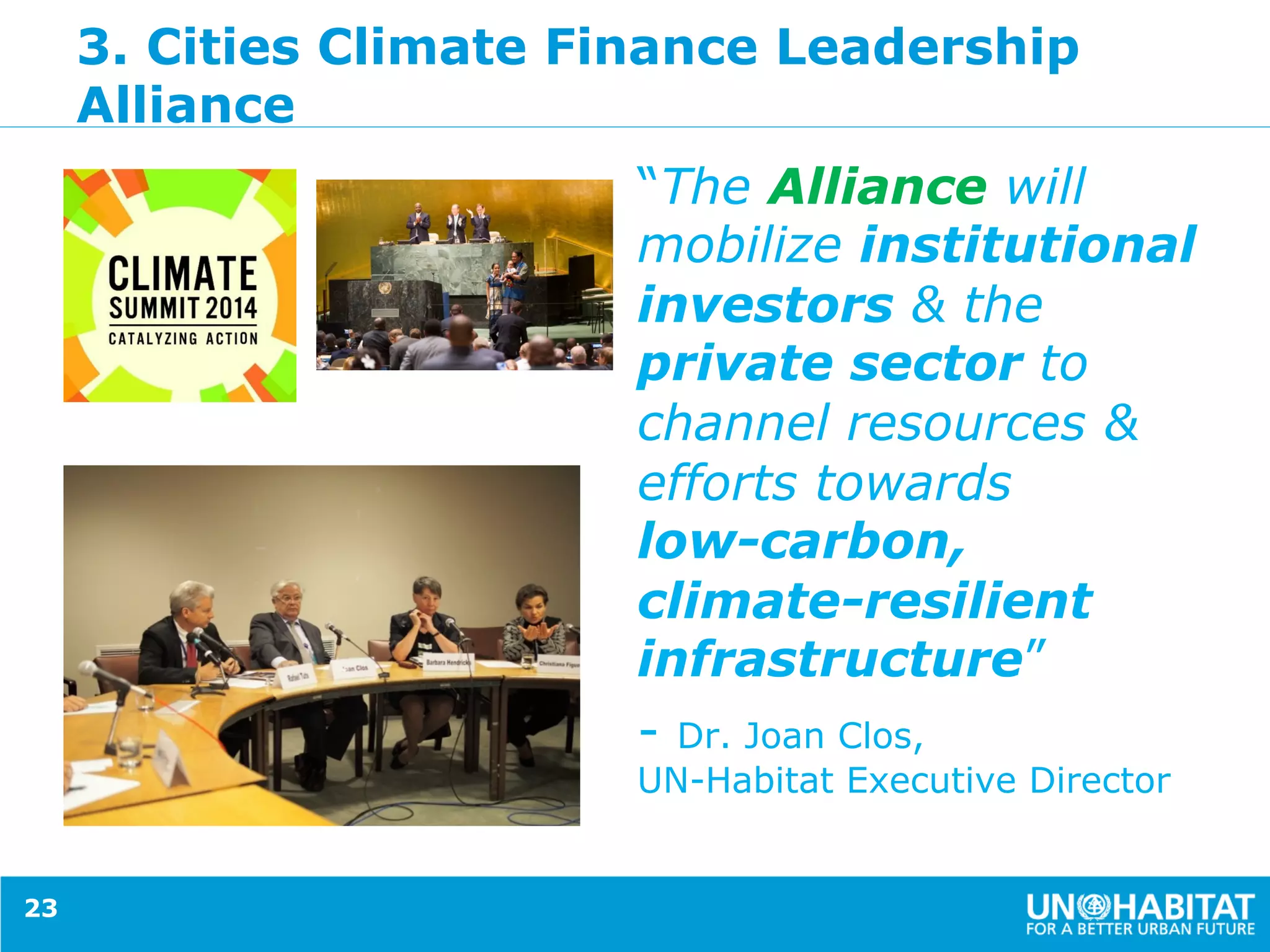
“The Alliance will
mobilize institutional
investors & the
private sector to
channel resources &
efforts towards
low-carbon,
climate-resilient
infrastructure”
- Dr. Joan Clos,
UN-Habitat Executive Director
23
3. Cities Climate Finance Leadership
Alliance
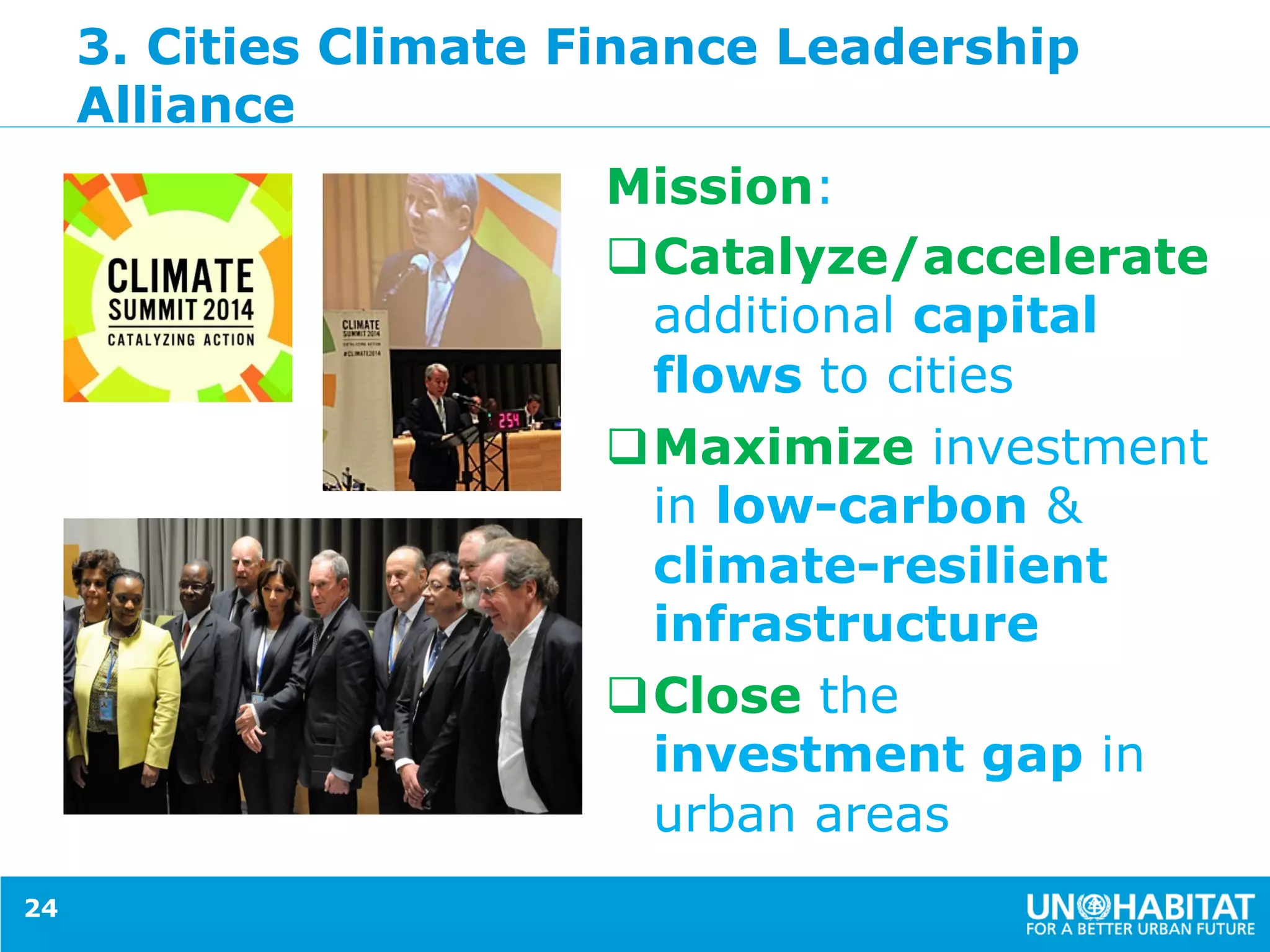
Mission:
q Catalyze/accelerate
additional capital
flows to cities
q Maximize investment
in low-carbon &
climate-resilient
infrastructure
q Close the
investment gap in
urban areas
24
Acknowledgements
25
Urban Basis Services Branch
26
THANK YOU!
Robert.Kehew@unhabitat.org
27
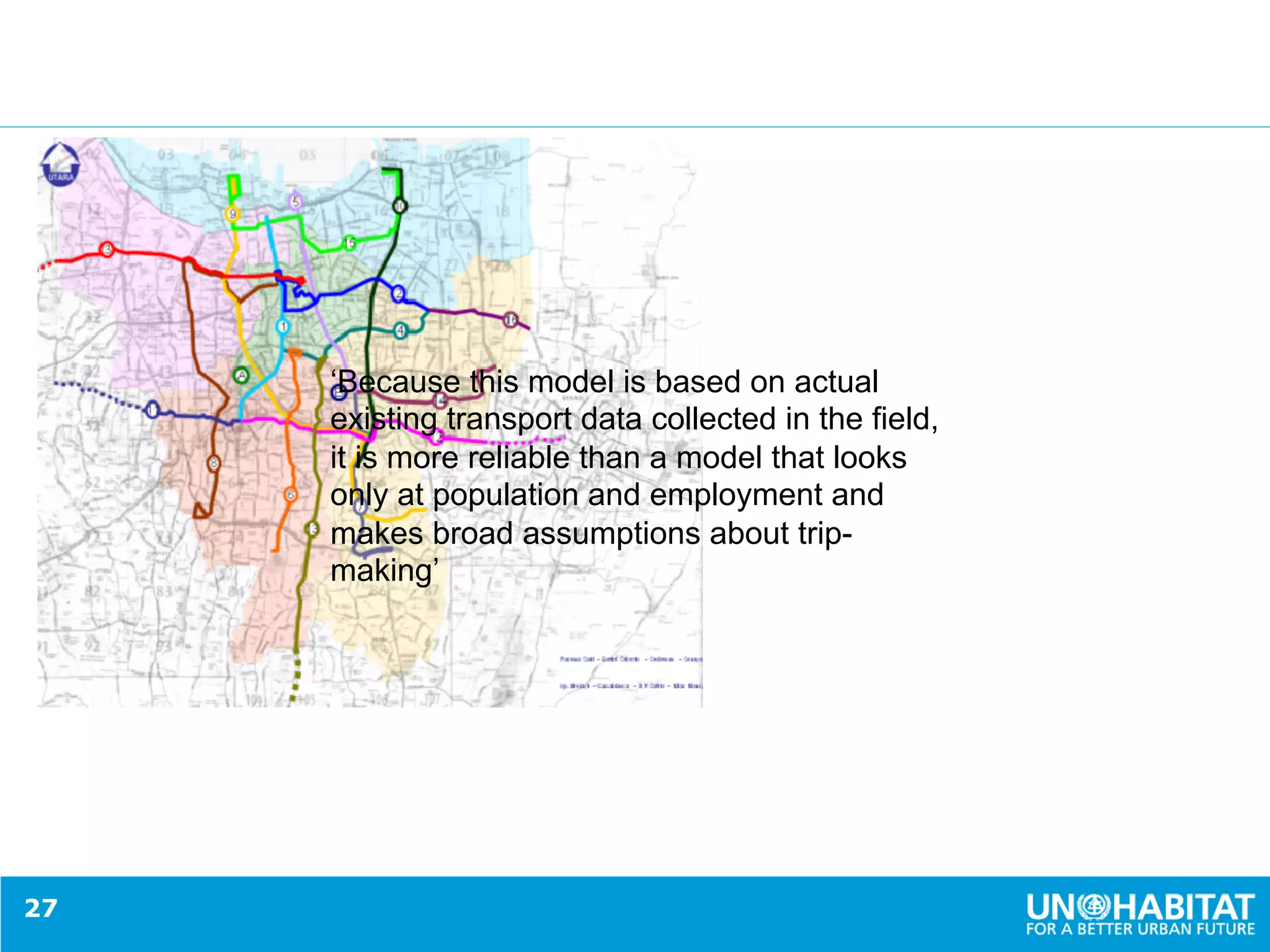
‘Because this model is based on actual
existing transport data collected in the field,
it is more reliable than a model that looks
only at population and employment and
makes broad assumptions about trip-
making’

GIB2015_Climate mitigation, Adaptation, and Infrastructure_Kehew

  • 1.
    This presentation was heldduring the 5th GIB Summit, May 27-28 2015. The presentation and more information on the Global Infrastructure Basel Foundation are available on www.gib-foundation.org The next GIB Summit will take place in Basel, May 24-25, 2016.   The information and views set out in this presenation are those of the author(s) and do not necessarily reflect the opinion of the Global Infrastructure Basel Foundation. Neither the Global Infrastructure Basel Foundation nor any person acting on its behalf may be held responsible for the use of the information contained therein.  
  • 2.
    2 Global Infrastructure Basel 2015Summit City-led financing of climate infrastructure: Lessons from Bus Rapid Transit projects Robert Kehew
  • 3.
    Outline 1.  Introduction –Why spend time on this topic at GIB Summit – feasibility of Bus Rapid Transit 2.  Experiences & lessons 3.  Cities Climate Finance Leadership Alliance 3
  • 4.
    1. Introduction –Why spend time on this topic? Session Guidance “…How to make sure that… sustainable urban infrastructure projects… that address climate change mitigation are investable and bankable becomes critical.” 4
  • 5.
    1. Introduction –Why spend time on this topic? Reason 1 – Bus Rapid Transit (BRT) – urban transport solution spreading globally ü Reduces GHG emissions from sector ü ‘Co-benefits’ – reduced travel time, reduced congestion, improved air quality, health… ü May be more cost effective than metro ü Focus of x projects at Summit 5 Lagos – BRT- resulted in est. 13 % reductions in GHG emissions from transport
  • 6.
    1. Introduction –Why spend time on this topic? Reason 2 – Projections of revenues from pay-for-use transport facilities may be wildly inaccurate (even in OECD countries) Reason 3 – Securitized revenues (from tolls, bus fares) may underpin credits (project finance) 6 Projection: traffic + 22 % in 7 years Actual: traffic – 11 % in 8 years Result: concession company filed bankruptcy Indiana Toll Road (US)
  • 7.
    1. Introduction –Why spend time on this topic? Not an isolated phenomenon. Poor projections increasingly are the subject of lawsuits – particularly as investors try to structure deals so as to offload risk on public sector! 7
  • 8.
    1. Introduction –Why spend time on this topic? Issue: If accuracy of ridership projections (built upon current conditions) is an issue in cities in developed countries… What about para-transit? Little data on… ü Routes ü Where people board & alight ü Frequency ü # passengers… 8 “Matatu operators & owners… are Nairobi’s invisible public transit planners”.
  • 9.
    2. Experience &lessons Project: Sustainable Urban Transport Solutions for East African Cities Nairobi (Kenya) Addis Ababa (Ethiopia) Kampala (Uganda) BRT Support to Cairo & Giza 9
  • 10.
    2. Experience &lessons Nairobi – Project took form of support to World Bank funded National Urban Transport Improvement Project 1 of 3 Goals: Promote private sector participation in operation, financing & management of systems § 2012 – GOK (with World Bank) invited UN-Habitat/ ITDP to advise on BRT planning under existing A104 road expansion project § 2013 – WB advised GOK: carry out detailed Service Plan before beginning detailed design § 2014 – Bus Rapid Transit Service Plan 10
  • 11.
    2. Experience &lessons 11 BRT Service Plan process Surveys Scenario modeling Decisions on network design & operation (‘Service plan’)
  • 12.
    2. Experience &lessons – Surveys •  Innovative effort by Columbia U., MIT, U of Nairobi •  Kampala – still does not have such a map 12 ‘Digital matatu’ Nairobi 2014
  • 13.
    2. Experience &lessons – Surveys •  But… Nairobi Digital Matatu only 1st step Therefore… 5 different types of surveys, using modified techniques ü  Map informal routes ü  Boarding & alighting surveys (48 routes) ü  Stop transfer ü  Speed & delay…13
  • 14.
    2. Experience &lessons – Modelling Models yield estimates of BRT ridership under various scenarios Different scenarios for… Infrastructure 14 CBD loop Cabanas Cabanas James Gichuru Rd. James Gichuru Rd. Original infrastructure design Alternative w/ CBD loop
  • 15.
    2. Experience &lessons – Modelling Include CBD loop? ‘Modeling of the BRT corridor showed that, if BRT infrastructure is not built through the CBD, many people would be forced to walk 0.7 to 1.0 kilometers to get to the BRT. Yet in general, people are willing to walk only 0.5 kilometers at most.’ 15
  • 16.
    2. Experience &lessons – Modelling … and different scenarios for service Original service scenario: Trunk only BRT ü 1st generation BRT ü Mimicked rail service ü Services operated only on trunk infrastructure ü But… may require huge transfer facilities where 2 BRT services connect ü May discourage ridership 16 Jakarta – Transfer station between 2 BRT trunk lines
  • 17.
    2. Experience &lessons – Modelling Alternative service scenario: Direct services ü  Before entering BRT infrastructure, services operate in mixed traffic on local streets ü  For many riders, eliminates need for transfer ü  May reduce travel times, size of transfer stations ü  Requires buses that can interface w/ BRT station, also provide traditional curb entrance 17 Guangzhou – 1st BRT system with fully direct services model
  • 18.
    2. Experience &lessons – Modelling Different combos of infrastructure & service scenarios yield… very different projections of BRT ridership 2015 – Detailed design still under discussion 18
  • 19.
    2. Experience &lessons – Lessons Lesson 1: Changes in BRT design & service may have major impacts on… Revenues - Ridership, fare collection Expenditures - # of buses needed - design parameters of buses - Number, size & location of transfer stations, etc. Project feasibility 19 ?
  • 20.
    2. Experience &lessons – Lessons Lesson 2: Prepare a quality Service Plan, based on micro survey data, with projections of ridership under different scenarios. ü Don’t rely on ‘macro’ data on population & employment, assumptions re trip-making ü For para-transit, use mod- ified survey techniques 20
  • 21.
    2. Experience &lessons – Lessons . Lesson 3: Prepare Service Plan early in process, so can inform decision- making ü Prefeasibility stage – Consider full range of solutions ü Feasibility stage – Develop Service Plan prior to final decisions regarding infrastructure & service 21
  • 22.
    2. Experience &lessons – Lessons Financing Plan Financial model BRT Design Service Plan - Surveys - Scenario modeling 22 Lesson 4: When considering BRT financing, look into Service Plan “Well designed & structured BRT projects are in everyone’s best interest”.
  • 23.
    3. Cities ClimateFinance Leadership Alliance “The Alliance will mobilize institutional investors & the private sector to channel resources & efforts towards low-carbon, climate-resilient infrastructure” - Dr. Joan Clos, UN-Habitat Executive Director 23
  • 24.
    3. Cities ClimateFinance Leadership Alliance Mission: q Catalyze/accelerate additional capital flows to cities q Maximize investment in low-carbon & climate-resilient infrastructure q Close the investment gap in urban areas 24
  • 25.
  • 26.
  • 27.
    27 ‘Because this modelis based on actual existing transport data collected in the field, it is more reliable than a model that looks only at population and employment and makes broad assumptions about trip- making’