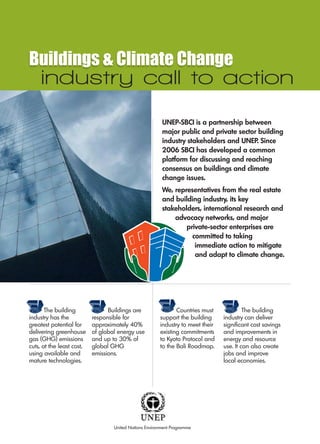
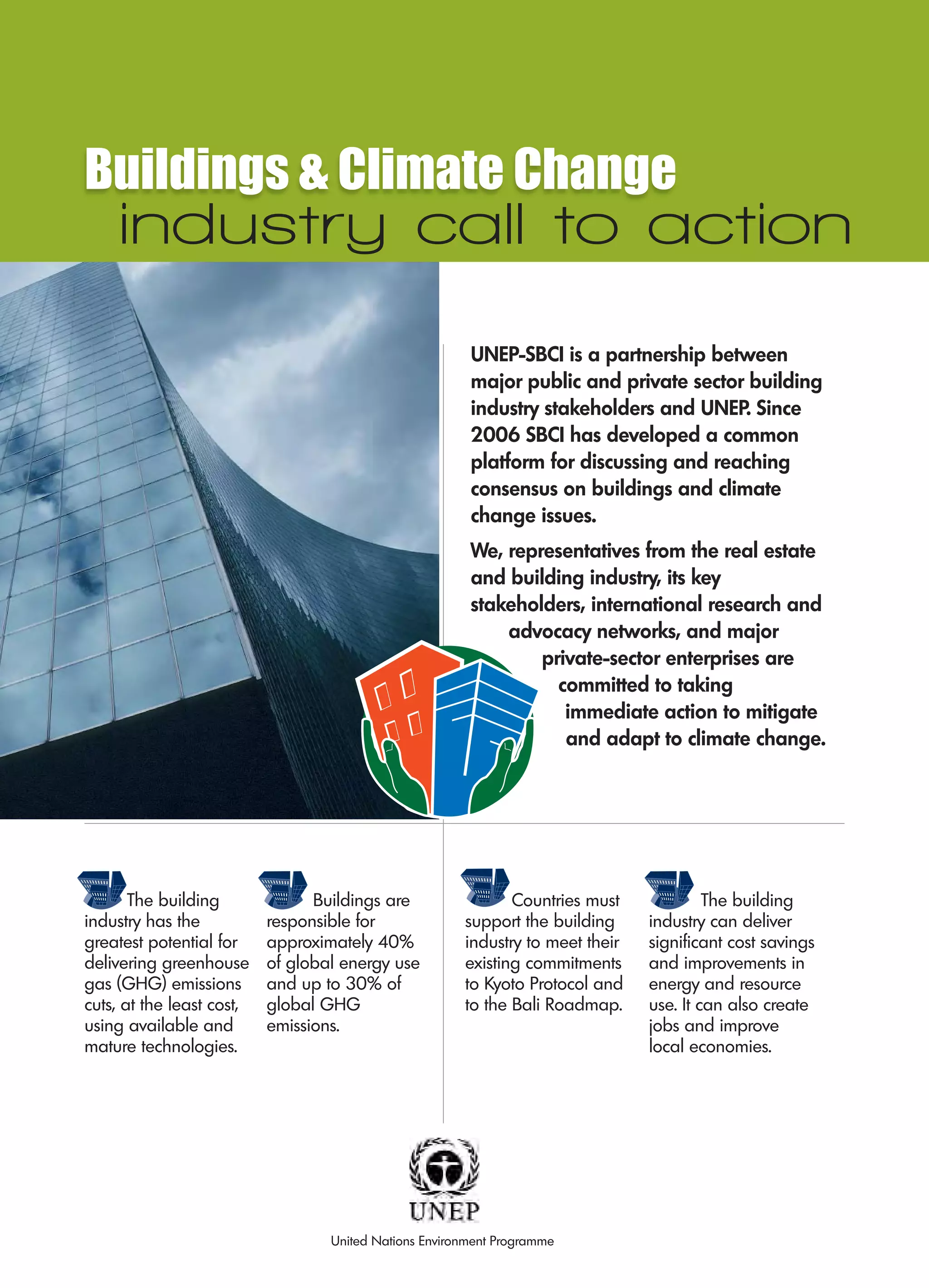
Buildings & Climate Change
    industry call to action
                                                         UNEP-SBCI is a partnership between
                                                         major public and private sector building
                                                         industry stakeholders and UNEP. Since
                                                         2006 SBCI has developed a common
                                                         platform for discussing and reaching
                                                         consensus on buildings and climate
                                                         change issues.
                                                         We, representatives from the real estate
                                                         and building industry, its key
                                                         stakeholders, international research and
                                                             advocacy networks, and major
                                                                 private-sector enterprises are
                                                                   committed to taking
                                                                    immediate action to mitigate
                                                                    and adapt to climate change.


       The building              Buildings are                 Countries must             The building
industry has the           responsible for              support the building     industry can deliver
greatest potential for     approximately 40%            industry to meet their   significant cost savings
delivering greenhouse      of global energy use         existing commitments     and improvements in
gas (GHG) emissions        and up to 30% of             to Kyoto Protocol and    energy and resource
cuts, at the least cost,   global GHG                   to the Bali Roadmap.     use. It can also create
using available and        emissions.                                            jobs and improve
mature technologies.                                                             local economies.


                                   United Nations Environment Programme
BUILDING INDUSTRY REQUESTS
    the assistance of parties
    to the convention
         Copenhagen’s climate change framework can facilitate
         GHG emissions reduction in the building industry by…


1. … Recognizing the     2. … Enabling market-    3. … Building capacity      4. … Supporting
building industry as     based measures that      and transfer                reform of flexible
a top priority for       can support              technology to enable        mechanisms to
achieving GHG            investment in building   improvements in             encourage investment
emissions reductions.    projects that are        energy efficiency of        in projects that
                         energy efficient and     buildings.                  improve energy
                         reduce GHG                                           efficiency and reduce
                         emissions.                                           GHG emissions from
5. … Encouraging                                                              new and existing
UNFCCC to establish                                                           buildings.
working groups to develop                 6. … Encouraging governments
specific measures for the                 to inventory and set performance
building industry prior to                goals for GHG emissions from
the next commitment                       national building stocks.
period.


   THE KYOTO PROTOCOL AND BUILDINGS
Current Kyoto protocol   Only 12 of the 4500      The building industry is    Governments gain
does not exploit the     projects in the Clean    the largest single          quality control of
GHG emissions            Development              industrial employer,        building industry
reduction potential of   Mechanism (CDM)          representing                transactions by
buildings.               pipeline (as of April    approximately:              supporting energy
                         2009) seek to reduce     • 10 to 40% of              efficient and low
                         energy demand in         countries’ Gross            GHG emissions
                         buildings.               Domestic Product            measures in
                                                  (GDP);                      buildings.
                                                  • 10% of country-level
                                                  employment; and
                                                  • 74% of employees in
                                                  developing countries
                                                  with 90% in
                                                  companies with less
                                                  than ten employees.
                                                  Measures to improve
                                                  energy efficiency in
                                                  buildings lead to direct,
                                                  indirect, and induced
                                                  jobs created directly in
                                                  the real estate
                                                  and construction
                                                  industries.
THE COMMITMENT OF THE BUILDING INDUSTRY
          to address climate change
                          In anticipation that the text of a global climate change
                       protocol being negotiated at COP15 will recognize the
                   importance of buildings in tackling climate change, UNEP SBCI
                members, partners, and supporters commit to take the following actions
            to reduce the greenhouse gas emissions of the building industry.


                      PUBLIC                                                           RESEARCH &
                      AUTHORITIES                                                      EDUCATION
                      ½ Make publicly      MUNICIPALITIES                              ½ Renovate and
PRIVATE SECTOR
                      owned buildings      ½ Mandate net-       NGO & CIVIL            build schools to
½ Work to             climate neutral.                          SOCIETY                reduce GHG
                                           zero energy
introduce a                                                                            emissions and
                      ½ Measure base-      performance for
carbon trade                                                    ½ Advocate             foster long term
                      line GHG             all new public
mechanism for                                                   communication          responsible
                      emissions to         buildings &
buildings.                                                      and information-       lifestyles.
                      develop and          support the same
                                                                sharing, quality
½ Renovate            enforce              process in                                  ½ Implement
                                                                assurance, and
buildings we          meaningful           developing                                  interdisciplinary
                                                                support standard-
occupy to reduce      energy &             countries and                               curricula and
                                                                setting.
direct and indirect   sustainability       transitional                                conduct research
GHG emissions         codes and            economies with       ½ Facilitate           on energy,
and improve           standards that       climate adaptive     leadership and         GHG emissions
climate               achieve:             measures and         bridge efforts.        and social
adaptability.         • 40%                goals through                               performance.
                      improvement in       twinning             ½ Train building
½ Dedicate            energy efficiency    programmes.          industry               ½ Collaborate to
research &            by 2020 for                               professionals and      provide a data
development to                             ½ Develop climate    trade people,          repository and
                      existing buildings   change strategies
climate neutral,      and                                       as well as             ongoing analysis
net-zero energy                            and action-plans     educate the next       of the climate
                      • 40% reduction      with strategic
buildings, work       in GHG emissions                          generation on          impact of
with governments                           goals to be          green building         buildings.
                      by 2020 for new      achieved by
on policy             buildings and the                         principles.
development                                2020 including
                      necessary skills     making publicly
and educate our       and performance
supply chain.                              owned buildings
                      standards for        climate neutral.
                      those skills.
                                           ½ Agree on a
                      ½ Support the        common
                      development of       assessment and
                      GHG emissions        evaluation
                      standards for        process to monitor         For more information
                      building types,      progress on                on how to join us in this call,
                      location and use.    tackling climate           VISIT our website at:
                                           change.                    www.unepsbci.org
Layout : EXOTYPIE / www.exotypie.com / Printed by Parchemins du Midi on 100 % recycled paper Print

UN Environmental Program SBCI Call To Action

  • 1.
    Buildings & ClimateChange industry call to action UNEP-SBCI is a partnership between major public and private sector building industry stakeholders and UNEP. Since 2006 SBCI has developed a common platform for discussing and reaching consensus on buildings and climate change issues. We, representatives from the real estate and building industry, its key stakeholders, international research and advocacy networks, and major private-sector enterprises are committed to taking immediate action to mitigate and adapt to climate change. The building Buildings are Countries must The building industry has the responsible for support the building industry can deliver greatest potential for approximately 40% industry to meet their significant cost savings delivering greenhouse of global energy use existing commitments and improvements in gas (GHG) emissions and up to 30% of to Kyoto Protocol and energy and resource cuts, at the least cost, global GHG to the Bali Roadmap. use. It can also create using available and emissions. jobs and improve mature technologies. local economies. United Nations Environment Programme
  • 2.
    BUILDING INDUSTRY REQUESTS the assistance of parties to the convention Copenhagen’s climate change framework can facilitate GHG emissions reduction in the building industry by… 1. … Recognizing the 2. … Enabling market- 3. … Building capacity 4. … Supporting building industry as based measures that and transfer reform of flexible a top priority for can support technology to enable mechanisms to achieving GHG investment in building improvements in encourage investment emissions reductions. projects that are energy efficiency of in projects that energy efficient and buildings. improve energy reduce GHG efficiency and reduce emissions. GHG emissions from 5. … Encouraging new and existing UNFCCC to establish buildings. working groups to develop 6. … Encouraging governments specific measures for the to inventory and set performance building industry prior to goals for GHG emissions from the next commitment national building stocks. period. THE KYOTO PROTOCOL AND BUILDINGS Current Kyoto protocol Only 12 of the 4500 The building industry is Governments gain does not exploit the projects in the Clean the largest single quality control of GHG emissions Development industrial employer, building industry reduction potential of Mechanism (CDM) representing transactions by buildings. pipeline (as of April approximately: supporting energy 2009) seek to reduce • 10 to 40% of efficient and low energy demand in countries’ Gross GHG emissions buildings. Domestic Product measures in (GDP); buildings. • 10% of country-level employment; and • 74% of employees in developing countries with 90% in companies with less than ten employees. Measures to improve energy efficiency in buildings lead to direct, indirect, and induced jobs created directly in the real estate and construction industries.
  • 3.
    THE COMMITMENT OFTHE BUILDING INDUSTRY to address climate change In anticipation that the text of a global climate change protocol being negotiated at COP15 will recognize the importance of buildings in tackling climate change, UNEP SBCI members, partners, and supporters commit to take the following actions to reduce the greenhouse gas emissions of the building industry. PUBLIC RESEARCH & AUTHORITIES EDUCATION ½ Make publicly MUNICIPALITIES ½ Renovate and PRIVATE SECTOR owned buildings ½ Mandate net- NGO & CIVIL build schools to ½ Work to climate neutral. SOCIETY reduce GHG zero energy introduce a emissions and ½ Measure base- performance for carbon trade ½ Advocate foster long term line GHG all new public mechanism for communication responsible emissions to buildings & buildings. and information- lifestyles. develop and support the same sharing, quality ½ Renovate enforce process in ½ Implement assurance, and buildings we meaningful developing interdisciplinary support standard- occupy to reduce energy & countries and curricula and setting. direct and indirect sustainability transitional conduct research GHG emissions codes and economies with ½ Facilitate on energy, and improve standards that climate adaptive leadership and GHG emissions climate achieve: measures and bridge efforts. and social adaptability. • 40% goals through performance. improvement in twinning ½ Train building ½ Dedicate energy efficiency programmes. industry ½ Collaborate to research & by 2020 for professionals and provide a data development to ½ Develop climate trade people, repository and existing buildings change strategies climate neutral, and as well as ongoing analysis net-zero energy and action-plans educate the next of the climate • 40% reduction with strategic buildings, work in GHG emissions generation on impact of with governments goals to be green building buildings. by 2020 for new achieved by on policy buildings and the principles. development 2020 including necessary skills making publicly and educate our and performance supply chain. owned buildings standards for climate neutral. those skills. ½ Agree on a ½ Support the common development of assessment and GHG emissions evaluation standards for process to monitor For more information building types, progress on on how to join us in this call, location and use. tackling climate VISIT our website at: change. www.unepsbci.org
  • 4.
    Layout : EXOTYPIE/ www.exotypie.com / Printed by Parchemins du Midi on 100 % recycled paper Print