DIDSOLIT-PB
Partnership and Objectives
Main expected results
Global approach
Project time line
Activities description
Examples of selected applications (Actions)
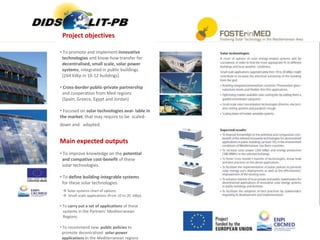
Project objectives
• To promote and implement innovative
technologies and know-how transfer for
decentralised, small scale, solar power
systems, integrated in public buildings.
(264 kWp in 10-12 buildings)
• Cross-border public-private partnership
and cooperation from Med regions
(Spain, Greece, Egypt and Jordan)
• Focused on solar technologies avai- lable in
the market, that may require to be scaled-
down and adapted.
Main expected outputs
• To improve knowledge on the potential
and compative cost-benefit of these
solar technologies.
• To define building-integrable systems
for these solar technologies.
 Solar systems chart of options
 Small scale applications (from 10 to 20 kWp)
• To carry out a set of applications of these
systems in the Partners’ Mediterranean
Regions.
• To recommend new public policies to
promote decentralised solar-power
applications in the Mediterranean regions
ENERGY
PERFORMANCE
COST
BUILDING
INTERACTION
OPERATION &
MAINTENANCE
LEGISLATION & ADMINISTRATIVE PROCESS
The projects will follow the national current procedures.
Nevertheless, the Project will propose improvements to
decision makers.
Minimum, 10 buildings
Building envelope
requirements
Aprox. 100-250 m2 / SUA
Power installed:
264 kWp
Energy produced:
380 MWh/year
Average investment
5.500 €/kW
Structural and construction
requirements
Scale down Dish-Stirling,
Parabolic Trough and PT
Solar Cooling application
Maintaining an optimal
performance ratio
Chart of options : 5
technologies >
Range of options
3,5 – 9 €/W
Electricity cost :
Grid parity scenario
Return of investment
Low maintenance scenario
Global approach
2013 2014 2015
WP4. Increasing & sharing of knowledge on the technologies (scale-down)
WP5. Selection & planning of the applications
WP6. Implementation of the selected applications
WP7. Promotion of other selected applications
• Research, market availability and tech. scale-down
• Technical and economical reports
• Public Buildings identification ‘ib’
• Public Buildings selection
• Conceptual (tech.& €) projects for the selected applications
• Systems/installers SMEs local consortiums
• Procurement process
• To undertake selected applications
• Installation reception
by public institution
•Final Tech-Economical reports
•To promote other applications
•To elaborate recommendations
for governements on policies
& regulatory framework
.
Project timeline
• DS and PT pilot in BCN. Trainning experts
WP4. Technology analysis and selection
of small-scale, market available solar technologies.
Technical / economical viability
Dish Stirling PT-SCH
BIPV
1. Building integration
2. Passive effect
3. Cost-performance balance
4. Flexibility
5. Visibility
CSP
1. High performance at high Tª and radiation
2. Technology trigger
3. Decentralized experiences
• The challenge to find small scale cost-efficiency
• First conclusions out of Technological research
Final Building selection ‘b’ of local public buildings/facilities, 10-12 total (minimum)
Building selection process
B(1) P1 P2 P3 P4 P5 P6 total Global (2)
UAB AEIPLOUS EAEE BAU UA M AICh EsE
ib indentification 0 4 14 14 8 3 5 48 40
pb pre-selected 0 3 9 9 5 2 4 32 30
b selected buildings 0 1 3 3 2 1 2 12 10
(1) Beneficiary doesn't have any direct assignation, but has the global responsability
(2) "Global"figures doesn't fit with the sum of the partners. The last selection will be made by the PTT and lead by the Beneficiary
WP5. Building selection.
Choosing the most feasible application
• Public owner and user. Visibility
• Proper building construction
• Building energy audit
• Building with significant permanent loads
(electrical and thermal)
• Possibility to integrate the syst. into the
building envelope
• The final building selection at the beginning of May
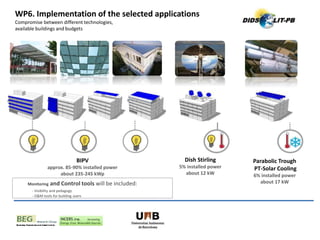
WP6. Implementation of the selected applications
Compromise between different technologies,
available buildings and budgets
BIPV
approx. 85-90% installed power
about 235-245 kWp
Dish Stirling
5% installed power
about 12 kW
Parabolic Trough
PT-Solar Cooling
6% installed power
about 17 kWMonitoring and Control tools will be included:
- Visibility and pedagogy
- O&M tools for building users
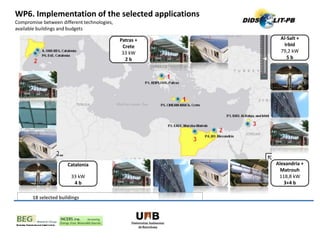
Catalonia
33 kW
4 b
Alexandria +
Matrouh
118,8 kW
3+4 b
Al-Salt +
Irbid
79,2 kW
5 b
Patras +
Crete
33 kW
2 b
WP6. Implementation of the selected applications
Compromise between different technologies,
available buildings and budgets
18 selected buildings
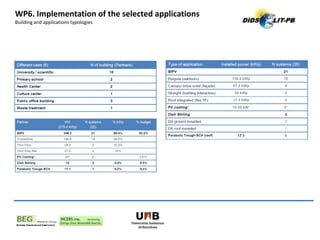
WP6. Implementation of the selected applications
Building and applications typologies
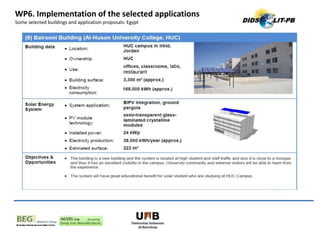
WP6. Implementation of the selected applications
Some selected buildings and application proposals: Egypt
WP6. Implementation of the selected applications
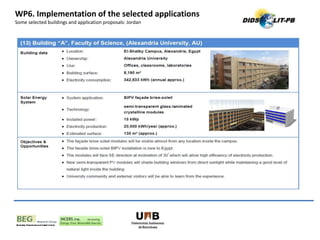
Some selected buildings and application proposals: Jordan
WP6. Implementation of the selected applications
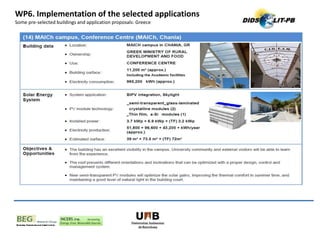
Some pre-selected buildings and application proposals: Greece
WP6. Implementation of the selected applications
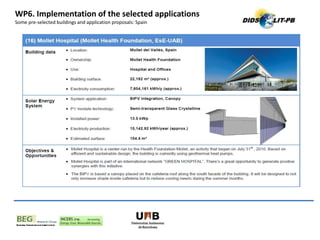
Some pre-selected buildings and application proposals: Spain
Thanks for your attention!!
Joaquim Vergés, BEG-UAB incers@uab.es
Alex Parella, alex.paerlla@didsolit.org
www.didsolit.eu

Solar energy ongoing project by Magda Cayón

  • 1.
  • 2.
    Partnership and Objectives Mainexpected results Global approach Project time line Activities description Examples of selected applications (Actions)
  • 4.
    Project objectives • Topromote and implement innovative technologies and know-how transfer for decentralised, small scale, solar power systems, integrated in public buildings. (264 kWp in 10-12 buildings) • Cross-border public-private partnership and cooperation from Med regions (Spain, Greece, Egypt and Jordan) • Focused on solar technologies avai- lable in the market, that may require to be scaled- down and adapted. Main expected outputs • To improve knowledge on the potential and compative cost-benefit of these solar technologies. • To define building-integrable systems for these solar technologies.  Solar systems chart of options  Small scale applications (from 10 to 20 kWp) • To carry out a set of applications of these systems in the Partners’ Mediterranean Regions. • To recommend new public policies to promote decentralised solar-power applications in the Mediterranean regions
  • 5.
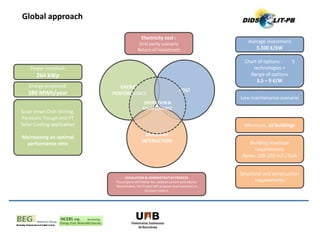
    ENERGY PERFORMANCE COST BUILDING INTERACTION OPERATION & MAINTENANCE LEGISLATION &ADMINISTRATIVE PROCESS The projects will follow the national current procedures. Nevertheless, the Project will propose improvements to decision makers. Minimum, 10 buildings Building envelope requirements Aprox. 100-250 m2 / SUA Power installed: 264 kWp Energy produced: 380 MWh/year Average investment 5.500 €/kW Structural and construction requirements Scale down Dish-Stirling, Parabolic Trough and PT Solar Cooling application Maintaining an optimal performance ratio Chart of options : 5 technologies > Range of options 3,5 – 9 €/W Electricity cost : Grid parity scenario Return of investment Low maintenance scenario Global approach
  • 6.
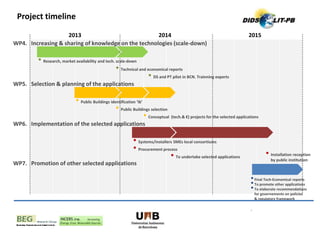
    2013 2014 2015 WP4.Increasing & sharing of knowledge on the technologies (scale-down) WP5. Selection & planning of the applications WP6. Implementation of the selected applications WP7. Promotion of other selected applications • Research, market availability and tech. scale-down • Technical and economical reports • Public Buildings identification ‘ib’ • Public Buildings selection • Conceptual (tech.& €) projects for the selected applications • Systems/installers SMEs local consortiums • Procurement process • To undertake selected applications • Installation reception by public institution •Final Tech-Economical reports •To promote other applications •To elaborate recommendations for governements on policies & regulatory framework . Project timeline • DS and PT pilot in BCN. Trainning experts
  • 7.
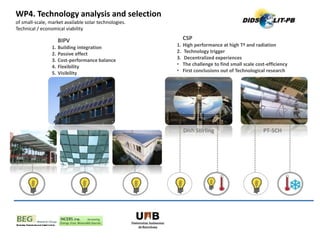
    WP4. Technology analysisand selection of small-scale, market available solar technologies. Technical / economical viability Dish Stirling PT-SCH BIPV 1. Building integration 2. Passive effect 3. Cost-performance balance 4. Flexibility 5. Visibility CSP 1. High performance at high Tª and radiation 2. Technology trigger 3. Decentralized experiences • The challenge to find small scale cost-efficiency • First conclusions out of Technological research
  • 8.
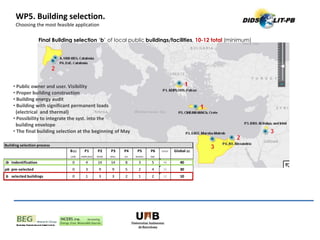
    Final Building selection‘b’ of local public buildings/facilities, 10-12 total (minimum) Building selection process B(1) P1 P2 P3 P4 P5 P6 total Global (2) UAB AEIPLOUS EAEE BAU UA M AICh EsE ib indentification 0 4 14 14 8 3 5 48 40 pb pre-selected 0 3 9 9 5 2 4 32 30 b selected buildings 0 1 3 3 2 1 2 12 10 (1) Beneficiary doesn't have any direct assignation, but has the global responsability (2) "Global"figures doesn't fit with the sum of the partners. The last selection will be made by the PTT and lead by the Beneficiary WP5. Building selection. Choosing the most feasible application • Public owner and user. Visibility • Proper building construction • Building energy audit • Building with significant permanent loads (electrical and thermal) • Possibility to integrate the syst. into the building envelope • The final building selection at the beginning of May
  • 9.
    WP6. Implementation ofthe selected applications Compromise between different technologies, available buildings and budgets BIPV approx. 85-90% installed power about 235-245 kWp Dish Stirling 5% installed power about 12 kW Parabolic Trough PT-Solar Cooling 6% installed power about 17 kWMonitoring and Control tools will be included: - Visibility and pedagogy - O&M tools for building users
  • 10.
    Catalonia 33 kW 4 b Alexandria+ Matrouh 118,8 kW 3+4 b Al-Salt + Irbid 79,2 kW 5 b Patras + Crete 33 kW 2 b WP6. Implementation of the selected applications Compromise between different technologies, available buildings and budgets 18 selected buildings
  • 11.
    WP6. Implementation ofthe selected applications Building and applications typologies
  • 12.
    WP6. Implementation ofthe selected applications Some selected buildings and application proposals: Egypt
  • 13.
    WP6. Implementation ofthe selected applications Some selected buildings and application proposals: Jordan
  • 14.
    WP6. Implementation ofthe selected applications Some pre-selected buildings and application proposals: Greece
  • 15.
    WP6. Implementation ofthe selected applications Some pre-selected buildings and application proposals: Spain
  • 16.
    Thanks for yourattention!! Joaquim Vergés, BEG-UAB incers@uab.es Alex Parella, alex.paerlla@didsolit.org www.didsolit.eu