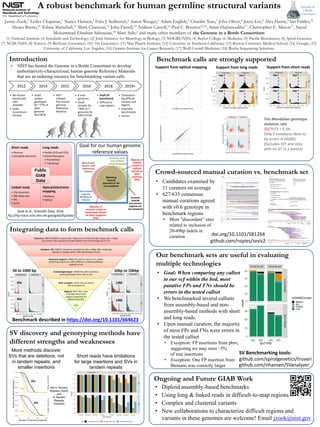
Discovery: 498876 (296761 unique) calls >=50bp and 1157458 (521360 unique) calls >=20bp
discovered in 30+ sequence-resolved callsets from 4 technologies for AJ Trio
Compare SVs: 128715 sequence-resolved SV calls >=50bp after clustering
sequence changes within 20% edit distance in trio
Discovery Support: 30062 SVs with 2+ techs or 5+ callers
predicting sequences <20% different or BioNano/Nabsys
support in trio
Evaluate/genotype: 19748 SVs with consensus
variant genotype from svviz in son
Filter complex: 12745 SVs not within
1kb of another SV
Regions: 9641 SVs inside
2.66 Gbp benchmark
regions supported by
diploid assembly
v0.6
Introduction
A robust benchmark for human germline structural variants
Justin Zook,1 Lesley Chapman,1 Nancy Hansen,3 Fritz J. Sedlazeck,4 Aaron Wenger,5 Adam English,6 Chunlin Xiao,7 John Oliver,8 Joyce Lee,9 Alex Hastie,9 Ian Fiddes,10
Alvaro Barrio,10 Tobias Marschall,11 Mark Chaisson,12 John Farrell,13 Andrew Carroll,14 Paul C. Boutros15,16, Iman Hajirasouliha17, Christopher E. Mason17, Sayed
Mohammad Ebrahim Sahraeian,18 Marc Salit,2 and many other members of the Genome in a Bottle Consortium
(1) National Institute of Standards and Technology; (2) Joint Initiative for Metrology in Biology; (3) NHGRI/NIH; (4) Baylor College of Medicine; (5) Pacific Biosciences; (6) Spiral Genetics;
(7) NCBI/NIH; (8) Nabsys; (9) BioNano Genomics; (10) 10x Genomics; (11) Max Planck Institute; (12) University of Southern California; (13) Boston University Medical School; (14) Google; (15)
University of California, Los Angeles; (16) Ontario Institute for Cancer Research; (17) Weill Cornell Medicine; (18) Roche Sequencing Solutions
• NIST has hosted the Genome in a Bottle Consortium to develop
authoritatively-characterized, human genome Reference Materials
that are an enduring resource for benchmarking variant calls
Integrating data to form benchmark calls
Ongoing and Future GIAB Work
• Diploid assembly-based benchmarks
• Using long & linked reads in difficult-to-map regions
• Complex and clustered variants
• New collaborations to characterize difficult regions and
variants in these genomes are welcome! Email jzook@nist.gov
Crowd-sourced manual curation vs. benchmark set
Benchmark calls are strongly supported
Zook et al., Scientific Data, 2016.
ftp://ftp-trace.ncbi.nlm.nih.gov/giab/ftp/data
Our benchmark sets are useful in evaluating
multiple technologies
2012
• No human
benchmark
calls
available
• GIAB
Consortium
formed
2014
• Small
variant
genotypes
for ~77% of
pilot
genome
NA12878
2015
• NIST
releases
first human
genome
Reference
Material
2016
• 4 new
genomes
• Small
variants for
~90% of 7
genomes for
GRCh37/38
2018
• Draft SV
benchmark
• Difficult to
map regions
2019+
• Characteriz-
ing difficult
variants and
regions
• Assembly
benchmarks
• Cancer
Benchmark described in https://doi.org/10.1101/664623
• Goal: When comparing any callset
to our vcf within the bed, most
putative FPs and FNs should be
errors in the tested callset
• We benchmarked several callsets
from assembly-based and non-
assembly-based methods with short
and long reads.
• Upon manual curation, the majority
of most FPs and FNs were errors in
the tested callset
• Exception: FP insertions from pbsv,
suggesting we may miss ~5%
of true insertions
• Exception: One FP insertion from
Bionano was correctly larger
github.com/nspies/svviz2
50 to 1000 bp
doi.org/10.1101/581264
1kbp to 10kbp
Alu
Alu
LINE
LINE
• Candidates examined by
11 curators on average
• 627/635 consensus
manual curations agreed
with v0.6 genotype in
benchmark regions
• Most “discordant” sites
related to inclusion of
20-49bp indels in
curation
github.com/spiralgenetics/truvari
Short reads
• Illumina
• Complete Genomics
Long reads
• PacBio (CLR and CCS)
• Oxford Nanopore
• Promethion
• “Ultralong”
Linked reads
• 10x Genomics
• 6kb Mate-pair
• HiC
• stLFR
Optical/electronic
mapping
• BioNano
• Nabsys
Public
GIAB
Data
Short reads have limitations
for large insertions and SVs in
tandem repeats
Trio Mendelian genotype
violation rate
20/7973 = 0.3%
Only 2 violations likely to
be errors in HG002
(Excludes X/Y and sites
with no GT in a parent)
Support from long reads Support from short readsSupport from optical mapping
SV discovery and genotyping methods have
different strengths and weaknesses
More methods discover
SVs that are deletions, not
in tandem repeats, and
smaller insertions github.com/nhansen/SVanalyzer
Goal for our human genome
reference values
Benchmark
variant calls
(Reference
Values)
Variants from
any method
being evaluated
Benchmark
regions
(Reference
Values)
Variants
outside
benchmark
regions are
not assessed
Majority of
variants
unique to
method
should be
false
positives
(FPs)
Majority of
variants unique to
benchmark should
be false negatives
(FNs)
Matching
variants
assumed to be
true positives
Het Hom
Het Hom
Het Hom
Het Hom
Het Hom
Het Hom
Het Hom
Het Hom
Genome in
a Bottle
Consortium
SV Benchmarking tools:
Not In Tandem
Repeats (Solid)
and
In Tandem
Repeats
(Dashed)
DEL
INS
DEL
INS

GIAB ASHG 2019 Structural Variant poster

  • 1.
    Discovery: 498876 (296761unique) calls >=50bp and 1157458 (521360 unique) calls >=20bp discovered in 30+ sequence-resolved callsets from 4 technologies for AJ Trio Compare SVs: 128715 sequence-resolved SV calls >=50bp after clustering sequence changes within 20% edit distance in trio Discovery Support: 30062 SVs with 2+ techs or 5+ callers predicting sequences <20% different or BioNano/Nabsys support in trio Evaluate/genotype: 19748 SVs with consensus variant genotype from svviz in son Filter complex: 12745 SVs not within 1kb of another SV Regions: 9641 SVs inside 2.66 Gbp benchmark regions supported by diploid assembly v0.6 Introduction A robust benchmark for human germline structural variants Justin Zook,1 Lesley Chapman,1 Nancy Hansen,3 Fritz J. Sedlazeck,4 Aaron Wenger,5 Adam English,6 Chunlin Xiao,7 John Oliver,8 Joyce Lee,9 Alex Hastie,9 Ian Fiddes,10 Alvaro Barrio,10 Tobias Marschall,11 Mark Chaisson,12 John Farrell,13 Andrew Carroll,14 Paul C. Boutros15,16, Iman Hajirasouliha17, Christopher E. Mason17, Sayed Mohammad Ebrahim Sahraeian,18 Marc Salit,2 and many other members of the Genome in a Bottle Consortium (1) National Institute of Standards and Technology; (2) Joint Initiative for Metrology in Biology; (3) NHGRI/NIH; (4) Baylor College of Medicine; (5) Pacific Biosciences; (6) Spiral Genetics; (7) NCBI/NIH; (8) Nabsys; (9) BioNano Genomics; (10) 10x Genomics; (11) Max Planck Institute; (12) University of Southern California; (13) Boston University Medical School; (14) Google; (15) University of California, Los Angeles; (16) Ontario Institute for Cancer Research; (17) Weill Cornell Medicine; (18) Roche Sequencing Solutions • NIST has hosted the Genome in a Bottle Consortium to develop authoritatively-characterized, human genome Reference Materials that are an enduring resource for benchmarking variant calls Integrating data to form benchmark calls Ongoing and Future GIAB Work • Diploid assembly-based benchmarks • Using long & linked reads in difficult-to-map regions • Complex and clustered variants • New collaborations to characterize difficult regions and variants in these genomes are welcome! Email jzook@nist.gov Crowd-sourced manual curation vs. benchmark set Benchmark calls are strongly supported Zook et al., Scientific Data, 2016. ftp://ftp-trace.ncbi.nlm.nih.gov/giab/ftp/data Our benchmark sets are useful in evaluating multiple technologies 2012 • No human benchmark calls available • GIAB Consortium formed 2014 • Small variant genotypes for ~77% of pilot genome NA12878 2015 • NIST releases first human genome Reference Material 2016 • 4 new genomes • Small variants for ~90% of 7 genomes for GRCh37/38 2018 • Draft SV benchmark • Difficult to map regions 2019+ • Characteriz- ing difficult variants and regions • Assembly benchmarks • Cancer Benchmark described in https://doi.org/10.1101/664623 • Goal: When comparing any callset to our vcf within the bed, most putative FPs and FNs should be errors in the tested callset • We benchmarked several callsets from assembly-based and non- assembly-based methods with short and long reads. • Upon manual curation, the majority of most FPs and FNs were errors in the tested callset • Exception: FP insertions from pbsv, suggesting we may miss ~5% of true insertions • Exception: One FP insertion from Bionano was correctly larger github.com/nspies/svviz2 50 to 1000 bp doi.org/10.1101/581264 1kbp to 10kbp Alu Alu LINE LINE • Candidates examined by 11 curators on average • 627/635 consensus manual curations agreed with v0.6 genotype in benchmark regions • Most “discordant” sites related to inclusion of 20-49bp indels in curation github.com/spiralgenetics/truvari Short reads • Illumina • Complete Genomics Long reads • PacBio (CLR and CCS) • Oxford Nanopore • Promethion • “Ultralong” Linked reads • 10x Genomics • 6kb Mate-pair • HiC • stLFR Optical/electronic mapping • BioNano • Nabsys Public GIAB Data Short reads have limitations for large insertions and SVs in tandem repeats Trio Mendelian genotype violation rate 20/7973 = 0.3% Only 2 violations likely to be errors in HG002 (Excludes X/Y and sites with no GT in a parent) Support from long reads Support from short readsSupport from optical mapping SV discovery and genotyping methods have different strengths and weaknesses More methods discover SVs that are deletions, not in tandem repeats, and smaller insertions github.com/nhansen/SVanalyzer Goal for our human genome reference values Benchmark variant calls (Reference Values) Variants from any method being evaluated Benchmark regions (Reference Values) Variants outside benchmark regions are not assessed Majority of variants unique to method should be false positives (FPs) Majority of variants unique to benchmark should be false negatives (FNs) Matching variants assumed to be true positives Het Hom Het Hom Het Hom Het Hom Het Hom Het Hom Het Hom Het Hom Genome in a Bottle Consortium SV Benchmarking tools: Not In Tandem Repeats (Solid) and In Tandem Repeats (Dashed) DEL INS DEL INS

Editor's Notes

  • #2 Vertical line at 0.5 Look at mendelian violations