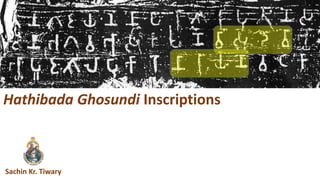
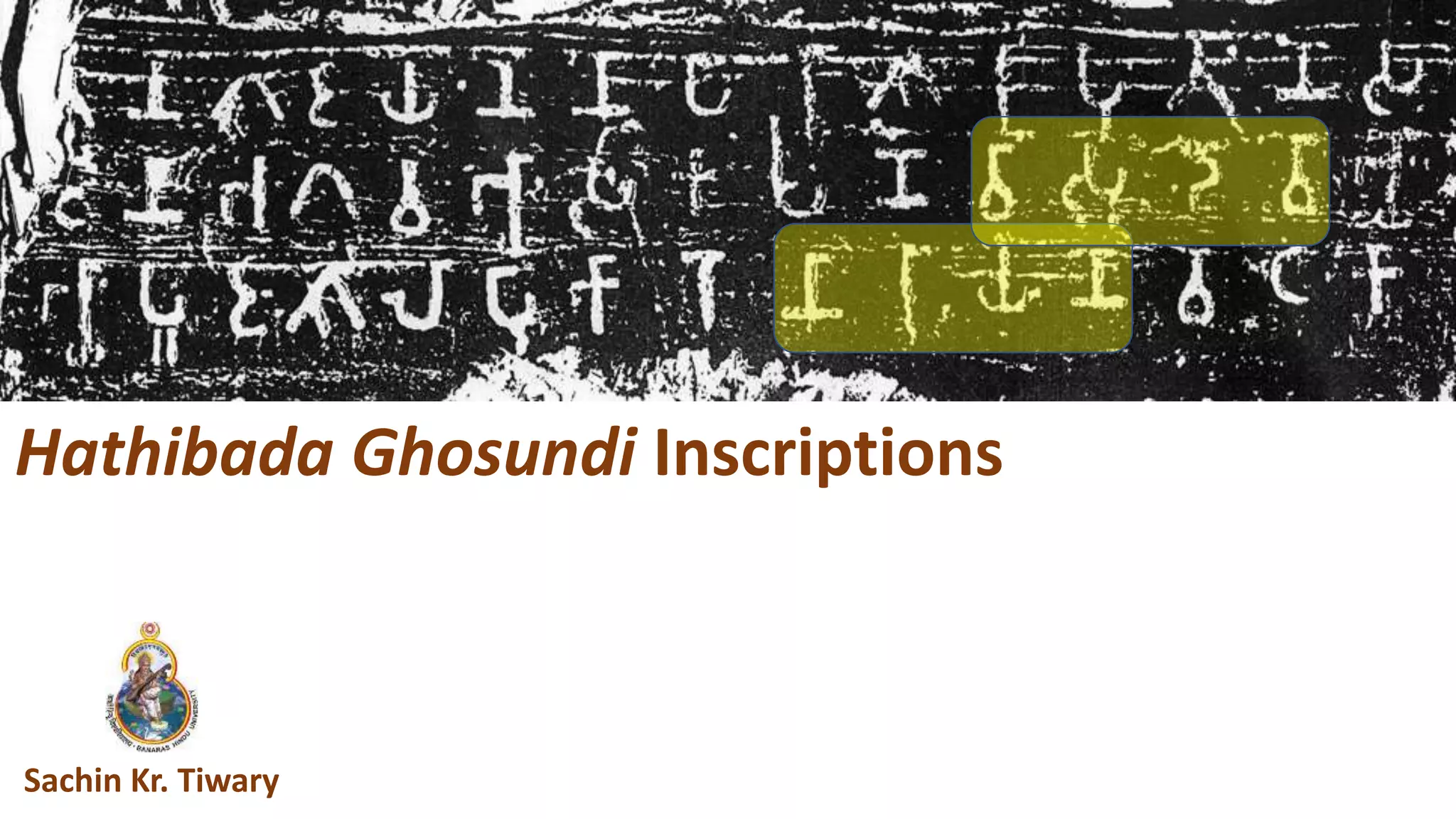
Hathibada Ghosundi Inscriptions
Sachin Kr. Tiwary
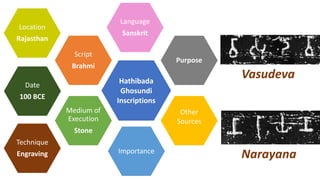
Hathibada
Ghosundi
Inscriptions
Language
Sanskrit
Purpose
Other
Sources
Importance
Medium of
Execution
Stone
Script
Brahmi
Technique
Engraving
Location
Rajasthan
Date
100 BCE
Vasudeva
Narayana
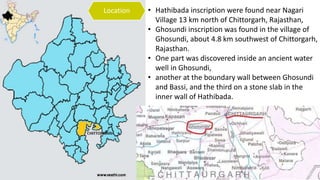
Location • Hathibada inscription were found near Nagari
Village 13 km north of Chittorgarh, Rajasthan,
• Ghosundi inscription was found in the village of
Ghosundi, about 4.8 km southwest of Chittorgarh,
Rajasthan.
• One part was discovered inside an ancient water
well in Ghosundi,
• another at the boundary wall between Ghosundi
and Bassi, and the third on a stone slab in the
inner wall of Hathibada.
Fragment A (Ghosundi stone inscription).
1 ..... tena Gajayanena P(a)rasarlputrena Sa-
2 ..... [j]i[na] bhagavabhyam Samkarshana-V[a]sudevabhya(m)
3 ......bhyam pujasila-prakaro Narayana-vat(i)ka.
According to Bhandarkar (This) enclosing wall round the stone (object) of worship, called Narayana-vatika
(Compound) for the divinities Samkarshana-Vasudeva who are unconquered and are lords of all (has been caused
to be made) by (the king) Sarvatata, a Gajayana and son of (a lady) of the Parasaragotra, who is a devotee of
Bhagavat (Vishnu or Samkarshana/Vāsudeva) and has performed an Asvamedha sacrifice.
View of Inscription
Fragment C (Hathibada stone inscription)
1 ....vat(ena) [Ga]j(a)yan[e]na P(a)r(asaripu)t(re)na [Sa](r)[vata]tena As(vame)[dha](ya)- [j](ina)
2 ....(na)-V(a)sudevabh[y]a(m) anihata(ohyam) sa(r)v(e)[s]va[r](a)bh(yam) p(u)[j](a)- [s](i)l(a)-
p[r]a[k]aro Nar[a]yana-vat(i)[k](a).
View of Inscription
Date
100 BCE
• 200 BCE- According to Jan Gonda, was a Dutch Indologist & the first
Utrecht Professor of Sanskrit.
• Engraved over the stone.Technique
• Oldest known Sanskrit inscriptions in the Brahmi script,,
• They are linked to Vaishnavism tradition of India,
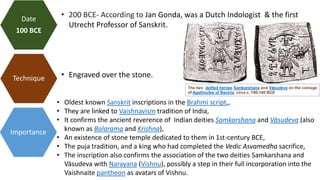
• It confirms the ancient reverence of Indian deities Samkarshana and Vāsudeva (also
known as Balarama and Krishna),
• An existence of stone temple dedicated to them in 1st-century BCE,
• The puja tradition, and a king who had completed the Vedic Asvamedha sacrifice,
• The inscription also confirms the association of the two deities Samkarshana and
Vāsudeva with Narayana (Vishnu), possibly a step in their full incorporation into the
Vaishnaite pantheon as avatars of Vishnu.
Importance
The two deified heroes Samkarshana and Vāsudeva on the coinage
of Agathocles of Bactria, circa c. 190-180 BCE
Importance
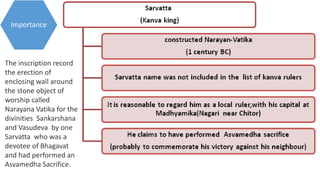
The inscription record
the erection of
enclosing wall around
the stone object of
worship called
Narayana Vatika for the
divinities Sankarshana
and Vasudeva by one
Sarvatta who was a
devotee of Bhagavat
and had performed an
Asvamedha Sacrifice.
Importance
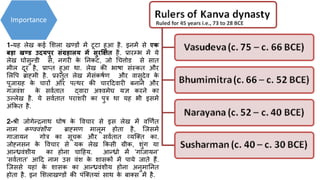
1-यह लेख कई शिला खण्डों में टूटा हुआ है. इनमें से एक
बड़ा खण्ड उदयपुर संग्रह़ालय में सुरक्षित है. प्रारम्भ में ये
लेख घोसुन्डी से, नगरी के ननकट, जो चित्तोड से सात
मील दूर है, प्राप्त हुआ था. लेख की भाषा संस्कत और
शलपि ब्राह्मी है. प्रस्तुत लेख मेंसंकषषण और वासुदेव के
िूजाग्रह के िारों ओर ित्थर की िारददवारी बनाने और
गजवंि के सवषतात द्वारा अश्वमेघ यज्ञ करने का
उल्लेख है. ये सवषतात िरािरी का िुत्र था यह भी इसमें
अंककत है.
2-श्री जोगेन्रनाथ घोष के पविार से इस लेख में वर्णषत
नाम कण्ववंिीय ब्राह्मण मालूम होता है, जजसमें
गाजायन गोत्र का सूिक और सवषतात व्यजतत का.
जोह्नसन के पविार से यक लेख ककसी ग्रीक, िुंग या
आन्रवंिीय का होना िादहय. आन्रो में ’गाजायन’
’सवषतात’ आदद नाम उस वंि के िासकों में िाये जाते हैं.
जजससे यहां के िासक का आन्रवंिीय होना अनुमाननत
होता है. इन शिलाखण्डों की िंजततयां साथ के बातस में है.
Ruled for 45 years i.e., 73 to 28 BCE
• Taken together with independent evidence such as the Besnagar inscription
found with Heliodorus pillar,
• The Hathibada Ghosundi Inscriptions suggest that one of the roots of
Vaishnavism in the form of Bhagavatism was thriving in ancient India between
the 2nd and 1st century BCE.
• They are not the oldest known Hindu inscription, however. Others such as
the Ayodhya Inscription and Nanaghat Cave Inscription are generally accepted
older or as old.
Other
Sources
Sources-
• https://en.wikipedia.org/wiki/Hathibada_Ghosundi_Inscriptions
• D. R. Bhandarkar, Hathi-bada Brahmi Inscription at Nagari, Epigraphia Indica Vol. XXII,
Archaeological Survey of India, pages 198-205
• Harry Falk (2006). Patrick Olivelle (ed.). Between the Empires: Society in India 300 BCE to
400 CE. Oxford University Press. pp. 149–150
• Benjamín Preciado-Solís (1984). The Kṛṣṇa Cycle in the Purāṇas: Themes and Motifs in a
Heroic Saga. Motilal Banarsidass. p. 23.

Ghousundi Inscription

  • 1.
  • 2.
  • 3.
    Location • Hathibadainscription were found near Nagari Village 13 km north of Chittorgarh, Rajasthan, • Ghosundi inscription was found in the village of Ghosundi, about 4.8 km southwest of Chittorgarh, Rajasthan. • One part was discovered inside an ancient water well in Ghosundi, • another at the boundary wall between Ghosundi and Bassi, and the third on a stone slab in the inner wall of Hathibada.
  • 4.
    Fragment A (Ghosundistone inscription). 1 ..... tena Gajayanena P(a)rasarlputrena Sa- 2 ..... [j]i[na] bhagavabhyam Samkarshana-V[a]sudevabhya(m) 3 ......bhyam pujasila-prakaro Narayana-vat(i)ka. According to Bhandarkar (This) enclosing wall round the stone (object) of worship, called Narayana-vatika (Compound) for the divinities Samkarshana-Vasudeva who are unconquered and are lords of all (has been caused to be made) by (the king) Sarvatata, a Gajayana and son of (a lady) of the Parasaragotra, who is a devotee of Bhagavat (Vishnu or Samkarshana/Vāsudeva) and has performed an Asvamedha sacrifice. View of Inscription
  • 5.
    Fragment C (Hathibadastone inscription) 1 ....vat(ena) [Ga]j(a)yan[e]na P(a)r(asaripu)t(re)na [Sa](r)[vata]tena As(vame)[dha](ya)- [j](ina) 2 ....(na)-V(a)sudevabh[y]a(m) anihata(ohyam) sa(r)v(e)[s]va[r](a)bh(yam) p(u)[j](a)- [s](i)l(a)- p[r]a[k]aro Nar[a]yana-vat(i)[k](a). View of Inscription
  • 6.
    Date 100 BCE • 200BCE- According to Jan Gonda, was a Dutch Indologist & the first Utrecht Professor of Sanskrit. • Engraved over the stone.Technique • Oldest known Sanskrit inscriptions in the Brahmi script,, • They are linked to Vaishnavism tradition of India, • It confirms the ancient reverence of Indian deities Samkarshana and Vāsudeva (also known as Balarama and Krishna), • An existence of stone temple dedicated to them in 1st-century BCE, • The puja tradition, and a king who had completed the Vedic Asvamedha sacrifice, • The inscription also confirms the association of the two deities Samkarshana and Vāsudeva with Narayana (Vishnu), possibly a step in their full incorporation into the Vaishnaite pantheon as avatars of Vishnu. Importance The two deified heroes Samkarshana and Vāsudeva on the coinage of Agathocles of Bactria, circa c. 190-180 BCE
  • 7.
    Importance The inscription record theerection of enclosing wall around the stone object of worship called Narayana Vatika for the divinities Sankarshana and Vasudeva by one Sarvatta who was a devotee of Bhagavat and had performed an Asvamedha Sacrifice.
  • 8.
    Importance 1-यह लेख कईशिला खण्डों में टूटा हुआ है. इनमें से एक बड़ा खण्ड उदयपुर संग्रह़ालय में सुरक्षित है. प्रारम्भ में ये लेख घोसुन्डी से, नगरी के ननकट, जो चित्तोड से सात मील दूर है, प्राप्त हुआ था. लेख की भाषा संस्कत और शलपि ब्राह्मी है. प्रस्तुत लेख मेंसंकषषण और वासुदेव के िूजाग्रह के िारों ओर ित्थर की िारददवारी बनाने और गजवंि के सवषतात द्वारा अश्वमेघ यज्ञ करने का उल्लेख है. ये सवषतात िरािरी का िुत्र था यह भी इसमें अंककत है. 2-श्री जोगेन्रनाथ घोष के पविार से इस लेख में वर्णषत नाम कण्ववंिीय ब्राह्मण मालूम होता है, जजसमें गाजायन गोत्र का सूिक और सवषतात व्यजतत का. जोह्नसन के पविार से यक लेख ककसी ग्रीक, िुंग या आन्रवंिीय का होना िादहय. आन्रो में ’गाजायन’ ’सवषतात’ आदद नाम उस वंि के िासकों में िाये जाते हैं. जजससे यहां के िासक का आन्रवंिीय होना अनुमाननत होता है. इन शिलाखण्डों की िंजततयां साथ के बातस में है. Ruled for 45 years i.e., 73 to 28 BCE
  • 9.
    • Taken togetherwith independent evidence such as the Besnagar inscription found with Heliodorus pillar, • The Hathibada Ghosundi Inscriptions suggest that one of the roots of Vaishnavism in the form of Bhagavatism was thriving in ancient India between the 2nd and 1st century BCE. • They are not the oldest known Hindu inscription, however. Others such as the Ayodhya Inscription and Nanaghat Cave Inscription are generally accepted older or as old. Other Sources Sources- • https://en.wikipedia.org/wiki/Hathibada_Ghosundi_Inscriptions • D. R. Bhandarkar, Hathi-bada Brahmi Inscription at Nagari, Epigraphia Indica Vol. XXII, Archaeological Survey of India, pages 198-205 • Harry Falk (2006). Patrick Olivelle (ed.). Between the Empires: Society in India 300 BCE to 400 CE. Oxford University Press. pp. 149–150 • Benjamín Preciado-Solís (1984). The Kṛṣṇa Cycle in the Purāṇas: Themes and Motifs in a Heroic Saga. Motilal Banarsidass. p. 23.