BA III sem
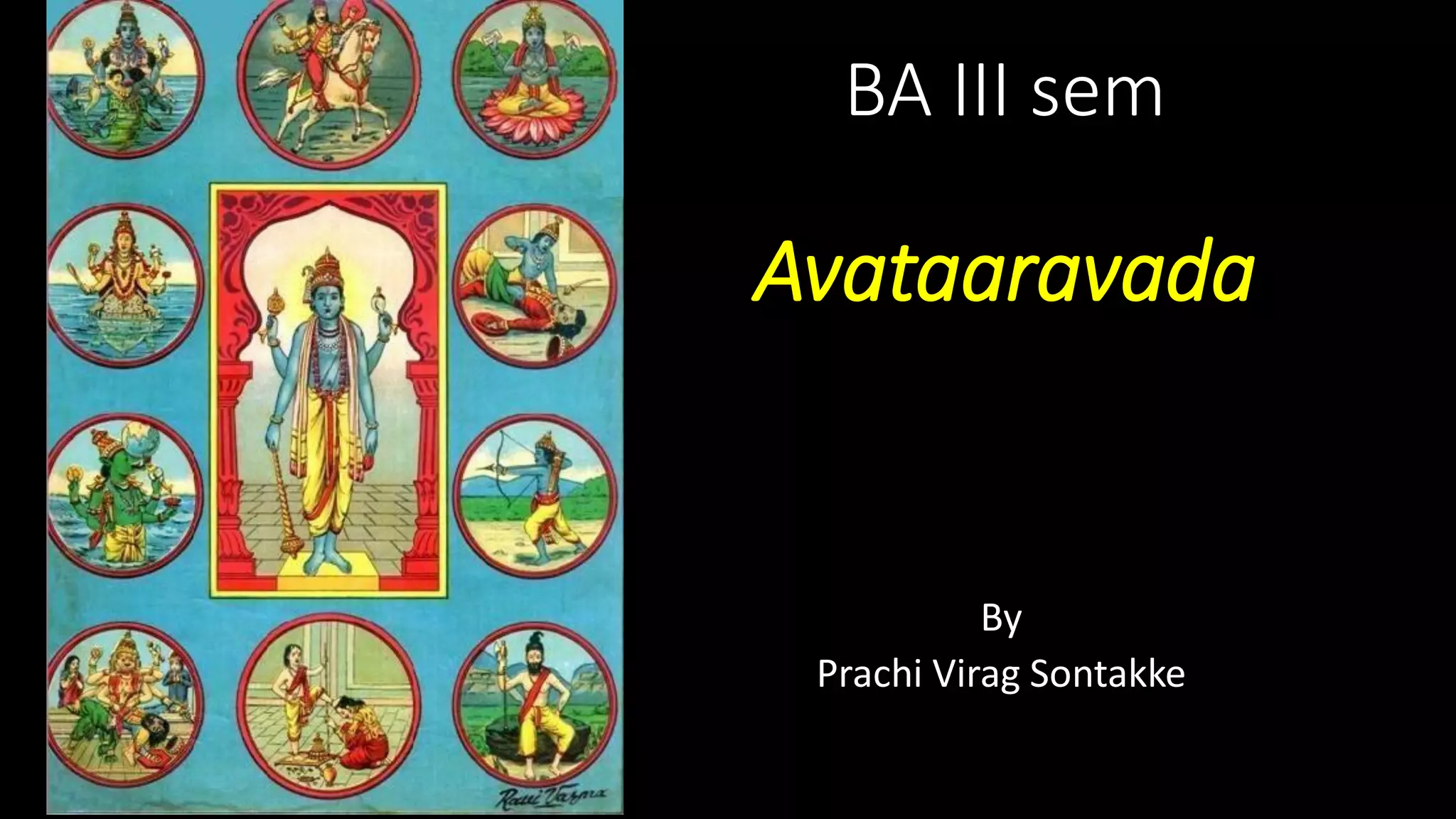
Avataaravada
By
Prachi Virag Sontakke
Introduction
• Etymologically, word Avatar is derived from root Aruta meaning to
descend, to come down
• Contextually, a principle of Vaishnava sect.
• Use of different terms to express the idea.
• Bhagavata Gita, Mahabharata: Janam, Sambhava
• Harivamsha Purana: Pradurbhaava
• Vishnudharmottar Purana: No where mentions the term Avataar.
Concept
• God’s (or a part of God) birth to serve a specific purpose.
• Necessary intervention by Divinity.
• Could be in form of a man, an animal or an anthropomorph.
• Incarnate has all the powers of God.
• Not a disguise: birth by natural process.
• Existence on earth.
• Often doesn’t incarnate alone: assisted by other Gods.
• Different from reincarnation: based on will.
Characteristics of Avatar
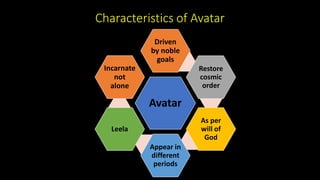
Avatar
Driven
by noble
goals
Restore
cosmic
order
As per
will of
God
Appear in
different
periods
Leela
Incarnate
not
alone
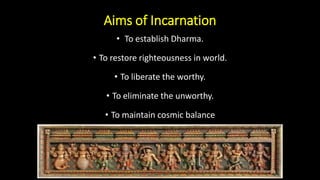
Aims of Incarnation
• To establish Dharma.
• To restore righteousness in world.
• To liberate the worthy.
• To eliminate the unworthy.
• To maintain cosmic balance
Roots of tradition?
• Rgveda: Vishnu took another form in a battle.
• Rgveda: Talks about various forms of Indra
But form is not incarnate.
Has no sense of purpose to it.
• Later other sects also adopted the concept of Incarnation.
Devibhagvata Purana: Shakti avatar- Durga, Kaali, Parvati. Lakshmi avatar: Sridevi, Bhudevi,
Sita, Radha
Linga Purana: Avatar of Ganesh- Gajanan, Mayureshwar, Vakratunda
Linga Purana + Shiva Purana: Veerbhadra incarnation to help Nrusimha.
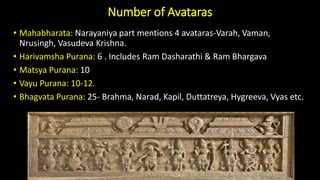
Number of Avataras
• Mahabharata: Narayaniya part mentions 4 avataras-Varah, Vaman,
Nrusingh, Vasudeva Krishna.
• Harivamsha Purana: 6 . Includes Ram Dasharathi & Ram Bhargava
• Matsya Purana: 10
• Vayu Purana: 10-12.
• Bhagvata Purana: 25- Brahma, Narad, Kapil, Duttatreya, Hygreeva, Vyas etc.
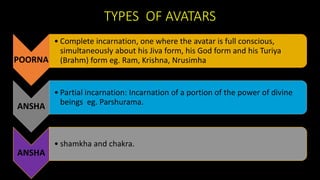
TYPES OF AVATARS
POORNA
• Complete incarnation, one where the avatar is full conscious,
simultaneously about his Jiva form, his God form and his Turiya
(Brahm) form eg. Ram, Krishna, Nrusimha
ANSHA
• Partial incarnation: Incarnation of a portion of the power of divine
beings eg. Parshurama.
ANSHA
• shamkha and chakra.
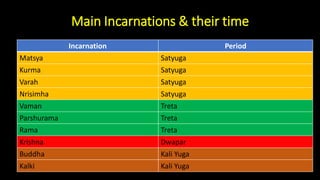
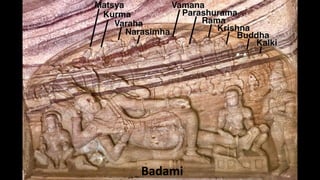
Main Incarnations & their time
Incarnation Period
Matsya Satyuga
Kurma Satyuga
Varah Satyuga
Nrisimha Satyuga
Vaman Treta
Parshurama Treta
Rama Treta
Krishna Dwapar
Buddha Kali Yuga
Kalki Kali Yuga
If Parshuram & Krishna were on earth at the same time, then
where was Lord Vishnu at that time?
• It is not that Vishnu stops what He is doing, changes clothes, sticks on a beard, hangs a sign
on His door saying ‘Gone for a while, back soon’, and descends to Earth. Nor does He
change form like a shapeshifter and Laxmi is left wondering who was that who just left
carrying an axe?
• Vishnu manifests enough forms to enter into each and every atom of the universe, but still
remains complete in His original form.
• So he has the capacity to be present simultaneously in different forms at the same time.
• Parasurama is an empowered incarnation. That means a personality who is imbued with
the power of Visnu to perform a specific function, like an ambassador who represents the
head of his country in a foreign country.
• Krishna is supremely independent, He is independent of Vishnu even.
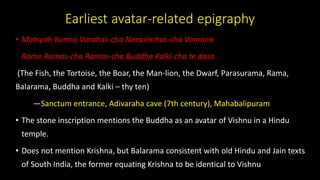
Earliest avatar-related epigraphy
• Matsyah Kurmo Varahas-cha Narasimhas-cha Vamana
Ramo Ramas-cha Ramas-cha Buddha Kalki-cha te dasa
(The Fish, the Tortoise, the Boar, the Man-lion, the Dwarf, Parasurama, Rama,
Balarama, Buddha and Kalki – thy ten)
—Sanctum entrance, Adivaraha cave (7th century), Mahabalipuram
• The stone inscription mentions the Buddha as an avatar of Vishnu in a Hindu
temple.
• Does not mention Krishna, but Balarama consistent with old Hindu and Jain texts
of South India, the former equating Krishna to be identical to Vishnu
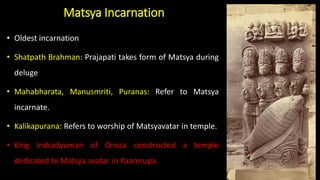
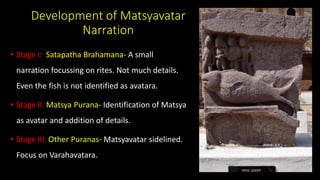
Matsya Incarnation
• Oldest incarnation
• Shatpath Brahman: Prajapati takes form of Matsya during
deluge
• Mahabharata, Manusmriti, Puranas: Refer to Matsya
incarnate.
• Kalikapurana: Refers to worship of Matsyavatar in temple.
• King Indradyuman of Orissa constructed a temple
dedicated to Matsya avatar in Kaamrupa.
Development of Matsyavatar
Narration
• Stage I: Satapatha Brahamana- A small
narration focussing on rites. Not much details.
Even the fish is not identified as avatara.
• Stage II: Matsya Purana- Identification of Matsya
as avatar and addition of details.
• Stage III: Other Puranas- Matsyavatar sidelined.
Focus on Varahavatara.
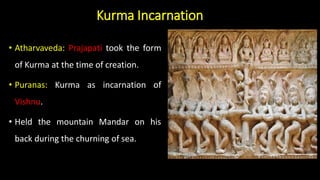
Kurma Incarnation
• Atharvaveda: Prajapati took the form
of Kurma at the time of creation.
• Puranas: Kurma as incarnation of
Vishnu.
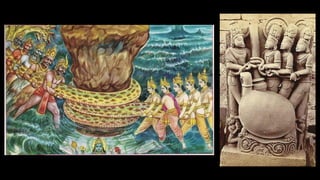
• Held the mountain Mandar on his
back during the churning of sea.
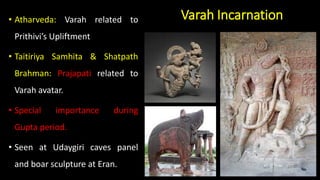
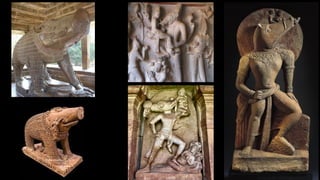
Varah Incarnation
• Atharveda: Varah related to
Prithivi’s Upliftment
• Taitiriya Samhita & Shatpath
Brahman: Prajapati related to
Varah avatar.
• Special importance during
Gupta period.
• Seen at Udaygiri caves panel
and boar sculpture at Eran.
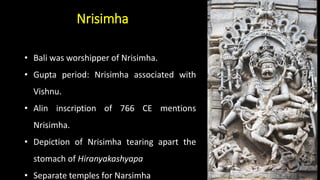
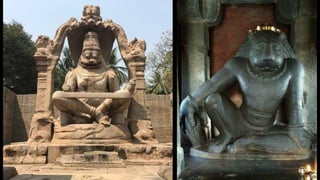
Nrisimha
• Bali was worshipper of Nrisimha.
• Gupta period: Nrisimha associated with
Vishnu.
• Alin inscription of 766 CE mentions
Nrisimha.
• Depiction of Nrisimha tearing apart the
stomach of Hiranyakashyapa
• Separate temples for Narsimha
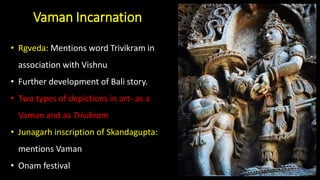
Vaman Incarnation
• Rgveda: Mentions word Trivikram in
association with Vishnu
• Further development of Bali story.
• Two types of depictions in art- as a
Vaman and as Trivikram
• Junagarh inscription of Skandagupta:
mentions Vaman
• Onam festival
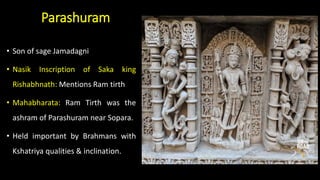
Parashuram
• Son of sage Jamadagni
• Nasik Inscription of Saka king
Rishabhnath: Mentions Ram tirth
• Mahabharata: Ram Tirth was the
ashram of Parashuram near Sopara.
• Held important by Brahmans with
Kshatriya qualities & inclination.
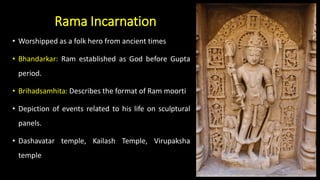
Rama Incarnation
• Worshipped as a folk hero from ancient times
• Bhandarkar: Ram established as God before Gupta
period.
• Brihadsamhita: Describes the format of Ram moorti
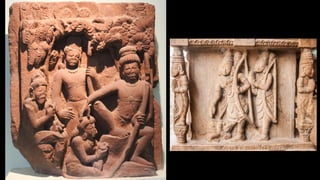
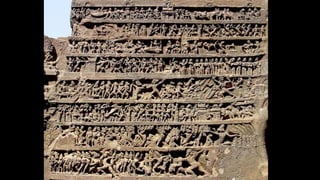
• Depiction of events related to his life on sculptural
panels.
• Dashavatar temple, Kailash Temple, Virupaksha
temple
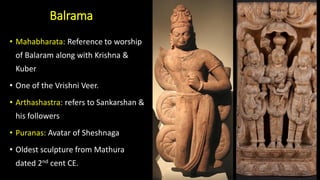
Balrama
• Mahabharata: Reference to worship
of Balaram along with Krishna &
Kuber
• One of the Vrishni Veer.
• Arthashastra: refers to Sankarshan &
his followers
• Puranas: Avatar of Sheshnaga
• Oldest sculpture from Mathura
dated 2nd cent CE.
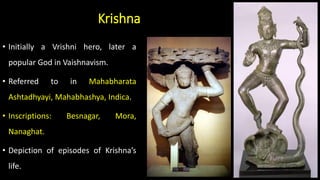
Krishna
• Initially a Vrishni hero, later a
popular God in Vaishnavism.
• Referred to in Mahabharata
Ashtadhyayi, Mahabhashya, Indica.
• Inscriptions: Besnagar, Mora,
Nanaghat.
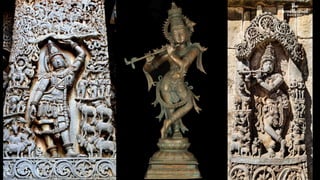
• Depiction of episodes of Krishna’s
life.
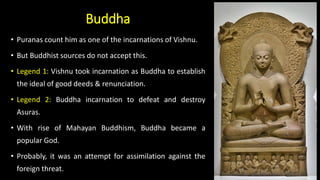
Buddha
• Puranas count him as one of the incarnations of Vishnu.
• But Buddhist sources do not accept this.
• Legend 1: Vishnu took incarnation as Buddha to establish
the ideal of good deeds & renunciation.
• Legend 2: Buddha incarnation to defeat and destroy
Asuras.
• With rise of Mahayan Buddhism, Buddha became a
popular God.
• Probably, it was an attempt for assimilation against the
foreign threat.
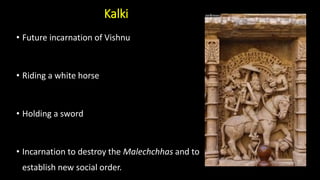
Kalki
• Future incarnation of Vishnu
• Riding a white horse
• Holding a sword
• Incarnation to destroy the Malechchhas and to
establish new social order.
Forms of Avatar worship
• Single Avatar
• Vaikuntha Chaturmurti
• Varaha Narasimha
• Dashavatar Panel
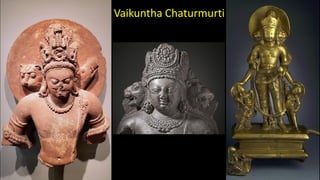
Vaikuntha Chaturmurti
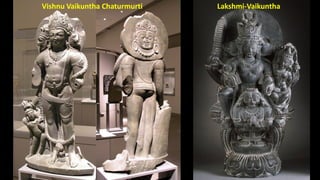
Lakshmi-Vaikuntha
Vishnu Vaikuntha Chaturmurti
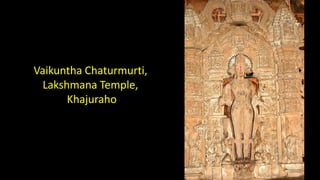
Vaikuntha Chaturmurti,
Lakshmana Temple,
Khajuraho
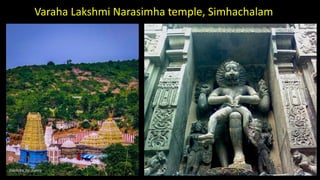
Varaha Lakshmi Narasimha temple, Simhachalam
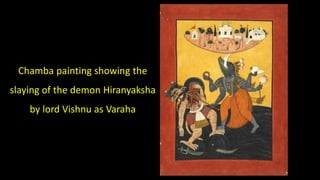
Chamba painting showing the
slaying of the demon Hiranyaksha
by lord Vishnu as Varaha
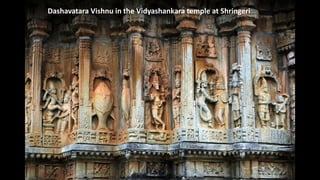
Dashavatara Vishnu in the Vidyashankara temple at Shringeri
Badami
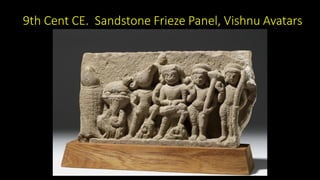
9th Cent CE. Sandstone Frieze Panel, Vishnu Avatars
Conclusion
• A unique concept
• Initially associated with Vaishnavism.
• Later other sects too included the concept of incarnation.
• Extensive mythology related to Avataras
• Frequent theme in Indian art.

Avatarvaada.pdf

  • 1.
  • 2.
    Introduction • Etymologically, wordAvatar is derived from root Aruta meaning to descend, to come down • Contextually, a principle of Vaishnava sect. • Use of different terms to express the idea. • Bhagavata Gita, Mahabharata: Janam, Sambhava • Harivamsha Purana: Pradurbhaava • Vishnudharmottar Purana: No where mentions the term Avataar.
  • 3.
    Concept • God’s (ora part of God) birth to serve a specific purpose. • Necessary intervention by Divinity. • Could be in form of a man, an animal or an anthropomorph. • Incarnate has all the powers of God. • Not a disguise: birth by natural process. • Existence on earth. • Often doesn’t incarnate alone: assisted by other Gods. • Different from reincarnation: based on will.
  • 4.
    Characteristics of Avatar Avatar Driven bynoble goals Restore cosmic order As per will of God Appear in different periods Leela Incarnate not alone
  • 5.
    Aims of Incarnation •To establish Dharma. • To restore righteousness in world. • To liberate the worthy. • To eliminate the unworthy. • To maintain cosmic balance
  • 6.
    Roots of tradition? •Rgveda: Vishnu took another form in a battle. • Rgveda: Talks about various forms of Indra But form is not incarnate. Has no sense of purpose to it. • Later other sects also adopted the concept of Incarnation. Devibhagvata Purana: Shakti avatar- Durga, Kaali, Parvati. Lakshmi avatar: Sridevi, Bhudevi, Sita, Radha Linga Purana: Avatar of Ganesh- Gajanan, Mayureshwar, Vakratunda Linga Purana + Shiva Purana: Veerbhadra incarnation to help Nrusimha.
  • 7.
    Number of Avataras •Mahabharata: Narayaniya part mentions 4 avataras-Varah, Vaman, Nrusingh, Vasudeva Krishna. • Harivamsha Purana: 6 . Includes Ram Dasharathi & Ram Bhargava • Matsya Purana: 10 • Vayu Purana: 10-12. • Bhagvata Purana: 25- Brahma, Narad, Kapil, Duttatreya, Hygreeva, Vyas etc.
  • 8.
    TYPES OF AVATARS POORNA •Complete incarnation, one where the avatar is full conscious, simultaneously about his Jiva form, his God form and his Turiya (Brahm) form eg. Ram, Krishna, Nrusimha ANSHA • Partial incarnation: Incarnation of a portion of the power of divine beings eg. Parshurama. ANSHA • shamkha and chakra.
  • 9.
    Main Incarnations &their time Incarnation Period Matsya Satyuga Kurma Satyuga Varah Satyuga Nrisimha Satyuga Vaman Treta Parshurama Treta Rama Treta Krishna Dwapar Buddha Kali Yuga Kalki Kali Yuga
  • 10.
    If Parshuram &Krishna were on earth at the same time, then where was Lord Vishnu at that time? • It is not that Vishnu stops what He is doing, changes clothes, sticks on a beard, hangs a sign on His door saying ‘Gone for a while, back soon’, and descends to Earth. Nor does He change form like a shapeshifter and Laxmi is left wondering who was that who just left carrying an axe? • Vishnu manifests enough forms to enter into each and every atom of the universe, but still remains complete in His original form. • So he has the capacity to be present simultaneously in different forms at the same time. • Parasurama is an empowered incarnation. That means a personality who is imbued with the power of Visnu to perform a specific function, like an ambassador who represents the head of his country in a foreign country. • Krishna is supremely independent, He is independent of Vishnu even.
  • 11.
    Earliest avatar-related epigraphy •Matsyah Kurmo Varahas-cha Narasimhas-cha Vamana Ramo Ramas-cha Ramas-cha Buddha Kalki-cha te dasa (The Fish, the Tortoise, the Boar, the Man-lion, the Dwarf, Parasurama, Rama, Balarama, Buddha and Kalki – thy ten) —Sanctum entrance, Adivaraha cave (7th century), Mahabalipuram • The stone inscription mentions the Buddha as an avatar of Vishnu in a Hindu temple. • Does not mention Krishna, but Balarama consistent with old Hindu and Jain texts of South India, the former equating Krishna to be identical to Vishnu
  • 12.
    Matsya Incarnation • Oldestincarnation • Shatpath Brahman: Prajapati takes form of Matsya during deluge • Mahabharata, Manusmriti, Puranas: Refer to Matsya incarnate. • Kalikapurana: Refers to worship of Matsyavatar in temple. • King Indradyuman of Orissa constructed a temple dedicated to Matsya avatar in Kaamrupa.
  • 13.
    Development of Matsyavatar Narration •Stage I: Satapatha Brahamana- A small narration focussing on rites. Not much details. Even the fish is not identified as avatara. • Stage II: Matsya Purana- Identification of Matsya as avatar and addition of details. • Stage III: Other Puranas- Matsyavatar sidelined. Focus on Varahavatara.
  • 14.
    Kurma Incarnation • Atharvaveda:Prajapati took the form of Kurma at the time of creation. • Puranas: Kurma as incarnation of Vishnu. • Held the mountain Mandar on his back during the churning of sea.
  • 16.
    Varah Incarnation • Atharveda:Varah related to Prithivi’s Upliftment • Taitiriya Samhita & Shatpath Brahman: Prajapati related to Varah avatar. • Special importance during Gupta period. • Seen at Udaygiri caves panel and boar sculpture at Eran.
  • 18.
    Nrisimha • Bali wasworshipper of Nrisimha. • Gupta period: Nrisimha associated with Vishnu. • Alin inscription of 766 CE mentions Nrisimha. • Depiction of Nrisimha tearing apart the stomach of Hiranyakashyapa • Separate temples for Narsimha
  • 20.
    Vaman Incarnation • Rgveda:Mentions word Trivikram in association with Vishnu • Further development of Bali story. • Two types of depictions in art- as a Vaman and as Trivikram • Junagarh inscription of Skandagupta: mentions Vaman • Onam festival
  • 24.
    Parashuram • Son ofsage Jamadagni • Nasik Inscription of Saka king Rishabhnath: Mentions Ram tirth • Mahabharata: Ram Tirth was the ashram of Parashuram near Sopara. • Held important by Brahmans with Kshatriya qualities & inclination.
  • 25.
    Rama Incarnation • Worshippedas a folk hero from ancient times • Bhandarkar: Ram established as God before Gupta period. • Brihadsamhita: Describes the format of Ram moorti • Depiction of events related to his life on sculptural panels. • Dashavatar temple, Kailash Temple, Virupaksha temple
  • 28.
    Balrama • Mahabharata: Referenceto worship of Balaram along with Krishna & Kuber • One of the Vrishni Veer. • Arthashastra: refers to Sankarshan & his followers • Puranas: Avatar of Sheshnaga • Oldest sculpture from Mathura dated 2nd cent CE.
  • 29.
    Krishna • Initially aVrishni hero, later a popular God in Vaishnavism. • Referred to in Mahabharata Ashtadhyayi, Mahabhashya, Indica. • Inscriptions: Besnagar, Mora, Nanaghat. • Depiction of episodes of Krishna’s life.
  • 31.
    Buddha • Puranas counthim as one of the incarnations of Vishnu. • But Buddhist sources do not accept this. • Legend 1: Vishnu took incarnation as Buddha to establish the ideal of good deeds & renunciation. • Legend 2: Buddha incarnation to defeat and destroy Asuras. • With rise of Mahayan Buddhism, Buddha became a popular God. • Probably, it was an attempt for assimilation against the foreign threat.
  • 32.
    Kalki • Future incarnationof Vishnu • Riding a white horse • Holding a sword • Incarnation to destroy the Malechchhas and to establish new social order.
  • 33.
    Forms of Avatarworship • Single Avatar • Vaikuntha Chaturmurti • Varaha Narasimha • Dashavatar Panel
  • 34.
  • 35.
  • 36.
  • 37.
    Varaha Lakshmi Narasimhatemple, Simhachalam
  • 38.
    Chamba painting showingthe slaying of the demon Hiranyaksha by lord Vishnu as Varaha
  • 39.
    Dashavatara Vishnu inthe Vidyashankara temple at Shringeri
  • 40.
  • 42.
    9th Cent CE.Sandstone Frieze Panel, Vishnu Avatars
  • 43.
    Conclusion • A uniqueconcept • Initially associated with Vaishnavism. • Later other sects too included the concept of incarnation. • Extensive mythology related to Avataras • Frequent theme in Indian art.