Improved Forages Increase Livestock Productivity:
Brachiaria Grass a Success Story
Sita Ram Ghimire
Workshop on transforming livelihoods in South Asia through sustainable livestock
research and development
Kathmandu, Nepal, 13-14 November 2018
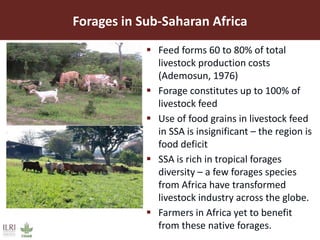
Forages in Sub-Saharan Africa
 Feed forms 60 to 80% of total
livestock production costs
(Ademosun, 1976)
 Forage constitutes up to 100% of
livestock feed
 Use of food grains in livestock feed
in SSA is insignificant – the region is
food deficit
 SSA is rich in tropical forages
diversity – a few forages species
from Africa have transformed
livestock industry across the globe.
 Farmers in Africa yet to benefit
from these native forages.
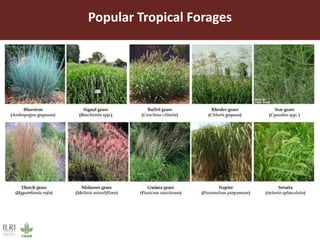
Popular Tropical Forages
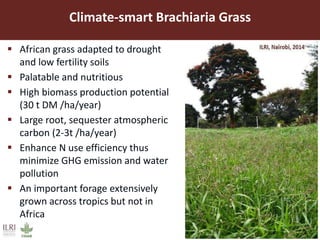
Climate-smart Brachiaria Grass
 African grass adapted to drought
and low fertility soils
 Palatable and nutritious
 High biomass production potential
(30 t DM /ha/year)
 Large root, sequester atmospheric
carbon (2-3t /ha/year)
 Enhance N use efficiency thus
minimize GHG emission and water
pollution
 An important forage extensively
grown across tropics but not in
Africa
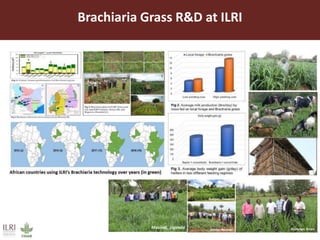
Brachiaria Grass R&D at ILRI
ILRI Forage Genebank
 A unique resource for exploring and capturing forage
diversity
 1,400 species representing over 600 genera
 Around 2,000 accessions distributed annually
Forage type Total
accessions
Accessions
under Treaty
Annex 1
accessions
Forage
cultivars
Browse 3,720 3,684 45 25
Grasses 4,397 4,377 313 11
Legumes 10,518 10,440 2,646 275
Total 18,635 18,501 3,004 311
Tropical Forages Selection Tool
• Developed to help promote adoption and use of forage
grasses and legumes that can be used as livestock feeds,
while curbing greenhouse gas emissions and reversing
land degradation.
• Series of fact sheets on ~200 each
species
• Selection tool, enables users to match
forages to needs in a particular area
• Approximately 500,000 visits a year
www.tropicalforages.info
This work is financed by
 Swedish International Development Cooperation Agency
 USAID’s Feed the Future Program
 European Commission’s H2020 Program
It is implemented in a partnership with
African National Agricultural Research Programs
It contributes to the CGIAR Research Program on
Livestock
Acknowledgements
This presentation is licensed for use under the Creative Commons Attribution 4.0 International Licence.
better lives through livestock
ilri.org
ILRI thanks all donors and organizations who globally supported its work through their contributions
to the CGIAR system

Improved forages increase livestock productivity: Brachiaria grass a success story

  • 1.
    Improved Forages IncreaseLivestock Productivity: Brachiaria Grass a Success Story Sita Ram Ghimire Workshop on transforming livelihoods in South Asia through sustainable livestock research and development Kathmandu, Nepal, 13-14 November 2018
  • 2.
    Forages in Sub-SaharanAfrica  Feed forms 60 to 80% of total livestock production costs (Ademosun, 1976)  Forage constitutes up to 100% of livestock feed  Use of food grains in livestock feed in SSA is insignificant – the region is food deficit  SSA is rich in tropical forages diversity – a few forages species from Africa have transformed livestock industry across the globe.  Farmers in Africa yet to benefit from these native forages.
  • 3.
  • 4.
    Climate-smart Brachiaria Grass African grass adapted to drought and low fertility soils  Palatable and nutritious  High biomass production potential (30 t DM /ha/year)  Large root, sequester atmospheric carbon (2-3t /ha/year)  Enhance N use efficiency thus minimize GHG emission and water pollution  An important forage extensively grown across tropics but not in Africa
  • 5.
  • 6.
    ILRI Forage Genebank A unique resource for exploring and capturing forage diversity  1,400 species representing over 600 genera  Around 2,000 accessions distributed annually Forage type Total accessions Accessions under Treaty Annex 1 accessions Forage cultivars Browse 3,720 3,684 45 25 Grasses 4,397 4,377 313 11 Legumes 10,518 10,440 2,646 275 Total 18,635 18,501 3,004 311
  • 7.
    Tropical Forages SelectionTool • Developed to help promote adoption and use of forage grasses and legumes that can be used as livestock feeds, while curbing greenhouse gas emissions and reversing land degradation. • Series of fact sheets on ~200 each species • Selection tool, enables users to match forages to needs in a particular area • Approximately 500,000 visits a year www.tropicalforages.info
  • 8.
    This work isfinanced by  Swedish International Development Cooperation Agency  USAID’s Feed the Future Program  European Commission’s H2020 Program It is implemented in a partnership with African National Agricultural Research Programs It contributes to the CGIAR Research Program on Livestock Acknowledgements
  • 9.
    This presentation islicensed for use under the Creative Commons Attribution 4.0 International Licence. better lives through livestock ilri.org ILRI thanks all donors and organizations who globally supported its work through their contributions to the CGIAR system

Editor's Notes

  • #2 There MUST be a CGIAR logo or a CRP logo. You can copy and paste the logo you need from the final slide of this presentation. Then you can delete that final slide   To replace a photo above, copy and paste this link in your browser: http://www.flickr.com/photos/ilri/sets/72157632057087650/detail/   Find a photo you like and the right size, copy and paste it in the block above.