Alternate Wall
Technologies
Group-6
1. Tejas
2. Shritej
3. Sonal
4. Sushmitha
5. Samyabrato
6. Rohitha
Glass Fiber Reinforced Gypsum Panels
• Glass fibre reinforced gypsum (GFRG) panel or Rapid wall is a modern building element
• A GFRG panel is basically calcined gypsum plaster, reinforced with glass fibre which when filled
with reinforced concrete in an appropriate proportion becomes strong enough to act as a load
bearing and shear wall.
• GFRG panels are originally white in color (due to gypsum) and have a smooth finished surface.
• Size- 12m length, 3m height, and 124mm thickness.
• Each panel has 48 modular holes of 230 mm * 94mm * 3m dimension.
• The weight of one panel is 1440 kg.
Construction Method
• The construction process up to the plinth level remains similar as in the conventional method. No
special foundation is required for the installation of GFRG panels.
• Concrete belts are built at the plinth area with protruding iron rods which are meant to strengthen
the interlocking with the cells of the panel.
• GFRG panels are placed at the appropriate positions using mechanical means, preferably a crane,
and external supports are provided to maintain the verticality. Necessary cuts for doors, windows,
sanitary fittings, vents etc. are made as per the design.
• The hollow cavities are filled with concrete and reinforcement as per the requirement to
strengthen the panels.
• Generally, concrete is filled in every third cavity of the panel and the remaining cavities can be
filled with waste materials like quarry dust.
• Finally, waterproofing treatment is carried out for the roofs and floors of the building.
Structural Drawings
Structural Drawings
Advantages
• Rapid Construction
• More carpet area for the same built-up area
• Less construction cost
• Less building weight
• One can construct 8 to 10 storeyed buildings
using GFRG Panels
• It gives a smooth finishing
• Less included the energy and carbon footprint
• GFRG Panel made building gives better
thermal comfort
Disadvantages
• It requires more space for the movement of a
crane during the construction time
• Construction method less cost-effective since
the design of the GFRG Panel is complicated.
• Highly experienced and skilled labor is needed
• During the transportation and erection
process, the GFRG Panel should be handled
carefully.
• To cut the GFRG Panel at the site, it requires
specific machinery.
• Can’t be used for the construction of walls in
circular or in curve shape.
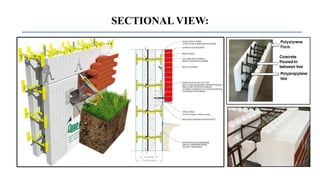
CONCRETE INSULATED WALL
• Insulating concrete form or insulated
concrete form (ICF) is a system
of formwork for reinforced
concrete usually made with a
rigid thermal insulation that stays in place
as a permanent interior and exterior
substrate for walls, floors, and roofs.
• The forms are interlocking modular units
that are dry-stacked (without mortar) and
filled with concrete. The units lock
together and create a form for the
structural walls or floors of a building.
• Common applications for this method of
construction are low-rise buildings, with
property uses ranging from residential to
commercial to industrial. These systems
are strong and energy efficient.
CONSTRUCTION METHODS:
• STEP 1- Formwork is placed for
footings
STEP 2- Place concrete in formwork.
Care should be taken when consolidating
concrete to eliminate voids or
honeycombing.
• STEP 3- Level the footing and
Place vertical reinforcements
• STEP 4 - Starting at a
corner, begin stacking
wall
• STEP 5 - Place horizontal
reinforcing
• STEP 6 - After two or three
courses have been placed, trim
as needed so walls are leveled.
• STEP 7 – pour the
concrete, continue
pouring until the concrete
reaches the desired level
STEP 8 -When topping the wall
leave extra concrete until all
consolidation is completed.
• STEP 9 -Make sure top of
wall is clean and flat. Wipe
away debris and splatter.
SECTIONAL VIEW:
ADVANTAGES DISADVANTAGES
• Stronger walls
• Stabilizes temperature and reduces sound
• Improved concrete curing time
• Allows you to install plumbing and wiring
• Does not work that well in low temperatures
• Higher costs from specialized labor
• Indoor humidity problems
• Future remodeling could be challenging
FERRO CEMENT
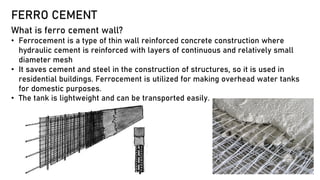
What is ferro cement wall?
• Ferrocement is a type of thin wall reinforced concrete construction where
hydraulic cement is reinforced with layers of continuous and relatively small
diameter mesh
• It saves cement and steel in the construction of structures, so it is used in
residential buildings. Ferrocement is utilized for making overhead water tanks
for domestic purposes.
• The tank is lightweight and can be transported easily.
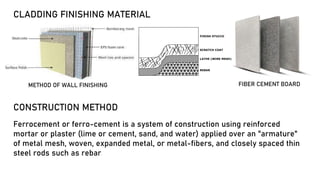
CLADDING FINISHING MATERIAL
METHOD OF WALL FINISHING FIBER CEMENT BOARD
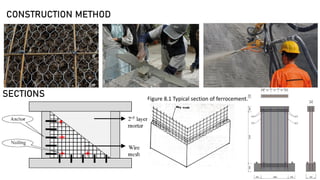
CONSTRUCTION METHOD
Ferrocement or ferro-cement is a system of construction using reinforced
mortar or plaster (lime or cement, sand, and water) applied over an "armature"
of metal mesh, woven, expanded metal, or metal-fibers, and closely spaced thin
steel rods such as rebar.
CONSTRUCTION METHOD
CONSTRUCTION METHOD
SECTIONS
ADVANTAGES
•Basic raw materials are readily
available in most countries.
•Fabricated into any desired shape.
•Low labor skill required.
•Ease of construction, low weight
and long lifetime.
•Low construction material cost.
•Better resistance against
earthquake.
DISADVANTAGES
•Structures made of it can be punctured by
collision with pointed objects.
•Corrosion of the reinforcing materials due to
the incomplete coverage of metal by mortar.
•It is difficult to fasten to Ferrocement with
bolts, screws, welding and nail etc.
•Large no of labors required.
•Cost of semi-skilled and unskilled labors is
high.
•Tying rods and mesh together is especially
tedious and time consuming
PROPERTIES OF FERROCEMENT
•Highly versatile form of reinforced
concrete.
•It's a type of thin reinforced concrete
construction, in which large amount of
small diameter wire meshes uniformly
throughout the cross section.
•Mesh may be metal or suitable material.
•Instead of concrete Portland cement
mortar is used.
•Strength depends on two factors quality
of sand/cement mortar mix and quantity of
reinforcing materials used
APPLICATION
STRAW-BALE
AS ALTERNATE MATERIAL FOR WALL OR BUILDING ENVOLOPE
INTRODUCTION :
Straw bale walls are constructed with vapour-permeable
materials, which allow water vapor to passively diffuse
through them. Examples include lime-based renders, clay
plasters and high-density wood fiber boards.
Straw is a natural and renewable material
with excellent insulation properties. Compared to
other types of insulation alternatives, straw bales have
a much lower environmental impact.
CONSTRUCTION METHOD:
The main construction techniques for straw
bale buildings are load bearing and infill wall
systems. Load bearing panels, consisting of
stacked straw bales and plaster skins, exploit
the structural capacity of the plaster/straw
composite.
Since the structural resistance of the
straw is lower than plaster, the majority
of load is carried by the plaster.
The render plays a significant structural
role, increasing resistance and improving
stiffness (limiting movement) as well as
protecting the straw from decay and
enhancing fire resistance.
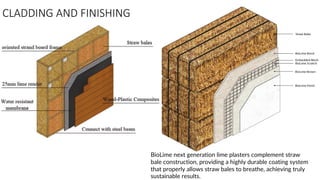
CLADDING AND FINISHING
BioLime next generation lime plasters complement straw
bale construction, providing a highly durable coating system
that properly allows straw bales to breathe, achieving truly
sustainable results.
SECTIONAL VIEWS:
CONSTRUCTION AND TECHNIQUES
ADVANTAGES DISADVANTAGES
1. They use a fast growing and renewable agricultural
by-product that is otherwise wasted.
2. They contain fewer toxins than conventional
materials.
3. They have a high insulation factor that lowers the cost
of heating and cooling.
4. The homes can be easily customized to the owner’s
needs, both practical and creative.
5. The cost per square foot is reasonable, and
depending on the building methods chosen, can be
very economical.
1. If straw bale building codes are not part of your
local codes, it may be a bit more work to get your
plans approved.
2. Straw bale walls need to be kept dry as moisture is
detrimental to not only straw, but to many building
materials. Moisture entering the bales from the roof
above is to be avoided at all cost. If the walls of your
straw bale home are kept dry
3. Areas of extreme humidity and rain my not be
appropriate for straw bale construction.
4. Due to the thickness of the walls (usually around 18-
20 inches), more of your overall square footage will
be unusable due to it being within the wall space.
Rammed earth construction
• Rammed earth walls are constructed by ramming a
mixture of selected aggregates, including gravel,
sand, silt, and a small amount of clay, into place
between flat panels called formwork. Modern
technology replaces the pole with a mechanical
ram.
• Rammed earth walls are
constructed by ramming a mixture
of gravel, sand, silt and a small
amount of clay into place between
flat panels called formwork.
• As the ratio of wall thickness to
wall height should be between 1: 8
and 1: 12 .
• External walls upto 300mm,
internal 200 mm
• rammed earth adds a small
amount of cement (typically 5–
10%) to increase strength and
durability.
• Rammed earth provides excellent
thermal mass but limited
insulation.
• Rammed earth is very strong in
compression and can be used for
multistorey loadbearing
construction.
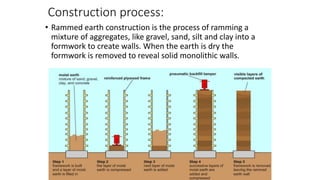
Construction process:
• Rammed earth construction is the process of ramming a
mixture of aggregates, like gravel, sand, silt and clay into a
formwork to create walls. When the earth is dry the
formwork is removed to reveal solid monolithic walls.
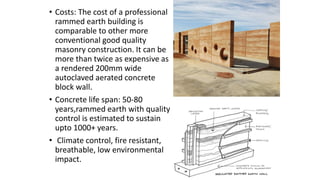
• Costs: The cost of a professional
rammed earth building is
comparable to other more
conventional good quality
masonry construction. It can be
more than twice as expensive as
a rendered 200mm wide
autoclaved aerated concrete
block wall.
• Concrete life span: 50-80
years,rammed earth with quality
control is estimated to sustain
upto 1000+ years.
• Climate control, fire resistant,
breathable, low environmental
impact.
• Advantages:
• Fire Protection. Earth
doesn't burn.
• Thermal Mass. The
external walls of our
rammed earth buildings
are a minimum of 300mm
(1 ft) thick, providing
excellent protection from
extremes in climate.
• Noise Reduction.
• Strong and Durable.
• Low Maintenance.
• Load Bearing.
• Pest Proof.
• Disadvantages:
• Soil selection is critical. Not any
soil can be used. If using it from
your own site, you’ll have to
figure out what to do with the
large holes.
• the labor costs can be expensive.
Count on it costing 5-15% more
than a conventional home.
• Due to the difficulty in designing
the forms, circular shapes are
usually out. Most rammed earth
construction is box shaped.
• The building design should plan
for services well in advance to
minimise logistical challenges,
with conduits located carefully
not to affect the surface finishes
of walls.

alternate wall technologies.pdf

  • 1.
    Alternate Wall Technologies Group-6 1. Tejas 2.Shritej 3. Sonal 4. Sushmitha 5. Samyabrato 6. Rohitha
  • 2.
    Glass Fiber ReinforcedGypsum Panels • Glass fibre reinforced gypsum (GFRG) panel or Rapid wall is a modern building element • A GFRG panel is basically calcined gypsum plaster, reinforced with glass fibre which when filled with reinforced concrete in an appropriate proportion becomes strong enough to act as a load bearing and shear wall. • GFRG panels are originally white in color (due to gypsum) and have a smooth finished surface. • Size- 12m length, 3m height, and 124mm thickness. • Each panel has 48 modular holes of 230 mm * 94mm * 3m dimension. • The weight of one panel is 1440 kg.
  • 3.
    Construction Method • Theconstruction process up to the plinth level remains similar as in the conventional method. No special foundation is required for the installation of GFRG panels. • Concrete belts are built at the plinth area with protruding iron rods which are meant to strengthen the interlocking with the cells of the panel. • GFRG panels are placed at the appropriate positions using mechanical means, preferably a crane, and external supports are provided to maintain the verticality. Necessary cuts for doors, windows, sanitary fittings, vents etc. are made as per the design. • The hollow cavities are filled with concrete and reinforcement as per the requirement to strengthen the panels. • Generally, concrete is filled in every third cavity of the panel and the remaining cavities can be filled with waste materials like quarry dust. • Finally, waterproofing treatment is carried out for the roofs and floors of the building.
  • 5.
  • 6.
  • 7.
    Advantages • Rapid Construction •More carpet area for the same built-up area • Less construction cost • Less building weight • One can construct 8 to 10 storeyed buildings using GFRG Panels • It gives a smooth finishing • Less included the energy and carbon footprint • GFRG Panel made building gives better thermal comfort Disadvantages • It requires more space for the movement of a crane during the construction time • Construction method less cost-effective since the design of the GFRG Panel is complicated. • Highly experienced and skilled labor is needed • During the transportation and erection process, the GFRG Panel should be handled carefully. • To cut the GFRG Panel at the site, it requires specific machinery. • Can’t be used for the construction of walls in circular or in curve shape.
  • 8.
    CONCRETE INSULATED WALL •Insulating concrete form or insulated concrete form (ICF) is a system of formwork for reinforced concrete usually made with a rigid thermal insulation that stays in place as a permanent interior and exterior substrate for walls, floors, and roofs. • The forms are interlocking modular units that are dry-stacked (without mortar) and filled with concrete. The units lock together and create a form for the structural walls or floors of a building. • Common applications for this method of construction are low-rise buildings, with property uses ranging from residential to commercial to industrial. These systems are strong and energy efficient.
  • 9.
    CONSTRUCTION METHODS: • STEP1- Formwork is placed for footings STEP 2- Place concrete in formwork. Care should be taken when consolidating concrete to eliminate voids or honeycombing. • STEP 3- Level the footing and Place vertical reinforcements • STEP 4 - Starting at a corner, begin stacking wall • STEP 5 - Place horizontal reinforcing • STEP 6 - After two or three courses have been placed, trim as needed so walls are leveled.
  • 10.
    • STEP 7– pour the concrete, continue pouring until the concrete reaches the desired level STEP 8 -When topping the wall leave extra concrete until all consolidation is completed. • STEP 9 -Make sure top of wall is clean and flat. Wipe away debris and splatter.
  • 11.
  • 12.
    ADVANTAGES DISADVANTAGES • Strongerwalls • Stabilizes temperature and reduces sound • Improved concrete curing time • Allows you to install plumbing and wiring • Does not work that well in low temperatures • Higher costs from specialized labor • Indoor humidity problems • Future remodeling could be challenging
  • 13.
    FERRO CEMENT What isferro cement wall? • Ferrocement is a type of thin wall reinforced concrete construction where hydraulic cement is reinforced with layers of continuous and relatively small diameter mesh • It saves cement and steel in the construction of structures, so it is used in residential buildings. Ferrocement is utilized for making overhead water tanks for domestic purposes. • The tank is lightweight and can be transported easily.
  • 14.
    CLADDING FINISHING MATERIAL METHODOF WALL FINISHING FIBER CEMENT BOARD CONSTRUCTION METHOD Ferrocement or ferro-cement is a system of construction using reinforced mortar or plaster (lime or cement, sand, and water) applied over an "armature" of metal mesh, woven, expanded metal, or metal-fibers, and closely spaced thin steel rods such as rebar.
  • 15.
  • 16.
  • 17.
    ADVANTAGES •Basic raw materialsare readily available in most countries. •Fabricated into any desired shape. •Low labor skill required. •Ease of construction, low weight and long lifetime. •Low construction material cost. •Better resistance against earthquake. DISADVANTAGES •Structures made of it can be punctured by collision with pointed objects. •Corrosion of the reinforcing materials due to the incomplete coverage of metal by mortar. •It is difficult to fasten to Ferrocement with bolts, screws, welding and nail etc. •Large no of labors required. •Cost of semi-skilled and unskilled labors is high. •Tying rods and mesh together is especially tedious and time consuming
  • 18.
    PROPERTIES OF FERROCEMENT •Highlyversatile form of reinforced concrete. •It's a type of thin reinforced concrete construction, in which large amount of small diameter wire meshes uniformly throughout the cross section. •Mesh may be metal or suitable material. •Instead of concrete Portland cement mortar is used. •Strength depends on two factors quality of sand/cement mortar mix and quantity of reinforcing materials used APPLICATION
  • 19.
    STRAW-BALE AS ALTERNATE MATERIALFOR WALL OR BUILDING ENVOLOPE INTRODUCTION : Straw bale walls are constructed with vapour-permeable materials, which allow water vapor to passively diffuse through them. Examples include lime-based renders, clay plasters and high-density wood fiber boards. Straw is a natural and renewable material with excellent insulation properties. Compared to other types of insulation alternatives, straw bales have a much lower environmental impact.
  • 20.
    CONSTRUCTION METHOD: The mainconstruction techniques for straw bale buildings are load bearing and infill wall systems. Load bearing panels, consisting of stacked straw bales and plaster skins, exploit the structural capacity of the plaster/straw composite. Since the structural resistance of the straw is lower than plaster, the majority of load is carried by the plaster. The render plays a significant structural role, increasing resistance and improving stiffness (limiting movement) as well as protecting the straw from decay and enhancing fire resistance.
  • 21.
    CLADDING AND FINISHING BioLimenext generation lime plasters complement straw bale construction, providing a highly durable coating system that properly allows straw bales to breathe, achieving truly sustainable results.
  • 22.
  • 23.
  • 24.
    ADVANTAGES DISADVANTAGES 1. Theyuse a fast growing and renewable agricultural by-product that is otherwise wasted. 2. They contain fewer toxins than conventional materials. 3. They have a high insulation factor that lowers the cost of heating and cooling. 4. The homes can be easily customized to the owner’s needs, both practical and creative. 5. The cost per square foot is reasonable, and depending on the building methods chosen, can be very economical. 1. If straw bale building codes are not part of your local codes, it may be a bit more work to get your plans approved. 2. Straw bale walls need to be kept dry as moisture is detrimental to not only straw, but to many building materials. Moisture entering the bales from the roof above is to be avoided at all cost. If the walls of your straw bale home are kept dry 3. Areas of extreme humidity and rain my not be appropriate for straw bale construction. 4. Due to the thickness of the walls (usually around 18- 20 inches), more of your overall square footage will be unusable due to it being within the wall space.
  • 25.
    Rammed earth construction •Rammed earth walls are constructed by ramming a mixture of selected aggregates, including gravel, sand, silt, and a small amount of clay, into place between flat panels called formwork. Modern technology replaces the pole with a mechanical ram.
  • 26.
    • Rammed earthwalls are constructed by ramming a mixture of gravel, sand, silt and a small amount of clay into place between flat panels called formwork. • As the ratio of wall thickness to wall height should be between 1: 8 and 1: 12 . • External walls upto 300mm, internal 200 mm • rammed earth adds a small amount of cement (typically 5– 10%) to increase strength and durability. • Rammed earth provides excellent thermal mass but limited insulation. • Rammed earth is very strong in compression and can be used for multistorey loadbearing construction.
  • 27.
    Construction process: • Rammedearth construction is the process of ramming a mixture of aggregates, like gravel, sand, silt and clay into a formwork to create walls. When the earth is dry the formwork is removed to reveal solid monolithic walls.
  • 29.
    • Costs: Thecost of a professional rammed earth building is comparable to other more conventional good quality masonry construction. It can be more than twice as expensive as a rendered 200mm wide autoclaved aerated concrete block wall. • Concrete life span: 50-80 years,rammed earth with quality control is estimated to sustain upto 1000+ years. • Climate control, fire resistant, breathable, low environmental impact.
  • 30.
    • Advantages: • FireProtection. Earth doesn't burn. • Thermal Mass. The external walls of our rammed earth buildings are a minimum of 300mm (1 ft) thick, providing excellent protection from extremes in climate. • Noise Reduction. • Strong and Durable. • Low Maintenance. • Load Bearing. • Pest Proof. • Disadvantages: • Soil selection is critical. Not any soil can be used. If using it from your own site, you’ll have to figure out what to do with the large holes. • the labor costs can be expensive. Count on it costing 5-15% more than a conventional home. • Due to the difficulty in designing the forms, circular shapes are usually out. Most rammed earth construction is box shaped. • The building design should plan for services well in advance to minimise logistical challenges, with conduits located carefully not to affect the surface finishes of walls.