

GOVT FIRST GRADE COLLEGE CHIKKABASUR
Department of History
CLASS : BA I Year
SUBJECT : History
TOPIC NAME : Plassey War
Presented By : Prof.Veeresh Hiremath
Dept of History
The Battle of Plassey was fought on 23
June 1757. It was fought between the Nawab
of Bengal and the British East India Company
in which the East India company emerged
victorious. This battle led to the establishment
of Company’s rule in South Asia. The battle
took place at Palashi, Bengal on the banks of
the Bhagirathi river, near Murshidabad, then
capital of the undivided Bengal. The two
forces of were Siraj-ud-Daulah, the last
independent Nawab of Bengal, and the British
East India Company.
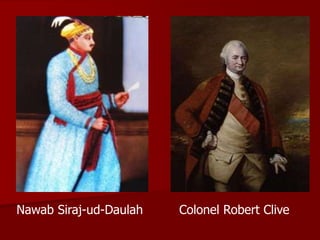
Colonel Robert CliveNawab Siraj-ud-Daulah
Causes of the Battle
 Disputed Succession of Siraj-ud-Daula
 Disrespect of Nawab by the British
 British help to Siraj-ud-daula’s rivals
 British Support to Shaukat Jang
 Anti-Hindu policies of the Nawab
 British alignment with discontented Hindus
 Refusal of British to stop fortifications
 Misuse of trade Privileges
 Affairs of Krishana Ballabh
 Capture of Calcutta by the Nawab (June
20, 1756) and Black Hole tragedy
 Re-occupation of Calcutta by the British
Jan 1757
 Treaty of Aliinagar
 Capture of Chander Nagar (French centre)
 Immediate Cause (Conspiracy against
Siraj-ud-Daula)
Black Hole Incident
The Black Hole of Calcutta was a small
dungeon in the old Fort William,
at Calcutta, India, where troops of
the Nawab of Bengal, Siraj ud-Daulah,
held British prisoners of war after the capture
of the Fort on June 19, 1756.
One of the prisoners, John Zephaniah Holwell,
claimed that following the fall of the fort,
British and Anglo-Indian soldiers and civilians
were held overnight in conditions so cramped
that many died from suffocation, heat
exhaustion and crushing. He claimed that 123
prisoners died out of 146 prisoners held.
About the Battle
Siraj-ud-Daulah had a numerically superior force
(about 50,000 soldiers) and made his stand at
Plassey. The British, worried about being
outnumbered, formed a conspiracy with Siraj-
ud-Daulah's demoted army chief Mir Jafar. Mir
Jafar, Rai Durlabh and Yar Lutuf Khan thus
assembled their troops near the battlefield but
made no move to actually join the battle. Siraj-
ud-Daulah's army was defeated by roughly
3,000 soldiers of Col. Robert Clive, owing to the
flight of Siraj-ud-daulah from the battlefield and
the inactivity of the conspirators.
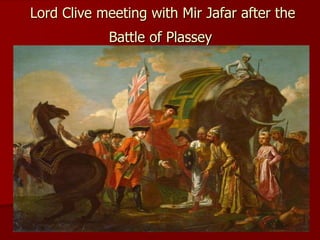
Lord Clive meeting with Mir Jafar after the
Battle of Plassey
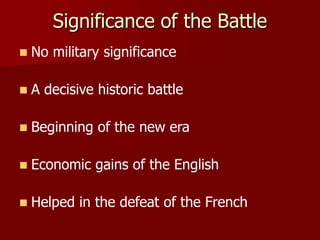
Significance of the Battle
 No military significance
 A decisive historic battle
 Beginning of the new era
 Economic gains of the English
 Helped in the defeat of the French
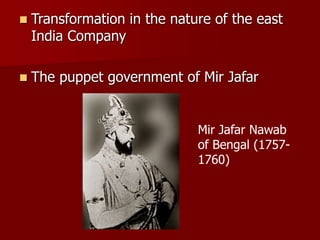
 Transformation in the nature of the east
India Company
 The puppet government of Mir Jafar
Mir Jafar Nawab
of Bengal (1757-
1760)
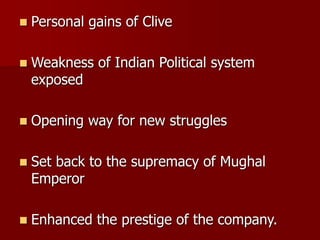
 Personal gains of Clive
 Weakness of Indian Political system
exposed
 Opening way for new struggles
 Set back to the supremacy of Mughal
Emperor
 Enhanced the prestige of the company.

GFGC CHIKKABASUR ( PLASSEY WAR )

  • 1.
    GOVT FIRST GRADECOLLEGE CHIKKABASUR Department of History CLASS : BA I Year SUBJECT : History TOPIC NAME : Plassey War Presented By : Prof.Veeresh Hiremath Dept of History
  • 2.
    The Battle ofPlassey was fought on 23 June 1757. It was fought between the Nawab of Bengal and the British East India Company in which the East India company emerged victorious. This battle led to the establishment of Company’s rule in South Asia. The battle took place at Palashi, Bengal on the banks of the Bhagirathi river, near Murshidabad, then capital of the undivided Bengal. The two forces of were Siraj-ud-Daulah, the last independent Nawab of Bengal, and the British East India Company.
  • 3.
  • 4.
    Causes of theBattle  Disputed Succession of Siraj-ud-Daula  Disrespect of Nawab by the British  British help to Siraj-ud-daula’s rivals  British Support to Shaukat Jang
  • 5.
     Anti-Hindu policiesof the Nawab  British alignment with discontented Hindus  Refusal of British to stop fortifications  Misuse of trade Privileges  Affairs of Krishana Ballabh
  • 6.
     Capture ofCalcutta by the Nawab (June 20, 1756) and Black Hole tragedy  Re-occupation of Calcutta by the British Jan 1757  Treaty of Aliinagar  Capture of Chander Nagar (French centre)  Immediate Cause (Conspiracy against Siraj-ud-Daula)
  • 7.
    Black Hole Incident TheBlack Hole of Calcutta was a small dungeon in the old Fort William, at Calcutta, India, where troops of the Nawab of Bengal, Siraj ud-Daulah, held British prisoners of war after the capture of the Fort on June 19, 1756. One of the prisoners, John Zephaniah Holwell, claimed that following the fall of the fort, British and Anglo-Indian soldiers and civilians were held overnight in conditions so cramped that many died from suffocation, heat exhaustion and crushing. He claimed that 123 prisoners died out of 146 prisoners held.
  • 8.
    About the Battle Siraj-ud-Daulahhad a numerically superior force (about 50,000 soldiers) and made his stand at Plassey. The British, worried about being outnumbered, formed a conspiracy with Siraj- ud-Daulah's demoted army chief Mir Jafar. Mir Jafar, Rai Durlabh and Yar Lutuf Khan thus assembled their troops near the battlefield but made no move to actually join the battle. Siraj- ud-Daulah's army was defeated by roughly 3,000 soldiers of Col. Robert Clive, owing to the flight of Siraj-ud-daulah from the battlefield and the inactivity of the conspirators.
  • 9.
    Lord Clive meetingwith Mir Jafar after the Battle of Plassey
  • 10.
    Significance of theBattle  No military significance  A decisive historic battle  Beginning of the new era  Economic gains of the English  Helped in the defeat of the French
  • 11.
     Transformation inthe nature of the east India Company  The puppet government of Mir Jafar Mir Jafar Nawab of Bengal (1757- 1760)
  • 12.
     Personal gainsof Clive  Weakness of Indian Political system exposed  Opening way for new struggles  Set back to the supremacy of Mughal Emperor  Enhanced the prestige of the company.