Mintz Levin. Not your standard practice.
Intellectual Property
What is Intellectual Property, and Why is it Important?
General Discussion Topics
2
• Trademarks
– Trademarks vs. Copyrights
– Trademark Clearance
– Federal Trademark Application Process
– Proper Trademark Usage
• Copyrights
– What is a Copyright?
– Common Pitfalls - Third party contributions, "private use" and "public
domain"
– Derivative Works
– The importance of Federal registration
General Discussion Topics
3
• Trade Secrets
• Patents
– What is protectable?
– The patent process – U.S. and rest of world (e.g., AIA and first-to-file
provisions)
– Do I have freedom to operate (FTO) in view of third-party patents?
– Protecting software innovations
– Employment agreement pitfalls
Forms of Intellectual Property
• Trademarks
• Copyrights
• Trade Secrets
• Patents
4
Trademarks
5
What is a Trademark?
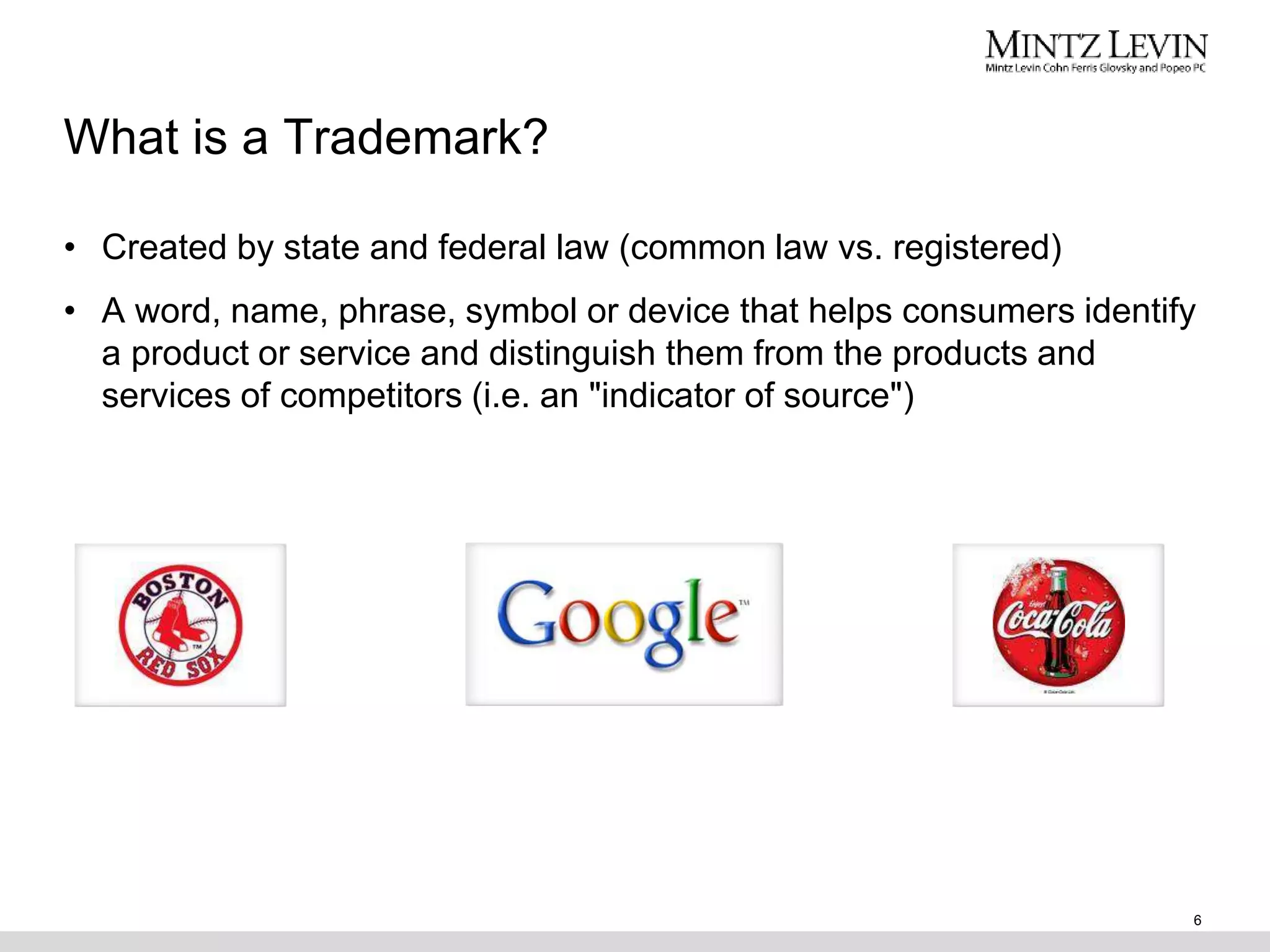
• Created by state and federal law (common law vs. registered)
• A word, name, phrase, symbol or device that helps consumers identify
a product or service and distinguish them from the products and
services of competitors (i.e. an "indicator of source")
6
Duration and Benefits of Trademark
• Rights exist when mark used in commerce, but without a Federal
registration, they are limited to geographic area in which used
• Unlimited in duration as long as mark is continuously used in
commerce and does not become “generic” (e.g., Aspirin, Band-Aid,
Scotch Tape)
• Owner may prevent others from using mark if public likely to be
confused
7
Trademark Characteristics
8
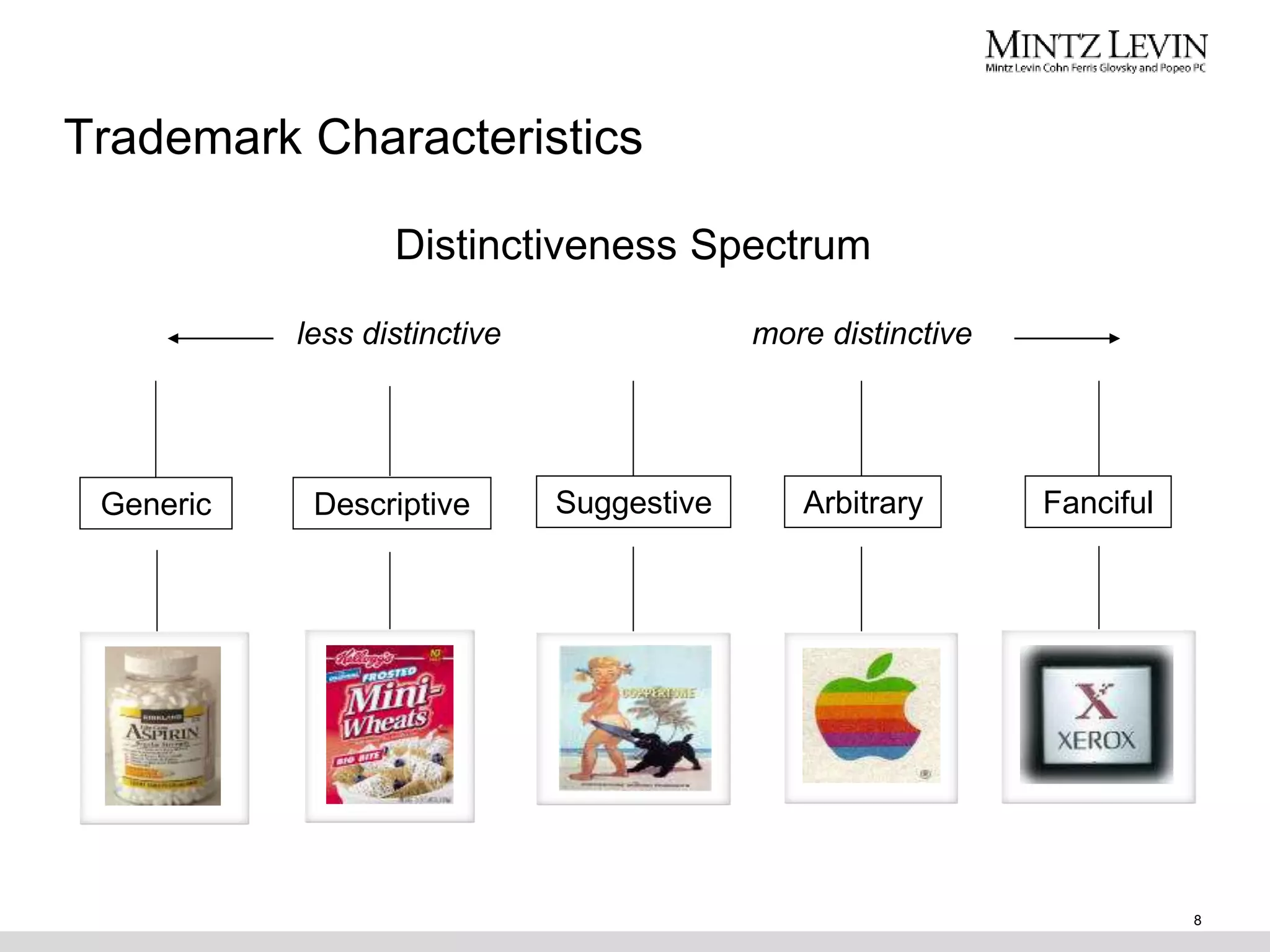
Distinctiveness Spectrum
SuggestiveDescriptiveGeneric FancifulArbitrary
less distinctive more distinctive
Choosing Trademarks
• Develop branding strategy
• Develop numerous alternatives
– Focus on distinctive names
• Clearance Searches to Determine Other Potential Users
– U.S. Patent and Trademark Office database
– State registries
– Popular Search engines
• Narrow down
9
Trademark Clearance
• What is clearance searching?
• Why Search?
– Two Purposes
• offensive (understanding potential registration problems and limitations)
• defensive (understanding potential use problems)
– Costs
– Benefits
• Understand landscape
• Assists with drafting identifications to minimize "Office Actions"
• Preliminary or "Knockout" vs. Comprehensive or "Full"
10
Registration
• May file for federal registration with U. S. Patent and Trademark Office
(about 18+ month wait)—Also may file with state
• Must determine one or more classes and describe goods/services
• USPTO Examination Process
• Benefits of Federal Registration:
– Presumption of nationwide rights (vs. "local" common law rights)
– Right to sue in federal court and seek statutory damages and attorneys fees
– Trademark achieves incontestable status after five years of registration and
continuous use – limits objections by third parties
– Right to use the "®" symbol
11
Proper Trademark Usage
® Mark has been registered with the USPTO—
It may be a service mark or a trademark
TM An unregistered (or registration is pending) trademark for
equipment, software or other products
SM An unregistered (or registration is pending)
service mark; used for services
• Set off Mark - Color, font, size, initial capitalization
• Do not use Descriptively, always as a trademark
• Never use as a noun or verb, e.g. I'm going to Google this
• Always use as adjective, e.g. I bough a new Apple computer
12
Copyrights
13
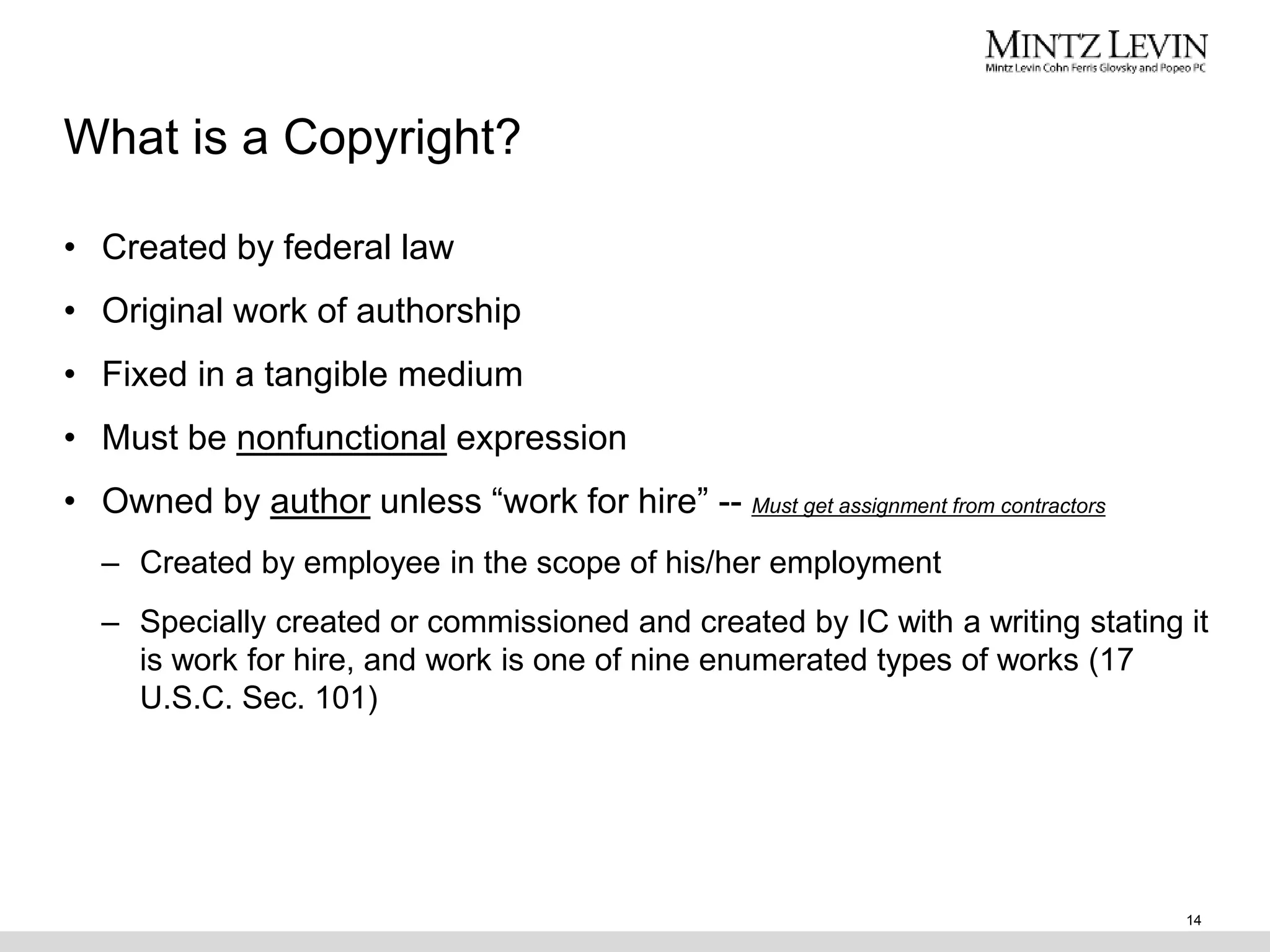
What is a Copyright?
• Created by federal law
• Original work of authorship
• Fixed in a tangible medium
• Must be nonfunctional expression
• Owned by author unless “work for hire” -- Must get assignment from contractors
– Created by employee in the scope of his/her employment
– Specially created or commissioned and created by IC with a writing stating it
is work for hire, and work is one of nine enumerated types of works (17
U.S.C. Sec. 101)
14
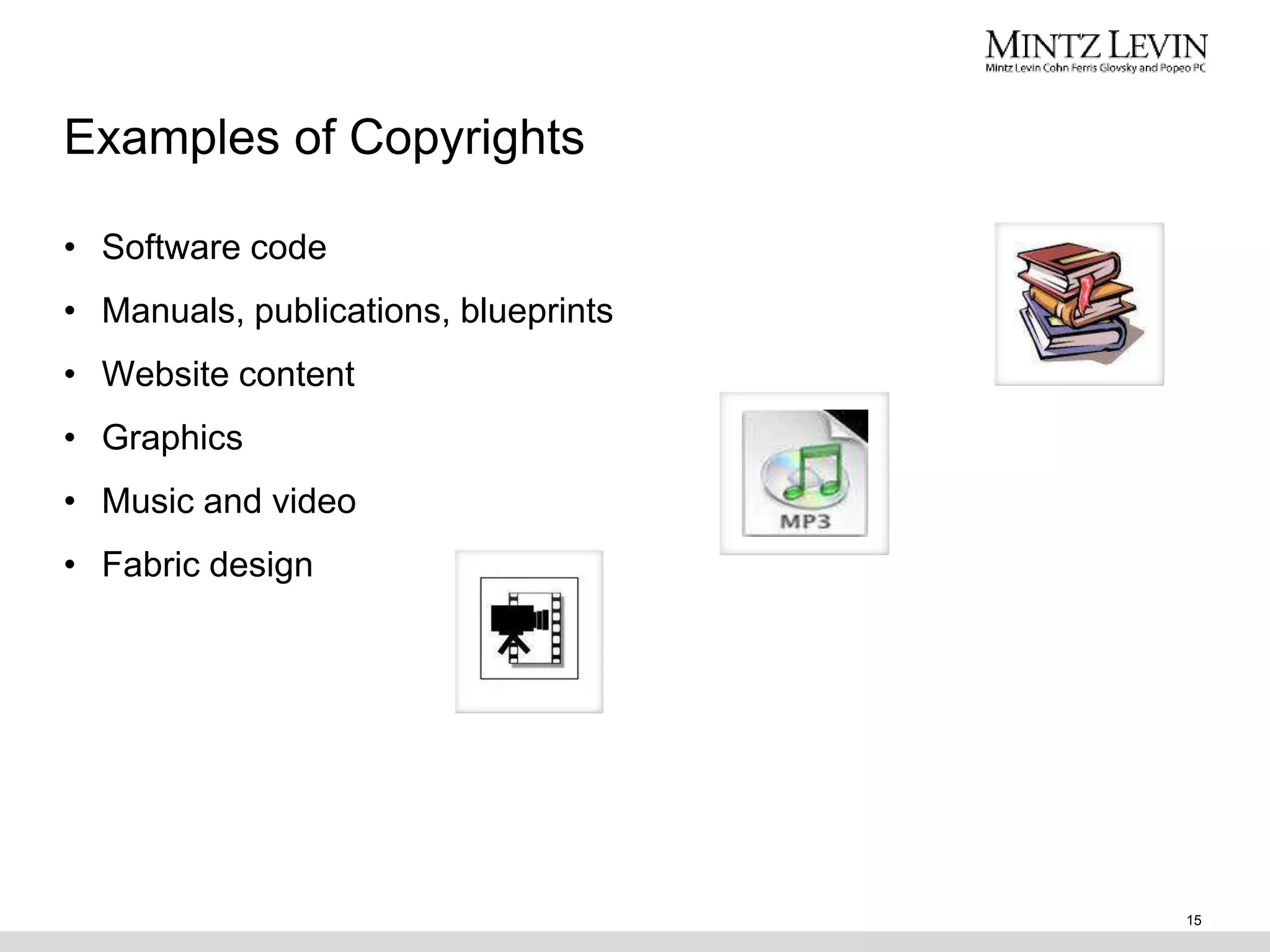
Examples of Copyrights
• Software code
• Manuals, publications, blueprints
• Website content
• Graphics
• Music and video
• Fabric design
15
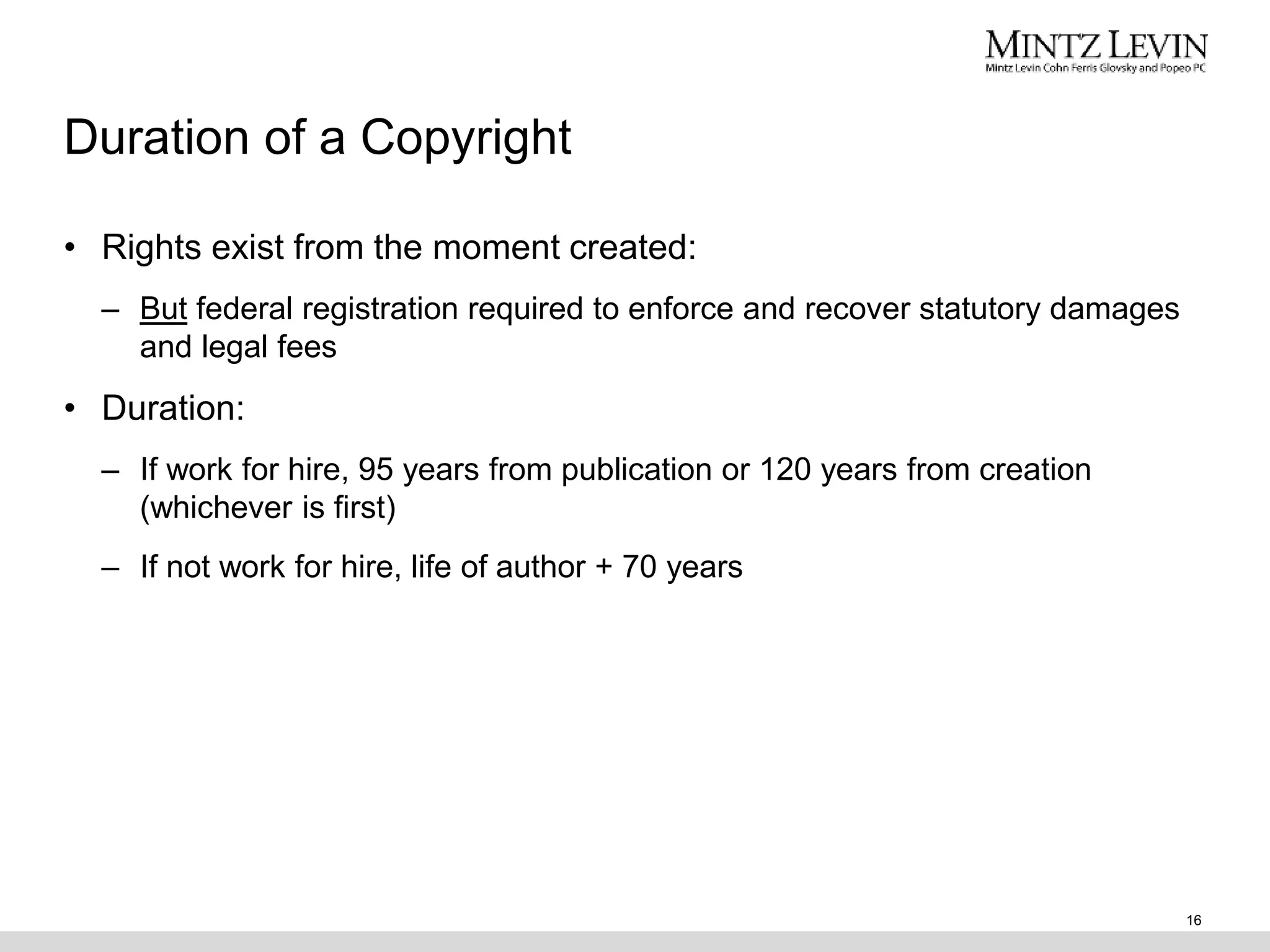
Duration of a Copyright
• Rights exist from the moment created:
– But federal registration required to enforce and recover statutory damages
and legal fees
• Duration:
– If work for hire, 95 years from publication or 120 years from creation
(whichever is first)
– If not work for hire, life of author + 70 years
16
Benefits of a Copyright
• Owner may prevent others from:
– Making copies
– Preparing derivative works
– Distributing copies
– Performing the work
– Displaying the work
• Exception: “fair use”
– Factors: purpose of new use (is it "transformative"), nature of copyright,
amount and substantiality of portion taken, effect on the market for original
17
Benefits of a Copyright
• Common Pitfalls
– Not properly taking into account third party material
– Improper assignments from independent contractors
– Believing the "private use" fallacy
– Assuming something is "public domain" because it can be easily copied or
obtained on the internet
– Software exists to scan the internet for infringement, and this is an area
where many business are trying to create a revenue stream
18
Trade Secrets
19
What is a Trade Secret?
• Created by state law
• Information, including formula, pattern, compilation, program, device,
method, technique or process that is:
1. Valuable because it’s secret; and
2. Owner takes reasonable efforts to maintain secrecy
20
Examples of Trade Secrets
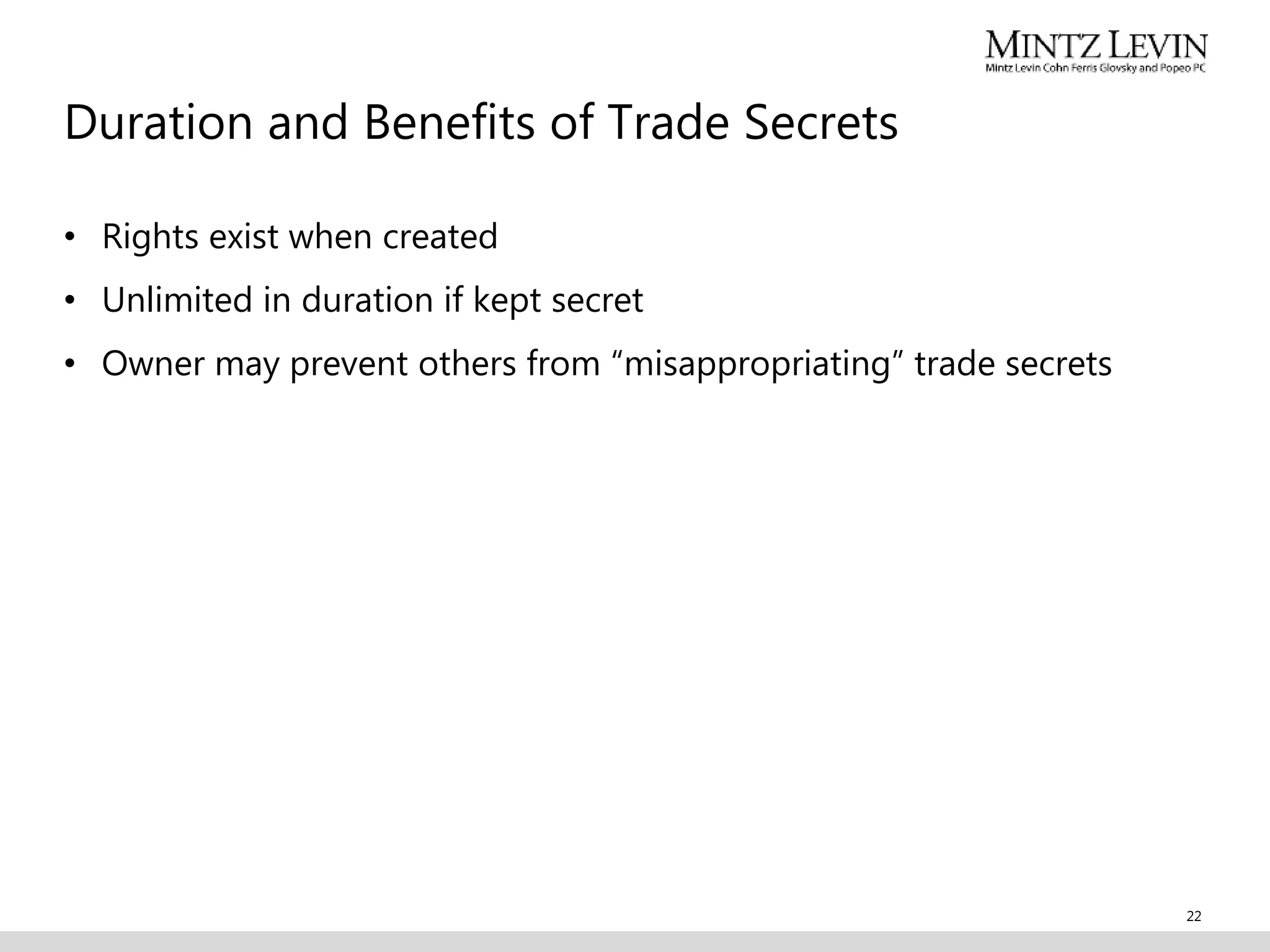
• Formulas (e.g., for Coke)
• Software programs
• Business methods
• Customer lists
• Financial forecasts (business plans)
• Pricing information
21
Duration and Benefits of Trade Secrets
• Rights exist when created
• Unlimited in duration if kept secret
• Owner may prevent others from “misappropriating” trade secrets
22
How Do You Maintain Secrecy?
• Adopt policies to protect against disclosure
• Communicate policies to employees
• Third parties must sign non-disclosure agreements (“NDAs”)
• Implement physical safeguards
23
Patents
24
What is a patent?
• Created by federal law (and laws of other countries)
• Government grant to exclude others from making, using, selling,
offering for sale or importing the patented invention
• Inventors must disclose the details of the invention to the public
• But, does not give owner “right to practice” (i.e., use the invention)
25
Types of Patents
• Utility patents (most common)
– Protects the way the invention is used and works
• Design patents
– Protects the way the invention looks
(ornamentality)
26
Filing of Application and Duration
• All individual inventors must file a patent application with U.S. Patent
and Trademark Office (although patent usually assigned to an entity)
• A utility patent expires 20 years from filing date (may be extended if
USPTO caused unreasonable delay)
• A design patent expires 14 years after it is issued
27
What Can be Patented?
• Machines
• Articles of manufacture
• Processes or business methods
• Compositions of matter
28
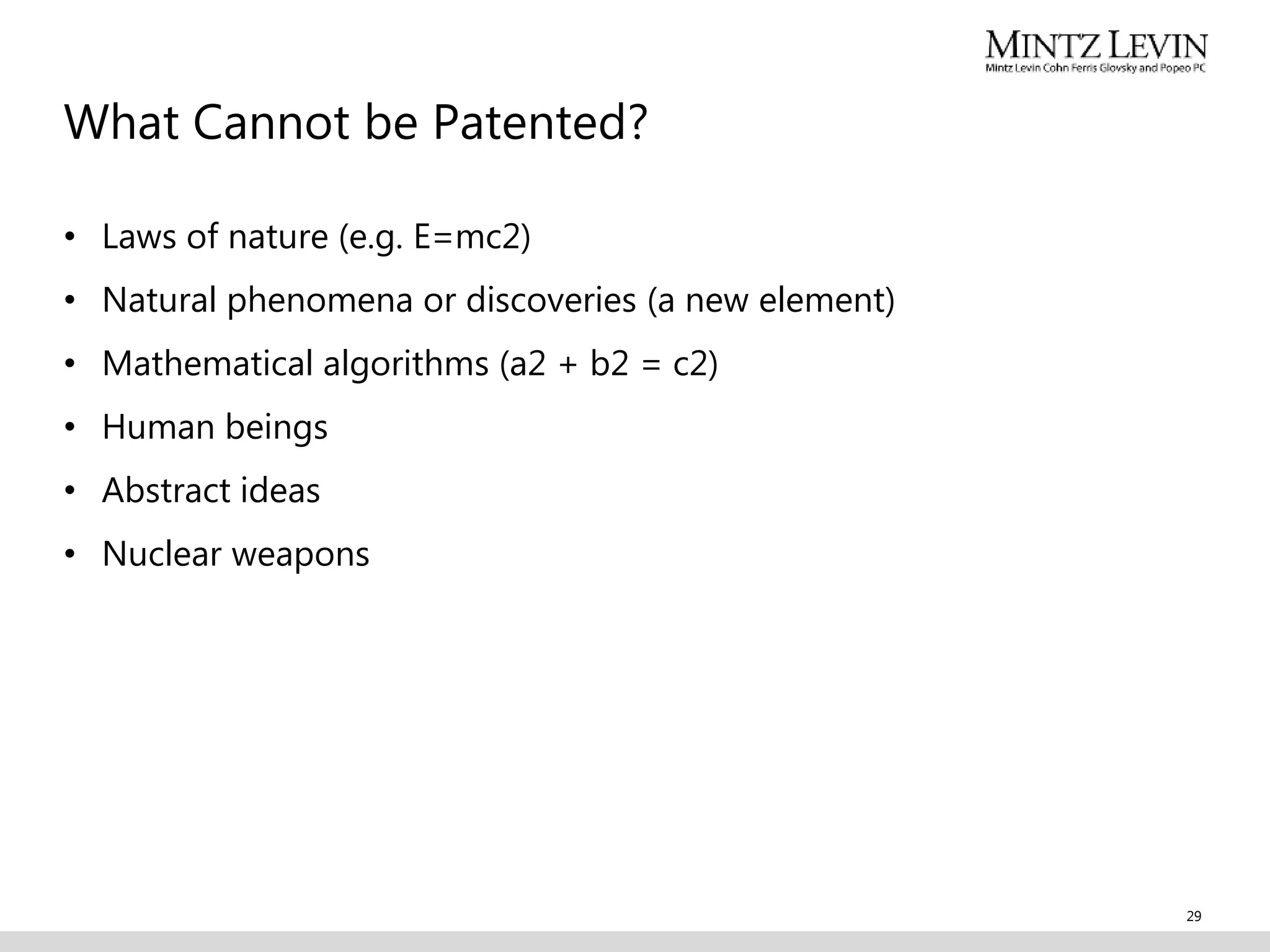
What Cannot be Patented?
• Laws of nature (e.g. E=mc2)
• Natural phenomena or discoveries (a new element)
• Mathematical algorithms (a2 + b2 = c2)
• Human beings
• Abstract ideas
• Nuclear weapons
29
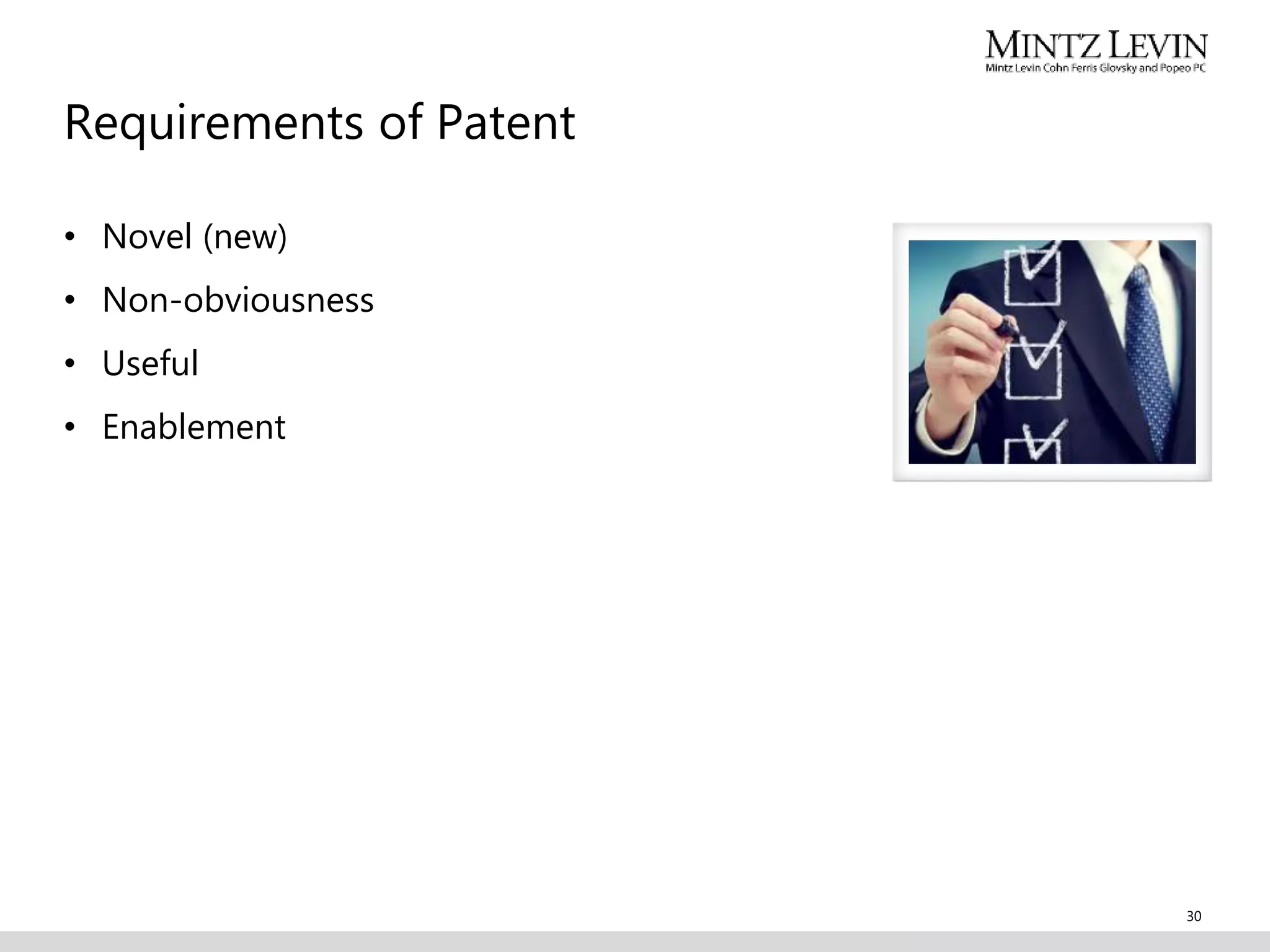
Requirements of Patent
• Novel (new)
• Non-obviousness
• Useful
• Enablement
30
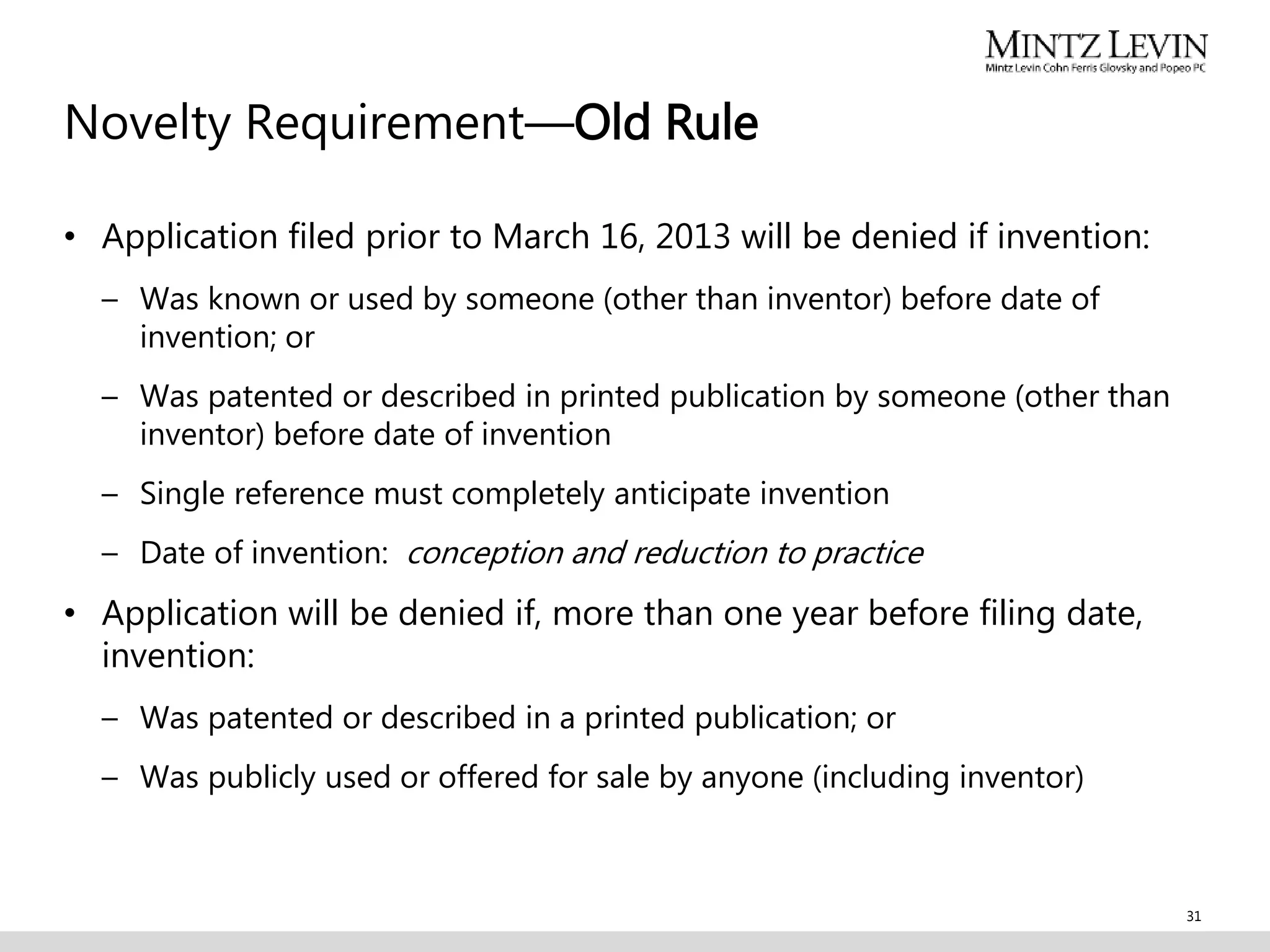
Novelty Requirement—Old Rule
• Application filed prior to March 16, 2013 will be denied if invention:
– Was known or used by someone (other than inventor) before date of
invention; or
– Was patented or described in printed publication by someone (other than
inventor) before date of invention
– Single reference must completely anticipate invention
– Date of invention: conception and reduction to practice
• Application will be denied if, more than one year before filing date,
invention:
– Was patented or described in a printed publication; or
– Was publicly used or offered for sale by anyone (including inventor)
31
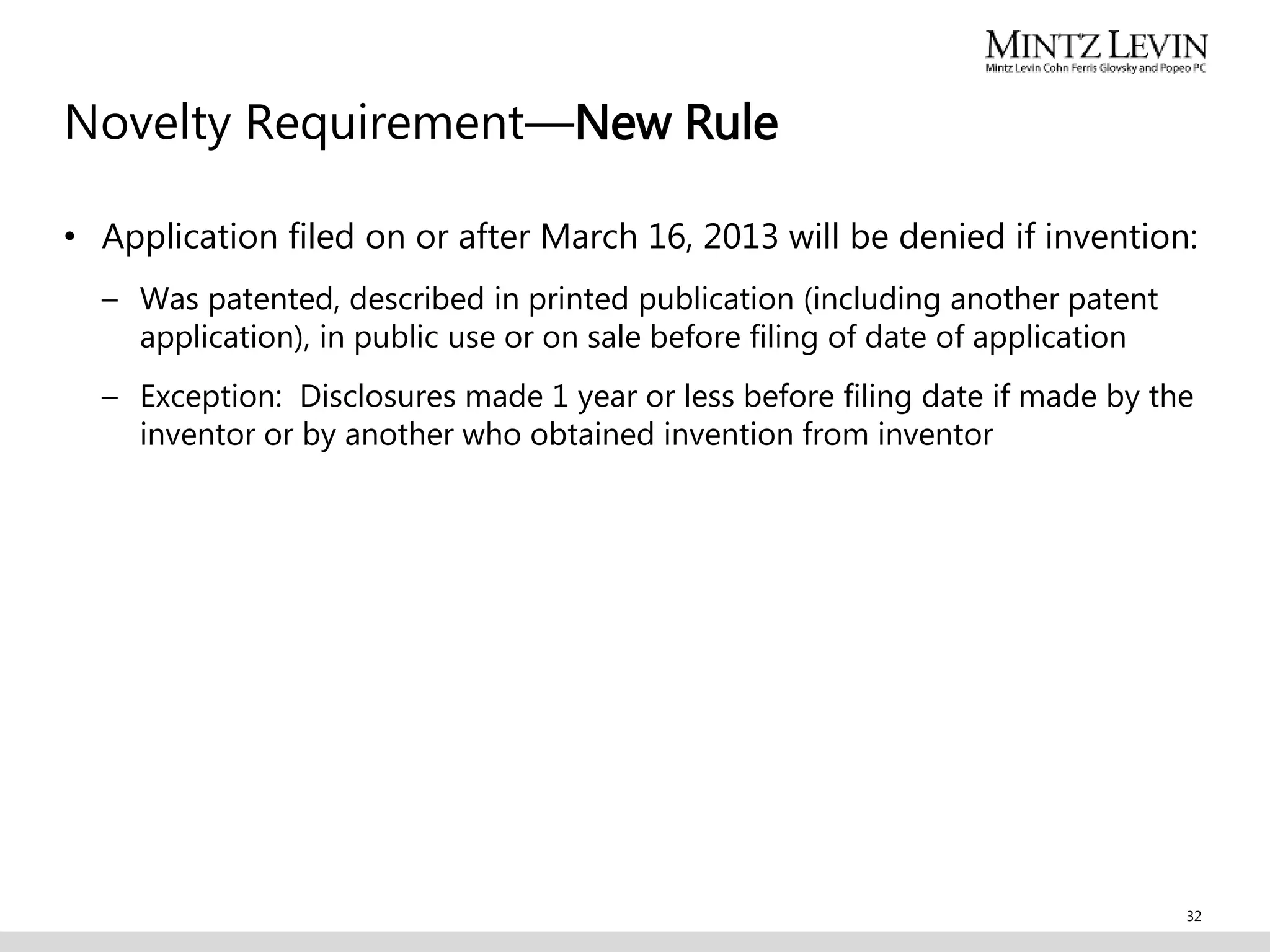
Novelty Requirement—New Rule
• Application filed on or after March 16, 2013 will be denied if invention:
– Was patented, described in printed publication (including another patent
application), in public use or on sale before filing of date of application
– Exception: Disclosures made 1 year or less before filing date if made by the
inventor or by another who obtained invention from inventor
32
Nonobviousness Requirement
• Must not have been obvious to person with ordinary skill in the art
before filing of application (or, prior to 3/16/13, before invention was
made)
• Factors considered:
– Scope and content of prior art
– Difference between the prior art and the claims
– Level of ordinary skill in the pertinent art at the time invention was made
– Any relevant secondary considerations
– Commercial success
– Failure of others
– Long felt need
33
Useful Requirement
• A specific, substantial and credible use
• Must be apparent to a person of ordinary skill in the art
• Need not be superior to existing products
• The invention must be capable of some beneficial use to society
34
Enablement Requirement
• Patent must include description that enables one skilled in the art to
practice invention
• Some experimentation is allowed—factors include:
– Quantity of experimentation required
– Amount of direction presented
– Nature of the invention
– State of the prior art
– Relative skill in the art
– Predictability/unpredictability of the art
35
Parts of a Utility Patent
• The disclosure of a patent application has 4
main parts:
– Abstract (brief description of invention)
– Written description
– Drawing(s) if necessary (graphical illustrations, flow
charts, diagrams, etc.)
– Claim(s)—MOST IMPORTANT PART (tells public
what the patent is protecting)
36
Types of Patent Application
• Provisional – Does not get examined. Used to get a filing date at
USPTO. Must convert provisional patent application to a non-
provisional within 12 months
• Non-Provisional – A patent application which gets examined
• Continuation – It is based on a previous patent application and
contains NO NEW MATTER
• Continuation-in-part – It is based on a previous patent application and
contains some new matter
• Divisional – A patent application that was filed because the USPTO
indicated there was more than one invention
37
Publication
U.S. patent applications will generally get published 18 months from the
filing date/priority date, UNLESS (i) applicant requests no publication
AND (ii) applicant does not file patent outside of the U.S.
38
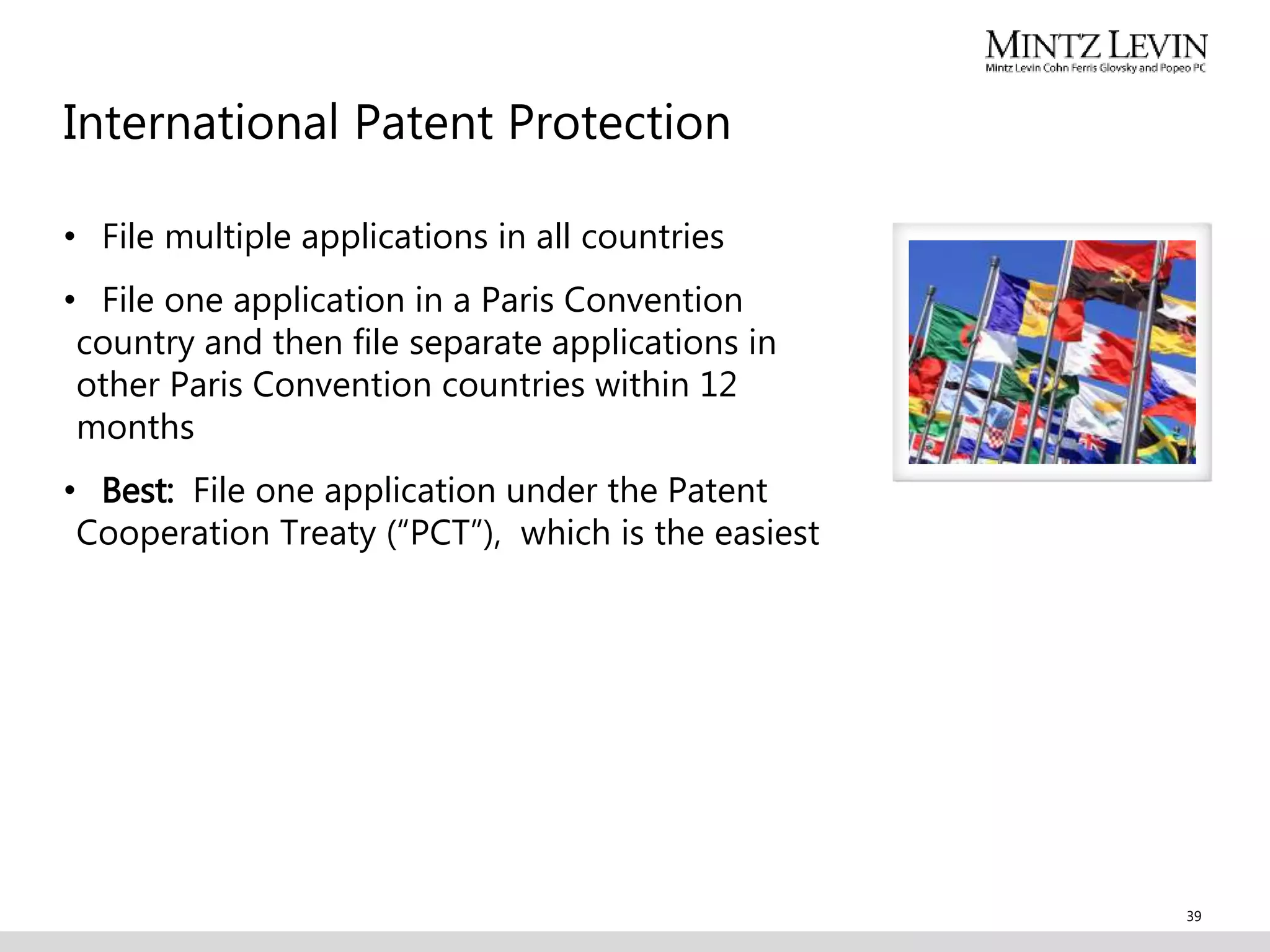
International Patent Protection
• File multiple applications in all countries
• File one application in a Paris Convention
country and then file separate applications in
other Paris Convention countries within 12
months
• Best: File one application under the Patent
Cooperation Treaty (“PCT”), which is the easiest
39
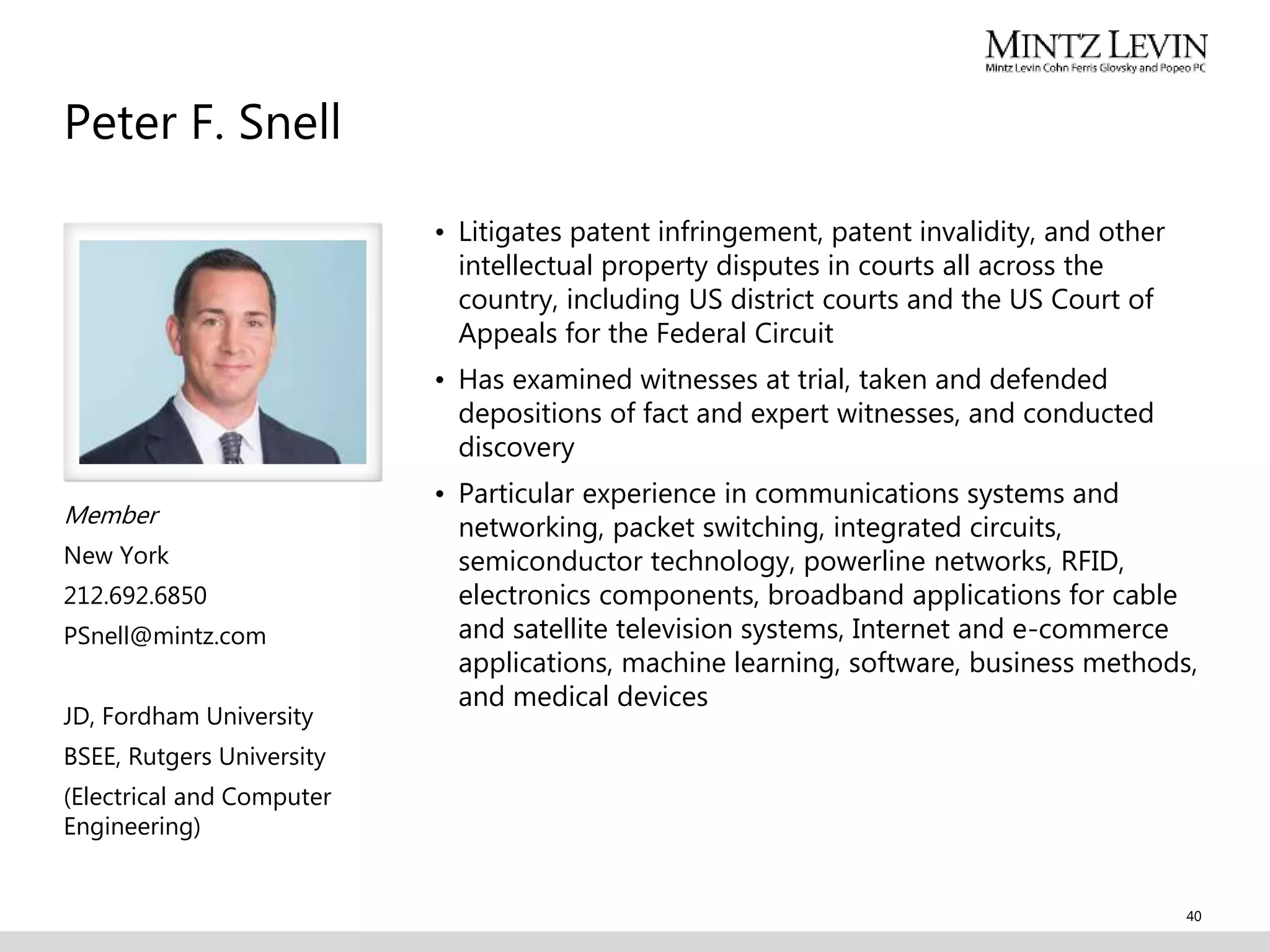
Member
New York
212.692.6850
PSnell@mintz.com
JD, Fordham University
BSEE, Rutgers University
(Electrical and Computer
Engineering)
• Litigates patent infringement, patent invalidity, and other
intellectual property disputes in courts all across the
country, including US district courts and the US Court of
Appeals for the Federal Circuit
• Has examined witnesses at trial, taken and defended
depositions of fact and expert witnesses, and conducted
discovery
• Particular experience in communications systems and
networking, packet switching, integrated circuits,
semiconductor technology, powerline networks, RFID,
electronics components, broadband applications for cable
and satellite television systems, Internet and e-commerce
applications, machine learning, software, business methods,
and medical devices
Peter F. Snell
40

Intellectual Property: What is intellectual property, and why is it important?

  • 1.
    Mintz Levin. Notyour standard practice. Intellectual Property What is Intellectual Property, and Why is it Important?
  • 2.
    General Discussion Topics 2 •Trademarks – Trademarks vs. Copyrights – Trademark Clearance – Federal Trademark Application Process – Proper Trademark Usage • Copyrights – What is a Copyright? – Common Pitfalls - Third party contributions, "private use" and "public domain" – Derivative Works – The importance of Federal registration
  • 3.
    General Discussion Topics 3 •Trade Secrets • Patents – What is protectable? – The patent process – U.S. and rest of world (e.g., AIA and first-to-file provisions) – Do I have freedom to operate (FTO) in view of third-party patents? – Protecting software innovations – Employment agreement pitfalls
  • 4.
    Forms of IntellectualProperty • Trademarks • Copyrights • Trade Secrets • Patents 4
  • 5.
  • 6.
    What is aTrademark? • Created by state and federal law (common law vs. registered) • A word, name, phrase, symbol or device that helps consumers identify a product or service and distinguish them from the products and services of competitors (i.e. an "indicator of source") 6
  • 7.
    Duration and Benefitsof Trademark • Rights exist when mark used in commerce, but without a Federal registration, they are limited to geographic area in which used • Unlimited in duration as long as mark is continuously used in commerce and does not become “generic” (e.g., Aspirin, Band-Aid, Scotch Tape) • Owner may prevent others from using mark if public likely to be confused 7
  • 8.
  • 9.
    Choosing Trademarks • Developbranding strategy • Develop numerous alternatives – Focus on distinctive names • Clearance Searches to Determine Other Potential Users – U.S. Patent and Trademark Office database – State registries – Popular Search engines • Narrow down 9
  • 10.
    Trademark Clearance • Whatis clearance searching? • Why Search? – Two Purposes • offensive (understanding potential registration problems and limitations) • defensive (understanding potential use problems) – Costs – Benefits • Understand landscape • Assists with drafting identifications to minimize "Office Actions" • Preliminary or "Knockout" vs. Comprehensive or "Full" 10
  • 11.
    Registration • May filefor federal registration with U. S. Patent and Trademark Office (about 18+ month wait)—Also may file with state • Must determine one or more classes and describe goods/services • USPTO Examination Process • Benefits of Federal Registration: – Presumption of nationwide rights (vs. "local" common law rights) – Right to sue in federal court and seek statutory damages and attorneys fees – Trademark achieves incontestable status after five years of registration and continuous use – limits objections by third parties – Right to use the "®" symbol 11
  • 12.
    Proper Trademark Usage ®Mark has been registered with the USPTO— It may be a service mark or a trademark TM An unregistered (or registration is pending) trademark for equipment, software or other products SM An unregistered (or registration is pending) service mark; used for services • Set off Mark - Color, font, size, initial capitalization • Do not use Descriptively, always as a trademark • Never use as a noun or verb, e.g. I'm going to Google this • Always use as adjective, e.g. I bough a new Apple computer 12
  • 13.
  • 14.
    What is aCopyright? • Created by federal law • Original work of authorship • Fixed in a tangible medium • Must be nonfunctional expression • Owned by author unless “work for hire” -- Must get assignment from contractors – Created by employee in the scope of his/her employment – Specially created or commissioned and created by IC with a writing stating it is work for hire, and work is one of nine enumerated types of works (17 U.S.C. Sec. 101) 14
  • 15.
    Examples of Copyrights •Software code • Manuals, publications, blueprints • Website content • Graphics • Music and video • Fabric design 15
  • 16.
    Duration of aCopyright • Rights exist from the moment created: – But federal registration required to enforce and recover statutory damages and legal fees • Duration: – If work for hire, 95 years from publication or 120 years from creation (whichever is first) – If not work for hire, life of author + 70 years 16
  • 17.
    Benefits of aCopyright • Owner may prevent others from: – Making copies – Preparing derivative works – Distributing copies – Performing the work – Displaying the work • Exception: “fair use” – Factors: purpose of new use (is it "transformative"), nature of copyright, amount and substantiality of portion taken, effect on the market for original 17
  • 18.
    Benefits of aCopyright • Common Pitfalls – Not properly taking into account third party material – Improper assignments from independent contractors – Believing the "private use" fallacy – Assuming something is "public domain" because it can be easily copied or obtained on the internet – Software exists to scan the internet for infringement, and this is an area where many business are trying to create a revenue stream 18
  • 19.
  • 20.
    What is aTrade Secret? • Created by state law • Information, including formula, pattern, compilation, program, device, method, technique or process that is: 1. Valuable because it’s secret; and 2. Owner takes reasonable efforts to maintain secrecy 20
  • 21.
    Examples of TradeSecrets • Formulas (e.g., for Coke) • Software programs • Business methods • Customer lists • Financial forecasts (business plans) • Pricing information 21
  • 22.
    Duration and Benefitsof Trade Secrets • Rights exist when created • Unlimited in duration if kept secret • Owner may prevent others from “misappropriating” trade secrets 22
  • 23.
    How Do YouMaintain Secrecy? • Adopt policies to protect against disclosure • Communicate policies to employees • Third parties must sign non-disclosure agreements (“NDAs”) • Implement physical safeguards 23
  • 24.
  • 25.
    What is apatent? • Created by federal law (and laws of other countries) • Government grant to exclude others from making, using, selling, offering for sale or importing the patented invention • Inventors must disclose the details of the invention to the public • But, does not give owner “right to practice” (i.e., use the invention) 25
  • 26.
    Types of Patents •Utility patents (most common) – Protects the way the invention is used and works • Design patents – Protects the way the invention looks (ornamentality) 26
  • 27.
    Filing of Applicationand Duration • All individual inventors must file a patent application with U.S. Patent and Trademark Office (although patent usually assigned to an entity) • A utility patent expires 20 years from filing date (may be extended if USPTO caused unreasonable delay) • A design patent expires 14 years after it is issued 27
  • 28.
    What Can bePatented? • Machines • Articles of manufacture • Processes or business methods • Compositions of matter 28
  • 29.
    What Cannot bePatented? • Laws of nature (e.g. E=mc2) • Natural phenomena or discoveries (a new element) • Mathematical algorithms (a2 + b2 = c2) • Human beings • Abstract ideas • Nuclear weapons 29
  • 30.
    Requirements of Patent •Novel (new) • Non-obviousness • Useful • Enablement 30
  • 31.
    Novelty Requirement—Old Rule •Application filed prior to March 16, 2013 will be denied if invention: – Was known or used by someone (other than inventor) before date of invention; or – Was patented or described in printed publication by someone (other than inventor) before date of invention – Single reference must completely anticipate invention – Date of invention: conception and reduction to practice • Application will be denied if, more than one year before filing date, invention: – Was patented or described in a printed publication; or – Was publicly used or offered for sale by anyone (including inventor) 31
  • 32.
    Novelty Requirement—New Rule •Application filed on or after March 16, 2013 will be denied if invention: – Was patented, described in printed publication (including another patent application), in public use or on sale before filing of date of application – Exception: Disclosures made 1 year or less before filing date if made by the inventor or by another who obtained invention from inventor 32
  • 33.
    Nonobviousness Requirement • Mustnot have been obvious to person with ordinary skill in the art before filing of application (or, prior to 3/16/13, before invention was made) • Factors considered: – Scope and content of prior art – Difference between the prior art and the claims – Level of ordinary skill in the pertinent art at the time invention was made – Any relevant secondary considerations – Commercial success – Failure of others – Long felt need 33
  • 34.
    Useful Requirement • Aspecific, substantial and credible use • Must be apparent to a person of ordinary skill in the art • Need not be superior to existing products • The invention must be capable of some beneficial use to society 34
  • 35.
    Enablement Requirement • Patentmust include description that enables one skilled in the art to practice invention • Some experimentation is allowed—factors include: – Quantity of experimentation required – Amount of direction presented – Nature of the invention – State of the prior art – Relative skill in the art – Predictability/unpredictability of the art 35
  • 36.
    Parts of aUtility Patent • The disclosure of a patent application has 4 main parts: – Abstract (brief description of invention) – Written description – Drawing(s) if necessary (graphical illustrations, flow charts, diagrams, etc.) – Claim(s)—MOST IMPORTANT PART (tells public what the patent is protecting) 36
  • 37.
    Types of PatentApplication • Provisional – Does not get examined. Used to get a filing date at USPTO. Must convert provisional patent application to a non- provisional within 12 months • Non-Provisional – A patent application which gets examined • Continuation – It is based on a previous patent application and contains NO NEW MATTER • Continuation-in-part – It is based on a previous patent application and contains some new matter • Divisional – A patent application that was filed because the USPTO indicated there was more than one invention 37
  • 38.
    Publication U.S. patent applicationswill generally get published 18 months from the filing date/priority date, UNLESS (i) applicant requests no publication AND (ii) applicant does not file patent outside of the U.S. 38
  • 39.
    International Patent Protection •File multiple applications in all countries • File one application in a Paris Convention country and then file separate applications in other Paris Convention countries within 12 months • Best: File one application under the Patent Cooperation Treaty (“PCT”), which is the easiest 39
  • 40.
    Member New York 212.692.6850 PSnell@mintz.com JD, FordhamUniversity BSEE, Rutgers University (Electrical and Computer Engineering) • Litigates patent infringement, patent invalidity, and other intellectual property disputes in courts all across the country, including US district courts and the US Court of Appeals for the Federal Circuit • Has examined witnesses at trial, taken and defended depositions of fact and expert witnesses, and conducted discovery • Particular experience in communications systems and networking, packet switching, integrated circuits, semiconductor technology, powerline networks, RFID, electronics components, broadband applications for cable and satellite television systems, Internet and e-commerce applications, machine learning, software, business methods, and medical devices Peter F. Snell 40