Gary Townley Business, Outreach & Education  An Introduction to  Intellectual Property
Intellectual Property Office  Executive Agency within Department of Business, Innovation and Skills (BIS) 850+ staff based in Newport in South Wales, 30 based in Bloomsbury, London Our task is to help stimulate innovation and raise the international competitiveness of British industry through Intellectual Property Rights (IPR)
IP Baseline Survey 96% of UK businesses do not know the value of their Intellectual Property Rights Only 11% of UK businesses know that disclosure of an invention before filing will invalidate a patent 74% of UK businesses could not correctly identify the owner of copyright when using a subcontractor Only 4% of UK businesses have an Intellectual Property policy
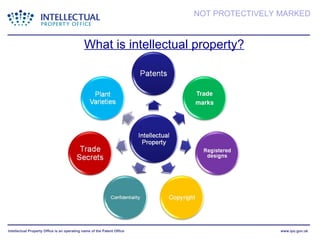
What is intellectual property? What makes your business different from your competitors? What makes your business stand out from the crowd?  Name? Service? Product? Look? What is your USP?
What is intellectual property?
Trade Marks
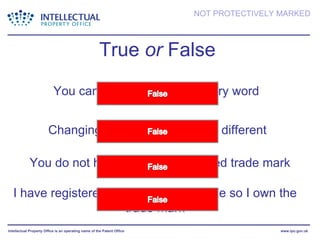
True  or  False You cannot register a dictionary word Changing the spelling makes it different You do not have to use a registered trade mark I have registered at Companies House so I own the trade mark
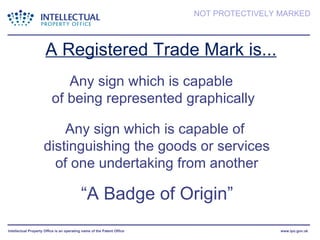
A Registered Trade Mark is... Any sign which is capable  of being represented graphically Any sign which is capable of  distinguishing the goods or services of one undertaking from another “ A Badge of Origin”
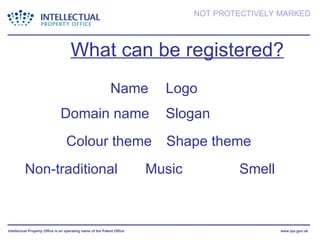
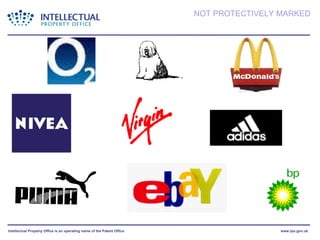
What can be registered? Smell Colour theme Shape theme Domain name Slogan Name Logo Non-traditional Music
 
The Hard Part Totally invented words Usually between 4 and 8 letters No meaning in any language Luck
Why infringement searches? Avoid expensive mistakes Awareness of competing marks Early resolution of potential problems
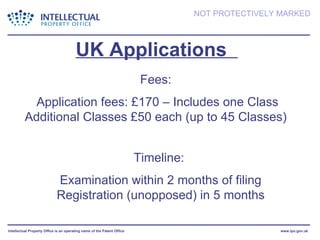
UK Applications  Fees:  Application fees: £170 – Includes one Class Additional Classes £50 each (up to 45 Classes)  Timeline:  Examination within 2 months of filing Registration (unopposed) in 5 months
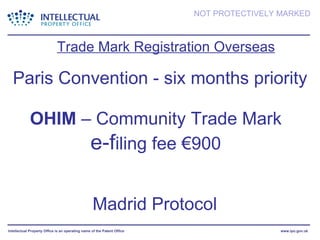
Trade Mark Registration Overseas Paris Convention - six months priority OHIM  – Community Trade Mark e-f iling fee €900 Madrid Protocol
Registered Designs
 
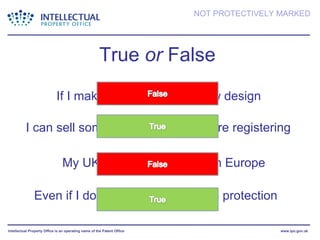
True  or  False If I make 6 changes it’s a new design I can sell some of the designs before registering  My UK design protects me in Europe Even if I don’t register I may have protection
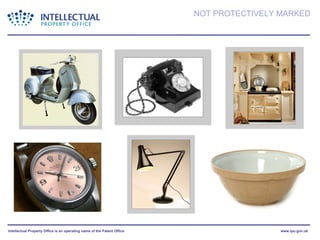
Registered Designs Protects shape or configuration (3-D) and/or pattern or ornamentation (2-D) No protection for function, materials or technology of manufacture No protection when form is dictated by function (ie:  no design freedom )
Registered Designs Design protected without limitation to a specific product or article Design protected even if applied to  single items or handicraft products Protection for component parts if ordinarily on view when in use
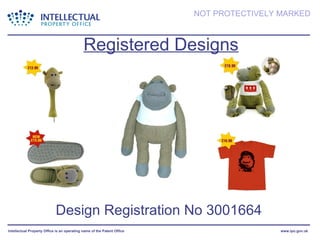
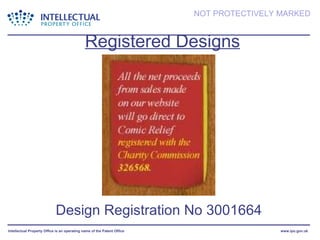
Design Registration No 3001664 Registered Designs
Multiple Applications £60 for first design  (£40 application + £20 publication) £40 for subsequent designs  (£20 application + £20 publication Renewal fees every 5 years Maximum term 25 years
Registration Overseas Paris Convention – 6 Months OHIM - Community Design Hague Agreement (1/1/2008)
Patents
 
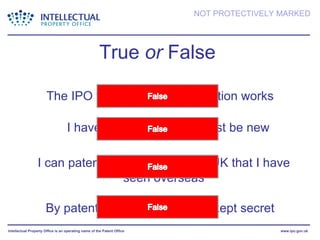
True  or  False The IPO test to see if the invention works I haven’t seen one so it must be new I can patent an invention in the UK that I have seen overseas By patenting my idea it will be kept secret
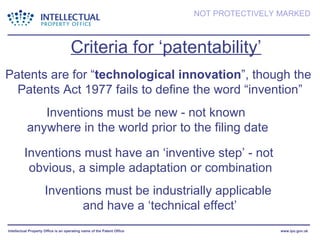
Criteria for ‘patentability’ Patents are for “ technological innovation ”, though the  Patents Act 1977 fails to define the word “invention” Inventions must be new - not known  anywhere in the world prior to the filing date Inventions must have an ‘inventive step’ - not  obvious, a simple adaptation or combination Inventions must be industrially applicable  and have a ‘technical effect’
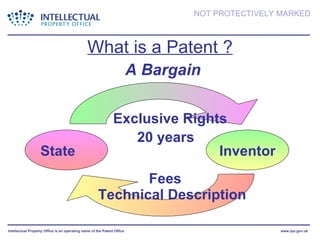
What is a Patent ? A Bargain State Inventor Fees Technical Description Exclusive Rights 20 years
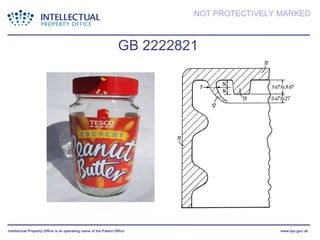
GB 2222821
Patent fees Application fee – £30 or £20 (Electronic filing) Search Fee - £150 or £130 (Electronic filing) Examination fee - £100 or £80 (Electronic filing) Renewals  5 th  Year - £70 10 th  Year - £170 20 th  Year - £600
Obtaining Patent Protection Abroad Separate national filings Patent Co-operation Treaty (PCT) European Patent Convention (EPC)
Working with others Prior use or disclosure will invalidate a patent  application - use ‘Confidentiality Agreements’ Agree in writing who will own any I.P. arising  from the collaboration  before  commercialisation
Copyright
True  or  False If it doesn’t have a copyright notice, it’s not protected I can copy 10% without it being an infringement  If I acknowledge the original work, I can use it I have bought the book/painting/photograph so I can use it as I wish
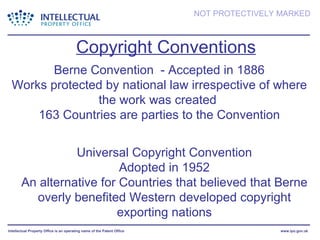
Copyright Conventions Universal Copyright Convention Adopted in 1952 An alternative for Countries that believed that Berne overly benefited Western developed copyright exporting nations Berne Convention  - Accepted in 1886 Works protected by national law irrespective of where the work was created  163 Countries are parties to the Convention
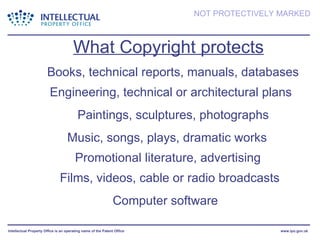
What Copyright protects Books, technical reports, manuals, databases Engineering, technical or architectural plans Paintings, sculptures, photographs Music, songs, plays, dramatic works Promotional literature, advertising Films, videos, cable or radio broadcasts Computer software
How long does Copyright last? Literary, musical, artistic & dramatic works: author’s lifetime plus 70 years Sound recordings, TV & radio broadcasts & cable programmes: 50 years from first broadcast Publishers’ right (typographical layout  etc .): 25 years Films: 70 years after the death of the last of: director, composer of the score, the author of the screenplay and the scriptwriter
Who owns Copyright? Usually the first creator or author... … or their employer if produced in the ordinary course of their employment However, a contractor will retain ownership unless their contract is explicit to the contrary Even if the creator sells their rights, they have ‘ moral rights’ over how their work is used
Top Dead Earners 2011 1. Michael Jackson - $170m 2. Elvis Presley – $55m 3. Marilyn Monroe - $27m 4. Charles Shultz - $25m 5. John Lennon - $12m 6. Elizabeth Taylor - $12m 7. Albert Einstein - $10m 8. Theodor Geisel - $9m 9. Jimi Hendrix - $7m 10. Stieg Larsson - $7m Shakespeare – 7th $12m Source Forbes.com
Copyright for Business Mark work with the international copyright symbol © Electronic fingerprints Look at licensing and assignment opportunities Regularly review contracts (business and employees) Record the work in some way
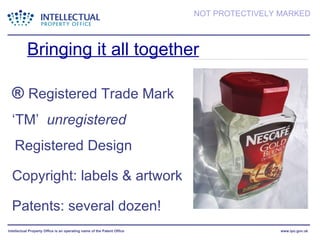
Registered Design Copyright: labels & artwork ®   Registered Trade Mark ‘ TM’  unregistered  Patents: several dozen! Bringing it all together
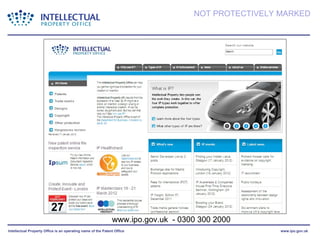
www.ipo.gov.uk  - 0300 300 2000
IP Healthcheck Free online diagnosis Patents, Trade marks, Designs & Copyright Licensing and exploiting your IP Confidential Information 7 On line IP Healthchecks
Thank you Gary Townley [email_address]

An Introduction To Intellectual Property. By Intellectual Property Office

  • 1.
    Gary Townley Business,Outreach & Education An Introduction to Intellectual Property
  • 2.
    Intellectual Property Office Executive Agency within Department of Business, Innovation and Skills (BIS) 850+ staff based in Newport in South Wales, 30 based in Bloomsbury, London Our task is to help stimulate innovation and raise the international competitiveness of British industry through Intellectual Property Rights (IPR)
  • 3.
    IP Baseline Survey96% of UK businesses do not know the value of their Intellectual Property Rights Only 11% of UK businesses know that disclosure of an invention before filing will invalidate a patent 74% of UK businesses could not correctly identify the owner of copyright when using a subcontractor Only 4% of UK businesses have an Intellectual Property policy
  • 4.
    What is intellectualproperty? What makes your business different from your competitors? What makes your business stand out from the crowd? Name? Service? Product? Look? What is your USP?
  • 5.
  • 6.
  • 7.
    True or False You cannot register a dictionary word Changing the spelling makes it different You do not have to use a registered trade mark I have registered at Companies House so I own the trade mark
  • 8.
    A Registered TradeMark is... Any sign which is capable of being represented graphically Any sign which is capable of distinguishing the goods or services of one undertaking from another “ A Badge of Origin”
  • 9.
    What can beregistered? Smell Colour theme Shape theme Domain name Slogan Name Logo Non-traditional Music
  • 10.
  • 11.
    The Hard PartTotally invented words Usually between 4 and 8 letters No meaning in any language Luck
  • 12.
    Why infringement searches?Avoid expensive mistakes Awareness of competing marks Early resolution of potential problems
  • 13.
    UK Applications Fees: Application fees: £170 – Includes one Class Additional Classes £50 each (up to 45 Classes) Timeline: Examination within 2 months of filing Registration (unopposed) in 5 months
  • 14.
    Trade Mark RegistrationOverseas Paris Convention - six months priority OHIM – Community Trade Mark e-f iling fee €900 Madrid Protocol
  • 15.
  • 16.
  • 17.
    True or False If I make 6 changes it’s a new design I can sell some of the designs before registering My UK design protects me in Europe Even if I don’t register I may have protection
  • 18.
    Registered Designs Protectsshape or configuration (3-D) and/or pattern or ornamentation (2-D) No protection for function, materials or technology of manufacture No protection when form is dictated by function (ie: no design freedom )
  • 19.
    Registered Designs Designprotected without limitation to a specific product or article Design protected even if applied to single items or handicraft products Protection for component parts if ordinarily on view when in use
  • 20.
    Design Registration No3001664 Registered Designs
  • 21.
    Design Registration No3001664 Registered Designs
  • 22.
    Multiple Applications £60for first design (£40 application + £20 publication) £40 for subsequent designs (£20 application + £20 publication Renewal fees every 5 years Maximum term 25 years
  • 23.
    Registration Overseas ParisConvention – 6 Months OHIM - Community Design Hague Agreement (1/1/2008)
  • 24.
  • 25.
  • 26.
    True or False The IPO test to see if the invention works I haven’t seen one so it must be new I can patent an invention in the UK that I have seen overseas By patenting my idea it will be kept secret
  • 27.
    Criteria for ‘patentability’Patents are for “ technological innovation ”, though the Patents Act 1977 fails to define the word “invention” Inventions must be new - not known anywhere in the world prior to the filing date Inventions must have an ‘inventive step’ - not obvious, a simple adaptation or combination Inventions must be industrially applicable and have a ‘technical effect’
  • 28.
    What is aPatent ? A Bargain State Inventor Fees Technical Description Exclusive Rights 20 years
  • 29.
  • 30.
    Patent fees Applicationfee – £30 or £20 (Electronic filing) Search Fee - £150 or £130 (Electronic filing) Examination fee - £100 or £80 (Electronic filing) Renewals 5 th Year - £70 10 th Year - £170 20 th Year - £600
  • 31.
    Obtaining Patent ProtectionAbroad Separate national filings Patent Co-operation Treaty (PCT) European Patent Convention (EPC)
  • 32.
    Working with othersPrior use or disclosure will invalidate a patent application - use ‘Confidentiality Agreements’ Agree in writing who will own any I.P. arising from the collaboration before commercialisation
  • 33.
  • 34.
    True or False If it doesn’t have a copyright notice, it’s not protected I can copy 10% without it being an infringement If I acknowledge the original work, I can use it I have bought the book/painting/photograph so I can use it as I wish
  • 35.
    Copyright Conventions UniversalCopyright Convention Adopted in 1952 An alternative for Countries that believed that Berne overly benefited Western developed copyright exporting nations Berne Convention - Accepted in 1886 Works protected by national law irrespective of where the work was created 163 Countries are parties to the Convention
  • 36.
    What Copyright protectsBooks, technical reports, manuals, databases Engineering, technical or architectural plans Paintings, sculptures, photographs Music, songs, plays, dramatic works Promotional literature, advertising Films, videos, cable or radio broadcasts Computer software
  • 37.
    How long doesCopyright last? Literary, musical, artistic & dramatic works: author’s lifetime plus 70 years Sound recordings, TV & radio broadcasts & cable programmes: 50 years from first broadcast Publishers’ right (typographical layout etc .): 25 years Films: 70 years after the death of the last of: director, composer of the score, the author of the screenplay and the scriptwriter
  • 38.
    Who owns Copyright?Usually the first creator or author... … or their employer if produced in the ordinary course of their employment However, a contractor will retain ownership unless their contract is explicit to the contrary Even if the creator sells their rights, they have ‘ moral rights’ over how their work is used
  • 39.
    Top Dead Earners2011 1. Michael Jackson - $170m 2. Elvis Presley – $55m 3. Marilyn Monroe - $27m 4. Charles Shultz - $25m 5. John Lennon - $12m 6. Elizabeth Taylor - $12m 7. Albert Einstein - $10m 8. Theodor Geisel - $9m 9. Jimi Hendrix - $7m 10. Stieg Larsson - $7m Shakespeare – 7th $12m Source Forbes.com
  • 40.
    Copyright for BusinessMark work with the international copyright symbol © Electronic fingerprints Look at licensing and assignment opportunities Regularly review contracts (business and employees) Record the work in some way
  • 41.
    Registered Design Copyright:labels & artwork ® Registered Trade Mark ‘ TM’ unregistered Patents: several dozen! Bringing it all together
  • 42.
    www.ipo.gov.uk -0300 300 2000
  • 43.
    IP Healthcheck Freeonline diagnosis Patents, Trade marks, Designs & Copyright Licensing and exploiting your IP Confidential Information 7 On line IP Healthchecks
  • 44.
    Thank you GaryTownley [email_address]

Editor's Notes

  • #11 No endorsement but…
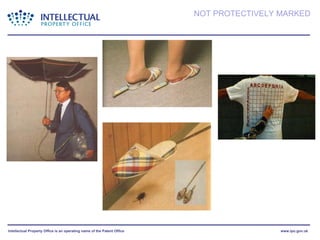
  • #26 Wacky patents - if you have an idea for an invention make sure there is a market for your product – dust coat for a dog /do you see many dogs walking around wearing dustcoats? Antennae on space suit? Would you buy one Spongy boots and parachute would you buy one?