What Every Business in
Wales needs to know about
Intellectual Property
Jane Lambert
9 Feb 2021
Topics to be discussed
● What’s the difference between “Intellectual Property” and “Intellectual
Assets”?
● Why is intellectual property important?
● What sort of intellectual assets are likely to be in your business?
● What sort of intellectual property rights are available for your business?
● How do you register those rights?
● How do you enforce and defend those rights?
Difference between “IP” and “Intellectual Assets”?
● Terms are often used interchangeably by people who ought to know better.
● An intellectual asset is a creation of the mind that gives one undertaking an
advantage over its competitors such as an invention, an attractive product
design, a website or goodwill.
● Intellectual property is the legal protection of those assets such as a patent for
an invention, the registration of a design, a copyright for a website or a trade
mark for a brand.
Why is Intellectual Property important?
● Correct use of intellectual property can make or break a business:
○ For many businesses the IP right is its most valuable asset
○ The Coca Cola mark for The Coca Cola Company
○ The shape of the iPhone for Apple
○ The copyrights in “Windows” for Microsoft
○ The patent for aspirin for Bayer
● Infringing another company’s IP rights can result in:
○ An order to stop making, selling or using a product or brand
○ Reputational damage
○ Piracy, counterfeiting or bootlegging, imprisonment, fines, costs and other sanctions
Every Business has some Intellectual Assets
● Reputation in the marketplace
● Artwork and copy for advertising, marketing and promotion
● Website
● Customer and supplier records
● Complaints and feedback
● Market research data
● Trade secrets
● New product development
● New designs
Most Businesses also have some Intellectual Property
● The right to prevent a competitor from using the same or similar name, mark
or get-up to trick consumers into dealing with the competitor known as
passing off.
● The right to restrain someone who has received secret information in
confidence from using or disclosing that information.
● The right to prevent unauthorized copying of artwork, copy, photos, software
or other artistic or literary work.
● The right to prevent unauthorized extraction and reutilization of data..The right
to prevent unauthorized reproduction of an original design.
● The right to prevent unauthorized reproduction of a registrable design.
Some want to register Patents, Trade Marks Etc
● Patents: Monopoly of a new invention for up to 20 years
○ Products
○ Processes.
● Trade Mark: Exclusive right to use a name, mark or other sign in relation to
specified goods or services that can be renewed indefinitely.
● Registered Designs: Exclusive right to use ta new design with individual
character for up to 25 years.
● Plant Varieties: Exclusive right to propagate a new plant variety (25 years for
plants or 30 years for trees, vines or potatoes).
Exploiting Intellectual Property Rights
● Intellectual property rights can limit competition but they can also generate
income through licensing, cross-licensing and assignment.
● Licensing is allowing another person to do something that would otherwise be
unlawful.
● Cross-licensing is where different manufacturers each with the right to block
the other from a market grant rights to make or use each other’s inventions so
that both can enter the market.
● Assignment is an outright sale of the intellectual property right.
Registering Intellectual Property Rights
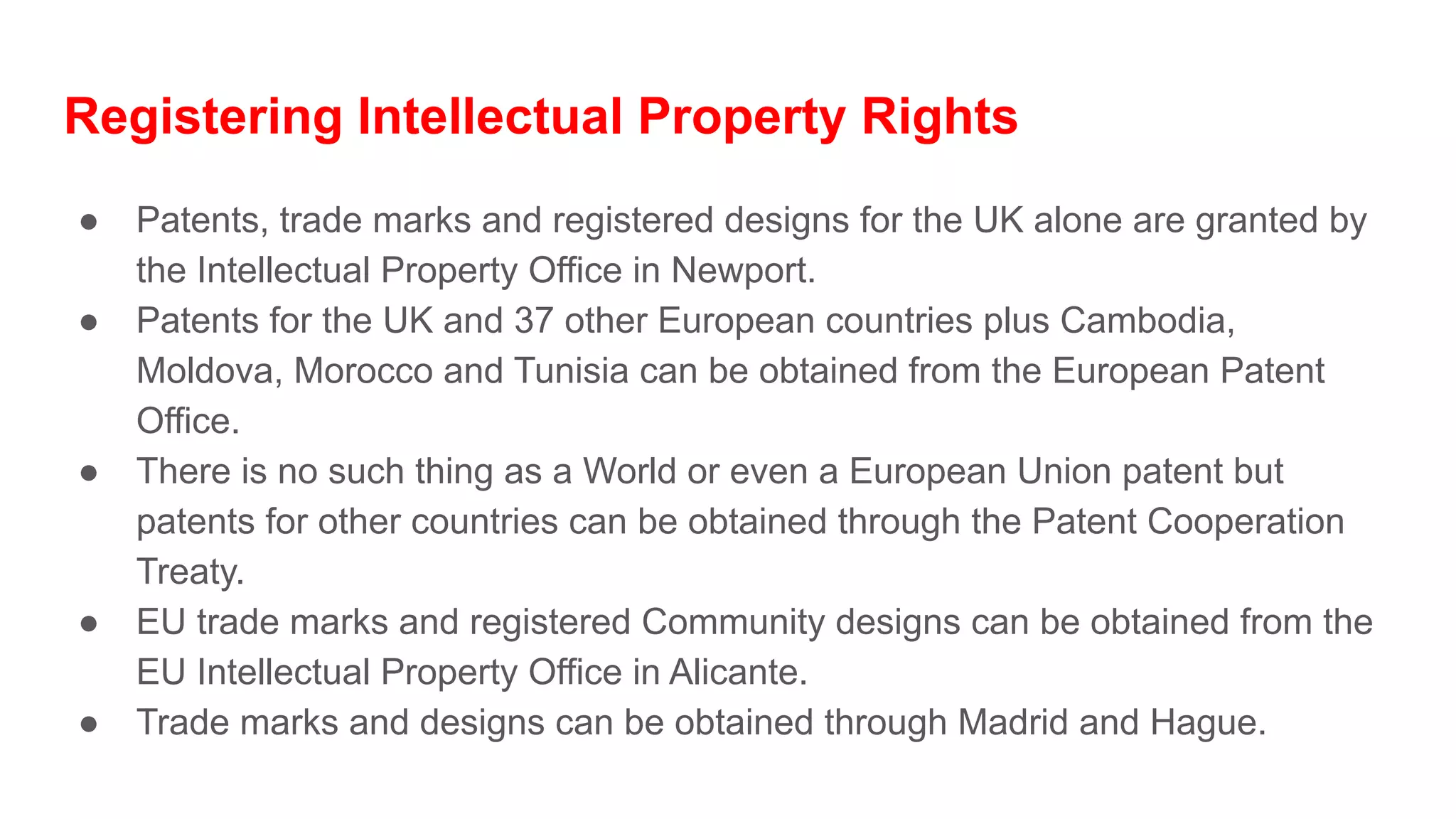
● Patents, trade marks and registered designs for the UK alone are granted by
the Intellectual Property Office in Newport.
● Patents for the UK and 37 other European countries plus Cambodia,
Moldova, Morocco and Tunisia can be obtained from the European Patent
Office.
● There is no such thing as a World or even a European Union patent but
patents for other countries can be obtained through the Patent Cooperation
Treaty.
● EU trade marks and registered Community designs can be obtained from the
EU Intellectual Property Office in Alicante.
● Trade marks and designs can be obtained through Madrid and Hague.
Registering Intellectual Property Rights
● Patents are the most expensive and time consuming to register
○ Searches
○ Attorneys’ fees
○ Office fees
○ Renewal fees.
● Trade Marks require examination and publication and sometimes opposition
○ Searches
○ Attorneys Fees
○ Office Fees.
● Registered Designs are registered without examination
○ Searches
○ Attorneys’ fees
○ Office fees.
Choosing the Right IP Right for the Right Country
● More businesses have been ruined through having too much IP rather than by
not having enough.
● All decisions on patenting or trade mark or design registration should be
consistent with the company’s business and marketing plans.
● A Simple IP Strategy
○ Where are the business’s main income streams over business planning period?
○ What are the main threats to those revenue streams
○ What are the main counter measures that can be taken?
○ What are the most cost-effective legal measures
○ Make arrangements to fund enforcement.
Finding Help
● Patent Attorneys: Regulated by IPReg and members of CIPA. Prosecute
patent and often trade mark and design registration applications. Some have
rights to conduct litigation and represent clients in the Civil Courts.
● Trade Mark Attorneys: Regulated by IPReg and members of CITMA.
Prosecute trade mark and design registration applications. Some have rights
to conduct litigation and represent clients in the Civil Courts.
● Solicitors: Regulated by SRA and members of Law Society. Negotiate and
implement licensing and other transactions and conduct litigation.
● Counsel: Advocates and specialist advisers. Representation in courts and
tribunals, advice on difficult points of law, draft complex legal instruments.
Finding Help
● British Library Business and IP Centre and local centres around England and
Glasgow: Talks, searches, clinics, website and inventors’ clubs.
● PatLib libraries where there is no Business and IP Centre: searches and
clinics.
● Clinics run by CIPA and practitioners.
● NIPC Clinic organized with M-SParc.
● Inventors’ clubs
● Networks of artists, designers and entrepreneurs such as the North Wales
Creatve.
Online Resources
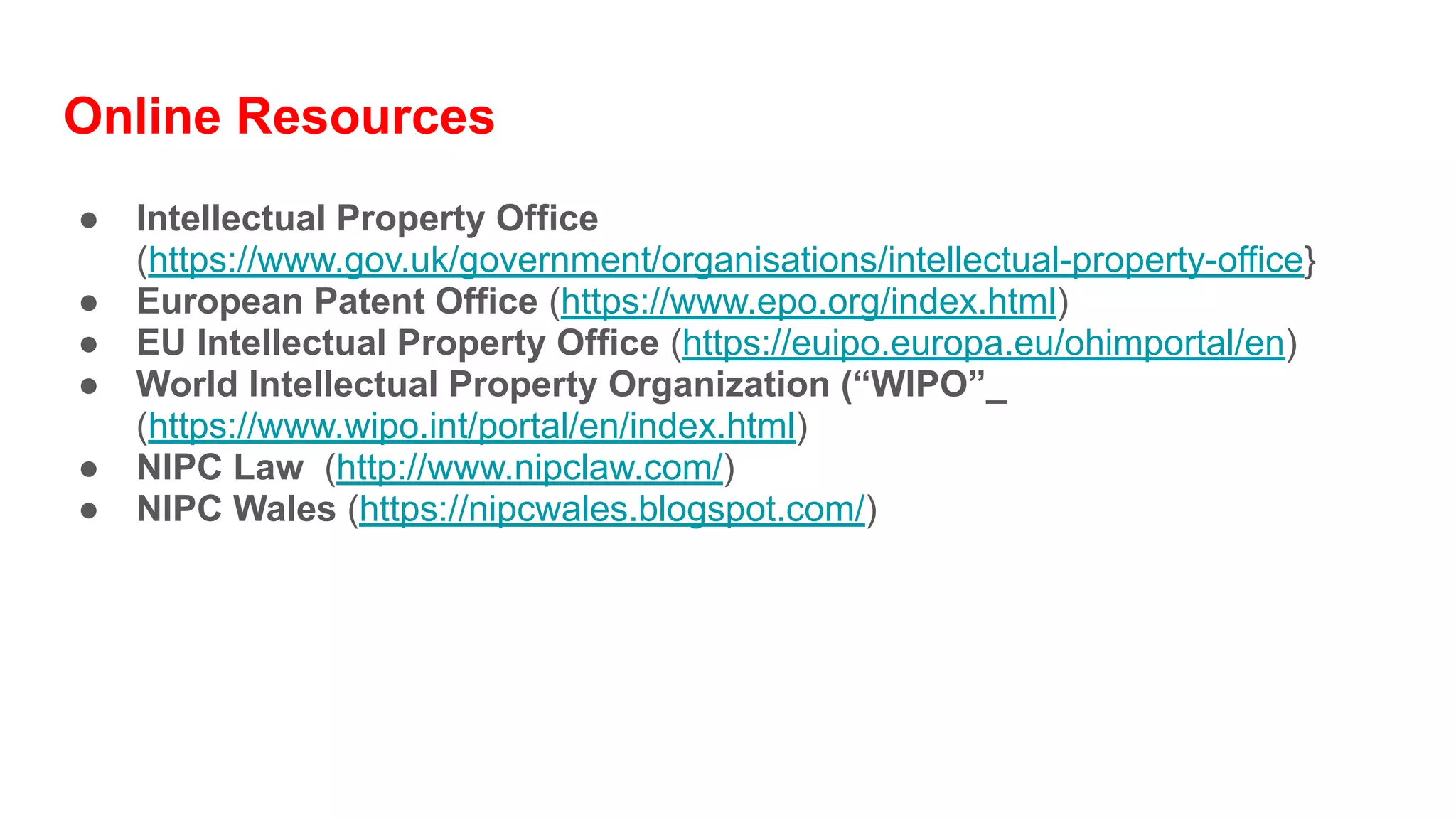
● Intellectual Property Office
(https://www.gov.uk/government/organisations/intellectual-property-office}
● European Patent Office (https://www.epo.org/index.html)
● EU Intellectual Property Office (https://euipo.europa.eu/ohimportal/en)
● World Intellectual Property Organization (“WIPO”_
(https://www.wipo.int/portal/en/index.html)
● NIPC Law (http://www.nipclaw.com/)
● NIPC Wales (https://nipcwales.blogspot.com/)
Enforcing IP Rights
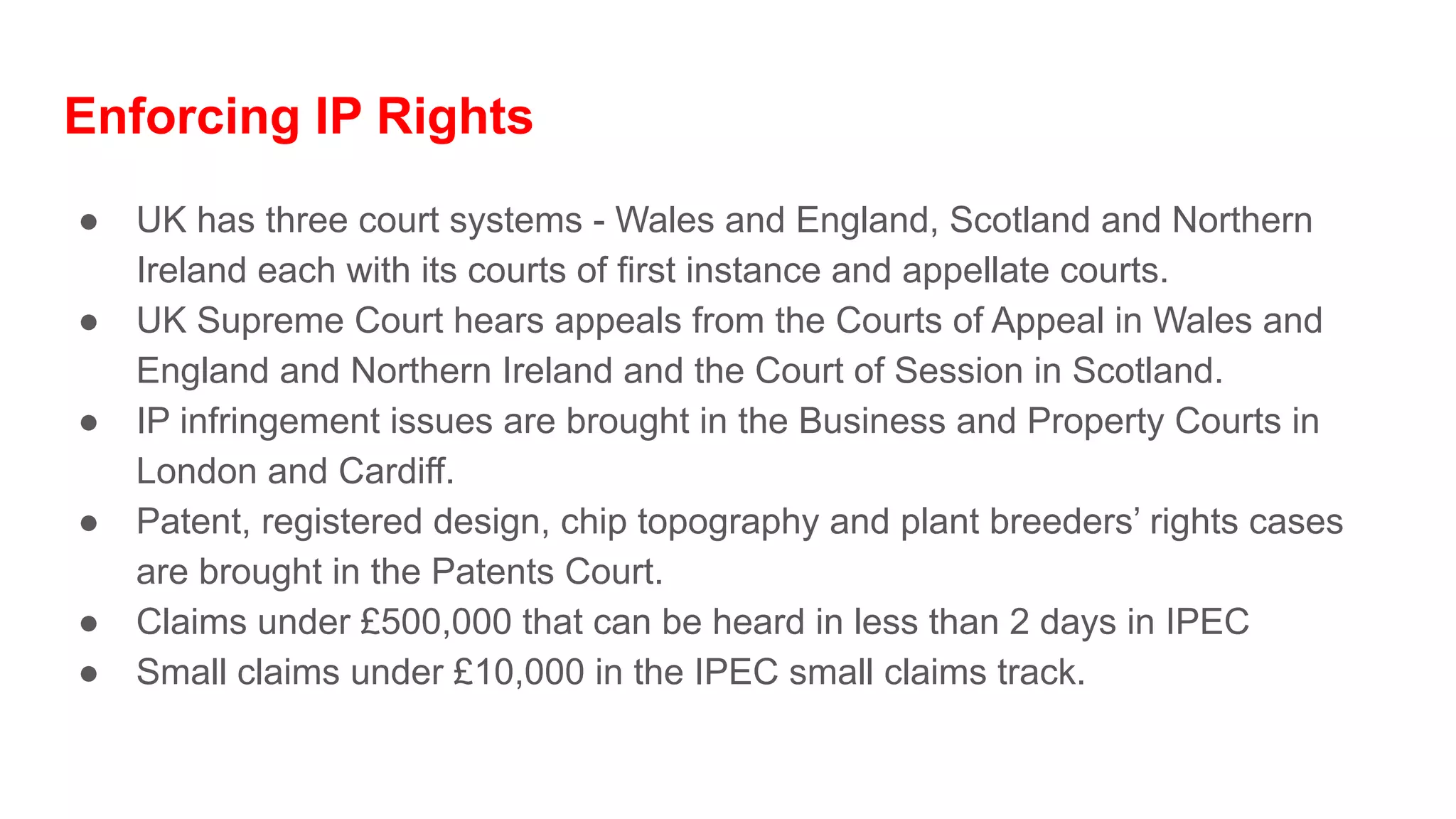
● UK has three court systems - Wales and England, Scotland and Northern
Ireland each with its courts of first instance and appellate courts.
● UK Supreme Court hears appeals from the Courts of Appeal in Wales and
England and Northern Ireland and the Court of Session in Scotland.
● IP infringement issues are brought in the Business and Property Courts in
London and Cardiff.
● Patent, registered design, chip topography and plant breeders’ rights cases
are brought in the Patents Court.
● Claims under £500,000 that can be heard in less than 2 days in IPEC
● Small claims under £10,000 in the IPEC small claims track.
Enforcing IP Rights
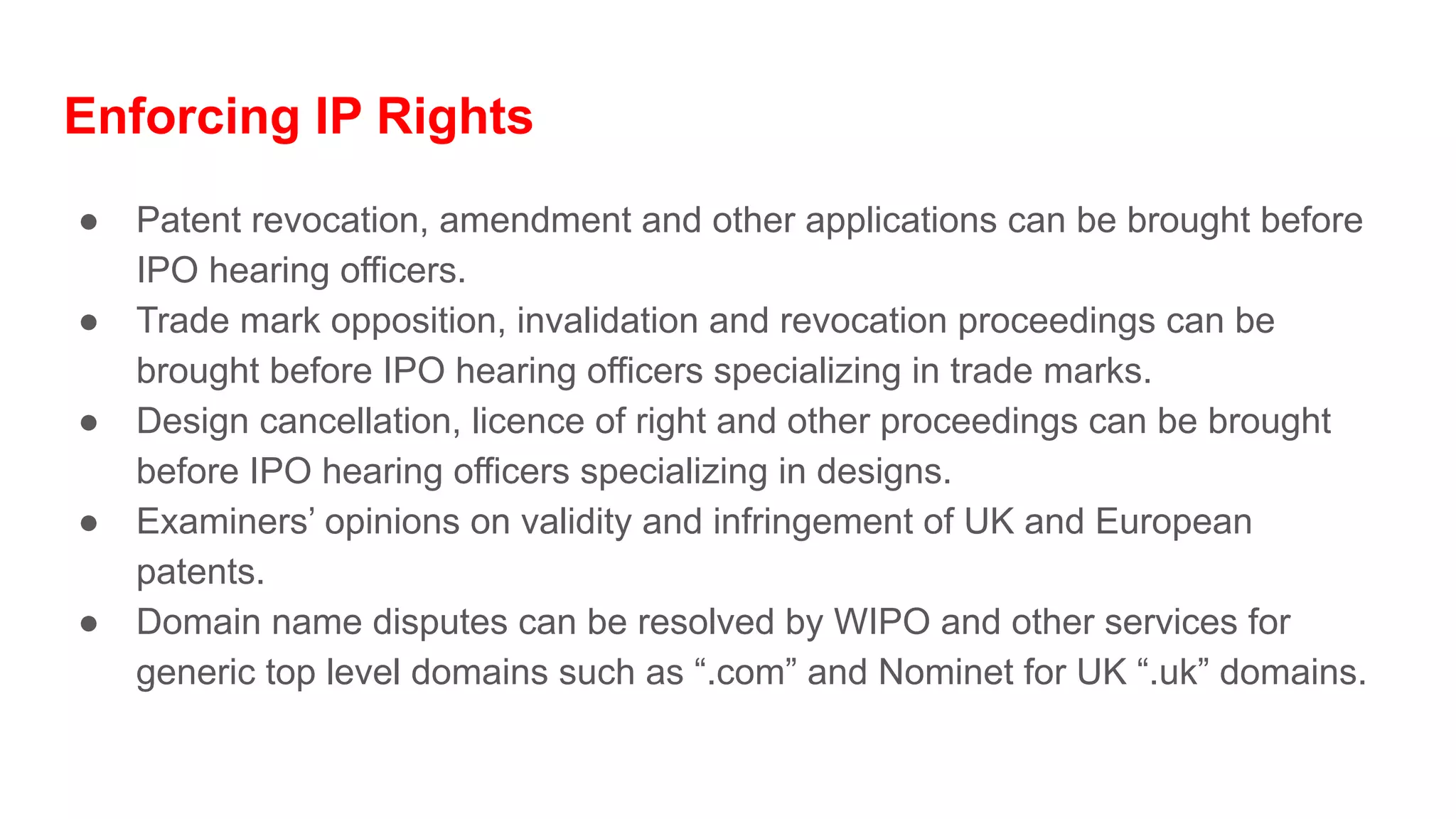
● Patent revocation, amendment and other applications can be brought before
IPO hearing officers.
● Trade mark opposition, invalidation and revocation proceedings can be
brought before IPO hearing officers specializing in trade marks.
● Design cancellation, licence of right and other proceedings can be brought
before IPO hearing officers specializing in designs.
● Examiners’ opinions on validity and infringement of UK and European
patents.
● Domain name disputes can be resolved by WIPO and other services for
generic top level domains such as “.com” and Nominet for UK “.uk” domains.
Criminal and Administrative Remedies
● Criminal sanctions for bootlegging, counterfeiting, piracy and registered
design infringement.
● The Courts can already obtain orders blocking access to websites distributing
infringing goods and services.
● Infringing items can be impounded at ports and airports.
● WIPO Advisory Committee on Enforcement.
Funding Enforcement
● Until Access to Justice Act 1999 Legal Aid was available for IP enforcement.
● Until Legal Aid, Sentencing and Punishment of Offenders Act 2012 it was
possible to recover success fees and insurance premiums from unsuccessful
party which made “no win no fee” agreements possible.
● Cost caps in IPEC and cost management orders in the High Court make no
win no fee contracts uneconomic.
● Before and after the event insurance.
● Litigation funding arrangements/
Any Questions
Jane Lambert
4.5 Gray’s Inn Square
London
WC1A 3TH
jane.lambert@nipclaw.com
020 7404 5252

What every Business in Wales needs to know about Intellectual Property

  • 1.
    What Every Businessin Wales needs to know about Intellectual Property Jane Lambert 9 Feb 2021
  • 2.
    Topics to bediscussed ● What’s the difference between “Intellectual Property” and “Intellectual Assets”? ● Why is intellectual property important? ● What sort of intellectual assets are likely to be in your business? ● What sort of intellectual property rights are available for your business? ● How do you register those rights? ● How do you enforce and defend those rights?
  • 3.
    Difference between “IP”and “Intellectual Assets”? ● Terms are often used interchangeably by people who ought to know better. ● An intellectual asset is a creation of the mind that gives one undertaking an advantage over its competitors such as an invention, an attractive product design, a website or goodwill. ● Intellectual property is the legal protection of those assets such as a patent for an invention, the registration of a design, a copyright for a website or a trade mark for a brand.
  • 4.
    Why is IntellectualProperty important? ● Correct use of intellectual property can make or break a business: ○ For many businesses the IP right is its most valuable asset ○ The Coca Cola mark for The Coca Cola Company ○ The shape of the iPhone for Apple ○ The copyrights in “Windows” for Microsoft ○ The patent for aspirin for Bayer ● Infringing another company’s IP rights can result in: ○ An order to stop making, selling or using a product or brand ○ Reputational damage ○ Piracy, counterfeiting or bootlegging, imprisonment, fines, costs and other sanctions
  • 5.
    Every Business hassome Intellectual Assets ● Reputation in the marketplace ● Artwork and copy for advertising, marketing and promotion ● Website ● Customer and supplier records ● Complaints and feedback ● Market research data ● Trade secrets ● New product development ● New designs
  • 6.
    Most Businesses alsohave some Intellectual Property ● The right to prevent a competitor from using the same or similar name, mark or get-up to trick consumers into dealing with the competitor known as passing off. ● The right to restrain someone who has received secret information in confidence from using or disclosing that information. ● The right to prevent unauthorized copying of artwork, copy, photos, software or other artistic or literary work. ● The right to prevent unauthorized extraction and reutilization of data..The right to prevent unauthorized reproduction of an original design. ● The right to prevent unauthorized reproduction of a registrable design.
  • 7.
    Some want toregister Patents, Trade Marks Etc ● Patents: Monopoly of a new invention for up to 20 years ○ Products ○ Processes. ● Trade Mark: Exclusive right to use a name, mark or other sign in relation to specified goods or services that can be renewed indefinitely. ● Registered Designs: Exclusive right to use ta new design with individual character for up to 25 years. ● Plant Varieties: Exclusive right to propagate a new plant variety (25 years for plants or 30 years for trees, vines or potatoes).
  • 8.
    Exploiting Intellectual PropertyRights ● Intellectual property rights can limit competition but they can also generate income through licensing, cross-licensing and assignment. ● Licensing is allowing another person to do something that would otherwise be unlawful. ● Cross-licensing is where different manufacturers each with the right to block the other from a market grant rights to make or use each other’s inventions so that both can enter the market. ● Assignment is an outright sale of the intellectual property right.
  • 9.
    Registering Intellectual PropertyRights ● Patents, trade marks and registered designs for the UK alone are granted by the Intellectual Property Office in Newport. ● Patents for the UK and 37 other European countries plus Cambodia, Moldova, Morocco and Tunisia can be obtained from the European Patent Office. ● There is no such thing as a World or even a European Union patent but patents for other countries can be obtained through the Patent Cooperation Treaty. ● EU trade marks and registered Community designs can be obtained from the EU Intellectual Property Office in Alicante. ● Trade marks and designs can be obtained through Madrid and Hague.
  • 10.
    Registering Intellectual PropertyRights ● Patents are the most expensive and time consuming to register ○ Searches ○ Attorneys’ fees ○ Office fees ○ Renewal fees. ● Trade Marks require examination and publication and sometimes opposition ○ Searches ○ Attorneys Fees ○ Office Fees. ● Registered Designs are registered without examination ○ Searches ○ Attorneys’ fees ○ Office fees.
  • 11.
    Choosing the RightIP Right for the Right Country ● More businesses have been ruined through having too much IP rather than by not having enough. ● All decisions on patenting or trade mark or design registration should be consistent with the company’s business and marketing plans. ● A Simple IP Strategy ○ Where are the business’s main income streams over business planning period? ○ What are the main threats to those revenue streams ○ What are the main counter measures that can be taken? ○ What are the most cost-effective legal measures ○ Make arrangements to fund enforcement.
  • 12.
    Finding Help ● PatentAttorneys: Regulated by IPReg and members of CIPA. Prosecute patent and often trade mark and design registration applications. Some have rights to conduct litigation and represent clients in the Civil Courts. ● Trade Mark Attorneys: Regulated by IPReg and members of CITMA. Prosecute trade mark and design registration applications. Some have rights to conduct litigation and represent clients in the Civil Courts. ● Solicitors: Regulated by SRA and members of Law Society. Negotiate and implement licensing and other transactions and conduct litigation. ● Counsel: Advocates and specialist advisers. Representation in courts and tribunals, advice on difficult points of law, draft complex legal instruments.
  • 13.
    Finding Help ● BritishLibrary Business and IP Centre and local centres around England and Glasgow: Talks, searches, clinics, website and inventors’ clubs. ● PatLib libraries where there is no Business and IP Centre: searches and clinics. ● Clinics run by CIPA and practitioners. ● NIPC Clinic organized with M-SParc. ● Inventors’ clubs ● Networks of artists, designers and entrepreneurs such as the North Wales Creatve.
  • 14.
    Online Resources ● IntellectualProperty Office (https://www.gov.uk/government/organisations/intellectual-property-office} ● European Patent Office (https://www.epo.org/index.html) ● EU Intellectual Property Office (https://euipo.europa.eu/ohimportal/en) ● World Intellectual Property Organization (“WIPO”_ (https://www.wipo.int/portal/en/index.html) ● NIPC Law (http://www.nipclaw.com/) ● NIPC Wales (https://nipcwales.blogspot.com/)
  • 15.
    Enforcing IP Rights ●UK has three court systems - Wales and England, Scotland and Northern Ireland each with its courts of first instance and appellate courts. ● UK Supreme Court hears appeals from the Courts of Appeal in Wales and England and Northern Ireland and the Court of Session in Scotland. ● IP infringement issues are brought in the Business and Property Courts in London and Cardiff. ● Patent, registered design, chip topography and plant breeders’ rights cases are brought in the Patents Court. ● Claims under £500,000 that can be heard in less than 2 days in IPEC ● Small claims under £10,000 in the IPEC small claims track.
  • 16.
    Enforcing IP Rights ●Patent revocation, amendment and other applications can be brought before IPO hearing officers. ● Trade mark opposition, invalidation and revocation proceedings can be brought before IPO hearing officers specializing in trade marks. ● Design cancellation, licence of right and other proceedings can be brought before IPO hearing officers specializing in designs. ● Examiners’ opinions on validity and infringement of UK and European patents. ● Domain name disputes can be resolved by WIPO and other services for generic top level domains such as “.com” and Nominet for UK “.uk” domains.
  • 17.
    Criminal and AdministrativeRemedies ● Criminal sanctions for bootlegging, counterfeiting, piracy and registered design infringement. ● The Courts can already obtain orders blocking access to websites distributing infringing goods and services. ● Infringing items can be impounded at ports and airports. ● WIPO Advisory Committee on Enforcement.
  • 18.
    Funding Enforcement ● UntilAccess to Justice Act 1999 Legal Aid was available for IP enforcement. ● Until Legal Aid, Sentencing and Punishment of Offenders Act 2012 it was possible to recover success fees and insurance premiums from unsuccessful party which made “no win no fee” agreements possible. ● Cost caps in IPEC and cost management orders in the High Court make no win no fee contracts uneconomic. ● Before and after the event insurance. ● Litigation funding arrangements/
  • 19.
    Any Questions Jane Lambert 4.5Gray’s Inn Square London WC1A 3TH jane.lambert@nipclaw.com 020 7404 5252