Session #9 
Getting The Most Out Of Your Data Analyst 
John Wadsworth 
Vice President, Technical Operations, Health Catalyst
Today’s Agenda 
 Unlock the data 
 Analytic tools 
 Prove or analyze? 
 Analytic whiplash 
 Accepting the truth
Poll Questions 1 - 2 
Question #1 - 
• How much time would you estimate your analysts 
spend gathering data (vs analyzing data)? 
Question #2 – 
• How much time would you estimate your analysts 
spend analyzing data? 
3
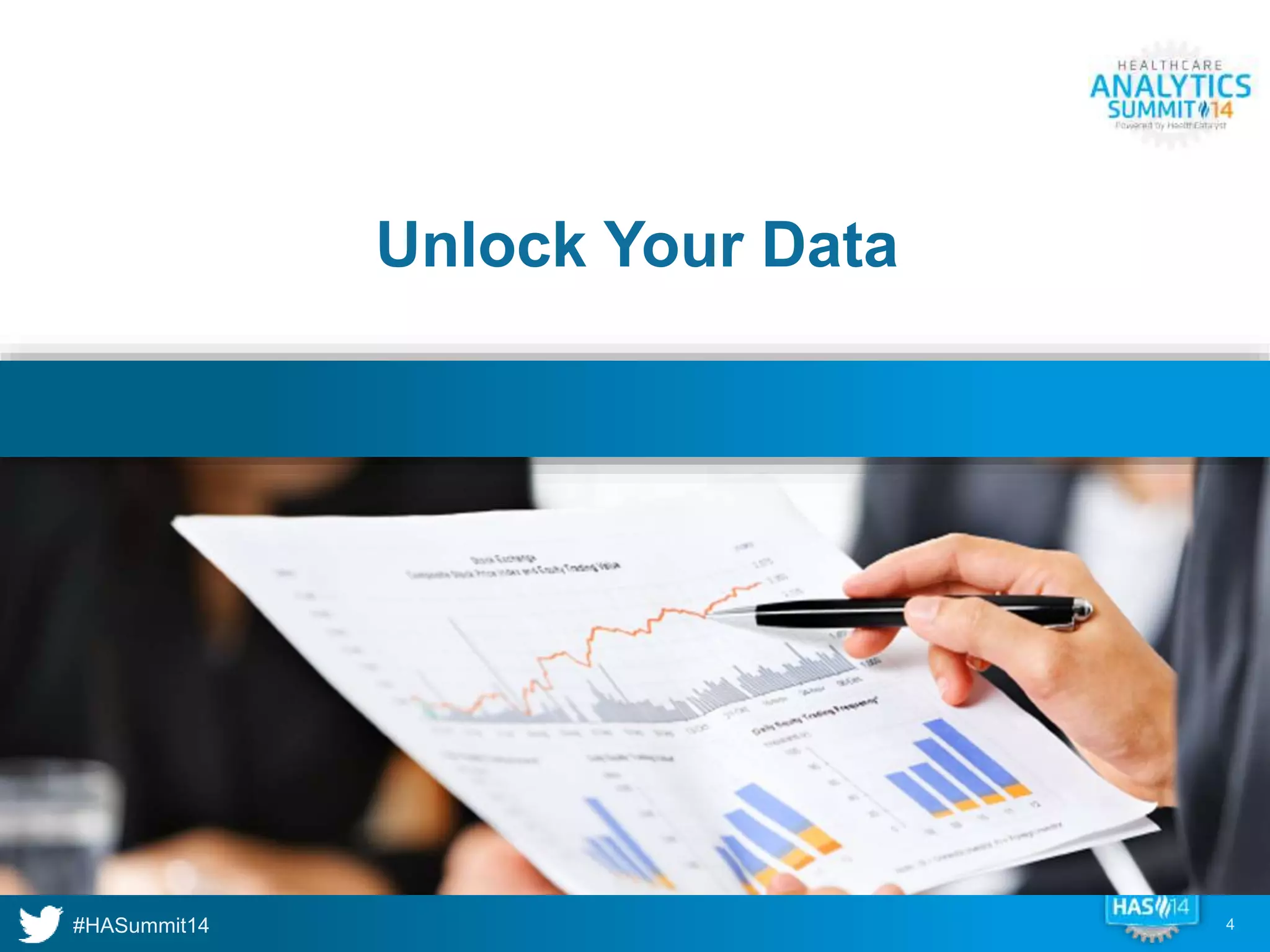
Unlock Your Data 
4
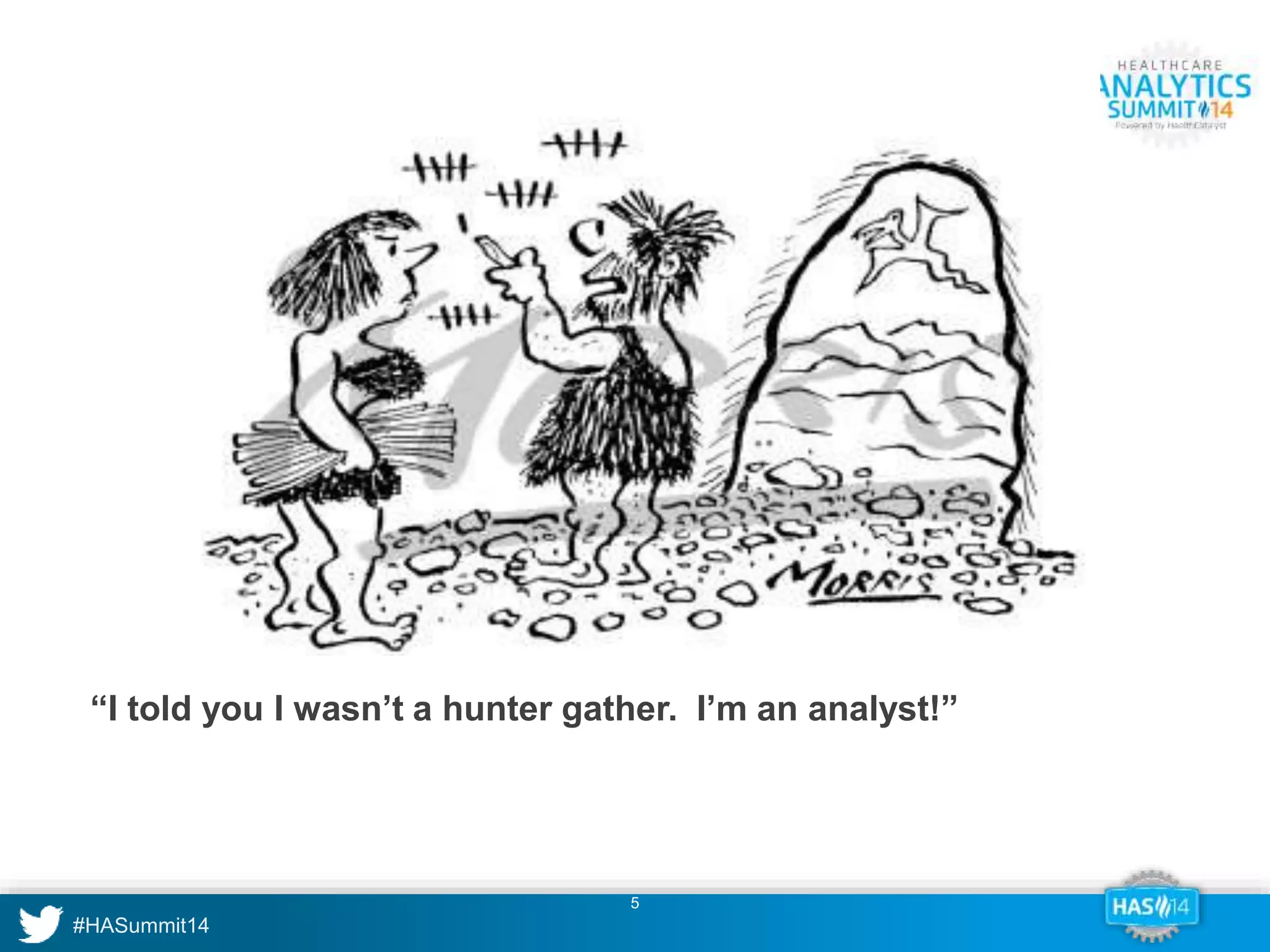
“I told you I wasn’t a hunter gather. I’m an analyst!” 
5
Analysts - Hunting and Gathering 
Conversation this week: 
• Shared savings partnerships withholding money 
because of poor analytics 
• Analysts spending 80% or more gathering data 
• Data exists in multiple sources (EMR, costing, 
billing, patient satisfaction, etc.) that are not 
integrated 
How hard can it be to gather the data for analytics? 
6
Unlocking Your Data - Exercise 
Objective #1: Determine the total value of the money 
in your team bucket. 
Rules 
• Work as a team. Everyone at your table needs to participate. 
• Collect your bucket at corresponding colored locations around 
the room. Send 1 person (runner) from each table. 
• Do not retrieve the bucket until you are given the “Go” signal. 
All teams start at the same time. 
• With each task that you complete, ring the bell and you will be 
7 
given an additional task. 
• Complete as many tasks as possible as a team. 
• Time limited, so work quickly!
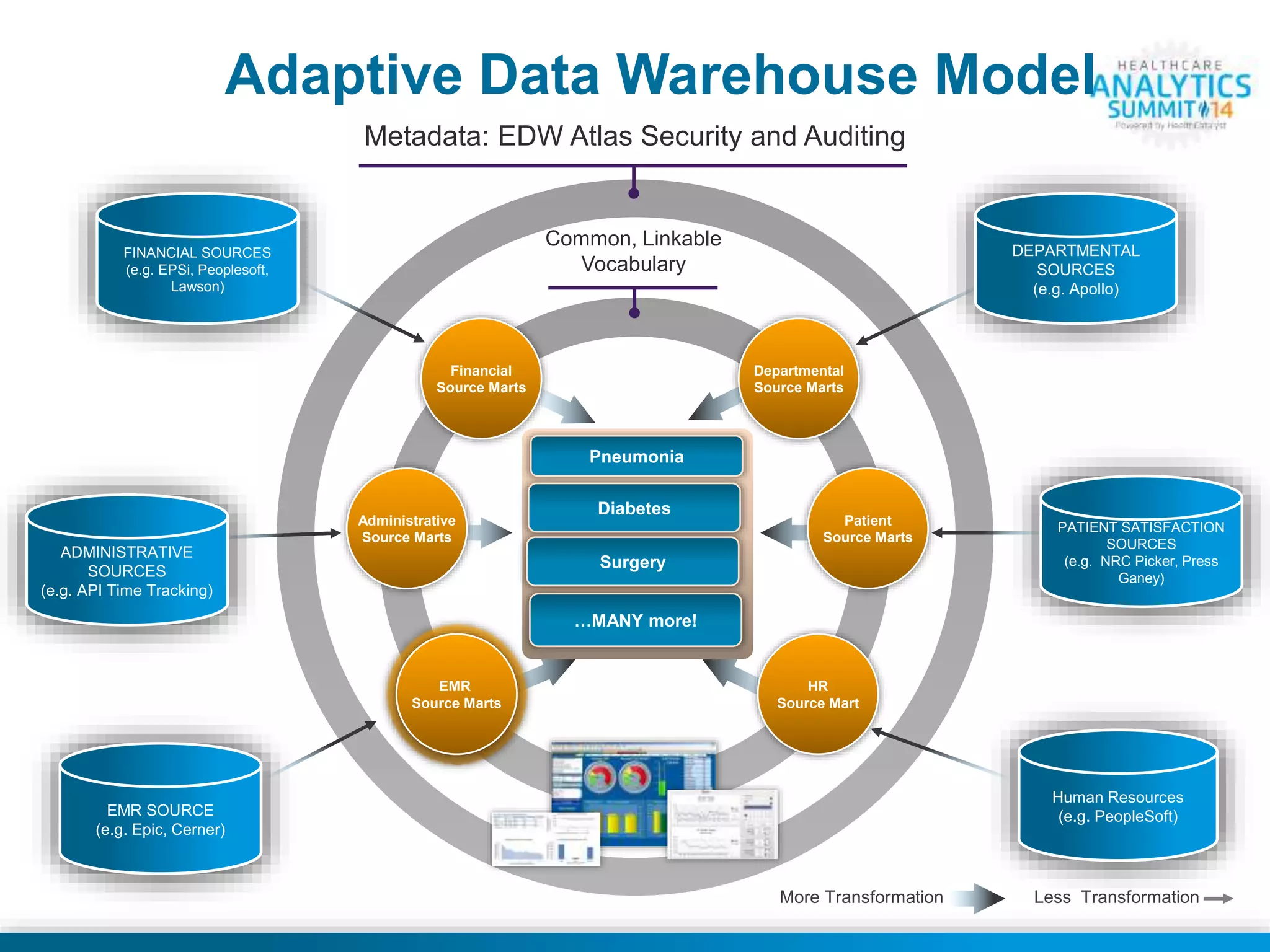
Catalyst Adaptive Data Warehouse 
Adaptive Data Warehouse Model 
Metadata: EDW Atlas Security and Auditing 
Common, Linkable 
Vocabulary 
Financial 
Source Marts 
Administrative 
Source Marts 
Departmental 
Source Marts 
Patient 
Source Marts 
EMR 
Source Marts 
HR 
Source Mart 
Pneumonia 
Diabetes 
…MANY more! 
More Transformation Less Transformation 
FINANCIAL SOURCES 
(e.g. EPSi, Peoplesoft, 
Lawson) 
ADMINISTRATIVE 
SOURCES 
(e.g. API Time Tracking) 
EMR SOURCE 
(e.g. Epic, Cerner) 
DEPARTMENTAL 
SOURCES 
(e.g. Apollo) 
PATIENT SATISFACTION 
SOURCES 
(e.g. NRC Picker, Press 
Ganey) 
Human Resources 
(e.g. PeopleSoft) 
Surgery
Poll Questions 3 - 4 
•Question #3 
•In your personal opinion, how important is the analyst 
role in your organization? 
•Question #4 
•How important is the role of analyst viewed by your 
organization? 
9
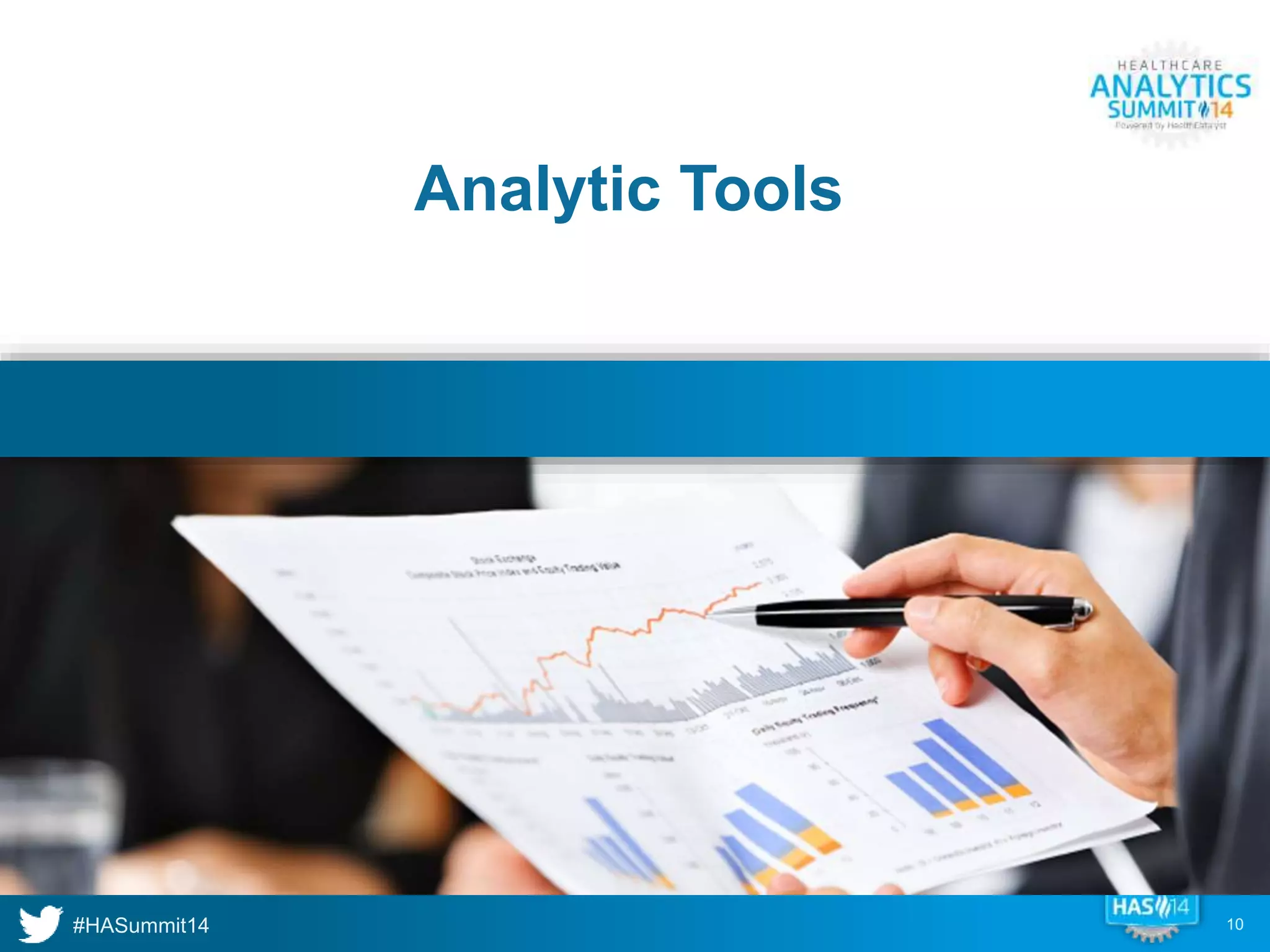
Analytic Tools 
10
Analytic Tools - Exercise 
Objective #1: Group your coins by denomination 
AND stack them at least 5 coins high. 
Rules 
• Work as a team. Everyone at your table needs to participate. 
• Do not open the bucket until you are given the “Go” signal. All 
11 
teams start at the same time. 
• With each task that you complete, ring the bell and you will be 
given an additional task. 
• Complete as many tasks as possible as a team. 
• Your entire team MUST use the (hand) tools provided you 
for the complete exercise.
From Hunter-Gather to Analyst 
Tools Support Transformation 
• Structured Query Language (SQL or variant) 
• Data analysis 
• Visual representation of information 
• Communicate meaningful story through the data 
• Domain knowledge 
12
Recommended Tools 
for Data-Driven Health System 
• Source systems that support query (SQL) 
• Let them get to the data 
• Business intelligence development tools to build 
meaningful visualizations 
• Cognos, Crystal Reports, Tableau, Qlikview, Excel 
• An enterprise data warehouse (EDW) 
• Start small and grow as needed 
• Assumes data architects will extract, transform, 
load (ETL) and model data into warehouse 
• Scalable platform to grow analytics
Poll Questions 5 - 6 
Question #5 
•How often do you act on information provided to you by 
your analysts? 
•Question #6 
•Analysts – How often does management act on your 
analysis and/or recommendations? 
14
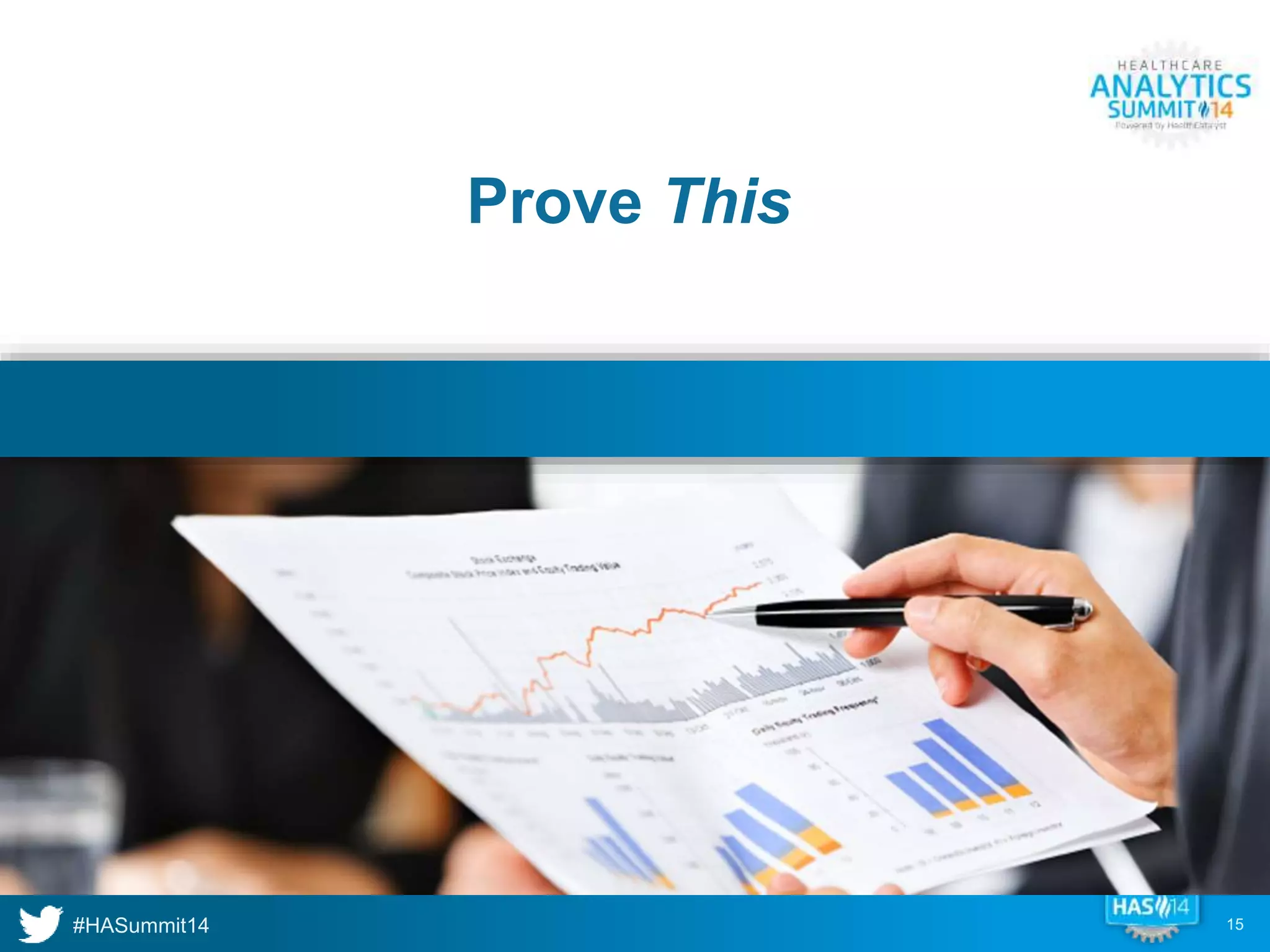
Prove This 
15
Analyze the Decision to Build 
• “We need to build an observation patient wing” 
‒ 3 year upward trend in observation patient volume through ED 
‒ Reimbursements dropping for obs patients  get to inpatient or 
16 
ED acuity 
‒ Historically we had an observation wing 
• Questions they wanted answered 
‒ How many beds do we need? 
» Clinical data informed bed count estimates 
‒ What clinical staffing will be needed for the new wing? 
» HR and clinical data justified staffing model 
‒ What will it cost to build the new wing? 
» Costing data supported estimate of $.5M - $1M/bed for re-purposing 
existing beds  $2.5M - $5M for 5 bed wing 
• WAIT! Has the decision to build already been made? 
‒ If so, do you need an Analyst … or something else?
Analyze the Data to Inform a Decision 
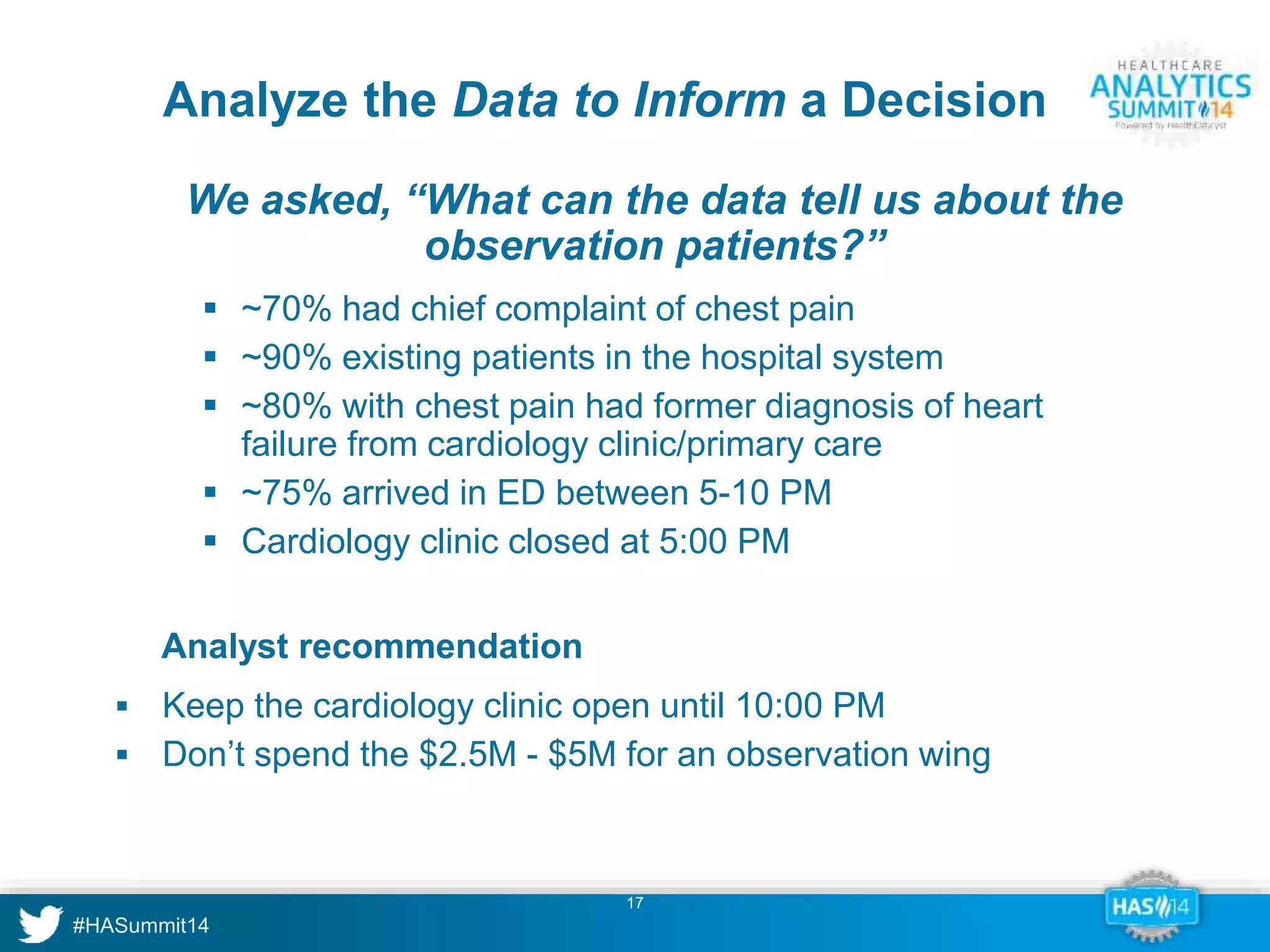
We asked, “What can the data tell us about the 
observation patients?” 
 ~70% had chief complaint of chest pain 
 ~90% existing patients in the hospital system 
 ~80% with chest pain had former diagnosis of heart 
failure from cardiology clinic/primary care 
 ~75% arrived in ED between 5-10 PM 
 Cardiology clinic closed at 5:00 PM 
17 
Analyst recommendation 
 Keep the cardiology clinic open until 10:00 PM 
 Don’t spend the $2.5M - $5M for an observation wing
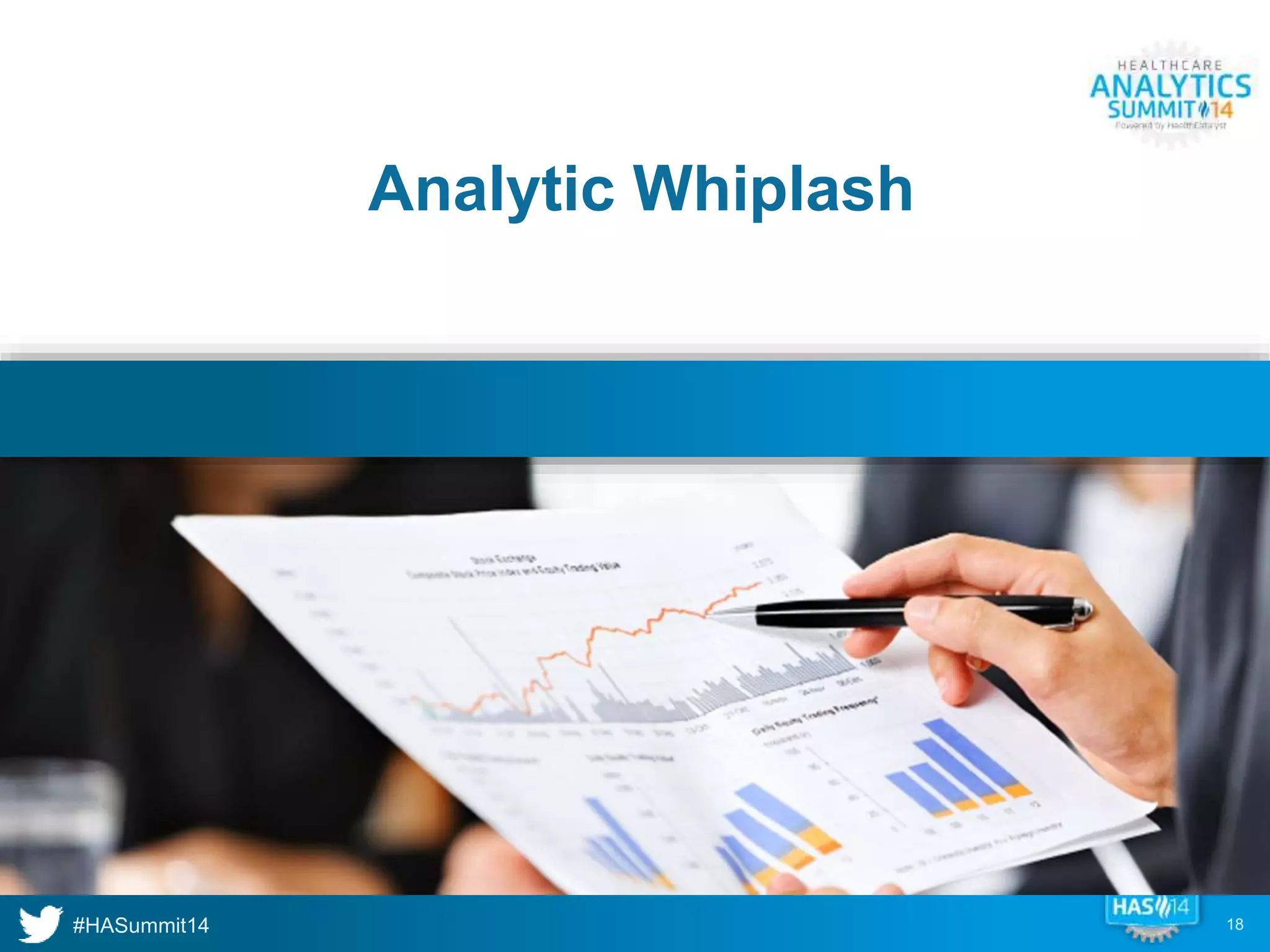
Analytic Whiplash 
18
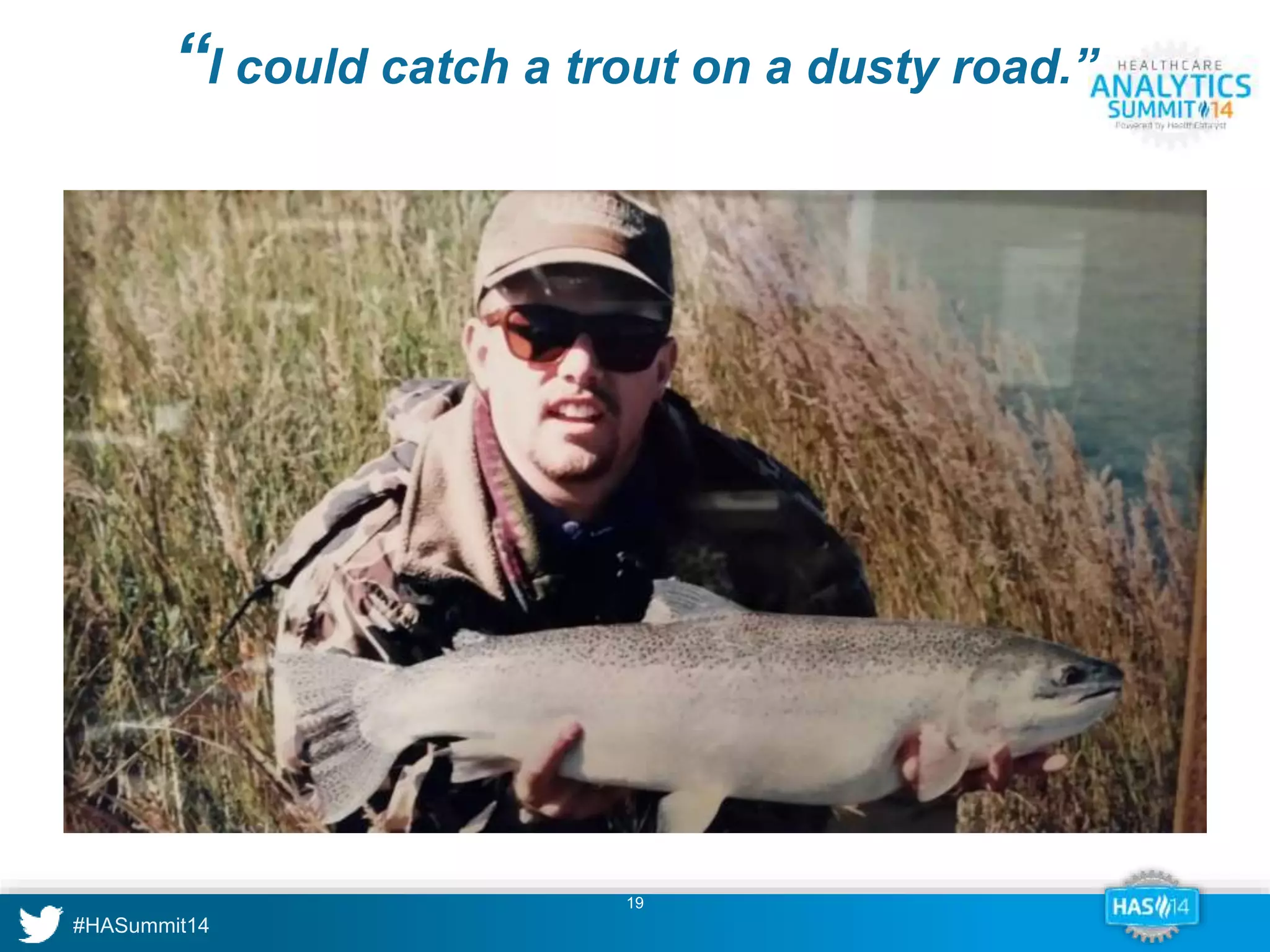
“I could catch a trout on a dusty road.” 
19
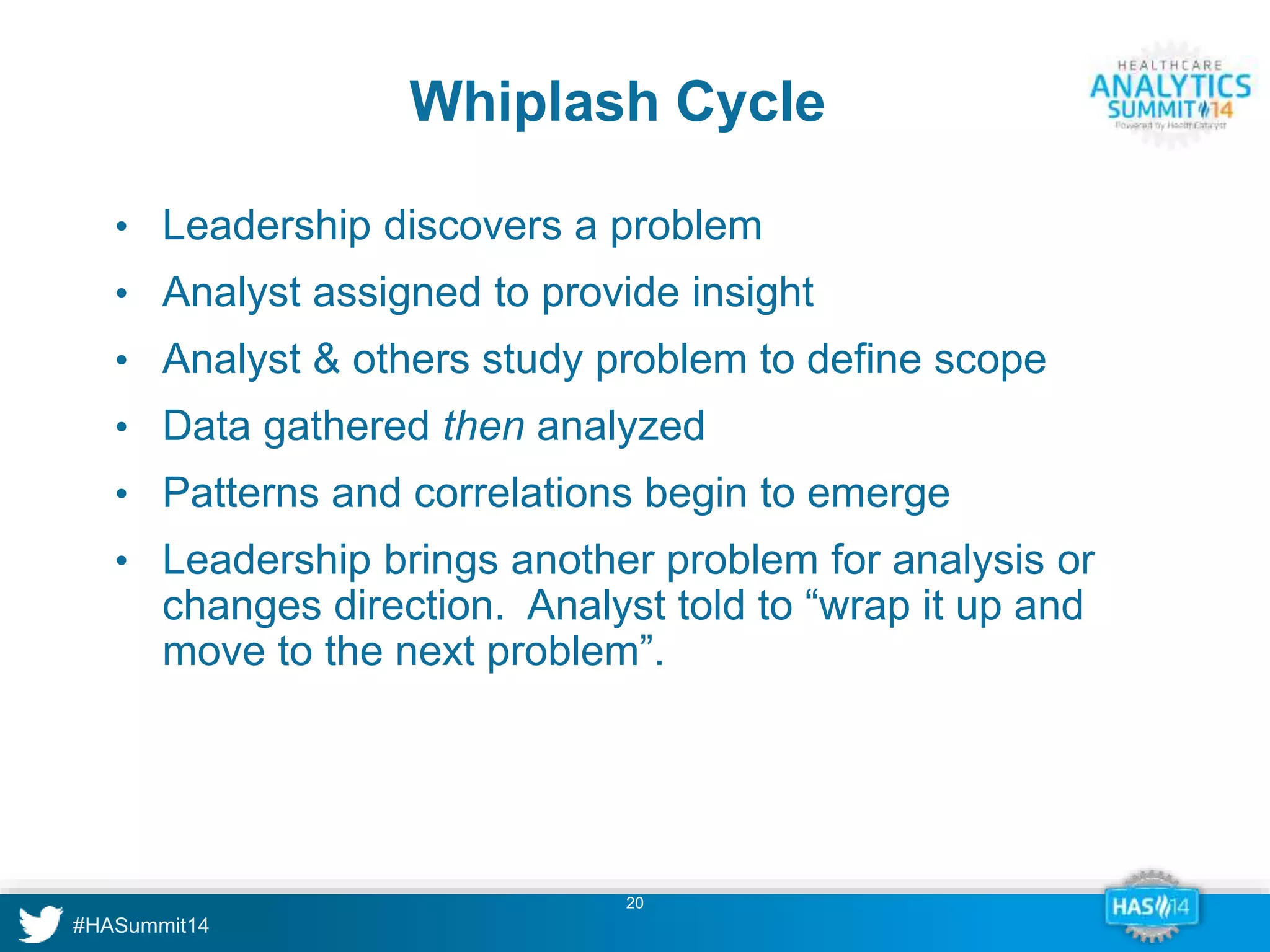
Whiplash Cycle 
• Leadership discovers a problem 
• Analyst assigned to provide insight 
• Analyst & others study problem to define scope 
• Data gathered then analyzed 
• Patterns and correlations begin to emerge 
• Leadership brings another problem for analysis or 
changes direction. Analyst told to “wrap it up and 
move to the next problem”. 
20
Considerations for 
Improved Analytic Insight 
• Analyst & others study problem to define scope 
• Data gathered then analyzed 
• Patterns and correlations begin to emerge 
• Assumptions verified/refuted by knowledge experts 
closest to the work process being measured 
• Adjust logic based on feedback. 
• Iterate through process until all logic validated by 
process owners (in the trenches) 
Give sufficient time for analysis, discovery 
and a recommendation. 
21
Risks of Under-resourced Analytics 
• Insufficient time leads to half-baked analysis 
• Incomplete analysis undermines credibility 
• Lack of credibility creates further dissatisfaction with 
22 
data and analytics
Do You Need More Analysts? 
• Perhaps… but before you hire more analysts, 
23 
consider asking: 
‒ Will more analysts get the needed time to do 
analysis? 
‒ No? Increased capacity for incomplete analysis 
• Analyst needs the time to work smarter, not harder.
Leadership and Prioritization 
• Remove prioritization burden from analysts 
• Leadership become proficient with prioritization 
• Leadership determine projects of highest priority 
‒ Unified front – individual agendas undermine execution 
‒ Decide what projects will and will not be funded 
‒ Resist the lure of shiny, new objects 
‒ Commit resources for top projects to completion 
‒ Communicate results of prioritization to the masses 
Minimize the whiplash of “urgent” projects 
24
Accepting the Truth 
25
Poll Questions 7- 8 
•Question #7 
•On a scale of 1 to 5, how well do you trust information 
provided through your analysts? 
•Question #8 
On a scale of 1 to 5, how well does your culture support 
analysts delivering information that may be perceived as 
negative or undesirable? 
26
Should I report the whole truth? 
• Honesty is the best policy for analytic credibility 
• CLABSI reported or actuals? 
• Confront the brutal facts 
‒ “When you turn over rocks and look at all the squiggly 
things underneath, you can either put the rock down, or 
you can say, ‘My job is to turn over rocks and look at the 
squiggly things,’ even if what you see can scare the [heck] 
out of you.” – Jim Collins 
27
Summary 
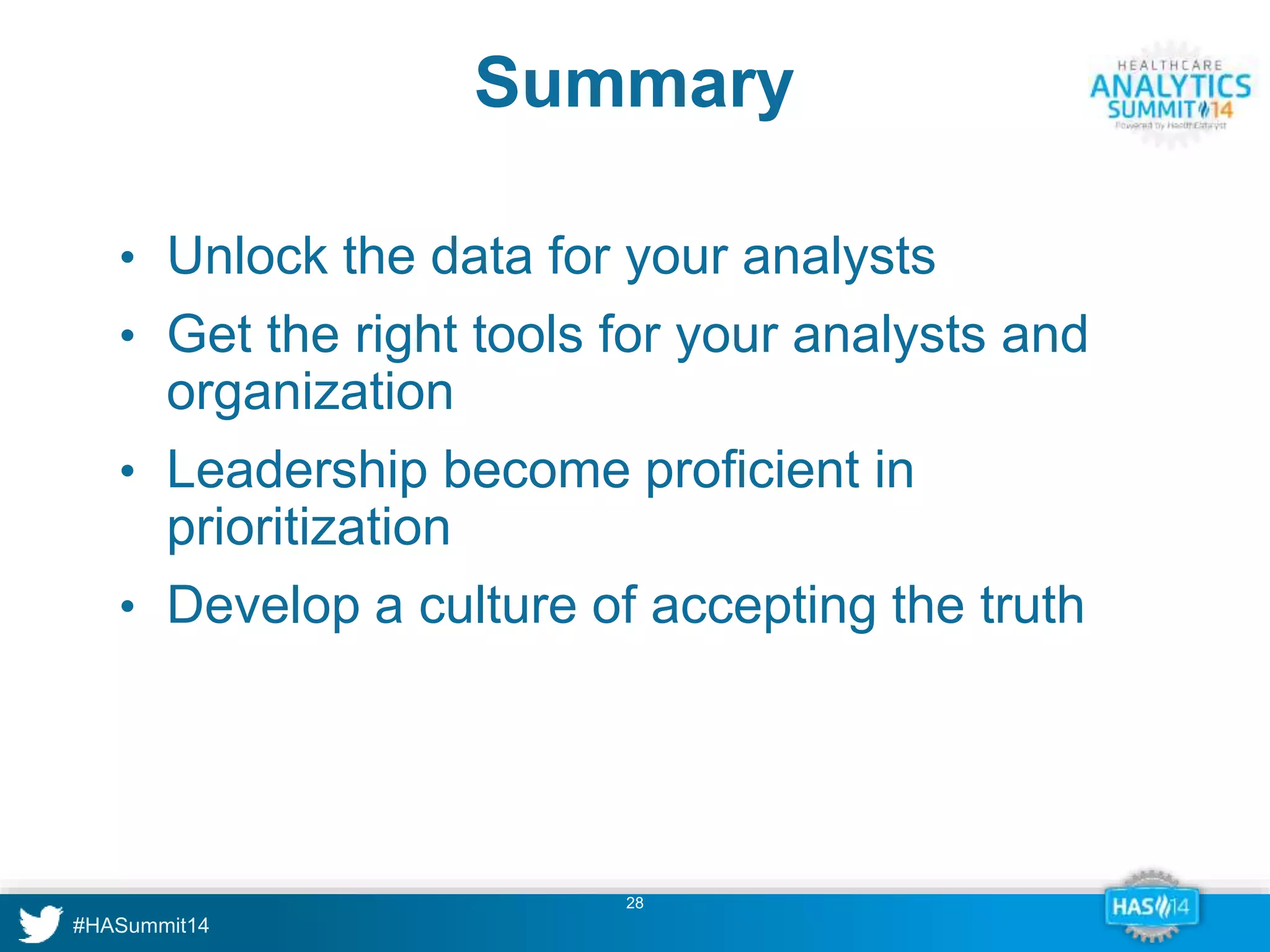
• Unlock the data for your analysts 
• Get the right tools for your analysts and 
organization 
• Leadership become proficient in 
prioritization 
• Develop a culture of accepting the truth 
28
Analytic 
Insights 
Questions & 
A 
Answers
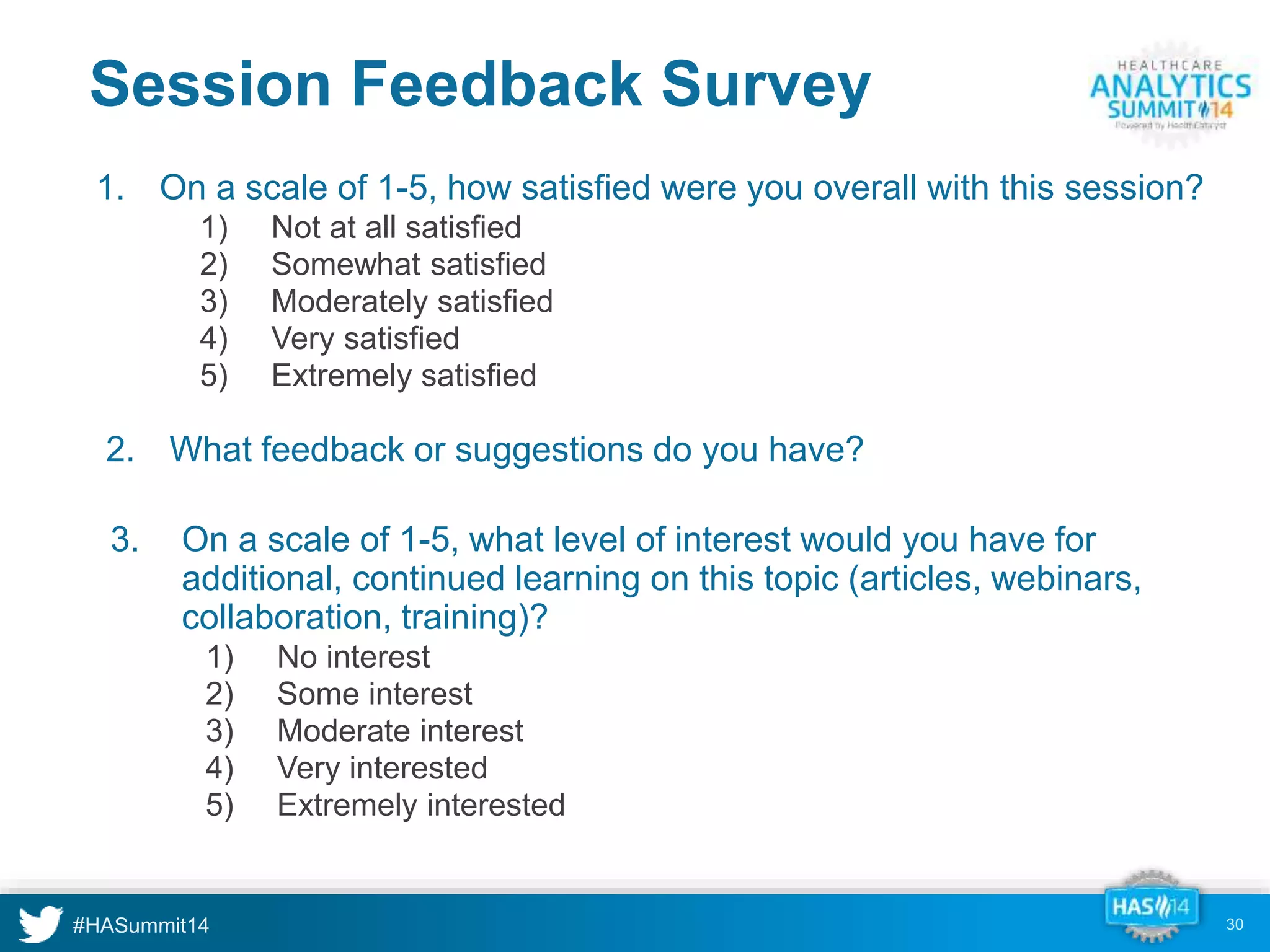
Session Feedback Survey 
30 
1. On a scale of 1-5, how satisfied were you overall with this session? 
1) Not at all satisfied 
2) Somewhat satisfied 
3) Moderately satisfied 
4) Very satisfied 
5) Extremely satisfied 
2. What feedback or suggestions do you have? 
3. On a scale of 1-5, what level of interest would you have for 
additional, continued learning on this topic (articles, webinars, 
collaboration, training)? 
1) No interest 
2) Some interest 
3) Moderate interest 
4) Very interested 
5) Extremely interested
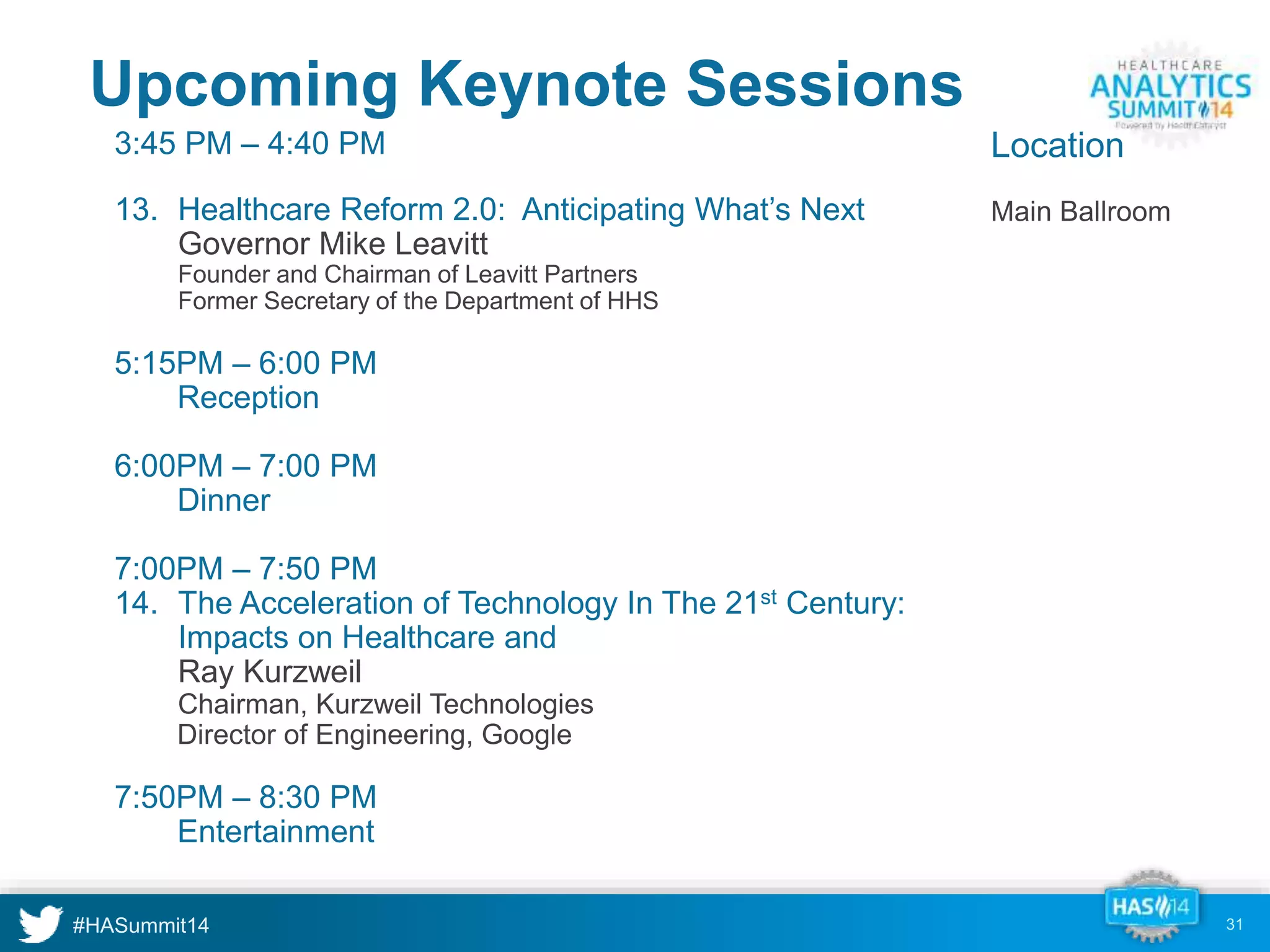
Upcoming Keynote Sessions 
3:45 PM – 4:40 PM 
13. Healthcare Reform 2.0: Anticipating What’s Next 
Governor Mike Leavitt 
Founder and Chairman of Leavitt Partners 
Former Secretary of the Department of HHS 
5:15PM – 6:00 PM 
Reception 
6:00PM – 7:00 PM 
Dinner 
7:00PM – 7:50 PM 
14. The Acceleration of Technology In The 21st Century: 
Impacts on Healthcare and 
Ray Kurzweil 
Chairman, Kurzweil Technologies 
Director of Engineering, Google 
7:50PM – 8:30 PM 
Entertainment 
31 
Location 
Main Ballroom

Getting The Most Out of Your Data Analyst - HAS Session 9

  • 1.
    Session #9 GettingThe Most Out Of Your Data Analyst John Wadsworth Vice President, Technical Operations, Health Catalyst
  • 2.
    Today’s Agenda Unlock the data  Analytic tools  Prove or analyze?  Analytic whiplash  Accepting the truth
  • 3.
    Poll Questions 1- 2 Question #1 - • How much time would you estimate your analysts spend gathering data (vs analyzing data)? Question #2 – • How much time would you estimate your analysts spend analyzing data? 3
  • 4.
  • 5.
    “I told youI wasn’t a hunter gather. I’m an analyst!” 5
  • 6.
    Analysts - Huntingand Gathering Conversation this week: • Shared savings partnerships withholding money because of poor analytics • Analysts spending 80% or more gathering data • Data exists in multiple sources (EMR, costing, billing, patient satisfaction, etc.) that are not integrated How hard can it be to gather the data for analytics? 6
  • 7.
    Unlocking Your Data- Exercise Objective #1: Determine the total value of the money in your team bucket. Rules • Work as a team. Everyone at your table needs to participate. • Collect your bucket at corresponding colored locations around the room. Send 1 person (runner) from each table. • Do not retrieve the bucket until you are given the “Go” signal. All teams start at the same time. • With each task that you complete, ring the bell and you will be 7 given an additional task. • Complete as many tasks as possible as a team. • Time limited, so work quickly!
  • 8.
    Catalyst Adaptive DataWarehouse Adaptive Data Warehouse Model Metadata: EDW Atlas Security and Auditing Common, Linkable Vocabulary Financial Source Marts Administrative Source Marts Departmental Source Marts Patient Source Marts EMR Source Marts HR Source Mart Pneumonia Diabetes …MANY more! More Transformation Less Transformation FINANCIAL SOURCES (e.g. EPSi, Peoplesoft, Lawson) ADMINISTRATIVE SOURCES (e.g. API Time Tracking) EMR SOURCE (e.g. Epic, Cerner) DEPARTMENTAL SOURCES (e.g. Apollo) PATIENT SATISFACTION SOURCES (e.g. NRC Picker, Press Ganey) Human Resources (e.g. PeopleSoft) Surgery
  • 9.
    Poll Questions 3- 4 •Question #3 •In your personal opinion, how important is the analyst role in your organization? •Question #4 •How important is the role of analyst viewed by your organization? 9
  • 10.
  • 11.
    Analytic Tools -Exercise Objective #1: Group your coins by denomination AND stack them at least 5 coins high. Rules • Work as a team. Everyone at your table needs to participate. • Do not open the bucket until you are given the “Go” signal. All 11 teams start at the same time. • With each task that you complete, ring the bell and you will be given an additional task. • Complete as many tasks as possible as a team. • Your entire team MUST use the (hand) tools provided you for the complete exercise.
  • 12.
    From Hunter-Gather toAnalyst Tools Support Transformation • Structured Query Language (SQL or variant) • Data analysis • Visual representation of information • Communicate meaningful story through the data • Domain knowledge 12
  • 13.
    Recommended Tools forData-Driven Health System • Source systems that support query (SQL) • Let them get to the data • Business intelligence development tools to build meaningful visualizations • Cognos, Crystal Reports, Tableau, Qlikview, Excel • An enterprise data warehouse (EDW) • Start small and grow as needed • Assumes data architects will extract, transform, load (ETL) and model data into warehouse • Scalable platform to grow analytics
  • 14.
    Poll Questions 5- 6 Question #5 •How often do you act on information provided to you by your analysts? •Question #6 •Analysts – How often does management act on your analysis and/or recommendations? 14
  • 15.
  • 16.
    Analyze the Decisionto Build • “We need to build an observation patient wing” ‒ 3 year upward trend in observation patient volume through ED ‒ Reimbursements dropping for obs patients  get to inpatient or 16 ED acuity ‒ Historically we had an observation wing • Questions they wanted answered ‒ How many beds do we need? » Clinical data informed bed count estimates ‒ What clinical staffing will be needed for the new wing? » HR and clinical data justified staffing model ‒ What will it cost to build the new wing? » Costing data supported estimate of $.5M - $1M/bed for re-purposing existing beds  $2.5M - $5M for 5 bed wing • WAIT! Has the decision to build already been made? ‒ If so, do you need an Analyst … or something else?
  • 17.
    Analyze the Datato Inform a Decision We asked, “What can the data tell us about the observation patients?”  ~70% had chief complaint of chest pain  ~90% existing patients in the hospital system  ~80% with chest pain had former diagnosis of heart failure from cardiology clinic/primary care  ~75% arrived in ED between 5-10 PM  Cardiology clinic closed at 5:00 PM 17 Analyst recommendation  Keep the cardiology clinic open until 10:00 PM  Don’t spend the $2.5M - $5M for an observation wing
  • 18.
  • 19.
    “I could catcha trout on a dusty road.” 19
  • 20.
    Whiplash Cycle •Leadership discovers a problem • Analyst assigned to provide insight • Analyst & others study problem to define scope • Data gathered then analyzed • Patterns and correlations begin to emerge • Leadership brings another problem for analysis or changes direction. Analyst told to “wrap it up and move to the next problem”. 20
  • 21.
    Considerations for ImprovedAnalytic Insight • Analyst & others study problem to define scope • Data gathered then analyzed • Patterns and correlations begin to emerge • Assumptions verified/refuted by knowledge experts closest to the work process being measured • Adjust logic based on feedback. • Iterate through process until all logic validated by process owners (in the trenches) Give sufficient time for analysis, discovery and a recommendation. 21
  • 22.
    Risks of Under-resourcedAnalytics • Insufficient time leads to half-baked analysis • Incomplete analysis undermines credibility • Lack of credibility creates further dissatisfaction with 22 data and analytics
  • 23.
    Do You NeedMore Analysts? • Perhaps… but before you hire more analysts, 23 consider asking: ‒ Will more analysts get the needed time to do analysis? ‒ No? Increased capacity for incomplete analysis • Analyst needs the time to work smarter, not harder.
  • 24.
    Leadership and Prioritization • Remove prioritization burden from analysts • Leadership become proficient with prioritization • Leadership determine projects of highest priority ‒ Unified front – individual agendas undermine execution ‒ Decide what projects will and will not be funded ‒ Resist the lure of shiny, new objects ‒ Commit resources for top projects to completion ‒ Communicate results of prioritization to the masses Minimize the whiplash of “urgent” projects 24
  • 25.
  • 26.
    Poll Questions 7-8 •Question #7 •On a scale of 1 to 5, how well do you trust information provided through your analysts? •Question #8 On a scale of 1 to 5, how well does your culture support analysts delivering information that may be perceived as negative or undesirable? 26
  • 27.
    Should I reportthe whole truth? • Honesty is the best policy for analytic credibility • CLABSI reported or actuals? • Confront the brutal facts ‒ “When you turn over rocks and look at all the squiggly things underneath, you can either put the rock down, or you can say, ‘My job is to turn over rocks and look at the squiggly things,’ even if what you see can scare the [heck] out of you.” – Jim Collins 27
  • 28.
    Summary • Unlockthe data for your analysts • Get the right tools for your analysts and organization • Leadership become proficient in prioritization • Develop a culture of accepting the truth 28
  • 29.
  • 30.
    Session Feedback Survey 30 1. On a scale of 1-5, how satisfied were you overall with this session? 1) Not at all satisfied 2) Somewhat satisfied 3) Moderately satisfied 4) Very satisfied 5) Extremely satisfied 2. What feedback or suggestions do you have? 3. On a scale of 1-5, what level of interest would you have for additional, continued learning on this topic (articles, webinars, collaboration, training)? 1) No interest 2) Some interest 3) Moderate interest 4) Very interested 5) Extremely interested
  • 31.
    Upcoming Keynote Sessions 3:45 PM – 4:40 PM 13. Healthcare Reform 2.0: Anticipating What’s Next Governor Mike Leavitt Founder and Chairman of Leavitt Partners Former Secretary of the Department of HHS 5:15PM – 6:00 PM Reception 6:00PM – 7:00 PM Dinner 7:00PM – 7:50 PM 14. The Acceleration of Technology In The 21st Century: Impacts on Healthcare and Ray Kurzweil Chairman, Kurzweil Technologies Director of Engineering, Google 7:50PM – 8:30 PM Entertainment 31 Location Main Ballroom

Editor's Notes

  • #4 How often does your organization include finance as part of its multi-disciplinary improvement teams? a.       Never b.      Not often c.       Sometimes d.      Frequently e.      Always f.        Unsure or not applicable
  • #5 Follow up group participation 1Would you like to participate in a follow up group on this topic that would meet 2-3 times next year to share progress, challenges and best practices? (Yes, No)
  • #9 8
  • #10 How often does your organization include finance as part of its multi-disciplinary improvement teams? a.       Never b.      Not often c.       Sometimes d.      Frequently e.      Always f.        Unsure or not applicable
  • #11 Follow up group participation 1Would you like to participate in a follow up group on this topic that would meet 2-3 times next year to share progress, challenges and best practices? (Yes, No)
  • #15 How often does your organization include finance as part of its multi-disciplinary improvement teams? a.       Never b.      Not often c.       Sometimes d.      Frequently e.      Always f.        Unsure or not applicable
  • #16 Follow up group participation 1Would you like to participate in a follow up group on this topic that would meet 2-3 times next year to share progress, challenges and best practices? (Yes, No)
  • #19 Follow up group participation 1Would you like to participate in a follow up group on this topic that would meet 2-3 times next year to share progress, challenges and best practices? (Yes, No)
  • #26 Follow up group participation 1Would you like to participate in a follow up group on this topic that would meet 2-3 times next year to share progress, challenges and best practices? (Yes, No)
  • #27 How often does your organization include finance as part of its multi-disciplinary improvement teams? a.       Never b.      Not often c.       Sometimes d.      Frequently e.      Always f.        Unsure or not applicable
  • #31 Follow up group participation 1Would you like to participate in a follow up group on this topic that would meet 2-3 times next year to share progress, challenges and best practices? (Yes, No)
  • #32 Follow up group participation 1Would you like to participate in a follow up group on this topic that would meet 2-3 times next year to share progress, challenges and best practices? (Yes, No)