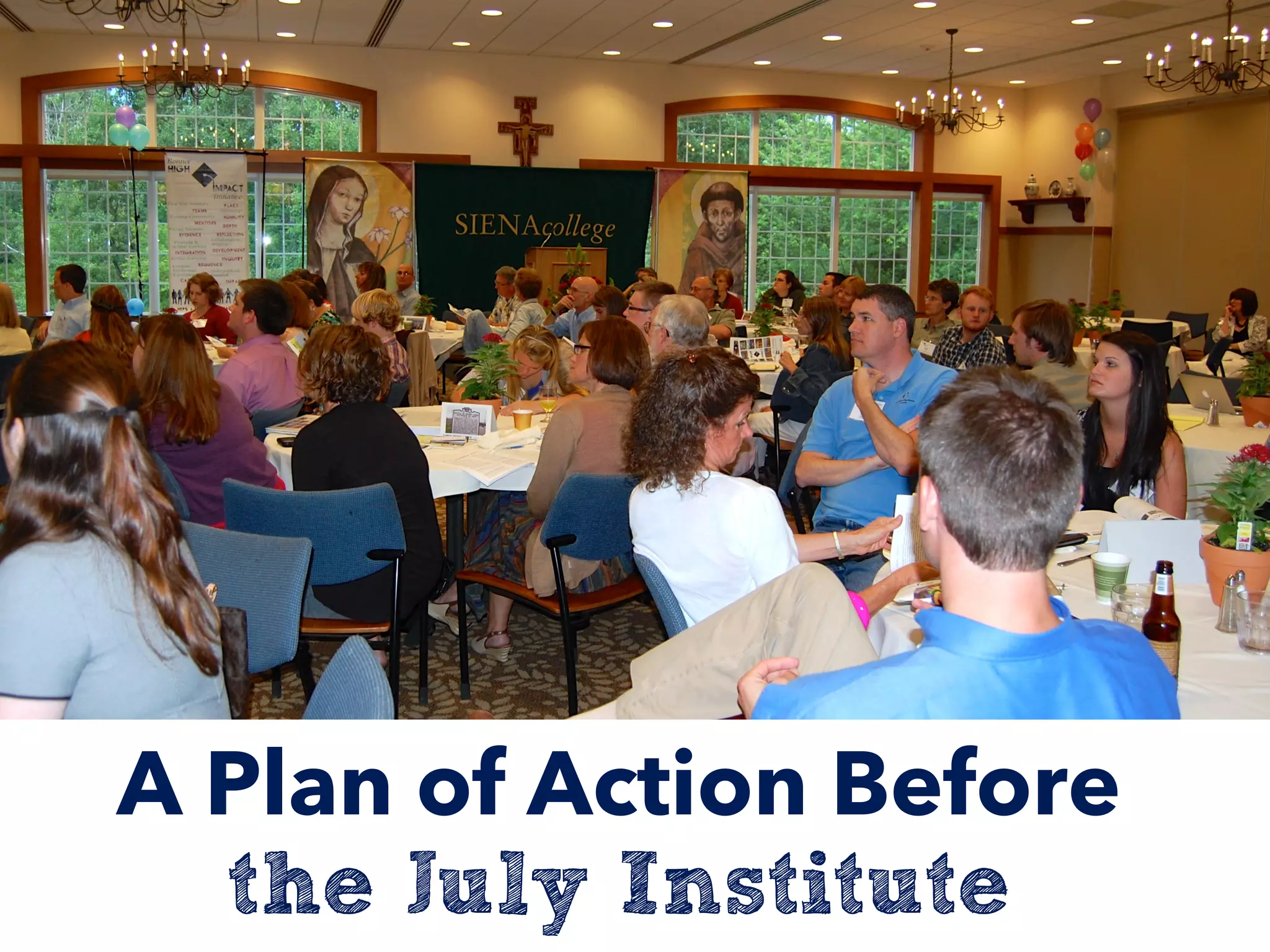
A Plan of Action Before
the July Institute
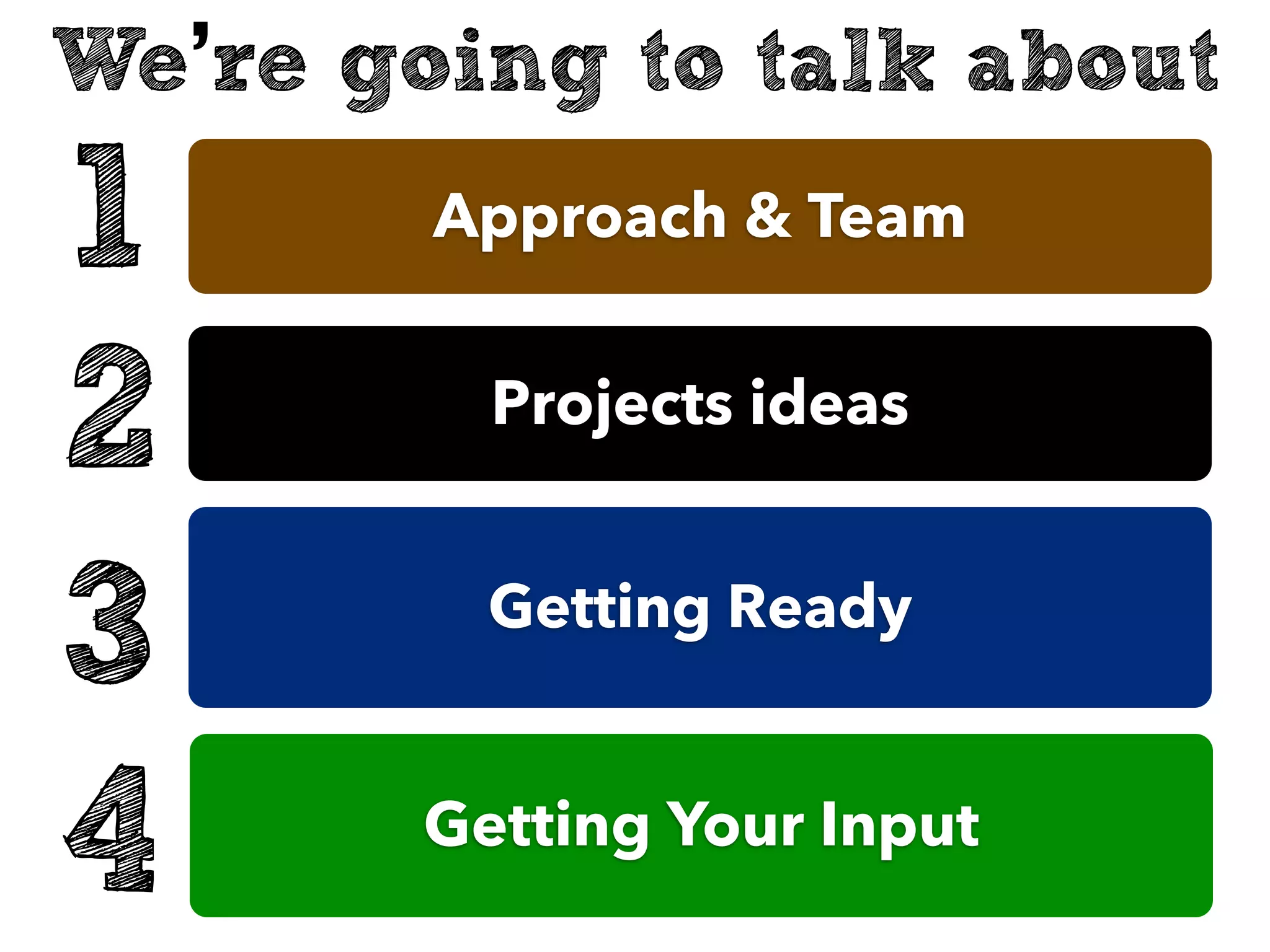
Getting Ready
Getting Your Input
Projects ideas
We’re going to talk about
1
2
3
Approach & Team
4
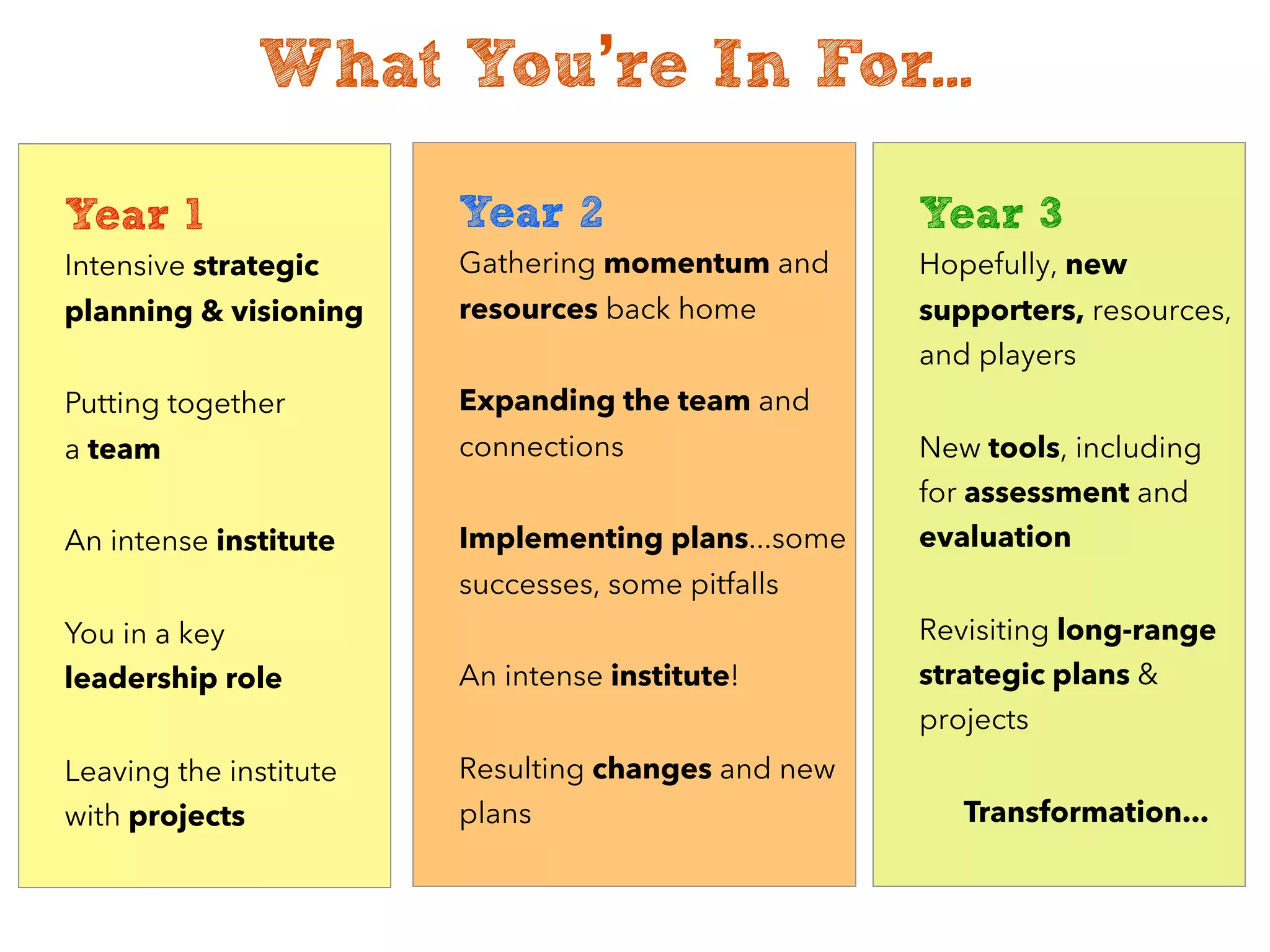
What You’re In For...
Year 1
Intensive strategic
planning & visioning
Putting together
a team
An intense institute
You in a key
leadership role
Leaving the institute
with projects
Year 2
Gathering momentum and
resources back home
Expanding the team and
connections
Implementing plans...some
successes, some pitfalls
An intense institute!
Resulting changes and new
plans
Year 3
Hopefully, new
supporters, resources,
and players
New tools, including
for assessment and
evaluation
Revisiting long-range
strategic plans &
projects
Transformation...
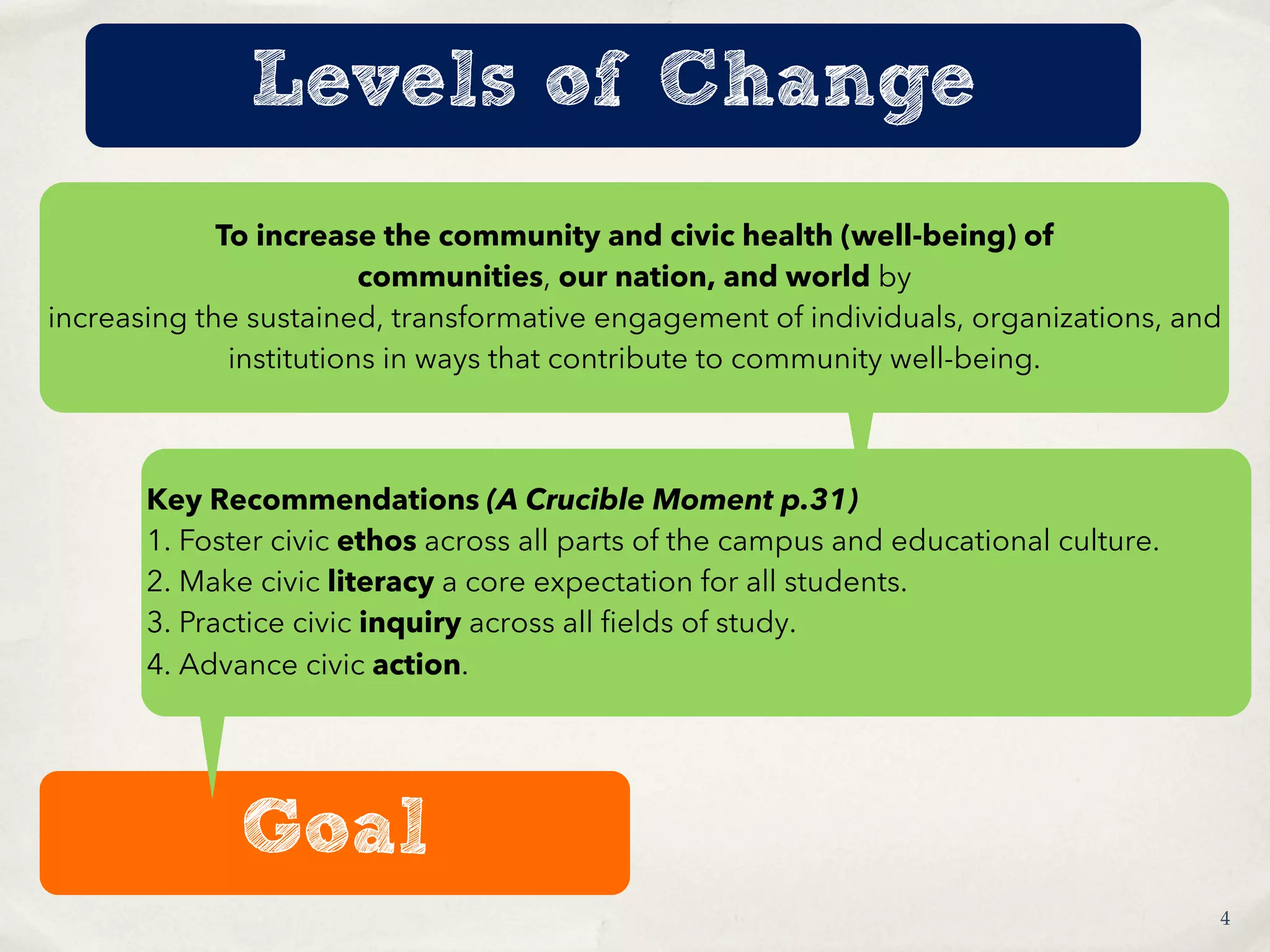
Goal
Levels of Change
Key Recommendations (A Crucible Moment p.31)
1. Foster civic ethos across all parts of the campus and educational culture.
2. Make civic literacy a core expectation for all students.
3. Practice civic inquiry across all fields of study.
4. Advance civic action.
To increase the community and civic health (well-being) of
communities, our nation, and world by
increasing the sustained, transformative engagement of individuals, organizations, and
institutions in ways that contribute to community well-being.
4
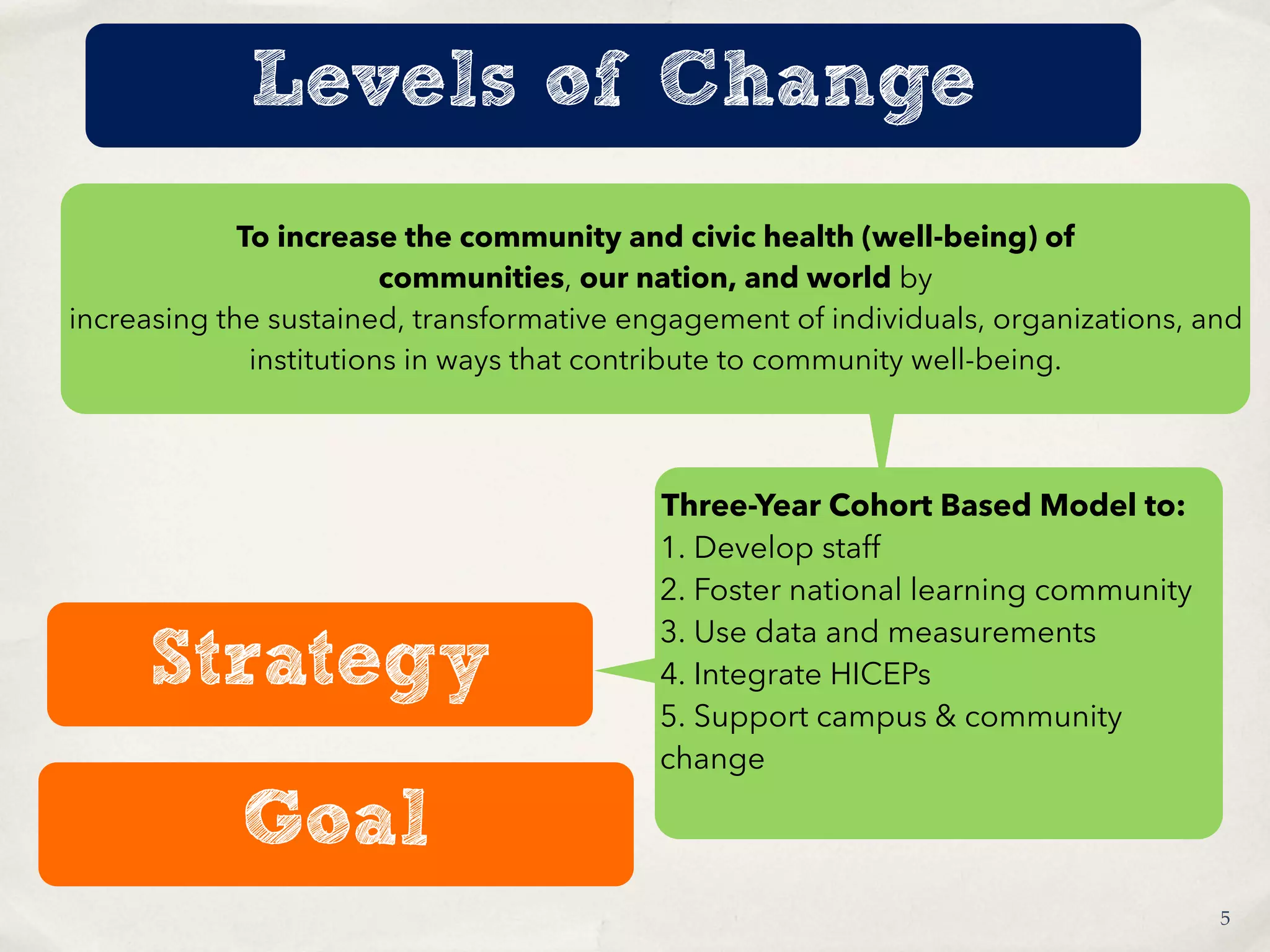
Strategy
Three-Year Cohort Based Model to:
1. Develop staff
2. Foster national learning community
3. Use data and measurements
4. Integrate HICEPs
5. Support campus & community
change
5
Levels of Change
Goal
To increase the community and civic health (well-being) of
communities, our nation, and world by
increasing the sustained, transformative engagement of individuals, organizations, and
institutions in ways that contribute to community well-being.
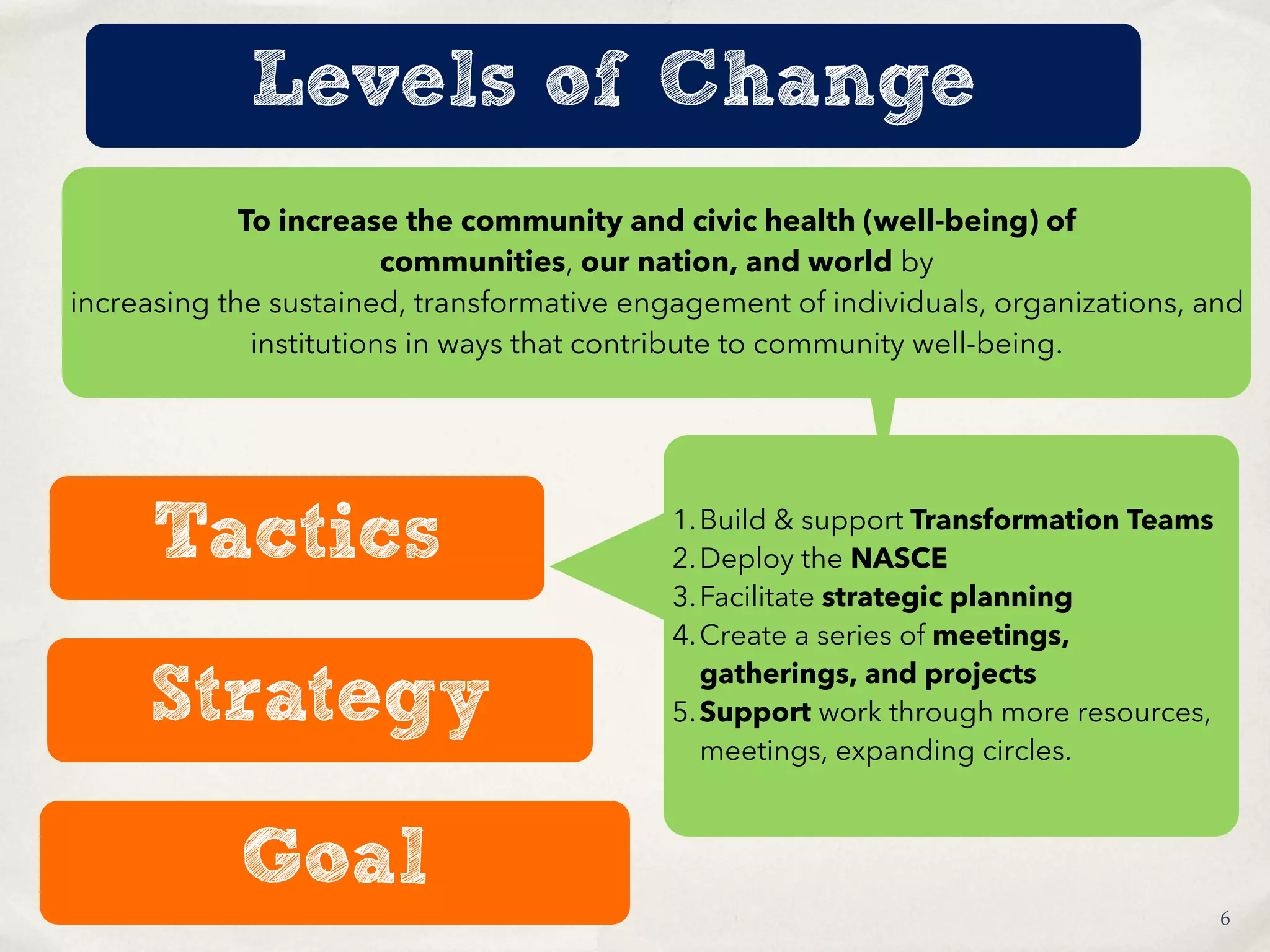
Strategy
Tactics 1.Build & support Transformation Teams
2.Deploy the NASCE
3.Facilitate strategic planning
4.Create a series of meetings,
gatherings, and projects
5.Support work through more resources,
meetings, expanding circles.
6
Levels of Change
Goal
To increase the community and civic health (well-being) of
communities, our nation, and world by
increasing the sustained, transformative engagement of individuals, organizations, and
institutions in ways that contribute to community well-being.
To increase the community and civic health (well-being) of
communities, our nation, and world by
increasing the sustained, transformative engagement of individuals, organizations, and
institutions in ways that contribute to community well-being.
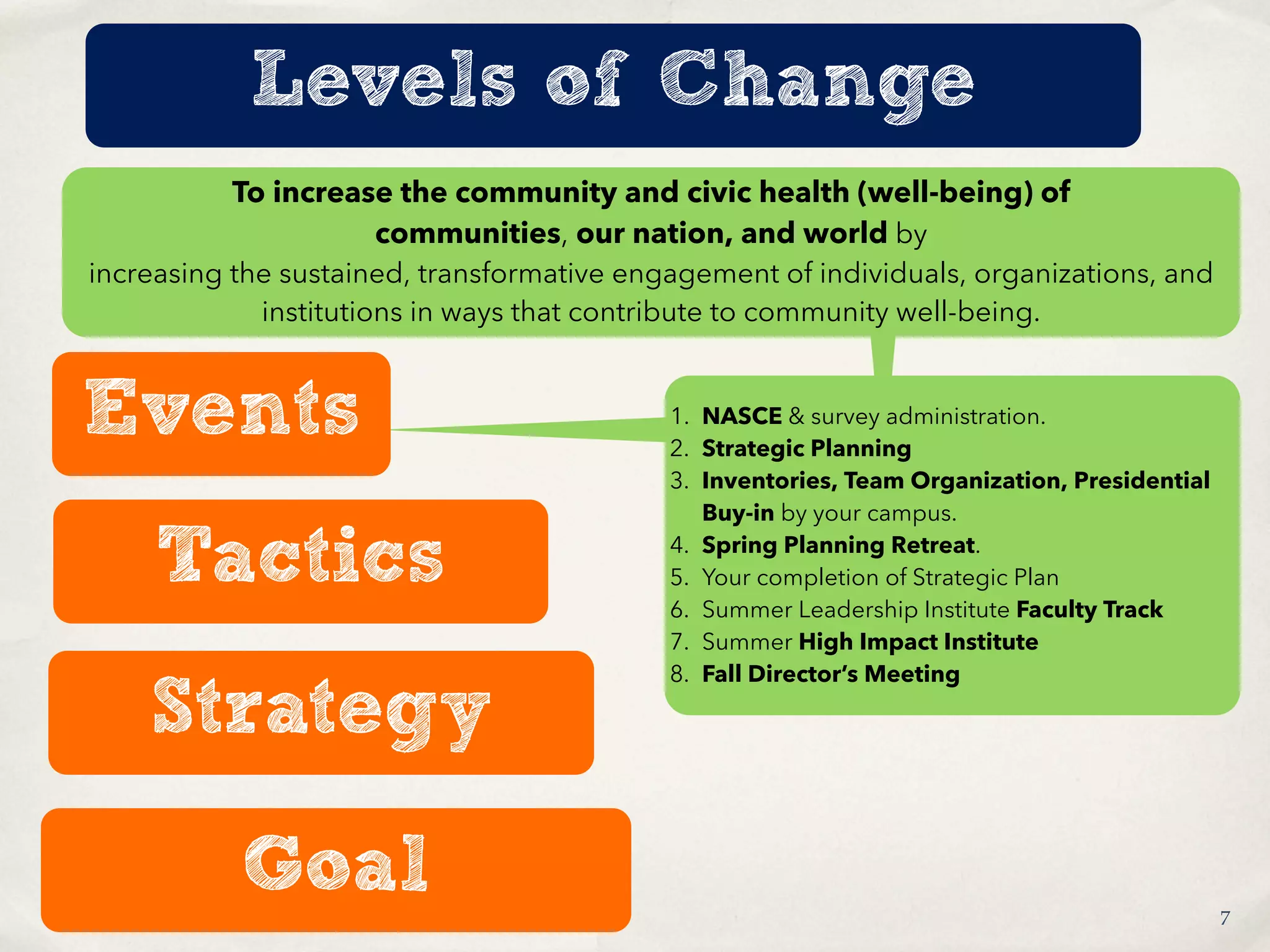
1. NASCE & survey administration.
2. Strategic Planning
3. Inventories, Team Organization, Presidential
Buy-in by your campus.
4. Spring Planning Retreat.
5. Your completion of Strategic Plan
6. Summer Leadership Institute Faculty Track
7. Summer High Impact Institute
8. Fall Director’s Meeting
7
Levels of Change
Events
Goal
Strategy
Tactics
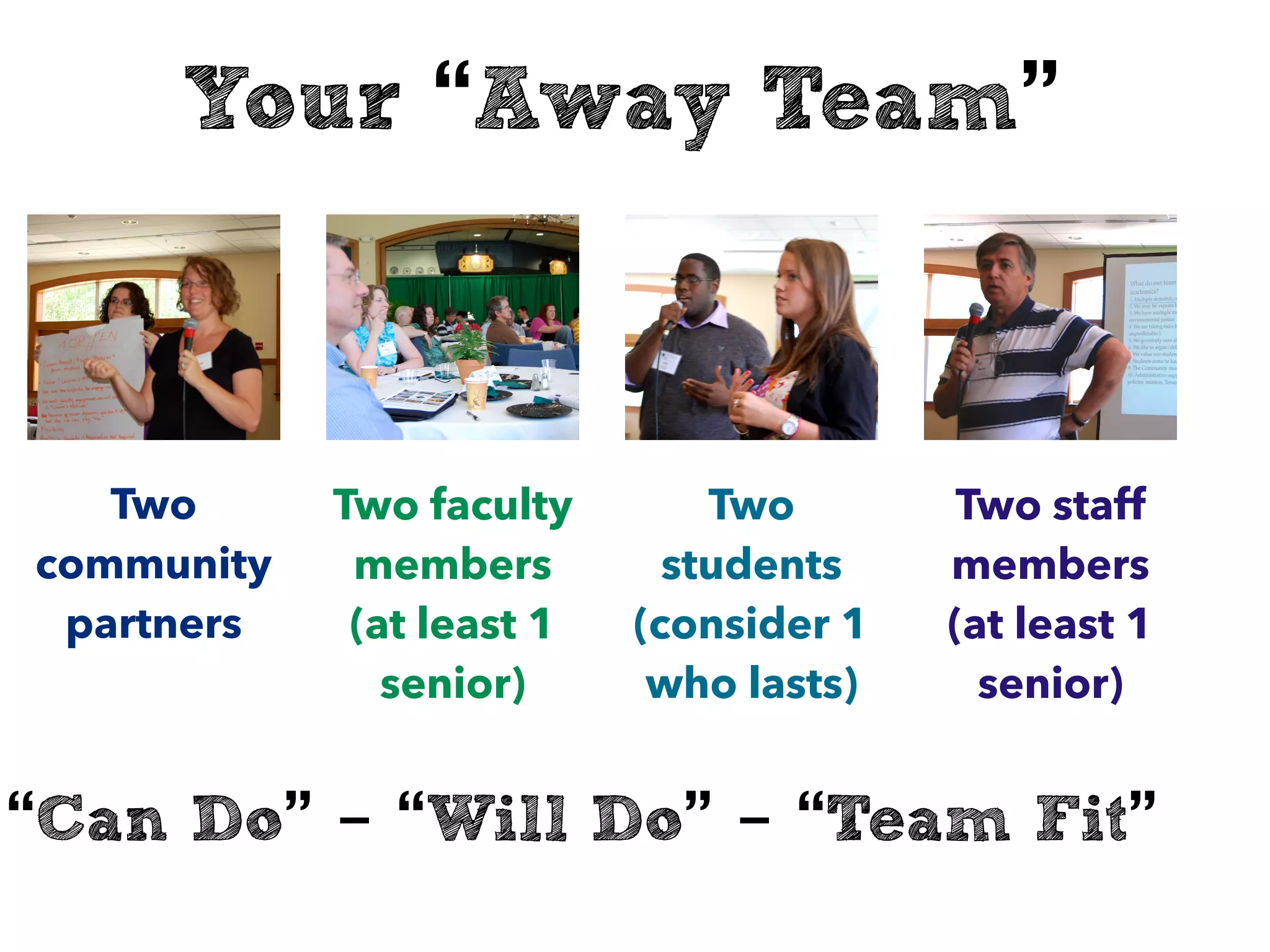
Your “Away Team”
Two
community
partners
Two faculty
members
(at least 1
senior)
Two
students
(consider 1
who lasts)
Two staff
members
(at least 1
senior)
“Can Do” - “Will Do” - “Team Fit”
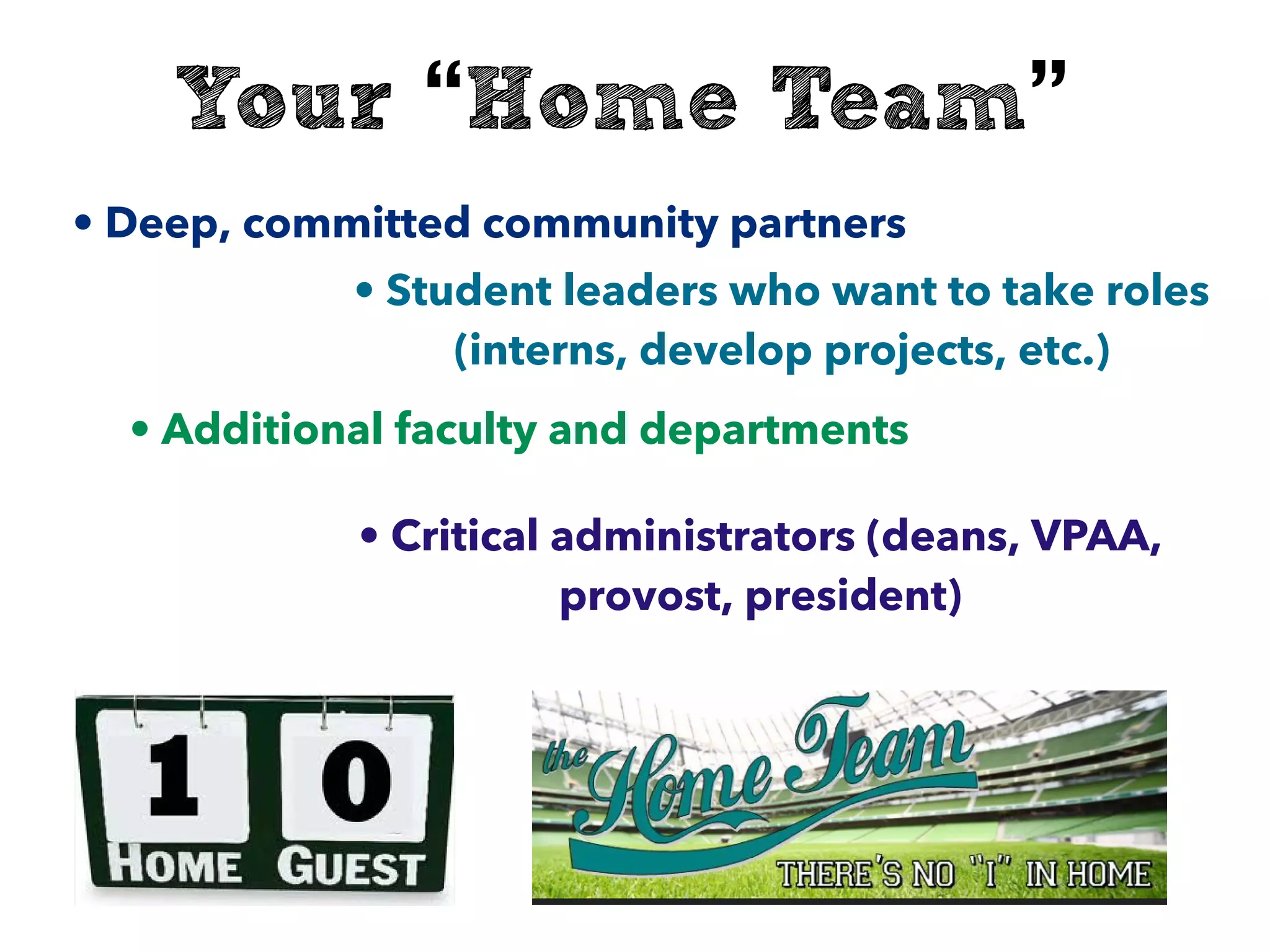
Your “Home Team”
• Deep, committed community partners
• Additional faculty and departments
• Student leaders who want to take roles
(interns, develop projects, etc.)
• Critical administrators (deans, VPAA,
provost, president)
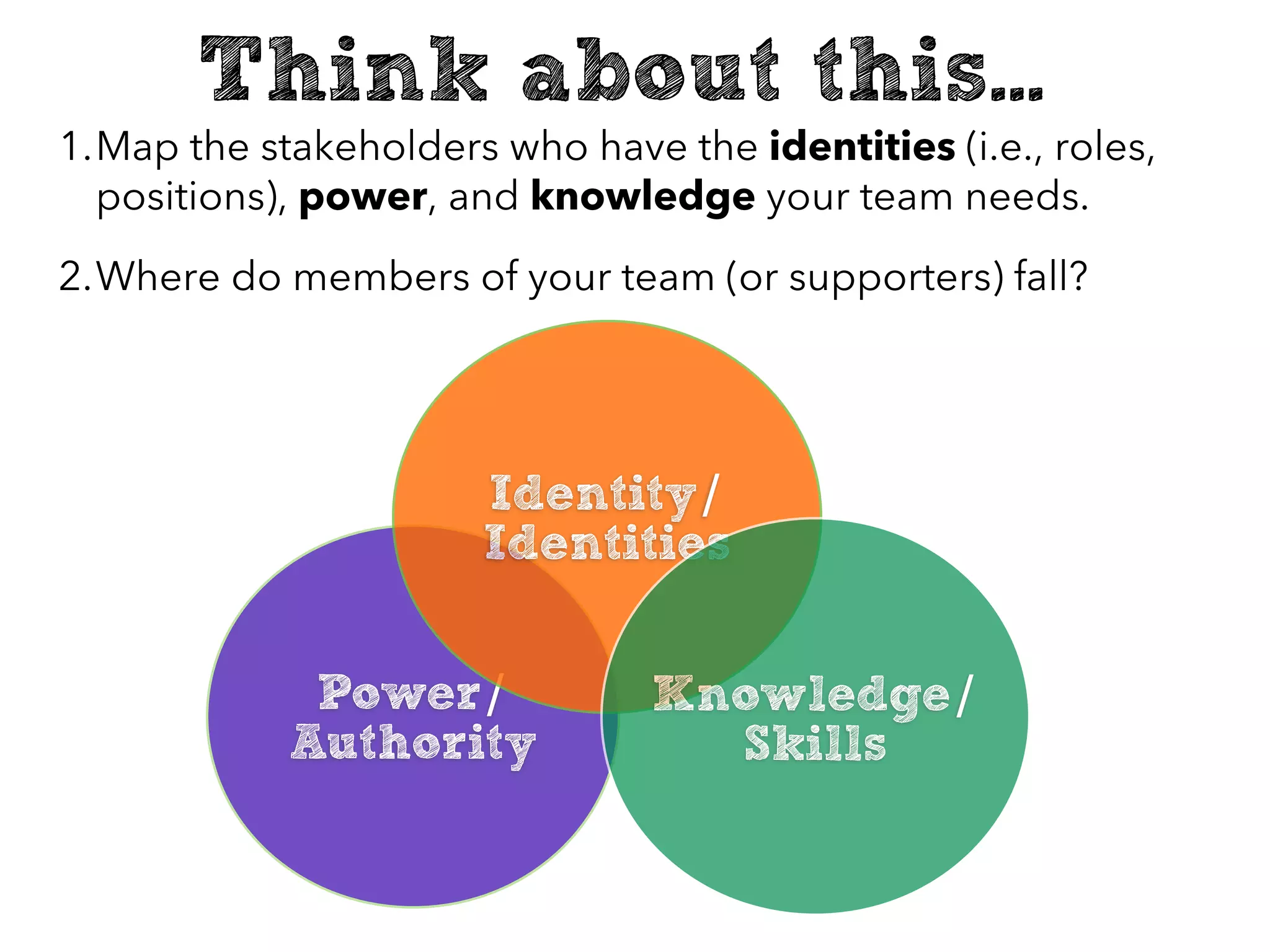
Power/
Authority
1.Map the stakeholders who have the identities (i.e., roles,
positions), power, and knowledge your team needs.
2.Where do members of your team (or supporters) fall?
Identity/
Identities
Knowledge/
Skills
Think about this...
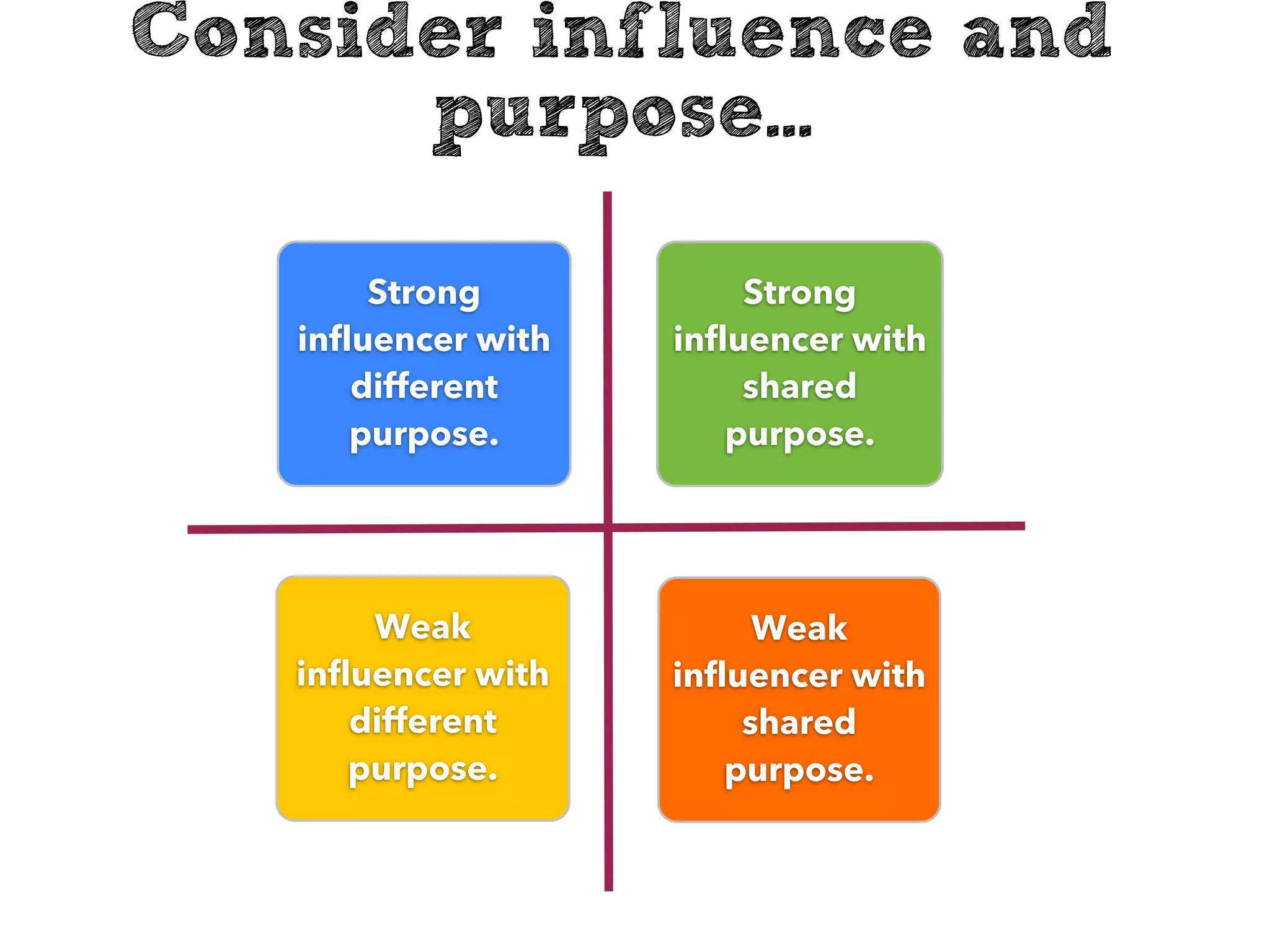
Weak
influencer with
shared
purpose.
Weak
influencer with
different
purpose.
Strong
influencer with
shared
purpose.
Strong
influencer with
different
purpose.
Consider influence and
purpose...
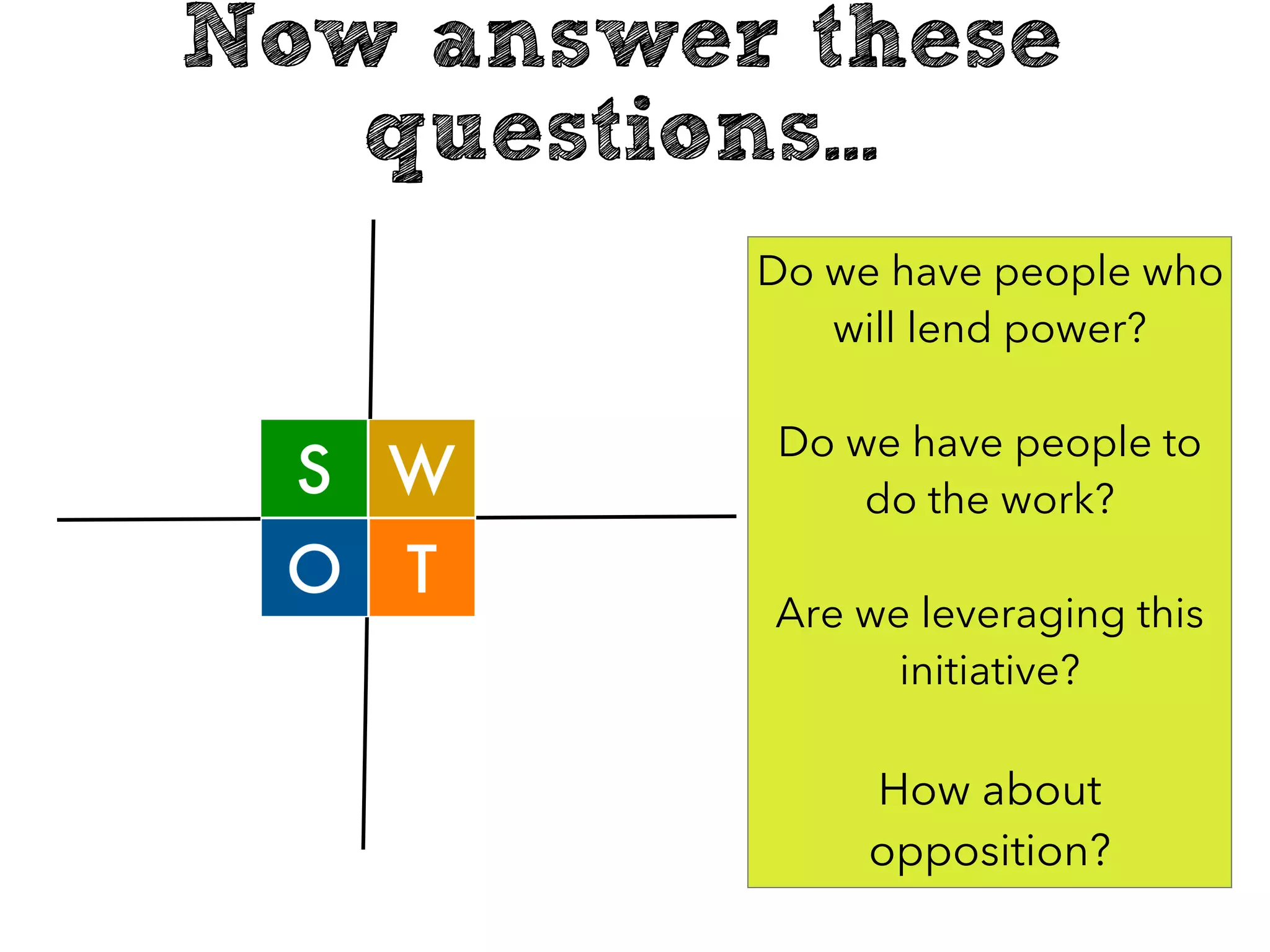
Now answer these
questions...
Do we have people who
will lend power?
Do we have people to
do the work?
Are we leveraging this
initiative?
How about
opposition?
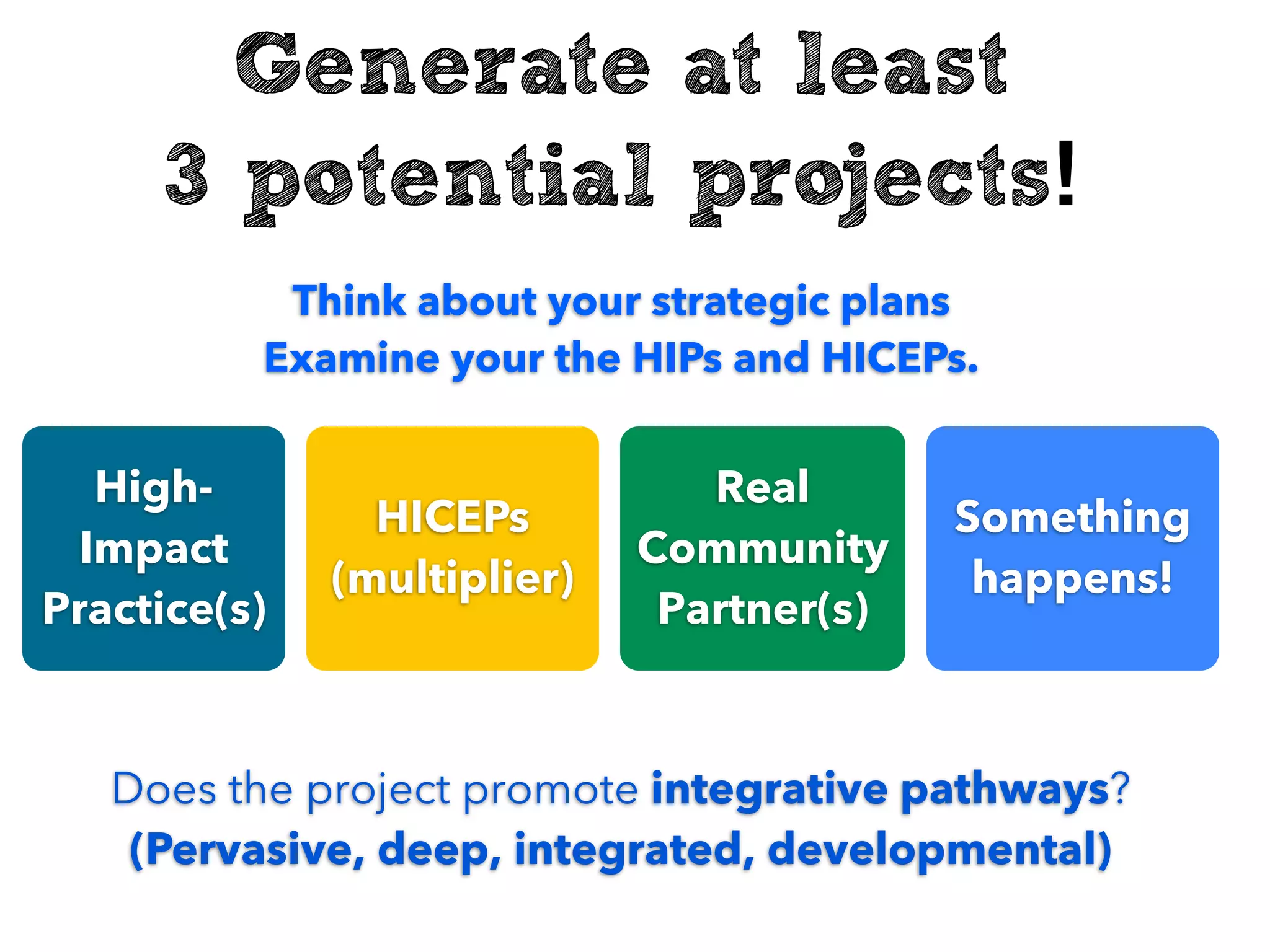
High-
Impact
Practice(s)
HICEPs
(multiplier)
Real
Community
Partner(s)
Something
happens!
Does the project promote integrative pathways?
(Pervasive, deep, integrated, developmental)
Generate at least
3 potential projects!
Think about your strategic plans
Examine your the HIPs and HICEPs.
Real Projects
Allegheny and
Sewanee’s First Year
Seminars [HICEP
Multipliers: Place,
Humility, Reflection]
Stetson’s work to
integrate Junior
Undergraduate
Research Seminars with
community engagement
[HICEP Multipliers:
Sequence,
Collaborative Projects]
Siena’s work to train
students as
deliberative democracy
facilitators, then host
campus-wide forum
with a focus on thematic
community issue [HICEP
Multipliers: Inquiry,
Capacity, Teams]
Carson-Newmans’ work
to build a community
development hub for
multiple course projects
[HICEP Multipliers: Place,
Depth, Integration]
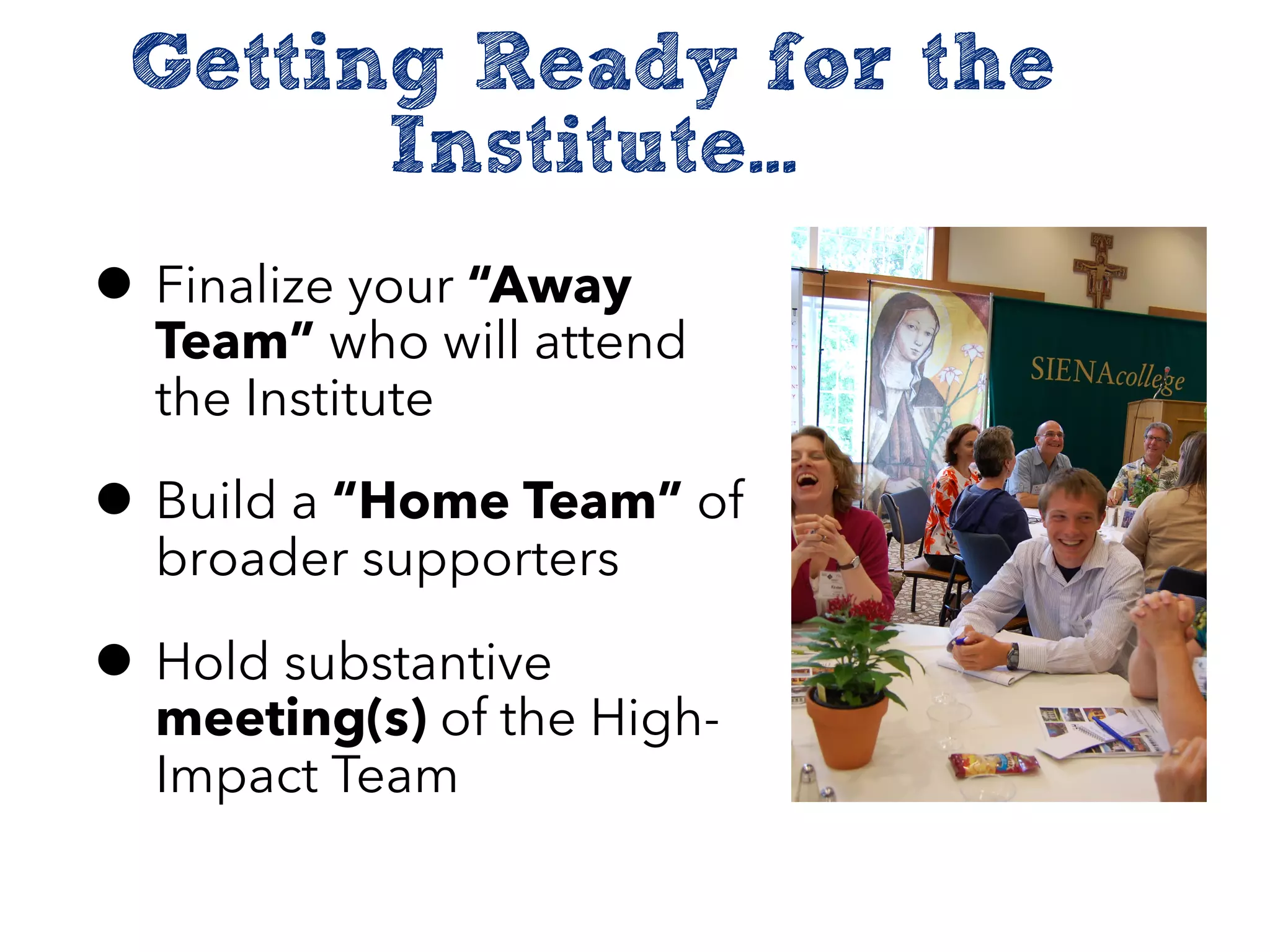
Getting Ready for the
Institute...
• Finalize your “Away
Team” who will attend
the Institute
• Build a “Home Team” of
broader supporters
• Hold substantive
meeting(s) of the High-
Impact Team
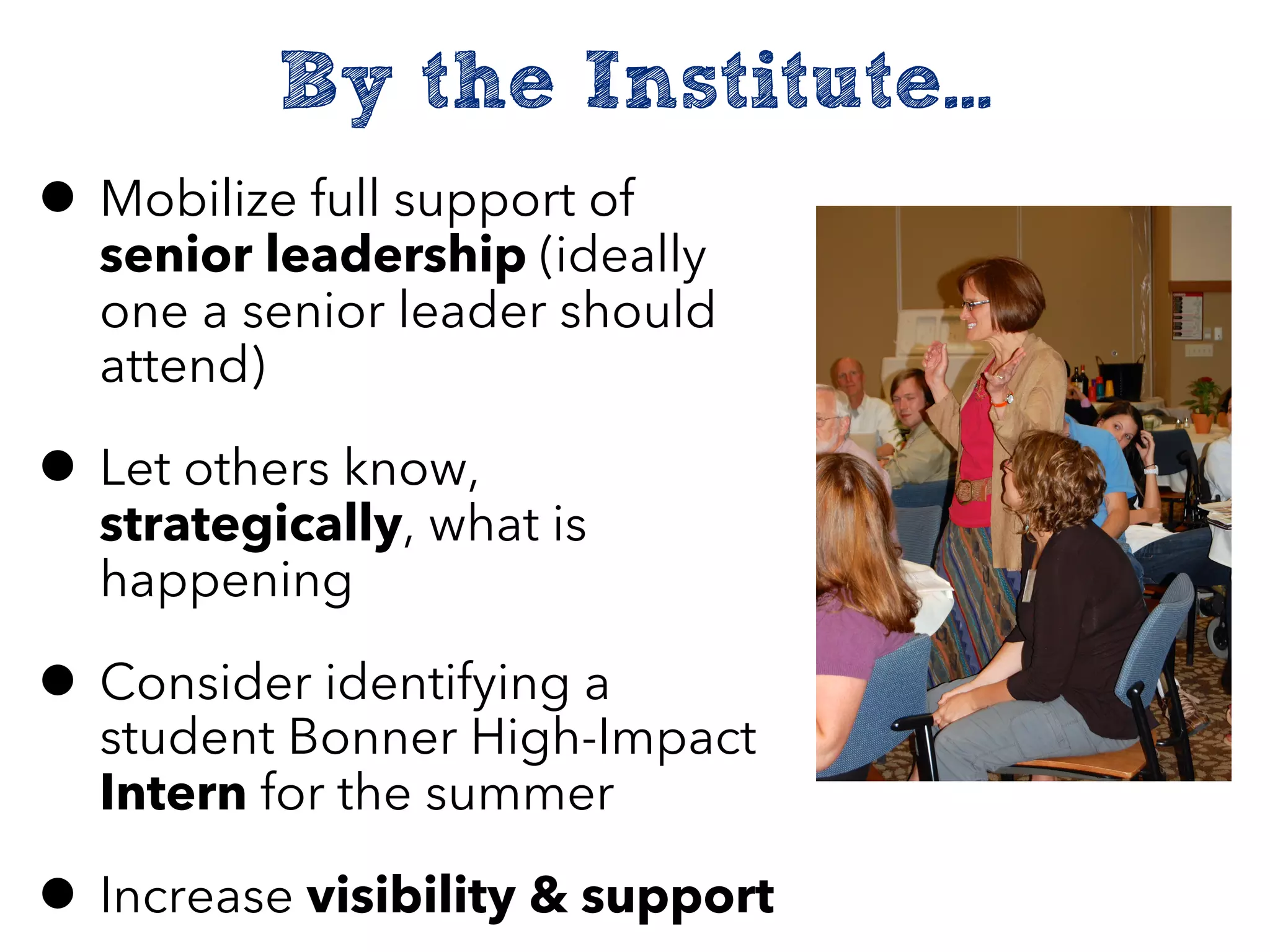
By the Institute...
• Mobilize full support of
senior leadership (ideally
one a senior leader should
attend)
• Let others know,
strategically, what is
happening
• Consider identifying a
student Bonner High-Impact
Intern for the summer
• Increase visibility & support
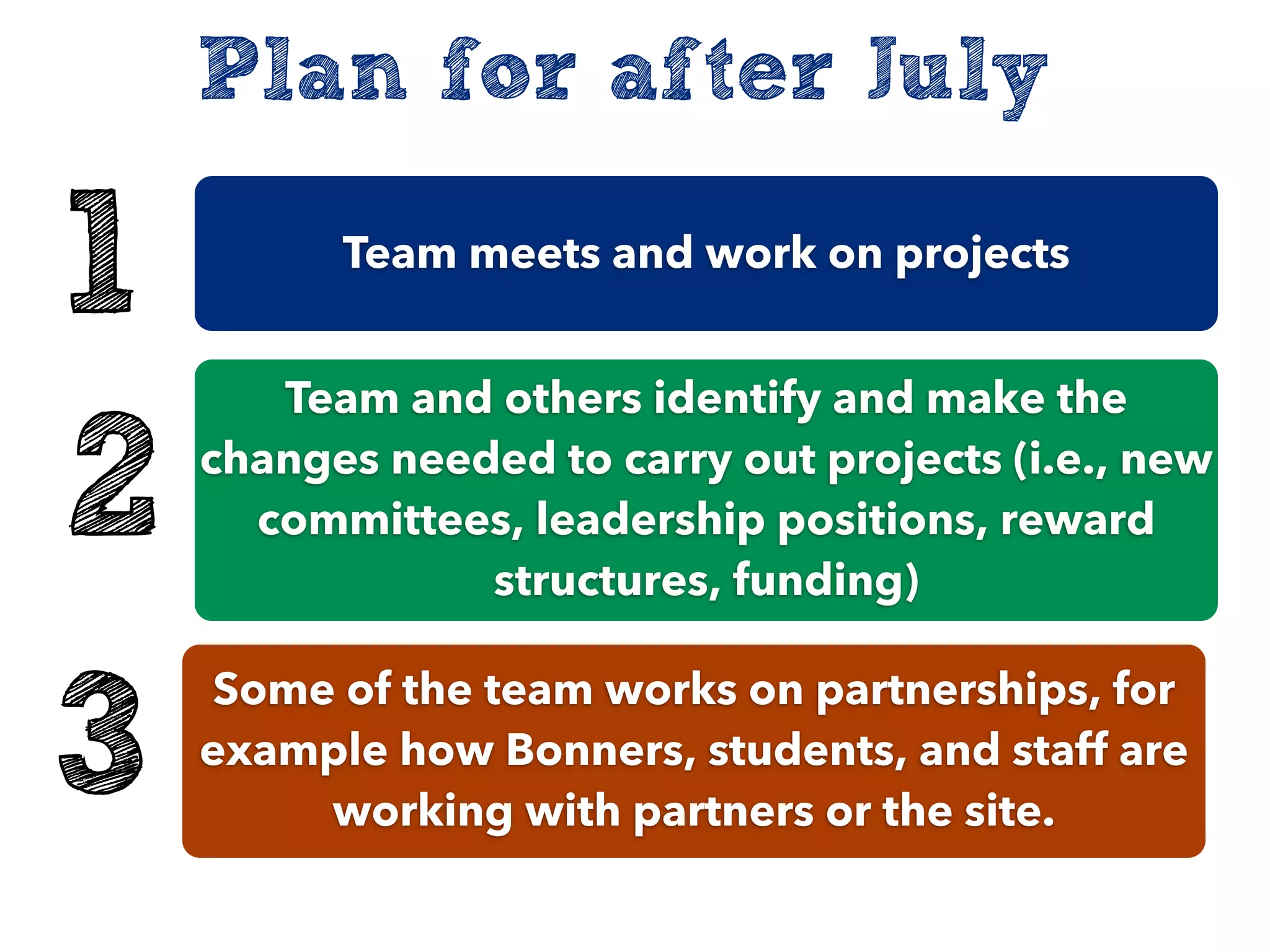
Team and others identify and make the
changes needed to carry out projects (i.e., new
committees, leadership positions, reward
structures, funding)
Some of the team works on partnerships, for
example how Bonners, students, and staff are
working with partners or the site.
Team meets and work on projects
Plan for after July
1
2
3
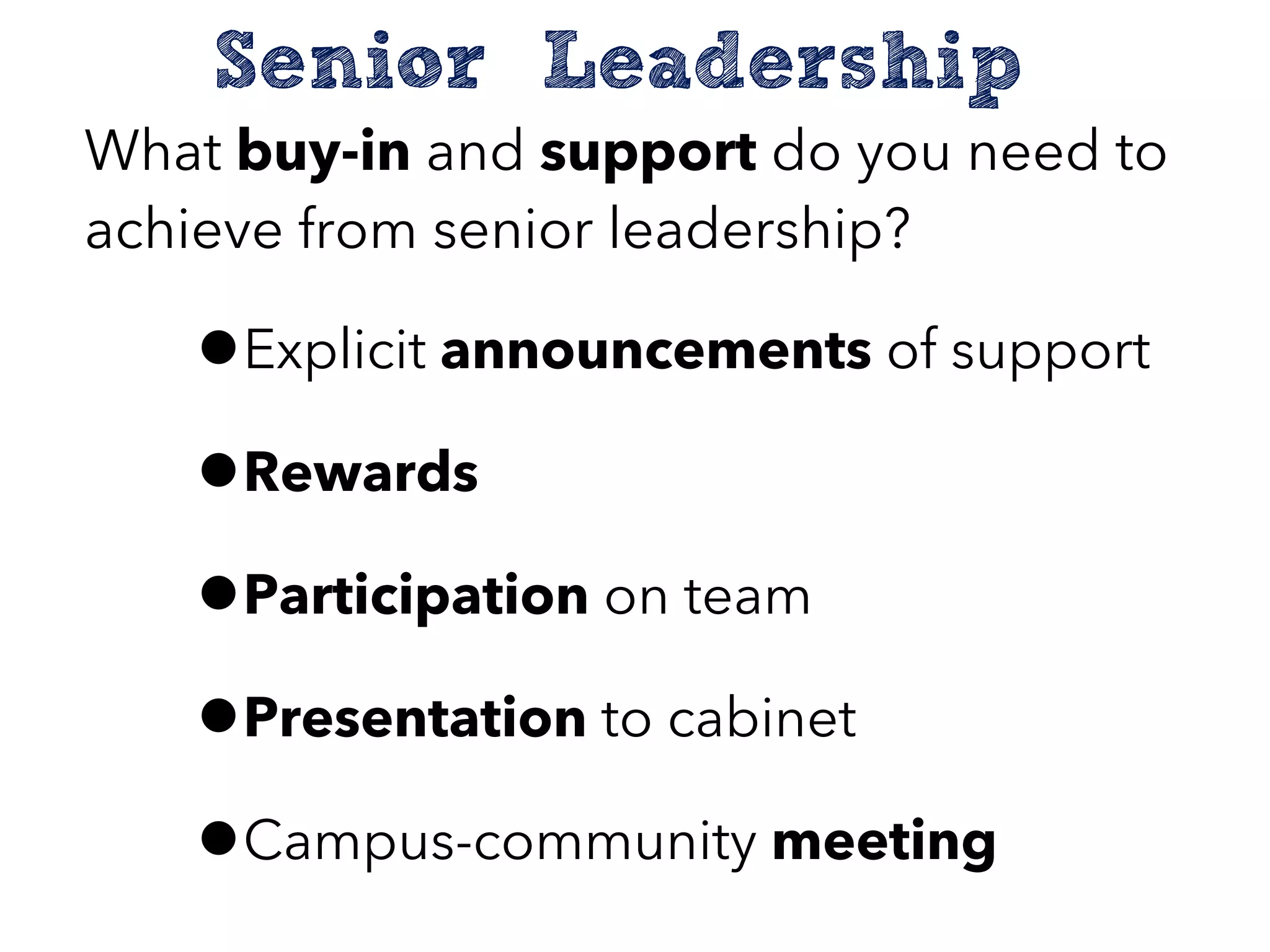
Senior Leadership
What buy-in and support do you need to
achieve from senior leadership?
•Explicit announcements of support
•Rewards
•Participation on team
•Presentation to cabinet
•Campus-community meeting
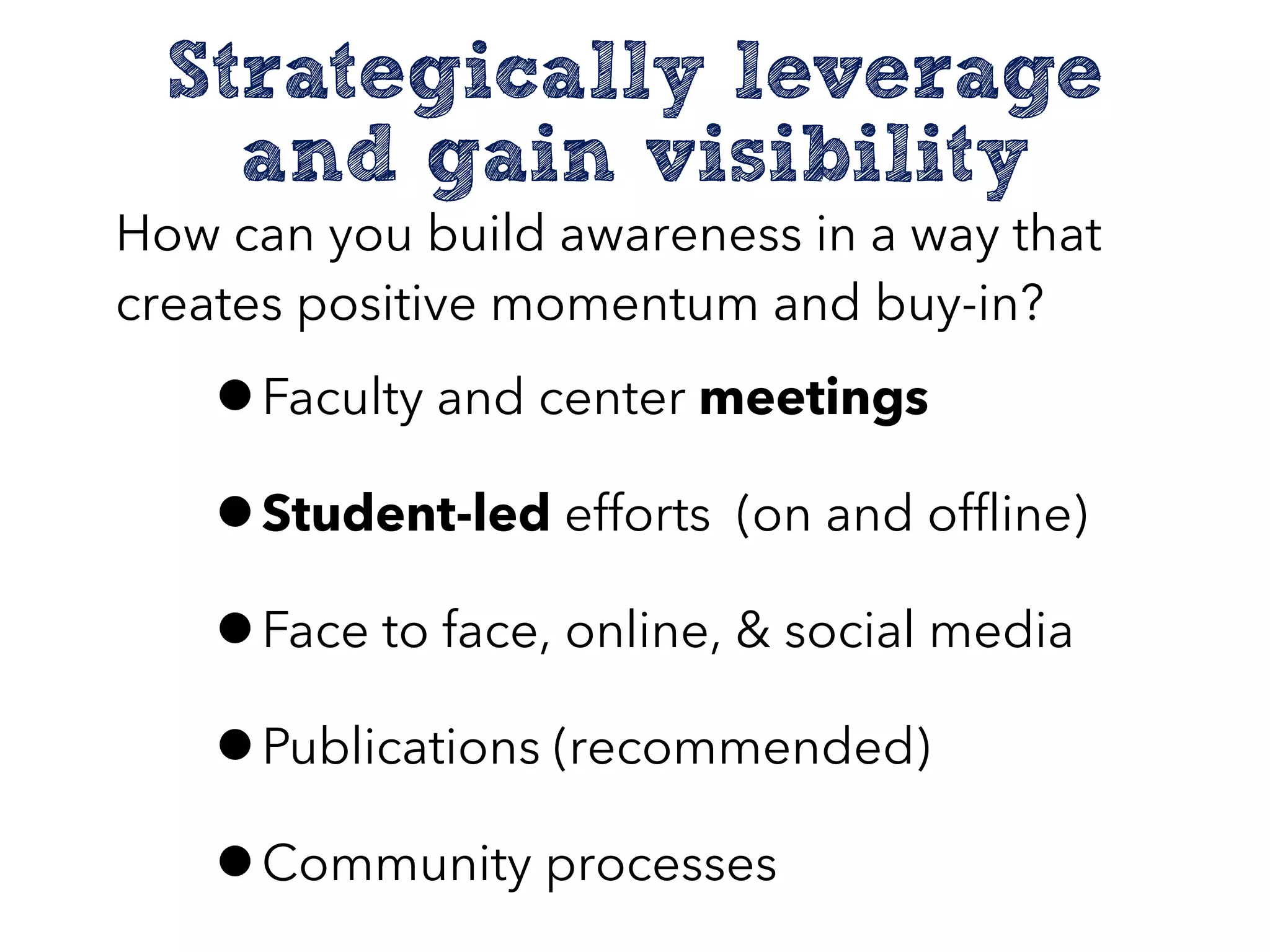
Strategically leverage
and gain visibility
How can you build awareness in a way that
creates positive momentum and buy-in?
•Faculty and center meetings
•Student-led efforts (on and offline)
•Face to face, online, & social media
•Publications (recommended)
•Community processes
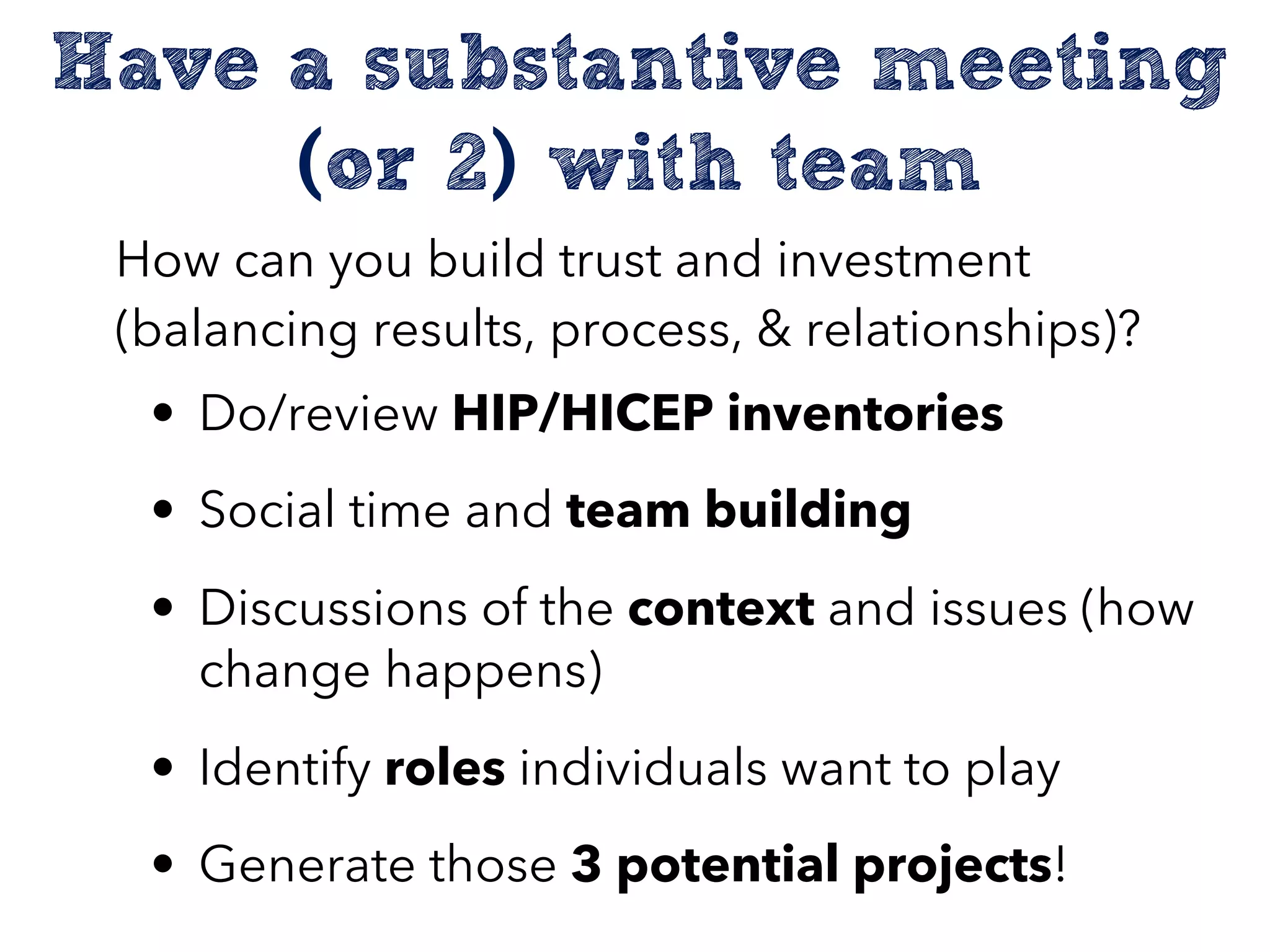
Have a substantive meeting
(or 2) with team
How can you build trust and investment
(balancing results, process, & relationships)?
• Do/review HIP/HICEP inventories
• Social time and team building
• Discussions of the context and issues (how
change happens)
• Identify roles individuals want to play
• Generate those 3 potential projects!
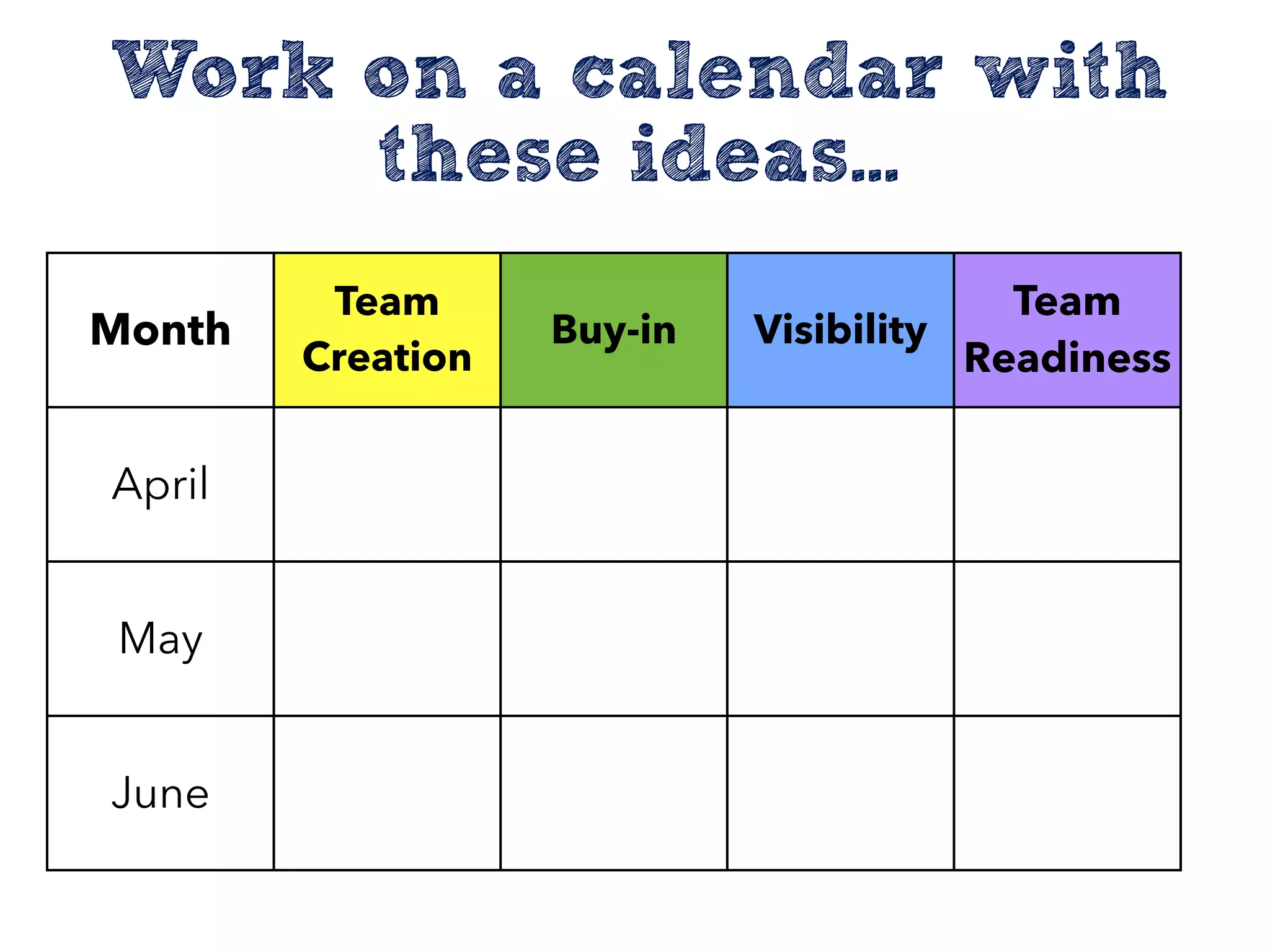
Month
Team
Creation
Buy-in Visibility
Team
Readiness
April
May
June
Work on a calendar with
these ideas...
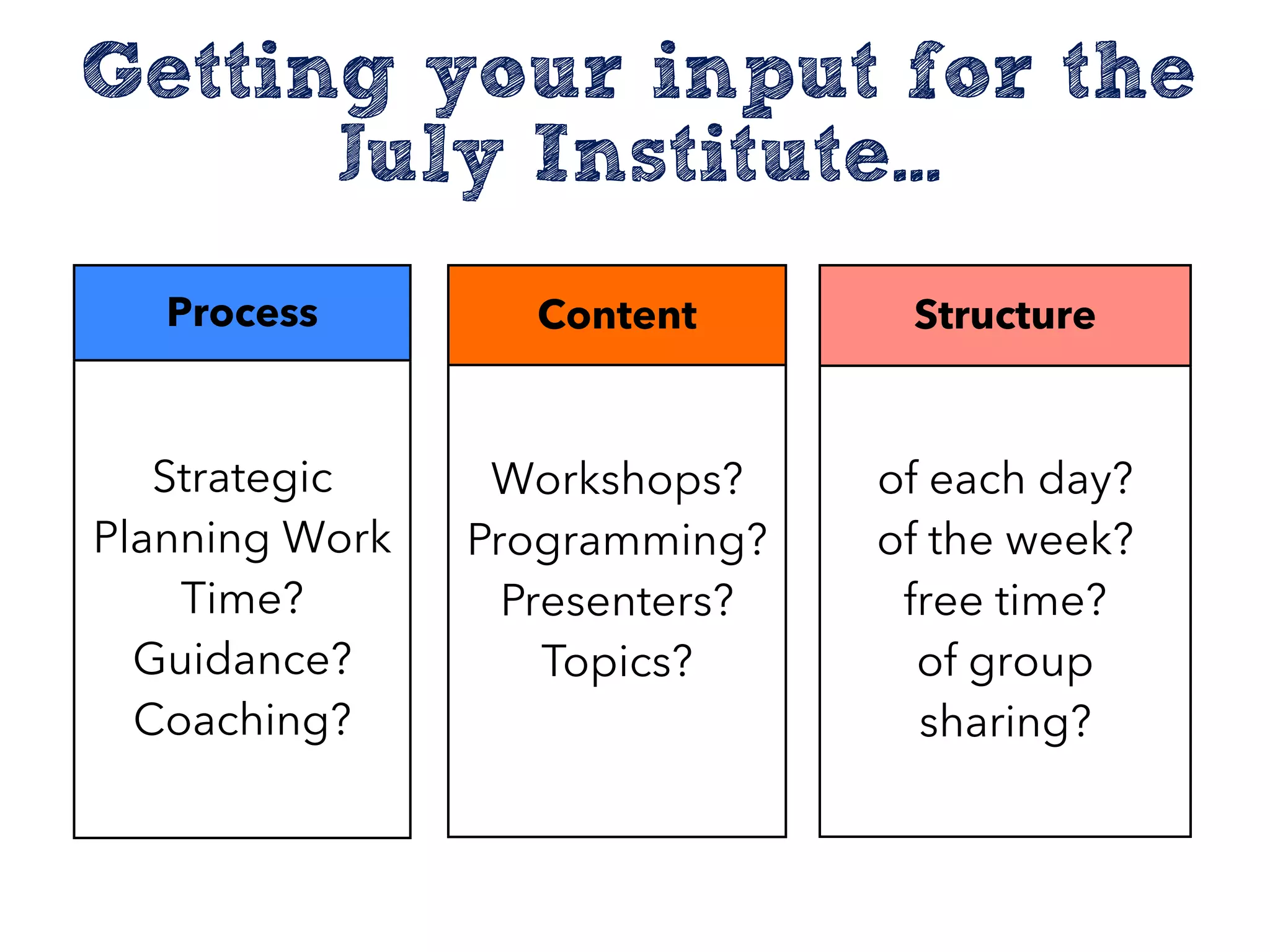
Getting your input for the
July Institute...
Process
Strategic
Planning Work
Time?
Guidance?
Coaching?
Content
Workshops?
Programming?
Presenters?
Topics?
Structure
of each day?
of the week?
free time?
of group
sharing?

Getting Ready: A Plan of Action Before July

  • 1.
    A Plan ofAction Before the July Institute
  • 2.
    Getting Ready Getting YourInput Projects ideas We’re going to talk about 1 2 3 Approach & Team 4
  • 3.
    What You’re InFor... Year 1 Intensive strategic planning & visioning Putting together a team An intense institute You in a key leadership role Leaving the institute with projects Year 2 Gathering momentum and resources back home Expanding the team and connections Implementing plans...some successes, some pitfalls An intense institute! Resulting changes and new plans Year 3 Hopefully, new supporters, resources, and players New tools, including for assessment and evaluation Revisiting long-range strategic plans & projects Transformation...
  • 4.
    Goal Levels of Change KeyRecommendations (A Crucible Moment p.31) 1. Foster civic ethos across all parts of the campus and educational culture. 2. Make civic literacy a core expectation for all students. 3. Practice civic inquiry across all fields of study. 4. Advance civic action. To increase the community and civic health (well-being) of communities, our nation, and world by increasing the sustained, transformative engagement of individuals, organizations, and institutions in ways that contribute to community well-being. 4
  • 5.
    Strategy Three-Year Cohort BasedModel to: 1. Develop staff 2. Foster national learning community 3. Use data and measurements 4. Integrate HICEPs 5. Support campus & community change 5 Levels of Change Goal To increase the community and civic health (well-being) of communities, our nation, and world by increasing the sustained, transformative engagement of individuals, organizations, and institutions in ways that contribute to community well-being.
  • 6.
    Strategy Tactics 1.Build &support Transformation Teams 2.Deploy the NASCE 3.Facilitate strategic planning 4.Create a series of meetings, gatherings, and projects 5.Support work through more resources, meetings, expanding circles. 6 Levels of Change Goal To increase the community and civic health (well-being) of communities, our nation, and world by increasing the sustained, transformative engagement of individuals, organizations, and institutions in ways that contribute to community well-being.
  • 7.
    To increase thecommunity and civic health (well-being) of communities, our nation, and world by increasing the sustained, transformative engagement of individuals, organizations, and institutions in ways that contribute to community well-being. 1. NASCE & survey administration. 2. Strategic Planning 3. Inventories, Team Organization, Presidential Buy-in by your campus. 4. Spring Planning Retreat. 5. Your completion of Strategic Plan 6. Summer Leadership Institute Faculty Track 7. Summer High Impact Institute 8. Fall Director’s Meeting 7 Levels of Change Events Goal Strategy Tactics
  • 8.
    Your “Away Team” Two community partners Twofaculty members (at least 1 senior) Two students (consider 1 who lasts) Two staff members (at least 1 senior) “Can Do” - “Will Do” - “Team Fit”
  • 9.
    Your “Home Team” •Deep, committed community partners • Additional faculty and departments • Student leaders who want to take roles (interns, develop projects, etc.) • Critical administrators (deans, VPAA, provost, president)
  • 10.
    Power/ Authority 1.Map the stakeholderswho have the identities (i.e., roles, positions), power, and knowledge your team needs. 2.Where do members of your team (or supporters) fall? Identity/ Identities Knowledge/ Skills Think about this...
  • 11.
    Weak influencer with shared purpose. Weak influencer with different purpose. Strong influencerwith shared purpose. Strong influencer with different purpose. Consider influence and purpose...
  • 12.
    Now answer these questions... Dowe have people who will lend power? Do we have people to do the work? Are we leveraging this initiative? How about opposition?
  • 13.
    High- Impact Practice(s) HICEPs (multiplier) Real Community Partner(s) Something happens! Does the projectpromote integrative pathways? (Pervasive, deep, integrated, developmental) Generate at least 3 potential projects! Think about your strategic plans Examine your the HIPs and HICEPs.
  • 14.
    Real Projects Allegheny and Sewanee’sFirst Year Seminars [HICEP Multipliers: Place, Humility, Reflection] Stetson’s work to integrate Junior Undergraduate Research Seminars with community engagement [HICEP Multipliers: Sequence, Collaborative Projects] Siena’s work to train students as deliberative democracy facilitators, then host campus-wide forum with a focus on thematic community issue [HICEP Multipliers: Inquiry, Capacity, Teams] Carson-Newmans’ work to build a community development hub for multiple course projects [HICEP Multipliers: Place, Depth, Integration]
  • 15.
    Getting Ready forthe Institute... • Finalize your “Away Team” who will attend the Institute • Build a “Home Team” of broader supporters • Hold substantive meeting(s) of the High- Impact Team
  • 16.
    By the Institute... •Mobilize full support of senior leadership (ideally one a senior leader should attend) • Let others know, strategically, what is happening • Consider identifying a student Bonner High-Impact Intern for the summer • Increase visibility & support
  • 17.
    Team and othersidentify and make the changes needed to carry out projects (i.e., new committees, leadership positions, reward structures, funding) Some of the team works on partnerships, for example how Bonners, students, and staff are working with partners or the site. Team meets and work on projects Plan for after July 1 2 3
  • 18.
    Senior Leadership What buy-inand support do you need to achieve from senior leadership? •Explicit announcements of support •Rewards •Participation on team •Presentation to cabinet •Campus-community meeting
  • 19.
    Strategically leverage and gainvisibility How can you build awareness in a way that creates positive momentum and buy-in? •Faculty and center meetings •Student-led efforts (on and offline) •Face to face, online, & social media •Publications (recommended) •Community processes
  • 20.
    Have a substantivemeeting (or 2) with team How can you build trust and investment (balancing results, process, & relationships)? • Do/review HIP/HICEP inventories • Social time and team building • Discussions of the context and issues (how change happens) • Identify roles individuals want to play • Generate those 3 potential projects!
  • 21.
  • 22.
    Getting your inputfor the July Institute... Process Strategic Planning Work Time? Guidance? Coaching? Content Workshops? Programming? Presenters? Topics? Structure of each day? of the week? free time? of group sharing?