“Leaders of Today:”
The Bonner Student
Developmental Model and Staff
Developmental Pipeline Project
BonnerSummerLeadershipInstitute2018
Wednesday, June 7, 2018 

from 9:00 am to 10:45 am
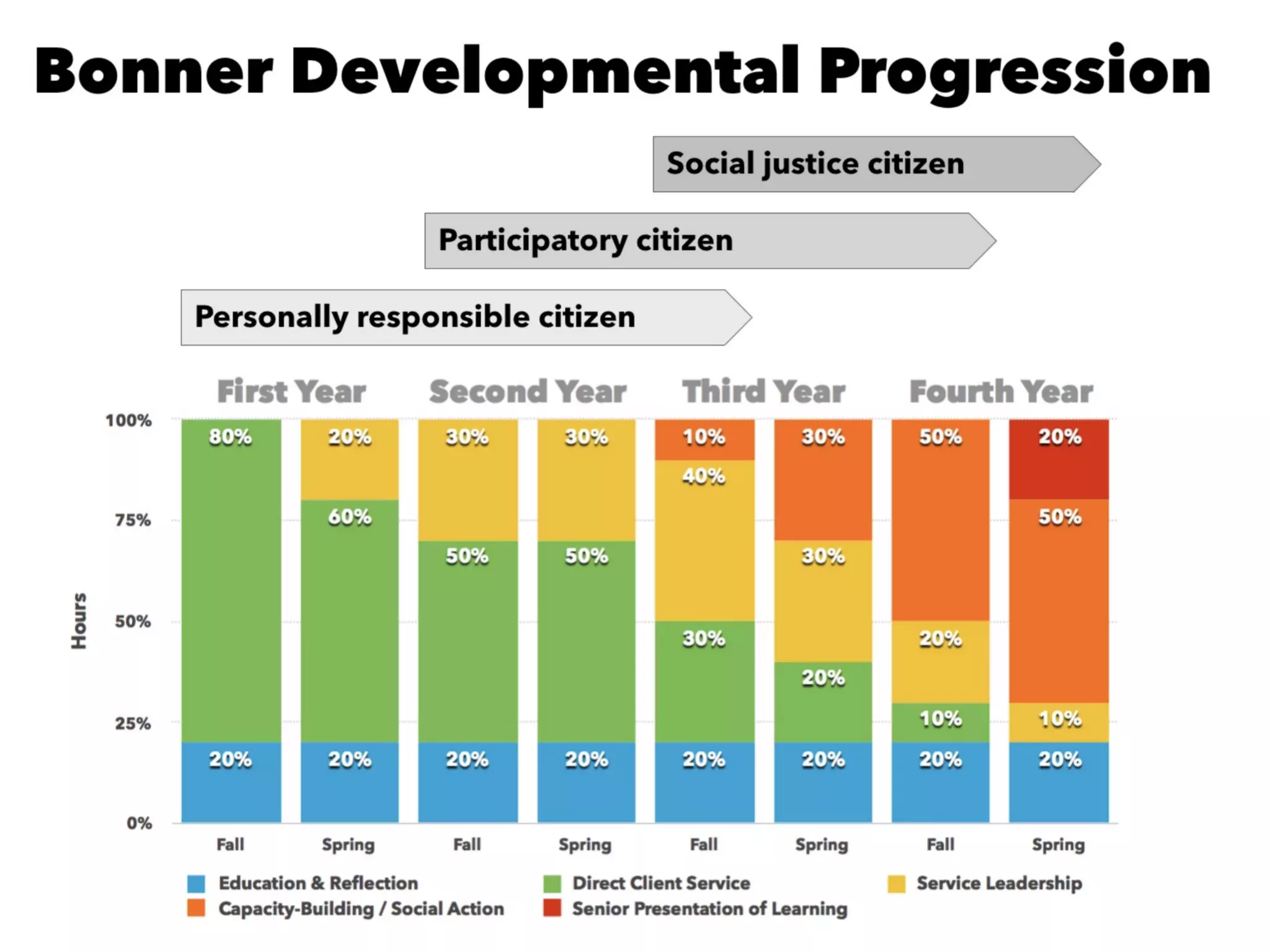
•Reintroduce the Bonner Student
Developmental Model
•Introduce the Bonner Staff
Development Pipeline Project
•Small groups networking and
discussion by level
What We’ll Do
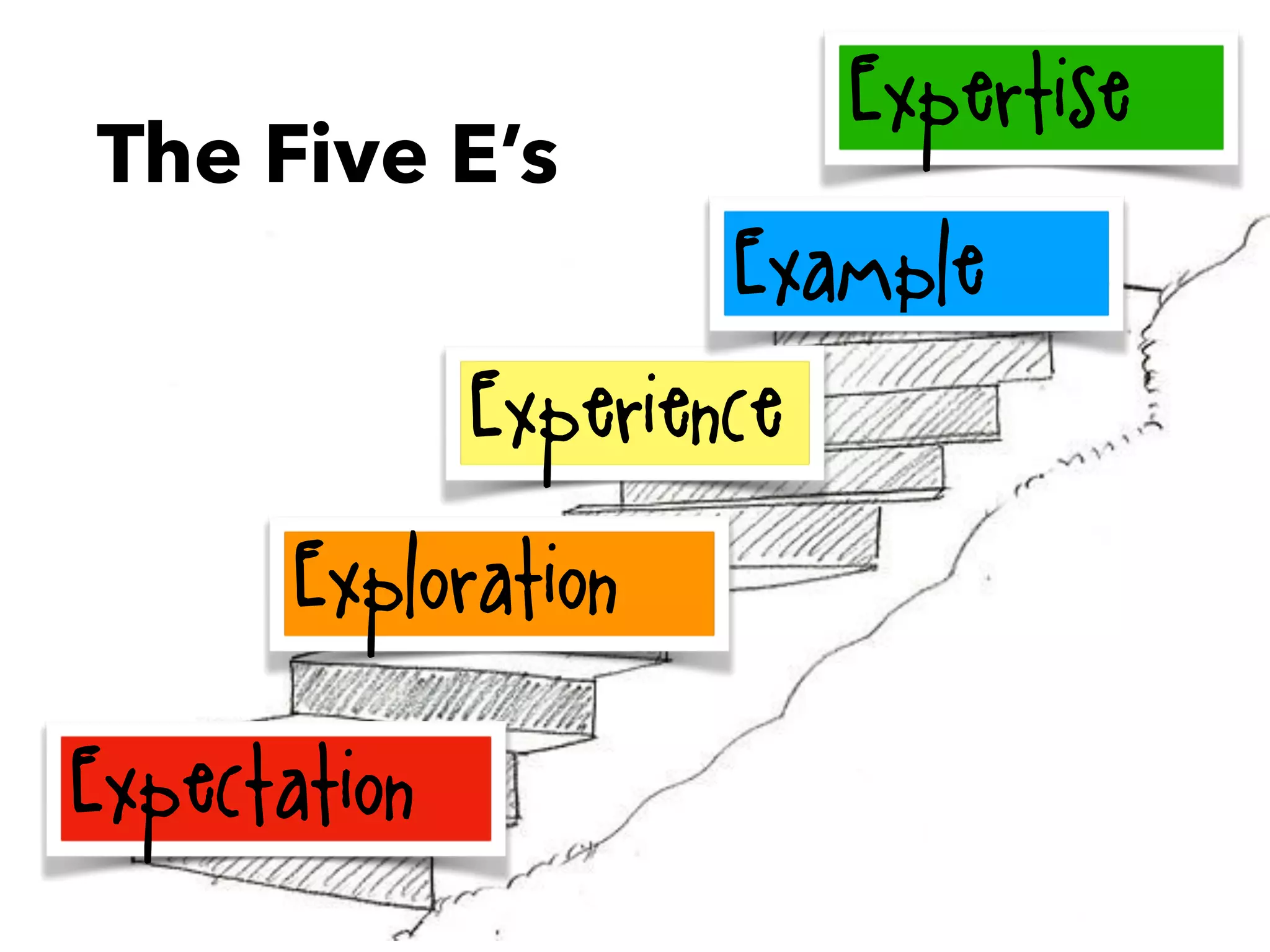
The Five E’s
Expectation
Exploration
Experience
Example
Expertise
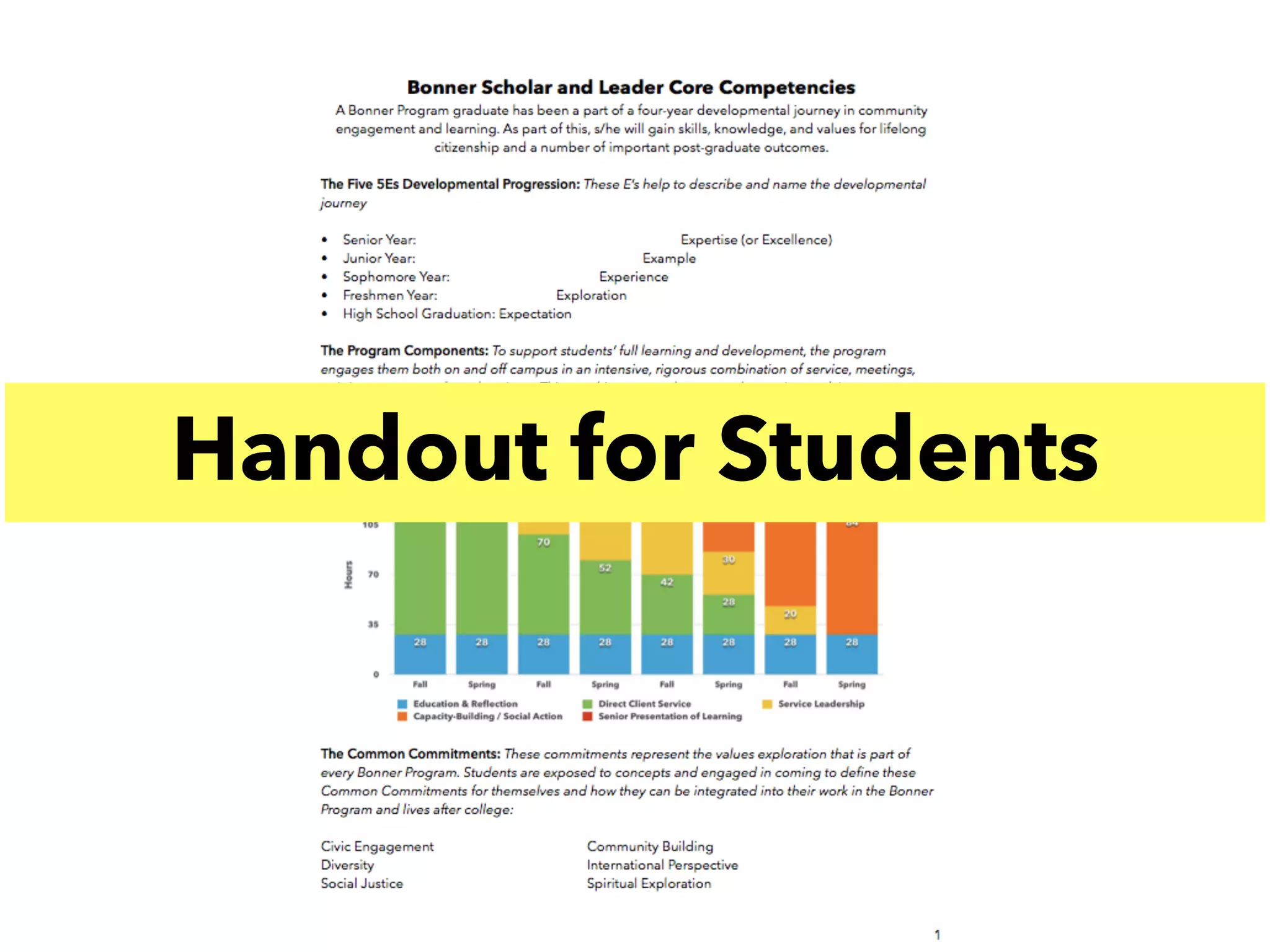
Handout for Students
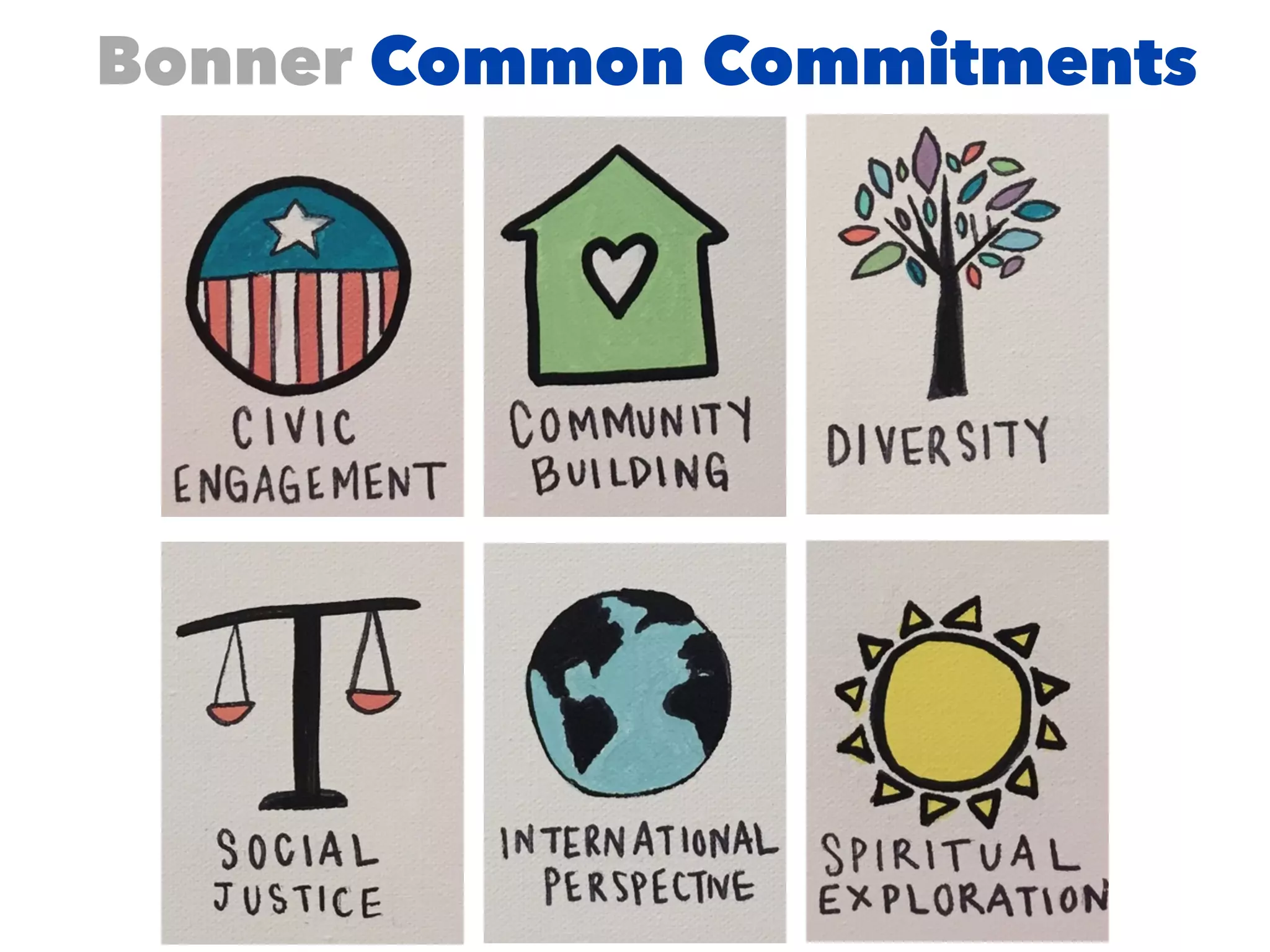
Bonner Common Commitments
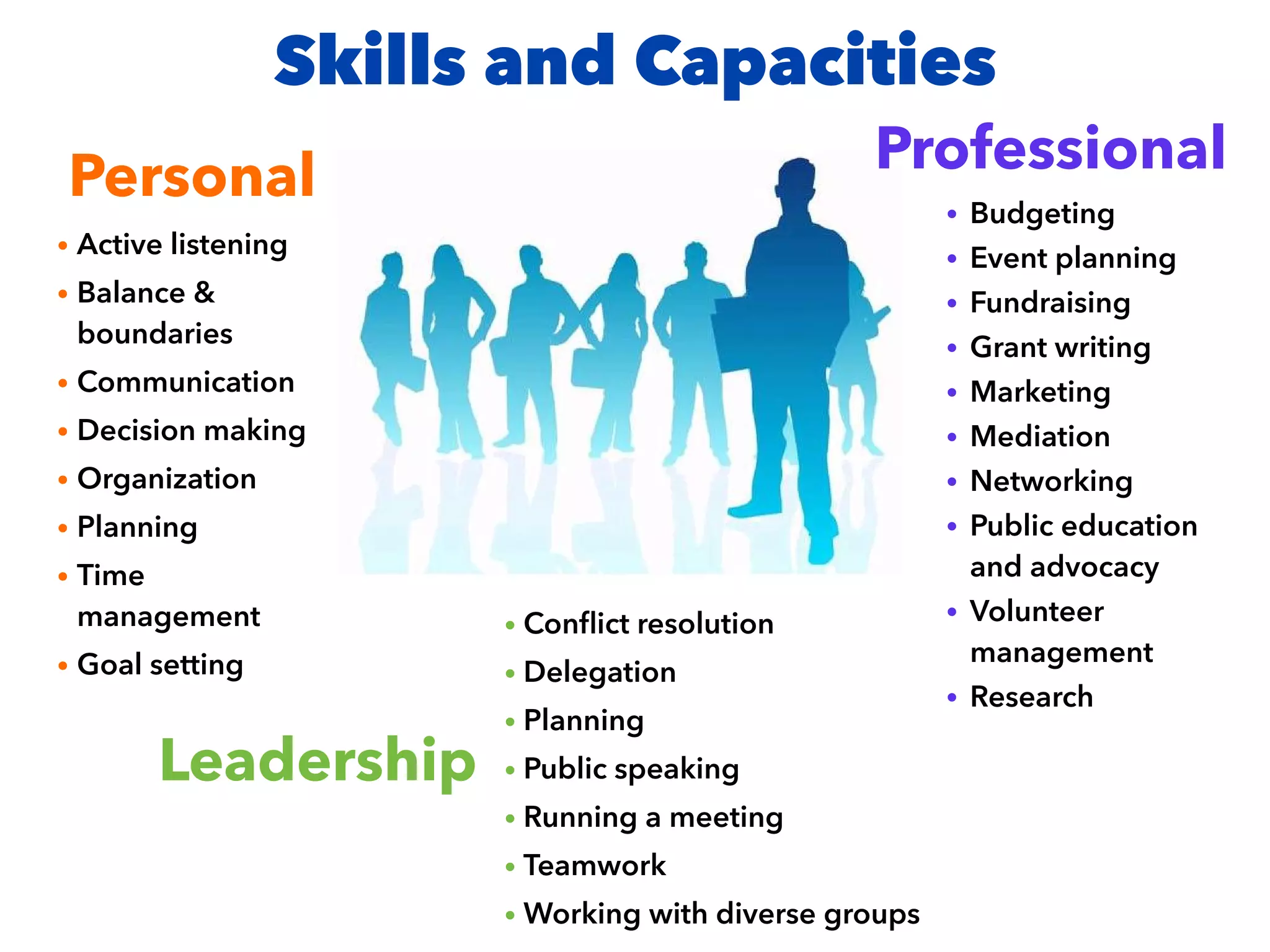
Skills and Capacities
Personal
• Active listening
• Balance &
boundaries
• Communication
• Decision making
• Organization
• Planning
• Time
management
• Goal setting
Professional
• Budgeting
• Event planning
• Fundraising
• Grant writing
• Marketing
• Mediation
• Networking
• Public education
and advocacy
• Volunteer
management
• Research
Leadership
• Conflict resolution
• Delegation
• Planning
• Public speaking
• Running a meeting
• Teamwork
• Working with diverse groups
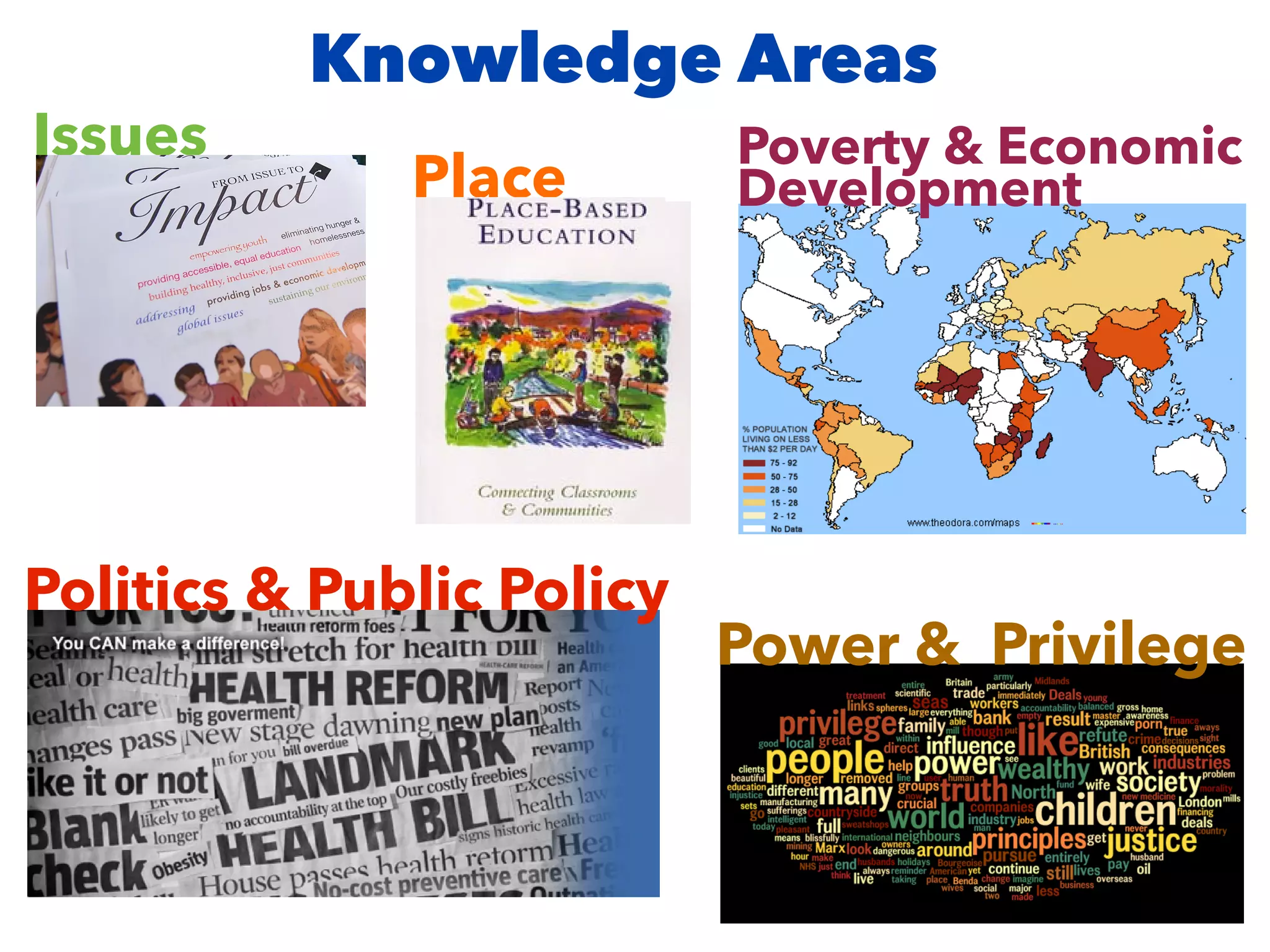
Knowledge Areas
Place
Politics & Public Policy
Power & Privilege
Poverty & Economic
Development
Issues
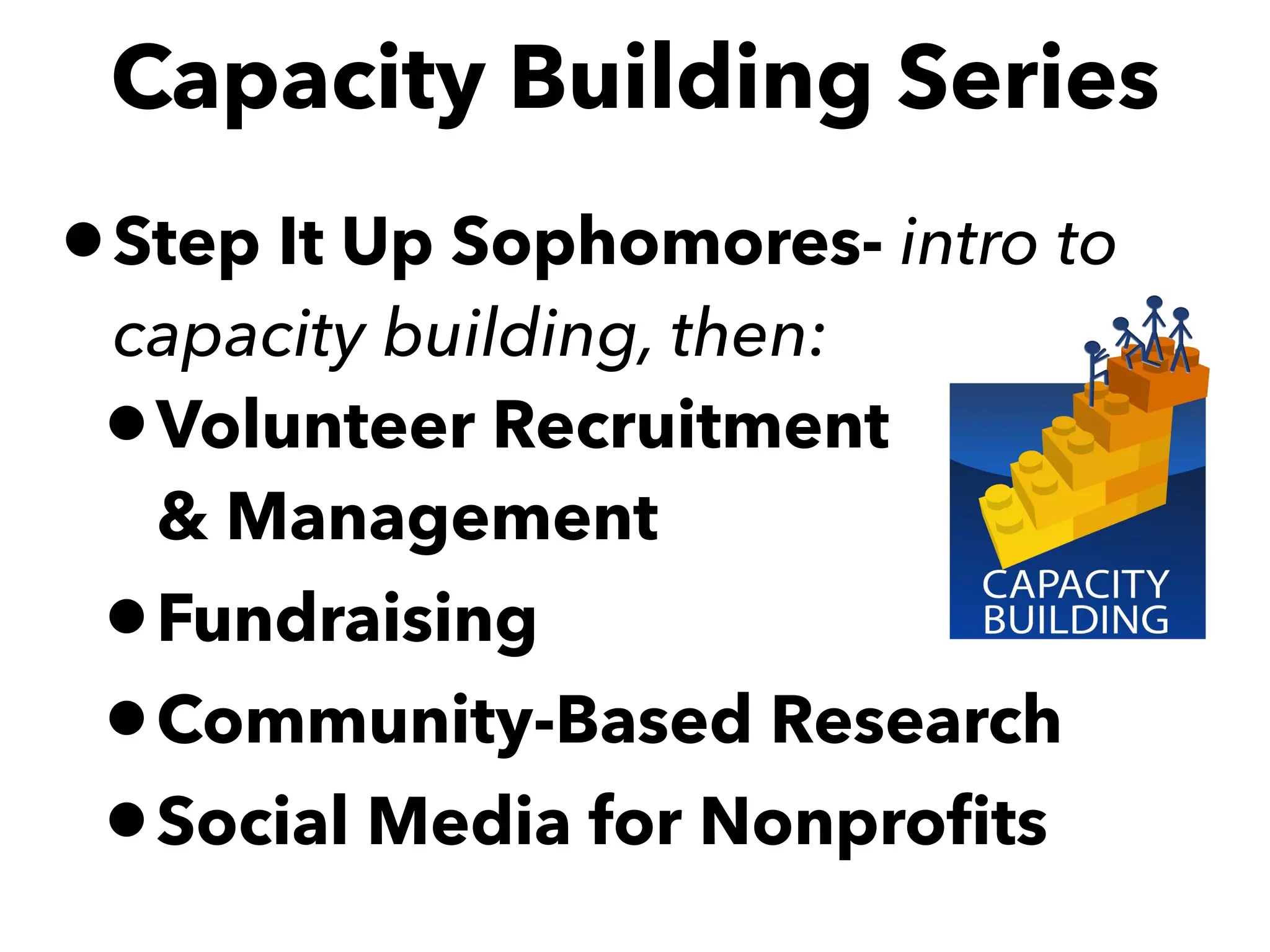
•Step It Up Sophomores- intro to
capacity building, then:
•Volunteer Recruitment 

& Management
•Fundraising
•Community-Based Research
•Social Media for Nonprofits
Capacity Building Series
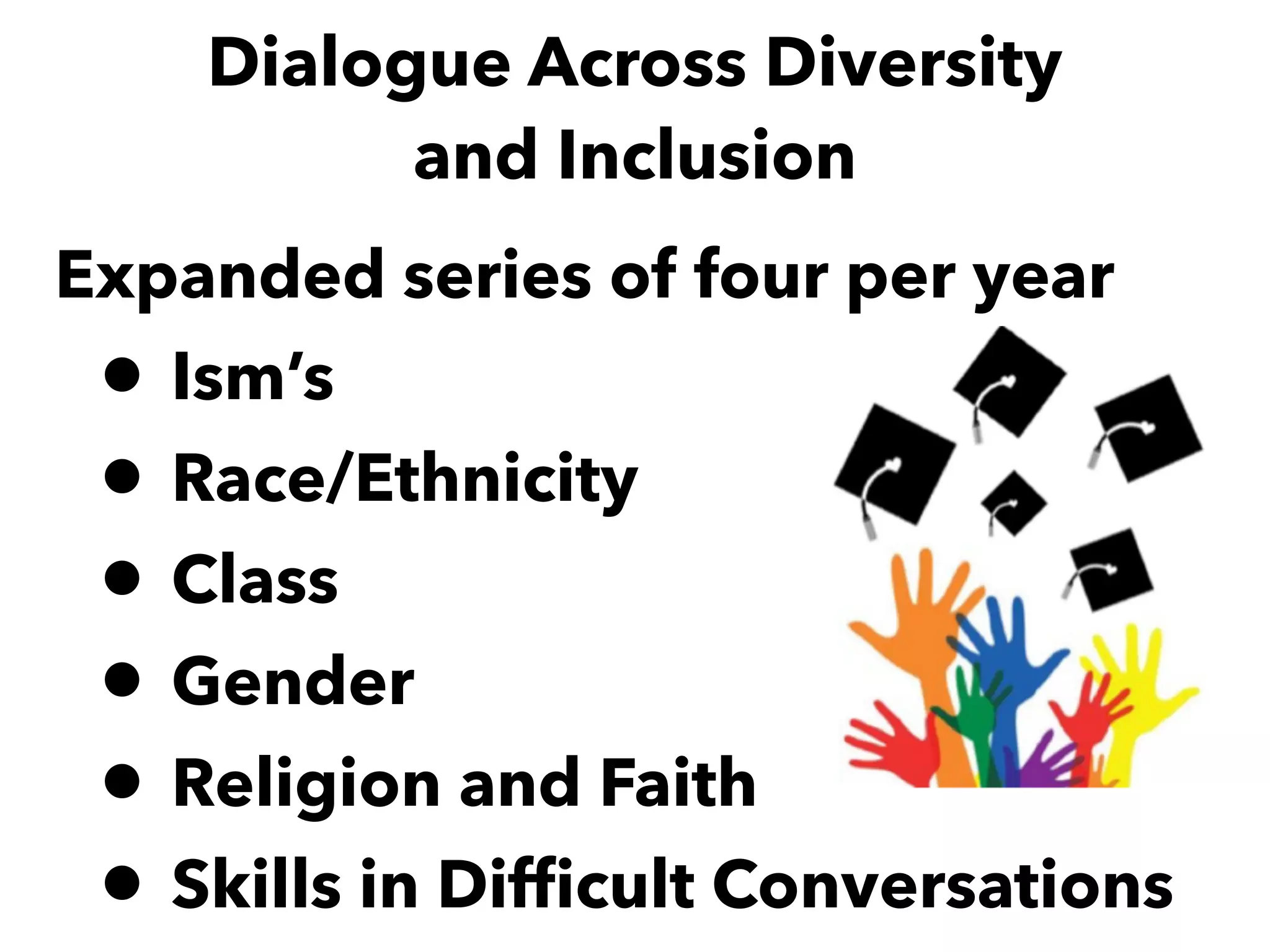
Expanded series of four per year
• Ism’s
• Race/Ethnicity
• Class
• Gender
• Religion and Faith
• Skills in Difficult Conversations
Dialogue Across Diversity 

and Inclusion
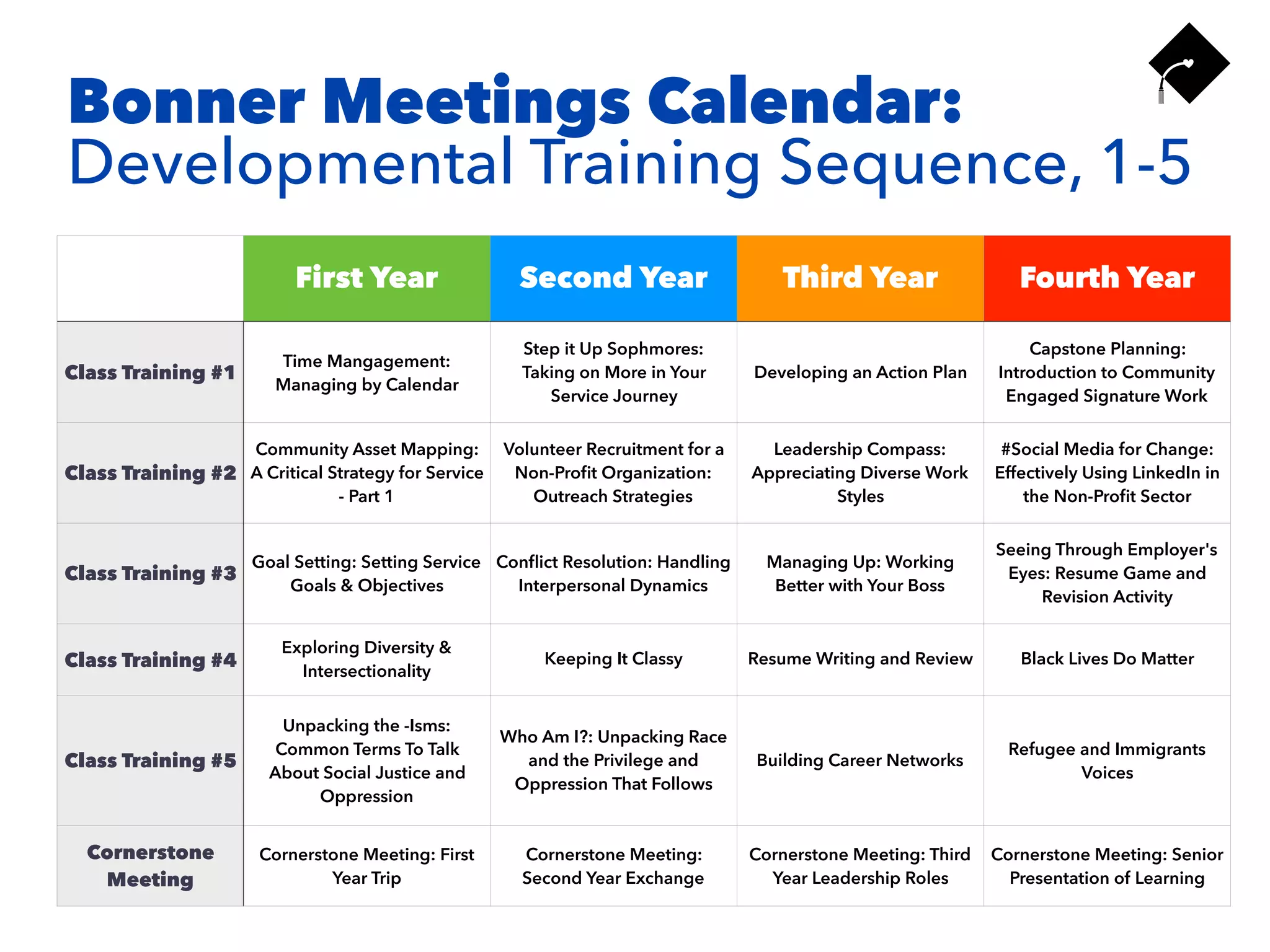
Bonner Meetings Calendar:
Developmental Training Sequence, 1-5
First Year Second Year Third Year Fourth Year
Class Training #1
Time Mangagement:
Managing by Calendar
Step it Up Sophmores:
Taking on More in Your
Service Journey
Developing an Action Plan
Capstone Planning:
Introduction to Community
Engaged Signature Work
Class Training #2
Community Asset Mapping:
A Critical Strategy for Service
- Part 1
Volunteer Recruitment for a
Non-Profit Organization:
Outreach Strategies
Leadership Compass:
Appreciating Diverse Work
Styles
#Social Media for Change:
Effectively Using LinkedIn in
the Non-Profit Sector
Class Training #3
Goal Setting: Setting Service
Goals & Objectives
Conflict Resolution: Handling
Interpersonal Dynamics
Managing Up: Working
Better with Your Boss
Seeing Through Employer's
Eyes: Resume Game and
Revision Activity
Class Training #4
Exploring Diversity &
Intersectionality
Keeping It Classy Resume Writing and Review Black Lives Do Matter
Class Training #5
Unpacking the -Isms:
Common Terms To Talk
About Social Justice and
Oppression
Who Am I?: Unpacking Race
and the Privilege and
Oppression That Follows
Building Career Networks
Refugee and Immigrants
Voices
Cornerstone
Meeting
Cornerstone Meeting: First
Year Trip
Cornerstone Meeting:
Second Year Exchange
Cornerstone Meeting: Third
Year Leadership Roles
Cornerstone Meeting: Senior
Presentation of Learning
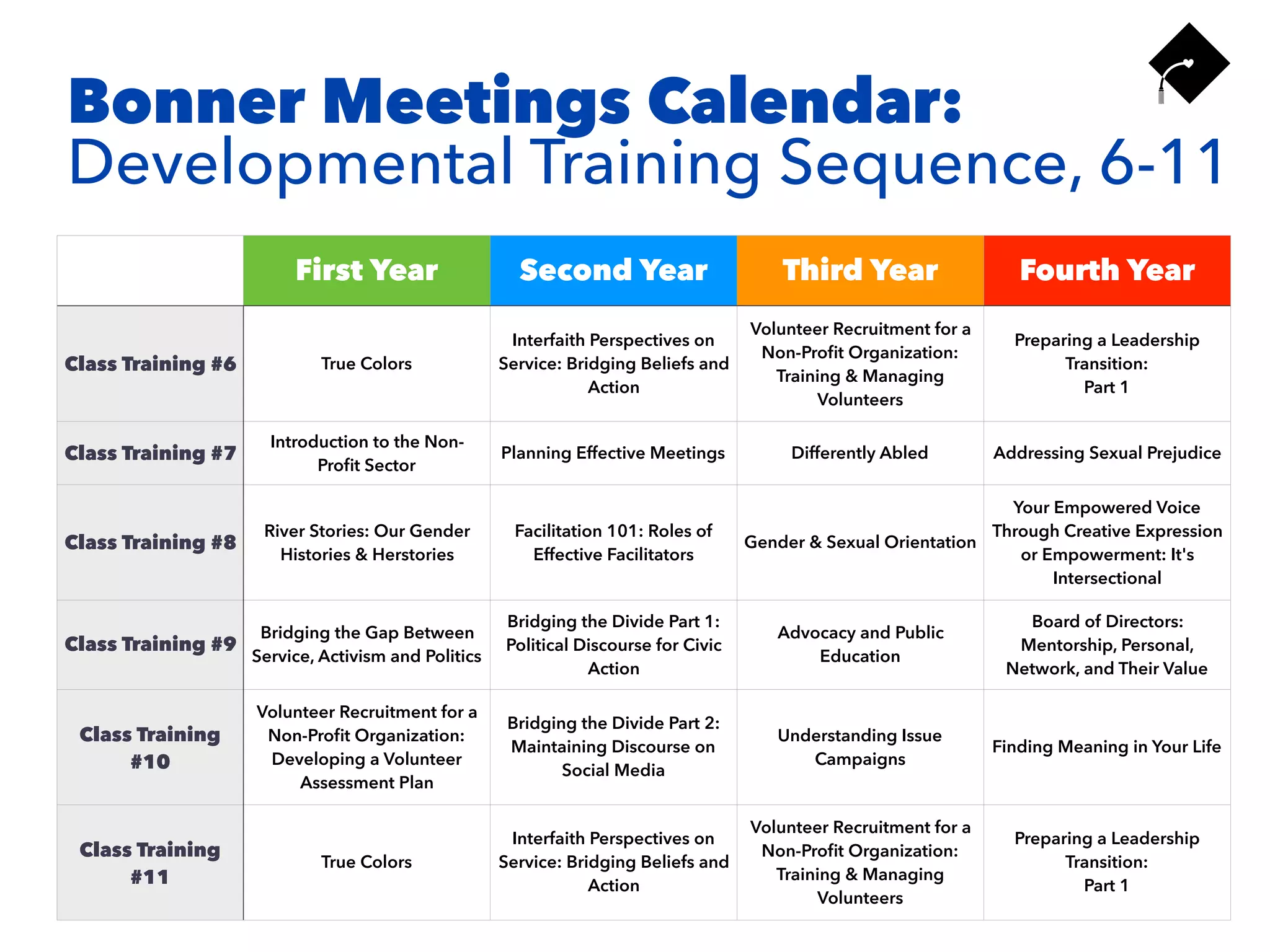
Bonner Meetings Calendar:
Developmental Training Sequence, 6-11
First Year Second Year Third Year Fourth Year
Class Training #6 True Colors
Interfaith Perspectives on
Service: Bridging Beliefs and
Action
Volunteer Recruitment for a
Non-Profit Organization:
Training & Managing
Volunteers
Preparing a Leadership
Transition:
Part 1
Class Training #7
Introduction to the Non-
Profit Sector
Planning Effective Meetings Differently Abled Addressing Sexual Prejudice
Class Training #8
River Stories: Our Gender
Histories & Herstories
Facilitation 101: Roles of
Effective Facilitators
Gender & Sexual Orientation
Your Empowered Voice
Through Creative Expression
or Empowerment: It's
Intersectional
Class Training #9
Bridging the Gap Between
Service, Activism and Politics
Bridging the Divide Part 1:
Political Discourse for Civic
Action
Advocacy and Public
Education
Board of Directors:
Mentorship, Personal,
Network, and Their Value
Class Training
#10
Volunteer Recruitment for a
Non-Profit Organization:
Developing a Volunteer
Assessment Plan
Bridging the Divide Part 2:
Maintaining Discourse on
Social Media
Understanding Issue
Campaigns
Finding Meaning in Your Life
Class Training
#11
True Colors
Interfaith Perspectives on
Service: Bridging Beliefs and
Action
Volunteer Recruitment for a
Non-Profit Organization:
Training & Managing
Volunteers
Preparing a Leadership
Transition:
Part 1
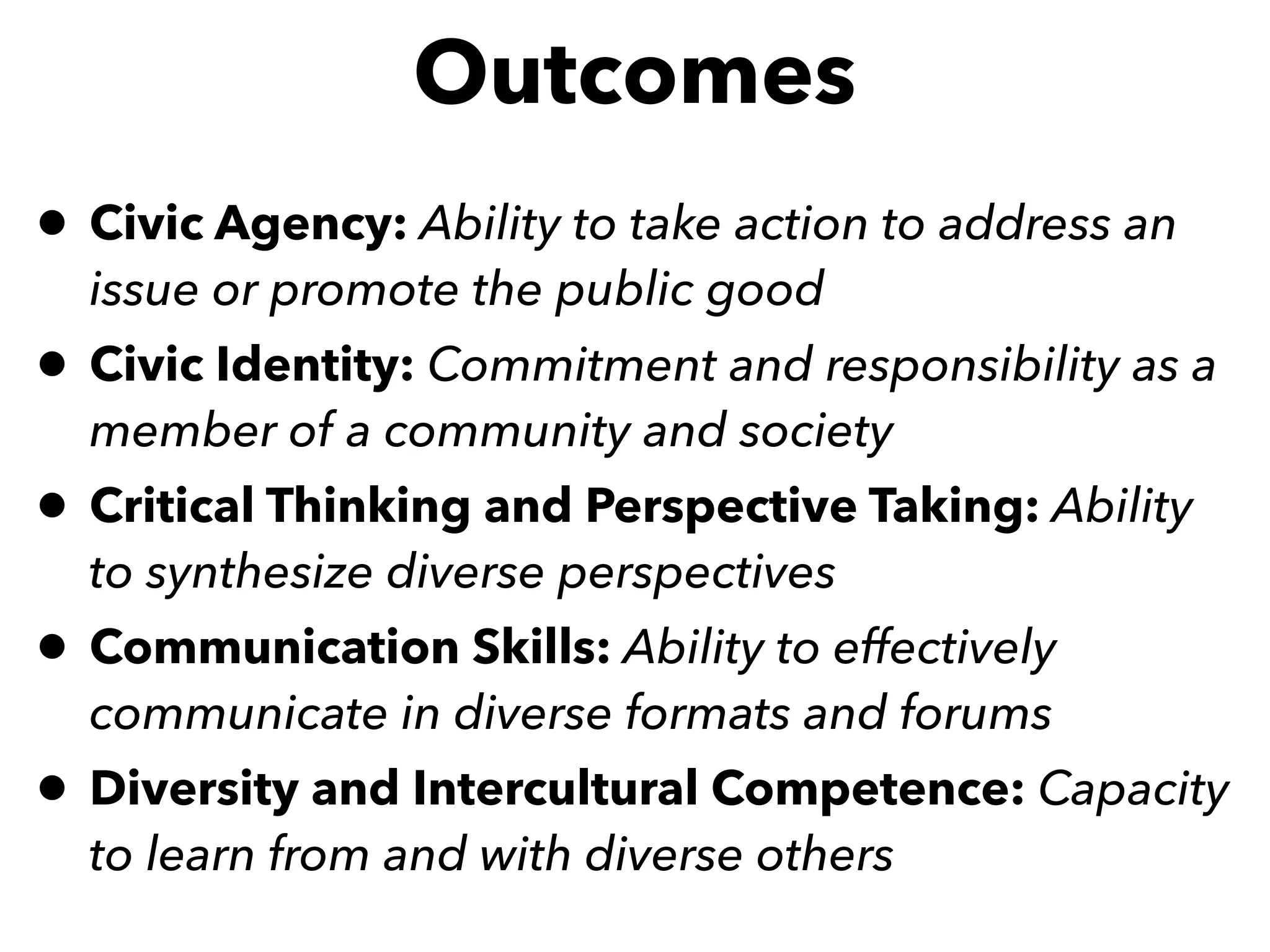
• Civic Agency: Ability to take action to address an
issue or promote the public good 
• Civic Identity: Commitment and responsibility as a
member of a community and society 
• Critical Thinking and Perspective Taking: Ability
to synthesize diverse perspectives 
• Communication Skills: Ability to effectively
communicate in diverse formats and forums 
• Diversity and Intercultural Competence: Capacity
to learn from and with diverse others 
Outcomes
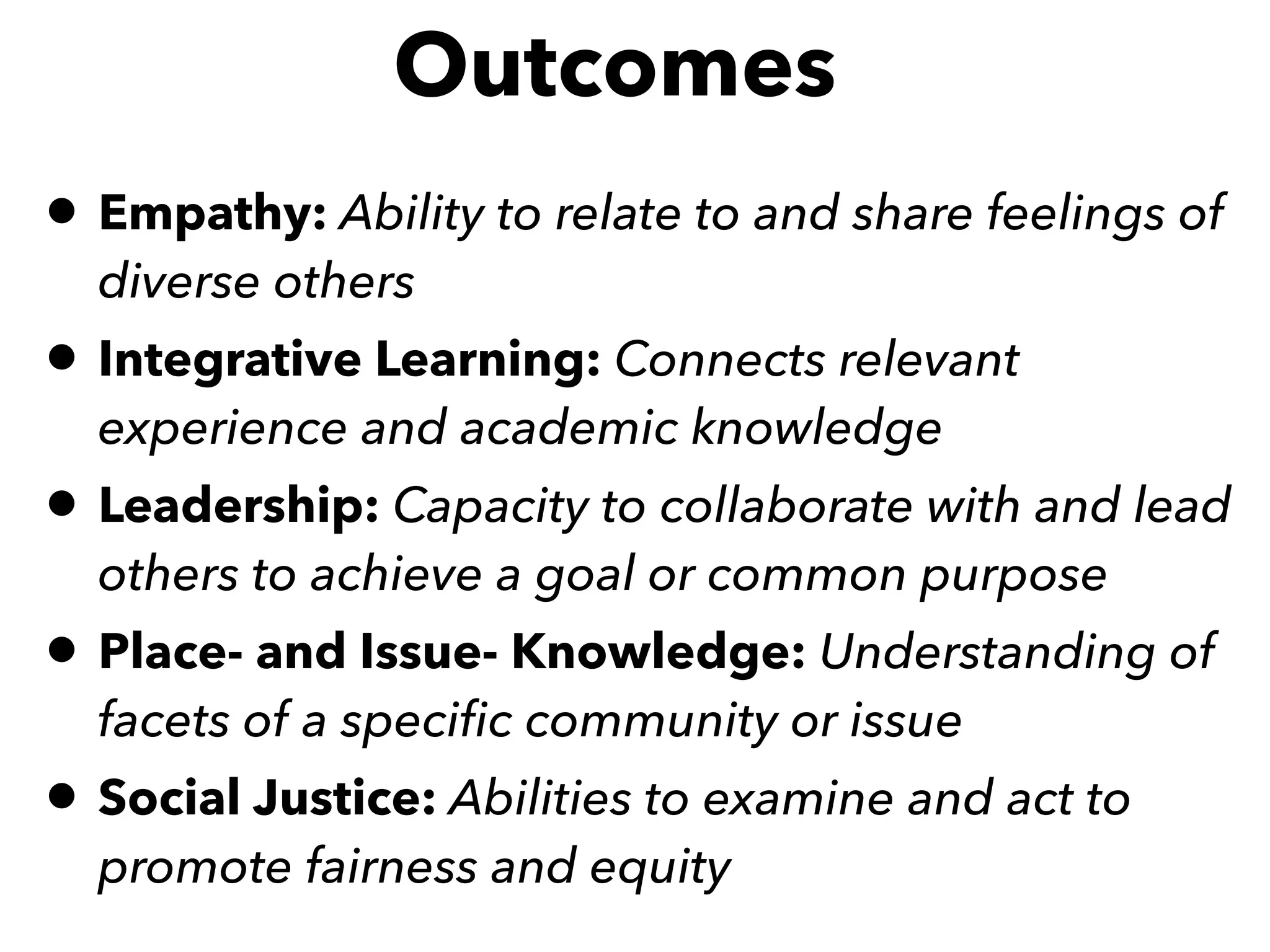
• Empathy: Ability to relate to and share feelings of
diverse others 
• Integrative Learning: Connects relevant
experience and academic knowledge 
• Leadership: Capacity to collaborate with and lead
others to achieve a goal or common purpose 
• Place- and Issue- Knowledge: Understanding of
facets of a specific community or issue 
• Social Justice: Abilities to examine and act to
promote fairness and equity 
Outcomes
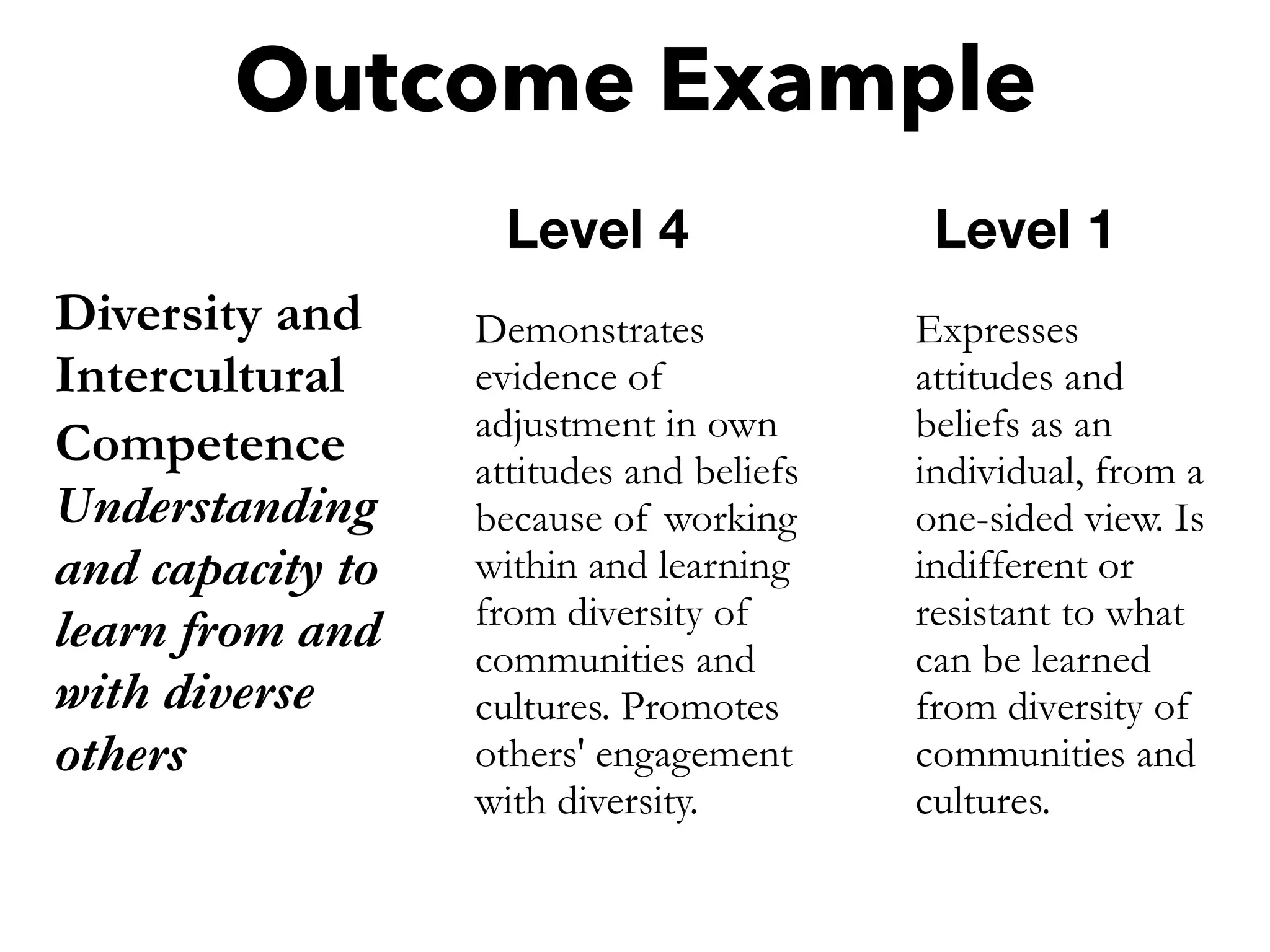
Outcome Example
Diversity and
Intercultural
Competence 

Understanding
and capacity to
learn from and
with diverse
others
Demonstrates
evidence of
adjustment in own
attitudes and beliefs
because of working
within and learning
from diversity of
communities and
cultures. Promotes
others' engagement
with diversity.
Expresses
attitudes and
beliefs as an
individual, from a
one-sided view. Is
indifferent or
resistant to what
can be learned
from diversity of
communities and
cultures.
Level 4 Level 1
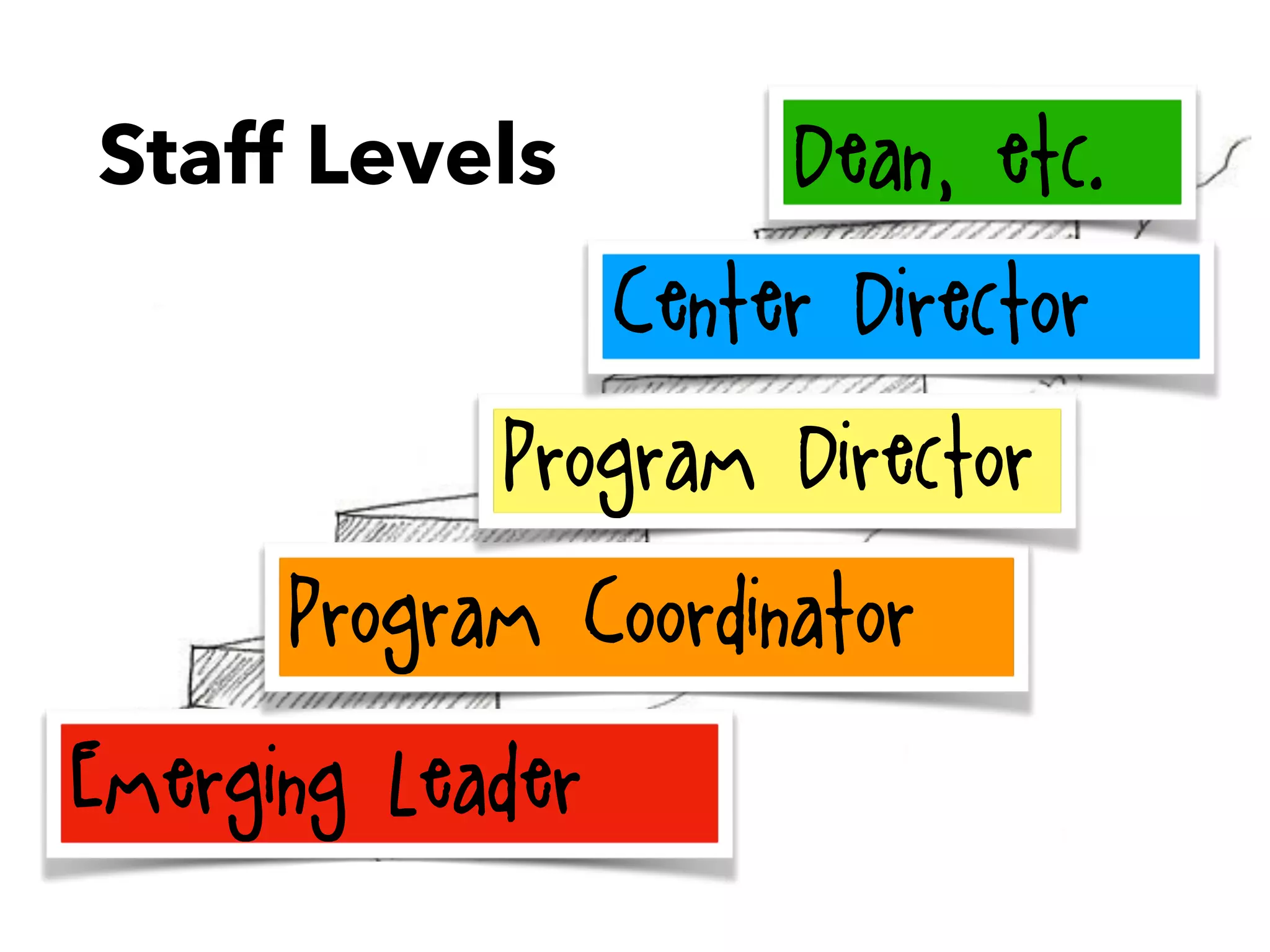
Staff Levels
Emerging Leader
Program Coordinator
Program Director
Center Director
Dean……, etc.
“…program developers,
political strategists,
communicators across
many boundaries,
counselors, learners,
wisdom figures,
interpreters, planners
and problem solvers.”
In 1992…and Today
Professional Development
& Recognition
• Annual Bonner Meetings like the 

Fall Directors Meeting and Summer
Leadership Institute
• Campus Resources: To punctuate the
need for staff to be able to access
available opportunities
• Legitimizing Expertise: By naming the
knowledge and skills of community
engagement professionals
Mentoring, Networking &
Career Advancement
•Networking by Role: by level and
role at meetings, as it will be here
with literature
•Cross-campus Connections:
connect in mentoring or
advancement dialogue
•Personal and Social Capital: build
knowledge, skill sets, and network
Program Quality
•Program Planning: delegating
roles involved for success
•Self-Assessment and
Supervision: discuss
performance & growth
•Campus Resource Allocation:
making needs more transparent
and help staff make the case
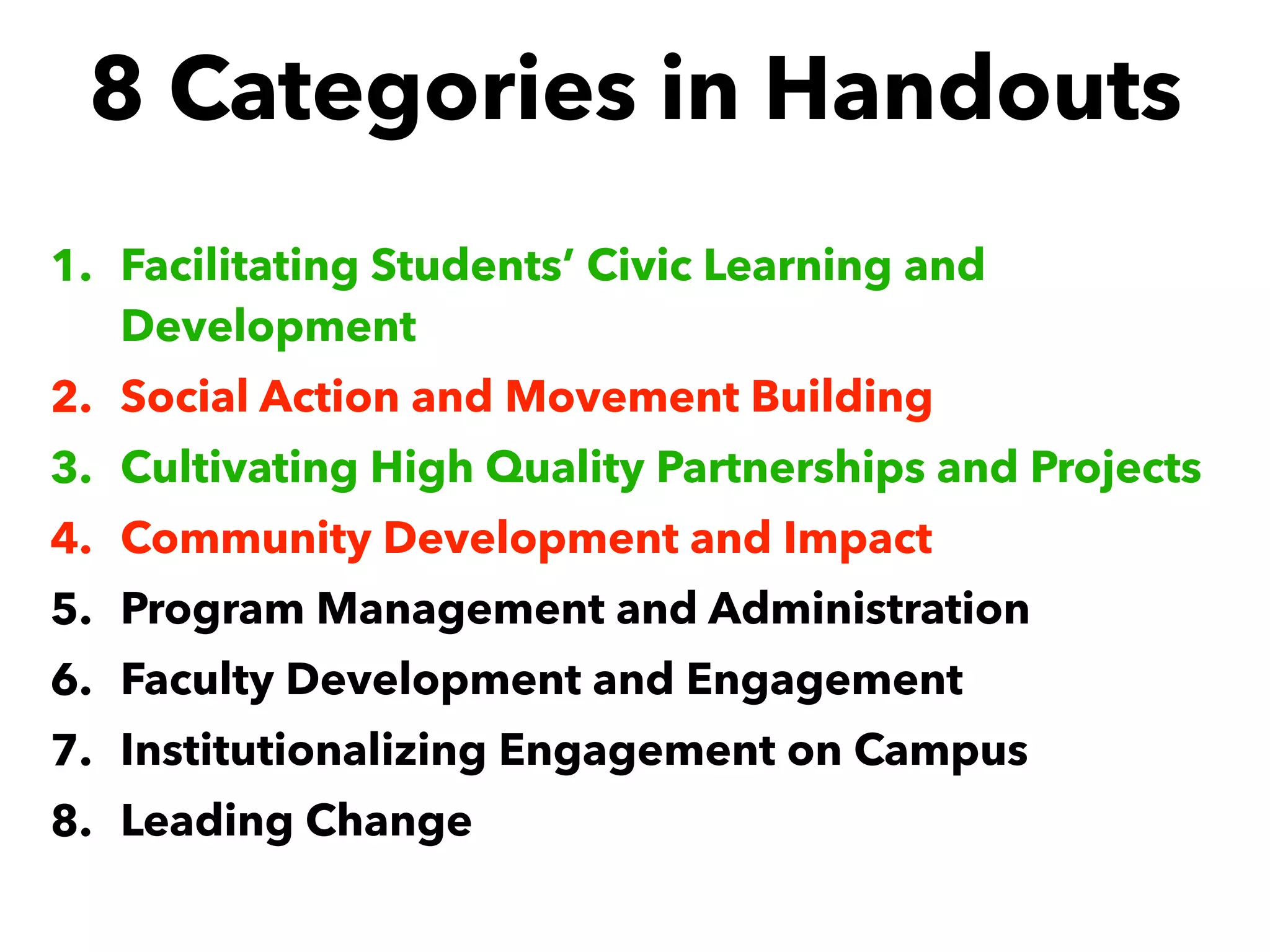
8 Categories in Handouts
1. Facilitating Students’ Civic Learning and
Development
2. Social Action and Movement Building
3. Cultivating High Quality Partnerships and Projects
4. Community Development and Impact
5. Program Management and Administration
6. Faculty Development and Engagement
7. Institutionalizing Engagement on Campus
8. Leading Change
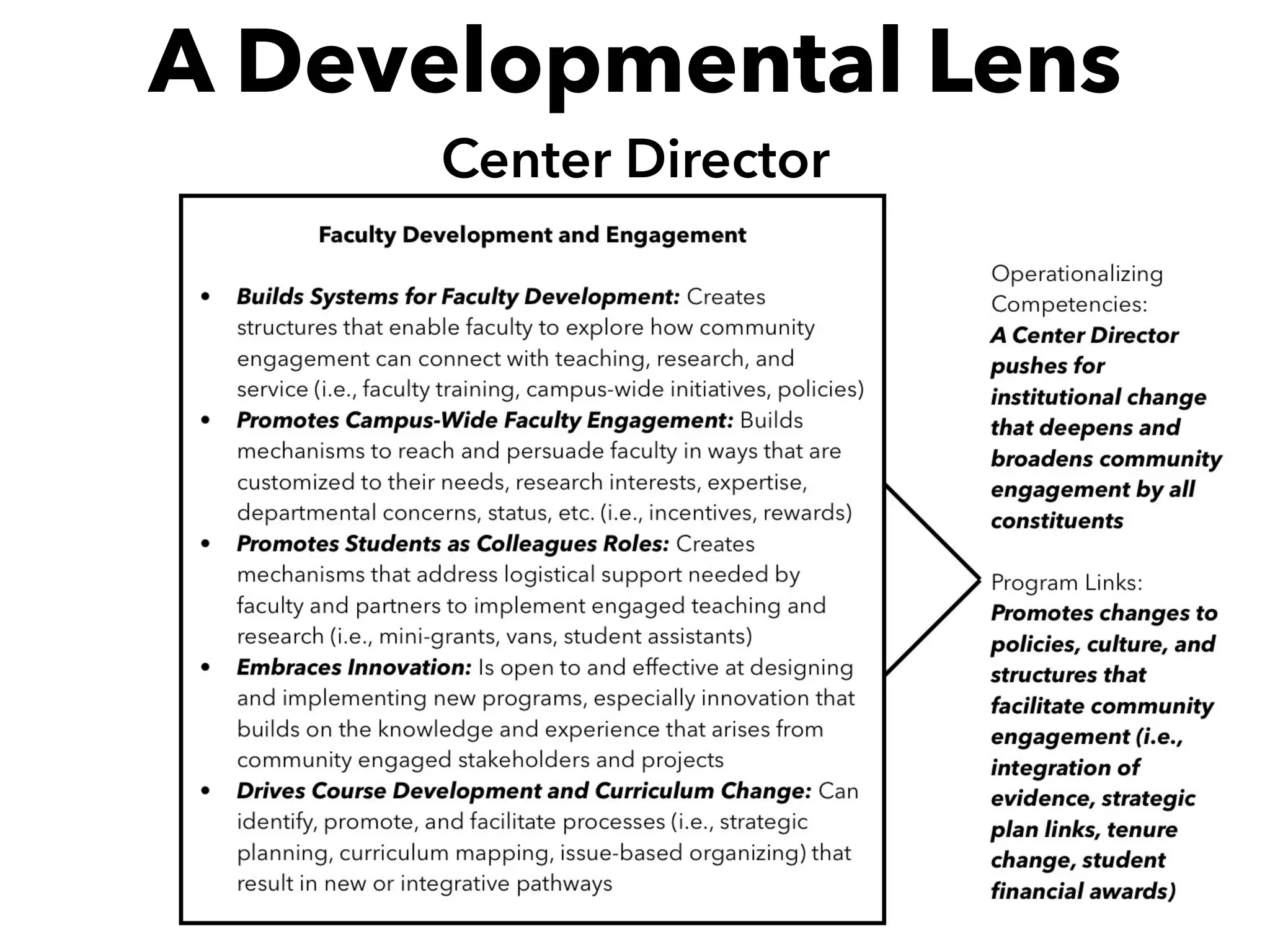
A Developmental Lens
Center Director
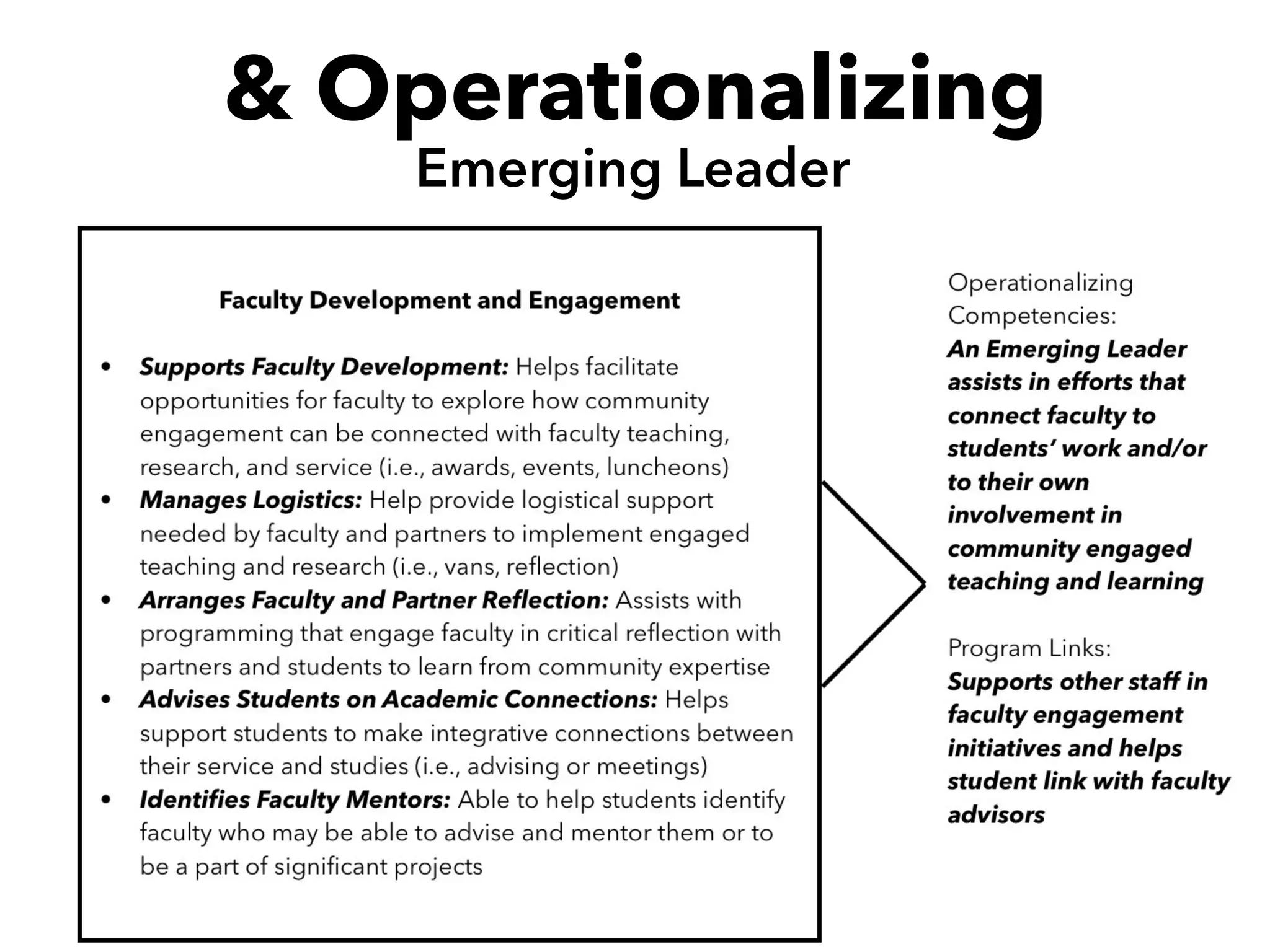
& Operationalizing
Emerging Leader
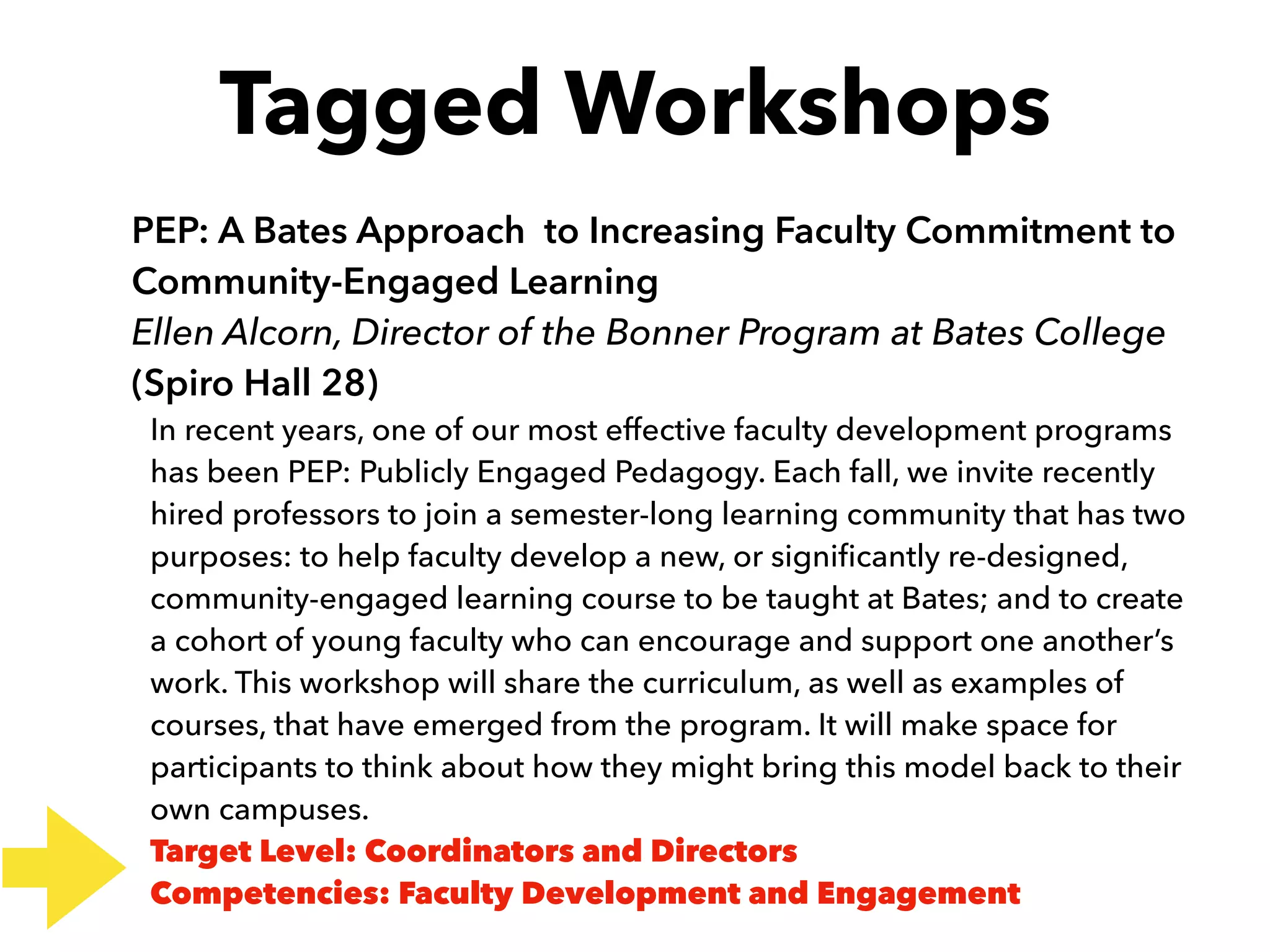
Tagged Workshops
PEP: A Bates Approach to Increasing Faculty Commitment to
Community-Engaged Learning
Ellen Alcorn, Director of the Bonner Program at Bates College
(Spiro Hall 28)
In recent years, one of our most effective faculty development programs
has been PEP: Publicly Engaged Pedagogy. Each fall, we invite recently
hired professors to join a semester-long learning community that has two
purposes: to help faculty develop a new, or significantly re-designed,
community-engaged learning course to be taught at Bates; and to create
a cohort of young faculty who can encourage and support one another’s
work. This workshop will share the curriculum, as well as examples of
courses, that have emerged from the program. It will make space for
participants to think about how they might bring this model back to their
own campuses.
Target Level: Coordinators and Directors
Competencies: Faculty Development and Engagement
Next Steps
•Identifying Bonner Program
staff volunteers (roughly 2-3 at
each level)
•Surveying staff across the
network to gauge areas of
strength and need
•Creating resource lists of places
that individuals are accessing
professional development
Your Input Shaped Program
• Strategy sessions for Administrators -
which target areas like faculty engagement,
curriculum change, and institutionalization
• Strategy sessions for Student Leaders -
which target areas like peer mobilization,
morale, and campus-wide engagement
• Opportunities to engage with the
literature - by level and begin to build out
Networking Activity
• Groups of 5-7
• No one from the same school
• Same level
• Freshmen/Sophomores
• Juniors/Seniors
• Senior Interns/New Staff (VISTAs)
• Coordinators
• Directors
Student Discussions
1. Get into groups of 5-7 with each person representing a
different school. Share how your program supports student
development using meetings, trainings, courses, etc. What is
similar and different about this?
2. Reflecting on the skills, knowledge areas, and Common
Commitments (handout), discuss the areas that you are getting
most exposure and the areas you need more exposure. Please
make a list of notes that reflects your discussion.
3. If the Bonner Foundation and network could extend the planning
for professional development to Bonner students, what would you
want that to look like? In particular, how might it look for you as
you graduate and become an alum or pursue post-graduate
opportunities in the field of community engagement and
beyond?
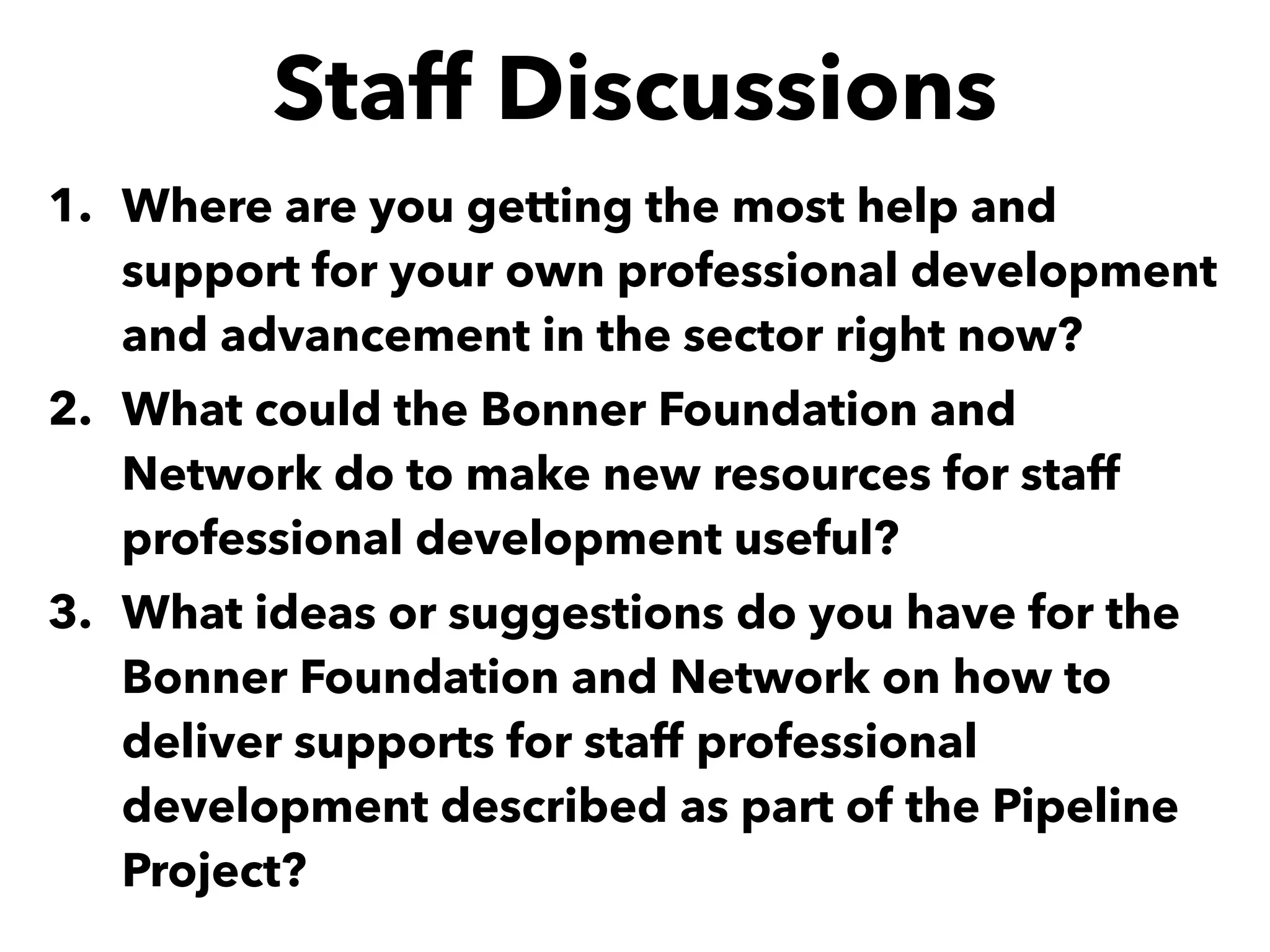
Staff Discussions
1. Where are you getting the most help and
support for your own professional development
and advancement in the sector right now?
2. What could the Bonner Foundation and
Network do to make new resources for staff
professional development useful?
3. What ideas or suggestions do you have for the
Bonner Foundation and Network on how to
deliver supports for staff professional
development described as part of the Pipeline
Project?

Bonner Student Developmental Model and Staff Pipeline Project

  • 1.
    “Leaders of Today:” TheBonner Student Developmental Model and Staff Developmental Pipeline Project BonnerSummerLeadershipInstitute2018 Wednesday, June 7, 2018 
 from 9:00 am to 10:45 am
  • 2.
    •Reintroduce the BonnerStudent Developmental Model •Introduce the Bonner Staff Development Pipeline Project •Small groups networking and discussion by level What We’ll Do
  • 3.
  • 4.
  • 6.
  • 7.
    Skills and Capacities Personal •Active listening • Balance & boundaries • Communication • Decision making • Organization • Planning • Time management • Goal setting Professional • Budgeting • Event planning • Fundraising • Grant writing • Marketing • Mediation • Networking • Public education and advocacy • Volunteer management • Research Leadership • Conflict resolution • Delegation • Planning • Public speaking • Running a meeting • Teamwork • Working with diverse groups
  • 8.
    Knowledge Areas Place Politics &Public Policy Power & Privilege Poverty & Economic Development Issues
  • 9.
    •Step It UpSophomores- intro to capacity building, then: •Volunteer Recruitment 
 & Management •Fundraising •Community-Based Research •Social Media for Nonprofits Capacity Building Series
  • 10.
    Expanded series offour per year • Ism’s • Race/Ethnicity • Class • Gender • Religion and Faith • Skills in Difficult Conversations Dialogue Across Diversity 
 and Inclusion
  • 11.
    Bonner Meetings Calendar: DevelopmentalTraining Sequence, 1-5 First Year Second Year Third Year Fourth Year Class Training #1 Time Mangagement: Managing by Calendar Step it Up Sophmores: Taking on More in Your Service Journey Developing an Action Plan Capstone Planning: Introduction to Community Engaged Signature Work Class Training #2 Community Asset Mapping: A Critical Strategy for Service - Part 1 Volunteer Recruitment for a Non-Profit Organization: Outreach Strategies Leadership Compass: Appreciating Diverse Work Styles #Social Media for Change: Effectively Using LinkedIn in the Non-Profit Sector Class Training #3 Goal Setting: Setting Service Goals & Objectives Conflict Resolution: Handling Interpersonal Dynamics Managing Up: Working Better with Your Boss Seeing Through Employer's Eyes: Resume Game and Revision Activity Class Training #4 Exploring Diversity & Intersectionality Keeping It Classy Resume Writing and Review Black Lives Do Matter Class Training #5 Unpacking the -Isms: Common Terms To Talk About Social Justice and Oppression Who Am I?: Unpacking Race and the Privilege and Oppression That Follows Building Career Networks Refugee and Immigrants Voices Cornerstone Meeting Cornerstone Meeting: First Year Trip Cornerstone Meeting: Second Year Exchange Cornerstone Meeting: Third Year Leadership Roles Cornerstone Meeting: Senior Presentation of Learning
  • 12.
    Bonner Meetings Calendar: DevelopmentalTraining Sequence, 6-11 First Year Second Year Third Year Fourth Year Class Training #6 True Colors Interfaith Perspectives on Service: Bridging Beliefs and Action Volunteer Recruitment for a Non-Profit Organization: Training & Managing Volunteers Preparing a Leadership Transition: Part 1 Class Training #7 Introduction to the Non- Profit Sector Planning Effective Meetings Differently Abled Addressing Sexual Prejudice Class Training #8 River Stories: Our Gender Histories & Herstories Facilitation 101: Roles of Effective Facilitators Gender & Sexual Orientation Your Empowered Voice Through Creative Expression or Empowerment: It's Intersectional Class Training #9 Bridging the Gap Between Service, Activism and Politics Bridging the Divide Part 1: Political Discourse for Civic Action Advocacy and Public Education Board of Directors: Mentorship, Personal, Network, and Their Value Class Training #10 Volunteer Recruitment for a Non-Profit Organization: Developing a Volunteer Assessment Plan Bridging the Divide Part 2: Maintaining Discourse on Social Media Understanding Issue Campaigns Finding Meaning in Your Life Class Training #11 True Colors Interfaith Perspectives on Service: Bridging Beliefs and Action Volunteer Recruitment for a Non-Profit Organization: Training & Managing Volunteers Preparing a Leadership Transition: Part 1
  • 13.
    • Civic Agency: Abilityto take action to address an issue or promote the public good  • Civic Identity: Commitment and responsibility as a member of a community and society  • Critical Thinking and Perspective Taking: Ability to synthesize diverse perspectives  • Communication Skills: Ability to effectively communicate in diverse formats and forums  • Diversity and Intercultural Competence: Capacity to learn from and with diverse others  Outcomes
  • 14.
    • Empathy: Ability torelate to and share feelings of diverse others  • Integrative Learning: Connects relevant experience and academic knowledge  • Leadership: Capacity to collaborate with and lead others to achieve a goal or common purpose  • Place- and Issue- Knowledge: Understanding of facets of a specific community or issue  • Social Justice: Abilities to examine and act to promote fairness and equity  Outcomes
  • 15.
    Outcome Example Diversity and Intercultural Competence
 Understanding and capacity to learn from and with diverse others Demonstrates evidence of adjustment in own attitudes and beliefs because of working within and learning from diversity of communities and cultures. Promotes others' engagement with diversity. Expresses attitudes and beliefs as an individual, from a one-sided view. Is indifferent or resistant to what can be learned from diversity of communities and cultures. Level 4 Level 1
  • 16.
    Staff Levels Emerging Leader ProgramCoordinator Program Director Center Director Dean……, etc.
  • 17.
    “…program developers, political strategists, communicatorsacross many boundaries, counselors, learners, wisdom figures, interpreters, planners and problem solvers.” In 1992…and Today
  • 18.
    Professional Development & Recognition •Annual Bonner Meetings like the 
 Fall Directors Meeting and Summer Leadership Institute • Campus Resources: To punctuate the need for staff to be able to access available opportunities • Legitimizing Expertise: By naming the knowledge and skills of community engagement professionals
  • 19.
    Mentoring, Networking & CareerAdvancement •Networking by Role: by level and role at meetings, as it will be here with literature •Cross-campus Connections: connect in mentoring or advancement dialogue •Personal and Social Capital: build knowledge, skill sets, and network
  • 20.
    Program Quality •Program Planning:delegating roles involved for success •Self-Assessment and Supervision: discuss performance & growth •Campus Resource Allocation: making needs more transparent and help staff make the case
  • 21.
    8 Categories inHandouts 1. Facilitating Students’ Civic Learning and Development 2. Social Action and Movement Building 3. Cultivating High Quality Partnerships and Projects 4. Community Development and Impact 5. Program Management and Administration 6. Faculty Development and Engagement 7. Institutionalizing Engagement on Campus 8. Leading Change
  • 22.
  • 23.
  • 24.
    Tagged Workshops PEP: ABates Approach to Increasing Faculty Commitment to Community-Engaged Learning Ellen Alcorn, Director of the Bonner Program at Bates College (Spiro Hall 28) In recent years, one of our most effective faculty development programs has been PEP: Publicly Engaged Pedagogy. Each fall, we invite recently hired professors to join a semester-long learning community that has two purposes: to help faculty develop a new, or significantly re-designed, community-engaged learning course to be taught at Bates; and to create a cohort of young faculty who can encourage and support one another’s work. This workshop will share the curriculum, as well as examples of courses, that have emerged from the program. It will make space for participants to think about how they might bring this model back to their own campuses. Target Level: Coordinators and Directors Competencies: Faculty Development and Engagement
  • 25.
    Next Steps •Identifying BonnerProgram staff volunteers (roughly 2-3 at each level) •Surveying staff across the network to gauge areas of strength and need •Creating resource lists of places that individuals are accessing professional development
  • 26.
    Your Input ShapedProgram • Strategy sessions for Administrators - which target areas like faculty engagement, curriculum change, and institutionalization • Strategy sessions for Student Leaders - which target areas like peer mobilization, morale, and campus-wide engagement • Opportunities to engage with the literature - by level and begin to build out
  • 27.
    Networking Activity • Groupsof 5-7 • No one from the same school • Same level • Freshmen/Sophomores • Juniors/Seniors • Senior Interns/New Staff (VISTAs) • Coordinators • Directors
  • 28.
    Student Discussions 1. Getinto groups of 5-7 with each person representing a different school. Share how your program supports student development using meetings, trainings, courses, etc. What is similar and different about this? 2. Reflecting on the skills, knowledge areas, and Common Commitments (handout), discuss the areas that you are getting most exposure and the areas you need more exposure. Please make a list of notes that reflects your discussion. 3. If the Bonner Foundation and network could extend the planning for professional development to Bonner students, what would you want that to look like? In particular, how might it look for you as you graduate and become an alum or pursue post-graduate opportunities in the field of community engagement and beyond?
  • 29.
    Staff Discussions 1. Whereare you getting the most help and support for your own professional development and advancement in the sector right now? 2. What could the Bonner Foundation and Network do to make new resources for staff professional development useful? 3. What ideas or suggestions do you have for the Bonner Foundation and Network on how to deliver supports for staff professional development described as part of the Pipeline Project?