Best Lessons from seasoned product leaders to help you grow in product career
* * *


Copyright © 2021 by The Product Folks


All rights reserved. No part of this publication may be reproduced, stored or transmitted in any
form or by any means, electronic, mechanical, photocopying, recording, scanning, or otherwise
without written permission from the publisher. It is illegal to copy this book, post it to a website, or
distribute it by any other means without permission.


First edition


02
02
02
01
Insurjo
02
02
02
02
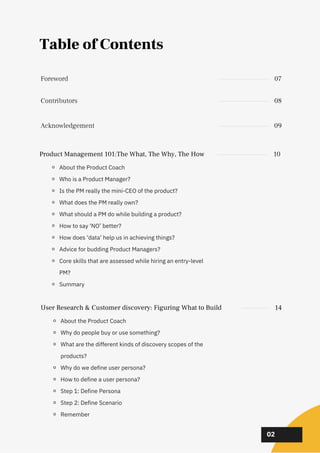
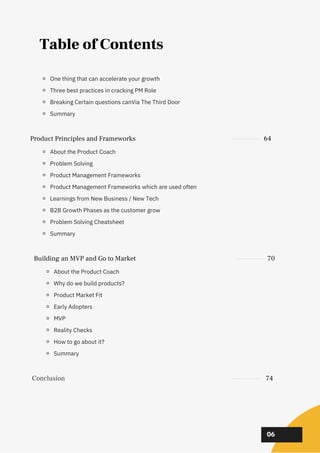
Table of Contents
Product Management 101:The What, The Why, The How 10
About the Product Coach
Who is a Product Manager?
Is the PM really the mini-CEO of the product?
What does the PM really own?
What should a PM do while building a product?
How to say ‘NO’ better?
How does ‘data’ help us in achieving things?
Advice for budding Product Managers?
Core skills that are assessed while hiring an entry-level
PM?
Summary
Contributors 08
Acknowledgement 09
Foreword 07
User Research & Customer discovery: Figuring What to Build 14
About the Product Coach
Why do people buy or use something?
What are the different kinds of discovery scopes of the
products?
Why do we define user persona?
How to define a user persona?
Step 1: Define Persona
Step 2: Define Scenario
Remember
02
02
02
03
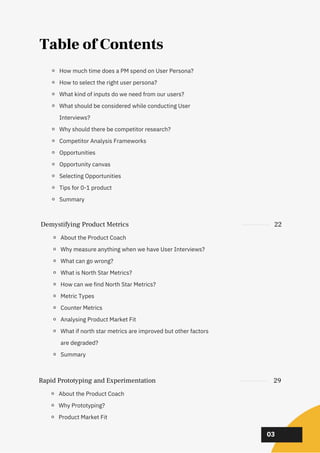
Table of Contents
How much time does a PM spend on User Persona?
How to select the right user persona?
What kind of inputs do we need from our users?
What should be considered while conducting User
Interviews?
Why should there be competitor research?
Competitor Analysis Frameworks
Opportunities
Opportunity canvas
Selecting Opportunities
Tips for 0-1 product
Summary
Demystifying Product Metrics 22
About the Product Coach
Why measure anything when we have User Interviews?
What can go wrong?
What is North Star Metrics?
How can we find North Star Metrics?
Metric Types
Counter Metrics
Analysing Product Market Fit
What if north star metrics are improved but other factors
are degraded?
Summary
Rapid Prototyping and Experimentation 29
About the Product Coach
Why Prototyping?
Product Market Fit
02
02
02
04
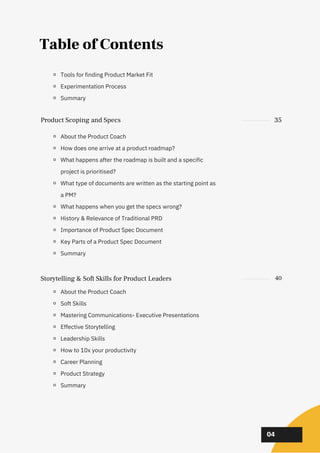
Table of Contents
About the Product Coach
How does one arrive at a product roadmap?
What happens after the roadmap is built and a specific
project is prioritised?
What type of documents are written as the starting point as
a PM?
What happens when you get the specs wrong?
History & Relevance of Traditional PRD
Importance of Product Spec Document
Key Parts of a Product Spec Document
Summary
Storytelling & Soft Skills for Product Leaders 40
About the Product Coach
Soft Skills
Mastering Communications- Executive Presentations
Effective Storytelling
Leadership Skills
How to 10x your productivity
Career Planning
Product Strategy
Summary
Product Scoping and Specs 35
Tools for finding Product Market Fit
Experimentation Process
Summary
02
02
02
05
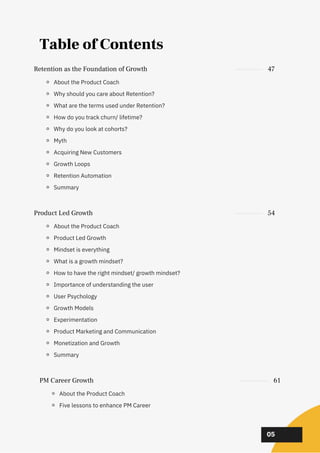
Table of Contents
Product Led Growth 54
About the Product Coach
Product Led Growth
Mindset is everything
What is a growth mindset?
How to have the right mindset/ growth mindset?
Importance of understanding the user
User Psychology
Growth Models
Experimentation
Product Marketing and Communication
Monetization and Growth
Summary
PM Career Growth 61
About the Product Coach
Five lessons to enhance PM Career
About the Product Coach
Why should you care about Retention?
What are the terms used under Retention?
How do you track churn/ lifetime?
Why do you look at cohorts?
Myth
Acquiring New Customers
Growth Loops
Retention Automation
Summary
Retention as the Foundation of Growth 47
02
02
02
06
Table of Contents
Building an MVP and Go to Market 70
About the Product Coach
Why do we build products?
Product Market Fit
Early Adopters
MVP
Reality Checks
How to go about it?
Summary
Conclusion 74
Product Principles and Frameworks 64
About the Product Coach
Problem Solving
Product Management Frameworks
Product Management Frameworks which are used often
Learnings from New Business / New Tech
B2B Growth Phases as the customer grow
Problem Solving Cheatsheet
Summary
One thing that can accelerate your growth
Three best practices in cracking PM Role
Breaking Certain questions canVia The Third Door
Summary
To start, thank you for picking up this piece of art. Yes, art. This isn’t just another ‘product’
book – it’s about the stories, the learnings, and the real-life experiences of some of the
best product managers and founders in our ecosystem. Anyone can toss together a bunch
of lessons. But the nuggets that take product folks deep inside their journey and help them
to understand how to become a better version of themselves are rare. They share lessons
that will engage you and, more importantly, allow you to learn and apply through their
practical insights. It’s a collection of strategies, resources and lots more – it’s highly
recommended that you jump right in!
That being said, this wouldn’t have been possible without the effort of the team – Megha,
Aditya, Shalini, Saurabh, Sajal, Paul and Parth – who have been putting effort into carefully
curating this collection, which is what makes it so special. You can bet that any genuinely
thoughtful book on revision captures my attention. And this is a gem by all means.
Over the last two years, we’ve been trying to get the ecosystem together and build the best
product community in the world. Though our original focus was on offline networking
events, it became apparent over time that there is a real gap in the way the industry
upskills.
Since early 2021, with a fresh perspective on outcomes, we’ve been carefully making the
underlying purpose behind every initiative we launch very clear: to help to democratise
tech learning and enable the bridge of opportunities between the larger community and
the industry. And with the help of tons of folks in the ecosystem – mentors, volunteers,
teammates, industry partners – who’ve helped us at every single step, we’ve been able to
make a tiny, tiny dent – and it’s only a start, I promise. By the community, for the
community
02
02
02
Suhas Motwani
Co-founder , TPF
07
Foreword
We wholeheartedly thank the team that worked on the Insurjo E-book.
Creator: Srishti Gupta
Design: Vaibhav Basantani and Krish Savani
E-book Content Contributor(s): Mrunmai Patil, Srishti Gupta, Vaibhav Basantani
Marketing Contributor(s): Shalini Singh and Parth Batra
Social Content Contributor(s): Amani Chowdhry and Hasmita Kapoor
Operations : Megha Pathak
02
02
02
08
Contribution
We started this community two years back with a simple motive to make the knowledge around
product management more accessible. With time, we have not only grown in size but also in our
motive. We have always strongly believed in working together for the greater good of the
community.
We are thankful to our readers and our community members from across the globe who have
made this possible. Your support and encouragement are the only fuel that keeps us going over
time. At the same time, we believe that every day is day one at The Product Folks, and we have
miles to go together.
Hope you have a good read!
02
02
02
09
Acknowledgment
02
02
02
02
02
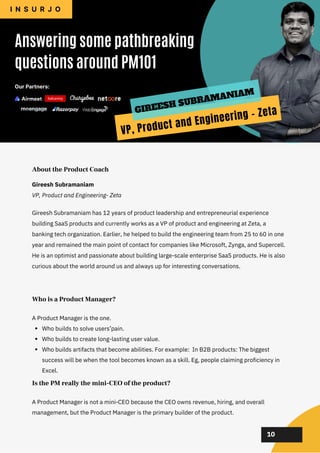
Gireesh Subramaniam has 12 years of product leadership and entrepreneurial experience
building SaaS products and currently works as a VP of product and engineering at Zeta, a
banking tech organization. Earlier, he helped to build the engineering team from 25 to 60 in one
year and remained the main point of contact for companies like Microsoft, Zynga, and Supercell.
He is an optimist and passionate about building large-scale enterprise SaaS products. He is also
curious about the world around us and always up for interesting conversations.
About the Product Coach
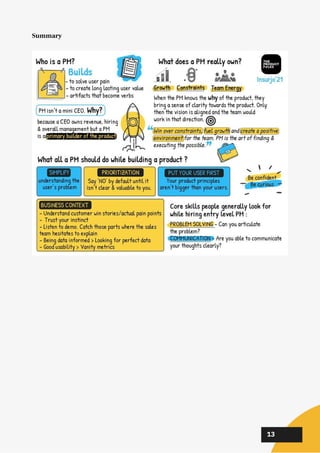
Who builds to solve users’pain.
Who builds to create long-lasting user value.
Who builds artifacts that become abilities. For example: In B2B products: The biggest
success will be when the tool becomes known as a skill. Eg, people claiming proficiency in
Excel.
A Product Manager is the one.
Who is a Product Manager?
A Product Manager is not a mini-CEO because the CEO owns revenue, hiring, and overall
management, but the Product Manager is the primary builder of the product.
Is the PM really the mini-CEO of the product?
10
Gireesh Subramaniam
VP, Product and Engineering- Zeta
Answering some pathbreaking
questions around PM101
I N S U R J O
GIREESH SUBRAMANIAM
VP, Product and Engineering - Zeta
Our Partners:
02
02
02
A Product Manager owns growth, constraints (internal or external), team energy. The PM has the
best vantage point, has a sense of purpose, is incredibly democratic, rallies the team, and brings
a sense of clarity.
What does the PM own?
Simplify by understanding user's problems.
Put the user first before your product's principles.
Give business context priority over aesthetics.
Understand their customer's needs
What do they need? What will they pay for?
Understand customer win stories or actual pain points.
Pay attention to demos. What do sales have to demo vs hesitate?
Trust your instinct
Being data-informed is more important than perfecting the data.
Form emotional bonds.
Prioritize - Say ‘No’ by default until it is not clear or valuable to you.
Start from NO and move to YES when it is super clear.
Non Opinionated PM is a disaster.
Transition to a PM career?
Assess what are your current strengths
What things do you need to learn?
Don't talk about things you can’t answer.
What should a PM do while building a product?
Listen well.
Earn the trust and respect with what you build
How to say ‘NO’ better?
11
Win over constraints, fuel growth and create a positive environment for the team; product
management is the art of the possible
02
02
02
Solve the need without building where possible.
No for Now is the mantra. Be open to changing your mind.
As long as you are an expert on customer, you will earn credibility
12
You can’t keep double guessing.
Lack of clarity damages the speed hence have a bias for action.
Data will not tell what exactly the problem is, it can only indicate whether there is a problem or
not.
How does ‘data’ help us in achieving things?
You are the PM of your career.
Learn from the community.
Only pick something you truly enjoy.
Learning is underrated.
Find interesting things to talk about your product.
Put yourself out there.
Curiosity and learning are important.
Advice for budding Product Managers?
Problem Solving- Can you articulate problems?
Communication- Are you able to communicate your thoughts?
Core skills which are assessed while hiring an entry level PM?
02
02
02
13
Summary
02
02
02
02
02
Toshi Prakash has been helping companies to grow for years, especially with their cultural
metrics, at xto10x, an Indian-based start-up that provides clear pillars on the way to scale a
company post-product-market fit. Earlier, she was VP of product at Locus. She is considered to
be one of the experts in the market research and customer discovery domains.
About the Product Coach
To get a job (desired task) done.
Invest their time, energy, and money- should be happy
You are not the user.
You are one part of your user segment and one of the pro users who knows everything.
Will it bring value to your business
Why do people buy or use something?
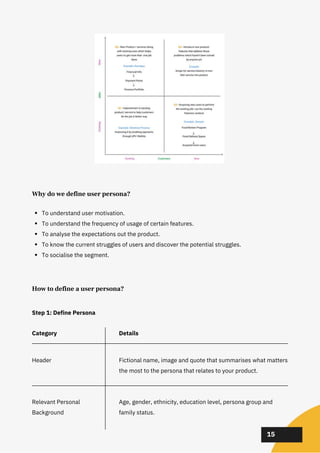
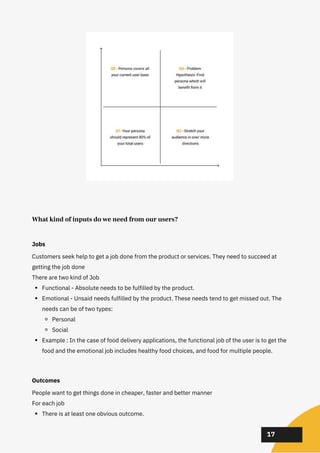
For each quadrant there are different user personas.
What are different kinds of discovery scopes of the products?
14
Toshi Prakash
Head, Products- xto10x
Market research and Customer
Discovery
I N S U R J O
Our Partners:
Head, Products -xto10x
TOSHI PRAKASH
02
02
02
15
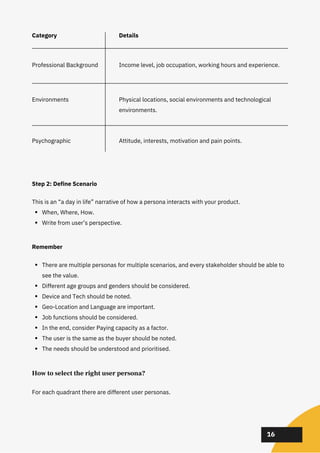
Category
Header
Relevant Personal
Background
Fictional name, image and quote that summarises what matters
the most to the persona that relates to your product.
Age, gender, ethnicity, education level, persona group and
family status.
Details
To understand user motivation.
To understand the frequency of usage of certain features.
To analyse the expectations out the product.
To know the current struggles of users and discover the potential struggles.
To socialise the segment.
Why do we define user persona?
Step 1: Define Persona
How to define a user persona?
02
02
02
16
Category
Professional Background
Environments
Psychographic
Income level, job occupation, working hours and experience.
Physical locations, social environments and technological
environments.
Attitude, interests, motivation and pain points.
Details
Step 2: Define Scenario
When, Where, How.
Write from user’s perspective.
This is an “a day in life” narrative of how a persona interacts with your product.
Remember
There are multiple personas for multiple scenarios, and every stakeholder should be able to
see the value.
Different age groups and genders should be considered.
Device and Tech should be noted.
Geo-Location and Language are important.
Job functions should be considered.
In the end, consider Paying capacity as a factor.
The user is the same as the buyer should be noted.
The needs should be understood and prioritised.
For each quadrant there are different user personas.
How to select the right user persona?
02
02
02
17
What kind of inputs do we need from our users?
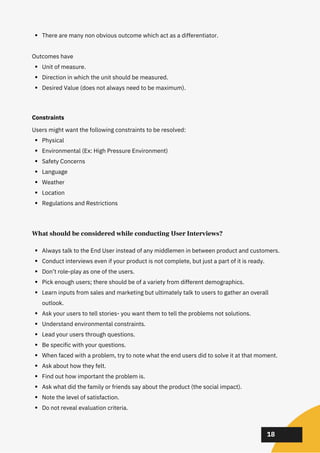
Jobs
Functional - Absolute needs to be fulfilled by the product.
Emotional - Unsaid needs fulfilled by the product. These needs tend to get missed out. The
needs can be of two types:
Personal
Social
Example : In the case of food delivery applications, the functional job of the user is to get the
food and the emotional job includes healthy food choices, and food for multiple people.
Customers seek help to get a job done from the product or services. They need to succeed at
getting the job done
There are two kind of Job
Outcomes
There is at least one obvious outcome.
People want to get things done in cheaper, faster and better manner
For each job
02
02
02
18
There are many non obvious outcome which act as a differentiator.
Unit of measure.
Direction in which the unit should be measured.
Desired Value (does not always need to be maximum).
Outcomes have
Constraints
Physical
Environmental (Ex: High Pressure Environment)
Safety Concerns
Language
Weather
Location
Regulations and Restrictions
Users might want the following constraints to be resolved:
What should be considered while conducting User Interviews?
Always talk to the End User instead of any middlemen in between product and customers.
Conduct interviews even if your product is not complete, but just a part of it is ready.
Don’t role-play as one of the users.
Pick enough users; there should be of a variety from different demographics.
Learn inputs from sales and marketing but ultimately talk to users to gather an overall
outlook.
Ask your users to tell stories- you want them to tell the problems not solutions.
Understand environmental constraints.
Lead your users through questions.
Be specific with your questions.
When faced with a problem, try to note what the end users did to solve it at that moment.
Ask about how they felt.
Find out how important the problem is.
Ask what did the family or friends say about the product (the social impact).
Note the level of satisfaction.
Do not reveal evaluation criteria.
02
02
02
19
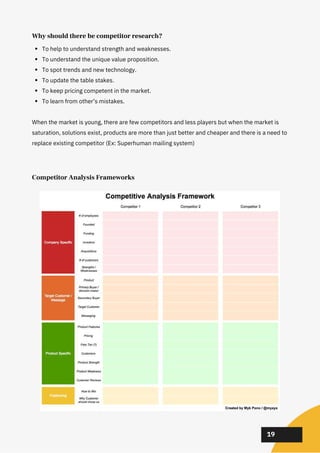
Why should there be competitor research?
To help to understand strength and weaknesses.
To understand the unique value proposition.
To spot trends and new technology.
To update the table stakes.
To keep pricing competent in the market.
To learn from other’s mistakes.
When the market is young, there are few competitors and less players but when the market is
saturation, solutions exist, products are more than just better and cheaper and there is a need to
replace existing competitor (Ex: Superhuman mailing system)
Competitor Analysis Frameworks
02
02
02
20
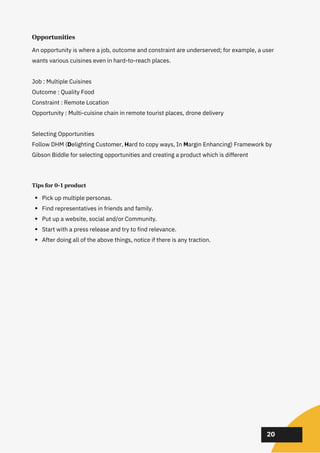
Opportunities
An opportunity is where a job, outcome and constraint are underserved; for example, a user
wants various cuisines even in hard-to-reach places.
Job : Multiple Cuisines
Outcome : Quality Food
Constraint : Remote Location
Opportunity : Multi-cuisine chain in remote tourist places, drone delivery
Selecting Opportunities
Follow DHM (Delighting Customer, Hard to copy ways, In Margin Enhancing) Framework by
Gibson Biddle for selecting opportunities and creating a product which is different
Tips for 0-1 product
Pick up multiple personas.
Find representatives in friends and family.
Put up a website, social and/or Community.
Start with a press release and try to find relevance.
After doing all of the above things, notice if there is any traction.
02
02
02
21
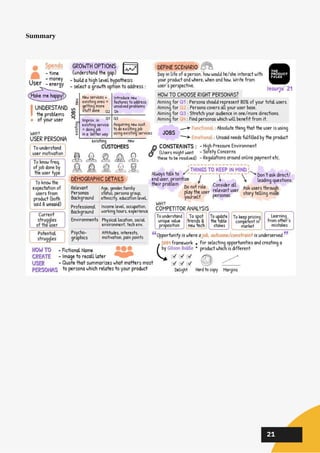
Summary
02
02
02
02
02
Moinak Bandyopadhyay is a born storyteller having 10 years of experience in Product Analytics,
AR, VR, Ecommerce. Currently, he is currently working as Product Manager at Stripe and earlier
was a Staff PM for Core Analytics and Machine Learning at Mixpanel. Moinak has studied
Computer Science from Georgia Tech, USA and has always been interested in the technical
domain but more into solving problems which eventually led him towards Product Management.
He gave an analytics angle towards Product Market Fit and focused on north star metrics and
evaluations of metrics through analytics.
About the Product Coach
What the problems are
Why they are problems
Possible solutions for the problem
Which problem should be solved first
Whether the possible solution actually solved the problem
There are certain questions that can only be answered through data, which supports the
answers gathered from user interviews
User Interviews identify:
Analytics helps figure out:
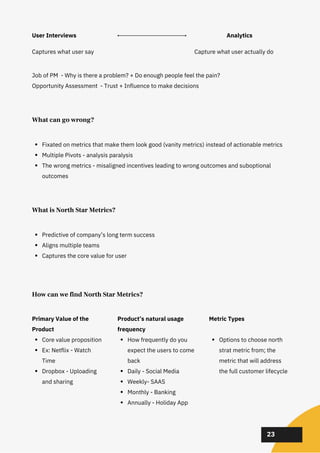
User Interviews <-> Analytics
Why measure anything when we have User Interviews?
22
Moinak Bandyopadhyay
PM- Stripe
Demystifying
Product Metrics
I N S U R J O
Our Partners:
PM-STRIPE
MOINAK
BANDYOPADHYAY
02
02
02
23
What can go wrong?
Fixated on metrics that make them look good (vanity metrics) instead of actionable metrics
Multiple Pivots - analysis paralysis
The wrong metrics - misaligned incentives leading to wrong outcomes and suboptional
outcomes
What is North Star Metrics?
Predictive of company’s long term success
Aligns multiple teams
Captures the core value for user
How can we find North Star Metrics?
Core value proposition
Ex: Netflix - Watch
Time
Dropbox - Uploading
and sharing
Primary Value of the
Product
How frequently do you
expect the users to come
back
Daily - Social Media
Weekly- SAAS
Monthly - Banking
Annually - Holiday App
Product’s natural usage
frequency
Options to choose north
strat metric from; the
metric that will address
the full customer lifecycle
Metric Types
User Interviews
Captures what user say
Job of PM - Why is there a problem? + Do enough people feel the pain?
Opportunity Assessment - Trust + Influence to make decisions
Capture what user actually do
Analytics
02
02
02
24
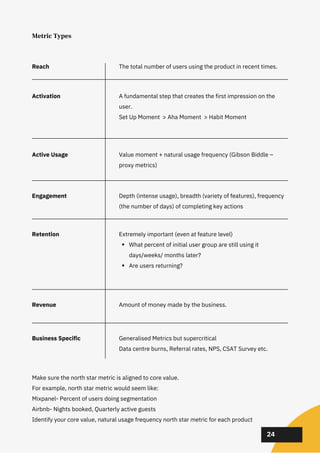
Metric Types
Make sure the north star metric is aligned to core value.
For example, north star metric would seem like:
Mixpanel- Percent of users doing segmentation
Airbnb- Nights booked, Quarterly active guests
Identify your core value, natural usage frequency north star metric for each product
Reach
Activation
Active Usage
Engagement
Retention
Revenue
Business Specific
A fundamental step that creates the first impression on the
user.
Set Up Moment > Aha Moment > Habit Moment
Value moment + natural usage frequency (Gibson Biddle –
proxy metrics)
Depth (intense usage), breadth (variety of features), frequency
(the number of days) of completing key actions
What percent of initial user group are still using it
days/weeks/ months later?
Are users returning?
Extremely important (even at feature level)
Generalised Metrics but supercritical
Data centre burns, Referral rates, NPS, CSAT Survey etc.
Amount of money made by the business.
The total number of users using the product in recent times.
02
02
02
25
Counter Metrics
Sometimes you are fixated on north star metric and unintentionally end up hurting the user
experience and the business
Figure out what checks do you need to add to avoid such an occurence
By spending 10 million in customer support
By spending 50 million for a new solution like reminder
Example:
Netflix free trial auto renewal was creating problems for its users. So they could solve this
problem through two ways
It was a tough decision between the two but in the second option, they found it better to loose
the margin because the customer delight was most likely to go up in this case
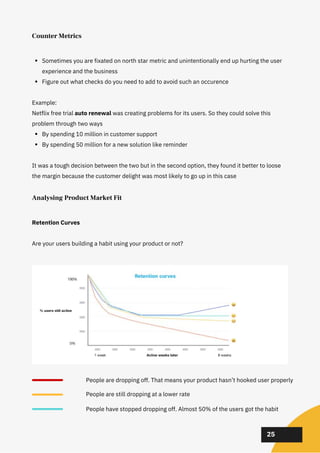
Analysing Product Market Fit
Retention Curves
Are your users building a habit using your product or not?
People are dropping off. That means your product hasn’t hooked user properly
People are still dropping at a lower rate
People have stopped dropping off. Almost 50% of the users got the habit
02
02
02
26
Very disappointed
Somewhat disappointed
Not disappointed
I no longer use the product
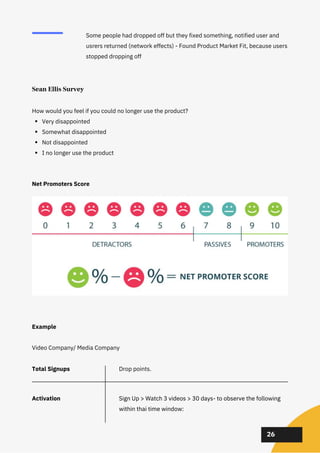
Sean Ellis Survey
How would you feel if you could no longer use the product?
Example
Video Company/ Media Company
Net Promoters Score
Some people had dropped off but they fixed something, notified user and
usrers returned (network effects) - Found Product Market Fit, because users
stopped dropping off
Total Signups
Total Signups
Activation
Activation Sign Up > Watch 3 videos > 30 days- to observe the following
within thai time window
Sign Up > Watch 3 videos > 30 days- to observe the following
within thai time window:
Drop points.
02
02
02
27
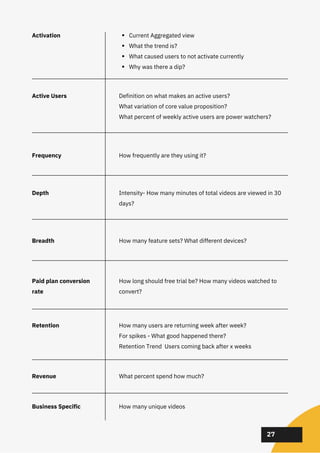
Activation
Active Users
Frequency
Depth
Breadth
Paid plan conversion
rate
Business Specific
Retention
Revenue
Current Aggregated view
What the trend is?
What caused users to not activate currently
Why was there a dip?
Definition on what makes an active users?
What variation of core value proposition?
What percent of weekly active users are power watchers?
How frequently are they using it?
Intensity- How many minutes of total videos are viewed in 30
days?
How many feature sets? What different devices?
How long should free trial be? How many videos watched to
convert?
How many unique videos
How many users are returning week after week?
For spikes - What good happened there?
Retention Trend Users coming back after x weeks
What percent spend how much?
02
02
02
28
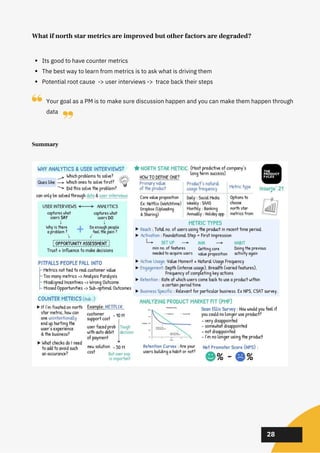
What if north star metrics are improved but other factors are degraded?
Its good to have counter metrics
The best way to learn from metrics is to ask what is driving them
Potential root cause -> user interviews -> trace back their steps
Summary
Your goal as a PM is to make sure discussion happen and you can make them happen through
data
02
02
02
02
02
Nathan Bobbin is VP of products at Chargebee, the subscription billing and revenue
management platform. He started his product journey 20 years ago with IBM as senior PM; since
then, he has been in the product domain. His experience with various start-ups helps us to
understand the importance of prototyping and experiments.
About the Product Coach
There is no such market need (people didnt care about it enough).
They run out of cash.
They have poor marketing.
They are outcomepeted.
Major features are not used by almost 50% target audience , and 66% drastically change the
plan.
9 out of 10 startups fail because
Therefore it is always good to prototype before hand and avoid such consequences
Why Prototyping?
29
Nathan Bobbin
VP, Product - Chargebee
Rapid Prototyping and
Experimentation
I N S U R J O
Our Partners:
VP Products, Chargebee
NATHAN BOBBIN
02
02
02
30
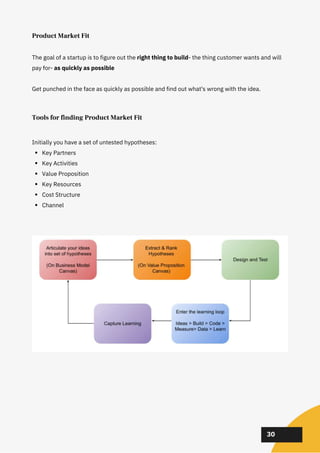
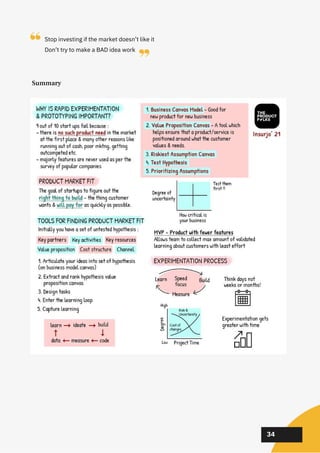
The goal of a startup is to figure out the right thing to build- the thing customer wants and will
pay for- as quickly as possible
Get punched in the face as quickly as possible and find out what's wrong with the idea.
Tools for finding Product Market Fit
Key Partners
Key Activities
Value Proposition
Key Resources
Cost Structure
Channel
Initially you have a set of untested hypotheses:
Product Market Fit
02
02
02
31
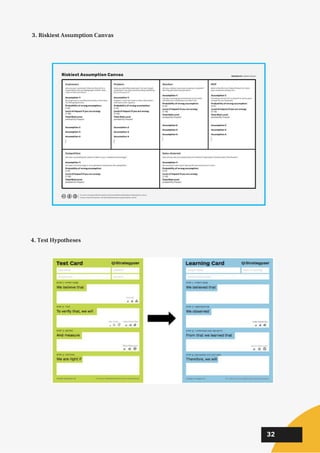
2. Value Proposition Canvas -A tool that helps ensure that a product/service is positioned
around what the customer values and needs are.
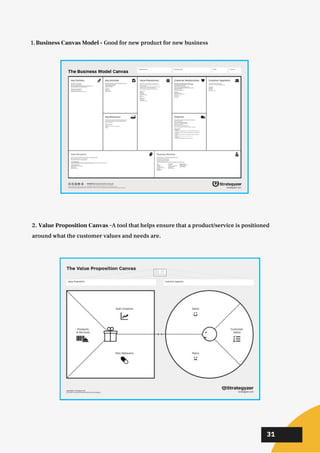
Business Canvas Model - Good for new product for new business
1.
02
02
02
32
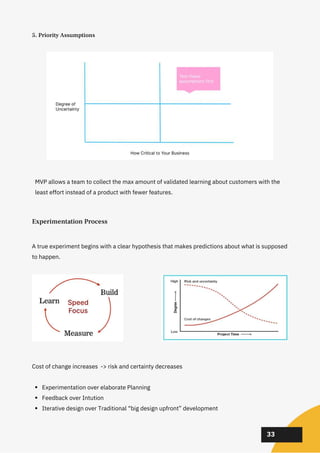
3. Riskiest Assumption Canvas
4. Test Hypotheses
02
02
02
33
5. Priority Assumptions
MVP allows a team to collect the max amount of validated learning about customers with the
least effort instead of a product with fewer features.
Experimentation over elaborate Planning
Feedback over Intution
Iterative design over Traditional “big design upfront” development
Cost of change increases -> risk and certainty decreases
Experimentation Process
A true experiment begins with a clear hypothesis that makes predictions about what is supposed
to happen.
02
02
02
34
Summary
Stop investing if the market doesn’t like it
Don’t try to make a BAD idea work
02
02
02
02
02
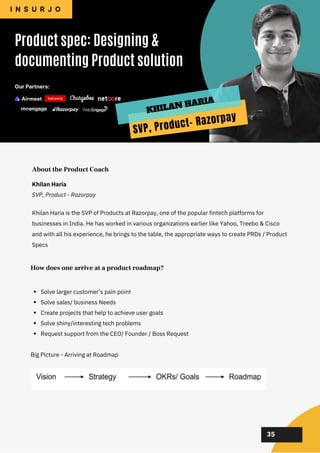
Khilan Haria is the SVP of Products at Razorpay, one of the popular fintech platforms for
businesses in India. He has worked in various organizations earlier like Yahoo, Treebo & Cisco
and with all his experience, he brings to the table, the appropriate ways to create PRDs / Product
Specs
Product spec: Designing &
documenting Product solution
I N S U R J O
SVP, Product- Razorpay
KHILAN HARIA
About the Product Coach
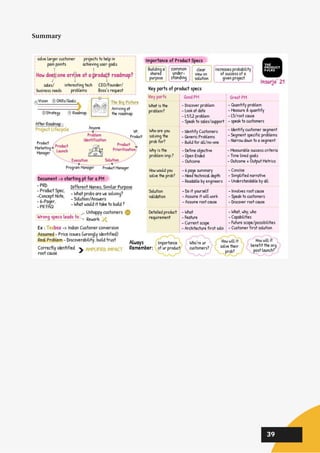
Solve larger customer’s pain point
Solve sales/ business Needs
Create projects that help to achieve user goals
Solve shiny/interesting tech problems
Request support from the CEO/ Founder / Boss Request
Big Picture - Arriving at Roadmap
How does one arrive at a product roadmap?
35
Khilan Haria
SVP, Product - Razorpay
Our Partners:
02
02
02
36
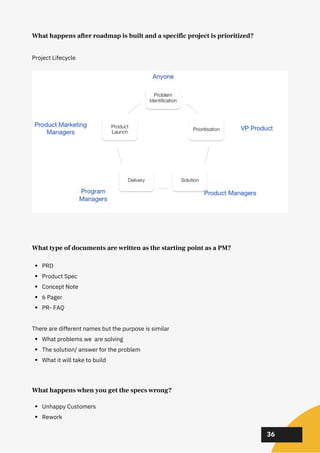
Project Lifecycle
What type of documents are written as the starting point as a PM?
PRD
Product Spec
Concept Note
6 Pager
PR- FAQ
What problems we are solving
The solution/ answer for the problem
What it will take to build
There are different names but the purpose is similar
What happens when you get the specs wrong?
Unhappy Customers
Rework
What happens after roadmap is built and a specific project is prioritized?
02
02
02
37
History & Relevance of Traditional PRD
Why is this product important?
Who are the customers?
How is it going to solve the problem of the customers?
What benefit will the organization get after this product launch?
Agile ↔ Waterfall
PRD/MRD is usually the voice of the PM rather than the voice of the customer. Unanswered
questions in traditional PRD include the following:
Importance of Product Spec Document
Helps to build a shared purpose.
Helps to build a common understanding of the problem.
Builds a clear view on the solution and ensures that expectation vs reality are not different.
In summary, a good spec increases probability of success of a given project.
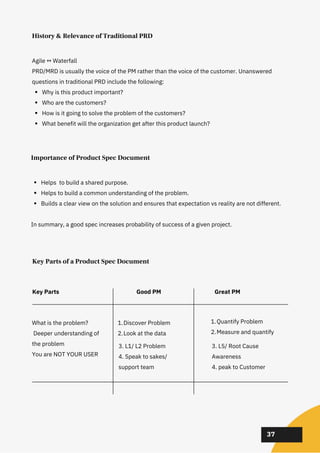
Key Parts of a Product Spec Document
Key Parts
Discover Problem
Look at the data
1.
2.
Quantify Problem
Measure and quantify
1.
2.
Great PM
Good PM
What is the problem?
Deeper understanding of
the problem
You are NOT YOUR USER
3. L1/ L2 Problem
4. Speak to sakes/
support team
3. L5/ Root Cause
Awareness
4. peak to Customer
02
02
02
38
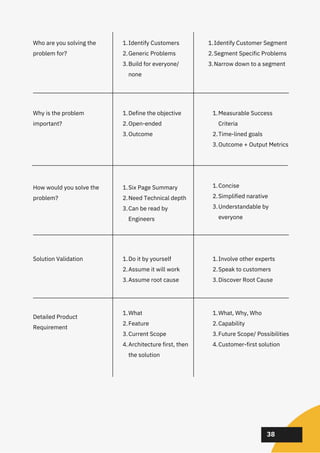
Who are you solving the
problem for?
Why is the problem
important?
How would you solve the
problem?
Solution Validation
Detailed Product
Requirement
What
Feature
Current Scope
Architecture first, then
the solution
1.
2.
3.
4.
What, Why, Who
Capability
Future Scope/ Possibilities
Customer-first solution
1.
2.
3.
4.
Do it by yourself
Assume it will work
Assume root cause
1.
2.
3.
Involve other experts
Speak to customers
Discover Root Cause
1.
2.
3.
Six Page Summary
Need Technical depth
Can be read by
Engineers
1.
2.
3.
Concise
Simplified narative
Understandable by
everyone
1.
2.
3.
Define the objective
Open-ended
Outcome
1.
2.
3.
Measurable Success
Criteria
Time-lined goals
Outcome + Output Metrics
1.
2.
3.
Identify Customers
Generic Problems
Build for everyone/
none
1.
2.
3.
Identify Customer Segment
Segment Specific Problems
Narrow down to a segment
1.
2.
3.
02
02
02
39
Summary
02
02
02
02
02
Apoorva is the product commercialisation and GTM strategy lead at Indeed, an American
worldwide employment website for job listings. She has always enjoyed working in product
management as it is an intersection between technology and business that drives vision.
Storytelling & Soft Skills
for Product Leaders
I N S U R J O
About the Product Coach
It gives you that edge to differentiate as a product leader
Make the difference between good and great product leaders
Soft Skills
40
Apoorva Singh
GTM Product Lead- Indeed
Our Partners:
Products- Indeed
APOORVA SINGH
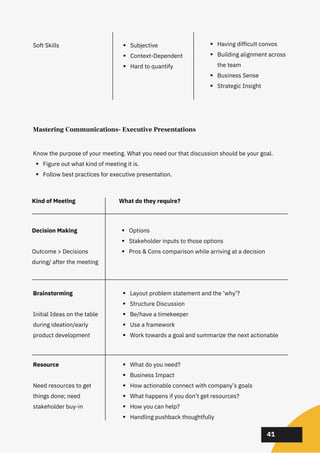
Skills
Hard Skills
Soft Skills
Transactional
Transferable
Measurable
About interpersonal
stuff
Stakeholder
Management
Writing user stories
Building & analyzing data
Building dashboards,
reports, business cases
Example
Characteristics
02
02
02
41
Soft Skills Subjective
Context-Dependent
Hard to quantify
Having difficult convos
Building alignment across
the team
Business Sense
Strategic Insight
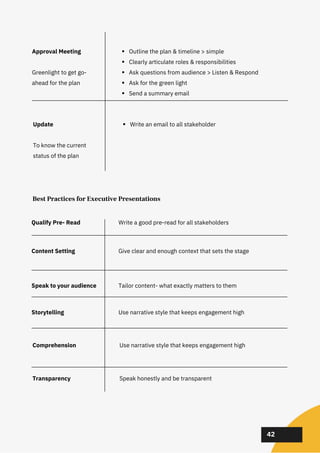
Figure out what kind of meeting it is.
Follow best practices for executive presentation.
Know the purpose of your meeting. What you need our that discussion should be your goal.
Mastering Communications- Executive Presentations
Kind of Meeting
Decision Making
Outcome > Decisions
during/ after the meeting
Brainstorming
Initial Ideas on the table
during ideation/early
product development
Resource
Need resources to get
things done; need
stakeholder buy-in
Options
Stakeholder inputs to those options
Pros & Cons comparison while arriving at a decision
Layout problem statement and the ‘why’?
Structure Discussion
Be/have a timekeeper
Use a framework
Work towards a goal and summarize the next actionable
What do you need?
Business Impact
How actionable connect with company’s goals
What happens if you don’t get resources?
How you can help?
Handling pushback thoughtfully
What do they require?
02
02
02
42
Approval Meeting
Greenlight to get go-
ahead for the plan
Qualify Pre- Read
Content Setting
Speak to your audience
Storytelling
Comprehension
Update
To know the current
status of the plan
Outline the plan & timeline > simple
Clearly articulate roles & responsibilities
Ask questions from audience > Listen & Respond
Ask for the green light
Send a summary email
Write a good pre-read for all stakeholders
Give clear and enough context that sets the stage
Tailor content- what exactly matters to them
Use narrative style that keeps engagement high
Write an email to all stakeholder
Best Practices for Executive Presentations
Transparency Speak honestly and be transparent
02
02
02
43
Effective Storytelling
What is the ‘WHY’?
The Problem / Conflict
The Context/ Plot
The Experience
The Solution
Personal/ Emotional Connections
Pacing it well
Why is storytelling has importance in a team?
Audience Remember the STORY!
Principles
1.
2.
3.
4.
5.
6.
7.
Leadership Skills
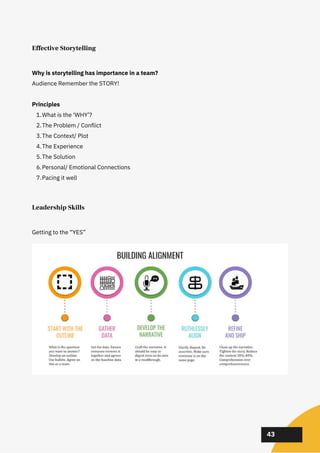
Getting to the “YES”
02
02
02
44
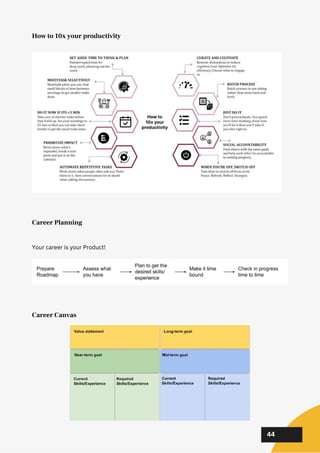
How to 10x your productivity
Career Planning
Your career is your Product!
Career Canvas
02
02
02
45
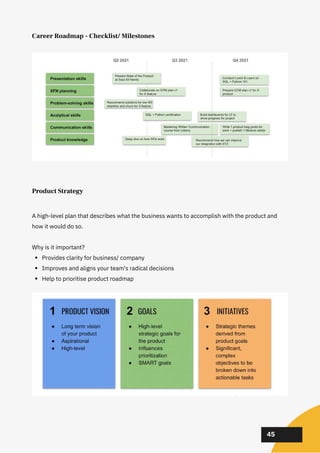
Career Roadmap - Checklist/ Milestones
Product Strategy
Provides clarity for business/ company
Improves and aligns your team's radical decisions
Help to prioritise product roadmap
A high-level plan that describes what the business wants to accomplish with the product and
how it would do so.
Why is it important?
02
02
02
46
How to break into Product Strategy?
Grow vertically in product management (if you are already in the product domain).
Find Product strategy roles at other companies like Googe, hypergrowth start-ups and larger
MNCs lie HCL.
1.
2.
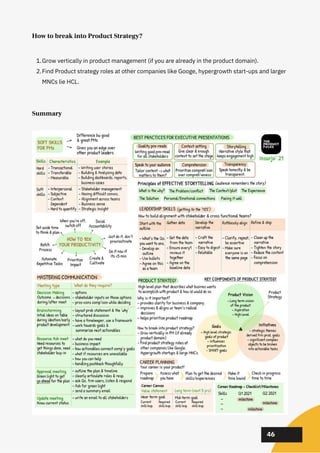
Summary
02
02
02
02
02
Ankur Gattani has dabbled in multiple spaces from mobile product management to venture
development. He is currently leading the growth and marketing at WebEngage, the platform that
provides contextual services and helps you to craft personalized campaigns to engage your
users through push notifications, web notifications, email, and more. He is one of the strongest
storytellers who will captivate your attention and help you to gain knowledge towards retention
as the foundation of growth and the jargon related to growth.
Retention as the
Foundation of Growth
I N S U R J O
About the Product Coach
It is about data driven growth which includes lot of workflows, automation, data models,
user insights and similar skill sets.
As a PM, you can bake growth pieces into products.
It is a great career path.
Once you understand funnels, you can use then everywhere.
Retention overlaps with product:
1.
2.
3.
4.
Why should you care about Retention?
47
Ankur Gattani
VP, Growth & Marketing - WebEngage
Our Partners:
VP Growth & Marketing - WebEngage
ANKUR GATTANI
02
02
02
48
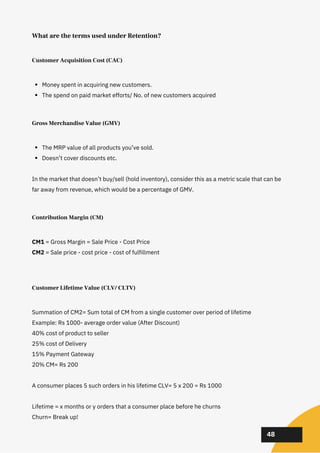
Customer Acquisition Cost (CAC)
Money spent in acquiring new customers.
The spend on paid market efforts/ No. of new customers acquired
Gross Merchandise Value (GMV)
The MRP value of all products you’ve sold.
Doesn’t cover discounts etc.
In the market that doesn’t buy/sell (hold inventory), consider this as a metric scale that can be
far away from revenue, which would be a percentage of GMV.
Contribution Margin (CM)
CM1 = Gross Margin = Sale Price - Cost Price
CM2 = Sale price - cost price - cost of fulfillment
Customer Lifetime Value (CLV/ CLTV)
Summation of CM2= Sum total of CM from a single customer over period of lifetime
Example: Rs 1000- average order value (After Discount)
40% cost of product to seller
25% cost of Delivery
15% Payment Gateway
20% CM= Rs 200
A consumer places 5 such orders in his lifetime CLV= 5 x 200 = Rs 1000
Lifetime = x months or y orders that a consumer place before he churns
Churn= Break up!
What are the terms used under Retention?
02
02
02
49
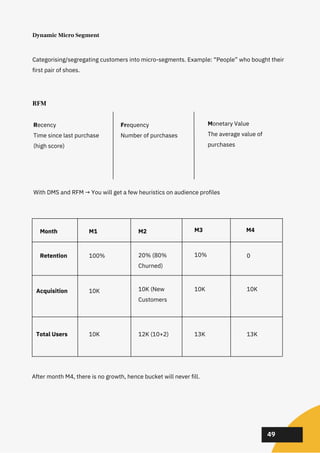
Dynamic Micro Segment
Categorising/segregating customers into micro-segments. Example: “People” who bought their
first pair of shoes.
RFM
Recency
Time since last purchase
(high score)
With DMS and RFM → You will get a few heuristics on audience profiles
After month M4, there is no growth, hence bucket will never fill.
Frequency
Number of purchases
Monetary Value
The average value of
purchases
Month M1 M2 M3
Retention
Acquisition
Total Users
100%
10K
10K 12K (10+2) 13K 13K
10K (New
Customers
10K 10K
20% (80%
Churned)
10% 0
M4
02
02
02
50
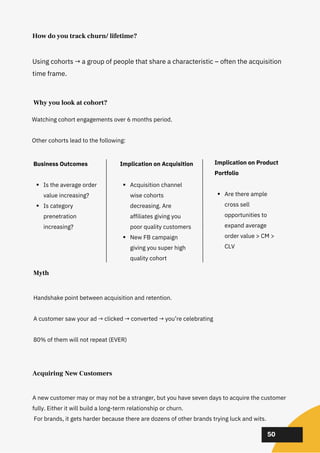
How do you track churn/ lifetime?
Using cohorts → a group of people that share a characteristic – often the acquisition
time frame.
Myth
Handshake point between acquisition and retention.
A customer saw your ad → clicked → converted → you’re celebrating
80% of them will not repeat (EVER)
Acquiring New Customers
A new customer may or may not be a stranger, but you have seven days to acquire the customer
fully. Either it will build a long-term relationship or churn.
For brands, it gets harder because there are dozens of other brands trying luck and wits.
Why you look at cohort?
Is the average order
value increasing?
Is category
prenetration
increasing?
Business Outcomes
Watching cohort engagements over 6 months period.
Other cohorts lead to the following:
Acquisition channel
wise cohorts
decreasing. Are
affiliates giving you
poor quality customers
New FB campaign
giving you super high
quality cohort
Implication on Acquisition
Are there ample
cross sell
opportunities to
expand average
order value > CM >
CLV
Implication on Product
Portfolio
02
02
02
51
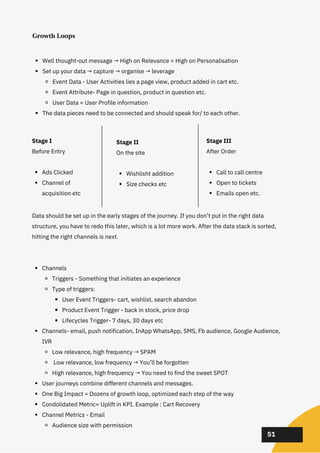
Growth Loops
Well thought-out message → High on Relevance = High on Personalisation
Set up your data → capture → organise → leverage
Event Data - User Activities lies a page view, product added in cart etc.
Event Attribute- Page in question, product in question etc.
User Data = User Profile information
The data pieces need to be connected and should speak for/ to each other.
Channels
Triggers - Something that initiates an experience
Type of triggers:
User Event Triggers- cart, wishlist, search abandon
Product Event Trigger - back in stock, price drop
Lifecycles Trigger- 7 days, 30 days etc
Channels- email, push notification, InApp WhatsApp, SMS, Fb audience, Google Audience,
IVR
Low relevance, high frequency → SPAM
Low relevance, low frequency → You’ll be forgotten
High relevance, high frequency → You need to find the sweet SPOT
User journeys combine different channels and messages.
One Big Impact = Dozens of growth loop, optimized each step of the way
Condolidated Metric= Uplift in KPI. Example : Cart Recovery
Channel Metrics - Email
Audience size with permission
Data should be set up in the early stages of the journey. If you don’t put in the right data
structure, you have to redo this later, which is a lot more work. After the data stack is sorted,
hitting the right channels is next.
Ads Clicked
Channel of
acquisition etc
Stage I
Before Entry
Wishlisht addition
Size checks etc
Stage II
On the site
Call to call centre
Open to tickets
Emails open etc.
Stage III
After Order
02
02
02
52
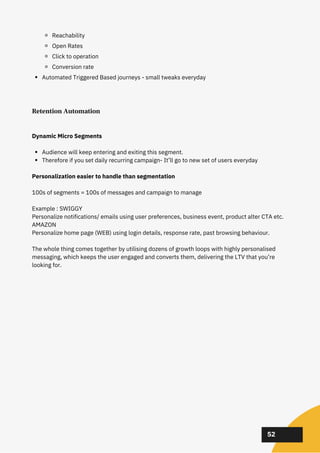
Reachability
Open Rates
Click to operation
Conversion rate
Automated Triggered Based journeys - small tweaks everyday
Retention Automation
Audience will keep entering and exiting this segment.
Therefore if you set daily recurring campaign- It’ll go to new set of users everyday
Dynamic Micro Segments
Personalization easier to handle than segmentation
100s of segments = 100s of messages and campaign to manage
Example : SWIGGY
Personalize notifications/ emails using user preferences, business event, product alter CTA etc.
AMAZON
Personalize home page (WEB) using login details, response rate, past browsing behaviour.
The whole thing comes together by utilising dozens of growth loops with highly personalised
messaging, which keeps the user engaged and converts them, delivering the LTV that you’re
looking for.
02
02
02
53
Summary
02
02
02
02
02
Anuj is SVP, Central Revenue and Growth at Swiggy where he leads growth marketing, customer
lifecycle Management, Swiggy One, merchandising, social, design solutions, financial services,
partnerships and Swiggy Labs. With more than 17 years of experience, Anuj brings rich
experience and insights from his stints at marquee Indian e-commerce startups. At Flipkart and
later at Snapdeal, he led the Buyer experience teams which were instrumental in crafting and
deciding how India buys online in web and mobile. Anuj also worked with Walmart Labs as a
Senior Product Manager where he created a truly multichannel experience for their online photo
and pharmacy products.
Product Strategy
I N S U R J O
About the Product Coach
Product plays a key role in all the teams
A growth mindset is the most important lever to drive growth
Product Led Growth
Mindset is everything
54
Anuj Rathi
SVP Revenue, Growth - Swiggy
Our Partners:
SVP Revenue, Growth- Swiggy
ANUJ RATHI
02
02
02
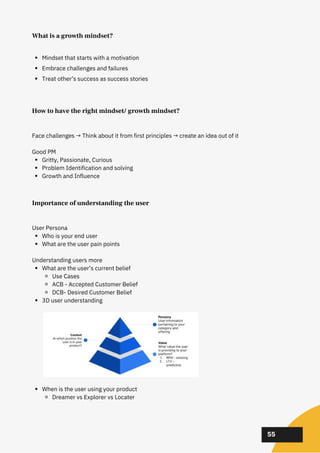
Importance of understanding the user
Who is your end user
What are the user pain points
What are the user’s current belief
Use Cases
ACB - Accepted Customer Belief
DCB- Desired Customer Belief
3D user understanding
When is the user using your product
Dreamer vs Explorer vs Locater
User Persona
Understanding users more
55
Mindset that starts with a motivation
Embrace challenges and failures
Treat other’s success as success stories
How to have the right mindset/ growth mindset?
Gritty, Passionate, Curious
Problem Identification and solving
Growth and Influence
Face challenges → Think about it from first principles → create an idea out of it
Good PM
What is a growth mindset?
02
02
02
56
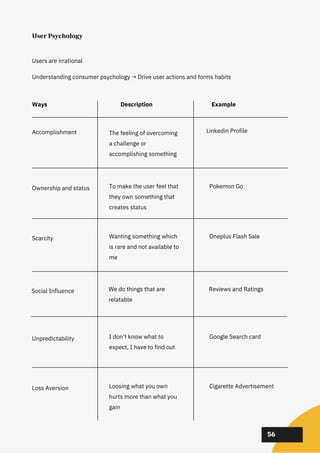
User Psychology
Users are irrational
Understanding consumer psychology → Drive user actions and forms habits
Ways
Accomplishment
Ownership and status
Scarcity
Social Influence
Unpredictability
Loss Aversion
The feeling of overcoming
a challenge or
accomplishing something
To make the user feel that
they own something that
creates status
Wanting something which
is rare and not available to
me
We do things that are
relatable
I don’t know what to
expect, I have to find out
Loosing what you own
hurts more than what you
gain
Pokemon Go
Oneplus Flash Sale
Reviews and Ratings
Google Search card
Cigarette Advertisement
Linkedin Profile
Example
Description
02
02
02
57
Meaning Make the user feel that
they are a part of
something
Wikipedia, Milap etc.
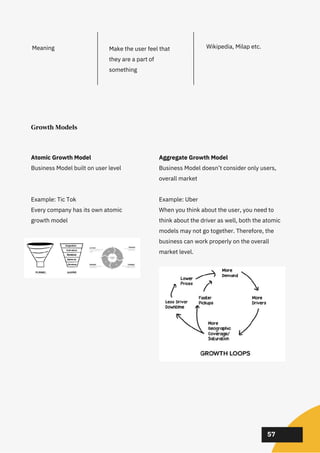
Growth Models
Atomic Growth Model
Business Model built on user level
Example: Tic Tok
Every company has its own atomic
growth model
Aggregate Growth Model
Business Model doesn’t consider only users,
overall market
Example: Uber
When you think about the user, you need to
think about the driver as well, both the atomic
models may not go together. Therefore, the
business can work properly on the overall
market level.
02
02
02
58
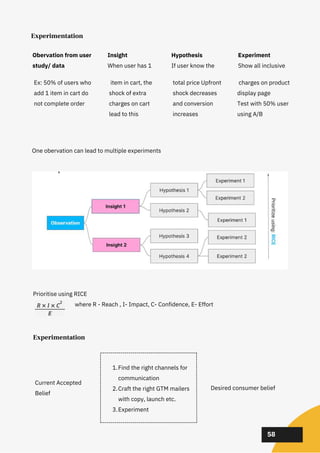
Ex: 50% of users who
add 1 item in cart do
not complete order
One obervation can lead to multiple experiments
Prioritise using RICE
where R - Reach , I- Impact, C- Confidence, E- Effort
item in cart, the
shock of extra
charges on cart
lead to this
total price Upfront
shock decreases
and conversion
increases
charges on product
display page
Test with 50% user
using A/B
Current Accepted
Belief
Desired consumer belief
Find the right channels for
communication
Craft the right GTM mailers
with copy, launch etc.
Experiment
1.
2.
3.
Experimentation
Obervation from user
study/ data
Insight
When user has 1
Hypothesis
If user know the
Experiment
Show all inclusive
Experimentation
02
02
02
59
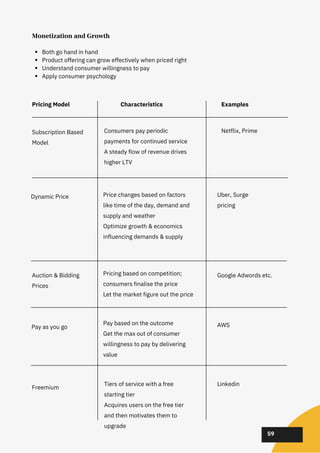
Monetization and Growth
Both go hand in hand
Product offering can grow effectively when priced right
Understand consumer willingness to pay
Apply consumer psychology
Pricing Model
Subscription Based
Model
Dynamic Price Price changes based on factors
like time of the day, demand and
supply and weather
Optimize growth & economics
influencing demands & supply
Auction & Bidding
Prices
Pay as you go
Freemium
Consumers pay periodic
payments for continued service
A steady flow of revenue drives
higher LTV
Pricing based on competition;
consumers finalise the price
Let the market figure out the price
Pay based on the outcome
Get the max out of consumer
willingness to pay by delivering
value
Tiers of service with a free
starting tier
Acquires users on the free tier
and then motivates them to
upgrade
Uber, Surge
pricing
Google Adwords etc.
AWS
Linkedin
Netflix, Prime
Examples
Characteristics
02
02
02
60
Summary
02
02
02
02
02
Venkatraman has been a product leader with Bounce and Razorpay, and his learning from his
own journey will provide insights on how to crack a PM and what the necessary steps to break
into product management are.
How to crack a PM role
I N S U R J O
About the Product Coach
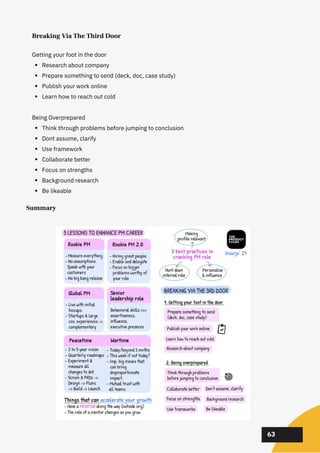
Five lessons to enhance PM Career
61
Venkatraman RM
Product Leader- Bounce
Our Partners:
Product Leader - Bounce
VENKATRAMAN RM
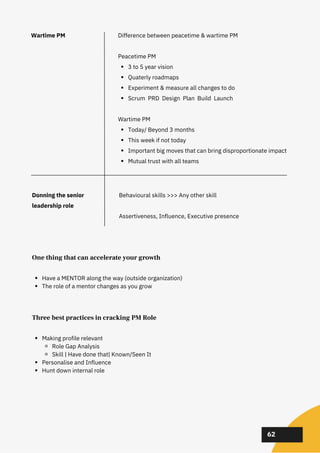
Rookie PM
Rookie Manager
Global PM
Measure Everything
X Assumptions
Speak with your customers
No big bang release
Hiring great people
Enable and Delegate
Focus on bigger problems worthy of your role
Live with initial hiccups
Startup and large company experiences
02
02
02
62
Wartime PM
Donning the senior
leadership role
3 to 5 year vision
Quaterly roadmaps
Experiment & measure all changes to do
Scrum PRD Design Plan Build Launch
Today/ Beyond 3 months
This week if not today
Important big moves that can bring disproportionate impact
Mutual trust with all teams
Difference between peacetime & wartime PM
Peacetime PM
Wartime PM
Behavioural skills >>> Any other skill
Assertiveness, Influence, Executive presence
One thing that can accelerate your growth
Have a MENTOR along the way (outside organization)
The role of a mentor changes as you grow
Three best practices in cracking PM Role
Making profile relevant
Role Gap Analysis
Skill | Have done that| Known/Seen It
Personalise and Influence
Hunt down internal role
02
02
02
63
Research about company
Prepare something to send (deck, doc, case study)
Publish your work online
Learn how to reach out cold
Think through problems before jumping to conclusion
Dont assume, clarify
Use framework
Collaborate better
Focus on strengths
Background research
Be likeable
Getting your foot in the door
Being Overprepared
Summary
Breaking Via The Third Door
02
02
02
02
02
Avijit Nanda has been in the product domain for 15+ years, working as director of PM at
MoEngage, a customer engagement platform. The factor that motivated him each day was to
know more about his customers and solve new problems sustainably, which could bring some
new potential perspectives into the world. According to him, product frameworks will help us to
put them into action while solving different problems.
PM Principles in
Action
I N S U R J O
About the Product Coach
64
Avijit Nanda
Director of PM - MoEngage
Our Partners:
Problem Solving
We all know how to solve a problem but our approach is biased by our experiences.
Director of PM, MoEngage
AVIJIT NANDA
Product Management Frameworks
Business / Strategy Analysis
PEST (Political, Economic, Social & Technological)
Business Model Canvas
SWOT
Porter’s 5 forces
BCG Matrix
Kano (How well needs are met, Satisfaction)
02
02
02
65
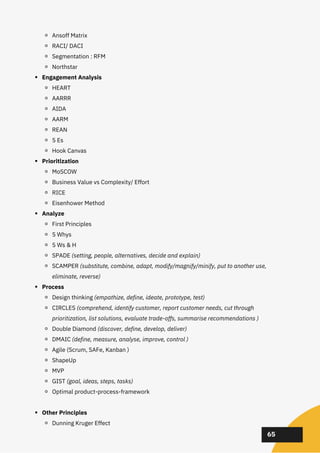
Ansoff Matrix
RACI/ DACI
Segmentation : RFM
Northstar
Engagement Analysis
HEART
AARRR
AIDA
AARM
REAN
5 Es
Hook Canvas
Prioritization
MoSCOW
Business Value vs Complexity/ Effort
RICE
Eisenhower Method
Analyze
First Principles
5 Whys
5 Ws & H
SPADE (setting, people, alternatives, decide and explain)
SCAMPER (substitute, combine, adapt, modify/magnify/minify, put to another use,
eliminate, reverse)
Process
Design thinking (empathize, define, ideate, prototype, test)
CIRCLES (comprehend, identify customer, report customer needs, cut through
prioritization, list solutions, evaluate trade-offs, summarise recommendations )
Double Diamond (discover, define, develop, deliver)
DMAIC (define, measure, analyse, improve, control )
Agile (Scrum, SAFe, Kanban )
ShapeUp
MVP
GIST (goal, ideas, steps, tasks)
Optimal product-process-framework
Other Principles
Dunning Kruger Effect
02
02
02
66
4 Ps (product, place, price, promotio )
Crossing the chasm
Toyota’s way - 14 principles
Product Management Frameworks which are used often
Ideation → White Boarding/mind maps
Macro View → Business Canvas Model / SWOT
Solutioning → Design thinking
Quick Priority → Value/cost, RICE
Delivery → Agile (Scrum)
B2B Growth Phases as the customer grow
Find one good customer
Be open to change
Hack and agility
Validation
Evaluate PMF Opportunities
First 10 Customers
Learnings from New Business / New Tech
People love new tech
Customer value creation by unlearning
traditional ways + identifying new
opportunities
Challenges for building good data/
annotations
How your business and tech decouples- be
nimble
Ensure tech’s value realisation & usage
Solve one primary use case well
Tech
1.
2.
3.
4.
5.
6.
While repivoting business, focus on channel,
delivery, customer value, incremented
offerings, competition- tech will be solved
Look for indirect competition
Customer trust and confidence
Partners to scale
Find ways to build Network Effect
Data & Data Derivations are pivotal
Each customer needs equal care
[PLAYBOOK]
Focus on usage/ value than just sales
numbers
Marketplace
1.
2.
3.
4.
5.
6.
7.
8.
02
02
02
67
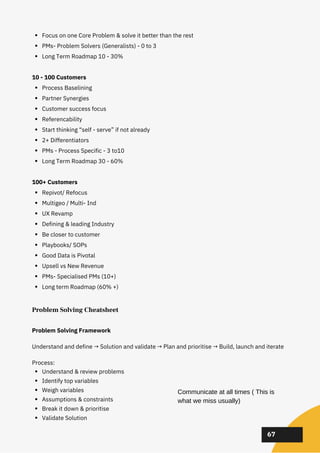
Focus on one Core Problem & solve it better than the rest
PMs- Problem Solvers (Generalists) - 0 to 3
Long Term Roadmap 10 - 30%
Process Baselining
Partner Synergies
Customer success focus
Referencability
Start thinking “self - serve” if not already
2+ Differentiators
PMs - Process Specific - 3 to10
Long Term Roadmap 30 - 60%
Repivot/ Refocus
Multigeo / Multi- Ind
UX Revamp
Defining & leading Industry
Be closer to customer
Playbooks/ SOPs
Good Data is Pivotal
Upsell vs New Revenue
PMs- Specialised PMs (10+)
Long term Roadmap (60% +)
10 - 100 Customers
100+ Customers
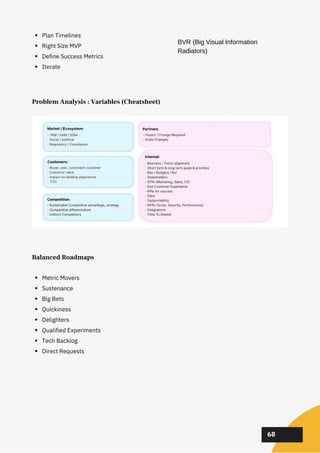
Problem Solving Cheatsheet
Understand & review problems
Identify top variables
Weigh variables
Assumptions & constraints
Break it down & prioritise
Validate Solution
Problem Solving Framework
Understand and define → Solution and validate → Plan and prioritise → Build, launch and iterate
Process:
Communicate at all times ( This is
what we miss usually)
02
02
02
68
Plan Timelines
Right Size MVP
Define Success Metrics
Iterate
Problem Analysis : Variables (Cheatsheet)
Balanced Roadmaps
BVR (Big Visual Information
Radiators)
Metric Movers
Sustenance
Big Bets
Quickiness
Delighters
Qualified Experiments
Tech Backlog
Direct Requests
Summary
69
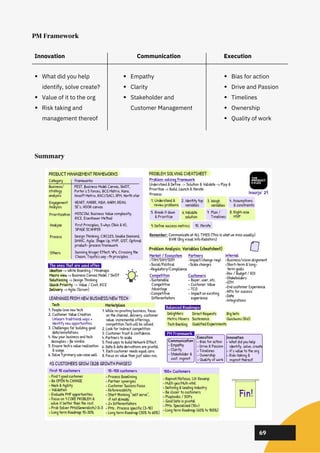
What did you help
identify, solve create?
Value of it to the org
Risk taking and
management thereof
Bias for action
Drive and Passion
Timelines
Ownership
Quality of work
Empathy
Clarity
Stakeholder and
Customer Management
Innovation Execution
Communication
PM Framework
02
02
02
02
02
Shivangi Srivastava is working on new initiatives at Swiggy. Earlier, she was VP of products at
Khatabook and a cofounder of Tazzobikes. She loves building new things and her entrepreneurial
experience will help us to understand the topic of product go-market strategies, best practices
and common pitfalls.
New Product Launches
/ Releases & GTM
I N S U R J O
About the Product Coach
70
Shivangi Srivastava
New Initiatives- Swiggy
Our Partners:
Why do we build products?
To solve a real problem
To delight users
To realise a big vision and change the world
To make a lot of money
Product Market Fit
Product market fit means being in a good market with a product that can satisfy that market
Great team → lousy market → market and vice versa
Great team meets ↔ great market ↔ something special happens
New Initiatives, Swiggy
SHIVANGI SRIVASTAVA
02
02
02
71
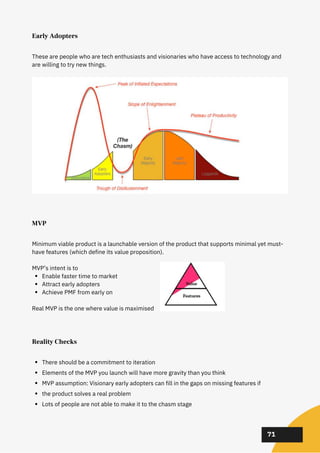
Early Adopters
These are people who are tech enthusiasts and visionaries who have access to technology and
are willing to try new things.
MVP
Enable faster time to market
Attract early adopters
Achieve PMF from early on
Minimum viable product is a launchable version of the product that supports minimal yet must-
have features (which define its value proposition).
MVP’s intent is to
Real MVP is the one where value is maximised
Reality Checks
There should be a commitment to iteration
Elements of the MVP you launch will have more gravity than you think
MVP assumption: Visionary early adopters can fill in the gaps on missing features if
the product solves a real problem
Lots of people are not able to make it to the chasm stage
02
02
02
72
How to go about it?
Selecting the right problem, identifying the user and key value proposition
Study the market, assess the competition, identify the risks
Identify risks and know what we are working towards?
What are the things that can affect my chances of success?
Will hitting PMF successfully mitigate the risk in question?
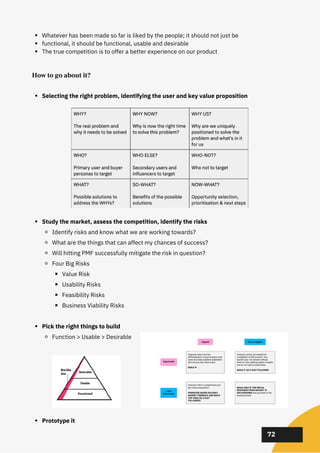
Four Big Risks
Value Risk
Usability Risks
Feasibility Risks
Business Viability Risks
Pick the right things to build
Function > Usable > Desirable
Prototype it
Whatever has been made so far is liked by the people; it should not just be
functional, it should be functional, usable and desirable
The true competition is to offer a better experience on our product
02
02
02
73
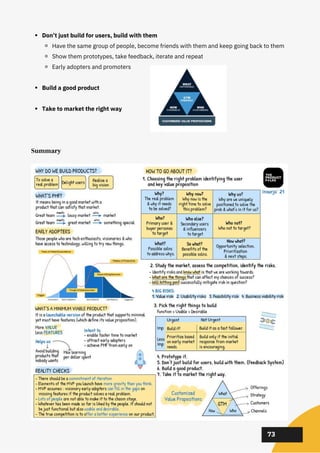
Don’t just build for users, build with them
Have the same group of people, become friends with them and keep going back to them
Show them prototypes, take feedback, iterate and repeat
Early adopters and promoters
Build a good product
Take to market the right way
Summary
02
02
02
74
The Way Forward
We have always believed that it's always day one for the product community. There are a lot of
amazing products to be built and shipped. We hope this book inspires you to build your own
product and helps you to be a great PM. We can't wait to hear your story someday.
We will appreciate your reviews of this e-book so that we can improve our work next time. Share
it away on the socials with the hashtag #InsurjoEbook

insurjio_the_product_folks.pdf

  • 2.
    Best Lessons fromseasoned product leaders to help you grow in product career * * * Copyright © 2021 by The Product Folks All rights reserved. No part of this publication may be reproduced, stored or transmitted in any form or by any means, electronic, mechanical, photocopying, recording, scanning, or otherwise without written permission from the publisher. It is illegal to copy this book, post it to a website, or distribute it by any other means without permission. First edition 02 02 02 01 Insurjo
  • 3.
    02 02 02 02 Table of Contents ProductManagement 101:The What, The Why, The How 10 About the Product Coach Who is a Product Manager? Is the PM really the mini-CEO of the product? What does the PM really own? What should a PM do while building a product? How to say ‘NO’ better? How does ‘data’ help us in achieving things? Advice for budding Product Managers? Core skills that are assessed while hiring an entry-level PM? Summary Contributors 08 Acknowledgement 09 Foreword 07 User Research & Customer discovery: Figuring What to Build 14 About the Product Coach Why do people buy or use something? What are the different kinds of discovery scopes of the products? Why do we define user persona? How to define a user persona? Step 1: Define Persona Step 2: Define Scenario Remember
  • 4.
    02 02 02 03 Table of Contents Howmuch time does a PM spend on User Persona? How to select the right user persona? What kind of inputs do we need from our users? What should be considered while conducting User Interviews? Why should there be competitor research? Competitor Analysis Frameworks Opportunities Opportunity canvas Selecting Opportunities Tips for 0-1 product Summary Demystifying Product Metrics 22 About the Product Coach Why measure anything when we have User Interviews? What can go wrong? What is North Star Metrics? How can we find North Star Metrics? Metric Types Counter Metrics Analysing Product Market Fit What if north star metrics are improved but other factors are degraded? Summary Rapid Prototyping and Experimentation 29 About the Product Coach Why Prototyping? Product Market Fit
  • 5.
    02 02 02 04 Table of Contents Aboutthe Product Coach How does one arrive at a product roadmap? What happens after the roadmap is built and a specific project is prioritised? What type of documents are written as the starting point as a PM? What happens when you get the specs wrong? History & Relevance of Traditional PRD Importance of Product Spec Document Key Parts of a Product Spec Document Summary Storytelling & Soft Skills for Product Leaders 40 About the Product Coach Soft Skills Mastering Communications- Executive Presentations Effective Storytelling Leadership Skills How to 10x your productivity Career Planning Product Strategy Summary Product Scoping and Specs 35 Tools for finding Product Market Fit Experimentation Process Summary
  • 6.
    02 02 02 05 Table of Contents ProductLed Growth 54 About the Product Coach Product Led Growth Mindset is everything What is a growth mindset? How to have the right mindset/ growth mindset? Importance of understanding the user User Psychology Growth Models Experimentation Product Marketing and Communication Monetization and Growth Summary PM Career Growth 61 About the Product Coach Five lessons to enhance PM Career About the Product Coach Why should you care about Retention? What are the terms used under Retention? How do you track churn/ lifetime? Why do you look at cohorts? Myth Acquiring New Customers Growth Loops Retention Automation Summary Retention as the Foundation of Growth 47
  • 7.
    02 02 02 06 Table of Contents Buildingan MVP and Go to Market 70 About the Product Coach Why do we build products? Product Market Fit Early Adopters MVP Reality Checks How to go about it? Summary Conclusion 74 Product Principles and Frameworks 64 About the Product Coach Problem Solving Product Management Frameworks Product Management Frameworks which are used often Learnings from New Business / New Tech B2B Growth Phases as the customer grow Problem Solving Cheatsheet Summary One thing that can accelerate your growth Three best practices in cracking PM Role Breaking Certain questions canVia The Third Door Summary
  • 8.
    To start, thankyou for picking up this piece of art. Yes, art. This isn’t just another ‘product’ book – it’s about the stories, the learnings, and the real-life experiences of some of the best product managers and founders in our ecosystem. Anyone can toss together a bunch of lessons. But the nuggets that take product folks deep inside their journey and help them to understand how to become a better version of themselves are rare. They share lessons that will engage you and, more importantly, allow you to learn and apply through their practical insights. It’s a collection of strategies, resources and lots more – it’s highly recommended that you jump right in! That being said, this wouldn’t have been possible without the effort of the team – Megha, Aditya, Shalini, Saurabh, Sajal, Paul and Parth – who have been putting effort into carefully curating this collection, which is what makes it so special. You can bet that any genuinely thoughtful book on revision captures my attention. And this is a gem by all means. Over the last two years, we’ve been trying to get the ecosystem together and build the best product community in the world. Though our original focus was on offline networking events, it became apparent over time that there is a real gap in the way the industry upskills. Since early 2021, with a fresh perspective on outcomes, we’ve been carefully making the underlying purpose behind every initiative we launch very clear: to help to democratise tech learning and enable the bridge of opportunities between the larger community and the industry. And with the help of tons of folks in the ecosystem – mentors, volunteers, teammates, industry partners – who’ve helped us at every single step, we’ve been able to make a tiny, tiny dent – and it’s only a start, I promise. By the community, for the community 02 02 02 Suhas Motwani Co-founder , TPF 07 Foreword
  • 9.
    We wholeheartedly thankthe team that worked on the Insurjo E-book. Creator: Srishti Gupta Design: Vaibhav Basantani and Krish Savani E-book Content Contributor(s): Mrunmai Patil, Srishti Gupta, Vaibhav Basantani Marketing Contributor(s): Shalini Singh and Parth Batra Social Content Contributor(s): Amani Chowdhry and Hasmita Kapoor Operations : Megha Pathak 02 02 02 08 Contribution
  • 10.
    We started thiscommunity two years back with a simple motive to make the knowledge around product management more accessible. With time, we have not only grown in size but also in our motive. We have always strongly believed in working together for the greater good of the community. We are thankful to our readers and our community members from across the globe who have made this possible. Your support and encouragement are the only fuel that keeps us going over time. At the same time, we believe that every day is day one at The Product Folks, and we have miles to go together. Hope you have a good read! 02 02 02 09 Acknowledgment
  • 11.
    02 02 02 02 02 Gireesh Subramaniam has12 years of product leadership and entrepreneurial experience building SaaS products and currently works as a VP of product and engineering at Zeta, a banking tech organization. Earlier, he helped to build the engineering team from 25 to 60 in one year and remained the main point of contact for companies like Microsoft, Zynga, and Supercell. He is an optimist and passionate about building large-scale enterprise SaaS products. He is also curious about the world around us and always up for interesting conversations. About the Product Coach Who builds to solve users’pain. Who builds to create long-lasting user value. Who builds artifacts that become abilities. For example: In B2B products: The biggest success will be when the tool becomes known as a skill. Eg, people claiming proficiency in Excel. A Product Manager is the one. Who is a Product Manager? A Product Manager is not a mini-CEO because the CEO owns revenue, hiring, and overall management, but the Product Manager is the primary builder of the product. Is the PM really the mini-CEO of the product? 10 Gireesh Subramaniam VP, Product and Engineering- Zeta Answering some pathbreaking questions around PM101 I N S U R J O GIREESH SUBRAMANIAM VP, Product and Engineering - Zeta Our Partners:
  • 12.
    02 02 02 A Product Managerowns growth, constraints (internal or external), team energy. The PM has the best vantage point, has a sense of purpose, is incredibly democratic, rallies the team, and brings a sense of clarity. What does the PM own? Simplify by understanding user's problems. Put the user first before your product's principles. Give business context priority over aesthetics. Understand their customer's needs What do they need? What will they pay for? Understand customer win stories or actual pain points. Pay attention to demos. What do sales have to demo vs hesitate? Trust your instinct Being data-informed is more important than perfecting the data. Form emotional bonds. Prioritize - Say ‘No’ by default until it is not clear or valuable to you. Start from NO and move to YES when it is super clear. Non Opinionated PM is a disaster. Transition to a PM career? Assess what are your current strengths What things do you need to learn? Don't talk about things you can’t answer. What should a PM do while building a product? Listen well. Earn the trust and respect with what you build How to say ‘NO’ better? 11 Win over constraints, fuel growth and create a positive environment for the team; product management is the art of the possible
  • 13.
    02 02 02 Solve the needwithout building where possible. No for Now is the mantra. Be open to changing your mind. As long as you are an expert on customer, you will earn credibility 12 You can’t keep double guessing. Lack of clarity damages the speed hence have a bias for action. Data will not tell what exactly the problem is, it can only indicate whether there is a problem or not. How does ‘data’ help us in achieving things? You are the PM of your career. Learn from the community. Only pick something you truly enjoy. Learning is underrated. Find interesting things to talk about your product. Put yourself out there. Curiosity and learning are important. Advice for budding Product Managers? Problem Solving- Can you articulate problems? Communication- Are you able to communicate your thoughts? Core skills which are assessed while hiring an entry level PM?
  • 14.
  • 15.
    02 02 02 02 02 Toshi Prakash hasbeen helping companies to grow for years, especially with their cultural metrics, at xto10x, an Indian-based start-up that provides clear pillars on the way to scale a company post-product-market fit. Earlier, she was VP of product at Locus. She is considered to be one of the experts in the market research and customer discovery domains. About the Product Coach To get a job (desired task) done. Invest their time, energy, and money- should be happy You are not the user. You are one part of your user segment and one of the pro users who knows everything. Will it bring value to your business Why do people buy or use something? For each quadrant there are different user personas. What are different kinds of discovery scopes of the products? 14 Toshi Prakash Head, Products- xto10x Market research and Customer Discovery I N S U R J O Our Partners: Head, Products -xto10x TOSHI PRAKASH
  • 16.
    02 02 02 15 Category Header Relevant Personal Background Fictional name,image and quote that summarises what matters the most to the persona that relates to your product. Age, gender, ethnicity, education level, persona group and family status. Details To understand user motivation. To understand the frequency of usage of certain features. To analyse the expectations out the product. To know the current struggles of users and discover the potential struggles. To socialise the segment. Why do we define user persona? Step 1: Define Persona How to define a user persona?
  • 17.
    02 02 02 16 Category Professional Background Environments Psychographic Income level,job occupation, working hours and experience. Physical locations, social environments and technological environments. Attitude, interests, motivation and pain points. Details Step 2: Define Scenario When, Where, How. Write from user’s perspective. This is an “a day in life” narrative of how a persona interacts with your product. Remember There are multiple personas for multiple scenarios, and every stakeholder should be able to see the value. Different age groups and genders should be considered. Device and Tech should be noted. Geo-Location and Language are important. Job functions should be considered. In the end, consider Paying capacity as a factor. The user is the same as the buyer should be noted. The needs should be understood and prioritised. For each quadrant there are different user personas. How to select the right user persona?
  • 18.
    02 02 02 17 What kind ofinputs do we need from our users? Jobs Functional - Absolute needs to be fulfilled by the product. Emotional - Unsaid needs fulfilled by the product. These needs tend to get missed out. The needs can be of two types: Personal Social Example : In the case of food delivery applications, the functional job of the user is to get the food and the emotional job includes healthy food choices, and food for multiple people. Customers seek help to get a job done from the product or services. They need to succeed at getting the job done There are two kind of Job Outcomes There is at least one obvious outcome. People want to get things done in cheaper, faster and better manner For each job
  • 19.
    02 02 02 18 There are manynon obvious outcome which act as a differentiator. Unit of measure. Direction in which the unit should be measured. Desired Value (does not always need to be maximum). Outcomes have Constraints Physical Environmental (Ex: High Pressure Environment) Safety Concerns Language Weather Location Regulations and Restrictions Users might want the following constraints to be resolved: What should be considered while conducting User Interviews? Always talk to the End User instead of any middlemen in between product and customers. Conduct interviews even if your product is not complete, but just a part of it is ready. Don’t role-play as one of the users. Pick enough users; there should be of a variety from different demographics. Learn inputs from sales and marketing but ultimately talk to users to gather an overall outlook. Ask your users to tell stories- you want them to tell the problems not solutions. Understand environmental constraints. Lead your users through questions. Be specific with your questions. When faced with a problem, try to note what the end users did to solve it at that moment. Ask about how they felt. Find out how important the problem is. Ask what did the family or friends say about the product (the social impact). Note the level of satisfaction. Do not reveal evaluation criteria.
  • 20.
    02 02 02 19 Why should therebe competitor research? To help to understand strength and weaknesses. To understand the unique value proposition. To spot trends and new technology. To update the table stakes. To keep pricing competent in the market. To learn from other’s mistakes. When the market is young, there are few competitors and less players but when the market is saturation, solutions exist, products are more than just better and cheaper and there is a need to replace existing competitor (Ex: Superhuman mailing system) Competitor Analysis Frameworks
  • 21.
    02 02 02 20 Opportunities An opportunity iswhere a job, outcome and constraint are underserved; for example, a user wants various cuisines even in hard-to-reach places. Job : Multiple Cuisines Outcome : Quality Food Constraint : Remote Location Opportunity : Multi-cuisine chain in remote tourist places, drone delivery Selecting Opportunities Follow DHM (Delighting Customer, Hard to copy ways, In Margin Enhancing) Framework by Gibson Biddle for selecting opportunities and creating a product which is different Tips for 0-1 product Pick up multiple personas. Find representatives in friends and family. Put up a website, social and/or Community. Start with a press release and try to find relevance. After doing all of the above things, notice if there is any traction.
  • 22.
  • 23.
    02 02 02 02 02 Moinak Bandyopadhyay isa born storyteller having 10 years of experience in Product Analytics, AR, VR, Ecommerce. Currently, he is currently working as Product Manager at Stripe and earlier was a Staff PM for Core Analytics and Machine Learning at Mixpanel. Moinak has studied Computer Science from Georgia Tech, USA and has always been interested in the technical domain but more into solving problems which eventually led him towards Product Management. He gave an analytics angle towards Product Market Fit and focused on north star metrics and evaluations of metrics through analytics. About the Product Coach What the problems are Why they are problems Possible solutions for the problem Which problem should be solved first Whether the possible solution actually solved the problem There are certain questions that can only be answered through data, which supports the answers gathered from user interviews User Interviews identify: Analytics helps figure out: User Interviews <-> Analytics Why measure anything when we have User Interviews? 22 Moinak Bandyopadhyay PM- Stripe Demystifying Product Metrics I N S U R J O Our Partners: PM-STRIPE MOINAK BANDYOPADHYAY
  • 24.
    02 02 02 23 What can gowrong? Fixated on metrics that make them look good (vanity metrics) instead of actionable metrics Multiple Pivots - analysis paralysis The wrong metrics - misaligned incentives leading to wrong outcomes and suboptional outcomes What is North Star Metrics? Predictive of company’s long term success Aligns multiple teams Captures the core value for user How can we find North Star Metrics? Core value proposition Ex: Netflix - Watch Time Dropbox - Uploading and sharing Primary Value of the Product How frequently do you expect the users to come back Daily - Social Media Weekly- SAAS Monthly - Banking Annually - Holiday App Product’s natural usage frequency Options to choose north strat metric from; the metric that will address the full customer lifecycle Metric Types User Interviews Captures what user say Job of PM - Why is there a problem? + Do enough people feel the pain? Opportunity Assessment - Trust + Influence to make decisions Capture what user actually do Analytics
  • 25.
    02 02 02 24 Metric Types Make surethe north star metric is aligned to core value. For example, north star metric would seem like: Mixpanel- Percent of users doing segmentation Airbnb- Nights booked, Quarterly active guests Identify your core value, natural usage frequency north star metric for each product Reach Activation Active Usage Engagement Retention Revenue Business Specific A fundamental step that creates the first impression on the user. Set Up Moment > Aha Moment > Habit Moment Value moment + natural usage frequency (Gibson Biddle – proxy metrics) Depth (intense usage), breadth (variety of features), frequency (the number of days) of completing key actions What percent of initial user group are still using it days/weeks/ months later? Are users returning? Extremely important (even at feature level) Generalised Metrics but supercritical Data centre burns, Referral rates, NPS, CSAT Survey etc. Amount of money made by the business. The total number of users using the product in recent times.
  • 26.
    02 02 02 25 Counter Metrics Sometimes youare fixated on north star metric and unintentionally end up hurting the user experience and the business Figure out what checks do you need to add to avoid such an occurence By spending 10 million in customer support By spending 50 million for a new solution like reminder Example: Netflix free trial auto renewal was creating problems for its users. So they could solve this problem through two ways It was a tough decision between the two but in the second option, they found it better to loose the margin because the customer delight was most likely to go up in this case Analysing Product Market Fit Retention Curves Are your users building a habit using your product or not? People are dropping off. That means your product hasn’t hooked user properly People are still dropping at a lower rate People have stopped dropping off. Almost 50% of the users got the habit
  • 27.
    02 02 02 26 Very disappointed Somewhat disappointed Notdisappointed I no longer use the product Sean Ellis Survey How would you feel if you could no longer use the product? Example Video Company/ Media Company Net Promoters Score Some people had dropped off but they fixed something, notified user and usrers returned (network effects) - Found Product Market Fit, because users stopped dropping off Total Signups Total Signups Activation Activation Sign Up > Watch 3 videos > 30 days- to observe the following within thai time window Sign Up > Watch 3 videos > 30 days- to observe the following within thai time window: Drop points.
  • 28.
    02 02 02 27 Activation Active Users Frequency Depth Breadth Paid planconversion rate Business Specific Retention Revenue Current Aggregated view What the trend is? What caused users to not activate currently Why was there a dip? Definition on what makes an active users? What variation of core value proposition? What percent of weekly active users are power watchers? How frequently are they using it? Intensity- How many minutes of total videos are viewed in 30 days? How many feature sets? What different devices? How long should free trial be? How many videos watched to convert? How many unique videos How many users are returning week after week? For spikes - What good happened there? Retention Trend Users coming back after x weeks What percent spend how much?
  • 29.
    02 02 02 28 What if northstar metrics are improved but other factors are degraded? Its good to have counter metrics The best way to learn from metrics is to ask what is driving them Potential root cause -> user interviews -> trace back their steps Summary Your goal as a PM is to make sure discussion happen and you can make them happen through data
  • 30.
    02 02 02 02 02 Nathan Bobbin isVP of products at Chargebee, the subscription billing and revenue management platform. He started his product journey 20 years ago with IBM as senior PM; since then, he has been in the product domain. His experience with various start-ups helps us to understand the importance of prototyping and experiments. About the Product Coach There is no such market need (people didnt care about it enough). They run out of cash. They have poor marketing. They are outcomepeted. Major features are not used by almost 50% target audience , and 66% drastically change the plan. 9 out of 10 startups fail because Therefore it is always good to prototype before hand and avoid such consequences Why Prototyping? 29 Nathan Bobbin VP, Product - Chargebee Rapid Prototyping and Experimentation I N S U R J O Our Partners: VP Products, Chargebee NATHAN BOBBIN
  • 31.
    02 02 02 30 The goal ofa startup is to figure out the right thing to build- the thing customer wants and will pay for- as quickly as possible Get punched in the face as quickly as possible and find out what's wrong with the idea. Tools for finding Product Market Fit Key Partners Key Activities Value Proposition Key Resources Cost Structure Channel Initially you have a set of untested hypotheses: Product Market Fit
  • 32.
    02 02 02 31 2. Value PropositionCanvas -A tool that helps ensure that a product/service is positioned around what the customer values and needs are. Business Canvas Model - Good for new product for new business 1.
  • 33.
    02 02 02 32 3. Riskiest AssumptionCanvas 4. Test Hypotheses
  • 34.
    02 02 02 33 5. Priority Assumptions MVPallows a team to collect the max amount of validated learning about customers with the least effort instead of a product with fewer features. Experimentation over elaborate Planning Feedback over Intution Iterative design over Traditional “big design upfront” development Cost of change increases -> risk and certainty decreases Experimentation Process A true experiment begins with a clear hypothesis that makes predictions about what is supposed to happen.
  • 35.
    02 02 02 34 Summary Stop investing ifthe market doesn’t like it Don’t try to make a BAD idea work
  • 36.
    02 02 02 02 02 Khilan Haria isthe SVP of Products at Razorpay, one of the popular fintech platforms for businesses in India. He has worked in various organizations earlier like Yahoo, Treebo & Cisco and with all his experience, he brings to the table, the appropriate ways to create PRDs / Product Specs Product spec: Designing & documenting Product solution I N S U R J O SVP, Product- Razorpay KHILAN HARIA About the Product Coach Solve larger customer’s pain point Solve sales/ business Needs Create projects that help to achieve user goals Solve shiny/interesting tech problems Request support from the CEO/ Founder / Boss Request Big Picture - Arriving at Roadmap How does one arrive at a product roadmap? 35 Khilan Haria SVP, Product - Razorpay Our Partners:
  • 37.
    02 02 02 36 Project Lifecycle What typeof documents are written as the starting point as a PM? PRD Product Spec Concept Note 6 Pager PR- FAQ What problems we are solving The solution/ answer for the problem What it will take to build There are different names but the purpose is similar What happens when you get the specs wrong? Unhappy Customers Rework What happens after roadmap is built and a specific project is prioritized?
  • 38.
    02 02 02 37 History & Relevanceof Traditional PRD Why is this product important? Who are the customers? How is it going to solve the problem of the customers? What benefit will the organization get after this product launch? Agile ↔ Waterfall PRD/MRD is usually the voice of the PM rather than the voice of the customer. Unanswered questions in traditional PRD include the following: Importance of Product Spec Document Helps to build a shared purpose. Helps to build a common understanding of the problem. Builds a clear view on the solution and ensures that expectation vs reality are not different. In summary, a good spec increases probability of success of a given project. Key Parts of a Product Spec Document Key Parts Discover Problem Look at the data 1. 2. Quantify Problem Measure and quantify 1. 2. Great PM Good PM What is the problem? Deeper understanding of the problem You are NOT YOUR USER 3. L1/ L2 Problem 4. Speak to sakes/ support team 3. L5/ Root Cause Awareness 4. peak to Customer
  • 39.
    02 02 02 38 Who are yousolving the problem for? Why is the problem important? How would you solve the problem? Solution Validation Detailed Product Requirement What Feature Current Scope Architecture first, then the solution 1. 2. 3. 4. What, Why, Who Capability Future Scope/ Possibilities Customer-first solution 1. 2. 3. 4. Do it by yourself Assume it will work Assume root cause 1. 2. 3. Involve other experts Speak to customers Discover Root Cause 1. 2. 3. Six Page Summary Need Technical depth Can be read by Engineers 1. 2. 3. Concise Simplified narative Understandable by everyone 1. 2. 3. Define the objective Open-ended Outcome 1. 2. 3. Measurable Success Criteria Time-lined goals Outcome + Output Metrics 1. 2. 3. Identify Customers Generic Problems Build for everyone/ none 1. 2. 3. Identify Customer Segment Segment Specific Problems Narrow down to a segment 1. 2. 3.
  • 40.
  • 41.
    02 02 02 02 02 Apoorva is theproduct commercialisation and GTM strategy lead at Indeed, an American worldwide employment website for job listings. She has always enjoyed working in product management as it is an intersection between technology and business that drives vision. Storytelling & Soft Skills for Product Leaders I N S U R J O About the Product Coach It gives you that edge to differentiate as a product leader Make the difference between good and great product leaders Soft Skills 40 Apoorva Singh GTM Product Lead- Indeed Our Partners: Products- Indeed APOORVA SINGH Skills Hard Skills Soft Skills Transactional Transferable Measurable About interpersonal stuff Stakeholder Management Writing user stories Building & analyzing data Building dashboards, reports, business cases Example Characteristics
  • 42.
    02 02 02 41 Soft Skills Subjective Context-Dependent Hardto quantify Having difficult convos Building alignment across the team Business Sense Strategic Insight Figure out what kind of meeting it is. Follow best practices for executive presentation. Know the purpose of your meeting. What you need our that discussion should be your goal. Mastering Communications- Executive Presentations Kind of Meeting Decision Making Outcome > Decisions during/ after the meeting Brainstorming Initial Ideas on the table during ideation/early product development Resource Need resources to get things done; need stakeholder buy-in Options Stakeholder inputs to those options Pros & Cons comparison while arriving at a decision Layout problem statement and the ‘why’? Structure Discussion Be/have a timekeeper Use a framework Work towards a goal and summarize the next actionable What do you need? Business Impact How actionable connect with company’s goals What happens if you don’t get resources? How you can help? Handling pushback thoughtfully What do they require?
  • 43.
    02 02 02 42 Approval Meeting Greenlight toget go- ahead for the plan Qualify Pre- Read Content Setting Speak to your audience Storytelling Comprehension Update To know the current status of the plan Outline the plan & timeline > simple Clearly articulate roles & responsibilities Ask questions from audience > Listen & Respond Ask for the green light Send a summary email Write a good pre-read for all stakeholders Give clear and enough context that sets the stage Tailor content- what exactly matters to them Use narrative style that keeps engagement high Use narrative style that keeps engagement high Write an email to all stakeholder Best Practices for Executive Presentations Transparency Speak honestly and be transparent
  • 44.
    02 02 02 43 Effective Storytelling What isthe ‘WHY’? The Problem / Conflict The Context/ Plot The Experience The Solution Personal/ Emotional Connections Pacing it well Why is storytelling has importance in a team? Audience Remember the STORY! Principles 1. 2. 3. 4. 5. 6. 7. Leadership Skills Getting to the “YES”
  • 45.
    02 02 02 44 How to 10xyour productivity Career Planning Your career is your Product! Career Canvas
  • 46.
    02 02 02 45 Career Roadmap -Checklist/ Milestones Product Strategy Provides clarity for business/ company Improves and aligns your team's radical decisions Help to prioritise product roadmap A high-level plan that describes what the business wants to accomplish with the product and how it would do so. Why is it important?
  • 47.
    02 02 02 46 How to breakinto Product Strategy? Grow vertically in product management (if you are already in the product domain). Find Product strategy roles at other companies like Googe, hypergrowth start-ups and larger MNCs lie HCL. 1. 2. Summary
  • 48.
    02 02 02 02 02 Ankur Gattani hasdabbled in multiple spaces from mobile product management to venture development. He is currently leading the growth and marketing at WebEngage, the platform that provides contextual services and helps you to craft personalized campaigns to engage your users through push notifications, web notifications, email, and more. He is one of the strongest storytellers who will captivate your attention and help you to gain knowledge towards retention as the foundation of growth and the jargon related to growth. Retention as the Foundation of Growth I N S U R J O About the Product Coach It is about data driven growth which includes lot of workflows, automation, data models, user insights and similar skill sets. As a PM, you can bake growth pieces into products. It is a great career path. Once you understand funnels, you can use then everywhere. Retention overlaps with product: 1. 2. 3. 4. Why should you care about Retention? 47 Ankur Gattani VP, Growth & Marketing - WebEngage Our Partners: VP Growth & Marketing - WebEngage ANKUR GATTANI
  • 49.
    02 02 02 48 Customer Acquisition Cost(CAC) Money spent in acquiring new customers. The spend on paid market efforts/ No. of new customers acquired Gross Merchandise Value (GMV) The MRP value of all products you’ve sold. Doesn’t cover discounts etc. In the market that doesn’t buy/sell (hold inventory), consider this as a metric scale that can be far away from revenue, which would be a percentage of GMV. Contribution Margin (CM) CM1 = Gross Margin = Sale Price - Cost Price CM2 = Sale price - cost price - cost of fulfillment Customer Lifetime Value (CLV/ CLTV) Summation of CM2= Sum total of CM from a single customer over period of lifetime Example: Rs 1000- average order value (After Discount) 40% cost of product to seller 25% cost of Delivery 15% Payment Gateway 20% CM= Rs 200 A consumer places 5 such orders in his lifetime CLV= 5 x 200 = Rs 1000 Lifetime = x months or y orders that a consumer place before he churns Churn= Break up! What are the terms used under Retention?
  • 50.
    02 02 02 49 Dynamic Micro Segment Categorising/segregatingcustomers into micro-segments. Example: “People” who bought their first pair of shoes. RFM Recency Time since last purchase (high score) With DMS and RFM → You will get a few heuristics on audience profiles After month M4, there is no growth, hence bucket will never fill. Frequency Number of purchases Monetary Value The average value of purchases Month M1 M2 M3 Retention Acquisition Total Users 100% 10K 10K 12K (10+2) 13K 13K 10K (New Customers 10K 10K 20% (80% Churned) 10% 0 M4
  • 51.
    02 02 02 50 How do youtrack churn/ lifetime? Using cohorts → a group of people that share a characteristic – often the acquisition time frame. Myth Handshake point between acquisition and retention. A customer saw your ad → clicked → converted → you’re celebrating 80% of them will not repeat (EVER) Acquiring New Customers A new customer may or may not be a stranger, but you have seven days to acquire the customer fully. Either it will build a long-term relationship or churn. For brands, it gets harder because there are dozens of other brands trying luck and wits. Why you look at cohort? Is the average order value increasing? Is category prenetration increasing? Business Outcomes Watching cohort engagements over 6 months period. Other cohorts lead to the following: Acquisition channel wise cohorts decreasing. Are affiliates giving you poor quality customers New FB campaign giving you super high quality cohort Implication on Acquisition Are there ample cross sell opportunities to expand average order value > CM > CLV Implication on Product Portfolio
  • 52.
    02 02 02 51 Growth Loops Well thought-outmessage → High on Relevance = High on Personalisation Set up your data → capture → organise → leverage Event Data - User Activities lies a page view, product added in cart etc. Event Attribute- Page in question, product in question etc. User Data = User Profile information The data pieces need to be connected and should speak for/ to each other. Channels Triggers - Something that initiates an experience Type of triggers: User Event Triggers- cart, wishlist, search abandon Product Event Trigger - back in stock, price drop Lifecycles Trigger- 7 days, 30 days etc Channels- email, push notification, InApp WhatsApp, SMS, Fb audience, Google Audience, IVR Low relevance, high frequency → SPAM Low relevance, low frequency → You’ll be forgotten High relevance, high frequency → You need to find the sweet SPOT User journeys combine different channels and messages. One Big Impact = Dozens of growth loop, optimized each step of the way Condolidated Metric= Uplift in KPI. Example : Cart Recovery Channel Metrics - Email Audience size with permission Data should be set up in the early stages of the journey. If you don’t put in the right data structure, you have to redo this later, which is a lot more work. After the data stack is sorted, hitting the right channels is next. Ads Clicked Channel of acquisition etc Stage I Before Entry Wishlisht addition Size checks etc Stage II On the site Call to call centre Open to tickets Emails open etc. Stage III After Order
  • 53.
    02 02 02 52 Reachability Open Rates Click tooperation Conversion rate Automated Triggered Based journeys - small tweaks everyday Retention Automation Audience will keep entering and exiting this segment. Therefore if you set daily recurring campaign- It’ll go to new set of users everyday Dynamic Micro Segments Personalization easier to handle than segmentation 100s of segments = 100s of messages and campaign to manage Example : SWIGGY Personalize notifications/ emails using user preferences, business event, product alter CTA etc. AMAZON Personalize home page (WEB) using login details, response rate, past browsing behaviour. The whole thing comes together by utilising dozens of growth loops with highly personalised messaging, which keeps the user engaged and converts them, delivering the LTV that you’re looking for.
  • 54.
  • 55.
    02 02 02 02 02 Anuj is SVP,Central Revenue and Growth at Swiggy where he leads growth marketing, customer lifecycle Management, Swiggy One, merchandising, social, design solutions, financial services, partnerships and Swiggy Labs. With more than 17 years of experience, Anuj brings rich experience and insights from his stints at marquee Indian e-commerce startups. At Flipkart and later at Snapdeal, he led the Buyer experience teams which were instrumental in crafting and deciding how India buys online in web and mobile. Anuj also worked with Walmart Labs as a Senior Product Manager where he created a truly multichannel experience for their online photo and pharmacy products. Product Strategy I N S U R J O About the Product Coach Product plays a key role in all the teams A growth mindset is the most important lever to drive growth Product Led Growth Mindset is everything 54 Anuj Rathi SVP Revenue, Growth - Swiggy Our Partners: SVP Revenue, Growth- Swiggy ANUJ RATHI
  • 56.
    02 02 02 Importance of understandingthe user Who is your end user What are the user pain points What are the user’s current belief Use Cases ACB - Accepted Customer Belief DCB- Desired Customer Belief 3D user understanding When is the user using your product Dreamer vs Explorer vs Locater User Persona Understanding users more 55 Mindset that starts with a motivation Embrace challenges and failures Treat other’s success as success stories How to have the right mindset/ growth mindset? Gritty, Passionate, Curious Problem Identification and solving Growth and Influence Face challenges → Think about it from first principles → create an idea out of it Good PM What is a growth mindset?
  • 57.
    02 02 02 56 User Psychology Users areirrational Understanding consumer psychology → Drive user actions and forms habits Ways Accomplishment Ownership and status Scarcity Social Influence Unpredictability Loss Aversion The feeling of overcoming a challenge or accomplishing something To make the user feel that they own something that creates status Wanting something which is rare and not available to me We do things that are relatable I don’t know what to expect, I have to find out Loosing what you own hurts more than what you gain Pokemon Go Oneplus Flash Sale Reviews and Ratings Google Search card Cigarette Advertisement Linkedin Profile Example Description
  • 58.
    02 02 02 57 Meaning Make theuser feel that they are a part of something Wikipedia, Milap etc. Growth Models Atomic Growth Model Business Model built on user level Example: Tic Tok Every company has its own atomic growth model Aggregate Growth Model Business Model doesn’t consider only users, overall market Example: Uber When you think about the user, you need to think about the driver as well, both the atomic models may not go together. Therefore, the business can work properly on the overall market level.
  • 59.
    02 02 02 58 Ex: 50% ofusers who add 1 item in cart do not complete order One obervation can lead to multiple experiments Prioritise using RICE where R - Reach , I- Impact, C- Confidence, E- Effort item in cart, the shock of extra charges on cart lead to this total price Upfront shock decreases and conversion increases charges on product display page Test with 50% user using A/B Current Accepted Belief Desired consumer belief Find the right channels for communication Craft the right GTM mailers with copy, launch etc. Experiment 1. 2. 3. Experimentation Obervation from user study/ data Insight When user has 1 Hypothesis If user know the Experiment Show all inclusive Experimentation
  • 60.
    02 02 02 59 Monetization and Growth Bothgo hand in hand Product offering can grow effectively when priced right Understand consumer willingness to pay Apply consumer psychology Pricing Model Subscription Based Model Dynamic Price Price changes based on factors like time of the day, demand and supply and weather Optimize growth & economics influencing demands & supply Auction & Bidding Prices Pay as you go Freemium Consumers pay periodic payments for continued service A steady flow of revenue drives higher LTV Pricing based on competition; consumers finalise the price Let the market figure out the price Pay based on the outcome Get the max out of consumer willingness to pay by delivering value Tiers of service with a free starting tier Acquires users on the free tier and then motivates them to upgrade Uber, Surge pricing Google Adwords etc. AWS Linkedin Netflix, Prime Examples Characteristics
  • 61.
  • 62.
    02 02 02 02 02 Venkatraman has beena product leader with Bounce and Razorpay, and his learning from his own journey will provide insights on how to crack a PM and what the necessary steps to break into product management are. How to crack a PM role I N S U R J O About the Product Coach Five lessons to enhance PM Career 61 Venkatraman RM Product Leader- Bounce Our Partners: Product Leader - Bounce VENKATRAMAN RM Rookie PM Rookie Manager Global PM Measure Everything X Assumptions Speak with your customers No big bang release Hiring great people Enable and Delegate Focus on bigger problems worthy of your role Live with initial hiccups Startup and large company experiences
  • 63.
    02 02 02 62 Wartime PM Donning thesenior leadership role 3 to 5 year vision Quaterly roadmaps Experiment & measure all changes to do Scrum PRD Design Plan Build Launch Today/ Beyond 3 months This week if not today Important big moves that can bring disproportionate impact Mutual trust with all teams Difference between peacetime & wartime PM Peacetime PM Wartime PM Behavioural skills >>> Any other skill Assertiveness, Influence, Executive presence One thing that can accelerate your growth Have a MENTOR along the way (outside organization) The role of a mentor changes as you grow Three best practices in cracking PM Role Making profile relevant Role Gap Analysis Skill | Have done that| Known/Seen It Personalise and Influence Hunt down internal role
  • 64.
    02 02 02 63 Research about company Preparesomething to send (deck, doc, case study) Publish your work online Learn how to reach out cold Think through problems before jumping to conclusion Dont assume, clarify Use framework Collaborate better Focus on strengths Background research Be likeable Getting your foot in the door Being Overprepared Summary Breaking Via The Third Door
  • 65.
    02 02 02 02 02 Avijit Nanda hasbeen in the product domain for 15+ years, working as director of PM at MoEngage, a customer engagement platform. The factor that motivated him each day was to know more about his customers and solve new problems sustainably, which could bring some new potential perspectives into the world. According to him, product frameworks will help us to put them into action while solving different problems. PM Principles in Action I N S U R J O About the Product Coach 64 Avijit Nanda Director of PM - MoEngage Our Partners: Problem Solving We all know how to solve a problem but our approach is biased by our experiences. Director of PM, MoEngage AVIJIT NANDA Product Management Frameworks Business / Strategy Analysis PEST (Political, Economic, Social & Technological) Business Model Canvas SWOT Porter’s 5 forces BCG Matrix Kano (How well needs are met, Satisfaction)
  • 66.
    02 02 02 65 Ansoff Matrix RACI/ DACI Segmentation: RFM Northstar Engagement Analysis HEART AARRR AIDA AARM REAN 5 Es Hook Canvas Prioritization MoSCOW Business Value vs Complexity/ Effort RICE Eisenhower Method Analyze First Principles 5 Whys 5 Ws & H SPADE (setting, people, alternatives, decide and explain) SCAMPER (substitute, combine, adapt, modify/magnify/minify, put to another use, eliminate, reverse) Process Design thinking (empathize, define, ideate, prototype, test) CIRCLES (comprehend, identify customer, report customer needs, cut through prioritization, list solutions, evaluate trade-offs, summarise recommendations ) Double Diamond (discover, define, develop, deliver) DMAIC (define, measure, analyse, improve, control ) Agile (Scrum, SAFe, Kanban ) ShapeUp MVP GIST (goal, ideas, steps, tasks) Optimal product-process-framework Other Principles Dunning Kruger Effect
  • 67.
    02 02 02 66 4 Ps (product,place, price, promotio ) Crossing the chasm Toyota’s way - 14 principles Product Management Frameworks which are used often Ideation → White Boarding/mind maps Macro View → Business Canvas Model / SWOT Solutioning → Design thinking Quick Priority → Value/cost, RICE Delivery → Agile (Scrum) B2B Growth Phases as the customer grow Find one good customer Be open to change Hack and agility Validation Evaluate PMF Opportunities First 10 Customers Learnings from New Business / New Tech People love new tech Customer value creation by unlearning traditional ways + identifying new opportunities Challenges for building good data/ annotations How your business and tech decouples- be nimble Ensure tech’s value realisation & usage Solve one primary use case well Tech 1. 2. 3. 4. 5. 6. While repivoting business, focus on channel, delivery, customer value, incremented offerings, competition- tech will be solved Look for indirect competition Customer trust and confidence Partners to scale Find ways to build Network Effect Data & Data Derivations are pivotal Each customer needs equal care [PLAYBOOK] Focus on usage/ value than just sales numbers Marketplace 1. 2. 3. 4. 5. 6. 7. 8.
  • 68.
    02 02 02 67 Focus on oneCore Problem & solve it better than the rest PMs- Problem Solvers (Generalists) - 0 to 3 Long Term Roadmap 10 - 30% Process Baselining Partner Synergies Customer success focus Referencability Start thinking “self - serve” if not already 2+ Differentiators PMs - Process Specific - 3 to10 Long Term Roadmap 30 - 60% Repivot/ Refocus Multigeo / Multi- Ind UX Revamp Defining & leading Industry Be closer to customer Playbooks/ SOPs Good Data is Pivotal Upsell vs New Revenue PMs- Specialised PMs (10+) Long term Roadmap (60% +) 10 - 100 Customers 100+ Customers Problem Solving Cheatsheet Understand & review problems Identify top variables Weigh variables Assumptions & constraints Break it down & prioritise Validate Solution Problem Solving Framework Understand and define → Solution and validate → Plan and prioritise → Build, launch and iterate Process: Communicate at all times ( This is what we miss usually)
  • 69.
    02 02 02 68 Plan Timelines Right SizeMVP Define Success Metrics Iterate Problem Analysis : Variables (Cheatsheet) Balanced Roadmaps BVR (Big Visual Information Radiators) Metric Movers Sustenance Big Bets Quickiness Delighters Qualified Experiments Tech Backlog Direct Requests
  • 70.
    Summary 69 What did youhelp identify, solve create? Value of it to the org Risk taking and management thereof Bias for action Drive and Passion Timelines Ownership Quality of work Empathy Clarity Stakeholder and Customer Management Innovation Execution Communication PM Framework
  • 71.
    02 02 02 02 02 Shivangi Srivastava isworking on new initiatives at Swiggy. Earlier, she was VP of products at Khatabook and a cofounder of Tazzobikes. She loves building new things and her entrepreneurial experience will help us to understand the topic of product go-market strategies, best practices and common pitfalls. New Product Launches / Releases & GTM I N S U R J O About the Product Coach 70 Shivangi Srivastava New Initiatives- Swiggy Our Partners: Why do we build products? To solve a real problem To delight users To realise a big vision and change the world To make a lot of money Product Market Fit Product market fit means being in a good market with a product that can satisfy that market Great team → lousy market → market and vice versa Great team meets ↔ great market ↔ something special happens New Initiatives, Swiggy SHIVANGI SRIVASTAVA
  • 72.
    02 02 02 71 Early Adopters These arepeople who are tech enthusiasts and visionaries who have access to technology and are willing to try new things. MVP Enable faster time to market Attract early adopters Achieve PMF from early on Minimum viable product is a launchable version of the product that supports minimal yet must- have features (which define its value proposition). MVP’s intent is to Real MVP is the one where value is maximised Reality Checks There should be a commitment to iteration Elements of the MVP you launch will have more gravity than you think MVP assumption: Visionary early adopters can fill in the gaps on missing features if the product solves a real problem Lots of people are not able to make it to the chasm stage
  • 73.
    02 02 02 72 How to goabout it? Selecting the right problem, identifying the user and key value proposition Study the market, assess the competition, identify the risks Identify risks and know what we are working towards? What are the things that can affect my chances of success? Will hitting PMF successfully mitigate the risk in question? Four Big Risks Value Risk Usability Risks Feasibility Risks Business Viability Risks Pick the right things to build Function > Usable > Desirable Prototype it Whatever has been made so far is liked by the people; it should not just be functional, it should be functional, usable and desirable The true competition is to offer a better experience on our product
  • 74.
    02 02 02 73 Don’t just buildfor users, build with them Have the same group of people, become friends with them and keep going back to them Show them prototypes, take feedback, iterate and repeat Early adopters and promoters Build a good product Take to market the right way Summary
  • 75.
    02 02 02 74 The Way Forward Wehave always believed that it's always day one for the product community. There are a lot of amazing products to be built and shipped. We hope this book inspires you to build your own product and helps you to be a great PM. We can't wait to hear your story someday. We will appreciate your reviews of this e-book so that we can improve our work next time. Share it away on the socials with the hashtag #InsurjoEbook