Get Published!
Nancy Walkup
Editor in Chief
Why should you get published?
It makes you (and your school, administrators, and
students) look good.
Your students’ parents will be very happy.
You can use your article as a conference handout.
You can frame it and hang it in your art room.
You can share your expertise with other art teachers.
You are demonstrating your professionalism.
You are instantly recognized as an author.
It can lead to other things (invitations to present, books).
Books by Ken Vieth
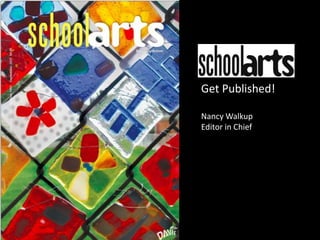
SchoolArts has been
published since 1901
for art teachers of
students Pre-K-12..
SchoolArts is based on universal themes.
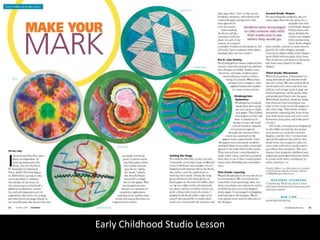
Early Childhood Studio Lesson
Elementary Studio Lessons
Middle School Studio Lessons
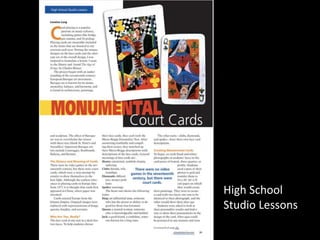
High School
Studio Lessons
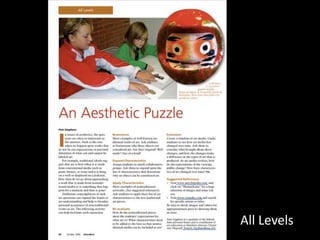
All Levels
Managing the
Art Room
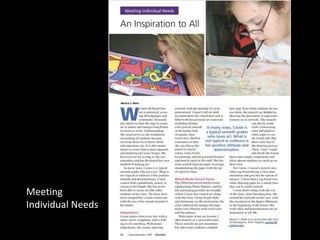
Meeting
Individual Needs
Advocacy
Point of View
Media
@r+
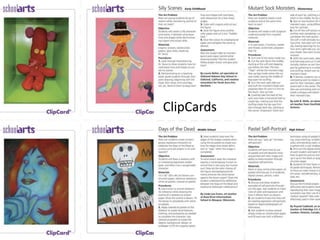
ClipCards
Travel with SchoolArts
and CRIZMACTravel with SchoolArts
SchoolArts’ digital edition is free online.
www.schoolartsroom.com
http:/cassiestephens.blogspot.com
http://drydenart.weebly.com/fugleblog
http://janinecampbell.weebly.com/blog
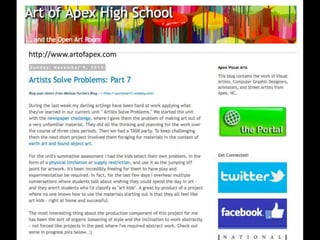
http://www.artofapex.com
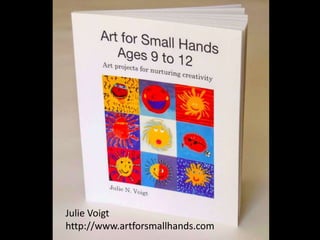
Julie Voigt
http://www.artforsmallhands.com
http://www.craighinshaw.com
Before writing, think about:
• A favorite lesson, idea, or issue.
• How you would express your idea to a fellow art teacher.
• What idea, artist, trend, or issue influenced your idea.
• The main ideas you’re trying to communicate.
• What problems a teacher might encounter.
When writing:
• Use a conversational style.
• Keep it to less than 800 words.
• Read it out loud.
• Have someone else read it.
• Copy your text and images separately onto a CD.
Photography Tips
Always have a camera with you.
SchoolArts Magazine requires high-quality digital photo-
graphs, at least 1 MB or 300 dpi.
• Photograph artwork on a neutral background.
• Leave space around the artwork/subject.
• Shoot straight down on 2D artwork.
• Use a curved background to shoot 3D artwork.
• Do not use flash; natural light is best.
• Do not try to photograph laminated artworks.
• Photographs of children should be unidentifiable.
• Make sure your digital camera is on the “Best” setting.
• Turn off the date mode on your camera.
Shoot 3D artwork on a curved piece of paper,
using natural light.
Shoot photos of students so their faces
don’t show.
Take photos of the steps of a process.
Two Kinds of Photos
Shoot close up whenever you can.
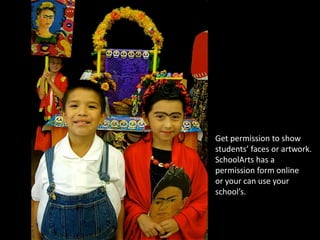
Get permission to show
students’ faces or artwork.
SchoolArts has a
permission form online
or your can use your
school’s.
Slideshare
http://www.slideshare.net/nwalkup
SchoolArts
http://www.schoolartsonline.com
Nancy Walkup
nancywalkup@davisart.com

Get Published

Editor's Notes

  • #3 Getting published can only help your career.
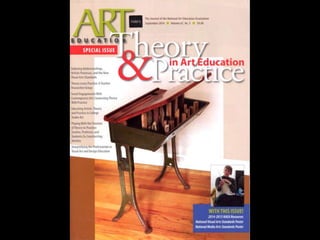
  • #4 Art Education, the journal of the National Art Education Association, is juried, research-based publication.
  • #5 Your state organization may have a journal. Trends is the name of the one in Texas.
  • #7 Ken Vieth’s studio lessons are in The Visual Experience.
  • #8 Art & Activities
  • #9 SchoolArts pays for articles, plus gives the authors extra copies of the issue, and a subscription to the print edition. SchoolArts has been published since 1901 for art teachers of students K-12. SchoolArts has studio lessons in each issue, in addition to departments such as Advocacy, Managing the Artroom, Meeting Individual Needs, Assessment, and more.
  • #10 Detail
  • #11 SchoolArts is based on universal themes. For example, this year the theme is Studio Thinking.
  • #12 Most SA articles are from 500-800 words.
  • #13 SA has studio lessons for early childhood, elementary, middle school, and high school every month.
  • #14 SA Middle School Lesson
  • #15 SA High School Lesson
  • #16 SA All Levels
  • #17 SA Managing the Art Room
  • #18 SA Meeting Individual Needs
  • #19 SchoolArts has an advocacy article in every issue.
  • #20 SA Point of View
  • #21 SA technology column, @r+, written by David Gran, an art teacher in Shanghai, and the author of the blog, The Carrot Revolution.
  • #22 SA ClipCards need only one image and about 150-200 words. They are a good entry point for getting published.
  • #23 SchoolArts and CRIZMAC team up to lead cultural travel opportunities.
  • #24 Get a free digital subscription to SA.
  • #27 Tricia Fuglestad, http://drydenart.weebly.com/fugleblog
  • #28 Janine Campbell, http://janinecampbell.weebly.com/blog
  • #29 Ian Sands, http://www.artofapex.com
  • #30 http://www.artforsmallhands.com, a self-published book
  • #31 Craig Hinshaw has published 2 books, Clay Connections and Animals, Houses, and People.
  • #32 Writing Tips
  • #33 Photography Tips: The main reason SA articles get declined is the low quality of the photographs of the artworks.
  • #34 Shoot straight down on artwork; use a photo gray background when needed.
  • #35 Shoot 3D work on a curved piece of paper, using natural light.
  • #36 Shoot photos of students so their faces don’t show.
  • #37 Take photos of the steps of a project if it will help explain it. This shows the steps of paper marbling with chalk and water.
  • #39 Shoot as close as you can.
  • #40 When you do show students’ faces, be sure to get written permission. Your school or district may already have one in use. SchoolArts has one on its website that you can print out and use.
  • #41 Free digital edition