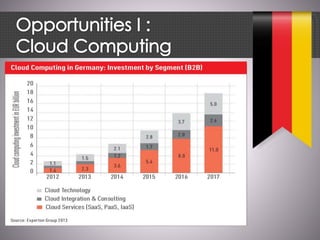
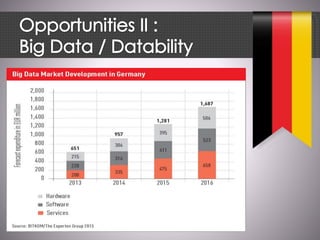

BUSINESS ANALYSIS
• Germany’s ICT Market
• Competition
• ICT Opportunities
• SWOT
• Strategy
• Recommendation
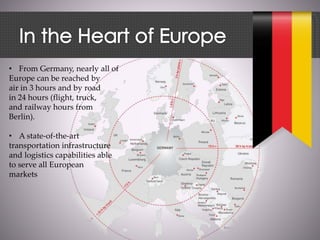
• From Germany, nearly all of
Europe can be reached by
air in 3 hours and by road
in 24 hours (flight, truck,
and railway hours from
Berlin).
• A state-of-the-art
transportation infrastructure
and logistics capabilities able
to serve all European
markets
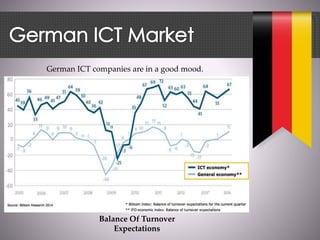
German ICT companies are in a good mood.
Balance Of Turnover
Expectations
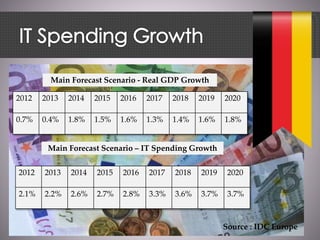
Main Forecast Scenario - Real GDP Growth
2012 2013 2014 2015 2016 2017 2018 2019 2020
0.7% 0.4% 1.8% 1.5% 1.6% 1.3% 1.4% 1.6% 1.8%
Main Forecast Scenario – IT Spending Growth
2012 2013 2014 2015 2016 2017 2018 2019 2020
2.1% 2.2% 2.6% 2.7% 2.8% 3.3% 3.6% 3.7% 3.7%
Source : IDC Europe
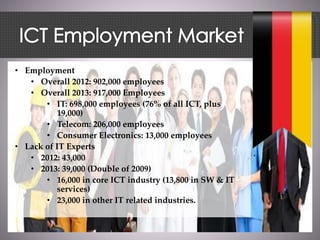
• Employment
• Overall 2012: 902,000 employees
• Overall 2013: 917,000 Employees
• IT: 698,000 employees (76% of all ICT, plus
19,000)
• Telecom: 206,000 employees
• Consumer Electronics: 13,000 employees
• Lack of IT Experts
• 2012: 43,000
• 2013: 39,000 (Double of 2009)
• 16,000 in core ICT industry (13,800 in SW & IT
services)
• 23,000 in other IT related industries.
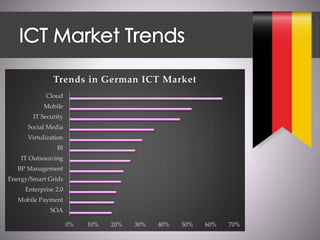
0% 10% 20% 30% 40% 50% 60% 70%
SOA
Mobile Payment
Enterprise 2.0
Energy/Smart Grids
BP Management
IT Outsourcing
BI
Virtulization
Social Media
IT Security
Mobile
Cloud
Trends in German ICT Market
• Germany’s ICT Market
• Competition
• ICT Opportunities
• SWOT
• Strategy
• Recommendation
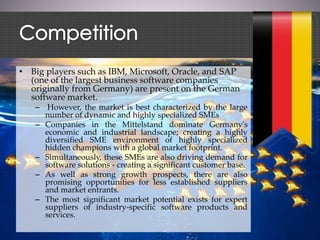
• Big players such as IBM, Microsoft, Oracle, and SAP
(one of the largest business software companies
originally from Germany) are present on the German
software market.
– However, the market is best characterized by the large
number of dynamic and highly specialized SMEs
– Companies in the Mittelstand dominate Germany's
economic and industrial landscape; creating a highly
diversified SME environment of highly specialized
hidden champions with a global market footprint.
– Simultaneously, these SMEs are also driving demand for
software solutions - creating a significant customer base.
– As well as strong growth prospects, there are also
promising opportunities for less established suppliers
and market entrants.
– The most significant market potential exists for expert
suppliers of industry-specific software products and
services.
• Germany’s ICT Market
• Competition
• ICT Opportunities
• SWOT
• Strategy
• Recommendation
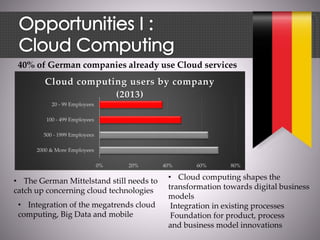
40% of German companies already use Cloud services
0% 20% 40% 60% 80%
2000 & More Employees
500 - 1999 Employees
100 - 499 Employees
20 - 99 Employees
Cloud computing users by company
(2013)
• The German Mittelstand still needs to
catch up concerning cloud technologies
• Integration of the megatrends cloud
computing, Big Data and mobile
• Cloud computing shapes the
transformation towards digital business
models
Integration in existing processes
Foundation for product, process
and business model innovations
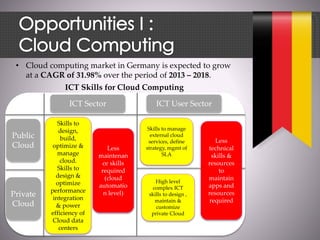
• Cloud computing market in Germany is expected to grow
at a CAGR of 31.98% over the period of 2013 – 2018.
ICT Skills for Cloud Computing
Private
Cloud
ICT Sector ICT User Sector
Public
Cloud
Skills to
design,
build,
optimize &
manage
cloud.
Skills to
design &
optimize
performance
integration
& power
efficiency of
Cloud data
centers
Less
maintenan
ce skills
required
(cloud
automatio
n level)
Skills to manage
external cloud
services, define
strategy, mgmt of
SLA
Less
technical
skills &
resources
to
maintain
apps and
resources
required
High level
complex ICT
skills to design ,
maintain &
customize
private Cloud
Private
Cloud
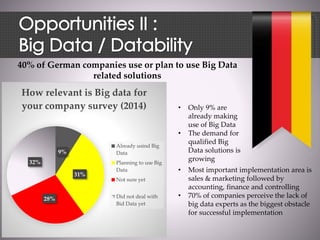
40% of German companies use or plan to use Big Data
related solutions
• Only 9% are
already making
use of Big Data
• The demand for
qualified Big
Data solutions is
growing
9%
31%
28%
32%
How relevant is Big data for
your company survey (2014)
Already usind Big
Data
Planning to use Big
Data
Not sure yet
Did not deal with
Bid Data yet
• Most important implementation area is
sales & marketing followed by
accounting, finance and controlling
• 70% of companies perceive the lack of
big data experts as the biggest obstacle
for successful implementation
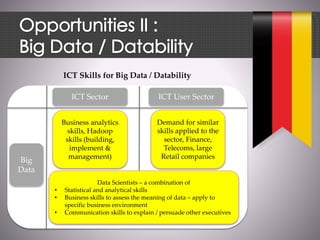
ICT Sector ICT User Sector
Big
Data
Data Scientists – a combination of
• Statistical and analytical skills
• Business skills to assess the meaning of data – apply to
specific business environment
• Communication skills to explain / persuade other executives
Demand for similar
skills applied to the
sector, Finance,
Telecoms, large
Retail companies
Business analytics
skills, Hadoop
skills (building,
implement &
management)
ICT Skills for Big Data / Datability
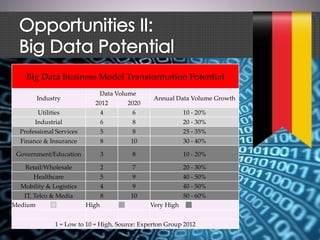
Big Data Business Model Transformation Potential
Industry
Data Volume
Annual Data Volume Growth
2012 2020
Utilities 4 6 10 - 20%
Industrial 6 8 20 - 30%
Professional Services 5 8 25 - 35%
Finance & Insurance 8 10 30 - 40%
Government/Education 3 8 10 - 20%
Retail/Wholesale 2 7 20 - 30%
Healthcare 5 9 40 - 50%
Mobility & Logistics 4 9 40 - 50%
IT, Telco & Media 8 10 50 - 60%
Medium High Very High
1 = Low to 10 = High, Source: Experton Group 2012
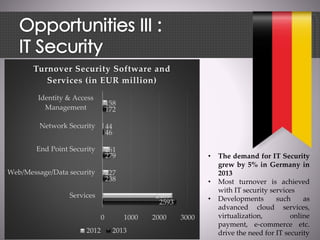
2593
238
279
46
172
2469
227
261
44
158
0 1000 2000 3000
Services
Web/Message/Data security
End Point Security
Network Security
Identity & Access
Management
Turnover Security Software and
Services (in EUR million)
2012 2013
• The demand for IT Security
grew by 5% in Germany in
2013
• Most turnover is achieved
with IT security services
• Developments such as
advanced cloud services,
virtualization, online
payment, e-commerce etc.
drive the need for IT security
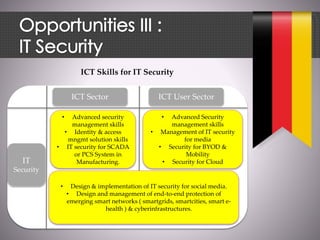
ICT Sector ICT User Sector
IT
Security
• Design & implementation of IT security for social media.
• Design and management of end-to-end protection of
emerging smart networks ( smartgrids, smartcities, smart e-
health ) & cyberinfrastructures.
• Advanced Security
management skills
• Management of IT security
for media
• Security for BYOD &
Mobility
• Security for Cloud
• Advanced security
management skills
• Identity & access
mngmt solution skills
• IT security for SCADA
or PCS System in
Manufacturing.
ICT Skills for IT Security
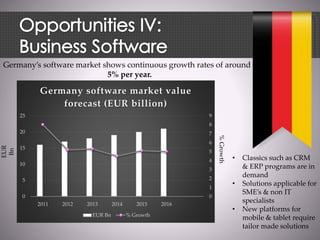
Germany’s software market shows continuous growth rates of around
5% per year.
0
1
2
3
4
5
6
7
8
9
0
5
10
15
20
25
2011 2012 2013 2014 2015 2016
Germany software market value
forecast (EUR billion)
EUR Bn % Growth
EUR
Bn
%Growth
• Classics such as CRM
& ERP programs are in
demand
• Solutions applicable for
SME’s & non IT
specialists
• New platforms for
mobile & tablet require
tailor made solutions
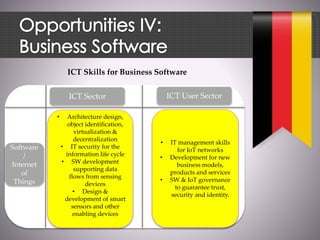
ICT Sector ICT User Sector
Software
/
Internet
of
Things
• IT management skills
for IoT networks
• Development for new
business models,
products and services
• SW & IoT governance
to guarantee trust,
security and identity.
• Architecture design,
object identification,
virtualization &
decentralization
• IT security for the
information life cycle
• SW development
supporting data
flows from sensing
devices
• Design &
development of smart
sensors and other
enabling devices
ICT Skills for Business Software
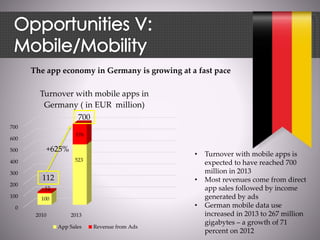
The app economy in Germany is growing at a fast pace
0
100
200
300
400
500
600
700
2010 2013
Turnover with mobile apps in
Germany ( in EUR million)
App Sales Revenue from Ads
100
523
176
12
112
700
+625%
• Turnover with mobile apps is
expected to have reached 700
million in 2013
• Most revenues come from direct
app sales followed by income
generated by ads
• German mobile data use
increased in 2013 to 267 million
gigabytes – a growth of 71
percent on 2012
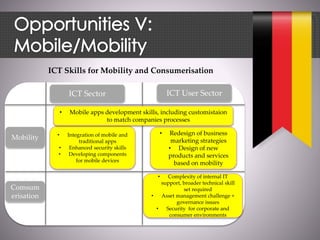
ICT Skills for Mobility and Consumerisation
ICT Sector ICT User Sector
Mobility
• Redesign of business
marketing strategies
• Design of new
products and services
based on mobility
• Integration of mobile and
traditional apps
• Enhanced security skills
• Developing components
for mobile devices
Comsum
erisation
• Mobile apps development skills, including customistaion
to match companies processes
• Complexity of internal IT
support, broader technical skill
set required
• Asset management challenge +
governance issues
• Security for corporate and
consumer environments
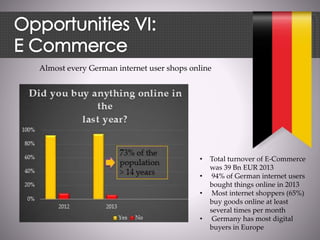
Almost every German internet user shops online
• Total turnover of E-Commerce
was 39 Bn EUR 2013
• 94% of German internet users
bought things online in 2013
• Most internet shoppers (65%)
buy goods online at least
several times per month
• Germany has most digital
buyers in Europe
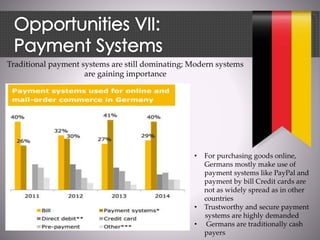
Traditional payment systems are still dominating; Modern systems
are gaining importance
• For purchasing goods online,
Germans mostly make use of
payment systems like PayPal and
payment by bill Credit cards are
not as widely spread as in other
countries
• Trustworthy and secure payment
systems are highly demanded
• Germans are traditionally cash
payers
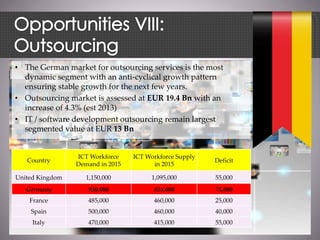
• The German market for outsourcing services is the most
dynamic segment with an anti-cyclical growth pattern
ensuring stable growth for the next few years.
• Outsourcing market is assessed at EUR 19.4 Bn with an
increase of 4.3% (est 2013)
• IT / software development outsourcing remain largest
segmented value at EUR 13 Bn
Country
ICT Workforce
Demand in 2015
ICT Workforce Supply
in 2015
Deficit
United Kingdom 1,150,000 1,095,000 55,000
Germany 930,000 855,000 75,000
France 485,000 460,000 25,000
Spain 500,000 460,000 40,000
Italy 470,000 415,000 55,000
• Germany’s ICT Market
• Competition
• ICT Opportunities
• SWOT
• Strategy
• Recommendation
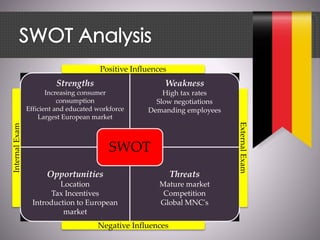
Strengths
Increasing consumer
consumption
Efficient and educated workforce
Largest European market
Weakness
High tax rates
Slow negotiations
Demanding employees
Opportunities
Location
Tax Incentives
Introduction to European
market
Threats
Mature market
Competition
Global MNC's
SWOT
Positive Influences
ExternalExam
InternalExam
Negative Influences
• Germany’s ICT Market
• Competition
• ICT Opportunities
• SWOT
• Strategy
• Recommendation
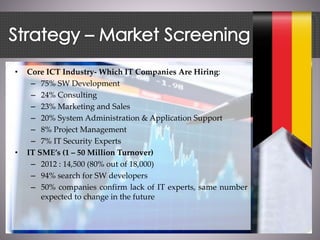
• Core ICT Industry- Which IT Companies Are Hiring:
– 75% SW Development
– 24% Consulting
– 23% Marketing and Sales
– 20% System Administration & Application Support
– 8% Project Management
– 7% IT Security Experts
• IT SME’s (1 – 50 Million Turnover)
– 2012 : 14,500 (80% out of 18,000)
– 94% search for SW developers
– 50% companies confirm lack of IT experts, same number
expected to change in the future
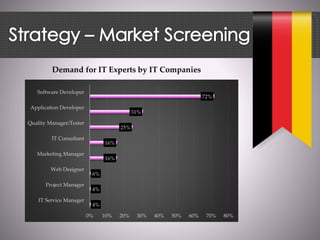
Demand for IT Experts by IT Companies
4%
4%
6%
16%
16%
25%
31%
72%
0% 10% 20% 30% 40% 50% 60% 70% 80%
IT Service Manager
Project Manager
Web Designer
Marketing Manager
IT Consultant
Quality Manager/Tester
Application Developer
Software Developer
• Germany’s ICT Market
• Competition
• ICT Opportunities
• SWOT
• Strategy
• Recommendation
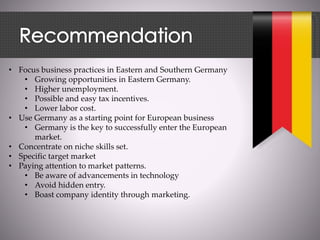
• Focus business practices in Eastern and Southern Germany
• Growing opportunities in Eastern Germany.
• Higher unemployment.
• Possible and easy tax incentives.
• Lower labor cost.
• Use Germany as a starting point for European business
• Germany is the key to successfully enter the European
market.
• Concentrate on niche skills set.
• Specific target market
• Paying attention to market patterns.
• Be aware of advancements in technology
• Avoid hidden entry.
• Boast company identity through marketing.
Author: Rahil Pathan
Contact – 0091 9004492862

Germany- ICT Opportunities & Business Analysis

  • 1.
  • 2.
    • Germany’s ICTMarket • Competition • ICT Opportunities • SWOT • Strategy • Recommendation
  • 3.
    • From Germany,nearly all of Europe can be reached by air in 3 hours and by road in 24 hours (flight, truck, and railway hours from Berlin). • A state-of-the-art transportation infrastructure and logistics capabilities able to serve all European markets
  • 4.
    German ICT companiesare in a good mood. Balance Of Turnover Expectations
  • 6.
    Main Forecast Scenario- Real GDP Growth 2012 2013 2014 2015 2016 2017 2018 2019 2020 0.7% 0.4% 1.8% 1.5% 1.6% 1.3% 1.4% 1.6% 1.8% Main Forecast Scenario – IT Spending Growth 2012 2013 2014 2015 2016 2017 2018 2019 2020 2.1% 2.2% 2.6% 2.7% 2.8% 3.3% 3.6% 3.7% 3.7% Source : IDC Europe
  • 7.
    • Employment • Overall2012: 902,000 employees • Overall 2013: 917,000 Employees • IT: 698,000 employees (76% of all ICT, plus 19,000) • Telecom: 206,000 employees • Consumer Electronics: 13,000 employees • Lack of IT Experts • 2012: 43,000 • 2013: 39,000 (Double of 2009) • 16,000 in core ICT industry (13,800 in SW & IT services) • 23,000 in other IT related industries.
  • 8.
    0% 10% 20%30% 40% 50% 60% 70% SOA Mobile Payment Enterprise 2.0 Energy/Smart Grids BP Management IT Outsourcing BI Virtulization Social Media IT Security Mobile Cloud Trends in German ICT Market
  • 9.
    • Germany’s ICTMarket • Competition • ICT Opportunities • SWOT • Strategy • Recommendation
  • 10.
    • Big playerssuch as IBM, Microsoft, Oracle, and SAP (one of the largest business software companies originally from Germany) are present on the German software market. – However, the market is best characterized by the large number of dynamic and highly specialized SMEs – Companies in the Mittelstand dominate Germany's economic and industrial landscape; creating a highly diversified SME environment of highly specialized hidden champions with a global market footprint. – Simultaneously, these SMEs are also driving demand for software solutions - creating a significant customer base. – As well as strong growth prospects, there are also promising opportunities for less established suppliers and market entrants. – The most significant market potential exists for expert suppliers of industry-specific software products and services.
  • 11.
    • Germany’s ICTMarket • Competition • ICT Opportunities • SWOT • Strategy • Recommendation
  • 12.
    40% of Germancompanies already use Cloud services 0% 20% 40% 60% 80% 2000 & More Employees 500 - 1999 Employees 100 - 499 Employees 20 - 99 Employees Cloud computing users by company (2013) • The German Mittelstand still needs to catch up concerning cloud technologies • Integration of the megatrends cloud computing, Big Data and mobile • Cloud computing shapes the transformation towards digital business models Integration in existing processes Foundation for product, process and business model innovations
  • 14.
    • Cloud computingmarket in Germany is expected to grow at a CAGR of 31.98% over the period of 2013 – 2018. ICT Skills for Cloud Computing Private Cloud ICT Sector ICT User Sector Public Cloud Skills to design, build, optimize & manage cloud. Skills to design & optimize performance integration & power efficiency of Cloud data centers Less maintenan ce skills required (cloud automatio n level) Skills to manage external cloud services, define strategy, mgmt of SLA Less technical skills & resources to maintain apps and resources required High level complex ICT skills to design , maintain & customize private Cloud Private Cloud
  • 15.
    40% of Germancompanies use or plan to use Big Data related solutions • Only 9% are already making use of Big Data • The demand for qualified Big Data solutions is growing 9% 31% 28% 32% How relevant is Big data for your company survey (2014) Already usind Big Data Planning to use Big Data Not sure yet Did not deal with Bid Data yet • Most important implementation area is sales & marketing followed by accounting, finance and controlling • 70% of companies perceive the lack of big data experts as the biggest obstacle for successful implementation
  • 17.
    ICT Sector ICTUser Sector Big Data Data Scientists – a combination of • Statistical and analytical skills • Business skills to assess the meaning of data – apply to specific business environment • Communication skills to explain / persuade other executives Demand for similar skills applied to the sector, Finance, Telecoms, large Retail companies Business analytics skills, Hadoop skills (building, implement & management) ICT Skills for Big Data / Datability
  • 18.
    Big Data BusinessModel Transformation Potential Industry Data Volume Annual Data Volume Growth 2012 2020 Utilities 4 6 10 - 20% Industrial 6 8 20 - 30% Professional Services 5 8 25 - 35% Finance & Insurance 8 10 30 - 40% Government/Education 3 8 10 - 20% Retail/Wholesale 2 7 20 - 30% Healthcare 5 9 40 - 50% Mobility & Logistics 4 9 40 - 50% IT, Telco & Media 8 10 50 - 60% Medium High Very High 1 = Low to 10 = High, Source: Experton Group 2012
  • 19.
    2593 238 279 46 172 2469 227 261 44 158 0 1000 20003000 Services Web/Message/Data security End Point Security Network Security Identity & Access Management Turnover Security Software and Services (in EUR million) 2012 2013 • The demand for IT Security grew by 5% in Germany in 2013 • Most turnover is achieved with IT security services • Developments such as advanced cloud services, virtualization, online payment, e-commerce etc. drive the need for IT security
  • 20.
    ICT Sector ICTUser Sector IT Security • Design & implementation of IT security for social media. • Design and management of end-to-end protection of emerging smart networks ( smartgrids, smartcities, smart e- health ) & cyberinfrastructures. • Advanced Security management skills • Management of IT security for media • Security for BYOD & Mobility • Security for Cloud • Advanced security management skills • Identity & access mngmt solution skills • IT security for SCADA or PCS System in Manufacturing. ICT Skills for IT Security
  • 21.
    Germany’s software marketshows continuous growth rates of around 5% per year. 0 1 2 3 4 5 6 7 8 9 0 5 10 15 20 25 2011 2012 2013 2014 2015 2016 Germany software market value forecast (EUR billion) EUR Bn % Growth EUR Bn %Growth • Classics such as CRM & ERP programs are in demand • Solutions applicable for SME’s & non IT specialists • New platforms for mobile & tablet require tailor made solutions
  • 22.
    ICT Sector ICTUser Sector Software / Internet of Things • IT management skills for IoT networks • Development for new business models, products and services • SW & IoT governance to guarantee trust, security and identity. • Architecture design, object identification, virtualization & decentralization • IT security for the information life cycle • SW development supporting data flows from sensing devices • Design & development of smart sensors and other enabling devices ICT Skills for Business Software
  • 23.
    The app economyin Germany is growing at a fast pace 0 100 200 300 400 500 600 700 2010 2013 Turnover with mobile apps in Germany ( in EUR million) App Sales Revenue from Ads 100 523 176 12 112 700 +625% • Turnover with mobile apps is expected to have reached 700 million in 2013 • Most revenues come from direct app sales followed by income generated by ads • German mobile data use increased in 2013 to 267 million gigabytes – a growth of 71 percent on 2012
  • 24.
    ICT Skills forMobility and Consumerisation ICT Sector ICT User Sector Mobility • Redesign of business marketing strategies • Design of new products and services based on mobility • Integration of mobile and traditional apps • Enhanced security skills • Developing components for mobile devices Comsum erisation • Mobile apps development skills, including customistaion to match companies processes • Complexity of internal IT support, broader technical skill set required • Asset management challenge + governance issues • Security for corporate and consumer environments
  • 25.
    Almost every Germaninternet user shops online • Total turnover of E-Commerce was 39 Bn EUR 2013 • 94% of German internet users bought things online in 2013 • Most internet shoppers (65%) buy goods online at least several times per month • Germany has most digital buyers in Europe
  • 26.
    Traditional payment systemsare still dominating; Modern systems are gaining importance • For purchasing goods online, Germans mostly make use of payment systems like PayPal and payment by bill Credit cards are not as widely spread as in other countries • Trustworthy and secure payment systems are highly demanded • Germans are traditionally cash payers
  • 27.
    • The Germanmarket for outsourcing services is the most dynamic segment with an anti-cyclical growth pattern ensuring stable growth for the next few years. • Outsourcing market is assessed at EUR 19.4 Bn with an increase of 4.3% (est 2013) • IT / software development outsourcing remain largest segmented value at EUR 13 Bn Country ICT Workforce Demand in 2015 ICT Workforce Supply in 2015 Deficit United Kingdom 1,150,000 1,095,000 55,000 Germany 930,000 855,000 75,000 France 485,000 460,000 25,000 Spain 500,000 460,000 40,000 Italy 470,000 415,000 55,000
  • 28.
    • Germany’s ICTMarket • Competition • ICT Opportunities • SWOT • Strategy • Recommendation
  • 29.
    Strengths Increasing consumer consumption Efficient andeducated workforce Largest European market Weakness High tax rates Slow negotiations Demanding employees Opportunities Location Tax Incentives Introduction to European market Threats Mature market Competition Global MNC's SWOT Positive Influences ExternalExam InternalExam Negative Influences
  • 30.
    • Germany’s ICTMarket • Competition • ICT Opportunities • SWOT • Strategy • Recommendation
  • 31.
    • Core ICTIndustry- Which IT Companies Are Hiring: – 75% SW Development – 24% Consulting – 23% Marketing and Sales – 20% System Administration & Application Support – 8% Project Management – 7% IT Security Experts • IT SME’s (1 – 50 Million Turnover) – 2012 : 14,500 (80% out of 18,000) – 94% search for SW developers – 50% companies confirm lack of IT experts, same number expected to change in the future
  • 32.
    Demand for ITExperts by IT Companies 4% 4% 6% 16% 16% 25% 31% 72% 0% 10% 20% 30% 40% 50% 60% 70% 80% IT Service Manager Project Manager Web Designer Marketing Manager IT Consultant Quality Manager/Tester Application Developer Software Developer
  • 33.
    • Germany’s ICTMarket • Competition • ICT Opportunities • SWOT • Strategy • Recommendation
  • 34.
    • Focus businesspractices in Eastern and Southern Germany • Growing opportunities in Eastern Germany. • Higher unemployment. • Possible and easy tax incentives. • Lower labor cost. • Use Germany as a starting point for European business • Germany is the key to successfully enter the European market. • Concentrate on niche skills set. • Specific target market • Paying attention to market patterns. • Be aware of advancements in technology • Avoid hidden entry. • Boast company identity through marketing.
  • 35.
    Author: Rahil Pathan Contact– 0091 9004492862