Mohan Sawhney
McCormick Tribune Professor of Technology
Kellogg School of Management
mohans@kellogg.northwestern.edu

Big Data Analytics 2012 - Chicago
June 28, 2012
What is Big Data?

What is the Big Deal?

How does Big Data link to business outcomes?

What are the use cases for Big Data?

What can we learn from the Big Data leaders?
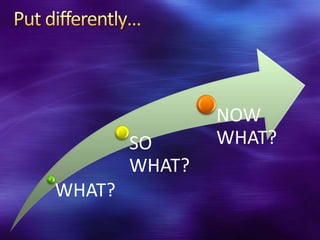
NOW
        SO      WHAT?
        WHAT?
WHAT?
Understanding Big Data

Relating Big Data to Business Advantage

Industry Use Cases for Big Data

Putting Big Data to Work for you
The technologies and practices of handling
structured and unstructured datasets so
large, diverse and dynamic that they cannot
be processed and analyzed with existing data
management systems.
Data moves from structured to unstructured
Sources of data proliferate
Real-time creates too much information
Quantity does not trump quality
Data becomes contextual based on roles,
processes, location, time, and relationships.
The “what” is shifting from “transaction
processing” to “interaction processing” with
social media services like Facebook, Twitter and
LinkedIn.
The “how” of computing is adapting from
desktop computers to context and location-
aware mobile devices.
The “where” is moving from on-premise
computing to cloud computing
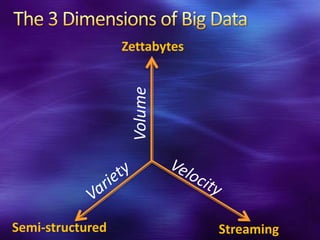
Zettabytes


                  Volume


Semi-structured                Streaming
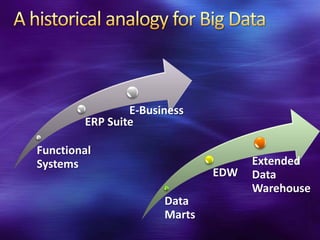
E-Business
        ERP Suite

Functional
Systems                             Extended
                              EDW   Data
                                    Warehouse
                      Data
                      Marts
Understanding Big Data

Relating Big Data to Business Advantage

Industry Use Cases for Big Data

Putting Big Data to Work for you
• Big Data is a response to the evolution of the
  Social, Local and Mobile data-driven enterprise
  that will be required to sense and respond in
  “right-time” to events in its ecosystem.
• Big Data leads to business advantage through
  faster, smarter and more cost-effective
  decisions
• Big Data’s ultimate business outcome is Agility
• Smarter decision making comes from the ability
  to combine new sources of data to enhance
  existing analytics and predictive models in
  operational systems and data warehouses.
• New insights emerge from synthesis of multi-
  structured data from sensors, system and web
  logs, social computing web sites, text
  documents, etc. that are difficult to process
  using traditional analytical processing
  technologies.
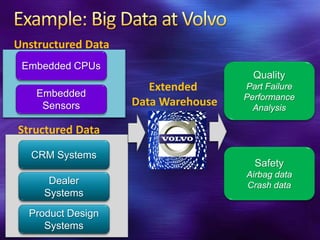
Unstructured Data
 Embedded CPUs
                                       Quality
    Embedded
                       Extended      Part Failure

     Sensors        Data Warehouse   Performance
                                       Analysis

Structured Data
   CRM Systems
                                       Safety
                                     Airbag data
      Dealer                         Crash data
     Systems
  Product Design
     Systems
Faster decisions are enabled because big data
solutions support the rapid analysis of high
volumes of detailed data.
Analysis at this scale is been difficult to date
because it takes too long or is too costly
Traditionally, enterprises have had to aggregate
or sample the detailed data before it can be
analyzed, which adds to data latency and
reduces value of the results.
Faster time to value is possible because
organizations can now process and analyze data
that is outside of the enterprise data
warehouse.
Enterprises can integrate large volumes of
machine-generated data from sensors and
system and web logs into the enterprise data
warehouse for analysis.
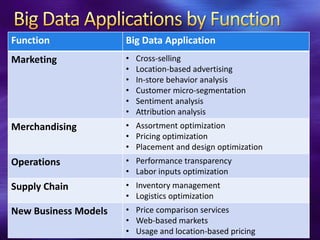
Function              Big Data Application
Marketing             •   Cross-selling
                      •   Location-based advertising
                      •   In-store behavior analysis
                      •   Customer micro-segmentation
                      •   Sentiment analysis
                      •   Attribution analysis
Merchandising         • Assortment optimization
                      • Pricing optimization
                      • Placement and design optimization
Operations            • Performance transparency
                      • Labor inputs optimization
Supply Chain          • Inventory management
                      • Logistics optimization
New Business Models   • Price comparison services
                      • Web-based markets
                      • Usage and location-based pricing
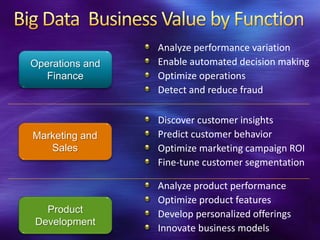
Analyze performance variation
Operations and   Enable automated decision making
   Finance       Optimize operations
                 Detect and reduce fraud

                 Discover customer insights
Marketing and    Predict customer behavior
   Sales         Optimize marketing campaign ROI
                 Fine-tune customer segmentation

                 Analyze product performance
                 Optimize product features
  Product        Develop personalized offerings
Development
                 Innovate business models
LinkedIn uses data from its more than 100 million users
to build new social products based on users’ own
definitions of their skill sets.
Silver Spring Networks deploys smart, two-way power
grids for its utility customers that allow homeowners to
send information back to utilities to help manage
energy use and maximize efficiency.
The Camden Coalition mapped the city’s crime trends
to identify problems with its healthcare system,
revealing services that were both medically ineffective
and expensive.
Insurance : Individualize auto-insurance policies based on vehicle telemetry data.
     More accurate assessments of risks
     Individualized pricing based on actual individual customer driving habits;
     Influence and motivate individual customers to improve their driving habits
Travel: Optimize buying experience through web log and social
media analysis
     Gain insight into customer preferences and desires;
     Up-sell by correlating current sales with subsequent browsing behavior Increase
     browse-to-buy conversions via customized offers and packages
     Personalized travel recommendations based on social media data
Gaming: Collect gaming data to optimize spend within and
across games
     Gain insight into likes, dislikes and relationships of its users
     Enhance games to drive customer spend within games
     Recommend content based on analysis of player connections and similar “likes”
Target analyzed its baby-shower registry to observe
changes in shopping habits changed as a woman
approached her due date.
Target analysts found interesting patterns. For instance,
women buy larger quantities of unscented lotion
around the beginning of their second trimester. In the
first 20 weeks, pregnant women buy supplements like
calcium, magnesium and zinc. They also buy hand
sanitizers and washcloths close to their due date.
Target identified 25 products that, when analyzed
together, allowed them to assign each shopper a
“pregnancy prediction” score and an estimated due
date. Target can target women at very specific stages of
a woman’s pregnancy.
Target can also optimize the purchase funnel from
emailed coupons to online buying and store visits.
Understanding Big Data

Relating Big Data to Business Advantage

Industry Use Cases for Big Data

Putting Big Data to Work for you
• A business use case describes what a
  technology or product does. It describes the job
  to be done by end-users to achieve their
  business goals.

• The business use case describes a process that
  provides business value to the end-user
Merchandizing and market basket analysis.
Campaign management and customer loyalty
programs.
Supply-chain management and analytics.
Event- and behavior-based targeting.
Market and consumer segmentations.
Customer Experience Optimization: Deliver consistent cross-
channel customer experiences; harvest customer leads from
sales, marketing, and other sources
Increase basket size: Increase average order size by
recommending complementary products based on predictive
analysis for cross-selling.
Cross-channel Analytics: Sales attribution, average order value,
lifetime value
Event Analytics: What series of steps (golden path) led to a
desired outcome (e.g., purchase, registration).
Next Best Offer: Deploy predictive models in combination
with recommendation engines that drive automated next best
offers and tailored interactions across multiple interaction
channels.
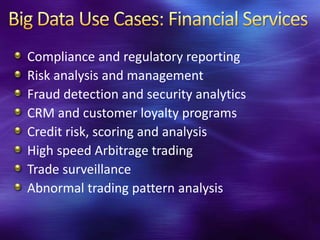
Compliance and regulatory reporting
Risk analysis and management
Fraud detection and security analytics
CRM and customer loyalty programs
Credit risk, scoring and analysis
High speed Arbitrage trading
Trade surveillance
Abnormal trading pattern analysis
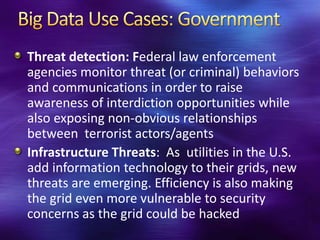
Threat detection: Federal law enforcement
agencies monitor threat (or criminal) behaviors
and communications in order to raise
awareness of interdiction opportunities while
also exposing non-obvious relationships
between terrorist actors/agents
Infrastructure Threats: As utilities in the U.S.
add information technology to their grids, new
threats are emerging. Efficiency is also making
the grid even more vulnerable to security
concerns as the grid could be hacked
Understanding Big Data

Relating Big Data to Business Advantage

Industry Use Cases for Big Data

Putting Big Data to Work for you
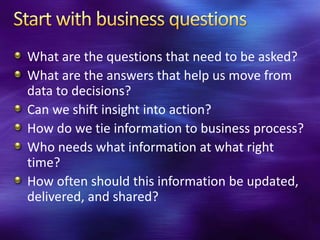
What are the questions that need to be asked?
What are the answers that help us move from
data to decisions?
Can we shift insight into action?
How do we tie information to business process?
Who needs what information at what right
time?
How often should this information be updated,
delivered, and shared?
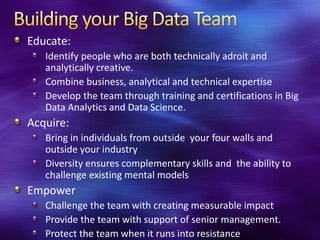
Educate:
   Identify people who are both technically adroit and
   analytically creative.
   Combine business, analytical and technical expertise
   Develop the team through training and certifications in Big
   Data Analytics and Data Science.
Acquire:
   Bring in individuals from outside your four walls and
   outside your industry
   Diversity ensures complementary skills and the ability to
   challenge existing mental models
Empower
   Challenge the team with creating measurable impact
   Provide the team with support of senior management.
   Protect the team when it runs into resistance
Big Data is characterized by volume, variety and
velocity
 Big Data analytics “extends” the Data
Warehouse with new data types and new
analytics techniques
Big Data creates business advantage through
smarter, faster decisions and faster time to value
Big Data should be leveraged with a clear
understanding of business use cases
Big Data teams should combine creativity and
analytics
Turning Big Data to Business Advantage

Turning Big Data to Business Advantage

  • 1.
    Mohan Sawhney McCormick TribuneProfessor of Technology Kellogg School of Management mohans@kellogg.northwestern.edu Big Data Analytics 2012 - Chicago June 28, 2012
  • 2.
    What is BigData? What is the Big Deal? How does Big Data link to business outcomes? What are the use cases for Big Data? What can we learn from the Big Data leaders?
  • 3.
    NOW SO WHAT? WHAT? WHAT?
  • 4.
    Understanding Big Data RelatingBig Data to Business Advantage Industry Use Cases for Big Data Putting Big Data to Work for you
  • 5.
    The technologies andpractices of handling structured and unstructured datasets so large, diverse and dynamic that they cannot be processed and analyzed with existing data management systems.
  • 6.
    Data moves fromstructured to unstructured Sources of data proliferate Real-time creates too much information Quantity does not trump quality Data becomes contextual based on roles, processes, location, time, and relationships.
  • 7.
    The “what” isshifting from “transaction processing” to “interaction processing” with social media services like Facebook, Twitter and LinkedIn. The “how” of computing is adapting from desktop computers to context and location- aware mobile devices. The “where” is moving from on-premise computing to cloud computing
  • 8.
    Zettabytes Volume Semi-structured Streaming
  • 10.
    E-Business ERP Suite Functional Systems Extended EDW Data Warehouse Data Marts
  • 11.
    Understanding Big Data RelatingBig Data to Business Advantage Industry Use Cases for Big Data Putting Big Data to Work for you
  • 12.
    • Big Datais a response to the evolution of the Social, Local and Mobile data-driven enterprise that will be required to sense and respond in “right-time” to events in its ecosystem. • Big Data leads to business advantage through faster, smarter and more cost-effective decisions • Big Data’s ultimate business outcome is Agility
  • 13.
    • Smarter decisionmaking comes from the ability to combine new sources of data to enhance existing analytics and predictive models in operational systems and data warehouses. • New insights emerge from synthesis of multi- structured data from sensors, system and web logs, social computing web sites, text documents, etc. that are difficult to process using traditional analytical processing technologies.
  • 14.
    Unstructured Data EmbeddedCPUs Quality Embedded Extended Part Failure Sensors Data Warehouse Performance Analysis Structured Data CRM Systems Safety Airbag data Dealer Crash data Systems Product Design Systems
  • 15.
    Faster decisions areenabled because big data solutions support the rapid analysis of high volumes of detailed data. Analysis at this scale is been difficult to date because it takes too long or is too costly Traditionally, enterprises have had to aggregate or sample the detailed data before it can be analyzed, which adds to data latency and reduces value of the results.
  • 16.
    Faster time tovalue is possible because organizations can now process and analyze data that is outside of the enterprise data warehouse. Enterprises can integrate large volumes of machine-generated data from sensors and system and web logs into the enterprise data warehouse for analysis.
  • 17.
    Function Big Data Application Marketing • Cross-selling • Location-based advertising • In-store behavior analysis • Customer micro-segmentation • Sentiment analysis • Attribution analysis Merchandising • Assortment optimization • Pricing optimization • Placement and design optimization Operations • Performance transparency • Labor inputs optimization Supply Chain • Inventory management • Logistics optimization New Business Models • Price comparison services • Web-based markets • Usage and location-based pricing
  • 18.
    Analyze performance variation Operationsand Enable automated decision making Finance Optimize operations Detect and reduce fraud Discover customer insights Marketing and Predict customer behavior Sales Optimize marketing campaign ROI Fine-tune customer segmentation Analyze product performance Optimize product features Product Develop personalized offerings Development Innovate business models
  • 19.
    LinkedIn uses datafrom its more than 100 million users to build new social products based on users’ own definitions of their skill sets. Silver Spring Networks deploys smart, two-way power grids for its utility customers that allow homeowners to send information back to utilities to help manage energy use and maximize efficiency. The Camden Coalition mapped the city’s crime trends to identify problems with its healthcare system, revealing services that were both medically ineffective and expensive.
  • 20.
    Insurance : Individualizeauto-insurance policies based on vehicle telemetry data. More accurate assessments of risks Individualized pricing based on actual individual customer driving habits; Influence and motivate individual customers to improve their driving habits Travel: Optimize buying experience through web log and social media analysis Gain insight into customer preferences and desires; Up-sell by correlating current sales with subsequent browsing behavior Increase browse-to-buy conversions via customized offers and packages Personalized travel recommendations based on social media data Gaming: Collect gaming data to optimize spend within and across games Gain insight into likes, dislikes and relationships of its users Enhance games to drive customer spend within games Recommend content based on analysis of player connections and similar “likes”
  • 21.
    Target analyzed itsbaby-shower registry to observe changes in shopping habits changed as a woman approached her due date. Target analysts found interesting patterns. For instance, women buy larger quantities of unscented lotion around the beginning of their second trimester. In the first 20 weeks, pregnant women buy supplements like calcium, magnesium and zinc. They also buy hand sanitizers and washcloths close to their due date. Target identified 25 products that, when analyzed together, allowed them to assign each shopper a “pregnancy prediction” score and an estimated due date. Target can target women at very specific stages of a woman’s pregnancy. Target can also optimize the purchase funnel from emailed coupons to online buying and store visits.
  • 22.
    Understanding Big Data RelatingBig Data to Business Advantage Industry Use Cases for Big Data Putting Big Data to Work for you
  • 24.
    • A businessuse case describes what a technology or product does. It describes the job to be done by end-users to achieve their business goals. • The business use case describes a process that provides business value to the end-user
  • 25.
    Merchandizing and marketbasket analysis. Campaign management and customer loyalty programs. Supply-chain management and analytics. Event- and behavior-based targeting. Market and consumer segmentations.
  • 26.
    Customer Experience Optimization:Deliver consistent cross- channel customer experiences; harvest customer leads from sales, marketing, and other sources Increase basket size: Increase average order size by recommending complementary products based on predictive analysis for cross-selling. Cross-channel Analytics: Sales attribution, average order value, lifetime value Event Analytics: What series of steps (golden path) led to a desired outcome (e.g., purchase, registration). Next Best Offer: Deploy predictive models in combination with recommendation engines that drive automated next best offers and tailored interactions across multiple interaction channels.
  • 27.
    Compliance and regulatoryreporting Risk analysis and management Fraud detection and security analytics CRM and customer loyalty programs Credit risk, scoring and analysis High speed Arbitrage trading Trade surveillance Abnormal trading pattern analysis
  • 28.
    Threat detection: Federallaw enforcement agencies monitor threat (or criminal) behaviors and communications in order to raise awareness of interdiction opportunities while also exposing non-obvious relationships between terrorist actors/agents Infrastructure Threats: As utilities in the U.S. add information technology to their grids, new threats are emerging. Efficiency is also making the grid even more vulnerable to security concerns as the grid could be hacked
  • 29.
    Understanding Big Data RelatingBig Data to Business Advantage Industry Use Cases for Big Data Putting Big Data to Work for you
  • 30.
    What are thequestions that need to be asked? What are the answers that help us move from data to decisions? Can we shift insight into action? How do we tie information to business process? Who needs what information at what right time? How often should this information be updated, delivered, and shared?
  • 31.
    Educate: Identify people who are both technically adroit and analytically creative. Combine business, analytical and technical expertise Develop the team through training and certifications in Big Data Analytics and Data Science. Acquire: Bring in individuals from outside your four walls and outside your industry Diversity ensures complementary skills and the ability to challenge existing mental models Empower Challenge the team with creating measurable impact Provide the team with support of senior management. Protect the team when it runs into resistance
  • 32.
    Big Data ischaracterized by volume, variety and velocity Big Data analytics “extends” the Data Warehouse with new data types and new analytics techniques Big Data creates business advantage through smarter, faster decisions and faster time to value Big Data should be leveraged with a clear understanding of business use cases Big Data teams should combine creativity and analytics