Decoding the Domestic IT Market

                                              Opportunity
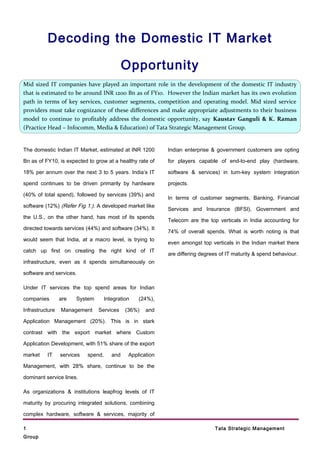
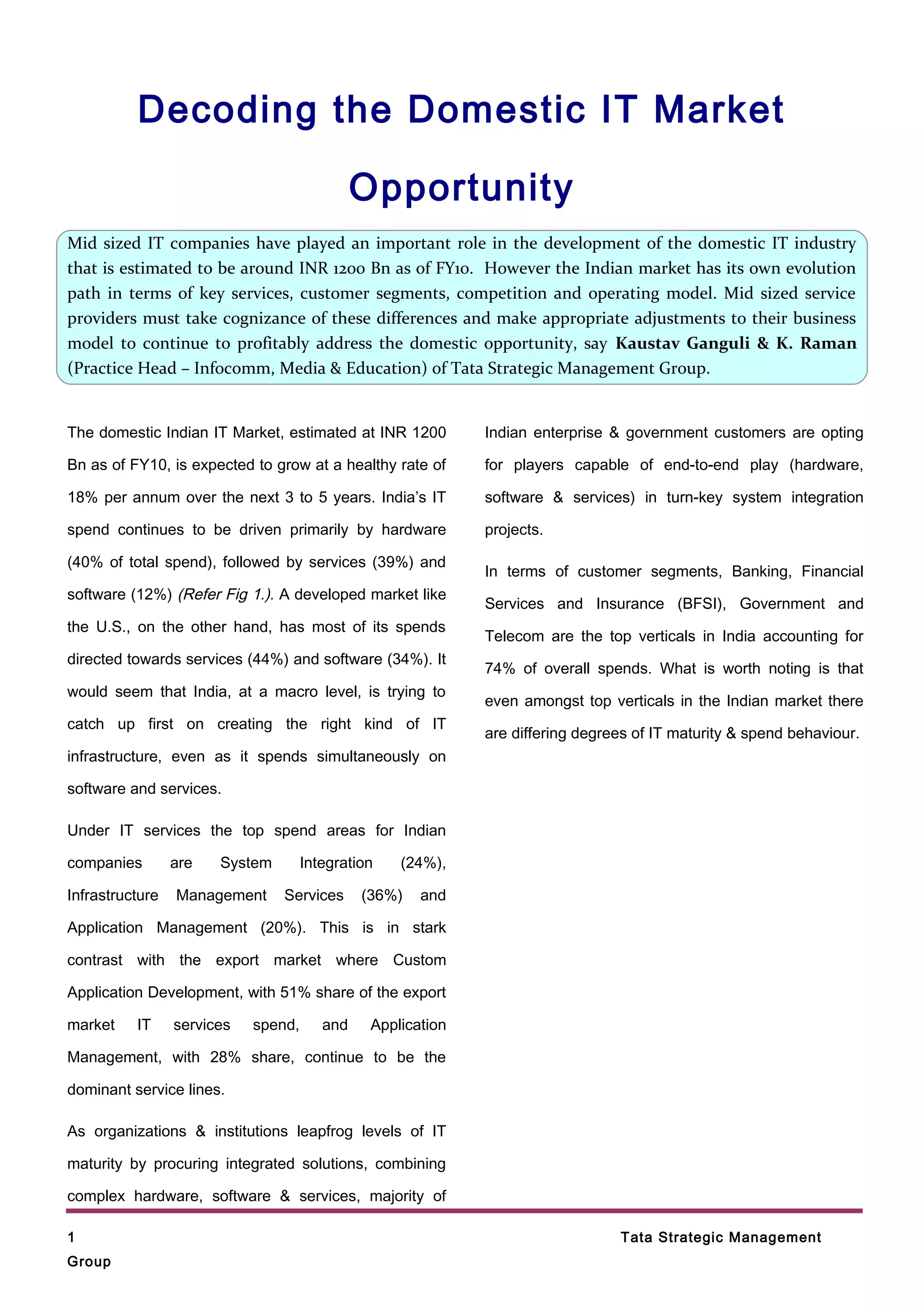
Mid sized IT companies have played an important role in the development of the domestic IT industry
that is estimated to be around INR 1200 Bn as of FY10. However the Indian market has its own evolution
path in terms of key services, customer segments, competition and operating model. Mid sized service
providers must take cognizance of these differences and make appropriate adjustments to their business
model to continue to profitably address the domestic opportunity, say Kaustav Ganguli & K. Raman
(Practice Head – Infocomm, Media & Education) of Tata Strategic Management Group.


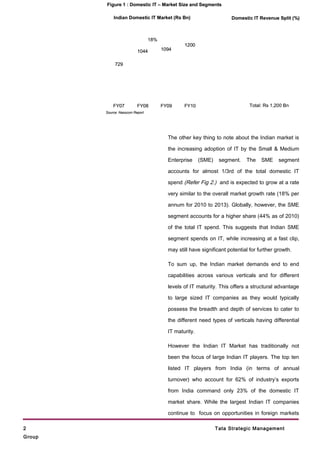
The domestic Indian IT Market, estimated at INR 1200         Indian enterprise & government customers are opting

Bn as of FY10, is expected to grow at a healthy rate of      for players capable of end-to-end play (hardware,

18% per annum over the next 3 to 5 years. India’s IT         software & services) in turn-key system integration

spend continues to be driven primarily by hardware           projects.

(40% of total spend), followed by services (39%) and
                                                             In terms of customer segments, Banking, Financial
software (12%) (Refer Fig 1.). A developed market like
                                                             Services and Insurance (BFSI), Government and
the U.S., on the other hand, has most of its spends
                                                             Telecom are the top verticals in India accounting for
directed towards services (44%) and software (34%). It
                                                             74% of overall spends. What is worth noting is that
would seem that India, at a macro level, is trying to
                                                             even amongst top verticals in the Indian market there
catch up first on creating the right kind of IT
                                                             are differing degrees of IT maturity & spend behaviour.
infrastructure, even as it spends simultaneously on

software and services.

Under IT services the top spend areas for Indian

companies        are   System        Integration   (24%),

Infrastructure   Management     Services      (36%)   and

Application Management (20%). This is in stark

contrast with the export market where Custom

Application Development, with 51% share of the export

market    IT     services   spend,      and    Application

Management, with 28% share, continue to be the

dominant service lines.

As organizations & institutions leapfrog levels of IT

maturity by procuring integrated solutions, combining

complex hardware, software & services, majority of

1                                                                               Tata Strategic Management
Group
Figure 1 : Domestic IT – Market Size and Segments

            Indian Domestic IT Market (Rs Bn)                        Domestic IT Revenue Split (%)


                                 18%
                                                1200
                          1044         1094


             729


            FY07          FY08         FY09     FY10                         Total: Rs 1,200 Bn
        Source: Nasscom Report


                                         The other key thing to note about the Indian market is

                                         the increasing adoption of IT by the Small & Medium

                                         Enterprise     (SME)    segment.   The    SME     segment

                                         accounts for almost 1/3rd of the total domestic IT

                                         spend (Refer Fig 2.) and is expected to grow at a rate

                                         very similar to the overall market growth rate (18% per

                                         annum for 2010 to 2013). Globally, however, the SME

                                         segment accounts for a higher share (44% as of 2010)

                                         of the total IT spend. This suggests that Indian SME

                                         segment spends on IT, while increasing at a fast clip,

                                         may still have significant potential for further growth.

                                         To sum up, the Indian market demands end to end

                                         capabilities across various verticals and for different

                                         levels of IT maturity. This offers a structural advantage

                                         to large sized IT companies as they would typically

                                         possess the breadth and depth of services to cater to

                                         the different need types of verticals having differential

                                         IT maturity.

                                         However the Indian IT Market has traditionally not

                                         been the focus of large Indian IT players. The top ten

                                         listed IT players from India (in terms of annual

                                         turnover) who account for 62% of industry’s exports

                                         from India command only 23% of the domestic IT

                                         market share. While the largest Indian IT companies

                                         continue to focus on opportunities in foreign markets

2                                                               Tata Strategic Management
Group
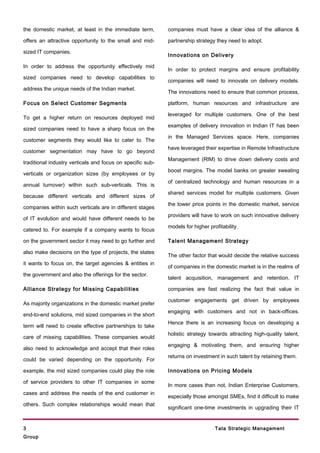
the domestic market, at least in the immediate term,        companies must have a clear idea of the alliance &

offers an attractive opportunity to the small and mid-      partnership strategy they need to adopt.

sized IT companies.
                                                            Innovations on Delivery

In order to address the opportunity effectively mid
                                                            In order to protect margins and ensure profitability
sized companies need to develop capabilities to
                                                            companies will need to innovate on delivery models.
address the unique needs of the Indian market.
                                                            The innovations need to ensure that common process,

Focus on Select Customer Segments                           platform, human resources and infrastructure are

                                                            leveraged for multiple customers. One of the best
To get a higher return on resources deployed mid
                                                            examples of delivery innovation in Indian IT has been
sized companies need to have a sharp focus on the
                                                            in the Managed Services space. Here, companies
customer segments they would like to cater to. The
                                                            have leveraged their expertise in Remote Infrastructure
customer segmentation may have to go beyond
                                                            Management (RIM) to drive down delivery costs and
traditional industry verticals and focus on specific sub-
                                                            boost margins. The model banks on greater sweating
verticals or organization sizes (by employees or by
                                                            of centralized technology and human resources in a
annual turnover) within such sub-verticals. This is
                                                            shared services model for multiple customers. Given
because different verticals and different sizes of
                                                            the lower price points in the domestic market, service
companies within such verticals are in different stages
                                                            providers will have to work on such innovative delivery
of IT evolution and would have different needs to be
                                                            models for higher profitability.
catered to. For example if a company wants to focus

on the government sector it may need to go further and      Talent Management Strategy

also make decisions on the type of projects, the states
                                                            The other factor that would decide the relative success
it wants to focus on, the target agencies & entities in
                                                            of companies in the domestic market is in the realms of
the government and also the offerings for the sector.
                                                            talent acquisition, management and retention. IT

Alliance Strategy for Missing Capabilities                  companies are fast realizing the fact that value in

                                                            customer engagements get driven by employees
As majority organizations in the domestic market prefer
                                                            engaging with customers and not in back-offices.
end-to-end solutions, mid sized companies in the short
                                                            Hence there is an increasing focus on developing a
term will need to create effective partnerships to take
                                                            holistic strategy towards attracting high-quality talent,
care of missing capabilities. These companies would
                                                            engaging & motivating them, and ensuring higher
also need to acknowledge and accept that their roles
                                                            returns on investment in such talent by retaining them.
could be varied depending on the opportunity. For

example, the mid sized companies could play the role        Innovations on Pricing Models

of service providers to other IT companies in some
                                                            In more cases than not, Indian Enterprise Customers,
cases and address the needs of the end customer in
                                                            especially those amongst SMEs, find it difficult to make
others. Such complex relationships would mean that
                                                            significant one-time investments in upgrading their IT


3                                                                                Tata Strategic Management
Group
infrastructure or applications portfolio. Our analysis         effectively leveraged implementation partnerships with

shows that an average medium sized Indian enterprise           other IT majors for initial entry and ramp-up in their

with an employee size of ~300 has an annual IT                 identified customer segments. As far as innovation in

budget in the vicinity of Rs. ~42 Lakhs – this obviously       delivery model is concerned, one of the most

places constraints on the extent of one time capital           successful examples is found in the Managed Services

investments that such a company can make towards IT            space where leading service providers like HCL &

upgrades. This underlines the need for opex-based or           others like Allied Digital and Glodyne pioneered the

‘pay per use’ pricing model in the Indian market.              concept of Remote Infrastructure Management (RIM)

Needless to say – such migrations in pricing models            to cut down delivery costs and boost margins. The

need to go hand-in-hand with changes in the delivery           other noteworthy example of delivery model innovation

architecture as well. The other emerging trend in              is unfolding in the SME space in the domestic market.

pricing models is with regards to increasing usage of          Here, some mid sized companies like Ramco Systems

performance-based      or   outcome-based        pricing   –   are offering cloud based services on a ‘pay per use’

especially in the area of IT services. Service providers       model to its customers and others have started offering

need to be alive to such new customer requirements             services in cloud consulting & integration. Though

with respect to pricing and effect appropriate changes         most IT companies in India are yet to adopt a

in offerings & delivery.                                       comprehensive talent management strategy, the seeds

                                                               of change in this area had perhaps been sown by HCL
Learnings from Successful Companies
                                                               in 2005 when it announced its ‘Employees First,
The success stories of the largest Indian IT companies
                                                               Customers Second’ (EFCS) policy. The EFCS is based
focused primarily on international markets are well-
                                                               on    the five   pillars of   employee    empowerment,
chronicled. However, in the domestic market we also
                                                               transformation, recognition, knowledge & support and
find examples of medium or small sized companies
                                                               endeavours to drive a unique employee organization
that have grown successfully by making strategic
                                                               thriving on a value-driven culture.
choices in some of the aforementioned factors. Apart
                                                               Strategic      Imperatives    for     Domestic   Market
from clearly identifying and implementing a go-to-
                                                               Play
market approach for select customer segments, many

of   these   companies      have   relied   on     effective   It is clearly evident that the domestic market has very

partnerships, innovations on delivery & pricing, and a         unique characteristics in its IT needs and spend

holistic talent management strategy for their growth.          behaviour. Companies which are looking to serve this

For example, Allied Digital and Glodyne are two                fast-growing and attractive market have to make

examples of companies who have derived majority                strategic choices primarily in two aspects. These two

(94%: Allied; 75%: Glodyne as of 2009) of their                aspects are:

revenues from the domestic market. One thing that
                                                               1.           Where to compete: This would involve
clearly marks out these companies is how they
                                                                    decisions on offerings & market segments (verticals


4                                                                                   Tata Strategic Management
Group
/   sub-verticals,   enterprise   sizes,   geographies,   strategic choices to maximize their chances of

     MNC / Indian, public / private etc.)                      sustainable growth in the domestic market. Firms that

                                                               do this quickly can seize the advantage and emerge as
2.             How to compete: This would mean
                                                               the next generation of success stories in the Indian IT
     identifying innovations in delivery & pricing models,
                                                               sector.
     entering into effective partnerships, and adopting
                                                               © Tata Strategic Management Group. All rights reserved
     long-term initiatives to ensure higher returns on

     talent.

Companies need to conduct critical analyses of the

strategic options under each of these two aspects and

institute an implementation program for the identified


About Tata Strategic:

Tata Strategic Management Group is the largest Indian Owned Management Consulting Firm. Set up in

1991, Tata Strategic has completed over 500 engagements with more than 100 Clients across countries

and industry sectors, addressing the business concerns of the top management. Today more than half

the revenue of Tata Strategic Management Group comes from working with companies outside the Tata

Group. We enhance client value by providing creative strategy advice, developing innovative solutions

and partnering effective implementation.


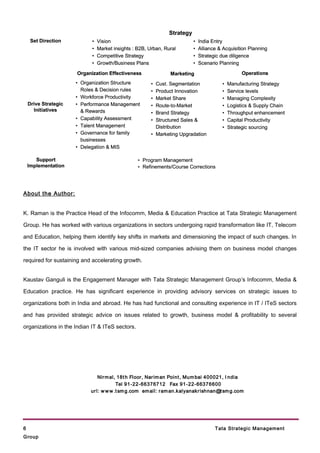
Our Offerings


5                                                                                         Tata Strategic Management
Group
Strategy
     Set Direction          •   Vision                                     •   India Entry
                            •   Market insights : B2B, Urban, Rural        •   Alliance & Acquisition Planning
                            •   Competitive Strategy                       •   Strategic due diligence
                            •   Growth/Business Plans                      •   Scenario Planning

                      Organization Effectiveness                Marketing                          Operations
                      • Organization Structure          • Cust. Segmentation             •   Manufacturing Strategy
                        Roles & Decision rules          • Product Innovation             •   Service levels
                      • Workforce Productivity          • Market Share                   •   Managing Complexity
    Drive Strategic   • Performance Management          • Route-to-Market                •   Logistics & Supply Chain
      Initiatives       & Rewards                       • Brand Strategy                 •   Throughput enhancement
                      • Capability Assessment           • Structured Sales &             •   Capital Productivity
                      • Talent Management                 Distribution                   •   Strategic sourcing
                      • Governance for family           • Marketing Upgradation
                        businesses
                      • Delegation & MIS

       Support                                    • Program Management
    Implementation                                • Refinements/Course Corrections


About the Author:


K. Raman is the Practice Head of the Infocomm, Media & Education Practice at Tata Strategic Management

Group. He has worked with various organizations in sectors undergoing rapid transformation like IT, Telecom

and Education, helping them identify key shifts in markets and dimensioning the impact of such changes. In

the IT sector he is involved with various mid-sized companies advising them on business model changes

required for sustaining and accelerating growth.


Kaustav Ganguli is the Engagement Manager with Tata Strategic Management Group’s Infocomm, Media &

Education practice. He has significant experience in providing advisory services on strategic issues to

organizations both in India and abroad. He has had functional and consulting experience in IT / ITeS sectors

and has provided strategic advice on issues related to growth, business model & profitability to several

organizations in the Indian IT & ITeS sectors.


                               Nir m al, 18t h Floor , Nar im an Point , Mum bai 400021, I ndia
                                        Tel 91-22-66376712 Fax 91 -22- 66376600
                           ur l: w w w .t sm g.com em ail: r am an.kalyanakr ishnan@t sm g.com


6                                                                                     Tata Strategic Management
Group
Strategy
     Set Direction          •   Vision                                     •   India Entry
                            •   Market insights : B2B, Urban, Rural        •   Alliance & Acquisition Planning
                            •   Competitive Strategy                       •   Strategic due diligence
                            •   Growth/Business Plans                      •   Scenario Planning

                      Organization Effectiveness                Marketing                          Operations
                      • Organization Structure          • Cust. Segmentation             •   Manufacturing Strategy
                        Roles & Decision rules          • Product Innovation             •   Service levels
                      • Workforce Productivity          • Market Share                   •   Managing Complexity
    Drive Strategic   • Performance Management          • Route-to-Market                •   Logistics & Supply Chain
      Initiatives       & Rewards                       • Brand Strategy                 •   Throughput enhancement
                      • Capability Assessment           • Structured Sales &             •   Capital Productivity
                      • Talent Management                 Distribution                   •   Strategic sourcing
                      • Governance for family           • Marketing Upgradation
                        businesses
                      • Delegation & MIS

       Support                                    • Program Management
    Implementation                                • Refinements/Course Corrections


About the Author:


K. Raman is the Practice Head of the Infocomm, Media & Education Practice at Tata Strategic Management

Group. He has worked with various organizations in sectors undergoing rapid transformation like IT, Telecom

and Education, helping them identify key shifts in markets and dimensioning the impact of such changes. In

the IT sector he is involved with various mid-sized companies advising them on business model changes

required for sustaining and accelerating growth.


Kaustav Ganguli is the Engagement Manager with Tata Strategic Management Group’s Infocomm, Media &

Education practice. He has significant experience in providing advisory services on strategic issues to

organizations both in India and abroad. He has had functional and consulting experience in IT / ITeS sectors

and has provided strategic advice on issues related to growth, business model & profitability to several

organizations in the Indian IT & ITeS sectors.


                               Nir m al, 18t h Floor , Nar im an Point , Mum bai 400021, I ndia
                                        Tel 91-22-66376712 Fax 91 -22- 66376600
                           ur l: w w w .t sm g.com em ail: r am an.kalyanakr ishnan@t sm g.com


6                                                                                     Tata Strategic Management
Group
Strategy
     Set Direction          •   Vision                                     •   India Entry
                            •   Market insights : B2B, Urban, Rural        •   Alliance & Acquisition Planning
                            •   Competitive Strategy                       •   Strategic due diligence
                            •   Growth/Business Plans                      •   Scenario Planning

                      Organization Effectiveness                Marketing                          Operations
                      • Organization Structure          • Cust. Segmentation             •   Manufacturing Strategy
                        Roles & Decision rules          • Product Innovation             •   Service levels
                      • Workforce Productivity          • Market Share                   •   Managing Complexity
    Drive Strategic   • Performance Management          • Route-to-Market                •   Logistics & Supply Chain
      Initiatives       & Rewards                       • Brand Strategy                 •   Throughput enhancement
                      • Capability Assessment           • Structured Sales &             •   Capital Productivity
                      • Talent Management                 Distribution                   •   Strategic sourcing
                      • Governance for family           • Marketing Upgradation
                        businesses
                      • Delegation & MIS

       Support                                    • Program Management
    Implementation                                • Refinements/Course Corrections


About the Author:


K. Raman is the Practice Head of the Infocomm, Media & Education Practice at Tata Strategic Management

Group. He has worked with various organizations in sectors undergoing rapid transformation like IT, Telecom

and Education, helping them identify key shifts in markets and dimensioning the impact of such changes. In

the IT sector he is involved with various mid-sized companies advising them on business model changes

required for sustaining and accelerating growth.


Kaustav Ganguli is the Engagement Manager with Tata Strategic Management Group’s Infocomm, Media &

Education practice. He has significant experience in providing advisory services on strategic issues to

organizations both in India and abroad. He has had functional and consulting experience in IT / ITeS sectors

and has provided strategic advice on issues related to growth, business model & profitability to several

organizations in the Indian IT & ITeS sectors.


                               Nir m al, 18t h Floor , Nar im an Point , Mum bai 400021, I ndia
                                        Tel 91-22-66376712 Fax 91 -22- 66376600
                           ur l: w w w .t sm g.com em ail: r am an.kalyanakr ishnan@t sm g.com


6                                                                                     Tata Strategic Management
Group

Decoding the domestic it market opportunity

  • 1.
    Decoding the DomesticIT Market Opportunity Mid sized IT companies have played an important role in the development of the domestic IT industry that is estimated to be around INR 1200 Bn as of FY10. However the Indian market has its own evolution path in terms of key services, customer segments, competition and operating model. Mid sized service providers must take cognizance of these differences and make appropriate adjustments to their business model to continue to profitably address the domestic opportunity, say Kaustav Ganguli & K. Raman (Practice Head – Infocomm, Media & Education) of Tata Strategic Management Group. The domestic Indian IT Market, estimated at INR 1200 Indian enterprise & government customers are opting Bn as of FY10, is expected to grow at a healthy rate of for players capable of end-to-end play (hardware, 18% per annum over the next 3 to 5 years. India’s IT software & services) in turn-key system integration spend continues to be driven primarily by hardware projects. (40% of total spend), followed by services (39%) and In terms of customer segments, Banking, Financial software (12%) (Refer Fig 1.). A developed market like Services and Insurance (BFSI), Government and the U.S., on the other hand, has most of its spends Telecom are the top verticals in India accounting for directed towards services (44%) and software (34%). It 74% of overall spends. What is worth noting is that would seem that India, at a macro level, is trying to even amongst top verticals in the Indian market there catch up first on creating the right kind of IT are differing degrees of IT maturity & spend behaviour. infrastructure, even as it spends simultaneously on software and services. Under IT services the top spend areas for Indian companies are System Integration (24%), Infrastructure Management Services (36%) and Application Management (20%). This is in stark contrast with the export market where Custom Application Development, with 51% share of the export market IT services spend, and Application Management, with 28% share, continue to be the dominant service lines. As organizations & institutions leapfrog levels of IT maturity by procuring integrated solutions, combining complex hardware, software & services, majority of 1 Tata Strategic Management Group
  • 2.
    Figure 1 :Domestic IT – Market Size and Segments Indian Domestic IT Market (Rs Bn) Domestic IT Revenue Split (%) 18% 1200 1044 1094 729 FY07 FY08 FY09 FY10 Total: Rs 1,200 Bn Source: Nasscom Report The other key thing to note about the Indian market is the increasing adoption of IT by the Small & Medium Enterprise (SME) segment. The SME segment accounts for almost 1/3rd of the total domestic IT spend (Refer Fig 2.) and is expected to grow at a rate very similar to the overall market growth rate (18% per annum for 2010 to 2013). Globally, however, the SME segment accounts for a higher share (44% as of 2010) of the total IT spend. This suggests that Indian SME segment spends on IT, while increasing at a fast clip, may still have significant potential for further growth. To sum up, the Indian market demands end to end capabilities across various verticals and for different levels of IT maturity. This offers a structural advantage to large sized IT companies as they would typically possess the breadth and depth of services to cater to the different need types of verticals having differential IT maturity. However the Indian IT Market has traditionally not been the focus of large Indian IT players. The top ten listed IT players from India (in terms of annual turnover) who account for 62% of industry’s exports from India command only 23% of the domestic IT market share. While the largest Indian IT companies continue to focus on opportunities in foreign markets 2 Tata Strategic Management Group
  • 3.
    the domestic market,at least in the immediate term, companies must have a clear idea of the alliance & offers an attractive opportunity to the small and mid- partnership strategy they need to adopt. sized IT companies. Innovations on Delivery In order to address the opportunity effectively mid In order to protect margins and ensure profitability sized companies need to develop capabilities to companies will need to innovate on delivery models. address the unique needs of the Indian market. The innovations need to ensure that common process, Focus on Select Customer Segments platform, human resources and infrastructure are leveraged for multiple customers. One of the best To get a higher return on resources deployed mid examples of delivery innovation in Indian IT has been sized companies need to have a sharp focus on the in the Managed Services space. Here, companies customer segments they would like to cater to. The have leveraged their expertise in Remote Infrastructure customer segmentation may have to go beyond Management (RIM) to drive down delivery costs and traditional industry verticals and focus on specific sub- boost margins. The model banks on greater sweating verticals or organization sizes (by employees or by of centralized technology and human resources in a annual turnover) within such sub-verticals. This is shared services model for multiple customers. Given because different verticals and different sizes of the lower price points in the domestic market, service companies within such verticals are in different stages providers will have to work on such innovative delivery of IT evolution and would have different needs to be models for higher profitability. catered to. For example if a company wants to focus on the government sector it may need to go further and Talent Management Strategy also make decisions on the type of projects, the states The other factor that would decide the relative success it wants to focus on, the target agencies & entities in of companies in the domestic market is in the realms of the government and also the offerings for the sector. talent acquisition, management and retention. IT Alliance Strategy for Missing Capabilities companies are fast realizing the fact that value in customer engagements get driven by employees As majority organizations in the domestic market prefer engaging with customers and not in back-offices. end-to-end solutions, mid sized companies in the short Hence there is an increasing focus on developing a term will need to create effective partnerships to take holistic strategy towards attracting high-quality talent, care of missing capabilities. These companies would engaging & motivating them, and ensuring higher also need to acknowledge and accept that their roles returns on investment in such talent by retaining them. could be varied depending on the opportunity. For example, the mid sized companies could play the role Innovations on Pricing Models of service providers to other IT companies in some In more cases than not, Indian Enterprise Customers, cases and address the needs of the end customer in especially those amongst SMEs, find it difficult to make others. Such complex relationships would mean that significant one-time investments in upgrading their IT 3 Tata Strategic Management Group
  • 4.
    infrastructure or applicationsportfolio. Our analysis effectively leveraged implementation partnerships with shows that an average medium sized Indian enterprise other IT majors for initial entry and ramp-up in their with an employee size of ~300 has an annual IT identified customer segments. As far as innovation in budget in the vicinity of Rs. ~42 Lakhs – this obviously delivery model is concerned, one of the most places constraints on the extent of one time capital successful examples is found in the Managed Services investments that such a company can make towards IT space where leading service providers like HCL & upgrades. This underlines the need for opex-based or others like Allied Digital and Glodyne pioneered the ‘pay per use’ pricing model in the Indian market. concept of Remote Infrastructure Management (RIM) Needless to say – such migrations in pricing models to cut down delivery costs and boost margins. The need to go hand-in-hand with changes in the delivery other noteworthy example of delivery model innovation architecture as well. The other emerging trend in is unfolding in the SME space in the domestic market. pricing models is with regards to increasing usage of Here, some mid sized companies like Ramco Systems performance-based or outcome-based pricing – are offering cloud based services on a ‘pay per use’ especially in the area of IT services. Service providers model to its customers and others have started offering need to be alive to such new customer requirements services in cloud consulting & integration. Though with respect to pricing and effect appropriate changes most IT companies in India are yet to adopt a in offerings & delivery. comprehensive talent management strategy, the seeds of change in this area had perhaps been sown by HCL Learnings from Successful Companies in 2005 when it announced its ‘Employees First, The success stories of the largest Indian IT companies Customers Second’ (EFCS) policy. The EFCS is based focused primarily on international markets are well- on the five pillars of employee empowerment, chronicled. However, in the domestic market we also transformation, recognition, knowledge & support and find examples of medium or small sized companies endeavours to drive a unique employee organization that have grown successfully by making strategic thriving on a value-driven culture. choices in some of the aforementioned factors. Apart Strategic Imperatives for Domestic Market from clearly identifying and implementing a go-to- Play market approach for select customer segments, many of these companies have relied on effective It is clearly evident that the domestic market has very partnerships, innovations on delivery & pricing, and a unique characteristics in its IT needs and spend holistic talent management strategy for their growth. behaviour. Companies which are looking to serve this For example, Allied Digital and Glodyne are two fast-growing and attractive market have to make examples of companies who have derived majority strategic choices primarily in two aspects. These two (94%: Allied; 75%: Glodyne as of 2009) of their aspects are: revenues from the domestic market. One thing that 1. Where to compete: This would involve clearly marks out these companies is how they decisions on offerings & market segments (verticals 4 Tata Strategic Management Group
  • 5.
    / sub-verticals, enterprise sizes, geographies, strategic choices to maximize their chances of MNC / Indian, public / private etc.) sustainable growth in the domestic market. Firms that do this quickly can seize the advantage and emerge as 2. How to compete: This would mean the next generation of success stories in the Indian IT identifying innovations in delivery & pricing models, sector. entering into effective partnerships, and adopting © Tata Strategic Management Group. All rights reserved long-term initiatives to ensure higher returns on talent. Companies need to conduct critical analyses of the strategic options under each of these two aspects and institute an implementation program for the identified About Tata Strategic: Tata Strategic Management Group is the largest Indian Owned Management Consulting Firm. Set up in 1991, Tata Strategic has completed over 500 engagements with more than 100 Clients across countries and industry sectors, addressing the business concerns of the top management. Today more than half the revenue of Tata Strategic Management Group comes from working with companies outside the Tata Group. We enhance client value by providing creative strategy advice, developing innovative solutions and partnering effective implementation. Our Offerings 5 Tata Strategic Management Group
  • 6.
    Strategy Set Direction • Vision • India Entry • Market insights : B2B, Urban, Rural • Alliance & Acquisition Planning • Competitive Strategy • Strategic due diligence • Growth/Business Plans • Scenario Planning Organization Effectiveness Marketing Operations • Organization Structure • Cust. Segmentation • Manufacturing Strategy Roles & Decision rules • Product Innovation • Service levels • Workforce Productivity • Market Share • Managing Complexity Drive Strategic • Performance Management • Route-to-Market • Logistics & Supply Chain Initiatives & Rewards • Brand Strategy • Throughput enhancement • Capability Assessment • Structured Sales & • Capital Productivity • Talent Management Distribution • Strategic sourcing • Governance for family • Marketing Upgradation businesses • Delegation & MIS Support • Program Management Implementation • Refinements/Course Corrections About the Author: K. Raman is the Practice Head of the Infocomm, Media & Education Practice at Tata Strategic Management Group. He has worked with various organizations in sectors undergoing rapid transformation like IT, Telecom and Education, helping them identify key shifts in markets and dimensioning the impact of such changes. In the IT sector he is involved with various mid-sized companies advising them on business model changes required for sustaining and accelerating growth. Kaustav Ganguli is the Engagement Manager with Tata Strategic Management Group’s Infocomm, Media & Education practice. He has significant experience in providing advisory services on strategic issues to organizations both in India and abroad. He has had functional and consulting experience in IT / ITeS sectors and has provided strategic advice on issues related to growth, business model & profitability to several organizations in the Indian IT & ITeS sectors. Nir m al, 18t h Floor , Nar im an Point , Mum bai 400021, I ndia Tel 91-22-66376712 Fax 91 -22- 66376600 ur l: w w w .t sm g.com em ail: r am an.kalyanakr ishnan@t sm g.com 6 Tata Strategic Management Group
  • 7.
    Strategy Set Direction • Vision • India Entry • Market insights : B2B, Urban, Rural • Alliance & Acquisition Planning • Competitive Strategy • Strategic due diligence • Growth/Business Plans • Scenario Planning Organization Effectiveness Marketing Operations • Organization Structure • Cust. Segmentation • Manufacturing Strategy Roles & Decision rules • Product Innovation • Service levels • Workforce Productivity • Market Share • Managing Complexity Drive Strategic • Performance Management • Route-to-Market • Logistics & Supply Chain Initiatives & Rewards • Brand Strategy • Throughput enhancement • Capability Assessment • Structured Sales & • Capital Productivity • Talent Management Distribution • Strategic sourcing • Governance for family • Marketing Upgradation businesses • Delegation & MIS Support • Program Management Implementation • Refinements/Course Corrections About the Author: K. Raman is the Practice Head of the Infocomm, Media & Education Practice at Tata Strategic Management Group. He has worked with various organizations in sectors undergoing rapid transformation like IT, Telecom and Education, helping them identify key shifts in markets and dimensioning the impact of such changes. In the IT sector he is involved with various mid-sized companies advising them on business model changes required for sustaining and accelerating growth. Kaustav Ganguli is the Engagement Manager with Tata Strategic Management Group’s Infocomm, Media & Education practice. He has significant experience in providing advisory services on strategic issues to organizations both in India and abroad. He has had functional and consulting experience in IT / ITeS sectors and has provided strategic advice on issues related to growth, business model & profitability to several organizations in the Indian IT & ITeS sectors. Nir m al, 18t h Floor , Nar im an Point , Mum bai 400021, I ndia Tel 91-22-66376712 Fax 91 -22- 66376600 ur l: w w w .t sm g.com em ail: r am an.kalyanakr ishnan@t sm g.com 6 Tata Strategic Management Group
  • 8.
    Strategy Set Direction • Vision • India Entry • Market insights : B2B, Urban, Rural • Alliance & Acquisition Planning • Competitive Strategy • Strategic due diligence • Growth/Business Plans • Scenario Planning Organization Effectiveness Marketing Operations • Organization Structure • Cust. Segmentation • Manufacturing Strategy Roles & Decision rules • Product Innovation • Service levels • Workforce Productivity • Market Share • Managing Complexity Drive Strategic • Performance Management • Route-to-Market • Logistics & Supply Chain Initiatives & Rewards • Brand Strategy • Throughput enhancement • Capability Assessment • Structured Sales & • Capital Productivity • Talent Management Distribution • Strategic sourcing • Governance for family • Marketing Upgradation businesses • Delegation & MIS Support • Program Management Implementation • Refinements/Course Corrections About the Author: K. Raman is the Practice Head of the Infocomm, Media & Education Practice at Tata Strategic Management Group. He has worked with various organizations in sectors undergoing rapid transformation like IT, Telecom and Education, helping them identify key shifts in markets and dimensioning the impact of such changes. In the IT sector he is involved with various mid-sized companies advising them on business model changes required for sustaining and accelerating growth. Kaustav Ganguli is the Engagement Manager with Tata Strategic Management Group’s Infocomm, Media & Education practice. He has significant experience in providing advisory services on strategic issues to organizations both in India and abroad. He has had functional and consulting experience in IT / ITeS sectors and has provided strategic advice on issues related to growth, business model & profitability to several organizations in the Indian IT & ITeS sectors. Nir m al, 18t h Floor , Nar im an Point , Mum bai 400021, I ndia Tel 91-22-66376712 Fax 91 -22- 66376600 ur l: w w w .t sm g.com em ail: r am an.kalyanakr ishnan@t sm g.com 6 Tata Strategic Management Group