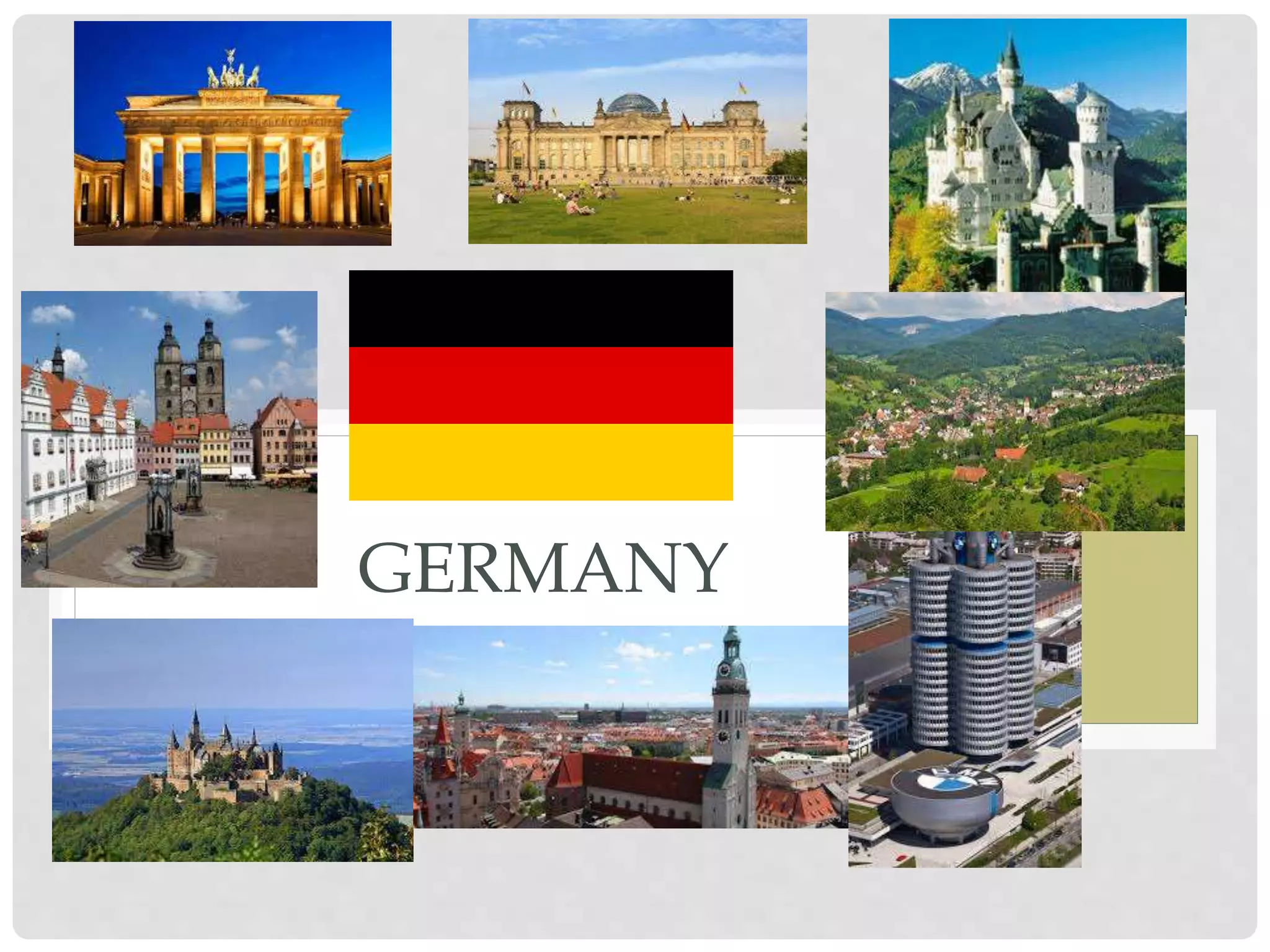
GERMANY
GERMANY: INTRODUCTION
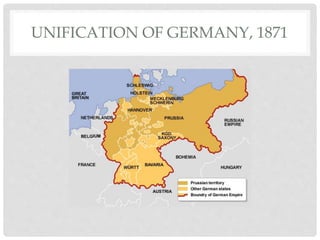
• The unification of Germany was achieved in 1871 under the leadership of Chancellor Otto von Bismarck,
who led the way for the establishment of the German Empire as a means of solving the Kleindeutsche
Lösung (“Lesser German solution”, i.e., Germany without Austria) or the Großdeutsche Lösung (“Greater
German solution”, i.e., Germany with Austria); the former succeeded.
• The new Reichstag, or Imperial Diet, only had a small role in the imperial government.
• Germany joined the other major world powers in expanding its territory to Africa and the Pacific; by the
end of the nineteenth century, it was the largest power in Europe.
• By 1900, its quickly growing industrial economy outdid Great Britain’s, leading to a naval race and an
belligerent foreign policy.
• Germany led the Central Powers during World War I (1914–1918) against France, Great Britain, Russia
(until March 1918), and the United States (from April 1917).
• In the wake of a humiliating defeat in November 1918, Germany was forced to accept full responsibility
for starting World War I; under the terms of the 1919 Treaty of Versailles, it was also required to pay war
reparations.
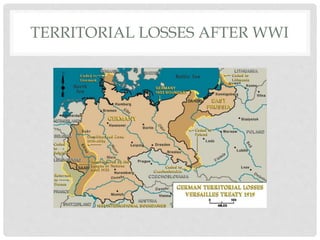
• After forty-seven years as a significant world power, Germany had to surrender its colonial possessions
as well as the Danzig corridor and Alsace-Lorraine.
• The German Revolution of 1918–19 overthrew Kaiser Wilhelm II, who later went into exile in the
Netherlands until his death in 1941, and the numerous kings and princes; the Weimar Republic was
established after the German Empire collapsed, but the newly established democracy faced many
problems, such as hyperinflation, political radicalism (with militias – both left and right), and tensions with
the victors of World War I.
UNIFICATION OF GERMANY, 1871
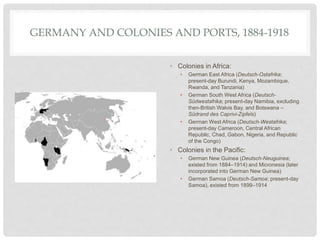
GERMANY AND COLONIES AND PORTS, 1884-1918
• Colonies in Africa:
• German East Africa (Deutsch-Ostafrika;
present-day Burundi, Kenya, Mozambique,
Rwanda, and Tanzania)
• German South West Africa (Deutsch-
Südwestafrika; present-day Namibia, excluding
then-British Walvis Bay, and Botswana –
Südrand des Caprivi-Zipfels)
• German West Africa (Deutsch-Westafrika;
present-day Cameroon, Central African
Republic, Chad, Gabon, Nigeria, and Republic
of the Congo)
• Colonies in the Pacific:
• German New Guinea (Deutsch-Neuguinea;
existed from 1884–1914) and Micronesia (later
incorporated into German New Guinea)
• German Samoa (Deutsch-Samoa; present-day
Samoa), existed from 1899–1914
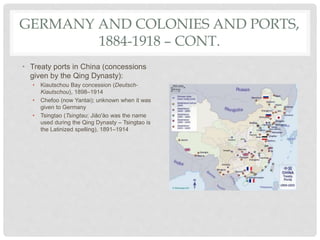
GERMANY AND COLONIES AND PORTS,
1884-1918 – CONT.
• Treaty ports in China (concessions
given by the Qing Dynasty):
• Kiautschou Bay concession (Deutsch-
Kiautschou), 1898–1914
• Chefoo (now Yantai); unknown when it was
given to Germany
• Tsingtao (Tsingtau; Jiāo'ào was the name
used during the Qing Dynasty – Tsingtao is
the Latinized spelling), 1891–1914
TERRITORIAL LOSSES AFTER WWI
GERMANY: INTRODUCTION – CONT.
• The worldwide Great Depression hit Germany hard in
the early 1930s; unemployment went up, and the
German people lost hope in the Weimar government.
• In January 1933, Adolf Hitler was appointed Chancellor;
the Nazi Party established a dictatorship and killed or
jailed their opponents.
• The Nazis outlawed all other political parties in July
1933.
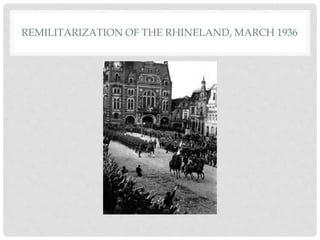
• The Nazi government’s foreign policy aspired to create a
Greater Germany (Großdeutschland), which led to the
remilitarization of the Rhineland in 1936 (which was
technically illegal under the Versailles Treaty), the
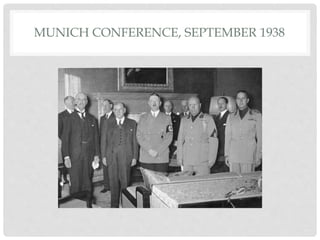
annexation (Anschluss) of Austria and parts of
Czechoslovakia with the Munich Agreement in 1938 (the
rest of the western half of Czechoslovakia was annexed
in 1939, while the eastern half would become a Nazi
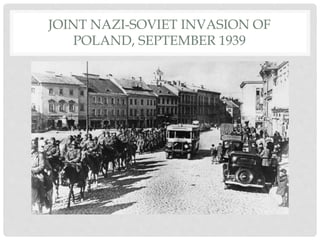
puppet government), and the invasion of Poland on 1
September 1939, marking the outbreak of World War II.
• After reaching a pact of neutrality with the Soviet Union a
week before the invasion of Poland, Hitler and Stalin
divided Eastern Europe.
REMILITARIZATION OF THE RHINELAND, MARCH 1936
MUNICH CONFERENCE, SEPTEMBER 1938
JOINT NAZI-SOVIET INVASION OF
POLAND, SEPTEMBER 1939
GERMANY: INTRODUCTION – CONT.
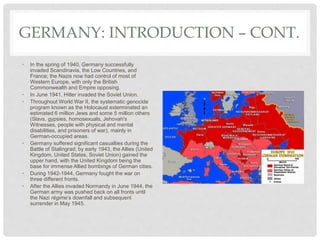
• In the spring of 1940, Germany successfully
invaded Scandinavia, the Low Countries, and
France; the Nazis now had control of most of
Western Europe, with only the British
Commonwealth and Empire opposing.
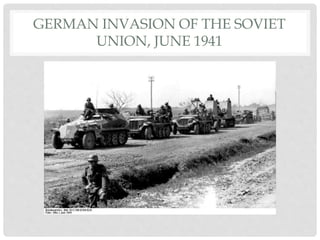
• In June 1941, Hitler invaded the Soviet Union.
• Throughout World War II, the systematic genocide
program known as the Holocaust exterminated an
estimated 6 million Jews and some 5 million others
(Slavs, gypsies, homosexuals, Jehovah's
Witnesses, people with physical and mental
disabilities, and prisoners of war), mainly in
German-occupied areas.
• Germany suffered significant casualties during the
Battle of Stalingrad; by early 1943, the Allies (United
Kingdom, United States, Soviet Union) gained the
upper hand, with the United Kingdom being the
base for immense Allied bombings of German cities.
• During 1942-1944, Germany fought the war on
three different fronts.
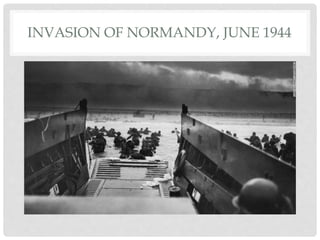
• After the Allies invaded Normandy in June 1944, the
German army was pushed back on all fronts until
the Nazi régime’s downfall and subsequent
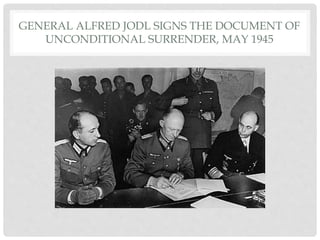
surrender in May 1945.
GERMAN INVASION OF THE SOVIET
UNION, JUNE 1941
INVASION OF NORMANDY, JUNE 1944
GENERAL ALFRED JODL SIGNS THE DOCUMENT OF
UNCONDITIONAL SURRENDER, MAY 1945
GERMANY: INTRODUCTION – CONT.
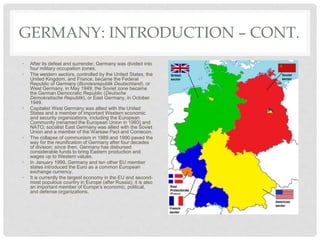
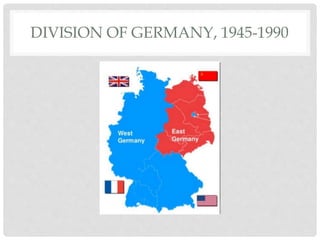
• After its defeat and surrender, Germany was divided into
four military occupation zones.
• The western sectors, controlled by the United States, the
United Kingdom, and France, became the Federal
Republic of Germany (Bundesrepublik Deutschland), or
West Germany, in May 1949; the Soviet zone became
the German Democratic Republic (Deutsche
Demokratische Republik), or East Germany, in October
1949.
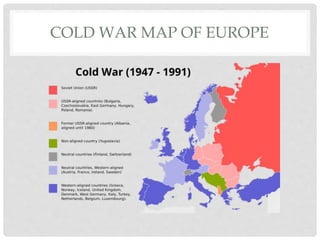
• Capitalist West Germany was allied with the United
States and a member of important Western economic
and security organizations, including the European
Community (renamed the European Union in 1993) and
NATO; socialist East Germany was allied with the Soviet
Union and a member of the Warsaw Pact and Comecon.
• The collapse of communism in 1989 and 1990 paved the
way for the reunification of Germany after four decades
of division; since then, Germany has disbursed
considerable funds to bring Eastern production and
wages up to Western values.
• In January 1999, Germany and ten other EU member
states introduced the Euro as a common European
exchange currency.
• It is currently the largest economy in the EU and second-
most populous country in Europe (after Russia); it is also
an important member of Europe’s economic, political,
and defense organizations.
DIVISION OF GERMANY, 1945-1990
COLD WAR MAP OF EUROPE
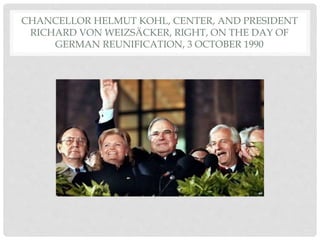
CHANCELLOR HELMUT KOHL, CENTER, AND PRESIDENT
RICHARD VON WEIZSÄCKER, RIGHT, ON THE DAY OF
GERMAN REUNIFICATION, 3 OCTOBER 1990
GERMANY: POLITICAL HISTORY FROM 1871 IN BRIEF
• 1871-1918: German Empire
• 1919-1933: Weimar Republic
• 1933-1945: Nazi Germany
• 1945-1990: Division
• 1990-present: Federal Republic of Germany
GERMANY: GEOGRAPHY
• Location: Central Europe, bordering the Baltic
and North Seas, between the Netherlands and
Poland, south of Denmark
• Geographic coordinates: 51 00 N, 9 00 E
• Area:
• Total: 357,022 sq km
• Land: 348,672 sq km
• Water: 8,350 sq km
• Country comparison to the world: 64
• Area – comparative: three times the size of
Pennsylvania; slightly smaller than Montana
• Land boundaries: 3,714 km
• Border countries (9): Austria 801 km, Belgium
133 km, Czech Republic 704 km, Denmark 140
km, France 418 km, Luxembourg 128 km,
Netherlands 575 km, Poland 467 km,
Switzerland 348 km
GERMANY: GEOGRAPHY – CONT.
• Coastline: 2,389 km
• Maritime claims:
• Territorial claims: 12 nm
• Exclusive economic zone: 200 nm
• Continental shelf: 200-m depth or to the depth of exploitation
• Climate: temperate and marine; cool, cloudy, wet winters and summers; occasional warm
mountain (foehn) wind
• Terrain: lowlands in north, uplands in center, Bavarian Alps in south
• Elevation:
• Mean elevation: 263 m
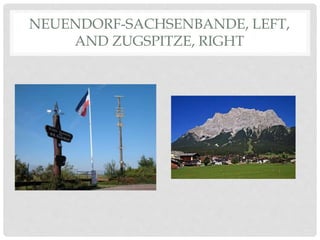
• Elevation extremes: lowest point: Neuendorf bei Wilster (3.5 m); highest point: Zugspitze 2,963
m
• Natural resources: coal, lignite, natural gas, iron ore, copper, nickel, uranium, potash, salt,
construction materials, timber, arable land
• Land use:
• Agricultural land: 48% (arable land 34.1%; permanent crops 0.6%; permanent pasture 13.3%)
• Forest: 31.8%
• Other: 20.2% (2011 estimation)
• Irrigated land: 6,500 sq km (2012)
NEUENDORF-SACHSENBANDE, LEFT,
AND ZUGSPITZE, RIGHT
GERMANY: DEMOGRAPHICS
• Population: 80,594,017 (July 2017 est.)
• Country comparison to the world: 19
• Nationality:
• Noun: German(s)
• Adjective: German
• Ethnic groups: German 91.5%, Turkish 2.4%, other 6.1% (made up mostly of Polish, Italian,
Romanian, Syrian, and Greek)
• Language(s): German (official; note: Danish, Frisian, Sorbian, and Romani are official minority
languages; Low German, Danish, North Frisian, Sater Frisian, Lower Sorbian, Upper Sorbian, and
Romani are recognized as regional languages under the European Charter for Regional or
Minority Languages)
• Religions: Roman Catholic 29%, Lutheran 27%, Muslim 4.4%, Orthodox Christian 1.9% none or
members of unrecorded religious groups 36% (2015 est.)
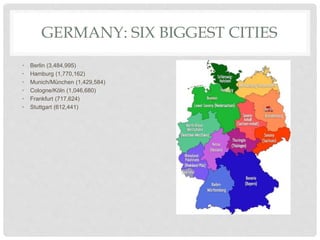
GERMANY: SIX BIGGEST CITIES
• Berlin (3,484,995)
• Hamburg (1,770,162)
• Munich/München (1,429,584)
• Cologne/Köln (1,046,680)
• Frankfurt (717,624)
• Stuttgart (612,441)
GERMANY: DEMOGRAPHICS – CONT.
• Official name: Federal Republic of Germany
(Bundesrepublik Deutschland)
• Etymology: the Gauls (Celts) of Western Europe
may have referred to the newly arriving Germanic
tribes who established residence in adjacent areas
east of the Rhine during the first centuries B.C. as
"Germani," a term the Romans assumed as
"Germania"; the native name Deutsch comes from
the Old High German "diutisc" meaning "of the
people“
• Form of government: Federal parliamentary
republic
• Capital: Berlin
• Geographic coordinates: 52 31 N, 13 24 E
• Time difference: UTC+1 (six hours ahead of
Washington, D.C., during Standard Time)
• Daylight savings time: +1hr, begins last Sunday in
March; ends last Sunday in October
GERMANY: DEMOGRAPHICS – CONT.
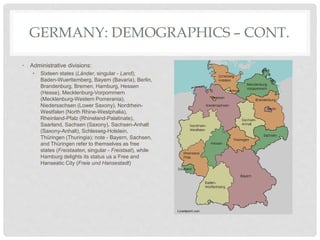
• Administrative divisions:
• Sixteen states (Länder, singular - Land);
Baden-Wuerttemberg, Bayern (Bavaria), Berlin,
Brandenburg, Bremen, Hamburg, Hessen
(Hesse), Mecklenburg-Vorpommern
(Mecklenburg-Western Pomerania),
Niedersachsen (Lower Saxony), Nordrhein-
Westfalen (North Rhine-Westphalia),
Rheinland-Pfalz (Rhineland-Palatinate),
Saarland, Sachsen (Saxony), Sachsen-Anhalt
(Saxony-Anhalt), Schleswig-Holstein,
Thüringen (Thuringia); note - Bayern, Sachsen,
and Thüringen refer to themselves as free
states (Freistaaten, singular - Freistaat), while
Hamburg delights its status us a Free and
Hanseatic City (Freie und Hansestadt)
GERMANY: DEMOGRAPHICS – CONT.
• Independence:
• 18 January 1871 (establishment of the German Empire); divided into four zones of occupation (UK, U.S.,
U.S.S.R., and France) in 1945 following World War II; Federal Republic of Germany (FRG/BRD or West
Germany) proclaimed on 23 May 1949 and included the former British, American, and French zones; German
Democratic Republic (GDR/DDR or East Germany) proclaimed on 7 October 1949 and included the former
Soviet zone; West Germany and East Germany unified on 3 October 1990; all four powers officially withdrew
rights on 15 March 1991; noteworthy prior dates: 10 August 843 (Eastern Francia established from the
division of the Carolingian Empire); 2 February 962 (crowning of OTTO I, recognized as the first Holy Roman
Emperor)
• National holiday: Unity Day (Tag der Deutschen Einheit), 3 October (1990)
• Constitution:
• History: previous was in 1919 (Weimar Constitution); newest (the West German Constitution) was drawn up in
August 1948, approved 12 May 1949, and went into effect 24 May 1949
• Amendments: recommended by Parliament; passage and enactment into law require two-thirds majority vote
by both the Bundesrat (upper house) and the Bundestag (lower house) of Parliament; articles including those
on basic human rights and freedoms cannot be revised (these articles have, however, been revised many
times, most recently in 2012)(2016)
• Legal system: Civil law system
• International law organization participation: accepts obligatory ICJ jurisdiction with
misgivings; accepts ICC jurisdiction
GERMANY: DEMOGRAPHICS – CONT.
• Citizenship
• Citizenship by birth: no
• Citizenship by descent only: at least one parent must be a citizen of Germany or a resident
alien who has lived in Germany no less than eight years
• Dual citizenship recognized: yes, but requires prior government consent
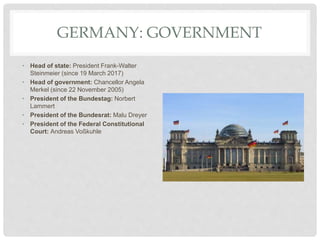
GERMANY: GOVERNMENT
• Head of state: President Frank-Walter
Steinmeier (since 19 March 2017)
• Head of government: Chancellor Angela
Merkel (since 22 November 2005)
• President of the Bundestag: Norbert
Lammert
• President of the Bundesrat: Malu Dreyer
• President of the Federal Constitutional
Court: Andreas Voßkuhle
GERMANY: POLITICAL PARTIES
REPRESENTED IN PARLIAMENT
• Christian Democratic Union of Germany
(Christlich Demokratische Union Deutschlands,
CDU)
• Christian Social Union in Bavaria (Christlich-
Soziale Union in Bayern, CSU)
• Social Democratic Party of Germany
(Sozialdemokratische Partei Deutschlands,
SPD)
• The Left (Die Linke, LINKE)
• Alliance ’90/The Greens (Bündnis 90/Die
Grünen, GRÜNE)
• Liberal Conservative Reformers (Liberal-
Konservative Reformer, LKR)
• Free Democratic Party (Freie Demokratische
Partei, FDP)
• Alternative for Germany (Alternative für
Deutschland, AfD)
• Free Voters (Freie Wähler, FREIE WÄHLER)
• Pirate Party Germany (Piratenpartei
Deutschland, PIRATEN)
• National Democratic Party of Germany
(Nationaldemokratische Partei
Deutschlands, NPD)
• Family Party of Germany (Familien-Partei
Deutschlands, FAMILIE)
• Ecological Democratic Party (Ökologisch-
Demokratische Partei, ÖDP)
• Die PARTEI (Partei für Arbeit, Rechtsstaat,
Tierschutz, Elitenförderung und
basisdemokratische Initiative, Die PARTEI )
GERMANY: PARTICIPATION IN
INTERNATIONAL ORGANIZATIONS
• ADB (nonregional member), AfDB (nonregional member), Arctic Council (observer), Australia Group, BIS,
BSEC (observer), CBSS, CD, CDB, CE, CERN, EAPC, EBRD, ECB, EIB, EITI (implementing country),
EMU, ESA, EU, FAO, FATF, G-5, G-7, G-8, G-10, G-20, IADB, IAEA, IBRD, ICAO, ICC (national
committees), ICCT, ICRM, IDA, IEA, IFAD, IFC, IFRCS, IGAD (partners), IHO, ILO, IMF, IMO, IMSO,
Interpol, IOC, IOM, IPU, ISO, ITSO, ITU, ITUC (NGOs), MIGA, MINURSO, MINUSMA, NATO, NEA,
NSG, OAS (observer), OECD, OPCW, OSCE, Pacific Alliance (observer), Paris Club, PCA, Schengen
Convention, SELEC (observer), SICA (observer), UN, UNAMID, UNCTAD, UNESCO, UNHCR, UNIDO,
UNIFIL, UNMISS, UNRWA, UNWTO, UPU, WCO, WHO, WIPO, WMO, WTO, ZC
GERMANY: FLAG
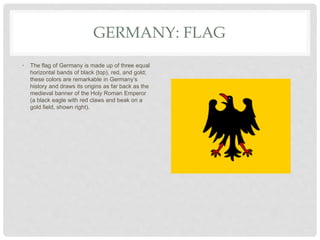
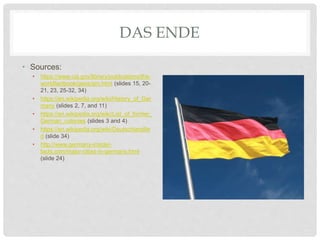
• The flag of Germany is made up of three equal
horizontal bands of black (top), red, and gold;
these colors are remarkable in Germany’s
history and draws its origins as far back as the
medieval banner of the Holy Roman Emperor
(a black eagle with red claws and beak on a
gold field, shown right).
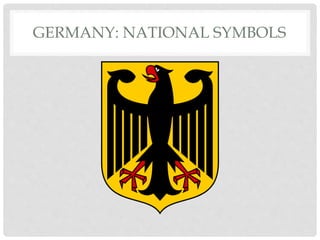
GERMANY: NATIONAL SYMBOLS
GERMANY: NATIONAL ANTHEM
• Name: "Das Lied der Deutschen" (" The Song of the Germans")
• Lyrics and music: August Heinrich Hoffmann von Fallersleben; Franz Joseph Haydn
• Note: adopted in 1922; also known as "Deutschlandlied“ (“Song of Germany“), it was originally adopted because
of its association with the March 1848 revolution. The Nazis used the first verse as the country’s anthem; it was
banned in 1945 due to its nationalist sentiment. In 1952, the West German government adopted the third verse as
their national anthem. In 1990, it became the national anthem of reunified Germany.
• Lyrics of the third verse:
• Einigkeit und Recht und Freiheit
Für das deutsche Vaterland!
Danach lasst uns alle streben
Brüderlich mit Herz und Hand!
Einigkeit und Recht und Freiheit
Sind des Glückes Unterpfand;
|: Blüh' im Glanze dieses Glückes,
Blühe, deutsches Vaterland! :|
• Translation:
• Unity and justice and freedom
For the German fatherland!
Towards these let us all strive
Brotherly with heart and hand!
Unity and justice and freedom
Are the foundation of happiness;
|: Flourish in the radiance of this happiness,
Flourish, German fatherland! :|
DAS ENDE
• Sources:
• https://www.cia.gov/library/publications/the-
worldfactbook/geos/gm.html (slides 15, 20-
21, 23, 25-32, 34)
• https://en.wikipedia.org/wiki/History_of_Ger
many (slides 2, 7, and 11)
• https://en.wikipedia.org/wiki/List_of_former_
German_colonies (slides 3 and 4)
• https://en.wikipedia.org/wiki/Deutschlandlie
d (slide 34)
• http://www.germany-insider-
facts.com/major-cities-in-germany.html
(slide 24)

GERMANY

  • 1.
  • 2.
    GERMANY: INTRODUCTION • Theunification of Germany was achieved in 1871 under the leadership of Chancellor Otto von Bismarck, who led the way for the establishment of the German Empire as a means of solving the Kleindeutsche Lösung (“Lesser German solution”, i.e., Germany without Austria) or the Großdeutsche Lösung (“Greater German solution”, i.e., Germany with Austria); the former succeeded. • The new Reichstag, or Imperial Diet, only had a small role in the imperial government. • Germany joined the other major world powers in expanding its territory to Africa and the Pacific; by the end of the nineteenth century, it was the largest power in Europe. • By 1900, its quickly growing industrial economy outdid Great Britain’s, leading to a naval race and an belligerent foreign policy. • Germany led the Central Powers during World War I (1914–1918) against France, Great Britain, Russia (until March 1918), and the United States (from April 1917). • In the wake of a humiliating defeat in November 1918, Germany was forced to accept full responsibility for starting World War I; under the terms of the 1919 Treaty of Versailles, it was also required to pay war reparations. • After forty-seven years as a significant world power, Germany had to surrender its colonial possessions as well as the Danzig corridor and Alsace-Lorraine. • The German Revolution of 1918–19 overthrew Kaiser Wilhelm II, who later went into exile in the Netherlands until his death in 1941, and the numerous kings and princes; the Weimar Republic was established after the German Empire collapsed, but the newly established democracy faced many problems, such as hyperinflation, political radicalism (with militias – both left and right), and tensions with the victors of World War I.
  • 3.
  • 4.
    GERMANY AND COLONIESAND PORTS, 1884-1918 • Colonies in Africa: • German East Africa (Deutsch-Ostafrika; present-day Burundi, Kenya, Mozambique, Rwanda, and Tanzania) • German South West Africa (Deutsch- Südwestafrika; present-day Namibia, excluding then-British Walvis Bay, and Botswana – Südrand des Caprivi-Zipfels) • German West Africa (Deutsch-Westafrika; present-day Cameroon, Central African Republic, Chad, Gabon, Nigeria, and Republic of the Congo) • Colonies in the Pacific: • German New Guinea (Deutsch-Neuguinea; existed from 1884–1914) and Micronesia (later incorporated into German New Guinea) • German Samoa (Deutsch-Samoa; present-day Samoa), existed from 1899–1914
  • 5.
    GERMANY AND COLONIESAND PORTS, 1884-1918 – CONT. • Treaty ports in China (concessions given by the Qing Dynasty): • Kiautschou Bay concession (Deutsch- Kiautschou), 1898–1914 • Chefoo (now Yantai); unknown when it was given to Germany • Tsingtao (Tsingtau; Jiāo'ào was the name used during the Qing Dynasty – Tsingtao is the Latinized spelling), 1891–1914
  • 6.
  • 7.
    GERMANY: INTRODUCTION –CONT. • The worldwide Great Depression hit Germany hard in the early 1930s; unemployment went up, and the German people lost hope in the Weimar government. • In January 1933, Adolf Hitler was appointed Chancellor; the Nazi Party established a dictatorship and killed or jailed their opponents. • The Nazis outlawed all other political parties in July 1933. • The Nazi government’s foreign policy aspired to create a Greater Germany (Großdeutschland), which led to the remilitarization of the Rhineland in 1936 (which was technically illegal under the Versailles Treaty), the annexation (Anschluss) of Austria and parts of Czechoslovakia with the Munich Agreement in 1938 (the rest of the western half of Czechoslovakia was annexed in 1939, while the eastern half would become a Nazi puppet government), and the invasion of Poland on 1 September 1939, marking the outbreak of World War II. • After reaching a pact of neutrality with the Soviet Union a week before the invasion of Poland, Hitler and Stalin divided Eastern Europe.
  • 8.
    REMILITARIZATION OF THERHINELAND, MARCH 1936
  • 9.
  • 10.
    JOINT NAZI-SOVIET INVASIONOF POLAND, SEPTEMBER 1939
  • 11.
    GERMANY: INTRODUCTION –CONT. • In the spring of 1940, Germany successfully invaded Scandinavia, the Low Countries, and France; the Nazis now had control of most of Western Europe, with only the British Commonwealth and Empire opposing. • In June 1941, Hitler invaded the Soviet Union. • Throughout World War II, the systematic genocide program known as the Holocaust exterminated an estimated 6 million Jews and some 5 million others (Slavs, gypsies, homosexuals, Jehovah's Witnesses, people with physical and mental disabilities, and prisoners of war), mainly in German-occupied areas. • Germany suffered significant casualties during the Battle of Stalingrad; by early 1943, the Allies (United Kingdom, United States, Soviet Union) gained the upper hand, with the United Kingdom being the base for immense Allied bombings of German cities. • During 1942-1944, Germany fought the war on three different fronts. • After the Allies invaded Normandy in June 1944, the German army was pushed back on all fronts until the Nazi régime’s downfall and subsequent surrender in May 1945.
  • 12.
    GERMAN INVASION OFTHE SOVIET UNION, JUNE 1941
  • 13.
  • 14.
    GENERAL ALFRED JODLSIGNS THE DOCUMENT OF UNCONDITIONAL SURRENDER, MAY 1945
  • 15.
    GERMANY: INTRODUCTION –CONT. • After its defeat and surrender, Germany was divided into four military occupation zones. • The western sectors, controlled by the United States, the United Kingdom, and France, became the Federal Republic of Germany (Bundesrepublik Deutschland), or West Germany, in May 1949; the Soviet zone became the German Democratic Republic (Deutsche Demokratische Republik), or East Germany, in October 1949. • Capitalist West Germany was allied with the United States and a member of important Western economic and security organizations, including the European Community (renamed the European Union in 1993) and NATO; socialist East Germany was allied with the Soviet Union and a member of the Warsaw Pact and Comecon. • The collapse of communism in 1989 and 1990 paved the way for the reunification of Germany after four decades of division; since then, Germany has disbursed considerable funds to bring Eastern production and wages up to Western values. • In January 1999, Germany and ten other EU member states introduced the Euro as a common European exchange currency. • It is currently the largest economy in the EU and second- most populous country in Europe (after Russia); it is also an important member of Europe’s economic, political, and defense organizations.
  • 16.
  • 17.
    COLD WAR MAPOF EUROPE
  • 18.
    CHANCELLOR HELMUT KOHL,CENTER, AND PRESIDENT RICHARD VON WEIZSÄCKER, RIGHT, ON THE DAY OF GERMAN REUNIFICATION, 3 OCTOBER 1990
  • 19.
    GERMANY: POLITICAL HISTORYFROM 1871 IN BRIEF • 1871-1918: German Empire • 1919-1933: Weimar Republic • 1933-1945: Nazi Germany • 1945-1990: Division • 1990-present: Federal Republic of Germany
  • 20.
    GERMANY: GEOGRAPHY • Location:Central Europe, bordering the Baltic and North Seas, between the Netherlands and Poland, south of Denmark • Geographic coordinates: 51 00 N, 9 00 E • Area: • Total: 357,022 sq km • Land: 348,672 sq km • Water: 8,350 sq km • Country comparison to the world: 64 • Area – comparative: three times the size of Pennsylvania; slightly smaller than Montana • Land boundaries: 3,714 km • Border countries (9): Austria 801 km, Belgium 133 km, Czech Republic 704 km, Denmark 140 km, France 418 km, Luxembourg 128 km, Netherlands 575 km, Poland 467 km, Switzerland 348 km
  • 21.
    GERMANY: GEOGRAPHY –CONT. • Coastline: 2,389 km • Maritime claims: • Territorial claims: 12 nm • Exclusive economic zone: 200 nm • Continental shelf: 200-m depth or to the depth of exploitation • Climate: temperate and marine; cool, cloudy, wet winters and summers; occasional warm mountain (foehn) wind • Terrain: lowlands in north, uplands in center, Bavarian Alps in south • Elevation: • Mean elevation: 263 m • Elevation extremes: lowest point: Neuendorf bei Wilster (3.5 m); highest point: Zugspitze 2,963 m • Natural resources: coal, lignite, natural gas, iron ore, copper, nickel, uranium, potash, salt, construction materials, timber, arable land • Land use: • Agricultural land: 48% (arable land 34.1%; permanent crops 0.6%; permanent pasture 13.3%) • Forest: 31.8% • Other: 20.2% (2011 estimation) • Irrigated land: 6,500 sq km (2012)
  • 22.
  • 23.
    GERMANY: DEMOGRAPHICS • Population:80,594,017 (July 2017 est.) • Country comparison to the world: 19 • Nationality: • Noun: German(s) • Adjective: German • Ethnic groups: German 91.5%, Turkish 2.4%, other 6.1% (made up mostly of Polish, Italian, Romanian, Syrian, and Greek) • Language(s): German (official; note: Danish, Frisian, Sorbian, and Romani are official minority languages; Low German, Danish, North Frisian, Sater Frisian, Lower Sorbian, Upper Sorbian, and Romani are recognized as regional languages under the European Charter for Regional or Minority Languages) • Religions: Roman Catholic 29%, Lutheran 27%, Muslim 4.4%, Orthodox Christian 1.9% none or members of unrecorded religious groups 36% (2015 est.)
  • 24.
    GERMANY: SIX BIGGESTCITIES • Berlin (3,484,995) • Hamburg (1,770,162) • Munich/München (1,429,584) • Cologne/Köln (1,046,680) • Frankfurt (717,624) • Stuttgart (612,441)
  • 25.
    GERMANY: DEMOGRAPHICS –CONT. • Official name: Federal Republic of Germany (Bundesrepublik Deutschland) • Etymology: the Gauls (Celts) of Western Europe may have referred to the newly arriving Germanic tribes who established residence in adjacent areas east of the Rhine during the first centuries B.C. as "Germani," a term the Romans assumed as "Germania"; the native name Deutsch comes from the Old High German "diutisc" meaning "of the people“ • Form of government: Federal parliamentary republic • Capital: Berlin • Geographic coordinates: 52 31 N, 13 24 E • Time difference: UTC+1 (six hours ahead of Washington, D.C., during Standard Time) • Daylight savings time: +1hr, begins last Sunday in March; ends last Sunday in October
  • 26.
    GERMANY: DEMOGRAPHICS –CONT. • Administrative divisions: • Sixteen states (Länder, singular - Land); Baden-Wuerttemberg, Bayern (Bavaria), Berlin, Brandenburg, Bremen, Hamburg, Hessen (Hesse), Mecklenburg-Vorpommern (Mecklenburg-Western Pomerania), Niedersachsen (Lower Saxony), Nordrhein- Westfalen (North Rhine-Westphalia), Rheinland-Pfalz (Rhineland-Palatinate), Saarland, Sachsen (Saxony), Sachsen-Anhalt (Saxony-Anhalt), Schleswig-Holstein, Thüringen (Thuringia); note - Bayern, Sachsen, and Thüringen refer to themselves as free states (Freistaaten, singular - Freistaat), while Hamburg delights its status us a Free and Hanseatic City (Freie und Hansestadt)
  • 27.
    GERMANY: DEMOGRAPHICS –CONT. • Independence: • 18 January 1871 (establishment of the German Empire); divided into four zones of occupation (UK, U.S., U.S.S.R., and France) in 1945 following World War II; Federal Republic of Germany (FRG/BRD or West Germany) proclaimed on 23 May 1949 and included the former British, American, and French zones; German Democratic Republic (GDR/DDR or East Germany) proclaimed on 7 October 1949 and included the former Soviet zone; West Germany and East Germany unified on 3 October 1990; all four powers officially withdrew rights on 15 March 1991; noteworthy prior dates: 10 August 843 (Eastern Francia established from the division of the Carolingian Empire); 2 February 962 (crowning of OTTO I, recognized as the first Holy Roman Emperor) • National holiday: Unity Day (Tag der Deutschen Einheit), 3 October (1990) • Constitution: • History: previous was in 1919 (Weimar Constitution); newest (the West German Constitution) was drawn up in August 1948, approved 12 May 1949, and went into effect 24 May 1949 • Amendments: recommended by Parliament; passage and enactment into law require two-thirds majority vote by both the Bundesrat (upper house) and the Bundestag (lower house) of Parliament; articles including those on basic human rights and freedoms cannot be revised (these articles have, however, been revised many times, most recently in 2012)(2016) • Legal system: Civil law system • International law organization participation: accepts obligatory ICJ jurisdiction with misgivings; accepts ICC jurisdiction
  • 28.
    GERMANY: DEMOGRAPHICS –CONT. • Citizenship • Citizenship by birth: no • Citizenship by descent only: at least one parent must be a citizen of Germany or a resident alien who has lived in Germany no less than eight years • Dual citizenship recognized: yes, but requires prior government consent
  • 29.
    GERMANY: GOVERNMENT • Headof state: President Frank-Walter Steinmeier (since 19 March 2017) • Head of government: Chancellor Angela Merkel (since 22 November 2005) • President of the Bundestag: Norbert Lammert • President of the Bundesrat: Malu Dreyer • President of the Federal Constitutional Court: Andreas Voßkuhle
  • 30.
    GERMANY: POLITICAL PARTIES REPRESENTEDIN PARLIAMENT • Christian Democratic Union of Germany (Christlich Demokratische Union Deutschlands, CDU) • Christian Social Union in Bavaria (Christlich- Soziale Union in Bayern, CSU) • Social Democratic Party of Germany (Sozialdemokratische Partei Deutschlands, SPD) • The Left (Die Linke, LINKE) • Alliance ’90/The Greens (Bündnis 90/Die Grünen, GRÜNE) • Liberal Conservative Reformers (Liberal- Konservative Reformer, LKR) • Free Democratic Party (Freie Demokratische Partei, FDP) • Alternative for Germany (Alternative für Deutschland, AfD) • Free Voters (Freie Wähler, FREIE WÄHLER) • Pirate Party Germany (Piratenpartei Deutschland, PIRATEN) • National Democratic Party of Germany (Nationaldemokratische Partei Deutschlands, NPD) • Family Party of Germany (Familien-Partei Deutschlands, FAMILIE) • Ecological Democratic Party (Ökologisch- Demokratische Partei, ÖDP) • Die PARTEI (Partei für Arbeit, Rechtsstaat, Tierschutz, Elitenförderung und basisdemokratische Initiative, Die PARTEI )
  • 31.
    GERMANY: PARTICIPATION IN INTERNATIONALORGANIZATIONS • ADB (nonregional member), AfDB (nonregional member), Arctic Council (observer), Australia Group, BIS, BSEC (observer), CBSS, CD, CDB, CE, CERN, EAPC, EBRD, ECB, EIB, EITI (implementing country), EMU, ESA, EU, FAO, FATF, G-5, G-7, G-8, G-10, G-20, IADB, IAEA, IBRD, ICAO, ICC (national committees), ICCT, ICRM, IDA, IEA, IFAD, IFC, IFRCS, IGAD (partners), IHO, ILO, IMF, IMO, IMSO, Interpol, IOC, IOM, IPU, ISO, ITSO, ITU, ITUC (NGOs), MIGA, MINURSO, MINUSMA, NATO, NEA, NSG, OAS (observer), OECD, OPCW, OSCE, Pacific Alliance (observer), Paris Club, PCA, Schengen Convention, SELEC (observer), SICA (observer), UN, UNAMID, UNCTAD, UNESCO, UNHCR, UNIDO, UNIFIL, UNMISS, UNRWA, UNWTO, UPU, WCO, WHO, WIPO, WMO, WTO, ZC
  • 32.
    GERMANY: FLAG • Theflag of Germany is made up of three equal horizontal bands of black (top), red, and gold; these colors are remarkable in Germany’s history and draws its origins as far back as the medieval banner of the Holy Roman Emperor (a black eagle with red claws and beak on a gold field, shown right).
  • 33.
  • 34.
    GERMANY: NATIONAL ANTHEM •Name: "Das Lied der Deutschen" (" The Song of the Germans") • Lyrics and music: August Heinrich Hoffmann von Fallersleben; Franz Joseph Haydn • Note: adopted in 1922; also known as "Deutschlandlied“ (“Song of Germany“), it was originally adopted because of its association with the March 1848 revolution. The Nazis used the first verse as the country’s anthem; it was banned in 1945 due to its nationalist sentiment. In 1952, the West German government adopted the third verse as their national anthem. In 1990, it became the national anthem of reunified Germany. • Lyrics of the third verse: • Einigkeit und Recht und Freiheit Für das deutsche Vaterland! Danach lasst uns alle streben Brüderlich mit Herz und Hand! Einigkeit und Recht und Freiheit Sind des Glückes Unterpfand; |: Blüh' im Glanze dieses Glückes, Blühe, deutsches Vaterland! :| • Translation: • Unity and justice and freedom For the German fatherland! Towards these let us all strive Brotherly with heart and hand! Unity and justice and freedom Are the foundation of happiness; |: Flourish in the radiance of this happiness, Flourish, German fatherland! :|
  • 35.
    DAS ENDE • Sources: •https://www.cia.gov/library/publications/the- worldfactbook/geos/gm.html (slides 15, 20- 21, 23, 25-32, 34) • https://en.wikipedia.org/wiki/History_of_Ger many (slides 2, 7, and 11) • https://en.wikipedia.org/wiki/List_of_former_ German_colonies (slides 3 and 4) • https://en.wikipedia.org/wiki/Deutschlandlie d (slide 34) • http://www.germany-insider- facts.com/major-cities-in-germany.html (slide 24)