Page | 1
Proactive By Design.
Our Company Commitment
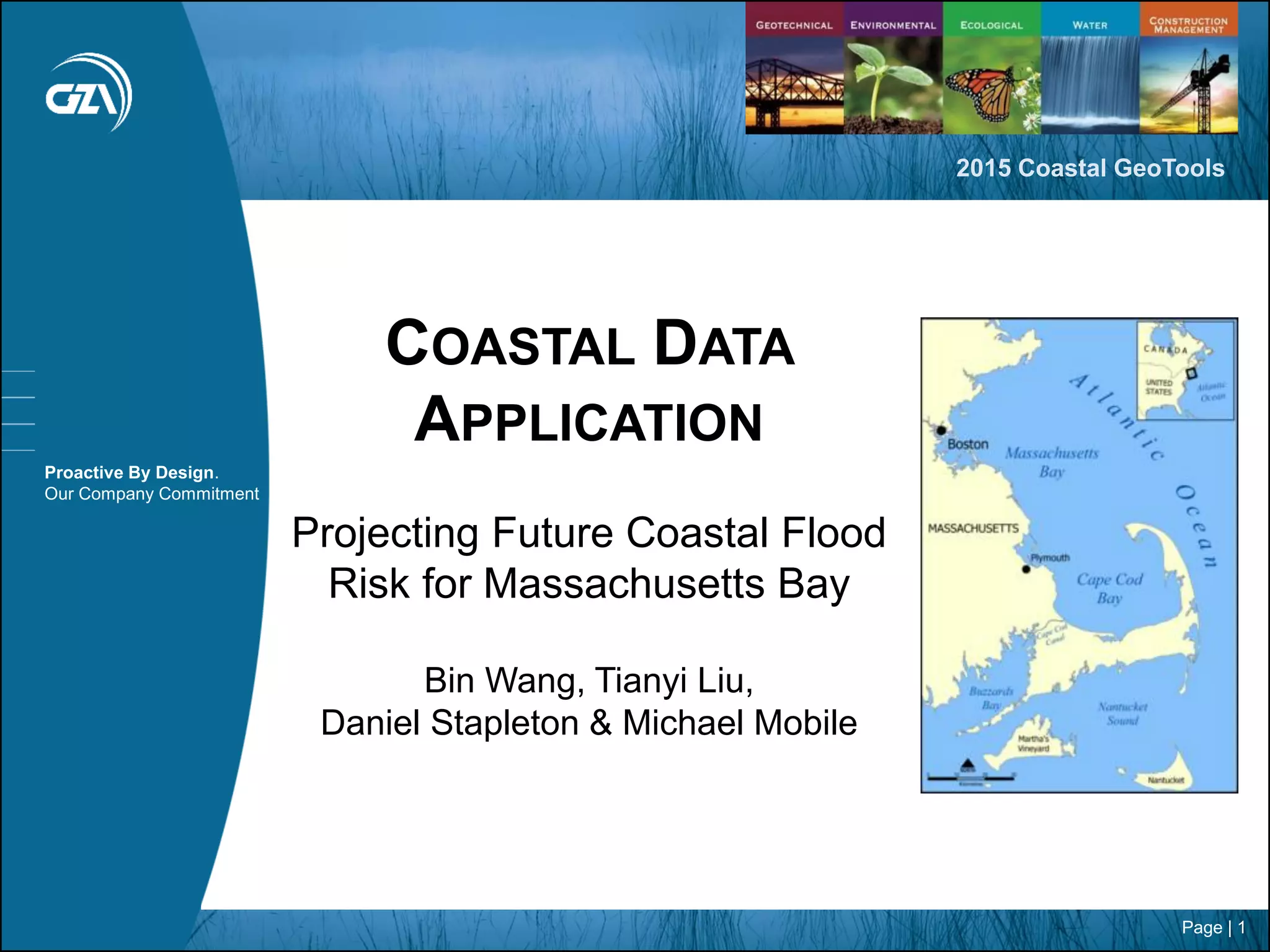
COASTAL DATA
APPLICATION
Projecting Future Coastal Flood
Risk for Massachusetts Bay
Bin Wang, Tianyi Liu,
Daniel Stapleton & Michael Mobile
2015 Coastal GeoTools
Page | 2
 Overview of available data sources for coastal and
water resource engineers
 Overview of numerical hydrodynamic modeling
Outline
Objective: to present method and steps for site-specific
coastal flood hazard analysis
• Small budget
• Relatively short project schedule
• Use of published data by USACE NACCS and
other government agencies
Page | 3
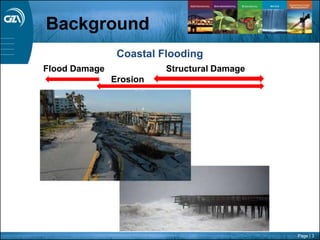
Background
Coastal Flooding
Erosion
Flood Damage Structural Damage
Page | 4
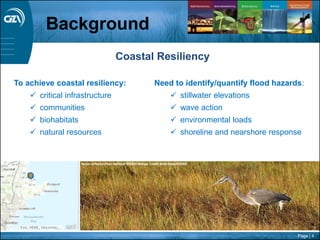
Background
Need to identify/quantify flood hazards:
 stillwater elevations
 wave action
 environmental loads
 shoreline and nearshore response
To achieve coastal resiliency:
 critical infrastructure
 communities
 biohabitats
 natural resources
Coastal Resiliency
Page | 5
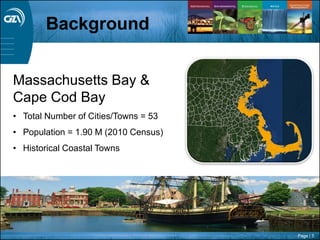
Massachusetts Bay &
Cape Cod Bay
• Total Number of Cities/Towns = 53
• Population = 1.90 M (2010 Census)
• Historical Coastal Towns
Background
Page | 6
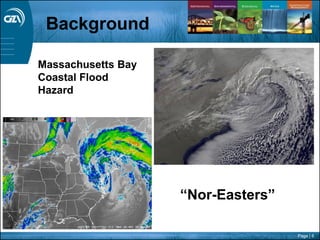
Massachusetts Bay
Coastal Flood
Hazard
Background
“Nor-Easters”
Page | 7
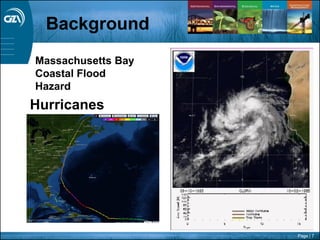
Hurricanes
Background
Massachusetts Bay
Coastal Flood
Hazard
Page | 8
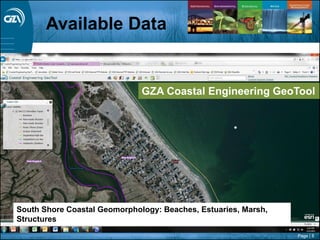
Available Data
South Shore Coastal Geomorphology: Beaches, Estuaries, Marsh,
Structures
GZA Coastal Engineering GeoTool
Page | 9
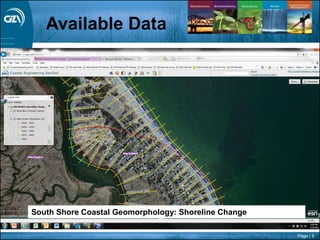
Available Data
South Shore Coastal Geomorphology: Shoreline Change
Page | 10
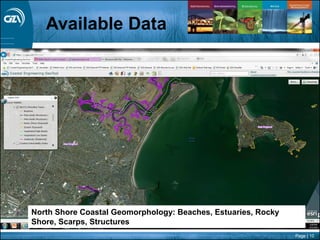
Available Data
North Shore Coastal Geomorphology: Beaches, Estuaries, Rocky
Shore, Scarps, Structures
Page | 11
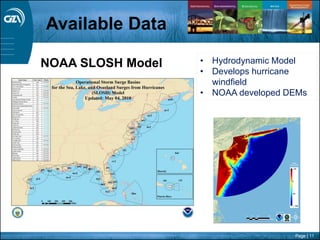
NOAA SLOSH Model • Hydrodynamic Model
• Develops hurricane
windfield
• NOAA developed DEMs
Available Data
Page | 12
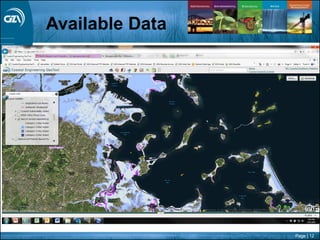
Available Data
Page | 13
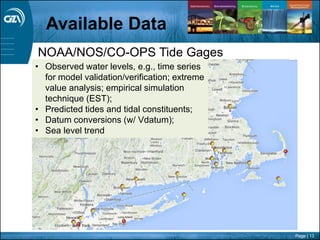
NOAA/NOS/CO-OPS Tide Gages
• Observed water levels, e.g., time series
for model validation/verification; extreme
value analysis; empirical simulation
technique (EST);
• Predicted tides and tidal constituents;
• Datum conversions (w/ Vdatum);
• Sea level trend
Available Data
Page | 14
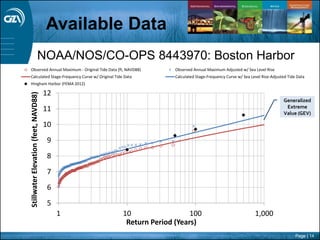
NOAA/NOS/CO-OPS 8443970: Boston Harbor
5
6
7
8
9
10
11
12
1 10 100 1,000
StillwaterElevation(feet,NAVD88)
Return Period (Years)
Observed Annual Maximum - Original Tide Data (ft, NAVD88) Observed Annual Maximum Adjusted w/ Sea Level Rise
Calculated Stage-Frequency Curve w/ Original Tide Data Calculated Stage-Frequency Curve w/ Sea Level Rise-Adjusted Tide Data
Hingham Harbor (FEMA 2012)
Generalized
Extreme
Value (GEV)
Available Data
Page | 15
Available Data
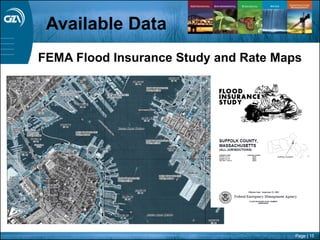
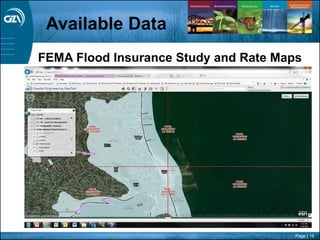
FEMA Flood Insurance Study and Rate Maps
Page | 16
Available Data
FEMA Flood Insurance Study and Rate Maps
Page | 17
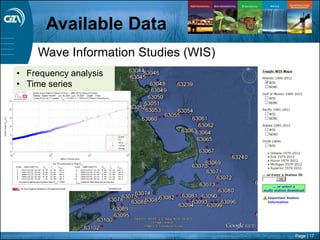
Wave Information Studies (WIS)
• Frequency analysis
• Time series
Available Data
Page | 18
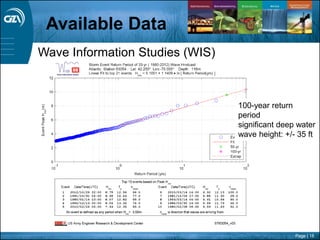
Wave Information Studies (WIS)
100-year return
period
significant deep water
wave height: +/- 35 ft
Available Data
Page | 19
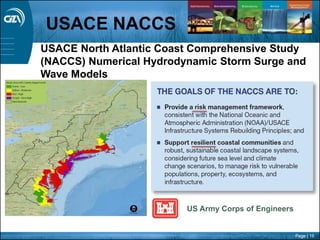
USACE North Atlantic Coast Comprehensive Study
(NACCS) Numerical Hydrodynamic Storm Surge and
Wave Models
USACE NACCS
Page | 20
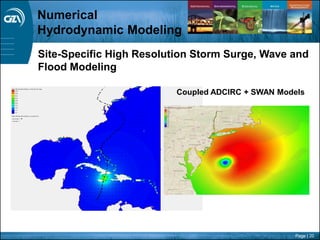
Site-Specific High Resolution Storm Surge, Wave and
Flood Modeling
Coupled ADCIRC + SWAN Models
Numerical
Hydrodynamic Modeling
Page | 21
• NOAA or State GIS topographic &
hydrographic data layers (DEM)
• National or state land cover database
• NOAA COOPS tide gages – water levels
and other data;
• USACE Wave Information System (WIS)
– wave & wind gages
• National Climate Data Center - ground
climate/weather stations
• NHC Hurricane Re-analysis project – best
track data
• Other (e.g., USGS stream gage data)
Model inputs
and calibration
Model construction
Data Sources
Page | 22
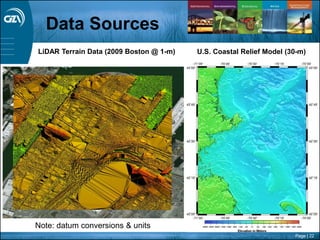
U.S. Coastal Relief Model (30-m)LiDAR Terrain Data (2009 Boston @ 1-m)
Note: datum conversions & units
Data Sources
Page | 23
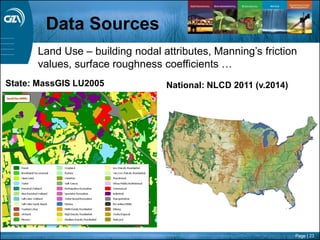
Land Use – building nodal attributes, Manning’s friction
values, surface roughness coefficients …
Data Sources
State: MassGIS LU2005 National: NLCD 2011 (v.2014)
Page | 24
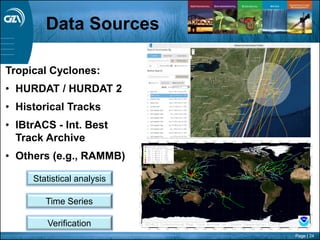
Tropical Cyclones:
• HURDAT / HURDAT 2
• Historical Tracks
• IBtrACS - Int. Best
Track Archive
• Others (e.g., RAMMB)
Data Sources
Time Series
Verification
Statistical analysis
Page | 25
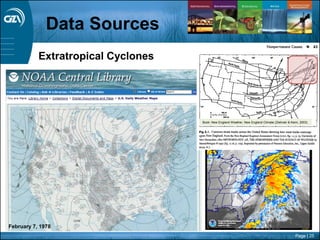
Extratropical Cyclones
Data Sources
Book: New England Weather, New England Climate (Zielinski & Keim, 2003)
February 7, 1978
Page | 26
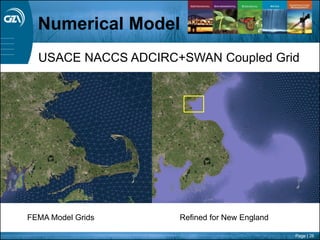
USACE NACCS ADCIRC+SWAN Coupled Grid
Numerical Model
FEMA Model Grids Refined for New England
Page | 27
GZA High Resolution, Locally-Refined ADCIRC+SWAN
Coupled Grid
GZA High
Resolution Local Model
FEMA Region II Refined for Southern New England
Page | 28
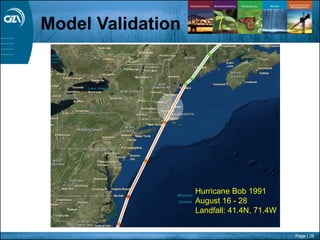
Model Validation
Hurricane Bob 1991
August 16 - 28
Landfall: 41.4N, 71.4W
Page | 29
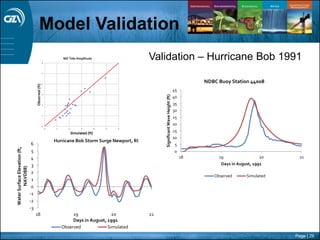
Validation – Hurricane Bob 1991
Model Validation
0
5
10
15
20
25
30
35
40
45
18 19 20 21
SignificantWaveHeight(ft)
Days in August, 1991
NDBC Buoy Station 44008
Observed Simulated
-3
-2
-1
0
1
2
3
4
5
6
18 19 20 21
WaterSurfaceElevation(ft,
NAVD88)
Days in August, 1991
Hurricane Bob Storm Surge Newport, RI
Observed Simulated
Page | 30
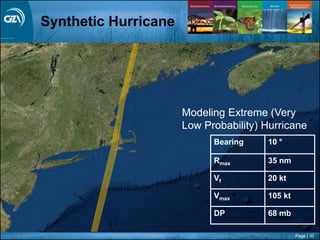
Bearing 10 °
Rmax 35 nm
Vf 20 kt
Vmax 105 kt
DP 68 mb
Modeling Extreme (Very
Low Probability) Hurricane
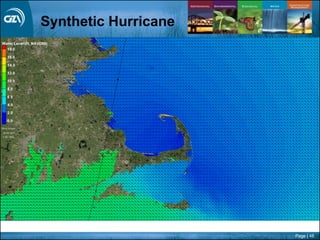
Synthetic Hurricane
Page | 31
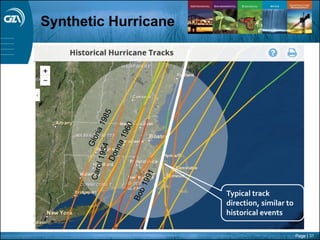
Typical track
direction, similar to
historical events
Synthetic Hurricane
Page | 32
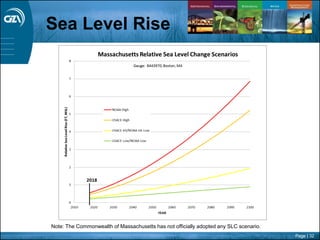
Sea Level Rise
Note: The Commonwealth of Massachusetts has not officially adopted any SLC scenario.
Page | 33
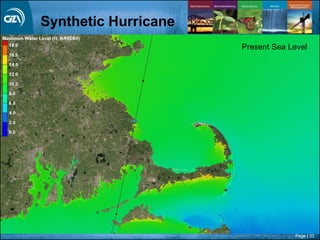
Synthetic Hurricane
Present Sea Level
Page | 34
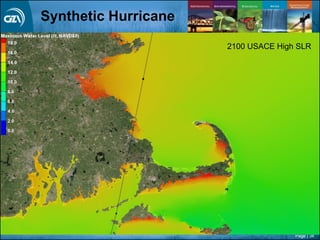
Synthetic Hurricane
2100 USACE High SLR
Page | 35
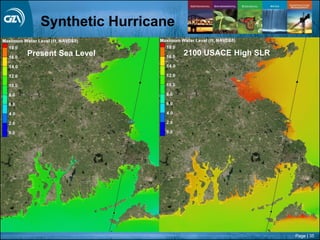
Synthetic Hurricane
Present Sea Level 2100 USACE High SLR
Page | 36
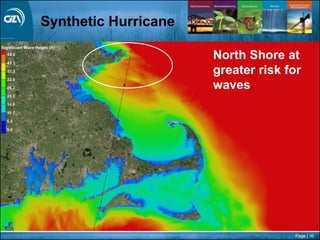
North Shore at
greater risk for
waves
Synthetic Hurricane
Page | 37
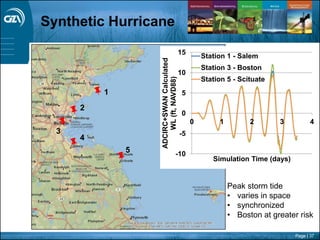
1
2
3
4
5 -10
-5
0
5
10
15
0 1 2 3 4
ADCIRC+SWANCalculated
WL(ft,NAVD88)
Simulation Time (days)
Station 1 - Salem
Station 3 - Boston
Station 5 - Scituate
Peak storm tide
• varies in space
• synchronized
• Boston at greater risk
Synthetic Hurricane
Page | 38
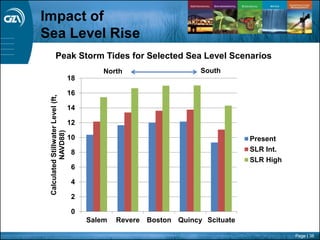
Impact of
Sea Level Rise
Peak Storm Tides for Selected Sea Level Scenarios
0
2
4
6
8
10
12
14
16
18
Salem Revere Boston Quincy Scituate
CalculatedStillwaterLevel(ft,
NAVD88)
Present
SLR Int.
SLR High
North South
Page | 39
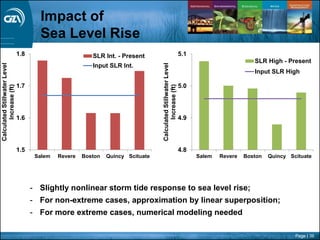
- Slightly nonlinear storm tide response to sea level rise;
- For non-extreme cases, approximation by linear superposition;
- For more extreme cases, numerical modeling needed
1.5
1.6
1.7
1.8
Salem Revere Boston Quincy Scituate
CalculatedStillwaterLevel
Increase(ft)
SLR Int. - Present
Input SLR Int.
4.8
4.9
5.0
5.1
Salem Revere Boston Quincy Scituate
CalculatedStillwaterLevel
Increase(ft)
SLR High - Present
Input SLR High
Impact of
Sea Level Rise
Page | 40
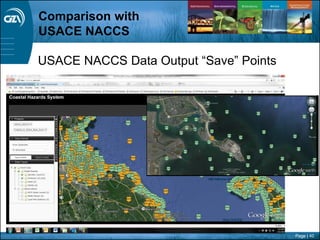
USACE NACCS Data Output “Save” Points
Comparison with
USACE NACCS
Page | 41
3
6
9
12
15
1 10 100 1,000 10,000
StillwaterElevation(feet,
NAVD88)
Return Period (Years)
Observed Annual Maximum Adjusted w/ Sea Level Rise Calculated Stage-Frequency Curve w/ Sea Level Rise-Adjusted Tide Data
Hingham Harbor (FEMA 2012) NACCS Boston Harbor MT
NACCS Boston Harbor HT
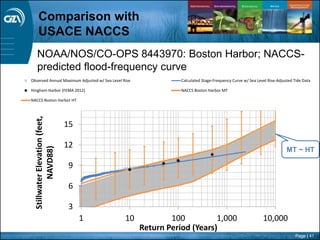
NOAA/NOS/CO-OPS 8443970: Boston Harbor; NACCS-
predicted flood-frequency curve
Comparison with
USACE NACCS
MT ~ HT
Page | 42
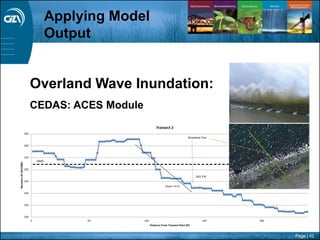
Overland Wave Inundation:
CEDAS: ACES Module
Applying Model
Output
Page | 43
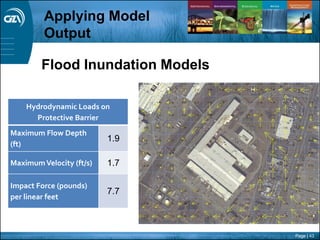
Flood Inundation Models
Hydrodynamic Loads on
Protective Barrier
Maximum Flow Depth
(ft)
1.9
MaximumVelocity (ft/s) 1.7
Impact Force (pounds)
per linear feet
7.7
Applying Model
Output
Page | 44
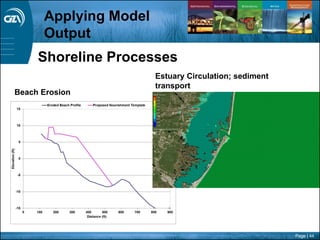
Estuary Circulation; sediment
transport
Applying Model
Output
Shoreline Processes
Beach Erosion
Page | 45
Applying Model
Output
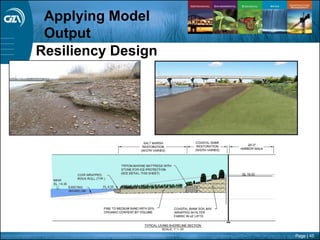
Resiliency Design
Page | 46
Take-away
• Massachusetts Bay has significant flood
risk:
 Tropical cyclones and nor’easters
 Sea level rise
 Large population
 Critical infrastructure
• USACE NACCS: provides updated flood
projections
• NACCS can be coupled with local, high resolution
surge and wave models
Page | 47
Bin Wang, P.E.
Technical Specialist
Norwood, MA
781-278-5809
Bin.Wang@gza.com
Daniel C. Stapleton, P.E.
Principal
Norwood, MA 02062
781-278-5743
Daniel.Stapleton@gza.com
Tianyi Liu, Ph.D.
Coastal Engineer Specialist
Norwood, MA
781-278-3819
Tianyi.Liu@gza.com
Michael A. Mobile, Ph.D.
Technical Specialist
Bedford, NH
603-232-8738
Michael.Mobile@gza.com
Thank You!
Page | 48
Synthetic Hurricane

GeoTool_2015_Coastal_Data_Application_BWang_Final

  • 1.
    Page | 1 ProactiveBy Design. Our Company Commitment COASTAL DATA APPLICATION Projecting Future Coastal Flood Risk for Massachusetts Bay Bin Wang, Tianyi Liu, Daniel Stapleton & Michael Mobile 2015 Coastal GeoTools
  • 2.
    Page | 2 Overview of available data sources for coastal and water resource engineers  Overview of numerical hydrodynamic modeling Outline Objective: to present method and steps for site-specific coastal flood hazard analysis • Small budget • Relatively short project schedule • Use of published data by USACE NACCS and other government agencies
  • 3.
    Page | 3 Background CoastalFlooding Erosion Flood Damage Structural Damage
  • 4.
    Page | 4 Background Needto identify/quantify flood hazards:  stillwater elevations  wave action  environmental loads  shoreline and nearshore response To achieve coastal resiliency:  critical infrastructure  communities  biohabitats  natural resources Coastal Resiliency
  • 5.
    Page | 5 MassachusettsBay & Cape Cod Bay • Total Number of Cities/Towns = 53 • Population = 1.90 M (2010 Census) • Historical Coastal Towns Background
  • 6.
    Page | 6 MassachusettsBay Coastal Flood Hazard Background “Nor-Easters”
  • 7.
  • 8.
    Page | 8 AvailableData South Shore Coastal Geomorphology: Beaches, Estuaries, Marsh, Structures GZA Coastal Engineering GeoTool
  • 9.
    Page | 9 AvailableData South Shore Coastal Geomorphology: Shoreline Change
  • 10.
    Page | 10 AvailableData North Shore Coastal Geomorphology: Beaches, Estuaries, Rocky Shore, Scarps, Structures
  • 11.
    Page | 11 NOAASLOSH Model • Hydrodynamic Model • Develops hurricane windfield • NOAA developed DEMs Available Data
  • 12.
  • 13.
    Page | 13 NOAA/NOS/CO-OPSTide Gages • Observed water levels, e.g., time series for model validation/verification; extreme value analysis; empirical simulation technique (EST); • Predicted tides and tidal constituents; • Datum conversions (w/ Vdatum); • Sea level trend Available Data
  • 14.
    Page | 14 NOAA/NOS/CO-OPS8443970: Boston Harbor 5 6 7 8 9 10 11 12 1 10 100 1,000 StillwaterElevation(feet,NAVD88) Return Period (Years) Observed Annual Maximum - Original Tide Data (ft, NAVD88) Observed Annual Maximum Adjusted w/ Sea Level Rise Calculated Stage-Frequency Curve w/ Original Tide Data Calculated Stage-Frequency Curve w/ Sea Level Rise-Adjusted Tide Data Hingham Harbor (FEMA 2012) Generalized Extreme Value (GEV) Available Data
  • 15.
    Page | 15 AvailableData FEMA Flood Insurance Study and Rate Maps
  • 16.
    Page | 16 AvailableData FEMA Flood Insurance Study and Rate Maps
  • 17.
    Page | 17 WaveInformation Studies (WIS) • Frequency analysis • Time series Available Data
  • 18.
    Page | 18 WaveInformation Studies (WIS) 100-year return period significant deep water wave height: +/- 35 ft Available Data
  • 19.
    Page | 19 USACENorth Atlantic Coast Comprehensive Study (NACCS) Numerical Hydrodynamic Storm Surge and Wave Models USACE NACCS
  • 20.
    Page | 20 Site-SpecificHigh Resolution Storm Surge, Wave and Flood Modeling Coupled ADCIRC + SWAN Models Numerical Hydrodynamic Modeling
  • 21.
    Page | 21 •NOAA or State GIS topographic & hydrographic data layers (DEM) • National or state land cover database • NOAA COOPS tide gages – water levels and other data; • USACE Wave Information System (WIS) – wave & wind gages • National Climate Data Center - ground climate/weather stations • NHC Hurricane Re-analysis project – best track data • Other (e.g., USGS stream gage data) Model inputs and calibration Model construction Data Sources
  • 22.
    Page | 22 U.S.Coastal Relief Model (30-m)LiDAR Terrain Data (2009 Boston @ 1-m) Note: datum conversions & units Data Sources
  • 23.
    Page | 23 LandUse – building nodal attributes, Manning’s friction values, surface roughness coefficients … Data Sources State: MassGIS LU2005 National: NLCD 2011 (v.2014)
  • 24.
    Page | 24 TropicalCyclones: • HURDAT / HURDAT 2 • Historical Tracks • IBtrACS - Int. Best Track Archive • Others (e.g., RAMMB) Data Sources Time Series Verification Statistical analysis
  • 25.
    Page | 25 ExtratropicalCyclones Data Sources Book: New England Weather, New England Climate (Zielinski & Keim, 2003) February 7, 1978
  • 26.
    Page | 26 USACENACCS ADCIRC+SWAN Coupled Grid Numerical Model FEMA Model Grids Refined for New England
  • 27.
    Page | 27 GZAHigh Resolution, Locally-Refined ADCIRC+SWAN Coupled Grid GZA High Resolution Local Model FEMA Region II Refined for Southern New England
  • 28.
    Page | 28 ModelValidation Hurricane Bob 1991 August 16 - 28 Landfall: 41.4N, 71.4W
  • 29.
    Page | 29 Validation– Hurricane Bob 1991 Model Validation 0 5 10 15 20 25 30 35 40 45 18 19 20 21 SignificantWaveHeight(ft) Days in August, 1991 NDBC Buoy Station 44008 Observed Simulated -3 -2 -1 0 1 2 3 4 5 6 18 19 20 21 WaterSurfaceElevation(ft, NAVD88) Days in August, 1991 Hurricane Bob Storm Surge Newport, RI Observed Simulated
  • 30.
    Page | 30 Bearing10 ° Rmax 35 nm Vf 20 kt Vmax 105 kt DP 68 mb Modeling Extreme (Very Low Probability) Hurricane Synthetic Hurricane
  • 31.
    Page | 31 Typicaltrack direction, similar to historical events Synthetic Hurricane
  • 32.
    Page | 32 SeaLevel Rise Note: The Commonwealth of Massachusetts has not officially adopted any SLC scenario.
  • 33.
    Page | 33 SyntheticHurricane Present Sea Level
  • 34.
    Page | 34 SyntheticHurricane 2100 USACE High SLR
  • 35.
    Page | 35 SyntheticHurricane Present Sea Level 2100 USACE High SLR
  • 36.
    Page | 36 NorthShore at greater risk for waves Synthetic Hurricane
  • 37.
    Page | 37 1 2 3 4 5-10 -5 0 5 10 15 0 1 2 3 4 ADCIRC+SWANCalculated WL(ft,NAVD88) Simulation Time (days) Station 1 - Salem Station 3 - Boston Station 5 - Scituate Peak storm tide • varies in space • synchronized • Boston at greater risk Synthetic Hurricane
  • 38.
    Page | 38 Impactof Sea Level Rise Peak Storm Tides for Selected Sea Level Scenarios 0 2 4 6 8 10 12 14 16 18 Salem Revere Boston Quincy Scituate CalculatedStillwaterLevel(ft, NAVD88) Present SLR Int. SLR High North South
  • 39.
    Page | 39 -Slightly nonlinear storm tide response to sea level rise; - For non-extreme cases, approximation by linear superposition; - For more extreme cases, numerical modeling needed 1.5 1.6 1.7 1.8 Salem Revere Boston Quincy Scituate CalculatedStillwaterLevel Increase(ft) SLR Int. - Present Input SLR Int. 4.8 4.9 5.0 5.1 Salem Revere Boston Quincy Scituate CalculatedStillwaterLevel Increase(ft) SLR High - Present Input SLR High Impact of Sea Level Rise
  • 40.
    Page | 40 USACENACCS Data Output “Save” Points Comparison with USACE NACCS
  • 41.
    Page | 41 3 6 9 12 15 110 100 1,000 10,000 StillwaterElevation(feet, NAVD88) Return Period (Years) Observed Annual Maximum Adjusted w/ Sea Level Rise Calculated Stage-Frequency Curve w/ Sea Level Rise-Adjusted Tide Data Hingham Harbor (FEMA 2012) NACCS Boston Harbor MT NACCS Boston Harbor HT NOAA/NOS/CO-OPS 8443970: Boston Harbor; NACCS- predicted flood-frequency curve Comparison with USACE NACCS MT ~ HT
  • 42.
    Page | 42 OverlandWave Inundation: CEDAS: ACES Module Applying Model Output
  • 43.
    Page | 43 FloodInundation Models Hydrodynamic Loads on Protective Barrier Maximum Flow Depth (ft) 1.9 MaximumVelocity (ft/s) 1.7 Impact Force (pounds) per linear feet 7.7 Applying Model Output
  • 44.
    Page | 44 EstuaryCirculation; sediment transport Applying Model Output Shoreline Processes Beach Erosion
  • 45.
    Page | 45 ApplyingModel Output Resiliency Design
  • 46.
    Page | 46 Take-away •Massachusetts Bay has significant flood risk:  Tropical cyclones and nor’easters  Sea level rise  Large population  Critical infrastructure • USACE NACCS: provides updated flood projections • NACCS can be coupled with local, high resolution surge and wave models
  • 47.
    Page | 47 BinWang, P.E. Technical Specialist Norwood, MA 781-278-5809 Bin.Wang@gza.com Daniel C. Stapleton, P.E. Principal Norwood, MA 02062 781-278-5743 Daniel.Stapleton@gza.com Tianyi Liu, Ph.D. Coastal Engineer Specialist Norwood, MA 781-278-3819 Tianyi.Liu@gza.com Michael A. Mobile, Ph.D. Technical Specialist Bedford, NH 603-232-8738 Michael.Mobile@gza.com Thank You!
  • 48.