KARABUK UNIVERSITY
Department of Electrical and electronic
engineering
Geothermal Energy
EEE748 Distributed Generation and Microgrid
Assoc. Prof. Dr. Ziyodulla YUSUPOV
Prepared by :
Masoud ELHAWAT
Abdulsalam ALMABROUK
CONTENTS
 Geothermal reserve.
 Uses of geothermal energy.
 Geothermal advantages and disadvantages.
 Geothermal energy around the world.
 Geothermal energy in the turkey.
 Nature of geothermal energy.
 Geophysics of the earth’s interior.
 Geothermal electricity power plants.
 Largest geothermal power plants in the world.
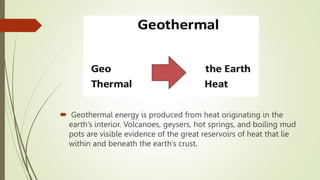
 Geothermal energy is produced from heat originating in the
earth’s interior. Volcanoes, geysers, hot springs, and boiling mud
pots are visible evidence of the great reservoirs of heat that lie
within and beneath the earth’s crust.
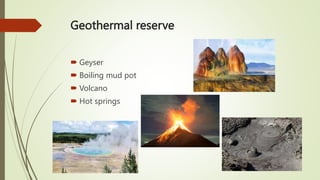
Geothermal reserve
 Geyser
 Boiling mud pot
 Volcano
 Hot springs
Geothermal energy
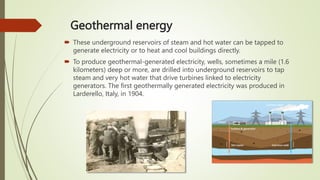
 These underground reservoirs of steam and hot water can be tapped to
generate electricity or to heat and cool buildings directly.
 To produce geothermal-generated electricity, wells, sometimes a mile (1.6
kilometers) deep or more, are drilled into underground reservoirs to tap
steam and very hot water that drive turbines linked to electricity
generators. The first geothermally generated electricity was produced in
Larderello, Italy, in 1904.
Uses of Geothermal Energy
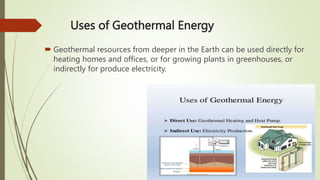
 Geothermal resources from deeper in the Earth can be used directly for
heating homes and offices, or for growing plants in greenhouses, or
indirectly for produce electricity.
Direct Use of Geothermal Energy
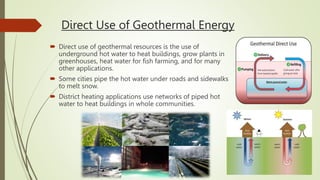
 Direct use of geothermal resources is the use of
underground hot water to heat buildings, grow plants in
greenhouses, heat water for fish farming, and for many
other applications.
 Some cities pipe the hot water under roads and sidewalks
to melt snow.
 District heating applications use networks of piped hot
water to heat buildings in whole communities.
Indirect Use of Geothermal Energy
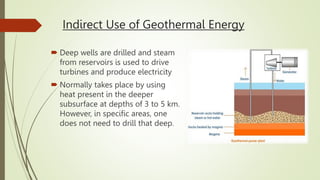
 Deep wells are drilled and steam
from reservoirs is used to drive
turbines and produce electricity
 Normally takes place by using
heat present in the deeper
subsurface at depths of 3 to 5 km.
However, in specific areas, one
does not need to drill that deep.
Geothermal Energy Advantages And
Disadvantages
Advantages
 It can be extracted without burning a fossil fuel such
as coal, gas, or oil.
 Geothermal fields produce only about one-sixth of
the carbon dioxide that a relatively clean natural-
gas-fueled power plant produces. Binary plants
release essentially no emissions.
 It’s also relatively inexpensive; savings from direct
use can be as much as 80 percent over fossil fuels.
Disadvantages
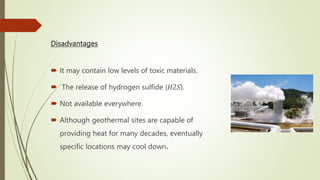
 It may contain low levels of toxic materials.
 The release of hydrogen sulfide (𝐻2𝑆).
 Not available everywhere.
 Although geothermal sites are capable of
providing heat for many decades, eventually
specific locations may cool down.
Geothermal Energy around the World
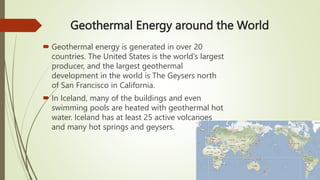
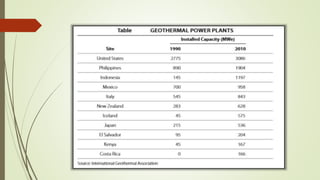
 Geothermal energy is generated in over 20
countries. The United States is the world’s largest
producer, and the largest geothermal
development in the world is The Geysers north
of San Francisco in California.
 In Iceland, many of the buildings and even
swimming pools are heated with geothermal hot
water. Iceland has at least 25 active volcanoes
and many hot springs and geysers.
Geothermal Energy in the Turkey
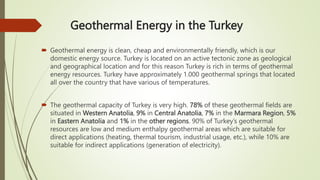
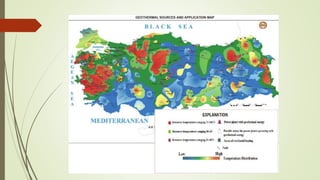
 Geothermal energy is clean, cheap and environmentally friendly, which is our
domestic energy source. Turkey is located on an active tectonic zone as geological
and geographical location and for this reason Turkey is rich in terms of geothermal
energy resources. Turkey have approximately 1.000 geothermal springs that located
all over the country that have various of temperatures.
 The geothermal capacity of Turkey is very high. 78% of these geothermal fields are
situated in Western Anatolia, 9% in Central Anatolia, 7% in the Marmara Region, 5%
in Eastern Anatolia and 1% in the other regions. 90% of Turkey’s geothermal
resources are low and medium enthalpy geothermal areas which are suitable for
direct applications (heating, thermal tourism, industrial usage, etc.), while 10% are
suitable for indirect applications (generation of electricity).
Nature of Geothermal Energy
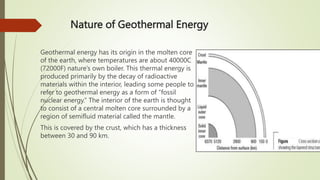
Geothermal energy has its origin in the molten core
of the earth, where temperatures are about 40000C
(72000F) nature’s own boiler. This thermal energy is
produced primarily by the decay of radioactive
materials within the interior, leading some people to
refer to geothermal energy as a form of “fossil
nuclear energy.” The interior of the earth is thought
to consist of a central molten core surrounded by a
region of semifluid material called the mantle.
This is covered by the crust, which has a thickness
between 30 and 90 km.
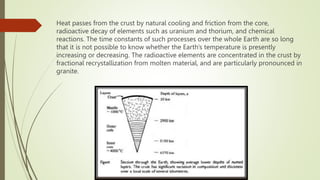
Heat passes from the crust by natural cooling and friction from the core,
radioactive decay of elements such as uranium and thorium, and chemical
reactions. The time constants of such processes over the whole Earth are so long
that it is not possible to know whether the Earth’s temperature is presently
increasing or decreasing. The radioactive elements are concentrated in the crust by
fractional recrystallization from molten material, and are particularly pronounced in
granite.
Geophysics Of The Earth’s Interior
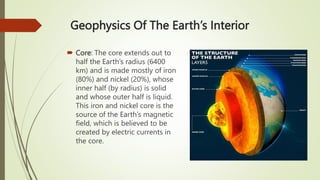
 Core: The core extends out to
half the Earth’s radius (6400
km) and is made mostly of iron
(80%) and nickel (20%), whose
inner half (by radius) is solid
and whose outer half is liquid.
This iron and nickel core is the
source of the Earth’s magnetic
field, which is believed to be
created by electric currents in
the core.
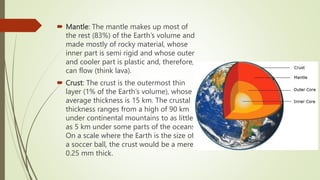
 Mantle: The mantle makes up most of
the rest (83%) of the Earth’s volume and
made mostly of rocky material, whose
inner part is semi rigid and whose outer
and cooler part is plastic and, therefore,
can flow (think lava).
 Crust: The crust is the outermost thin
layer (1% of the Earth’s volume), whose
average thickness is 15 km. The crustal
thickness ranges from a high of 90 km
under continental mountains to as little
as 5 km under some parts of the oceans.
On a scale where the Earth is the size of
a soccer ball, the crust would be a mere
0.25 mm thick.
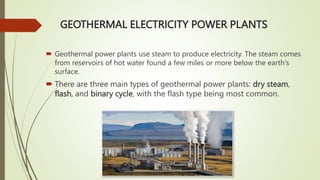
GEOTHERMAL ELECTRICITY POWER PLANTS
 Geothermal power plants use steam to produce electricity. The steam comes
from reservoirs of hot water found a few miles or more below the earth's
surface.
 There are three main types of geothermal power plants: dry steam,
flash, and binary cycle, with the flash type being most common.
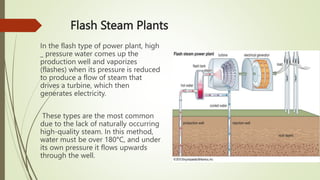
Flash Steam Plants
In the flash type of power plant, high
_ pressure water comes up the
production well and vaporizes
(flashes) when its pressure is reduced
to produce a flow of steam that
drives a turbine, which then
generates electricity.
These types are the most common
due to the lack of naturally occurring
high-quality steam. In this method,
water must be over 180°C, and under
its own pressure it flows upwards
through the well.
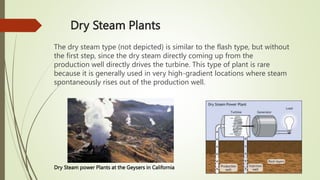
Dry Steam Plants
The dry steam type (not depicted) is similar to the flash type, but without
the first step, since the dry steam directly coming up from the
production well directly drives the turbine. This type of plant is rare
because it is generally used in very high-gradient locations where steam
spontaneously rises out of the production well.
Dry Steam power Plants at the Geysers in California
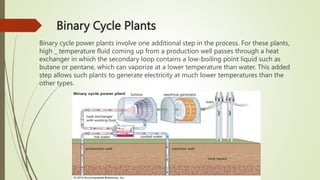
Binary Cycle Plants
Binary cycle power plants involve one additional step in the process. For these plants,
high _ temperature fluid coming up from a production well passes through a heat
exchanger in which the secondary loop contains a low-boiling point liquid such as
butane or pentane, which can vaporize at a lower temperature than water. This added
step allows such plants to generate electricity at much lower temperatures than the
other types.
Largest Geothermal Power Plants In The World
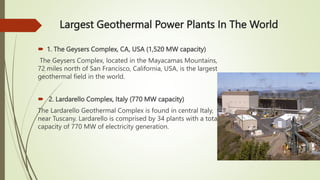
 1. The Geysers Complex, CA, USA (1,520 MW capacity)
The Geysers Complex, located in the Mayacamas Mountains,
72 miles north of San Francisco, California, USA, is the largest
geothermal field in the world.
 2. Lardarello Complex, Italy (770 MW capacity)
The Lardarello Geothermal Complex is found in central Italy,
near Tuscany. Lardarello is comprised by 34 plants with a total
capacity of 770 MW of electricity generation.
 3. Cerro Prieto Station, Mexico (720 MW capacity)
The Cerro Prieto Geothermal Power Station is a large complex comprised by several
geothermal power stations located near Mexicali, in the Baja California region of
Mexico.
 4. Makiling-Banahaw Complex, Phillipines (460 MW capacity)
The Makiling-Banahaw complex in the Philippines was set up by the Chevron
Geothermal Philippine Holdings, Inc. Commercial production started at this plant in
1979, when the two 55 MW units started operating.
 5. CalEnergy-Salton Sea, CA, USA (340 MW capacity)
The CalEnergy Salton Sea Geothermal, with a generating capacity of 340 MW electricity,
is the fifth largest of its kind in the world. The facility covers a large area that includes
10 geothermal energy generating plants in Calipatria, near the Salton Sea in California,
USA.
Thank
you

Geothermal Energy [تم حفظه تلقائيا].pptx

  • 1.
    KARABUK UNIVERSITY Department ofElectrical and electronic engineering Geothermal Energy EEE748 Distributed Generation and Microgrid Assoc. Prof. Dr. Ziyodulla YUSUPOV Prepared by : Masoud ELHAWAT Abdulsalam ALMABROUK
  • 2.
    CONTENTS  Geothermal reserve. Uses of geothermal energy.  Geothermal advantages and disadvantages.  Geothermal energy around the world.  Geothermal energy in the turkey.  Nature of geothermal energy.  Geophysics of the earth’s interior.  Geothermal electricity power plants.  Largest geothermal power plants in the world.
  • 3.
     Geothermal energyis produced from heat originating in the earth’s interior. Volcanoes, geysers, hot springs, and boiling mud pots are visible evidence of the great reservoirs of heat that lie within and beneath the earth’s crust.
  • 4.
    Geothermal reserve  Geyser Boiling mud pot  Volcano  Hot springs
  • 5.
    Geothermal energy  Theseunderground reservoirs of steam and hot water can be tapped to generate electricity or to heat and cool buildings directly.  To produce geothermal-generated electricity, wells, sometimes a mile (1.6 kilometers) deep or more, are drilled into underground reservoirs to tap steam and very hot water that drive turbines linked to electricity generators. The first geothermally generated electricity was produced in Larderello, Italy, in 1904.
  • 6.
    Uses of GeothermalEnergy  Geothermal resources from deeper in the Earth can be used directly for heating homes and offices, or for growing plants in greenhouses, or indirectly for produce electricity.
  • 7.
    Direct Use ofGeothermal Energy  Direct use of geothermal resources is the use of underground hot water to heat buildings, grow plants in greenhouses, heat water for fish farming, and for many other applications.  Some cities pipe the hot water under roads and sidewalks to melt snow.  District heating applications use networks of piped hot water to heat buildings in whole communities.
  • 8.
    Indirect Use ofGeothermal Energy  Deep wells are drilled and steam from reservoirs is used to drive turbines and produce electricity  Normally takes place by using heat present in the deeper subsurface at depths of 3 to 5 km. However, in specific areas, one does not need to drill that deep.
  • 9.
    Geothermal Energy AdvantagesAnd Disadvantages Advantages  It can be extracted without burning a fossil fuel such as coal, gas, or oil.  Geothermal fields produce only about one-sixth of the carbon dioxide that a relatively clean natural- gas-fueled power plant produces. Binary plants release essentially no emissions.  It’s also relatively inexpensive; savings from direct use can be as much as 80 percent over fossil fuels.
  • 10.
    Disadvantages  It maycontain low levels of toxic materials.  The release of hydrogen sulfide (𝐻2𝑆).  Not available everywhere.  Although geothermal sites are capable of providing heat for many decades, eventually specific locations may cool down.
  • 11.
    Geothermal Energy aroundthe World  Geothermal energy is generated in over 20 countries. The United States is the world’s largest producer, and the largest geothermal development in the world is The Geysers north of San Francisco in California.  In Iceland, many of the buildings and even swimming pools are heated with geothermal hot water. Iceland has at least 25 active volcanoes and many hot springs and geysers.
  • 14.
    Geothermal Energy inthe Turkey  Geothermal energy is clean, cheap and environmentally friendly, which is our domestic energy source. Turkey is located on an active tectonic zone as geological and geographical location and for this reason Turkey is rich in terms of geothermal energy resources. Turkey have approximately 1.000 geothermal springs that located all over the country that have various of temperatures.  The geothermal capacity of Turkey is very high. 78% of these geothermal fields are situated in Western Anatolia, 9% in Central Anatolia, 7% in the Marmara Region, 5% in Eastern Anatolia and 1% in the other regions. 90% of Turkey’s geothermal resources are low and medium enthalpy geothermal areas which are suitable for direct applications (heating, thermal tourism, industrial usage, etc.), while 10% are suitable for indirect applications (generation of electricity).
  • 17.
    Nature of GeothermalEnergy Geothermal energy has its origin in the molten core of the earth, where temperatures are about 40000C (72000F) nature’s own boiler. This thermal energy is produced primarily by the decay of radioactive materials within the interior, leading some people to refer to geothermal energy as a form of “fossil nuclear energy.” The interior of the earth is thought to consist of a central molten core surrounded by a region of semifluid material called the mantle. This is covered by the crust, which has a thickness between 30 and 90 km.
  • 18.
    Heat passes fromthe crust by natural cooling and friction from the core, radioactive decay of elements such as uranium and thorium, and chemical reactions. The time constants of such processes over the whole Earth are so long that it is not possible to know whether the Earth’s temperature is presently increasing or decreasing. The radioactive elements are concentrated in the crust by fractional recrystallization from molten material, and are particularly pronounced in granite.
  • 19.
    Geophysics Of TheEarth’s Interior  Core: The core extends out to half the Earth’s radius (6400 km) and is made mostly of iron (80%) and nickel (20%), whose inner half (by radius) is solid and whose outer half is liquid. This iron and nickel core is the source of the Earth’s magnetic field, which is believed to be created by electric currents in the core.
  • 20.
     Mantle: Themantle makes up most of the rest (83%) of the Earth’s volume and made mostly of rocky material, whose inner part is semi rigid and whose outer and cooler part is plastic and, therefore, can flow (think lava).  Crust: The crust is the outermost thin layer (1% of the Earth’s volume), whose average thickness is 15 km. The crustal thickness ranges from a high of 90 km under continental mountains to as little as 5 km under some parts of the oceans. On a scale where the Earth is the size of a soccer ball, the crust would be a mere 0.25 mm thick.
  • 21.
    GEOTHERMAL ELECTRICITY POWERPLANTS  Geothermal power plants use steam to produce electricity. The steam comes from reservoirs of hot water found a few miles or more below the earth's surface.  There are three main types of geothermal power plants: dry steam, flash, and binary cycle, with the flash type being most common.
  • 22.
    Flash Steam Plants Inthe flash type of power plant, high _ pressure water comes up the production well and vaporizes (flashes) when its pressure is reduced to produce a flow of steam that drives a turbine, which then generates electricity. These types are the most common due to the lack of naturally occurring high-quality steam. In this method, water must be over 180°C, and under its own pressure it flows upwards through the well.
  • 23.
    Dry Steam Plants Thedry steam type (not depicted) is similar to the flash type, but without the first step, since the dry steam directly coming up from the production well directly drives the turbine. This type of plant is rare because it is generally used in very high-gradient locations where steam spontaneously rises out of the production well. Dry Steam power Plants at the Geysers in California
  • 24.
    Binary Cycle Plants Binarycycle power plants involve one additional step in the process. For these plants, high _ temperature fluid coming up from a production well passes through a heat exchanger in which the secondary loop contains a low-boiling point liquid such as butane or pentane, which can vaporize at a lower temperature than water. This added step allows such plants to generate electricity at much lower temperatures than the other types.
  • 25.
    Largest Geothermal PowerPlants In The World  1. The Geysers Complex, CA, USA (1,520 MW capacity) The Geysers Complex, located in the Mayacamas Mountains, 72 miles north of San Francisco, California, USA, is the largest geothermal field in the world.  2. Lardarello Complex, Italy (770 MW capacity) The Lardarello Geothermal Complex is found in central Italy, near Tuscany. Lardarello is comprised by 34 plants with a total capacity of 770 MW of electricity generation.
  • 26.
     3. CerroPrieto Station, Mexico (720 MW capacity) The Cerro Prieto Geothermal Power Station is a large complex comprised by several geothermal power stations located near Mexicali, in the Baja California region of Mexico.  4. Makiling-Banahaw Complex, Phillipines (460 MW capacity) The Makiling-Banahaw complex in the Philippines was set up by the Chevron Geothermal Philippine Holdings, Inc. Commercial production started at this plant in 1979, when the two 55 MW units started operating.  5. CalEnergy-Salton Sea, CA, USA (340 MW capacity) The CalEnergy Salton Sea Geothermal, with a generating capacity of 340 MW electricity, is the fifth largest of its kind in the world. The facility covers a large area that includes 10 geothermal energy generating plants in Calipatria, near the Salton Sea in California, USA.
  • 27.