
Cement Chemistry
SAIFULLAH MAHMUD 王方
2093191
2021
Geopolymer Cement
2
What’s wrong with cement concrete?
• Many concrete structures deteriorate after 20 years.
• Cement production releases high amounts of CO2 to
the atmosphere(1tonne of cement production releases
1tonne of CO2) thus contributing to 7% of world CO2
emissions.
• Cement is one of the most energy intensive material.
How to reduce the use of cement
• Partially replace the use of cement in concrete.
example: high volume fly ash concrete
• Develop alternate materials.
example:Geopolymer concrete
Geopolymer Concrete
• Hardened cementitious paste made from flyash
and alkaline solution.
• Combines waste products into useful
product.
• Setting mechanism depends on
polymerization.
• Curing temp is between 60-90 degree
celcious.
CONSTITUENTS OF
GEOPOLYMER CONCRETE
• Source materials :
 alumina-silicate
Alkaline liquids
combination of sodium hydroxide
(NaOH) or potassium hydroxide
(KOH) and sodium silicate or
potassium silicate.
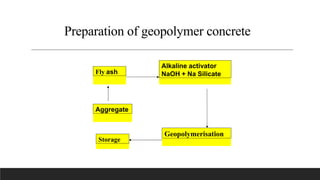
Preparation of geopolymer concrete
Geopolymerisation
Storage
Aggregate
Fly ash
Alkaline activator
NaOH + Na Silicate
5
2.Geopolymer Concrete :Process
• Alkaline solutions induce the Si and Al atoms in the source
materials, example fly ash , to dissolve.
• Gel formation is assisted by applying heat.
• Gel binds the aggregates ,and the unreacted source material to
form the Geopolymer concrete.
MANUFACTUREOF
GEOPOLYMER CEMENT
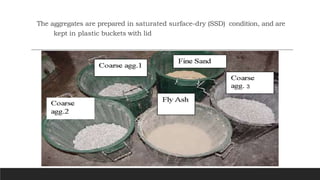
The aggregates are prepared in saturated surface-dry (SSD) condition, and are
kept in plastic buckets with lid
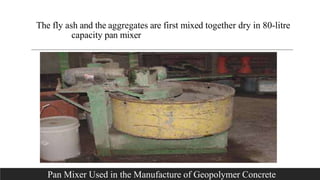
The fly ash and the aggregates are first mixed together dry in 80-litre
capacity pan mixer
. Pan Mixer Used in the Manufacture of Geopolymer Concrete
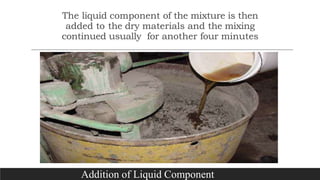
The liquid component of the mixture is then
added to the dry materials and the mixing
continued usually for another four minutes
Addition of Liquid Component
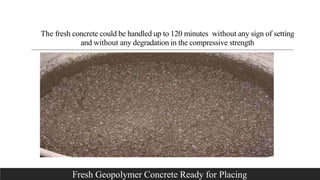
The fresh concrete could be handled up to 120 minutes without any sign of setting
and without any degradation in the compressive strength
Fresh Geopolymer Concrete Ready for Placing
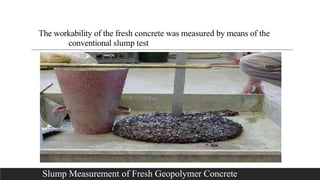
The workability of the fresh concrete was measured by means of the
conventional slump test
Slump Measurement of Fresh Geopolymer Concrete
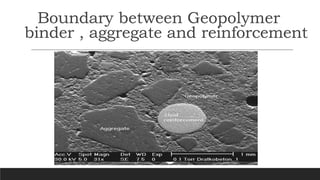
Boundary between Geopolymer
binder , aggregate and reinforcement
ADVANTAGES
Cutting the world’s carbon.
The price of fly ash is low.
Better compressive strength.
Fire proof.
Low permeability.
Eco-friendly.
Excellent properties within both acid and salt
environments.
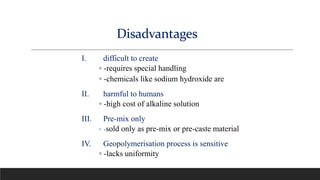
I. difficult to create
◦ -requires special handling
◦ -chemicals like sodium hydroxide are
II. harmful to humans
◦ -high cost of alkaline solution
III. Pre-mix only
◦ -sold only as pre-mix or pre-caste material
IV. Geopolymerisation process is sensitive
◦ -lacks uniformity
Disadvantages
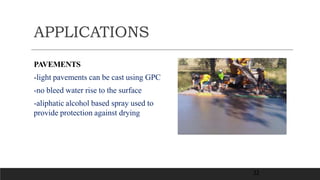
APPLICATIONS
PAVEMENTS
-light pavements can be cast using GPC
-no bleed water rise to the surface
-aliphatic alcohol based spray used to
provide protection against drying
32
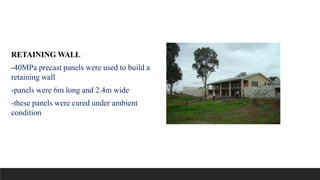
RETAINING WALL
-40MPa precast panels were used to build a
retaining wall
-panels were 6m long and 2.4m wide
-these panels were cured under ambient
condition
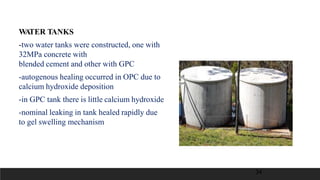
W
ATER TANKS
-two water tanks were constructed, one with
32MPa concrete with
blended cement and other with GPC
-autogenous healing occurred in OPC due to
calcium hydroxide deposition
-in GPC tank there is little calcium hydroxide
-nominal leaking in tank healed rapidly due
to gel swelling mechanism
34
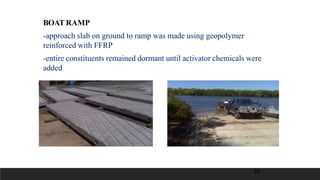
BOAT RAMP
-approach slab on ground to ramp was made using geopolymer
reinforced with FFRP
-entire constituents remained dormant until activator chemicals were
added
20
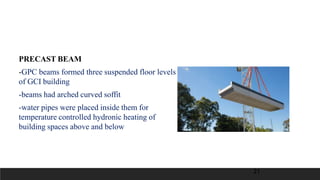
PRECAST BEAM
-GPC beams formed three suspended floor levels
of GCI building
-beams had arched curved soffit
-water pipes were placed inside them for
temperature controlled hydronic heating of
building spaces above and below
21
• Different source materials
• Properties of soluble silicate
• Contaminants
• Industry regulations
• New material
The reduced CO2 emissions of Geopolymer cements make them a
good alternative to Ordinary Portland Cement.
Produces a substance that is comparable to or better than
traditional cements with respect to most properties.
Geopolymer concrete has excellent properties within both acid and
salt environments
Low-calcium fly ash-based geopolymer concrete has excellent
compressive strength and is suitable for Structural applications.
THANKS!
Saifullah Mahmud 王方 2093191
saifullah_mahmud@tongji.edu.cn

Geopolymer Cement

  • 1.
    Cement Chemistry SAIFULLAH MAHMUD王方 2093191 2021 Geopolymer Cement
  • 2.
    2 What’s wrong withcement concrete? • Many concrete structures deteriorate after 20 years. • Cement production releases high amounts of CO2 to the atmosphere(1tonne of cement production releases 1tonne of CO2) thus contributing to 7% of world CO2 emissions. • Cement is one of the most energy intensive material.
  • 3.
    How to reducethe use of cement • Partially replace the use of cement in concrete. example: high volume fly ash concrete • Develop alternate materials. example:Geopolymer concrete
  • 4.
    Geopolymer Concrete • Hardenedcementitious paste made from flyash and alkaline solution. • Combines waste products into useful product. • Setting mechanism depends on polymerization. • Curing temp is between 60-90 degree celcious.
  • 5.
    CONSTITUENTS OF GEOPOLYMER CONCRETE •Source materials :  alumina-silicate Alkaline liquids combination of sodium hydroxide (NaOH) or potassium hydroxide (KOH) and sodium silicate or potassium silicate.
  • 6.
    Preparation of geopolymerconcrete Geopolymerisation Storage Aggregate Fly ash Alkaline activator NaOH + Na Silicate
  • 7.
    5 2.Geopolymer Concrete :Process •Alkaline solutions induce the Si and Al atoms in the source materials, example fly ash , to dissolve. • Gel formation is assisted by applying heat. • Gel binds the aggregates ,and the unreacted source material to form the Geopolymer concrete.
  • 8.
  • 9.
    The aggregates areprepared in saturated surface-dry (SSD) condition, and are kept in plastic buckets with lid
  • 10.
    The fly ashand the aggregates are first mixed together dry in 80-litre capacity pan mixer . Pan Mixer Used in the Manufacture of Geopolymer Concrete
  • 11.
    The liquid componentof the mixture is then added to the dry materials and the mixing continued usually for another four minutes Addition of Liquid Component
  • 12.
    The fresh concretecould be handled up to 120 minutes without any sign of setting and without any degradation in the compressive strength Fresh Geopolymer Concrete Ready for Placing
  • 13.
    The workability ofthe fresh concrete was measured by means of the conventional slump test Slump Measurement of Fresh Geopolymer Concrete
  • 14.
    Boundary between Geopolymer binder, aggregate and reinforcement
  • 15.
    ADVANTAGES Cutting the world’scarbon. The price of fly ash is low. Better compressive strength. Fire proof. Low permeability. Eco-friendly. Excellent properties within both acid and salt environments.
  • 16.
    I. difficult tocreate ◦ -requires special handling ◦ -chemicals like sodium hydroxide are II. harmful to humans ◦ -high cost of alkaline solution III. Pre-mix only ◦ -sold only as pre-mix or pre-caste material IV. Geopolymerisation process is sensitive ◦ -lacks uniformity Disadvantages
  • 17.
    APPLICATIONS PAVEMENTS -light pavements canbe cast using GPC -no bleed water rise to the surface -aliphatic alcohol based spray used to provide protection against drying 32
  • 18.
    RETAINING WALL -40MPa precastpanels were used to build a retaining wall -panels were 6m long and 2.4m wide -these panels were cured under ambient condition
  • 19.
    W ATER TANKS -two watertanks were constructed, one with 32MPa concrete with blended cement and other with GPC -autogenous healing occurred in OPC due to calcium hydroxide deposition -in GPC tank there is little calcium hydroxide -nominal leaking in tank healed rapidly due to gel swelling mechanism 34
  • 20.
    BOAT RAMP -approach slabon ground to ramp was made using geopolymer reinforced with FFRP -entire constituents remained dormant until activator chemicals were added 20
  • 21.
    PRECAST BEAM -GPC beamsformed three suspended floor levels of GCI building -beams had arched curved soffit -water pipes were placed inside them for temperature controlled hydronic heating of building spaces above and below 21
  • 22.
    • Different sourcematerials • Properties of soluble silicate • Contaminants • Industry regulations • New material
  • 23.
    The reduced CO2emissions of Geopolymer cements make them a good alternative to Ordinary Portland Cement. Produces a substance that is comparable to or better than traditional cements with respect to most properties. Geopolymer concrete has excellent properties within both acid and salt environments Low-calcium fly ash-based geopolymer concrete has excellent compressive strength and is suitable for Structural applications.
  • 24.
    THANKS! Saifullah Mahmud 王方2093191 saifullah_mahmud@tongji.edu.cn