CK-12 Basic Geometry 
Concepts 
Dan Greenberg 
Lori Jordan 
Andrew Gloag 
Victor Cifarelli 
Jim Sconyers 
Bill Zahner 
Say Thanks to the Authors 
Click http://www.ck12.org/saythanks 
(No sign in required)
www.ck12.org 
To access a customizable version of this book, as well as other 
interactive content, visit www.ck12.org 
CK-12 Foundation is a non-profit organization with a mission to 
reduce the cost of textbook materials for the K-12 market both 
in the U.S. and worldwide. Using an open-content, web-based 
collaborative model termed the FlexBook®, CK-12 intends to 
pioneer the generation and distribution of high-quality educational 
content that will serve both as core text as well as provide an 
adaptive environment for learning, powered through the FlexBook 
Platform®. 
Copyright © 2013 CK-12 Foundation, www.ck12.org 
The names “CK-12” and “CK12” and associated logos and the 
terms “FlexBook®” and “FlexBook Platform®” (collectively 
“CK-12 Marks”) are trademarks and service marks of CK-12 
Foundation and are protected by federal, state, and international 
laws. 
Any form of reproduction of this book in any format or medium, 
in whole or in sections must include the referral attribution link 
http://www.ck12.org/saythanks (placed in a visible location) in 
addition to the following terms. 
Except as otherwise noted, all CK-12 Content (including 
CK-12 Curriculum Material) is made available to Users 
in accordance with the Creative Commons Attribution/Non- 
Commercial/Share Alike 3.0 Unported (CC BY-NC-SA) License 
(http://creativecommons.org/licenses/by-nc-sa/3.0/), as amended 
and updated by Creative Commons from time to time (the “CC 
License”), which is incorporated herein by this reference. 
Complete terms can be found at http://www.ck12.org/terms. 
Printed: August 8, 2013 
AUTHORS 
Dan Greenberg 
Lori Jordan 
Andrew Gloag 
Victor Cifarelli 
Jim Sconyers 
Bill Zahner 
EDITOR 
Annamaria Farbizio 
iii
Contents www.ck12.org 
Contents 
1 Basics of Geometry 1 
1.1 Basic Geometric Definitions . . . . . . . . . . . . . . . . . . . . . . . . . . . . . . . . . . . . 2 
1.2 Distance Between Two Points . . . . . . . . . . . . . . . . . . . . . . . . . . . . . . . . . . . . 10 
1.3 Congruent Angles and Angle Bisectors . . . . . . . . . . . . . . . . . . . . . . . . . . . . . . . 16 
1.4 Midpoints and Segment Bisectors . . . . . . . . . . . . . . . . . . . . . . . . . . . . . . . . . . 21 
1.5 Angle Measurement . . . . . . . . . . . . . . . . . . . . . . . . . . . . . . . . . . . . . . . . . 26 
1.6 Angle Classification . . . . . . . . . . . . . . . . . . . . . . . . . . . . . . . . . . . . . . . . . 33 
1.7 Complementary Angles . . . . . . . . . . . . . . . . . . . . . . . . . . . . . . . . . . . . . . . 37 
1.8 Supplementary Angles . . . . . . . . . . . . . . . . . . . . . . . . . . . . . . . . . . . . . . . 41 
1.9 Linear Pairs . . . . . . . . . . . . . . . . . . . . . . . . . . . . . . . . . . . . . . . . . . . . . 44 
1.10 Vertical Angles . . . . . . . . . . . . . . . . . . . . . . . . . . . . . . . . . . . . . . . . . . . 47 
1.11 Triangle Classification . . . . . . . . . . . . . . . . . . . . . . . . . . . . . . . . . . . . . . . . 51 
1.12 Polygon Classification . . . . . . . . . . . . . . . . . . . . . . . . . . . . . . . . . . . . . . . . 57 
2 Reasoning and Proof 64 
2.1 Inductive Reasoning from Patterns . . . . . . . . . . . . . . . . . . . . . . . . . . . . . . . . . 65 
2.2 Deductive Reasoning . . . . . . . . . . . . . . . . . . . . . . . . . . . . . . . . . . . . . . . . 70 
2.3 If-Then Statements . . . . . . . . . . . . . . . . . . . . . . . . . . . . . . . . . . . . . . . . . 74 
2.4 Converse, Inverse, and Contrapositive . . . . . . . . . . . . . . . . . . . . . . . . . . . . . . . 77 
2.5 Conjectures and Counterexamples . . . . . . . . . . . . . . . . . . . . . . . . . . . . . . . . . 81 
2.6 Properties of Equality and Congruence . . . . . . . . . . . . . . . . . . . . . . . . . . . . . . . 84 
2.7 Two-Column Proofs . . . . . . . . . . . . . . . . . . . . . . . . . . . . . . . . . . . . . . . . . 88 
3 Parallel and Perpendicular Lines 100 
3.1 Parallel and Skew Lines . . . . . . . . . . . . . . . . . . . . . . . . . . . . . . . . . . . . . . . 101 
3.2 Perpendicular Lines . . . . . . . . . . . . . . . . . . . . . . . . . . . . . . . . . . . . . . . . . 107 
3.3 Corresponding Angles . . . . . . . . . . . . . . . . . . . . . . . . . . . . . . . . . . . . . . . . 116 
3.4 Alternate Interior Angles . . . . . . . . . . . . . . . . . . . . . . . . . . . . . . . . . . . . . . 122 
3.5 Alternate Exterior Angles . . . . . . . . . . . . . . . . . . . . . . . . . . . . . . . . . . . . . . 128 
3.6 Same Side Interior Angles . . . . . . . . . . . . . . . . . . . . . . . . . . . . . . . . . . . . . . 133 
3.7 Slope in the Coordinate Plane . . . . . . . . . . . . . . . . . . . . . . . . . . . . . . . . . . . . 139 
3.8 Parallel Lines in the Coordinate Plane . . . . . . . . . . . . . . . . . . . . . . . . . . . . . . . 145 
3.9 Perpendicular Lines in the Coordinate Plane . . . . . . . . . . . . . . . . . . . . . . . . . . . . 150 
3.10 Distance Formula in the Coordinate Plane . . . . . . . . . . . . . . . . . . . . . . . . . . . . . 155 
3.11 Distance Between Parallel Lines . . . . . . . . . . . . . . . . . . . . . . . . . . . . . . . . . . 158 
4 Triangles and Congruence 164 
4.1 Triangle Sum Theorem . . . . . . . . . . . . . . . . . . . . . . . . . . . . . . . . . . . . . . . 165 
4.2 Exterior Angles Theorems . . . . . . . . . . . . . . . . . . . . . . . . . . . . . . . . . . . . . 171 
4.3 Congruent Triangles . . . . . . . . . . . . . . . . . . . . . . . . . . . . . . . . . . . . . . . . . 178 
4.4 Congruence Statements . . . . . . . . . . . . . . . . . . . . . . . . . . . . . . . . . . . . . . . 183 
4.5 Third Angle Theorem . . . . . . . . . . . . . . . . . . . . . . . . . . . . . . . . . . . . . . . . 187 
iv
www.ck12.org Contents 
4.6 SSS Triangle Congruence . . . . . . . . . . . . . . . . . . . . . . . . . . . . . . . . . . . . . . 192 
4.7 SAS Triangle Congruence . . . . . . . . . . . . . . . . . . . . . . . . . . . . . . . . . . . . . . 200 
4.8 ASA and AAS Triangle Congruence . . . . . . . . . . . . . . . . . . . . . . . . . . . . . . . . 207 
4.9 HL Triangle Congruence . . . . . . . . . . . . . . . . . . . . . . . . . . . . . . . . . . . . . . 214 
4.10 Isosceles Triangles . . . . . . . . . . . . . . . . . . . . . . . . . . . . . . . . . . . . . . . . . 219 
4.11 Equilateral Triangles . . . . . . . . . . . . . . . . . . . . . . . . . . . . . . . . . . . . . . . . 225 
5 Triangle Relationships 233 
5.1 Midsegment Theorem . . . . . . . . . . . . . . . . . . . . . . . . . . . . . . . . . . . . . . . . 234 
5.2 Perpendicular Bisectors . . . . . . . . . . . . . . . . . . . . . . . . . . . . . . . . . . . . . . . 241 
5.3 Angle Bisectors in Triangles . . . . . . . . . . . . . . . . . . . . . . . . . . . . . . . . . . . . 248 
5.4 Medians . . . . . . . . . . . . . . . . . . . . . . . . . . . . . . . . . . . . . . . . . . . . . . . 254 
5.5 Altitudes . . . . . . . . . . . . . . . . . . . . . . . . . . . . . . . . . . . . . . . . . . . . . . . 260 
5.6 Comparing Angles and Sides in Triangles . . . . . . . . . . . . . . . . . . . . . . . . . . . . . 266 
5.7 Triangle Inequality Theorem . . . . . . . . . . . . . . . . . . . . . . . . . . . . . . . . . . . . 272 
5.8 Indirect Proof in Algebra and Geometry . . . . . . . . . . . . . . . . . . . . . . . . . . . . . . 275 
6 Polygons and Quadrilaterals 279 
6.1 Interior Angles in Convex Polygons . . . . . . . . . . . . . . . . . . . . . . . . . . . . . . . . 280 
6.2 Exterior Angles in Convex Polygons . . . . . . . . . . . . . . . . . . . . . . . . . . . . . . . . 286 
6.3 Parallelograms . . . . . . . . . . . . . . . . . . . . . . . . . . . . . . . . . . . . . . . . . . . . 289 
6.4 Quadrilaterals that are Parallelograms . . . . . . . . . . . . . . . . . . . . . . . . . . . . . . . 297 
6.5 Parallelogram Classification . . . . . . . . . . . . . . . . . . . . . . . . . . . . . . . . . . . . . 306 
6.6 Trapezoids . . . . . . . . . . . . . . . . . . . . . . . . . . . . . . . . . . . . . . . . . . . . . . 313 
6.7 Kites . . . . . . . . . . . . . . . . . . . . . . . . . . . . . . . . . . . . . . . . . . . . . . . . . 319 
6.8 Quadrilateral Classification . . . . . . . . . . . . . . . . . . . . . . . . . . . . . . . . . . . . . 326 
7 Similarity 331 
7.1 Forms of Ratios . . . . . . . . . . . . . . . . . . . . . . . . . . . . . . . . . . . . . . . . . . . 332 
7.2 Proportion Properties . . . . . . . . . . . . . . . . . . . . . . . . . . . . . . . . . . . . . . . . 336 
7.3 Similar Polygons and Scale Factors . . . . . . . . . . . . . . . . . . . . . . . . . . . . . . . . . 341 
7.4 AA Similarity . . . . . . . . . . . . . . . . . . . . . . . . . . . . . . . . . . . . . . . . . . . . 347 
7.5 Indirect Measurement . . . . . . . . . . . . . . . . . . . . . . . . . . . . . . . . . . . . . . . . 353 
7.6 SSS Similarity . . . . . . . . . . . . . . . . . . . . . . . . . . . . . . . . . . . . . . . . . . . . 357 
7.7 SAS Similarity . . . . . . . . . . . . . . . . . . . . . . . . . . . . . . . . . . . . . . . . . . . . 362 
7.8 Triangle Proportionality . . . . . . . . . . . . . . . . . . . . . . . . . . . . . . . . . . . . . . . 369 
7.9 Parallel Lines and Transversals . . . . . . . . . . . . . . . . . . . . . . . . . . . . . . . . . . . 374 
7.10 Proportions with Angle Bisectors . . . . . . . . . . . . . . . . . . . . . . . . . . . . . . . . . . 381 
7.11 Dilation . . . . . . . . . . . . . . . . . . . . . . . . . . . . . . . . . . . . . . . . . . . . . . . 390 
7.12 Dilation in the Coordinate Plane . . . . . . . . . . . . . . . . . . . . . . . . . . . . . . . . . . 396 
7.13 Self-Similarity . . . . . . . . . . . . . . . . . . . . . . . . . . . . . . . . . . . . . . . . . . . . 400 
8 Right Triangle Trigonometry 404 
8.1 Expressions with Radicals . . . . . . . . . . . . . . . . . . . . . . . . . . . . . . . . . . . . . . 405 
8.2 Pythagorean Theorem and Pythagorean Triples . . . . . . . . . . . . . . . . . . . . . . . . . . 408 
8.3 Applications of the Pythagorean Theorem . . . . . . . . . . . . . . . . . . . . . . . . . . . . . 415 
8.4 Inscribed Similar Triangles . . . . . . . . . . . . . . . . . . . . . . . . . . . . . . . . . . . . . 421 
8.5 45-45-90 Right Triangles . . . . . . . . . . . . . . . . . . . . . . . . . . . . . . . . . . . . . . 429 
8.6 30-60-90 Right Triangles . . . . . . . . . . . . . . . . . . . . . . . . . . . . . . . . . . . . . . 434 
8.7 Sine, Cosine, Tangent . . . . . . . . . . . . . . . . . . . . . . . . . . . . . . . . . . . . . . . . 439 
8.8 Trigonometric Ratios with a Calculator . . . . . . . . . . . . . . . . . . . . . . . . . . . . . . . 444 
8.9 Trigonometry Word Problems . . . . . . . . . . . . . . . . . . . . . . . . . . . . . . . . . . . . 448 
v
Contents www.ck12.org 
8.10 Inverse Trigonometric Ratios . . . . . . . . . . . . . . . . . . . . . . . . . . . . . . . . . . . . 453 
9 Circles 460 
9.1 Parts of Circles . . . . . . . . . . . . . . . . . . . . . . . . . . . . . . . . . . . . . . . . . . . 461 
9.2 Tangent Lines . . . . . . . . . . . . . . . . . . . . . . . . . . . . . . . . . . . . . . . . . . . . 466 
9.3 Arcs in Circles . . . . . . . . . . . . . . . . . . . . . . . . . . . . . . . . . . . . . . . . . . . . 474 
9.4 Chords in Circles . . . . . . . . . . . . . . . . . . . . . . . . . . . . . . . . . . . . . . . . . . 482 
9.5 Inscribed Angles in Circles . . . . . . . . . . . . . . . . . . . . . . . . . . . . . . . . . . . . . 491 
9.6 Inscribed Quadrilaterals in Circles . . . . . . . . . . . . . . . . . . . . . . . . . . . . . . . . . 498 
9.7 Angles On and Inside a Circle . . . . . . . . . . . . . . . . . . . . . . . . . . . . . . . . . . . . 503 
9.8 Angles Outside a Circle . . . . . . . . . . . . . . . . . . . . . . . . . . . . . . . . . . . . . . . 509 
9.9 Segments from Chords . . . . . . . . . . . . . . . . . . . . . . . . . . . . . . . . . . . . . . . 514 
9.10 Segments from Secants . . . . . . . . . . . . . . . . . . . . . . . . . . . . . . . . . . . . . . . 521 
9.11 Segments from Secants and Tangents . . . . . . . . . . . . . . . . . . . . . . . . . . . . . . . . 529 
9.12 Circles in the Coordinate Plane . . . . . . . . . . . . . . . . . . . . . . . . . . . . . . . . . . . 538 
10 Perimeter and Area 544 
10.1 Area and Perimeter of Rectangles . . . . . . . . . . . . . . . . . . . . . . . . . . . . . . . . . . 545 
10.2 Area of a Parallelogram . . . . . . . . . . . . . . . . . . . . . . . . . . . . . . . . . . . . . . . 548 
10.3 Area and Perimeter of Triangles . . . . . . . . . . . . . . . . . . . . . . . . . . . . . . . . . . 553 
10.4 Area of Composite Shapes . . . . . . . . . . . . . . . . . . . . . . . . . . . . . . . . . . . . . 557 
10.5 Area and Perimeter of Trapezoids . . . . . . . . . . . . . . . . . . . . . . . . . . . . . . . . . . 563 
10.6 Area and Perimeter of Rhombuses and Kites . . . . . . . . . . . . . . . . . . . . . . . . . . . . 568 
10.7 Area and Perimeter of Similar Polygons . . . . . . . . . . . . . . . . . . . . . . . . . . . . . . 575 
10.8 Circumference . . . . . . . . . . . . . . . . . . . . . . . . . . . . . . . . . . . . . . . . . . . . 579 
10.9 Arc Length . . . . . . . . . . . . . . . . . . . . . . . . . . . . . . . . . . . . . . . . . . . . . . 583 
10.10 Area of a Circle . . . . . . . . . . . . . . . . . . . . . . . . . . . . . . . . . . . . . . . . . . . 588 
10.11 Area of Sectors and Segments . . . . . . . . . . . . . . . . . . . . . . . . . . . . . . . . . . . . 592 
11 Surface Area and Volume 598 
11.1 Polyhedrons . . . . . . . . . . . . . . . . . . . . . . . . . . . . . . . . . . . . . . . . . . . . . 599 
11.2 Cross-Sections and Nets . . . . . . . . . . . . . . . . . . . . . . . . . . . . . . . . . . . . . . . 605 
11.3 Prisms . . . . . . . . . . . . . . . . . . . . . . . . . . . . . . . . . . . . . . . . . . . . . . . . 611 
11.4 Cylinders . . . . . . . . . . . . . . . . . . . . . . . . . . . . . . . . . . . . . . . . . . . . . . 619 
11.5 Pyramids . . . . . . . . . . . . . . . . . . . . . . . . . . . . . . . . . . . . . . . . . . . . . . . 624 
11.6 Cones . . . . . . . . . . . . . . . . . . . . . . . . . . . . . . . . . . . . . . . . . . . . . . . . 631 
11.7 Spheres . . . . . . . . . . . . . . . . . . . . . . . . . . . . . . . . . . . . . . . . . . . . . . . 637 
11.8 Composite Solids . . . . . . . . . . . . . . . . . . . . . . . . . . . . . . . . . . . . . . . . . . 642 
11.9 Area and Volume of Similar Solids . . . . . . . . . . . . . . . . . . . . . . . . . . . . . . . . . 649 
12 Rigid Transformations 654 
12.1 Reflection Symmetry . . . . . . . . . . . . . . . . . . . . . . . . . . . . . . . . . . . . . . . . 655 
12.2 Rotation Symmetry . . . . . . . . . . . . . . . . . . . . . . . . . . . . . . . . . . . . . . . . . 661 
12.3 Geometric Translations . . . . . . . . . . . . . . . . . . . . . . . . . . . . . . . . . . . . . . . 666 
12.4 Rotations . . . . . . . . . . . . . . . . . . . . . . . . . . . . . . . . . . . . . . . . . . . . . . . 672 
12.5 Reflections . . . . . . . . . . . . . . . . . . . . . . . . . . . . . . . . . . . . . . . . . . . . . . 684 
12.6 Composition of Transformations . . . . . . . . . . . . . . . . . . . . . . . . . . . . . . . . . . 697 
12.7 Tessellations . . . . . . . . . . . . . . . . . . . . . . . . . . . . . . . . . . . . . . . . . . . . . 707 
Back Matter 712 
vi
www.ck12.org Chapter 1. Basics of Geometry 
CHAPTER 1 Basics of Geometry 
Chapter Outline 
1.1 BASIC GEOMETRIC DEFINITIONS 
1.2 DISTANCE BETWEEN TWO POINTS 
1.3 CONGRUENT ANGLES AND ANGLE BISECTORS 
1.4 MIDPOINTS AND SEGMENT BISECTORS 
1.5 ANGLE MEASUREMENT 
1.6 ANGLE CLASSIFICATION 
1.7 COMPLEMENTARY ANGLES 
1.8 SUPPLEMENTARY ANGLES 
1.9 LINEAR PAIRS 
1.10 VERTICAL ANGLES 
1.11 TRIANGLE CLASSIFICATION 
1.12 POLYGON CLASSIFICATION 
Introduction 
In this chapter, students will learn about the building blocks of geometry. We will start with what the basic 
terms: point, line and plane. From here, students will learn about segments, midpoints, angles, bisectors, angle 
relationships, and how to classify polygons. 
1
1.1. Basic Geometric Definitions www.ck12.org 
1.1 Basic Geometric Definitions 
Here you’ll learn the basic geometric definitions and rules you will need to succeed in geometry. 
What if you were given a picture of a figure or object, like a map with cities and roads marked on it? How could 
you explain that picture geometrically? After completing this Concept, you’ll be able to describe such a map using 
geometric terms. 
Watch This 
MEDIA 
Click image to the left for more content. 
CK-12 Basic Geometric Definitions - Guidance 
MEDIA 
Click image to the left for more content. 
James Sousa:Definitionsof and Postulates InvolvingPoints,Lines, and Planes 
Guidance 
A point is an exact location in space. It describes a location, but has no size. Examples are shown below: 
TABLE 1.1: 
Label It Say It 
A point A 
A line is infinitely many points that extend forever in both directions. Lines have direction and location and are 
always straight. 
2
www.ck12.org Chapter 1. Basics of Geometry 
TABLE 1.2: 
Label It Say It 
line g line g 
 ! 
PQ line PQ 
A plane is infinitely many intersecting lines that extend forever in all directions. Think of a plane as a huge sheet of 
paper that goes on forever. 
TABLE 1.3: 
Label It Say It 
Plane M Plane M 
Plane ABC Plane ABC 
We can use point, line, and plane to define new terms. 
Space is the set of all points extending in three dimensions. Think back to the plane. It extended in two dimensions, 
what we think of as up/down and left/right. If we add a third dimension, one that is perpendicular to the other two, 
we arrive at three-dimensional space. 
Points that lie on the same line are collinear. P;Q;R;S, and T are collinear because they are all on line w. If a point 
U were located above or below line w, it would be non-collinear. 
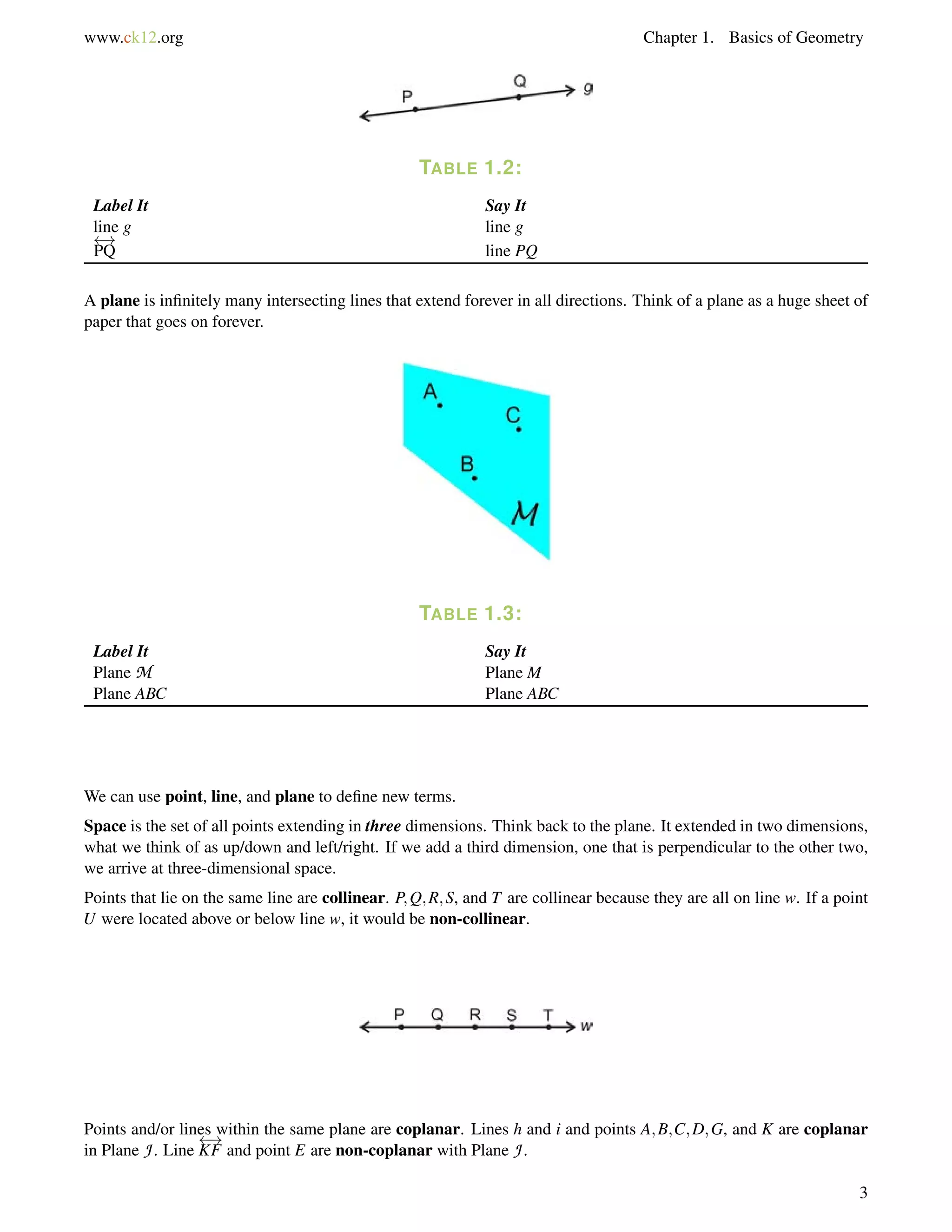
Points and/or lines within the same plane are coplanar. Lines h and i and points A;B;C;D;G, and K are coplanar 
in Plane J . Line 
 ! 
KF and point E are non-coplanar with Plane J . 
3
1.1. Basic Geometric Definitions www.ck12.org 
An endpoint is a point at the end of a line segment. A line segment is a portion of a line with two endpoints. Or, it 
is a finite part of a line that stops at both ends. Line segments are labeled by their endpoints. Order does not matter. 
TABLE 1.4: 
Label It Say It 
AB Segment AB 
BA Segment BA 
A ray is a part of a line with one endpoint that extends forever in the direction opposite that endpoint. A ray is 
labeled by its endpoint and one other point on the ray. For rays, order matters. When labeling, put the endpoint 
under the side WITHOUT the arrow. 
TABLE 1.5: 
Label It Say It 
! 
CD Ray CD 
  
DC Ray CD 
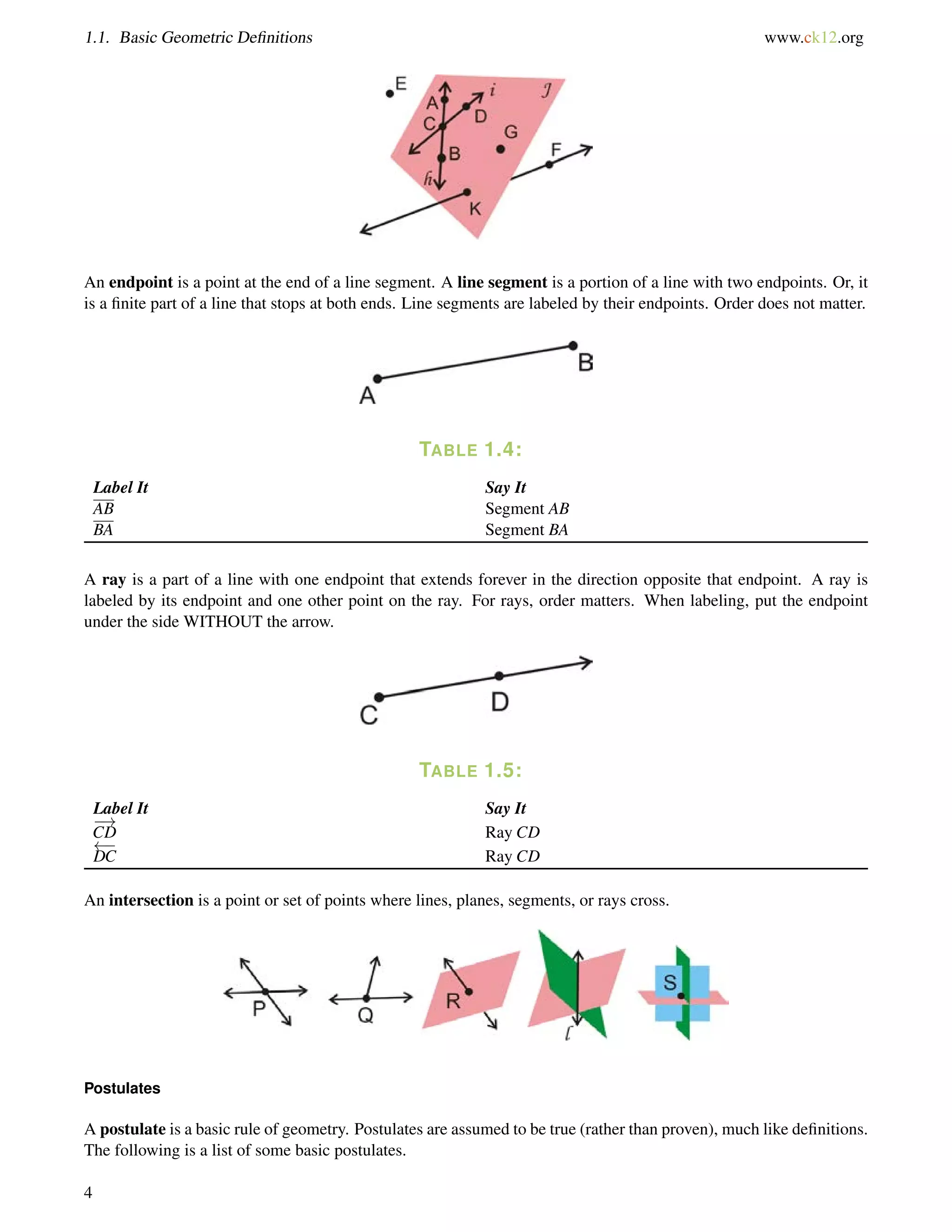
An intersection is a point or set of points where lines, planes, segments, or rays cross. 
Postulates 
A postulate is a basic rule of geometry. Postulates are assumed to be true (rather than proven), much like definitions. 
The following is a list of some basic postulates. 
4
www.ck12.org Chapter 1. Basics of Geometry 
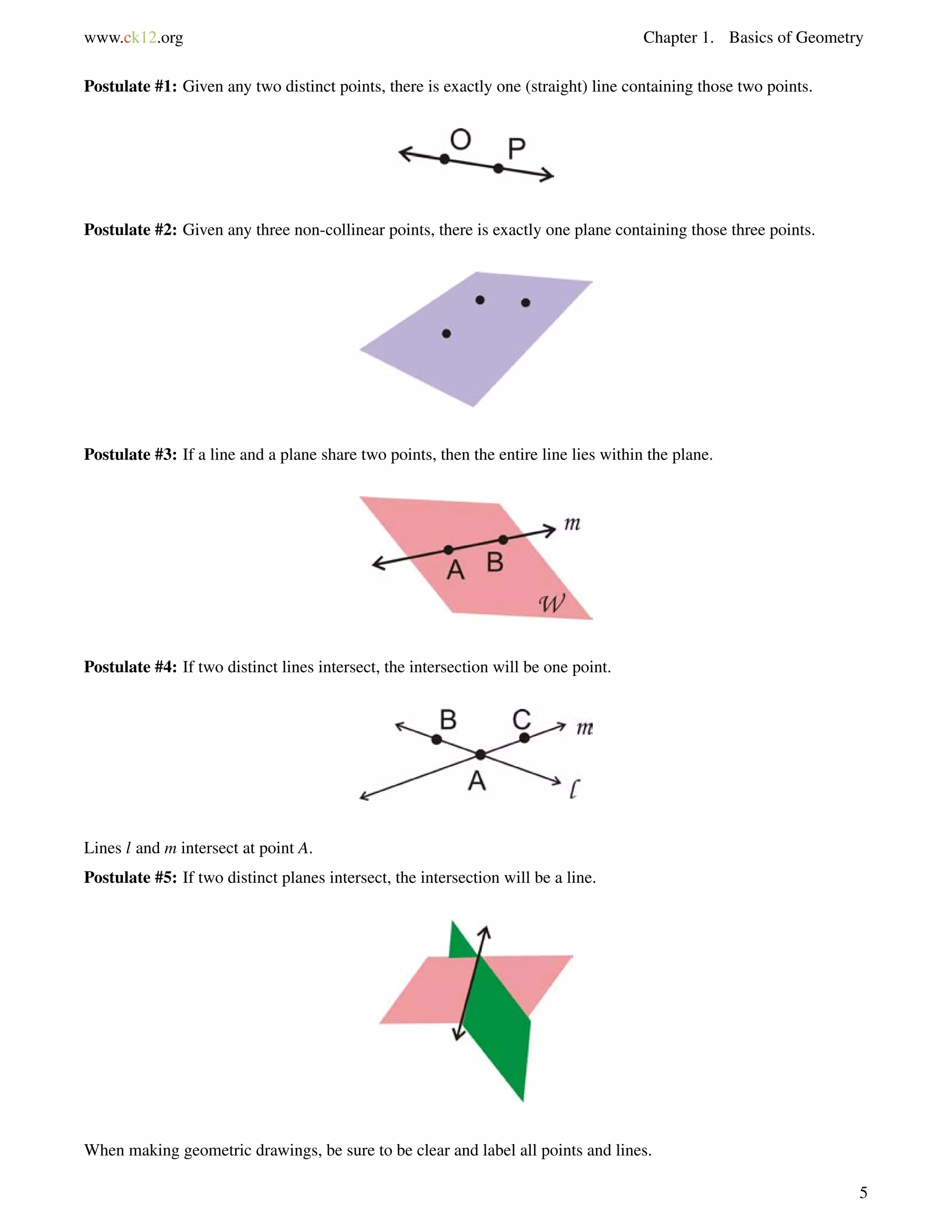
Postulate #1: Given any two distinct points, there is exactly one (straight) line containing those two points. 
Postulate #2: Given any three non-collinear points, there is exactly one plane containing those three points. 
Postulate #3: If a line and a plane share two points, then the entire line lies within the plane. 
Postulate #4: If two distinct lines intersect, the intersection will be one point. 
Lines l and m intersect at point A. 
Postulate #5: If two distinct planes intersect, the intersection will be a line. 
When making geometric drawings, be sure to be clear and label all points and lines. 
5
1.1. Basic Geometric Definitions www.ck12.org 
Example A 
What best describes San Diego, California on a globe? 
A. point 
B. line 
C. plane 
Answer: A city is usually labeled with a dot, or point, on a globe. 
Example B 
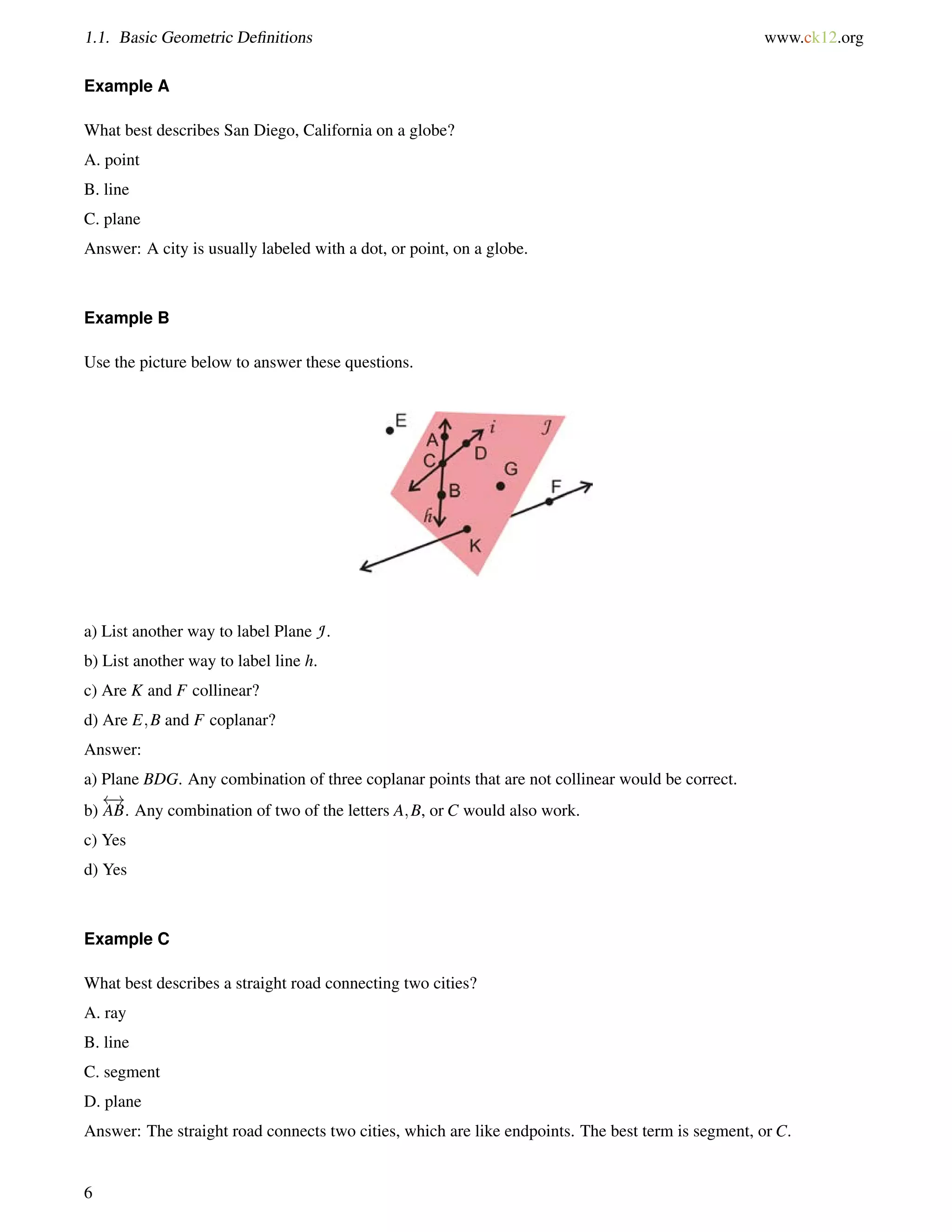
Use the picture below to answer these questions. 
a) List another way to label Plane J . 
b) List another way to label line h. 
c) Are K and F collinear? 
d) Are E;B and F coplanar? 
Answer: 
a) Plane BDG. Any combination of three coplanar points that are not collinear would be correct. 
b) 
 ! 
AB. Any combination of two of the letters A;B, or C would also work. 
c) Yes 
d) Yes 
Example C 
What best describes a straight road connecting two cities? 
A. ray 
B. line 
C. segment 
D. plane 
Answer: The straight road connects two cities, which are like endpoints. The best term is segment, or C. 
6
www.ck12.org Chapter 1. Basics of Geometry 
MEDIA 
Click image to the left for more content. 
CK-12 Basic Geometric Definitions E 
Guided Practice 
1. What best describes the surface of a movie screen? 
A. point 
B. line 
C. plane 
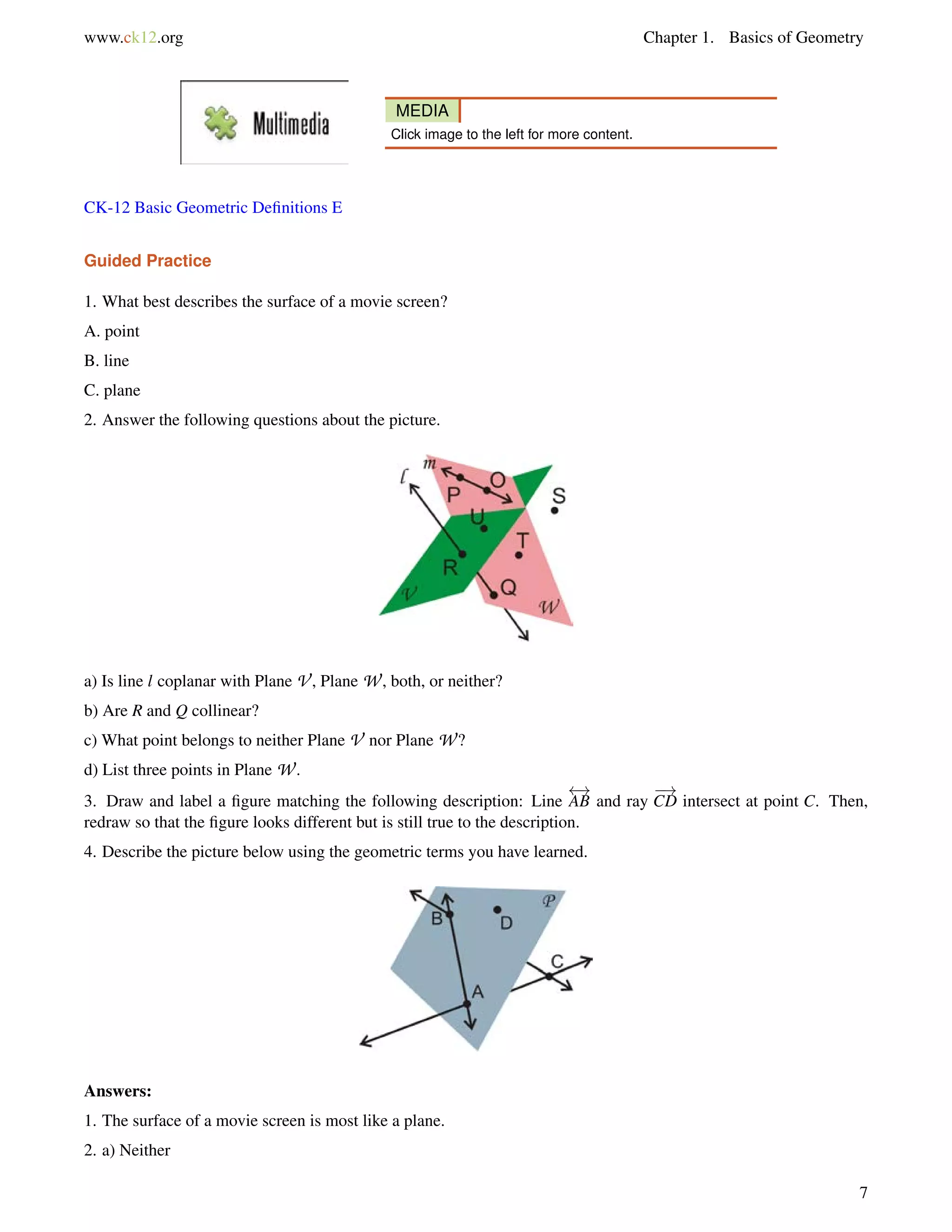
2. Answer the following questions about the picture. 
a) Is line l coplanar with Plane V , Plane W, both, or neither? 
b) Are R and Q collinear? 
c) What point belongs to neither Plane V nor Plane W? 
d) List three points in Plane W. 
3. Draw and label a figure matching the following description: Line 
 ! 
AB and ray 
! 
CD intersect at point C. Then, 
redraw so that the figure looks different but is still true to the description. 
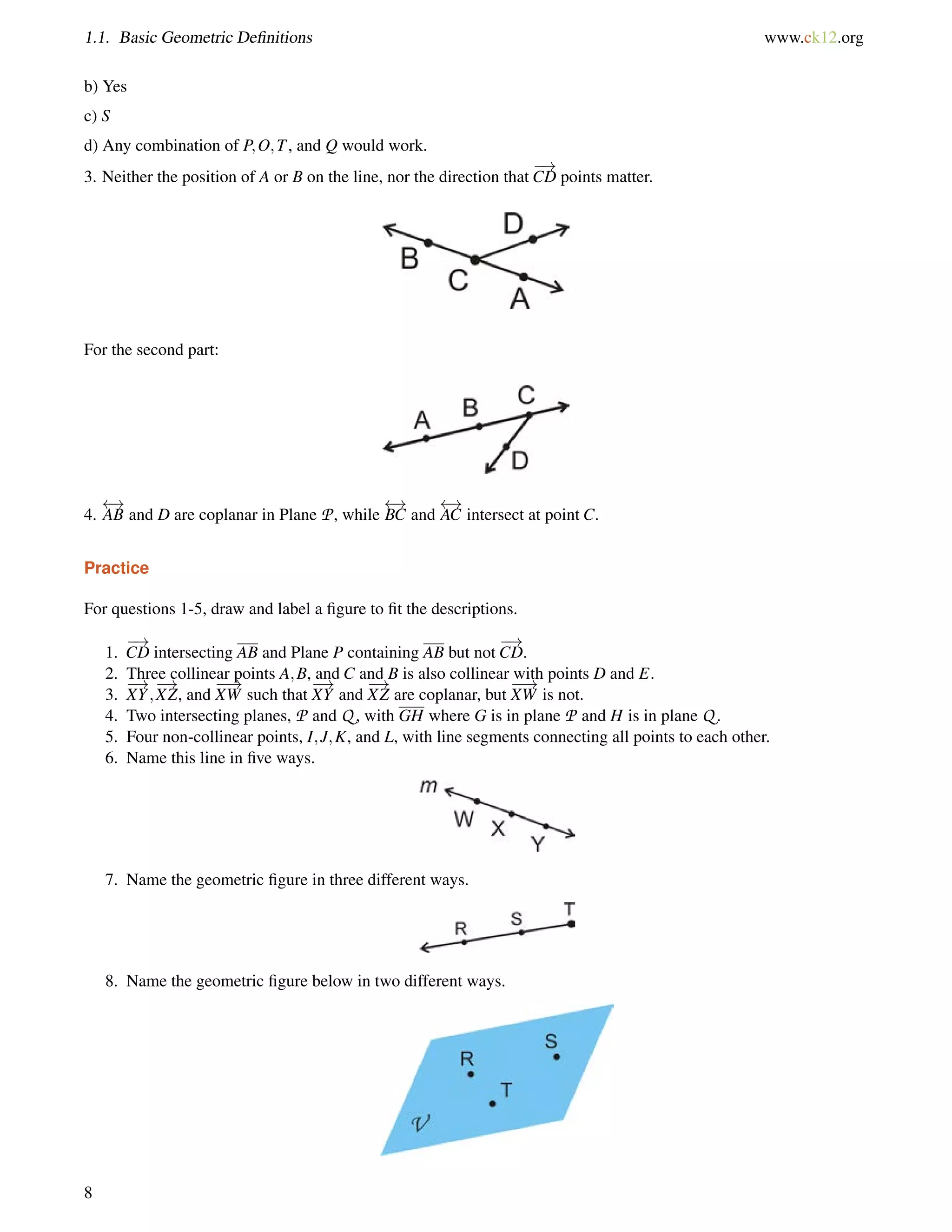
4. Describe the picture below using the geometric terms you have learned. 
Answers: 
1. The surface of a movie screen is most like a plane. 
2. a) Neither 
7
1.1. Basic Geometric Definitions www.ck12.org 
b) Yes 
c) S 
d) Any combination of P;O;T, and Q would work. 
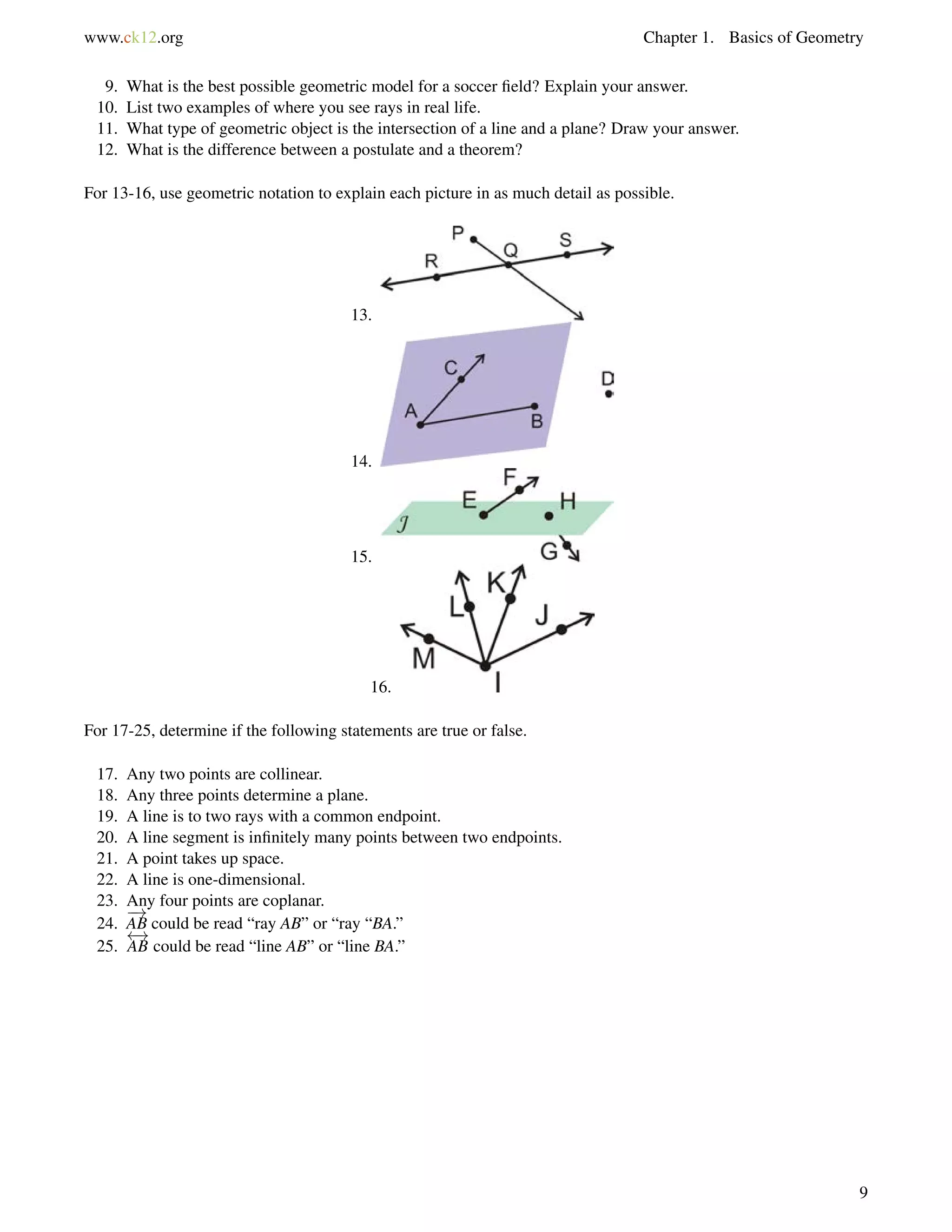
3. Neither the position of A or B on the line, nor the direction that 
! 
CD points matter. 
For the second part: 
4. 
 ! 
AB and D are coplanar in Plane P, while 
 ! 
BC and 
 ! 
AC intersect at point C. 
Practice 
For questions 1-5, draw and label a figure to fit the descriptions. 
1. 
! 
CD intersecting AB and Plane P containing AB but not 
! 
CD. 
2. Three collinear points A;B, and C and B is also collinear with points D and E. 
! 
! 
! 
! 
! 
! 
3. 
XY; 
XZ, and 
XW such that 
XY and 
XZ are coplanar, but 
XW is not. 
4. Two intersecting planes, P and Q , with GH where G is in plane P and H is in plane Q . 
5. Four non-collinear points, I;J;K, and L, with line segments connecting all points to each other. 
6. Name this line in five ways. 
7. Name the geometric figure in three different ways. 
8. Name the geometric figure below in two different ways. 
8
www.ck12.org Chapter 1. Basics of Geometry 
9. What is the best possible geometric model for a soccer field? Explain your answer. 
10. List two examples of where you see rays in real life. 
11. What type of geometric object is the intersection of a line and a plane? Draw your answer. 
12. What is the difference between a postulate and a theorem? 
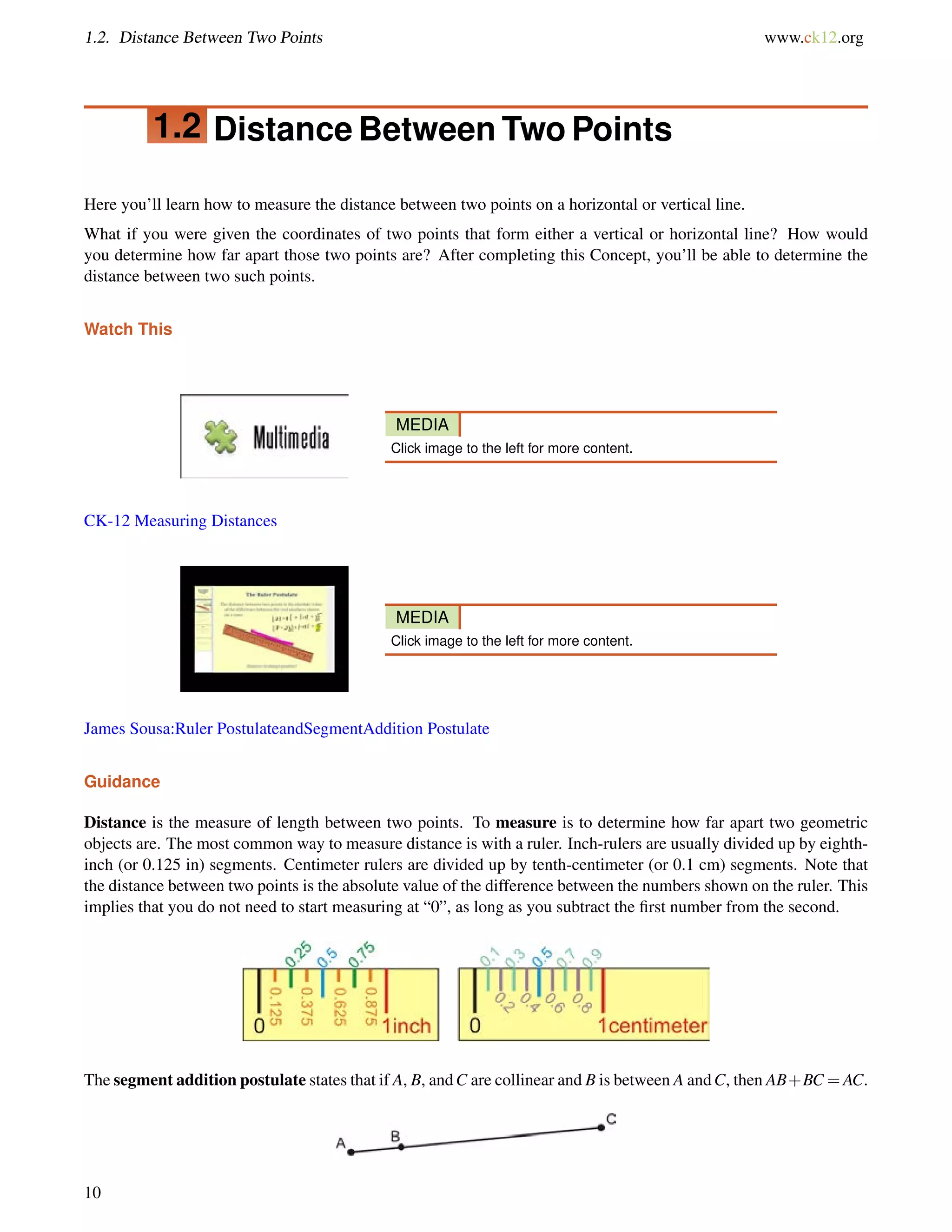
For 13-16, use geometric notation to explain each picture in as much detail as possible. 
13. 
14. 
15. 
16. 
For 17-25, determine if the following statements are true or false. 
17. Any two points are collinear. 
18. Any three points determine a plane. 
19. A line is to two rays with a common endpoint. 
20. A line segment is infinitely many points between two endpoints. 
21. A point takes up space. 
22. A line is one-dimensional. 
23. Any four points are coplanar. 
! 
24. 
AB could be read “ray AB” or “ray “BA.” 
25. 
 ! 
AB could be read “line AB” or “line BA.” 
9
1.2. Distance Between Two Points www.ck12.org 
1.2 Distance Between Two Points 
Here you’ll learn how to measure the distance between two points on a horizontal or vertical line. 
What if you were given the coordinates of two points that form either a vertical or horizontal line? How would 
you determine how far apart those two points are? After completing this Concept, you’ll be able to determine the 
distance between two such points. 
Watch This 
MEDIA 
Click image to the left for more content. 
CK-12 Measuring Distances 
MEDIA 
Click image to the left for more content. 
James Sousa:Ruler PostulateandSegmentAddition Postulate 
Guidance 
Distance is the measure of length between two points. To measure is to determine how far apart two geometric 
objects are. The most common way to measure distance is with a ruler. Inch-rulers are usually divided up by eighth-inch 
(or 0.125 in) segments. Centimeter rulers are divided up by tenth-centimeter (or 0.1 cm) segments. Note that 
the distance between two points is the absolute value of the difference between the numbers shown on the ruler. This 
implies that you do not need to start measuring at “0”, as long as you subtract the first number from the second. 
The segment addition postulate states that if A, B, andC are collinear and B is between A andC, then AB+BC=AC. 
10
www.ck12.org Chapter 1. Basics of Geometry 
You can find the distances between points in the x–y plane if the lines are horizontal or vertical. If the line is vertical, 
find the change in the ycoordinates. If the line is horizontal, find the change in the xcoordinates. 
Example A 
What is the distance marked on the ruler below? The ruler is in centimeters. 
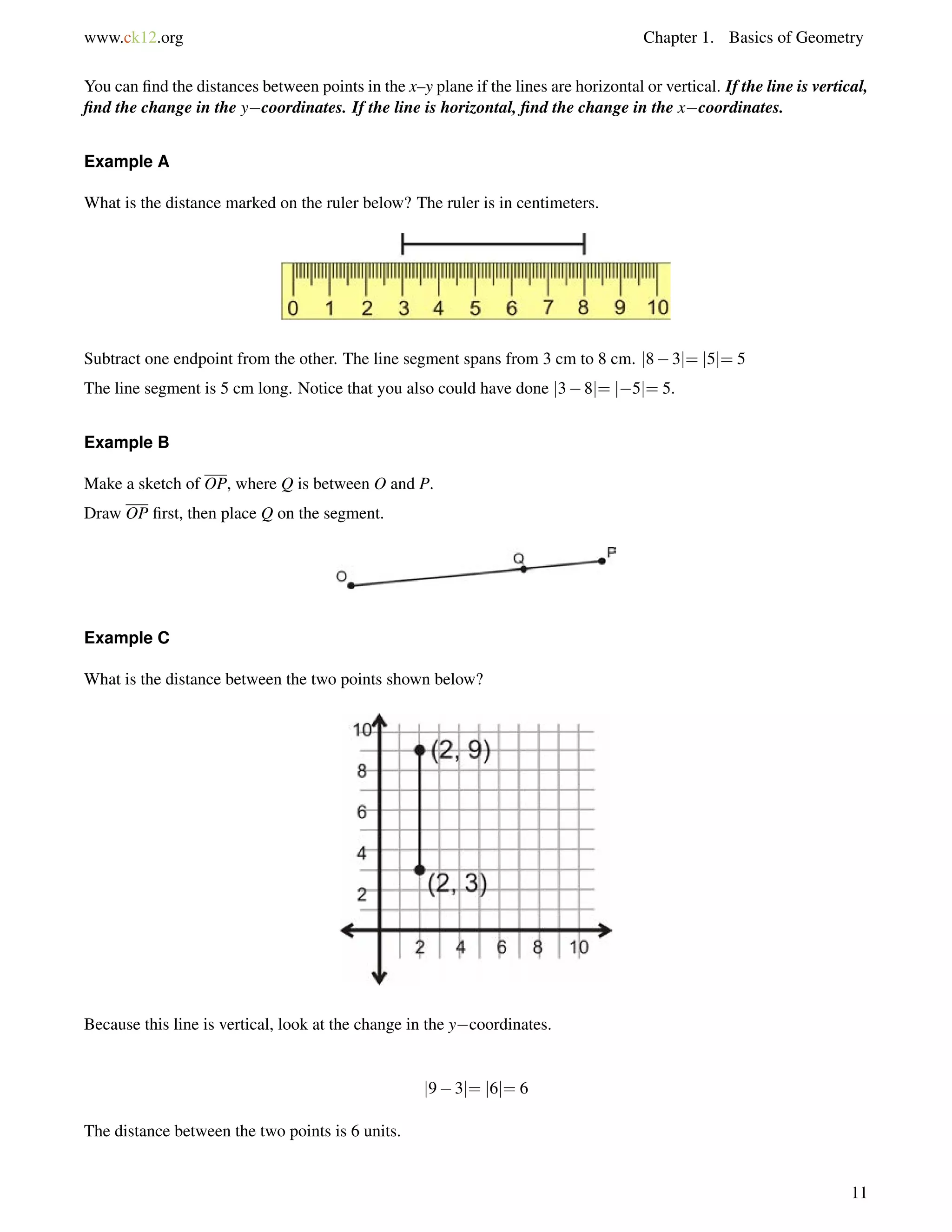
Subtract one endpoint from the other. The line segment spans from 3 cm to 8 cm. j83j= j5j= 5 
The line segment is 5 cm long. Notice that you also could have done j38j= j5j= 5. 
Example B 
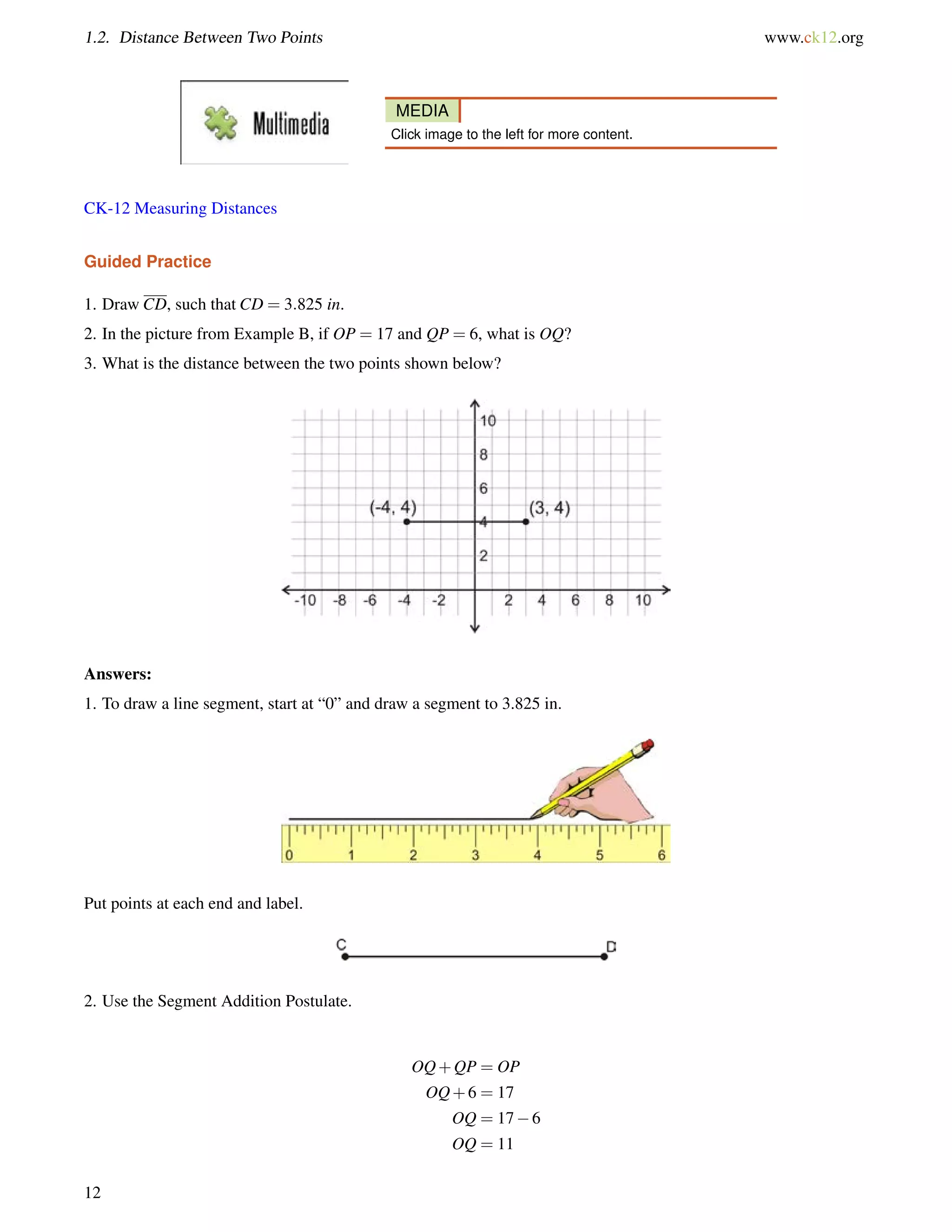
Make a sketch of OP, where Q is between O and P. 
Draw OP first, then place Q on the segment. 
Example C 
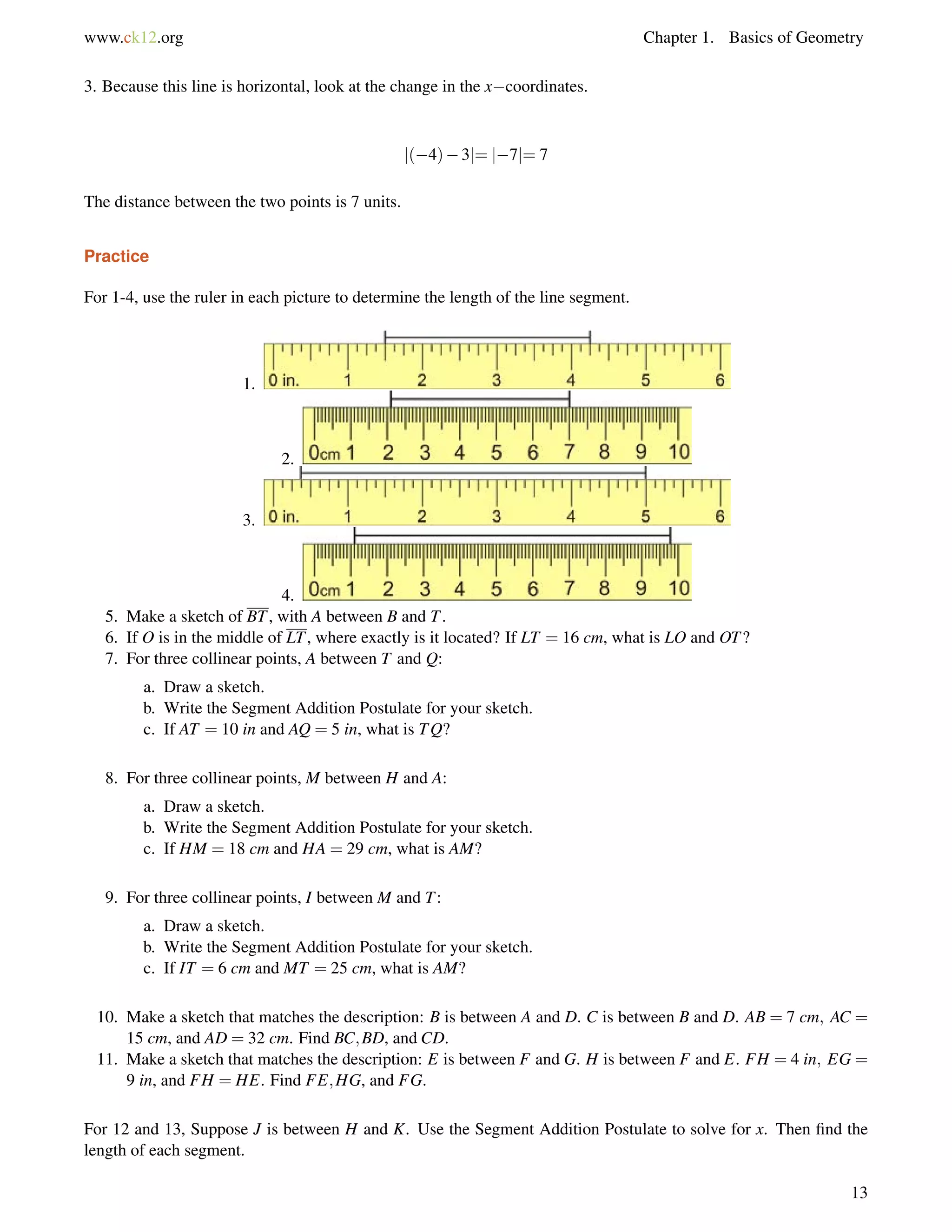
What is the distance between the two points shown below? 
Because this line is vertical, look at the change in the ycoordinates. 
j93j= j6j= 6 
The distance between the two points is 6 units. 
11
1.2. Distance Between Two Points www.ck12.org 
MEDIA 
Click image to the left for more content. 
CK-12 Measuring Distances 
Guided Practice 
1. Draw CD, such that CD = 3:825 in. 
2. In the picture from Example B, if OP = 17 and QP = 6, what is OQ? 
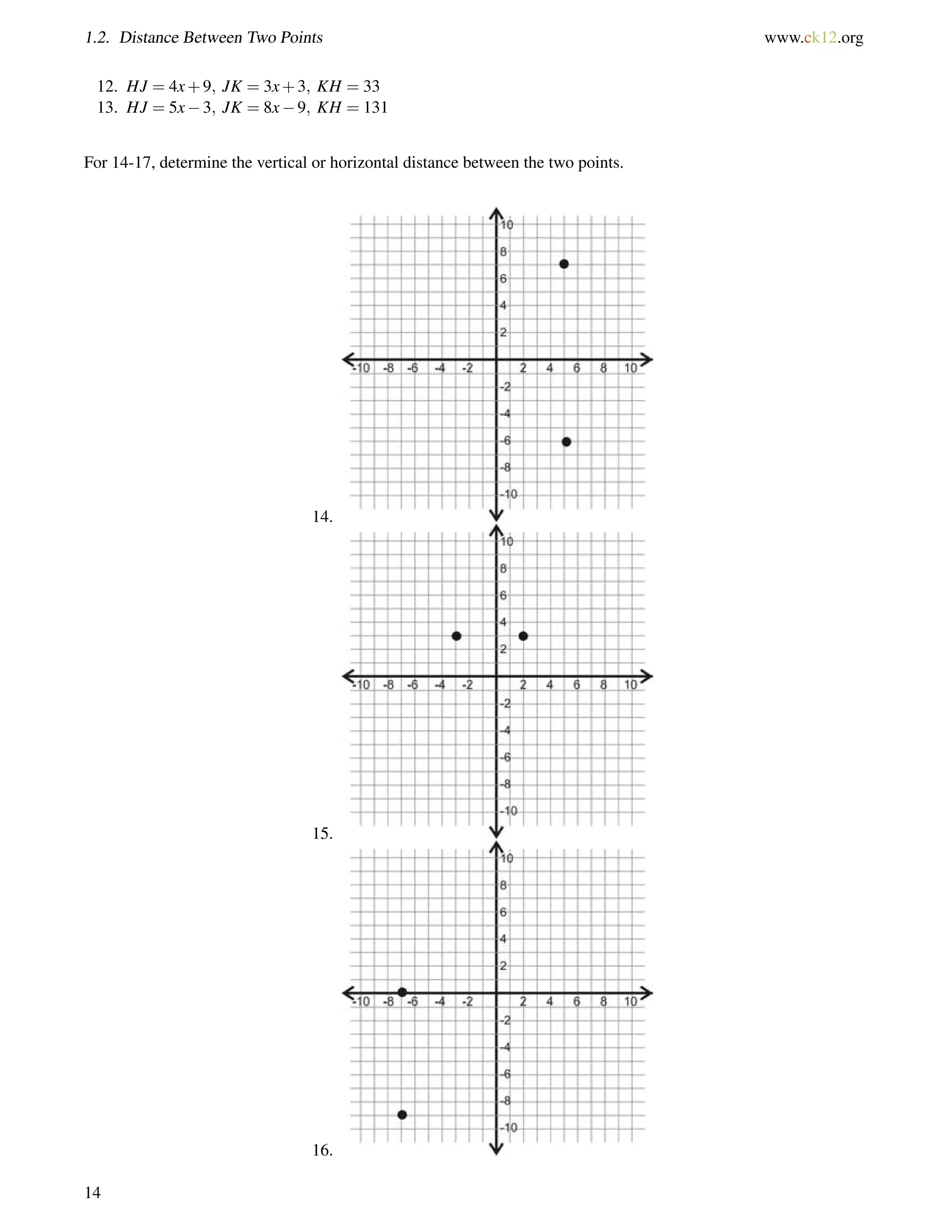
3. What is the distance between the two points shown below? 
Answers: 
1. To draw a line segment, start at “0” and draw a segment to 3.825 in. 
Put points at each end and label. 
2. Use the Segment Addition Postulate. 
OQ+QP = OP 
OQ+6 = 17 
OQ = 176 
OQ = 11 
12
www.ck12.org Chapter 1. Basics of Geometry 
3. Because this line is horizontal, look at the change in the xcoordinates. 
j(4)3j= j7j= 7 
The distance between the two points is 7 units. 
Practice 
For 1-4, use the ruler in each picture to determine the length of the line segment. 
1. 
2. 
3. 
4. 
5. Make a sketch of BT, with A between B and T. 
6. If O is in the middle of LT, where exactly is it located? If LT = 16 cm, what is LO and OT? 
7. For three collinear points, A between T and Q: 
a. Draw a sketch. 
b. Write the Segment Addition Postulate for your sketch. 
c. If AT = 10 in and AQ = 5 in, what is TQ? 
8. For three collinear points, M between H and A: 
a. Draw a sketch. 
b. Write the Segment Addition Postulate for your sketch. 
c. If HM = 18 cm and HA = 29 cm, what is AM? 
9. For three collinear points, I between M and T: 
a. Draw a sketch. 
b. Write the Segment Addition Postulate for your sketch. 
c. If IT = 6 cm and MT = 25 cm, what is AM? 
10. Make a sketch that matches the description: B is between A and D. C is between B and D. AB = 7 cm; AC = 
15 cm, and AD = 32 cm. Find BC;BD, and CD. 
11. Make a sketch that matches the description: E is between F and G. H is between F and E. FH = 4 in; EG = 
9 in, and FH = HE. Find FE;HG, and FG. 
For 12 and 13, Suppose J is between H and K. Use the Segment Addition Postulate to solve for x. Then find the 
length of each segment. 
13
1.2. Distance Between Two Points www.ck12.org 
12. HJ = 4x+9; JK = 3x+3; KH = 33 
13. HJ = 5x3; JK = 8x9; KH = 131 
For 14-17, determine the vertical or horizontal distance between the two points. 
14. 
15. 
16. 
14
www.ck12.org Chapter 1. Basics of Geometry 
17. 
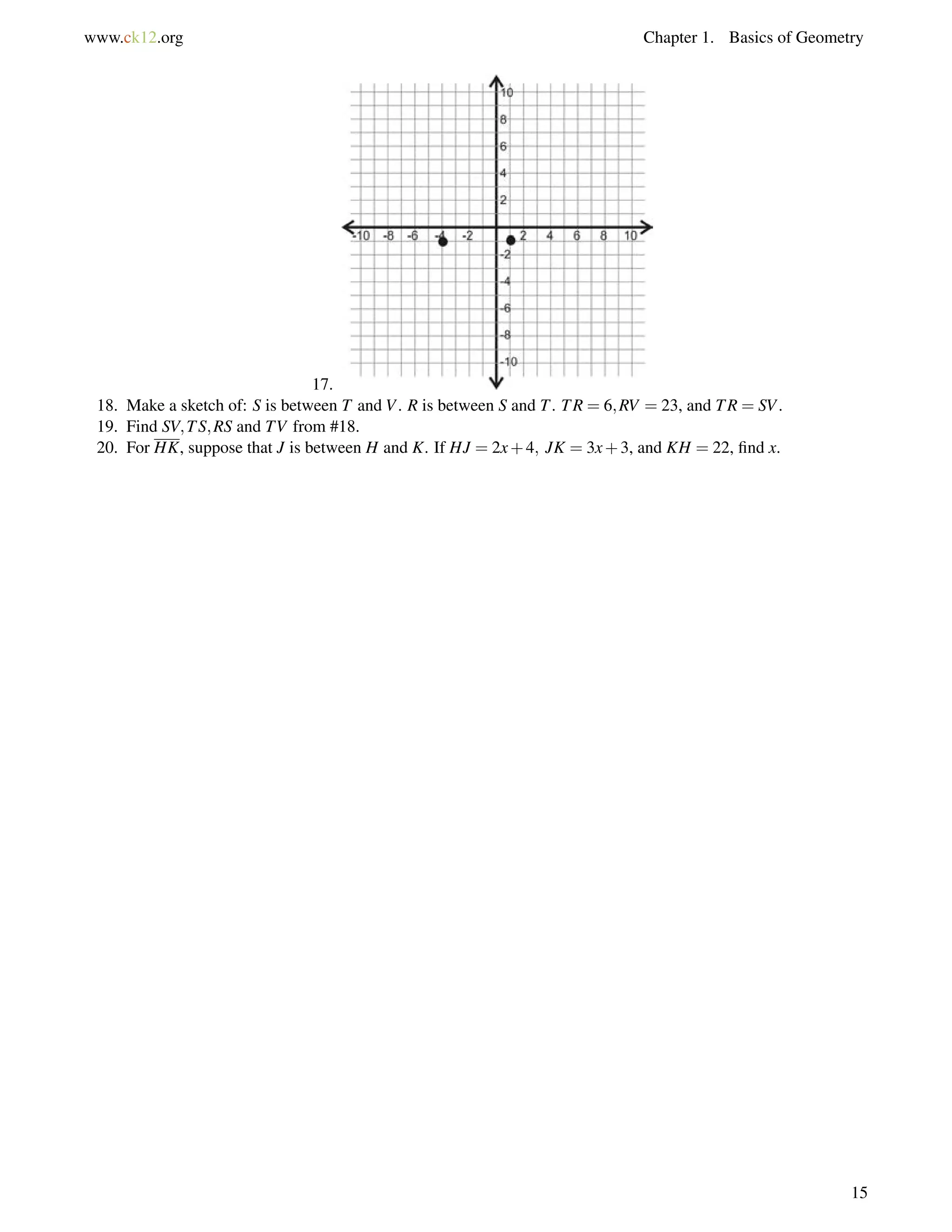
18. Make a sketch of: S is between T and V. R is between S and T. TR = 6;RV = 23, and TR = SV. 
19. Find SV;TS;RS and TV from #18. 
20. For HK, suppose that J is between H and K. If HJ = 2x+4; JK = 3x+3, and KH = 22, find x. 
15
1.3. Congruent Angles and Angle Bisectors www.ck12.org 
1.3 Congruent Angles and Angle Bisectors 
Here you’ll learn how to find unknown values using the definitions of angle congruency and angle bisector. 
What if you were told that a line segment divides an angle in half? How would you find the measures of the two 
new angles formed by that segment? After completing this Concept, you’ll be able to use the definitions of angle 
congruency and angle bisector to find such angle measures. 
Watch This 
MEDIA 
Click image to the left for more content. 
CK-12 Congruent Angles and AngleBisectors 
MEDIA 
Click image to the left for more content. 
James Sousa:Angle Bisectors 
Then watch the first part of this video. 
MEDIA 
Click image to the left for more content. 
James Sousa:Angle Bisector Exercise2 
Guidance 
When two geometric figures have the same shape and size (or the same angle measure in the case of angles) they are 
said to be congruent. 
16
www.ck12.org Chapter 1. Basics of Geometry 
TABLE 1.6: 
Label It Say It 
6 ABC = 
6 DEF Angle ABC is congruent to angle DEF. 
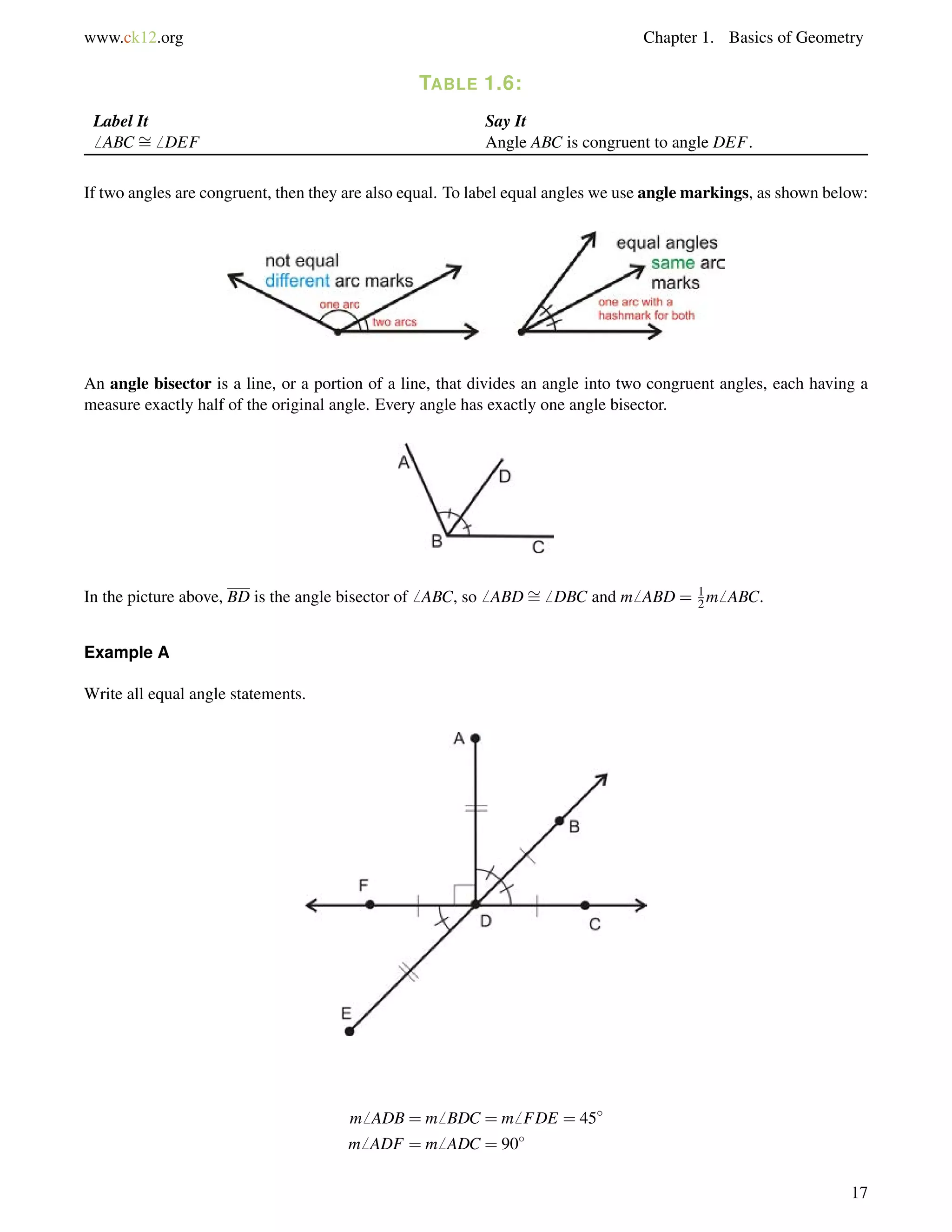
If two angles are congruent, then they are also equal. To label equal angles we use angle markings, as shown below: 
An angle bisector is a line, or a portion of a line, that divides an angle into two congruent angles, each having a 
measure exactly half of the original angle. Every angle has exactly one angle bisector. 
In the picture above, BD is the angle bisector of6 ABC, so6 ABD= 
6 DBC and m6 ABD = 12 
m6 ABC. 
Example A 
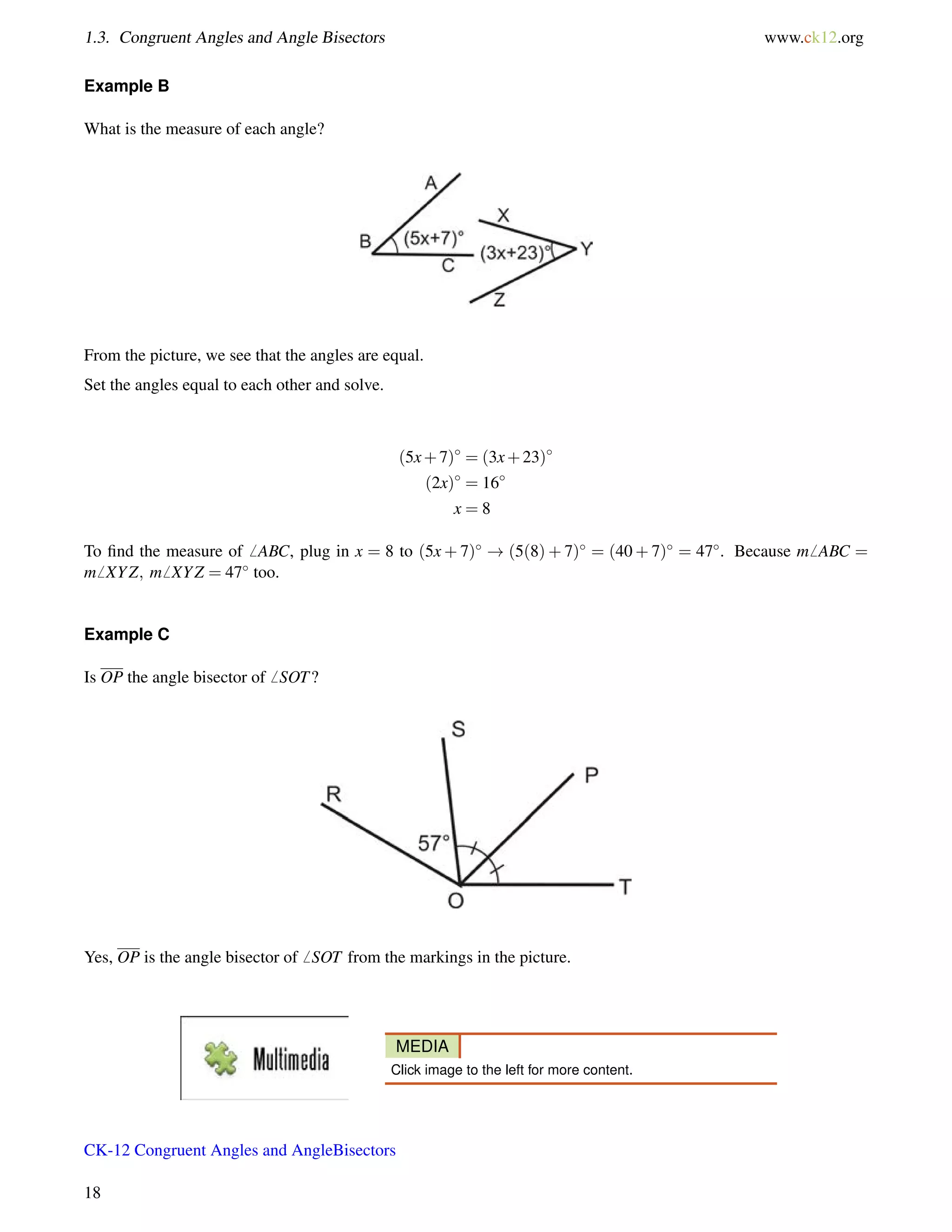
Write all equal angle statements. 
m6 ADB = m6 BDC = m6 FDE = 45 
m6 ADF = m6 ADC = 90 
17
1.3. Congruent Angles and Angle Bisectors www.ck12.org 
Example B 
What is the measure of each angle? 
From the picture, we see that the angles are equal. 
Set the angles equal to each other and solve. 
(5x+7) = (3x+23) 
(2x) = 16 
x = 8 
To find the measure of6 ABC, plug in x = 8 to (5x+7) ! (5(8)+7) = (40+7) = 47. Because m6 ABC = 
m6 XYZ; m6 XYZ = 47 too. 
Example C 
Is OP the angle bisector of6 SOT? 
Yes, OP is the angle bisector of6 SOT from the markings in the picture. 
MEDIA 
Click image to the left for more content. 
CK-12 Congruent Angles and AngleBisectors 
18
www.ck12.org Chapter 1. Basics of Geometry 
Guided Practice 
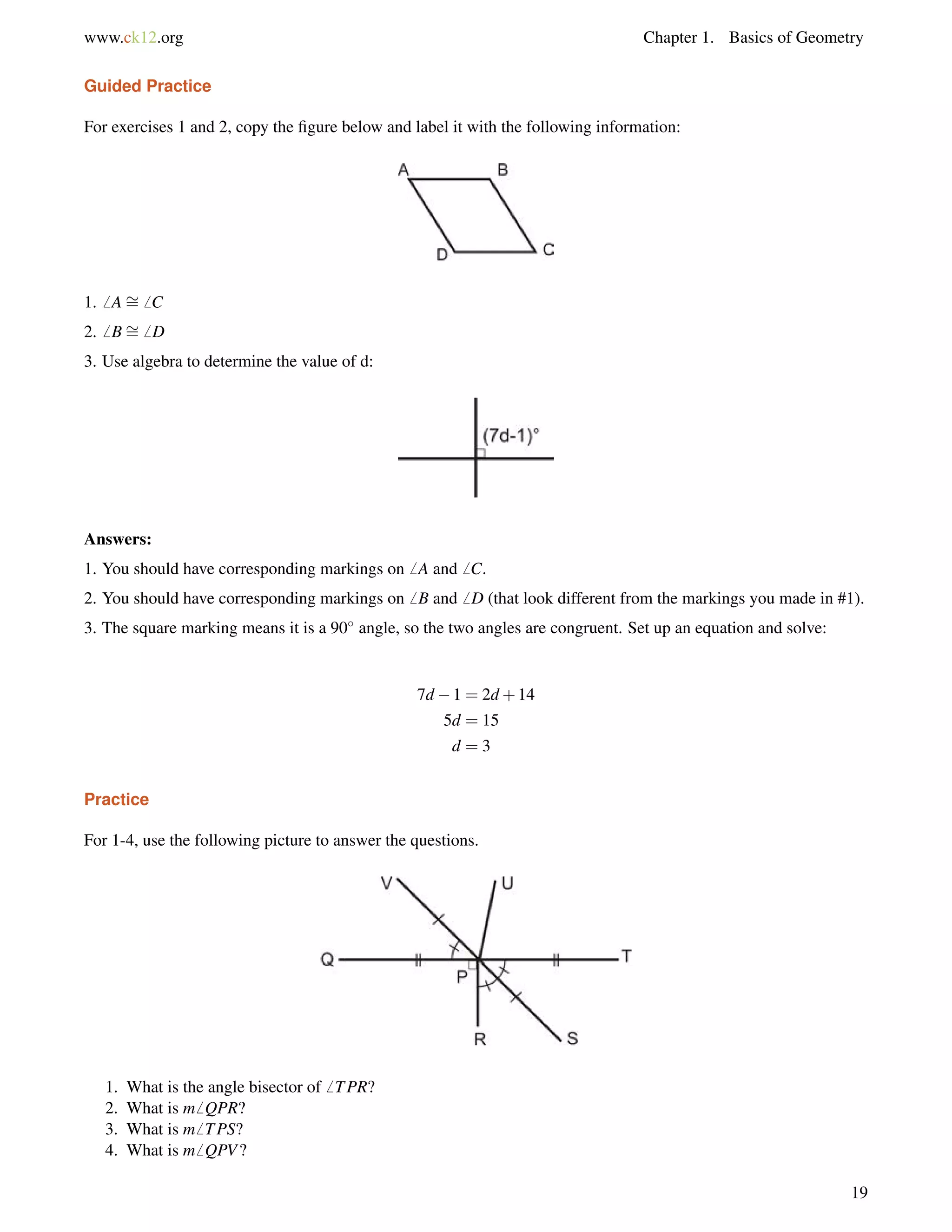
For exercises 1 and 2, copy the figure below and label it with the following information: 
1.6 A= 
6 C 
2.6 B= 
6 D 
3. Use algebra to determine the value of d: 
Answers: 
1. You should have corresponding markings on6 A and6 C. 
2. You should have corresponding markings on6 B and6 D (that look different from the markings you made in #1). 
3. The square marking means it is a 90 angle, so the two angles are congruent. Set up an equation and solve: 
7d1 = 2d+14 
5d = 15 
d = 3 
Practice 
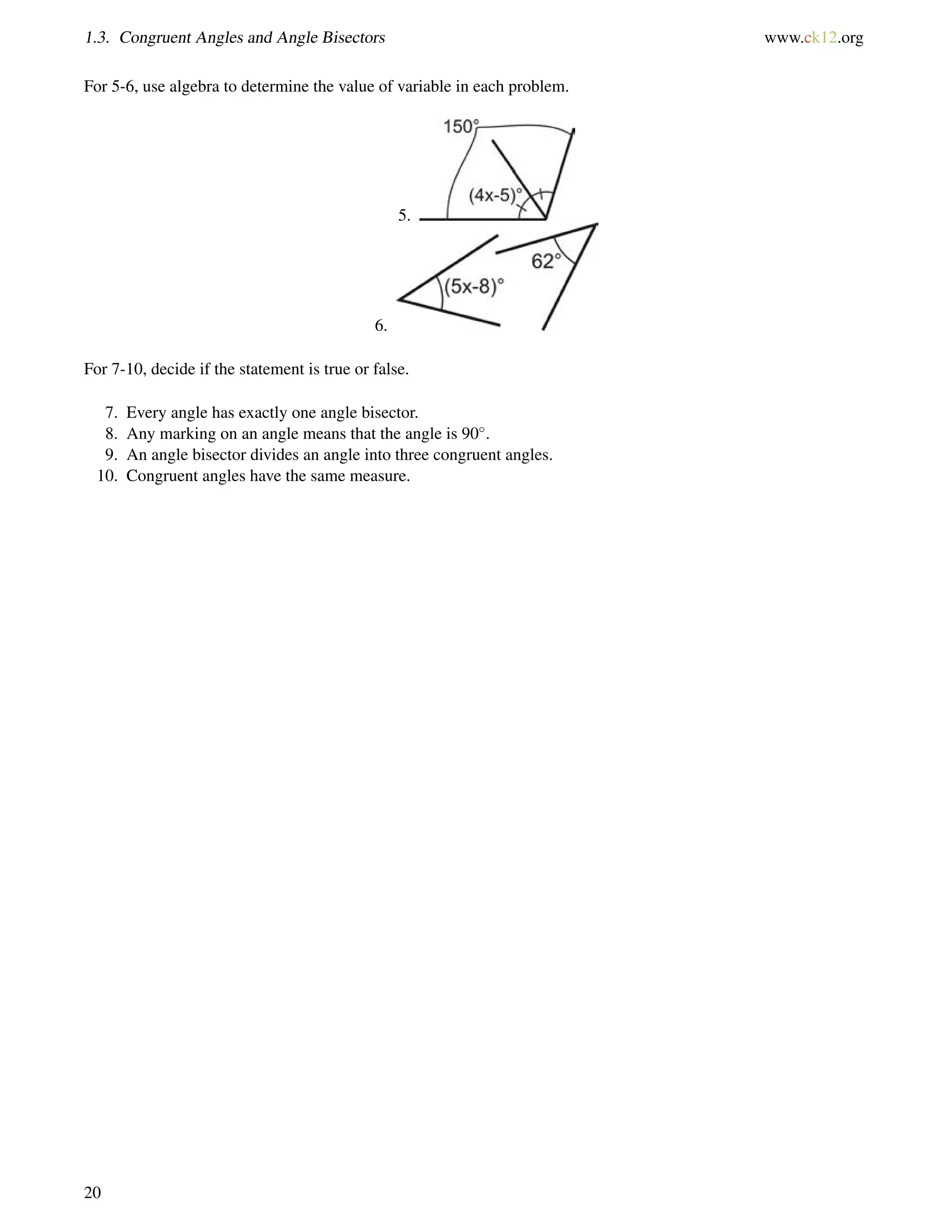
For 1-4, use the following picture to answer the questions. 
1. What is the angle bisector of6 TPR? 
2. What is m6 QPR? 
3. What is m6 TPS? 
4. What is m6 QPV? 
19
1.3. Congruent Angles and Angle Bisectors www.ck12.org 
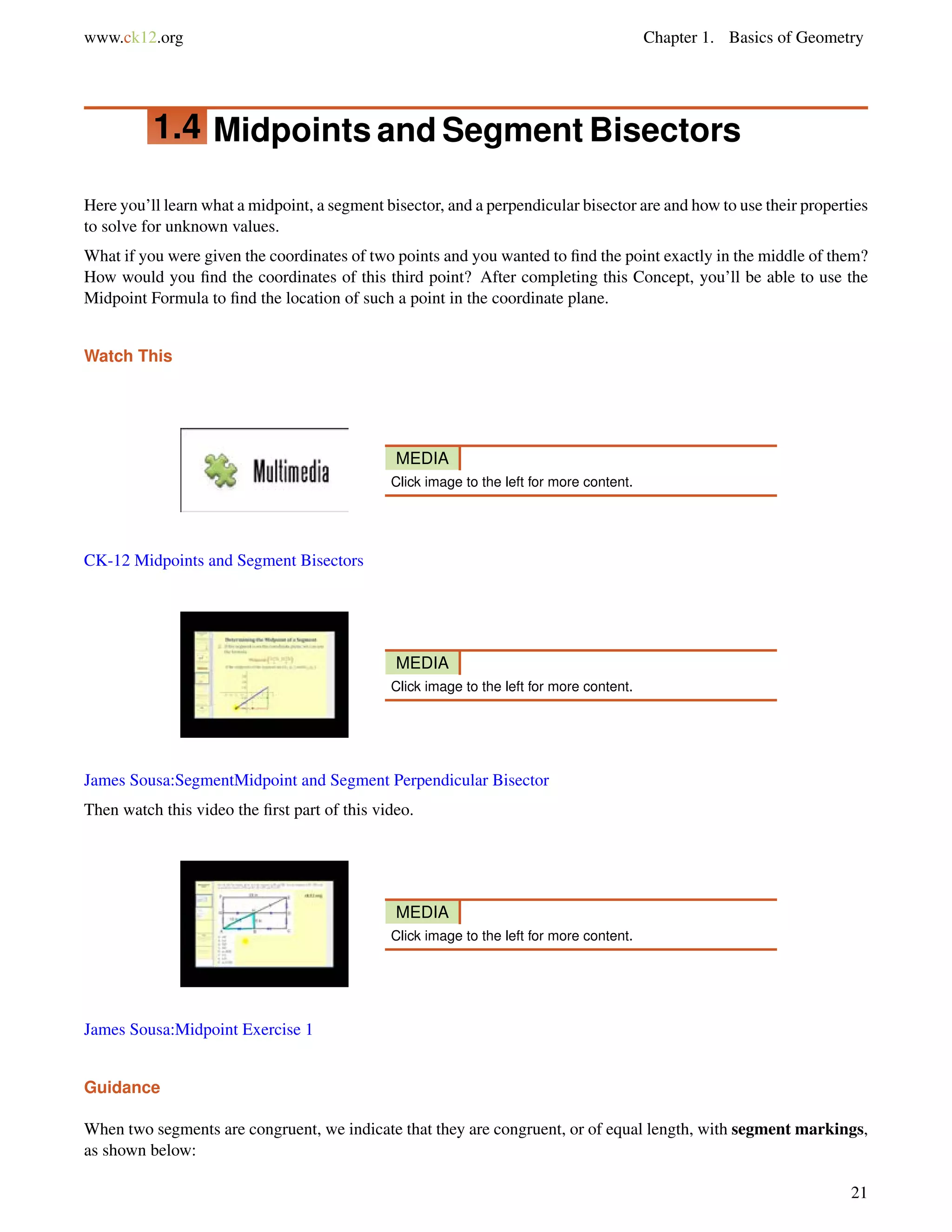
For 5-6, use algebra to determine the value of variable in each problem. 
5. 
6. 
For 7-10, decide if the statement is true or false. 
7. Every angle has exactly one angle bisector. 
8. Any marking on an angle means that the angle is 90. 
9. An angle bisector divides an angle into three congruent angles. 
10. Congruent angles have the same measure. 
20
www.ck12.org Chapter 1. Basics of Geometry 
1.4 Midpoints and Segment Bisectors 
Here you’ll learn what a midpoint, a segment bisector, and a perpendicular bisector are and how to use their properties 
to solve for unknown values. 
What if you were given the coordinates of two points and you wanted to find the point exactly in the middle of them? 
How would you find the coordinates of this third point? After completing this Concept, you’ll be able to use the 
Midpoint Formula to find the location of such a point in the coordinate plane. 
Watch This 
MEDIA 
Click image to the left for more content. 
CK-12 Midpoints and Segment Bisectors 
MEDIA 
Click image to the left for more content. 
James Sousa:SegmentMidpoint and Segment Perpendicular Bisector 
Then watch this video the first part of this video. 
MEDIA 
Click image to the left for more content. 
James Sousa:Midpoint Exercise 1 
Guidance 
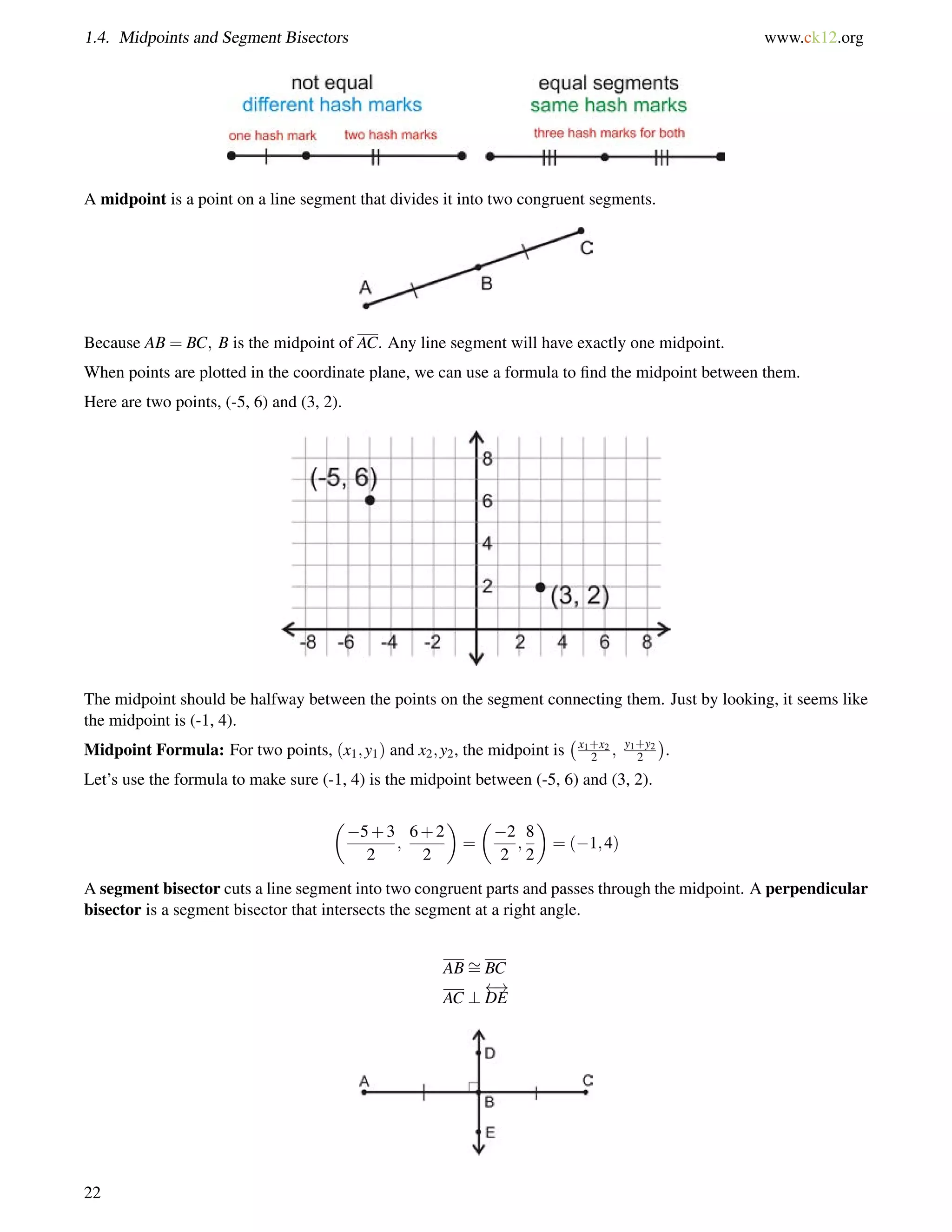
When two segments are congruent, we indicate that they are congruent, or of equal length, with segment markings, 
as shown below: 
21
1.4. Midpoints and Segment Bisectors www.ck12.org 
A midpoint is a point on a line segment that divides it into two congruent segments. 
Because AB = BC; B is the midpoint of AC. Any line segment will have exactly one midpoint. 
When points are plotted in the coordinate plane, we can use a formula to find the midpoint between them. 
Here are two points, (-5, 6) and (3, 2). 
The midpoint should be halfway between the points on the segment connecting them. Just by looking, it seems like 
the midpoint is (-1, 4). 
Midpoint Formula: For two points, (x1;y1) and x2;y2, the midpoint is 
x1+x2 
2 ; y1+y2 
2 
 
. 
Let’s use the formula to make sure (-1, 4) is the midpoint between (-5, 6) and (3, 2). 
 
5+3 
2 
; 
6+2 
2 
 
= 
 
2 
2 
; 
8 
2 
 
= (1;4) 
A segment bisector cuts a line segment into two congruent parts and passes through the midpoint. A perpendicular 
bisector is a segment bisector that intersects the segment at a right angle. 
AB= 
BC 
AC ? 
 ! 
DE 
22
www.ck12.org Chapter 1. Basics of Geometry 
Example A 
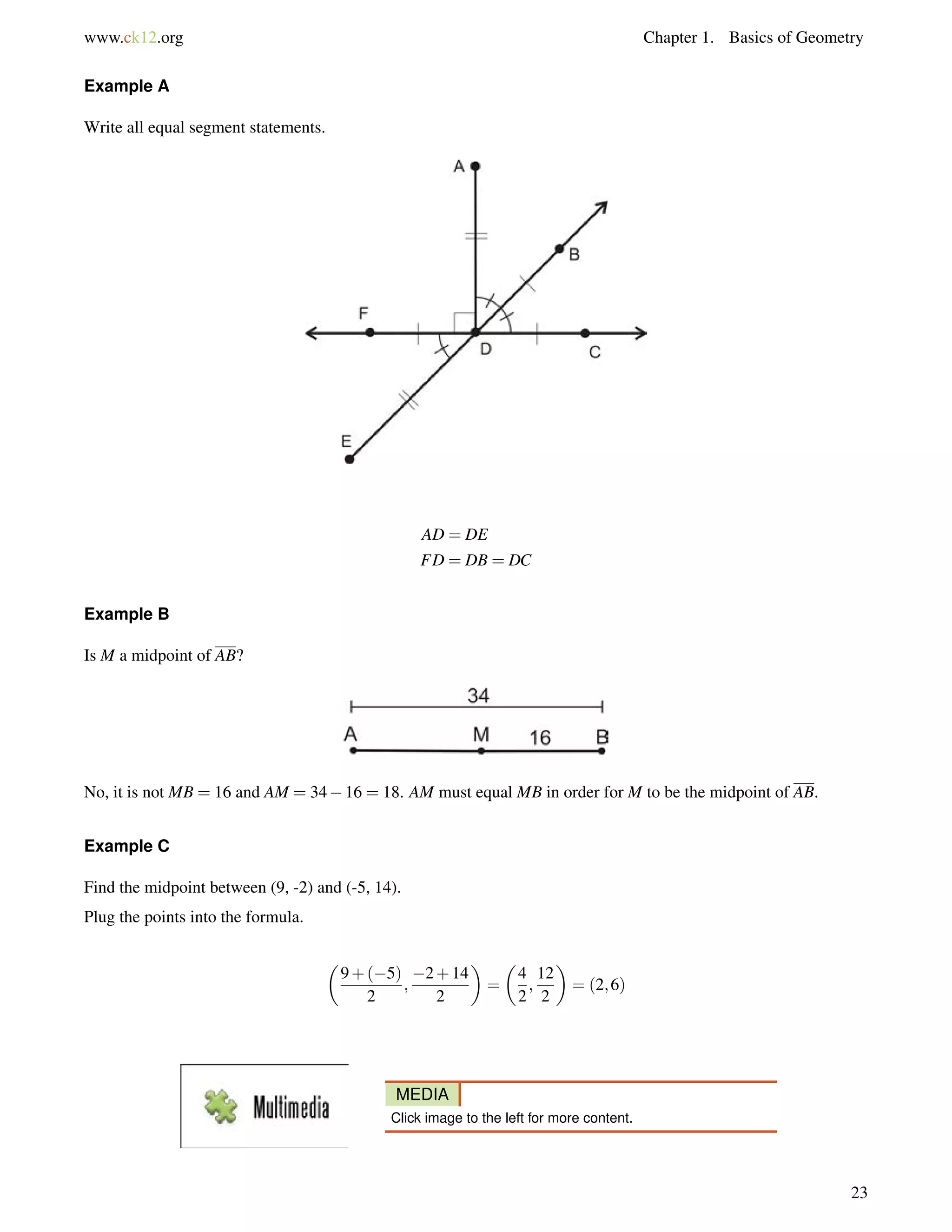
Write all equal segment statements. 
AD = DE 
FD = DB = DC 
Example B 
Is M a midpoint of AB? 
No, it is not MB = 16 and AM = 3416 = 18. AM must equal MB in order for M to be the midpoint of AB. 
Example C 
Find the midpoint between (9, -2) and (-5, 14). 
Plug the points into the formula. 
 
9+(5) 
2 
; 
2+14 
2 
 
= 
 
4 
2 
; 
12 
2 
 
= (2;6) 
MEDIA 
Click image to the left for more content. 
23
1.4. Midpoints and Segment Bisectors www.ck12.org 
CK-12 Midpoints and Segment Bisectors 
Guided Practice 
1. If M(3;1) is the midpoint of AB and B(7;6), find A. 
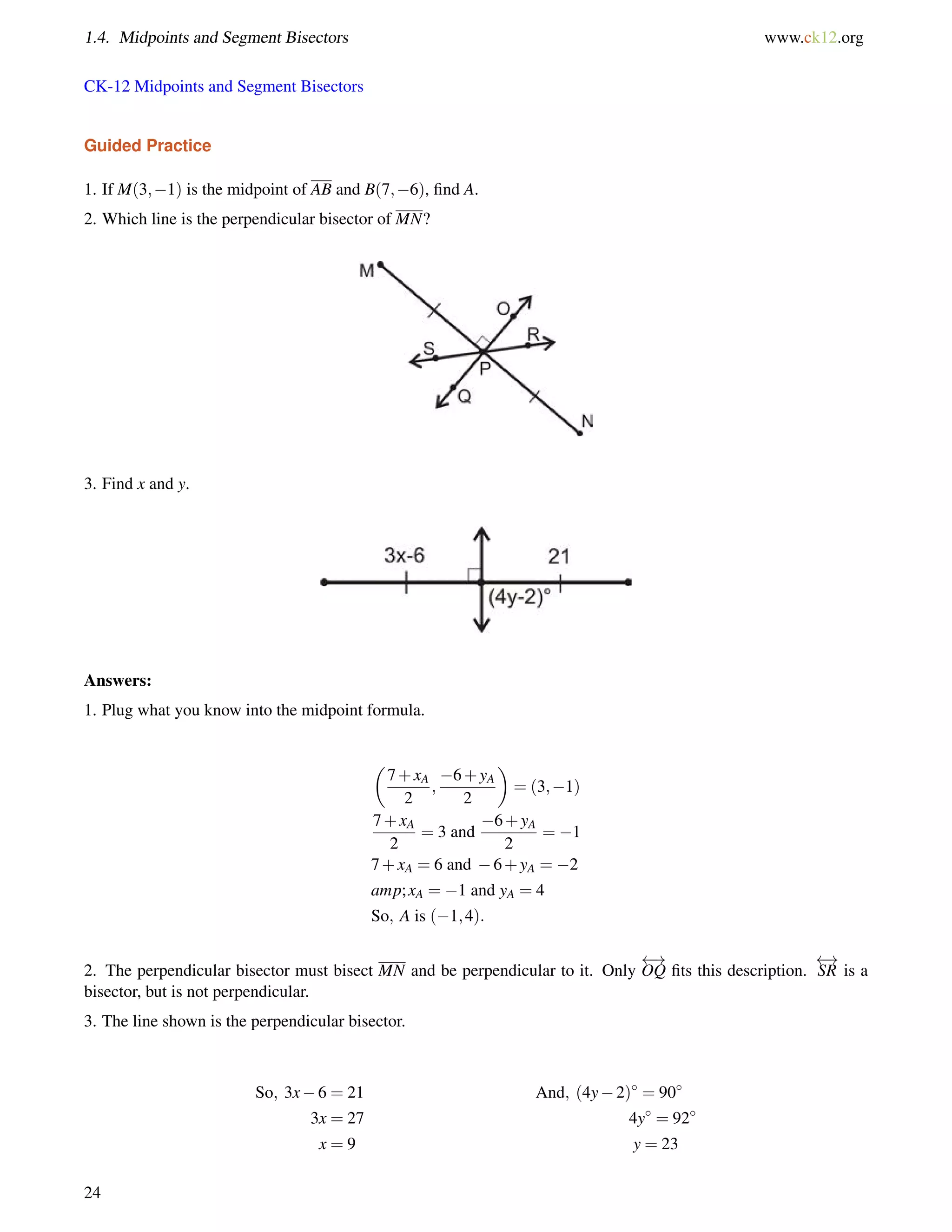
2. Which line is the perpendicular bisector of MN? 
3. Find x and y. 
Answers: 
1. Plug what you know into the midpoint formula. 
 
7+xA 
2 
; 
6+yA 
2 
 
= (3;1) 
7+xA 
2 
= 3 and 
6+yA 
2 
= 1 
7+xA = 6 and 6+yA = 2 
amp; xA = 1 and yA = 4 
So; A is (1;4): 
2. The perpendicular bisector must bisect MN and be perpendicular to it. Only 
 ! 
OQ fits this description. 
 ! 
SR is a 
bisector, but is not perpendicular. 
3. The line shown is the perpendicular bisector. 
So; 3x6 = 21 And; (4y2) = 90 
3x = 27 4y = 92 
x = 9 y = 23 
24
www.ck12.org Chapter 1. Basics of Geometry 
Practice 
1. Copy the figure below and label it with the following information: 
AB= 
CD 
AD= 
BC 
For 2-4, use the following picture to answer the questions. 
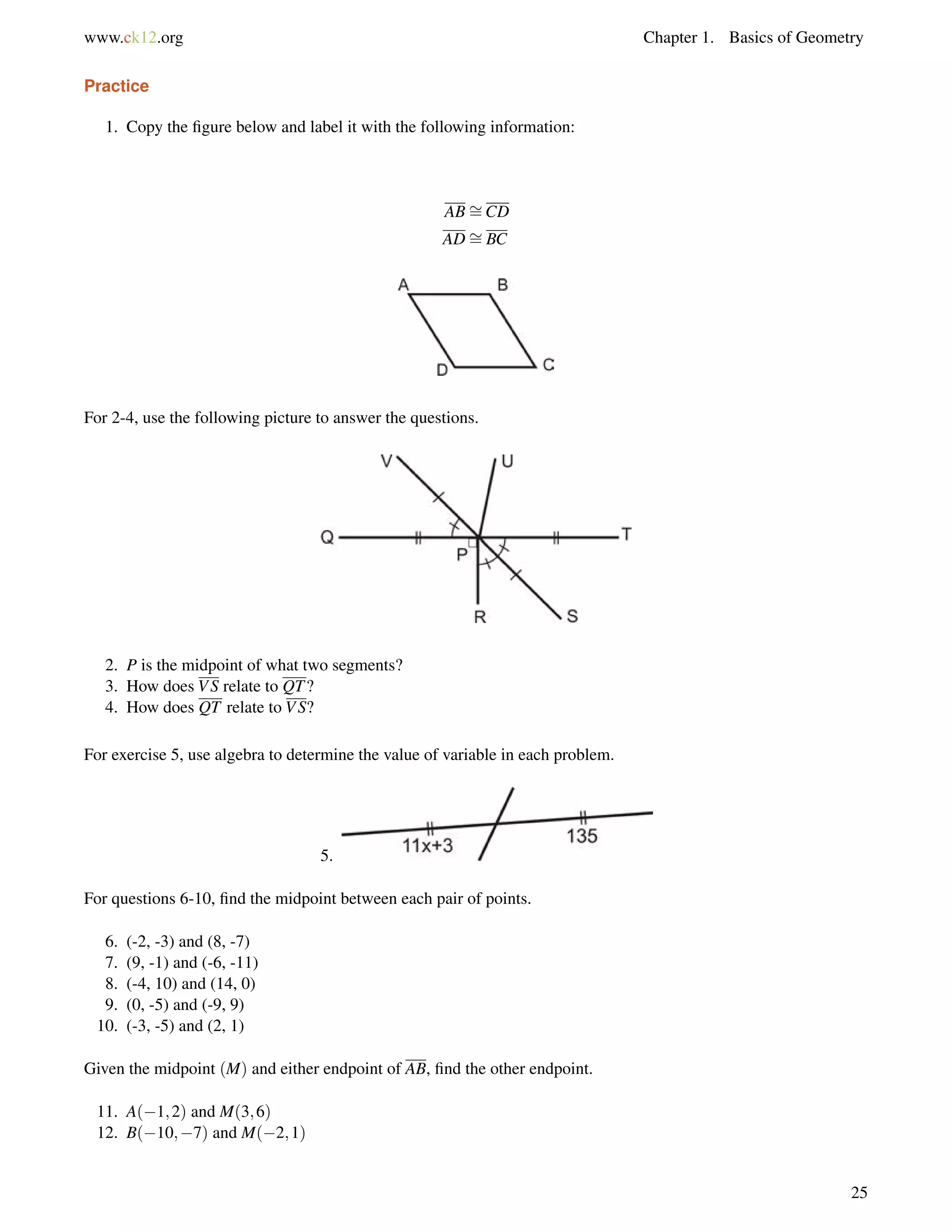
2. P is the midpoint of what two segments? 
3. How does VS relate to QT? 
4. How does QT relate to VS? 
For exercise 5, use algebra to determine the value of variable in each problem. 
5. 
For questions 6-10, find the midpoint between each pair of points. 
6. (-2, -3) and (8, -7) 
7. (9, -1) and (-6, -11) 
8. (-4, 10) and (14, 0) 
9. (0, -5) and (-9, 9) 
10. (-3, -5) and (2, 1) 
Given the midpoint (M) and either endpoint of AB, find the other endpoint. 
11. A(1;2) and M(3;6) 
12. B(10;7) and M(2;1) 
25
1.5. Angle Measurement www.ck12.org 
1.5 Angle Measurement 
Here you’ll learn how to measure an angle with a protractor and how to apply the Angle Addition Postulate to find 
unknown values. 
What if you were given the measure of an angle and two unknown quantities that make up that angle? How would 
you find the values of those quantities? After completing this Concept, you’ll be able to use the Angle Addition 
Postulate to evaluate such quantities. 
Watch This 
MEDIA 
Click image to the left for more content. 
CK-12 Measuring Angles 
MEDIA 
Click image to the left for more content. 
James Sousa:Animation of Measuring Angles with a Protractor 
Then look at the first part of this video. 
MEDIA 
Click image to the left for more content. 
James Sousa:Angle Basics 
Guidance 
An angle is formed when two rays have the same endpoint. The vertex is the common endpoint of the two rays that 
form an angle. The sides are the two rays that form an angle. 
26
www.ck12.org Chapter 1. Basics of Geometry 
TABLE 1.7: 
Label It Say It 
6 ABC Angle ABC 
6 CBA Angle CBA 
The vertex is B and the sides are 
! 
BA and 
! 
BC. Always use three letters to name an angle,6 SIDE-VERTEX-SIDE. 
Angles are measured with something called a protractor. A protractor is a measuring device that measures how 
“open” an angle is. Angles are measured in degrees and are labeled with a  symbol. For now, angles are always 
positive. 
There are two sets of measurements, one starting on the left and the other on the right side of the protractor. Both go 
around from 0 to 180. When measuring angles, you can line up one side with 0, and see where the other side hits 
the protractor. The vertex lines up in the middle of the bottom line. 
Note that if you don’t line up one side with 0, the angle’s measure will be the difference of the degrees where the 
sides of the angle intersect the protractor. 
27
1.5. Angle Measurement www.ck12.org 
Sometimes you will want to draw an angle that is a specific number of degrees. Follow the steps below to draw a 
50 angle with a protractor: 
1. Start by drawing a horizontal line across the page, 2 in long. 
2. Place an endpoint at the left side of your line. 
3. Place the protractor on this point, such that the line passes through the 0 mark on the protractor and the endpoint 
is at the center. Mark 50 on the appropriate scale. 
4. Remove the protractor and connect the vertex and the 50 mark. 
This process can be used to draw any angle between 0 and 180. See http://www.mathsisfun.com/geometry/protr 
actor-using.html for an animation of this. 
When two smaller angles form to make a larger angle, the sum of the measures of the smaller angles will equal the 
measure of the larger angle. This is called the Angle Addition Postulate. So, if B is on the interior of6 ADC, then 
m6 ADC = m6 ADB+m6 BDC 
. 
28
www.ck12.org Chapter 1. Basics of Geometry 
Example A 
How many angles are in the picture below? Label each one. 
There are three angles with vertex U. It might be easier to see them all if we separate them. 
So, the three angles can be labeled,6 XUY (or6 YUX),6 YUZ (or6 ZUY), and6 XUZ (or6 ZUX). 
Example B 
Measure the three angles from Example 1, using a protractor. 
Just like in Example A, it might be easier to measure these three angles if we separate them. 
With measurement, we put an m in front of the6 sign to indicate measure. So, m6 XUY = 84; m6 YUZ = 42 and 
m6 XUZ = 126. 
Example C 
What is the measure of the angle shown below? 
29
1.5. Angle Measurement www.ck12.org 
This angle is lined up with 0, so where the second side intersects the protractor is the angle measure, which is 50. 
MEDIA 
Click image to the left for more content. 
CK-12 Measuring Angles 
Guided Practice 
1. What is the measure of the angle shown below? 
2. Use a protractor to measure6 RST below. 
3. What is m6 QRT in the diagram below? 
30
www.ck12.org Chapter 1. Basics of Geometry 
Answers 
1. This angle is not lined up with 0, so use subtraction to find its measure. It does not matter which scale you use. 
Inner scale: 14015 = 125 
Outer scale: 16540 = 125 
2. Lining up one side with 0 on the protractor, the other side hits 100. 
3. Using the Angle Addition Postulate, m6 QRT = 15+30 = 45. 
Practice 
1. What is m6 LMN if m6 LMO = 85 and m6 NMO = 53? 
2. If m6 ABD = 100, find x. 
For questions 3-6, determine if the statement is true or false. 
3. For an angle6 ABC;C is the vertex. 
4. For an angle6 ABC;AB and BC are the sides. 
5. The m in front of m6 ABC means measure. 
6. The Angle Addition Postulate says that an angle is equal to the sum of the smaller angles around it. 
For 7-12, draw the angle with the given degree, using a protractor and a ruler. 
7. 55 
8. 92 
9. 178 
10. 5 
11. 120 
12. 73 
For 13-16, use a protractor to determine the measure of each angle. 
13. 
31
1.5. Angle Measurement www.ck12.org 
14. 
15. 
16. 
Solve for x. 
17. m6 ADC = 56 
32
www.ck12.org Chapter 1. Basics of Geometry 
1.6 Angle Classification 
Here you’ll learn how to classify angles based on their angle measure. 
What if you were given the degree measure of an angle? How would you describe that angle based on its size? After 
completing this Concept, you’ll be able to classify an angle as acute, right, obtuse, or straight. 
Watch This 
MEDIA 
Click image to the left for more content. 
CK-12 Classifying anAngle 
MEDIA 
Click image to the left for more content. 
James Sousa:Animation of Types of Angles 
Guidance 
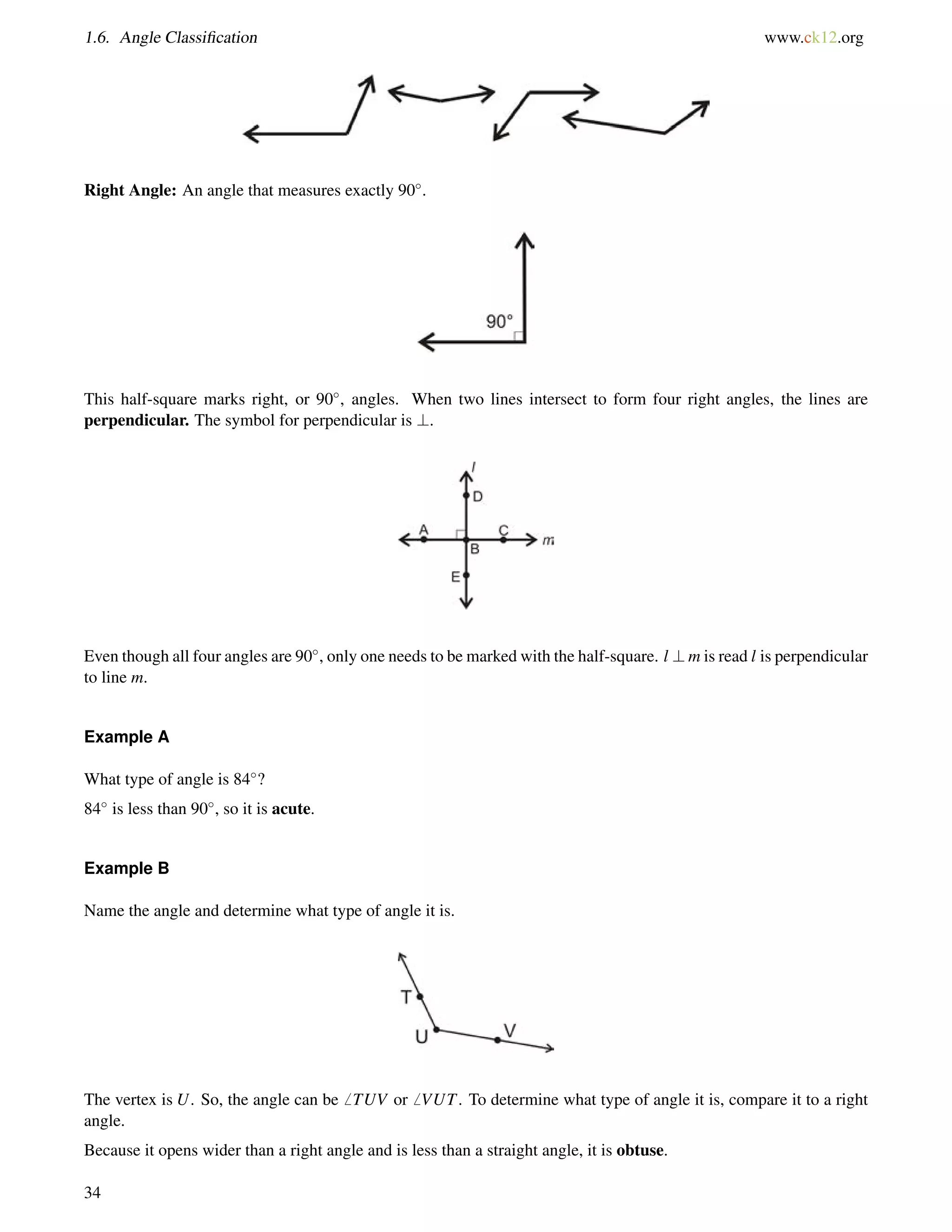
Angles can be grouped into four different categories. 
Straight Angle: An angle that measures exactly 180. 
Acute Angles: Angles that measure between 0 and up to but not including 90. 
Obtuse Angles: Angles that measure more than 90 but less than 180. 
33
1.6. Angle Classification www.ck12.org 
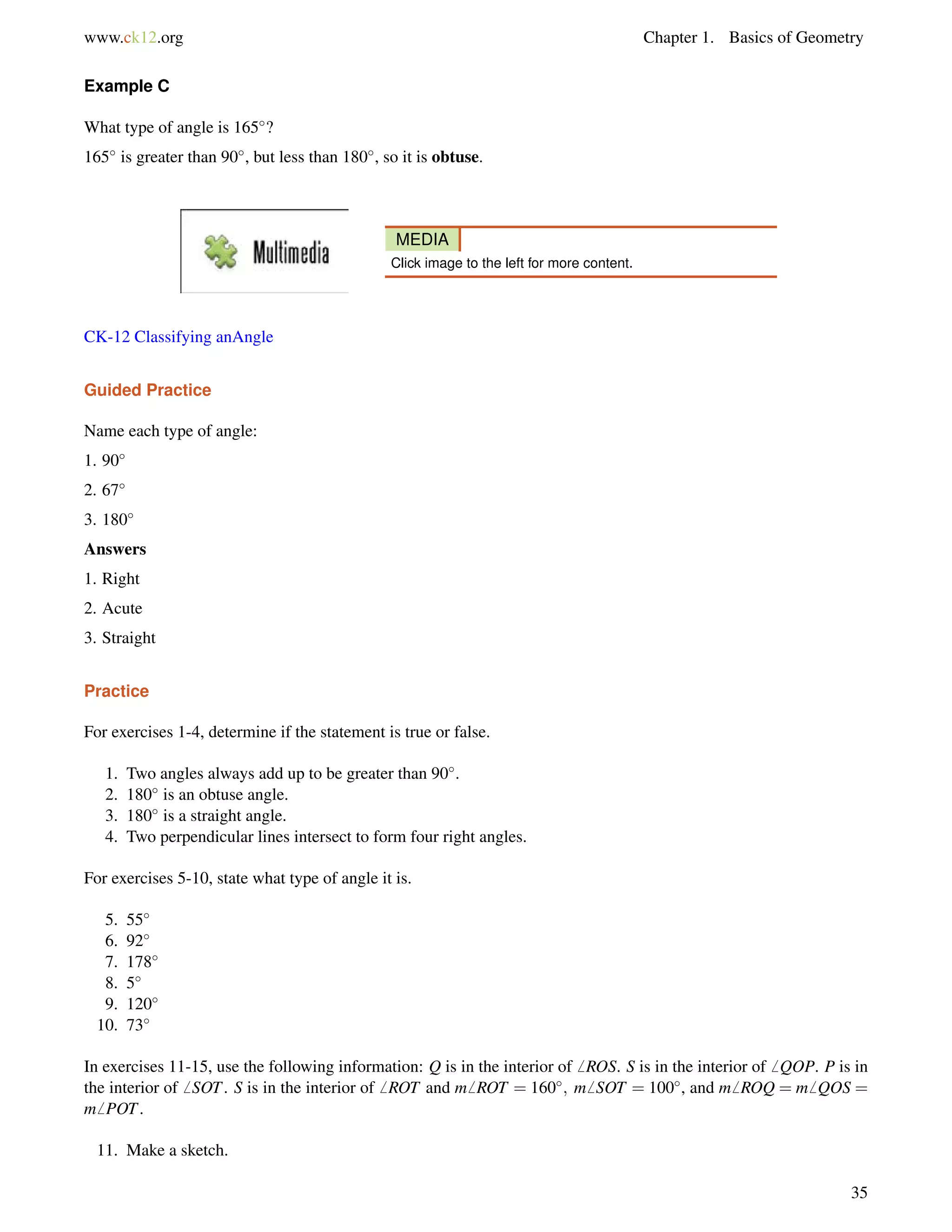
Right Angle: An angle that measures exactly 90. 
This half-square marks right, or 90, angles. When two lines intersect to form four right angles, the lines are 
perpendicular. The symbol for perpendicular is ?. 
Even though all four angles are 90, only one needs to be marked with the half-square. l ?m is read l is perpendicular 
to line m. 
Example A 
What type of angle is 84? 
84 is less than 90, so it is acute. 
Example B 
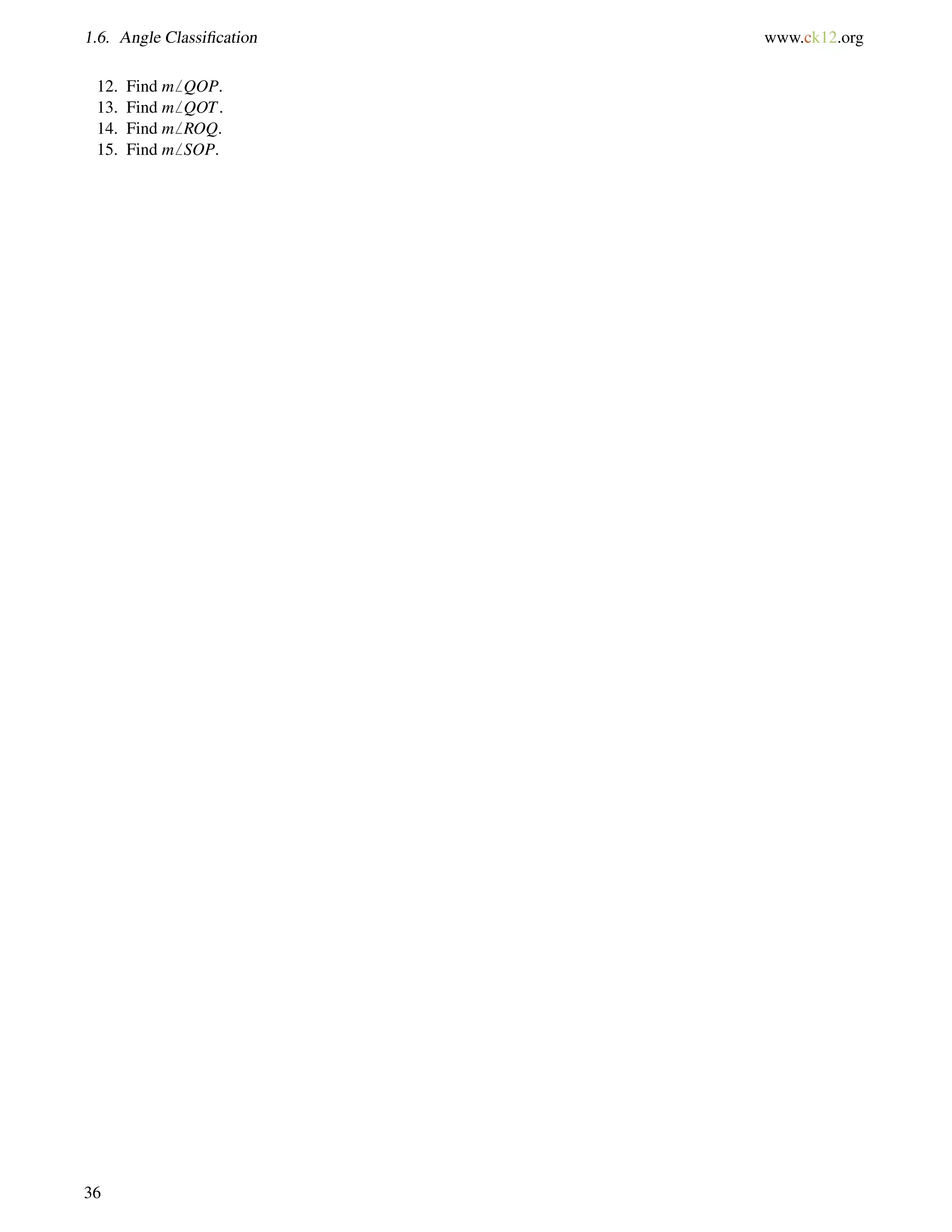
Name the angle and determine what type of angle it is. 
The vertex is U. So, the angle can be6 TUV or6 VUT. To determine what type of angle it is, compare it to a right 
angle. 
Because it opens wider than a right angle and is less than a straight angle, it is obtuse. 
34
www.ck12.org Chapter 1. Basics of Geometry 
Example C 
What type of angle is 165? 
165 is greater than 90, but less than 180, so it is obtuse. 
MEDIA 
Click image to the left for more content. 
CK-12 Classifying anAngle 
Guided Practice 
Name each type of angle: 
1. 90 
2. 67 
3. 180 
Answers 
1. Right 
2. Acute 
3. Straight 
Practice 
For exercises 1-4, determine if the statement is true or false. 
1. Two angles always add up to be greater than 90. 
2. 180 is an obtuse angle. 
3. 180 is a straight angle. 
4. Two perpendicular lines intersect to form four right angles. 
For exercises 5-10, state what type of angle it is. 
5. 55 
6. 92 
7. 178 
8. 5 
9. 120 
10. 73 
In exercises 11-15, use the following information: Q is in the interior of6 ROS. S is in the interior of6 QOP. P is in 
the interior of6 SOT. S is in the interior of6 ROT and m6 ROT = 160; m6 SOT = 100, and m6 ROQ = m6 QOS = 
m6 POT. 
11. Make a sketch. 
35
1.6. Angle Classification www.ck12.org 
12. Find m6 QOP. 
13. Find m6 QOT. 
14. Find m6 ROQ. 
15. Find m6 SOP. 
36
www.ck12.org Chapter 1. Basics of Geometry 
1.7 Complementary Angles 
Here you’ll learn what complementary angles are and how to solve complementary angle problems. 
What if you were given two angles of unknown size and were told they are complementary? How would you 
determine their angle measures? After completing this Concept, you’ll be able to use the definition of complementary 
angles to solve problems like this one. 
Watch This 
MEDIA 
Click image to the left for more content. 
CK-12 Complementary Angles 
Watch this video beginning at around the 3:20 mark. 
MEDIA 
Click image to the left for more content. 
James Sousa:Angle Basics–ComplementaryAngles 
Then watch the first part of this video. 
MEDIA 
Click image to the left for more content. 
James Sousa:Complementary Angles 
Guidance 
Two angles are complementary if they add up to 90. Complementary angles do not have to be congruent or next 
to each other. 
37
1.7. Complementary Angles www.ck12.org 
Example A 
The two angles below are complementary. m6 GHI = x. What is x? 
Because the two angles are complementary, they add up to 90. Make an equation. 
x+34 = 90 
x = 56 
Example B 
The two angles below are complementary. Find the measure of each angle. 
The two angles add up to 90. Make an equation. 
(8r+9)+(7r+6) = 90 
(15r+15) = 90 
15r = 75 
r = 5 
However, you need to find each angle. Plug r back into each expression. 
m6 GHI = 8(5)+9 = 49 
m6 JKL = 7(5)+6 = 41 
Example C 
Find the measure of an angle that is complementary to6 MRS if m6 MRS is 70. 
Because complementary angles have to add up to 90, the other angle must be 9070 = 20. 
38
www.ck12.org Chapter 1. Basics of Geometry 
MEDIA 
Click image to the left for more content. 
CK-12 Complementary Angles 
Guided Practice 
Find the measure of an angle that is complementary to6 ABC if m6 ABC is: 
1. 45 
2. 82 
3. 19 
4. 12 
Answers: 
1. Because complementary angles have to add up to 90, the other angle must be 9045 = 45. 
2. Because complementary angles have to add up to 90, the other angle must be 9082 = 8. 
3. Because complementary angles have to add up to 90, the other angle must be 9019 = 71. 
4. Because complementary angles have to add up to 90, the other angle must be 9012 = 78. 
Practice 
Find the measure of an angle that is complementary to6 ABC if m6 ABC is: 
1. 4 
2. 89 
3. 54 
4. 32 
5. 27 
6. (x+y) 
7. z 
Use the diagram below for exercises 8-9. Note that NK ? 
 ! 
IL . 
8. Name two complementary angles. 
9. If m6 INJ = 63, find m6 KNJ. 
39
1.7. Complementary Angles www.ck12.org 
For 10-11, determine if the statement is true or false. 
10. Complementary angles add up to 180. 
11. Complementary angles are always 45. 
40
www.ck12.org Chapter 1. Basics of Geometry 
1.8 Supplementary Angles 
Here you’ll learn what supplementary angles are and how to solve supplementary angle problems. 
What if you were given two angles of unknown size and were told they are supplementary? How would you 
determine their angle measures? After completing this Concept, you’ll be able to use the definition of supplementary 
angles to solve problems like this one. 
Watch This 
MEDIA 
Click image to the left for more content. 
CK-12 Basic Geometric Definitions 
Watch this video beginning at around the 3:20 mark. 
MEDIA 
Click image to the left for more content. 
James Sousa:Angle Basics–SupplementaryAngles 
Then watch the second part of this video. 
MEDIA 
Click image to the left for more content. 
James Sousa:Supplementary Angles 
Guidance 
Two angles are supplementary if they add up to 180. Supplementary angles do not have to be congruent or next 
to each other. 
41
1.8. Supplementary Angles www.ck12.org 
Example A 
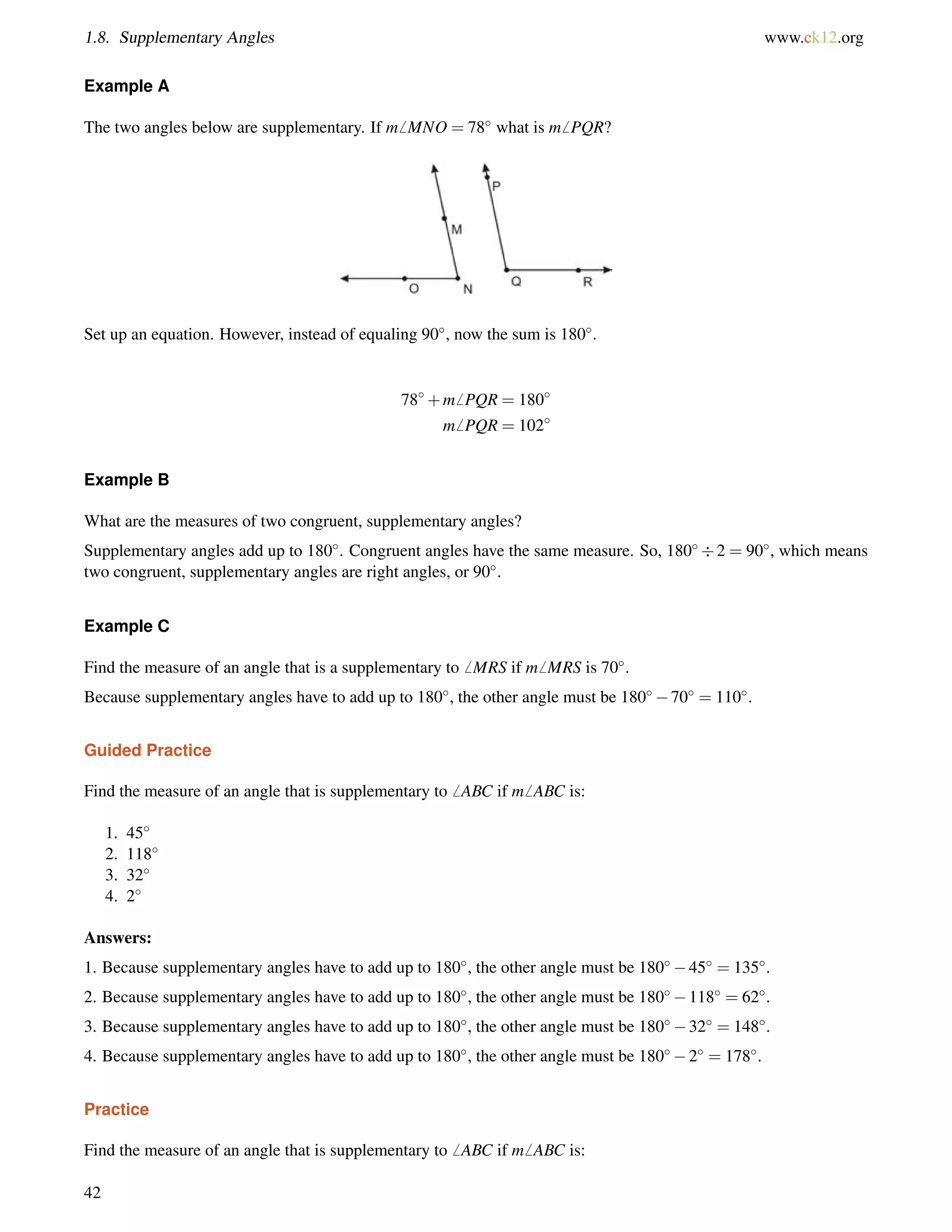
The two angles below are supplementary. If m6 MNO = 78 what is m6 PQR? 
Set up an equation. However, instead of equaling 90, now the sum is 180. 
78+m6 PQR = 180 
m6 PQR = 102 
Example B 
What are the measures of two congruent, supplementary angles? 
Supplementary angles add up to 180. Congruent angles have the same measure. So, 1802 = 90, which means 
two congruent, supplementary angles are right angles, or 90. 
Example C 
Find the measure of an angle that is a supplementary to6 MRS if m6 MRS is 70. 
Because supplementary angles have to add up to 180, the other angle must be 18070 = 110. 
Guided Practice 
Find the measure of an angle that is supplementary to6 ABC if m6 ABC is: 
1. 45 
2. 118 
3. 32 
4. 2 
Answers: 
1. Because supplementary angles have to add up to 180, the other angle must be 18045 = 135. 
2. Because supplementary angles have to add up to 180, the other angle must be 180118 = 62. 
3. Because supplementary angles have to add up to 180, the other angle must be 18032 = 148. 
4. Because supplementary angles have to add up to 180, the other angle must be 1802 = 178. 
Practice 
Find the measure of an angle that is supplementary to6 ABC if m6 ABC is: 
42
www.ck12.org Chapter 1. Basics of Geometry 
1. 114 
2. 11 
3. 91 
4. 84 
5. 57 
6. x 
7. (x+y) 
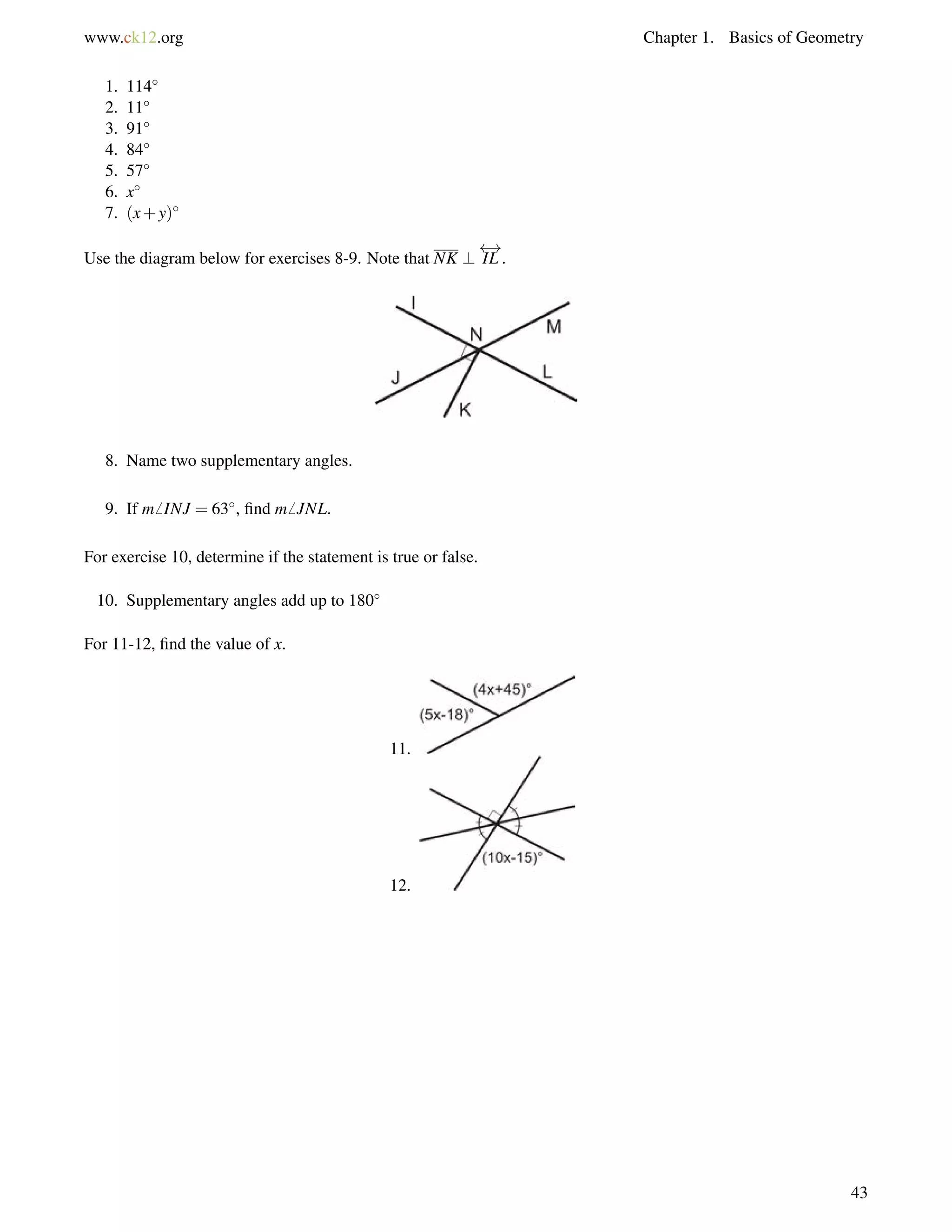
Use the diagram below for exercises 8-9. Note that NK ? 
 ! 
IL . 
8. Name two supplementary angles. 
9. If m6 INJ = 63, find m6 JNL. 
For exercise 10, determine if the statement is true or false. 
10. Supplementary angles add up to 180 
For 11-12, find the value of x. 
11. 
12. 
43
1.9. Linear Pairs www.ck12.org 
1.9 Linear Pairs 
Here you’ll learn what linear pairs are and how to solve linear pair problems. 
What if you were given two angles of unknown size and were told they form a linear pair? How would you determine 
their angle measures? After completing this Concept, you’ll be able to use the definition of linear pair to solve 
problems like this one. 
Watch This 
MEDIA 
Click image to the left for more content. 
CK-12 LinearPairs 
Guidance 
Two angles are adjacent if they have the same vertex, share a side, and do not overlap6 PSQ and6 QSR are adjacent. 
A linear pair is two angles that are adjacent and whose non-common sides form a straight line. If two angles are a 
linear pair, then they are supplementary (add up to 180).6 PSQ and6 QSR are a linear pair. 
Example A 
What is the measure of each angle? 
44
www.ck12.org Chapter 1. Basics of Geometry 
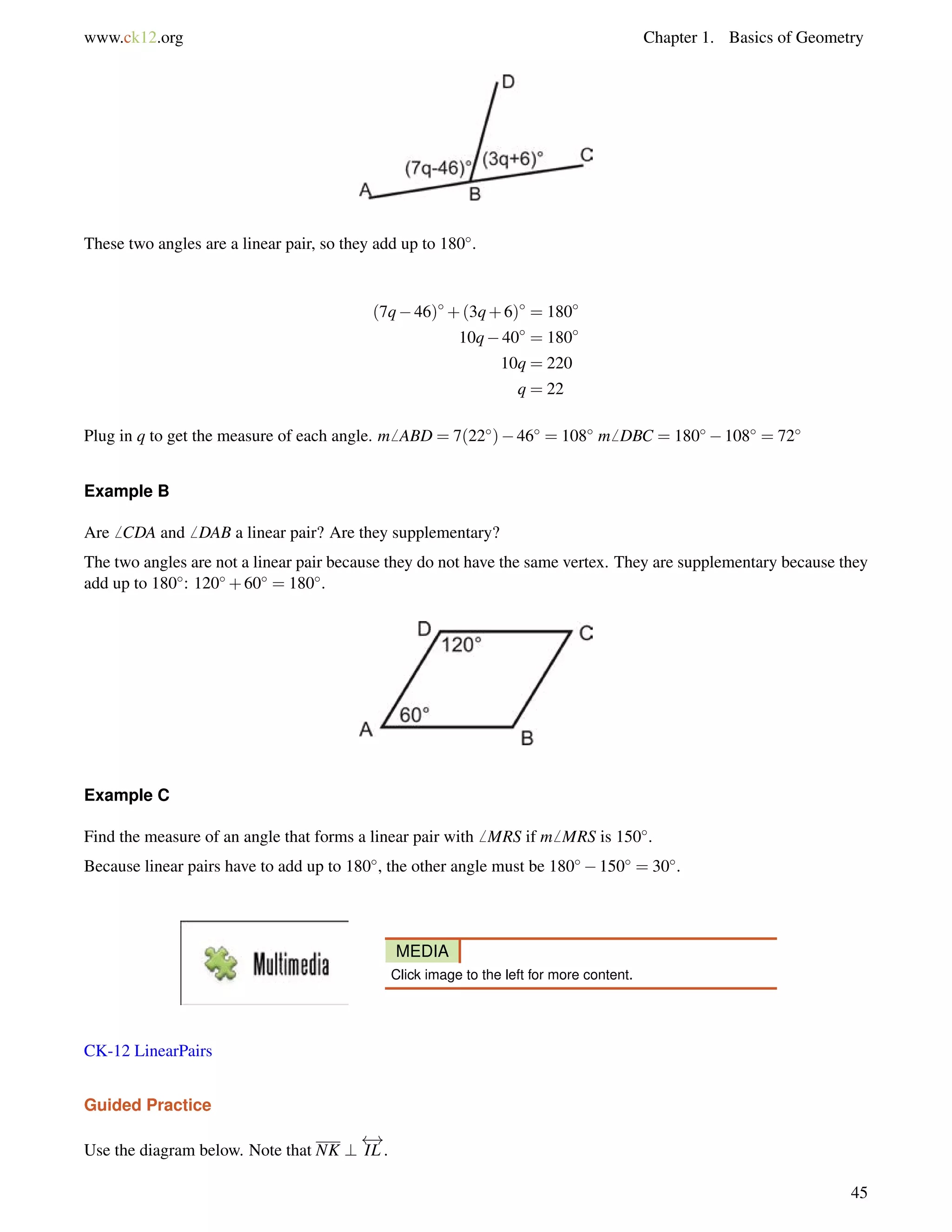
These two angles are a linear pair, so they add up to 180. 
(7q46)+(3q+6) = 180 
10q40 = 180 
10q = 220 
q = 22 
Plug in q to get the measure of each angle. m6 ABD = 7(22)46 = 108 m6 DBC = 180108 = 72 
Example B 
Are6 CDA and6 DAB a linear pair? Are they supplementary? 
The two angles are not a linear pair because they do not have the same vertex. They are supplementary because they 
add up to 180: 120+60 = 180. 
Example C 
Find the measure of an angle that forms a linear pair with6 MRS if m6 MRS is 150. 
Because linear pairs have to add up to 180, the other angle must be 180150 = 30. 
MEDIA 
Click image to the left for more content. 
CK-12 LinearPairs 
Guided Practice 
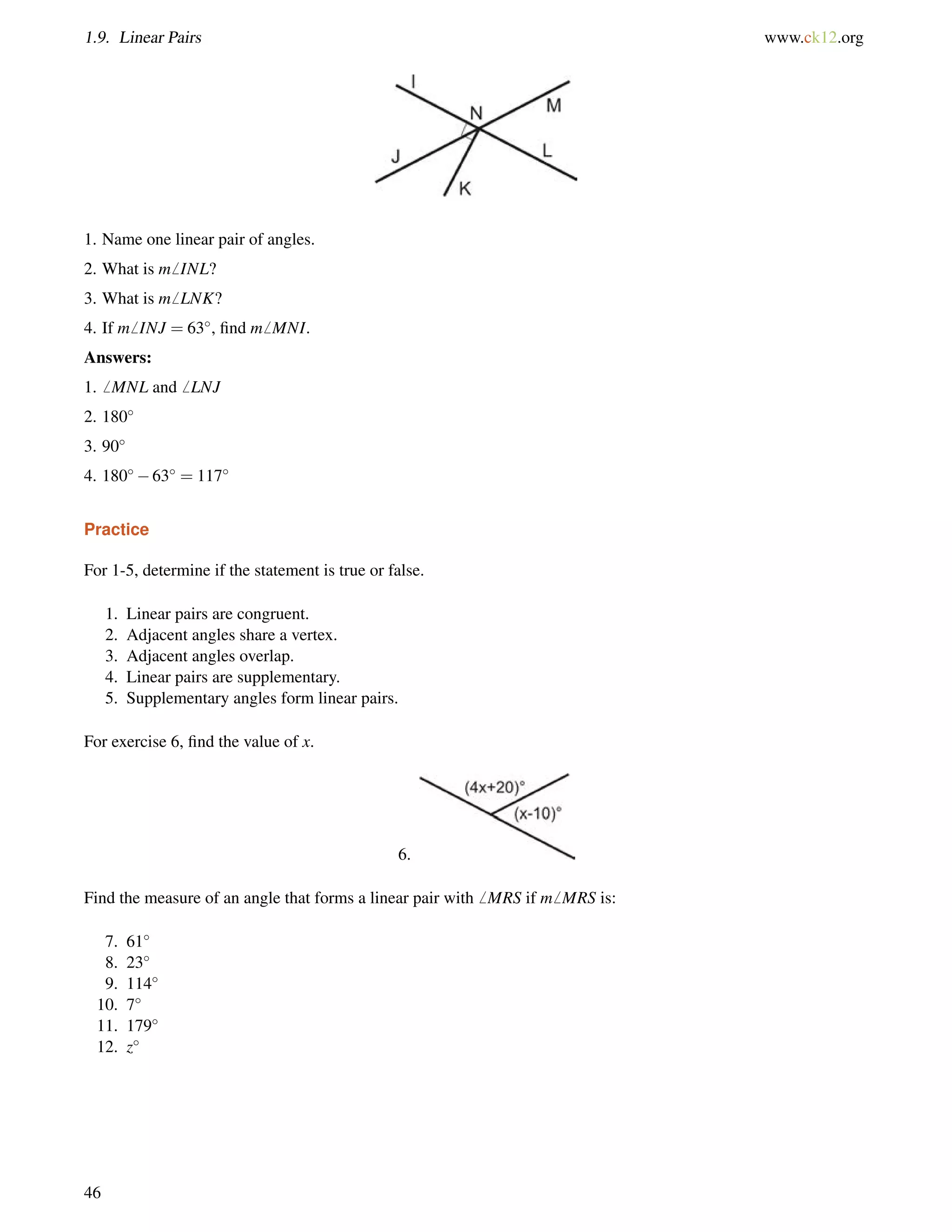
Use the diagram below. Note that NK ? 
 ! 
IL . 
45
1.9. Linear Pairs www.ck12.org 
1. Name one linear pair of angles. 
2. What is m6 INL? 
3. What is m6 LNK? 
4. If m6 INJ = 63, find m6 MNI. 
Answers: 
1.6 MNL and6 LNJ 
2. 180 
3. 90 
4. 18063 = 117 
Practice 
For 1-5, determine if the statement is true or false. 
1. Linear pairs are congruent. 
2. Adjacent angles share a vertex. 
3. Adjacent angles overlap. 
4. Linear pairs are supplementary. 
5. Supplementary angles form linear pairs. 
For exercise 6, find the value of x. 
6. 
Find the measure of an angle that forms a linear pair with6 MRS if m6 MRS is: 
7. 61 
8. 23 
9. 114 
10. 7 
11. 179 
12. z 
46
www.ck12.org Chapter 1. Basics of Geometry 
1.10 Vertical Angles 
Here you’ll learn what vertical angles are and how to solve vertical angle problems. 
What if you were given two angles of unknown size and were told they are vertical angles? How would you 
determine their angle measures? After completing this Concept, you’ll be able to use the definition of vertical angles 
to solve problems like this one. 
Watch This 
MEDIA 
Click image to the left for more content. 
CK-12 Vertical Angles 
Watch the first part of this video. 
MEDIA 
Click image to the left for more content. 
James Sousa:Angle Relationships 
Then watch the third part of this video. 
MEDIA 
Click image to the left for more content. 
James Sousa:Complementary Angles 
Guidance 
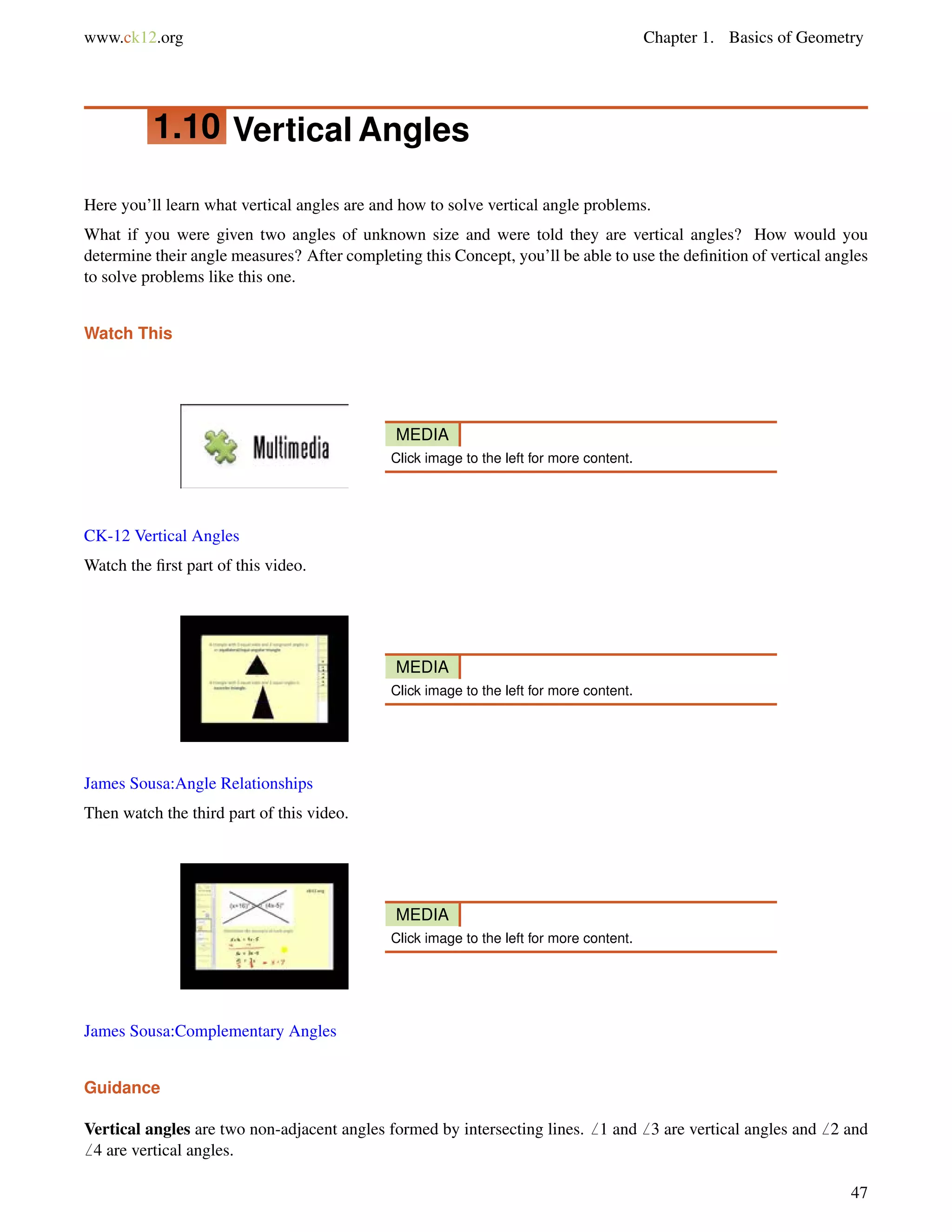
Vertical angles are two non-adjacent angles formed by intersecting lines.6 1 and6 3 are vertical angles and6 2 and 
6 4 are vertical angles. 
47
1.10. Vertical Angles www.ck12.org 
The Vertical Angles Theorem states that if two angles are vertical angles, then they are congruent. 
Example A 
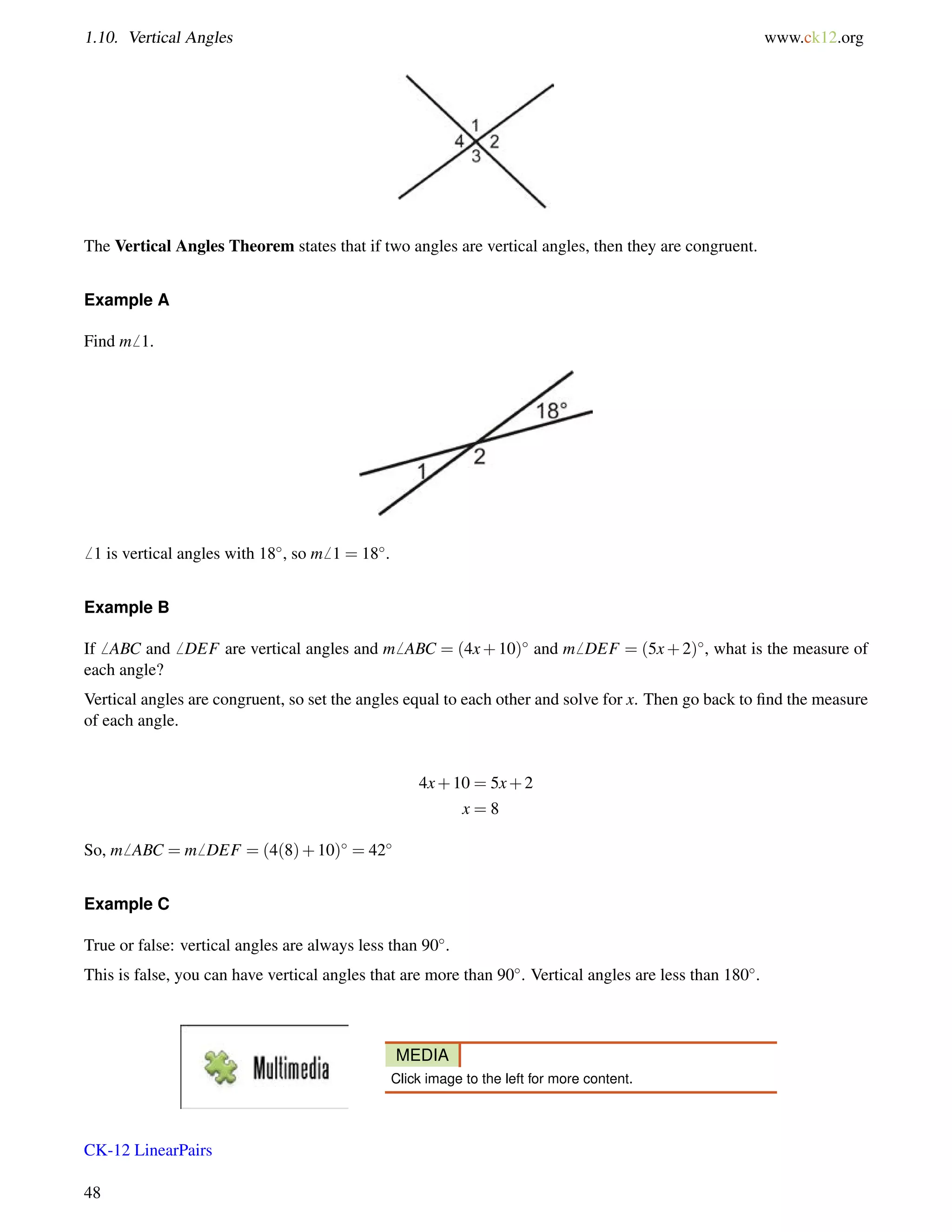
Find m6 1. 
6 1 is vertical angles with 18, so m6 1 = 18. 
Example B 
If6 ABC and6 DEF are vertical angles and m6 ABC = (4x+10) and m6 DEF = (5x+2), what is the measure of 
each angle? 
Vertical angles are congruent, so set the angles equal to each other and solve for x. Then go back to find the measure 
of each angle. 
4x+10 = 5x+2 
x = 8 
So, m6 ABC = m6 DEF = (4(8)+10) = 42 
Example C 
True or false: vertical angles are always less than 90. 
This is false, you can have vertical angles that are more than 90. Vertical angles are less than 180. 
MEDIA 
Click image to the left for more content. 
CK-12 LinearPairs 
48
www.ck12.org Chapter 1. Basics of Geometry 
Guided Practice 
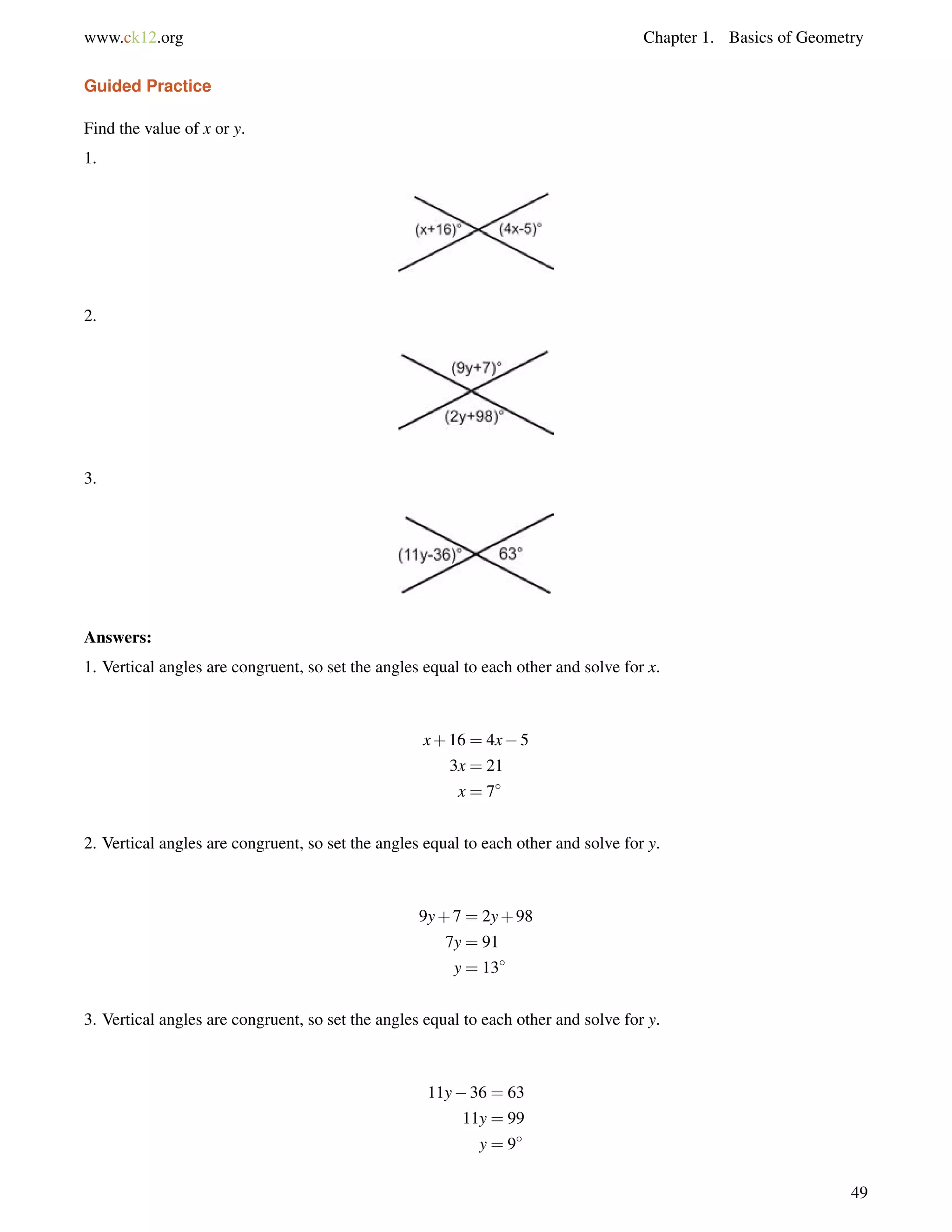
Find the value of x or y. 
1. 
2. 
3. 
Answers: 
1. Vertical angles are congruent, so set the angles equal to each other and solve for x. 
x+16 = 4x5 
3x = 21 
x = 7 
2. Vertical angles are congruent, so set the angles equal to each other and solve for y. 
9y+7 = 2y+98 
7y = 91 
y = 13 
3. Vertical angles are congruent, so set the angles equal to each other and solve for y. 
11y36 = 63 
11y = 99 
y = 9 
49
1.10. Vertical Angles www.ck12.org 
Practice 
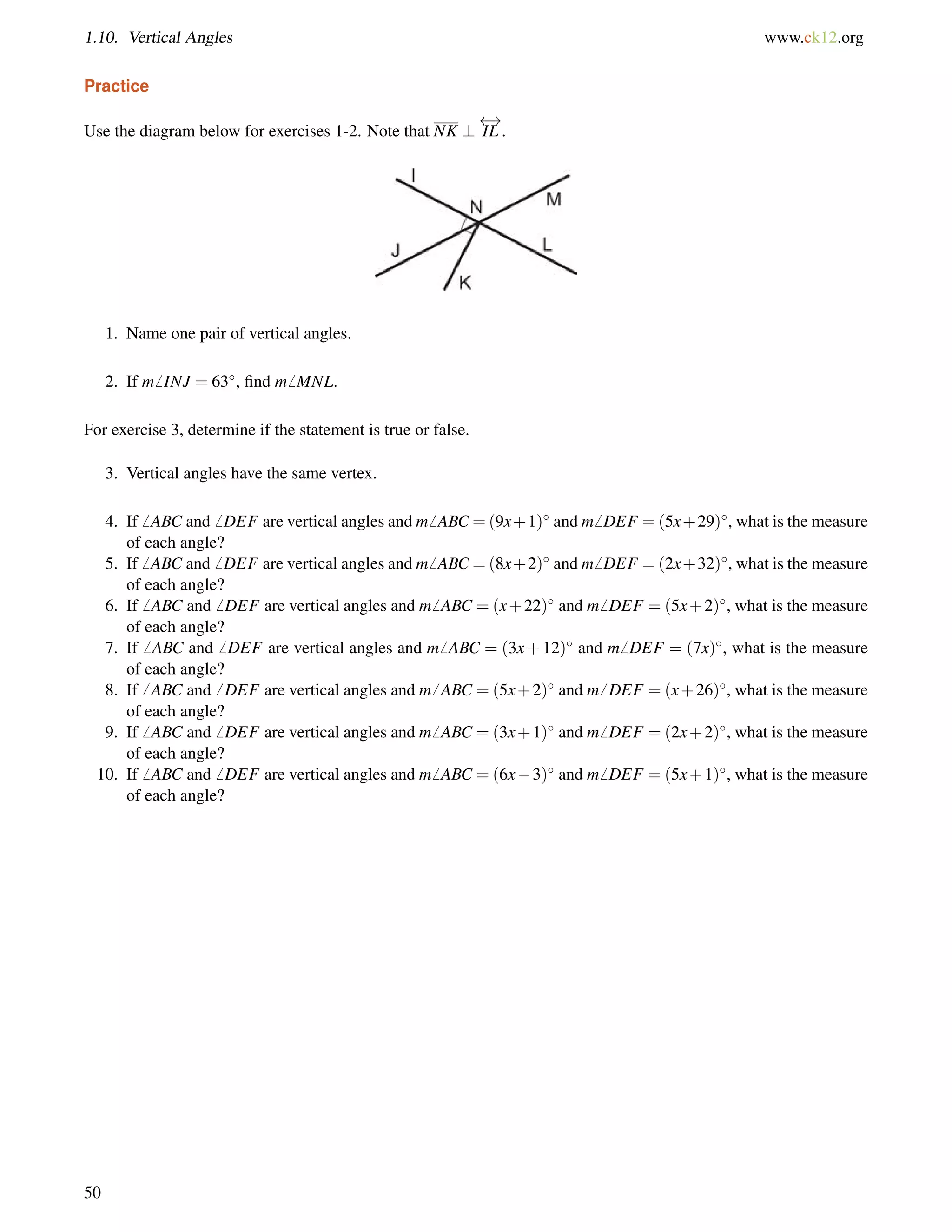
Use the diagram below for exercises 1-2. Note that NK ? 
 ! 
IL . 
1. Name one pair of vertical angles. 
2. If m6 INJ = 63, find m6 MNL. 
For exercise 3, determine if the statement is true or false. 
3. Vertical angles have the same vertex. 
4. If6 ABC and6 DEF are vertical angles and m6 ABC =(9x+1) and m6 DEF =(5x+29), what is the measure 
of each angle? 
5. If6 ABC and6 DEF are vertical angles and m6 ABC =(8x+2) and m6 DEF =(2x+32), what is the measure 
of each angle? 
6. If6 ABC and6 DEF are vertical angles and m6 ABC = (x+22) and m6 DEF = (5x+2), what is the measure 
of each angle? 
7. If6 ABC and6 DEF are vertical angles and m6 ABC = (3x+12) and m6 DEF = (7x), what is the measure 
of each angle? 
8. If6 ABC and6 DEF are vertical angles and m6 ABC = (5x+2) and m6 DEF = (x+26), what is the measure 
of each angle? 
9. If6 ABC and6 DEF are vertical angles and m6 ABC = (3x+1) and m6 DEF = (2x+2), what is the measure 
of each angle? 
10. If6 ABC and6 DEF are vertical angles and m6 ABC = (6x3) and m6 DEF = (5x+1), what is the measure 
of each angle? 
50
www.ck12.org Chapter 1. Basics of Geometry 
1.11 Triangle Classification 
Here you’ll learn how to classify triangles based on their angle and side measures. 
What if you were given the angle measures and/or side lengths of a triangle? How would you describe the triangle 
based on that information? After completing this Concept, you’ll be able to classify a triangle as right, obtuse, acute, 
equiangular, scalene, isosceles, and/or equilateral. 
Watch This 
MEDIA 
Click image to the left for more content. 
CK-12 LinearPairs 
Watch this video beginning at around the 2:38 mark. 
MEDIA 
Click image to the left for more content. 
James Sousa:Types of Triangles 
Guidance 
A triangle is any closed figure made by three line segments intersecting at their endpoints. Every triangle has three 
vertices (the points where the segments meet), three sides (the segments), and three interior angles (formed at each 
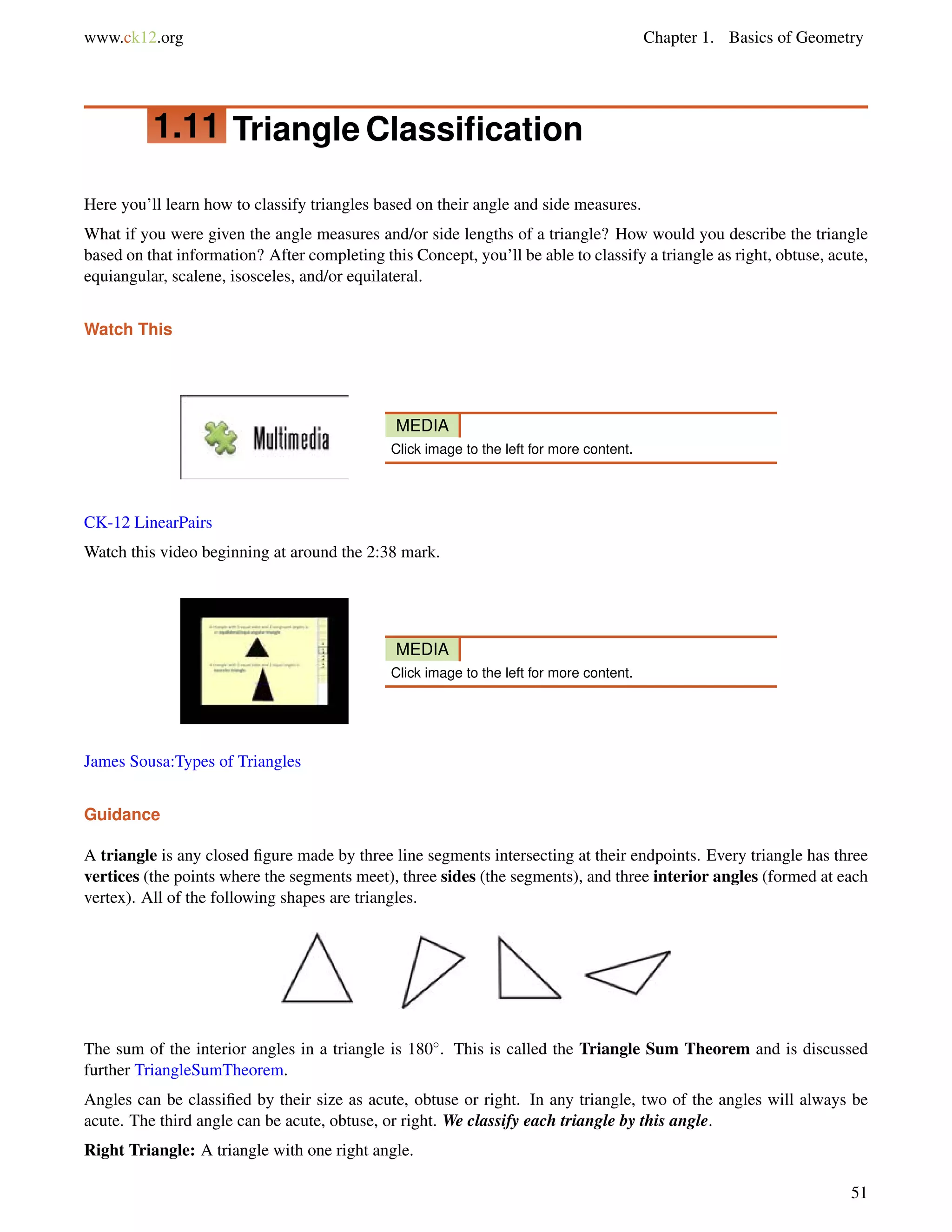
vertex). All of the following shapes are triangles. 
The sum of the interior angles in a triangle is 180. This is called the Triangle Sum Theorem and is discussed 
further TriangleSumTheorem. 
Angles can be classified by their size as acute, obtuse or right. In any triangle, two of the angles will always be 
acute. The third angle can be acute, obtuse, or right. We classify each triangle by this angle. 
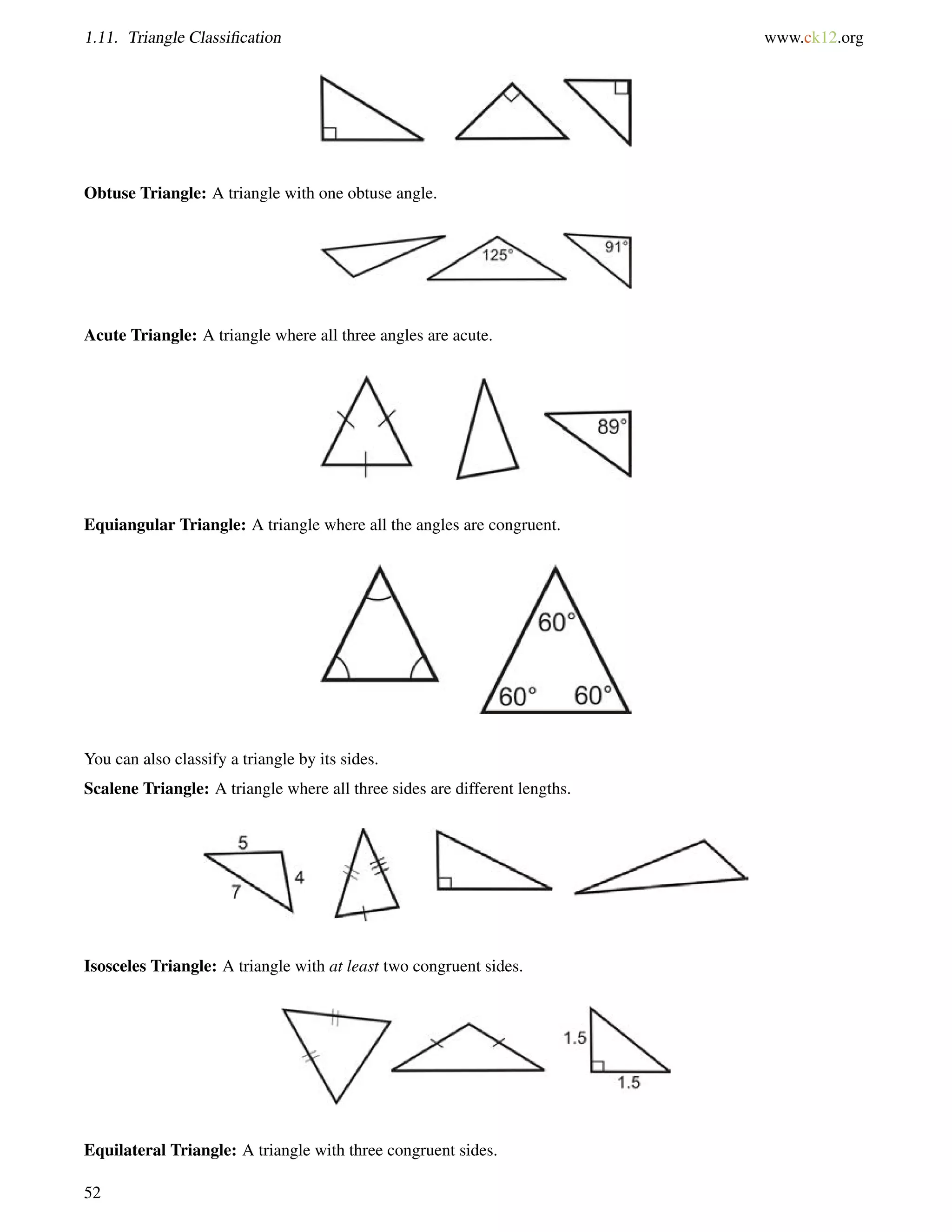
Right Triangle: A triangle with one right angle. 
51
1.11. Triangle Classification www.ck12.org 
Obtuse Triangle: A triangle with one obtuse angle. 
Acute Triangle: A triangle where all three angles are acute. 
Equiangular Triangle: A triangle where all the angles are congruent. 
You can also classify a triangle by its sides. 
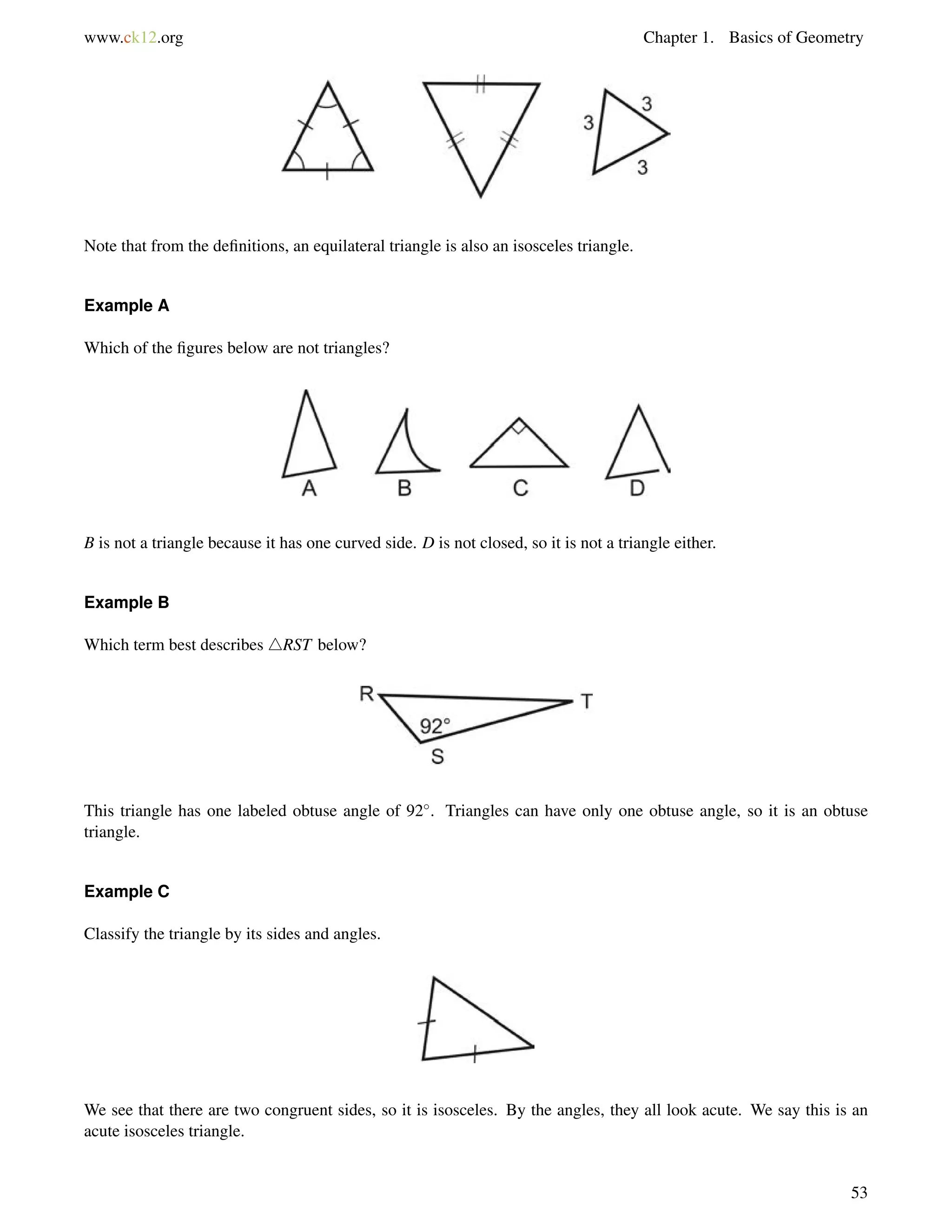
Scalene Triangle: A triangle where all three sides are different lengths. 
Isosceles Triangle: A triangle with at least two congruent sides. 
Equilateral Triangle: A triangle with three congruent sides. 
52
www.ck12.org Chapter 1. Basics of Geometry 
Note that from the definitions, an equilateral triangle is also an isosceles triangle. 
Example A 
Which of the figures below are not triangles? 
B is not a triangle because it has one curved side. D is not closed, so it is not a triangle either. 
Example B 
Which term best describes 4RST below? 
This triangle has one labeled obtuse angle of 92. Triangles can have only one obtuse angle, so it is an obtuse 
triangle. 
Example C 
Classify the triangle by its sides and angles. 
We see that there are two congruent sides, so it is isosceles. By the angles, they all look acute. We say this is an 
acute isosceles triangle. 
53
1.11. Triangle Classification www.ck12.org 
MEDIA 
Click image to the left for more content. 
CK-12 LinearPairs 
Guided Practice 
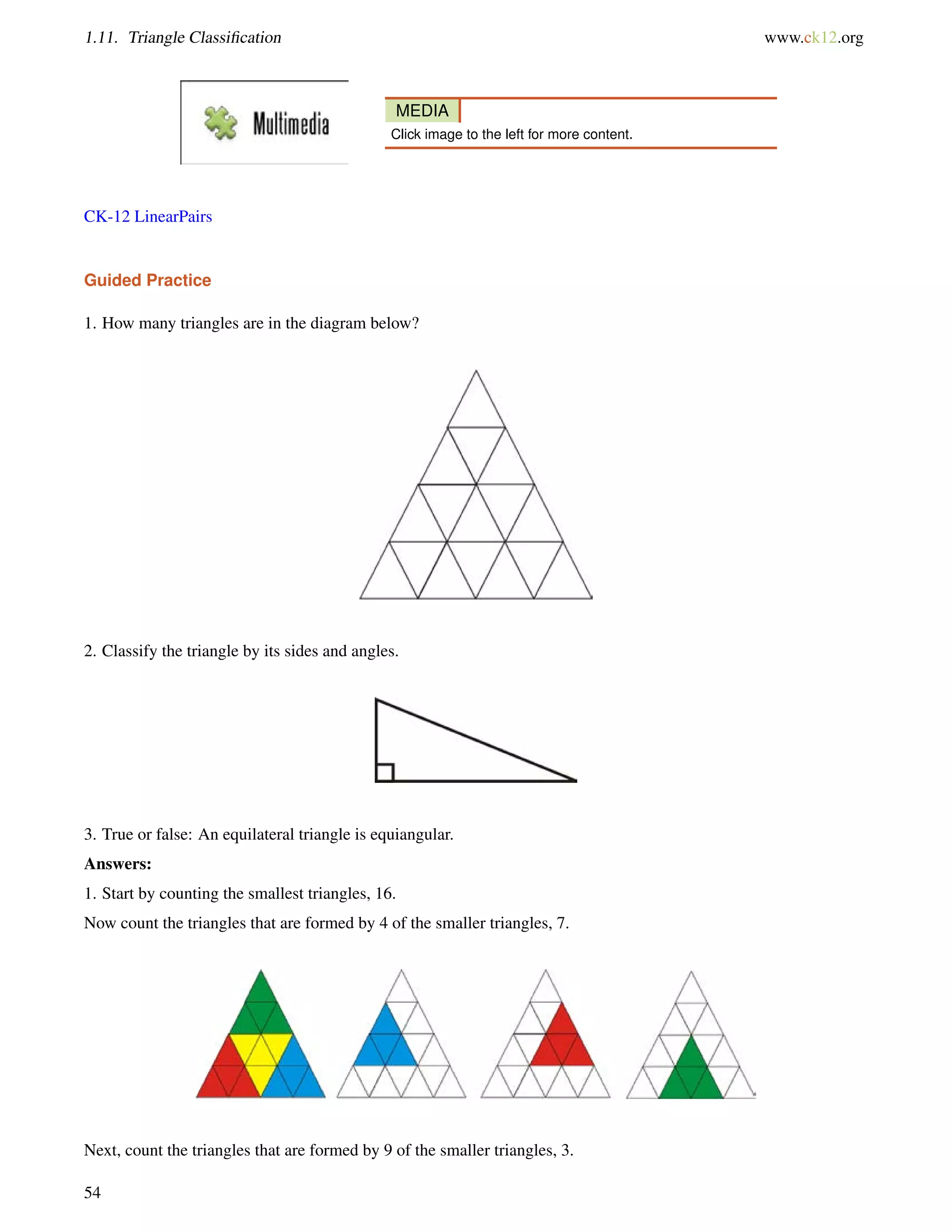
1. How many triangles are in the diagram below? 
2. Classify the triangle by its sides and angles. 
3. True or false: An equilateral triangle is equiangular. 
Answers: 
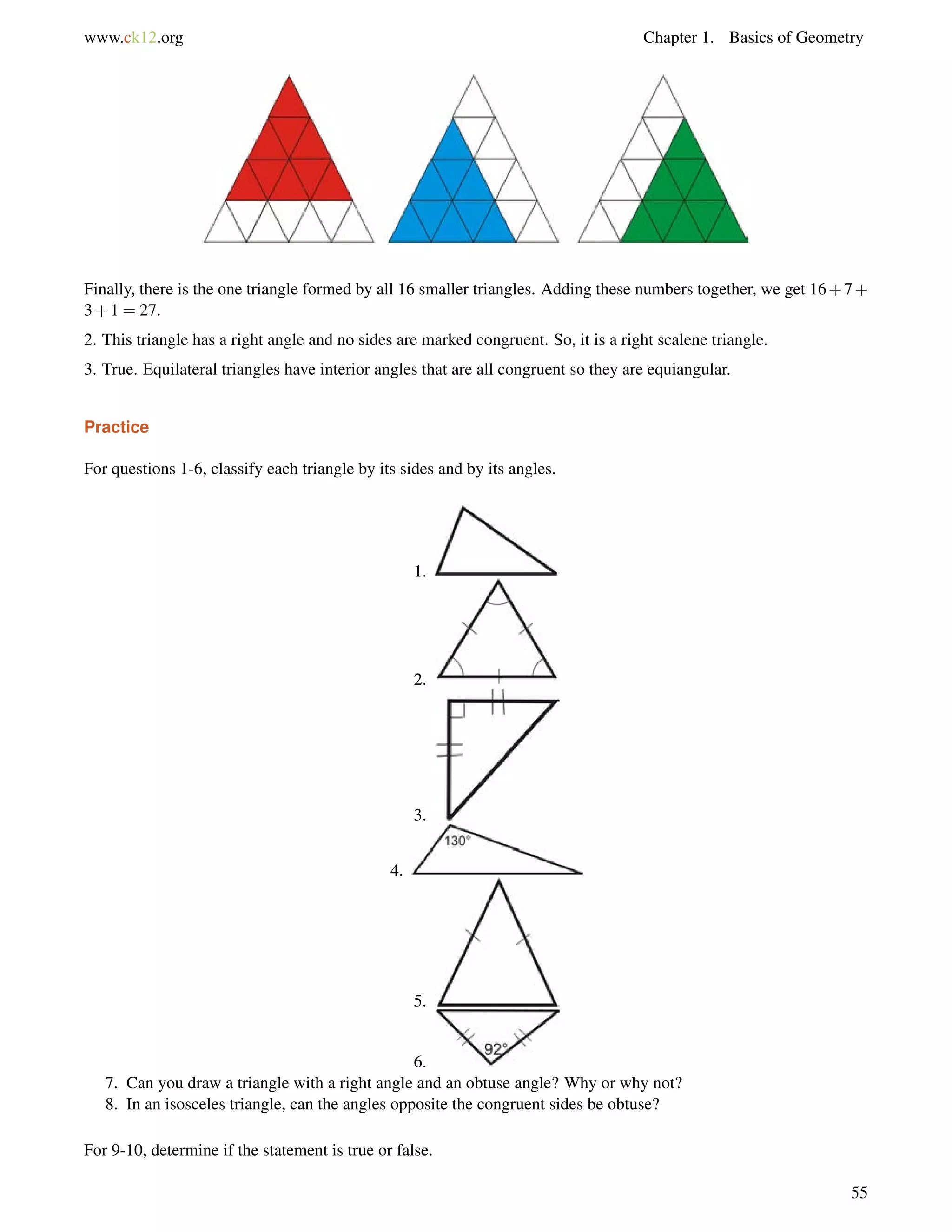
1. Start by counting the smallest triangles, 16. 
Now count the triangles that are formed by 4 of the smaller triangles, 7. 
Next, count the triangles that are formed by 9 of the smaller triangles, 3. 
54
www.ck12.org Chapter 1. Basics of Geometry 
Finally, there is the one triangle formed by all 16 smaller triangles. Adding these numbers together, we get 16+7+ 
3+1 = 27. 
2. This triangle has a right angle and no sides are marked congruent. So, it is a right scalene triangle. 
3. True. Equilateral triangles have interior angles that are all congruent so they are equiangular. 
Practice 
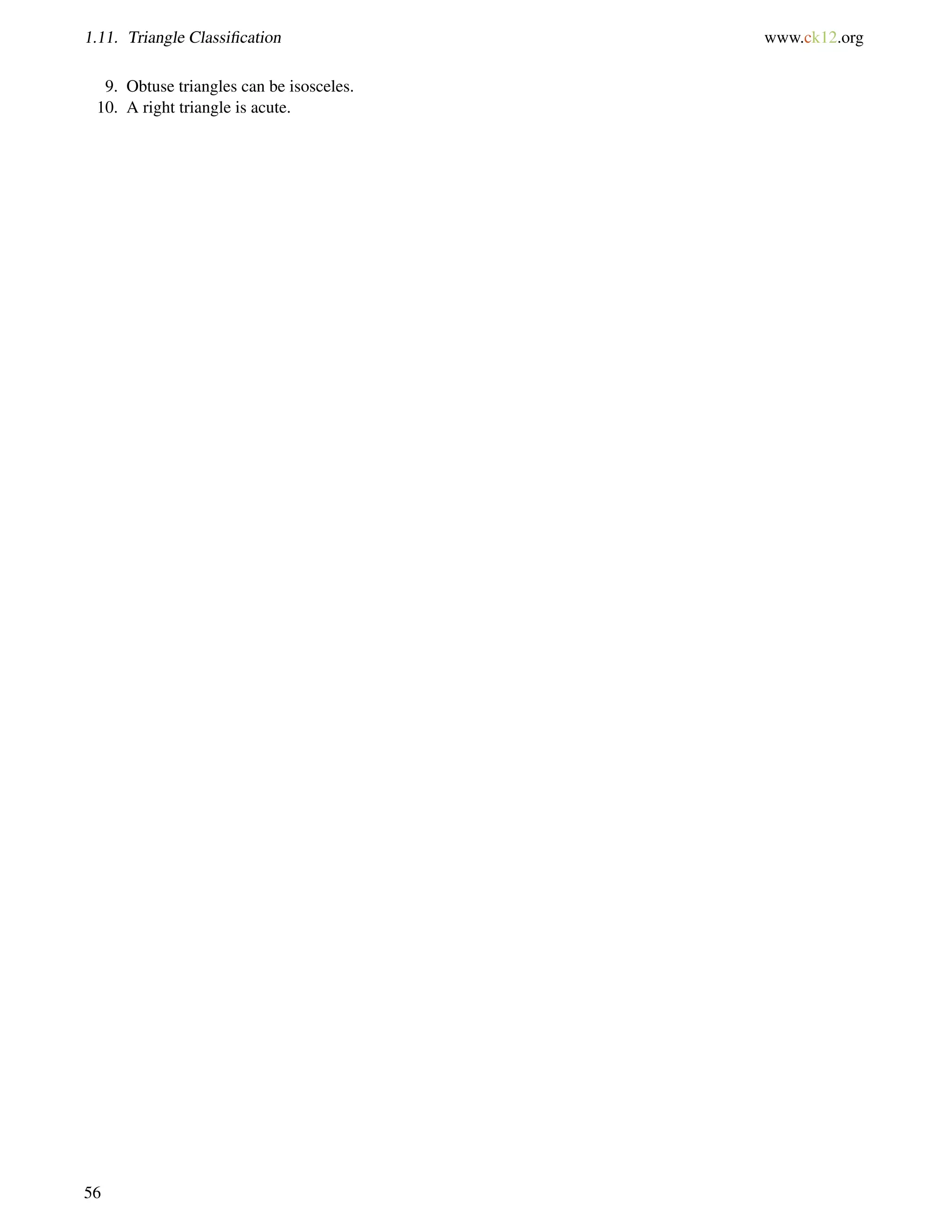
For questions 1-6, classify each triangle by its sides and by its angles. 
1. 
2. 
3. 
4. 
5. 
6. 
7. Can you draw a triangle with a right angle and an obtuse angle? Why or why not? 
8. In an isosceles triangle, can the angles opposite the congruent sides be obtuse? 
For 9-10, determine if the statement is true or false. 
55
1.11. Triangle Classification www.ck12.org 
9. Obtuse triangles can be isosceles. 
10. A right triangle is acute. 
56
www.ck12.org Chapter 1. Basics of Geometry 
1.12 Polygon Classification 
Here you’ll learn how to classify a polygon based on its sides. You’ll also learn how to decide whether a polygon is 
convex or concave. 
What if you were told how many sides a polygon has? How would you describe the polygon based on that 
information? After completing this Concept, you’ll be able to classify a polygon according to its shape and the 
number of sides it has. 
Watch This 
MEDIA 
Click image to the left for more content. 
CK-12 Classifying a Polygon 
MEDIA 
Click image to the left for more content. 
James Sousa:Introduction toPolygons 
Then watch the first part of this video. 
MEDIA 
Click image to the left for more content. 
James Sousa:ClassifyingPolygons 
Guidance 
A polygon is any closed, 2-dimensional figure that is made entirely of line segments that intersect at their endpoints. 
Polygons can have any number of sides and angles, but the sides can never be curved. The segments are called the 
sides of the polygons, and the points where the segments intersect are called vertices. 
57
1.12. Polygon Classification www.ck12.org 
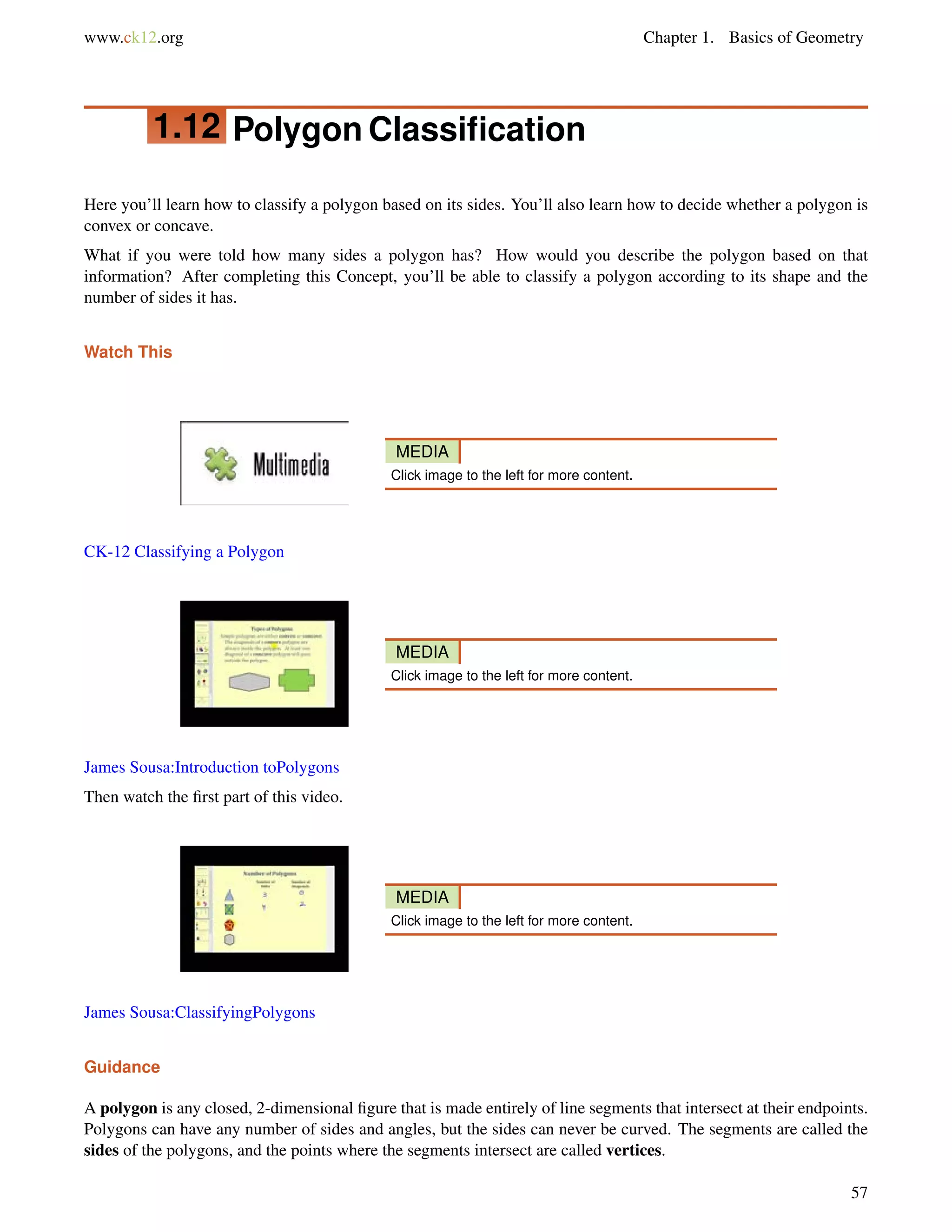
Polygons can be either convex or concave. The term concave refers to a cave, or the polygon is “caving in”. All 
stars are concave polygons. 
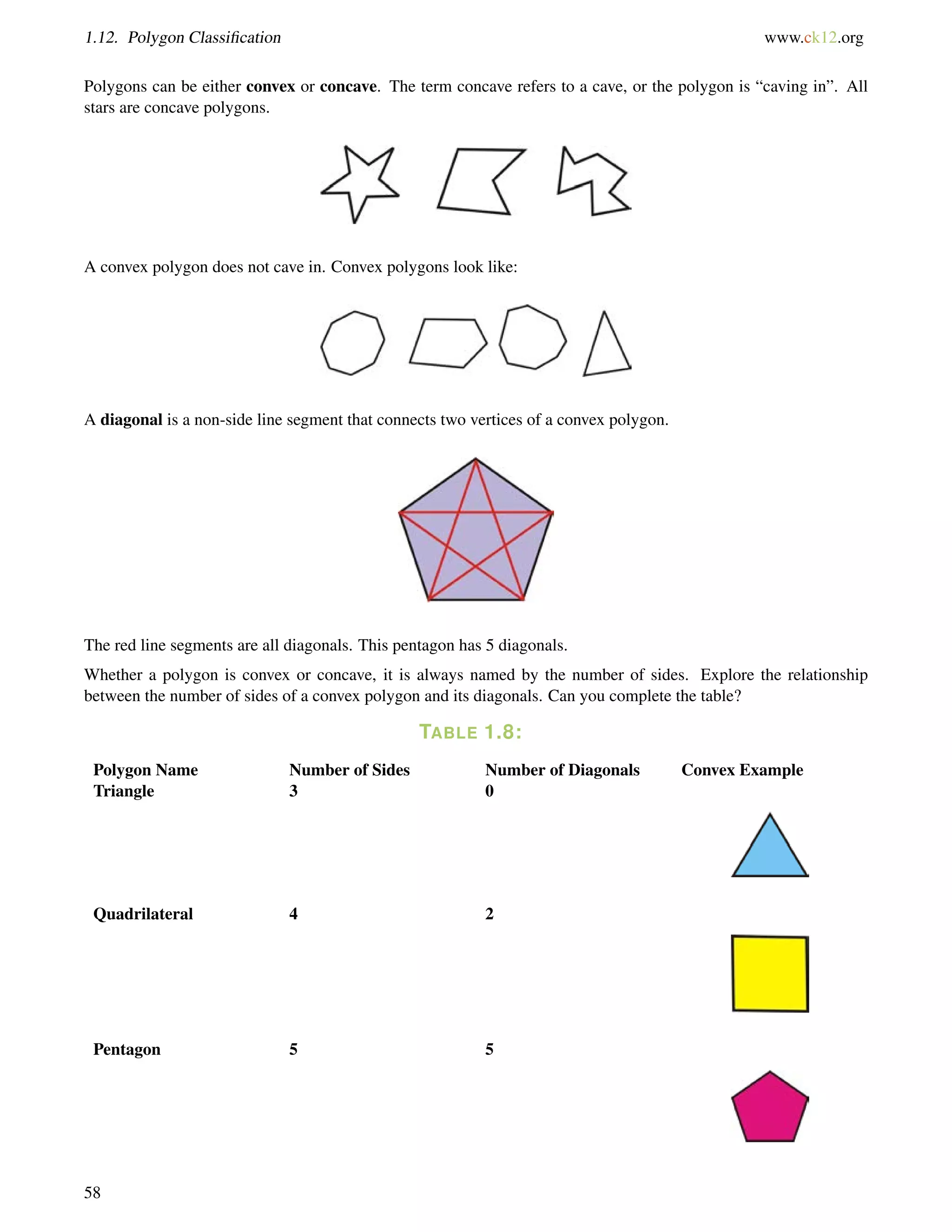
A convex polygon does not cave in. Convex polygons look like: 
A diagonal is a non-side line segment that connects two vertices of a convex polygon. 
The red line segments are all diagonals. This pentagon has 5 diagonals. 
Whether a polygon is convex or concave, it is always named by the number of sides. Explore the relationship 
between the number of sides of a convex polygon and its diagonals. Can you complete the table? 
TABLE 1.8: 
Polygon Name Number of Sides Number of Diagonals Convex Example 
Triangle 3 0 
Quadrilateral 4 2 
Pentagon 5 5 
58
www.ck12.org Chapter 1. Basics of Geometry 
TABLE 1.8: (continued) 
Polygon Name Number of Sides Number of Diagonals Convex Example 
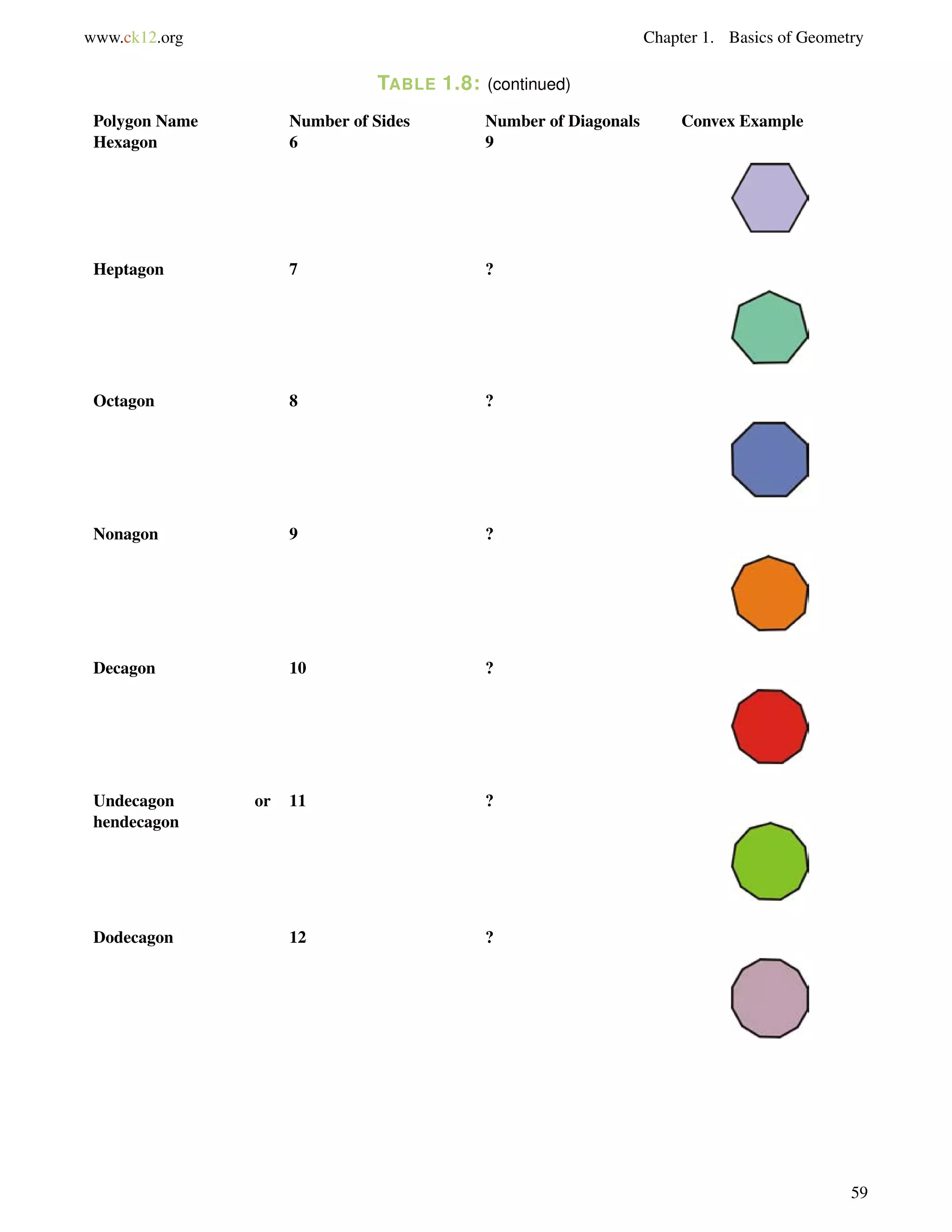
Hexagon 6 9 
Heptagon 7 ? 
Octagon 8 ? 
Nonagon 9 ? 
Decagon 10 ? 
Undecagon or 
hendecagon 
11 ? 
Dodecagon 12 ? 
59
1.12. Polygon Classification www.ck12.org 
TABLE 1.8: (continued) 
Polygon Name Number of Sides Number of Diagonals Convex Example 
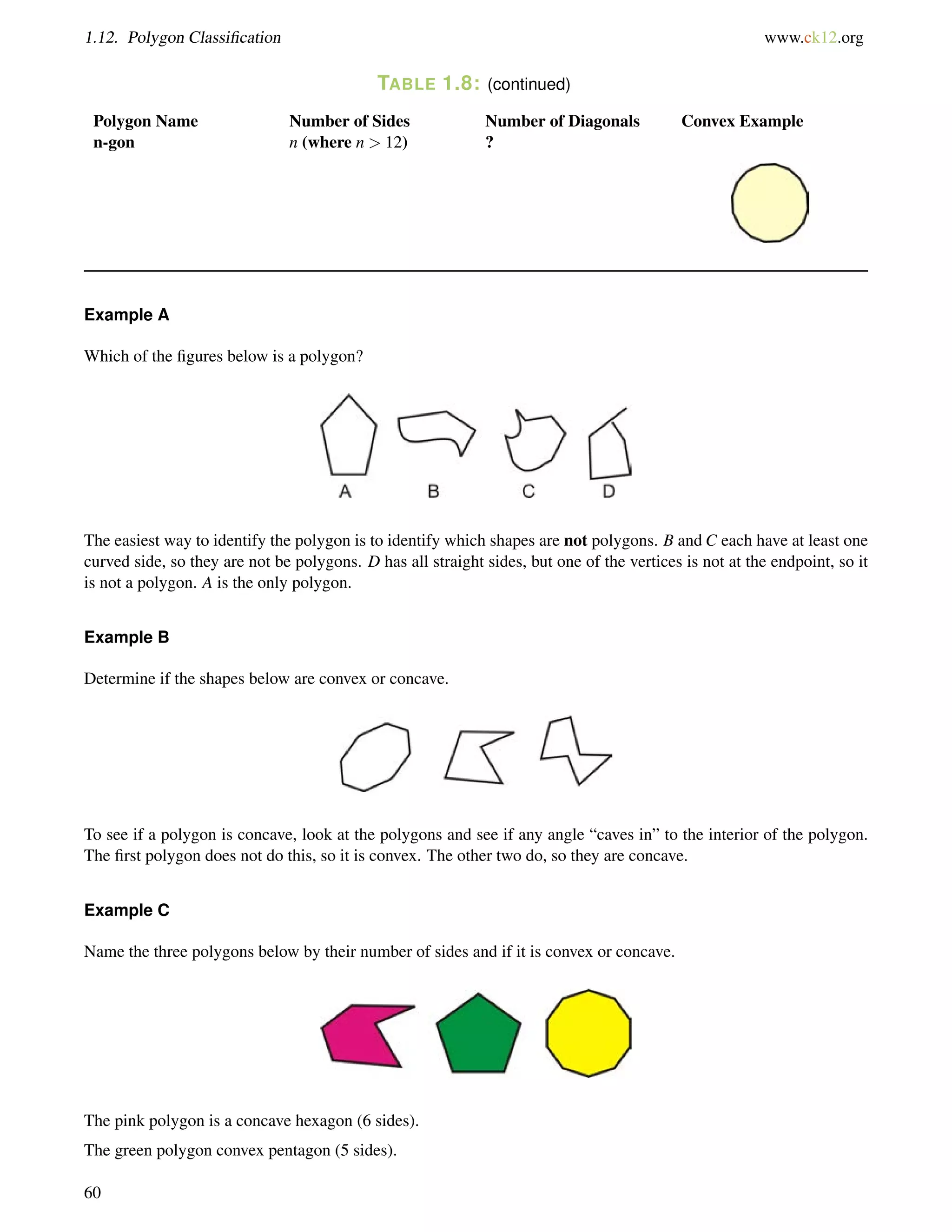
n-gon n (where n  12) ? 
Example A 
Which of the figures below is a polygon? 
The easiest way to identify the polygon is to identify which shapes are not polygons. B and C each have at least one 
curved side, so they are not be polygons. D has all straight sides, but one of the vertices is not at the endpoint, so it 
is not a polygon. A is the only polygon. 
Example B 
Determine if the shapes below are convex or concave. 
To see if a polygon is concave, look at the polygons and see if any angle “caves in” to the interior of the polygon. 
The first polygon does not do this, so it is convex. The other two do, so they are concave. 
Example C 
Name the three polygons below by their number of sides and if it is convex or concave. 
The pink polygon is a concave hexagon (6 sides). 
The green polygon convex pentagon (5 sides). 
60
www.ck12.org Chapter 1. Basics of Geometry 
The yellow polygon is a convex decagon (10 sides). 
MEDIA 
Click image to the left for more content. 
CK-12 Classifying a Polygon 
Guided Practice 
1. Which of the figures below is not a polygon? 
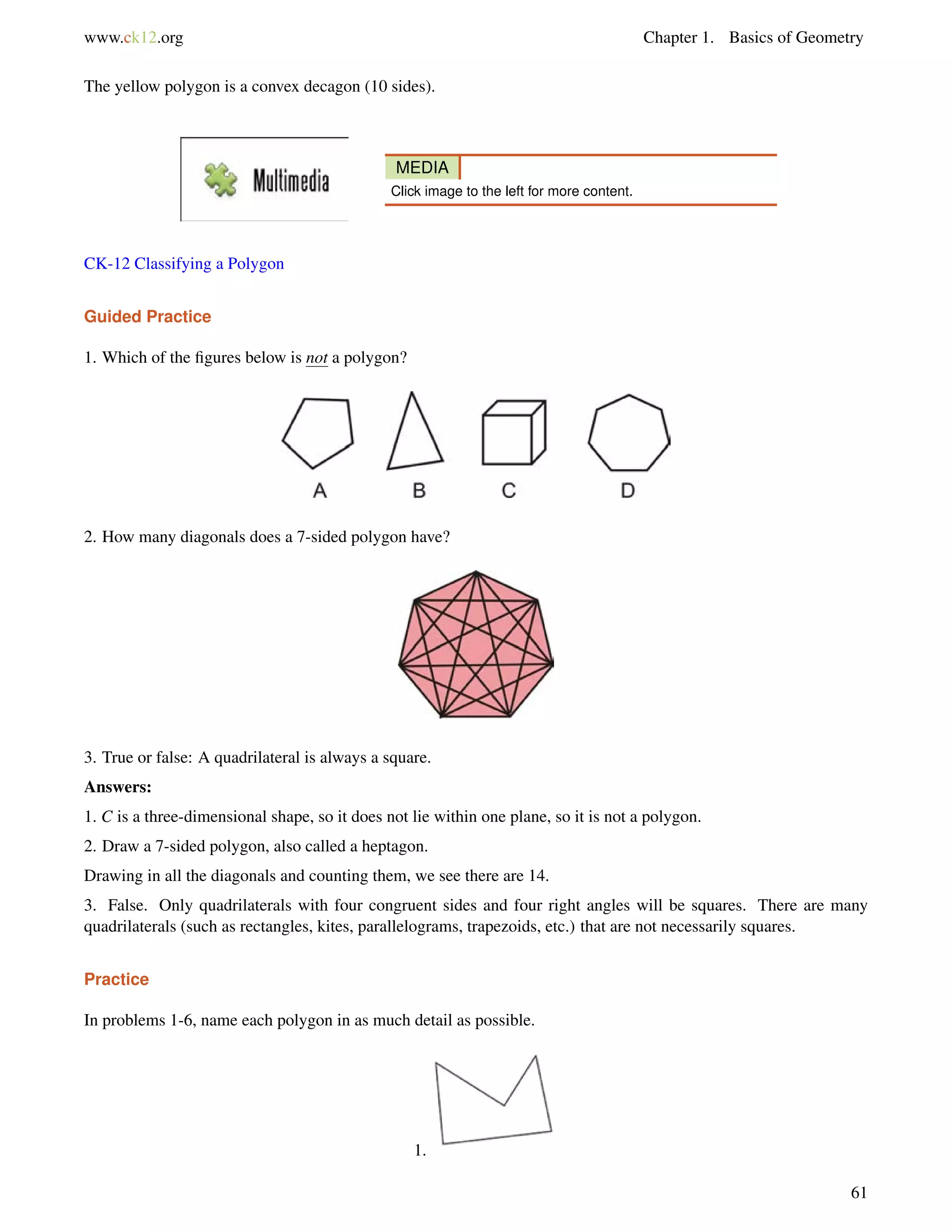
2. How many diagonals does a 7-sided polygon have? 
3. True or false: A quadrilateral is always a square. 
Answers: 
1. C is a three-dimensional shape, so it does not lie within one plane, so it is not a polygon. 
2. Draw a 7-sided polygon, also called a heptagon. 
Drawing in all the diagonals and counting them, we see there are 14. 
3. False. Only quadrilaterals with four congruent sides and four right angles will be squares. There are many 
quadrilaterals (such as rectangles, kites, parallelograms, trapezoids, etc.) that are not necessarily squares. 
Practice 
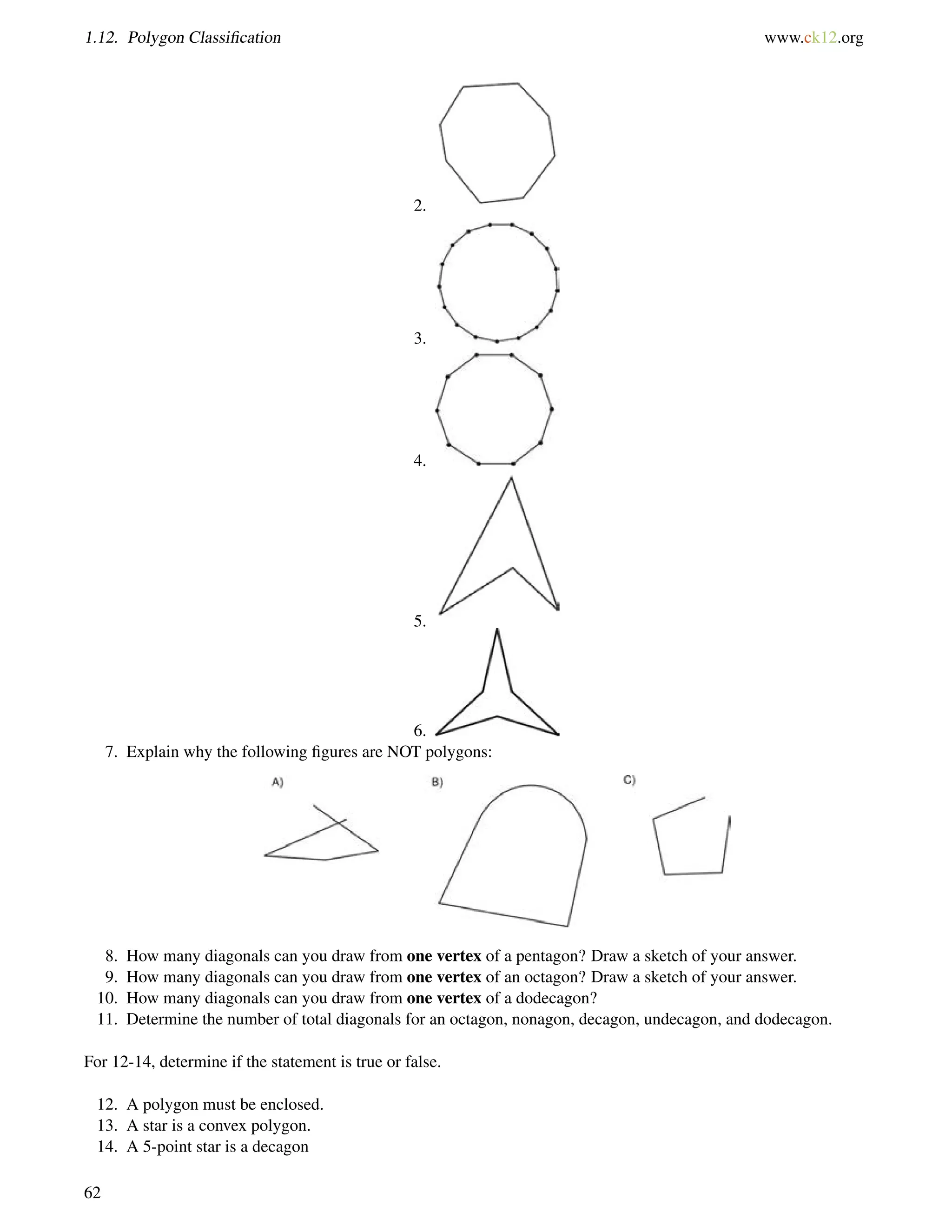
In problems 1-6, name each polygon in as much detail as possible. 
1. 
61
1.12. Polygon Classification www.ck12.org 
2. 
3. 
4. 
5. 
6. 
7. Explain why the following figures are NOT polygons: 
8. How many diagonals can you draw from one vertex of a pentagon? Draw a sketch of your answer. 
9. How many diagonals can you draw from one vertex of an octagon? Draw a sketch of your answer. 
10. How many diagonals can you draw from one vertex of a dodecagon? 
11. Determine the number of total diagonals for an octagon, nonagon, decagon, undecagon, and dodecagon. 
For 12-14, determine if the statement is true or false. 
12. A polygon must be enclosed. 
13. A star is a convex polygon. 
14. A 5-point star is a decagon 
62
www.ck12.org Chapter 1. Basics of Geometry 
Summary 
This chapter begins with the basic components of Euclidean Geometry. From the introductory definition of points, 
lines, and planes it builds to a discussion of classifying figures such as angles, triangles, and polygons. Measurement 
of distances and angles are also covered. Different types of angle relationships are compared and explored, such as 
complementary angles, supplementary angles and linear pairs. 
63
www.ck12.org 
CHAPTER 2 Reasoning and Proof 
Chapter Outline 
2.1 INDUCTIVE REASONING FROM PATTERNS 
2.2 DEDUCTIVE REASONING 
2.3 IF-THEN STATEMENTS 
2.4 CONVERSE, INVERSE, AND CONTRAPOSITIVE 
2.5 CONJECTURES AND COUNTEREXAMPLES 
2.6 PROPERTIES OF EQUALITY AND CONGRUENCE 
2.7 TWO-COLUMN PROOFS 
Introduction 
This chapter explains how to use reasoning to prove theorems about angle pairs and segments. This chapter also 
introduces the properties of congruence, which will be used in 2-column proofs. 
64
www.ck12.org Chapter 2. Reasoning and Proof 
2.1 Inductive Reasoning fromPatterns 
Here you’ll learn how to inductively draw conclusions from patterns and examples to solve problems. 
What if you were given a pattern of three numbers or shapes and asked to determine the sixth number or shape that 
fit that pattern? After completing this Concept, you’ll be able to use inductive reasoning to draw conclusions like 
this based on examples and patterns provided. 
Watch This 
MEDIA 
Click image to the left for more content. 
CK-12 Types of Reasoning: Inductive 
Watch the first two parts of this video. 
MEDIA 
Click image to the left for more content. 
James Sousa:Inductive Reasoning 
Guidance 
One type of reasoning is inductive reasoning. Inductive reasoning entails making conclusions based upon examples 
and patterns. Visual patterns and number patterns provide good examples of inductive reasoning. Let’s look at some 
patterns to get a feel for what inductive reasoning is. 
Example A 
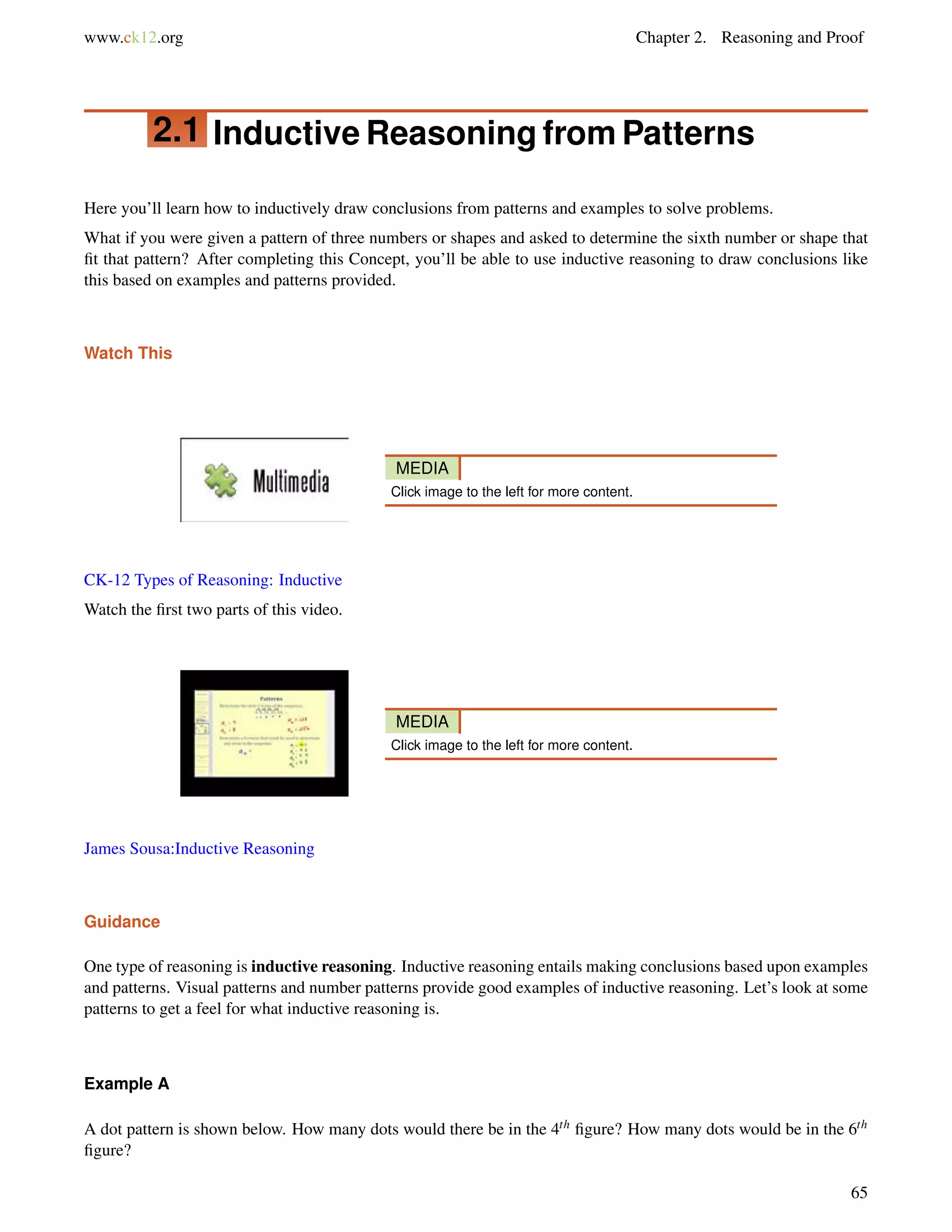
A dot pattern is shown below. How many dots would there be in the 4th figure? How many dots would be in the 6th 
figure? 
65
2.1. Inductive Reasoning from Patterns www.ck12.org 
Draw a picture. Counting the dots, there are 4+3+2+1 = 10 dots. 
For the 6th figure, we can use the same pattern, 6+5+4+3+2+1. There are 21 dots in the 6th figure. 
Example B 
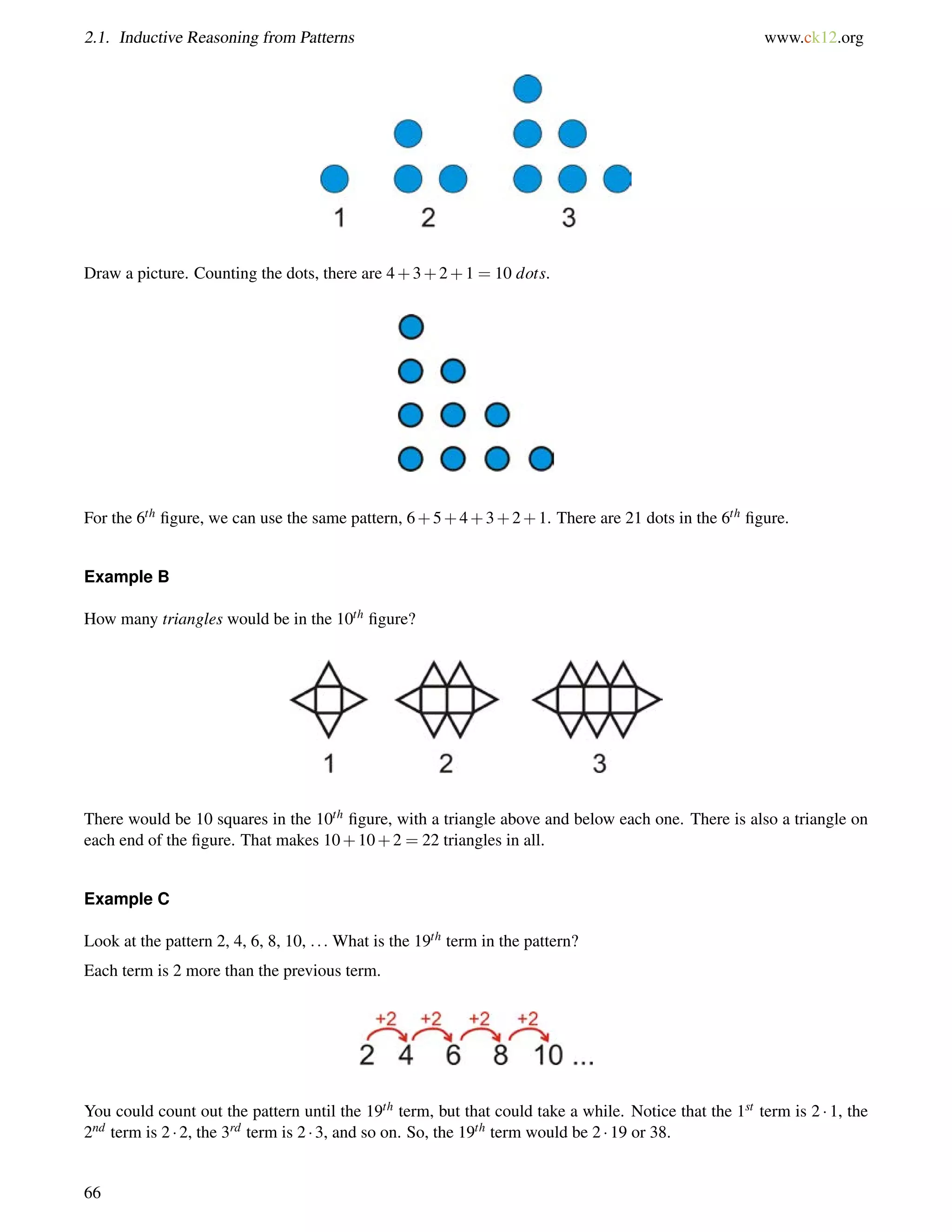
How many triangles would be in the 10th figure? 
There would be 10 squares in the 10th figure, with a triangle above and below each one. There is also a triangle on 
each end of the figure. That makes 10+10+2 = 22 triangles in all. 
Example C 
Look at the pattern 2, 4, 6, 8, 10, : : : What is the 19th term in the pattern? 
Each term is 2 more than the previous term. 
You could count out the pattern until the 19th term, but that could take a while. Notice that the 1st term is 2  1, the 
2nd term is 2  2, the 3rd term is 2  3, and so on. So, the 19th term would be 2  19 or 38. 
66
www.ck12.org Chapter 2. Reasoning and Proof 
MEDIA 
Click image to the left for more content. 
CK-12 Types of Reasoning: Inductive 
Guided Practice 
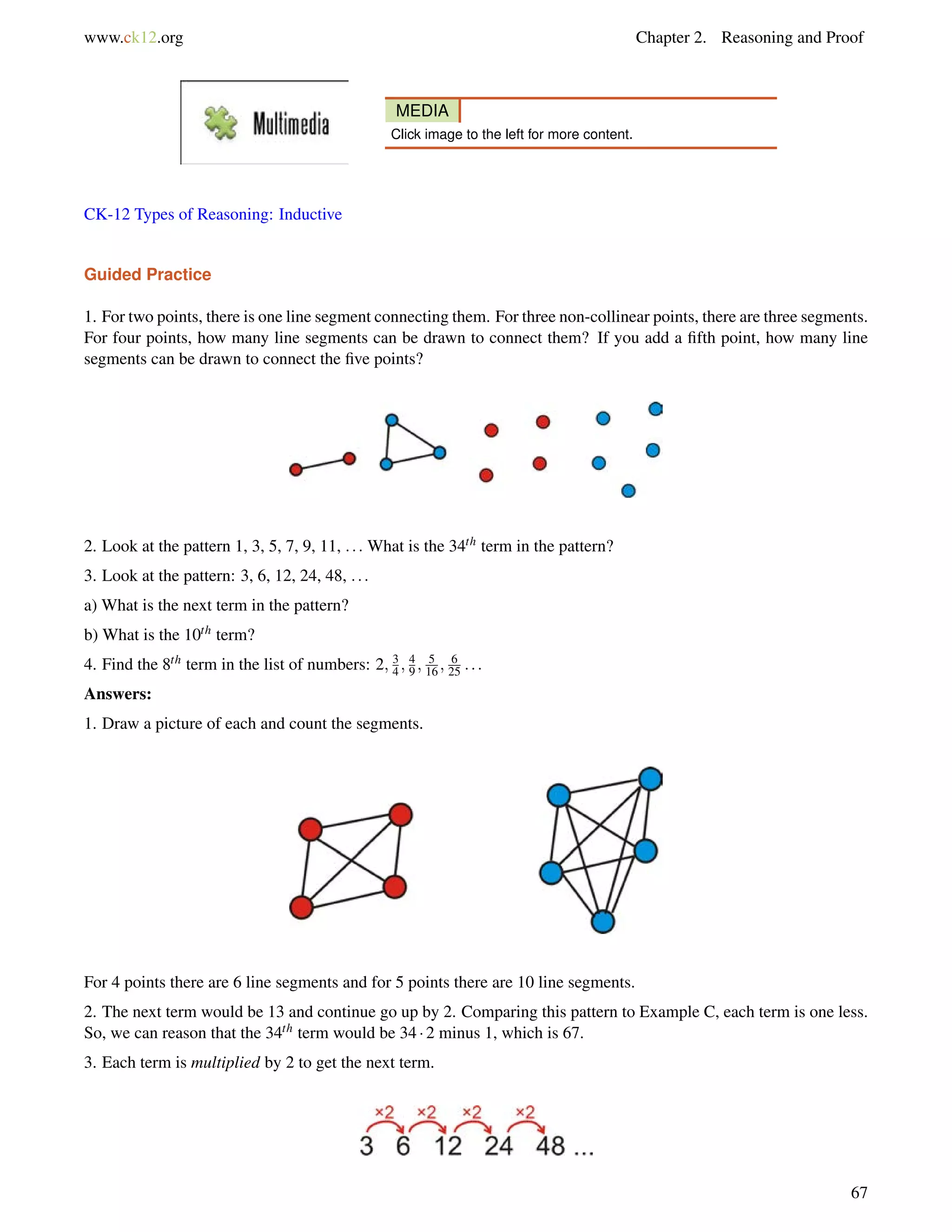
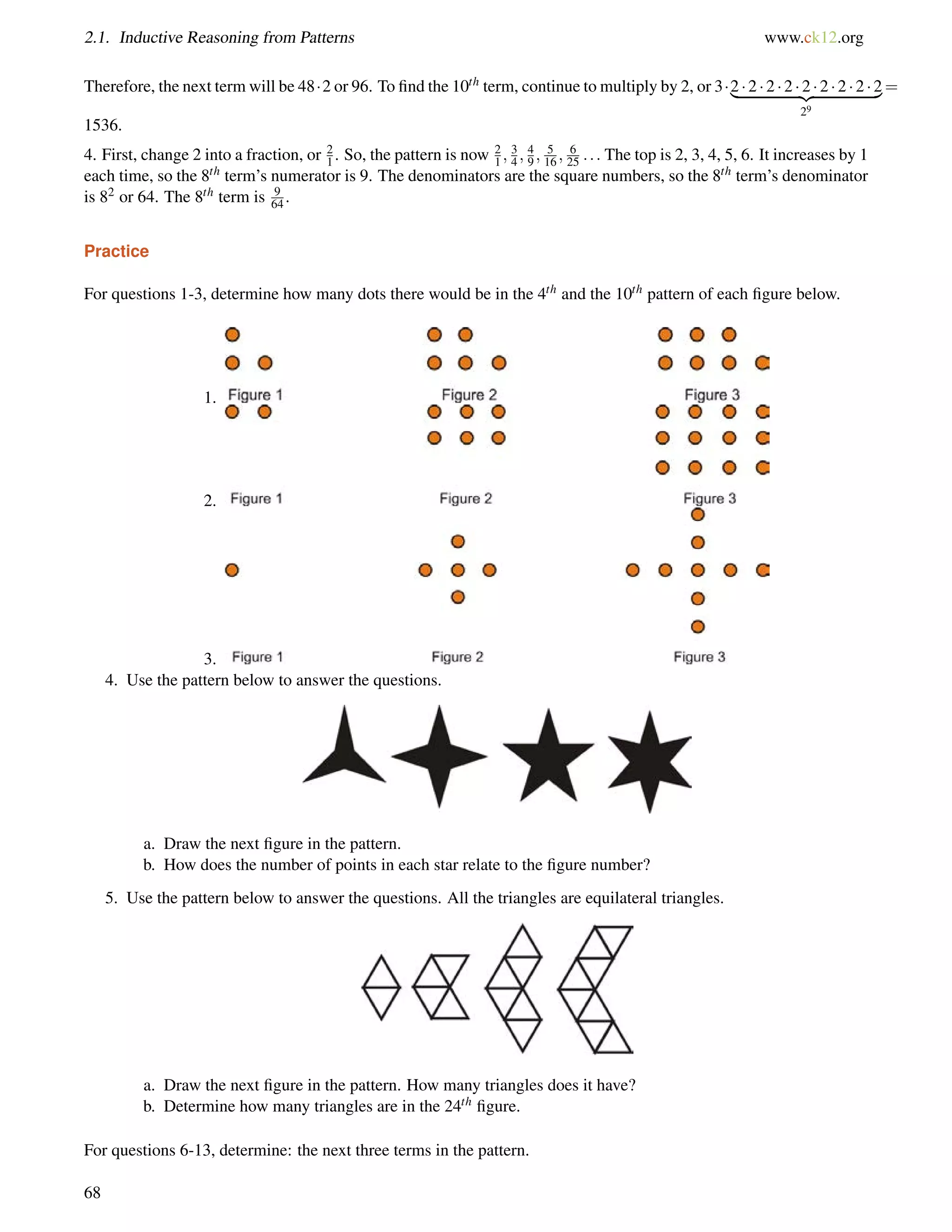
1. For two points, there is one line segment connecting them. For three non-collinear points, there are three segments. 
For four points, how many line segments can be drawn to connect them? If you add a fifth point, how many line 
segments can be drawn to connect the five points? 
34 
2. Look at the pattern 1, 3, 5, 7, 9, 11, : : : What is the 34th term in the pattern? 
3. Look at the pattern: 3, 6, 12, 24, 48, : : : 
a) What is the next term in the pattern? 
b) What is the 10th term? 
4. Find the 8th term in the list of numbers: 2;; 4 
; 5 
9 16 ; 6 
25 : : : 
Answers: 
1. Draw a picture of each and count the segments. 
For 4 points there are 6 line segments and for 5 points there are 10 line segments. 
2. The next term would be 13 and continue go up by 2. Comparing this pattern to Example C, each term is one less. 
So, we can reason that the 34th term would be 34  2 minus 1, which is 67. 
3. Each term is multiplied by 2 to get the next term. 
67
2.1. Inductive Reasoning from Patterns www.ck12.org 
Therefore, the next term will be 482 or 96. To find the 10th term, continue to multiply by 2, or 3|2     2       2        2     {2z   2        2       2       2} 
29 
= 
1536. 
4. First, change 2 into a fraction, or 2 
1 . So, the pattern is now 21 
; 3 
4 ;49 
; 5 
16 ; 6 
25 : : : The top is 2, 3, 4, 5, 6. It increases by 1 
each time, so the 8th term’s numerator is 9. The denominators are the square numbers, so the 8th term’s denominator 
is 82 or 64. The 8th term is 9 
64 . 
Practice 
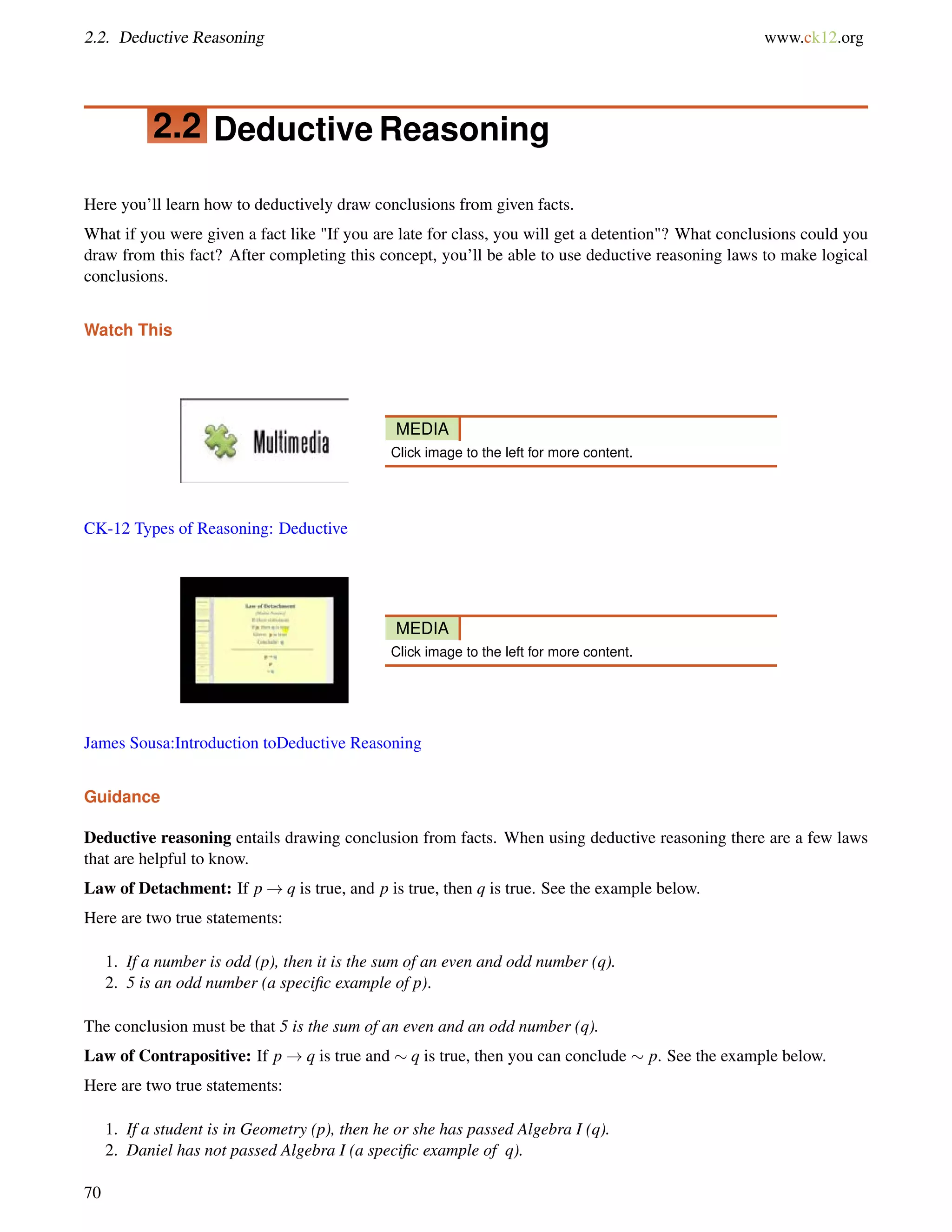
For questions 1-3, determine how many dots there would be in the 4th and the 10th pattern of each figure below. 
1. 
2. 
3. 
4. Use the pattern below to answer the questions. 
a. Draw the next figure in the pattern. 
b. How does the number of points in each star relate to the figure number? 
5. Use the pattern below to answer the questions. All the triangles are equilateral triangles. 
a. Draw the next figure in the pattern. How many triangles does it have? 
b. Determine how many triangles are in the 24th figure. 
For questions 6-13, determine: the next three terms in the pattern. 
68
www.ck12.org Chapter 2. Reasoning and Proof 
6. 5, 8, 11, 14, 17, : : : 
7. 6, 1, -4, -9, -14, : : : 
8. 2, 4, 8, 16, 32, : : : 
9. 67, 56, 45, 34, 23, : : : 
10. 9, -4, 6, -8, 3, : : : 
11. 1 
2 ;23 
;34 
;45 
;56 
: : : 
12. 2 
3 ;47 
; 6 
11 ; 8 
15 ; 10 
19 ; : : : 
13. -1, 5, -9, 13, -17, : : : 
For questions 14-17, determine the next two terms and describe the pattern. 
14. 3, 6, 11, 18, 27, : : : 
15. 3, 8, 15, 24, 35, : : : 
16. 1, 8, 27, 64, 125, : : : 
17. 1, 1, 2, 3, 5, : : : 
69
2.2. Deductive Reasoning www.ck12.org 
2.2 Deductive Reasoning 
Here you’ll learn how to deductively draw conclusions from given facts. 
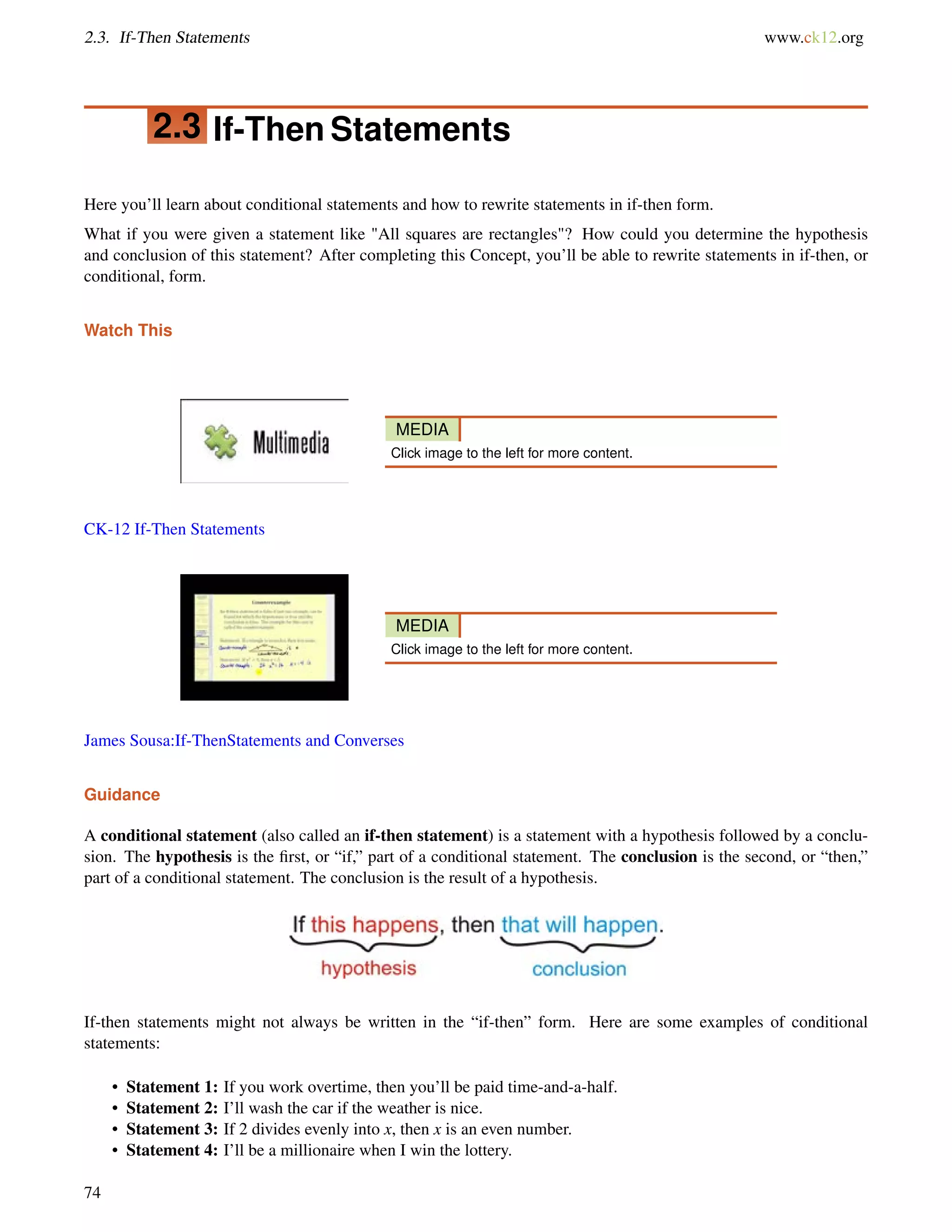
What if you were given a fact like If you are late for class, you will get a detention? What conclusions could you 
draw from this fact? After completing this concept, you’ll be able to use deductive reasoning laws to make logical 
conclusions. 
Watch This 
MEDIA 
Click image to the left for more content. 
CK-12 Types of Reasoning: Deductive 
MEDIA 
Click image to the left for more content. 
James Sousa:Introduction toDeductive Reasoning 
Guidance 
Deductive reasoning entails drawing conclusion from facts. When using deductive reasoning there are a few laws 
that are helpful to know. 
Law of Detachment: If p!q is true, and p is true, then q is true. See the example below. 
Here are two true statements: 
1. If a number is odd (p), then it is the sum of an even and odd number (q). 
2. 5 is an odd number (a specific example of p). 
The conclusion must be that 5 is the sum of an even and an odd number (q). 
Law of Contrapositive: If p!q is true and  q is true, then you can conclude  p. See the example below. 
Here are two true statements: 
1. If a student is in Geometry (p), then he or she has passed Algebra I (q). 
2. Daniel has not passed Algebra I (a specific example of q). 
70
www.ck12.org Chapter 2. Reasoning and Proof 
The conclusion must be that Daniel is not in Geometry ( p). 
Law of Syllogism: If p!q and q!r are true, then p!r is true. See the example below. 
Here are three true statements: 
1. If Pete is late (p), Mark will be late (q). 
2. If Mark is late (q), Karl will be late (r). 
3. Pete is late (p). 
Notice how each “then” becomes the next “if” in a chain of statements. If Pete is late, this starts a domino effect 
of lateness. Mark will be late and Karl will be late too. So, if Pete is late, then Karl will be late (r), is the logical 
conclusion. 
Example A 
Suppose Bea makes the following statements, which are known to be true. 
If Central High School wins today, they will go to the regional tournament. Central High School won today. 
What is the logical conclusion? 
These are true statements that we can take as facts. The conclusion is: Central High School will go to the regional 
tournament. 
Example B 
Here are two true statements. 
If6 A and6 B are a linear pair, then m6 A+m6 B = 180. 
6 ABC and6 CBD are a linear pair. 
What conclusion can you draw from this? 
This is an example of the Law of Detachment, therefore: 
m6 ABC+m6 CBD = 180 
Example C 
Determine the conclusion from the true statements below. 
Babies wear diapers. 
My little brother does not wear diapers. 
The second statement is the equivalent of  q. Therefore, the conclusion is  p, or: My little brother is not a baby. 
MEDIA 
Click image to the left for more content. 
CK-12 Types of Reasoning: Deductive 
71
2.2. Deductive Reasoning www.ck12.org 
Guided Practice 
1. Here are two true statements. 
If6 A and6 B are a linear pair, then m6 A+m6 B = 180. 
m6 1 = 90 and m6 2 = 90. 
What conclusion can you draw from these two statements? 
2. Determine the conclusion from the true statements below. 
If you are not in Chicago, then you can’t be on the L. 
Bill is in Chicago. 
3. Determine the conclusion from the true statements below. 
If you are not in Chicago, then you can’t be on the L. 
Sally is on the L. 
Answers: 
1. Here there is NO conclusion. These statements are in the form: 
p!q 
q 
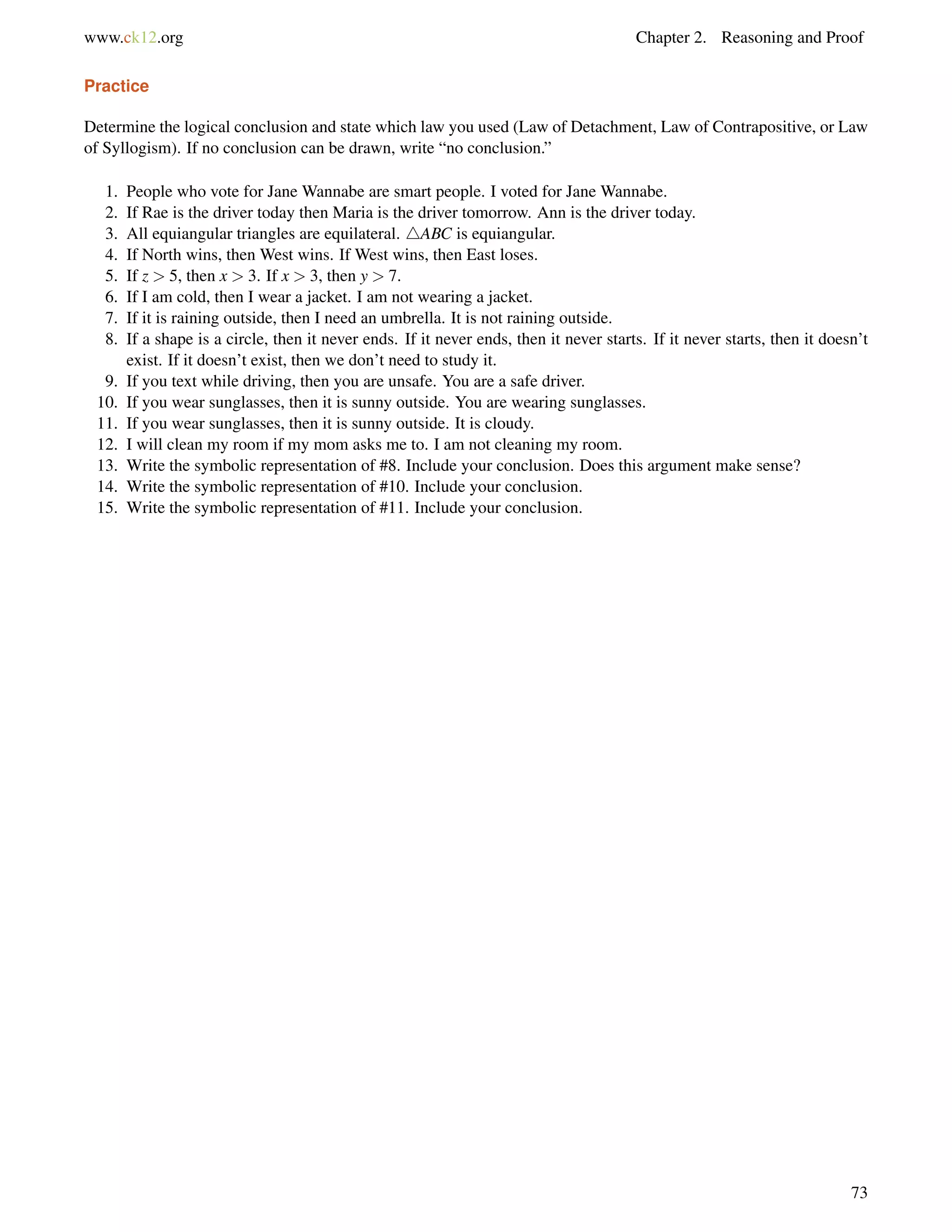
We cannot conclude that6 1 and6 2 are a linear pair. 
Here are two counterexamples: 
2. If we were to rewrite this symbolically, it would look like: 
 p !q 
p 
This is not in the form of the Law of Contrapositive or the Law of Detachment, so neither of these laws can be used 
to draw a logical conclusion. 
3. If we were to rewrite this symbolically, it would look like: 
 p !q 
q 
Even though it looks a little different, this is an example of the Law of Contrapositive. Therefore, the logical 
conclusion is: Sally is in Chicago. 
72
www.ck12.org Chapter 2. Reasoning and Proof 
Practice 
Determine the logical conclusion and state which law you used (Law of Detachment, Law of Contrapositive, or Law 
of Syllogism). If no conclusion can be drawn, write “no conclusion.” 
1. People who vote for Jane Wannabe are smart people. I voted for Jane Wannabe. 
2. If Rae is the driver today then Maria is the driver tomorrow. Ann is the driver today. 
3. All equiangular triangles are equilateral. 4ABC is equiangular. 
4. If North wins, then West wins. If West wins, then East loses. 
5. If z  5, then x  3. If x  3, then y  7. 
6. If I am cold, then I wear a jacket. I am not wearing a jacket. 
7. If it is raining outside, then I need an umbrella. It is not raining outside. 
8. If a shape is a circle, then it never ends. If it never ends, then it never starts. If it never starts, then it doesn’t 
exist. If it doesn’t exist, then we don’t need to study it. 
9. If you text while driving, then you are unsafe. You are a safe driver. 
10. If you wear sunglasses, then it is sunny outside. You are wearing sunglasses. 
11. If you wear sunglasses, then it is sunny outside. It is cloudy. 
12. I will clean my room if my mom asks me to. I am not cleaning my room. 
13. Write the symbolic representation of #8. Include your conclusion. Does this argument make sense? 
14. Write the symbolic representation of #10. Include your conclusion. 
15. Write the symbolic representation of #11. Include your conclusion. 
73
2.3. If-Then Statements www.ck12.org 
2.3 If-Then Statements 
Here you’ll learn about conditional statements and how to rewrite statements in if-then form. 
What if you were given a statement like All squares are rectangles? How could you determine the hypothesis 
and conclusion of this statement? After completing this Concept, you’ll be able to rewrite statements in if-then, or 
conditional, form. 
Watch This 
MEDIA 
Click image to the left for more content. 
CK-12 If-Then Statements 
MEDIA 
Click image to the left for more content. 
James Sousa:If-ThenStatements and Converses 
Guidance 
A conditional statement (also called an if-then statement) is a statement with a hypothesis followed by a conclu-sion. 
The hypothesis is the first, or “if,” part of a conditional statement. The conclusion is the second, or “then,” 
part of a conditional statement. The conclusion is the result of a hypothesis. 
If-then statements might not always be written in the “if-then” form. Here are some examples of conditional 
statements: 
• Statement 1: If you work overtime, then you’ll be paid time-and-a-half. 
• Statement 2: I’ll wash the car if the weather is nice. 
• Statement 3: If 2 divides evenly into x, then x is an even number. 
• Statement 4: I’ll be a millionaire when I win the lottery. 
74
www.ck12.org Chapter 2. Reasoning and Proof 
• Statement 5: All equiangular triangles are equilateral. 
Statements 1 and 3 are written in the “if-then” form. The hypothesis of Statement 1 is “you work overtime.” The 
conclusion is “you’ll be paid time-and-a-half.” Statement 2 has the hypothesis after the conclusion. If the word “if” 
is in the middle of the statement, then the hypothesis is after it. The statement can be rewritten: If the weather is nice, 
then I will wash the car. Statement 4 uses the word “when” instead of “if” and is like Statement 2. It can be written: 
If I win the lottery, then I will be a millionaire. Statement 5 “if” and “then” are not there. It can be rewritten: If a 
triangle is equiangular, then it is equilateral. 
Example A 
Use the statement: I will graduate when I pass Calculus. 
a) Rewrite in if-then form. 
b) Determine the hypothesis and conclusion. 
This statement can be rewritten as If I pass Calculus, then I will graduate. The hypothesis is “I pass Calculus,” and 
the conclusion is “I will graduate.” 
Example B 
Use the statement: All prime numbers are odd. 
a) Rewrite in if-then form. 
b) Determine the hypothesis and conclusion. 
c) Is this a true statement? 
This statement can be rewritten as If a number is prime, then it is odd. The hypothesis is a number is prime and 
the conclusion is it is odd. This is not a true statement (remember that not all conditional statements will be true!) 
since 2 is a prime number but it is not odd. 
Example C 
Determine the hypothesis and conclusion: Sarah will go to the store if Riley does the laundry. 
The statement can be rewritten as If Riley does the laundry then Sarah will go to the store. The hypothesis is Riley 
does the laundry and the conclusion is Sarah will go to the store. 
MEDIA 
Click image to the left for more content. 
CK-12 If-Then Statements 
Guided Practice 
Determine the hypothesis and conclusion: 
1. I’ll bring an umbrella if it rains. 
75
2.3. If-Then Statements www.ck12.org 
2. If I win the game, then I will get a prize. 
3. All right angles are 90. 
Answers: 
1. Hypothesis: It rains. Conclusion: I’ll bring an umbrella. 
2. Hypothesis: I win the game. Conclusion: I will get a prize. 
3. Hypothesis: An angle is right. Conclusion: It is 90. 
Practice 
Determine the hypothesis and the conclusion for each statement. 
1. If 5 divides evenly into x, then x ends in 0 or 5. 
2. If a triangle has three congruent sides, it is an equilateral triangle. 
3. Three points are coplanar if they all lie in the same plane. 
4. If x = 3, then x2 = 9. 
5. If you take yoga, then you are relaxed. 
6. All baseball players wear hats. 
7. I’ll learn how to drive when I am 16 years old. 
8. If you do your homework, then you can watch TV. 
9. Alternate interior angles are congruent if lines are parallel. 
10. All kids like ice cream. 
76
www.ck12.org Chapter 2. Reasoning and Proof 
2.4 Converse, Inverse, and Contrapositive 
Here you’ll learn how to write the converse, inverse, and contrapositive of any conditional statement. You’ll also 
learn what a biconditional statement is. 
What if you were given a conditional statement like If I walk to school, then I will be late? How could you 
rearrange and/or negate this statement to form new conditional statements? After completing this Concept, you’ll be 
able to write the converse, inverse, and contrapositive of a conditional statement like this one. 
Watch This 
MEDIA 
Click image to the left for more content. 
CK-12 Converse, Inverse and Contrapositive of a Conditional Statement 
MEDIA 
Click image to the left for more content. 
James Sousa:Converse, Contrapositive, and Inverse of anIf-ThenStatement 
Guidance 
Consider the statement: If the weather is nice, then I’ll wash the car. We can rewrite this statement using letters to 
represent the hypothesis and conclusion. 
p = the weather is nice q = I’ll wash the car 
Now the statement is: If p, then q, which can also be written as p!q. 
We can also make the negations, or “nots,” of p and q. The symbolic version of not p is  p. 
 p = the weather is not nice  q = I won’t wash the car 
Using these “nots” and switching the order of p and q, we can create three new statements. 
77
2.4. Converse, Inverse, and Contrapositive www.ck12.org 
Converse q! p I|f    I    w     a   s{hz t  h    e    c    a }r 
q 
; t|h   e   n      t h    e     w     e{azt  h    e   r    i  s    n   i  c   }e 
p 
: 
Inverse  p! q I|f    t  h   e     w     e   a   t  h {ezr   i  s     n   o    t   n    i  c  }e 
p 
; t|h   e   n     I    w     o    n   ’  t{zw   a   s   h     t  h   e     c   a  }r 
q 
: 
Contrapositive  q! p I|f    I    d    o   n    ’  t    w{za  s   h     t  h   e     c   a  }r 
q 
; t|h   e   n     t  h    e     w     e   a  {thze   r    i  s     n   o   t    n    i  c  }e 
p 
: 
If the “if-then” statement is true, then the contrapositive is also true. The contrapositive is logically equivalent to the 
original statement. The converse and inverse may or may not be true. When the original statement and converse are 
both true then the statement is a biconditional statement. In other words, if p!q is true and q! p is true, then 
p$q (said “p if and only if q”). 
Example A 
If n  2, then n2  4. 
a) Find the converse, inverse, and contrapositive. 
b) Determine if the statements from part a are true or false. If they are false, find a counterexample. 
The original statement is true. 
Converse : If n2  4; then n  2: False: If n2 = 9;n = 3 or 3: (3)2 = 9 
Inverse : If n  2; then n2  4: False: If n = 3; then n2 = 9: 
Contrapositive : If n2  4; then n  2: True: The only n2  4 is 1 or 4: 
p 
1 = 1 
and 
p 
4 = 2 
; which are both less than or equal to 2. 
Example B 
If I am at Disneyland, then I am in California. 
a) Find the converse, inverse, and contrapositive. 
b) Determine if the statements from part a are true or false. If they are false, find a counterexample. 
The original statement is true. 
Converse : If I am in California, then I am at Disneyland. 
False: I could be in San Francisco. 
Inverse : If I am not at Disneyland, then I am not in California. 
False: Again, I could be in San Francisco. 
Contrapositive : If I am not in California, then I am not at Disneyland. 
True: If I am not in the state, I couldn’t be at Disneyland. 
Notice for the converse and inverse we can use the same counterexample. 
78
www.ck12.org Chapter 2. Reasoning and Proof 
Example C 
Rewrite as a biconditional statement: Any two points are collinear. 
This statement can be rewritten as: 
Two points are on the same line if and only if they are collinear. Replace the “if-then” with “if and only if” in the 
middle of the statement. 
MEDIA 
Click image to the left for more content. 
CK-12 Converse, Inverse and Contrapositive of a Conditional Statement 
Guided Practice 
1. Any two points are collinear. 
a) Find the converse, inverse, and contrapositive. 
b) Determine if the statements from part a are true or false. If they are false, find a counterexample. 
2. The following is a true statement: 
m6 ABC  90 if and only if6 ABC is an obtuse angle. 
Determine the two true statements within this biconditional. 
3. p : x  10 q : 2x  50 
a) Is p!q true? If not, find a counterexample. 
b) Is q! p true? If not, find a counterexample. 
c) Is  p!q true? If not, find a counterexample. 
d) Is  q ! p true? If not, find a counterexample. 
Answers 
1. First, change the statement into an “if-then” statement: 
If two points are on the same line, then they are collinear. 
Converse : If two points are collinear, then they are on the same line. True: 
Inverse : If two points are not on the same line, then they are not collinear. True: 
Contrapositive : If two points are not collinear, then they do not lie on the same line: True: 
2. Statement 1: If m6 ABC  90, then6 ABC is an obtuse angle. 
Statement 2: If6 ABC is an obtuse angle, then m6 ABC  90. 
3. a) If x  10, then 2x  50. True. 
b) If 2x  50, then x  10. False, x = 15 
c) If x  10, then 2x  50. False, x = 15 
d) If 2x  50, then x  10. True, x  25 
79
2.4. Converse, Inverse, and Contrapositive www.ck12.org 
Practice 
For questions 1-4, use the statement: 
If AB = 5 and BC = 5, then B is the midpoint of AC. 
1. Is this a true statement? If not, what is a counterexample? 
2. Find the converse of this statement. Is it true? 
3. Find the inverse of this statement. Is it true? 
4. Find the contrapositive of this statement. Which statement is it the same as? 
Find the converse of each true if-then statement. If the converse is true, write the biconditional statement. 
5. An acute angle is less than 90. 
6. If you are at the beach, then you are sun burnt. 
7. If x  4, then x+3  7. 
For questions 8-10, determine the two true conditional statements from the given biconditional statements. 
8. A U.S. citizen can vote if and only if he or she is 18 or more years old. 
9. A whole number is prime if and only if its factors are 1 and itself. 
10. 2x = 18 if and only if x = 9. 
80
www.ck12.org Chapter 2. Reasoning and Proof 
2.5 Conjectures and Counterexamples 
Here you’ll learn how to make educated guesses, or conjectures, based on patterns. You’ll also learn how to disprove 
conjectures with counterexamples. 
Suppose you were given a mathematical pattern like h = 16=t2. What if you wanted to make an educated 
guess, or conjecture, about h? After completing this Concept, you’ll be able to make such a guess and provide 
counterexamples that disprove incorrect guesses. 
Watch This 
MEDIA 
Click image to the left for more content. 
CK-12 Conjectures and Counterexamples 
Watch the final part of this video. 
MEDIA 
Click image to the left for more content. 
James Sousa:Counterexamples 
Guidance 
A conjecture is an “educated guess” that is based on examples in a pattern. A counterexample is an example that 
disproves a conjecture. 
Example A 
Here’s an algebraic equation and a table of values for n and t. 
t = (n1)(n2)(n3) 
81
2.5. Conjectures and Counterexamples www.ck12.org 
TABLE 2.1: 
n (n1)(n2)(n3) t 
1 (0)(1)(2) 0 
2 (1)(0)(1) 0 
3 (2)(1)(0) 0 
After looking at the table, Pablo makes this conjecture: 
The value of (n1)(n2)(n3) is 0 for any number n. 
Is this a true conjecture? 
This is not a valid conjecture. If Pablo were to continue the table to n = 4, he would have see that (n1)(n2)(n 
3) = (41)(42)(43) = (3)(2)(1) = 6 
In this example n = 4 is the counterexample. 
Example B 
Arthur is making figures for an art project. He drew polygons and some of their diagonals. 
From these examples, Arthur made this conjecture: 
If a convex polygon has n sides, then there are n2 triangles formed when diagonals are drawn from any vertex of 
the polygon. 
Is Arthur’s conjecture correct? Or, can you find a counterexample? 
The conjecture appears to be correct. If Arthur draws other polygons, in every case he will be able to draw n2 
triangles if the polygon has n sides. 
Notice that we have not proved Arthur’s conjecture, but only found several examples that hold true. So, at this 
point, we say that the conjecture is true. 
Example C 
Give a counterexample to this statement: Every prime number is an odd number. 
The only counterexample is the number 2: an even number (not odd) that is prime. 
MEDIA 
Click image to the left for more content. 
CK-12 Conjectures and Counterexamples 
82
www.ck12.org Chapter 2. Reasoning and Proof 
Guided Practice 
A car salesman sold 5 used cars to five different couples. He noticed that each couple was under 30 years old. The 
following day, he sold a new, luxury car to a couple in their 60’s. The salesman determined that only younger couples 
by used cars. 
1. Is the salesman’s conjecture logical? Why or why not? 
2. Can you think of a counterexample? 
Answers: 
1. It is logical based on his experiences, but is not true. 
2. A counterexample would be a couple that is 30 years old or older buying a used car. 
Practice 
Give a counterexample for each of the following statements. 
1. If n is a whole number, then n2  n. 
2. All numbers that end in 1 are prime numbers. 
3. All positive fractions are between 0 and 1. 
4. Any three points that are coplanar are also collinear. 
5. All girls like ice cream. 
6. All high school students are in choir. 
7. For any angle there exists a complementary angle. 
8. All teenagers can drive. 
9. If n is an integer, then n  0. 
10. All equations have integer solutions. 
83
2.6. Properties of Equality and Congruence www.ck12.org 
2.6 Properties of Equality and Congruence 
Here you’ll review the properties of equality you learned in Algebra I, be introduced to the properties of congruence, 
and learn how to use these properties. 
Suppose you know that a circle measures 360 degrees and you want to find what kind of angle one-quarter of a circle 
is. After completing this Concept, you’ll be able to apply the basic properties of equality and congruence to solve 
geometry problems like this one. 
Watch This 
MEDIA 
Click image to the left for more content. 
CK-12 Propertiesof EqualityandCongruence 
MEDIA 
Click image to the left for more content. 
James Sousa:Introduction toProof UsingProperties of Equality 
Now watch this. 
MEDIA 
Click image to the left for more content. 
James Sousa:Introduction toProof UsingProperties of Congruence 
Guidance 
The basic properties of equality were introduced to you in Algebra I. Here they are again: 
• Reflexive Property of Equality: AB = AB 
84
www.ck12.org Chapter 2. Reasoning and Proof 
• Symmetric Property of Equality: If m6 A = m6 B, then m6 B = m6 A 
• Transitive Property of Equality: If AB =CD and CD = EF, then AB = EF 
• Substitution Property of Equality: If a = 9 and ac = 5, then 9c = 5 
• Addition Property of Equality: If 2x = 6, then 2x+5 = 6+5 or 2x+5 = 11 
• Subtraction Property of Equality: If m6 x+15 = 65, then m6 x+1515 = 6515 or m6 x = 50 
• Multiplication Property of Equality: If y = 8, then 5  y = 5  8 or 5y = 40 
• Division Property of Equality: If 3b = 18, then 3b 
3 = 18 
3 or b = 6 
• Distributive Property: 5(2x7) = 5(2x)5(7) = 10x35 
Just like the properties of equality, there are properties of congruence. These properties hold for figures and shapes. 
• Reflexive Property of Congruence: AB= 
AB or6 B= 
6 B 
• Symmetric Property of Congruence: If AB = 
CD, then CD = 
AB. Or, if6 ABC = 
6 DEF, then6 DEF = 
6 ABC 
• Transitive Property of Congruence: If AB= 
CD and CD= 
EF, then AB= 
EF. Or, if6 ABC = 
6 DEF and 
6 DEF = 
6 GHI, then6 ABC = 
6 GHI 
When you solve equations in algebra you use properties of equality. You might not write out the property for each 
step, but you should know that there is an equality property that justifies that step. We will abbreviate “Property of 
Equality” “PoE” and “Property of Congruence” “PoC” when we use these properties in proofs. 
Example A 
Solve 2(3x4)+11 = x27 and write the property for each step (also called “to justify each step”). 
2(3x4)+11 = x27 
6x8+11 = x27 Distributive Property 
6x+3 = x27 Combine like terms 
6x+33 = x273 Subtraction PoE 
6x = x30 Simplify 
6xx = xx30 Subtraction PoE 
5x = 30 Simplify 
5x 
30 
= 
5 
5 
Division PoE 
x = 6 Simplify 
Example B 
AB = 8;BC = 17, and AC = 20. Are points A;B, and C collinear? 
Set up an equation using the Segment Addition Postulate. 
AB+BC = AC Segment Addition Postulate 
8+17 = 20 Substitution PoE 
256= 20 Combine like terms 
Because the two sides of the equation are not equal, A;B and C are not collinear. 
85
2.6. Properties of Equality and Congruence www.ck12.org 
Example C 
If m6 A+m6 B = 100 and m6 B = 40, prove that m6 A is an acute angle. 
We will use a 2-column format, with statements in one column and their reasons next to it, just like Example A. 
m6 A+m6 B = 100 Given Information 
m6 B = 40 Given Information 
m6 A+40 = 100 Substitution PoE 
m6 A = 60 Subtraction PoE 
6 A is an acute angle Definition of an acute angle;m6 A  90 
MEDIA 
Click image to the left for more content. 
CK-12 Propertiesof EqualityandCongruence 
Guided Practice 
Use the given property or properties of equality to fill in the blank. x;y, and z are real numbers. 
1. Symmetric: If x = 3, then ______________. 
2. Distributive: If 4(3x8), then ______________. 
3. Transitive: If y = 12 and x = y, then ______________. 
Answers: 
1. 3 = x 
2. 12x32 
3. x = 12 
Practice 
For questions 1-8, solve each equation and justify each step. 
1. 3x+11 = 16 
2. 7x3 = 3x35 
86
www.ck12.org Chapter 2. Reasoning and Proof 
12 
3. 3g2 
+1 = 19 
4. MN = 5 
13 
56 
5. 5m6 14 
ABC = 540 
6. 10b2(b+3) = 5b 
7. y+ = 8. 14 
AB+ 13 
AB = 12+ 12 
AB 
For questions 9-11, use the given property or properties of equality to fill in the blank. x;y, and z are real numbers. 
9. Symmetric: If x+y = y+z, then ______________. 
10. Transitive: If AB = 5 and AB =CD, then ______________. 
11. Substitution: If x = y7 and x = z+4, then ______________. 
87
2.7. Two-Column Proofs www.ck12.org 
2.7 Two-Column Proofs 
Here you’ll learn how to create two-column proofs with statements and reasons for each step you take in proving a 
geometric statement. 
Suppose you are told that6 XYZ is a right angle and that 
! 
YW bisects6 XYZ. You are then asked to prove6 XYW = 
6 WYZ. After completing this Concept, you’ll be able to create a two-column proof to prove this congruency. 
Watch This 
MEDIA 
Click image to the left for more content. 
CK-12 Two ColumnProofs 
Guidance 
A two column proof is one common way to organize a proof in geometry. Two column proofs always have two 
columns- statements and reasons. The best way to understand two column proofs is to read through examples. 
When when writing your own two column proof, keep these keep things in mind: 
= 
• Number each step. 
• Start with the given information. 
• Statements with the same reason can be combined into one step. It is up to you. 
• Draw a picture and mark it with the given information. 
• You must have a reason for EVERY statement. 
• The order of the statements in the proof is not always fixed, but make sure the order makes logical 
sense. 
• Reasons will be definitions, postulates, properties and previously proven theorems. “Given” is only used 
as a reason if the information in the statement column was told in the problem. 
• Use symbols and abbreviations for words within proofs. For example, can be used in place of the word 
congruent. You could also use6 for the word angle. 
Example A 
Write a two-column proof for the following: 
If A;B;C, and D are points on a line, in the given order, and AB =CD, then AC = BD. 
When the statement is given in this way, the “if” part is the given and the “then” part is what we are trying to prove. 
Always start with drawing a picture of what you are given. 
Plot the points in the order A;B;C;D on a line. 
88
www.ck12.org Chapter 2. Reasoning and Proof 
Add the given, AB =CD. 
Draw the 2-column proof and start with the given information. 
TABLE 2.2: 
Statement Reason 
1. A;B;C, and D are collinear, in that order. 1. Given 
2. AB =CD 2. Given 
3. BC = BC 3. Reflexive PoE 
4. AB+BC = BC+CD 4. Addition PoE 
5. AB+BC = AC 
BC+CD = BD 
5. Segment Addition Postulate 
6. AC = BD 6. Substitution or Transitive PoE 
Example B 
Write a two-column proof. 
Given: 
! 
BF bisects6 ABC;6 ABD= 
6 CBE 
Prove:6 DBF = 
6 EBF 
First, put the appropriate markings on the picture. Recall, that bisect means “to cut in half.” Therefore, m6 ABF = 
m6 FBC. 
89
2.7. Two-Column Proofs www.ck12.org 
TABLE 2.3: 
Statement Reason 
1. 
! 
BF bisects6 ABC;6 ABD= 
6 CBE 1. Given 
2. m6 ABF = m6 FBC 2. Definition of an Angle Bisector 
3. m6 ABD = m6 CBE 3. If angles are = 
, then their measures are equal. 
4. m6 ABF = m6 ABD+m6 DBF 
m6 FBC = m6 EBF +m6 CBE 
4. Angle Addition Postulate 
5. m6 ABD+m6 DBF = m6 EBF +m6 CBE 5. Substitution PoE 
6. m6 ABD+m6 DBF = m6 EBF +m6 ABD 6. Substitution PoE 
7. m6 DBF = m6 EBF 7. Subtraction PoE 
8.6 DBF = 
6 EBF 8. If measures are equal, the angles are = 
. 
= 
Example C 
The Right Angle Theorem states that if two angles are right angles, then the angles are congruent. Prove this 
theorem. 
To prove this theorem, set up your own drawing and name some angles so that you have specific angles to talk about. 
Given:6 A and6 B are right angles 
Prove:6 A6 B 
TABLE 2.4: 
= 
Statement Reason 
= 
1.6 A and6 B are right angles 1. Given 
2. m6 A = 90 and m6 B = 90 2. Definition of right angles 
3. m6 A = m6 B 3. Transitive PoE 
4.6 A6 B 4. angles have = measures 
Any time right angles are mentioned in a proof, you will need to use this theorem to say the angles are congruent. 
= 
Example D 
The Same Angle Supplements Theorem states that if two angles are supplementary to the same angle then the two 
angles are congruent. Prove this theorem. 
Given:6 A and6 B are supplementary angles.6 B and6 C are supplementary angles. 
Prove:6 A6 C 
90
www.ck12.org Chapter 2. Reasoning and Proof 
TABLE 2.5: 
Statement Reason 
1.6 A and6 B are supplementary 
6 B and6 C are supplementary 
1. Given 
2. m6 A+m6 B = 180 
m6 B+m6 C = 180 
2. Definition of supplementary angles 
= 
3. m= 
6 A+m6 B = m6 B+m6 C 3. Substitution PoE 
4. m6 A = m6 C 4. Subtraction PoE 
5.6 A6 C 5. angles have = measures 
= 
Example E 
The Vertical Angles Theorem states that vertical angles are congruent. Prove this theorem. 
Given: Lines k and m intersect. 
Prove:6 16 3 
TABLE 2.6: 
Statement Reason 
1. Lines k and m intersect 1. Given 
2.6 1 and6 2 are a linear pair 
6 2 and6 3 are a linear pair 
2. Definition of a Linear Pair 
3.6 1 and6 2 are supplementary 
6 2 and6 3 are supplementary 
3. Linear Pair Postulate 
4. m6 1+m6 2 = 180 
m6 2+m6 3 = 180 
4. Definition of Supplementary Angles 
= 
5. m= 
6 1+m6 2 = m6 2+m6 3 5. Substitution PoE 
6. m6 1 = m6 3 6. Subtraction PoE 
7.6 16 3 7. angles have = measures 
Guided Practice 
1.6 1= 
6 4 and6 C and6 F are right angles. 
Which angles are congruent and why? 
91
2.7. Two-Column Proofs www.ck12.org 
2. In the figure6 2= 
6 3 and k?p. 
Each pair below is congruent. State why. 
a)6 1 and6 5 
b)6 1 and6 4 
c)6 2 and6 6 
d)6 6 and6 7 
3. Write a two-column proof. 
Given:6 16 2 and6 36 4 
= 
= 
Prove:6 1= 
6 4 
Answers: 
1. By the Right Angle Theorem,6 C = 
6 F. Also,6 2 = 
6 3 by the Same Angles Supplements Theorem because 
6 1= 
6 4 and they are linear pairs with these congruent angles. 
2. a) Vertical Angles Theorem 
b) Same Angles Complements Theorem 
c) Vertical Angles Theorem 
d) Vertical Angles Theorem followed by the Transitive Property 
92
www.ck12.org Chapter 2. Reasoning and Proof 
3. Follow the format from the examples. 
93
2.7. Two-Column Proofs www.ck12.org 
TABLE 2.7: 
= 
Statement Reason 
1.6 16 2 and6 = 
36 4 1. Given 
2.6 2= 
6 3 2. Vertical Angles Theorem 
3.6 1= 
6 4 3. Transitive PoC 
Practice 
Fill in the blanks in the proofs below. 
1. Given:6 ABC = 
6 DEF and6 GHI = 
6 JKL 
Prove: m6 ABC+m6 GHI = m6 DEF +m6 JKL 
TABLE 2.8: 
Statement Reason 
1. 1. Given 
2. m6 ABC = m6 DEF 
2. 
m6 GHI = m6 JKL 
3. 3. Addition PoE 
4. m6 ABC+m6 GHI = m6 DEF +m6 JKL 4. 
2. Given: M is the midpoint of AN. N is the midpoint MB 
Prove: AM = NB 
TABLE 2.9: 
Statement Reason 
1. Given 
2. Definition of a midpoint 
3. AM = NB 
3. Given: AC?BD and6 1= 
6 4 
Prove:6 2= 
6 3 
TABLE 2.10: 
= 
Statement Reason 
1. AC?BD;6 16 4 1. 
2. m6 1 = m6 4 2. 
3. 3. ? lines create right angles 
4. m6 ACB = 90 
4. 
m6 ACD = 90 
94
www.ck12.org Chapter 2. Reasoning and Proof 
TABLE 2.10: (continued) 
Statement Reason 
5. m6 1+m6 2 = m6 ACB 
5. 
m6 3+m6 4 = m6 ACD 
= 
6. 6. Substitution 
7. m6 1+m6 2 = m6 3+m6 4 7. 
8. 8. Substitution 
9. 9.Subtraction PoE 
10.6 26 3 10. 
4. Given:6 MLN = 
6 OLP 
Prove:6 MLO= 
6 NLP 
TABLE 2.11: 
Statement Reason 
1. 1. 
2. 2. = 
angles have = measures 
3. 3. Angle Addition Postulate 
4. 4. Substitution 
5. m6 MLO = m6 NLP 5. 
6. 6. = 
angles have = measures 
= 
5. Given: AE?EC and BE?ED 
Prove:6 16 3 
TABLE 2.12: 
Statement Reason 
1. 1. 
95
2.7. Two-Column Proofs www.ck12.org 
TABLE 2.12: (continued) 
Statement Reason 
2. 2. ? lines create right angles 
3. m6 BED = 90 
3. 
m6 AEC = 90 
4. 4. Angle Addition Postulate 
5. 5. Substitution 
6. m6 2+m6 3 = m6 1+m6 3 6. 
7. 7. Subtraction PoE 
8. 8. = 
angles have = measures 
6. Given:6 L is supplementary to6 M and6 P is supplementary to6 O and6 L= 
6 O 
Prove:6 P= 
6 M 
TABLE 2.13: 
= 
Statement Reason 
1. 1. 
2. m6 L = m6 O 2. 
3. 3. Definition of supplementary angles 
4. 4. Substitution 
5. 5. Substitution 
6. 6. Subtraction PoE 
7.6 M 6 P 7. 
7. Given:6 1= 
6 4 
Prove:6 2= 
6 3 
96
www.ck12.org Chapter 2. Reasoning and Proof 
TABLE 2.14: 
Statement Reason 
1. 1. 
2. m6 1 = m6 4 2. 
3. 3. Definition of a Linear Pair 
4.6 1 and6 2 are supplementary 
4. 
6 3 and6 4 are supplementary 
= 
5. 5. Definition of supplementary angles 
6. m6 1+m6 2 = m6 3+m6 4 6. 
7. m6 1+m6 2 = m6 3+m6 1 7. 
8. m6 2 = m6 3 8. 
9.6 26 3 9. 
8. Given:6 C and6 F are right angles 
Prove: m6 C+m6 F = 180 
TABLE 2.15: 
Statement Reason 
1. 1. 
2. m6 C = 90;m6 F = 90 2. 
3. 90+90 = 180 3. 
4. m6 C+m6 F = 180 4. 
9. Given: l?m 
Prove:6 1= 
6 2 
97
2.7. Two-Column Proofs www.ck12.org 
TABLE 2.16: 
Statement Reason 
1. l?m 1. 
2.6 1 and6 2 are right angles 2. 
3. 3. 
10. Given: m6 1 = 90 
Prove: m6 2 = 90 
TABLE 2.17: 
Statement Reason 
1. 1. 
2.6 1 and6 2 are a linear pair 2. 
3. 3. Linear Pair Postulate 
4. 4. Definition of supplementary angles 
5. 5. Substitution 
6. m6 2 = 90 6. 
11. Given: l?m 
Prove:6 1 and6 2 are complements 
TABLE 2.18: 
Statement Reason 
1. 1. 
2. 2. ? lines create right angles 
3. m6 1+m6 2 = 90 3. 
4.6 1 and6 2 are complementary 4. 
12. Given: l?m and6 2= 
6 6 
Prove:6 6= 
6 5 
98
www.ck12.org Chapter 2. Reasoning and Proof 
TABLE 2.19: 
= 
Statement Reason 
1. 1. 
2. m6 2 = m6 6 2. 
3.6 56 2 3. 
4. m6 5 = m6 2 4. 
5. m6 5 = m6 6 5. 
Summary 
This chapter introduces the two types of reasoning, inductive and deductive. From this foundation, rewriting 
statements in if-then form is discussed and then the associated forms of converse, inverse, and contrapositive are 
presented. Biconditional statements are explored. How to offer a conjecture and how to provide a counterexample 
offer beginning steps to the necessary skills needed to complete two-column proofs. The properties of equality and 
congruence are reviewed and practice for completing two-column proofs is provided. 
99
www.ck12.org 
CHAPTER 3 Parallel and Perpendicular 
Lines 
Chapter Outline 
3.1 PARALLEL AND SKEW LINES 
3.2 PERPENDICULAR LINES 
3.3 CORRESPONDING ANGLES 
3.4 ALTERNATE INTERIOR ANGLES 
3.5 ALTERNATE EXTERIOR ANGLES 
3.6 SAME SIDE INTERIOR ANGLES 
3.7 SLOPE IN THE COORDINATE PLANE 
3.8 PARALLEL LINES IN THE COORDINATE PLANE 
3.9 PERPENDICULAR LINES IN THE COORDINATE PLANE 
3.10 DISTANCE FORMULA IN THE COORDINATE PLANE 
3.11 DISTANCE BETWEEN PARALLEL LINES 
Introduction 
In this chapter, you will explore the different relationships formed by parallel and perpendicular lines and planes. 
Different angle relationships will also be explored and what happens when lines are parallel. You will start to 
prove lines parallel or perpendicular using a fill-in-the-blank 2-column proof. There is also an algebra review of the 
equations of lines, slopes, and how that relates to parallel and perpendicular lines in geometry. 
100
www.ck12.org Chapter 3. Parallel and Perpendicular Lines 
3.1 Parallel and SkewLines 
Here you’ll learn the difference between parallel and skew lines. You’ll also learn basic properties of parallel lines 
and the definition of a transversal. 
What if you were given a pair of lines that never intersect and were asked to describe them? What terminology 
would you use? After completing this Concept, you will be able to define the terms parallel line, skew line, and 
transversal. You’ll also be able to apply the properties associated with parallel lines. 
Watch This 
MEDIA 
Click image to the left for more content. 
CK-12 Parallel and Skew Lines 
Watch the portions of this video dealing with parallel lines. 
MEDIA 
Click image to the left for more content. 
James Sousa:Parallel Lines 
Then watch this video. 
MEDIA 
Click image to the left for more content. 
James Sousa:Parallel Line Postulate 
Guidance 
Parallel lines are two or more lines that lie in the same plane and never intersect. To show that lines are parallel, 
arrows are used. 
101
3.1. Parallel and Skew Lines www.ck12.org 
TABLE 3.1: 
Label It Say It 
 ! 
ABjj 
 ! 
MN Line AB is parallel to line MN 
ljjm Line l is parallel to line m. 
In the definition of parallel the word “line” is used. However, line segments, rays and planes can also be parallel. 
The image below shows two parallel planes, with a third blue plane that is perpendicular to both of them. 
Skew lines are lines that are in different planes and never intersect. They are different from parallel lines because 
parallel lines lie in the SAME plane. In the cube below, AB and FH are skew and AC and EF are skew. 
Basic Facts About Parallel Lines 
Property: If lines ljjm and mjjn, then ljjn. 
If 
102
www.ck12.org Chapter 3. Parallel and Perpendicular Lines 
then 
Postulate: For any line and a point not on the line, there is one line parallel to this line through the point. There are 
infinitely many lines that go through A, but only one that is parallel to l. 
Transversals 
A transversal is a line that intersects two other lines. The area between l and m is the interior. The area outside l 
and m is the exterior. 
Example A 
True or false: some pairs of skew lines are also parallel. 
This is false, by definition skew lines are in different planes and parallel lines are in the same plane. Two lines 
could be skew or parallel (or neither), but never both. 
103
3.1. Parallel and Skew Lines www.ck12.org 
Example B 
Using the cube below, list a pair of parallel lines. 
One possible answer is lines AB and EF. 
Example C 
Using the cube below, list a pair of skew lines. 
One possible answer is BD and CG. 
MEDIA 
Click image to the left for more content. 
CK-12 Parallel and Skew Lines 
Guided Practice 
Use the figure below to answer the questions. The two pentagons are parallel and all of the rectangular sides are 
perpendicular to both of them. 
104
www.ck12.org Chapter 3. Parallel and Perpendicular Lines 
1. Find two pairs of skew lines. 
2. List a pair of parallel lines. 
3. For XY, how many parallel lines would pass through point D? Name this/these line(s). 
Answers: 
1. ZV andWB. YD and VW 
2. ZV and EA. 
3. One line, CD 
Practice 
1. Which of the following is the best example of parallel lines? 
a. Railroad Tracks 
b. Lamp Post and a Sidewalk 
c. Longitude on a Globe 
d. Stonehenge (the stone structure in Scotland) 
2. Which of the following is the best example of skew lines? 
a. Roof of a Home 
b. Northbound Freeway and an Eastbound Overpass 
c. Longitude on a Globe 
d. The Golden Gate Bridge 
Use the picture below for questions 3-5. 
3. If m6 2 = 55, what other angles do you know? 
4. If m6 5 = 123, what other angles do you know? 
105
3.1. Parallel and Skew Lines www.ck12.org 
5. Is ljjm? Why or why not? 
For 6-10, determine whether the statement is true or false. 
6. If pjjq and qjjr, then pjjr. 
7. Skew lines are never in the same plane. 
8. Skew lines can be perpendicular. 
9. Planes can be parallel. 
10. Parallel lines are never in the same plane. 
106
www.ck12.org Chapter 3. Parallel and Perpendicular Lines 
3.2 Perpendicular Lines 
Here you’ll learn what perpendicular lines are and how to apply some basic properties and theorems about such 
lines. 
What if you were given a pair of lines that intersect each other at a 90 angle? What terminology would you use to 
describe such lines? After completing this Concept, you will be able to define perpendicular lines. You’ll also be 
able to apply the properties associated with such lines to solve for unknown angles. 
Watch This 
MEDIA 
Click image to the left for more content. 
CK-12 Perpendicular Lines 
Watch the portions of this video dealing with perpendicular lines. 
MEDIA 
Click image to the left for more content. 
James Sousa:Perpendicular Lines 
Then watch this video. 
MEDIA 
Click image to the left for more content. 
James Sousa:Perpendicular Line Postulate 
Guidance 
Two lines are perpendicular when they intersect to form a 90 angle. Below, l ? AB. 
107
3.2. Perpendicular Lines www.ck12.org 
In the definition of perpendicular the word “line” is used. However, line segments, rays and planes can also be 
perpendicular. The image below shows two parallel planes, with a third blue plane that is perpendicular to both of 
them. 
Basic Facts about Perpendicular Lines 
Theorem #1: If ljjm and n ? l, then n ? m. 
Theorem #2: If l ? n and n ? m, then ljjm. 
Postulate: For any line and a point not on the line, there is one line perpendicular to this line passing through the 
point. There are infinitely many lines that pass through A, but only one that is perpendicular to l. 
108
www.ck12.org Chapter 3. Parallel and Perpendicular Lines 
Example A 
Which of the following is the best example of perpendicular lines? 
1. Latitude on a Globe 
2. Opposite Sides of a Picture Frame 
3. Fence Posts 
4. Adjacent Sides of a Picture Frame 
The best example would be adjacent sides of a picture frame. Remember that adjacent means next to and sharing a 
vertex. The adjacent sides of a picture frame meet at a 90 angle and so these sides are perpendicular. 
Example B 
Is 
 ! 
SO ? 
! 
GD? 
6 OGD= 
6 SGD and the angles form a linear pair. This means both angles are 90, so the lines are perpendicular. 
Example C 
Write a 2-column proof to prove Theorem #1. Note: You need to understand corresponding angles in order to 
understand this proof. If you have not yet learned corresponding angles, be sure to check out that concept first, or 
skip this example for now. 
Given: ljjm; l ? n 
Prove: n ? m 
109
3.2. Perpendicular Lines www.ck12.org 
TABLE 3.2: 
Statement Reason 
1. ljjm; l ? n 1. Given 
2.6 1;6 2;6 3, and6 4 are right angles 2. Definition of perpendicular lines 
3. m6 1 = 90 3. Definition of a right angle 
4. m6 1 = m6 5 4. Corresponding Angles Postulate 
5. m6 5 = 90 5. Transitive PoE 
6. m6 6 = m6 7 = 90 6. Congruent Linear Pairs 
7. m6 8 = 90 7. Vertical Angles Theorem 
8.6 5;6 6;6 7, and6 8 are right angles 8. Definition of right angle 
9. n ? m 9. Definition of perpendicular lines 
MEDIA 
Click image to the left for more content. 
CK-12 Perpendicular Lines 
Guided Practice 
1. Find m6 CTA. 
2. Determine the measure of6 1. 
110
www.ck12.org Chapter 3. Parallel and Perpendicular Lines 
3. Find m6 1. 
Answers: 
1. These two angles form a linear pair and6 STC is a right angle. 
m6 STC = 90 
m6 CTA is 18090 = 90 
2. We know that both parallel lines are perpendicular to the transversal. 
m6 1 = 90: 
3. The two adjacent angles add up to 90, so l ? m. 
m6 1 = 90 
because it is a vertical angle to the pair of adjacent angles and vertical angles are congruent. 
Practice 
Use the figure below to answer questions 1-2. The two pentagons are parallel and all of the rectangular sides are 
perpendicular to both of them. 
111
3.2. Perpendicular Lines www.ck12.org 
1. List a pair of perpendicular lines. 
2. For AB, how many perpendicular lines would pass through point V? Name this/these line(s). 
Use the picture below for questions 3. 
3. If t ? l, is t ? m? Why or why not? 
Find the measure of6 1 for each problem below. 
4. 
5. 
6. 
112
www.ck12.org Chapter 3. Parallel and Perpendicular Lines 
7. 
8. 
9. 
10. 
11. 
12. 
In questions 13-16, determine if l ? m. 
113
3.2. Perpendicular Lines www.ck12.org 
13. 
14. 
15. 
16. 
Fill in the blanks in the proof below. 
17. Given: l ? m; l ? nProve: mjjn 
114
www.ck12.org Chapter 3. Parallel and Perpendicular Lines 
TABLE 3.3: 
Statement Reason 
1. 1. 
2.6 1 and6 2 are right angles 2. 
3. 3. Definition of right angles 
4. 4. Transitive PoE 
5. mjjn 5. 
115
3.3. Corresponding Angles www.ck12.org 
3.3 Corresponding Angles 
Here you’ll learn what corresponding angles are and what relationship they have with parallel lines. 
What if you were presented with two angles that are in the same place with respect to the transversal but on different 
lines? How would you describe these angles and what could you conclude about their measures? After completing 
this Concept, you’ll be able to answer these questions and use corresponding angle postulates. 
Watch This 
MEDIA 
Click image to the left for more content. 
CK-12 Corresponding Angles 
Watch the portions of this video dealing with corresponding angles. 
MEDIA 
Click image to the left for more content. 
James Sousa:Angles and Transversals 
Then watch this video beginning at the 4:50 mark. 
MEDIA 
Click image to the left for more content. 
James Sousa:Corresponding Angles Postulate 
Finally, watch this video. 
116
www.ck12.org Chapter 3. Parallel and Perpendicular Lines 
MEDIA 
Click image to the left for more content. 
James Sousa:Corresponding Angles Converse 
Guidance 
Corresponding angles are two angles that are in the same place with respect to the transversal but on different 
lines. Imagine sliding the four angles formed with line l down to line m. The angles which match up are correspond-ing. 
Corresponding Angles Postulate: If two parallel lines are cut by a transversal, then the corresponding angles are 
congruent. 
If ljjm, then6 1= 
6 2. 
Converse of Corresponding Angles Postulate: If corresponding angles are congruent when two lines are cut by a 
transversal, then the lines are parallel. 
If 
117
3.3. Corresponding Angles www.ck12.org 
then ljjm. 
Example A 
If ajjb, which pairs of angles are congruent by the Corresponding Angles Postulate? 
There are 4 pairs of congruent corresponding angles: 
6 1= 
6 5;6 2= 
6 6;6 3= 
6 7, and6 4= 
6 8. 
Example B 
If m6 2 = 76, what is m6 6? 
6 2 and6 6 are corresponding angles and ljjm from the arrows in the figure.6 2 = 
6 6 by the Corresponding Angles 
Postulate, which means that m6 6 = 76. 
Example C 
If m6 8 = 110 and m6 4 = 110, then what do we know about lines l and m? 
118
www.ck12.org Chapter 3. Parallel and Perpendicular Lines 
6 8 and6 4 are corresponding angles. Since m6 8 = m6 4, we can conclude that ljjm. 
MEDIA 
Click image to the left for more content. 
CK-12 Corresponding Angles 
Guided Practice 
1. Using the measures of6 2 and6 6 from Example B, find all the other angle measures. 
2. Is ljjm? 
3. Find the value of y: 
Answers: 
1. If m6 2 = 76, then m6 1 = 18076 = 104 (linear pair).6 3= 
6 2 (vertical angles), so m6 3 = 76: m6 4 = 104 
(vertical angle with6 1). 
119
3.3. Corresponding Angles www.ck12.org 
By the Corresponding Angles Postulate, we know6 1= 
6 5;6 2= 
6 6;6 3= 
6 7, and6 4= 
6 8, so m6 5=104; m6 6= 
76; m6 7 = 76, and m6 104. 
2. The two angles are corresponding and must be equal to say that ljjm. 1166= 118, so l is not parallel to m. 
3. The horizontal lines are marked parallel and the angle marked 2y is corresponding to the angle marked 80 so these 
two angles are congruent. This means that 2y = 80 and therefore y = 40. 
Practice 
1. Determine if the angle pair6 4 and6 2 is congruent, supplementary or neither: 
2. Give two examples of corresponding angles in the diagram: 
3. Find the value of x: 
4. Are the lines parallel? Why or why not? 
5. Are the lines parallel? Justify your answer. 
120
www.ck12.org Chapter 3. Parallel and Perpendicular Lines 
For 6-10, what does the value of x have to be to make the lines parallel? 
6. If m6 1 = (6x5) and m6 5 = (5x+7). 
7. If m6 2 = (3x4) and m6 6 = (4x10). 
8. If m6 3 = (7x5) and m6 7 = (5x+11). 
9. If m6 4 = (5x5) and m6 8 = (3x+15). 
10. If m6 2 = (2x+4) and m6 6 = (5x2). 
121
3.4. Alternate Interior Angles www.ck12.org 
3.4 Alternate Interior Angles 
Here you’ll learn what alternate interior angles are and what relationship they have with parallel lines. 
What if you were presented with two angles that are on the interior of two parallel lines cut by a transversal but on 
opposite sides of the transversal? How would you describe these angles and what could you conclude about their 
measures? After completing this Concept, you’ll be able to answer these questions and apply alternate interior angle 
theorems to find the measure of unknown angles. 
Watch This 
MEDIA 
Click image to the left for more content. 
CK-12 Alternate InteriorAngles 
Watch the portions of this video dealing with alternate interior angles. 
MEDIA 
Click image to the left for more content. 
James Sousa:Angles and Transversals 
Then watch this video. 
MEDIA 
Click image to the left for more content. 
James Sousa:Proof that Alternate Interior Angles Are Congruent 
Finally, watch this video. 
122
www.ck12.org Chapter 3. Parallel and Perpendicular Lines 
MEDIA 
Click image to the left for more content. 
James Sousa:Proof of Alternate InteriorAngles Converse 
Guidance 
Alternate interior angles are two angles that are on the interior of l and m, but on opposite sides of the transversal. 
Alternate Interior Angles Theorem: If two parallel lines are cut by a transversal, then the alternate interior angles 
are congruent. 
If ljjm, then6 1= 
6 2 
Converse of Alternate Interior Angles Theorem: If two lines are cut by a transversal and the alternate interior 
angles are congruent, then the lines are parallel. 
If 
then ljjm. 
123
3.4. Alternate Interior Angles www.ck12.org 
Example A 
Find the value of x. 
The two given angles are alternate interior angles and equal. 
(4x10) = 58 
4x = 68 
x = 17 
Example B 
True or false: alternate interior angles are always congruent. 
This statement is false, but is a common misconception. Remember that alternate interior angles are only congruent 
when the lines are parallel. 
Example C 
What does x have to be to make ajjb? 
The angles are alternate interior angles, and must be equal for ajjb. Set the expressions equal to each other and solve. 
3x+16 = 5x54 
70 = 2x 
35 = x 
To make ajjb; x = 35. 
124
www.ck12.org Chapter 3. Parallel and Perpendicular Lines 
MEDIA 
Click image to the left for more content. 
CK-12 Alternate InteriorAngles 
Guided Practice 
Use the given information to determine which lines are parallel. If there are none, write none. Consider each question 
individually. 
1.6 EAF = 
6 FJI 
2.6 EFJ = 
6 FJK 
3.6 DIE = 
6 EAF 
Answers: 
1. None 
 ! 
2. 
CGjj 
 ! 
HK 
3. 
 ! 
AM 
 ! 
BI jj 
Practice 
1. Is the angle pair6 6 and6 3 congruent, supplementary or neither? 
2. Give two examples of alternate interior angles in the diagram: 
125
3.4. Alternate Interior Angles www.ck12.org 
For 3-4, find the values of x. 
3. 
4. 
For question 5, use the picture below. Find the value of x. 
5. m6 4 = (5x33); m6 5 = (2x+60) 
6. Are lines l and m parallel? If yes, how do you know? 
For 7-10, what does the value of x have to be to make the lines parallel? 
7. m6 4 = (3x7) and m6 5 = (5x21) 
126
www.ck12.org Chapter 3. Parallel and Perpendicular Lines 
8. m6 3 = (2x1) and m6 6 = (4x11) 
9. m6 3 = (5x2) and m6 6 = (3x) 
10. m6 4 = (x7) and m6 5 = (5x31) 
127
3.5. Alternate Exterior Angles www.ck12.org 
3.5 Alternate Exterior Angles 
Here you’ll learn what alternate exterior angles are and what relationship they have with parallel lines. 
What if you were presented with two angles that are on the exterior of two parallel lines cut by a transversal but on 
opposite sides of the transversal? How would you describe these angles and what could you conclude about their 
measures? After completing this Concept, you’ll be able to answer these questions and apply alternate exterior angle 
theorems to find the measure of unknown angles. 
Watch This 
MEDIA 
Click image to the left for more content. 
CK-12 Alternate ExteriorAngles 
Watch the portions of this video dealing with alternate exterior angles. 
MEDIA 
Click image to the left for more content. 
James Sousa:Angles and Transversals 
Then watch this video. 
MEDIA 
Click image to the left for more content. 
James Sousa:Proof of Alternate ExteriorAngles Converse 
Guidance 
Alternate exterior angles are two angles that are on the exterior of l and m, but on opposite sides of the transversal. 
128
www.ck12.org Chapter 3. Parallel and Perpendicular Lines 
Alternate Exterior Angles Theorem: If two parallel lines are cut by a transversal, then the alternate exterior angles 
are congruent. 
If ljjm, then6 1= 
6 2. 
Converse of the Alternate Exterior Angles Theorem: If two lines are cut by a transversal and the alternate exterior 
angles are congruent, then the lines are parallel. 
If 
then ljjm. 
Example A 
Find the measure of each angle and the value of y. 
129
3.5. Alternate Exterior Angles www.ck12.org 
The angles are alternate exterior angles. Because the lines are parallel, the angles are equal. 
(3y+53) = (7y55) 
108 = 4y 
27 = y 
If y = 27, then each angle is [3(27)+53] = 134. 
Example B 
The map below shows three roads in Julio’s town. 
Julio used a surveying tool to measure two angles at the intersections in this picture he drew (NOT to scale). Julio 
wants to know if Franklin Way is parallel to Chavez Avenue. 
The 130 angle and6 a are alternate exterior angles. If m6 a = 130, then the lines are parallel. 
6 a+40 = 180 by the Linear Pair Postulate 
6 a = 140 
1406= 130, so Franklin Way and Chavez Avenue are not parallel streets. 
Example C 
Which lines are parallel if6 AFG= 
6 IJM? 
130
www.ck12.org Chapter 3. Parallel and Perpendicular Lines 
These two angles are alternate exterior angles so if they are congruent it means that 
 ! 
CGjj 
 ! 
HK. 
MEDIA 
Click image to the left for more content. 
CK-12 Alternate ExteriorAngles 
Guided Practice 
Give THREE examples of pairs of alternate exterior angles in the diagram below: 
Answers: 
There are many examples of alternate exterior angles in the diagram. Here are some possible answers: 
1.6 1 and6 14 
2.6 2 and6 13 
3.6 12 and6 13 
Practice 
1. Find the value of x if m6 1 = (4x+35); m6 8 = (7x40): 
131
3.5. Alternate Exterior Angles www.ck12.org 
2. Are lines 1 and 2 parallel? Why or why not? 
For 3-6, what does the value of x have to be to make the lines parallel? 
3. m6 2 = (8x) and m6 7 = (11x36) 
4. m6 1 = (3x+5) and m6 8 = (4x3) 
5. m6 2 = (6x4) and m6 7 = (5x+10) 
6. m6 1 = (2x5) and m6 8 = (x) 
For 7-10, determine whether the statement is true or false. 
7. Alternate exterior angles are always congruent. 
8. If alternate exterior angles are congruent then lines are parallel. 
9. Alternate exterior angles are on the interior of two lines. 
10. Alternate exterior angles are on opposite sides of the transversal. 
132
www.ck12.org Chapter 3. Parallel and Perpendicular Lines 
3.6 Same Side Interior Angles 
Here you’ll learn what same side interior angles are and what relationship they have with parallel lines. 
What if you were presented with two angles that are on the same side of the transversal and on the interior of 
the two lines? How would you describe these angles and what could you conclude about their measures? After 
completing this Concept, you’ll be able to answer these questions and apply same side interior angle theorems to 
find the measure of unknown angles. 
Watch This 
MEDIA 
Click image to the left for more content. 
CK-12 Same Side InteriorAngles 
Watch the portions of this video dealing with same side interior angles. 
MEDIA 
Click image to the left for more content. 
James Sousa:Angles and Transversals 
Then watch this video. 
MEDIA 
Click image to the left for more content. 
James Sousa:Proof that Consecutive InteriorAngles Are Supplementary 
Finally, watch this video. 
133
3.6. Same Side Interior Angles www.ck12.org 
MEDIA 
Click image to the left for more content. 
James Sousa:Proof of Consecutive Interior Angles Converse 
Guidance 
Same side interior angles are two angles that are on the same side of the transversal and on the interior of the two 
lines. 
Same Side Interior Angles Theorem: If two parallel lines are cut by a transversal, then the same side interior 
angles are supplementary. 
If ljjm, then m6 1+m6 2 = 180. 
Converse of the Same Side Interior Angles Theorem: If two lines are cut by a transversal and the same side 
interior angles are supplementary, then the lines are parallel. 
If 
then ljjm. 
134
www.ck12.org Chapter 3. Parallel and Perpendicular Lines 
Example A 
Find z. 
z+116 = 180 so z = 64 by Same Side Interior Angles Theorem. 
Example B 
Is ljjm? How do you know? 
These angles are Same Side Interior Angles. So, if they add up to 180, then ljjm. 
130+67 = 197, therefore the lines are not parallel. 
Example C 
Give two examples of same side interior angles in the diagram below: 
There are MANY examples of same side interior angles in the diagram. Two are6 6 and6 10, and6 8 and6 12. 
135
3.6. Same Side Interior Angles www.ck12.org 
MEDIA 
Click image to the left for more content. 
CK-12 Same Side InteriorAngles 
Guided Practice 
1. Find the value of x. 
2. Find the value of y. 
3. Find the value of x if m6 3 = (3x+12) and m6 5 = (5x+8). 
Answers: 
1. The given angles are same side interior angles. Because the lines are parallel, the angles add up to 180. 
(2x+43)+(2x3) = 180 
(4x+40) = 180 
4x = 140 
x = 35 
136
www.ck12.org Chapter 3. Parallel and Perpendicular Lines 
2. y is a same side interior angle with the marked right angle. This means that 90+y = 180 so y = 90. 
3. These are same side interior angles so set up an equation and solve for x. Remember that same side interior angles 
add up to 180. 
(3x+12)+(5x+8) = 180 
(8x+20) = 180 
8x = 160 
x = 20 
Practice 
For questions 1-2, determine if each angle pair below is congruent, supplementary or neither. 
1.6 5 and6 8 
2.6 2 and6 3 
3. Are the lines below parallel? Justify your answer. 
In 4-5, use the given information to determine which lines are parallel. If there are none, write none. Consider each 
question individually. 
4.6 AFD and6 BDF are supplementary 
5.6 DIJ and6 FJI are supplementary 
137
3.6. Same Side Interior Angles www.ck12.org 
For 6-8, what does the value of x have to be to make the lines parallel? 
6. m6 3 = (3x+25) and m6 5 = (4x55) 
7. m6 4 = (2x+15) and m6 6 = (3x5) 
8. m6 3 = (x+17) and m6 5 = (3x5) 
For 9-10, determine whether the statement is true or false. 
9. Same side interior angles are on the same side of the transversal. 
10. Same side interior angles are congruent when lines are parallel. 
138
www.ck12.org Chapter 3. Parallel and Perpendicular Lines 
3.7 Slope in the Coordinate Plane 
Here you’ll learn how to find the slope of a line given two of its points and you’ll review the different types of slope. 
What if you were given the coordinates of two points? How would you determine the steepness of the line they 
form? After completing this Concept, you’ll be able to find the slope of a line through two points. 
Watch This 
MEDIA 
Click image to the left for more content. 
CK-12 Slope in the Coordinate Plane 
Guidance 
Recall from Algebra I that slope is the measure of the steepness of a line. Two points (x1;y1) and (x2;y2) have a 
slope of m = (y2y1) 
(x2x1) . You might have also learned slope as rise 
run . This is a great way to remember the formula. Also 
remember that if an equation is written in slope-intercept form, y = mx+b, then m is always the slope of the line. 
Slopes can be positive, negative, zero, or undefined as shown in the pictures below: 
Positive: 
Negative: 
139
3.7. Slope in the Coordinate Plane www.ck12.org 
Zero: 
Undefined: 
Example A 
What is the slope of the line through (2, 2) and (4, 6)? 
140
www.ck12.org Chapter 3. Parallel and Perpendicular Lines 
Use (2, 2) as (x1;y1) and (4, 6) as (x2;y2). 
m = 
62 
42 
= 
4 
2 
= 2 
Example B 
Find the slope between (-8, 3) and (2, -2). 
Use (-8, 3) as (x1;y1) and (2, -2) as (x2;y2). 
m = 
23 
2(8) 
= 
5 
10 
=  
1 
2 
Example C 
The picture shown is the California Incline, a short road that connects Highway 1 with Santa Monica. The length of 
the road is 1532 feet and has an elevation of 177 feet. You may assume that the base of this incline is zero feet. Can 
you find the slope of the California Incline? 
141
3.7. Slope in the Coordinate Plane www.ck12.org 
In order to find the slope, we need to first find the horizontal distance in the triangle shown. This triangle represents 
the incline and the elevation. To find the horizontal distance, we need to use the Pythagorean Theorem (a concept 
you will be introduced to formally in a future lesson), a2+b2 = c2, where c is the hypotenuse. 
1772+run2 = 15322 
31;329+run2 = 2;347;024 
run2 = 2;315;695 
run  1521:75 
The slope is then 177 
1521:75 , which is roughly 3 
25 . 
MEDIA 
Click image to the left for more content. 
CK-12 Slope in the Coordinate Plane 
Guided Practice 
1. Find the slope between (-5, -1) and (3, -1). 
142
www.ck12.org Chapter 3. Parallel and Perpendicular Lines 
2. What is the slope of the line through (3, 2) and (3, 6)? 
3. Find the slope between (-5, 2) and (3, 4). 
Answers: 
1. Use (-5, -1) as (x1;y1) and (3, -1) as (x2;y2). 
m = 
1(1) 
3(5) 
= 
0 
8 
= 0 
The slope of this line is 0, or a horizontal line. Horizontal lines always pass through the yaxis. The ycoordinate 
for both points is -1. So, the equation of this line is y = 1. 
2. Use (3, 2) as (x1;y1) and (3, 6) as (x2;y2). 
m = 
62 
33 
= 
4 
0 
= unde f ined 
The slope of this line is undefined, which means that it is a vertical line. Vertical lines always pass through the 
xaxis. The xcoordinate for both points is 3. 
So, the equation of this line is x = 3. 
3. Use (-5, 2) as (x1;y1) and (3, 4) as (x2;y2). 
m = 
42 
3(5) 
= 
2 
8 
= 
1 
4 
Practice 
Find the slope between the two given points. 
1. (4, -1) and (-2, -3) 
2. (-9, 5) and (-6, 2) 
3. (7, 2) and (-7, -2) 
4. (-6, 0) and (-1, -10) 
5. (1, -2) and (3, 6) 
6. (-4, 5) and (-4, -3) 
143
3.7. Slope in the Coordinate Plane www.ck12.org 
7. (-2, 3) and (-2, -3) 
8. (4, 1) and (7, 1) 
For 9-10, determine if the statement is true or false. 
9. If you know the slope of a line you will know whether it is pointing up or down from left to right. 
10. Vertical lines have a slope of zero. 
144
www.ck12.org Chapter 3. Parallel and Perpendicular Lines 
3.8 Parallel Lines in the Coordinate Plane 
Here you’ll learn that parallel lines have the same slope. You’ll then apply this fact to determine if two lines are 
parallel and to find what their equations are. 
What if you were given two parallel lines in the coordinate plane? What could you say about their slopes? After 
completing this Concept, you’ll be able to answer this question. You’ll also find the equations of parallel lines and 
determine if two lines are parallel based on their slopes. 
Watch This 
MEDIA 
Click image to the left for more content. 
CK-12 Parallel Linesin the Coordinate Plane 
Guidance 
Parallel lines are two lines that never intersect. In the coordinate plane, that would look like this: 
If we take a closer look at these two lines, the slopes are both 23 
. 
This can be generalized to any pair of parallel lines. Parallel lines always have the same slope and different 
yintercepts. 
Example A 
Find the equation of the line that is parallel to y = 1 
3x+4 and passes through (9, -5). 
13 
Recall that the equation of a line is y = mx+b, where m is the slope and b is the yintercept. We know that parallel 
lines have the same slope, so the line will have a slope of . Now, we need to find the yintercept. Plug in 9 for x 
and -5 for y to solve for the new yintercept (b). 
145
3.8. Parallel Lines in the Coordinate Plane www.ck12.org 
5 =  
1 
3 
(9)+b 
5 = 3+b 
2 = b 
The equation of parallel line is y = 13 
x2. 
Example B 
Find the equation of the lines below and determine if they are parallel. 
12 
The top line has a yintercept of 1. From there, use “rise over run” to find the slope. From the yintercept, if you 
go up 1 and over 2, you hit the line again, m = . The equation is y = 1 
2x+1. 
For the second line, the yintercept is -3. The “rise” is 1 and the “run” is 2 making the slope 12 
. The equation of this 
line is y = 12 
x3. 
The lines are parallel because they have the same slope. 
Example C 
Find the equation of the line that is parallel to the line through the point marked with a blue dot. 
First, notice that the equation of the line is y = 2x+6 and the point is (2, -2). The parallel would have the same slope 
and pass through (2, -2). 
146
www.ck12.org Chapter 3. Parallel and Perpendicular Lines 
y = 2x+b 
2 = 2(2)+b 
2 = 4+b 
6 = b 
The equation of the parallel line is y = 2x+6. 
MEDIA 
Click image to the left for more content. 
CK-12 Parallel Linesin the Coordinate Plane 
Guided Practice 
1. Find the equation of the line that is parallel to y = 14 
x+3 and passes through (8, -7). 
2. Are the lines y = 2x+1 and y = 2x+5 parallel? 
3. Are the lines 3x+4y = 7 and y = 3 
4x+1 parallel? 
Answers: 
1. We know that parallel lines have the same slope, so the line will have a slope of 14 
. Now, we need to find the 
yintercept. Plug in 8 for x and -7 for y to solve for the new yintercept (b). 
7 = 
1 
4 
(8)+b 
7 = 2+b 
9 = b 
The equation of the parallel line is y = 1 
4x9. 
2. Both equations are already in slope-intercept form and their slopes are both 2 so yes, the lines are parallel. 
3. First we need to rewrite the first equation in slope-intercept form. 
3x+4y = 7 
4y = 3x+7 
y =  
3 
4 
x+ 
7 
4 
. 
The slope of this line is 3 
4 while the slope of the other line is 34 
. Because the slopes are different the lines are not 
parallel. 
147
3.8. Parallel Lines in the Coordinate Plane www.ck12.org 
Practice 
Determine if each pair of lines are parallel. Then, graph each pair on the same set of axes. 
1. y = 4x2 and y = 4x+5 
2. y = x+5 and y = x+1 
3. 5x+2y = 4 and 5x+2y = 8 
4. x+y = 6 and 4x+4y = 16 
Determine the equation of the line that is parallel to the given line, through the given point. 
5. y = 5x+1; (2;3) 
6. y = 2 
3x2; (9;1) 
7. x4y = 12; (16;2) 
8. 3x+2y = 10; (8;11) 
Find the equation of the two lines in each graph below. Then, determine if the two lines are parallel. 
9. 
For the line and point below, find a parallel line, through the given point. 
10. 
148
www.ck12.org Chapter 3. Parallel and Perpendicular Lines 
11. 
12. 
13. 
149
3.9. Perpendicular Lines in the Coordinate Plane www.ck12.org 
3.9 Perpendicular Lines in the Coordinate 
Plane 
Here you’ll learn that the slopes of perpendicular lines are negative reciprocals of each other. You’ll then apply this 
fact to determine if two lines are perpendicular and to find what their equations are. 
What if you were given two perpendicular lines in the coordinate plane? What could you say about their slopes? 
After completing this Concept, you’ll be able to answer this question. You’ll also find the equations of perpendicular 
lines and determine if two lines are perpendicular based on their slopes. 
Watch This 
MEDIA 
Click image to the left for more content. 
CK-12 Perpendicular Lines intheCoordinate Plane 
Guidance 
Perpendicular lines are two lines that intersect at a 90, or right, angle. In the coordinate plane, that would look 
like this: 
If we take a closer look at these two lines, the slope of one is -4 and the other is 14 
. 
This can be generalized to any pair of perpendicular lines in the coordinate plane. The slopes of perpendicular lines 
are opposite reciprocals of each other. 
Example A 
Find the equation of the line that is perpendicular to y = 1 
3x+4 and passes through (9, -5). 
First, the slope is the opposite reciprocal of 13 
. So, m = 3. Plug in 9 for x and -5 for y to solve for the new 
yintercept (b). 
150
www.ck12.org Chapter 3. Parallel and Perpendicular Lines 
5 = 3(9)+b 
5 = 27+b 
32 = b 
Therefore, the equation of the perpendicular line is y = 3x32. 
Example B 
Graph 3x4y = 8 and 4x+3y = 15. Determine if they are perpendicular. 
First, we have to change each equation into slope-intercept form. In other words, we need to solve each equation for 
y. 
3x4y = 8 4x+3y = 15 
4y = 3x+8 3y = 4x+15 
y = 
3 
4 
x2 y =  
4 
3 
x+5 
Now that the lines are in slope-intercept form (also called yintercept form), we can tell they are perpendicular 
because their slopes are opposite reciprocals. 
Example C 
Find the equation of the line that is perpendicular to the line y = 2x+7 and goes through the point (2, -2). 
The perpendicular line goes through (2, -2), but the slope is 12 
because we need to take the opposite reciprocal of 
2. 
y =  
1 
2 
x+b 
2 =  
1 
2 
(2)+b 
2 = 1+b 
1 = b 
151
3.9. Perpendicular Lines in the Coordinate Plane www.ck12.org 
The equation is y = 12 
x1. 
MEDIA 
Click image to the left for more content. 
CK-12 Perpendicular Lines intheCoordinate Plane 
Guided Practice 
Find the slope of the lines that are perpendicular to the lines below. 
1. y = 2x+3 
2. y = 2 
3x5 
3. y = x+2 
Answers: 
1. m = 2, so m? is the opposite reciprocal, m? = 12 
. 
2. m = 23 
, take the reciprocal and change the sign, m? = 3 
2 . 
3. Because there is no number in front of x, the slope is 1. The reciprocal of 1 is 1, so the only thing to do is make it 
negative, m? = 1. 
Practice 
Determine if each pair of lines are perpendicular. Then, graph each pair on the same set of axes. 
1. y = 2x+3 and y = 12 
x+3 
2. y = 3x+1 and y = 3x1 
3. 2x3y = 6 and 3x+2y = 6 
4. x3y = 3 and x+3y = 9 
Determine the equation of the line that is perpendicular to the given line, through the given point. 
5. y = x1; (6;2) 
6. y = 3x+4; (9;7) 
7. 5x2y = 6; (5;5) 
8. y = 4; (1;3) 
Find the equations of the two lines in each graph below. Then, determine if the two lines are perpendicular. 
152
www.ck12.org Chapter 3. Parallel and Perpendicular Lines 
9. 
10. 
11. 
For the line and point below, find a perpendicular line through the given point. 
12. 
153
3.9. Perpendicular Lines in the Coordinate Plane www.ck12.org 
13. 
14. 
15. 
154
www.ck12.org Chapter 3. Parallel and Perpendicular Lines 
3.10 Distance Formula in the Coordinate Plane 
Here you’ll learn the Distance Formula and you’ll use it to find the distance between two points. 
What if you were given the coordinates of two points? How could you find how far apart these two points are? After 
completing this Concept, you’ll be able to find the distance between two points in the coordinate plane using the 
Distance Formula. 
Watch This 
MEDIA 
Click image to the left for more content. 
CK-12 Finding The Distance Between Two Points 
MEDIA 
Click image to the left for more content. 
James Sousa:TheDistance Formula 
Guidance 
The distance between two points (x1;y1) and (x2;y2) can be defined as d = 
q 
(x2x1)2+(y2y1)2. This is called 
the distance formula. Remember that distances are always positive! 
Example A 
Find the distance between (4, -2) and (-10, 3). 
Plug in (4, -2) for (x1;y1) and (-10, 3) for (x2;y2) and simplify. 
d = 
q 
(104)2+(3+2)2 
= 
q 
(14)2+(5)2 
= 
p 
196+25 
= 
p 
221  14:87 units 
155
3.10. Distance Formula in the Coordinate Plane www.ck12.org 
Example B 
Find the distance between (3, 4) and (-1, 3). 
Plug in (3, 4) for (x1;y1) and (-1, 3) for (x2;y2) and simplify. 
d = 
q 
(13)2+(34)2 
= 
q 
(4)2+(1)2 
= 
p 
16+1 
= 
p 
17  4:12 units 
Example C 
Find the distance between (4, 23) and (8, 14). 
Plug in (4, 23) for (x1;y1) and (8, 14) for (x2;y2) and simplify. 
d = 
q 
(84)2+(1423)2 
= 
q 
(4)2+(9)2 
= 
p 
16+81 
= 
p 
97  9:85 units 
MEDIA 
Click image to the left for more content. 
CK-12 Finding The Distance Between Two Points 
Guided Practice 
1. Find the distance between (-2, -3) and (3, 9). 
2. Find the distance between (12, 26) and (8, 7) 
3. Find the distance between (5, 2) and (6, 1) 
Answers 
1. Use the distance formula, plug in the points, and simplify. 
156
www.ck12.org Chapter 3. Parallel and Perpendicular Lines 
d = 
q 
(3(2))2+(9(3))2 
= 
q 
(5)2+(12)2 
= 
p 
25+144 
= 
p 
169 = 13 units 
2. Use the distance formula, plug in the points, and simplify. 
d = 
q 
(812)2+(726)2 
= 
q 
(4)2+(19)2 
= 
p 
16+361 
= 
p 
377  19:42 units 
3. Use the distance formula, plug in the points, and simplify. 
d = 
q 
(65)2+(12)2 
= 
q 
(1)2+(1)2 
= 
p 
1+1 
= 
p 
2 = 1:41 units 
Practice 
Find the distance between each pair of points. Round your answer to the nearest hundredth. 
1. (4, 15) and (-2, -1) 
2. (-6, 1) and (9, -11) 
3. (0, 12) and (-3, 8) 
4. (-8, 19) and (3, 5) 
5. (3, -25) and (-10, -7) 
6. (-1, 2) and (8, -9) 
7. (5, -2) and (1, 3) 
8. (-30, 6) and (-23, 0) 
9. (2, -2) and (2, 5) 
10. (-9, -4) and (1, -1) 
157
3.11. Distance Between Parallel Lines www.ck12.org 
3.11 Distance Between Parallel Lines 
Here you’ll learn that the shortest distance between two parallel lines is the length of a perpendicular line between 
them. 
What if you were given two parallel lines? How could you find how far apart these two lines are? After completing 
this Concept, you’ll be able to find the distance between two vertical lines, two horizontal lines, and two non-vertical, 
non-horizontal parallel lines using the perpendicular slope. 
Watch This 
MEDIA 
Click image to the left for more content. 
CK-12 Finding The Distance Between Parallel Lines 
MEDIA 
Click image to the left for more content. 
James Sousa:DeterminingtheDistance Between Two Parallel Lines 
Guidance 
All vertical lines are in the form x = a, where a is the xintercept. To find the distance between two vertical lines, 
count the squares between the two lines. You can use this method for horizontal lines as well. All horizontal lines 
are in the form y = b, where b is the y intercept. 
In general, the shortest distance between two parallel lines is the length of a perpendicular line between them. There 
are infinitely many perpendicular lines between two parallel lines, but they will all be the same length. 
158
www.ck12.org Chapter 3. Parallel and Perpendicular Lines 
Remember that distances are always positive! 
Example A 
Find the distance between x = 3 and x = 5. 
The two lines are 3 – (-5) units apart, or 8 units apart. 
Example B 
Find the distance between y = 5 and y = 8. 
The two lines are 5 – (-8) units apart, or 13 units apart. 
159
3.11. Distance Between Parallel Lines www.ck12.org 
Example C 
Find the distance between y = x+6 and y = x2. 
Step 1: Find the perpendicular slope. 
m = 1, so m? = 1 
Step 2: Find the yintercept of the top line, y = x+6. (0, 6) 
Step 3: Use the slope and count down 1 and to the right 1 until you hit y = x2. 
Always rise/run the same amount for m = 1 or -1. 
Step 4: Use these two points in the distance formula to determine how far apart the lines are. 
d = 
q 
(04)2+(62)2 
= 
q 
(4)2+(4)2 
= 
p 
16+16 
= 
p 
32 = 5:66 units 
160
www.ck12.org Chapter 3. Parallel and Perpendicular Lines 
MEDIA 
Click image to the left for more content. 
CK-12 Finding The Distance Between Parallel Lines 
Guided Practice 
1. Find the distance between y = x1 and y = x3. 
2. Find the distance between y = 2 and y = 4. 
3. Find the distance between x = 5 and x = 10. 
Answers: 
1. Step 1: Find the perpendicular slope. 
m = 1, so m? = 1 
Step 2: Find the yintercept of the top line, y = x1. (0, -1) 
Step 3: Use the slope and count down 1 and to the left 1 until you hit y = x3. 
Step 4: Use these two points in the distance formula to determine how far apart the lines are. 
d = 
q 
(0(1))2+(1(2))2 
= 
q 
(1)2+(1)2 
= 
p 
1+1 
= 
p 
2 = 1:41 units 
161
3.11. Distance Between Parallel Lines www.ck12.org 
2. The two lines are 2 – (-4) units apart, or 6 units apart. 
3. The two lines are -5 – (-10) units apart, or 5 units apart. 
Practice 
Use each graph below to determine how far apart each pair of parallel lines is. 
1. 
2. 
3. 
162
www.ck12.org Chapter 3. Parallel and Perpendicular Lines 
4. 
Determine the shortest distance between the each pair of parallel lines. Round your answer to the nearest hundredth. 
5. x = 5;x = 1 
6. y = 6;y = 4 
7. y = 3;y = 15 
8. x = 10;x = 1 
9. x = 8;x = 0 
10. y = 7;y = 12 
Find the distance between the given parallel lines. 
11. y = x3; y = x+11 
12. y = x+4; y = x 
13. y = x5; y = x+1 
14. y = x+12; y = x6 
Summary 
This chapter begins by comparing parallel and skew lines and presenting some of the basic properties of parallel 
lines. Perpendicular lines are then introduced and some basic properties and theorems related to perpendicular lines 
are explored. Building on the discussion of parallel lines, perpendicular lines, and transversals, the different angles 
formed when parallel lines are cut by a transversal are displayed. Corresponding angles, alternate interior angles, 
alternate exterior angles and their properties are presented. The algebra topics of equations of lines, slope, and 
distance are tied to the geometric concepts of parallel and perpendicular lines. 
163
www.ck12.org 
CHAPTER 4 Triangles and Congruence 
Chapter Outline 
4.1 TRIANGLE SUM THEOREM 
4.2 EXTERIOR ANGLES THEOREMS 
4.3 CONGRUENT TRIANGLES 
4.4 CONGRUENCE STATEMENTS 
4.5 THIRD ANGLE THEOREM 
4.6 SSS TRIANGLE CONGRUENCE 
4.7 SAS TRIANGLE CONGRUENCE 
4.8 ASA AND AAS TRIANGLE CONGRUENCE 
4.9 HL TRIANGLE CONGRUENCE 
4.10 ISOSCELES TRIANGLES 
4.11 EQUILATERAL TRIANGLES 
Introduction 
In this chapter, you will learn all about triangles. First, we will find out how many degrees are in a triangle and other 
properties of the angles within a triangle. Second, we will use that information to determine if two different triangles 
are congruent. Finally, we will investigate the properties of isosceles and equilateral triangles. 
164
www.ck12.org Chapter 4. Triangles and Congruence 
4.1 TriangleSumTheorem 
Here you’ll learn how to use the Triangle Sum Theorem, which states that the sum of the angles in any triangle is 
180. 
What if you knew that two of the angles in a triangle measured 55? How could you find the measure of the third 
angle? After completing this Concept, you’ll be able to apply the Triangle Sum Theorem to solve problems like this 
one. 
Watch This 
MEDIA 
Click image to the left for more content. 
CK-12 Triangle Sum Theorem 
MEDIA 
Click image to the left for more content. 
James Sousa:Animation of the Sum oftheInterior Anglesof a Triangle 
Now watch this video. 
MEDIA 
Click image to the left for more content. 
James Sousa:ProvingtheTriangle Sum Theorem 
Guidance 
The Triangle Sum Theorem says that the three interior angles of any triangle add up to 180. 
165
4.1. Triangle Sum Theorem www.ck12.org 
m6 1+m6 2+m6 3 = 180 
. 
Here is one proof of the Triangle Sum Theorem. 
Given: 4ABC with 
 ! 
ADjjBC 
Prove: m6 1+m6 2+m6 3 = 180 
TABLE 4.1: 
Statement Reason 
1. 4ABC with 
 ! 
ADjjBC Given 
2.6 1= 
6 4;6 2= 
6 5 Alternate Interior Angles Theorem 
3. m6 1 = m6 4; m6 2 = m6 5 = 
angles have = measures 
4. m6 4+m6 CAD = 180 Linear Pair Postulate 
5. m6 3+m6 5 = m6 CAD Angle Addition Postulate 
6. m6 4+m6 3+m6 5 = 180 Substitution PoE 
7. m6 1+m6 3+m6 2 = 180 Substitution PoE 
You can use the Triangle Sum Theorem to find missing angles in triangles. 
Example A 
What is m6 T? 
We know that the three angles in the triangle must add up to 180. To solve this problem, set up an equation and 
substitute in the information you know. 
m6 M+m6 A+m6 T = 180 
82+27+m6 T = 180 
109+m6 T = 180 
m6 T = 71 
166
www.ck12.org Chapter 4. Triangles and Congruence 
Example B 
What is the measure of each angle in an equiangular triangle? 
To solve, remember that 4ABC is an equiangular triangle, so all three angles are equal. Write an equation. 
m6 A+m6 B+m6 C = 180 
m6 A+m6 A+m6 A = 180 Substitute; all angles are equal: 
3m6 A = 180 Combine like terms: 
m6 A = 60 
If m6 A = 60, then m6 B = 60 and m6 C = 60. 
Each angle in an equiangular triangle is 60. 
Example C 
Find the measure of the missing angle. 
We know that m6 O = 41 and m6 G = 90 because it is a right angle. Set up an equation like in Example A. 
m6 D+m6 O+m6 G = 180 
m6 D+41+90 = 180 
m6 D+41 = 90 
m6 D = 49 
MEDIA 
Click image to the left for more content. 
CK-12 Triangle Sum Theorem 
167
4.1. Triangle Sum Theorem www.ck12.org 
Guided Practice 
1. Determine m6 1 in this triangle: 
2. Two interior angles of a triangle measure 50 and 70. What is the third interior angle of the triangle? 
3. Find the value of x and the measure of each angle. 
Answers: 
1. 72+65+m6 1 = 180. 
Solve this equation and you find that m6 1 = 43. 
2. 50+70+x = 180. 
Solve this equation and you find that the third angle is 60. 
3. All the angles add up to 180. 
(8x1)+(3x+9)+(3x+4) = 180 
(14x+12) = 180 
14x = 168 
x = 12 
Substitute in 12 for x to find each angle. 
[3(12)+9] = 45 [3(12)+4] = 40 [8(12)1] = 95 
Practice 
Determine m6 1 in each triangle. 
1. 
168
www.ck12.org Chapter 4. Triangles and Congruence 
2. 
3. 
4. 
5. 
6. 
7. 
8. Two interior angles of a triangle measure 32 and 64. What is the third interior angle of the triangle? 
9. Two interior angles of a triangle measure 111 and 12. What is the third interior angle of the triangle? 
10. Two interior angles of a triangle measure 2 and 157. What is the third interior angle of the triangle? 
Find the value of x and the measure of each angle. 
11. 
169
4.1. Triangle Sum Theorem www.ck12.org 
12. 
13. 
14. 
15. 
170
www.ck12.org Chapter 4. Triangles and Congruence 
4.2 Exterior Angles Theorems 
Here you’ll learn what an exterior angle is as well as two theorems involving exterior angles: that the sum of the 
exterior angles is always 360 and that in a triangle, an exterior angle is equal to the sum of its remote interior angles. 
What if you knew that two of the exterior angles of a triangle measured 130? How could you find the measure of 
the third exterior angle? After completing this Concept, you’ll be able to apply the Exterior Angle Sum Theorem to 
solve problems like this one. 
Watch This 
MEDIA 
Click image to the left for more content. 
CK-12 Exterior Angles Theorems 
MEDIA 
Click image to the left for more content. 
James Sousa:Introduction totheExterior Anglesof a Triangle 
Then watch this video. 
MEDIA 
Click image to the left for more content. 
James Sousa:Proof that the Sum of the Exterior Angles of a Triangleis 360 Degrees 
Finally, watch this video. 
MEDIA 
Click image to the left for more content. 
171
4.2. Exterior Angles Theorems www.ck12.org 
James Sousa:Proof of the Exterior Angles Theorem 
Guidance 
An Exterior Angle is the angle formed by one side of a polygon and the extension of the adjacent side. 
In all polygons, there are two sets of exterior angles, one that goes around clockwise and the other goes around 
counterclockwise. 
Notice that the interior angle and its adjacent exterior angle form a linear pair and add up to 180. 
m6 1+m6 2 = 180 
There are two important theorems to know involving exterior angles: the Exterior Angle Sum Theorem and the 
Exterior Angle Theorem. 
The Exterior Angle Sum Theorem states that the exterior angles of any polygon will always add up to 360. 
m6 1+m6 2+m6 3 = 360 
m6 4+m6 5+m6 6 = 360 
. 
The Exterior Angle Theorem states that an exterior angle of a triangle is equal to the sum of its remote interior 
angles. (Remote Interior Angles are the two interior angles in a triangle that are not adjacent to the indicated 
exterior angle.) 
172
www.ck12.org Chapter 4. Triangles and Congruence 
m6 A+m6 B = m6 ACD 
. 
Example A 
Find the measure of6 RQS. 
Notice that 112 is an exterior angle of 4RQS and is supplementary to6 RQS. 
Set up an equation to solve for the missing angle. 
112+m6 RQS = 180 
m6 RQS = 68 
Example B 
Find the measures of the numbered interior and exterior angles in the triangle. 
We know that m6 1+92 = 180 because they form a linear pair. So, m6 1 = 88. 
Similarly, m6 2+123 = 180 because they form a linear pair. So, m6 2 = 57. 
We also know that the three interior angles must add up to 180 by the Triangle Sum Theorem. 
m6 1+m6 2+m6 3 = 180 by the Triangle Sum Theorem. 
88+57+m6 3 = 180 
m6 3 = 35 
173
4.2. Exterior Angles Theorems www.ck12.org 
Lastly; m6 3+m6 4 = 180 because they form a linear pair: 
35+m6 4 = 180 
m6 4 = 145 
Example C 
What is the value of p in the triangle below? 
First, we need to find the missing exterior angle, which we will call x. Set up an equation using the Exterior Angle 
Sum Theorem. 
130+110+x = 360 
x = 360130110 
x = 120 
x and p add up to 180 because they are a linear pair. 
x+ p = 180 
120+ p = 180 
p = 60 
MEDIA 
Click image to the left for more content. 
CK-12 Exterior Angles Theorems 
Guided Practice 
1. Find m6 C. 
174
www.ck12.org Chapter 4. Triangles and Congruence 
2. Two interior angles of a triangle are 40 and 73. What are the measures of the three exterior angles of the 
triangle? 
3. Find the value of x and the measure of each angle. 
Answers: 
1. Using the Exterior Angle Theorem 
m6 C+16 = 121 
m6 C = 105 
If you forget the Exterior Angle Theorem, you can do this problem just like Example C. 
2. Remember that every interior angle forms a linear pair (adds up to 180) with an exterior angle. So, since one 
of the interior angles is 40 that means that one of the exterior angles is 140 (because 40+140 = 180). Similarly, 
since another one of the interior angles is 73, one of the exterior angles must be 107. The third interior angle is 
not given to us, but we could figure it out using the Triangle Sum Theorem. We can also use the Exterior Angle 
Sum Theorem. If two of the exterior angles are 140 and 107, then the third Exterior Angle must be 113 since 
140+107+113 = 360. 
So, the measures of the three exterior angles are 140, 107 and 113. 
3. Set up an equation using the Exterior Angle Theorem. 
(4x+2)+(2x9) = (5x+13) 
 %  
remote interior angles exterior angle 
(6x7) = (5x+13) 
x = 20 
Substitute in 20 for x to find each angle. 
[4(20)+2] = 82 [2(20)9] = 31 Exterior angle: [5(20)+13] = 113 
175
4.2. Exterior Angles Theorems www.ck12.org 
Practice 
Determine m6 1. 
1. 
2. 
3. 
4. 
5. 
6. 
Use the following picture for the next three problems: 
7. What is m6 1+m6 2+m6 3? 
176
www.ck12.org Chapter 4. Triangles and Congruence 
8. What is m6 4+m6 5+m6 6? 
9. What is m6 7+m6 8+m6 9? 
Solve for x. 
10. 
11. 
12. 
177
4.3. Congruent Triangles www.ck12.org 
4.3 Congruent Triangles 
Here you’ll learn that two triangles are congruent if they have exactly the same size and shape. You’ll then use this 
fact to determine if two triangles are congruent. 
What if you were given two triangles with all the angle measures and all the side lengths marked? How could you 
tell if the two triangles were congruent? After completing this Concept, you’ll be able to compare two triangles and 
decide whether they have exactly the same size and shape. 
Watch This 
MEDIA 
Click image to the left for more content. 
CK-12 Congruent Triangles 
MEDIA 
Click image to the left for more content. 
James Sousa:Congruent Triangles 
Guidance 
Two figures are congruent if they have exactly the same size and shape. If two triangles are congruent, they will 
have exactly the same three sides and exactly the same three angles. In other words, two triangles are congruent if 
you can turn, flip, and/or slide one so it fits exactly on the other. 
178
www.ck12.org Chapter 4. Triangles and Congruence 
4ABC and 4DEF are congruent because 
AB= 
DE6 A= 
6 D 
BC = 
EF and6 B= 
6 E 
AC = 
DF6 C = 
6 F 
Notice that when two triangles are congruent their three pairs of corresponding angles and their three pairs of 
corresponding sides are congruent. 
When referring to corresponding congruent parts of congruent triangles, you can use the phrase Corresponding Parts 
of Congruent Triangles are Congruent, or its abbreviation CPCTC. 
Example A 
Are the two triangles below congruent? 
To determine if the triangles are congruent, match up sides with the same number of tic marks: BC = 
MN; AB = 
LM; AC = 
LN. 
Next match up the angles with the same markings: 
6 A= 
6 L;6 B= 
6 M, and6 C = 
6 N. 
= 
Lastly, we = 
need to make sure these are corresponding parts. To do this, check to see if the congruent angles are 
opposite congruent sides. Here,6 A is opposite BC and6 L is opposite MN. Because6 A 6 L and BC MN, they 
are corresponding. Doing this check for the other sides and angles, we see that everything matches up and the two 
triangles are congruent. 
Example B 
If all three pairs of angles for two given triangles are congruent does that mean that the triangles are congruent? 
Without knowing anything about the lengths of the sides you cannot tell whether or not two triangles are congruent. 
The two triangles described above might be congruent, but we would need more information to know for sure. 
Example C 
Determine if the triangles are congruent using the definition of congruent triangles. 
179
4.3. Congruent Triangles www.ck12.org 
From the tic marks we can see that AB = 
DE. We also know that6 ACB = 
6 ECD because they are vertical angles. 
However, this is not enough information to know whether or not the triangles are congruent. 
MEDIA 
Click image to the left for more content. 
CK-12 Congruent Triangles 
Guided Practice 
1. Determine if the triangles are congruent using the definition of congruent triangles. 
2. Determine if the triangles are congruent using the definition of congruent triangles. 
3. Determine if the triangles are congruent using the definition of congruent triangles. 
180
www.ck12.org Chapter 4. Triangles and Congruence 
Answers: 
1. We can see from the markings that6 B = 
6 C,6 A = 
6 D, and6 AEB = 
6 DEC because they are vertical angles. 
Also, we know that BA = 
CD, EA = 
ED, and BE = 
CE. Because three pairs of sides and three pairs of angles are 
= 
= 
= 
all congruent and they are corresponding parts, this means that the two triangles are congruent. 
2. While there are congruent corresponding parts, there are only two pairs of congruent sides, the marked ones and 
the shared side. Without knowing whether or not the third pair of sides is congruent we cannot say if the triangles are 
congruent using the definition of congruent triangles. Note, this does not mean that the triangles are not congruent, 
it just means that we need more information in order to say they are congruent using the definition of congruent 
triangles (congruent triangles have three pairs of congruent angles and three pairs of congruent sides). 
3. We can see from the markings that6 G 6 L,6 F 6 K, and therefore6 H 6 M by the Third Angle Theorem. 
Also, we know that MK = 
FH, GF = 
LK, and GH = 
LM. Because three pairs of sides and three pairs of angles are 
all congruent and they are corresponding parts, this means that the two triangles are congruent. 
Practice 
The following illustrations show two parallel lines cut by a transversal. Are the triangles formed by them definitively 
congruent? 
1. 
2. 
181
4.3. Congruent Triangles www.ck12.org 
3. 
4. 
5. 
Based on the following details, are the triangles definitively congruent? 
6. Both triangles are right triangles in which one angle measures 55. All of their corresponding sides are 
congruent. 
7. Both triangles are equiangular triangles. 
8. Both triangles are equilateral triangles. All sides are 5 inches in length. 
9. Both triangles are obtuse triangles in which one angle measures 35. Two of their corresponding sides are 
congruent. 
10. Both triangles are obtuse triangles in which two of their angles measure 40 and 20. All of their corresponding 
sides are congruent. 
11. Both triangles are isosceles triangles in which one angle measures 15. 
12. Both triangles are isosceles triangles with two equal angles of 55. All corresponding sides are congruent. 
13. Both triangles are acute triangles in which two of their angles measure 40 and 80. All of their corresponding 
sides are congruent. 
14. Both triangles are acute triangles in which one angle measures 60. Two of their corresponding sides are 
congruent. 
15. Both triangles are equilateral triangles. 
182
www.ck12.org Chapter 4. Triangles and Congruence 
4.4 Congruence Statements 
Here you’ll learn how to write congruence statements that show which sides and angles of congruent triangles are 
congruent. 
What if you were told that 
4FGH = 
4XYZ 
? How could you determine which side in 4XYZ is congruent to GH and which angle is congruent to6 F? After 
completing this Concept, you’ll be able to state which sides and angles are congruent in congruent triangles. 
Watch This 
MEDIA 
Click image to the left for more content. 
CK-12 Creating Congruence Statements 
Watch the first part of this video. 
MEDIA 
Click image to the left for more content. 
James Sousa:Introduction toCongruent Triangles 
Guidance 
When stating that two triangles are congruent, the corresponding parts must be written in the same order. For 
example, if we know that 4ABC and 4LMN are congruent then we know that: 
183
4.4. Congruence Statements www.ck12.org 
= 
Notice that the = 
= 
congruent sides also line up within the congruence statement. 
ABLM; BC MN; AC LN 
= 
We can also write this congruence statement five other ways, as long as the congruent angles match up. For example, 
we can also write 4ABC 4LMN as: 
4ACB= 
4LNM 4BCA= 
4MNL 4BAC = 
4MLN 
4CBA= 
4NML 4CAB= 
4NLM 
Example A 
Write a congruence statement for the two triangles below. 
Line up the corresponding angles in the triangles: 
6 R= 
6 F;6 S= 
6 E, and6 T = 
6 D. 
Therefore, one possible congruence statement is 4RST = 
6 FED 
Example B 
If 4CAT = 
4DOG, what else do you know? 
From this congruence statement, we know three pairs of angles and three pairs of sides are congruent. 
Example C 
If 4BUG= 
4ANT, what angle is congruent to6 N? 
Since the order of the letters in the congruence statement tells us which angles are congruent,6 N = 
6 U because they 
are each the second of the three letters. 
MEDIA 
Click image to the left for more content. 
184
www.ck12.org Chapter 4. Triangles and Congruence 
CK-12 Creating Congruence Statements 
Guided Practice 
1. If 4ABC = 
4DEF, what else do you know? 
2. If 4KBP= 
4MRS, what else do you know? 
3. If 4EWN = 
4MAP, what else do you know? 
= 
= 
= 
= 
= 
Answers: 
1. From this congruence statement, we know three pairs of angles and three pairs of sides are congruent.6 A 6 D;6 B6 E;6 C 6 F, ABDE; BC EF; AC DF. 
= 
= 
= 
= 
= 
= 
2. From this congruence statement, we know three pairs of angles and three pairs of sides are congruent.6 K 6 M;6 B6 R;6 P6 S, KBMR; BPRS; KPMS. 
= 
= 
= 
= 
= 
= 
3. From this congruence statement, we know three pairs of angles and three pairs of sides are congruent.6 E 6 M;6 W 6 A;6 N 6 P, EW MA; WN AP; EN MP. 
= 
Practice 
For questions 1-4, determine if the triangles are congruent using the definition of congruent triangles. If they are, 
write the congruence statement. 
1. 
2. 
3. 
4. 
5. Suppose the two triangles to the right are congruent. Write a congruence statement for these triangles. 
185
4.4. Congruence Statements www.ck12.org 
6. Explain how we know that if the two triangles are congruent, then6 B= 
6 Z. 
7. If 4TBS= 
4FAM, what else do you know? 
8. If 4PAM = 
4STE, what else do you know? 
9. If 4INT = 
4WEB, what else do you know? 
10. If 4ADG= 
4BCE, what angle is congruent to6 G? 
186
www.ck12.org Chapter 4. Triangles and Congruence 
4.5 Third Angle Theorem 
Here you’ll learn the Third Angle Theorem: If two triangles have two pairs of angles that are congruent, then the 
third pair of angles will be congruent. 
What if you were given 4FGH and 4XYZ and you were told that 
6 F = 
6 X 
and 
6 G= 
6 Y 
? What conclusion could you draw about6 H and6 Z? After completing this Concept, you’ll be able to make such a 
conclusion. 
Watch This 
MEDIA 
Click image to the left for more content. 
CK-12 The Third Angle Theorem 
Guidance 
= 
If two angles = 
= 
in one triangle are congruent to two angles in another triangle, then the third pair of angles must also 
congruent. This is called the Third Angle Theorem. 
If6 A6 D and6 B6 E, then6 C 6 F. 
Example A 
Determine the measure of the missing angles. 
187
4.5. Third Angle Theorem www.ck12.org 
From the Third Angle Theorem, we know6 C = 
6 F. From the Triangle Sum Theorem, we know that the sum of the 
interior angles in each triangle is 180. 
m6 A+m6 B+m6 C = 180 
m6 D+m6 B+m6 C = 180 
42+83+m6 C = 180 
m6 C = 55 = m6 F 
Example B 
Explain why the Third Angle Theorem works. 
The Third Angle Theorem is really like an extension of the Triangle Sum Theorem. Once you know two angles in 
a triangle, you automatically know the third because of the Triangle Sum Theorem. This means that if you have 
two triangles with two pairs of angles congruent between them, when you use the Triangle Sum Theorem on each 
triangle to come up with the third angle you will get the same answer both times. Therefore, the third pair of angles 
must also be congruent. 
Example C 
Determine the measure of all the angles in the triangle: 
First we can see that m6 DCA = 15. This means that m6 BAC = 15 also because they are alternate interior angles. 
m6 ABC =153 was given. This means by the Triangle Sum Theorem that m6 BCA=12. This means that m6 CAD= 
12 also because they are alternate interior angles. Finally, m6 ADC = 153 by the Triangle Sum Theorem. 
MEDIA 
Click image to the left for more content. 
CK-12 The Third Angle Theorem 
188
www.ck12.org Chapter 4. Triangles and Congruence 
Guided Practice 
Determine the measure of all the angles in the each triangle. 
1. 
2. 
3. 
Answers: 
1. m6 A = 86, m6 C = 42 and by the Triangle Sum Theorem m6 B = 52. 
m6 Y = 42, m6 X = 86 and by the Triangle Sum Theorem, m6 Z = 52. 
2. m6 C = m6 A = m6 Y = m6 Z = 35. By the Triangle Sum Theorem m6 B = m6 X = 110. 
3. m6 A = 28, m6 ABE = 90 and by the Triangle Sum Theorem, m6 E = 62. m6 D = m6 E = 62 because they are 
alternate interior angles and the lines are parallel. m6 C = m6 A = 28 because they are alternate interior angles and 
the lines are parallel. m6 DBC = m6 ABE = 90 because they are vertical angles. 
Practice 
Determine the measures of the unknown angles. 
189
4.5. Third Angle Theorem www.ck12.org 
1.6 XYZ 
2.6 ZXY 
3.6 LNM 
4.6 MLN 
5.6 CED 
6.6 GFH 
7.6 FHG 
190
www.ck12.org Chapter 4. Triangles and Congruence 
8.6 ACB 
9.6 HIJ 
10.6 HJI 
11.6 IHJ 
12.6 RQS 
13.6 SRQ 
14.6 TSU 
15.6 TUS 
191
4.6. SSS Triangle Congruence www.ck12.org 
4.6 SSS Triangle Congruence 
Here you’ll learn how to prove that triangles are congruent given information only about their sides. 
What if you were given two triangles and provided with information only about their side lengths? How could you 
determine if the two triangles were congruent? After completing this concept, you’ll be able to use the Side-Side- 
Side (SSS) shortcut to prove triangle congruency. 
Watch This 
MEDIA 
Click image to the left for more content. 
CK-12 
Watch the portions of the following two videos that deal with SSS triangle congruence. 
MEDIA 
Click image to the left for more content. 
James Sousa:Introduction toCongruent Triangles 
MEDIA 
Click image to the left for more content. 
James Sousa:DeterminingIf Two Triangles are Congruent 
Guidance 
If 3 sides in one triangle are congruent to 3 sides in another triangle, then the triangles are congruent. 
192
www.ck12.org Chapter 4. Triangles and Congruence 
BC = 
YZ; AB= 
XY, and AC = 
XZ then 4ABC = 
4XYZ. 
This is called the Side-Side-Side (SSS) Postulate and it is a shortcut for proving that two triangles are congruent. 
Before, you had to show 3 sides and 3 angles in one triangle were congruent to 3 sides and 3 angles in another 
triangle. Now you only have to show 3 sides in one triangle are congruent to 3 sides in another. 
Example A 
Write a triangle congruence statement based on the picture below: 
From the tic marks, we know AB= 
LM; AC = 
LK; BC = 
MK. From the SSS Postulate, the triangles are congruent. 
Lining up the corresponding sides, we have 4ABC = 
4LMK. 
Don’t forget ORDER MATTERS when writing congruence statements. Line up the sides with the same number of 
tic marks. 
Example B 
Write a two-column proof to show that the two triangles are congruent. 
Given: AB= 
DE 
= 
C is the midpoint of AE and DB. 
Prove: 4ACB4ECD 
TABLE 4.2: 
= 
Statement Reason 
1. ABDE 
C is the midpoint of AE and DB 
1.Given 
2. AC = 
CE; BC = 
CD 2.Definition of a midpoint 
3. 4ACB=4ECD 3.SSS Postulate 
Note that you must clearly state the three sets of sides are congruent BEFORE stating the triangles are congruent. 
193
4.6. SSS Triangle Congruence www.ck12.org 
Example C 
The only way we will show two triangles are congruent in an xy plane is using SSS. 
Find the lengths of all the line segments from both triangles to see if the two triangles are congruent. 
To do this, you need to use the distance formula. 
Begin with 4ABC and its sides. 
AB = 
q 
(6(2))2+(510)2 
= 
q 
(4)2+(5)2 
= 
p 
16+25 
= 
p 
41 
BC = 
q 
(2(3))2+(103)2 
= 
q 
(1)2+(7)2 
= 
p 
1+49 
= 
p 
50 = 5 
p 
2 
AC = 
q 
(6(3))2+(53)2 
= 
q 
(3)2+(2)2 
= 
p 
9+4 
= 
p 
13 
Now, find the lengths of all the sides in 4DEF. 
194
www.ck12.org Chapter 4. Triangles and Congruence 
DE = 
q 
(15)2+(32)2 
= 
q 
(4)2+(5)2 
= 
p 
16+25 
= 
p 
41 
EF = 
q 
(54)2+(2(5))2 
= 
q 
(1)2+(7)2 
= 
p 
1+49 
= 
p 
50 = 5 
p 
2 
DF = 
q 
(14)2+(3(5))2 
= 
q 
(3)2+(2)2 
= 
p 
9+4 
= 
p 
13 
AB = DE; BC = EF, and AC = DF, so the two triangles are congruent by SSS. 
MEDIA 
Click image to the left for more content. 
CK-12 
Guided Practice 
1. Determine if the two triangles are congruent. 
195
4.6. SSS Triangle Congruence www.ck12.org 
= 
2. Fill = 
in the blanks in the proof below. 
Given: ABDC; AC DB 
Prove: 4ABC = 
4DCB 
TABLE 4.3: 
= 
Statement Reason 
1. 1. 
2. 2. Reflexive PoC 
3. 4ABC 4DCB 3. 
3. Is the pair of triangles congruent? If so, write the congruence statement and why. 
Answers: 
1. Start with 4ABC. 
AB = 
q 
(2(8))2+(2(6))2 
= 
q 
(6)2+(4)2 
= 
p 
36+16 
= 
p 
52 = 2 
p 
13 
BC = 
q 
(8(6))2+(6(9))2 
= 
q 
(2)2+(3)2 
= 
p 
4+9 
= 
p 
13 
196
www.ck12.org Chapter 4. Triangles and Congruence 
AC = 
q 
(2(6))2+(2(9))2 
= 
q 
(4)2+(7)2 
= 
p 
16+49 
= 
p 
65 
Now find the sides of 4DEF. 
DE = 
q 
(36)2+(94)2 
= 
q 
(3)2+(5)2 
= 
p 
9+25 
= 
p 
34 
EF = 
q 
(610)2+(47)2 
= 
q 
(4)2+(3)2 
= 
p 
16+9 
= 
p 
25 = 5 
DF = 
q 
(310)2+(97)2 
= 
q 
(7)2+(2)2 
= 
p 
49+4 
= 
p 
53 
No sides have equal measures, so the triangles are not congruent. 
2. 
TABLE 4.4: 
Statement Reason 
1. ABDC; AC = 
= 
DB 1. Given 
2. BC = 
CB 2. Reflexive PoC 
3. 4ABC = 
4DCB 3. SSS Postulate 
3. The triangles are congruent because they have three pairs of sides congruent. 4DEF = 
4IGH. 
Practice 
Are the pairs of triangles congruent? If so, write the congruence statement and why. 
197
4.6. SSS Triangle Congruence www.ck12.org 
1. 
2. 
3. 
4. 
State the additional piece of information needed to show that each pair of triangles is congruent. 
5. Use SSS 
6. Use SSS 
Fill in the blanks in the proofs below. 
7. Given: B is the midpoint of DCAD= 
ACProve: 4ABD= 
4ABC 
198
www.ck12.org Chapter 4. Triangles and Congruence 
TABLE 4.5: 
= 
Statement Reason 
1. 1. 
2. 2. Definition of a Midpoint 
3. 3. Reflexive PoC 
4. 4ABD4ABC 4. 
Find the lengths of the sides of each triangle to see if the two triangles are congruent. Leave your answers under the 
radical. 
8. 
9. 
10. 4ABC : A(1;5); B(4;2); C(2;2) and 4DEF : D(7;5); E(4;2); F(8;9) 
11. 4ABC : A(8;3); B(2;4); C(5;9) and 4DEF : D(7;2); E(1;3); F(4;8) 
199
4.7. SAS Triangle Congruence www.ck12.org 
4.7 SASTriangle Congruence 
Here you’ll learn how to prove that triangles are congruent given information only about two of their sides and the 
angle between those two sides. 
What if you were given two triangles and provided with only two of their side lengths and the measure of the angle 
between those two sides? How could you determine if the two triangles were congruent? After completing this 
Concept, you’ll be able to use the Side-Angle-Side (SAS) shortcut to prove triangle congruency. 
Watch This 
MEDIA 
Click image to the left for more content. 
CK-12 
Watch the portions of the following two videos that deal with SAS triangle congruence. 
MEDIA 
Click image to the left for more content. 
James Sousa:Introduction toCongruent Triangles 
MEDIA 
Click image to the left for more content. 
James Sousa:DeterminingIf Two Triangles are Congruent 
Finally, watch this video. 
200
www.ck12.org Chapter 4. Triangles and Congruence 
MEDIA 
Click image to the left for more content. 
James Sousa:Example1: Prove Two Triangles are Congruent 
Guidance 
If two sides and the included angle in one triangle are congruent to two sides and the included angle in another 
triangle, then the two triangles are congruent. (When an angle is between two given sides of a polygon it is called 
an included angle.) 
AC = 
XZ; BC = 
YZ, and6 C = 
6 Z, then 4ABC = 
4XYZ. 
This is called the Side-Angle-Side (SAS) Postulate and it is a shortcut for proving that two triangles are congruent. 
The placement of the word Angle is important because it indicates that the angle you are given is between the two 
sides. 
6 B would be the included angle for sides AB and BC. 
Example A 
What additional piece of information do you need to show that these two triangles are congruent using the SAS 
Postulate? 
201
4.7. SAS Triangle Congruence www.ck12.org 
a)6 ABC = 
6 LKM 
b) AB= 
LK 
c) BC = 
KM 
d)6 BAC = 
6 KLM 
For the SAS Postulate, you need the side on the other side of the angle. In 4ABC, that is BC and in 4LKM that is 
KM. The answer is c. 
= 
Example B 
Write a two-column proof to show that the two triangles are congruent. 
Given: C is the midpoint of AE and DB 
Prove: 4ACB4ECD 
TABLE 4.6: 
= 
= 
Statement Reason 
1. C is the midpoint of AE and DB 1. Given 
2. AC CE; BC CD 2. Definition of a midpoint 
3.6 ACB= 
6 DCE 3. Vertical Angles Postulate 
4. 4ACB= 
4ECD 4. SAS Postulate 
Example C 
Is the pair of triangles congruent? If so, write the congruence statement and why. 
While the triangles have two pairs of sides and one pair of angles that are congruent, the angle is not in the same place 
in both triangles. The first triangle fits with SAS, but the second triangle is SSA. There is not enough information 
for us to know whether or not these triangles are congruent. 
MEDIA 
Click image to the left for more content. 
202
www.ck12.org Chapter 4. Triangles and Congruence 
CK-12 
Guided Practice 
1. Is the pair of triangles congruent? If so, write the congruence statement and why. 
2. State the additional piece of information needed to show that each pair of triangles is congruent. 
= 
3. Fill = 
in the blanks in the proof below. 
Given: 
ABDC; BE CE 
Prove: 4ABE = 
4ACE 
TABLE 4.7: 
= 
Statement Reason 
1. 1. 
2.6 AEB6 DEC 2. 
3. 4ABE = 
4ACE 3. 
Answers: 
1. The pair of triangles is congruent by the SAS postulate. 4CAB= 
4QRS. 
= 
2. We know that one pair of sides and one pair of angles are congruent from the diagram. In order to know that the 
triangles are congruent by SAS we need to know that the pair of sides on the other side of the angle are congruent. 
So, we need to know that EF BA. 
203
4.7. SAS Triangle Congruence www.ck12.org 
3. 
TABLE 4.8: 
Statement Reason 
1. ABDC; BE = 
= 
CE 1. Given 
2.6 AEB= 
6 DEC 2. Vertical Angle Theorem 
3. 4ABE = 
4ACE 3. SAS postulate 
Practice 
Are the pairs of triangles congruent? If so, write the congruence statement and why. 
1. 
2. 
3. 
State the additional piece of information needed to show that each pair of triangles is congruent. 
4. Use SAS 
5. Use SAS 
6. Use SAS 
204
www.ck12.org Chapter 4. Triangles and Congruence 
Fill in the blanks in the proofs below. 
7. Given: B is a midpoint of DCAB ? DCProve: 4ABD= 
4ABC 
TABLE 4.9: 
= 
Statement Reason 
= 
1. B is a midpoint of DC;AB ? DC 1. 
2. 2. Definition of a midpoint 
3.6 ABD and6 ABC are right angles 3. 
4. 4. All right angles are 5. 5. 
6. 4ABD4ABC 6. 
8. Given: AB is an angle bisector of6 DACAD= 
ACProve: 4ABD= 
4ABC 
TABLE 4.10: 
= 
Statement Reason 
1. 1. 
2.6 DAB6 BAC 2. 
= 
3. 3. Reflexive PoC 
4. 4ABD4ABC 4. 
9. Given: B is the midpoint of DE and AC6 ABE is a right angle Prove: 4ABE = 
4CBD 
205
4.7. SAS Triangle Congruence www.ck12.org 
TABLE 4.11: 
Statement Reason 
1. 1. Given 
2. DBBE; ABBC 2. 
= 
= 
= 
3. 3. Definition of a Right Angle 
4. 4. Vertical Angle Theorem 
5. 4ABE 4CBD 5. 
10. Given: DB is the angle bisector of6 ADCAD= 
DCProve: 4ABD= 
4CBD 
TABLE 4.12: 
= 
Statement Reason 
1. 1. 
2.6 ADB6 BDC 2. 
3. 3. 
4. 4ABD= 
4CBD 4. 
206
www.ck12.org Chapter 4. Triangles and Congruence 
4.8 ASAandAASTriangle Congruence 
Here you’ll learn how to prove that triangles are congruent given information only about two of their angles and one 
of their sides. 
What if you were given two triangles and provided with only the measure of two of their angles and one of their side 
lengths? How could you determine if the two triangles were congruent? After completing this Concept, you’ll be 
able to use the Angle-Side-Angle (ASA) and Angle-Angle-Side (AAS) shortcuts to prove triangle congruency. 
Watch This 
MEDIA 
Click image to the left for more content. 
CK-12 ASA and AAS Triangle Congruence 
Watch the portions of the following two videos that deal with ASA and AAS triangle congruence. 
MEDIA 
Click image to the left for more content. 
James Sousa:Introduction toCongruent Triangles 
MEDIA 
Click image to the left for more content. 
James Sousa:DeterminingIf Two Triangles are Congruent 
Finally, watch this video. 
207
4.8. ASA and AAS Triangle Congruence www.ck12.org 
MEDIA 
Click image to the left for more content. 
James Sousa:Example2: Prove Two Triangles are Congruent 
Guidance 
If two angles and one side in one triangle are congruent to the corresponding two angles and one side in another 
triangle, then the two triangles are congruent. This idea encompasses two triangle congruence shortcuts: Angle- 
Side-Angle and Angle-Angle-Side. 
Angle-Side-Angle (ASA) Congruence Postulate: If two angles and the included side in one triangle are congruent 
to two angles and the included side in another triangle, then the two triangles are congruent. 
Angle-Angle-Side (AAS) Congruence Theorem: If two angles and a non-included side in one triangle are congru-ent 
to two angles and the corresponding non-included side in another triangle, then the triangles are congruent. 
The placement of the word Side is important because it indicates where the side that you are given is in relation to 
the angles. The pictures below help to show the difference between the two shortcuts. 
ASA 
AAS 
Example A 
What information do you need to prove that these two triangles are congruent using the ASA Postulate? 
208
www.ck12.org Chapter 4. Triangles and Congruence 
a) AB= 
UT 
b) AC = 
UV 
c) BC = 
TV 
d)6 B= 
6 T 
For ASA, we need the side between the two given angles, which is AC and UV. The answer is b. 
= 
Example B 
= 
Write a 2-column proof. 
Given:6 C 6 E; AC AE 
Prove: 4ACF = 
4AEB 
TABLE 4.13: 
Statement Reason 
1.6 C 6 E; AC = 
= 
AE 1. Given 
2.6 A= 
6 A 2. Reflexive PoC 
3. 4ACF = 
4AEB 3. ASA 
Example C 
What information do you need to prove that these two triangles are congruent using: 
a) ASA? 
b) AAS? 
Solution: 
a) For ASA, we need the angles on the other side of EF and QR.6 F = 
6 Q 
b) For AAS, we would need the other angle.6 G= 
6 P 
209
4.8. ASA and AAS Triangle Congruence www.ck12.org 
MEDIA 
Click image to the left for more content. 
CK-12 ASA and AAS Triangle Congruence 
Guided Practice 
1. Can you prove that the following triangles are congruent? Why or why not? 
2. Write a 2-column proof. 
Given: BD is an angle bisector of6 CDA;6 C = 
6 A 
Prove: 4CBD= 
6 ABD 
3. Write a 2-column proof. 
Given: ABjjED;6 C = 
6 F; AB= 
ED 
Prove: AF = 
CD 
Answers: 
1. We cannot show the triangles are congruent because KL and ST are not corresponding, even though they are 
congruent. To determine if KL and ST are corresponding, look at the angles around them,6 K and6 L and6 S and 
6 T.6 K has one arc and6 L is unmarked.6 S has two arcs and6 T is unmarked. In order to use AAS,6 S needs to be 
congruent to6 K. 
2. 
210
www.ck12.org Chapter 4. Triangles and Congruence 
TABLE 4.14: 
Statement Reason 
1. BD is an angle bisector of6 CDA;6 C = 
6 A 1. Given 
2.6 CDB= 
6 ADB 2. Definition of an Angle Bisector 
3. DB= 
DB 3. Reflexive PoC 
4. 4CBD= 
4ABD 4. AAS 
3. 
TABLE 4.15: 
= 
Statement Reason 
= 
1. ABjjED;6 C 6 F; ABED 1. Given 
2.6 ABE = 
6 DEB 2. Alternate Interior Angles Theorem 
3. 4ABF = 
4DEC 3. ASA 
4. AF = 
CD 4. CPCTC (Corresponding Parts of Congruent Trian-gles 
are Congruent) 
Practice 
For questions 1-3, determine if the triangles are congruent. If they are, write the congruence statement and which 
congruence postulate or theorem you used. 
1. 
2. 
3. 
For questions 4-8, use the picture and the given information below. 
211
4.8. ASA and AAS Triangle Congruence www.ck12.org 
Given: DB ? AC; DB is the angle bisector of6 CDA 
4. From DB ? AC, which angles are congruent and why? 
5. Because DB is the angle bisector of6 CDA, what two angles are congruent? 
6. From looking at the picture, what additional piece of information are you given? Is this enough to prove the 
two triangles are congruent? 
7. Write a 2-column proof to prove 4CDB= 
4ADB, using #4-6. 
8. What would be your reason for6 C = 
6 A? 
= 
For questions 9-13, use the picture and the given information. 
Given: LPjjNO; LPNO 
= 
9. From LPjjNO, which angles are congruent and why? 
10. From looking at the picture, what additional piece of information can you conclude? 
11. Write a 2-column proof to prove 4LMP4OMN. 
12. What would be your reason for LM = 
MO? 
13. Fill in the blanks for the proof below. Use the given from above. Prove: M is the midpoint of PN. 
TABLE 4.16: 
Statement Reason 
1. LPjjNO; LP= 
NO 1. Given 
= 
2. 2. Alternate Interior Angles 
3. 3. ASA 
4. LM MO 4. 
5. M is the midpoint of PN. 5. 
Determine the additional piece of information needed to show the two triangles are congruent by the given postulate. 
14. AAS 
212
www.ck12.org Chapter 4. Triangles and Congruence 
15. ASA 
16. ASA 
17. AAS 
213
4.9. HL Triangle Congruence www.ck12.org 
4.9 HL Triangle Congruence 
Here you’ll learn how to prove that right triangles are congruent given the length of only their hypotenuses and one 
of their legs. 
What if you were given two right triangles and provided with only the measure of their hypotenuses and one of their 
legs? How could you determine if the two right triangles were congruent? After completing this Concept, you’ll be 
able to use the Hypotenuse-Leg (HL) shortcut to prove right triangle congruency. 
Watch This 
MEDIA 
Click image to the left for more content. 
CK-12 HLTriangle Congruence 
MEDIA 
Click image to the left for more content. 
James Sousa:Hypotenuse-Leg Congruence Theorem 
= 
= 
Guidance 
If the = 
hypotenuse and leg in one right triangle are congruent to the hypotenuse and leg in another right triangle, then 
the two triangles are congruent. This is called the Hypotenuse-Leg (HL) Congruence Theorem. Note that it will 
only work for right triangles. 
If 4ABC and 4XYZ are both right triangles and ABXY and BC YZ then 4ABC 4XYZ. 
Example A 
What additional information would you need to prove that these two triangles were congruent using the HL Theo-rem? 
214
www.ck12.org Chapter 4. Triangles and Congruence 
For HL, you need the hypotenuses to be congruent. AC = 
MN. 
Example B 
Determine if the triangles are congruent. If they are, write the congruence statement and which congruence postulate 
or theorem you used. 
= 
We know the two triangles are right triangles. The have one pair of legs that is congruent and their hypotenuses are 
congruent. This means that 4ABC 4RQP by HL. 
Example C 
Determine the additional piece of information needed to show the two triangles are congruent by HL. 
= 
We already know one pair of legs is congruent and that they are right triangles. The additional piece of information 
we need is that the two hypotenuses are congruent, UT FG. 
MEDIA 
Click image to the left for more content. 
CK-12 HLTriangle Congruence 
Guided Practice 
1. Determine if the triangles are congruent. If they are, write the congruence statement and which congruence 
postulate or theorem you used. 
215
4.9. HL Triangle Congruence www.ck12.org 
= 
2. Fill in the blanks in the proof below. 
Given: 
SV ?WU 
T is the midpoint of SV andWU 
Prove: WSUV 
TABLE 4.17: 
= 
= 
Statement Reason 
1. 1. 
2.6 STW and6 UTV are right angles 2. 
3. 3. 
4. ST TV; WT TU 4. 
5. 4STW = 
4UTV 5. 
6. WS= 
UV 6. 
3. Explain why the HL Congruence shortcut works. 
Answers: 
1. All we know is that two pairs of sides are congruent. Since we do not know if these are right triangles, we cannot 
use HL. We do not know if these triangles are congruent. 
2. 
TABLE 4.18: 
= 
Statement Reason 
= 
1. SV ?WU 1. Given 
2.6 STW and6 UTV are right angles 2. Definition of perpendicular lines. 
3. T is the midpoint of SV andWU 3. Given 
4. ST TV; WT TU 4. Definition of midpoint 
5. 4STW = 
4UTV 5. SAS 
6. WS= 
UV 6. CPCTC 
216
www.ck12.org Chapter 4. Triangles and Congruence 
Note that even though these were right triangles, we did not use the HL congruence shortcut because we were not 
originally given that the two hypotenuses were congruent. The SAS congruence shortcut was quicker in this case. 
3. The Pythagorean Theorem, which says, for any right triangle, this equation is true: 
(leg)2+(leg)2 = (hypotenuse)2 
What this means is that if you are given two sides of a right triangle, you can always find the third. Therefore, if you 
know two sides of a right triangle are congruent to two sides of another right triangle, then you can conclude that 
the third sides are also congruent. If three pairs of sides are congruent, then we know the triangles are congruent by 
SSS. 
Practice 
Using the HL Theorem, what information do you need to prove the two triangles are congruent? 
1. 
2. 
217
4.9. HL Triangle Congruence www.ck12.org 
3. 
The triangles are formed by two parallel lines cut by a perpendicular transversal. C is the midpoint of AD. 
Complete the proof to show the two triangles are congruent. 
TABLE 4.19: 
= 
Statement Reason 
1.6 ACB and6 DCE are right angles. (4.) 
2. (5.) Definition of midpoint 
3. (6.) Given 
4. DACDDDCE (7.) 
Based on the following details, are the two right triangles definitively congruent? 
8. The hypotenuses of two right triangles are congruent. 
9. Both sets of legs in the two right triangles are congruent. 
10. One set of legs are congruent in the two right triangles. 
11. The hypotenuses and one pair of legs are congruent in the two right triangles. 
12. One of the non right angles of the two right triangles is congruent. 
13. All of the angles of the two right triangles are congruent. 
14. All of the sides of the two right triangles are congruent. 
15. Both triangles have one leg that is twice the length of the other. 
218
www.ck12.org Chapter 4. Triangles and Congruence 
4.10 Isosceles Triangles 
Here you’ll learn the definition of an isosceles triangle as well as two theorems about isosceles triangles: 1) The 
angle bisector of the vertex is the perpendicular bisector of the base; and 2) The base angles are congruent. 
What if you were presented with an isoceles triangle and told that its base angles measure x and y? What could you 
conclude about x and y? After completing this Concept, you’ll be able to apply important properties about isoceles 
triangles to help you solve problems like this one. 
Watch This 
MEDIA 
Click image to the left for more content. 
CK-12 
Watch the first part of this video. 
MEDIA 
Click image to the left for more content. 
James Sousa:HowTo Construct AnIsosceles Triangle 
Then watch this video. 
MEDIA 
Click image to the left for more content. 
James Sousa:Proof of the Isosceles TriangleTheorem 
Finally, watch this video. 
219
4.10. Isosceles Triangles www.ck12.org 
MEDIA 
Click image to the left for more content. 
James Sousa:Using the Properties ofIsosceles Trianglesto Determine Values 
Guidance 
= 
= 
An isosceles triangle is a triangle that has at least two congruent sides. The congruent sides of the isosceles triangle 
are called the legs. The other side is called the base. The angles between the base and the legs are called base 
angles. The angle made by the two legs is called the vertex angle. One of the important properties of isosceles 
triangles is that their base angles are always congruent. This is called the Base Angles Theorem. 
For 4DEF, if DE EF, then6 D6 F. 
Another important property of isosceles triangles is that the angle bisector of the vertex angle is also the perpendicu-lar 
bisector of the base. This is called the Isosceles Triangle Theorem. (Note this is ONLY true of the vertex angle.) 
= 
The converses = 
of the Base Angles Theorem and the Isosceles Triangle Theorem are both true as well. 
Base Angles Theorem Converse: If two angles in a triangle are congruent, then the sides opposite those angles are 
also congruent. So for 4DEF, if6 D6 F, then DE EF. 
= 
Isosceles Triangle = 
Theorem Converse: The perpendicular bisector of the base of an isosceles triangle is also the 
angle bisector of the vertex angle. So for isosceles 4DEF, if EG ? DF and DGGF, then6 DEG6 FEG. 
220
www.ck12.org Chapter 4. Triangles and Congruence 
Example A 
Which two angles are congruent? 
= 
This is an isosceles triangle. The congruent angles are opposite the congruent sides. From the arrows we see that 
6 S6 U. 
Example B 
If an isosceles triangle has base angles with measures of 47, what is the measure of the vertex angle? 
Draw a picture and set up an equation to solve for the vertex angle, v. Remember that the three angles in a triangle 
always add up to 180. 
47+47+v = 180 
v = 1804747 
v = 86 
Example C 
If an isosceles triangle has a vertex angle with a measure of 116, what is the measure of each base angle? 
221
4.10. Isosceles Triangles www.ck12.org 
Draw a picture and set up and equation to solve for the base angles, b. 
116+b+b = 180 
2b = 64 
b = 32 
MEDIA 
Click image to the left for more content. 
CK-12 Isosceles Triangles 
Guided Practice 
1. Find the value of xand the measure of each angle. 
2. Find the measure of x. 
3. True or false: Base angles of an isosceles triangle can be right angles. 
Answers: 
1. The two angles are equal, so set them equal to each other and solve for x. 
(4x+12) = (5x3) 
15 = x 
Substitute x = 15; the base angles are [4(15)+12], or 72. The vertex angle is 1807272 = 36. 
2. The two sides are equal, so set them equal to each other and solve for x. 
2x9 = x+5 
x = 14 
222
www.ck12.org Chapter 4. Triangles and Congruence 
3. This statement is false. Because the base angles of an isosceles triangle are congruent, if one base angle is a right 
angle then both base angles must be right angles. It is impossible to have a triangle with two right (90) angles. The 
Triangle Sum Theorem states that the sum of the three angles in a triangle is 180. If two of the angles in a triangle 
are right angles, then the third angle must be 0 and the shape is no longer a triangle. 
Practice 
Find the measures of x and/or y. 
1. 
2. 
3. 
4. 
5. 
Determine if the following statements are true or false. 
6. Base angles of an isosceles triangle are congruent. 
7. Base angles of an isosceles triangle are complementary. 
8. Base angles of an isosceles triangle can be equal to the vertex angle. 
9. Base angles of an isosceles triangle are acute. 
Fill in the proofs below. 
10. Given: Isosceles 4CIS, with base angles6 C and6 SIO is the angle bisector of6 CISProve: IO is the perpen-dicular 
bisector of CS 
223
4.10. Isosceles Triangles www.ck12.org 
TABLE 4.20: 
= 
Statement Reason 
1. 1. Given 
2. 2. Base Angles Theorem 
3.6 CIO6 SIO 3. 
= 
4. 4. Reflexive PoC 
5. 4CIO4SIO 5. 
6. CO= 
OS 6. 
7. 7. CPCTC 
8.6 IOC and6 IOS are supplementary 8. 
9. 9. Congruent Supplements Theorem 
10. IO is the perpendicular bisector of CS 10. 
11. Given: Isosceles 4ICS with6 C and6 SIO is the perpendicular bisector of CSProve: IO is the angle bisector 
of6 CIS 
TABLE 4.21: 
= 
Statement Reason 
1. 1. 
2.6 C 6 S 2. 
3. CO= 
OS 3. 
4. m6 IOC = m6 IOS = 90 4. 
5. 5. 
6. 6. CPCTC 
7. IO is the angle bisector of6 CIS 7. 
On the xy plane, plot the coordinates and determine if the given three points make a scalene or isosceles triangle. 
12. (-2, 1), (1, -2), (-5, -2) 
13. (-2, 5), (2, 4), (0, -1) 
14. (6, 9), (12, 3), (3, -6) 
15. (-10, -5), (-8, 5), (2, 3) 
16. (-1, 2), (7, 2), (3, 9) 
224
www.ck12.org Chapter 4. Triangles and Congruence 
4.11 Equilateral Triangles 
Here you’ll learn the definition of an equilateral triangle as well as an important theorem about equilateral triangles: 
Equilateral triangles are always equiangular. 
What if you were presented with an equilateral triangle and told that its sides measure x, y, and 8? What could you 
conclude about x and y? After completing this Concept, you’ll be able to apply important properties about equilateral 
triangles to help you solve problems like this one. 
Watch This 
MEDIA 
Click image to the left for more content. 
CK-12 Equilateral Triangles 
Watch this video first. 
MEDIA 
Click image to the left for more content. 
James Sousa:Constructing anEquilateralTriangle 
Now watch this video. 
MEDIA 
Click image to the left for more content. 
James Sousa:EquilateralTriangles Theorem 
Finally, watch this video. 
225
4.11. Equilateral Triangles www.ck12.org 
MEDIA 
Click image to the left for more content. 
James Sousa:Using the Properties ofEquilateralTriangles 
Guidance 
All sides in an equilateral triangle have the same length. One important property of equilateral triangles is that 
all of their angles are congruent (and thus 60 each). This is called the Equilateral Triangle Theorem and can be 
derived from the Base Angles Theorem. 
Equilateral Triangle Theorem: All equilateral triangles are also equiangular. Furthermore, all equiangular trian-gles 
are also equilateral. 
If AB= 
BC = 
AC, then6 A= 
6 B= 
6 C. Conversely, if6 A= 
6 B= 
6 C, then AB= 
BC = 
AC. 
Example A 
Find the value of x. 
Solution: Because this is an equilateral triangle 3x1 = 11. Solve for x. 
3x1 = 11 
3x = 12 
x = 4 
Example B 
Find the values of x and y. 
226
www.ck12.org Chapter 4. Triangles and Congruence 
The markings show that this is an equilateral triangle since all sides are congruent. This means all sides must equal 
10. We have x = 10 and y+3 = 10 which means that y = 7. 
Example C 
Two sides of an equilateral triangle are 2x+5 units and x+13 units. How long is each side of this triangle? 
The two given sides must be equal because this is an equilateral triangle. Write and solve the equation for x. 
2x+5 = x+13 
x = 8 
To figure out how long each side is, plug in 8 for x in either of the original expressions. 2(8)+5 = 21. Each side is 
21 units. 
MEDIA 
Click image to the left for more content. 
CK-12 Equilateral Triangles 
Guided Practice 
1. Find the measure of y. 
= 
2. Fill =in the proof: 
Given: Equilateral 4RST with 
RT ST RS 
Prove: 4RST is equiangular 
227
4.11. Equilateral Triangles www.ck12.org 
TABLE 4.22: 
Statement Reason 
1. 1. Given 
2. 2. Base Angles Theorem 
3. 3. Base Angles Theorem 
4. 4. Transitive PoC 
5. 4RST is equiangular 5. 
3. True or false: All equilateral triangles are isosceles triangles. 
Answers: 
1. The markings show that all angles are congruent. Since all three angles must add up to 180 this means that each 
angle must equal 60. Write and solve an equation: 
8y+4 = 60 
8y = 56 
y = 7 
2. 
TABLE 4.23: 
= 
Statement Reason 
= 
1. RT ST RS 1. Given 
2.6 R= 
6 S 2. Base Angles Theorem 
3.6 T = 
6 R 3. Base Angles Theorem 
4.6 T = 
6 S 4. Transitive PoC 
5. 4RST is equiangular 5. Definition of equiangular. 
3. This statement is true. The definition of an isosceles triangle is a triangle with at least two congruent sides. Since 
all equilateral triangles have three congruent sides, they fit the definition of an isosceles triangle. 
Practice 
The following triangles are equilateral triangles. Solve for the unknown variables. 
228
www.ck12.org Chapter 4. Triangles and Congruence 
1. 
2. 
3. 
4. 
229
4.11. Equilateral Triangles www.ck12.org 
5. 
6. 
7. 
8. 
230
www.ck12.org Chapter 4. Triangles and Congruence 
9. 
10. 
11. 
12. 
231
4.11. Equilateral Triangles www.ck12.org 
13. 
14. 
15. Find the measures of x and y. 
Summary 
This chapter begins by showing that the sum of the angles in a triangle is a constant. From the Triangle Sum Theorem, 
theorems related to the exterior angles of a triangle are developed. The definition of congruency is presented and 
from that foundation the chapter presents other important theorems related to congruent triangles, such as the Third 
Angle Theorem and the SSS, SAS, ASA, AAS and HL Triangle Congruency Theorems. Isosceles triangles and 
equilateral triangles are compared and explored. 
232
www.ck12.org Chapter 5. Triangle Relationships 
CHAPTER 5 Triangle Relationships 
Chapter Outline 
5.1 MIDSEGMENT THEOREM 
5.2 PERPENDICULAR BISECTORS 
5.3 ANGLE BISECTORS IN TRIANGLES 
5.4 MEDIANS 
5.5 ALTITUDES 
5.6 COMPARING ANGLES AND SIDES IN TRIANGLES 
5.7 TRIANGLE INEQUALITY THEOREM 
5.8 INDIRECT PROOF IN ALGEBRA AND GEOMETRY 
Introduction 
In this chapter we will explore the properties of midsegments, perpendicular bisectors, angle bisectors, medians, 
and altitudes. Next, we will look at the relationship of the sides of a triangle and how the sides of one triangle can 
compare to another. 
233
5.1. Midsegment Theorem www.ck12.org 
5.1 Midsegment Theorem 
Here you’ll learn what a midsegment is and how to use the Midsegment Theorem. 
What if you were given 4FGH and told that JK was its midsegment? How could you find the length of JK given 
the length of the triangle’s third side, FH? After completing this Concept, you’ll be able to use the Midsegment 
Theorem to solve problems like this one. 
Watch This 
MEDIA 
Click image to the left for more content. 
CK-12 MidsegmentTheorem 
First watch this video. 
MEDIA 
Click image to the left for more content. 
James Sousa:Introduction totheMidsegmentsof a Triangle 
Now watch this video. 
MEDIA 
Click image to the left for more content. 
James Sousa:DeterminingUnknownValues Using Propertiesof the Midsegments of aTriangle 
Guidance 
A line segment that connects two midpoints of the sides of a triangle is called a midsegment. DF is the midsegment 
between AB and BC. 
234
www.ck12.org Chapter 5. Triangle Relationships 
The tic marks show that D and F are midpoints. AD = 
DB and BF = 
FC. For every triangle there are three 
midsegments. 
There are two important properties of midsegments that combine to make the Midsegment Theorem. The Midseg-ment 
Theorem states that the midsegment connecting the midpoints of two sides of a triangle is parallel to the third 
side of the triangle, and the length of this midsegment is half the length of the third side. So, if DF is a midsegment 
of 4ABC, then DF = 1 
2AC = AE = EC and DFkAC. 
Note that there are two important ideas here. One is that the midsegment is parallel to a side of the triangle. The 
other is that the midsegment is always half the length of this side. To play with the properties of midsegments, go to 
http://www.mathopenref.com/trianglemidsegment.html. 
Example A 
The vertices of 4LMN are L(4;5); M(2;7) and N(8;3). Find the midpoints of all three sides, label them O; P 
and Q: Then, graph the triangle, plot the midpoints and draw the midsegments. 
To solve this problem, use the midpoint formula 3 times to find all the midpoints. Recall that the midpoint formula 
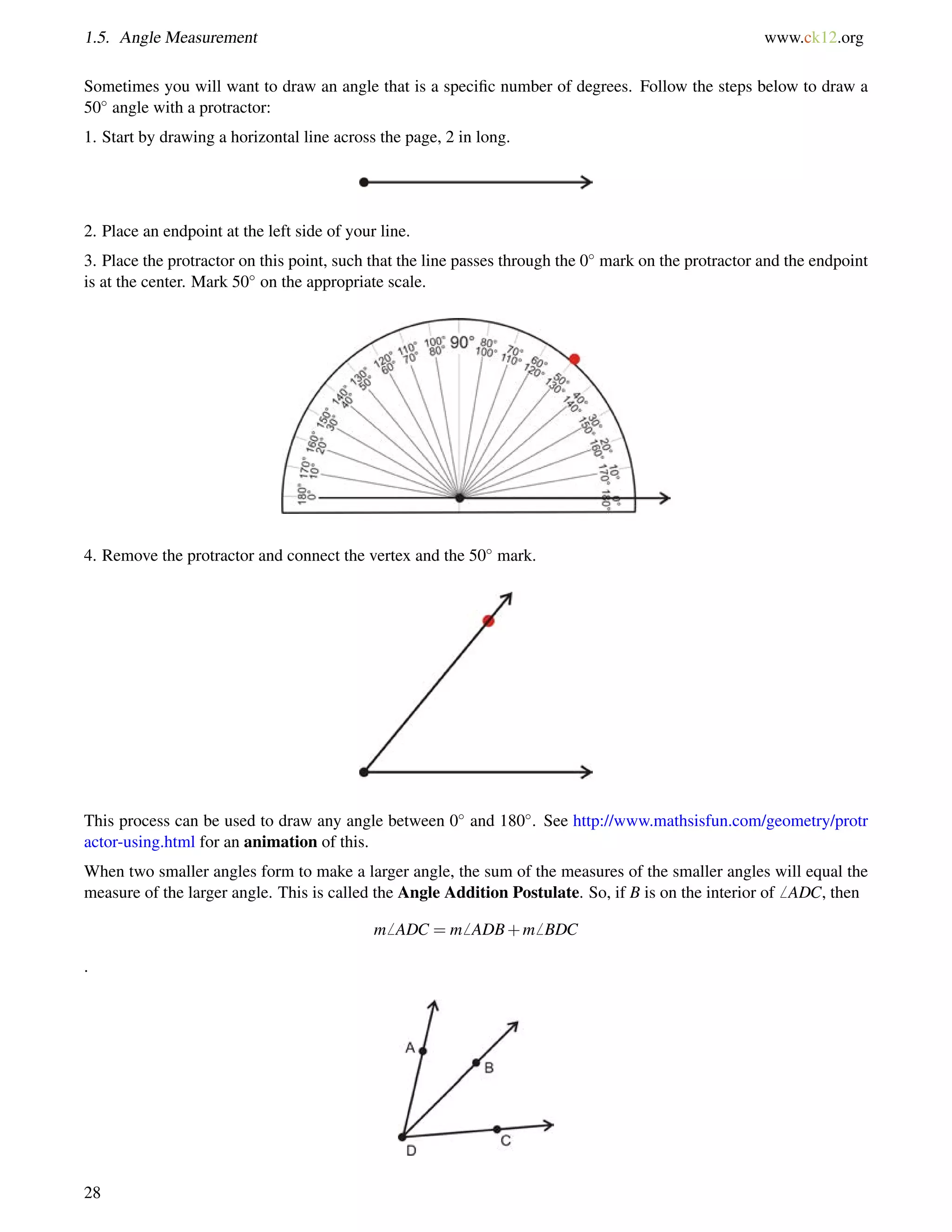
is 
x1+x2 
2 ; y1+y2 
2 
 
. 
L and M = 
 
4+(2) 
2 ; 5+(7) 
2 
 
= (1;1) point O 
M and N = 
 
2+(8) 
2 ; 7+3 
2 
 
= (5;2), point P 
L and N = 
 
4+(8) 
2 ; 5+3 
2 
 
= (2;4), point Q 
The graph is to the right. 
235
5.1. Midsegment Theorem www.ck12.org 
Example B 
Mark all the congruent segments on 4ABC with midpoints D; E, and F. 
Drawing in all three midsegments, we have: 
Also, this means the four smaller triangles are congruent by SSS. 
Now, mark all the parallel lines on 4ABC, with midpoints D; E, and F. 
236
www.ck12.org Chapter 5. Triangle Relationships 
Example C 
M; N, and O are the midpoints of the sides of 4XYZ. 
Find 
a) MN 
b) XY 
c) The perimeter of 4XYZ 
To solve, use the Midsegment Theorem. 
a) MN = OZ = 5 
b) XY = 2(ON) = 2  4 = 8 
c) Add up the three sides of 4XYZ to find the perimeter. 
XY +YZ+XZ = 2  4+2  3+2  5 = 8+6+10 = 24 
Remember: No line segment over MN means length or distance. 
MEDIA 
Click image to the left for more content. 
CK-12 MidsegmentTheorem 
Guided Practice 
1. Find the value of x and AB. A and B are midpoints. 
237
5.1. Midsegment Theorem www.ck12.org 
2. True or false: If a line passes through two sides of a triangle and is parallel to the third side, then it is a midsegment. 
3. Find y. You may assume that the line segment within the triangle is a midsegment. 
Answers: 
1. AB = 342 = 17. To find x, set 3x1 equal to 17. 
3x1 = 17 
3x = 18 
x = 6 
12 
2. This statement is false. A line that passes through two sides of a triangle is only a midsegment if it passes through 
the midpoints of the two sides of the triangle. 
3. Because a midsegment is always half the length of the side it is parallel to, we know that y = (36) = 18. 
Practice 
Determine whether each statement is true or false. 
1. The endpoints of a midsegment are midpoints. 
2. A midsegment is parallel to the side of the triangle that it does not intersect. 
3. There are three congruent triangles formed by the midsegments and sides of a triangle. 
4. There are three midsegments in every triangle. 
R; S; T, and U are midpoints of the sides of 4XPO and 4YPO. 
5. If OP = 12, find RS and TU. 
6. If RS = 8, find TU. 
7. If RS = 2x, and OP = 20, find x and TU. 
8. If OP = 4x and RS = 6x8, find x. 
For questions 9-15, find the indicated variable(s). You may assume that all line segments within a triangle are 
midsegments. 
238
www.ck12.org Chapter 5. Triangle Relationships 
9. 
10. 
11. 
12. 
13. 
14. 
15. 
16. The sides of 4XYZ are 26, 38, and 42. 4ABC is formed by joining the midpoints of 4XYZ. 
a. What are the lengths of the sides of 4ABC? 
239
5.1. Midsegment Theorem www.ck12.org 
b. Find the perimeter of 4ABC. 
c. Find the perimeter of 4XYZ. 
d. What is the relationship between the perimeter of a triangle and the perimeter of the triangle formed by 
connecting its midpoints? 
Coordinate Geometry Given the vertices of 4ABC below find the midpoints of each side. 
17. A(5;2); B(9;4) and C(3;8) 
18. A(10;1); B(4;11) and C(0;7) 
19. A(1;3); B(5;7) and C(9;5) 
20. A(4;15); B(2;1) and C(20;11) 
240
www.ck12.org Chapter 5. Triangle Relationships 
5.2 Perpendicular Bisectors 
Here you’ll learn what a perpendicular bisector is and the Perpendicular Bisector Theorem, which states that if a 
point is on the perpendicular bisector of a segment, then it is equidistant from the endpoints of the segment. 
What if you were given 4FGH and told that 
 ! 
GJ was the perpendicular bisector of FH? How could you find the 
length of FG given the length of GH? After completing this Concept, you’ll be able to use the Perpendicular Bisector 
Theorem to solve problems like this one. 
Watch This 
MEDIA 
Click image to the left for more content. 
CK-12 Perpendicular Bisectors 
First watch this video. 
MEDIA 
Click image to the left for more content. 
James Sousa:Constructing Perpendicular Bisectors 
Next watch this video. 
MEDIA 
Click image to the left for more content. 
James Sousa:Proof of the Perpendicular BisectorTheorem 
Then watch this video. 
241
5.2. Perpendicular Bisectors www.ck12.org 
MEDIA 
Click image to the left for more content. 
James Sousa:Proof of the Perpendicular BisectorTheoremConverse 
Finally, watch this video. 
MEDIA 
Click image to the left for more content. 
James Sousa:DeterminingValues Using Perpendicular Bisectors 
Guidance 
A perpendicular bisector is a line that intersects a line segment at its midpoint and is perpendicular to that line 
segment, as shown in the construction below. 
One important property related to perpendicular bisectors is that if a point is on the perpendicular bisector of a 
segment, then it is equidistant from the endpoints of the segment. This is called the Perpendicular Bisector 
Theorem. 
If 
 ! 
CD ? AB and AD = DB, then AC =CB. 
In addition to the Perpendicular Bisector Theorem, the converse is also true. 
242
www.ck12.org Chapter 5. Triangle Relationships 
Perpendicular Bisector Theorem Converse: If a point is equidistant from the endpoints of a segment, then the 
point is on the perpendicular bisector of the segment. 
 ! 
Using the picture above: If AC =CB, then 
CD ? AB and AD = DB. 
When we construct perpendicular bisectors for the sides of a triangle, they meet in one point. This point is called the 
circumcenter of the triangle. 
Example A 
If 
 ! 
MO is the perpendicular bisector of LN and LO = 8, what is ON? 
By the Perpendicular Bisector Theorem, LO = ON. So, ON = 8. 
Example B 
Find x and the length of each segment. 
 ! 
WX is the perpendicular bisector of XZ and from the Perpendicular Bisector TheoremWZ =WY. 
2x+11 = 4x5 
16 = 2x 
8 = x 
243
5.2. Perpendicular Bisectors www.ck12.org 
WZ =WY = 2(8)+11 = 16+11 = 27. 
Example C 
Find the value of x. m is the perpendicular bisector of AB. 
By the Perpendicular Bisector Theorem, both segments are equal. Set up and solve an equation. 
3x8 = 2x 
x = 8 
MEDIA 
Click image to the left for more content. 
CK-12 Perpendicular Bisectors 
Guided Practice 
1. 
 ! 
OQ is the perpendicular bisector of MP. 
a) Which line segments are equal? 
b) Find x. 
c) Is L on 
 ! 
OQ? How do you know? 
2. Find the value of x. m is the perpendicular bisector of AB. 
244
www.ck12.org Chapter 5. Triangle Relationships 
3. Determine if 
 ! 
ST is the perpendicular bisector of XY. Explain why or why not. 
Answers: 
1. a) ML = LP; MO = OP, and MQ = QP. 
b) 
4x+3 = 11 
4x = 8 
x = 2 
c) Yes, L is on 
 ! 
OQ because ML = LP (the Perpendicular Bisector Theorem Converse). 
2. By the Perpendicular Bisector Theorem, both segments are equal. Set up and solve an equation. 
x+6 = 22 
x = 16 
 ! 
ST is not necessarily the perpendicular bisector of XY because not enough information is given in the diagram. 
There is no way to know from the diagram if 
3. 
 ! 
ST will extend to make a right angle with XY. 
Practice 
For questions 1-4, find the value of x. m is the perpendicular bisector of AB. 
1. 
245
5.2. Perpendicular Bisectors www.ck12.org 
2. 
3. 
4. 
m is the perpendicular bisector of AB. 
5. List all the congruent segments. 
6. Is C on m? Why or why not? 
7. Is D on m? Why or why not? 
For Question 8, determine if 
 ! 
ST is the perpendicular bisector of XY. Explain why or why not. 
8. 
9. In what type of triangle will all perpendicular bisectors pass through vertices of the triangle? 
10. Fill in the blanks of the proof of the Perpendicular Bisector Theorem. 
Given: 
 ! 
CD is the perpendicular bisector of AB 
Prove: AC = 
CB 
246
www.ck12.org Chapter 5. Triangle Relationships 
TABLE 5.1: 
= 
Statement Reason 
1. 1. 
2. D is the midpoint of AB 2. 
3. 3. Definition of a midpoint 
4.6 CDA and6 CDB are right angles 4. 
5.6 CDA6 CDB 5. 
= 
6. 6. Reflexive PoC 
7. 4CDA4CDB 7. 
8. AC = 
CB 8. 
247
5.3. Angle Bisectors in Triangles www.ck12.org 
5.3 Angle Bisectors in Triangles 
Here you’ll learn what an angle bisector is as well as the Angle Bisector Theorem, which states that if a point is on 
the bisector of an angle, then the point is equidistant from the sides of the angle. 
What if you were told that 
! 
GJ is the angle bisector of6 FGH? How would you find the length of FJ given the length 
of HJ? After completing this Concept, you’ll be able to use the Angle Bisector Theorem to solve problems like this 
one. 
Watch This 
MEDIA 
Click image to the left for more content. 
CK-12 Angle Bisectors 
First watch this video. 
MEDIA 
Click image to the left for more content. 
James Sousa:Introduction toAngle Bisectors 
Next watch this video. 
MEDIA 
Click image to the left for more content. 
James Sousa:Proof of the Angle BisectorTheorem 
Then watch this video. 
248
www.ck12.org Chapter 5. Triangle Relationships 
MEDIA 
Click image to the left for more content. 
James Sousa:Proof of the Angle BisectorTheoremConverse 
Finally, watch this video. 
MEDIA 
Click image to the left for more content. 
James Sousa:SolvingForUnknownValues Using Angle Bisectors 
Guidance 
An angle bisector cuts an angle exactly in half. One important property of angle bisectors is that if a point is on 
the bisector of an angle, then the point is equidistant from the sides of the angle. This is called the Angle Bisector 
Theorem. 
! 
! 
! 
In other words, if 
BD bisects6 ABC; 
BA ? FD, and, 
BC ? DG then FD = DG. 
The converse of this theorem is also true. 
Angle Bisector Theorem Converse: If a point is in the interior of an angle and equidistant from the sides, then it 
lies on the bisector of that angle. 
When we construct angle bisectors for the angles of a triangle, they meet in one point. This point is called the 
incenter of the triangle. 
249
5.3. Angle Bisectors in Triangles www.ck12.org 
Example A 
Is Y on the angle bisector of6 XWZ? 
If Y is on the angle bisector, then XY = YZ and both segments need to be perpendicular to the sides of the angle. 
! 
From the markings we know XY ? 
WX and ZY ? 
! 
WZ. Second, XY =YZ = 6. So, yes, Y is on the angle bisector of 
6 XWZ. 
Example B 
! 
MO is the angle bisector of6 LMN. Find the measure of x. 
LO = ON by the Angle Bisector Theorem. 
4x5 = 23 
4x = 28 
x = 7 
Example C 
! 
AB is the angle bisector of6 CAD. Solve for the missing variable. 
250
www.ck12.org Chapter 5. Triangle Relationships 
CB = BD by the Angle Bisector Theorem, so we can set up and solve an equation for x. 
x+7 = 2(3x4) 
x+7 = 6x8 
15 = 5x 
x = 3 
MEDIA 
Click image to the left for more content. 
CK-12 Angle Bisectors 
Guided Practice 
1. 
! 
AB is the angle bisector of6 CAD. Solve for the missing variable. 
2. Is there enough information to determine if 
! 
AB is the angle bisector of6 CAD? Why or why not? 
3. A 108 angle is bisected. What are the measures of the resulting angles? 
Answers: 
251
5.3. Angle Bisectors in Triangles www.ck12.org 
1.CB = BD by the Angle Bisector Theorem, so x = 6. 
2. No because B is not necessarily equidistant from AC and AD. We do not know if the angles in the diagram are 
right angles. 
3. We know that to bisect means to cut in half, so each of the resulting angles will be half of 108. The measure of 
each resulting angle is 54. 
Practice 
For questions 1-4, 
! 
AB is the angle bisector of6 CAD. Solve for the missing variable. 
1. 
2. 
3. 
4. 
Is there enough information to determine if 
! 
AB is the angle bisector of6 CAD? Why or why not? 
5. 
252
www.ck12.org Chapter 5. Triangle Relationships 
6. 
7. In what type of triangle will all angle bisectors pass through vertices of the triangle? 
8. What is another name for the angle bisectors of the vertices of a square? 
9. Draw in the angle bisectors of the vertices of a square. How many triangles do you have? What type of 
triangles are they? 
10. Fill in the blanks in the Angle Bisector Theorem Converse. 
Given: AD= 
DC, such that AD and DC are the shortest distances to 
! 
BA and 
! 
BC 
Prove: 
! 
BD bisects6 ABC 
TABLE 5.2: 
Statement Reason 
1. 1. 
2. 2. The shortest distance from a point to a line is 
perpendicular. 
= 
3.6 DAB and6 DCB are right angles 3. 
4.6 DAB6 DCB 4. 
5. BD= 
BD 5. 
6. 4ABD= 
4CBD 6. 
7. 7. CPCTC 
! 
8. 
BD bisects6 ABC 8. 
253
5.4. Medians www.ck12.org 
5.4 Medians 
Here you’ll learn the definitions of median and centroid as well as the Median Theorem, which states that the 
medians of a triangle intersect at a point that is two-thirds of the distance from the vertices to the midpoint of the 
opposite sides. 
What if you were told that J, K, and L were the midpoints of the sides of 4FGH and that M was the centroid of 
4FGH? Given the length of JK, how could you find the lengths of JM and KM? After completing this Concept, 
you’ll be able to use the Median Theorem to solve problems like this one. 
Watch This 
First watch this video. 
MEDIA 
Click image to the left for more content. 
James Sousa:Mediansof a Triangle 
Now watch this video. 
MEDIA 
Click image to the left for more content. 
James Sousa:Using the Properties ofMediansto Solve for Unknown Values 
Guidance 
In a triangle, the line segment that joins a vertex and the midpoint of the opposite side is called a median. 
254
www.ck12.org Chapter 5. Triangle Relationships 
LO is the median from L to the midpoint of NM. 
If you draw all three medians they will intersect at one point called the centroid. 
The centroid is the “balancing point” of a triangle. This means that if you were to cut out the triangle, the centroid 
is its center of gravity so you could balance it there. 
The Median Theorem states that the medians of a triangle intersect at a point called the centroid that is two-thirds 
of the distance from the vertices to the midpoint of the opposite sides. 
So if G is the centroid, then: 
AG = 
2 
3 
AD; CG = 
2 
3 
CF; EG = 
2 
3 
BE 
DG = 
1 
3 
AD; FG = 
1 
3 
CF; BG = 
1 
3 
BE 
And by substitution : DG = 
1 
2 
AG; FG = 
1 
2 
CG; BG = 
1 
2 
EG 
Example A 
I; K, and M are midpoints of the sides of 4HJL. 
255
5.4. Medians www.ck12.org 
a) If JM = 18, find JN and NM. 
b) If HN = 14, find NK and HK. 
To solve, use the Median Theorem. 
a) JN = 23 
 18 = 12. NM = JMJN = 1812. NM = 6: 
b) 14 = 2 
3 HK 
14  3 
2 = HK = 21. NK is a third of 21, NK = 7. 
Example B 
H is the centroid of 4ABC and DC = 5y16. Find x and y. 
To solve, use the Median Theorem. Set up and solve equations. 
1 
2 
BH = HF !BH = 2HF HC = 
2 
3 
DC ! 
3 
2 
HC = DC 
3x+6 = 2(2x1) 
3 
2 
(2y+8) = 5y16 
3x+6 = 4x2 3y+12 = 5y16 
8 = x 28 = 2y !14 = y 
Example C 
B; D, and F are the midpoints of each side and G is the centroid. If BG = 5, find GE and BE 
Use the Median Theorem. 
256
www.ck12.org Chapter 5. Triangle Relationships 
BG = 
1 
3 
BE 
5 = 
1 
3 
BE 
BE = 15 
. 
Therefore, GE = 10. 
MEDIA 
Click image to the left for more content. 
CK-12 Medians 
Guided Practice 
1. B; D, and F are the midpoints of each side and G is the centroid. If CG = 16, find GF and CF 
2. True or false: The median bisects the side it intersects. 
3. N and M are the midpoints of sides XYand ZY. 
a. What is point C? 
b. If XN = 5, find XY. 
c. If ZN = 6x+15 and ZC = 38, find x and ZN. 
Answers 
1. Use the Median Theorem. 
257
5.4. Medians www.ck12.org 
CG = 
2 
3 
CF 
16 = 
2 
3 
CF 
CF = 24 
. 
Therefore, GF = 8 
2. This statement is true. By definition, a median intersects a side of a triangle at its midpoint. Midpoints divide 
segments into two equal parts. 
3. Use the Median Theorem. 
a. C is the centroid. 
b. XN = 1 
2XY, so XY = 10. 
c. 
ZC = 
2 
3 
ZN 
38 = 
2 
3 
(6x+15) 
57 = 6x+15 
42 = 6x 
x = 7 
. 
Substitute 7 for x to find that ZN = 57. 
Practice 
For questions 1-4, B; D, and F are the midpoints of each side and G is the centroid. Find the following lengths. 
1. If CG = 16, find GF and CF 
2. If AD = 30, find AG and GD 
3. If GF = x, find GC and CF 
4. If AG = 9x and GD = 5x1, find x and AD. 
Multistep Problem Find the equation of a median in the xy plane. 
5. Plot 4ABC : A(6;4); B(2;4) and C(6;4) 
258
www.ck12.org Chapter 5. Triangle Relationships 
6. Find the midpoint of AC. Label it D. 
7. Find the slope of BD. 
8. Find the equation of BD. 
9. Plot 4DEF : D(1;5); E(0;1); F(6;3) 
10. Find the midpoint of EF. Label it G. 
11. Find the slope of DG. 
12. Find the equation of DG. 
Determine whether the following statement is true or false. 
13. The centroid is the balancing point of a triangle. 
259
5.5. Altitudes www.ck12.org 
5.5 Altitudes 
Here you’ll learn the definition of altitude and how to determine where a triangle’s altitude will be found. 
What if you were given one or more of a triangle’s angle measures? How would you determine where the triangle’s 
altitude would be found? After completing this Concept, you’ll be able to answer this type of question. 
Watch This 
MEDIA 
Click image to the left for more content. 
CK-12 Altitudes 
MEDIA 
Click image to the left for more content. 
James Sousa:Altitudes of a Triangle 
Guidance 
In a triangle, a line segment from a vertex and perpendicular to the opposite side is called an altitude. It is also 
called the height of a triangle. The red lines below are all altitudes. 
When a triangle is a right triangle, the altitude, or height, is the leg. If the triangle is obtuse, then the altitude will be 
outside of the triangle. If the triangle is acute, then the altitude will be inside the triangle. 
Example A 
Which line segment is the altitude of 4ABC? 
260
www.ck12.org Chapter 5. Triangle Relationships 
Solution: In a right triangle, the altitude, or the height, is the leg. If we rotate the triangle so that the right angle is in 
the lower left corner, we see that leg BC is the altitude. 
Example B 
A triangle has angles that measure 55;60; and 65. Where will the altitude be found? 
Solution: Because all of the angle measures are less than 90, the triangle is an acute triangle. The altitude of any 
acute triangle is inside the triangle. 
Example C 
A triangle has an angle that measures 95. Where will the altitude be found? 
Solution: Because 95  90, the triangle is an obtuse triangle. The altitude of any obtuse triangle is outside the 
triangle. 
MEDIA 
Click image to the left for more content. 
CK-12 Altitudes 
Guided Practice 
1. True or false: The altitudes of an obtuse triangle are inside the triangle. 
2. Draw the altitude for the triangle shown. 
261
5.5. Altitudes www.ck12.org 
Solution: The triangle is an acute triangle, so the altitude is inside the triangle as shown below so that it is 
perpendicular to the base. 
3. Draw the altitude for the triangle shown. 
Solution: The triangle is a right triangle, so the altitude is already drawn. The altitude is XZ. 
Answers 
1. Every triangle has three altitudes. For an obtuse triangle, at least one of the altitudes will be outside of the triangle, 
as shown in the picture at the beginning of this concept. 
2. 
3. 
262
www.ck12.org Chapter 5. Triangle Relationships 
Practice 
Given the following triangles, tell whether the altitude is inside the triangle, outside the triangle, or at the leg of the 
triangle. 
1. 
2. 
3. 
4. 
263
5.5. Altitudes www.ck12.org 
5. 
6. 4JKL is an equiangular triangle. 
7. 4MNO is a triangle in which two the angles measure 30 and 60. 
8. 4PQR is an isosceles triangle in which two of the angles measure 25. 
9. 4STU is an isosceles triangle in which two angles measures 45. 
Given the following triangles, which line segment is the altitude? 
10. 
11. 
12. 
264
www.ck12.org Chapter 5. Triangle Relationships 
13. 
14. 
15. 
265
5.6. Comparing Angles and Sides in Triangles www.ck12.org 
5.6 Comparing Angles and Sides in Triangles 
Here you’ll learn how to order the angles of a triangle from largest to smallest based on the length of their opposite 
sides. You’ll also learn the SAS and SSS Inequality Theorems. 
What if you were told that a triangle has sides that measure 3, 4, and 5? How could you determine which of the 
triangle’s angles is largest? Smallest? After completing this Concept, you’ll be able to use triangle theorems to solve 
problems like this one. 
Watch This 
MEDIA 
Click image to the left for more content. 
CK-12 Comparing Angles Sides in Triangles 
MEDIA 
Click image to the left for more content. 
James Sousa:Proof that the Angle ofa Triangle OppositeTheLongestSide istheLargestAngle 
Guidance 
Look at the triangle below. The sides of the triangle are given. Can you determine which angle is the largest? The 
largest angle will be opposite 18 because that is the longest side. Similarly, the smallest angle will be opposite 7, 
which is the shortest side. 
This idea is actually a theorem: If one side of a triangle is longer than another side, then the angle opposite the longer 
side will be larger than the angle opposite the shorter side. 
The converse is also true: If one angle in a triangle is larger than another angle in that triangle, then the side opposite 
the larger angle will be longer than the side opposite the smaller angle. 
266
www.ck12.org Chapter 5. Triangle Relationships 
We can extend this idea into two theorems that help us compare sides and angles in two triangles If we have two 
congruent triangles 4ABC and 4DEF, marked below: 
Therefore, if AB = DE, BC = EF, and m6 B = m6 E, then AC = DF. 
Now, let’s make m6 B  m6 E. Would that make AC  DF? Yes. This idea is called the SAS Inequality Theorem. 
The SAS Inequality Theorem: If two sides of a triangle are congruent to two sides of another triangle, but the 
included angle of one triangle has greater measure than the included angle of the other triangle, then the third side 
of the first triangle is longer than the third side of the second triangle. 
If AB= 
DE;BC = 
EF and m6 B  m6 E, then AC  DF. 
If we know the third sides as opposed to the angles, the opposite idea is also true and is called the SSS Inequality 
Theorem. 
SSS Inequality Theorem: If two sides of a triangle are congruent to two sides of another triangle, but the third side 
of the first triangle is longer than the third side of the second triangle, then the included angle of the first triangle’s 
two congruent sides is greater in measure than the included angle of the second triangle’s two congruent sides. 
If AB= 
DE; BC = 
EF and AC  DF, then m6 B  m6 E. 
Example A 
List the sides in order, from shortest to longest. 
267
5.6. Comparing Angles and Sides in Triangles www.ck12.org 
First, find m6 A. From the Triangle Sum Theorem: 
m6 A+86+27 = 180 
m6 A = 67 
86 is the largest angle, so AC is the longest side. The next angle is 67, so BC would be the next longest side. 27 
is the smallest angle, so AB is the shortest side. In order, the answer is: AB; BC; AC. 
Example B 
List the angles in order, from largest to smallest. 
Just like with the sides, the largest angle is opposite the longest side. The longest side is BC, so the largest angle is 
6 A. Next would be6 B and then6 C. 
Example C 
List the sides in order, from least to greatest. 
To solve, let’s start with 4DCE. The missing angle is 55. By the theorem presented in this Concept, the sides, in 
order from least to greatest are CE; CD, and DE. 
For 4BCD, the missing angle is 43. Again, by the theorem presented in this Concept, the order of the sides from 
least to greatest is BD; CD, and BC. 
By the SAS Inequality Theorem, we know that BCDE, so the order of all the sides would be: BD; CE; CD; DE; BC. 
268
www.ck12.org Chapter 5. Triangle Relationships 
MEDIA 
Click image to the left for more content. 
CK-12 Comparing Angles Sides in Triangles 
Guided Practice 
1. If XM is a median of 4XYZ and XY  XZ, what can we say about m6 1 and m6 2? 
2. List the sides of the two triangles in order, from shortest to longest. 
3. Below is isosceles triangle 4ABC. List everything you can about the sides and angles of the triangle and why. 
Answers: 
1. M is the midpoint of YZ, so YM = MZ. MX = MX by the Reflexive Property and we know XY  XZ. 
We can use the SSS Inequality Theorem Converse to say m6 1  m6 2. 
2. There are no congruent sides or angles. Look at each triangle separately. 
4XYZ: The missing angle is 42. By the theorem presented in this lesson, the order of the sides from shortest to 
longest is YZ; XY, and XZ. 
4WXZ: The missing angle is 55. The order of the sides from shortest to longest is XZ; WZ, andWX. 
Because the longest side in 4XYZ is the shortest side in 4WXZ, we can put all the sides together in one list: 
YZ; XY; XZ; WZ; WX. 
269
5.6. Comparing Angles and Sides in Triangles www.ck12.org 
3. AB = BC because it is given. 
m6 A = m6 C because if sides are equal than their opposite angles must be equal.. 
AD  DC because m6 ABD  m6 CBD and because of the SAS Triangle Inequality Theorem. 
Practice 
For questions 1-3, list the sides in order from shortest to longest. 
1. 
2. 
3. 
For questions 4-6, list the angles from largest to smallest. 
4. 
5. 
6. 
7. Draw a triangle with sides 3 cm, 4 cm, and 5 cm. The angle measures are 90; 53, and 37. Place the angle 
measures in the appropriate spots. 
8. Draw a triangle with angle measures 56; 54 and the included side is 8 cm. What is the longest side of this 
triangle? 
9. Draw a triangle with sides 6 cm, 7 cm, and 8 cm. The angle measures are 75:5; 58, and 46:5. Place the 
angle measures in the appropriate spots. 
10. What conclusions can you draw about x? 
270
www.ck12.org Chapter 5. Triangle Relationships 
11. Compare m6 1 and m6 2. 
12. List the sides from shortest to longest. 
13. Compare m6 1 and m6 2. What can you say about m6 3 and m6 4? 
271
5.7. Triangle Inequality Theorem www.ck12.org 
5.7 Triangle Inequality Theorem 
Here you’ll learn the Triangle Inequality Theorem, which states that to make a triangle, two sides must add up to be 
greater than the third side. 
What if you were given three lengths, like 5, 7 and 10? How could you determine if sides with these lengths form a 
triangle? After completing this Concept, you’ll be able to use the Triangle Inequality Theorem to determine if any 
three side lengths make a triangle. 
Watch This 
MEDIA 
Click image to the left for more content. 
CK-12 Triangle Inequality Theorem 
MEDIA 
Click image to the left for more content. 
James Sousa:Triangle InequalityTheorem 
Guidance 
Can any three lengths make a triangle? The answer is no. For example, the lengths 1, 2, 3 cannot make a triangle 
because 1+2 = 3, so they would all lie on the same line. The lengths 4, 5, 10 also cannot make a triangle because 
4+5 = 9  10. Look at the pictures below: 
The arcs show that the two sides would never meet to form a triangle. 
272
www.ck12.org Chapter 5. Triangle Relationships 
To make a triangle, two sides must add up to be greater than the third side. This is called the Triangle Inequality 
Theorem. This means that if you know two sides of a triangle, there are only certain lengths that the third side could 
be. If two sides have lengths a and b, then the length of the third side, s, has the range ab  s  a+b: 
Example A 
Do the lengths 4, 11, 8 make a triangle? 
To solve this problem, check to make sure that the smaller two numbers add up to be greater than the biggest number. 
4+8 = 12 and 12  11 so yes these lengths make a triangle. 
Example B 
Find the length of the third side of a triangle if the other two sides are 10 and 6. 
The Triangle Inequality Theorem can also help you find the range of the third side. The two given sides are 6 and 10, 
so the third side, s, can either be the shortest side or the longest side. For example s could be 5 because 6+5  10. 
It could also be 15 because 6+10  15. Therefore, the range of values for s is 4  s  16. 
Notice the range is no less than 4, and not equal to 4. The third side could be 4.1 because 4:1+6  10. For the same 
reason, s cannot be greater than 16, but it could 15.9, 10+6  15:9. 
Example C 
The base of an isosceles triangle has length 24. What can you say about the length of each leg? 
To solve this problem, remember that an isosceles triangle has two congruent sides (the legs). We have to make sure 
that the sum of the lengths of the legs is greater than 24. In other words, if x is the length of a leg: 
x+x  24 
2x  24 
x  12 
Each leg must have a length greater than 12. 
273
5.7. Triangle Inequality Theorem www.ck12.org 
MEDIA 
Click image to the left for more content. 
CK-12 Triangle Inequality Theorem 
Guided Practice 
Do the lengths below make a triangle? 
1. 4.1, 3.5, 7.5 
2. 4, 4, 8 
3. 6, 7, 8 
Answers: 
Use the Triangle Inequality Theorem. Test to see if the smaller two numbers add up to be greater than the largest 
number. 
1. 4:1+3:5  7:5. Yes this is a triangle because 7:6  7:5. 
2. 4+4 = 8. No this is not a triangle because two lengths cannot equal the third. 
3. 6+7  8. Yes this is a triangle because 13  8. 
Practice 
Determine if the sets of lengths below can make a triangle. If not, state why. 
1. 6, 6, 13 
2. 1, 2, 3 
3. 7, 8, 10 
4. 5, 4, 3 
5. 23, 56, 85 
6. 30, 40, 50 
7. 7, 8, 14 
8. 7, 8, 15 
9. 7, 8, 14.99 
If two lengths of the sides of a triangle are given, determine the range of the length of the third side. 
10. 8 and 9 
11. 4 and 15 
12. 20 and 32 
13. 2 and 5 
14. 10 and 8 
15. x and 2x 
16. The legs of an isosceles triangle have a length of 12 each. What can you say about the length of the base? 
274
www.ck12.org Chapter 5. Triangle Relationships 
5.8 Indirect Proof in Algebra and Geometry 
Here you’ll learn how to write indirect proofs, or proofs by contradiction, by assuming a hypothesis is false. 
What if you wanted to prove a statement was true without a two-column proof? How might you go about doing so? 
After completing this Concept, you’ll be able to indirectly prove a statement by way of contradiction. 
Watch This 
MEDIA 
Click image to the left for more content. 
CK-12 Indirect Proofin Algebra and Geometry 
MEDIA 
Click image to the left for more content. 
James Sousa:Introduction toIndirect Proof 
Guidance 
Most likely, the first type of formal proof you learned was a direct proof using direct reasoning. Most of the proofs 
done in geometry are done in the two-column format, which is a direct proof format. Another common type of 
reasoning is indirect reasoning, which you have likely done outside of math class. Below we will formally learn 
what an indirect proof is and see some examples in both algebra and geometry. 
Indirect Proof or Proof by Contradiction: When the conclusion from a hypothesis is assumed false (or opposite 
of what it states) and then a contradiction is reached from the given or deduced statements. 
In other words, if you are trying to show that something is true, show that if it was not true there would be a 
contradiction (something else would not make sense). 
The steps to follow when proving indirectly are: 
• Assume the opposite of the conclusion (second half) of the statement. 
• Proceed as if this assumption is true to find the contradiction. 
• Once there is a contradiction, the original statement is true. 
• DO NOT use specific examples. Use variables so that the contradiction can be generalized. 
The easiest way to understand indirect proofs is by example. 
275
5.8. Indirect Proof in Algebra and Geometry www.ck12.org 
Example A (Algebra Example) 
If x = 2, then 3x56= 10. Prove this statement is true by contradiction. 
Remember that in an indirect proof the first thing you do is assume the conclusion of the statement is false. In this 
case, we will assume the opposite of If x = 2, then 3x56= 10: 
If x = 2, then 3x5 = 10. 
Take this statement as true and solve for x. 
3x5 = 10 
3x = 15 
x = 5 
But x = 5contradicts the given statement that x = 2. Hence, our assumption is incorrect and 3x56= 10 is true. 
Example B (Geometry Example) 
If 4ABC is isosceles, then the measure of the base angles cannot be 92. Prove this indirectly. 
Remember, to start assume the opposite of the conclusion. 
The measure of the base angles are 92. 
If the base angles are 92, then they add up to 184. This contradicts the Triangle Sum Theorem that says the three 
angle measures of all triangles add up to 180. Therefore, the base angles cannot be 92. 
Example C (Geometry Example) 
If6 A and6 B are complementary then6 A  90. Prove this by contradiction. 
Assume the opposite of the conclusion. 
6 A  90. 
Consider first that the measure of6 B cannot be negative. So if6 A  90 this contradicts the definition of comple-mentary, 
which says that two angles are complementary if they add up to 90. Therefore,6 A  90. 
MEDIA 
Click image to the left for more content. 
CK-12 Indirect Proofin Algebra and Geometry 
Guided Practice 
1. If n is an integer and n2 is odd, then n is odd. Prove this is true indirectly. 
2. Prove the SSS Inequality Theorem is true by contradiction. (The SSS Inequality Theorem says: “If two sides of 
a triangle are congruent to two sides of another triangle, but the third side of the first triangle is longer than the third 
276
www.ck12.org Chapter 5. Triangle Relationships 
side of the second triangle, then the included angle of the first triangle’s two congruent sides is greater in measure 
than the included angle of the second triangle’s two congruent sides.”) 
3. If x = 3, then 4x+16= 17. Prove this statement is true by contradiction. 
Answers: 
1. First, assume the opposite of “n is odd.” 
n is even. 
Now, square n and see what happens. 
If n is even, then n = 2a, where a is any integer. 
n2 = (2a)2 = 4a2 
This means that n2 is a multiple of 4. No odd number can be divided evenly by an even number, so this contradicts 
our assumption that n is even. Therefore, n must be odd if n2 is odd. 
2. First, assume the opposite of the conclusion. 
The included angle of the first triangle is less than or equal to the included angle of the second triangle. 
If the included angles are equal then the two triangles would be congruent by SAS and the third sides would be 
congruent by CPCTC. This contradicts the hypothesis of the original statement “the third side of the first triangle is 
longer than the third side of the second.” Therefore, the included angle of the first triangle must be larger than the 
included angle of the second. 
3. In an indirect proof the first thing you do is assume the conclusion of the statement is false. In this case, we will 
assume the opposite of If x = 3, then 4x+16= 17: 
If x = 3, then 4x+1 = 17 
Take this statement as true and solve for x. 
4x+1 = 17 
4x = 16 
x = 4 
x = 4contradicts the given statement that x = 3. Hence, our assumption is incorrect and 4x+16= 17 is true. 
Practice 
Prove the following statements true indirectly. 
1. If n is an integer and n2 is even, then n is even. 
2. If m6 A6= m6 B in 4ABC, then 4ABC is not equilateral. 
3. If x  3, then x2  9. 
4. The base angles of an isosceles triangle are congruent. 
5. If x is even and y is odd, then x+y is odd. 
6. In 4ABE, if6 A is a right angle, then6 B cannot be obtuse. 
7. If A; B, and C are collinear, then AB+BC = AC (Segment Addition Postulate). 
8. If 4ABC is equilateral, then the measure of the base angles cannot be 72. 
9. If x = 11 then 2x36= 21. 
10. If 4ABC is a right triangle, then it cannot have side lengths 3, 4, and 6. 
277
5.8. Indirect Proof in Algebra and Geometry www.ck12.org 
Summary 
This chapter begins with an introduction to the Midsegment Theorem. The definition of a perpendicular bisector is 
presented and the Perpendicular Bisector Theorem and its converse are explored. Now that the bisectors of segments 
have been discussed, the definition of an angle bisector is next and the Angle Bisector Theorem and its converse are 
presented. The properties of medians and altitudes of triangles are discussed in detail. The entire chapter builds to 
a discovery of the relationships between the angles and sides in triangles as a foundation for the Triangle Inequality 
Theorem. The chapter ends with a presentation of indirect proofs. 
278
www.ck12.org Chapter 6. Polygons and Quadrilaterals 
CHAPTER 6 Polygons and 
Quadrilaterals 
Chapter Outline 
6.1 INTERIOR ANGLES IN CONVEX POLYGONS 
6.2 EXTERIOR ANGLES IN CONVEX POLYGONS 
6.3 PARALLELOGRAMS 
6.4 QUADRILATERALS THAT ARE PARALLELOGRAMS 
6.5 PARALLELOGRAM CLASSIFICATION 
6.6 TRAPEZOIDS 
6.7 KITES 
6.8 QUADRILATERAL CLASSIFICATION 
Introduction 
This chapter starts with the properties of polygons and narrows to focus on quadrilaterals. We will study several 
different types of quadrilaterals: parallelograms, rhombi, rectangles, squares, kites and trapezoids. Then, we will 
prove that different types of quadrilaterals are parallelograms. 
279
6.1. Interior Angles in Convex Polygons www.ck12.org 
6.1 Interior Angles in Convex Polygons 
Here you’ll learn how to find the measure of an interior angle of a convex polygon based on the number of sides the 
polygon has. 
What if you were given an equiangular seven-sided convex polygon? How could you determine the measure of its 
interior angles? After completing this Concept, you’ll be able to use the Polygon Sum Formula to solve problems 
like this one. 
Watch This 
MEDIA 
Click image to the left for more content. 
CK-12 Interior Angles inConvex Polygons 
Watch the first half of this video. 
MEDIA 
Click image to the left for more content. 
James Sousa:Angles of Convex Polygons 
Guidance 
The interior angle of a polygon is one of the angles on the inside, as shown in the picture below. A polygon has the 
same number of interior angles as it does sides. 
The sum of the interior angles in a polygon depends on the number of sides it has. The Polygon Sum Formula 
states that for any ngon, the interior angles add up to (n2)180: 
280
www.ck12.org Chapter 6. Polygons and Quadrilaterals 
!n = 8 
(82)180 
6180 
1080 
Once you know the sum of the interior angles in a polygon it is easy to find the measure of ONE interior angle if 
the polygon is regular: all sides are congruent and all angles are congruent. Just divide the sum of the angles by the 
number of sides. 
Regular Polygon Interior Angle Formula: For any equiangular ngon, the measure of each angle is (n2)180 
n . 
In the picture below, if all eight angles are congruent then each angle is (82)180 
8 = 6180 
8 = 1080 
8 = 135. 
Example A 
The interior angles of a polygon add up to 1980. How many sides does it have? 
Use the Polygon Sum Formula and solve for n. 
(n2)180 = 1980 
180n360 = 1980 
180n = 2340 
n = 13 
The polygon has 13 sides. 
281
6.1. Interior Angles in Convex Polygons www.ck12.org 
Example B 
How many degrees does each angle in an equiangular nonagon have? 
First we need to find the sum of the interior angles; set n = 9: 
(92)180 = 7180 = 1260 
“Equiangular” tells us every angle is equal. So, each angle is 1260 
9 = 140. 
Example C 
An interior angle in a regular polygon is 135. How many sides does this polygon have? 
Here, we will set the Regular Polygon Interior Angle Formula equal to 135 and solve for n. 
(n2)180 
n 
= 135 
180n360 = 135n 
360 = 45n 
n = 8 The polygon is an octagon: 
MEDIA 
Click image to the left for more content. 
CK-12 Interior Angles inConvex Polygons 
Guided Practice 
1. Find the measure of x. 
2. The interior angles of a pentagon are x;x;2x;2x; and 2x. What is x? 
3. What is the sum of the interior angles in a 100-gon? 
Answers: 
1. From the Polygon Sum Formula we know that a quadrilateral has interior angles that sum to (42)180 =360. 
282
www.ck12.org Chapter 6. Polygons and Quadrilaterals 
Write an equation and solve for x. 
89+(5x8)+(3x+4)+51 = 360 
8x = 224 
x = 28 
2. From the Polygon Sum Formula we know that a pentagon has interior angles that sum to (52)180 = 540. 
Write an equation and solve for x. 
x+x+2x+2x+2x = 540 
8x = 540 
x = 67:5 
3. Use the Polygon Sum Formula. (1002)180 = 17;640. 
Practice 
1. Fill in the table. 
TABLE 6.1: 
# of sides Sum of the Interior An-gles 
Measure of Each Inte-rior 
Angle in a Regular 
ngon 
3 60 
4 360 
5 540 108 
6 120 
7 
8 
9 
10 
11 
12 
2. What is the sum of the angles in a 15-gon? 
3. What is the sum of the angles in a 23-gon? 
4. The sum of the interior angles of a polygon is 4320. How many sides does the polygon have? 
5. The sum of the interior angles of a polygon is 3240. How many sides does the polygon have? 
6. What is the measure of each angle in a regular 16-gon? 
7. What is the measure of each angle in an equiangular 24-gon? 
8. Each interior angle in a regular polygon is 156. How many sides does it have? 
9. Each interior angle in an equiangular polygon is 90. How many sides does it have? 
For questions 10-18, find the value of the missing variable(s). 
283
6.1. Interior Angles in Convex Polygons www.ck12.org 
10. 
11. 
12. 
13. 
14. 
15. 
16. 
284
www.ck12.org Chapter 6. Polygons and Quadrilaterals 
17. 
18. 
19. The interior angles of a hexagon are x; (x+1); (x+2); (x+3); (x+4); and (x+5): What is x? 
285
6.2. Exterior Angles in Convex Polygons www.ck12.org 
6.2 Exterior Angles in Convex Polygons 
Here you’ll learn the Exterior Angle Sum Theorem that states that the exterior angles of a polygon always add up to 
360. 
What if you were given a seven-sided regular polygon? How could you determine the measure of each of its exterior 
angles? After completing this Concept, you’ll be able to use the Exterior Angle Sum Theorem to solve problems 
like this one. 
Watch This 
MEDIA 
Click image to the left for more content. 
CK-12 Exterior Angles inConvex Polygons 
Watch the second half of this video. 
MEDIA 
Click image to the left for more content. 
James Sousa:Angles of Convex Polygons 
Guidance 
An exterior angle is an angle that is formed by extending a side of the polygon. 
As you can see, there are two sets of exterior angles for any vertex on a polygon, one going around clockwise (1st 
hexagon), and the other going around counter-clockwise (2nd hexagon). The angles with the same colors are vertical 
and congruent. 
286
www.ck12.org Chapter 6. Polygons and Quadrilaterals 
The Exterior Angle Sum Theorem states that the sum of the exterior angles of ANY convex polygon is 360. If 
the polygon is regular with n sides, this means that each exterior angle is 360 
n 
. 
Example A 
What is y? 
y is an exterior angle and all the given angles add up to 360. Set up an equation. 
70+60+65+40+y = 360 
y = 125 
Example B 
What is the measure of each exterior angle of a regular heptagon? 
Because the polygon is regular, the interior angles are equal. It also means the exterior angles are equal. 360 
7  
51:43 
Example C 
What is the sum of the exterior angles in a regular 15-gon? 
The sum of the exterior angles in any convex polygon, including a regular 15-gon, is 360. 
MEDIA 
Click image to the left for more content. 
CK-12 Exterior Angles inConvex Polygons 
Guided Practice 
Find the measure of each exterior angle for each regular polygon below: 
1. 12-gon 
287
6.2. Exterior Angles in Convex Polygons www.ck12.org 
2. 100-gon 
3. 36-gon 
Answers: 
For each, divide 360 by the given number of sides. 
1. 30 
2. 3:6 
3. 10 
Practice 
1. What is the measure of each exterior angle of a regular decagon? 
2. What is the measure of each exterior angle of a regular 30-gon? 
3. What is the sum of the exterior angles of a regular 27-gon? 
Find the measure of the missing variables: 
4. 
5. 
6. The exterior angles of a quadrilateral are x;2x;3x; and 4x: What is x? 
Find the measure of each exterior angle for each regular polygon below: 
7. octagon 
8. nonagon 
9. triangle 
10. pentagon 
288
www.ck12.org Chapter 6. Polygons and Quadrilaterals 
6.3 Parallelograms 
Here you’ll learn what a parallelogram is and how apply theorems about its sides, angles, and diagonals to solve for 
unknown values. 
What if you were told that FGHI is a parallelogram and you are given the length of FG and the measure of6 F? What 
can you determine about HI,6 H,6 G, and6 I? After completing this Concept, you’ll be able to apply parallelogram 
theorems to answer such questions. 
Watch This 
MEDIA 
Click image to the left for more content. 
CK-12 Parallelograms 
Guidance 
A parallelogram is a quadrilateral with two pairs of parallel sides. 
Notice that each pair of sides is marked parallel (for the last two shapes, remember that when two lines are 
perpendicular to the same line then they are parallel). Parallelograms have a lot of interesting properties. (You 
can explore the properties of a parallelogram at: http://www.mathwarehouse.com/geometry/quadrilaterals/paralle 
lograms/interactive-parallelogram.php) 
Facts about Parallelograms 
1) Opposite Sides Theorem: If a quadrilateral is a parallelogram, then both pairs of opposite sides are congruent. 
If 
289
6.3. Parallelograms www.ck12.org 
then 
2) Opposite Angles Theorem: If a quadrilateral is a parallelogram, then both pairs of opposite angles are congruent. 
If 
then 
3) Consecutive Angles Theorem: If a quadrilateral is a parallelogram, then all pairs of consecutive angles are 
supplementary. 
If 
then 
m6 A+m6 D = 180 
m6 A+m6 B = 180 
m6 B+m6 C = 180 
m6 C+m6 D = 180 
4) Parallelogram Diagonals Theorem: If a quadrilateral is a parallelogram, then the diagonals bisect each other. 
If 
290
www.ck12.org Chapter 6. Polygons and Quadrilaterals 
then 
Example A 
ABCD is a parallelogram. If m6 A = 56, find the measure of the other angles. 
First draw a picture. When labeling the vertices, the letters are listed, in order. 
If m6 A = 56, then m6 C = 56 by the Opposite Angles Theorem. 
m6 A+m6 B = 180 by the Consecutive Angles Theorem. 
56+m6 B = 180 
m6 B = 124 m6 D = 124 because it is an opposite angle to6 B: 
Example B 
Find the values of x and y. 
Remember that opposite sides of a parallelogram are congruent. Set up equations and solve. 
6x7 = 2x+9 y+3 = 12 
4x = 16 y = 9 
x = 4 
291
6.3. Parallelograms www.ck12.org 
Example C 
Prove the Opposite Sides Theorem. 
= 
Given: ABCD = 
is a parallelogram with diagonal BD 
Prove: ABDC;ADBC 
TABLE 6.2: 
= 
= 
Statement Reason 
1. ABCD is a parallelogram with diagonal BD 1. Given 
2. ABkDC;ADkBC 2. Definition of a parallelogram 
3.6 ABD6 BDC;6 ADB6 DBC 3. Alternate Interior Angles Theorem 
4. DB= 
DB 4. Reflexive PoC 
5. 4ABD= 
4CDB 5. ASA 
6. AB= 
DC;AD= 
BC 6. CPCTC 
The proof of the Opposite Angles Theorem is almost identical. You will try this proof in the problem set. 
MEDIA 
Click image to the left for more content. 
CK-12 Parallelograms 
Guided Practice 
1. Show that the diagonals of FGHJ bisect each other. 
292
www.ck12.org Chapter 6. Polygons and Quadrilaterals 
2. SAND is a parallelogram, SY = 4x11 and YN = x+10. Solve for x. 
3. Find the measures of a and b in the parallelogram below: 
Answers: 
1. Find the midpoint of each diagonal. 
Midpoint of FH : 
 
4+6 
2 
; 
54 
2 
 
= (1;0:5) 
Midpoint of GJ : 
 
31 
2 
; 
32 
2 
 
= (1;0:5) 
= 
Because they are the same point, the diagonals intersect at each other’s midpoint. This means they bisect each other. 
2. Because this is a parallelogram, the diagonals bisect each other and SY YN. 
SY =YN 
4x11 = x+10 
3x = 21 
x = 7 
3. Consecutive angles are supplementary so 127+m6 b = 180 which means that m6 b = 53. a and b are alternate 
interior angles and since the lines are parallel (since its a parallelogram), that means that m6 a = m6 b = 53. 
293
6.3. Parallelograms www.ck12.org 
Practice 
ABCD is a parallelogram. Fill in the blanks below. 
1. If AB = 6, then CD = ______. 
2. If AE = 4, then AC = ______. 
3. If m6 ADC = 80;m6 DAB = ______. 
4. If m6 BAC = 45;m6 ACD = ______. 
5. If m6 CBD = 62;m6 ADB = ______. 
6. If DB = 16, then DE = ______. 
7. If m6 B = 72 in parallelogram ABCD, find the other three angles. 
8. If m6 S = 143 in parallelogram PQRS, find the other three angles. 
9. If AB ? BC in parallelogram ABCD, find the measure of all four angles. 
10. If m6 F = x in parallelogram EFGH, find the other three angles. 
For questions 11-18, find the values of the variable(s). All the figures below are parallelograms. 
11. 
12. 
13. 
14. 
15. 
294
www.ck12.org Chapter 6. Polygons and Quadrilaterals 
16. 
17. 
18. 
Use the parallelogramWAVE to find: 
19. m6 AWE 
20. m6 ESV 
21. m6 WEA 
22. m6 AVW 
Find the point of intersection of the diagonals to see if EFGH is a parallelogram. 
23. E(1;3);F(3;4);G(5;1);H(1;2) 
24. E(3;2);F(7;0);G(9;4);H(5;4) 
25. E(6;3);F(2;5);G(6;3);H(4;5) 
26. E(2;2);F(4;6);G(6;4);H(4;0) 
Fill in the blanks in the proofs below. 
27. Opposite Angles Theorem 
295
6.3. Parallelograms www.ck12.org 
= 
Given: ABCD is a parallelogram with diagonal BD 
Prove:6 A6 C 
TABLE 6.3: 
= 
Statement Reason 
1. 1. Given 
2. ABkDC;ADkBC 2. 
3. 3. Alternate Interior Angles Theorem 
4. 4. Reflexive PoC 
5. 4ABD4CDB 5. 
6.6 A= 
6 C 6. 
28. Parallelogram Diagonals Theorem 
= 
Given: ABCD = 
is a parallelogram with diagonals BD and AC 
Prove: AE EC;DE EB 
TABLE 6.4: 
= 
Statement Reason 
1. 1. 
2. 2. Definition of a parallelogram 
3. 3. Alternate Interior Angles Theorem 
4. ABDC 4. 
5. 5. 
6. AE EC;DE = 
= 
EB 6. 
29. Find x;y; and z. (The two quadrilaterals with the same side are parallelograms.) 
296
www.ck12.org Chapter 6. Polygons and Quadrilaterals 
6.4 Quadrilaterals that are Parallelograms 
Here you’ll learn how to apply various quadrilateral theorems to prove that a quadrilateral is a parallelogram. 
What if you were given four pairs of coordinates that form a quadrilateral? How could you determine if that 
quadrilateral is a parallelogram? After completing this Concept, you’ll be able to use the Parallel Congruent Sides 
Theorem and other quadrilateral theorems to solve problems like this one. 
Watch This 
MEDIA 
Click image to the left for more content. 
CK-12 Proving a Quadrilateral isa Parallelogram 
Guidance 
Recall that a parallelogram is a quadrilateral with two pairs of parallel sides. Even if a quadrilateral is not marked 
with having two pairs of sides, it still might be a parallelogram. The following is a list of theorems that will help you 
decide if a quadrilateral is a parallelogram or not. 
1) Opposite Sides Theorem Converse: If both pairs of opposite sides of a quadrilateral are congruent, then the 
figure is a parallelogram. 
If 
then 
2) Opposite Angles Theorem Converse: If both pairs of opposite angles of a quadrilateral are congruent, then the 
figure is a parallelogram. 
If 
297
6.4. Quadrilaterals that are Parallelograms www.ck12.org 
then 
3) Parallelogram Diagonals Theorem Converse: If the diagonals of a quadrilateral bisect each other, then the 
figure is a parallelogram. 
If 
then 
4) Parallel Congruent Sides Theorem: If a quadrilateral has one set of parallel lines that are also congruent, then 
it is a parallelogram. 
If 
then 
You can use any of the above theorems to help show that a quadrilateral is a parallelogram. If you are working in the 
xy plane, you might need to know the formulas shown below to help you use the theorems. 
• The Slope Formula, y2y1 
x2x1 . (Remember that if slopes are the same then lines are parallel). 
• The Distance Formula, 
q 
(x2x1)2+(y2y1)2. (This will help you to show that two sides are congruent). 
• The Midpoint Formula, 
x1+x2 
2 ; y1+y2 
2 
 
. (If the midpoints of the diagonals are the same then the diagonals 
bisect each other). 
298
www.ck12.org Chapter 6. Polygons and Quadrilaterals 
Example A 
Prove the Opposite Sides Theorem Converse. 
Given: AB= 
DC;AD= 
BC 
Prove: ABCD is a parallelogram 
TABLE 6.5: 
Statement Reason 
1. ABDC;AD= 
= 
BC 1.Given 
2. DB= 
DB 2. Reflexive PoC 
3. 4ABD= 
4CDB 3. SSS 
4.6 ABD= 
6 BDC;6 ADB= 
6 DBC 4. CPCTC 
5. ABkDC;ADkBC 5. Alternate Interior Angles Converse 
6. ABCD is a parallelogram 6. Definition of a parallelogram 
Example B 
Is quadrilateral EFGH a parallelogram? How do you know? 
a) By the Opposite Angles Theorem Converse, EFGH is a parallelogram. 
b) EFGH is not a parallelogram because the diagonals do not bisect each other. 
Example C 
Is the quadrilateral ABCD a parallelogram? 
299
6.4. Quadrilaterals that are Parallelograms www.ck12.org 
Let’s use the Parallel Congruent Sides Theorem to see if ABCD is a parallelogram. First, find the length of AB and 
CD using the distance formula. 
AB = 
q 
(13)2+(53)2 CD = 
q 
(26)2+(2+4)2 
= 
q 
(4)2+22 = 
q 
(4)2+22 
= 
p 
16+4 = 
p 
16+4 
= 
p 
20 = 
p 
20 
Next find the slopes to check if the lines are parallel. 
Slope AB = 53 
13 = 2 
4 = 12 
Slope CD = 2+4 
26 = 2 
4 = 12 
AB =CD and the slopes are the same (implying that the lines are parallel), so ABCD is a parallelogram. 
MEDIA 
Click image to the left for more content. 
CK-12 Proving a Quadrilateral isa Parallelogram 
Guided Practice 
1. Prove the Parallel Congruent Sides Theorem. 
300
www.ck12.org Chapter 6. Polygons and Quadrilaterals 
Given: ABkDC, and AB= 
DC 
Prove: ABCD is a parallelogram 
2. What value of x would make ABCD a parallelogram? 
3. Is the quadrilateral RSTU a parallelogram? 
Answers: 
1. 
TABLE 6.6: 
Statement Reason 
1. ABkDC, and AB= 
DC 1. Given 
2.6 ABD= 
6 BDC 2. Alternate Interior Angles 
3. DB= 
DB 3. Reflexive PoC 
4. 4ABD= 
4CDB 4. SAS 
5. AD= 
BC 5. CPCTC 
6. ABCD is a parallelogram 6. Opposite Sides Converse 
2. ABkDC. By the Parallel Congruent Sides Theorem, ABCD would be a parallelogram if AB = DC. 
5x8 = 2x+13 
3x = 21 
x = 7 
301
6.4. Quadrilaterals that are Parallelograms www.ck12.org 
3. Let’s use the Parallelogram Diagonals Converse to see if RSTU is a parallelogram. Find the midpoint of each 
diagonal. 
Midpoint of RT = 
 
4+3 
2 
; 
34 
2 
 
= (0:5;0:5) 
Midpoint of SU = 
 
45 
2 
; 
55 
2 
 
= (0:5;0) 
RSTU is not a parallelogram because the midpoints are not the same. 
Practice 
For questions 1-12, determine if the quadrilaterals are parallelograms. 
1. 
2. 
3. 
4. 
5. 
6. 
7. 
302
www.ck12.org Chapter 6. Polygons and Quadrilaterals 
8. 
9. 
10. 
11. 
12. 
For questions 13-18, determine the value of x and y that would make the quadrilateral a parallelogram. 
13. 
14. 
15. 
303
6.4. Quadrilaterals that are Parallelograms www.ck12.org 
16. 
17. 
18. 
For questions 19-22, determine if ABCD is a parallelogram. 
19. A(8;1);B(6;5);C(7;2);D(5;4) 
20. A(5;8);B(2;9);C(3;4);D(0;3) 
21. A(2;6);B(4;4);C(13;7);D(4;10) 
22. A(9;1);B(7;5);C(3;8);D(1;2) 
Fill in the blanks in the proofs below. 
23. Opposite Angles Theorem Converse 
Given:6 A= 
6 C;6 D= 
6 B 
Prove: ABCD is a parallelogram 
TABLE 6.7: 
Statement Reason 
1. 1. 
2. m6 A = m6 C;m6 D = m6 B 2. 
3. 3. Definition of a quadrilateral 
4. m6 A+m6 A+m6 B+m6 B = 360 4. 
5. 5. Combine Like Terms 
6. 6. Division PoE 
304
www.ck12.org Chapter 6. Polygons and Quadrilaterals 
TABLE 6.7: (continued) 
Statement Reason 
7.6 A and6 B are supplementary6 A and6 D are 
7. 
supplementary 
8. 8. Consecutive Interior Angles Converse 
9. ABCD is a parallelogram 9. 
24. Parallelogram Diagonals Theorem Converse 
Given: AE = 
EC;DE = 
EB 
Prove: ABCD is a parallelogram 
TABLE 6.8: 
Statement Reason 
1. 1. 
2. 2. Vertical Angles Theorem 
3. 4AED= 
4CEB 
4AEB= 
4CED 
3. 
4. 4. 
5. ABCD is a parallelogram 5. 
25. Given:6 ADB= 
6 CBD;AD= 
BCProve: ABCD is a parallelogram 
TABLE 6.9: 
Statement Reason 
1. 1. 
2. ADkBC 2. 
3. ABCD is a parallelogram 3. 
305
6.5. Parallelogram Classification www.ck12.org 
6.5 Parallelogram Classification 
Here you’ll learn what properties differentiate the three special parallelograms: rhombuses, rectangles, and squares. 
What if you were given a parallelogram and information about its diagonals? How could you use that information 
to classify the parallelogram as a rectangle, rhombus, and/or square? After completing this Concept, you’ll be able 
to further classify a parallelogram based on its diagonals, angles, and sides. 
Watch This 
MEDIA 
Click image to the left for more content. 
CK-12 Classifying Parallelograms 
Guidance 
Rectangles, rhombuses (also called rhombi) and squares are all more specific versions of parallelograms, also called 
special parallelograms. 
• A quadrilateral is a rectangle if and only if it has four right (congruent) angles. 
ABCD is a rectangle if and only if6 A= 
6 B= 
6 C = 
6 D. 
• A quadrilateral is a rhombus if and only if it has four congruent sides. 
ABCD is a rhombus if and only if AB= 
BC = 
CD= 
AD. 
• A quadrilateral is a square if and only if it has four right angles and four congruent sides. By definition, a 
square is a rectangle and a rhombus. 
306
www.ck12.org Chapter 6. Polygons and Quadrilaterals 
ABCD is a square if and only if6 A= 
6 B= 
6 C = 
6 Dand AB= 
BC = 
CD= 
AD. 
You can always show that a parallelogram is a rectangle, rhombus, or square by using the definitions of these shapes. 
There are some additional ways to prove parallelograms are rectangles and rhombuses, shown below: 
1) A parallelogram is a rectangle if the diagonals are congruent. 
ABCD is parallelogram. If AC = 
BD, then ABCD is also a rectangle. 
2) A parallelogram is a rhombus if the diagonals are perpendicular. 
ABCD is a parallelogram. If AC ? BD, then ABCD is also a rhombus. 
3) A parallelogram is a rhombus if the diagonals bisect each angle. 
ABCD is a parallelogram. If AC bisects6 BAD and6 BCDand BD bisects6 ABC and6 ADC, then ABCD is also a 
rhombus. 
Example A 
What typed of parallelogram are the figures below? 
a) 
307
6.5. Parallelogram Classification www.ck12.org 
b) 
Answer: 
a) All sides are congruent and one angle is 135, so the angles are not congruent. This is a rhombus. 
b) All four angles are congruent but the sides are not. This is a rectangle. 
Example B 
Is a rhombus SOMETIMES, ALWAYS, or NEVER a square? Explain why. 
A rhombus has four congruent sides and a square has four congruent sides and angles. Therefore, a rhombus is a 
square when it has congruent angles. This means a rhombus is SOMETIMES a square. 
Example C 
List everything you know about the square SQRE. 
A square has all the properties of a parallelogram, rectangle and rhombus. 
TABLE 6.10: 
Properties of a Parallelogram Properties of a Rhombus Properties of a Rectangle 
• SQkER • SQ= 
ER= 
SE = 
QR • m6 SER = m6 SQR = 
m6 QSE = m6 QRE = 90 
308
www.ck12.org Chapter 6. Polygons and Quadrilaterals 
TABLE 6.10: (continued) 
Properties of a Parallelogram Properties of a Rhombus Properties of a Rectangle 
• SEkQR • SR ? QE 
•6 SEQ = 
6 QER = 
6 SQE = 
6 EQR 
• SR= 
QE 
•6 QSR = 
6 RSE = 
6 QRS = 
6 SRE 
• SA= 
AR= 
QA= 
AE 
All the bisected angles are 45. 
MEDIA 
Click image to the left for more content. 
CK-12 Classifying Parallelograms 
Guided Practice 
1. Is a rectangle SOMETIMES, ALWAYS, or NEVER a parallelogram? Explain why. 
2. Is a rhombus SOMETIMES, ALWAYS, or NEVER equiangular? Explain why. 
3. Is a quadrilateral SOMETIMES, ALWAYS, or NEVER a pentagon? Explain why. 
Answers: 
1. A rectangle has two sets of parallel sides, so it is ALWAYS a parallelogram. 
2. Any quadrilateral, including a rhombus, is only equiangular if all its angles are 90. This means a rhombus is 
SOMETIMES equiangular, only when it is a square. 
3. A quadrilateral has four sides, so it will NEVER be a pentagon with five sides. 
Practice 
1. RACE is a rectangle. Find: 
a. RG 
b. AE 
c. AC 
d. EC 
e. m6 RAC 
309
6.5. Parallelogram Classification www.ck12.org 
2. DIAM is a rhombus. Find: 
a. MA 
b. MI 
c. DA 
d. m6 DIA 
e. m6 MOA 
3. CUBE is a square. Find: 
a. m6 UCE 
b. m6 EYB 
c. m6 UBY 
d. m6 UEB 
For questions 4-15, determine if the quadrilateral is a parallelogram, rectangle, rhombus, square or none. 
4. 
310
www.ck12.org Chapter 6. Polygons and Quadrilaterals 
5. 
6. 
7. 
8. 
9. 
10. 
11. 
12. 
13. 
14. 
311
6.5. Parallelogram Classification www.ck12.org 
15. 
For questions 16-21 determine if the following are ALWAYS, SOMETIME, or NEVER true. Explain your reasoning. 
16. A rectangle is a rhombus. 
17. A square is a parallelogram. 
18. A parallelogram is regular. 
19. A square is a rectangle. 
312
www.ck12.org Chapter 6. Polygons and Quadrilaterals 
6.6 Trapezoids 
Here you’ll learn what a trapezoid is and what properties it possesses. 
What if you were told that the polygonABCD is an isoceles trapezoid and that one of its base angles measures 38? 
What can you conclude about its other base angle? After completing this Concept, you’ll be able to find the value 
of a trapezoid’s unknown angles and sides. 
Watch This 
MEDIA 
Click image to the left for more content. 
CK-12 Trapezoids 
Guidance 
A trapezoid is a quadrilateral with exactly one pair of parallel sides. 
An isosceles trapezoid is a trapezoid where the non-parallel sides are congruent. 
The base angles of an isosceles trapezoid are congruent. If ABCD is an isosceles trapezoid, then6 A = 
6 B and 
6 C = 
6 D. 
313
6.6. Trapezoids www.ck12.org 
The converse is also true. If a trapezoid has congruent base angles, then it is an isosceles trapezoid. The diagonals 
of an isosceles trapezoid are also congruent. The midsegment (of a trapezoid) is a line segment that connects the 
midpoints of the non-parallel sides: 
There is only one midsegment in a trapezoid. It will be parallel to the bases because it is located halfway between 
them. 
Midsegment Theorem: The length of the midsegment of a trapezoid is the average of the lengths of the bases. 
If EF is the midsegment, then EF = AB+CD 
2 . 
Example A 
Look at trapezoid TRAP below. What is m6 A? 
TRAP is an isosceles trapezoid. m6 R = 115 also. 
To find m6 A, set up an equation. 
314
www.ck12.org Chapter 6. Polygons and Quadrilaterals 
115+115+m6 A+m6 P = 360 
230+2m6 A = 360 !m6 A = m6 P 
2m6 A = 130 
m6 A = 65 
Notice that m6 R+m6 A=115+65 =180. These angles will always be supplementary because of the Consecutive 
Interior Angles Theorem. 
Example B 
Is ZOID an isosceles trapezoid? How do you know? 
406= 35, ZOID is not an isosceles trapezoid. 
Example C 
Find x. All figures are trapezoids with the midsegment marked as indicated. 
a) 
b) 
c) 
315
6.6. Trapezoids www.ck12.org 
Answer: 
a) x is the average of 12 and 26. 12+26 
2 = 38 
2 = 19 
b) 24 is the average of x and 35. 
x+35 
2 
= 24 
x+35 = 48 
x = 13 
c) 20 is the average of 5x15 and 2x8. 
5x15+2x8 
2 
= 20 
7x23 = 40 
7x = 63 
x = 9 
MEDIA 
Click image to the left for more content. 
CK-12 Trapezoids 
Guided Practice 
TRAP an isosceles trapezoid. 
Find: 
1. m6 TPA 
2. m6 PTR 
3. m6 PZA 
4. m6 ZRA 
Answers: 
1.6 TPZ = 
6 RAZ so m6 TPA = 20+35 = 55. 
316
www.ck12.org Chapter 6. Polygons and Quadrilaterals 
2.6 TPA is supplementary with6 PTR, so m6 PTR = 125. 
3. By the Triangle Sum Theorem, 35+35+m6 PZA = 180, so m6 PZA = 110. 
4. Since m6 PZA = 110, m6 RZA = 70 because they form a linear pair. By the Triangle Sum Theorem, m6 ZRA = 
90. 
Practice 
1. Can the parallel sides of a trapezoid be congruent? Why or why not? 
For questions 2-7, find the length of the midsegment or missing side. 
2. 
3. 
4. 
5. 
6. 
7. 
Find the value of the missing variable(s). 
317
6.6. Trapezoids www.ck12.org 
8. 
Find the lengths of the diagonals of the trapezoids below to determine if it is isosceles. 
9. A(3;2);B(1;3);C(3;1);D(4;2) 
10. A(3;3);B(2;2);C(6;6);D(7;1) 
318
www.ck12.org Chapter 6. Polygons and Quadrilaterals 
6.7 Kites 
Here you’ll learn what a kite is and what properties it possesses. 
What if you were told that WIND is a kite and you are given information about some of its angles or its diagonals? 
How would you find the measure of its other angles or its sides? After completing this Concept, you’ll be able to 
find the value of a kite’s unknown angles and sides. 
Watch This 
MEDIA 
Click image to the left for more content. 
CK-12 Kites 
Guidance 
A kite is a quadrilateral with two distinct sets of adjacent congruent sides. It looks like a kite that flies in the air. 
From the definition, a kite could be concave. If a kite is concave, it is called a dart. The word distinct in the 
definition means that the two pairs of congruent sides have to be different. This means that a square or a rhombus is 
not a kite. 
The angles between the congruent sides are called vertex angles. The other angles are called non-vertex angles. If 
we draw the diagonal through the vertex angles, we would have two congruent triangles. 
319
6.7. Kites www.ck12.org 
Facts about Kites 
1) The non-vertex angles of a kite are congruent. 
If KITE is a kite, then6 K = 
6 T. 
2) The diagonal through the vertex angles is the angle bisector for both angles. 
If KITE is a kite, then6 KEI = 
6 IET and6 KIE = 
6 EIT. 
3) Kite Diagonals Theorem: The diagonals of a kite are perpendicular. 
4KET and 4KIT are isosceles triangles, so EI is the perpendicular bisector of KT (Isosceles Triangle Theorem). 
Example A 
Find the missing measures in the kites below. 
a) 
320
www.ck12.org Chapter 6. Polygons and Quadrilaterals 
b) 
Answer: 
a) The two angles left are the non-vertex angles, which are congruent. 
130+60+x+x = 360 
2x = 170 
x = 85 Both angles are 85: 
b) The other non-vertex angle is also 94. To find the fourth angle, subtract the other three angles from 360. 
90+94+94+x = 360 
x = 82 
Example B 
Use the Pythagorean Theorem to find the lengths of the sides of the kite. 
Recall that the Pythagorean Theorem says a2 +b2 = c2, where c is the hypotenuse. In this kite, the sides are the 
hypotenuses. 
321
6.7. Kites www.ck12.org 
62+52 = h2 122+52 = j2 
36+25 = h2 144+25 = j2 
61 = h2 169 = j2 
p 
61 = h 13 = j 
= 
= 
Example C 
Prove that the non-vertex angles of a kite are congruent. 
Given: KITE with KE TE and KI TI 
Prove:6 K = 
6 T 
TABLE 6.11: 
Statement Reason 
1. KE TE and KI = 
= 
TI 1. Given 
2. EI = 
EI 2. Reflexive PoC 
3. 4EKI = 
4ETI 3. SSS 
4.6 K = 
6 T 4. CPCTC 
MEDIA 
Click image to the left for more content. 
CK-12 Kites 
Guided Practice 
KITE is a kite. 
322
www.ck12.org Chapter 6. Polygons and Quadrilaterals 
Find: 
1. m6 KIS 
2. m6 IST 
3. m6 SIT 
Answers: 
1. m6 KIS = 25 by the Triangle Sum Theorem (remember that6 KSI is a right angle because the diagonals are 
perpendicular.) 
2. m6 IST = 90 because the diagonals are perpendicular. 
3. m6 SIT = 25 because it is congruent to6 KIS. 
Practice 
For questions 1-6, find the value of the missing variable(s). All figures are kites. 
1. 
2. 
3. 
4. 
323
6.7. Kites www.ck12.org 
5. 
6. 
For questions 7-11, find the value of the missing variable(s). 
7. 
8. 
9. 
10. 
11. 
12. Fill in the blanks to the proof below. 
Given: KE = 
TE and KI = 
TI 
Prove: EI is the angle bisector of6 KET and6 KIT 
324
www.ck12.org Chapter 6. Polygons and Quadrilaterals 
TABLE 6.12: 
= 
Statement Reason 
1. KE TE and KI TI 1. 
= 
2. EI = 
EI 2. 
3. 4EKI = 
4ETI 3. 
4. 4. CPCTC 
5. EI is the angle bisector of6 KET and6 KIT 5. 
13. Fill in the blanks to the proof below. 
Given: EK = 
ET;KI = 
IT 
Prove: KT?EI 
TABLE 6.13: 
= 
Statement Reason 
1. KE TE and KI TI 1. 
= 
2. 2. Definition of isosceles triangles 
3. EI is the angle bisector of6 KET and6 KIT 3. 
4. 4. Isosceles Triangle Theorem 
5. KT?EI 5. 
325
6.8. Quadrilateral Classification www.ck12.org 
6.8 Quadrilateral Classification 
Here you’ll learn how to differentiate among parallelograms, rectangles, rhombuses, squares, kites, trapezoids, and 
quadrilaterals in the coordinate plane. 
What if you were given the coordinates of four points that form a quadrilateral? How could you determine if that 
quadrilateral qualifies as one of the special four-sided figures you learned about in the previous Concepts? After 
completing this Concept, you’ll be able to make such a determination. 
Watch This 
MEDIA 
Click image to the left for more content. 
CK-12 Classifying Quadrilateralsin the Coordinate Plane 
Guidance 
In order to be successful in this concept you need to already be familiar with the definitions and properties of the 
following quadrilaterals: parallelograms, rhombuses, rectangles, squares, kites and trapezoids. The definitions for 
each are provided in the vocabulary section as a resource, and further information can be found by searching on 
those topic words. 
When working in the coordinate plane, you will sometimes want to know what type of shape a given shape is. You 
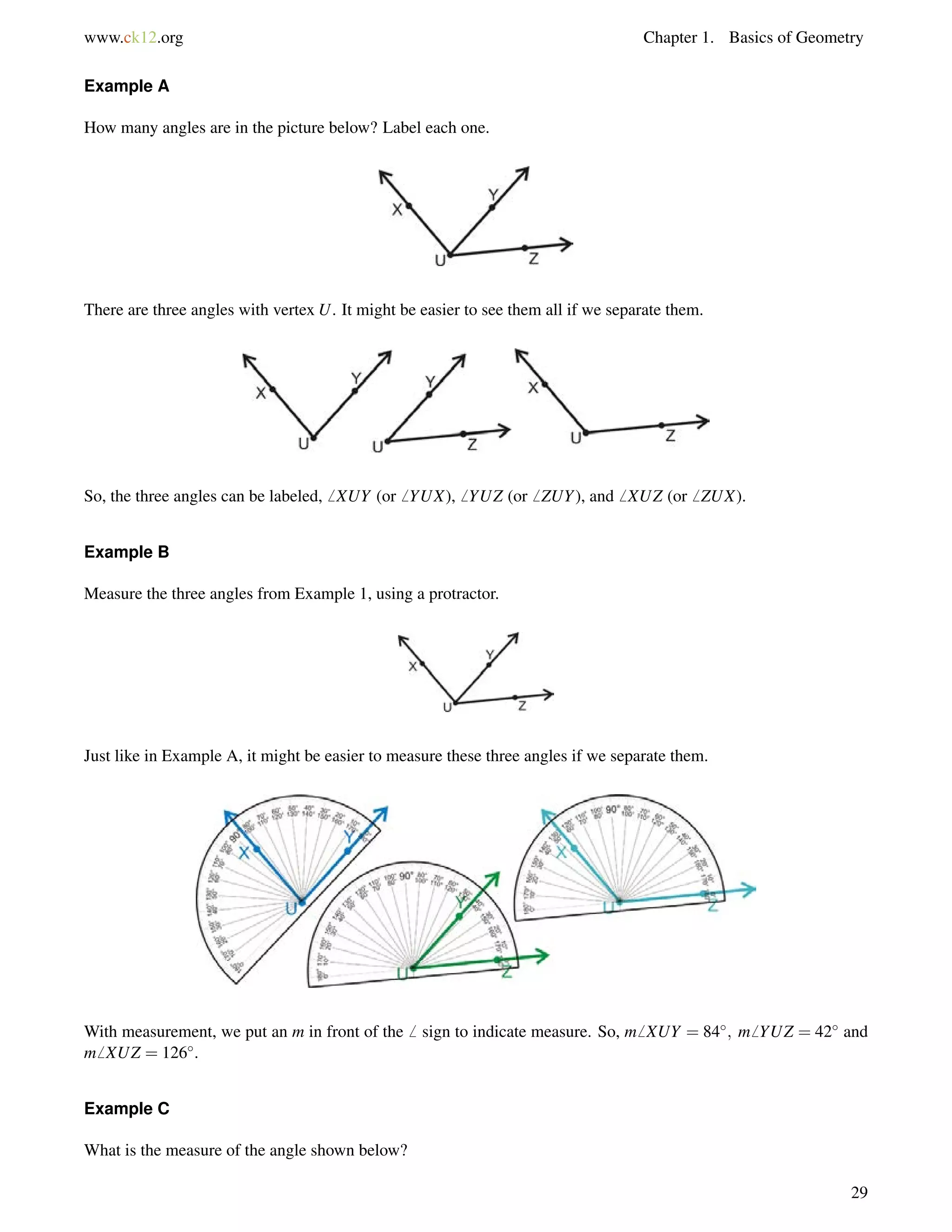
should easily be able to tell that it is a quadrilateral if it has four sides. But how can you classify it beyond that? 
First you should graph the shape if it has not already been graphed. Look at it and see if it looks like any special 
quadrilateral. Do the sides appear to be congruent? Do they meet at right angles? This will give you a place to start. 
Once you have a guess for what type of quadrilateral it is, your job is to prove your guess. To prove that a quadrilateral 
is a parallelogram, rectangle, rhombus, square, kite or trapezoid, you must show that it meets the definition of that 
shape OR that it has properties that only that shape has. 
If it turns out that your guess was wrong because the shape does not fulfill the necessary properties, you can guess 
again. If it appears to be no type of special quadrilateral then it is simply a quadrilateral. 
The examples below will help you to see what this process might look like. 
Example A 
Determine what type of parallelogram TUNE is: T(0;10);U(4;2);N(2;1), and E(6;7). 
326
www.ck12.org Chapter 6. Polygons and Quadrilaterals 
This looks like a rectangle. Let’s see if the diagonals are equal. If they are, then TUNE is a rectangle. 
EU = 
q 
(64)2+(72)2 TN = 
q 
(0+2)2+(10+1)2 
= 
q 
(10)2+52 = 
p 
22+112 
= 
p 
100+25 = 
p 
4+121 
= 
p 
125 = 
p 
125 
If the diagonals are also perpendicular, then TUNE is a square. 
Slope of EU = 72 
64 =  5 
10 = 1 
2 Slope of TN = 10(1) 
11 
0(2= ) 2 
The slope of EU6= slope of TN, so TUNE is a rectangle. 
Example B 
A quadrilateral is defined by the four lines y = 2x+1, y = x+5, y = 2x4, and y = x5. Is this quadrilateral 
a parallelogram? 
To check if its a parallelogram we have to check that it has two pairs of parallel sides. From the equations we can 
see that the slopes of the lines are 2, 1, 2 and 1. Because two pairs of slopes match, this shape has two pairs of 
parallel sides and is a parallelogram. 
Example C 
Determine what type of quadrilateral RSTV is. 
327
6.8. Quadrilateral Classification www.ck12.org 
This looks like a kite. Find the lengths of all the sides to check if the adjacent sides are congruent. 
RS = 
q 
(52)2+(76)2 ST = 
q 
(25)2+(6(3))2 
= 
q 
(7)2+12 = 
q 
(3)2+92 
= 
p 
50 = 
p 
90 
RV = 
q 
(5(4))2+(70)2 VT = 
q 
(45)2+(0(3))2 
= 
q 
(1)2+72 = 
q 
(9)2+32 
= 
p 
50 = 
p 
90 
From this we see that the adjacent sides are congruent. Therefore, RSTV is a kite. 
MEDIA 
Click image to the left for more content. 
CK-12 Classifying Quadrilateralsin the Coordinate Plane 
Guided Practice 
1. A quadrilateral is defined by the four lines y = 2x+1, y = 2x+5, y = 2x4, and y = 2x5. Is this 
quadrilateral a rectangle? 
2. Determine what type of quadrilateral ABCD is. A(3;3);B(1;5);C(4;1);D(1;5). 
3. Determine what type of quadrilateral EFGH is. E(5;1);F(11;3);G(5;5);H(1;3) 
Answers: 
328
www.ck12.org Chapter 6. Polygons and Quadrilaterals 
1. To be a rectangle a shape must have four right angles. This means that the sides must be perpendicular to each 
other. From the given equations we see that the slopes are 2, 2, 2 and 2. Because the slopes are not opposite 
reciprocals of each other, the sides are not perpendicular, and the shape is not a rectangle. 
2. First, graph ABCD. This will make it easier to figure out what type of quadrilateral it is. From the graph, we can 
tell this is not a parallelogram. Find the slopes of BC and AD to see if they are parallel. 
Slope of BC = 5(1) 
14 = 6 
3 = 2 
Slope of AD = 3(5) 
31 = 8 
4 = 2 
BCkAD, so ABCD is a trapezoid. To determine if it is an isosceles trapezoid, find AB and CD. 
AB = 
q 
(31)2+(35)2 ST = 
q 
(41)2+(1(5))2 
= 
q 
(4)2+(2)2 = 
p 
32+42 
= 
p 
20 = 2 
p 
5 = 
p 
25 = 5 
AB6=CD, therefore this is noy an isosceles trapezoid. 
3. We will not graph this example. Let’s find the length of all four sides. 
EF = 
q 
(511)2+(1(3))2 
p 
FG = 
q 
(115)2+(3(5))2 
= 
q 
(6)2+22 = 
p 
40 = 
p 
62+22 = 
p 
40 
GH = 
q 
(5(1))2+(5(3))2 HE = 
q 
(15)2+(3(1))2 
= 
q 
62+(2)2 = 
p 
40 = 
q 
(6)2+(2)2 = 
p 
40 
All four sides are equal. This quadrilateral is either a rhombus or a square. Let’s find the length of the diagonals. 
EG = 
q 
(55)2+(1(5))2 FH = 
q 
(11(1))2+(3(3))2 
= 
p 
02+42 = 
p 
122+02 
= 
p 
16 = 4 = 
p 
144 = 12 
329
6.8. Quadrilateral Classification www.ck12.org 
The diagonals are not congruent, so EFGH is a rhombus and not a square. 
Practice 
Determine what type of quadrilateral ABCD is. 
1. A(2;4);B(1;2);C(3;1);D(4;3) 
2. A(2;3);B(3;4);C(2;1);D(3;2) 
3. A(1;1);B(7;1);C(8;2);D(2;4) 
4. A(10;4);B(8;2);C(2;2);D(4;8) 
5. A(0;0);B(5;0);C(0;4);D(5;4) 
6. A(1;0);B(0;1);C(1;0);D(0;1) 
7. A(2;0);B(3;5);C(5;0);D(6;5) 
SRUE is a rectangle and PRUC is a square. 
8. What type of quadrilateral is SPCE? 
9. If SR = 20 and RU = 12, find CE. 
10. Find SC and RC based on the information from part b. Round your answers to the nearest hundredth. 
For questions 11-14, determine what type of quadrilateral ABCD is. If it is no type of special quadrilateral, just write 
quadrilateral. 
11. A(1;2);B(7;5);C(4;8);D(2;5) 
12. A(6;6);B(10;8);C(12;4);D(8;2) 
13. A(1;8);B(1;4);C(5;4);D(5;6) 
14. A(5;1);B(9;4);C(6;10);D(3;5) 
Summary 
This chapter introduces the Polygon Sum Formula and the Regular Polygon Interior Angle Formula. After this 
detailed presentation of the interior angles of polygons, the next topic is exterior angles of polygons and the Exterior 
Angle Sum Theorem. Quadrilaterals, parallelograms, rectangles, squares, trapezoids, kites, and rhombuses are 
introduced and these various types of four-sided figures are classified and their properties are explored. 
330
www.ck12.org Chapter 7. Similarity 
CHAPTER 7 Similarity 
Chapter Outline 
7.1 FORMS OF RATIOS 
7.2 PROPORTION PROPERTIES 
7.3 SIMILAR POLYGONS AND SCALE FACTORS 
7.4 AA SIMILARITY 
7.5 INDIRECT MEASUREMENT 
7.6 SSS SIMILARITY 
7.7 SAS SIMILARITY 
7.8 TRIANGLE PROPORTIONALITY 
7.9 PARALLEL LINES AND TRANSVERSALS 
7.10 PROPORTIONS WITH ANGLE BISECTORS 
7.11 DILATION 
7.12 DILATION IN THE COORDINATE PLANE 
7.13 SELF-SIMILARITY 
Introduction 
In this chapter, we will start with a review of ratios and proportions. Second, we will introduce the concept of 
similarity and apply it to polygons, quadrilaterals and triangles. Then, we will extend proportionality to parallel 
lines and dilations. Finally, we conclude with an extension about fractals. 
331
7.1. Forms of Ratios www.ck12.org 
7.1 Forms of Ratios 
Here you’ll learn what a ratio is and the different forms it can take. You’ll also learn how to find and reduce ratios 
and how to convert measurements using ratios. 
What if you were told that there were 15 birds on a pond and that the ratio of ducks to geese is 2:3? How could you 
determine how many ducks and how many geese are on the pond? After completing this Concept, you’ll be able to 
solve problems like this one. 
Watch This 
MEDIA 
Click image to the left for more content. 
CK-12 Using Ratios 
MEDIA 
Click image to the left for more content. 
James Sousa:Ratios 
Guidance 
A ratio is a way to compare two numbers. Ratios can be written in three ways: a 
b , a : b, and a to b. 
We always reduce ratios just like fractions. When two or more ratios reduce to the same ratio they are called 
equivalent ratios. For example, 50:250 and 2:10 are equivalent ratios because they both reduce to 1:5. 
One common use of ratios is as a way to convert measurements. 
Example A 
There are 14 girls and 18 boys in your math class. What is the ratio of girls to boys? 
Remember that order matters. The question asked for the ratio of girls to boys. The ratio would be 14:18. This can 
be simplified to 7:9. 
332
www.ck12.org Chapter 7. Similarity 
Example B 
Simplify the following ratios. 
a) 7 f t 
14 in 
b) 9m:900cm 
c) 4 gal 
16 gal 
First, change each ratio so that each part is in the same units. Remember that there are 12 inches in a foot. 
a) 
7@t 
f 
@ 14in 
 
f 
@ 12in 
1@t 
= 
84 
14 
= 
6 
1 
The inches and feet cancel each other out. Simplified ratios do not have units. 
b) It is easier to simplify a ratio when written as a fraction. 
9Zm 
900 cm 
 
100 cm 
1Zm 
= 
900 
900 
= 
1 
1 
c) 
4ZgaZl 
16ZgaZl 
= 
1 
4 
Example C 
A talent show has dancers and singers. The ratio of dancers to singers is 3:2. There are 30 performers total, how 
many of each are there? 
To solve, notice that 3:2 is a reduced ratio, so there is a number, n, that we can multiply both by to find the total 
number in each group. Represent dancers and singers as expressions in terms of n. Then set up and solve an equation. 
dancers = 3n; singers = 2n ! 3n+2n = 30 
5n = 30 
n = 6 
There are 3  6 = 18 dancers and 2  6 = 12 singers. 
MEDIA 
Click image to the left for more content. 
CK-12 Using Ratios 
Guided Practice 
The total bagel sales at a bagel shop for Monday is in the table below. 
333
7.1. Forms of Ratios www.ck12.org 
TABLE 7.1: 
Type of Bagel Number Sold 
Plain 80 
Cinnamon Raisin 30 
Sesame 25 
Jalapeno Cheddar 20 
Everything 45 
Honey Wheat 50 
1. What is the ratio of cinnamon raisin bagels to plain bagels? 
2. What is the ratio of honey wheat bagels to total bagels sold? 
3. What is the ratio of cinnamon raisin bagels to sesame bagels to jalapeno cheddar bagels? 
Answers: 
1. The ratio is 30:80. Reducing the ratio by 10, we get 3:8. 
2. Order matters. Honey wheat is listed first, so that number comes first in the ratio (or on the top of the fraction). 
Find the total number of bagels sold, 80+30+25+20+45+50 = 250. 
The ratio is 50 
250 = 15 
. 
3. You can have ratios that compare more than two numbers and they work just the same way. The ratio for this 
problem is 30:25:20, which reduces to 6:5:4. 
Practice 
1. The votes for president in a club election were: Smith : 24 Munoz : 32 Park : 20 Find the following ratios and 
write in simplest form. 
• Votes for Munoz to Smith 
• Votes for Park to Munoz 
• Votes for Smith to total votes 
• Votes for Smith to Munoz to Park 
Use the picture to write the following ratios for questions 2-6. 
AEFD is a square ABCD is a rectangle 
2. AE : EF 
3. EB : AB 
4. DF : FC 
334
www.ck12.org Chapter 7. Similarity 
5. EF : BC 
6. Perimeter ABCD:Perimeter AEFD:Perimeter EBCF 
Simplify the following ratios. Remember that there are 12 inches in a foot, 3 feet in a yard, and 100 centimeters in a 
meter. 
7. 25 in 
5 f t 
8. 9 f t 
3 yd 
9. 95 cm 
1:5 m 
10. The measures of the angles of a triangle are have the ratio 3:3:4. What are the measures of the angles? 
11. The length and width of a rectangle are in a 3:5 ratio. The perimeter of the rectangle is 64. What are the length 
and width? 
12. The length and width of a rectangle are in a 4:7 ratio. The perimeter of the rectangle is 352. What are the 
length and width? 
13. A math class has 36 students. The ratio of boys to girls is 4:5. How many girls are in the class? 
14. The senior class has 450 students in it. The ratio of boys to girls is 8:7. How many boys are in the senior 
class? 
15. The varsity football team has 50 players. The ratio of seniors to juniors is 3:2. How many seniors are on the 
team? 
335
7.2. Proportion Properties www.ck12.org 
7.2 Proportion Properties 
Here you’ll learn what a proportion is, the properties of proportions, and how to solve proportions using cross-multiplication. 
What if you were told that a scale model of a python is in the ratio of 1:24? If the model measures 0.75 feet long, 
how long is the real python? After completing this Concept, you’ll be able to solve problems like this one by using 
a proportion. 
Watch This 
MEDIA 
Click image to the left for more content. 
CK-12 Proportions 
First watch this video. 
MEDIA 
Click image to the left for more content. 
James Sousa:Proportions 
Now watch this video. 
MEDIA 
Click image to the left for more content. 
James Sousa:Applications ofProportions 
Finally, watch this video. 
336
www.ck12.org Chapter 7. Similarity 
MEDIA 
Click image to the left for more content. 
James Sousa:Using Similar Trianglesto Determine Unknown Values 
Guidance 
A proportion is two ratios that are set equal to each other. Usually the ratios in proportions are written in fraction 
form. An example of a proportion is 2x 
= 510. To solve a proportion, you need to cross-multiply. The Cross- 
Multiplication Theorem, which allows us to solve proportions using this method, states that if a;b;c; and d are real 
numbers, with b6= 0 and d6= 0 and if a 
b = cd 
, then ad = bc. Cross-multiplying allows us to get rid of the fractions in 
ac 
cd 
ab 
our equation. The Cross-Multiplication Theorem has several sub-theorems, called corollaries. 
Corollary #1: If a;b;c; and d are nonzero and = , then = b 
d . Switch band c. 
Corollary #2: If a;b;c; and d are nonzero and ab 
= cd 
, then d 
b = ca 
. Switch aand d. 
Corollary #3: If a;b;c; and d are nonzero and ab 
= cd 
, then ba 
= cd 
. Flip each ratio upside down. 
Corollary #4: If a;b;c; and d are nonzero and ab 
= cd 
, then a+b 
b = c+d 
d . 
Corollary #5: If a;b;c; and d are nonzero and ab 
= cd 
, then ab 
b = cd 
d . 
Example A 
Solve the proportions. 
a) = x 
30 
45 
b) y+1 
8 = 5 
20 
c) 65 
= 2x+4 
x2 
Remember, to solve a proportion, you need to cross-multiply. 
a) 
b) 
337
7.2. Proportion Properties www.ck12.org 
c) 
Example B 
Your parents have an architect’s drawing of their home. On the paper, the house’s dimensions are 36 in by 30 in. If 
the shorter length of the house is actually 50 feet, what is the longer length? 
To solve, first set up a proportion. If the shorter length is 50 feet, then it lines up with 30 in, the shorter length of the 
paper dimensions. 
30 
36 
= 
50 
x 
! 30x = 1800 
x = 60 The longer length is 60 feet. 
Example C 
Suppose we have the proportion 2 
5 = 14 
35 . Write three true proportions that follow. 
First of all, we know this is a true proportion because you would multiply 25by 77 
to get 14 
35 . Using the first three 
corollaries: 
1. 2 
14 = 5 
35 
2. 35 
5 = 14 
2 
3. 52 
= 35 
14 
MEDIA 
Click image to the left for more content. 
CK-12 Proportions 
Guided Practice 
1. In the picture, AB 
XY = BC 
YZ = AC 
XZ . 
Find the measures of AC and XY. 
338
www.ck12.org Chapter 7. Similarity 
2. In the picture, ED 
AD = BC 
AC . Find y. 
3. In the picture, AB 
BE = AC 
CD. Find BE. 
Answers: 
1. Plug in the lengths of the sides we know. 
2. Substitute in the lengths of the sides we know. 
6 
y 
= 
8 
12+8 
! 8y = 6(20) 
y = 15 
3. Substitute in the lengths of the sides we know. 
12 
BE 
= 
20 
25 
! 20(BE) = 12(25) 
BE = 15 
Practice 
Solve each proportion. 
1. x 
10 = 42 
35 
339
7.2. Proportion Properties www.ck12.org 
2. x 
x2 = 57 
3. 69 
= y 
24 
4. x9 
= 16 
x 
5. y3 
8 = y+6 
5 
6. 20 
z+5 = 16 
7 
7. Shawna drove 245 miles and used 8.2 gallons of gas. At the same rate, if she drove 416 miles, how many 
gallons of gas will she need? Round to the nearest tenth. 
8. The president, vice-president, and financial officer of a company divide the profits is a 4:3:2 ratio. If the 
company made $1,800,000 last year, how much did each person receive? 
6 = 15 
Given the true proportion, 10 
d = x 
y and d;x; and y are nonzero, determine if the following proportions are also 
true. 
9. 10 
y = x6 
10. 15 
10 = d 
6 
10 = y+x 
11. 6+10 
x 
x = yd 
12. 15 
For questions 13-16, AE 
ED = BC 
CD and ED 
AD = CD 
DB = EC 
AB . 
13. Find DB. 
14. Find EC. 
15. Find CB. 
16. Find AD. 
340
www.ck12.org Chapter 7. Similarity 
7.3 Similar Polygons and Scale Factors 
Here you’ll learn what properties two or more polygons must possess to be similar. You’ll also learn what a scale 
factor is and how to solve for missing information in similar polygon problems. 
What if you were told that two pentagons were similar and you were given the lengths of each pentagon’s sides. 
How could you determine the scale factor of pentagon #1 to pentagon #2? After completing this Concept, you’ll be 
able to answer questions like this one about similar polygons. 
Watch This 
MEDIA 
Click image to the left for more content. 
CK-12 Similar Polygons and ScaleFactors 
MEDIA 
Click image to the left for more content. 
James Sousa:SimilarPolygons 
Now watch this video. 
MEDIA 
Click image to the left for more content. 
James Sousa:Scale Factor 
Guidance 
Similar polygons are two polygons with the same shape, but not the same size. Similar polygons have corresponding 
angles that are congruent, and corresponding sides that are proportional. 
341
7.3. Similar Polygons and Scale Factors www.ck12.org 
These polygons are not similar: 
Think about similar polygons as enlarging or shrinking the same shape. The symbol  is used to represent similarity. 
Specific types of triangles, quadrilaterals, and polygons will always be similar. For example, all equilateral triangles 
are similar and all squares are similar. If two polygons are similar, we know the lengths of corresponding sides are 
proportional. In similar polygons, the ratio of one side of a polygon to the corresponding side of the other is called 
the scale factor. The ratio of all parts of a polygon (including the perimeters, diagonals, medians, midsegments, 
altitudes) is the same as the ratio of the sides. 
Example A 
Suppose 4ABC  4JKL. Based on the similarity statement, which angles are congruent and which sides are 
proportional? 
Just like in a congruence statement, the congruent angles line up within the similarity statement. So,6 A= 
6 J;6 B= 
6 K; and6 C = 
6 L. Write the sides in a proportion: AB 
JK = BC 
KL = AC 
JL . Note that the proportion could be written in 
BC = JK 
KL is also true. 
different ways. For example, AB 
Example B 
MNPQ  RSTU. What are the values of x;y and z? 
In the similarity statement,6 M = 
6 R, so z = 115. For x and y, set up proportions. 
18 
30 
= 
x 
25 
18 
30 
= 
15 
y 
450 = 30x 18y = 450 
x = 15 y = 25 
342
www.ck12.org Chapter 7. Similarity 
Example C 
ABCD  AMNP. Find the scale factor and the length of BC. 
Line up the corresponding sides, AB and AM =CD, so the scale factor is 30 
45 = 23 
or 32 
. Because BC is in the bigger 
rectangle, we will multiply 40 by 3 
2 because 32 
is greater than 1. BC = 32 
(40) = 60. 
MEDIA 
Click image to the left for more content. 
CK-12 Similar Polygons and ScaleFactors 
Guided Practice 
1. ABCD and UVWX are below. Are these two rectangles similar? 
2. What is the scale factor of 4ABC to 4XYZ? Write the similarity statement. 
3. 4ABC 4MNP. The perimeter of 4ABC is 150, AB = 32 and MN = 48. Find the perimeter of 4MNP. 
Answers: 
1. All the corresponding angles are congruent because the shapes are rectangles. 
Let’s see if the sides are proportional. 8 
12 = 23 
and 18 
24 = 34 
. 23 
6= 3 
4 , so the sides are not in the same proportion, and the 
rectangles are not similar. 
343
7.3. Similar Polygons and Scale Factors www.ck12.org 
2. All the sides are in the same ratio. Pick the two largest (or smallest) sides to find the ratio. 
15 
20 
= 
3 
4 
For the similarity statement, line up the proportional sides. AB!XY;BC!XZ;AC!YZ; so 4ABC 4YXZ. 
3. From the similarity statement, AB and MN are corresponding sides. The scale factor is 32 
48 = 23 
or 32 
. 4ABC is the 
smaller triangle, so the perimeter of 4MNP is 3 
2 (150) = 225. 
Practice 
For questions 1-8, determine whether the following statements are true or false. 
1. All equilateral triangles are similar. 
2. All isosceles triangles are similar. 
3. All rectangles are similar. 
4. All rhombuses are similar. 
5. All squares are similar. 
6. All congruent polygons are similar. 
7. All similar polygons are congruent. 
8. All regular pentagons are similar. 
9. 4BIG 4HAT. List the congruent angles and proportions for the sides. 
10. If BI = 9 and HA = 15, find the scale factor. 
11. If BG = 21, find HT. 
12. If AT = 45, find IG. 
13. Find the perimeter of 4BIG and 4HAT. What is the ratio of the perimeters? 
14. An NBA basketball court is a rectangle that is 94 feet by 50 feet. A high school basketball court is a rectangle 
that is 84 feet by 50 feet. Are the two rectangles similar? 
15. HD TVs have sides in a ratio of 16:9. Non-HD TVs have sides in a ratio of 4:3. Are these two ratios equivalent? 
Use the picture to the right to answer questions 16-20. 
16. Find m6 E and m6 Q. 
17. ABCDE  QLMNP, find the scale factor. 
18. Find BC. 
19. Find CD. 
20. Find NP. 
Determine if the following triangles and quadrilaterals are similar. If they are, write the similarity statement. 
344
www.ck12.org Chapter 7. Similarity 
21. 
22. 
23. 
24. 
25. 
26. 
27. 
345
7.3. Similar Polygons and Scale Factors www.ck12.org 
28. 
29. 
30. 
346
www.ck12.org Chapter 7. Similarity 
7.4 AASimilarity 
Here you’ll learn how to determine if triangles are similar using Angle-Angle (AA). 
What if you were given a pair of triangles and the angle measures for two of their angles? How could you use this 
information to determine if the two triangles are similar? After completing this Concept, you’ll be able to use the 
AA Similarity Postulate to decide if two triangles are similar. 
Watch This 
MEDIA 
Click image to the left for more content. 
CK-12 Foundation: AASimilarity 
For additional help, first watch this video beginning at the 2:09 mark. 
MEDIA 
Click image to the left for more content. 
James Sousa:SimilarTriangles 
Then watch this video. 
MEDIA 
Click image to the left for more content. 
James Sousa:SimilarTriangles by AA 
Guidance 
By definition, two triangles are similar if all their corresponding angles are congruent and their corresponding sides 
are proportional. It is not necessary to check all angles and sides in order to tell if two triangles are similar. In fact, 
if you only know that two pairs of corresponding angles are congruent that is enough information to know that the 
triangles are similar. This is called the AA Similarity Postulate. 
347
7.4. AA Similarity www.ck12.org 
AA Similarity Postulate: If two angles in one triangle are congruent to two angles in another triangle, then the two 
triangles are similar. 
If6 A= 
6 Y and6 B= 
6 Z, then 4ABC 4YZX. 
Example A 
Determine if the following two triangles are similar. If so, write the similarity statement. 
= 
Compare the angles = 
= 
to see if we can use the AA Similarity Postulate. Using the Triangle Sum Theorem, m6 G = 48 
and m6 M = 30 So,6 F 6 M;6 E 6 L and6 G6 N and the triangles are similar. 4FEG 4MLN. 
Example B 
Determine if the following two triangles are similar. If so, write the similarity statement. 
Compare the angles to see if we can use the AA Similarity Postulate. Using the Triangle Sum Theorem, m6 C = 39 
and m6 F = 59. m6 C6= m6 F, So 4ABC and 4DEF are not similar. 
Example C 
4LEG 4MAR by AA. Find GE and MR. 
348
www.ck12.org Chapter 7. Similarity 
Set up a proportion to find the missing sides. 
24 
32 
= 
MR 
20 
24 
32 
= 
21 
GE 
480 = 32MR 24GE = 672 
15 = MR GE = 28 
When two triangles are similar, the corresponding sides are proportional. But, what are the corresponding sides? 
Using the triangles from this example, we see how the sides line up in the diagram to the right. 
MEDIA 
Click image to the left for more content. 
CK-12 Foundation: AASimilarity 
Guided Practice 
1.Are the following triangles similar? If so, write the similarity statement. 
349
7.4. AA Similarity www.ck12.org 
2. Are the triangles similar? If so, write a similarity statement. 
3. Are the triangles similar? If so, write a similarity statement. 
Answers: 
1. Because AEkCD;6 A = 
6 D and6 C = 
6 E by the Alternate Interior Angles Theorem. By the AA Similarity 
= 
Postulate, 4= 
ABE 4DBC. 
2. Yes, there are three similar triangles that each have a right angle. DGE  FGD  FDE. 
3. By the reflexive property,6 H 6 H. Because the horizontal lines are parallel,6 L 6 K (corresponding angles). 
So yes, there is a pair of similar triangles. HLI  HKJ. 
Practice 
Use the diagram to complete each statement. 
1. 4SAM 4 ______ 
2. SA 
? = SM 
? = ? 
RI 
8 
?9? 
3. SM = ______ 
4. TR = ______ 
5. = 350
www.ck12.org Chapter 7. Similarity 
Answer questions 6-9 about trapezoid ABCD. 
6. Name two similar triangles. How do you know they are similar? 
7. Write a true proportion. 
8. Name two other triangles that might not be similar. 
9. If AB = 10;AE = 7; and DC = 22, find AC. Be careful! 
Use the triangles to the left for questions 10-14. 
AB = 20;DE = 15, and BC = k. 
10. Are the two triangles similar? How do you know? 
11. Write an expression for FE in terms of k. 
12. If FE = 12;, what is k? 
13. Fill in the blanks: If an acute angle of a _______ triangle is congruent to an acute angle in another ________- 
triangle, then the two triangles are _______. 
14. Writing How do congruent triangles and similar triangles differ? How are they the same? 
Are the following triangles similar? If so, write a similarity statement. 
15. 
351
7.4. AA Similarity www.ck12.org 
16. 
17. 
18. 
19. 
20. 
21. 
352
www.ck12.org Chapter 7. Similarity 
7.5 Indirect Measurement 
Here you’ll learn how to apply your knowledge of similar triangles and proportions to model real-life situations and 
to find unknown measurements indirectly. 
What if you were standing next to a building and wanted to know how tall the building was? How could you use 
your own height and the length of the shadows cast by you and the building to determine the building’s height? After 
completing this Concept, you’ll be able to solve problems like this one. 
Watch This 
MEDIA 
Click image to the left for more content. 
CK-12 Foundation: Indirect Measurement 
MEDIA 
Click image to the left for more content. 
James Sousa:Indirect MeasurmentUsing Similar Triangles 
Guidance 
An application of similar triangles is to measure lengths indirectly. You can use this method to measure the width 
of a river or canyon or the height of a tall object. The idea is that you model a situation with similar triangles and 
then use proportions to find the missing measurement indirectly. 
Example A 
A tree outside Ellie’s building casts a 125 foot shadow. At the same time of day, Ellie casts a 5.5 foot shadow. If 
Ellie is 4 feet 10 inches tall, how tall is the tree? 
353
7.5. Indirect Measurement www.ck12.org 
To solve, start by drawing a picture. We see that the tree and Ellie are parallel, so the two triangles are similar. 
4 f t;10 in 
x 
= 
5:5 f t 
125 f t 
The measurements need to be in the same units. Change everything into inches and then we can cross multiply. 
58 in 
x 
= 
66 in 
1500 in 
87000 = 66x 
x  1318:18 in or 109:85 f t 
Example B 
Cameron is 5 ft tall and casts a 12 ft shadow. At the same time of day, a nearby building casts a 78 ft shadow. How 
tall is the building? 
To solve, set up a proportion that compares height to shadow length for Cameron and the building. Then solve the 
equation to find the height of the building. Let x represent the height of the building. 
5 f t 
12 f t 
= 
x 
78 f t 
12x = 390 
x = 32:5 f t 
The building is 32:5 feet tall. 
Example C 
The Empire State Building is 1250 ft. tall. At 3:00, Pablo stands next to the building and has an 8 ft. shadow. If he 
is 6 ft tall, how long is the Empire State Building’s shadow at 3:00? 
Similar to Example B, solve by setting up a proportion that compares height to shadow length. Then solve the 
equation to find the length of the shadow. Let x represent the length of the shadow. 
6 f t 
8 f t 
= 
1250 f t 
x 
6x = 10000 
x = 1666:67 f t 
354
www.ck12.org Chapter 7. Similarity 
The shadow is approximately 1666:67 feet long. 
MEDIA 
Click image to the left for more content. 
CK-12 Foundation: Indirect Measurement 
Guided Practice 
In order to estimate the width of a river, the following technique can be used. Use the diagram. 
= 
= 
Place three markers, O;C; and E on the upper bank of the river. E is on the edge of the river and OC ? CE. Go 
across the river and place a marker, N so that it is collinear with C and E. Then, walk along the lower bank of the 
river and place marker A, so that CN ? NA. OC = 50 feet, CE = 30 feet, NA = 80 feet. 
1. Is 4OCE 4ANE? How do you know? 
2. Is OCkNA? How do you know? 
3. What is the width of the river? Find EN. 
Answers: 
1. Yes.6 C 6 N because they are both right angles.6 OEC 6 AEN because they are vertical angles. This means 
4OCE 4ANE by the AA Similarity Postulate. 
2. Since the two triangles are similar, we must have6 EOC = 
6 EAN. These are alternate interior angles. When 
alternate interior angles are congruent then lines are parallel, so OCkNA. 
3. Set up a proportion and solve by cross-multiplying. 
30 f t 
EN 
= 
50 f t 
80 f t 
50(EN) = 2400 
EN = 48 
The river is 48 feet wide. 
Practice 
The technique from the guided practice section was used to measure the distance across the Grand Canyon. Use the 
picture below and OC = 72 f t;CE = 65 f t, and NA = 14;400 f t for problems 1 - 3. 
355
7.5. Indirect Measurement www.ck12.org 
1. Find EN (the distance across the Grand Canyon). 
2. Find OE. 
3. Find EA. 
4. Mark is 6 ft tall and casts a 15 ft shadow. A the same time of day, a nearby building casts a 30 ft shadow. How 
tall is the building? 
5. Karen and Jeff are standing next to each other. Karen casts a 10 ft shadow and Jeff casts an 8 ft shadow. Who is 
taller? How do you know? 
6. Billy is 5 ft 9 inches tall and Bobby is 6 ft tall. Bobby’s shadow is 13 feet long. How long is Billy’s shadow? 
7. Sally and her little brother are walking to school. Sally is 4 ft tall and has a shadow that is 3 ft long. Her little 
brother’s shadow is 2 ft long. How tall is her little brother? 
8. Ryan is outside playing basketball. He is 5 ft tall and at this time of day is casting a 12 ft shadow. The basketball 
hoop is 10 ft tall. How long is the basketball hoop’s shadow? 
9. Jack is standing next to a very tall tree and wonders just how tall it is. He knows that he is 6 ft tall and at this 
moment his shadow is 8 ft long. He measures the shadow of the tree and finds it is 90 ft. How tall is the tree? 
10. Thomas, who is 4 ft 9 inches tall is casting a 6 ft shadow. A nearby building is casting a 42 ft shadow. How tall 
is the building? 
356
www.ck12.org Chapter 7. Similarity 
7.6 SSS Similarity 
Here you’ll learn how to determine if triangles are similar using Side-Side-Side (SSS). 
What if you were given a pair of triangles and the side lengths for all three of their sides? How could you use this 
information to determine if the two triangles are similar? After completing this Concept, you’ll be able to use the 
SSS Similarity Theorem to decide if two triangles are congruent. 
Watch This 
MEDIA 
Click image to the left for more content. 
CK-12 Foundation: SSS Similarity 
Watch this video beginning at the 2:09 mark. 
MEDIA 
Click image to the left for more content. 
James Sousa:SimilarTriangles 
Now watch the first part of this video. 
MEDIA 
Click image to the left for more content. 
James Sousa:SimilarTriangles UsingSSSandSAS 
Guidance 
By definition, two triangles are similar if all their corresponding angles are congruent and their corresponding sides 
are proportional. It is not necessary to check all angles and sides in order to tell if two triangles are similar. In fact, if 
357
7.6. SSS Similarity www.ck12.org 
you know only that all sides are proportional, that is enough information to know that the triangles are similar. This 
is called the SSS Similarity Theorem. 
SSS Similarity Theorem: If all three pairs of corresponding sides of two triangles are proportional, then the two 
triangles are similar. 
If AB 
YZ = BC 
ZX = AC 
XY , then 4ABC 4YZX. 
Example A 
Determine if the following triangles are similar. If so, explain why and write the similarity statement. 
We will need to find the ratios for the corresponding sides of the triangles and see if they are all the same. Start with 
the longest sides and work down to the shortest sides. 
BC 
FD = 28 
20 = 75 
BA 
FE = 21 
15 = 7 
5 
AC 
ED = 14 
10 = 75 
Since all the ratios are the same, 4ABC 4EFD by the SSS Similarity Theorem. 
Example B 
Find x and y, such that 4ABC 4DEF. 
According to the similarity statement, the corresponding sides are: AB 
DE = BC 
EF = AC 
DF . Substituting in what we know, 
we have 96 
= 4x1 
10 = 18 
y . 
358
www.ck12.org Chapter 7. Similarity 
9 
6 
= 
4x1 
10 
9 
6 
= 
18 
y 
9(10) = 6(4x1) 9y = 18(6) 
90 = 24x6 9y = 108 
96 = 24x y = 12 
x = 4 
Example C 
Determine if the following triangles are similar. If so, explain why and write the similarity statement. 
We will need to find the ratios for the corresponding sides of the triangles and see if they are all the same. Start with 
the longest sides and work down to the shortest sides. 
AC 
ED = 21 
35 = 35 
BC 
FD = 15 
25 = 35 
AB 
EF = 10 
20 = 1 
2 
Since the ratios are not all the same, the triangles are not similar. 
MEDIA 
Click image to the left for more content. 
CK-12 Foundation: SSS Similarity 
Guided Practice 
Determine if any of the triangles below are similar. Compare two triangles at a time. 
359
7.6. SSS Similarity www.ck12.org 
1. Is 4ABC 4DEF? 
2. Is 4DEF 4GHI? 
3. Is 4ABC 4GHI? 
Answers: 
1. 4ABC and 4DEF: Is 20 
15 = 22 
16 = 24 
18? 
15 = 4 
3 ; 22 
16 = 11 
8 , and 24 
18 = 43 
Reduce each fraction to see if they are equal. 20 
. 
4 
36= 11 
8 ;4ABC and 4DEF are not similar. 
2. 4DEF and 4GHI: Is 15 
30 = 16 
33 = 18 
36? 
15 
30 = 12 
; 16 
33 = 16 
33 , and 18 
36 = 12 
. 12 
6= 16 
33 ;4DEF is not similar to 4GHI. 
30 = 22 
33 = 24 
36? 
3. 4ABC and 4GHI: Is 20 
20 
30 = 23 
; 22 
33 = 23 
, and 24 
36 = 23 
. All three ratios reduce to 23 
, 4ABC 4GIH. 
Practice 
Fill in the blanks. 
1. If all three sides in one triangle are __________________ to the three sides in another, then the two triangles 
are similar. 
2. Two triangles are similar if the corresponding sides are _____________. 
Use the following diagram for questions 3-5. The diagram is to scale. 
3. Are the two triangles similar? Explain your answer. 
4. Are the two triangles congruent? Explain your answer. 
5. What is the scale factor for the two triangles? 
Fill in the blanks in the statements below. Use the diagram to the left. 
6. 4ABC 4_____ 
7. AB 
? = BC 
? = AC 
? 
360
www.ck12.org Chapter 7. Similarity 
8. If 4ABC had an altitude, AG = 10, what would be the length of altitude DH? 
9. Find the perimeter of 4ABC and 4DEF. Find the ratio of the perimeters. 
Use the diagram to the right for questions 10-15. 
10. 4ABC 4_____ 
11. Why are the two triangles similar? 
12. Find ED. 
13. BD 
? = ? 
BC = DE 
? 
DB = CE 
EB true? 
14. Is AD 
15. Is AD 
DB = AC 
DE true? 
Find the value of the missing variable(s) that makes the two triangles similar. 
16. 
361
7.7. SAS Similarity www.ck12.org 
7.7 SASSimilarity 
Here you’ll learn how to determine if triangles are similar using Side-Angle-Side (SAS). 
What if you were given a pair of triangles, the lengths of two of their sides, and the measure of the angle between 
those two sides? How could you use this information to determine if the two triangles are similar? After completing 
this Concept, you’ll be able to use the SAS Similarity Theorem to decide if two triangles are congruent. 
Watch This 
MEDIA 
Click image to the left for more content. 
CK-12 Foundation: SAS Similarity 
Watch this video beginning at the 2:09 mark. 
MEDIA 
Click image to the left for more content. 
James Sousa:SimilarTriangles 
Now watch the second part of this video. 
MEDIA 
Click image to the left for more content. 
James Sousa:SimilarTriangles UsingSSSandSAS 
Guidance 
By definition, two triangles are similar if all their corresponding angles are congruent and their corresponding sides 
are proportional. It is not necessary to check all angles and sides in order to tell if two triangles are similar. In fact, 
362
www.ck12.org Chapter 7. Similarity 
if you know only that two pairs of sides are proportional and their included angles are congruent, that is enough 
information to know that the triangles are similar. This is called the SAS Similarity Theorem. 
SAS Similarity Theorem: If two sides in one triangle are proportional to two sides in another triangle and the 
included angle in both are congruent, then the two triangles are similar. 
If AB 
XY = AC 
XZ and6 A= 
6 X, then 4ABC 4XYZ. 
Example A 
Are the two triangles similar? How do you know? 
We know that6 B= 
6 Z because they are both right angles and 10 
15 = 24 
36 . So, AB 
XZ = BC 
ZY and 4ABC 4XZY by SAS. 
Example B 
Are there any similar triangles in the figure? How do you know? 
6 A is shared by 4EAB and 4DAC, so it is congruent to itself. Let’s see if AE 
AD = AB 
AC . 
9 
9+3 
= 
12 
12+5 
9 
12 
= 
3 
4 
6= 
12 
17 
The two triangles are not similar. 
363
7.7. SAS Similarity www.ck12.org 
Example C 
From Example B, what should BC equal for 4EAB 4DAC? 
The proportion we ended up with was 9 
12 = 34 
6= 12 
17 . AC needs to equal 16, so that 12 
16 = 34 
. AC = AB+BC and 
16 = 12+BC. BC should equal 4. 
MEDIA 
Click image to the left for more content. 
CK-12 Foundation: SAS Similarity 
Guided Practice 
Determine if the following triangles are similar. If so, write the similarity theorem and statement. 
1. 
2. 
3. 
Answers: 
1. We can see that6 B = 
6 F and these are both included angles. We just have to check that the sides around the 
angles are proportional. 
364
www.ck12.org Chapter 7. Similarity 
AB 
DF = 12 
8 = 32 
BC 
FE = 24 
16 = 3 
2 
Since the ratios are the same 4ABC 4DFE by the SAS Similarity Theorem. 
2. The triangles are not similar because the angle is not the included angle for both triangles. 
3.6 A is the included angle for both triangles, so we have a pair of congruent angles. Now we have to check that the 
sides around the angles are proportional. 
AE 
AD = 16 
16+4 = 16 
20 = 4 
5 
AB 
AC = 24 
24+8 = 24 
32 = 34 
The ratios are not the same so the triangles are not similar. 
Practice 
Fill in the blanks. 
1. If two sides in one triangle are _________________ to two sides in another and the ________________ angles 
are _________________, then the triangles are ______________. 
Determine if the following triangles are similar. If so, write the similarity theorem and statement. 
2. 
Find the value of the missing variable(s) that makes the two triangles similar. 
3. 
4. 
5. 
365
7.7. SAS Similarity www.ck12.org 
Determine if the triangles are similar. If so, write the similarity theorem and statement. 
6. DABC is a right triangle with legs that measure 3 and 4. DDEF is a right triangle with legs that measure 6 and 
8. 
7. DGHI is a right triangle with a leg that measures 12 and a hypotenuse that measures 13. DJKL is a right 
triangle with legs that measure 1 and 2. 
8. 
9. 
10. 
366
www.ck12.org Chapter 7. Similarity 
11. 
12. AC = 3 
DF = 6 
13. 
367
7.7. SAS Similarity www.ck12.org 
14. 
15. 
368
www.ck12.org Chapter 7. Similarity 
7.8 Triangle Proportionality 
Here you’ll learn how to apply both the Triangle Proportionality Theorem, which states that if a line that is parallel 
to one side of a triangle intersects the other two sides, then it divides those sides proportionally, and its converse. 
What if you were given a triangle with a line segment drawn through it from one side to the other? How could you 
use information about the triangle’s side lengths to determine if that line segment is parallel to the third side? After 
completing this Concept, you’ll be able to answer questions like this one. 
Watch This 
MEDIA 
Click image to the left for more content. 
CK-12 Foundation: Triangle Proportionality 
First watch this video. 
MEDIA 
Click image to the left for more content. 
James Sousa:Triangle Proportionality Theorem 
Now watch this video. 
MEDIA 
Click image to the left for more content. 
James Sousa:Using the Triangle Proportionality Theorem to SolveforUnknownValues 
Guidance 
Think about a midsegment of a triangle. A midsegment is parallel to one side of a triangle and divides the other two 
sides into congruent halves. The midsegment divides those two sides proportionally. But what about another line 
369
7.8. Triangle Proportionality www.ck12.org 
that is parallel, but does not divide the other two sides into congruent halves? In fact, such a line will still divide the 
sides proportionally. This is called the Triangle Proportionality Theorem. 
Triangle Proportionality Theorem: If a line parallel to one side of a triangle intersects the other two sides, then it 
divides those sides proportionally. 
If DEkAC, then BD 
DA = BE 
EC . (DA 
BD = EC 
BE is also a true proportion.) 
The converse of this theorem is also true. 
Triangle Proportionality Theorem Converse: If a line divides two sides of a triangle proportionally, then it is 
parallel to the third side. 
If BD 
DA = BE 
EC , then DEkAC. 
Example A 
A triangle with its midsegment is drawn below. What is the ratio that the midsegment divides the sides into? 
The midsegment splits the sides evenly. The ratio would be 8:8 or 10:10, which both reduce to 1:1. 
Example B 
In the diagram below, EBkCD. Find BC. 
To solve, set up a proportion. 
370
www.ck12.org Chapter 7. Similarity 
10 
15 
= 
BC 
12 
! 15(BC) = 120 
BC = 8 
Example C 
Is DEkCB? 
If the ratios are equal, then the lines are parallel. 
6 
18 
= 
8 
24 
= 
1 
3 
Because the ratios are equal, DEkCB. 
MEDIA 
Click image to the left for more content. 
CK-12 Foundation: Triangle Proportionality 
Guided Practice 
Use the diagram to answers questions 1-5. DBkFE. 
1. Name the similar triangles. Write the similarity statement. 
2. BE 
EC = ? 
FC 
3. EC 
CB = CF 
? 
4. DB 
? = BC 
EC 
371
7.8. Triangle Proportionality www.ck12.org 
5. FC+? 
FC = ? 
FE 
Answers: 
1. 4DBC 4FEC 
2. DF 
3. DC 
4. FE 
5. DF; DB 
Practice 
Use the diagram to answer questions 1-7. ABkDE. 
1. Find BD. 
2. Find DC. 
3. Find DE. 
4. Find AC. 
5. What is BD : DC? 
6. What is DC : BC? 
7. Why BD : DC6= DC : BC? 
Use the given lengths to determine if ABkDE. 
8. 
9. 
372
www.ck12.org Chapter 7. Similarity 
10. 
11. 
12. 
13. 
373
7.9. Parallel Lines and Transversals www.ck12.org 
7.9 Parallel Lines and Transversals 
Here you’ll learn how to use the Triangle Proportionality Theorem, which states that if a line that is parallel to one 
side of a triangle intersects the other two sides, then it divides those sides proportionally. 
What if you were looking at a map that showed four parallel streets (A, B, C, and D) cut by two avenues, or 
transversals, (1 and 2)? How could you determine the distance you would have to travel down Avenue 2 to reach 
Street C from Street B given the distance down Avenue 1 from Street A to Street B, the distance down Avenue 1 
from Street B to C, and the distance down Avenue 2 from Street A to B? After completing this Concept, you’ll be 
able to solve problems like this one. 
Watch This 
MEDIA 
Click image to the left for more content. 
CK-12 Foundation: Parallel LinesandTransversals 
Guidance 
The Triangle Proportionality Theorem states that if a line parallel to one side of a triangle intersects the other two 
sides, then it divides those sides proportionally. We can extend this theorem to a situation outside of triangles where 
we have multiple parallel lines cut by transverals. 
Theorem: If two or more parallel lines are cut by two transversals, then they divide the transversals proportionally. 
If l k m k n, then ab 
= cdor ac 
= b 
d . 
Note that this theorem works for any number of parallel lines with any number of transversals. When this happens, 
all corresponding segments of the transversals are proportional. 
Example A 
Find a. 
374
www.ck12.org Chapter 7. Similarity 
The three lines are marked parallel, so to solve, set up a proportion. 
a 
20 
= 
9 
15 
180 = 15a 
a = 12 
Example B 
Find b. 
To solve, set up a proportion. 
12 
9:6 
= 
b 
24 
288 = 9:6b 
b = 30 
Example C 
Find the value of x that makes the lines parallel. 
375
7.9. Parallel Lines and Transversals www.ck12.org 
To solve, set up a proportion and solve for x. 
5 
8 
= 
3:75 
2x4 
! 5(2x4) = 8(3:75) 
10x20 = 30 
10x = 50 
x = 5 
MEDIA 
Click image to the left for more content. 
CK-12 Foundation: Parallel LinesandTransversals 
Guided Practice 
1. Find a;b; and c. 
2. Below is a street map of part of Washington DC. R Street, Q Street, and O Street are parallel and 7th Street is 
perpendicular to all three. All the measurements are given on the map. What are x and y? 
376
www.ck12.org Chapter 7. Similarity 
3. Find the value of a in the diagram below: 
Answers: 
1. Line up the segments that are opposite each other. 
a 
9 
= 
2 
3 
2 
3 
= 
4 
b 
2 
3 
= 
3 
c 
3a = 18 2b = 12 2c = 9 
a = 6 b = 6 c = 4:5 
2. To find x and y, you need to set up a proportion using the parallel lines. 
2640 
x 
= 
1320 
2380 
= 
1980 
y 
From this, x = 4760 f t and y = 3570 f t. 
3. Set up a proportion using the parallel lines and solve the equation for a. 
377
7.9. Parallel Lines and Transversals www.ck12.org 
8 
20 
= 
a 
15 
15  8 = 20a 
120 = 20a 
a = 6 
Practice 
Find the value of each variable in the pictures below. 
1. 
2. 
3. 
4. 
378
www.ck12.org Chapter 7. Similarity 
5. 
The street map shows part of New Orleans. Burgundy St., Dauphine St. and Royal St. are parallel to each other. If 
Spain St. is perpendicular to all three, find the indicated distances. 
6. What is the distance between points A and B? 
7. What is the distance between points C and D? 
8. What is the distance between points A and D? 
Using the diagram, answer the questions. 
9. What is the value of w? 
10. What is the value of x? 
11. What is the value of y? 
12. What is the length of AB? 
13. What is the length of AC? 
379
7.9. Parallel Lines and Transversals www.ck12.org 
Using the diagram, fill in the blank. 
14. If b is one-third d, then a is ____________________. 
15. If c is two times a, then b is ____________________. 
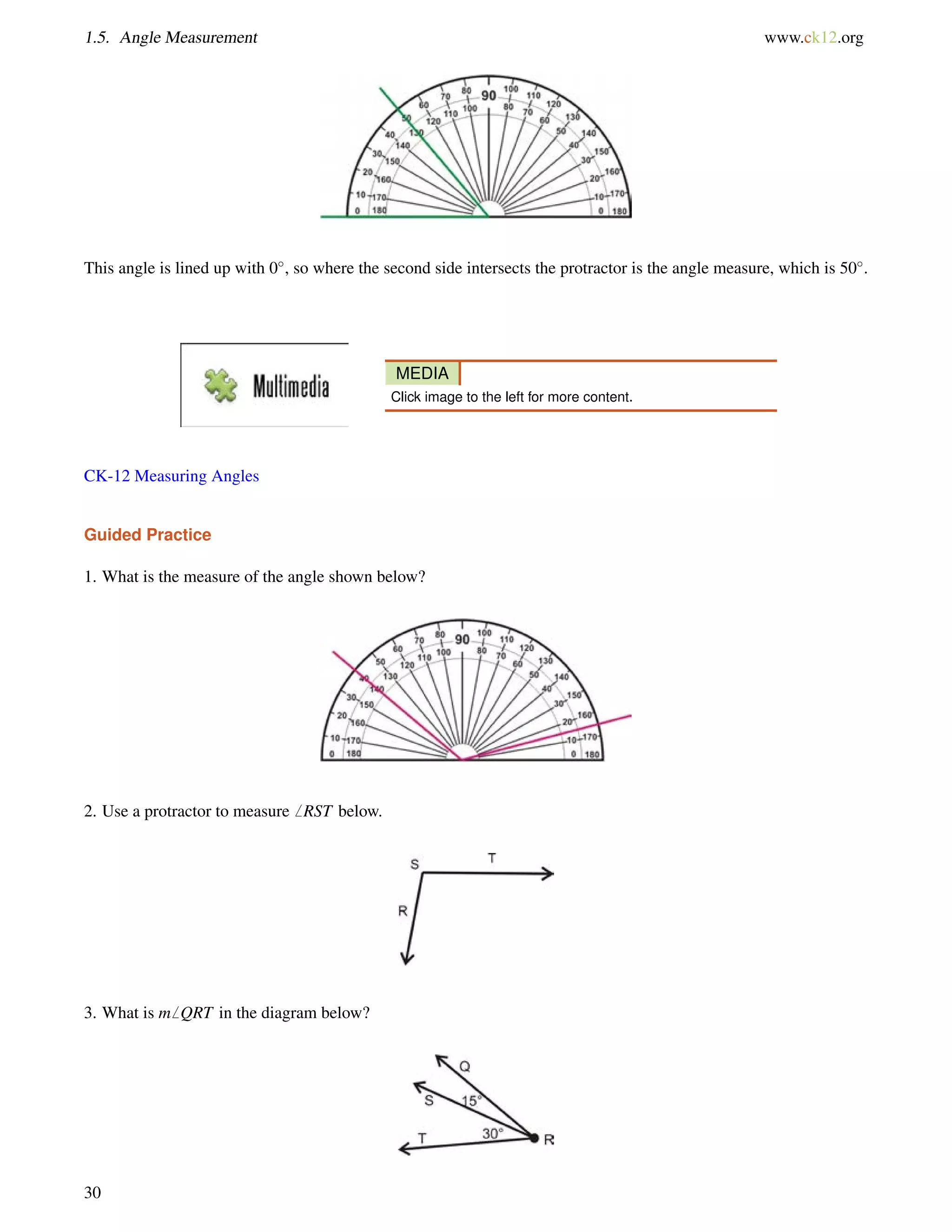
380
www.ck12.org Chapter 7. Similarity 
7.10 Proportions with Angle Bisectors 
Here you’ll learn how to apply the Angle Bisector Theorem, which states that if a ray bisects an angle of a triangle, 
then it divides the opposite side into segments that are proportional to the lengths of the other two sides. 
What if you were told that a ray was an angle bisector of a triangle? How would you use this fact to find unknow 
values regarding the triangle’s side lengths? After completing this Concept, you’ll be able to use the Angle Bisector 
Theorem to solve such problems. 
Watch This 
MEDIA 
Click image to the left for more content. 
CK-12 Foundation: Proportions with AngleBisectors 
First watch this video. 
MEDIA 
Click image to the left for more content. 
James Sousa:Triangle Angle BisectorTheorem 
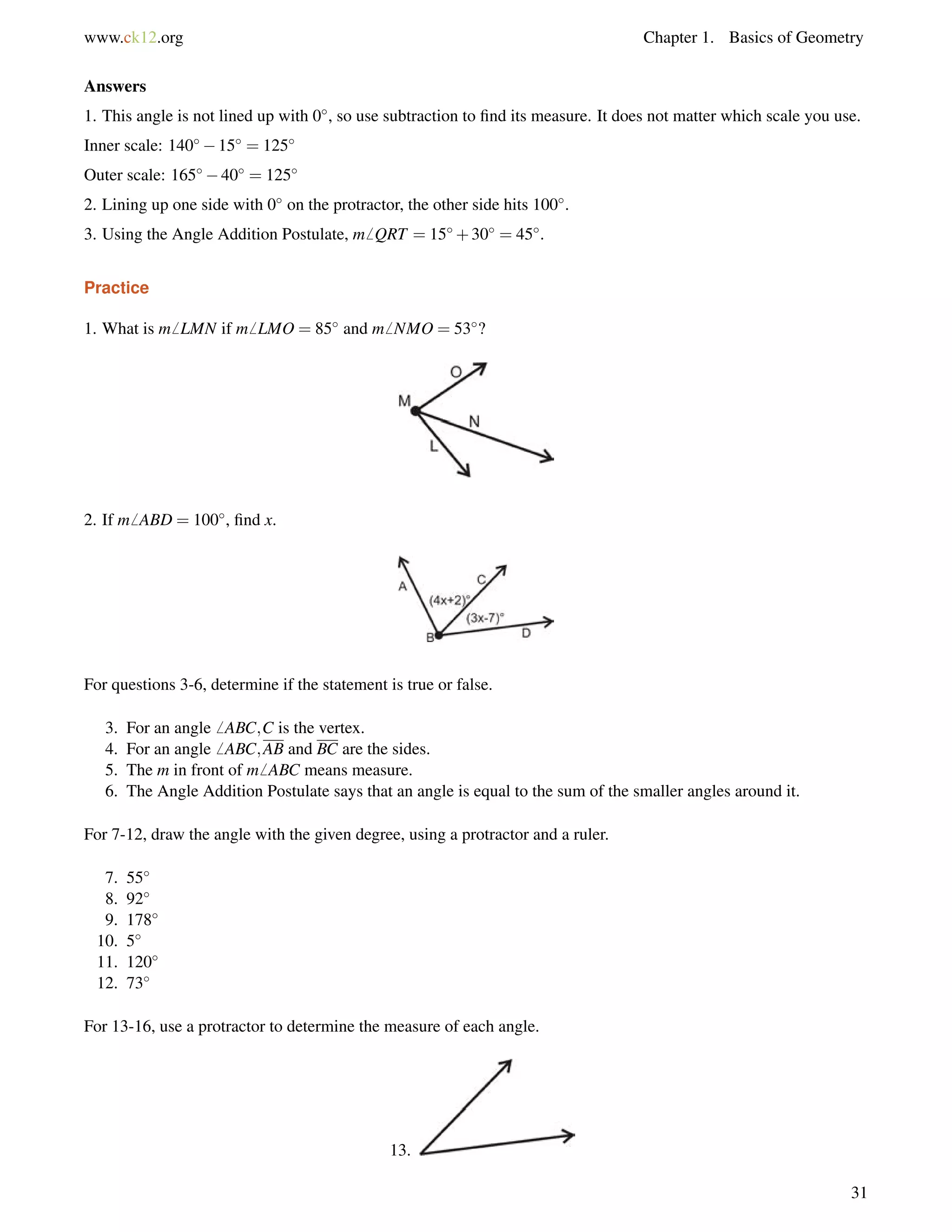
Now watch this video. 
MEDIA 
Click image to the left for more content. 
James Sousa:Using the Triangle Angle Bisector Theorem to Determine Unknown Values 
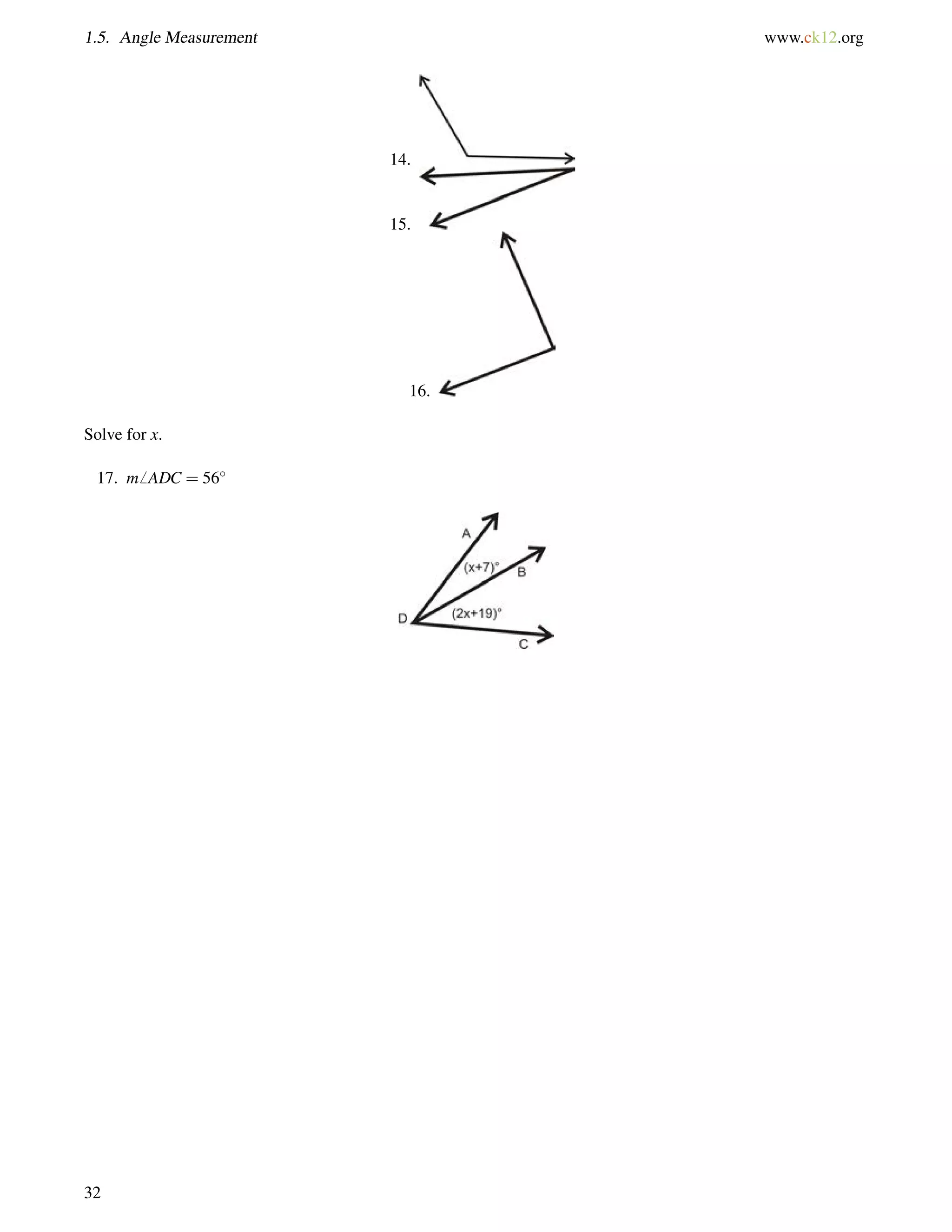
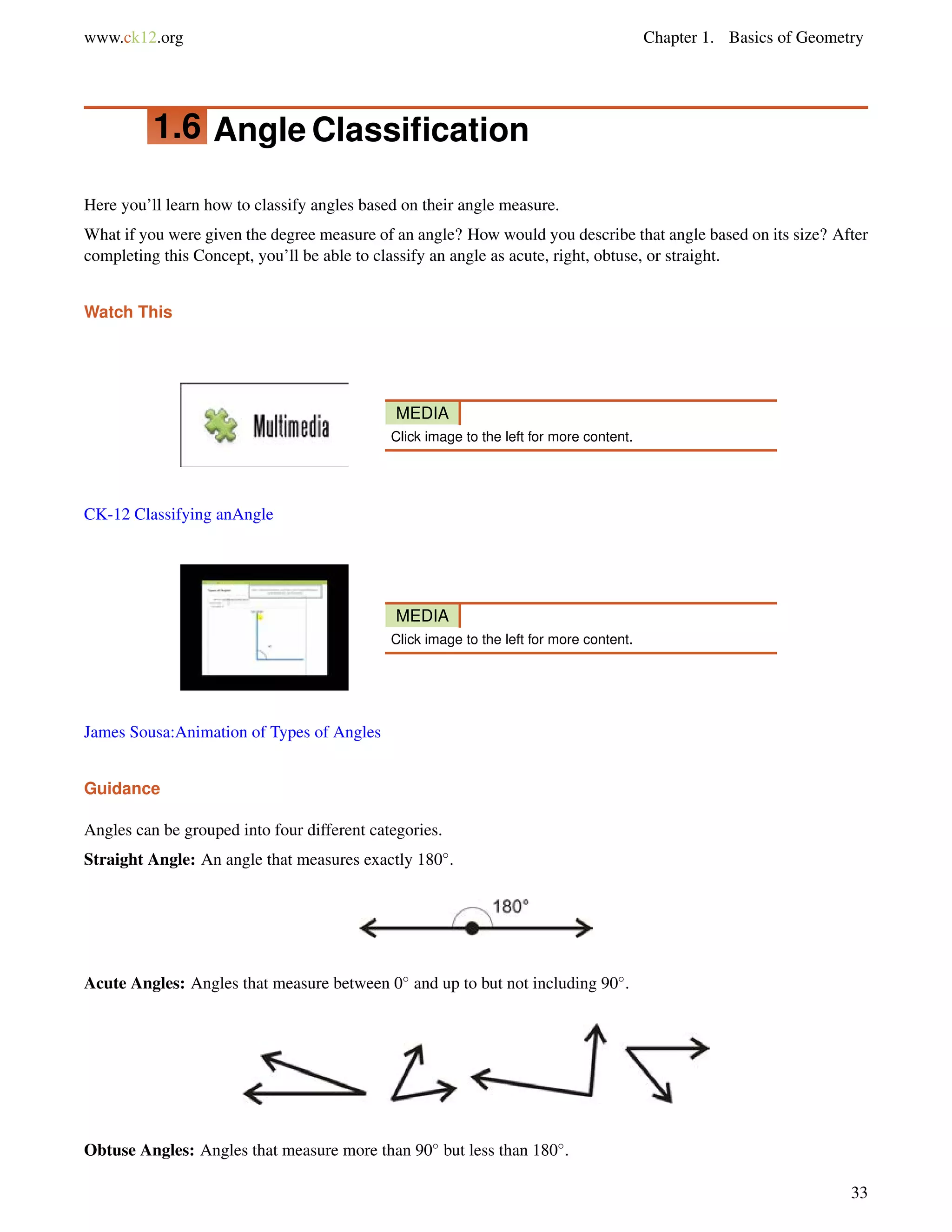
Guidance 
When an angle within a triangle is bisected, the bisector divides the triangle proportionally. This idea is called the 
Angle Bisector Theorem. 
381
7.10. Proportions with Angle Bisectors www.ck12.org 
Angle Bisector Theorem: If a ray bisects an angle of a triangle, then it divides the opposite side into segments that 
are proportional to the lengths of the other two sides. 
If 4BAC = 
CD = AB 
AD. 
4CAD, then BC 
Example A 
Find x. 
The ray is the angle bisector and it splits the opposite side in the same ratio as the other two sides. The proportion is: 
9 
x 
= 
21 
14 
21x = 126 
x = 6 
Example B 
Find the value of x that would make the proportion true. 
You can set up this proportion like the previous example. 
382
www.ck12.org Chapter 7. Similarity 
5 
3 
= 
4x+1 
15 
75 = 3(4x+1) 
75 = 12x+3 
72 = 12x 
6 = x 
Example C 
Find the missing variable: 
Set up a proportion and solve like in the previous examples. 
12 
4 
= 
x 
3 
36 = 4x 
x = 9 
MEDIA 
Click image to the left for more content. 
CK-12 Foundation: Proportions with AngleBisectors 
Guided Practice 
Find the missing variables: 
1. 
383
7.10. Proportions with Angle Bisectors www.ck12.org 
2. 
3. 
Answers: 
1. Set up a proportion and solve. 
20 
8 
= 
25 
y 
20y = 200 
y = 10 
2. Set up a proportion and solve. 
20 
y 
= 
15 
28y 
15y = 20(28y) 
15y = 56020y 
35y = 560 
y = 16 
384
www.ck12.org Chapter 7. Similarity 
3. Set up a proportion and solve. 
12 
z 
= 
15 
9z 
15z = 12(9z) 
15z = 108 = 12z 
27z = 108 
z = 4 
Practice 
Find the value of the missing variable(s). 
1. 
2. 
Solve for the unknown variable. 
3. 
385
7.10. Proportions with Angle Bisectors www.ck12.org 
4. 
5. 
6. 
386
www.ck12.org Chapter 7. Similarity 
7. 
8. 
9. 
387
7.10. Proportions with Angle Bisectors www.ck12.org 
10. 
11. 
12. 
388
www.ck12.org Chapter 7. Similarity 
13. 
14. 
15. 
389
7.11. Dilation www.ck12.org 
7.11 Dilation 
Here you’ll learn what a dilation is, how to dilate a figure, and how to find the scale factor by which the figure is 
dilated. 
What if you enlarged or reduced a triangle without changing its shape? How could you find the scale factor by which 
the triangle was stretched or shrunk? After completing this Concept, you’ll be able to use the corresponding sides 
of dilated figures to solve problems like this one. 
Watch This 
MEDIA 
Click image to the left for more content. 
CK-12 Foundation: Dilation 
Guidance 
Two figures are similar if they are the same shape but not necessarily the same size. One way to create similar 
figures is by dilating. A dilation makes a figure larger or smaller but the new resulting figure has the same shape as 
the original. 
Dilation: An enlargement or reduction of a figure that preserves shape but not size. All dilations are similar to the 
original figure. 
Dilations have a center and a scale factor. The center is the point of reference for the dilation and the scale factor 
tells us how much the figure stretches or shrinks. A scale factor is labeled k. Only positive scale factors, k, will be 
considered in this text. 
If the dilated image is smaller than the original, then 0  k  1. 
If the dilated image is larger than the original, then k  1. 
A dilation, or image, is always followed by a 0. 
TABLE 7.2: 
Label It Say It 
0 “prime” (copy of the original) 
A0 “a prime” (copy of point A) 
A00 “a double prime” (second copy) 
Example A 
The center of dilation is P and the scale factor is 3. 
390
www.ck12.org Chapter 7. Similarity 
Find Q0. 
If the scale factor is 3 and Q is 6 units away from P, then Q0 is going to be 63 = 18 units away from P. The dilated 
image will be on the same line as the original image and center. 
Example B 
Using the picture above, change the scale factor to 13 
. 
Find Q00 using this new scale factor. 
The scale factor is 1 
3 , so Q00 is going to be 6 1 
3 = 2 units away from P. Q00 will also be collinear with Q and center. 
Example C 
KLMN is a rectangle. If the center of dilation is K and k = 2, draw K0L0M0N0. 
391
7.11. Dilation www.ck12.org 
If K is the center of dilation, then K and K0 will be the same point. From there, L0 will be 8 units above L and N0 will 
be 12 units to the right of N. 
MEDIA 
Click image to the left for more content. 
CK-12 Foundation: Dilation 
Guided Practice 
1. Find the perimeters of KLMN and K0L0M0N0. Compare this ratio to the scale factor. 
2. 4ABC is a dilation of 4DEF. If P is the center of dilation, what is the scale factor? 
392
www.ck12.org Chapter 7. Similarity 
3. Find the scale factor, given the corresponding sides. In the diagram, the black figure is the original and P is the 
center of dilation. 
Answers: 
1. The perimeter of KLMN = 12+8+12+8 = 40. The perimeter of K0L0M0N0 = 24+16+24+16 = 80. The ratio 
is 80:40, which reduces to 2:1, which is the same as the scale factor. 
2. Because 4ABC is a dilation of 4DEF, then 4ABC  4DEF. The scale factor is the ratio of the sides. Since 
4ABC is smaller than the original, 4DEF, the scale factor is going to be less than one, 12 
20 = 35 
. 
If 4DEF was the dilated image, the scale factor would have been 53 
. 
20 = 25 
3. Since the dilation is smaller than the original, the scale factor is going to be less than one. 8 
Practice 
For the given shapes, draw the dilation, given the scale factor and center. 
1. k = 3:5, center is A 
2. k = 2, center is D 
393
7.11. Dilation www.ck12.org 
3. k = 3 
4 , center is A 
4. k = 25 
, center is A 
In the four questions below, you are told the scale factor. Determine the dimensions of the dilation. In each diagram, 
the black figure is the original and P is the center of dilation. 
5. k = 4 
6. k = 13 
7. k = 2:5 
394
www.ck12.org Chapter 7. Similarity 
8. k = 1 
4 
In the three questions below, find the scale factor, given the corresponding sides. In each diagram, the black figure 
is the original and P is the center of dilation. 
9. 
10. 
11. 
395
7.12. Dilation in the Coordinate Plane www.ck12.org 
7.12 Dilation in the Coordinate Plane 
Here you’ll learn how to draw dilated figures in the coordinate plane given starting coordinates and the scale factor. 
You’ll also learn how to use dilated figures in the coordinate plane to find scale factors. 
What if you were given the coordinates of a figure and were asked to dilate that figure by a scale factor of 2? How 
could you find the coordinates of the dilated figure? After completing this Concept, you’ll be able to solve problems 
like this one. 
Watch This 
MEDIA 
Click image to the left for more content. 
CK-12 Foundation: Dilation in the CoordinatePlane 
Guidance 
Two figures are similar if they are the same shape but not necessarily the same size. One way to create similar figures 
is by dilating. A dilation makes a figure larger or smaller such that the new image has the same shape as the original. 
Dilation: An enlargement or reduction of a figure that preserves shape but not size. All dilations are similar to the 
original figure. 
Dilations have a center and a scale factor. The center is the point of reference for the dilation and the scale factor 
tells us how much the figure stretches or shrinks. A scale factor is labeled k. Only positive scale factors, k, will be 
considered in this text. 
If the dilated image is smaller than the original, then 0  k  1. 
If the dilated image is larger than the original, then k  1. 
To dilate something in the coordinate plane, multiply each coordinate by the scale factor. This is called mapping. 
For any dilation the mapping will be (x;y)!(kx;ky). In this text, the center of dilation will always be the origin. 
Example A 
Quadrilateral EFGH has vertices E(4;2);F(1;4);G(6;2) and H(0;4). Draw the dilation with a scale factor of 
1.5. 
396
www.ck12.org Chapter 7. Similarity 
Remember that to dilate something in the coordinate plane, multiply each coordinate by the scale factor. 
For this dilation, the mapping will be (x;y)!(1:5x;1:5y). 
amp;E(4;2)!(1:5(4);1:5(2))!E0(6;3) 
amp;F(1;4)!(1:5(1);1:5(4))!F0(1:5;6) 
amp;G(6;2)!(1:5(6);1:5(2))!G0(9;3) 
amp;H(0;4)!(1:5(0);1:5(4))!H0(0;6) 
In the graph above, the blue quadrilateral is the original and the red image is the dilation. 
Example B 
Determine the coordinates of 4ABC and 4A0B0C0 and find the scale factor. 
The coordinates of the vertices of 4ABC are A(2;1), B(5;1) and C(3;6). The coordinates of the vertices of 4A0B0C0 
are A0(6;3);B0(15;3) and C0(9;18). Each of the corresponding coordinates are three times the original, so k = 3. 
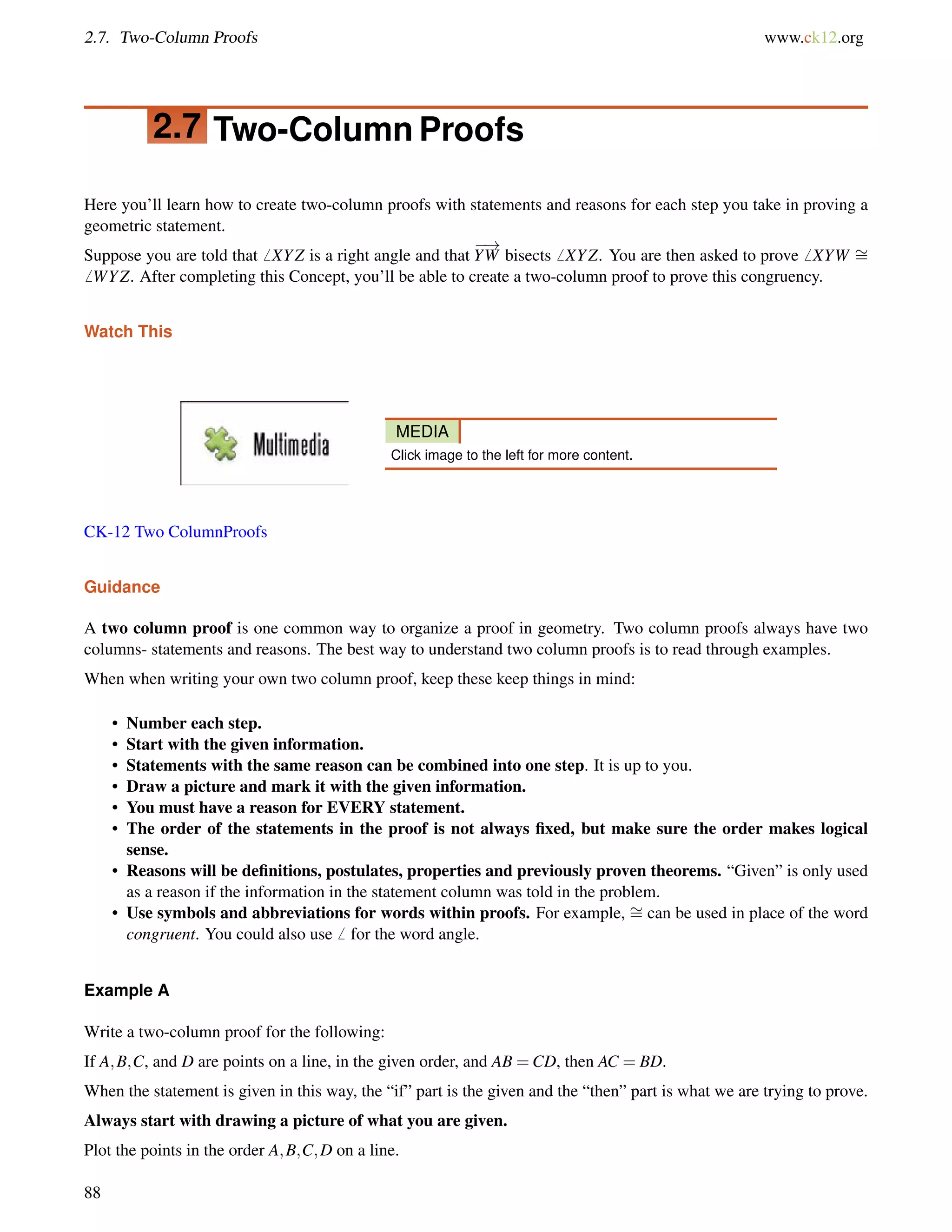
397
7.12. Dilation in the Coordinate Plane www.ck12.org 
Example C 
Show that dilations preserve shape by using the distance formula. Find the lengths of the sides of both triangles in 
Example B. 
4ABC 4A0B0C0 
q 
AB = 
(25)2+(11)2 = 
p 
9 = 3 A0B0 = 
q 
(615)2+(33)2 = 
p 
81 = 9 
AC = 
q 
(23)2+(16)2 = 
p 
26 A0C0 = 
q 
(69)2+(318)2 = 
p 
234 = 3 
p 
26 
CB = 
q 
(35)2+(61)2 = 
p 
29 C0B0 = 
q 
(915)2+(183)2 = 
p 
261 = 3 
p 
29 
From this, we also see that all the sides of 4A0B0C0 are three times larger than 4ABC. 
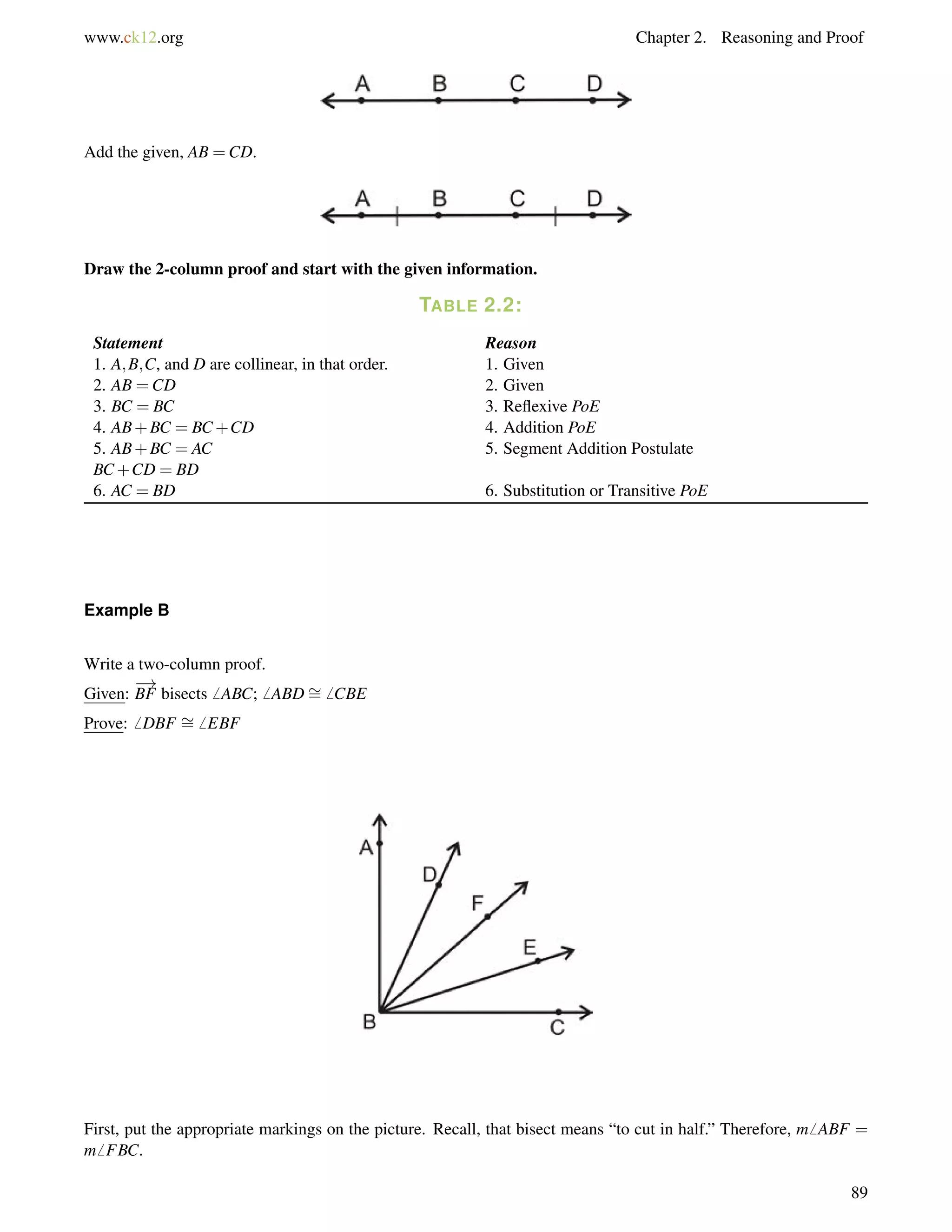
MEDIA 
Click image to the left for more content. 
CK-12 Foundation: Dilation in the CoordinatePlane 
Guided Practice 
Given A and the scale factor, determine the coordinates of the dilated point, A0. You may assume the center of 
dilation is the origin. 
1. A(3;9);k = 23 
2. A(4;6);k = 2 
3. A(9;13);k = 1 
2 
Answers 
Remember that the mapping will be (x;y)!(kx;ky). 
1. A0(2;6) 
2. A0(8;12) 
3. A0(4:5;6:5) 
Practice 
Given A and A0, find the scale factor. You may assume the center of dilation is the origin. 
1. A(8;2);A0(12;3) 
2. A(5;9);A0(45;81) 
3. A(22;7);A(11;3:5) 
The origin is the center of dilation. Draw the dilation of each figure, given the scale factor. 
398
www.ck12.org Chapter 7. Similarity 
4. A(2;4);B(3;7);C(1;2); k = 3 
5. A(12;8);B(4;16);C(0;10); k = 3 
4 
Multi-Step Problem Questions 6-9 build upon each other. 
6. Plot A(1;2);B(12;4);C(10;10). Connect to form a triangle. 
7. Make the origin the center of dilation. Draw 4 rays from the origin to each point from #21. Then, plot 
A0(2;4);B0(24;8);C0(20;20). What is the scale factor? 
8. Use k = 4, to find A00B00C00. Plot these points. 
9. What is the scale factor from A0B0C0 to A00B00C00? 
If O is the origin, find the following lengths (using 6-9 above). Round all answers to the nearest hundredth. 
10. OA 
11. AA0 
12. AA00 
13. OA0 
14. OA00 
15. AB 
16. A0B0 
17. A00B00 
18. Compare the ratios OA : OA0 and AB : A0B0. What do you notice? Why do you think that is? 
19. Compare the ratios OA : OA00 and AB : A00B00. What do you notice? Why do you think that is? 
399
7.13. Self-Similarity www.ck12.org 
7.13 Self-Similarity 
Here you’ll learn what it means for an object to be self-similar and you’ll be introduced to some common examples 
of self-similarity. 
What if you were given an object, like a triangle or a snowflake, in which a part of it could be enlarged (or shrunk) 
to look like the whole object? What would each successive iteration of that object look like? After completing this 
Concept, you’ll be able to use the idea of self-similarity to answer questions like this one. 
Watch This 
MEDIA 
Click image to the left for more content. 
CK-12 Foundation: Self-Similarity 
Guidance 
When one part of an object can be enlarged (or shrunk) to look like the whole object it is self-similar. 
To explore self-similarity, we will go through some examples. Typically, each step of a process is called an iteration. 
The first level is called Stage 0. 
Example A (Sierpinski Triangle) 
The Sierpinski triangle iterates a triangle by connecting the midpoints of the sides and shading the central triangle 
(Stage 1). Repeat this process for the unshaded triangles in Stage 1 to get Stage 2. 
Example B (Fractals) 
Like the Sierpinski triangle, a fractal is another self-similar object that is repeated at smaller scales. Below are the 
first three stages of the Koch snowflake. 
400
www.ck12.org Chapter 7. Similarity 
Example C (The Cantor Set) 
The Cantor set is another example of a fractal. It consists of dividing a segment into thirds and then erasing the 
middle third. 
MEDIA 
Click image to the left for more content. 
CK-12 Foundation: Self-Similarity 
Guided Practice 
1. Determine the number of edges and the perimeter of each snowflake shown in Example B. Assume that the length 
of one side of the original (stage 0) equilateral triangle is 1. 
2. Determine the number of shaded and unshaded triangles in each stage of the Sierpinkski triangle. Determine if 
there is a pattern. 
3. Determine the number of segments in each stage of the Cantor Set. Is there a pattern? 
Answers: 
1. 
TABLE 7.3: 
Stage 0 Stage 1 Stage 2 
Number of Edges 3 12 48 
Edge Length 1 13 
19 
Perimeter 3 4 48 
9 = 15 
3 
2. 
TABLE 7.4: 
Stage 0 Stage 1 Stage 2 Stage 3 
Unshaded 1 3 9 27 
401
7.13. Self-Similarity www.ck12.org 
TABLE 7.4: (continued) 
Stage 0 Stage 1 Stage 2 Stage 3 
Shaded 0 1 4 13 
The number of unshaded triangles seems to be powers of 3 : 30;31;32;33; : : :. The number of shaded triangles is the 
sum the the number of shaded and unshaded triangles from the previous stage. For Example, the number of shaded 
triangles in Stage 4 would equal 27 + 13 = 40. 
3. Starting from Stage 0, the number of segments is 1;2;4;8;16; : : :. These are the powers of 2. 20;21;22; : : :. 
Practice 
1. Draw Stage 4 of the Cantor set. 
2. Use the Cantor Set to fill in the table below. 
TABLE 7.5: 
Number of Segments Length of each Segment Total Length of the Seg-ments 
Stage 0 1 1 1 
Stage 1 2 13 
23 Stage 49 
19 
2 4 Stage 3 
Stage 4 
Stage 5 
3. How many segments are in Stage n? 
4. Draw Stage 3 of the Koch snowflake. 
5. A variation on the Sierpinski triangle is the Sierpinski carpet, which splits a square into 9 equal squares, 
coloring the middle one only. Then, split the uncolored squares to get the next stage. Draw the first 3 stages 
of this fractal. 
6. How many colored vs. uncolored square are in each stage? 
7. Fractals are very common in nature. For example, a fern leaf is a fractal. As the leaves get closer to the end, 
they get smaller and smaller. Find three other examples of fractals in nature. 
402
www.ck12.org Chapter 7. Similarity 
Summary 
This chapter is all about proportional relationships. It begins by introducing the concept of ratio and proportion 
and detailing properties of proportions. It then takes these arithmetic and algebraic relationships and connects them 
to the geometric relationships of similar polygons. Applications of similar polygons and scale factors are covered. 
The AA, SSS, and SAS methods of determining similar triangles are presented and the Triangle Proportionality 
Theorem is explored. The chapter wraps up with the proportional relationships formed when parallel lines are cut 
by a transversal, similarity and dilated figures, and self-similarity. 
403
www.ck12.org 
CHAPTER 8 Right Triangle Trigonometry 
Chapter Outline 
8.1 EXPRESSIONS WITH RADICALS 
8.2 PYTHAGOREAN THEOREM AND PYTHAGOREAN TRIPLES 
8.3 APPLICATIONS OF THE PYTHAGOREAN THEOREM 
8.4 INSCRIBED SIMILAR TRIANGLES 
8.5 45-45-90 RIGHT TRIANGLES 
8.6 30-60-90 RIGHT TRIANGLES 
8.7 SINE, COSINE, TANGENT 
8.8 TRIGONOMETRIC RATIOS WITH A CALCULATOR 
8.9 TRIGONOMETRY WORD PROBLEMS 
8.10 INVERSE TRIGONOMETRIC RATIOS 
Introduction 
This chapter takes a look at right triangles. A right triangle is a triangle with exactly one right angle. In this chapter, 
we will prove the Pythagorean Theorem and its converse. Then, we will discuss trigonometry ratios and inverse 
ratios. 
404
www.ck12.org Chapter 8. Right Triangle Trigonometry 
8.1 Expressions with Radicals 
Here you’ll learn how to simplify expressions containing radicals. 
What if you were asked to find the sum of 
p 
32 and 3 
p 
8? How could you combine these two terms so that you 
could add them? After completing this lesson, you’ll be able to simplify radical terms and expressions like these. 
Watch This 
MEDIA 
Click image to the left for more content. 
CK-12 Foundation: Simplifying Radicals Review 
Guidance 
In algebra, you learned how to simplify radicals. Let’s review it here. Some key points to remember: 
1. One way to simplify a radical is to factor out the perfect squares (see Example A). 
2. When adding radicals, you can only combine radicals with the same number underneath it. For example, 
2 
p 
5+3 
p 
6 cannot be combined, because 5 and 6 are not the same number (see Example B). 
3. To multiply two radicals, multiply what is under the radicals and what is in front (see Example B). 
4. To divide radicals, you need to simplify the denominator, which means multiplying the top and bottom of the 
fraction by the radical in the denominator (see Example C). 
Example A 
Simplify the radicals. 
a) 
p 
50 
b) 
p 
27 
p 
c) 
272 
Answers: For each radical, find the square number(s) that are factors. 
p 
p 
p 
a) 
50 = 
25  2 = 5 
2 
b) 
p 
27 = 
p 
9  3 = 3 
p 
3 
c) 
p 
272 = 
p 
16  17 = 4 
p 
17 
Example B 
Simplify the radicals. 
405
8.1. Expressions with Radicals www.ck12.org 
a) 2 
p 
10+ 
p 
160 
b) 5 
p 
6  4 
p 
18 
c) 
p 
8  12 
p 
2 
d) 
 
5 
p 
2 
2 
Answers: 
a) Simplify 
p 
160 before adding: 2 
p 
10+ 
p 
160 = 2 
p 
10+ 
p 
16  10 = 2 
p 
10+4 
p 
10 = 6 
p 
10 
b) 5 
p 
6  4 
p 
18 = 5  4 
p 
6  18 = 20 
p 
108 = 20 
p 
36  3 = 20  6 
p 
3 = 120 
p 
3 
c) 
p 
8  12 
p 
2 = 12 
p 
8  2 = 12 
p 
16 = 12  4 = 48 
d) 
 
5 
p 
2 
2 
= 52 
p 
2 
2 
= 25  2 = 50! the p and the 2 cancel each other out 
Example C 
Divide and simplify the radicals. 
p 
p 
a) 4 
6 
3 
b) 
p 
p30 
8 
p 
2 
6 
c) 8 
p 
7 
Answers: Rewrite all division problems like a fraction. 
a) 
b) 
p 
p30 
8 
 
p 
p8 
8 
= 
p 
p240 
64 
= 
p 
16  15 
8 = 4 
p 
15 
8 = 
p 
15 
2 
p 
2 
6 
c) 8 
p 
7 
 
p 
p7 
7 
= 8 
p 
14 
67 = 4 
p 
14 
37 = 4 
p 
14 
21 
Notice, we do not really “divide” radicals, but get them out of the denominator of a fraction. 
MEDIA 
Click image to the left for more content. 
CK-12 Foundation: Simplifying Radicals Review 
Guided Practice 
Simplify the radicals. 
1. 
p 
75 
406
www.ck12.org Chapter 8. Right Triangle Trigonometry 
2. 2 
p 
5+3 
p 
80 
p 
3. 
p45 
2 
Answers: 
1. 
p 
75 = 
p 
25  3 = 5 
p 
3 
2. 2 
p 
5+3 
p 
80 = 2 
p 
5+3( 
p 
16  5) = 2 
p 
5+(3  4) 
p 
5 = 14 
p 
5 
3. 
p 
p45 
2 
 
p 
p2 
2 
= 
p 
p90 
4 
= 
p 
9  10 
2 = 3 
p 
10 
2 
Practice 
Simplify the radicals. 
1. 
p 
48 
2. 2 
p 
5+ 
p 
20 
3. 
p 
24 
4. 
 
6 
p 
3 
2 
5. 8 
p 
8  
p 
10 
6. 
 
2 
2 
p 
30 
7. 
p 
320 
p 
p5 
6 
8. 4 
9. p12 
10 
10. 21 
p 
5 
9 
p 
15 
407
8.2. Pythagorean Theorem and Pythagorean Triples www.ck12.org 
8.2 Pythagorean Theorem and Pythagorean 
Triples 
Here you’ll learn how to use the Pythagorean Theorem, which states that given a right triangle with legs of lengths 
a and b and a hypotenuse of length c, a2+b2 = c2. You’ll also learn the theorem’s converse and what a Pythagorean 
Triple is. 
What if you were told that a triangle had side lengths of 5, 12, and 13? How could you determine if the triangle were 
a right one? After completing this Concept, you’ll be able to use the Pythagorean Theorem to solve problems like 
this one. 
Watch This 
MEDIA 
Click image to the left for more content. 
CK-12 Foundation: Using The Pythagorean Theorem 
MEDIA 
Click image to the left for more content. 
James Sousa:PythagoreanTheorem 
Guidance 
The two shorter sides of a right triangle (the sides that form the right angle) are the legs and the longer side (the 
side opposite the right angle) is the hypotenuse. For the Pythagorean Theorem, the legs are “a” and “b” and the 
hypotenuse is “c”. 
Pythagorean Theorem: Given a right triangle with legs of lengths a and b and a hypotenuse of length c, a2+b2 =c2. 
408
www.ck12.org Chapter 8. Right Triangle Trigonometry 
For proofs of the Pythagorean Theorem go to: http://www.mathsisfun.com/pythagoras.html and scroll down to “And 
You Can Prove the Theorem Yourself.” 
The converse of the Pythagorean Theorem is also true. It allows you to prove that a triangle is a right triangle even 
if you do not know its angle measures. 
Pythagorean Theorem Converse: If the square of the longest side of a triangle is equal to the sum of the squares 
of the other two sides, then the triangle is a right triangle. 
If a2+b2 = c2, then 4ABC is a right triangle. 
Pythagorean Triples 
A combination of three numbers that makes the Pythagorean Theorem true is called a Pythagorean triple. Each set 
of numbers below is a Pythagorean triple. 
3;4;5 5;12;13 7;24;25 8;15;17 9;12;15 10;24;26 
Any multiple of a Pythagorean triple is also considered a Pythagorean triple. Multiplying 3, 4, 5 by 2 gives 6, 8, 
10, which is another triple. To see if a set of numbers makes a Pythagorean triple, plug them into the Pythagorean 
Theorem. 
Example A 
Do 6, 7, and 8 make the sides of a right triangle? 
Plug the three numbers into the Pythagorean Theorem. Remember that the largest length will always be the 
hypotenuse, c. If 62+72 = 82, then they are the sides of a right triangle. 
62+72 = 36+49 = 85 
82 = 64 856= 64; so the lengths are not the sides of a right triangle. 
409
8.2. Pythagorean Theorem and Pythagorean Triples www.ck12.org 
Example B 
Find the length of the hypotenuse. 
Use the Pythagorean Theorem. Set a = 8 and b = 15. Solve for c. 
82+152 = c2 
64+225 = c2 
289 = c2 Take the square root o f both sides: 
17 = c 
Example C 
Is 20, 21, 29 a Pythagorean triple? 
If 202+212 = 292, then the set is a Pythagorean triple. 
202+212 = 400+441 = 841 
292 = 841 
Therefore, 20, 21, and 29 is a Pythagorean triple. 
Example D 
Determine if the triangles below are right triangles. 
a) 
b) 
410
www.ck12.org Chapter 8. Right Triangle Trigonometry 
Check to see if the three lengths satisfy the Pythagorean Theorem. Let the longest side represent c. 
a) 
a2+b2 = c2 
82+162 ?= 
 
8 
p 
5 
2 
64+256 ?= 
64  5 
320 = 320 Yes 
b) 
a2+b2 = c2 
222+242 ?= 
262 
484+576 ?= 
676 
10606= 676 No 
MEDIA 
Click image to the left for more content. 
CK-12 Foundation: Using The Pythagorean Theorem 
Guided Practice 
1. Find the missing side of the right triangle below. 
2. What is the diagonal of a rectangle with sides 10 and 16? 
411
8.2. Pythagorean Theorem and Pythagorean Triples www.ck12.org 
3. Do the following lengths make a right triangle? 
p 
p 
a) 
5;3; 
14 
b) 6;2 
p 
3;8 
c) 3 
p 
2;4 
p 
2;5 
p 
2 
Answers: 
1. Here, we are given the hypotenuse and a leg. Let’s solve for b. 
72+b2 = 142 
49+b2 = 196 
b2 = 147 
b = 
p 
147 = 
p 
49  3 = 7 
p 
3 
2. For any square and rectangle, you can use the Pythagorean Theorem to find the length of a diagonal. Plug in the 
sides to find d. 
102+162 = d2 
100+256 = d2 
356 = d2 
d = 
p 
356 = 2 
p 
89  18:87 
3. Even though there is no picture, you can still use the Pythagorean Theorem. Again, the longest length will be c. 
a) 
p 
2 
5 
+32 = 
p 
142 
5+9 = 14 
Yes 
b) 
62+ 
 
2 
p 
3 
2 
= 82 
36+(4  3) = 64 
36+126= 64 
c) This is a multiple of 
p 
2 of a 3, 4, 5 right triangle. Yes, this is a right triangle. 
412
www.ck12.org Chapter 8. Right Triangle Trigonometry 
Practice 
Find the length of the missing side. Simplify all radicals. 
1. 
2. 
3. 
4. 
5. 
6. 
7. If the legs of a right triangle are 10 and 24, then the hypotenuse is __________. 
8. If the sides of a rectangle are 12 and 15, then the diagonal is _____________. 
9. If the sides of a square are 16, then the diagonal is ____________. 
10. If the sides of a square are 9, then the diagonal is _____________. 
Determine if the following sets of numbers are Pythagorean Triples. 
11. 12, 35, 37 
12. 9, 17, 18 
13. 10, 15, 21 
14. 11, 60, 61 
15. 15, 20, 25 
413
8.2. Pythagorean Theorem and Pythagorean Triples www.ck12.org 
16. 18, 73, 75 
Determine if the following lengths make a right triangle. 
17. 7, 24, 25 
18. 
p 
5;2 
p 
10;3 
p 
5 
19. 2 
p 
3; 
p 
6;8 
20. 15, 20, 25 
21. 20, p 
25, 30 
22. 8 
3;6;2 
p 
39 
414
www.ck12.org Chapter 8. Right Triangle Trigonometry 
8.3 Applications of the Pythagorean Theorem 
Here you’ll learn how to use the Pythagorean Theorem to find the altitude of an isosceles triangle and to determine 
if a triangle is acute, obtuse, or right. 
What if you were given an equilateral triangle in which all the sides measured 4 inches? How could you use the 
Pythagorean Theorem to find the triangle’s altitude? After completing this Concept, you’ll be able to solve problems 
like this one. 
Watch This 
MEDIA 
Click image to the left for more content. 
CK-12 Foundation: Applications of the Pythagorean Theorem 
MEDIA 
Click image to the left for more content. 
James Sousa:PythagoreanTheoremandItsConverse 
Guidance 
Find the Height of an Isosceles Triangle 
One way to use The Pythagorean Theorem is to find the height of an isosceles triangle (see Example A). 
Prove the Distance Formula 
Another application of the Pythagorean Theorem is the Distance Formula. We will prove it here. 
415
8.3. Applications of the Pythagorean Theorem www.ck12.org 
Let’s start with point A(x1;y1) and point B(x2;y2). We will call the distance between A and B;d. 
Draw the vertical and horizontal lengths to make a right triangle. 
Now that we have a right triangle, we can use the Pythagorean Theorem to find the hypotenuse, d. 
d2 = (x1x2)2+(y1y2)2 
q 
d = 
(x1x2)2+(y1y2)2 
Distance Formula: The distance between A(x1;y1) and B(x2;y2) is d = 
q 
(x1x2)2+(y1y2)2. 
Classify a Triangle as Acute, Right, or Obtuse 
We can extend the converse of the Pythagorean Theorem to determine if a triangle is an obtuse or acute triangle. 
Acute Triangles: If the sum of the squares of the two shorter sides in a right triangle is greater than the square of 
the longest side, then the triangle is acute. 
416
www.ck12.org Chapter 8. Right Triangle Trigonometry 
For b  c and a  c, if a2+b2  c2, then the triangle is acute. 
Obtuse Triangles: If the sum of the squares of the two shorter sides in a right triangle is less than the square of the 
longest side, then the triangle is obtuse. 
For b  c and a  c, if a2+b2  c2, then the triangle is obtuse. 
Example A 
What is the height of the isosceles triangle? 
Draw the altitude from the vertex between the congruent sides, which will bisect the base. 
72+h2 = 92 
49+h2 = 81 
h2 = 32 
h = 
p 
32 = 
p 
16  2 = 4 
p 
2 
Example B 
Find the distance between (1, 5) and (5, 2). 
Make A(1;5) and B(5;2). Plug into the distance formula. 
d = 
q 
(15)2+(52)2 
= 
q 
(4)2+(3)2 
= 
p 
16+9 = 
p 
25 = 5 
417
8.3. Applications of the Pythagorean Theorem www.ck12.org 
Just like the lengths of the sides of a triangle, distances are always positive. 
Example C 
Graph A(4;1);B(3;8), and C(9;6). Determine if 4ABC is acute, obtuse, or right. 
Use the distance formula to find the length of each side. 
AB = 
q 
(43)2+(18)2 = 
p 
49+49 = 
p 
98 
BC = 
q 
(39)2+(86)2 = 
p 
36+4 = 
p 
40 
AC = 
q 
(49)2+(16)2 = 
p 
169+25 = 
p 
194 
Plug these lengths into the Pythagorean Theorem. 
p 
2 
98 
+ 
p 
2 
40 
? 
p 
2 
194 
98+40 ? 194 
138  194 
4ABC is an obtuse triangle. 
MEDIA 
Click image to the left for more content. 
CK-12 Foundation: Applications of the Pythagorean Theorem 
418
www.ck12.org Chapter 8. Right Triangle Trigonometry 
Guided Practice 
Determine if the following triangles are acute, right or obtuse. 
1. 
2. 
3. A triangle with side lengths 5, 12, 13. 
Answers: 
Set the longest side equal to c. 
1. 
62+ 
 
3 
p 
5 
2 
? 82 
36+45 ? 64 
81  64 
The triangle is acute. 
2. 
152+142 ? 212 
225+196 ? 441 
421  441 
The triangle is obtuse. 
3. 52+122 = 132 so this triangle is right. 
Practice 
Find the height of each isosceles triangle below. Simplify all radicals. 
419
8.3. Applications of the Pythagorean Theorem www.ck12.org 
1. 
2. 
3. 
Find the length between each pair of points. 
4. (-1, 6) and (7, 2) 
5. (10, -3) and (-12, -6) 
6. (1, 3) and (-8, 16) 
7. What are the length and width of a 42” HDTV? Round your answer to the nearest tenth. 
8. Standard definition TVs have a length and width ratio of 4:3. What are the length and width of a 42” Standard 
definition TV? Round your answer to the nearest tenth. 
Determine whether the following triangles are acute, right or obtuse. 
9. 7, 8, 9 
10. 14, 48, 50 
11. 5, 12, 15 
12. 13, 84, 85 
13. 20, 20, 24 
14. 35, 40, 51 
15. 39, 80, 89 
16. 20, 21, 38 
17. 48, 55, 76 
Graph each set of points and determine whether 4ABC is acute, right, or obtuse, using the distance formula. 
18. A(3;5);B(5;8);C(2;7) 
19. A(5;3);B(2;7);C(1;5) 
20. A(1;6);B(5;2);C(2;3) 
21. A(6;1);B(4;5);C(5;2) 
420
www.ck12.org Chapter 8. Right Triangle Trigonometry 
8.4 Inscribed Similar Triangles 
Here you’ll learn the Inscribed Similar Triangles Theorem that states that a line drawn from the right angle of a right 
triangle perpendicular to the opposite side of the triangle creates similar triangles. You’ll then use this fact to find 
missing lengths in right triangles. 
What if you drew a line from the right angle of a right triangle perpendicular to the side that is opposite that angle? 
How could you determine the length of that line? After completing this Concept, you’ll be able to solve problems 
like this one. 
Watch This 
MEDIA 
Click image to the left for more content. 
CK-12 Foundation: Inscribed Similar Triangles 
Guidance 
Remember that if two objects are similar, their corresponding angles are congruent and their sides are proportional 
in length. The altitude of a right triangle creates similar triangles. 
Inscribed Similar Triangles Theorem: If an altitude is drawn from the right angle of any right triangle, then the 
two triangles formed are similar to the original triangle and all three triangles are similar to each other. 
In 4ADB;m6 A = 90 and AC?DB: 
So, 4ADB 4CDA 4CAB: 
This means that all of the corresponding sides are proportional. You can use this fact to find missing lengths in right 
triangles. 
421
8.4. Inscribed Similar Triangles www.ck12.org 
Example A 
Find the value of x. 
Separate the triangles to find the corresponding sides. 
Set up a proportion. 
shorter leg in 4EDG 
shorter leg in 4DFG 
= 
hypotenuse in 4EDG 
hypotenuse in 4DFG 
6 
x 
= 
10 
8 
48 = 10x 
4:8 = x 
Example B 
Find the value of x. 
Set up a proportion. 
422
www.ck12.org Chapter 8. Right Triangle Trigonometry 
shorter leg o f smallest 4 
shorter leg o f middle 4 
= 
longer leg o f smallest 4 
longer leg o f middle 4 
9 
x 
= 
x 
27 
x2 = 243 
x = 
p 
243 = 9 
p 
3 
Example C 
Find the values of x and y. 
Separate the triangles. Write a proportion for x. 
20 
x 
= 
x 
35 
x2 = 20  35 
x = 
p 
20  35 
x = 10 
p 
7 
Set up a proportion for y. Or, now that you know the value of x you can use the Pythagorean Theorem to solve for y. 
Use the method you feel most comfortable with. 
15 
y 
= 
y 
35 
(10 
p 
7)2+y2 = 352 
y2 = 15  35 700+y2 = 1225 
y = 
p 
15  35 y = 
p 
525 = 5 
p 
21 
y = 5 
p 
21 
423
8.4. Inscribed Similar Triangles www.ck12.org 
MEDIA 
Click image to the left for more content. 
CK-12 Foundation: Inscribed Similar Triangles 
Guided Practice 
1. Find the value of x. 
2. Now find the value of y in 4RST above. 
3. Write the similarity statement for the right triangles in the diagram. 
Answers: 
1. Set up a proportion. 
shorter leg in 4SVT 
shorter leg in 4RST 
= 
hypotenuse in 4SVT 
hypotenuse in 4RST 
4 
x 
= 
x 
20 
x2 = 80 
x = 
p 
80 = 4 
p 
5 
2. Use the Pythagorean Theorem. 
424
www.ck12.org Chapter 8. Right Triangle Trigonometry 
y2+ 
 
4 
p 
5 
2 
= 202 
y2+80 = 400 
y2 = 320 
y = 
p 
320 = 8 
p 
5 
3. 4ACD 4DCB 4ADB 
Practice 
Fill in the blanks. 
1. 4BAD 4 4 
2. BC 
? = ? 
CD 
3. BC 
AB = AB 
? 
AD = AD 
BD 
4. ? 
Write the similarity statement for the right triangles in each diagram. 
5. 
6. 
Use the diagram to answer questions 7-10. 
425
8.4. Inscribed Similar Triangles www.ck12.org 
7. Write the similarity statement for the three triangles in the diagram. 
8. If JM = 12 and ML = 9, find KM. 
9. Find JK. 
10. Find KL. 
Find the length of the missing variable(s). Simplify all radicals. 
11. 
12. 
13. 
14. 
15. 
426
www.ck12.org Chapter 8. Right Triangle Trigonometry 
16. 
17. 
18. 
19. 
20. 
21. 
22. 
23. Fill in the blanks of the proof for the Inscribed Similar Triangles Theorem. 
Given: 4ABD with AC ? DB and6 DAB is a right angle. 
427
8.4. Inscribed Similar Triangles www.ck12.org 
Prove: 4ABD 4CBA 4CAD 
TABLE 8.1: 
= 
= 
Statement Reason 
1. 1. Given 
2.6 DCA and6 ACB are right angles 2. 
3.6 DAB6 DCA6 ACB 3. 
= 
4. 4. Reflexive PoC 
5. 5. AA Similarity Postulate 
6. B6 B 6. 
7. 4CBA= 
4ABD 7. 
8. 4CAD= 
4CBA 8. 
428
www.ck12.org Chapter 8. Right Triangle Trigonometry 
8.5 45-45-90 Right Triangles 
Here you’ll learn that the sides of a 45-45-90 right triangle are in the ratio x : x : x 
p 
2. 
What if you were given an isosceles right triangle and the length of one of its sides? How could you figure out 
the lengths of its other sides? After completing this Concept, you’ll be able to use the 45-45-90 Theorem to solve 
problems like this one. 
Watch This 
MEDIA 
Click image to the left for more content. 
CK-12 Foundation: Special Right Triangle: 45-45-90 
Watch the second half of this video. 
MEDIA 
Click image to the left for more content. 
James Sousa:Trigonometric Function Values of Special Angles 
Now watch the second half of this video. 
MEDIA 
Click image to the left for more content. 
James Sousa:SolvingSpecialRight Triangles 
Guidance 
A right triangle with congruent legs and acute angles is an Isosceles Right Triangle. This triangle is also called a 
45-45-90 triangle (named after the angle measures). 
429
8.5. 45-45-90 Right Triangles www.ck12.org 
4ABC is a right triangle with m6 A = 90, AB= 
AC and m6 B = m6 C = 45. 
45-45-90 Theorem: If a right triangle is isosceles, then its sides are in the ratio x : x : x 
p 
2. For any isosceles right 
triangle, the legs are x and the hypotenuse is always x 
p 
2. 
Example A 
Find the length of the missing side. 
Use the x : x : x 
p 
2 ratio. TV = 6 because it is equal to ST. So, SV = 6  
p 
2 = 6 
p 
2. 
Example B 
Find the length of the missing side. 
Use the x : x : x 
p 
2 ratio. AB = 9 
p 
2 because it is equal to AC. So, BC = 9 
p 
2  
p 
2 = 9  2 = 18. 
Example C 
A square has a diagonal with length 10, what are the lengths of the sides? 
Draw a picture. 
430
www.ck12.org Chapter 8. Right Triangle Trigonometry 
We know half of a square is a 45-45-90 triangle, so 10 = s 
p 
2. 
s 
p 
2 = 10 
s = 
10 
p 
2 
 
p 
2 
p 
2 
= 
p 
2 
2 
10 
= 5 
p 
2 
MEDIA 
Click image to the left for more content. 
CK-12 Foundation: Special Right Triangle: 45-45-90 
Guided Practice 
Find the length of x. 
1. 
2. 
431
8.5. 45-45-90 Right Triangles www.ck12.org 
3. x is the hypotenuse of a 45-45-90 triangle with leg lengths of 5 
p 
3. 
Answers: 
Use the x : x : x 
p 
2 ratio. 
1. 12 
p 
2 is the diagonal of the square. Remember that the diagonal of a square bisects each angle, so it splits the 
square into two 45-45-90 triangles. 12 
p 
2 would be the hypotenuse, or equal to x 
p 
2. 
12 
p 
2 = x 
p 
2 
12 = x 
2. Here, we are given the hypotenuse. Solve for x in the ratio. 
x 
p 
2 = 16 
x = 
16 
p 
2 
 
p 
2 
p 
2 
= 
p 
2 
2 
16 
= 8 
p 
2 
3. x = 5 
p 
3  
p 
2 = 5 
p 
6 
Practice 
1. In an isosceles right triangle, if a leg is 4, then the hypotenuse is __________. 
2. In an isosceles right triangle, if a leg is x, then the hypotenuse is __________. 
3. A square has sides of length 15. What is the length of the diagonal? 
4. A square’s diagonal is 22. What is the length of each side? 
For questions 5-11, find the lengths of the missing sides. Simplify all radicals. 
5. 
6. 
7. 
432
www.ck12.org Chapter 8. Right Triangle Trigonometry 
8. 
9. 
10. 
11. 
433
8.6. 30-60-90 Right Triangles www.ck12.org 
8.6 30-60-90 Right Triangles 
Here you’ll learn that the sides of a 30-60-90 right triangle are in the ratio x : x 
p 
3 : 2x. 
What if you were given a 30-60-90 right triangle and the length of one of its side? How could you figure out the 
lengths of its other sides? After completing this Concept, you’ll be able to use the 30-60-90 Theorem to solve 
problems like this one. 
Watch This 
MEDIA 
Click image to the left for more content. 
CK-12 Foundation: Special Right Triangle: 30-60-90 
Watch the first half of this video. 
MEDIA 
Click image to the left for more content. 
James Sousa:Trigonometric Function Values of Special Angles 
Now watch the first half of this video. 
MEDIA 
Click image to the left for more content. 
James Sousa:SolvingSpecialRight Triangles 
Guidance 
One of the two special right triangles is called a 30-60-90 triangle, after its three angles. 
30-60-90 Theorem: If a triangle has angle measures 30;60 and 90, then the sides are in the ratio x : x 
p 
3 : 2x. 
The shorter leg is always x, the longer leg is always x 
p 
3, and the hypotenuse is always 2x. If you ever forget these 
theorems, you can still use the Pythagorean Theorem. 
434
www.ck12.org Chapter 8. Right Triangle Trigonometry 
Example A 
Find the length of the missing side. 
We are given the shorter leg. If x = 5, then the longer leg, b = 5 
p 
3, and the hypotenuse, c = 2(5) = 10. 
Example B 
Find the length of the missing side. 
We are given the hypotenuse. 2x = 20, so the shorter leg, f = 20 
2 = 10, and the longer leg, g = 10 
p 
3. 
Example C 
A rectangle has sides 4 and 4 
p 
3. What is the length of the diagonal? 
If you are not given a picture, draw one. 
The two lengths are x;x 
p 
3, so the diagonal would be 2x, or 2(4) = 8. 
If you did not recognize this is a 30-60-90 triangle, you can use the Pythagorean Theorem too. 
42+ 
 
4 
p 
3 
2 
= d2 
16+48 = d2 
d = 
p 
64 = 8 
435
8.6. 30-60-90 Right Triangles www.ck12.org 
MEDIA 
Click image to the left for more content. 
CK-12 Foundation: Special Right Triangle: 30-60-90 
Guided Practice 
Find the value of x and y. 
1. 
2. 
3. x is the hypotenuse of a 30-60-90 triangle and y is the longer leg of the same triangle. The shorter leg has a length 
of 6. 
Answers: 
1. We are given the longer leg. 
p 
x 
3 = 12 
x = 
12 
p 
3 
 
p 
3 
p 
3 
= 
p 
3 
3 
12 
= 4 
p 
3 
The hypotenuse is 
p 
y = 2(4 
3) = 8 
p 
3 
2. We are given the hypotenuse. 
2x = 16 
x = 8 
The longer leg is 
p 
y = 8  
3 = 8 
p 
3 
436
www.ck12.org Chapter 8. Right Triangle Trigonometry 
3. We are given the shorter leg. 
x = 2(6) 
x = 12 
The longer leg is 
amp; y = 6  
p 
3 = 6 
p 
3 
Practice 
1. In a 30-60-90 triangle, if the shorter leg is 5, then the longer leg is __________ and the hypotenuse is _____- 
______. 
2. In a 30-60-90 triangle, if the shorter leg is x, then the longer leg is __________ and the hypotenuse is _____- 
______. 
3. A rectangle has sides of length 6 and 6 
p 
3. What is the length of the diagonal? 
4. Two (opposite) sides of a rectangle are 10 and the diagonal is 20. What is the length of the other two sides? 
For questions 5-12, find the lengths of the missing sides. Simplify all radicals. 
5. 
6. 
7. 
8. 
9. 
437
8.6. 30-60-90 Right Triangles www.ck12.org 
10. 
11. 
12. 
438
www.ck12.org Chapter 8. Right Triangle Trigonometry 
8.7 Sine, Cosine, Tangent 
Here you’ll learn what the three trigonometric ratios are and how to find their value for a right triangle’s non-right 
angle. 
What if you were given a right triangle and told that its sides measure 3, 4, and 5 inches? How could you find the 
sine, cosine, and tangent of one of the triangle’s non-right angles? After completing this Concept, you’ll be able to 
solve for these trigonometric ratios. 
Watch This 
MEDIA 
Click image to the left for more content. 
CK-12 Foundation: The Trigonometric Ratios 
Watch the parts of the video dealing with the sine, cosine, and tangent. 
MEDIA 
Click image to the left for more content. 
James Sousa:Introduction toTrigonometric FunctionsUsing Triangles 
Guidance 
Trigonometry is the study of the relationships between the sides and angles of right triangles. The legs are called 
adjacent or opposite depending on which acute angle is being used. 
439
8.7. Sine, Cosine, Tangent www.ck12.org 
a is ad jacent to6 B a is opposite6 A 
b is ad jacent to6 A b is opposite6 B 
c is the hypotenuse 
The three basic trigonometric ratios are called sine, cosine and tangent. For right triangle 4ABC, we have: 
Sine Ratio: opposite leg 
hypotenuse sinA = ac 
or sinB = bc 
Cosine Ratio: ad jacent leg 
hypotenuse cosA = bc 
or cosB = ac 
Tangent Ratio: opposite leg 
ad jacent leg tanA = ab 
or tanB = ba 
An easy way to remember ratios is to use SOH-CAH-TOA. 
A few important points: 
• Always reduce ratios (fractions) when you can. 
• Use the Pythagorean Theorem to find the missing side (if there is one). 
• If there is a radical in the denominator, rationalize the denominator. 
Example A 
Find the sine, cosine and tangent ratios of6 A. 
First, we need to use the Pythagorean Theorem to find the length of the hypotenuse. 
52+122 = c2 
13 = c 
sinA = 
leg opposite6 A 
hypotenuse 
= 
12 
13 
cosA = 
leg ad jacent to6 A 
hypotenuse 
= 
5 
13 
; 
tanA = 
leg opposite6 A 
leg ad jacent to6 A 
= 
12 
5 
Example B 
Find the sine, cosine, and tangent of6 B. 
440
www.ck12.org Chapter 8. Right Triangle Trigonometry 
Find the length of the missing side. 
AC2+52 = 152 
AC2 = 200 
AC = 10 
p 
2 
sinB = 
p 
2 
15 
10 
= 
2 
p 
2 
3 
cosB = 
5 
15 
= 
1 
3 
tanB = 
p 
2 
5 
10 
= 2 
p 
2 
Example C 
Find the sine, cosine and tangent of 30. 
This is a 30-60-90 triangle. The short leg is 6, y = 6 
p 
3 and x = 12. 
sin30 = 
6 
12 
= 
1 
2 
cos30 = 
p 
3 
12 
6 
= 
p 
3 
2 
tan30 = 
6 
6 
p 
3 
= 
1p 
3 
 
p 
3 
p 
3 
= 
p 
3 
3 
MEDIA 
Click image to the left for more content. 
CK-12 Foundation: The Trigonometric Ratios 
Guided Practice 
Answer the questions about the following image. Reduce all fractions. 
441
8.7. Sine, Cosine, Tangent www.ck12.org 
1. What is sinA? 
2. What is cosA? 
3. What is tanA? 
Answers: 
1. sinA = 16 
20 = 45 
2. cosA = 12 
20 = 35 
3. tanA = 16 
12 = 4 
3 
Practice 
Use the diagram to fill in the blanks below. 
1. tanD = ?? 
2. sinF = ?? 
3. tanF = ?? 
4. cosF = ?? 
5. sinD = ? 
? 
6. cosD = ?? 
From questions 1-6, we can conclude the following. Fill in the blanks. 
7. cos = sinF and sin = cosF. 
8. tanD and tanF are _________ of each other. 
Find the sine, cosine and tangent of6 A. Reduce all fractions and radicals. 
9. 
442
www.ck12.org Chapter 8. Right Triangle Trigonometry 
10. 
11. 
12. 
13. 
443
8.8. Trigonometric Ratios with a Calculator www.ck12.org 
8.8 Trigonometric Ratios with a Calculator 
Here you’ll learn how to solve for missing sides in right triangles that are not one of the special right triangles. 
What if you were given a 20-70-90 triangle? How could you find the sine, cosine, and tangent of the 20 and 70 
angles? After completing this Concept, you’ll be able to use a calculator to find the trigonometric ratios for angles 
that do not measure 45, 30, or 60. 
Watch This 
MEDIA 
Click image to the left for more content. 
CK-12 Foundation: The Trigonometric Ratios with a Calculator 
MEDIA 
Click image to the left for more content. 
James Sousa:DeterminingTrigonometric Function Values on the Calculator 
Guidance 
There is a fixed sine, cosine, and tangent value for every angle, from 0 to 90. Your scientific (or graphing) 
calculator knows all the trigonometric values for any angle. Your calculator, should have [SIN], [COS], and [TAN] 
buttons. You can use your calculator and the trigonometric ratios is to find the missing sides of a right triangle by 
setting up a trig equation. 
Example A 
Find the trigonometric value, using your calculator. Round to 4 decimal places. 
a) sin78 
b) cos60 
c) tan15 
Depending on your calculator, you enter the degree and then press the trig button or the other way around. Also, 
make sure the mode of your calculator is in DEGREES. 
444
www.ck12.org Chapter 8. Right Triangle Trigonometry 
a) sin78 = 0:97815 
b) cos60 = 0:5 
c) tan15 = 0:26795 
Example B 
Find the value of each variable. Round your answer to the nearest tenth. 
We are given the hypotenuse. Use sine to find b, and cosine to find a. Use your calculator to evaluate the sine and 
cosine of the angles. 
sin22 = 
b 
30 
cos22 = 
a 
30 
30  sin22 = b 30  cos22 = a 
b  11:2 a  27:8 
Example C 
Find the value of each variable. Round your answer to the nearest tenth. 
We are given the adjacent leg to 42. To find c, use cosine and use tangent to find d. 
cos42 = 
ad jacent 
hypotenuse 
= 
9 
c 
tan42 = 
opposite 
ad jacent 
= 
d 
9 
c  cos42 = 9 9  tan42 = d 
c = 
9 
cos42  12:1 d  27:0 
445
8.8. Trigonometric Ratios with a Calculator www.ck12.org 
Any time you use trigonometric ratios, use only the information that you are given. This will result in the most 
accurate answers. 
MEDIA 
Click image to the left for more content. 
CK-12 Foundation: The Trigonometric Ratios with a Calculator 
Guided Practice 
1. What is tan45? 
2. Find the length of the missing sides and round your answers to the nearest tenth: 
. 
3. Find the length of the missing sides and round your answers to the nearest tenth: 
. 
Answers: 
1. Using your calculator, you should find that tan45 = 1? 
2. Use tangent for x and cosine for y. 
tan28 = 
x 
11 
cos28 = 
11 
y 
11  tan28 = x 
11 
cos28 = y 
x  5:8 y  12:5 
3. Use tangent for y and cosine for x. 
446
www.ck12.org Chapter 8. Right Triangle Trigonometry 
tan40 = 
y 
16 
cos40 = 
16 
x 
16  tan40 = y 
16 
cos40 = x 
y  13:4 x  20:9 
Practice 
Use your calculator to find the value of each trig function below. Round to four decimal places. 
1. sin24 
2. cos45 
3. tan88 
4. sin43 
5. tan12 
6. cos79 
7. sin82 
Find the length of the missing sides. Round your answers to the nearest tenth. 
8. 
9. 
10. 
11. 
447
8.9. Trigonometry Word Problems www.ck12.org 
8.9 TrigonometryWord Problems 
Here you’ll learn how to solve word problems using the trigonometric ratios. 
What if you placed a ladder 10 feet from a haymow whose floor is 20 feet from the ground? How tall would the 
ladder need to be to reach the haymow’s floor if it forms a 30 angle with the ground? After completing this Concept, 
you’ll be able to solve angle of elevation and angle of depression word problems like this one. 
Watch This 
MEDIA 
Click image to the left for more content. 
CK-12 Foundation: Trigonometry Word Problems 
First watch this video. 
MEDIA 
Click image to the left for more content. 
James Sousa:SolvingRight Triangles- The Basics 
Then watch this video. 
MEDIA 
Click image to the left for more content. 
James Sousa:SolvingRight Triangles- Applications 
Guidance 
One application of the trigonometric ratios is to find lengths that you cannot measure. Very frequently, angles of 
depression and elevation are used in these types of problems. 
Angle of Depression: The angle measured down from the horizon or a horizontal line. 
448
www.ck12.org Chapter 8. Right Triangle Trigonometry 
Angle of Elevation: The angle measured up from the horizon or a horizontal line. 
Example A 
A math student is standing 25 feet from the base of the Washington Monument. The angle of elevation from her 
horizontal line of sight is 87:4. If her “eye height” is 5 ft, how tall is the monument? 
We can find the height of the monument by using the tangent ratio. 
tan87:4 = 
h 
25 
h = 25  tan87:4 = 550:54 
Adding 5 ft, the total height of the Washington Monument is 555.54 ft. 
Example B 
A 25 foot tall flagpole casts a 42 foot shadow. What is the angle that the sun hits the flagpole? 
449
8.9. Trigonometry Word Problems www.ck12.org 
Draw a picture. The angle that the sun hits the flagpole is x. We need to use the inverse tangent ratio. 
tan x = 
42 
25 
tan1 42 
25 
 59:2 = x 
Example C 
Elise is standing on top of a 50 foot building and sees her friend, Molly. If Molly is 30 feet away from the base of 
the building, what is the angle of depression from Elise to Molly? Elise’s eye height is 4.5 feet. 
Because of parallel lines, the angle of depression is equal to the angle at Molly, or x. We can use the inverse tangent 
ratio. 
tan1 
 
54:5 
30 
 
= 61:2 = x 
MEDIA 
Click image to the left for more content. 
450
www.ck12.org Chapter 8. Right Triangle Trigonometry 
CK-12 Foundation: Trigonometry Word Problems 
Guided Practice 
1. Mark is flying a kite and realizes that 300 feet of string are out. The angle of the string with the ground is 42:5. 
How high is Mark’s kite above the ground? 
2. A 20 foot ladder rests against a wall. The base of the ladder is 7 feet from the wall. What angle does the ladder 
make with the ground? 
3. A 20 foot ladder rests against a wall. The ladder makes a 55 angle with the ground. How far from the wall is the 
base of the ladder? 
Answers 
1. It might help to draw a picture. Then write and solve a trig equation. 
sin42:5 = 
x 
300 
300  sin42:5 = x 
x  202:7 
The kite is about 202:7 feet off of the ground. 
2. It might help to draw a picture. 
cos x = 
7 
20 
x = cos1 7 
20 
x  69:5 
. 
3. It might help to draw a picture. 
cos55 = 
x 
20 
20  cos55 = x 
x  11:5 f t 
. 
Practice 
1. Kristin is swimming in the ocean and notices a coral reef below her. The angle of depression is 35 and the 
depth of the ocean, at that point is 250 feet. How far away is she from the reef? 
451
8.9. Trigonometry Word Problems www.ck12.org 
2. The Leaning Tower of Piza currently “leans” at a 4 angle and has a vertical height of 55.86 meters. How tall 
was the tower when it was originally built? 
Use what you know about right triangles to solve for the missing angle. If needed, draw a picture. Round all answers 
to the nearest tenth of a degree. 
3. A 75 foot building casts an 82 foot shadow. What is the angle that the sun hits the building? 
4. Over 2 miles (horizontal), a road rises 300 feet (vertical). What is the angle of elevation? 
5. A boat is sailing and spots a shipwreck 650 feet below the water. A diver jumps from the boat and swims 935 
feet to reach the wreck. What is the angle of depression from the boat to the shipwreck? 
6. Standing 100 feet from the base of a building, Sam measures the angle to the top of the building from his eye 
height to be 50. If his eyes are 6 feet above the ground, how tall is the building? 
7. Over 4 miles (horizontal), a road rises 200 feet (vertical). What is the angle of elevation? 
8. A 90 foot building casts an 110 foot shadow. What is the angle that the sun hits the building? 
9. Luke is flying a kite and realizes that 400 feet of string are out. The angle of the string with the ground is 50. 
How high is Luke’s kite above the ground? 
10. An 18 foot ladder rests against a wall. The base of the ladder is 10 feet from the wall. What angle does the 
ladder make with the ground? 
452
www.ck12.org Chapter 8. Right Triangle Trigonometry 
8.10 Inverse Trigonometric Ratios 
Here you’ll learn how to apply the three inverse trigonometric ratios, the inverse sine, the inverse cosine, and the 
inverse tangent, to find angle measures. 
What if you were told the tangent of6 Z is 0.6494? How could you find the measure of6 Z? After completing this 
Concept, you’ll be able to find angle measures by using the inverse trigonometric ratios. 
Watch This 
MEDIA 
Click image to the left for more content. 
CK-12 Foundation: The Inverse Trigonometric Ratios 
MEDIA 
Click image to the left for more content. 
James Sousa:Introduction toInverseTrigonometric Functions 
Guidance 
In mathematics, the word inverse means “undo.” For example, addition and subtraction are inverses of each other 
because one undoes the other. When we we use the inverse trigonometric ratios, we can find acute angle measures 
as long as we are given two sides. 
Inverse Tangent: Labeled tan1, the “-1” means inverse. 
tan1 b 
a 
 
= m6 B and tan1 ab 
 
= m6 A. 
Inverse Sine: Labeled sin1. 
453
8.10. Inverse Trigonometric Ratios www.ck12.org 
sin1 bc 
 
= m6 B and sin1 ac 
 
= m6 A. 
bc 
ac 
Inverse Cosine: Labeled cos1. 
 
cos1 = m6 B and cos1  
= m6 A. 
In most problems, to find the measure of the angles you will need to use your calculator. On most scientific and 
graphing calculators, the buttons look like [SIN1]; [COS1], and [TAN1]. You might also have to hit a shift or 2nd 
button to access these functions. 
Now that you know both the trig ratios and the inverse trig ratios you can solve a right triangle. To solve a right 
triangle, you need to find all sides and angles in it. You will usually use sine, cosine, or tangent; inverse sine, inverse 
cosine, or inverse tangent; or the Pythagorean Theorem. 
Example A 
Use the sides of the triangle and your calculator to find the value of6 A. Round your answer to the nearest tenth of a 
degree. 
In reference to6 A, we are given the opposite leg and the adjacent leg. This means we should use the tangent ratio. 
tanA = 20 
25 = 45 
. So, tan1 45 
= m6 A. Now, use your calculator. 
45  
If you are using a TI-83 or 84, the keystrokes would be: [2nd][TAN] 
[ENTER] and the screen looks like: 
m6 A  38:7 
Example B 
6 A is an acute angle in a right triangle. Find m6 A to the nearest tenth of a degree. 
a) sinA = 0:68 
b) cosA = 0:85 
c) tanA = 0:34 
Answers: 
a) m6 A = sin1 0:68  42:8 
b) m6 A = cos1 0:85  31:8 
c) m6 A = tan1 0:34  18:8 
454
www.ck12.org Chapter 8. Right Triangle Trigonometry 
Example C 
Solve the right triangle. 
To solve this right triangle, we need to find AB;m6 C and m6 B. Use only the values you are given. 
AB: Use the Pythagorean Theorem. 
242+AB2 = 302 
576+AB2 = 900 
AB2 = 324 
AB = 
p 
324 = 18 
m6 B: Use the inverse sine ratio. 
sinB = 
24 
30 
= 
4 
5 
sin1 
 
4 
5 
 
 53:1 = m6 B 
m6 C: Use the inverse cosine ratio. 
cosC = 
24 
30 
= 
4 
5 
!cos1 
 
4 
5 
 
 36:9 = m6 C 
MEDIA 
Click image to the left for more content. 
CK-12 Foundation: The Inverse Trigonometric Ratios 
Guided Practice 
1. Solve the right triangle. 
455
8.10. Inverse Trigonometric Ratios www.ck12.org 
2. Solve the right triangle. 
3. When would you use sin and when would you use sin1? 
Answers: 
1. To solve this right triangle, we need to find AB;BC and m6 A. 
AB: Use the sine ratio. 
sin62 = 
25 
AB 
AB = 
25 
sin62 
AB  28:31 
BC: Use the tangent ratio. 
tan62 = 
25 
BC 
BC = 
25 
tan62 
BC  13:30 
m6 A: Use the Triangle Sum Theorem 
62+90+m6 A = 180 
m6 A = 28 
2. The two acute angles are congruent, making them both 45. This is a 45-45-90 triangle. You can use the 
trigonometric ratios or the special right triangle ratios. 
Trigonometric Ratios 
tan45 = 
15 
BC 
sin45 = 
15 
AC 
BC = 
15 
tan45 = 15 AC = 
15 
sin45  21:21 
456
www.ck12.org Chapter 8. Right Triangle Trigonometry 
45-45-90 Triangle Ratios 
BC = AB = 15;AC = 15 
p 
2  21:21 
3. You would use sin when you are given an angle and you are solving for a missing side. You would use sin1 
when you are given sides and you are solving for a missing angle. 
Practice 
Use your calculator to find m6 A to the nearest tenth of a degree. 
1. 
2. 
3. 
4. 
5. 
6. 
Let6 A be an acute angle in a right triangle. Find m6 A to the nearest tenth of a degree. 
457
8.10. Inverse Trigonometric Ratios www.ck12.org 
7. sinA = 0:5684 
8. cosA = 0:1234 
9. tanA = 2:78 
10. cos1 0:9845 
11. tan1 15:93 
12. sin1 0:7851 
Solving the following right triangles. Find all missing sides and angles. Round any decimal answers to the nearest 
tenth. 
13. 
14. 
15. 
16. 
17. 
18. 
458
www.ck12.org Chapter 8. Right Triangle Trigonometry 
19. 
20. 
21. 
Summary 
This chapter begins with a review of how to simplify radicals, an important prerequisite technique for working with 
the Pythagorean Theorem. The Pythagorean Theorem, its converse, and Pythagorean triples are discussed in detail. 
Applications of the Pythagorean Theorem are explored including finding missing lengths in right triangles. The 
chapter then branches out into applications of special right triangles, namely 45-45-90 and 30-60-90. The connection 
between trigonometry and geometry is explored through trigonometric ratios, trigonometry word problems and 
inverse trigonometric ratios at the end of this chapter. 
459
www.ck12.org 
CHAPTER 9 Circles 
Chapter Outline 
9.1 PARTS OF CIRCLES 
9.2 TANGENT LINES 
9.3 ARCS IN CIRCLES 
9.4 CHORDS IN CIRCLES 
9.5 INSCRIBED ANGLES IN CIRCLES 
9.6 INSCRIBED QUADRILATERALS IN CIRCLES 
9.7 ANGLES ON AND INSIDE A CIRCLE 
9.8 ANGLES OUTSIDE A CIRCLE 
9.9 SEGMENTS FROM CHORDS 
9.10 SEGMENTS FROM SECANTS 
9.11 SEGMENTS FROM SECANTS AND TANGENTS 
9.12 CIRCLES IN THE COORDINATE PLANE 
Introduction 
First, we will define all the parts of circles and explore the properties of tangent lines, arcs, inscribed angles, and 
chords. Next, we will learn about angles and segments that are formed by chords, tangents and secants. Lastly, we 
will place circles in the coordinate plane and find the equation of and graph circles. 
460
www.ck12.org Chapter 9. Circles 
9.1 Parts of Circles 
Here you’ll learn all the vocabulary associated with the parts of a circle. 
What if you drew a line through a circle from one side to the other that does not pass through the center? What if 
you drew a line outside a circle that touched the circle at one point? What would you call these lines you drew? 
After completing this Concept, you’ll be able to name circle parts such as these. 
Watch This 
MEDIA 
Click image to the left for more content. 
Parts ofCirclesCK-12 
Watch the first half of this video. 
MEDIA 
Click image to the left for more content. 
James Sousa:Introduction toCircles 
Guidance 
A circle is the set of all points in the plane that are the same distance away from a specific J 
point, called the center. 
The center of the circle below is point A. We call this circle “circle A,” and it is labeled 
A. 
Important Circle Parts 
Radius: The distance from the center of the circle to its outer rim. 
461
9.1. Parts of Circles www.ck12.org 
Chord: A line segment whose endpoints are on a circle. 
Diameter: A chord that passes through the center of the circle. The length of a diameter is two times the length of 
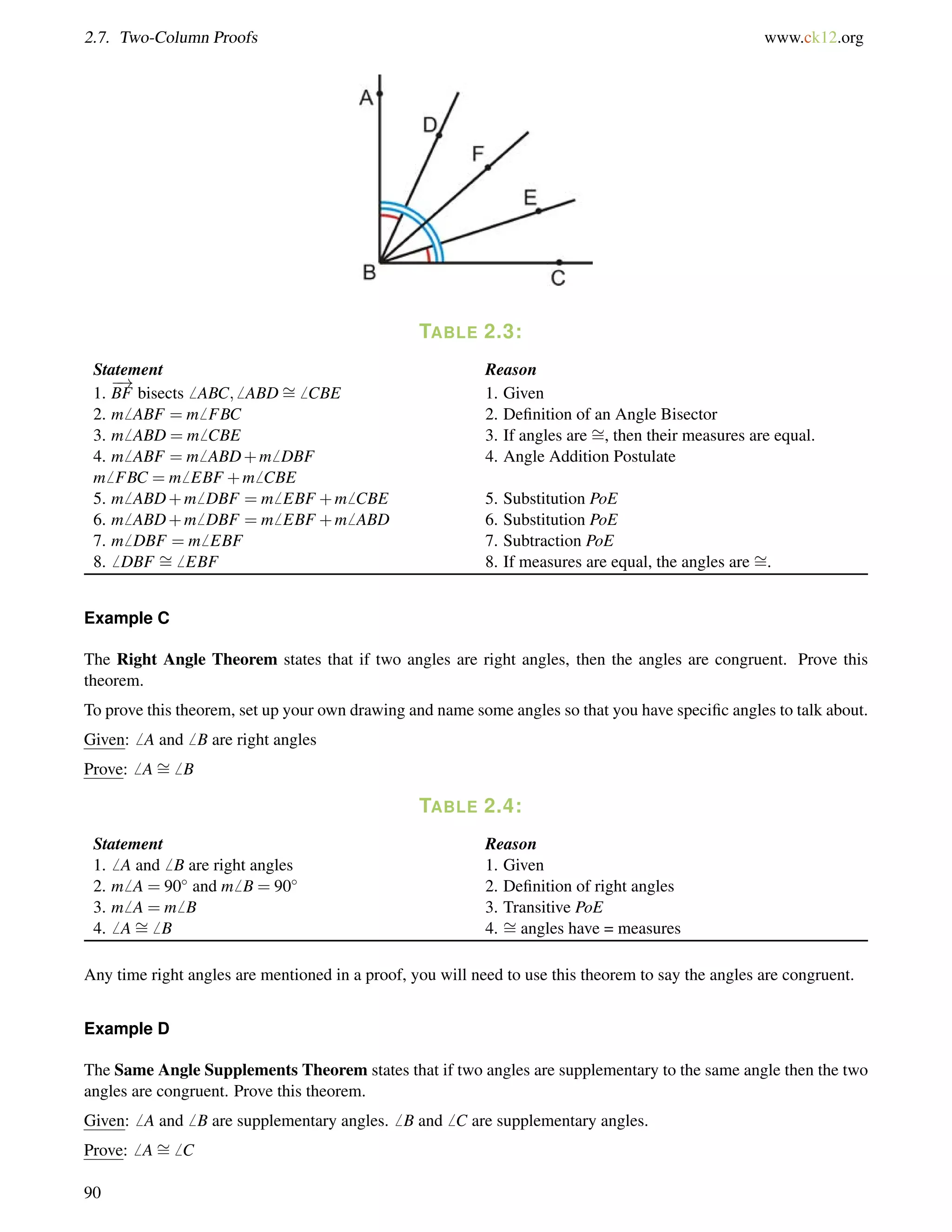
a radius. 
Secant: A line that intersects a circle in two points. 
Tangent: A line that intersects a circle in exactly one point. 
Point of Tangency: The point where a tangent line touches the circle. 
The tangent ray 
! 
TP and tangent segment TP are also called tangents. 
Tangent Circles: Two or more circles that intersect at one point. 
Concentric Circles: Two or more circles that have the same center, but different radii. 
Congruent Circles: Two or more circles with the same radius, but different centers. 
Example A 
Find the parts of 
J 
A that best fit each description. 
a) A radius 
462
www.ck12.org Chapter 9. Circles 
b) A chord 
c) A tangent line 
d) A point of tangency 
e) A diameter 
f) A secant 
Answers: 
a) HA or AF 
b) CD; HF, or DG 
c) 
 ! 
BJ 
d) Point H 
e) HF 
 ! 
f) 
BD 
Example B 
Draw an example of how two circles can intersect with no, one and two points of intersection. You will make three 
separate drawings. 
Example C 
Determine if any of the following circles are congruent. 
463
9.1. Parts of Circles www.ck12.org 
From each center, count the units to the outer rim of the circle. It is easiest to count vertically or horizontally. Doing 
this, we have: 
Radius of 
K 
A = 3 units 
Radius of 
K 
B = 4 units 
Radius of 
K 
C = 3 units 
From these measurements, we see that 
J 
A= 
J 
C. 
Notice the circles are congruent. The lengths of the radii are equal. 
MEDIA 
Click image to the left for more content. 
Parts ofCirclesCK-12 
Guided Practice 
1. If the diameter of a circle is 10 inches, how long is the radius? 
2. Is it possible to have a line that intersects a circle three times? If so, draw one. If not, explain. 
3. Are all circles similar? 
Answers: 
1. The radius is always half the length of the diameter, so it is 5 inches. 
2. It is not possible. By definition, all lines are straight. The maximum number of times a line can intersect a circle 
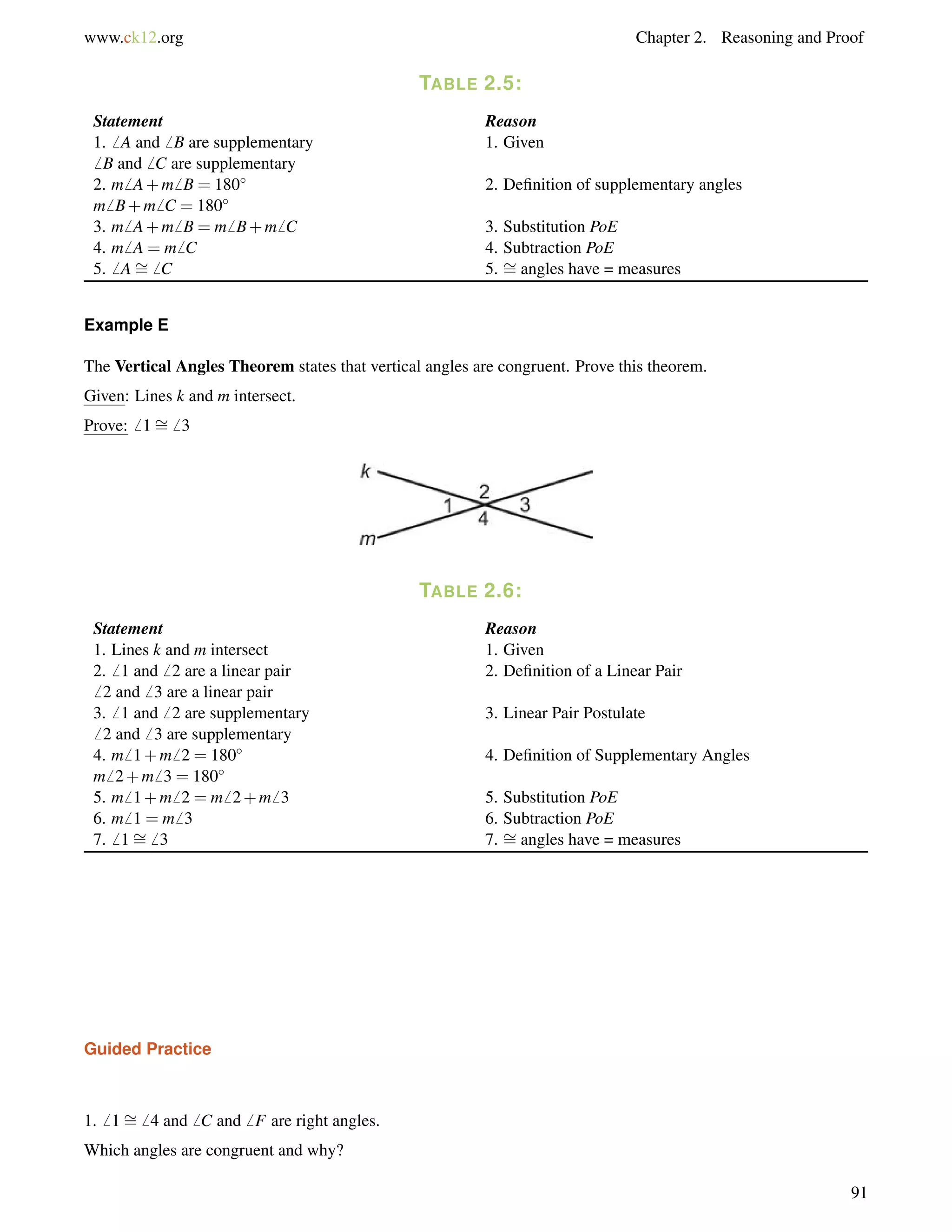
is twice. 
3. Yes. All circles are the same shape, but not necessarily the same size, so they are similar. 
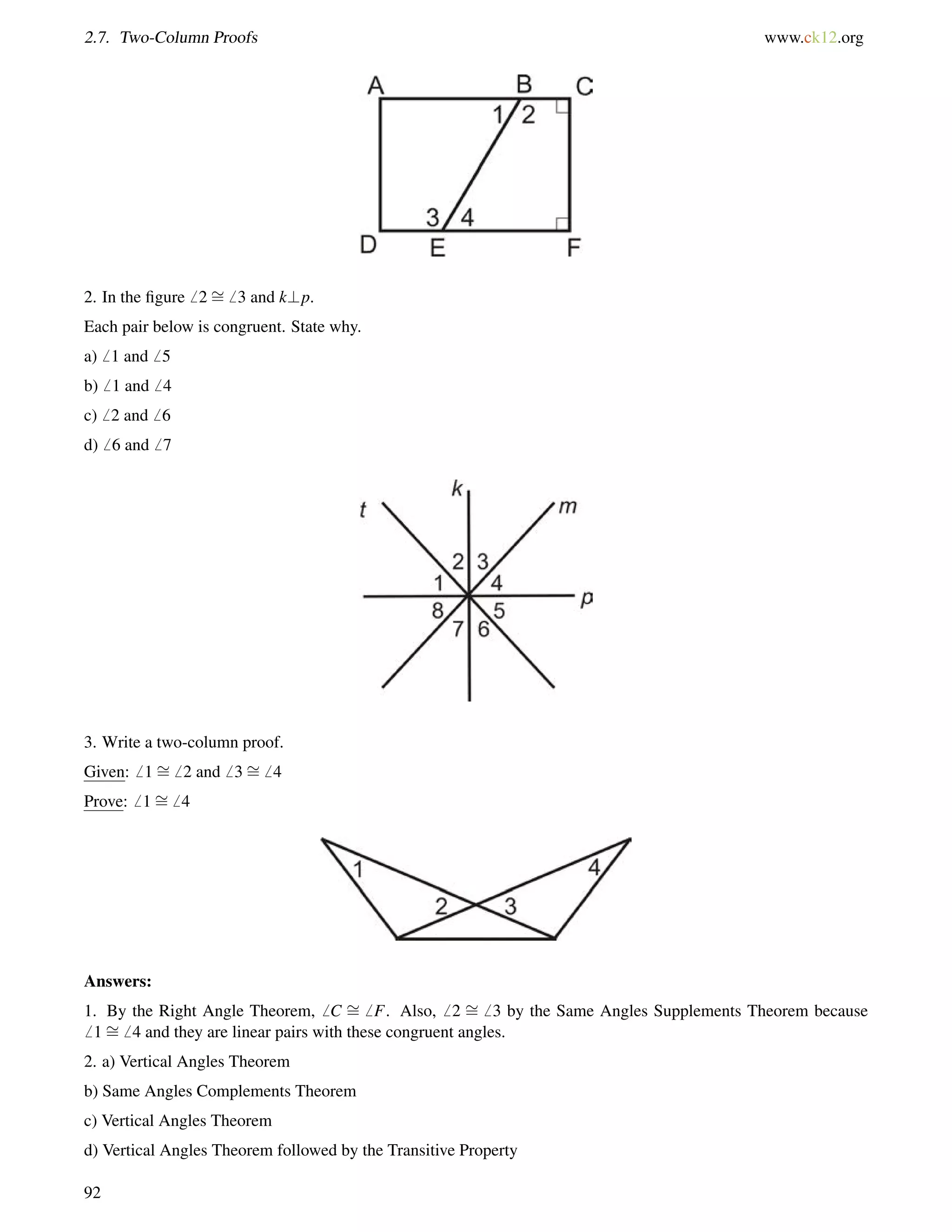
Practice 
Determine which term best describes each of the following parts of 
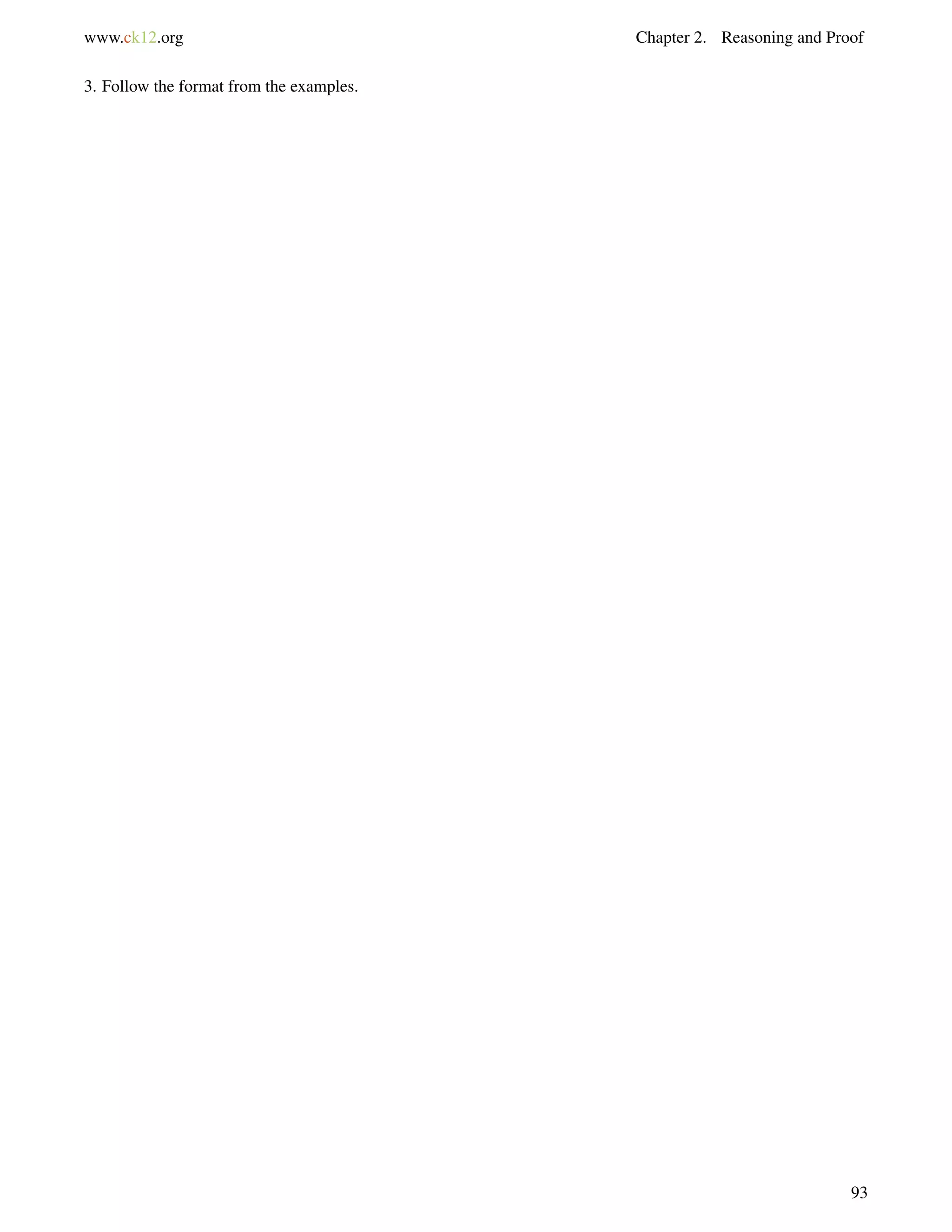
J 
P. 
464
www.ck12.org Chapter 9. Circles 
1. KG 
2. 
 ! 
FH 
3. KH 
4. E 
 ! 
5. 
BK 
 ! 
6. 
CF 
7. A 
8. JG 
9. What is the longest chord in any circle? 
Use the graph below to answer the following questions. 
10. Find the radius of each circle. 
11. Are any circles congruent? How do J 
you know? 
12. Find all the common tangents for 
B and 
J 
C. 
13. 
J 
C and 
J 
E are externally tangent. What is CE? 
14. Find the equation of CE. 
465
9.2. Tangent Lines www.ck12.org 
9.2 Tangent Lines 
Here you’ll learn two theorems about tangent lines: 1) the Tangent to a Circle Theorem that states tangents are 
perpendicular to radii; and 2) the Two Tangents Theorem that states two tangents drawn from the same point will be 
congruent. 
What if a line were drawn outside a circle that appeared to touch the circle at only one point? How could you 
determine if that line were actually a tangent? After completing this Concept, you’ll be able to apply theorems to 
solve tangent problems like this one. 
Watch This 
MEDIA 
Click image to the left for more content. 
Tangent Lines CK-12 
First watch this video. 
MEDIA 
Click image to the left for more content. 
James Sousa:TangentLines to a Circle 
Now watch this video. 
MEDIA 
Click image to the left for more content. 
James Sousa:TangentLines to a Circle Example Problems 
Guidance 
There are two important theorems about tangent lines. 
466
www.ck12.org Chapter 9. Circles 
1) Tangent to a Circle Theorem: A line is tangent to a circle if and only if the line is perpendicular to the radius 
drawn to the point of tangency. 
 ! 
BC is tangent at point B if and only if 
 ! 
BC ? AB. 
This theorem uses the words “if and only if,” making it a biconditional statement, which means the converse of this 
theorem is also true. 
2) Two Tangents Theorem: If two tangent segments are drawn to one circle from the same external point, then they 
are congruent. 
BC and DC have C as an endpoint and are tangent; BC = 
DC. 
Example A 
CB is tangent to 
J 
A at point B. Find AC. Reduce any radicals. 
CB is tangent, so AB ?CB and 4ABC a right triangle. Use the Pythagorean Theorem to find AC. 
52+82 = AC2 
25+64 = AC2 
89 = AC2 
AC = 
p 
89 
467
9.2. Tangent Lines www.ck12.org 
Example B 
Using the answer from Example A above, find DC in 
J 
A. Round your answer to the nearest hundredth. 
DC = ACAD 
DC = 
p 
895  4:43 
Example C 
Find the perimeter of 4ABC. 
AE = AD; EB = BF; and CF =CD. Therefore, the perimeter of 4ABC = 6+6+4+4+7+7 = 34. 
J 
G is inscribed in 4ABC. A circle is inscribed in a polygon if every side of the polygon is tangent to the circle. 
MEDIA 
Click image to the left for more content. 
Tangent Lines CK-12 
Guided Practice 
1. Find AB between 
J 
A and 
J 
B. Reduce the radical. 
2. Determine if the triangle below is a right triangle. 
468
www.ck12.org Chapter 9. Circles 
3. If D and C are the centers and AE is tangent to both circles, find DC. 
4. Find the value of x. 
Answers: 
1. AD ? DC and DC ?CB. Draw in BE, so EDCB is a rectangle. Use the Pythagorean Theorem to find AB. 
52+552 = AB2 
25+3025 = AB2 
3050 = AB2 
AB = 
p 
3050 = 5 
p 
122 
2. Again, use the Pythagorean Theorem. 4 
p 
10 is the longest side, so it will be c. 
469
9.2. Tangent Lines www.ck12.org 
Does 
82+102 = 
 
4 
2 
? 
p 
10 
64+1006= 160 
4ABC is not a right triangle. From this, we also find that CB is not tangent to 
J 
A. 
3. AE ? DE and AE ? AC and 4ABC 4DBE by AA Similarity. 
To find DB, use the Pythagorean Theorem. 
102+242 = DB2 
100+576 = 676 
DB = 
p 
676 = 26 
To find BC, use similar triangles. 5 
10 = BC 
26 !BC = 13: DC = DB+BC = 26+13 = 39 
4. AB= 
CB by the Two Tangents Theorem. Set AB =CB and solve for x. 
4x9 = 15 
4x = 24 
x = 6 
Practice 
Determine whether the given segment is tangent to 
J 
K. 
1. 
2. 
3. 
470
www.ck12.org Chapter 9. Circles 
Find the value of the indicated length(s) in 
J 
C. A and B are points of tangency. Simplify all radicals. 
4. 
5. 
6. 
7. 
8. 
9. 
A and B are points of tangency for 
J 
C and 
J 
D. 
471
9.2. Tangent Lines www.ck12.org 
10. Is 4AEC 4BED? Why? 
11. Find CE. 
12. Find BE. 
13. Find ED. 
14. Find BC and AD. 
J 
A is inscribed in BDFH. 
15. Find the perimeter of BDFH. 
16. What type of quadrilateral is BDFH? How do you know? 
17. Draw a circle inscribed in a square. If the radius of the circle is 5, what is the perimeter of the square? 
18. Can a circle be inscribed in a rectangle? If so, draw it. If not, explain. 
19. Draw a triangle with two sides tangent to a circle, but the third side is not. 
20. Can a circle be inscribed in an obtuse triangle? If so, draw it. If not, explain. 
21. Fill in the blanks in the proof of the Two Tangents Theorem. 
= 
Given: AB and CB with points of tangency at A and C. AD and DC are radii. 
Prove: ABCB 
472
www.ck12.org Chapter 9. Circles 
TABLE 9.1: 
= 
Statement Reason 
1. 1. 
2. ADDC 2. 
= 
3. DA ? AB and DC ?CB 3. 
4. 4. Definition of perpendicular lines 
5. 5. Connecting two existing points 
6. 4ADB and 4DCB are right triangles 6. 
7. DBDB 7. 
8. 4ABD= 
4CBD 8. 
9. AB= 
CB 9. 
22. Fill in the blanks, using the proof from #21. 
a. ABCD is a _____________ (type of quadrilateral). 
b. The line that connects the ___________ and the external point B __________6 ABC. 
23. Points A; B; and C are points of tangency for the three tangent circles. Explain why AT = 
BT = 
CT. 
473
9.3. Arcs in Circles www.ck12.org 
9.3 Arcs in Circles 
Here you’ll learn the properties of arcs and central angles and use them to find the measure of arcs. 
What if a circle were divided into pieces by various radii? How could you find the measures of the arcs formed by 
these radii? After completing this Concept, you’ll be able to use central angles to solve problems like this one. 
Watch This 
MEDIA 
Click image to the left for more content. 
Arcsin Circles CK-12 
Guidance 
A circle has 360. An arc is a section of the circle. A semicircle is an arc that measures 180. 
[EHG and dEJG are semicircles 
A central angle is the angle formed by two radii with its vertex at the center of the circle. A minor arc is an arc 
that is less than 180. A major arc is an arc that is greater than 180. Always use 3 letters to label a major arc. 
The central angle is6 BAC. The minor arc is cBC. The major arc is dBDC. 
An arc can be measured in degrees or in a linear measure (cm, ft, etc.). In this concept we will use degree measure. 
The measure of a minor arc is the same as the measure of the central angle that corresponds to it. The measure 
474
www.ck12.org Chapter 9. Circles 
of a major arc is 360 minus the measure of the corresponding minor arc. The measure of the arc formed by two 
adjacent arcs is the sum of the measures of the two arcs (Arc Addition Postulate). 
mcAD+mcDB = mdADB 
Example A 
Find mcAB and mdADB in 
J 
C. 
mcAB = m6 ACB. So, mcAB = 102. 
mdADB = 360mcAB = 360102 = 258 
Example B 
Find the measures of the minor arcs in 
J 
A. EB is a diameter. 
475
9.3. Arcs in Circles www.ck12.org 
Because EB is a diameter, m6 EAB = 180. Each arc has the same measure as its corresponding central angle. 
mcBF = m6 FAB = 60 
mcEF = m6 EAF = 120 !18060 
mcED = m6 EAD = 38 !1809052 
mcDC = m6 DAC = 90 
mcBC = m6 BAC = 52 
Example C 
Find the measures of the indicated arcs in 
J 
A. EB is a diameter. 
a) m[FED 
b) m[CDF 
c) m[DFC 
Use the Arc Addition Postulate. 
a) m[FED = mcFE +mcED = 120+38 = 158 
b) m[CDF = mcCD+mcDE +mcEF = 90+38+120 = 248 
c) m[DFC = mcED+mcEF +mcFB+mcBC = 38+120+60+52 = 270 
MEDIA 
Click image to the left for more content. 
Arcsin Circles CK-12 
Guided Practice 
1. List the congruent arcs in 
J 
C below. AB and DE are diameters. 
476
www.ck12.org Chapter 9. Circles 
2. Are the blue arcs congruent? Explain why or why not. 
a) 
b) 
3. Find the value of x for 
J 
C below. 
Answers: 
1.6 ACD= 
6 ECB because they are vertical angles.6 DCB= 
6 ACE because they are also vertical angles. 
cAD=cEB and cAE = 
cDB 
2. a) cAD= 
cBC because they have the same central angle measure and are in the same circle. 
477
9.3. Arcs in Circles www.ck12.org 
b) The two arcs have the same measure, but are not congruent because the circles have different radii. 
3. The sum of the measure of the arcs is 360 because they make a full circle. 
mcAB+mcAD+mcDB = 360 
(4x+15)+92+(6x+3) = 360 
10x+110 = 360 
10x = 250 
x = 25 
Practice 
Determine whether the arcs below are a minor arc, major arc, or semicircle of 
J 
G. EB is a diameter. 
1. cAB 
2. dABD 
3. dBCE 
4. dCAE 
5. dABC 
6. dEAB 
7. Are there any congruent arcs? If so, list them. 
8. If mcBC = 48, find mcCD. 
9. Using #8, find mdCAE. 
Find the measure of the minor arc and the major arc in each circle below. 
10. 
11. 
478
www.ck12.org Chapter 9. Circles 
12. 
13. 
14. 
15. 
Determine if the blue arcs are congruent. If so, state why. 
16. 
17. 
479
9.3. Arcs in Circles www.ck12.org 
18. 
Find the measure of the indicated arcs or central angles in 
J 
A. DG is a diameter. 
19. cDE 
20. cDC 
21. dGAB 
22. cFG 
23. [EDB 
24. dEAB 
25. [DCF 
26. [DBE 
Find the measure of x in 
J 
P. 
27. 
28. 
480
www.ck12.org Chapter 9. Circles 
29. 
481
9.4. Chords in Circles www.ck12.org 
9.4 Chords in Circles 
Here you’ll learn four theorems about chords in circles and how to apply them to find missing values. 
What if you were given a circle with two chords drawn through it? How could you determine if these two chords 
were congruent? After completing this Concept, you’ll be able to use four chord theorems to solve problems like 
this one. 
Watch This 
MEDIA 
Click image to the left for more content. 
Chords in Circles CK-12 
Guidance 
There are several important theorems about chords that will help you to analyze circles better. 
1) Chord Theorem #1: In the same circle or congruent circles, minor arcs are congruent if and only if their 
corresponding chords are congruent. 
In both of these pictures, BE = 
CD and cBE = 
cCD. 
2) Chord Theorem #2: The perpendicular bisector of a chord is also a diameter. 
482
www.ck12.org Chapter 9. Circles 
If AD ? BC and BD= 
DC then EF is a diameter. 
3) Chord Theorem #3: If a diameter is perpendicular to a chord, then the diameter bisects the chord and its 
corresponding arc. 
If EF ? BC, then BD= 
DC and cBE = 
cEC. 
4) Chord Theorem #4: In the same circle or congruent circles, two chords are congruent if and only if they are 
equidistant from the center. 
= 
The shortest distance from any point to a line is the perpendicular line between them. If FE = EG and EF ? EG, 
then AB and CD are equidistant to the center and ABCD. 
Example A 
Use 
J 
A to answer the following. 
a) If mcBD = 125, find mcCD. 
b) If mcBC = 80, find mcCD. 
Answers: 
483
9.4. Chords in Circles www.ck12.org 
= 
a) BD =CD, which means the arcs are congruent too. mCD c= 125. 
b) mCDcmBD cbecause BD =CD. 
mcBC+mcCD+mcBD = 360 
80+2mcCD = 360 
2mcCD = 280 
mcCD = 140 
Example B 
Find the values of x and y. 
The diameter is perpendicular to the chord. From Chord Theorem #3, x = 6 and y = 75. 
Example C 
Find the value of x. 
Because the distance from the center to the chords is equal, the chords are congruent. 
6x7 = 35 
6x = 42 
x = 7 
484
www.ck12.org Chapter 9. Circles 
MEDIA 
Click image to the left for more content. 
Chords in Circles CK-12 
Guided Practice 
1. Find the value of x and y. 
2. BD = 12 and AC = 3 in 
J 
A. Find the radius. 
3. Find mcBD from #2. 
Answers: 
1. The diameter is perpendicular to the chord, which means it bisects the chord and the arc. Set up equations for x 
and y. 
(3x4) = (5x18) y+4 = 2y+1 
14 = 2x 3 = y 
7 = x 
2. First find the radius. AB is a radius, so we can use the right triangle 4ABC with hypotenuse AB. From Chord 
Theorem #3, BC = 6. 
32+62 = AB2 
9+36 = AB2 
AB = 
p 
45 = 3 
p 
5 
485
9.4. Chords in Circles www.ck12.org 
3. First, find the corresponding central angle,6 BAD. We can find m6 BAC using the tangent ratio. Then, multiply 
m6 BAC by 2 for m6 BAD and mcBD. 
tan1 
 
6 
3 
 
= m6 BAC 
m6 BAC  63:43 
m6 BAD  2  63:43  126:86  mcBD 
Practice 
Fill in the blanks. 
1. = 
DF 
2. cAC = 
3. cDJ = 
4. = 
EJ 
5.6 AGH = 
6.6 DGF = 
7. List all the congruent radii in 
J 
G. 
Find the value of the indicated arc in 
J 
A. 
8. mcBC 
9. mcBD 
486
www.ck12.org Chapter 9. Circles 
10. mcBC 
11. mcBD 
12. mcBD 
13. mcBD 
487
9.4. Chords in Circles www.ck12.org 
Find the value of x and/or y. 
14. 
15. 
16. 
17. AB = 32 
18. 
488
www.ck12.org Chapter 9. Circles 
19. 
20. 
21. 
22. AB = 20 
23. Find mcAB in Question 17. Round your answer to the nearest tenth of a degree. 
24. Find mcAB in Question 22. Round your answer to the nearest tenth of a degree. 
In problems 25-27, what can you conclude about the picture? State a theorem that justifies your answer. You may 
assume that A is the center of the circle. 
25. 
489
9.4. Chords in Circles www.ck12.org 
26. 
27. 
490
www.ck12.org Chapter 9. Circles 
9.5 Inscribed Angles in Circles 
Here you’ll learn the Inscribed Angle Theorem, which states that the measure of an inscribed angle is half the 
measure of its intercepted arc. You’ll also learn other inscribed angle theorems and you’ll use them to solve problems 
about circles. 
What if you had a circle with two chords that share a common endpoint? How could you use the arc formed by those 
chords to determine the measure of the angle those chords make inside the circle? After completing this Concept, 
you’ll be able to use the Inscribed Angle Theorem to solve problems like this one. 
Watch This 
MEDIA 
Click image to the left for more content. 
Inscribed Anglesin Circles CK-12 
Guidance 
An inscribed angle is an angle with its vertex on the circle and whose sides are chords. The intercepted arc is the 
arc that is inside the inscribed angle and whose endpoints are on the angle. The vertex of an inscribed angle can be 
anywhere on the circle as long as its sides intersect the circle to form an intercepted arc. 
The Inscribed Angle Theorem states that the measure of an inscribed angle is half the measure of its intercepted 
arc. 
m6 ADC = 12 
mcAC and mcAC = 2m6 ADC 
491
9.5. Inscribed Angles in Circles www.ck12.org 
Inscribed angles that intercept the same arc are congruent. This is called the Congruent Inscribed Angles Theorem 
and is shown below. 
6 ADB and6 ACB intercept cAB, so m6 ADB = m6 ACB. Similarly,6 DAC and6 DBC intercept cDC, so m6 DAC = 
m6 DBC. 
An angle intercepts a semicircle if and only if it is a right angle (Semicircle Theorem). Anytime a right angle is 
inscribed in a circle, the endpoints of the angle are the endpoints of a diameter and the diameter is the hypotenuse. 
MEDIA 
Click image to the left for more content. 
6 DAB intercepts a semicircle, so m6 DAB = 90.6 DAB is a right angle, so cDB is a semicircle. 
Example A 
Find mcDC and m6 ADB. 
From the Inscribed Angle Theorem: 
mcDC = 2  45 = 90 
m6 ADB = 
1 
2 
 76 = 38 
492
www.ck12.org Chapter 9. Circles 
Example B 
Find m6 ADB and m6 ACB. 
The intercepted arc for both angles is cAB. Therefore, 
m6 ADB = 
1 
2 
 124 = 62 
m6 ACB = 
1 
2 
 124 = 62 
Example C 
Find m6 DAB in 
J 
C. 
C is the center, so DB is a diameter.6 DAB’s endpoints are on the diameter, so the central angle is 180. 
m6 DAB = 
1 
2 
 180 = 90: 
MEDIA 
Click image to the left for more content. 
Inscribed Anglesin Circles CK-12 
493
9.5. Inscribed Angles in Circles www.ck12.org 
Guided Practice 
1. Find m6 PMN; mcPN; m6 MNP; and m6 LNP. 
2. Fill in the blank: An inscribed angle is ____________ the measure of the intercepted arc. 
3. Fill in the blank: A central angle is ________________ the measure of the intercepted arc. 
Answers: 
1. Use what you’ve learned about inscribed angles. 
m6 PMN = m6 PLN = 68 by the Congruent Inscribed Angles Theorem: 
mcPN = 2  68 = 136 from the Inscribed Angle Theorem. 
m6 MNP = 90 by the Semicircle Theorem: 
m6 LNP = 
1 
2 
 92 = 46 from the Inscribed Angle Theorem. 
2. half 
3. equal to 
Practice 
Fill in the blanks. 
1. An angle inscribed in a ________________ is 90. 
2. Two inscribed angles that intercept the same arc are _______________. 
3. The sides of an inscribed angle are ___________________. 
4. Draw inscribed angle6 JKL in 
J 
M. Then draw central angle6 JML. How do the two angles relate? 
Find the value of x and/or y in 
J 
A. 
5. 
494
www.ck12.org Chapter 9. Circles 
6. 
7. 
8. 
9. 
Solve for x. 
10. 
495
9.5. Inscribed Angles in Circles www.ck12.org 
11. 
12. 
13. 
14. Fill in the blanks of the Inscribed Angle Theorem proof. 
12 
Given: Inscribed6 ABC and diameter BD 
Prove: m6 ABC = mAC 
cTABLE 9.2: 
Statement Reason 
1. Inscribed6 ABC and diameter BD 
1. 
m6 ABE = x and m6 CBE = y 
2. x+y = m6 ABC 2. 
3. 3. All radii are congruent 
4. 4. Definition of an isosceles triangle 
5. m6 EAB = x and m6 ECB = y 5. 
6. m6 AED = 2x and m6 CED = 2y 6. 
7. mcAD = 2x and mcDC = 2y 7. 
8. 8. Arc Addition Postulate 
9. mcAC = 2x+2y 9. 
496
www.ck12.org Chapter 9. Circles 
TABLE 9.2: (continued) 
12 
Statement Reason 
10. 10. Distributive PoE 
11. mAC c= 2m6 ABC 11. 
12. m6 ABC = mAC c12. 
497
9.6. Inscribed Quadrilaterals in Circles www.ck12.org 
9.6 Inscribed Quadrilaterals in Circles 
Here you’ll learn about inscribed quadrilaterals and how to use the Inscribed Quadrilateral Theorem to solve prob-lems 
about circles. 
What if you were given a circle with a quadrilateral inscribed in it? How could you use information about the 
arcs formed by the quadrilateral and/or the quadrilateral’s angle measures to find the measure of the unknown 
quadrilateral angles? After completing this Concept, you’ll be able to apply the Inscribed Quadrilateral Theorem to 
solve problems like this one. 
Watch This 
MEDIA 
Click image to the left for more content. 
Inscribed Quadrilateralsin Circles CK-12 
Guidance 
An inscribed polygon is a polygon where every vertex is on the circle, as shown below. 
For inscribed quadrilaterals in particular, the opposite angles will always be supplementary. 
Inscribed Quadrilateral Theorem: A quadrilateral can be inscribed in a circle if and only if the opposite angles 
are supplementary. 
If ABCD is inscribed in 
J 
E, then m6 A+m6 C = 180 and m6 B+m6 D = 180. Conversely, If m6 A+m6 C = 180 
and m6 B+m6 D = 180, then ABCD is inscribed in 
J 
E. 
498
www.ck12.org Chapter 9. Circles 
Example A 
Find the values of the missing variables. 
a) 
b) 
Answers: 
a) 
x+80 = 180 y+71 = 180 
x = 100 y = 109 
b) 
z+93 = 180 x = 
1 
2 
(58+106) y+82 = 180 
z = 87 x = 82 y = 98 
Example B 
Find x and y in the picture below. 
499
9.6. Inscribed Quadrilaterals in Circles www.ck12.org 
(7x+1)+105 = 180 (4y+14)+(7y+1) = 180 
7x+106 = 180 11y+15 = 180 
7x = 74 11y = 165 
x = 10:57 y = 15 
Example C 
Find the values of x and y in 
J 
A. 
Use the Inscribed Quadrilateral Theorem. x+108 = 180 so x = 72. Similarly, y+88 = 180 so y = 92. 
MEDIA 
Click image to the left for more content. 
Inscribed Quadrilateralsin Circles CK-12 
Guided Practice 
Quadrilateral ABCD is inscribed in 
J 
E. Find: 
1. m6 A 
2. m6 B 
3. m6 C 
4. m6 D 
500
www.ck12.org Chapter 9. Circles 
12 
12 
Answers: 
First, note that mAD c= 105 because the complete circle must add up to 360. 
1. m6 A = mBD c= (115+86) = 100:5 
2. m6 B = 12 
mcAC = 1 
2 (86+105) = 95:5 
3. m6 C = 180m6 A = 180100:5 = 79:5 
4. m6 D = 180m6 B = 18095:5 = 84:5 
Practice 
Fill in the blanks. 
1. A(n) _______________ polygon has all its vertices on a circle. 
2. The _____________ angles of an inscribed quadrilateral are ________________. 
Quadrilateral ABCD is inscribed in 
J 
E. Find: 
3. m6 DBC 
4. mcBC 
5. mcAB 
6. m6 ACD 
7. m6 ADC 
8. m6 ACB 
Find the value of x and/or y in 
J 
A. 
9. 
10. 
501
9.6. Inscribed Quadrilaterals in Circles www.ck12.org 
11. 
Solve for x. 
12. 
13. 
502
www.ck12.org Chapter 9. Circles 
9.7 AnglesOnand Inside a Circle 
Here you’ll learn how to use the Chord/Tangent Angle Theorem and the Intersecting Chords Angle Theorem to solve 
problems containing angles that are on or inside a circle. 
What if you were given a circle with either a chord and a tangent or two chords that meet at a common point? How 
could you use the measure of the arc(s) formed by those circle parts to find the measure of the angles they make on 
or inside the circle? After completing this Concept, you’ll be able to apply the Chord/Tangent Angle Theorem and 
the Intersecting Chords Angle Theorem to solve problems like this one. 
Watch This 
MEDIA 
Click image to the left for more content. 
Angles On and Insidea Circle CK-12 
Guidance 
When we say an angle is on a circle, we mean the vertex is on the edge of the circle. One type of angle on a circle 
is the inscribed angle (see Inscribed Anglesin Circles). Another type of angle on a circle is one formed by a tangent 
and a chord. 
Chord/Tangent Angle Theorem: The measure of an angle formed by a chord and a tangent that intersect on a circle 
is half the measure of the intercepted arc. 
m6 DBA = 12 
mcAB 
If two angles, with their vertices on the circle, intercept the same arc then the angles are congruent. 
An angle is inside a circle when the vertex lies anywhere inside the circle. 
Intersecting Chords Angle Theorem: The measure of the angle formed by two chords that intersect inside a circle 
is the average of the measures of the intercepted arcs. 
503
9.7. Angles On and Inside a Circle www.ck12.org 
m6 SVR = 
1 
2 
 
mcSR+mcTQ 
 
= 
mcSR+mcTQ 
2 
= m6 TVQ 
m6 SVT = 
1 
2 
 
mcST +mcRQ 
 
= 
mcST +mcRQ 
2 
= m6 RVQ 
Example A 
Find m6 BAD. 
Use the Chord/Tangent Angle Theorem. m6 BAD = 12 
mcAB = 1 
2  124 = 62. 
Example B 
Find a; b; and c. 
50+45+m6 a = 180 straight angle 
m6 a = 85 
504
www.ck12.org Chapter 9. Circles 
m6 b = 
1 
2 
mcAC 
mcAC = 2 m6 EAC = 2  45 = 90 
m6 b = 
1 
2 
 90 = 45 
85+45+m6 c = 180 Triangle Sum Theorem 
m6 c = 50 
Example C 
Find mdAEB. 
Use the Chord/Tangent Angle Theorem. mdAEB = 2 m6 DAB = 2  133 = 266. 
MEDIA 
Click image to the left for more content. 
Angles On and Insidea Circle CK-12 
Guided Practice 
Find x. 
1. 
505
9.7. Angles On and Inside a Circle www.ck12.org 
2. 
3. 
Answers: 
Use the Intersecting Chords Angle Theorem to write an equation. 
1. x = 129+71 
2 = 200 
2 = 100 
2. 
40 = 
52+x 
2 
80 = 52+x 
28 = x 
3. x is supplementary to the angle that is the average of the given intercepted arcs. We call this supplementary angle 
y. 
y = 
19+107 
2 
= 
126 
2 
= 63 x+63 = 180; x = 117 
Practice 
Find the value of the missing variable(s). 
1. 
506
www.ck12.org Chapter 9. Circles 
2. 
3. 
4. 
5. 
6. 
7. y6= 60 
Solve for x. 
507
9.7. Angles On and Inside a Circle www.ck12.org 
8. Fill in the blanks of the proof for the Intersecting Chords Angle Theorem 
12 
Given: Intersecting chords AC and BD. 
 
 
Prove: m6 a = mDCc+mAB 
cTABLE 9.3: 
Statement Reason 
1. Intersecting chords AC and BD. 1. 
2. Draw BC 2. Construction 
3. 
m6 DBC = 
1 
2 
mcDC 
m6 ACB = 
1 
2 
mcAB 
3. 
12 
12 
4. m6 a = m6 DBC+m6 ACB 4. 
5. m6 a = mDCc+ mcAB 5. 
Fill in the blanks. 
9. If the vertex of an angle is _______________ a circle, then its measure is the average of the _____________- 
_____ arcs. 
10. If the vertex of an angle is ________ a circle, then its measure is ______________ the intercepted arc. 
508
www.ck12.org Chapter 9. Circles 
9.8 Angles Outside a Circle 
Here you’ll learn how to use the Outside Angle Theorem to solve problems containing angles that are outside a 
circle. 
What if you were given a circle with either two secents, two tangents, or one of each that share a common point 
outside the circle? How could you use the measure of the arcs formed by those circle parts to find the measure of 
the angle they make outside the circle? After completing this Concept, you’ll be able to apply the Outside Angle 
Theorem to solve problems like this one. 
Watch This 
MEDIA 
Click image to the left for more content. 
Angles Outside aCircle CK-12 
Guidance 
An angle is outside a circle if its vertex is outside the circle and its sides are tangents or secants. The possibilities are: 
an angle formed by two tangents, an angle formed by a tangent and a secant, and an angle formed by two secants. 
Outside Angle Theorem: The measure of an angle formed by two secants, two tangents, or a secant and a tangent 
from a point outside the circle is half the difference of the measures of the intercepted arcs. 
m6 D = mcEFmdGH 
2 , m6 L = m[MPNmdMN 
2 , m6 Q = mcRSmcRT 
2 
Example A 
Find the value of x. 
509
9.8. Angles Outside a Circle www.ck12.org 
x = 7222 
2 = 50 
2 = 25. 
Example B 
Find the value of x. 
x = 12032 
2 = 88 
2 = 44. 
Example C 
Find the value of x. 
First note that the missing arc by angle x measures 32 because the complete circle must make 360. Then, x = 
14132 
2 = 109 
2 = 54:5. 
MEDIA 
Click image to the left for more content. 
Angles Outside aCircle CK-12 
Guided Practice 
Find the measure of x. 
1. 
510
www.ck12.org Chapter 9. Circles 
2. 
3. 
Answers: 
For all of the above problems we can use the Outside Angle Theorem. 
1. x = 12527 
2 = 98 
2 = 49 
2 = 80 
2 = 40 
2. 40 is not the intercepted arc. The intercepted arc is 120; (36020040). x = 200120 
3. Find the other intercepted arc, 360265 = 95x = 26595 
2 = 170 
2 = 85 
Practice 
Find the value of the missing variable(s). 
1. 
511
9.8. Angles Outside a Circle www.ck12.org 
2. 
3. 
4. 
5. 
6. 
7. 
Solve for x. 
512
www.ck12.org Chapter 9. Circles 
8. 
9. 
10. Fill in the blanks of the proof for the Outside Angle Theorem 
Given: Secant rays 
! 
AB and 
! 
AC 
Prove: m6 a = 12 
 
mcBCmcDE 
 
TABLE 9.4: 
Statement Reason 
! 
! 
1. Intersecting secants 
AB and 
AC. 1. 
2. Draw BE. 2. Construction 
3. 
m6 BEC = 
1 
2 
mcBC 
m6 DBE = 
1 
2 
mcDE 
3. 
12 
4. m6 a+m6 DBE = m6 BEC 4. 
5. 5. Subtraction PoE 
6.  
 
6. Substitution 
7. m6 a = mBCcmDE 
c7. 
513
9.9. Segments from Chords www.ck12.org 
9.9 Segments fromChords 
Here you’ll learn the relationship that exists between two chords when they intersect to solve for unknown circle 
values. 
What if you were given a circle with two chords that intersect each other? How could you use the length of some of 
the segments formed by their intersection to determine the lengths of the unknown segments? After completing this 
Concept, you’ll be able to use the Intersecting Chords Theorem to solve problems like this one. 
Watch This 
MEDIA 
Click image to the left for more content. 
Segmentsfrom ChordsCK-12 
Guidance 
When we have two chords that intersect inside a circle, as shown below, the two triangles that result are similar. 
This makes the corresponding sides in each triangle proportional and leads to a relationship between the segments 
of the chords, as stated in the Intersecting Chords Theorem. 
Intersecting Chords Theorem: If two chords intersect inside a circle so that one is divided into segments of length 
a and b and the other into segments of length c and d then ab = cd. 
514
www.ck12.org Chapter 9. Circles 
Example A 
Find x in each diagram below. 
a) 
b) 
Use the formula from the Intersecting Chords Theorem. 
a) 
12  8 = 10  x 
96 = 10x 
9:6 = x 
b) 
x  15 = 5  9 
15x = 45 
x = 3 
Example B 
Solve for x. 
a) 
515
9.9. Segments from Chords www.ck12.org 
b) 
Use the Intersecting Chords Theorem. 
a) 
8  24 = (3x+1)  12 
192 = 36x+12 
180 = 36x 
5 = x 
b) 
(x5)21 = (x9)24 
21x105 = 24x216 
111 = 3x 
37 = x 
Example C 
Ishmael found a broken piece of a CD in his car. He places a ruler across two points on the rim, and the length of 
the chord is 9.5 cm. The distance from the midpoint of this chord to the nearest point on the rim is 1.75 cm. Find 
the diameter of the CD. 
Think of this as two chords intersecting each other. If we were to extend the 1.75 cm segment, it would be a diameter. 
So, if we find x in the diagram below and add it to 1.75 cm, we would find the diameter. 
4:25  4:25 = 1:75  x 
18:0625 = 1:75x 
x  10:3 cm; making the diameter10:3+1:75  12 cm; which is the 
actual diameter of a CD. 
516
www.ck12.org Chapter 9. Circles 
MEDIA 
Click image to the left for more content. 
Segmentsfrom ChordsCK-12 
Guided Practice 
Find x in each diagram below. Simplify any radicals. 
1. 
2. 
3. 
517
9.9. Segments from Chords www.ck12.org 
Answers 
For all problems, use the Intersecting Chords Theorem. 
1. 
15  4 = 5  x 
60 = 5x 
x = 12 
2. 
18  x = 9  3 
18x = 27 
x = 1:5 
3. 
12  x = 9  16 
12x = 144 
x = 12 
Practice 
Fill in the blanks for each problem below and then solve for the missing segment. 
1. 
20x = 
518
www.ck12.org Chapter 9. Circles 
2. 
 4 =  x 
Find x in each diagram below. Simplify any radicals. 
3. 
4. 
5. 
Find the value of x. 
6. 
7. 
519
9.9. Segments from Chords www.ck12.org 
8. 
9. Suzie found a piece of a broken plate. She places a ruler across two points on the rim, and the length of the 
chord is 6 inches. The distance from the midpoint of this chord to the nearest point on the rim is 1 inch. Find 
the diameter of the plate. 
10. Fill in the blanks of the proof of the Intersecting Chords Theorem. 
Given: Intersecting chords AC and BE. 
Prove: ab = cd 
TABLE 9.5: 
Statement Reason 
1. Intersecting chords AC and BE with segments 
1. 
a; b; c; and d. 
2. 2. Congruent Inscribed Angles Theorem 
3. 4ADE 4BDC 3. 
4. 4. Corresponding parts of similar triangles are propor-tional 
5. ab = cd 5. 
520
www.ck12.org Chapter 9. Circles 
9.10 Segments fromSecants 
Here you’ll learn the relationship between the segments that are created when two secants intersect outside a circle. 
You’ll then use this relationship to solve for unknown circle values. 
What if you were given a circle with two secants that intersect outside the circle? How could you use the length 
of some of the segments formed by their intersection to determine the lengths of the unknown segments? After 
completing this Concept, you’ll be able to use the Two Secants Segments Theorem to solve problems like this one. 
Watch This 
MEDIA 
Click image to the left for more content. 
Segmentsfrom Secants CK-12 
Guidance 
When two secants intersect outside a circle, the circle divides the secants into segments that are proportional with 
each other. 
Two Secants Segments Theorem: If two secants are drawn from a common point outside a circle and the segments 
are labeled as below, then a(a+b) = c(c+d). 
Example A 
Find the value of x. 
521
9.10. Segments from Secants www.ck12.org 
Use the Two Secants Segments Theorem to set up an equation. 
18  (18+x) = 16  (16+24) 
324+18x = 256+384 
18x = 316 
x = 17 
5 
9 
Example B 
Find the value of x. 
Use the Two Secants Segments Theorem to set up an equation. 
x  (x+x) = 9  32 
2x2 = 288 
x2 = 144 
x = 12; x6= 12 (length is not negative) 
Example C 
True or False: Two secants will always intersect outside of a circle. 
This is false. If the two secants are parallel, they will never intersect. It’s also possible for two secants to intersect 
inside a circle. 
MEDIA 
Click image to the left for more content. 
Segmentsfrom Secants CK-12 
Guided Practice 
Find x in each diagram below. Simplify any radicals. 
1. 
522
www.ck12.org Chapter 9. Circles 
2. 
3. 
Answers: 
Use the Two Secants Segments Theorem. 
1. 
8(8+x) = 6(6+18) 
64+8x = 144 
8x = 80 
x = 10 
2. 
4(4+x) = 3(3+13) 
16+4x = 48 
4x = 32 
x = 8 
3. 
523
9.10. Segments from Secants www.ck12.org 
15(15+27) = x  45 
630 = 45x 
x = 14 
Practice 
Fill in the blanks for each problem below. Then, solve for the missing segment. 
1. 
3( + ) = 2(2+7) 
2. 
x  = 8( + ) 
Find x in each diagram below. Simplify any radicals. 
3. 
4. 
524
www.ck12.org Chapter 9. Circles 
5. 
6. Fill in the blanks of the proof of the Two Secants Segments Theorem. 
Given: Secants PR and RT 
Prove: a(a+b) = c(c+d) 
TABLE 9.6: 
Statement Reason 
1. Secants PR and RT with segments a; b; c; and d. 1. Given 
2.6 R= 
6 R 2. Reflexive PoC 
3.6 QPS= 
6 STQ 3. Congruent Inscribed Angles Theorem 
4. 4RPS 4RTQ 4. AA Similarity Postulate 
5. a 
c+d = c 
a+b 5. Corresponding parts of similar triangles are propor-tional 
6. a(a+b) = c(c+d) 6. Cross multiplication 
Solve for the unknown variable. 
7. 
525
9.10. Segments from Secants www.ck12.org 
8. 
9. 
10. 
526
www.ck12.org Chapter 9. Circles 
11. 
12. 
13. 
14. 
527
9.10. Segments from Secants www.ck12.org 
15. 
528
www.ck12.org Chapter 9. Circles 
9.11 Segments fromSecants and Tangents 
Here you’ll learn the relationship that exists between the segments that are created when a secant and tangent 
intersect on a circle. You’ll then use this relationship to solve for unknown circle values. 
What if you were given a circle with a tangent and a secant that intersect outside the circle? How could you use 
the length of some of the segments formed by their intersection to determine the lengths of the unknown segments? 
After completing this Concept, you’ll be able to use the Tangent Secant Segment Theorem to solve problems like 
this one. 
Watch This 
MEDIA 
Click image to the left for more content. 
Segmentsfrom Secants and Tangents CK-12 
Guidance 
If a tangent and secant meet at a common point outside a circle, the segments created have a similar relationship to 
that of two secant rays. 
Tangent Secant Segment Theorem: If a tangent and a secant are drawn from a common point outside the circle 
(and the segments are labeled like the picture below), then a2 = b(b+c). 
Example A 
Find the length of the missing segment. 
529
9.11. Segments from Secants and Tangents www.ck12.org 
Use the Tangent Secant Segment Theorem. 
x2 = 4(4+12) 
x2 = 4  16 = 64 
x = 8 
Example B 
Fill in the blank and then solve for the missing segment. 
= (4+5) 
x2 = 4(4+5) 
x2 = 36 
x = 6 
Example C 
Find the value of the missing segment. 
530
www.ck12.org Chapter 9. Circles 
Use the Tangent Secant Segment Theorem. 
202 = y(y+30) 
400 = y2+30y 
0 = y2+30y400 
0 = (y+40)(y10) 
y =H4HH0;10 
MEDIA 
Click image to the left for more content. 
Segmentsfrom Secants and Tangents CK-12 
Guided Practice 
Find x in each diagram below. Simplify any radicals. 
1. 
2. 
3. 
531
9.11. Segments from Secants and Tangents www.ck12.org 
Answers: 
Use the Tangent Secant Segment Theorem. 
1. 
182 = 10(10+x) 
324 = 100+10x 
224 = 10x 
x = 22:4 
2. 
x2 = 16(16+25) 
x2 = 656 
p 
x = 4 
41 
3. 
x2 = 24(24+20) 
x2 = 1056 
p 
x = 4 
66 
Practice 
Fill in the blanks for each problem below and then solve for the missing segment. 
1. 
102 = x( + ) 
Find x in each diagram below. Simplify any radicals. 
532
www.ck12.org Chapter 9. Circles 
2. 
3. 
4. 
5. Describe and correct the error in finding y. 
10  10 = y  15y 
100 = 15y2 
20 
3 
= y2 
2 
p 
15 
3 
= y   y is not correct 
Solve for the unknown variable. 
533
9.11. Segments from Secants and Tangents www.ck12.org 
6. 
7. 
8. 
534
www.ck12.org Chapter 9. Circles 
9. 
10. 
11. 
535
9.11. Segments from Secants and Tangents www.ck12.org 
12. 
13. 
14. 
536
www.ck12.org Chapter 9. Circles 
15. 
537
9.12. Circles in the Coordinate Plane www.ck12.org 
9.12 Circles in the Coordinate Plane 
Here you’ll learn how to find the standard equation for circles given their radius and center. You’ll also graph circles 
in the coordinate plane. 
What if you were given the length of the radius of a circle and the coordinates of its center? How could you write 
the equation of the circle in the coordinate plane? After completing this Concept, you’ll be able to write the standard 
equation of a circle. 
Watch This 
MEDIA 
Click image to the left for more content. 
GraphingCirclesCK-12 
MEDIA 
Click image to the left for more content. 
James Sousa:Write the Standard Formof a Circle 
Guidance 
Recall that a circle is the set of all points in a plane that are the same distance from the center. This definition can be 
used to find an equation of a circle in the coordinate plane. 
538
www.ck12.org Chapter 9. Circles 
Let’s start with the circle centered at (0, 0). If (x;y) is a point on the circle, then the distance from the center to this 
point would be the radius, r. x is the horizontal distance and y is the vertical distance. This forms a right triangle. 
From the Pythagorean Theorem, the equation of a circle centered at the origin is x2+y2 = r2. 
The center does not always have to be on (0, 0). If it is not, then we label the center (h;k). We would then use the 
Distance Formula to find the length of the radius. 
r = 
q 
(xh)2+(yk)2 
If you square both sides of this equation, then you would have the standard equation of a circle. The standard 
equation of a circle with center (h;k) and radius r is r2 = (xh)2+(yk)2. 
Example A 
Graph x2+y2 = 9. 
The center is (0, 0). Its radius is the square root of 9, or 3. Plot the center, plot the points that are 3 units to the right, 
left, up, and down from the center and then connect these four points to form a circle. 
Example B 
Find the equation of the circle below. 
539
9.12. Circles in the Coordinate Plane www.ck12.org 
First locate the center. Draw in the horizontal and vertical diameters to see where they intersect. 
From this, we see that the center is (-3, 3). If we count the units from the center to the circle on either of these 
diameters, we find r = 6. Plugging this into the equation of a circle, we get: (x (3))2 +(y 3)2 = 62 or 
(x+3)2+(y3)2 = 36. 
Example C 
Determine if the following points are on (x+1)2+(y5)2 = 50. 
a) (8, -3) 
b) (-2, -2) 
Plug in the points for x and y in (x+1)2+(y5)2 = 50. 
a) 
(8+1)2+(35)2 = 50 
92+(8)2 = 50 
81+646= 50 
(8, -3) is not on the circle 
b) 
(2+1)2+(25)2 = 50 
(1)2+(7)2 = 50 
1+49 = 50 
540
www.ck12.org Chapter 9. Circles 
(-2, -2) is on the circle 
MEDIA 
Click image to the left for more content. 
GraphingCirclesCK-12 
Guided Practice 
Find the center and radius of the following circles. 
1. (x3)2+(y1)2 = 25 
2. (x+2)2+(y5)2 = 49 
3. Find the equation of the circle with center (4, -1) and which passes through (-1, 2). 
Answers: 
1. Rewrite the equation as (x3)2+(y1)2 = 52. The center is (3, 1) and r = 5. 
2. Rewrite the equation as (x(2))2+(y5)2 = 72. The center is (-2, 5) and r = 7. 
Keep in mind that, due to the minus signs in the formula, the coordinates of the center have the opposite signs of 
what they may initially appear to be. 
3. First plug in the center to the standard equation. 
(x4)2+(y(1))2 = r2 
(x4)2+(y+1)2 = r2 
Now, plug in (-1, 2) for x and y and solve for r. 
(14)2+(2+1)2 = r2 
(5)2+(3)2 = r2 
25+9 = r2 
34 = r2 
Substituting in 34 for r2, the equation is (x4)2+(y+1)2 = 34. 
Practice 
Find the center and radius of each circle. Then, graph each circle. 
1. (x+5)2+(y3)2 = 16 
2. x2+(y+8)2 = 4 
3. (x7)2+(y10)2 = 20 
541
9.12. Circles in the Coordinate Plane www.ck12.org 
4. (x+2)2+y2 = 8 
Find the equation of the circles below. 
5. 
6. 
7. 
8. 
9. Is (-7, 3) on (x+1)2+(y6)2 = 45? 
10. Is (9, -1) on (x2)2+(y2)2 = 60? 
542
www.ck12.org Chapter 9. Circles 
11. Is (-4, -3) on (x+3)2+(y3)2 = 37? 
12. Is (5, -3) on (x+1)2+(y6)2 = 45? 
Find the equation of the circle with the given center and point on the circle. 
13. center: (2, 3), point: (-4, -1) 
14. center: (10, 0), point: (5, 2) 
15. center: (-3, 8), point: (7, -2) 
16. center: (6, -6), point: (-9, 4) 
Summary 
This chapter begins with vocabulary associated with the parts of circles. It then branches into theorems about tangent 
lines; properties of arcs and central angles; and theorems about chords and how to apply them. Inscribed angles and 
inscribed quadrilaterals and their properties are explored. Angles on, inside, and outside a circle are presented 
in detail and the subsequent relationships are used in problem solving. Relationships among chords, secants, and 
tangents are discovered and applied. The chapter ends with the connection between algebra and geometry as the 
equations of circles are discussed. 
543
www.ck12.org 
CHAPTER 10 Perimeter and Area 
Chapter Outline 
10.1 AREA AND PERIMETER OF RECTANGLES 
10.2 AREA OF A PARALLELOGRAM 
10.3 AREA AND PERIMETER OF TRIANGLES 
10.4 AREA OF COMPOSITE SHAPES 
10.5 AREA AND PERIMETER OF TRAPEZOIDS 
10.6 AREA AND PERIMETER OF RHOMBUSES AND KITES 
10.7 AREA AND PERIMETER OF SIMILAR POLYGONS 
10.8 CIRCUMFERENCE 
10.9 ARC LENGTH 
10.10 AREA OF A CIRCLE 
10.11 AREA OF SECTORS AND SEGMENTS 
Introduction 
Now that we have explored triangles, quadrilaterals, polygons, and circles, we are going to learn how to find the 
perimeter and area of each. 
544
www.ck12.org Chapter 10. Perimeter and Area 
10.1 Area and Perimeter of Rectangles 
Here you’ll learn how to find the area and perimeter of a rectangle given its base and height. 
What if you were given a rectangle and the size of its base and height? How could you find the total distance around 
the rectangle and the amount of space it takes up? After completing this Concept, you’ll be able to use the formulas 
for the perimeter and area of a rectangle to solve problems like this. 
Watch This 
MEDIA 
Click image to the left for more content. 
AreaandPerimeter of RectanglesCK-12 
Guidance 
To find the area of a rectangle, calculate A = bh, where b is the base (width) and h is the height (length). The 
perimeter of a rectangle will always be P = 2b+2h. 
If a rectangle is a square, with sides of length s, then perimeter is Psquare =2s+2s=4s and area is Asqaure =s  s=s2. 
Example A 
Find the area and perimeter of a rectangle with sides 4 cm by 9 cm. 
545
10.1. Area and Perimeter of Rectangles www.ck12.org 
The perimeter is 4+9+4+9 = 26 cm. The area is A = 9  4 = 36 cm2. 
Example B 
Find the area and perimeter of a square with side 5 in. 
The perimeter is 4(5) = 20in and the area is 52 = 25 in2. 
Example C 
Find the area and perimeter of a rectangle with sides 13 m and 12 m. 
The perimeter is 2(13)+2(12) = 50 m. The area is 13(12) = 156 m2. 
MEDIA 
Click image to the left for more content. 
AreaandPerimeter of RectanglesCK-12 
Guided Practice 
1. The area of a square is 75 in2. Find the perimeter. 
2. Draw two different rectangles with an area of 36 cm2. 
3. Find the area and perimeter of a rectangle with sides 7 in and 10 in. 
Answers: 
1. To find the perimeter, we need to find the length of the sides. 
A = s2 = 75 in2 
s = 
p 
75 = 5 
p 
3 in 
From this, P = 4 
 
5 
p 
3 
 
= 20 
p 
3 in. 
2. Think of all the different factors of 36. These can all be dimensions of the different rectangles. 
546
www.ck12.org Chapter 10. Perimeter and Area 
Other possibilities could be 66;218, and 136. 
3. Area is 7(10) = 70 in2. Perimeter is 2(7)+2(10) = 34 in. 
Practice 
1. Find the area and perimeter of a square with sides of length 12 in. 
2. Find the area and perimeter of a rectangle with height of 9 cm and base of 16 cm. 
3. Find the area and perimeter of a rectangle if the height is 8 and the base is 14. 
4. Find the area and perimeter of a square if the sides are 18 ft. 
5. If the area of a square is 81 f t2, find the perimeter. 
6. If the perimeter of a square is 24 in, find the area. 
7. The perimeter of a rectangle is 32. Find two different dimensions that the rectangle could be. 
8. Draw two different rectangles that haven an area of 90 mm2. 
9. True or false: For a rectangle, the bigger the perimeter, the bigger the area. 
10. Find the perimeter and area of a rectangle with sides 17 in and 21 in. 
547
10.2. Area of a Parallelogram www.ck12.org 
10.2 Area of a Parallelogram 
Here you’ll learn how to find the area of a parallelogram given its base and height. 
What if you were given a parallelogram and the size of its base and height? How could you find the amount of 
space the parallelogram takes up? After completing this Concept, you’ll be able to use the formula for the area of a 
parallelogram to solve problems like this one. 
Watch This 
MEDIA 
Click image to the left for more content. 
CK-12 
Guidance 
A parallelogram is a quadrilateral whose opposite sides are parallel. 
To find the area of a parallelogram, make it into a rectangle. 
From this, we see that the area of a parallelogram is the same as the area of a rectangle. The area of a parallelogram 
is A = bh. The height of a parallelogram is always perpendicular to the base. This means that the sides are not the 
height. 
548
www.ck12.org Chapter 10. Perimeter and Area 
Example A 
Find the area of the parallelogram. 
A = 15  8 = 120 in2 
Example B 
If the area of a parallelogram is 56 units2 and the base is 4 units, what is the height? 
Solve for the height in A = bh. 
56 units = 4h 
14 units = h 
Example C 
If the height of a parallelogram is 12 m and the area is 60 m2, how wide is the base? 
Solve for the base in A = bh. 
60 units = 12b 
5 units = b 
MEDIA 
Click image to the left for more content. 
CK-12 
549
10.2. Area of a Parallelogram www.ck12.org 
Guided Practice 
Find the area of the following shapes. 
1. 
2. 
3. A parallelogram with a base of 10 m and a height of 12 m. 
Answers: 
1. Area is 15(6) = 90 un2. 
2. Area is 32(12) = 672 un2. 
3. Area is 10(12) = 120 m2. 
Practice 
1. Find the area of a parallelogram with height of 20 m and base of 18 m. 
2. Find the area of a parallelogram with height of 12 m and base of 15 m. 
3. Find the area of a parallelogram with height of 40 m and base of 33 m. 
4. Find the area of a parallelogram with height of 32 m and base of 21 m. 
5. Find the area of a parallelogram with height of 25 m and base of 10 m. 
Find the area of the parallelogram. 
6. 
550
www.ck12.org Chapter 10. Perimeter and Area 
7. 
8. 
9. 
551
10.2. Area of a Parallelogram www.ck12.org 
10. 
11. 
12. 
13. If the area of a parallelogram is 42 units2 and the base is 6 units, what is the height? 
14. If the area of a parallelogram is 48 units2 and the height is 6 units, what is the base? 
15. If the base of a parallelogram is 9 units and the area is 108 units2, what is the height? 
16. If the height of a parallelogram is 11 units and the area is 27:5 units2, what is the base? 
552
www.ck12.org Chapter 10. Perimeter and Area 
10.3 Area and Perimeter of Triangles 
Here you’ll learn how to find the area and perimeter of a triangle given its base and height. 
What if you were given a triangle and the size of its base and height? How could you find the total distance around 
the triangle and the amount of space it takes up? After completing this Concept, you’ll be able to use the formulas 
for the perimeter and area of a triangle to solve problems like this. 
Watch This 
MEDIA 
Click image to the left for more content. 
AreaandPerimeter of Triangles CK-12 
Guidance 
The formula for the area of a triangle is half the area of a parallelogram. 
Area of a Triangle: A = 12 
bh or A = bh 
2 . 
Example A 
Find the area of the triangle. 
553
10.3. Area and Perimeter of Triangles www.ck12.org 
To find the area, we need to find the height of the triangle. We are given two sides of the small right triangle, where 
the hypotenuse is also the short side of the obtuse triangle. 
32+h2 = 52 
9+h2 = 25 
h2 = 16 
h = 4 
A = 
1 
2 
(4)(7) = 14 units2 
Example B 
Find the perimeter of the triangle in Example A. 
To find the perimeter, we need to find the longest side of the obtuse triangle. If we used the black lines in the picture, 
we would see that the longest side is also the hypotenuse of the right triangle with legs 4 and 10. 
42+102 = c2 
16+100 = c2 
c = 
p 
116  10:77 
The perimeter is 7+5+10:77  22:77 units 
12 
Example C 
Find the area of a triangle with base of length 28 cm and height of 15 cm. 
The area is (28)(15) = 210 cm2. 
MEDIA 
Click image to the left for more content. 
554
www.ck12.org Chapter 10. Perimeter and Area 
AreaandPerimeter of Triangles CK-12 
Guided Practice 
Use the triangle to answer the following questions. 
1. Find the height of the triangle. 
2. Find the perimeter. 
3. Find the area. 
Answers: 
1. Use the Pythagorean Theorem to find the height. 
82+h2 = 172 
h2 = 225 
h = 15 in 
2. We need to find the hypotenuse. Use the Pythagorean Theorem again. 
(8+24)2+152 = h2 
h2 = 1249 
h  35:3 in 
The perimeter is 24+35:3+17  76:3 in. 
3. The area is 1 
2 (24)(15) = 180 in2. 
Practice 
Use the triangle to answer the following questions. 
1. Find the height of the triangle by using the geometric mean. 
555
10.3. Area and Perimeter of Triangles www.ck12.org 
2. Find the perimeter. 
3. Find the area. 
Find the area of the following shape. 
4. 
5. What is the height of a triangle with area 144 m2 and a base of 24 m? 
In questions 6-11 we are going to derive a formula for the area of an equilateral triangle. 
6. What kind of triangle is 4ABD? Find AD and BD. 
7. Find the area of 4ABC. 
8. If each side is x, what is AD and BD? 
9. If each side is x, find the area of 4ABC. 
10. Using your formula from #9, find the area of an equilateral triangle with 12 inch sides. 
11. Using your formula from #9, find the area of an equilateral triangle with 5 inch sides. 
556
www.ck12.org Chapter 10. Perimeter and Area 
10.4 Area of Composite Shapes 
Here you’ll learn how to find the area of a figure that can be broken down into shapes you’ve already learned. 
What if you drew a basic house with a triangle on top of a square? How could you find the area of this composite 
shape? After completing this Concept, you’ll be able to calculate the area of irregular shapes that are made up of 
two or more shapes you already know. 
Watch This 
MEDIA 
Click image to the left for more content. 
Areaof Composite ShapesCK-12 
Guidance 
Perimeter is the distance around a shape. The perimeter of any figure must have a unit of measurement attached to 
it. If no specific units are given (feet, inches, centimeters, etc), write “units.” 
Area is the amount of space inside a figure. If two figures are congruent, they have the same area (Congruent Areas 
Postulate). 
A composite shape is a shape made up of other shapes. To find the area of such a shape, simply find the area of 
each part and add them up. 
Area Addition Postulate: If a figure is composed of two or more parts that do not overlap each other, then the area 
of the figure is the sum of the areas of the parts. 
Example A 
Find the area of the figure below. 
557
10.4. Area of Composite Shapes www.ck12.org 
Divide the figure into a triangle and a rectangle with a small rectangle cut out of the lower right-hand corner. 
A = Atop triangle+ArectangleAsmall triangle 
A = 
 
1 
2 
 
+(9  15) 
 6  9 
 
( 
1 
2 
 3  6 
 
A = 27+1359 
A = 153 units2 
Example B 
Divide the shape into two rectangles and one triangle. Find the area of the two rectangles and triangle: 
Rectangle #1: Area = 24(9+12) = 504 units2 
Rectangle #2: Area = 15(9+12) = 315 units2 
Triangle: Area = 15(9) 
2 = 67:5 units2 
558
www.ck12.org Chapter 10. Perimeter and Area 
Example C 
Find the area of the entire shape from Example B (you will need to subtract the area of the small triangle in the lower 
right-hand corner). 
Total Area = 504+315+67:5 15(12) 
2 = 796:5 units2 
MEDIA 
Click image to the left for more content. 
Areaof Composite ShapesCK-12 
Guided Practice 
1. Divide the shape into two triangles and one rectangle. 
2. Find the area of the two triangles and rectangle. 
3. Find the area of the entire shape. 
Answers 
1. One triangle on the top and one on the right. Rectangle is the rest. 
2. Area of triangle on top is 8(5) 
2 = 20 units2. Area of triangle on right is 5(5) 
2 = 12:5 units2. Area of rectangle is 
375 units2. 
3. Total area is 407:5 units2. 
Practice 
Use the picture below for questions 1-4. Both figures are squares. 
1. Find the area of the outer square. 
559
10.4. Area of Composite Shapes www.ck12.org 
2. Find the area of one grey triangle. 
3. Find the area of all four grey triangles. 
4. Find the area of the inner square. 
Find the areas of the figures below. You may assume all sides are perpendicular. 
5. 
6. 
Find the areas of the composite figures. 
7. 
560
www.ck12.org Chapter 10. Perimeter and Area 
8. 
9. 
10. 
11. 
561
10.4. Area of Composite Shapes www.ck12.org 
12. 
Use the figure to answer the questions. 
13. What is the area of the square? 
14. What is the area of the triangle on the left? 
15. What is the area of the composite figure? 
562
www.ck12.org Chapter 10. Perimeter and Area 
10.5 Area and Perimeter of Trapezoids 
Here you’ll learn how to find the area and perimeter of a trapezoid given its two bases and its height. 
What if you were given a trapezoid and the size of its two bases as well as its height? How could you find the total 
distance around the trapezoid and the amount of space it takes up? After completing this Concept, you’ll be able to 
use the formulas for the perimeter and area of a trapezoid to solve problems like this. 
Watch This 
MEDIA 
Click image to the left for more content. 
AreaandPerimeter of TrapezoidsCK-12 
Guidance 
A trapezoid is a quadrilateral with one pair of parallel sides. The parallel sides are called the bases and we will refer 
to the lengths of the bases as b1 and b2. The perpendicular distance between the parallel sides is the height of the 
trapezoid. The area of a trapezoid is A = 1 
2h(b1+b2) where h is always perpendicular to the bases. 
Example A 
Find the area of the trapezoid below. 
563
10.5. Area and Perimeter of Trapezoids www.ck12.org 
A = 
1 
2 
(11)(14+8) 
A = 
1 
2 
(11)(22) 
A = 121 units2 
Example B 
Find the area of the trapezoid below. 
A = 
1 
2 
(9)(15+23) 
A = 
1 
2 
(9)(38) 
A = 171 units2 
Example C 
Find the perimeter and area of the trapezoid. 
Even though we are not told the length of the second base, we can find it using special right triangles. Both triangles 
at the ends of this trapezoid are isosceles right triangles, so the hypotenuses are 4 
p 
2 and the other legs are of length 
4. 
P = 8+4 
p 
2+16+4 
p 
2 A = 
1 
2 
(4)(8+16) 
P = 24+8 
p 
2  35:3 units A = 48 units2 
564
www.ck12.org Chapter 10. Perimeter and Area 
MEDIA 
Click image to the left for more content. 
AreaandPerimeter of TrapezoidsCK-12 
Guided Practice 
Find the area of the following shapes. Round your answers to the nearest hundredth. 
1. 
2. 
3. 
Answers 
Use the formula for the area of a trapezoid. 
1. (18)(41+21) = 558 units2. 
12 
2. 1 
2 (7)(14+8) = 77 units2. 
3. 12 
(5)(16+9) = 62:5 units2. 
Practice 
Find the area and perimeter of the following shapes. Round your answers to the nearest hundredth. 
565
10.5. Area and Perimeter of Trapezoids www.ck12.org 
1. 
2. 
Find the area of the following trapezoids. 
3. Trapezoid with bases 3 in and 7 in and height of 3 in. 
4. Trapezoid with bases 6 in and 8 in and height of 5 in. 
5. Trapezoid with bases 10 in and 26 in and height of 2 in. 
6. Trapezoid with bases 15 in and 12 in and height of 10 in. 
7. Trapezoid with bases 4 in and 23 in and height of 21 in. 
8. Trapezoid with bases 9 in and 4 in and height of 1 in. 
9. Trapezoid with bases 12 in and 8 in and height of 16 in. 
10. Trapezoid with bases 26 in and 14 in and height of 19 in. 
Use the given figures to answer the questions. 
11. What is the perimeter of the trapezoid? 
12. What is the area of the trapezoid? 
566
www.ck12.org Chapter 10. Perimeter and Area 
13. What is the perimeter of the trapezoid? 
14. What is the area of the trapezoid? 
15. What is the perimeter of the trapezoid? 
16. What is the area of the trapezoid? 
567
10.6. Area and Perimeter of Rhombuses and Kites www.ck12.org 
10.6 Area and Perimeter ofRhombuses and 
Kites 
Here you’ll learn how to find the area and perimeter of a kite or a rhombus given its two diagonals. 
What if you were given a kite or a rhombus and the size of its two diagonals? How could you find the total distance 
around the kite or rhombus and the amount of space it takes up? After completing this Concept, you’ll be able to use 
the formulas for the perimeter and area of a kite/rhombus to solve problems like this. 
Watch This 
MEDIA 
Click image to the left for more content. 
AreaandPerimeter of Rhombuses and Kites CK-12 
Guidance 
Recall that a rhombus is a quadrilateral with four congruent sides and a kite is a quadrilateral with distinct adjacent 
congruent sides. Both of these quadrilaterals have perpendicular diagonals, which is how we are going to find their 
areas. 
Notice that the diagonals divide each quadrilateral into 4 triangles. If we move the two triangles on the bottom 
of each quadrilateral so that they match up with the triangles above the horizontal diagonal, we would have two 
rectangles. 
So, the height of these rectangles is half of one of the diagonals and the base is the length of the other diagonal. 
568
www.ck12.org Chapter 10. Perimeter and Area 
The area of a rhombus or a kite is A = 12 
d1d2 
Example A 
Find the perimeter and area of the rhombus below. 
In a rhombus, all four triangles created by the diagonals are congruent. 
To find the perimeter, you must find the length of each side, which would be the hypotenuse of one of the four 
triangles. Use the Pythagorean Theorem. 
122+82 = side2 A = 
1 
2 
 16  24 
144+64 = side2 A = 192 units2 
side = 
p 
208 = 4 
p 
13 
P = 4 
 
4 
 
= 16 
p 
13 
p 
13 units 
Example B 
Find the perimeter and area of the rhombus below. 
In a rhombus, all four triangles created by the diagonals are congruent. 
Here, each triangle is a 30-p 
60-90 triangle with a hypotenuse of 14. From the special right triangle ratios the short leg 
is 7 and the long leg is 7 
3. 
P = 4  14 = 56 units A = 
1 
2 
 14  14 
p 
3 = 98 
p 
3 units2 
569
10.6. Area and Perimeter of Rhombuses and Kites www.ck12.org 
Example C 
The vertices of a quadrilateral are A(2;8);B(7;9);C(11;2), and D(3;3). Show ABCD is a kite and find its area. 
After plotting the points, it looks like a kite. AB = AD and BC = DC. The diagonals are perpendicular if the slopes 
are negative reciprocals of each other. 
mAC = 
28 
112 
=  
6 
9 
=  
2 
3 
mBD = 
93 
73 
= 
6 
4 
= 
3 
2 
The diagonals are perpendicular, so ABCD is a kite. To find the area, we need to find the length of the diagonals, AC 
and BD. 
d1 = 
q 
(211)2+(82)2 d2 = 
q 
(73)2+(93)2 
= 
q 
(9)2+62 = 
p 
42+62 
= 
p 
81+36 = 
p 
117 = 3 
p 
13 = 
p 
16+36 = 
p 
52 = 2 
p 
13 
Plug these lengths into the area formula for a kite. A = 1 
2 
 
3 
 
p 
13 
2 
 
= 39 units2 
p 
13 
MEDIA 
Click image to the left for more content. 
AreaandPerimeter of Rhombuses and Kites CK-12 
Guided Practice 
Find the perimeter and area of the kites below. 
1. 
570
www.ck12.org Chapter 10. Perimeter and Area 
2. 
3. Find the area of a rhombus with diagonals of 6 in and 8 in. 
Answers: 
In a kite, there are two pairs of congruent triangles. Use the Pythagorean Theorem in the first two problems to find 
the lengths of sides or diagonals. 
1. 
Shorter sides of kite Longer sides of kite 
62+52 = s21 
122+52 = s22 
36+25 = s21 
144+25 = s22 
s1 = 
p 
61 units s2 = 
p 
169 = 13 units 
P = 2 
p 
 
+2(13) = 2 
61 
p 
61+26  41:6 units A = 
1 
2 
(10)(18) = 90 units 
2. 
Smaller diagonal portion Larger diagonal portion 
s = 252 202+d2 
202+d2 
l = 352 
d2 
s = 225 d2 
l = 825 
ds = 15 units dl = 5 
p 
33 units 
A = 
1 
2 
 
15+5 
p 
33 
 
(40)  874:5 units2 P = 2(25)+2(35) = 120 units 
3. The area is 1 
2 (8)(6) = 24 in2. 
571
10.6. Area and Perimeter of Rhombuses and Kites www.ck12.org 
Practice 
1. Do you think all rhombi and kites with the same diagonal lengths have the same area? Explain your answer. 
Find the area of the following shapes. Round your answers to the nearest hundredth. 
2. 
3. 
4. 
5. 
6. 
7. 
572
www.ck12.org Chapter 10. Perimeter and Area 
Find the area and perimeter of the following shapes. Round your answers to the nearest hundredth. 
8. 
9. 
10. 
11. 
For Questions 12 and 13, the area of a rhombus is 32 units2. 
12. What would the product of the diagonals have to be for the area to be 32 units2? 
13. List two possibilities for the length of the diagonals, based on your answer from #12. 
For Questions 14 and 15, the area of a kite is 54 units2. 
14. What would the product of the diagonals have to be for the area to be 54 units2? 
15. List two possibilities for the length of the diagonals, based on your answer from #14. 
Sherry designed the logo for a new company, made up of 3 congruent kites. 
16. What are the lengths of the diagonals for one kite? 
17. Find the area of one kite. 
18. Find the area of the entire logo. 
573
10.6. Area and Perimeter of Rhombuses and Kites www.ck12.org 
574
www.ck12.org Chapter 10. Perimeter and Area 
10.7 Area and Perimeter of Similar Polygons 
Here you’ll learn that the ratio of the perimeters of similar figures is equal to their scale factor and that the ratio of 
their areas is equal to the square of their scale factor. 
What if you were given two similar triangles and told what the scale factor of their sides was? How could you find 
the ratio of their perimeters and the ratio of their areas? After completing this Concept, you’ll be able to use the 
Area of Similar Polygons Theorem to solve problems like this. 
Watch This 
MEDIA 
Click image to the left for more content. 
AreaandPerimeter of Similar Polygons CK-12 
Guidance 
mn 
mn 
Polygons are similar when their corresponding angles are equal and their corresponding sides are in the same 
proportion. Just as their corresponding sides are in the same proportion, perimeters and areas of similar polygons 
have a special relationship. 
Perimeters: The ratio of the perimeters is the same as the scale factor. In fact, the ratio of any part of two similar 
shapes (diagonals, medians, midsegments, altitudes, etc.) is the same as the scale factor. 
Areas: If the scale factor of the sides of two similar polygons is , then the ratio of the areas is 
2 (Area of 
Similar Polygons Theorem). You square the ratio because area is a two-dimensional measurement. 
Example A 
The two rectangles below are similar. Find the scale factor and the ratio of the perimeters and verify that the two 
results are the same. 
575
10.7. Area and Perimeter of Similar Polygons www.ck12.org 
The scale factor is 16 
24 = 2 
3 . 
Psmall = 2(10)+2(16) = 52 units 
Plarge = 2(15)+2(24) = 78 units 
78 = 23 
The ratio of the perimeters is 52 
. 
Example B 
Find the area of each rectangle from Example A. Then, find the ratio of the areas and verify that it fits the Area of 
Similar Polygons Theorem. 
Asmall = 10  16 = 160 units2 
Alarge = 15  24 = 360 units2 
The ratio of the areas would be 160 
360 = 49 
. 
The ratio of the sides, or scale factor is 23 
and the ratio of the areas is 49 
. Notice that the ratio of the areas is the square 
of the scale factor. 
Example C 
Find the ratio of the areas of the rhombi below. The rhombi are similar. 
Find the ratio of the sides and square it. 
 
3 
5 
2 
= 
9 
25 
576
www.ck12.org Chapter 10. Perimeter and Area 
MEDIA 
Click image to the left for more content. 
AreaandPerimeter of Similar Polygons CK-12 
Guided Practice 
1. Two trapezoids are similar. If the scale factor is 34 
and the area of the smaller trapezoid is 81 cm2, what is the area 
of the larger trapezoid? 
2. Two triangles are similar. The ratio of the areas is 25 
64 . What is the scale factor? 
3. Using the ratios from #2, find the length of the base of the smaller triangle if the length of the base of the larger 
triangle is 24 units. 
Answers: 
1. First, the ratio of the areas is 
3 
4 
2 
= 9 
16 . Now, we need the area of the larger trapezoid. To find this, set up a 
proportion using the area ratio. 
9 
16 
= 
81 
A 
!9A = 1296 
A = 144 cm2 
2. The scale factor is 
r 
25 
64 
= 58 
. 
3. Set up a proportion using the scale factor. 
5 
8 
= 
b 
24 
!8b = 120 
b = 15 units 
Practice 
Determine the ratio of the areas, given the ratio of the sides of a polygon. 
1. 35 
2. 14 
3. 72 
4. 6 
11 
Determine the ratio of the sides of a polygon, given the ratio of the areas. 
5. 1 
36 
6. 4 
81 
7. 49 
9 
8. 25 
144 
577
10.7. Area and Perimeter of Similar Polygons www.ck12.org 
This is an equilateral triangle made up of 4 congruent equilateral triangles. 
9. What is the ratio of the areas of the large triangle to one of the small triangles? 
10. What is the scale factor of large to small triangle? 
11. If the area of the large triangle is 20 units2, what is the area of a small triangle? 
12. If the length of the altitude of a small triangle is 2 
p 
3, find the perimeter of the large triangle. 
13. Find the perimeter of the large square and the blue square. 
14. Find the scale factor of the blue square and large square. 
15. Find the ratio of their perimeters. 
16. Find the area of the blue and large squares. 
17. Find the ratio of their areas. 
18. Find the length of the diagonals of the blue and large squares. Put them into a ratio. Which ratio is this the 
same as? 
19. Two rectangles are similar with a scale factor of 47 
. If the area of the larger rectangle is 294 in2, find the area 
of the smaller rectangle. 
20. Two triangles are similar with a scale factor of 1 
3 . If the area of the smaller triangle is 22 f t2, find the area of 
the larger triangle. 
21. The ratio of the areas of two similar squares is 16 
81 . If the length of a side of the smaller square is 24 units, find 
the length of a side in the larger square. 
22. The ratio of the areas of two right triangles is 4 
9 . If the length of the hypotenuse of the larger triangle is 48 
units, find the length of the smaller triangle’s hypotenuse. 
Questions 23-26 build off of each other. You may assume the problems are connected. 
23. Two similar rhombi have areas of 72 units2 and 162 units2. Find the ratio of the areas. 
24. Find the scale factor. 
25. The diagonals in these rhombi are congruent. Find the length of the diagonals and the sides. 
26. What type of rhombi are these quadrilaterals? 
578
www.ck12.org Chapter 10. Perimeter and Area 
10.8 Circumference 
Here you’ll learn how to find the distance around, or the circumference of, a circle. 
What if you were given the radius or diameter of a circle? How could you find the distance around that circle? After 
completing this Concept, you’ll be able to use the formula for circumference to solve problems like this one. 
Watch This 
MEDIA 
Click image to the left for more content. 
Circumference CK-12 
Guidance 
Circumference is the distance around a circle. The circumference can also be called the perimeter of a circle. 
However, we use the term circumference for circles because they are round. 
Circumference Formula: C = pd where the diameter d = 2r, or twice the radius. So C = 2pr as well. 
p, or “pi” is the ratio of the circumference of a circle to its diameter. It is approximately equal to 3.14159265358979323846... 
To see more digits of p, go to http://www.eveandersson.com/pi/digits/. You should have a p button on your calculator. 
If you don’t, you can use 3.14 as an approximation for p. You can also leave your answers in terms of p for many 
problems. 
Example A 
Find the circumference of a circle with a radius of 7 cm. 
Plug the radius into the formula. 
C = 2p(7) = 14p  44 cm 
579
10.8. Circumference www.ck12.org 
Example B 
The circumference of a circle is 64p units. Find the diameter. 
Again, you can plug in what you know into the circumference formula and solve for d. 
64p = pd 
64 units = d 
Example C 
A circle is inscribed in a square with 10 in. sides. What is the circumference of the circle? Leave your answer in 
terms of p. 
From the picture, we can see that the diameter of the circle is equal to the length of a side. C = 10p in. 
MEDIA 
Click image to the left for more content. 
Circumference CK-12 
Guided Practice 
1. Find the perimeter of the square in Example C. Is it more or less than the circumference of the circle? Why? 
2. The tires on a compact car are 18 inches in diameter. How far does the car travel after the tires turn once? How 
far does the car travel after 2500 rotations of the tires? 
580
www.ck12.org Chapter 10. Perimeter and Area 
3. Find the radius of circle with circumference 88 in. 
Answers: 
1. The perimeter is P = 4(10) = 40 in. In order to compare the perimeter with the circumference we should change 
the circumference into a decimal. 
C = 10p  31:42 in. This is less than the perimeter of the square, which makes sense because the circle is inside the 
square. 
2. One turn of the tire is the circumference. This would be C = 18p  56:55 in. 2500 rotations would be 2500  
56:55 in approx141;375 in, 11,781 ft, or 2.23 miles. 
3. Use the formula for circumference and solve for the radius. 
C = 2pr 
88 = 2pr 
44 
p = r 
r  14 in 
Practice 
Fill in the following table. Leave all answers in terms of p. 
TABLE 10.1: 
diameter radius circumference 
1. 15 
2. 4 
3. 6 
4. 84p 
5. 9 
6. 25p 
7. 2p 
8. 36 
9. Find the circumference of a circle with d = 20 
p cm. 
Square PQSR is inscribed in 
J 
T. RS = 8 
p 
2. 
10. Find the length of the diameter of 
J 
T. 
11. How does the diameter relate to PQSR? 
581
10.8. Circumference www.ck12.org 
12. Find the perimeter of PQSR. 
13. Find the circumference of 
J 
T. 
For questions 14-17, a truck has tires with a 26 in diameter. 
14. How far does the truck travel every time a tire turns exactly once? What is this the same as? 
15. How many times will the tire turn after the truck travels 1 mile? (1 mile = 5280 feet) 
16. The truck has travelled 4072 tire rotations. How many miles is this? 
17. The average recommendation for the life of a tire is 30,000 miles. How many rotations is this? 
582
www.ck12.org Chapter 10. Perimeter and Area 
10.9 Arc Length 
Here you’ll learn how to use a circle’s circumference to find the length of an arc. 
What if you were given the angle measure of a circle’s arc? How could you find the length of that arc? After 
completing this Concept, you’ll be able to find an arc’s length, or its portion of a circle’s circumference. 
Watch This 
MEDIA 
Click image to the left for more content. 
Arc Length CK-12 
Guidance 
One way to measure arcs is in degrees. This is called the “arc measure” or “degree measure” (see Arcsin Circles 
). Arcs can also be measured in length, as a portion of the circumference. Arc length is the length of an arc or a 
portion of a circle’s circumference. The arc length is directly related to the degree arc measure. 
Arc Length Formula: The length of cAB = mcAB 
360  pd or mcAB 
360  2pr. 
Example A 
Find the length of cPQ. Leave your answer in terms of p. 
583
10.9. Arc Length www.ck12.org 
In the picture, the central angle that corresponds with cPQ is 60. This means that mcPQ = 60. Think of the arc 
length as a portion of the circumference. There are 360 in a circle, so 60 would be 1 
6 of that 
 60 
360 = 1 
6 
 
. Therefore, 
the length of cPQ is 1 
6 of the circumference. length of cPQ = 1 
6  2p(9) = 3p units. 
Example B 
The arc length of a circle is cAB = 6p and is 1 
4 the circumference. Find the radius of the circle. 
If 6p is 1 
4 the circumference, then the total circumference is 4(6p) = 24p. To find the radius, plug this into the 
circumference formula and solve for r. 
24p = 2pr 
12 units = r 
Example C 
Find the measure of the central angle or cPQ. 
Let’s plug in what we know to the Arc Length Formula. 
15p = 
mcPQ 
360  2p(18) 
15 = 
mcPQ 
10 
150 = mcPQ 
MEDIA 
Click image to the left for more content. 
Arc Length CK-12 
Guided Practice 
Find the arc length of cPQ in 
J 
A. Leave your answers in terms of p. 
1. 
584
www.ck12.org Chapter 10. Perimeter and Area 
2. 
3. A typical large pizza has a diameter of 14 inches and is cut into 8 pieces. Think of the crust as the circumference 
of the pizza. Find the length of the crust for the entire pizza. Then, find the length of the crust for one piece of pizza 
if the entire pizza is cut into 8 pieces. 
Answers: 
1. Use the Arc Length formula. 
cPQ = 
135 
360 
 2p(12) 
cPQ = 
3 
8 
 24p 
cPQ = 9p 
2. Use the Arc Length formula. 
cPQ = 
360260 
360 
 2p(144) 
cPQ = 
5 
18 
 288p 
cPQ = 80p 
3. The entire length of the crust, or the circumference of the pizza, is 14p  44 in. In 1 
8 of the pizza, one piece would 
have 44 
8  5:5 inches of crust. 
585
10.9. Arc Length www.ck12.org 
Practice 
Find the arc length of cPQ in 
J 
A. Leave your answers in terms of p. 
1. 
2. 
3. 
4. 
Find PA (the radius) in 
J 
A. Leave your answer in terms of p. 
5. 
6. 
586
www.ck12.org Chapter 10. Perimeter and Area 
7. 
Find the central angle or mcPQ in 
J 
A. Round any decimal answers to the nearest tenth. 
8. 
9. 
10. 
587
10.10. Area of a Circle www.ck12.org 
10.10 Area of a Circle 
Here you’ll learn how to find the area of a circle given its radius or diameter. 
What if you were given the radius or diameter of a circle? How could you find the amount of space the circle takes 
up? After completing this Concept, you’ll be able to use the formula for the area of a circle to solve problems like 
this. 
Watch This 
MEDIA 
Click image to the left for more content. 
Areaof a CircleCK-12 
Guidance 
MEDIA 
Click image to the left for more content. 
To find the area of a circle, all you need to know is its radius. If r is the radius of a circle, then its area is A = pr2. 
We will leave our answers in terms of p, unless otherwise specified. To see a derivation of this formula, see http://w 
ww.rkm.com.au/ANIMATIONS/animation-Circle-Area-Derivation.html, by Russell Knightley. 
Example A 
Find the area of a circle with a diameter of 12 cm. 
If d = 12 cm, then r = 6 cm. The area is A = p 
 
62 
= 36p cm2. 
588
www.ck12.org Chapter 10. Perimeter and Area 
Example B 
If the area of a circle is 20p units, what is the radius? 
Plug in the area and solve for the radius. 
20p = pr2 
20 = r2 
r = 
p 
20 = 2 
p 
5units 
Example C 
A circle is inscribed in a square. Each side of the square is 10 cm long. What is the area of the circle? 
The diameter of the circle is the same as the length of a side of the square. Therefore, the radius is 5 cm. 
A = p52 = 25p cm2 
MEDIA 
Click image to the left for more content. 
Areaof a CircleCK-12 
Guided Practice 
1. Find the area of the shaded region from Example C. 
2. Find the diameter of a circle with area 36p. 
3. Find the area of a circle with diameter 20 inches. 
Answers: 
1. The area of the shaded region would be the area of the square minus the area of the circle. 
589
10.10. Area of a Circle www.ck12.org 
A = 10225p = 10025p  21:46 cm2 
2. First, use the formula for the area of a circle to solve for the radius of the circle. 
A = pr2 
36p = pr2 
36 = r2 
r = 6 
If the radius is 6 units, then the diameter is 12 units. 
3. If the diameter is 20 inches that means that the radius is 10 inches. Now we can use the formula for the area of a 
circle. A = p(10)2 = 100p in2 . 
Practice 
Fill in the following table. Leave all answers in terms of p. 
TABLE 10.2: 
radius Area circumference 
1. 2 
2. 16p 
3. 10p 
4. 24p 
5. 9 
6. 90p 
7. 35p 
8. 7p 
9. 60 
10. 36 
Find the area of the shaded region. Round your answer to the nearest hundredth. 
11. 
590
www.ck12.org Chapter 10. Perimeter and Area 
12. 
13. 
591
10.11. Area of Sectors and Segments www.ck12.org 
10.11 Area of Sectors and Segments 
Here you’ll learn how to find the area of a circle portion that is bounded by either two radii or a chord. 
What if you were given a circle with two radii in which the region between those two radii was shaded? How could 
you find the area of that shaded region of the circle? After completing this Concept, you’ll be able to use the formula 
for the area of a circle’s sector to solve problems like this one. 
Watch This 
MEDIA 
Click image to the left for more content. 
Areaof Sectors and SegmentsCK-12 
Guidance 
A sector of a circle is the area bounded by two radii and the arc between the endpoints of the radii. If r is the radius 
and cAB is the arc bounding a sector, then the area of the sector is A = mcAB 
360  pr2. 
A segment of a circle is the area of a circle that is bounded by a chord and the arc with the same endpoints as the 
chord. The area of a segment is Asegment = Asector A4ABC 
Example A 
Find the area of the blue sector. Leave your answer in terms of p. 
592
www.ck12.org Chapter 10. Perimeter and Area 
In the picture, the central angle that corresponds with the sector is 60. 60 is 16 
of 360, so this sector is 16 
of the 
total area. area o f blue sector = 16 
 p82 = 32 
3 p 
Example B 
The area of a sector is 8p and the radius of the circle is 12. What is the central angle? 
Plug in what you know to the sector area formula and then solve for the central angle, which we will call x. 
8p = 
x 
360  p122 
8p = 
x 
360  144p 
8 = 
2x 
5 
x = 8  
5 
2 
= 20 
Example C 
Find the area of the blue segment below. 
593
10.11. Area of Sectors and Segments www.ck12.org 
The area of the segment is the area of the sector minus the area of the isosceles triangle made by the radii. If we 
split the isosceles triangle in half,  
each  
half is a 30-60-90 triangle, where the radius is the hypotenuse. The height of 
p 
p 
4ABC is 12 and the base is 2 
12 
3 
= 24 
3. 
Asector = 
120 
360 
p  242 A4 = 
1 
2 
 
24 
p 
3 
 
(12) 
= 192p = 144 
p 
3 
The area of the segment is A = 192p144 
p 
3  353:8 units. 
MEDIA 
Click image to the left for more content. 
Areaof Sectors and SegmentsCK-12 
Guided Practice 
1. The area of a sector is 135p and the arc measure is 216. What is the radius of the circle? 
2. Find the area of the shaded region. The quadrilateral is a square. 
3. Find the area of the blue sector of 
J 
A. 
594
www.ck12.org Chapter 10. Perimeter and Area 
Answers: 
1. Plug in what you know to the sector area formula and solve for r. 
135p = 
216 
360  pr2 
135 = 
3 
5 
 r2 
5 
3 
 135 = r2 
225 = r2 !r = 
p 
225 = 15 
2. The radius of the circle is 16, which is also half of the diagonal of the square. So, the diagonal is 32 and the sides 
would be p32 
2 
 
p 
p2 
2 
= 16 
p 
2 because each half of a square is a 45-45-90 triangle. 
Acircle = 162p = 256p 
 
p 
2 
Asquare = 
16 
2 
= 256  2 = 512 
The area of the shaded region is 256p512  292:25 
3. The right angle tells us that this sector represents 1 
4 of the circle. The area of the whole circle is A = p82 = 64p. 
So, the area of the sector is 1 
464p = 16p. 
Practice 
Find the area of the blue sector or segment in 
J 
A. Leave your answers in terms of p. Round any decimal answers 
to the nearest hundredth. 
1. 
2. 
3. 
595
10.11. Area of Sectors and Segments www.ck12.org 
4. 
5. 
Find the radius of the circle. Leave your answer in terms of p. 
6. 
7. 
8. 
Find the central angle of each blue sector. Round any decimal answers to the nearest tenth. 
9. 
596
www.ck12.org Chapter 10. Perimeter and Area 
10. 
11. 
12. Find the area of the sector in 
J 
A. Leave your answer in terms of p. 
13. Find the area of the equilateral triangle. 
14. Find the area of the segment. Round your answer to the nearest hundredth. 
15. Find the area of the sector in 
J 
A. Leave your answer in terms of p. 
16. Find the area of the right triangle. 
17. Find the area of the segment. Round your answer to the nearest hundredth. 
Summary 
This chapter covers perimeter and area of all the basic geometric figures. Perimeter and area are compared and 
calculated for rectangles, parallelograms, triangles, and then for composite shapes of those figures. The chapter then 
branches into perimeter and area for other special geometric figures, namely trapezoids, rhombuses, and kites, as 
well as similar polygons. The chapter continues with the circumference of circles and arc length followed by the area 
of a circle and the area of sectors and segments. The chapter wraps up with area and perimeter of regular polygons. 
597
www.ck12.org 
CHAPTER 11 Surface Area and Volume 
Chapter Outline 
11.1 POLYHEDRONS 
11.2 CROSS-SECTIONS AND NETS 
11.3 PRISMS 
11.4 CYLINDERS 
11.5 PYRAMIDS 
11.6 CONES 
11.7 SPHERES 
11.8 COMPOSITE SOLIDS 
11.9 AREA AND VOLUME OF SIMILAR SOLIDS 
Introduction 
In this chapter we extend what we know about two-dimensional figures to three-dimensional shapes. First, we will 
define the different types of 3D shapes and their parts. Then, we will find the surface area and volume of prisms, 
cylinders, pyramids, cones, and spheres. 
598
www.ck12.org Chapter 11. Surface Area and Volume 
11.1 Polyhedrons 
Here you’ll learn what a polyhedron is and the parts of a polyhedron. You’ll then use these parts in a formula called 
Euler’s Theorem. 
What if you were given a solid three-dimensional figure, like a carton of ice cream? How could you determine how 
the faces, vertices, and edges of that figure are related? After completing this Concept, you’ll be able to use Euler’s 
Theorem to answer that question. 
Watch This 
MEDIA 
Click image to the left for more content. 
Polyhedrons CK-12 
Guidance 
A polyhedron is a 3-dimensional figure that is formed by polygons that enclose a region in space. Each polygon in 
a polyhedron is a face. The line segment where two faces intersect is an edge. The point of intersection of two edges 
is a vertex. 
Examples of polyhedrons include a cube, prism, or pyramid. Cones, spheres, and cylinders are not polyhedrons 
because they have surfaces that are not polygons. The following are more examples of polyhedrons: 
599
11.1. Polyhedrons www.ck12.org 
The number of faces (F), vertices (V) and edges (E) are related in the same way for any polyhedron. Their 
relationship was discovered by the Swiss mathematician Leonhard Euler, and is called Euler’s Theorem. 
Euler’s Theorem: F +V = E +2. 
Faces+Vertices = Edges+2 
5+6 = 9+2 
A regular polyhedron is a polyhedron where all the faces are congruent regular polygons. There are only five 
regular polyhedra, called the Platonic solids. 
1. Regular Tetrahedron: A 4-faced polyhedron and all the faces are equilateral triangles. 
2. Cube: A 6-faced polyhedron and all the faces are squares. 
3. Regular Octahedron: An 8-faced polyhedron and all the faces are equilateral triangles. 
4. Regular Dodecahedron: A 12-faced polyhedron and all the faces are regular pentagons. 
5. Regular Icosahedron: A 20-faced polyhedron and all the faces are equilateral triangles. 
Example A 
Determine if the following solids are polyhedrons. If the solid is a polyhedron, name it and find the number of faces, 
edges and vertices its has. 
a) 
600
www.ck12.org Chapter 11. Surface Area and Volume 
b) 
c) 
Answer: 
a) The base is a triangle and all the sides are triangles, so this is a triangular pyramid, which is also known as a 
tetrahedron. There are 4 faces, 6 edges and 4 vertices. 
b) This solid is also a polyhedron. The bases are both pentagons, so it is a pentagonal prism. There are 7 faces, 15 
edges, and 10 vertices. 
c) The bases are circles. Circles are not polygons, so it is not a polyhedron. 
Example B 
Find the number of faces, vertices, and edges in an octagonal prism. 
There are 10 faces and 16 vertices. Use Euler’s Theorem, to solve for E. 
601
11.1. Polyhedrons www.ck12.org 
F +V = E +2 
10+16 = E +2 
24 = E 
Therefore, there are 24 edges. 
Example C 
A truncated icosahedron is a polyhedron with 12 regular pentagonal faces, 20 regular hexagonal faces, and 90 
edges. This icosahedron closely resembles a soccer ball. How many vertices does it have? Explain your reasoning. 
We can use Euler’s Theorem to solve for the number of vertices. 
F +V = E +2 
32+V = 90+2 
V = 60 
Therefore, it has 60 vertices. 
MEDIA 
Click image to the left for more content. 
Polyhedrons CK-12 
Guided Practice 
1. In a six-faced polyhedron, there are 10 edges. How many vertices does the polyhedron have? 
2. Markus counts the edges, faces, and vertices of a polyhedron. He comes up with 10 vertices, 5 faces, and 12 
edges. Did he make a mistake? 
3. Is this a polyhedron? Explain. 
602
www.ck12.org Chapter 11. Surface Area and Volume 
Answers: 
1. Solve for V in Euler’s Theorem. 
F +V = E +2 
6+V = 10+2 
V = 6 
Therefore, there are 6 vertices. 
2. Plug all three numbers into Euler’s Theorem. 
F +V = E +2 
5+10 = 12+2 
156= 14 
Because the two sides are not equal, Markus made a mistake. 
3. All of the faces are polygons, so this is a polyhedron. Notice that even though not all of the faces are regular 
polygons, the number of faces, vertices, and edges still works with Euler’s Theorem. 
Practice 
Complete the table using Euler’s Theorem. 
TABLE 11.1: 
Name Faces Edges Vertices 
1. Rectangular Prism 6 12 
2. Octagonal Pyramid 16 9 
3. Regular 
Icosahedron 
20 12 
4. Cube 12 8 
5. Triangular Pyramid 4 4 
6. Octahedron 8 12 
7. Heptagonal Prism 21 14 
8. Triangular Prism 5 9 
Determine if the following figures are polyhedra. If so, name the figure and find the number of faces, edges, and 
vertices. 
603
11.1. Polyhedrons www.ck12.org 
9. 
10. 
11. 
12. 
13. 
604
www.ck12.org Chapter 11. Surface Area and Volume 
11.2 Cross-Sections and Nets 
Here you’ll learn different ways of representing three-dimensional objects in two dimensions. In particular, you’ll 
learn about cross-sections and nets. 
What if you were given a three-dimensional figure like a pyramid and you wanted to know what that figure would 
look like in two dimensions? What would a flat slice or an unfolded flat representation of that solid look like? After 
completing this Concept, you’ll be able to use cross-sections and nets to answer questions like these. 
Watch This 
MEDIA 
Click image to the left for more content. 
Three Dimensionsin Two Dimensions CK-12 
Guidance 
While our world is three dimensional, we are used to modeling and thinking about three dimensional objects on 
paper (in two dimensions). There are a few common ways to help think about three dimensions in two dimensions. 
One way to “view” a three-dimensional figure in a two-dimensional plane (like on a piece of paper or a computer 
screen) is to use cross-sections. Another way to “view” a three-dimensional figure in a two-dimensional plane is to 
use a net. 
Cross-Section: The intersection of a plane with a solid. 
The cross-section of the peach plane and the tetrahedron is a triangle. 
Net: An unfolded, flat representation of the sides of a three-dimensional shape. 
It is good to be able to visualize cross sections and nets as the three dimensional objects they represent. 
605
11.2. Cross-Sections and Nets www.ck12.org 
Example A 
What is the shape formed by the intersection of the plane and the regular octahedron? 
a) 
b) 
c) 
Answer: 
a) Square 
b) Rhombus 
c) Hexagon 
Example B 
What kind of figure does this net create? 
606
www.ck12.org Chapter 11. Surface Area and Volume 
The net creates a rectangular prism. 
Example C 
Draw a net of the right triangular prism below. 
The net will have two triangles and three rectangles. The rectangles are different sizes and the two triangles are the 
same. 
There are several different nets of any polyhedron. For example, this net could have the triangles anywhere along 
the top or bottom of the three rectangles. Click the site http://www.cs.mcgill.ca/ sqrt/unfold/unfolding.html to see a 
few animations of other nets. 
MEDIA 
Click image to the left for more content. 
Three Dimensionsin Two Dimensions CK-12 
607
11.2. Cross-Sections and Nets www.ck12.org 
Guided Practice 
1. Describe the cross section formed by the intersection of the plane and the solid. 
2. Determine what shape is formed by the following net. 
3. Determine what shape is formed by the following net. 
Answers: 
1. A circle. 
2. A cube. 
3. A square-based pyramid. 
Practice 
Describe the cross section formed by the intersection of the plane and the solid. 
1. 
608
www.ck12.org Chapter 11. Surface Area and Volume 
2. 
Draw the net for the following solids. 
3. 
4. 
5. 
6. 
7. 
8. 
Determine what shape is formed by the following nets. 
609
11.2. Cross-Sections and Nets www.ck12.org 
9. 
10. 
11. 
12. 
610
www.ck12.org Chapter 11. Surface Area and Volume 
11.3 Prisms 
Here you’ll learn what a prism is and how to find its volume and surface area. 
What if you were given a solid three-dimensional figure with two congruent bases in which the other faces were 
rectangles? How could you determine how much two-dimensional and three-dimensional space that figure occupies? 
After completing this Concept, you’ll be able to find the surface area and volume of a prism. 
Watch This 
MEDIA 
Click image to the left for more content. 
Prisms CK-12 
Guidance 
A prism is a 3-dimensional figure with 2 congruent bases, in parallel planes, in which the other faces are rectangles. 
The non-base faces are lateral faces. The edges between the lateral faces are lateral edges. 
This particular example is a pentagonal prism because its base is a pentagon. Prisms are named by the shape of 
their base. Prisms are classified as either right prisms (prisms where all the lateral faces are perpendicular to the 
bases) or oblique prisms (prisms that lean to one side, whose base is a parallelogram rather than a rectangle, and 
whose height is perpendicular to the base’s plane), as shown below. 
611
11.3. Prisms www.ck12.org 
Surface Area 
To find the surface area of a prism, find the sum of the areas of its faces. The lateral area is the sum of the areas of 
the lateral faces. The basic unit of area is the square unit. 
Sur f ace Area = B1+B2+L1+L2+L3 
Lateral Area = L1+L2+L3 
Volume 
To find the volume of any solid you must figure out how much space it occupies. The basic unit of volume is the 
cubic unit. 
For prisms in particular, to find the volume you must find the area of the base and multiply it by the height. 
Volume of a Prism: V = B h, where B =area of base. 
If an oblique prism and a right prism have the same base area and height, then they will have the same volume. This 
is due to Cavalieri’s Principle, which states that if two solids have the same height and the same cross-sectional 
area at every level, then they will have the same volume. 
Example A 
Find the surface area of the prism below. 
612
www.ck12.org Chapter 11. Surface Area and Volume 
To solve, draw the net of the prism so that we can make sure we find the area of ALL faces. 
Using the net, we have: 
SAprism = 2(4)(10)+2(10)(17)+2(17)(4) 
= 80+340+136 
= 556 cm2 
Example B 
Find the surface area of the prism below. 
This is a right triangular prism. To find the surface area, we need to find the length of the hypotenuse of the base 
because it is the width of one of the lateral faces. We can use the Pythagorean Theorem to find this length. 
613
11.3. Prisms www.ck12.org 
72+242 = c2 
49+576 = c2 
625 = c2 c = 25 
Looking at the net, the surface area is: 
SA = 28(7)+28(24)+28(25)+2 
 
1 
2 
 
 7  24 
SA = 196+672+700+168 = 1736 units2 
Example C 
You have a small, triangular prism-shaped tent. How much volume does it have once it is set up? 
First, we need to find the area of the base. 
B = 
1 
2 
(3)(4) = 6 f t2: 
V = Bh = 6(7) = 42 f t3 
Even though the height in this problem does not look like a “height,” it is because it is the perpendicular segment 
conecting the two bases. 
MEDIA 
Click image to the left for more content. 
Prisms CK-12 
Guided Practice 
1. The total surface area of the triangular prism is 540 units2. What is x? 
614
www.ck12.org Chapter 11. Surface Area and Volume 
2. Find the volume of the right rectangular prism below. 
3. A typical shoe box is 8 in by 14 in by 6 in. What is the volume of the box? 
Answers: 
1. The total surface area is equal to: 
A2 triangles+A3 rectangles = 540 
The hypotenuse of the triangle bases is 13, 
p 
52+122. Let’s fill in what we know. 
A2 triangles = 2 
 
1 
2 
 
= 60 
 5  12 
A3 rectangles = 5x+12x+13x = 30x 
60+30x = 540 
30x = 480 
x = 16 units The height is 16 units. 
2. The area of the base is (5)(4) = 20 and the height is 3. So the total volume is (20)(3) = 60 units3 
3. We can assume that a shoe box is a rectangular prism. 
V = (8)(14)(6) = 672 in3 
615
11.3. Prisms www.ck12.org 
Interactive Practice 
Practice 
1. What type of prism is this? 
2. Draw the net of this prism. 
3. Find the area of the bases. 
4. Find the area of lateral faces, or the lateral surface area. 
5. Find the total surface area of the prism. 
6. How many one-inch cubes can fit into a box that is 8 inches wide, 10 inches long, and 12 inches tall? Is this 
the same as the volume of the box? 
7. A cereal box in 2 inches wide, 10 inches long and 14 inches tall. How much cereal does the box hold? 
8. A can of soda is 4 inches tall and has a diameter of 2 inches. How much soda does the can hold? Round your 
answer to the nearest hundredth. 
9. A cube holds 216 in3. What is the length of each edge? 
10. A cube has sides that are 8 inches. What is the volume? 
Use the right triangular prism to answer questions 11-15. 
11. Find the volume of the prism. 
12. What shape are the bases of this prism? What are their areas? 
13. What are the dimensions of each of the lateral faces? What are their areas? 
14. Find the lateral surface area of the prism. 
15. Find the total surface area of the prism. 
16. Describe the difference between lateral surface area and total surface area. 
17. Fuzzy dice are cubes with 4 inch sides. 
616
www.ck12.org Chapter 11. Surface Area and Volume 
a. What is the volume and surface area of one die? 
b. What is the volume and surface area of both dice? 
Find the volume of the following solids. Round your answers to the nearest hundredth. 
18. bases are isosceles trapezoids 
19. 
20. 
21. 
Find the value of x, given the surface area. 
22. V = 504 units3 
617
11.3. Prisms www.ck12.org 
23. V = 2688 units3 
618
www.ck12.org Chapter 11. Surface Area and Volume 
11.4 Cylinders 
Here you’ll learn what a cylinder is and how to find its volume and surface area. 
What if you were given a solid three-dimensional figure with congruent enclosed circular bases that are in parallel 
planes? How could you determine how much two-dimensional and three-dimensional space that figure occupies? 
After completing this Concept, you’ll be able to find the surface area and volume of a cylinder. 
Watch This 
MEDIA 
Click image to the left for more content. 
Cylinders CK-12 
Guidance 
A cylinder is a solid with congruent circular bases that are in parallel planes. The space between the circles is 
enclosed. 
A cylinder has a radius and a height. 
A cylinder can also be oblique (slanted) like the one below. 
619
11.4. Cylinders www.ck12.org 
Surface Area 
Surface area is the sum of the area of the faces of a solid. The basic unit of area is the square unit. 
Surface Area of a Right Cylinder: SA = 2pr2+2prh. 
2pr2 
| {z } + |2{pzr}h 
area of length 
both of 
circles rectangle 
To see an animation of the surface area, click http://www.rkm.com.au/ANIMATIONS/animation-Cylinder-Surface- 
Area-Derivation.html, by Russell Knightley. 
Volume 
To find the volume of any solid you must figure out how much space it occupies. The basic unit of volume is the 
cubic unit. For cylinders, volume is the area of the circular base times the height. 
Volume of a Cylinder: V = pr2h. 
If an oblique cylinder has the same base area and height as another cylinder, then it will have the same volume. This 
is due to Cavalieri’s Principle, which states that if two solids have the same height and the same cross-sectional 
area at every level, then they will have the same volume. 
Example A 
Find the surface area of the cylinder. 
620
www.ck12.org Chapter 11. Surface Area and Volume 
r = 4 and h = 12. 
SA = 2p(4)2+2p(4)(12) 
= 32p+96p 
= 128p units2 
Example B 
The circumference of the base of a cylinder is 16p and the height is 21. Find the surface area of the cylinder. 
We need to solve for the radius, using the circumference. 
2pr = 16p 
r = 8 
Now, we can find the surface area. 
SA = 2p(8)2+(16p)(21) 
= 128p+336p 
= 464p units2 
Example C 
Find the volume of the cylinder. 
If the diameter is 16, then the radius is 8. 
V = p82(21) = 1344p units3 
621
11.4. Cylinders www.ck12.org 
MEDIA 
Click image to the left for more content. 
Cylinders CK-12 
Guided Practice 
1. Find the volume of the cylinder. 
2. If the volume of a cylinder is 484p in3 and the height is 4 in, what is the radius? 
3. The circumference of the base of a cylinder is 80p cm and the height is 36 cm. Find the total surface area. 
Answers: 
1. V = p62(15) = 540p units3 
2. Solve for r. 
484p = pr2(4) 
121 = r2 
11in = r 
3. We need to solve for the radius, using the circumference. 
2pr = 80p 
r = 40 
Now, we can find the surface area. 
SA = 2p(40)2+(80p)(36) 
= 3200p+2880p 
= 6080p units2 
Practice 
1. Two cylinders have the same surface area. Do they have the same volume? How do you know? 
622
www.ck12.org Chapter 11. Surface Area and Volume 
2. A cylinder has r = h and the radius is 4 cm. What is the volume? 
3. A cylinder has a volume of 486p f t:3. If the height is 6 ft., what is the diameter? 
4. A right cylinder has a 7 cm radius and a height of 18 cm. Find the volume. 
Find the volume of the following solids. Round your answers to the nearest hundredth. 
5. 
6. 
Find the value of x, given the volume. 
7. V = 6144p units3 
8. The area of the base of a cylinder is 49p in2 and the height is 6 in. Find the volume. 
9. The circumference of the base of a cylinder is 34p cm and the height is 20 cm. Find the total surface area. 
10. The lateral surface area of a cylinder is 30p m2 and the height is 5m. What is the radius? 
623
11.5. Pyramids www.ck12.org 
11.5 Pyramids 
Here you’ll learn what a pyramid is and how to find its volume and surface area. 
What if you were given a solid three-dimensional figure with one base and lateral faces that meet at a common 
vertex? How could you determine how much two-dimensional and three-dimensional space that figure occupies? 
After completing this Concept, you’ll be able to find the surface area and volume of a pyramid. 
Watch This 
MEDIA 
Click image to the left for more content. 
PyramidsCK-12 
Guidance 
A pyramid is a solid with one base and lateral faces that meet at a common vertex. The edges between the lateral 
faces are lateral edges. The edges between the base and the lateral faces are base edges. 
A regular pyramid is a pyramid where the base is a regular polygon. All regular pyramids also have a slant height, 
which is the height of a lateral face. A non-regular pyramid does not have a slant height. 
624
www.ck12.org Chapter 11. Surface Area and Volume 
12 
Surface Area 
Surface area is a two-dimensional measurement that is the total area of all surfaces that bound a solid. The basic 
unit of area is the square unit. For pyramids, we will need to use the slant height, which is labeled l, to find the area 
of each triangular face. 
Surface Area of a Regular Pyramid: If B is the area of the base, and n is the number of triangles, then SA = 
B+ nbl. 
The net shows the surface area of a pyramid. If you ever forget the formula, use the net. 
Volume 
13 
To find the volume of any solid you must figure out how much space it occupies. The basic unit of volume is the 
cubic unit. 
Volume of a Pyramid: V = Bh where B is the area of the base. 
Example A 
Find the slant height of the square pyramid. 
The slant height is the hypotenuse of the right triangle formed by the height and half the base length. Use the 
Pythagorean Theorem. 
625
11.5. Pyramids www.ck12.org 
82+242 = l2 
640 = l2 
l = 
p 
640 = 8 
p 
10 
Example B 
Find the surface area of the pyramid from Example A. 
The total surface area of the four triangular faces is 4 
1 
2 bl 
 
= 2(16) 
 
8 
 
= 256 
p 
10 
p 
10. To find the total surface 
area, we also need the area of the base, which is 162 =256. The total surface area is 256 
p 
10+2561065:54 units2. 
Example C 
Find the volume of the pyramid. 
V = 13 
(122)12 = 576 units3 
MEDIA 
Click image to the left for more content. 
PyramidsCK-12 
Guided Practice 
1. Find the surface area of the regular triangular pyramid. 
626
www.ck12.org Chapter 11. Surface Area and Volume 
2. If the lateral surface area of a regular square pyramid is 72 f t2 and the base edge is equal to the slant height. What 
is the length of the base edge? 
3. Find the height and then volume of the pyramid. 
4. Find the volume of the pyramid with a right triangle as its base. 
5. A rectangular pyramid has a base area of 56 cm2 and a volume of 224 cm3. What is the height of the pyramid? 
Answers: 
1. “Regular” tells us the base is an equilateral triangle. Let’s draw it and find its area. 
B = 12 
 8  4 
p 
3 = 16 
p 
3 
627
11.5. Pyramids www.ck12.org 
The surface area is: 
SA = 16 
p 
3+ 12 
 3  8  18 = 16 
p 
3+216  243:71 
2. In the formula for surface area, the lateral surface area is 12 
nbl. We know that n = 4 and b = l. Let’s solve for b. 
1 
2 
nbl = 72 f t2 
1 
2 
(4)b2 = 72 
2b2 = 72 
b2 = 36 
b = 6 f eet 
3. In this example, we are given the slant height. Use the Pythagorean Theorem. 
72+h2 = 252 
h2 = 576 
h = 24 
V = 1 
3 (142)(24) = 1568 units3. 
4. The base of the pyramid is a right triangle. The area of the base is 1 
2 (14)(8) = 56 units2. 
V = 1 
3 (56)(17)  317:33 units3 
5. Use the formula for volume and plug in the information we were given. Then solve for the height. 
V = 
1 
3 
Bh 
224 = 
1 
3 
 56h 
12 = h 
Practice 
Fill in the blanks about the diagram to the left. 
628
www.ck12.org Chapter 11. Surface Area and Volume 
1. x is the ___________. 
2. The slant height is ________. 
3. y is the ___________. 
4. The height is ________. 
5. The base is _______. 
6. The base edge is ________. 
For questions 7-8, sketch each of the following solids and answer the question. Your drawings should be to scale, 
but not one-to-one. Leave your answer in simplest radical form. 
7. Draw a square pyramid with an edge length of 9 in and a 12 in height. Find the slant height. 
8. Draw an equilateral triangle pyramid with an edge length of 6 cm and a height of 6 cm. What is the height of 
the base? 
Find the slant height, l, of one lateral face in each pyramid. Round your answer to the nearest hundredth. 
9. 
10. 
Find the surface area and volume of the regular pyramid. Round your answers to the nearest hundredth. 
11. 
12. 
629
11.5. Pyramids www.ck12.org 
13. 
14. 
15. 
16. 
17. A regular tetrahedron has four equilateral triangles as its faces. 
a. Find the height of one of the faces if the edge length is 6 units. 
b. Find the area of one face. 
c. Find the total surface area of the regular tetrahedron. 
18. If the surface area of a square pyramid is 40 f t2 and the base edge is 4 ft, what is the slant height? 
19. If the lateral area of a square pyramid is 800 in2 and the slant height is 16 in, what is the length of the base 
edge? 
20. If the lateral area of a regular triangle pyramid is 252 in2 and the base edge is 8 in, what is the slant height? 
21. The volume of a square pyramid is 72 square inches and the base edge is 4 inches. What is the height? 
22. The volume of a triangle pyramid is 170 in3 and the base area is 34 in2. What is the height of the pyramid? 
630
www.ck12.org Chapter 11. Surface Area and Volume 
11.6 Cones 
Here you’ll learn what a cone is and how to find its volume and surface area. 
What if you were given a three-dimensional solid figure with a circular base and sides that taper up towards a 
vertex? How could you determine how much two-dimensional and three-dimensional space that figure occupies? 
After completing this Concept, you’ll be able to find the surface area and volume of a cone. 
Watch This 
MEDIA 
Click image to the left for more content. 
Cones CK-12 
Guidance 
A cone is a solid with a circular base and sides that taper up towards a vertex. A cone is generated from rotating a 
right triangle, around one leg. A cone has a slant height. 
Surface Area 
Surface area is a two-dimensional measurement that is the total area of all surfaces that bound a solid. The basic 
unit of area is the square unit. For the surface area of a cone we need the sum of the area of the base and the area of 
the sides. 
Surface Area of a Right Cone: SA = pr2+prl. 
631
11.6. Cones www.ck12.org 
Area of the base: pr2 
Area of the sides: prl 
Volume 
To find the volume of any solid you must figure out how much space it occupies. The basic unit of volume is the 
cubic unit. 
Volume of a Cone: V = 1 
3pr2h. 
Example A 
What is the surface area of the cone? 
First, we need to find the slant height. Use the Pythagorean Theorem. 
l2 = 92+212 
= 81+441 
l = 
p 
522  22:85 
The total surface area, then, is SA = p92+p(9)(22:85)  900:54 units2. 
632
www.ck12.org Chapter 11. Surface Area and Volume 
Example B 
Find the volume of the cone. 
First, we need the height. Use the Pythagorean Theorem. 
52+h2 = 152 
h = 
p 
200 = 10 
p 
2 
V = 
1 
3 
(52) 
 
10 
 
p  370:24 units3 
p 
2 
Example C 
Find the volume of the cone. 
We can use the same volume formula. Find the radius. 
V = 
1 
3 
p(32)(6) = 18p  56:55 units3 
MEDIA 
Click image to the left for more content. 
Cones CK-12 
633
11.6. Cones www.ck12.org 
Guided Practice 
1. The surface area of a cone is 36p and the radius is 4 units. What is the slant height? 
2. The volume of a cone is 484p cm3 and the height is 12 cm. What is the radius? 
3. Find the surface area and volume of the right cone. Round your answers to 2 decimal places. 
Answers: 
1. Plug what you know into the formula for the surface area of a cone and solve for l. 
36p = p42+p4l 
36 = 16+4l When each term has a p; they cancel out: 
20 = 4l 
5 = l 
2. Plug what you know to the volume formula. 
484p = 
1 
3 
pr2(12) 
121 = r2 
11 cm = r 
3. First we need to find the radius. Use the Pythagorean Theorem. 
r2+402 = 412 
r2 = 81 
r = 9 
Now use the formulas to find surface area and volume. Use the p button on your calculator to help approximate your 
answer at the end. 
SA = pr2+prl 
SA = 81p+369p 
SA = 450p 
SA = 1413:72 
634
www.ck12.org Chapter 11. Surface Area and Volume 
Now for volume: 
V = 
1 
3 
pr2h 
V = 
1 
3 
p(92)(40) 
V = 1080p 
V = 3392:92 
Practice 
Use the cone to fill in the blanks. 
1. v is the ___________. 
2. The height of the cone is ______. 
3. x is a __________ and it is the ___________ of the cone. 
4. w is the _____________ ____________. 
Sketch the following solid and answer the question. Your drawing should be to scale, but not one-to-one. Leave 
your answer in simplest radical form. 
5. Draw a right cone with a radius of 5 cm and a height of 15 cm. What is the slant height? 
Find the slant height, l, of one lateral face in the cone. Round your answer to the nearest hundredth. 
6. 
Find the surface area and volume of the right cones. Round your answers to 2 decimal places. 
635
11.6. Cones www.ck12.org 
7. 
8. 
9. If the lateral surface area of a cone is 30p cm2 and the radius is 5 cm, what is the slant height? 
10. If the surface area of a cone is 105p cm2 and the slant height is 8 cm, what is the radius? 
11. If the volume of a cone is 30p cm3 and the radius is 5 cm, what is the height? 
12. If the volume of a cone is 105p cm3 and the height is 35 cm, what is the radius? 
636
www.ck12.org Chapter 11. Surface Area and Volume 
11.7 Spheres 
Here you’ll learn what a sphere is and how to find its volume and surface area. 
What if you were given a solid figure consisting of the set of all points, in three-dimensional space, that are 
equidistant from a point? How could you determine how much two-dimensional and three-dimensional space that 
figure occupies? After completing this Concept, you’ll be able to find the surface area and volume of a sphere. 
Watch This 
MEDIA 
Click image to the left for more content. 
Spheres CK-12 
Guidance 
A sphere is the set of all points, in three-dimensional space, which are equidistant from a point. The radius has one 
endpoint on the sphere and the other endpoint at the center of that sphere. The diameter of a sphere must contain 
the center. 
A great circle is the largest circular cross-section in a sphere. The circumference of a sphere is the circumference 
of a great circle. Every great circle divides a sphere into two congruent hemispheres. 
637
11.7. Spheres www.ck12.org 
Surface Area 
Surface area is a two-dimensional measurement that is the total area of all surfaces that bound a solid. The basic 
unit of area is the square unit. The best way to understand the surface area of a sphere is to watch the link by Russell 
Knightley, http://www.rkm.com.au/ANIMATIONS/animation-Sphere-Surface-Area-Derivation.html 
Surface Area of a Sphere: SA = 4pr2. 
Volume 
43 
To find the volume of any solid you must figure out how much space it occupies. The basic unit of volume is the 
cubic unit. To see an animation of the volume of a sphere, see http://www.rkm.com.au/ANIMATIONS/animation-S 
phere-Volume-Derivation.html by Russell Knightley. 
Volume of a Sphere: V = pr3. 
Example A 
The circumference of a sphere is 26p f eet. What is the radius of the sphere? 
The circumference is referring to the circumference of a great circle. Use C = 2pr. 
2pr = 26p 
r = 13 f t: 
Example B 
Find the surface area of a sphere with a radius of 14 feet. 
Use the formula. 
SA = 4p(14)2 
= 784p f t2 
638
www.ck12.org Chapter 11. Surface Area and Volume 
Example C 
Find the volume of a sphere with a radius of 6 m. 
Use the formula for volume: 
V = 
4 
3 
p63 
= 
4 
3 
p(216) 
= 288p m3 
MEDIA 
Click image to the left for more content. 
Spheres CK-12 
Guided Practice 
1. Find the surface area of the figure below, a hemisphere with a circular base added. 
2. The surface area of a sphere is 100p in2. What is the radius? 
3. A sphere has a volume of 14;137:167 f t3. What is the radius? 
Answers: 
1. Use the formula for surface area. 
SA = pr2+ 
1 
2 
4pr2 
= p(62)+2p(62) 
= 36p+72p = 108p cm2 
2. Use the formula for surface area. 
639
11.7. Spheres www.ck12.org 
SA = 4pr2 
100p = 4pr2 
25 = r2 
5 = r 
3. Use the formula for volume, plug in the given volume and solve for the radius, r. 
V = 
4 
3 
pr3 
14;137:167 = 
4 
3 
pr3 
3 
4p  14;137:167 = r3 
3375  r3 
At this point, you will need to take the cubed root of 3375. Your calculator might have a button that looks like 3 p 
, 
or you can do 337513 
. 
3 p 
3375 = 15  r 
. 
Practice 
1. Are there any cross-sections of a sphere that are not a circle? Explain your answer. 
2. List all the parts of a sphere that are the same as a circle. 
3. List any parts of a sphere that a circle does not have. 
Find the surface area and volume of a sphere with: (Leave your answer in terms of p) 
4. a radius of 8 in. 
5. a diameter of 18 cm. 
6. a radius of 20 ft. 
7. a diameter of 4 m. 
8. a radius of 15 ft. 
9. a diameter of 32 in. 
10. a circumference of 26p cm. 
11. a circumference of 50p yds. 
12. The surface area of a sphere is 121p in2. What is the radius? 
13. The volume of a sphere is 47916p m3. What is the radius? 
14. The surface area of a sphere is 4p f t2. What is the volume? 
15. The volume of a sphere is 36p mi3. What is the surface area? 
16. Find the radius of the sphere that has a volume of 335 cm3. Round your answer to the nearest hundredth. 
17. Find the radius of the sphere that has a surface area 225p f t2. 
Find the surface area and volume of the following shape. Leave your answers in terms of p. 
640
www.ck12.org Chapter 11. Surface Area and Volume 
18. 
641
11.8. Composite Solids www.ck12.org 
11.8 Composite Solids 
Here you’ll learn what a composite solid is and how to find its volume and surface area. 
What if you built a solid three-dimensional house model consisting of a pyramid on top of a square prism? How could 
you determine how much two-dimensional and three-dimensional space that model occupies? After completing this 
Concept, you’ll be able to find the surface area and volume of composite solids like this one. 
Watch This 
MEDIA 
Click image to the left for more content. 
Composite SolidsCK-12 
Guidance 
A composite solid is a solid that is composed, or made up of, two or more solids. The solids that it is made up 
of are generally prisms, pyramids, cones, cylinders, and spheres. In order to find the surface area and volume of a 
composite solid, you need to know how to find the surface area and volume of prisms, pyramids, cones, cylinders, 
and spheres. For more information on any of those specific solids, consult the concept that focuses on them. This 
concept will assume knowledge of those five solids. 
Most composite solids problems that you will see will be about volume, so most of the examples and practice 
problems below are about volume. There is one surface area example as well. 
Example A 
Find the volume of the solid below. 
This solid is a parallelogram-based prism with a cylinder cut out of the middle. 
Vprism = (25  25)30 = 18;750 cm3 
Vcylinder = p(4)2(30) = 480p cm3 
The total volume is 18750480p  17;242:04 cm3. 
642
www.ck12.org Chapter 11. Surface Area and Volume 
Example B 
Find the volume of the composite solid. All bases are squares. 
This is a square prism with a square p 
pyramid on top. First, we need the height of the pyramid portion. Using the 
Pythagorean Theorem, we have, h = 
252242 = 7. 
Vprism = (48)(48)(18) = 41;472 cm3 
Vpyramid = 
1 
3 
(482)(7) = 5376 cm3 
The total volume is 41;472+5376 = 46;848 cm3. 
Example C 
Find the surface area of the following solid. 
This solid is a cylinder with a hemisphere on top. It is one solid, so do not include the bottom of the hemisphere or 
the top of the cylinder. 
SA = LAcylinder +LAhemisphere+Abase circle 
= 2prh+ 
1 
2 
4pr2+pr2 
= 2p(6)(13)+2p62+p62 
= 156p+72p+36p 
= 264p in2 “LA00 stands for lateral area: 
643
11.8. Composite Solids www.ck12.org 
MEDIA 
Click image to the left for more content. 
Composite SolidsCK-12 
Guided Practice 
1. Find the volume of the following solid. 
2. Find the volume of the base prism. Round your answer to the nearest hundredth. 
3. Using your work from #2, find the volume of the pyramid and then of the entire solid. 
Answers: 
1. Use what you know about cylinders and spheres. The top of the solid is a hemisphere. 
Vcylinder = p62(13) = 468p 
Vhemisphere = 
1 
2 
 
4 
3 
p63 
 
= 144p 
Vtotal = 468p+144p = 612p in3 
2. Use what you know about prisms. 
Vprism = B h 
Vprism = (4  4)  5 
Vprism = 80in3 
644
www.ck12.org Chapter 11. Surface Area and Volume 
3. Use what you know about pyramids. 
Vpyramid = 
1 
3 
B h 
Vpyramid = 
1 
3 
(4  4)(6) 
Vpyramid = 32in3 
Now find the total volume by finding the sum of the volumes of each solid. 
Vtotal =Vprism+Vpyramid 
Vtotal = 112in3 
Practice 
Round your answers to the nearest hundredth. The solid below is a cube with a cone cut out. 
1. Find the volume of the cube. 
2. Find the volume of the cone. 
3. Find the volume of the entire solid. 
The solid below is a cylinder with a cone on top. 
4. Find the volume of the cylinder. 
5. Find the volume of the cone. 
6. Find the volume of the entire solid. 
645
11.8. Composite Solids www.ck12.org 
7. 
8. 
9. You may assume the bottom is open. 
Find the volume of the following shapes. Round your answers to the nearest hundredth. 
10. 
11. 
646
www.ck12.org Chapter 11. Surface Area and Volume 
12. 
13. A sphere has a radius of 5 cm. A right cylinder has the same radius and volume. Find the height of the 
cylinder. 
The bases of the prism are squares and a cylinder is cut out of the center. 
14. Find the volume of the prism. 
15. Find the volume of the cylinder in the center. 
16. Find the volume of the figure. 
This is a prism with half a cylinder on the top. 
17. Find the volume of the prism. 
18. Find the volume of the half-cylinder. 
19. Find the volume of the entire figure. 
Tennis balls with a 3 inch diameter are sold in cans of three. The can is a cylinder. Round your answers to the nearest 
hundredth. 
647
11.8. Composite Solids www.ck12.org 
20. What is the volume of one tennis ball? 
21. What is the volume of the cylinder? 
22. Assume the balls touch the can on the sides, top and bottom. What is the volume of the space not occupied by 
the tennis balls? 
648
www.ck12.org Chapter 11. Surface Area and Volume 
11.9 Area and Volume of Similar Solids 
Here you’ll learn that the ratio of the surface areas of similar solids is equal to the square of their scale factor and 
that the ratio of their volumes is equal to the cube of their scale factor. 
What if you were given two similar square prisms and told what the scale factor of their sides was? How could you 
find the ratio of their surface areas and the ratio of their volumes? After completing this Concept, you’ll be able to 
use the Surface Area Ratio and the Volume Ratio to solve problems like this. 
Watch This 
MEDIA 
Click image to the left for more content. 
Similar Solids CK-12 
Guidance 
Two shapes are similar if all their corresponding angles are congruent and all their corresponding sides are propor-tional. 
Two solids are similar if they are the same type of solid and their corresponding radii, heights, base lengths, 
widths, etc. are proportional. 
Surface Areas of Similar Solids 
In two dimensions, when two shapes are similar, the ratio of their areas is the square of the scale factor. This 
relationship holds in three dimensions as well. 
Surface Area Ratio: If two solids are similar with a scale factor of a 
b , then the surface areas are in a ratio of 
ab 
2. 
Volumes of Similar Solids 
ab 
Just like surface area, volumes of similar solids have a relationship that is related to the scale factor. 
Volume Ratio: If two solids are similar with a scale factor of , then the volumes are in a ratio of 
ab 
3. 
Summary 
TABLE 11.2: 
Ratios Units 
Scale Factor ab 
in, ft, cm, m, etc. 
Ratio of the Surface Areas 
a 
b 
2 in2; f t2;cm2;m2, etc. 
Ratio of the Volumes 
ab 
3 in3; f t3;cm3;m3, etc. 
649
11.9. Area and Volume of Similar Solids www.ck12.org 
Example A 
Are the two rectangular prisms similar? How do you know? 
Match up the corresponding heights, widths, and lengths. 
small prism 
large prism 
: 
3 
4:5 
= 
4 
6 
= 
5 
7:5 
The congruent ratios tell us the two prisms are similar. 
Example B 
Two similar cylinders are below. If the ratio of the areas is 16:25, what is the height of the taller cylinder? 
First, we need to take the square root of the area ratio to find the scale factor, 
r 
16 
25 
= 4 
5 . Set up a proportion to find 
h. 
4 
5 
= 
24 
h 
4h = 120 
h = 30units 
Example C 
Two spheres have radii in a ratio of 3:4. What is the ratio of their volumes? 
If we cube 3 and 4, we will have the ratio of the volumes. 33 : 43 = 27 : 64. 
650
www.ck12.org Chapter 11. Surface Area and Volume 
MEDIA 
Click image to the left for more content. 
Similar Solids CK-12 
Guided Practice 
1. Determine if the two triangular pyramids are similar. 
2. Using the cylinders from Example B, if the area of the smaller cylinder is 1536p cm2, what is the area of the 
larger cylinder? 
3. If the ratio of the volumes of two similar prisms is 125:8, what is the scale factor? 
4. Two similar triangular prisms are below. If the ratio of the volumes is 343:125, find the missing sides in both 
triangles. 
Answers: 
1. Match up the corresponding parts. 
68 
= 3 
4 = 12 
16 however, 8 
12 = 2 
3 . 
These triangle pyramids are not similar. 
2. Set up a proportion using the ratio of the areas, 16:25. 
16 
25 
= 
1536p 
A 
16A = 38;400p 
A = 2400p cm2 
3. Take the cube root of 125 and 8 to find the scale factor. 
651
11.9. Area and Volume of Similar Solids www.ck12.org 
3 p 
125 : 3 p 
8 = 5 : 2 
4. The scale factor is 7:5, the cube root of 343:125. With the scale factor, we can now set up several proportions. 
7 
5 
= 
7 
y 
7 
5 
= 
x 
10 
7 
5 
= 
35 
w 
72+x2 = z2 7 
5 
= 
z 
v 
y = 5 x = 14 w = 25 72+142 = z2 
z = 
p 
245 = 7 
p 
5 
7 
5 
= 
7 
p 
5 
v 
!v = 5 
p 
5 
Practice 
Determine if each pair of right solids are similar. 
1. 
2. 
3. 
4. 
5. Are all cubes similar? Why or why not? 
6. Two prisms have a scale factor of 1:4. What is the ratio of their surface areas? 
7. Two pyramids have a scale factor of 2:7. What is the ratio of their volumes? 
8. Two spheres have radii of 5 and 9. What is the ratio of their volumes? 
9. The surface area of two similar cones is in a ratio of 64:121. What is the scale factor? 
10. The volume of two hemispheres is in a ratio of 125:1728. What is the scale factor? 
652
www.ck12.org Chapter 11. Surface Area and Volume 
11. A cone has a volume of 15p and is similar to another larger cone. If the scale factor is 5:9, what is the volume 
of the larger cone? 
12. The ratio of the volumes of two similar pyramids is 8:27. What is the ratio of their total surface areas? 
13. The ratio of the volumes of two tetrahedrons is 1000:1. The smaller tetrahedron has a side of length 6 cm. 
What is the side length of the larger tetrahedron? 
14. The ratio of the surface areas of two cubes is 64:225. What is the ratio of the volumes? 
Below are two similar square pyramids with a volume ratio of 8:27. The base lengths are equal to the heights. Use 
this to answer questions 15-18. 
15. What is the scale factor? 
16. What is the ratio of the surface areas? 
17. Find h;x and y. 
18. Find the volume of both pyramids. 
Use the hemispheres below to answer questions 19-20. 
19. Are the two hemispheres similar? How do you know? 
20. Find the ratio of the surface areas and volumes. 
21. The ratio of the surface areas of two similar cylinders is 16:81. What is the ratio of the volumes? 
Summary 
This chapter presents three-dimensional geometric figures beginning with polyhedrons, regular polyhedrons, and an 
explanation of Euler’s Theorem. Three-dimensional figures represented as cross sections and nets are discussed. 
Then the chapter branches out to the formulas for surface area and volume of prisms, cylinders, pyramids, cones, 
spheres and composite solids. The relationship between similar solids and their surface areas and volumes are 
explored. 
653
www.ck12.org 
CHAPTER 12 Rigid Transformations 
Chapter Outline 
12.1 REFLECTION SYMMETRY 
12.2 ROTATION SYMMETRY 
12.3 GEOMETRIC TRANSLATIONS 
12.4 ROTATIONS 
12.5 REFLECTIONS 
12.6 COMPOSITION OF TRANSFORMATIONS 
12.7 TESSELLATIONS 
Introduction 
The final chapter of Geometry transforms a figure by moving, flipping, or rotating it. First, we will look at symmetry, 
followed by the different transformations. 
654
www.ck12.org Chapter 12. Rigid Transformations 
12.1 Reflection Symmetry 
Here you’ll learn what reflection symmetry is and how to find lines of symmetry for a figure. 
What if you you had a six-pointed star, you drew a line down it, and then you folded it along that line? If the two 
sides of the star lined up, what would that mean about the line? After completing this Concept, you’ll be able to 
draw the lines of symmetry for a figure like this one. 
Watch This 
MEDIA 
Click image to the left for more content. 
Reflection Symmetry CK-12 
Guidance 
A line of symmetry is a line that passes through a figure such that it splits the figure into two congruent halves such 
that if one half were folded across the line of symmetry it would land directly on top of the other half. 
Reflection symmetry is present when a figure has one or more lines of symmetry. These figures have reflection 
symmetry: 
These figures do not have reflection symmetry: 
655
12.1. Reflection Symmetry www.ck12.org 
Example A 
Find all lines of symmetry for the shape below. 
This figure has two lines of symmetry. 
Example B 
Does the figure below have reflection symmetry? 
Yes, this figure has reflection symmetry. 
Example C 
Does the figure below have reflection symmetry? 
656
www.ck12.org Chapter 12. Rigid Transformations 
Yes, this figure has reflection symmetry. 
MEDIA 
Click image to the left for more content. 
Reflection Symmetry CK-12 
Guided Practice 
Find all lines of symmetry for the shapes below. 
1. 
2. 
3. 
657
12.1. Reflection Symmetry www.ck12.org 
Answers: 
For each figure, draw lines through the figure so that the lines perfectly cut the figure in half. Figure 1 has eight, 2 
has no lines of symmetry, and 3 has one. 
1. 
2. 
3. 
Practice 
Determine whether each statement is true or false. 
1. All right triangles have line symmetry. 
2. All isosceles triangles have line symmetry. 
3. Every rectangle has line symmetry. 
4. Every rectangle has exactly two lines of symmetry. 
5. Every parallelogram has line symmetry. 
6. Every square has exactly two lines of symmetry. 
7. Every regular polygon has three lines of symmetry. 
8. Every sector of a circle has a line of symmetry. 
Draw the following figures. 
9. A quadrilateral that has two pairs of congruent sides and exactly one line of symmetry. 
658
www.ck12.org Chapter 12. Rigid Transformations 
10. A figure with infinitely many lines of symmetry. 
Find all lines of symmetry for the letters below. 
11. 
12. 
13. 
14. 
15. 
Determine if the words below have reflection symmetry. 
16. OHIO 
17. MOW 
18. WOW 
19. KICK 
20. pod 
Trace each figure and then draw in all lines of symmetry. 
21. 
22. 
659
12.1. Reflection Symmetry www.ck12.org 
23. 
Determine if the figures below have reflection symmetry. Identify all lines of symmetry. 
24. 
25. 
26. 
660
www.ck12.org Chapter 12. Rigid Transformations 
12.2 Rotation Symmetry 
Here you’ll learn what rotational symmetry is and how to find the angle of rotation for a figure. 
What if you you had a six-pointed star and you rotated that star less than 360? If the rotated star looked exactly 
the same as the original star, what would that say about the star? After completing this Concept, you’ll be able to 
determine if a figure like this one has rotational symmetry. 
Watch This 
MEDIA 
Click image to the left for more content. 
RotationSymmetry CK-12 
Guidance 
Rotational symmetry is present when a figure can be rotated (less than 360) such that it looks like it did before the 
rotation. The center of rotation is the point a figure is rotated around such that the rotational symmetry holds. 
For the H, we can rotate it twice, the triangle can be rotated 3 times and still look the same and the hexagon can be 
rotated 6 times. 
Example A 
Determine if the figure below has rotational symmetry. Find the angle and how many times it can be rotated. 
The pentagon can be rotated 5 times. Because there are 5 lines of rotational symmetry, the angle would be 360 
5 =72. 
661
12.2. Rotation Symmetry www.ck12.org 
Example B 
Determine if the figure below has rotational symmetry. Find the angle and how many times it can be rotated. 
The N can be rotated twice. This means the angle of rotation is 180. 
Example C 
Determine if the figure below has rotational symmetry. Find the angle and how many times it can be rotated. 
The checkerboard can be rotated 4 times. There are 4 lines of rotational symmetry, so the angle of rotation is 
360 
4 = 90. 
662
www.ck12.org Chapter 12. Rigid Transformations 
MEDIA 
Click image to the left for more content. 
RotationSymmetry CK-12 
Guided Practice 
Find the angle of rotation and the number of times each figure can rotate. 
1. 
2. 
3. 
663
12.2. Rotation Symmetry www.ck12.org 
Answers: 
1. The parallelogram can be rotated twice. The angle of rotation is 180. 
2. The hexagon can be rotated six times. The angle of rotation is 60. 
3. This figure can be rotated four times. The angle of rotation is 90. 
Practice 
1. If a figure has 3 lines of rotational symmetry, it can be rotated _______ times. 
2. If a figure can be rotated 6 times, it has _______ lines of rotational symmetry. 
3. If a figure can be rotated n times, it has _______ lines of rotational symmetry. 
4. To find the angle of rotation, divide 360 by the total number of _____________. 
5. Every square has an angle of rotation of _________. 
Determine whether each statement is true or false. 
6. Every parallelogram has rotational symmetry. 
7. Every figure that has line symmetry also has rotational symmetry. 
Determine whether the words below have rotation symmetry. 
8. OHIO 
9. MOW 
10. WOW 
11. KICK 
12. pod 
Find the angle of rotation and the number of times each figure can rotate. 
13. 
14. 
15. 
Determine if the figures below have rotation symmetry. Identify the angle of rotation. 
664
www.ck12.org Chapter 12. Rigid Transformations 
16. 
17. 
18. 
665
12.3. Geometric Translations www.ck12.org 
12.3 Geometric Translations 
Here you’ll learn what a translation is and how to find translation rules. 
What if you were given the coordinates of a quadrilateral and you were asked to move that quadrilateral 3 units to 
the left and 2 units down? What would its new coordinates be? After completing this Concept, you’ll be able to 
translate a figure like this one in the coordinate plane. 
Watch This 
MEDIA 
Click image to the left for more content. 
Transformation: Translation CK-12 
Guidance 
A transformation is an operation that moves, flips, or otherwise changes a figure to create a new figure. A rigid 
transformation (also known as an isometry or congruence transformation) is a transformation that does not 
change the size or shape of a figure. 
The rigid transformations are translations (discussed here), Transformation: Reflection, and Transformation: Rota 
tion. The new figure created by a transformation is called the image. The original figure is called the preimage. If 
the preimage is A, then the image would be A0, said “a prime.” If there is an image of A0, that would be labeled A00, 
said “a double prime.” 
A translation is a transformation that moves every point in a figure the same distance in the same direction. For 
example, this transformation moves the parallelogram to the right 5 units and up 3 units. It is written (x;y) ! 
(x+5;y+3). 
666
www.ck12.org Chapter 12. Rigid Transformations 
Example A 
Graph square S(1;2);Q(4;1);R(5;4) and E(2;5). Find the image after the translation (x;y)!(x2;y+3). Then, 
graph and label the image. 
We are going to move the square to the left 2 and up 3. 
(x;y)!(x2;y+3) 
S(1;2)!S0(1;5) 
Q(4;1)!Q0(2;4) 
R(5;4)!R0(3;7) 
E(2;5)!E0(0;8) 
Example B 
Find the translation rule for 4TRI to 4T0R0I0. 
Look at the movement from T to T0. The translation rule is (x;y)!(x+6;y4). 
667
12.3. Geometric Translations www.ck12.org 
Example C 
Show 4TRI = 
4T0R0I0 from Example B. 
Use the distance formula to find all the lengths of the sides of the two triangles. 
4TRI 4T0R0I0 
q 
TR = 
(32)2+(36)2 = 
p 
34 T0R0 = 
q 
(38)2+(12)2 = 
p 
34 
RI = 
q 
(2(2))2+(68)2 = 
p 
20 R0I0 = 
q 
(84)2+(24)2 = 
p 
20 
TI = 
q 
(3(2))2+(38)2 = 
p 
26 T0I0 = 
q 
(34)2+(14)2 = 
p 
26 
Since all three pairs of corresponding sides are congruent, the two triangles are congruent by SSS. 
MEDIA 
Click image to the left for more content. 
Transformation: Translation CK-12 
Guided Practice 
1. Triangle 4ABC has coordinates A(3;1);B(7;5) and C(2;2). Translate 4ABC to the left 4 units and up 5 
units. Determine the coordinates of 4A0B0C0. 
668
www.ck12.org Chapter 12. Rigid Transformations 
Use the translation (x;y)!(x+2;y5) for questions 2-4. 
2. What is the image of A(6;3)? 
3. What is the image of B(4;8)? 
4. What is the image of C(5;3)? 
Answers: 
1. Graph 4ABC. To translate 4ABC, subtract 4 from each x value and add 5 to each y value of its coordinates. 
A(3;1)!(34;1+5) = A0(1;4) 
B(7;5)!(74;5+5) = B0(3;0) 
C(2;2)!(24;2+5) =C0(6;3) 
The rule would be (x;y)!(x4;y+5). 
2. A0(4;2) 
3. B0(6;3) 
4. C0(7;8) 
Practice 
Use the translation (x;y)!(x+5;y9) for questions 1-7. 
1. What is the image of A(1;3)? 
2. What is the image of B(2;5)? 
3. What is the image of C(4;2)? 
4. What is the image of A0? 
5. What is the preimage of D0(12;7)? 
6. What is the image of A00? 
7. Plot A;A0;A00; and A000 from the questions above. What do you notice? 
The vertices of 4ABC are A(6;7);B(3;10) and C(5;2). Find the vertices of 4A0B0C0, given the translation 
rules below. 
8. (x;y)!(x2;y7) 
9. (x;y)!(x+11;y+4) 
669
12.3. Geometric Translations www.ck12.org 
10. (x;y)!(x;y3) 
11. (x;y)!(x5;y+8) 
12. (x;y)!(x+1;y) 
13. (x;y)!(x+3;y+10) 
In questions 14-17, 4A0B0C0 is the image of 4ABC. Write the translation rule. 
14. 
15. 
16. 
17. 
Use the triangles from #17 to answer questions 18-20. 
670
www.ck12.org Chapter 12. Rigid Transformations 
18. Find the lengths of all the sides of 4ABC. 
19. Find the lengths of all the sides of 4A0B0C0. 
20. What can you say about 4ABC and 4A0B0C0? Can you say this for any translation? 
21. If 4A0B0C0 was the preimage and 4ABC was the image, write the translation rule for #14. 
22. If 4A0B0C0 was the preimage and 4ABC was the image, write the translation rule for #15. 
23. Find the translation rule that would move A to A0(0;0), for #16. 
24. The coordinates of 4DEF are D(4;2);E(7;4) and F(5;3). Translate 4DEF to the right 5 units and up 
11 units. Write the translation rule. 
25. The coordinates of quadrilateral QUAD are Q(6;1);U(3;7);A(4;2) and D(1;8). Translate QUAD to 
the left 3 units and down 7 units. Write the translation rule. 
671
12.4. Rotations www.ck12.org 
12.4 Rotations 
Here you’ll learn what a rotation is and how to find the coordinates of a rotated figure. 
What if you were given the coordinates of a quadrilateral and you were asked to rotate that quadrilateral 270 about 
the origin? What would its new coordinates be? After completing this Concept, you’ll be able to rotate a figure like 
this one in the coordinate plane. 
Watch This 
MEDIA 
Click image to the left for more content. 
Transformation: RotationCK-12 
Guidance 
A transformation is an operation that moves, flips, or otherwise changes a figure to create a new figure. A rigid 
transformation (also known as an isometry or congruence transformation) is a transformation that does not 
change the size or shape of a figure. 
The rigid transformations are Transformation: Translation, Transformation: Reflection, and rotations (discussed 
here). The new figure created by a transformation is called the image. The original figure is called the preimage. If 
the preimage is A, then the image would be A0, said “a prime.” If there is an image of A0, that would be labeled A00, 
said “a double prime.” 
A rotation is a transformation where a figure is turned around a fixed point to create an image. The lines drawn 
from the preimage to the center of rotation and from the center of rotation to the image form the angle of rotation. 
In this concept, we will only do counterclockwise rotations. 
While we can rotate any image any amount of degrees, 90;180 and 270 rotations are common and have rules 
worth memorizing. 
Rotation of 180: (x;y)!(x;y) 
672
www.ck12.org Chapter 12. Rigid Transformations 
Rotation of 90: (x;y)!(y;x) 
Rotation of 270: (x;y)!(y;x) 
Example A 
A rotation of 80 clockwise is the same as what counterclockwise rotation? 
There are 360 around a point. So, an 80 rotation clockwise is the same as a 360 80 = 280 rotation counter-clockwise. 
Example B 
A rotation of 160 counterclockwise is the same as what clockwise rotation? 
673
12.4. Rotations www.ck12.org 
360160 = 200 clockwise rotation. 
Example C 
Rotate 4ABC, with vertices A(7;4);B(6;1), and C(3;1), 180 about the origin. Find the coordinates of 4A0B0C0. 
Use the rule above to find 4A0B0C0. 
A(7;4)!A0(7;4) 
B(6;1)!B0(6;1) 
C(3;1)!C0(3;1) 
MEDIA 
Click image to the left for more content. 
Transformation: RotationCK-12 
Guided Practice 
1. Rotate ST 90. 
674
www.ck12.org Chapter 12. Rigid Transformations 
2. Find the coordinates of ABCD after a 270 rotation. 
675
12.4. Rotations www.ck12.org 
3. The rotation of a quadrilateral is shown below. What is the measure of x and y? 
Answers: 
1. 
676
www.ck12.org Chapter 12. Rigid Transformations 
2. Using the rule, we have: 
(x;y)!(y;x) 
A(4;5)!A0(5;4) 
B(1;2)!B0(2;1) 
C(6;2)!C0(2;6) 
D(8;3)!D0(3;8) 
3. Because a rotation produces congruent figures, we can set up two equations to solve for x and y. 
2y = 80 2x3 = 15 
y = 40 2x = 18 
x = 9 
Practice 
In the questions below, every rotation is counterclockwise, unless otherwise stated. 
1. If you rotated the letter p 180 counterclockwise, what letter would you have? 
2. If you rotated the letter p 180 clockwise, what letter would you have? 
3. A 90 clockwise rotation is the same as what counterclockwise rotation? 
4. A 270 clockwise rotation is the same as what counterclockwise rotation? 
5. A 210 counterclockwise rotation is the same as what clockwise rotation? 
6. A 120 counterclockwise rotation is the same as what clockwise rotation? 
7. A 340 counterclockwise rotation is the same as what clockwise rotation? 
8. Rotating a figure 360 is the same as what other rotation? 
9. Does it matter if you rotate a figure 180 clockwise or counterclockwise? Why or why not? 
10. When drawing a rotated figure and using your protractor, would it be easier to rotate the figure 300 counter-clockwise 
or 60 clockwise? Explain your reasoning. 
Rotate each figure in the coordinate plane the given angle measure. The center of rotation is the origin. 
11. 180 
677
12.4. Rotations www.ck12.org 
12. 90 
13. 180 
14. 270 
15. 90 
678
www.ck12.org Chapter 12. Rigid Transformations 
16. 270 
17. 180 
18. 270 
679
12.4. Rotations www.ck12.org 
19. 90 
Find the measure of x in the rotations below. The blue figure is the preimage. 
20. 
21. 
680
www.ck12.org Chapter 12. Rigid Transformations 
22. 
Find the angle of rotation for the graphs below. The center of rotation is the origin and the blue figure is the preimage. 
Your answer will be 90;270, or 180. 
23. 
24. 
681
12.4. Rotations www.ck12.org 
25. 
26. 
27. 
682
www.ck12.org Chapter 12. Rigid Transformations 
28. 
683
12.5. Reflections www.ck12.org 
12.5 Reflections 
Here you’ll learn what a reflection is and how to find the coordinates of a reflected figure. 
What if you were given the coordinates of a quadrilateral and you were asked to reflect that quadrilateral over the 
yaxis? What would its new coordinates be? After completing this Concept, you’ll be able to reflect a figure like 
this one in the coordinate plane. 
Watch This 
MEDIA 
Click image to the left for more content. 
Transformation: Reflection CK-12 
Guidance 
A transformation is an operation that moves, flips, or otherwise changes a figure to create a new figure. A rigid 
transformation (also known as an isometry or congruence transformation) is a transformation that does not 
change the size or shape of a figure. 
The rigid transformations are Transformation: Translation, reflections (discussed here), and Transformation: Rota 
tion. The new figure created by a transformation is called the image. The original figure is called the preimage. If 
the preimage is A, then the image would be A0, said “a prime.” If there is an image of A0, that would be labeled A00, 
said “a double prime.” 
A reflection is a transformation that turns a figure into its mirror image by flipping it over a line. The line of 
reflection is the line that a figure is reflected over. If a point is on the line of reflection then the image is the same as 
the preimage. Images are always congruent to preimages. 
While you can reflect over any line, some common lines of reflection have rules that are worth memorizing: 
Reflection over the yaxis: (x;y)!(x;y) 
684
www.ck12.org Chapter 12. Rigid Transformations 
Reflection over the xaxis: (x;y)!(x;y) 
Reflection over y = x: (x;y)!(y;x) 
Example A 
Reflect 4ABC over the yaxis. Find the coordinates of the image. 
685
12.5. Reflections www.ck12.org 
4A0B0C0 will be the same distance away from the yaxis as 4ABC, but on the other side. Hence, their x-coordinates 
will be opposite. 
A(4;3)!A0(4;3) 
B(7;1)!B0(7;1) 
C(2;2)!C0(2;2) 
Example B 
Reflect the letter “F00 over the xaxis. 
686
www.ck12.org Chapter 12. Rigid Transformations 
When reflecting the letter F over the xaxis, the ycoordinates will be the same distance away from the xaxis, but 
on the other side of the xaxis. Hence, their y-coordinates will be opposite. 
Example C 
Reflect the triangle 4ABC with vertices A(4;5);B(7;1) and C(9;6) over the line x = 5. Find the coordinates of A0, 
B0, and C0. 
The image’s vertices are the same distance away from x = 5 as those of the preimage. 
687
12.5. Reflections www.ck12.org 
A(4;5)!A0(6;5) 
B(7;1)!B0(3;1) 
C(9;6)!C0(1;6) 
MEDIA 
Click image to the left for more content. 
Transformation: Reflection CK-12 
Guided Practice 
1. Reflect the line segment PQ with endpoints P(1;5) and Q(7;8) over the line y = 5. 
2. A triangle 4LMN and its reflection, 4L0M0N0 are below. What is the line of reflection? 
3. Reflect square ABCD over the line y = x. 
4. Reflect the trapezoid TRAP over the line y = x. 
688
www.ck12.org Chapter 12. Rigid Transformations 
Answers: 
1. P is on the line of reflection, which means P0 has the same coordinates. Q0 is the same distance away from y = 5, 
but on the other side. 
P(1;5)!P0(1;5) 
Q(7;8)!Q0(7;2) 
2. Looking at the graph, we see that the corresponding parts of the preimage and image intersect when y = 1. 
Therefore, this is the line of reflection. 
689
12.5. Reflections www.ck12.org 
If the image does not intersect the preimage, find the midpoint between the preimage point and its image. This point 
is on the line of reflection. 
3. The purple line is y = x. Fold the graph on the line of reflection. 
A(1;5)!A0(5;1) 
B(0;2)!B0(2;0) 
C(3;1)!C0(1;3) 
D(4;4)!D0(4;4) 
4. The purple line is y = x. You can reflect the trapezoid over this line. 
T(2;2)!T0(2;2) 
R(4;3)!R0(3;4) 
A(5;1)!A0(1;5) 
P(1;1)!P0(1;1) 
Practice 
1. If (5, 3) is reflected over the yaxis, what is the image? 
2. If (5, 3) is reflected over the xaxis, what is the image? 
690
www.ck12.org Chapter 12. Rigid Transformations 
3. If (5, 3) is reflected over y = x, what is the image? 
4. If (5, 3) is reflected over y = x, what is the image? 
5. Plot the four images. What shape do they make? Be specific. 
6. Which letter is a reflection over a vertical line of the letter “b00? 
7. Which letter is a reflection over a horizontal line of the letter “b00? 
Reflect each shape over the given line. 
8. yaxis 
9. xaxis 
10. y = 3 
691
12.5. Reflections www.ck12.org 
11. x = 1 
12. xaxis 
13. yaxis 
692
www.ck12.org Chapter 12. Rigid Transformations 
14. y = x 
15. y = x 
16. x = 2 
693
12.5. Reflections www.ck12.org 
17. y = 4 
18. y = x 
19. y = x 
694
www.ck12.org Chapter 12. Rigid Transformations 
Find the line of reflection the blue triangle (preimage) and the red triangle (image). 
20. 
21. 
695
12.5. Reflections www.ck12.org 
22. 
696
www.ck12.org Chapter 12. Rigid Transformations 
12.6 Composition of Transformations 
Here you’ll learn how to perform a composition of transformations. You’ll also learn several theorems related to 
composing transformations. 
What if you were given the coordinates of a quadrilateral and you were asked to reflect the quadrilateral and then 
translate it? What would its new coordinates be? After completing this Concept, you’ll be able to perform a series 
of transformations on a figure like this one in the coordinate plane. 
Watch This 
MEDIA 
Click image to the left for more content. 
Composing Transformations CK-12 
Guidance 
Transformations Summary 
A transformation is an operation that moves, flips, or otherwise changes a figure to create a new figure. A rigid 
transformation (also known as an isometry or congruence transformation) is a transformation that does not 
change the size or shape of a figure. The new figure created by a transformation is called the image. The original 
figure is called the preimage. 
There are three rigid transformations: translations, rotations and reflections. A translation is a transformation that 
moves every point in a figure the same distance in the same direction. A rotation is a transformation where a figure 
is turned around a fixed point to create an image. A reflection is a transformation that turns a figure into its mirror 
image by flipping it over a line. 
Composition of Transformations 
A composition (of transformations) is when more than one transformation is performed on a figure. Compositions 
can always be written as one rule. You can compose any transformations, but here are some of the most common 
compositions: 
1) A glide reflection is a composition of a reflection and a translation. The translation is in a direction parallel to the 
line of reflection. 
697
12.6. Composition of Transformations www.ck12.org 
2) The composition of two reflections over parallel lines that are h units apart is the same as a translation of 2h units 
(Reflections over Parallel Lines Theorem). 
3) If you compose two reflections over each axis, then the final image is a rotation of 180 around the origin of the 
original (Reflection over the Axes Theorem). 
4) A composition of two reflections over lines that intersect at x is the same as a rotation of 2x. The center of 
rotation is the point of intersection of the two lines of reflection (Reflection over Intersecting Lines Theorem). 
Example A 
Reflect 4ABC over the yaxis and then translate the image 8 units down. 
698
www.ck12.org Chapter 12. Rigid Transformations 
The green image to the right is the final answer. 
A(8;8)!A00(8;0) 
B(2;4)!B00(2;4) 
C(10;2)!C00(10;6) 
Example B 
Write a single rule for 4ABC to 4A00B00C00 from Example A. 
Looking at the coordinates of A to A00, the xvalue is the opposite sign and the yvalue is y8. Therefore the rule 
would be (x;y)!(x;y8). 
Example C 
Reflect 4ABC over y = 3 and then reflect the image over y = 5. 
699
12.6. Composition of Transformations www.ck12.org 
Order matters, so you would reflect over y = 3 first, (red triangle) then reflect it over y = 5 (green triangle). 
Example D 
A square is reflected over two lines that intersect at a 79 angle. What one transformation will this be the same as? 
From the Reflection over Intersecting Lines Theorem, this is the same as a rotation of 2  79 = 178. 
MEDIA 
Click image to the left for more content. 
Composing Transformations CK-12 
Guided Practice 
1. Write a single rule for 4ABC to 4A00B00C00 from Example C. 
700
www.ck12.org Chapter 12. Rigid Transformations 
2. 4DEF has vertices D(3;1);E(8;3), and F(6;4). Reflect 4DEF over x = 5 and then x = 1. Determine 
which one translation this double reflection would be the same as. 
3. Reflect 4DEF from Question 2 over the xaxis, followed by the yaxis. Find the coordinates of 4D00E00F00 and 
the one transformation this double reflection is the same as. 
4. Copy the figure below and reflect the triangle over l, followed by m. 
Answers: 
1. In the graph, the two lines are 8 units apart (3(5) = 8). The figures are 16 units apart. The double reflection 
is the same as a translation that is double the distance between the parallel lines. (x;y)!(x;y16). 
2. From the Reflections over Parallel Lines Theorem, we know that this double reflection is going to be the same as 
a single translation of 2(1(5)) or 12 units. 
701
12.6. Composition of Transformations www.ck12.org 
3. 4D00E00F00 is the green triangle in the graph to the left. If we compare the coordinates of it to 4DEF, we have: 
D(3;1)!D00(3;1) 
E(8;3)!E00(8;3) 
F(6;4)!F00(6;4) 
4. The easiest way to reflect the triangle is to fold your paper on each line of reflection and draw the image. The 
final result should look like this (the green triangle is the final answer): 
Practice 
1. Explain why the composition of two or more isometries must also be an isometry. 
2. What one transformation is the same as a reflection over two parallel lines? 
3. What one transformation is the same as a reflection over two intersecting lines? 
Use the graph of the square to the left to answer questions 4-6. 
702
www.ck12.org Chapter 12. Rigid Transformations 
4. Perform a glide reflection over the xaxis and to the right 6 units. Write the new coordinates. 
5. What is the rule for this glide reflection? 
6. What glide reflection would move the image back to the preimage? 
Use the graph of the square to the left to answer questions 7-9. 
7. Perform a glide reflection to the right 6 units, then over the xaxis. Write the new coordinates. 
8. What is the rule for this glide reflection? 
9. Is the rule in #8 different than the rule in #5? Why or why not? 
Use the graph of the triangle to the left to answer questions 10-12. 
703
12.6. Composition of Transformations www.ck12.org 
10. Perform a glide reflection over the yaxis and down 5 units. Write the new coordinates. 
11. What is the rule for this glide reflection? 
12. What glide reflection would move the image back to the preimage? 
Use the graph of the triangle to the left to answer questions 13-15. 
13. Reflect the preimage over y = 1 followed by y = 7. Draw the new triangle. 
14. What one transformation is this double reflection the same as? 
15. Write the rule. 
Use the graph of the triangle to the left to answer questions 16-18. 
704
www.ck12.org Chapter 12. Rigid Transformations 
16. Reflect the preimage over y = 7 followed by y = 1. Draw the new triangle. 
17. What one transformation is this double reflection the same as? 
18. Write the rule. 
19. How do the final triangles in #13 and #16 differ? 
Use the trapezoid in the graph to the left to answer questions 20-22. 
20. Reflect the preimage over the xaxis then the yaxis. Draw the new trapezoid. 
21. Now, start over. Reflect the trapezoid over the yaxis then the xaxis. Draw this trapezoid. 
22. Are the final trapezoids from #20 and #21 different? Why do you think that is? 
Answer the questions below. Be as specific as you can. 
23. Two parallel lines are 7 units apart. If you reflect a figure over both how far apart with the preimage and final 
image be? 
24. After a double reflection over parallel lines, a preimage and its image are 28 units apart. How far apart are the 
parallel lines? 
25. Two lines intersect at a 165 angle. If a figure is reflected over both lines, how far apart will the preimage and 
image be? 
26. What is the center of rotation for #25? 
27. Two lines intersect at an 83 angle. If a figure is reflected over both lines, how far apart will the preimage and 
image be? 
705
12.6. Composition of Transformations www.ck12.org 
28. A preimage and its image are 244 apart. If the preimage was reflected over two intersecting lines, at what 
angle did they intersect? 
29. A preimage and its image are 98 apart. If the preimage was reflected over two intersecting lines, at what 
angle did they intersect? 
30. After a double reflection over parallel lines, a preimage and its image are 62 units apart. How far apart are the 
parallel lines? 
706
www.ck12.org Chapter 12. Rigid Transformations 
12.7 Tessellations 
Here you’ll learn what a tessellation is and how to tell whether or not a regular polygon can tessellate. 
What if you were given a hexagon and asked to tile it over a plane such that it would fill the plane with no overlaps 
and no gaps? Could you do this? After completing this Concept, you’ll be able to determine if a figure tessellates. 
Watch This 
MEDIA 
Click image to the left for more content. 
Tessellations CK-12 
Guidance 
A tessellation is a tiling over a plane with one or more figures such that the figures fill the plane with no overlaps 
and no gaps. You have probably seen tessellations before. Examples of a tessellation are: a tile floor, a brick or 
block wall, a checker or chess board, and a fabric pattern. The following pictures are also examples of tessellations. 
Notice the hexagon (cubes, first tessellation) and the quadrilaterals fit together perfectly. If we keep adding more, 
they will entirely cover the plane with no gaps or overlaps. 
We are only going to worry about tessellating regular polygons. To tessellate a shape, it must be able to exactly 
surround a point, or the sum of the angles around each point in a tessellation must be 360. The only regular 
polygons with this feature are equilateral triangles, squares, and regular hexagons. 
Example A 
Draw a tessellation of equilateral triangles. 
In an equilateral triangle each angle is 60. Therefore, six triangles will perfectly fit around each point. 
707
12.7. Tessellations www.ck12.org 
Extending the pattern, we have: 
Example B 
Does a regular pentagon tessellate? 
First, recall that there are 540 in a pentagon. Each angle in a regular pentagon is 540 5 = 108. From this, we 
know that a regular pentagon will not tessellate by itself because 108 times 2 or 3 does not equal 360. 
Example C 
How many squares will fit around one point? 
First, recall how many degrees are in a circle, and then figure out how many degrees are in each angle of a square. 
There are 360 in a circle and 90 in each interior angle of a square, so 360 
90 = 4 squares will fit around one point. 
MEDIA 
Click image to the left for more content. 
Tessellations CK-12 
708
www.ck12.org Chapter 12. Rigid Transformations 
Guided Practice 
1. How many regular hexagons will fit around one point? 
2. Does a regular octagon tessellate? 
3. Tessellations can also be much more complicated. Check out http://www.mathsisfun.com/geometry/tessellation. 
html to see other tessellations and play with the Tessellation Artist, which has a link at the bottom of the page. 
Answers: 
1. First, recall how many degrees are in a circle, and then figure out how many degrees are in each angle of a regular 
hexagon. There are 360 in a circle and 120 in each interior angle of a hexagon, so 360 
120 = 3 hexagons will fit around 
one point. 
2. First, recall that there are 1080 in a pentagon. Each angle in a regular pentagon is 10808 = 135. From this, 
we know that a regular octagon will not tessellate by itself because 135 does not go evenly into 360. 
Practice 
1. Tessellate a square. Add color to your design. 
2. What is an example of a tessellated square in real life? 
3. Tessellate a regular hexagon. Add color to your design. 
4. You can also tessellate two regular polygons together. Try tessellating a regular hexagon and an equilateral 
triangle. First, determine how many of each fit around a point and then repeat the pattern. Add color to your 
design. 
5. Does a regular dodecagon (12-sided shape) tessellate? Why of why not? 
6. Does a kite tessellate? Why or why not? 
Do the following figures tessellate? 
7. 
8. 
709
12.7. Tessellations www.ck12.org 
9. 
10. 
11. 
12. 
710
www.ck12.org Chapter 12. Rigid Transformations 
13. 
14. 
Summary 
This chapter discusses transformations of figures in the two-dimensional space. It begins with an explanation of 
reflection and rotation symmetry. The chapter then branches out to discuss the different types of transformations: 
translation (sliding a figure to a new position), rotation (rotating a figure with respect to an axis), and reflection 
(flipping a figure along a line of symmetry). Now that the different types of basic transformations are discussed, 
the composition of these actions to create a new type of transformation is explored. The chapter wraps up with a 
detailed presentation of tessellations and regular polygons. 
711

Ck 12 basic geometry concepts

  • 2.
    CK-12 Basic Geometry Concepts Dan Greenberg Lori Jordan Andrew Gloag Victor Cifarelli Jim Sconyers Bill Zahner Say Thanks to the Authors Click http://www.ck12.org/saythanks (No sign in required)
  • 3.
    www.ck12.org To accessa customizable version of this book, as well as other interactive content, visit www.ck12.org CK-12 Foundation is a non-profit organization with a mission to reduce the cost of textbook materials for the K-12 market both in the U.S. and worldwide. Using an open-content, web-based collaborative model termed the FlexBook®, CK-12 intends to pioneer the generation and distribution of high-quality educational content that will serve both as core text as well as provide an adaptive environment for learning, powered through the FlexBook Platform®. Copyright © 2013 CK-12 Foundation, www.ck12.org The names “CK-12” and “CK12” and associated logos and the terms “FlexBook®” and “FlexBook Platform®” (collectively “CK-12 Marks”) are trademarks and service marks of CK-12 Foundation and are protected by federal, state, and international laws. Any form of reproduction of this book in any format or medium, in whole or in sections must include the referral attribution link http://www.ck12.org/saythanks (placed in a visible location) in addition to the following terms. Except as otherwise noted, all CK-12 Content (including CK-12 Curriculum Material) is made available to Users in accordance with the Creative Commons Attribution/Non- Commercial/Share Alike 3.0 Unported (CC BY-NC-SA) License (http://creativecommons.org/licenses/by-nc-sa/3.0/), as amended and updated by Creative Commons from time to time (the “CC License”), which is incorporated herein by this reference. Complete terms can be found at http://www.ck12.org/terms. Printed: August 8, 2013 AUTHORS Dan Greenberg Lori Jordan Andrew Gloag Victor Cifarelli Jim Sconyers Bill Zahner EDITOR Annamaria Farbizio iii
  • 4.
    Contents www.ck12.org Contents 1 Basics of Geometry 1 1.1 Basic Geometric Definitions . . . . . . . . . . . . . . . . . . . . . . . . . . . . . . . . . . . . 2 1.2 Distance Between Two Points . . . . . . . . . . . . . . . . . . . . . . . . . . . . . . . . . . . . 10 1.3 Congruent Angles and Angle Bisectors . . . . . . . . . . . . . . . . . . . . . . . . . . . . . . . 16 1.4 Midpoints and Segment Bisectors . . . . . . . . . . . . . . . . . . . . . . . . . . . . . . . . . . 21 1.5 Angle Measurement . . . . . . . . . . . . . . . . . . . . . . . . . . . . . . . . . . . . . . . . . 26 1.6 Angle Classification . . . . . . . . . . . . . . . . . . . . . . . . . . . . . . . . . . . . . . . . . 33 1.7 Complementary Angles . . . . . . . . . . . . . . . . . . . . . . . . . . . . . . . . . . . . . . . 37 1.8 Supplementary Angles . . . . . . . . . . . . . . . . . . . . . . . . . . . . . . . . . . . . . . . 41 1.9 Linear Pairs . . . . . . . . . . . . . . . . . . . . . . . . . . . . . . . . . . . . . . . . . . . . . 44 1.10 Vertical Angles . . . . . . . . . . . . . . . . . . . . . . . . . . . . . . . . . . . . . . . . . . . 47 1.11 Triangle Classification . . . . . . . . . . . . . . . . . . . . . . . . . . . . . . . . . . . . . . . . 51 1.12 Polygon Classification . . . . . . . . . . . . . . . . . . . . . . . . . . . . . . . . . . . . . . . . 57 2 Reasoning and Proof 64 2.1 Inductive Reasoning from Patterns . . . . . . . . . . . . . . . . . . . . . . . . . . . . . . . . . 65 2.2 Deductive Reasoning . . . . . . . . . . . . . . . . . . . . . . . . . . . . . . . . . . . . . . . . 70 2.3 If-Then Statements . . . . . . . . . . . . . . . . . . . . . . . . . . . . . . . . . . . . . . . . . 74 2.4 Converse, Inverse, and Contrapositive . . . . . . . . . . . . . . . . . . . . . . . . . . . . . . . 77 2.5 Conjectures and Counterexamples . . . . . . . . . . . . . . . . . . . . . . . . . . . . . . . . . 81 2.6 Properties of Equality and Congruence . . . . . . . . . . . . . . . . . . . . . . . . . . . . . . . 84 2.7 Two-Column Proofs . . . . . . . . . . . . . . . . . . . . . . . . . . . . . . . . . . . . . . . . . 88 3 Parallel and Perpendicular Lines 100 3.1 Parallel and Skew Lines . . . . . . . . . . . . . . . . . . . . . . . . . . . . . . . . . . . . . . . 101 3.2 Perpendicular Lines . . . . . . . . . . . . . . . . . . . . . . . . . . . . . . . . . . . . . . . . . 107 3.3 Corresponding Angles . . . . . . . . . . . . . . . . . . . . . . . . . . . . . . . . . . . . . . . . 116 3.4 Alternate Interior Angles . . . . . . . . . . . . . . . . . . . . . . . . . . . . . . . . . . . . . . 122 3.5 Alternate Exterior Angles . . . . . . . . . . . . . . . . . . . . . . . . . . . . . . . . . . . . . . 128 3.6 Same Side Interior Angles . . . . . . . . . . . . . . . . . . . . . . . . . . . . . . . . . . . . . . 133 3.7 Slope in the Coordinate Plane . . . . . . . . . . . . . . . . . . . . . . . . . . . . . . . . . . . . 139 3.8 Parallel Lines in the Coordinate Plane . . . . . . . . . . . . . . . . . . . . . . . . . . . . . . . 145 3.9 Perpendicular Lines in the Coordinate Plane . . . . . . . . . . . . . . . . . . . . . . . . . . . . 150 3.10 Distance Formula in the Coordinate Plane . . . . . . . . . . . . . . . . . . . . . . . . . . . . . 155 3.11 Distance Between Parallel Lines . . . . . . . . . . . . . . . . . . . . . . . . . . . . . . . . . . 158 4 Triangles and Congruence 164 4.1 Triangle Sum Theorem . . . . . . . . . . . . . . . . . . . . . . . . . . . . . . . . . . . . . . . 165 4.2 Exterior Angles Theorems . . . . . . . . . . . . . . . . . . . . . . . . . . . . . . . . . . . . . 171 4.3 Congruent Triangles . . . . . . . . . . . . . . . . . . . . . . . . . . . . . . . . . . . . . . . . . 178 4.4 Congruence Statements . . . . . . . . . . . . . . . . . . . . . . . . . . . . . . . . . . . . . . . 183 4.5 Third Angle Theorem . . . . . . . . . . . . . . . . . . . . . . . . . . . . . . . . . . . . . . . . 187 iv
  • 5.
    www.ck12.org Contents 4.6SSS Triangle Congruence . . . . . . . . . . . . . . . . . . . . . . . . . . . . . . . . . . . . . . 192 4.7 SAS Triangle Congruence . . . . . . . . . . . . . . . . . . . . . . . . . . . . . . . . . . . . . . 200 4.8 ASA and AAS Triangle Congruence . . . . . . . . . . . . . . . . . . . . . . . . . . . . . . . . 207 4.9 HL Triangle Congruence . . . . . . . . . . . . . . . . . . . . . . . . . . . . . . . . . . . . . . 214 4.10 Isosceles Triangles . . . . . . . . . . . . . . . . . . . . . . . . . . . . . . . . . . . . . . . . . 219 4.11 Equilateral Triangles . . . . . . . . . . . . . . . . . . . . . . . . . . . . . . . . . . . . . . . . 225 5 Triangle Relationships 233 5.1 Midsegment Theorem . . . . . . . . . . . . . . . . . . . . . . . . . . . . . . . . . . . . . . . . 234 5.2 Perpendicular Bisectors . . . . . . . . . . . . . . . . . . . . . . . . . . . . . . . . . . . . . . . 241 5.3 Angle Bisectors in Triangles . . . . . . . . . . . . . . . . . . . . . . . . . . . . . . . . . . . . 248 5.4 Medians . . . . . . . . . . . . . . . . . . . . . . . . . . . . . . . . . . . . . . . . . . . . . . . 254 5.5 Altitudes . . . . . . . . . . . . . . . . . . . . . . . . . . . . . . . . . . . . . . . . . . . . . . . 260 5.6 Comparing Angles and Sides in Triangles . . . . . . . . . . . . . . . . . . . . . . . . . . . . . 266 5.7 Triangle Inequality Theorem . . . . . . . . . . . . . . . . . . . . . . . . . . . . . . . . . . . . 272 5.8 Indirect Proof in Algebra and Geometry . . . . . . . . . . . . . . . . . . . . . . . . . . . . . . 275 6 Polygons and Quadrilaterals 279 6.1 Interior Angles in Convex Polygons . . . . . . . . . . . . . . . . . . . . . . . . . . . . . . . . 280 6.2 Exterior Angles in Convex Polygons . . . . . . . . . . . . . . . . . . . . . . . . . . . . . . . . 286 6.3 Parallelograms . . . . . . . . . . . . . . . . . . . . . . . . . . . . . . . . . . . . . . . . . . . . 289 6.4 Quadrilaterals that are Parallelograms . . . . . . . . . . . . . . . . . . . . . . . . . . . . . . . 297 6.5 Parallelogram Classification . . . . . . . . . . . . . . . . . . . . . . . . . . . . . . . . . . . . . 306 6.6 Trapezoids . . . . . . . . . . . . . . . . . . . . . . . . . . . . . . . . . . . . . . . . . . . . . . 313 6.7 Kites . . . . . . . . . . . . . . . . . . . . . . . . . . . . . . . . . . . . . . . . . . . . . . . . . 319 6.8 Quadrilateral Classification . . . . . . . . . . . . . . . . . . . . . . . . . . . . . . . . . . . . . 326 7 Similarity 331 7.1 Forms of Ratios . . . . . . . . . . . . . . . . . . . . . . . . . . . . . . . . . . . . . . . . . . . 332 7.2 Proportion Properties . . . . . . . . . . . . . . . . . . . . . . . . . . . . . . . . . . . . . . . . 336 7.3 Similar Polygons and Scale Factors . . . . . . . . . . . . . . . . . . . . . . . . . . . . . . . . . 341 7.4 AA Similarity . . . . . . . . . . . . . . . . . . . . . . . . . . . . . . . . . . . . . . . . . . . . 347 7.5 Indirect Measurement . . . . . . . . . . . . . . . . . . . . . . . . . . . . . . . . . . . . . . . . 353 7.6 SSS Similarity . . . . . . . . . . . . . . . . . . . . . . . . . . . . . . . . . . . . . . . . . . . . 357 7.7 SAS Similarity . . . . . . . . . . . . . . . . . . . . . . . . . . . . . . . . . . . . . . . . . . . . 362 7.8 Triangle Proportionality . . . . . . . . . . . . . . . . . . . . . . . . . . . . . . . . . . . . . . . 369 7.9 Parallel Lines and Transversals . . . . . . . . . . . . . . . . . . . . . . . . . . . . . . . . . . . 374 7.10 Proportions with Angle Bisectors . . . . . . . . . . . . . . . . . . . . . . . . . . . . . . . . . . 381 7.11 Dilation . . . . . . . . . . . . . . . . . . . . . . . . . . . . . . . . . . . . . . . . . . . . . . . 390 7.12 Dilation in the Coordinate Plane . . . . . . . . . . . . . . . . . . . . . . . . . . . . . . . . . . 396 7.13 Self-Similarity . . . . . . . . . . . . . . . . . . . . . . . . . . . . . . . . . . . . . . . . . . . . 400 8 Right Triangle Trigonometry 404 8.1 Expressions with Radicals . . . . . . . . . . . . . . . . . . . . . . . . . . . . . . . . . . . . . . 405 8.2 Pythagorean Theorem and Pythagorean Triples . . . . . . . . . . . . . . . . . . . . . . . . . . 408 8.3 Applications of the Pythagorean Theorem . . . . . . . . . . . . . . . . . . . . . . . . . . . . . 415 8.4 Inscribed Similar Triangles . . . . . . . . . . . . . . . . . . . . . . . . . . . . . . . . . . . . . 421 8.5 45-45-90 Right Triangles . . . . . . . . . . . . . . . . . . . . . . . . . . . . . . . . . . . . . . 429 8.6 30-60-90 Right Triangles . . . . . . . . . . . . . . . . . . . . . . . . . . . . . . . . . . . . . . 434 8.7 Sine, Cosine, Tangent . . . . . . . . . . . . . . . . . . . . . . . . . . . . . . . . . . . . . . . . 439 8.8 Trigonometric Ratios with a Calculator . . . . . . . . . . . . . . . . . . . . . . . . . . . . . . . 444 8.9 Trigonometry Word Problems . . . . . . . . . . . . . . . . . . . . . . . . . . . . . . . . . . . . 448 v
  • 6.
    Contents www.ck12.org 8.10Inverse Trigonometric Ratios . . . . . . . . . . . . . . . . . . . . . . . . . . . . . . . . . . . . 453 9 Circles 460 9.1 Parts of Circles . . . . . . . . . . . . . . . . . . . . . . . . . . . . . . . . . . . . . . . . . . . 461 9.2 Tangent Lines . . . . . . . . . . . . . . . . . . . . . . . . . . . . . . . . . . . . . . . . . . . . 466 9.3 Arcs in Circles . . . . . . . . . . . . . . . . . . . . . . . . . . . . . . . . . . . . . . . . . . . . 474 9.4 Chords in Circles . . . . . . . . . . . . . . . . . . . . . . . . . . . . . . . . . . . . . . . . . . 482 9.5 Inscribed Angles in Circles . . . . . . . . . . . . . . . . . . . . . . . . . . . . . . . . . . . . . 491 9.6 Inscribed Quadrilaterals in Circles . . . . . . . . . . . . . . . . . . . . . . . . . . . . . . . . . 498 9.7 Angles On and Inside a Circle . . . . . . . . . . . . . . . . . . . . . . . . . . . . . . . . . . . . 503 9.8 Angles Outside a Circle . . . . . . . . . . . . . . . . . . . . . . . . . . . . . . . . . . . . . . . 509 9.9 Segments from Chords . . . . . . . . . . . . . . . . . . . . . . . . . . . . . . . . . . . . . . . 514 9.10 Segments from Secants . . . . . . . . . . . . . . . . . . . . . . . . . . . . . . . . . . . . . . . 521 9.11 Segments from Secants and Tangents . . . . . . . . . . . . . . . . . . . . . . . . . . . . . . . . 529 9.12 Circles in the Coordinate Plane . . . . . . . . . . . . . . . . . . . . . . . . . . . . . . . . . . . 538 10 Perimeter and Area 544 10.1 Area and Perimeter of Rectangles . . . . . . . . . . . . . . . . . . . . . . . . . . . . . . . . . . 545 10.2 Area of a Parallelogram . . . . . . . . . . . . . . . . . . . . . . . . . . . . . . . . . . . . . . . 548 10.3 Area and Perimeter of Triangles . . . . . . . . . . . . . . . . . . . . . . . . . . . . . . . . . . 553 10.4 Area of Composite Shapes . . . . . . . . . . . . . . . . . . . . . . . . . . . . . . . . . . . . . 557 10.5 Area and Perimeter of Trapezoids . . . . . . . . . . . . . . . . . . . . . . . . . . . . . . . . . . 563 10.6 Area and Perimeter of Rhombuses and Kites . . . . . . . . . . . . . . . . . . . . . . . . . . . . 568 10.7 Area and Perimeter of Similar Polygons . . . . . . . . . . . . . . . . . . . . . . . . . . . . . . 575 10.8 Circumference . . . . . . . . . . . . . . . . . . . . . . . . . . . . . . . . . . . . . . . . . . . . 579 10.9 Arc Length . . . . . . . . . . . . . . . . . . . . . . . . . . . . . . . . . . . . . . . . . . . . . . 583 10.10 Area of a Circle . . . . . . . . . . . . . . . . . . . . . . . . . . . . . . . . . . . . . . . . . . . 588 10.11 Area of Sectors and Segments . . . . . . . . . . . . . . . . . . . . . . . . . . . . . . . . . . . . 592 11 Surface Area and Volume 598 11.1 Polyhedrons . . . . . . . . . . . . . . . . . . . . . . . . . . . . . . . . . . . . . . . . . . . . . 599 11.2 Cross-Sections and Nets . . . . . . . . . . . . . . . . . . . . . . . . . . . . . . . . . . . . . . . 605 11.3 Prisms . . . . . . . . . . . . . . . . . . . . . . . . . . . . . . . . . . . . . . . . . . . . . . . . 611 11.4 Cylinders . . . . . . . . . . . . . . . . . . . . . . . . . . . . . . . . . . . . . . . . . . . . . . 619 11.5 Pyramids . . . . . . . . . . . . . . . . . . . . . . . . . . . . . . . . . . . . . . . . . . . . . . . 624 11.6 Cones . . . . . . . . . . . . . . . . . . . . . . . . . . . . . . . . . . . . . . . . . . . . . . . . 631 11.7 Spheres . . . . . . . . . . . . . . . . . . . . . . . . . . . . . . . . . . . . . . . . . . . . . . . 637 11.8 Composite Solids . . . . . . . . . . . . . . . . . . . . . . . . . . . . . . . . . . . . . . . . . . 642 11.9 Area and Volume of Similar Solids . . . . . . . . . . . . . . . . . . . . . . . . . . . . . . . . . 649 12 Rigid Transformations 654 12.1 Reflection Symmetry . . . . . . . . . . . . . . . . . . . . . . . . . . . . . . . . . . . . . . . . 655 12.2 Rotation Symmetry . . . . . . . . . . . . . . . . . . . . . . . . . . . . . . . . . . . . . . . . . 661 12.3 Geometric Translations . . . . . . . . . . . . . . . . . . . . . . . . . . . . . . . . . . . . . . . 666 12.4 Rotations . . . . . . . . . . . . . . . . . . . . . . . . . . . . . . . . . . . . . . . . . . . . . . . 672 12.5 Reflections . . . . . . . . . . . . . . . . . . . . . . . . . . . . . . . . . . . . . . . . . . . . . . 684 12.6 Composition of Transformations . . . . . . . . . . . . . . . . . . . . . . . . . . . . . . . . . . 697 12.7 Tessellations . . . . . . . . . . . . . . . . . . . . . . . . . . . . . . . . . . . . . . . . . . . . . 707 Back Matter 712 vi
  • 7.
    www.ck12.org Chapter 1.Basics of Geometry CHAPTER 1 Basics of Geometry Chapter Outline 1.1 BASIC GEOMETRIC DEFINITIONS 1.2 DISTANCE BETWEEN TWO POINTS 1.3 CONGRUENT ANGLES AND ANGLE BISECTORS 1.4 MIDPOINTS AND SEGMENT BISECTORS 1.5 ANGLE MEASUREMENT 1.6 ANGLE CLASSIFICATION 1.7 COMPLEMENTARY ANGLES 1.8 SUPPLEMENTARY ANGLES 1.9 LINEAR PAIRS 1.10 VERTICAL ANGLES 1.11 TRIANGLE CLASSIFICATION 1.12 POLYGON CLASSIFICATION Introduction In this chapter, students will learn about the building blocks of geometry. We will start with what the basic terms: point, line and plane. From here, students will learn about segments, midpoints, angles, bisectors, angle relationships, and how to classify polygons. 1
  • 8.
    1.1. Basic GeometricDefinitions www.ck12.org 1.1 Basic Geometric Definitions Here you’ll learn the basic geometric definitions and rules you will need to succeed in geometry. What if you were given a picture of a figure or object, like a map with cities and roads marked on it? How could you explain that picture geometrically? After completing this Concept, you’ll be able to describe such a map using geometric terms. Watch This MEDIA Click image to the left for more content. CK-12 Basic Geometric Definitions - Guidance MEDIA Click image to the left for more content. James Sousa:Definitionsof and Postulates InvolvingPoints,Lines, and Planes Guidance A point is an exact location in space. It describes a location, but has no size. Examples are shown below: TABLE 1.1: Label It Say It A point A A line is infinitely many points that extend forever in both directions. Lines have direction and location and are always straight. 2
  • 9.
    www.ck12.org Chapter 1.Basics of Geometry TABLE 1.2: Label It Say It line g line g ! PQ line PQ A plane is infinitely many intersecting lines that extend forever in all directions. Think of a plane as a huge sheet of paper that goes on forever. TABLE 1.3: Label It Say It Plane M Plane M Plane ABC Plane ABC We can use point, line, and plane to define new terms. Space is the set of all points extending in three dimensions. Think back to the plane. It extended in two dimensions, what we think of as up/down and left/right. If we add a third dimension, one that is perpendicular to the other two, we arrive at three-dimensional space. Points that lie on the same line are collinear. P;Q;R;S, and T are collinear because they are all on line w. If a point U were located above or below line w, it would be non-collinear. Points and/or lines within the same plane are coplanar. Lines h and i and points A;B;C;D;G, and K are coplanar in Plane J . Line ! KF and point E are non-coplanar with Plane J . 3
  • 10.
    1.1. Basic GeometricDefinitions www.ck12.org An endpoint is a point at the end of a line segment. A line segment is a portion of a line with two endpoints. Or, it is a finite part of a line that stops at both ends. Line segments are labeled by their endpoints. Order does not matter. TABLE 1.4: Label It Say It AB Segment AB BA Segment BA A ray is a part of a line with one endpoint that extends forever in the direction opposite that endpoint. A ray is labeled by its endpoint and one other point on the ray. For rays, order matters. When labeling, put the endpoint under the side WITHOUT the arrow. TABLE 1.5: Label It Say It ! CD Ray CD DC Ray CD An intersection is a point or set of points where lines, planes, segments, or rays cross. Postulates A postulate is a basic rule of geometry. Postulates are assumed to be true (rather than proven), much like definitions. The following is a list of some basic postulates. 4
  • 11.
    www.ck12.org Chapter 1.Basics of Geometry Postulate #1: Given any two distinct points, there is exactly one (straight) line containing those two points. Postulate #2: Given any three non-collinear points, there is exactly one plane containing those three points. Postulate #3: If a line and a plane share two points, then the entire line lies within the plane. Postulate #4: If two distinct lines intersect, the intersection will be one point. Lines l and m intersect at point A. Postulate #5: If two distinct planes intersect, the intersection will be a line. When making geometric drawings, be sure to be clear and label all points and lines. 5
  • 12.
    1.1. Basic GeometricDefinitions www.ck12.org Example A What best describes San Diego, California on a globe? A. point B. line C. plane Answer: A city is usually labeled with a dot, or point, on a globe. Example B Use the picture below to answer these questions. a) List another way to label Plane J . b) List another way to label line h. c) Are K and F collinear? d) Are E;B and F coplanar? Answer: a) Plane BDG. Any combination of three coplanar points that are not collinear would be correct. b) ! AB. Any combination of two of the letters A;B, or C would also work. c) Yes d) Yes Example C What best describes a straight road connecting two cities? A. ray B. line C. segment D. plane Answer: The straight road connects two cities, which are like endpoints. The best term is segment, or C. 6
  • 13.
    www.ck12.org Chapter 1.Basics of Geometry MEDIA Click image to the left for more content. CK-12 Basic Geometric Definitions E Guided Practice 1. What best describes the surface of a movie screen? A. point B. line C. plane 2. Answer the following questions about the picture. a) Is line l coplanar with Plane V , Plane W, both, or neither? b) Are R and Q collinear? c) What point belongs to neither Plane V nor Plane W? d) List three points in Plane W. 3. Draw and label a figure matching the following description: Line ! AB and ray ! CD intersect at point C. Then, redraw so that the figure looks different but is still true to the description. 4. Describe the picture below using the geometric terms you have learned. Answers: 1. The surface of a movie screen is most like a plane. 2. a) Neither 7
  • 14.
    1.1. Basic GeometricDefinitions www.ck12.org b) Yes c) S d) Any combination of P;O;T, and Q would work. 3. Neither the position of A or B on the line, nor the direction that ! CD points matter. For the second part: 4. ! AB and D are coplanar in Plane P, while ! BC and ! AC intersect at point C. Practice For questions 1-5, draw and label a figure to fit the descriptions. 1. ! CD intersecting AB and Plane P containing AB but not ! CD. 2. Three collinear points A;B, and C and B is also collinear with points D and E. ! ! ! ! ! ! 3. XY; XZ, and XW such that XY and XZ are coplanar, but XW is not. 4. Two intersecting planes, P and Q , with GH where G is in plane P and H is in plane Q . 5. Four non-collinear points, I;J;K, and L, with line segments connecting all points to each other. 6. Name this line in five ways. 7. Name the geometric figure in three different ways. 8. Name the geometric figure below in two different ways. 8
  • 15.
    www.ck12.org Chapter 1.Basics of Geometry 9. What is the best possible geometric model for a soccer field? Explain your answer. 10. List two examples of where you see rays in real life. 11. What type of geometric object is the intersection of a line and a plane? Draw your answer. 12. What is the difference between a postulate and a theorem? For 13-16, use geometric notation to explain each picture in as much detail as possible. 13. 14. 15. 16. For 17-25, determine if the following statements are true or false. 17. Any two points are collinear. 18. Any three points determine a plane. 19. A line is to two rays with a common endpoint. 20. A line segment is infinitely many points between two endpoints. 21. A point takes up space. 22. A line is one-dimensional. 23. Any four points are coplanar. ! 24. AB could be read “ray AB” or “ray “BA.” 25. ! AB could be read “line AB” or “line BA.” 9
  • 16.
    1.2. Distance BetweenTwo Points www.ck12.org 1.2 Distance Between Two Points Here you’ll learn how to measure the distance between two points on a horizontal or vertical line. What if you were given the coordinates of two points that form either a vertical or horizontal line? How would you determine how far apart those two points are? After completing this Concept, you’ll be able to determine the distance between two such points. Watch This MEDIA Click image to the left for more content. CK-12 Measuring Distances MEDIA Click image to the left for more content. James Sousa:Ruler PostulateandSegmentAddition Postulate Guidance Distance is the measure of length between two points. To measure is to determine how far apart two geometric objects are. The most common way to measure distance is with a ruler. Inch-rulers are usually divided up by eighth-inch (or 0.125 in) segments. Centimeter rulers are divided up by tenth-centimeter (or 0.1 cm) segments. Note that the distance between two points is the absolute value of the difference between the numbers shown on the ruler. This implies that you do not need to start measuring at “0”, as long as you subtract the first number from the second. The segment addition postulate states that if A, B, andC are collinear and B is between A andC, then AB+BC=AC. 10
  • 17.
    www.ck12.org Chapter 1.Basics of Geometry You can find the distances between points in the x–y plane if the lines are horizontal or vertical. If the line is vertical, find the change in the ycoordinates. If the line is horizontal, find the change in the xcoordinates. Example A What is the distance marked on the ruler below? The ruler is in centimeters. Subtract one endpoint from the other. The line segment spans from 3 cm to 8 cm. j83j= j5j= 5 The line segment is 5 cm long. Notice that you also could have done j38j= j5j= 5. Example B Make a sketch of OP, where Q is between O and P. Draw OP first, then place Q on the segment. Example C What is the distance between the two points shown below? Because this line is vertical, look at the change in the ycoordinates. j93j= j6j= 6 The distance between the two points is 6 units. 11
  • 18.
    1.2. Distance BetweenTwo Points www.ck12.org MEDIA Click image to the left for more content. CK-12 Measuring Distances Guided Practice 1. Draw CD, such that CD = 3:825 in. 2. In the picture from Example B, if OP = 17 and QP = 6, what is OQ? 3. What is the distance between the two points shown below? Answers: 1. To draw a line segment, start at “0” and draw a segment to 3.825 in. Put points at each end and label. 2. Use the Segment Addition Postulate. OQ+QP = OP OQ+6 = 17 OQ = 176 OQ = 11 12
  • 19.
    www.ck12.org Chapter 1.Basics of Geometry 3. Because this line is horizontal, look at the change in the xcoordinates. j(4)3j= j7j= 7 The distance between the two points is 7 units. Practice For 1-4, use the ruler in each picture to determine the length of the line segment. 1. 2. 3. 4. 5. Make a sketch of BT, with A between B and T. 6. If O is in the middle of LT, where exactly is it located? If LT = 16 cm, what is LO and OT? 7. For three collinear points, A between T and Q: a. Draw a sketch. b. Write the Segment Addition Postulate for your sketch. c. If AT = 10 in and AQ = 5 in, what is TQ? 8. For three collinear points, M between H and A: a. Draw a sketch. b. Write the Segment Addition Postulate for your sketch. c. If HM = 18 cm and HA = 29 cm, what is AM? 9. For three collinear points, I between M and T: a. Draw a sketch. b. Write the Segment Addition Postulate for your sketch. c. If IT = 6 cm and MT = 25 cm, what is AM? 10. Make a sketch that matches the description: B is between A and D. C is between B and D. AB = 7 cm; AC = 15 cm, and AD = 32 cm. Find BC;BD, and CD. 11. Make a sketch that matches the description: E is between F and G. H is between F and E. FH = 4 in; EG = 9 in, and FH = HE. Find FE;HG, and FG. For 12 and 13, Suppose J is between H and K. Use the Segment Addition Postulate to solve for x. Then find the length of each segment. 13
  • 20.
    1.2. Distance BetweenTwo Points www.ck12.org 12. HJ = 4x+9; JK = 3x+3; KH = 33 13. HJ = 5x3; JK = 8x9; KH = 131 For 14-17, determine the vertical or horizontal distance between the two points. 14. 15. 16. 14
  • 21.
    www.ck12.org Chapter 1.Basics of Geometry 17. 18. Make a sketch of: S is between T and V. R is between S and T. TR = 6;RV = 23, and TR = SV. 19. Find SV;TS;RS and TV from #18. 20. For HK, suppose that J is between H and K. If HJ = 2x+4; JK = 3x+3, and KH = 22, find x. 15
  • 22.
    1.3. Congruent Anglesand Angle Bisectors www.ck12.org 1.3 Congruent Angles and Angle Bisectors Here you’ll learn how to find unknown values using the definitions of angle congruency and angle bisector. What if you were told that a line segment divides an angle in half? How would you find the measures of the two new angles formed by that segment? After completing this Concept, you’ll be able to use the definitions of angle congruency and angle bisector to find such angle measures. Watch This MEDIA Click image to the left for more content. CK-12 Congruent Angles and AngleBisectors MEDIA Click image to the left for more content. James Sousa:Angle Bisectors Then watch the first part of this video. MEDIA Click image to the left for more content. James Sousa:Angle Bisector Exercise2 Guidance When two geometric figures have the same shape and size (or the same angle measure in the case of angles) they are said to be congruent. 16
  • 23.
    www.ck12.org Chapter 1.Basics of Geometry TABLE 1.6: Label It Say It 6 ABC = 6 DEF Angle ABC is congruent to angle DEF. If two angles are congruent, then they are also equal. To label equal angles we use angle markings, as shown below: An angle bisector is a line, or a portion of a line, that divides an angle into two congruent angles, each having a measure exactly half of the original angle. Every angle has exactly one angle bisector. In the picture above, BD is the angle bisector of6 ABC, so6 ABD= 6 DBC and m6 ABD = 12 m6 ABC. Example A Write all equal angle statements. m6 ADB = m6 BDC = m6 FDE = 45 m6 ADF = m6 ADC = 90 17
  • 24.
    1.3. Congruent Anglesand Angle Bisectors www.ck12.org Example B What is the measure of each angle? From the picture, we see that the angles are equal. Set the angles equal to each other and solve. (5x+7) = (3x+23) (2x) = 16 x = 8 To find the measure of6 ABC, plug in x = 8 to (5x+7) ! (5(8)+7) = (40+7) = 47. Because m6 ABC = m6 XYZ; m6 XYZ = 47 too. Example C Is OP the angle bisector of6 SOT? Yes, OP is the angle bisector of6 SOT from the markings in the picture. MEDIA Click image to the left for more content. CK-12 Congruent Angles and AngleBisectors 18
  • 25.
    www.ck12.org Chapter 1.Basics of Geometry Guided Practice For exercises 1 and 2, copy the figure below and label it with the following information: 1.6 A= 6 C 2.6 B= 6 D 3. Use algebra to determine the value of d: Answers: 1. You should have corresponding markings on6 A and6 C. 2. You should have corresponding markings on6 B and6 D (that look different from the markings you made in #1). 3. The square marking means it is a 90 angle, so the two angles are congruent. Set up an equation and solve: 7d1 = 2d+14 5d = 15 d = 3 Practice For 1-4, use the following picture to answer the questions. 1. What is the angle bisector of6 TPR? 2. What is m6 QPR? 3. What is m6 TPS? 4. What is m6 QPV? 19
  • 26.
    1.3. Congruent Anglesand Angle Bisectors www.ck12.org For 5-6, use algebra to determine the value of variable in each problem. 5. 6. For 7-10, decide if the statement is true or false. 7. Every angle has exactly one angle bisector. 8. Any marking on an angle means that the angle is 90. 9. An angle bisector divides an angle into three congruent angles. 10. Congruent angles have the same measure. 20
  • 27.
    www.ck12.org Chapter 1.Basics of Geometry 1.4 Midpoints and Segment Bisectors Here you’ll learn what a midpoint, a segment bisector, and a perpendicular bisector are and how to use their properties to solve for unknown values. What if you were given the coordinates of two points and you wanted to find the point exactly in the middle of them? How would you find the coordinates of this third point? After completing this Concept, you’ll be able to use the Midpoint Formula to find the location of such a point in the coordinate plane. Watch This MEDIA Click image to the left for more content. CK-12 Midpoints and Segment Bisectors MEDIA Click image to the left for more content. James Sousa:SegmentMidpoint and Segment Perpendicular Bisector Then watch this video the first part of this video. MEDIA Click image to the left for more content. James Sousa:Midpoint Exercise 1 Guidance When two segments are congruent, we indicate that they are congruent, or of equal length, with segment markings, as shown below: 21
  • 28.
    1.4. Midpoints andSegment Bisectors www.ck12.org A midpoint is a point on a line segment that divides it into two congruent segments. Because AB = BC; B is the midpoint of AC. Any line segment will have exactly one midpoint. When points are plotted in the coordinate plane, we can use a formula to find the midpoint between them. Here are two points, (-5, 6) and (3, 2). The midpoint should be halfway between the points on the segment connecting them. Just by looking, it seems like the midpoint is (-1, 4). Midpoint Formula: For two points, (x1;y1) and x2;y2, the midpoint is x1+x2 2 ; y1+y2 2 . Let’s use the formula to make sure (-1, 4) is the midpoint between (-5, 6) and (3, 2). 5+3 2 ; 6+2 2 = 2 2 ; 8 2 = (1;4) A segment bisector cuts a line segment into two congruent parts and passes through the midpoint. A perpendicular bisector is a segment bisector that intersects the segment at a right angle. AB= BC AC ? ! DE 22
  • 29.
    www.ck12.org Chapter 1.Basics of Geometry Example A Write all equal segment statements. AD = DE FD = DB = DC Example B Is M a midpoint of AB? No, it is not MB = 16 and AM = 3416 = 18. AM must equal MB in order for M to be the midpoint of AB. Example C Find the midpoint between (9, -2) and (-5, 14). Plug the points into the formula. 9+(5) 2 ; 2+14 2 = 4 2 ; 12 2 = (2;6) MEDIA Click image to the left for more content. 23
  • 30.
    1.4. Midpoints andSegment Bisectors www.ck12.org CK-12 Midpoints and Segment Bisectors Guided Practice 1. If M(3;1) is the midpoint of AB and B(7;6), find A. 2. Which line is the perpendicular bisector of MN? 3. Find x and y. Answers: 1. Plug what you know into the midpoint formula. 7+xA 2 ; 6+yA 2 = (3;1) 7+xA 2 = 3 and 6+yA 2 = 1 7+xA = 6 and 6+yA = 2 amp; xA = 1 and yA = 4 So; A is (1;4): 2. The perpendicular bisector must bisect MN and be perpendicular to it. Only ! OQ fits this description. ! SR is a bisector, but is not perpendicular. 3. The line shown is the perpendicular bisector. So; 3x6 = 21 And; (4y2) = 90 3x = 27 4y = 92 x = 9 y = 23 24
  • 31.
    www.ck12.org Chapter 1.Basics of Geometry Practice 1. Copy the figure below and label it with the following information: AB= CD AD= BC For 2-4, use the following picture to answer the questions. 2. P is the midpoint of what two segments? 3. How does VS relate to QT? 4. How does QT relate to VS? For exercise 5, use algebra to determine the value of variable in each problem. 5. For questions 6-10, find the midpoint between each pair of points. 6. (-2, -3) and (8, -7) 7. (9, -1) and (-6, -11) 8. (-4, 10) and (14, 0) 9. (0, -5) and (-9, 9) 10. (-3, -5) and (2, 1) Given the midpoint (M) and either endpoint of AB, find the other endpoint. 11. A(1;2) and M(3;6) 12. B(10;7) and M(2;1) 25
  • 32.
    1.5. Angle Measurementwww.ck12.org 1.5 Angle Measurement Here you’ll learn how to measure an angle with a protractor and how to apply the Angle Addition Postulate to find unknown values. What if you were given the measure of an angle and two unknown quantities that make up that angle? How would you find the values of those quantities? After completing this Concept, you’ll be able to use the Angle Addition Postulate to evaluate such quantities. Watch This MEDIA Click image to the left for more content. CK-12 Measuring Angles MEDIA Click image to the left for more content. James Sousa:Animation of Measuring Angles with a Protractor Then look at the first part of this video. MEDIA Click image to the left for more content. James Sousa:Angle Basics Guidance An angle is formed when two rays have the same endpoint. The vertex is the common endpoint of the two rays that form an angle. The sides are the two rays that form an angle. 26
  • 33.
    www.ck12.org Chapter 1.Basics of Geometry TABLE 1.7: Label It Say It 6 ABC Angle ABC 6 CBA Angle CBA The vertex is B and the sides are ! BA and ! BC. Always use three letters to name an angle,6 SIDE-VERTEX-SIDE. Angles are measured with something called a protractor. A protractor is a measuring device that measures how “open” an angle is. Angles are measured in degrees and are labeled with a symbol. For now, angles are always positive. There are two sets of measurements, one starting on the left and the other on the right side of the protractor. Both go around from 0 to 180. When measuring angles, you can line up one side with 0, and see where the other side hits the protractor. The vertex lines up in the middle of the bottom line. Note that if you don’t line up one side with 0, the angle’s measure will be the difference of the degrees where the sides of the angle intersect the protractor. 27
  • 34.
    1.5. Angle Measurementwww.ck12.org Sometimes you will want to draw an angle that is a specific number of degrees. Follow the steps below to draw a 50 angle with a protractor: 1. Start by drawing a horizontal line across the page, 2 in long. 2. Place an endpoint at the left side of your line. 3. Place the protractor on this point, such that the line passes through the 0 mark on the protractor and the endpoint is at the center. Mark 50 on the appropriate scale. 4. Remove the protractor and connect the vertex and the 50 mark. This process can be used to draw any angle between 0 and 180. See http://www.mathsisfun.com/geometry/protr actor-using.html for an animation of this. When two smaller angles form to make a larger angle, the sum of the measures of the smaller angles will equal the measure of the larger angle. This is called the Angle Addition Postulate. So, if B is on the interior of6 ADC, then m6 ADC = m6 ADB+m6 BDC . 28
  • 35.
    www.ck12.org Chapter 1.Basics of Geometry Example A How many angles are in the picture below? Label each one. There are three angles with vertex U. It might be easier to see them all if we separate them. So, the three angles can be labeled,6 XUY (or6 YUX),6 YUZ (or6 ZUY), and6 XUZ (or6 ZUX). Example B Measure the three angles from Example 1, using a protractor. Just like in Example A, it might be easier to measure these three angles if we separate them. With measurement, we put an m in front of the6 sign to indicate measure. So, m6 XUY = 84; m6 YUZ = 42 and m6 XUZ = 126. Example C What is the measure of the angle shown below? 29
  • 36.
    1.5. Angle Measurementwww.ck12.org This angle is lined up with 0, so where the second side intersects the protractor is the angle measure, which is 50. MEDIA Click image to the left for more content. CK-12 Measuring Angles Guided Practice 1. What is the measure of the angle shown below? 2. Use a protractor to measure6 RST below. 3. What is m6 QRT in the diagram below? 30
  • 37.
    www.ck12.org Chapter 1.Basics of Geometry Answers 1. This angle is not lined up with 0, so use subtraction to find its measure. It does not matter which scale you use. Inner scale: 14015 = 125 Outer scale: 16540 = 125 2. Lining up one side with 0 on the protractor, the other side hits 100. 3. Using the Angle Addition Postulate, m6 QRT = 15+30 = 45. Practice 1. What is m6 LMN if m6 LMO = 85 and m6 NMO = 53? 2. If m6 ABD = 100, find x. For questions 3-6, determine if the statement is true or false. 3. For an angle6 ABC;C is the vertex. 4. For an angle6 ABC;AB and BC are the sides. 5. The m in front of m6 ABC means measure. 6. The Angle Addition Postulate says that an angle is equal to the sum of the smaller angles around it. For 7-12, draw the angle with the given degree, using a protractor and a ruler. 7. 55 8. 92 9. 178 10. 5 11. 120 12. 73 For 13-16, use a protractor to determine the measure of each angle. 13. 31
  • 38.
    1.5. Angle Measurementwww.ck12.org 14. 15. 16. Solve for x. 17. m6 ADC = 56 32
  • 39.
    www.ck12.org Chapter 1.Basics of Geometry 1.6 Angle Classification Here you’ll learn how to classify angles based on their angle measure. What if you were given the degree measure of an angle? How would you describe that angle based on its size? After completing this Concept, you’ll be able to classify an angle as acute, right, obtuse, or straight. Watch This MEDIA Click image to the left for more content. CK-12 Classifying anAngle MEDIA Click image to the left for more content. James Sousa:Animation of Types of Angles Guidance Angles can be grouped into four different categories. Straight Angle: An angle that measures exactly 180. Acute Angles: Angles that measure between 0 and up to but not including 90. Obtuse Angles: Angles that measure more than 90 but less than 180. 33
  • 40.
    1.6. Angle Classificationwww.ck12.org Right Angle: An angle that measures exactly 90. This half-square marks right, or 90, angles. When two lines intersect to form four right angles, the lines are perpendicular. The symbol for perpendicular is ?. Even though all four angles are 90, only one needs to be marked with the half-square. l ?m is read l is perpendicular to line m. Example A What type of angle is 84? 84 is less than 90, so it is acute. Example B Name the angle and determine what type of angle it is. The vertex is U. So, the angle can be6 TUV or6 VUT. To determine what type of angle it is, compare it to a right angle. Because it opens wider than a right angle and is less than a straight angle, it is obtuse. 34
  • 41.
    www.ck12.org Chapter 1.Basics of Geometry Example C What type of angle is 165? 165 is greater than 90, but less than 180, so it is obtuse. MEDIA Click image to the left for more content. CK-12 Classifying anAngle Guided Practice Name each type of angle: 1. 90 2. 67 3. 180 Answers 1. Right 2. Acute 3. Straight Practice For exercises 1-4, determine if the statement is true or false. 1. Two angles always add up to be greater than 90. 2. 180 is an obtuse angle. 3. 180 is a straight angle. 4. Two perpendicular lines intersect to form four right angles. For exercises 5-10, state what type of angle it is. 5. 55 6. 92 7. 178 8. 5 9. 120 10. 73 In exercises 11-15, use the following information: Q is in the interior of6 ROS. S is in the interior of6 QOP. P is in the interior of6 SOT. S is in the interior of6 ROT and m6 ROT = 160; m6 SOT = 100, and m6 ROQ = m6 QOS = m6 POT. 11. Make a sketch. 35
  • 42.
    1.6. Angle Classificationwww.ck12.org 12. Find m6 QOP. 13. Find m6 QOT. 14. Find m6 ROQ. 15. Find m6 SOP. 36
  • 43.
    www.ck12.org Chapter 1.Basics of Geometry 1.7 Complementary Angles Here you’ll learn what complementary angles are and how to solve complementary angle problems. What if you were given two angles of unknown size and were told they are complementary? How would you determine their angle measures? After completing this Concept, you’ll be able to use the definition of complementary angles to solve problems like this one. Watch This MEDIA Click image to the left for more content. CK-12 Complementary Angles Watch this video beginning at around the 3:20 mark. MEDIA Click image to the left for more content. James Sousa:Angle Basics–ComplementaryAngles Then watch the first part of this video. MEDIA Click image to the left for more content. James Sousa:Complementary Angles Guidance Two angles are complementary if they add up to 90. Complementary angles do not have to be congruent or next to each other. 37
  • 44.
    1.7. Complementary Angleswww.ck12.org Example A The two angles below are complementary. m6 GHI = x. What is x? Because the two angles are complementary, they add up to 90. Make an equation. x+34 = 90 x = 56 Example B The two angles below are complementary. Find the measure of each angle. The two angles add up to 90. Make an equation. (8r+9)+(7r+6) = 90 (15r+15) = 90 15r = 75 r = 5 However, you need to find each angle. Plug r back into each expression. m6 GHI = 8(5)+9 = 49 m6 JKL = 7(5)+6 = 41 Example C Find the measure of an angle that is complementary to6 MRS if m6 MRS is 70. Because complementary angles have to add up to 90, the other angle must be 9070 = 20. 38
  • 45.
    www.ck12.org Chapter 1.Basics of Geometry MEDIA Click image to the left for more content. CK-12 Complementary Angles Guided Practice Find the measure of an angle that is complementary to6 ABC if m6 ABC is: 1. 45 2. 82 3. 19 4. 12 Answers: 1. Because complementary angles have to add up to 90, the other angle must be 9045 = 45. 2. Because complementary angles have to add up to 90, the other angle must be 9082 = 8. 3. Because complementary angles have to add up to 90, the other angle must be 9019 = 71. 4. Because complementary angles have to add up to 90, the other angle must be 9012 = 78. Practice Find the measure of an angle that is complementary to6 ABC if m6 ABC is: 1. 4 2. 89 3. 54 4. 32 5. 27 6. (x+y) 7. z Use the diagram below for exercises 8-9. Note that NK ? ! IL . 8. Name two complementary angles. 9. If m6 INJ = 63, find m6 KNJ. 39
  • 46.
    1.7. Complementary Angleswww.ck12.org For 10-11, determine if the statement is true or false. 10. Complementary angles add up to 180. 11. Complementary angles are always 45. 40
  • 47.
    www.ck12.org Chapter 1.Basics of Geometry 1.8 Supplementary Angles Here you’ll learn what supplementary angles are and how to solve supplementary angle problems. What if you were given two angles of unknown size and were told they are supplementary? How would you determine their angle measures? After completing this Concept, you’ll be able to use the definition of supplementary angles to solve problems like this one. Watch This MEDIA Click image to the left for more content. CK-12 Basic Geometric Definitions Watch this video beginning at around the 3:20 mark. MEDIA Click image to the left for more content. James Sousa:Angle Basics–SupplementaryAngles Then watch the second part of this video. MEDIA Click image to the left for more content. James Sousa:Supplementary Angles Guidance Two angles are supplementary if they add up to 180. Supplementary angles do not have to be congruent or next to each other. 41
  • 48.
    1.8. Supplementary Angleswww.ck12.org Example A The two angles below are supplementary. If m6 MNO = 78 what is m6 PQR? Set up an equation. However, instead of equaling 90, now the sum is 180. 78+m6 PQR = 180 m6 PQR = 102 Example B What are the measures of two congruent, supplementary angles? Supplementary angles add up to 180. Congruent angles have the same measure. So, 1802 = 90, which means two congruent, supplementary angles are right angles, or 90. Example C Find the measure of an angle that is a supplementary to6 MRS if m6 MRS is 70. Because supplementary angles have to add up to 180, the other angle must be 18070 = 110. Guided Practice Find the measure of an angle that is supplementary to6 ABC if m6 ABC is: 1. 45 2. 118 3. 32 4. 2 Answers: 1. Because supplementary angles have to add up to 180, the other angle must be 18045 = 135. 2. Because supplementary angles have to add up to 180, the other angle must be 180118 = 62. 3. Because supplementary angles have to add up to 180, the other angle must be 18032 = 148. 4. Because supplementary angles have to add up to 180, the other angle must be 1802 = 178. Practice Find the measure of an angle that is supplementary to6 ABC if m6 ABC is: 42
  • 49.
    www.ck12.org Chapter 1.Basics of Geometry 1. 114 2. 11 3. 91 4. 84 5. 57 6. x 7. (x+y) Use the diagram below for exercises 8-9. Note that NK ? ! IL . 8. Name two supplementary angles. 9. If m6 INJ = 63, find m6 JNL. For exercise 10, determine if the statement is true or false. 10. Supplementary angles add up to 180 For 11-12, find the value of x. 11. 12. 43
  • 50.
    1.9. Linear Pairswww.ck12.org 1.9 Linear Pairs Here you’ll learn what linear pairs are and how to solve linear pair problems. What if you were given two angles of unknown size and were told they form a linear pair? How would you determine their angle measures? After completing this Concept, you’ll be able to use the definition of linear pair to solve problems like this one. Watch This MEDIA Click image to the left for more content. CK-12 LinearPairs Guidance Two angles are adjacent if they have the same vertex, share a side, and do not overlap6 PSQ and6 QSR are adjacent. A linear pair is two angles that are adjacent and whose non-common sides form a straight line. If two angles are a linear pair, then they are supplementary (add up to 180).6 PSQ and6 QSR are a linear pair. Example A What is the measure of each angle? 44
  • 51.
    www.ck12.org Chapter 1.Basics of Geometry These two angles are a linear pair, so they add up to 180. (7q46)+(3q+6) = 180 10q40 = 180 10q = 220 q = 22 Plug in q to get the measure of each angle. m6 ABD = 7(22)46 = 108 m6 DBC = 180108 = 72 Example B Are6 CDA and6 DAB a linear pair? Are they supplementary? The two angles are not a linear pair because they do not have the same vertex. They are supplementary because they add up to 180: 120+60 = 180. Example C Find the measure of an angle that forms a linear pair with6 MRS if m6 MRS is 150. Because linear pairs have to add up to 180, the other angle must be 180150 = 30. MEDIA Click image to the left for more content. CK-12 LinearPairs Guided Practice Use the diagram below. Note that NK ? ! IL . 45
  • 52.
    1.9. Linear Pairswww.ck12.org 1. Name one linear pair of angles. 2. What is m6 INL? 3. What is m6 LNK? 4. If m6 INJ = 63, find m6 MNI. Answers: 1.6 MNL and6 LNJ 2. 180 3. 90 4. 18063 = 117 Practice For 1-5, determine if the statement is true or false. 1. Linear pairs are congruent. 2. Adjacent angles share a vertex. 3. Adjacent angles overlap. 4. Linear pairs are supplementary. 5. Supplementary angles form linear pairs. For exercise 6, find the value of x. 6. Find the measure of an angle that forms a linear pair with6 MRS if m6 MRS is: 7. 61 8. 23 9. 114 10. 7 11. 179 12. z 46
  • 53.
    www.ck12.org Chapter 1.Basics of Geometry 1.10 Vertical Angles Here you’ll learn what vertical angles are and how to solve vertical angle problems. What if you were given two angles of unknown size and were told they are vertical angles? How would you determine their angle measures? After completing this Concept, you’ll be able to use the definition of vertical angles to solve problems like this one. Watch This MEDIA Click image to the left for more content. CK-12 Vertical Angles Watch the first part of this video. MEDIA Click image to the left for more content. James Sousa:Angle Relationships Then watch the third part of this video. MEDIA Click image to the left for more content. James Sousa:Complementary Angles Guidance Vertical angles are two non-adjacent angles formed by intersecting lines.6 1 and6 3 are vertical angles and6 2 and 6 4 are vertical angles. 47
  • 54.
    1.10. Vertical Angleswww.ck12.org The Vertical Angles Theorem states that if two angles are vertical angles, then they are congruent. Example A Find m6 1. 6 1 is vertical angles with 18, so m6 1 = 18. Example B If6 ABC and6 DEF are vertical angles and m6 ABC = (4x+10) and m6 DEF = (5x+2), what is the measure of each angle? Vertical angles are congruent, so set the angles equal to each other and solve for x. Then go back to find the measure of each angle. 4x+10 = 5x+2 x = 8 So, m6 ABC = m6 DEF = (4(8)+10) = 42 Example C True or false: vertical angles are always less than 90. This is false, you can have vertical angles that are more than 90. Vertical angles are less than 180. MEDIA Click image to the left for more content. CK-12 LinearPairs 48
  • 55.
    www.ck12.org Chapter 1.Basics of Geometry Guided Practice Find the value of x or y. 1. 2. 3. Answers: 1. Vertical angles are congruent, so set the angles equal to each other and solve for x. x+16 = 4x5 3x = 21 x = 7 2. Vertical angles are congruent, so set the angles equal to each other and solve for y. 9y+7 = 2y+98 7y = 91 y = 13 3. Vertical angles are congruent, so set the angles equal to each other and solve for y. 11y36 = 63 11y = 99 y = 9 49
  • 56.
    1.10. Vertical Angleswww.ck12.org Practice Use the diagram below for exercises 1-2. Note that NK ? ! IL . 1. Name one pair of vertical angles. 2. If m6 INJ = 63, find m6 MNL. For exercise 3, determine if the statement is true or false. 3. Vertical angles have the same vertex. 4. If6 ABC and6 DEF are vertical angles and m6 ABC =(9x+1) and m6 DEF =(5x+29), what is the measure of each angle? 5. If6 ABC and6 DEF are vertical angles and m6 ABC =(8x+2) and m6 DEF =(2x+32), what is the measure of each angle? 6. If6 ABC and6 DEF are vertical angles and m6 ABC = (x+22) and m6 DEF = (5x+2), what is the measure of each angle? 7. If6 ABC and6 DEF are vertical angles and m6 ABC = (3x+12) and m6 DEF = (7x), what is the measure of each angle? 8. If6 ABC and6 DEF are vertical angles and m6 ABC = (5x+2) and m6 DEF = (x+26), what is the measure of each angle? 9. If6 ABC and6 DEF are vertical angles and m6 ABC = (3x+1) and m6 DEF = (2x+2), what is the measure of each angle? 10. If6 ABC and6 DEF are vertical angles and m6 ABC = (6x3) and m6 DEF = (5x+1), what is the measure of each angle? 50
  • 57.
    www.ck12.org Chapter 1.Basics of Geometry 1.11 Triangle Classification Here you’ll learn how to classify triangles based on their angle and side measures. What if you were given the angle measures and/or side lengths of a triangle? How would you describe the triangle based on that information? After completing this Concept, you’ll be able to classify a triangle as right, obtuse, acute, equiangular, scalene, isosceles, and/or equilateral. Watch This MEDIA Click image to the left for more content. CK-12 LinearPairs Watch this video beginning at around the 2:38 mark. MEDIA Click image to the left for more content. James Sousa:Types of Triangles Guidance A triangle is any closed figure made by three line segments intersecting at their endpoints. Every triangle has three vertices (the points where the segments meet), three sides (the segments), and three interior angles (formed at each vertex). All of the following shapes are triangles. The sum of the interior angles in a triangle is 180. This is called the Triangle Sum Theorem and is discussed further TriangleSumTheorem. Angles can be classified by their size as acute, obtuse or right. In any triangle, two of the angles will always be acute. The third angle can be acute, obtuse, or right. We classify each triangle by this angle. Right Triangle: A triangle with one right angle. 51
  • 58.
    1.11. Triangle Classificationwww.ck12.org Obtuse Triangle: A triangle with one obtuse angle. Acute Triangle: A triangle where all three angles are acute. Equiangular Triangle: A triangle where all the angles are congruent. You can also classify a triangle by its sides. Scalene Triangle: A triangle where all three sides are different lengths. Isosceles Triangle: A triangle with at least two congruent sides. Equilateral Triangle: A triangle with three congruent sides. 52
  • 59.
    www.ck12.org Chapter 1.Basics of Geometry Note that from the definitions, an equilateral triangle is also an isosceles triangle. Example A Which of the figures below are not triangles? B is not a triangle because it has one curved side. D is not closed, so it is not a triangle either. Example B Which term best describes 4RST below? This triangle has one labeled obtuse angle of 92. Triangles can have only one obtuse angle, so it is an obtuse triangle. Example C Classify the triangle by its sides and angles. We see that there are two congruent sides, so it is isosceles. By the angles, they all look acute. We say this is an acute isosceles triangle. 53
  • 60.
    1.11. Triangle Classificationwww.ck12.org MEDIA Click image to the left for more content. CK-12 LinearPairs Guided Practice 1. How many triangles are in the diagram below? 2. Classify the triangle by its sides and angles. 3. True or false: An equilateral triangle is equiangular. Answers: 1. Start by counting the smallest triangles, 16. Now count the triangles that are formed by 4 of the smaller triangles, 7. Next, count the triangles that are formed by 9 of the smaller triangles, 3. 54
  • 61.
    www.ck12.org Chapter 1.Basics of Geometry Finally, there is the one triangle formed by all 16 smaller triangles. Adding these numbers together, we get 16+7+ 3+1 = 27. 2. This triangle has a right angle and no sides are marked congruent. So, it is a right scalene triangle. 3. True. Equilateral triangles have interior angles that are all congruent so they are equiangular. Practice For questions 1-6, classify each triangle by its sides and by its angles. 1. 2. 3. 4. 5. 6. 7. Can you draw a triangle with a right angle and an obtuse angle? Why or why not? 8. In an isosceles triangle, can the angles opposite the congruent sides be obtuse? For 9-10, determine if the statement is true or false. 55
  • 62.
    1.11. Triangle Classificationwww.ck12.org 9. Obtuse triangles can be isosceles. 10. A right triangle is acute. 56
  • 63.
    www.ck12.org Chapter 1.Basics of Geometry 1.12 Polygon Classification Here you’ll learn how to classify a polygon based on its sides. You’ll also learn how to decide whether a polygon is convex or concave. What if you were told how many sides a polygon has? How would you describe the polygon based on that information? After completing this Concept, you’ll be able to classify a polygon according to its shape and the number of sides it has. Watch This MEDIA Click image to the left for more content. CK-12 Classifying a Polygon MEDIA Click image to the left for more content. James Sousa:Introduction toPolygons Then watch the first part of this video. MEDIA Click image to the left for more content. James Sousa:ClassifyingPolygons Guidance A polygon is any closed, 2-dimensional figure that is made entirely of line segments that intersect at their endpoints. Polygons can have any number of sides and angles, but the sides can never be curved. The segments are called the sides of the polygons, and the points where the segments intersect are called vertices. 57
  • 64.
    1.12. Polygon Classificationwww.ck12.org Polygons can be either convex or concave. The term concave refers to a cave, or the polygon is “caving in”. All stars are concave polygons. A convex polygon does not cave in. Convex polygons look like: A diagonal is a non-side line segment that connects two vertices of a convex polygon. The red line segments are all diagonals. This pentagon has 5 diagonals. Whether a polygon is convex or concave, it is always named by the number of sides. Explore the relationship between the number of sides of a convex polygon and its diagonals. Can you complete the table? TABLE 1.8: Polygon Name Number of Sides Number of Diagonals Convex Example Triangle 3 0 Quadrilateral 4 2 Pentagon 5 5 58
  • 65.
    www.ck12.org Chapter 1.Basics of Geometry TABLE 1.8: (continued) Polygon Name Number of Sides Number of Diagonals Convex Example Hexagon 6 9 Heptagon 7 ? Octagon 8 ? Nonagon 9 ? Decagon 10 ? Undecagon or hendecagon 11 ? Dodecagon 12 ? 59
  • 66.
    1.12. Polygon Classificationwww.ck12.org TABLE 1.8: (continued) Polygon Name Number of Sides Number of Diagonals Convex Example n-gon n (where n 12) ? Example A Which of the figures below is a polygon? The easiest way to identify the polygon is to identify which shapes are not polygons. B and C each have at least one curved side, so they are not be polygons. D has all straight sides, but one of the vertices is not at the endpoint, so it is not a polygon. A is the only polygon. Example B Determine if the shapes below are convex or concave. To see if a polygon is concave, look at the polygons and see if any angle “caves in” to the interior of the polygon. The first polygon does not do this, so it is convex. The other two do, so they are concave. Example C Name the three polygons below by their number of sides and if it is convex or concave. The pink polygon is a concave hexagon (6 sides). The green polygon convex pentagon (5 sides). 60
  • 67.
    www.ck12.org Chapter 1.Basics of Geometry The yellow polygon is a convex decagon (10 sides). MEDIA Click image to the left for more content. CK-12 Classifying a Polygon Guided Practice 1. Which of the figures below is not a polygon? 2. How many diagonals does a 7-sided polygon have? 3. True or false: A quadrilateral is always a square. Answers: 1. C is a three-dimensional shape, so it does not lie within one plane, so it is not a polygon. 2. Draw a 7-sided polygon, also called a heptagon. Drawing in all the diagonals and counting them, we see there are 14. 3. False. Only quadrilaterals with four congruent sides and four right angles will be squares. There are many quadrilaterals (such as rectangles, kites, parallelograms, trapezoids, etc.) that are not necessarily squares. Practice In problems 1-6, name each polygon in as much detail as possible. 1. 61
  • 68.
    1.12. Polygon Classificationwww.ck12.org 2. 3. 4. 5. 6. 7. Explain why the following figures are NOT polygons: 8. How many diagonals can you draw from one vertex of a pentagon? Draw a sketch of your answer. 9. How many diagonals can you draw from one vertex of an octagon? Draw a sketch of your answer. 10. How many diagonals can you draw from one vertex of a dodecagon? 11. Determine the number of total diagonals for an octagon, nonagon, decagon, undecagon, and dodecagon. For 12-14, determine if the statement is true or false. 12. A polygon must be enclosed. 13. A star is a convex polygon. 14. A 5-point star is a decagon 62
  • 69.
    www.ck12.org Chapter 1.Basics of Geometry Summary This chapter begins with the basic components of Euclidean Geometry. From the introductory definition of points, lines, and planes it builds to a discussion of classifying figures such as angles, triangles, and polygons. Measurement of distances and angles are also covered. Different types of angle relationships are compared and explored, such as complementary angles, supplementary angles and linear pairs. 63
  • 70.
    www.ck12.org CHAPTER 2Reasoning and Proof Chapter Outline 2.1 INDUCTIVE REASONING FROM PATTERNS 2.2 DEDUCTIVE REASONING 2.3 IF-THEN STATEMENTS 2.4 CONVERSE, INVERSE, AND CONTRAPOSITIVE 2.5 CONJECTURES AND COUNTEREXAMPLES 2.6 PROPERTIES OF EQUALITY AND CONGRUENCE 2.7 TWO-COLUMN PROOFS Introduction This chapter explains how to use reasoning to prove theorems about angle pairs and segments. This chapter also introduces the properties of congruence, which will be used in 2-column proofs. 64
  • 71.
    www.ck12.org Chapter 2.Reasoning and Proof 2.1 Inductive Reasoning fromPatterns Here you’ll learn how to inductively draw conclusions from patterns and examples to solve problems. What if you were given a pattern of three numbers or shapes and asked to determine the sixth number or shape that fit that pattern? After completing this Concept, you’ll be able to use inductive reasoning to draw conclusions like this based on examples and patterns provided. Watch This MEDIA Click image to the left for more content. CK-12 Types of Reasoning: Inductive Watch the first two parts of this video. MEDIA Click image to the left for more content. James Sousa:Inductive Reasoning Guidance One type of reasoning is inductive reasoning. Inductive reasoning entails making conclusions based upon examples and patterns. Visual patterns and number patterns provide good examples of inductive reasoning. Let’s look at some patterns to get a feel for what inductive reasoning is. Example A A dot pattern is shown below. How many dots would there be in the 4th figure? How many dots would be in the 6th figure? 65
  • 72.
    2.1. Inductive Reasoningfrom Patterns www.ck12.org Draw a picture. Counting the dots, there are 4+3+2+1 = 10 dots. For the 6th figure, we can use the same pattern, 6+5+4+3+2+1. There are 21 dots in the 6th figure. Example B How many triangles would be in the 10th figure? There would be 10 squares in the 10th figure, with a triangle above and below each one. There is also a triangle on each end of the figure. That makes 10+10+2 = 22 triangles in all. Example C Look at the pattern 2, 4, 6, 8, 10, : : : What is the 19th term in the pattern? Each term is 2 more than the previous term. You could count out the pattern until the 19th term, but that could take a while. Notice that the 1st term is 2 1, the 2nd term is 2 2, the 3rd term is 2 3, and so on. So, the 19th term would be 2 19 or 38. 66
  • 73.
    www.ck12.org Chapter 2.Reasoning and Proof MEDIA Click image to the left for more content. CK-12 Types of Reasoning: Inductive Guided Practice 1. For two points, there is one line segment connecting them. For three non-collinear points, there are three segments. For four points, how many line segments can be drawn to connect them? If you add a fifth point, how many line segments can be drawn to connect the five points? 34 2. Look at the pattern 1, 3, 5, 7, 9, 11, : : : What is the 34th term in the pattern? 3. Look at the pattern: 3, 6, 12, 24, 48, : : : a) What is the next term in the pattern? b) What is the 10th term? 4. Find the 8th term in the list of numbers: 2;; 4 ; 5 9 16 ; 6 25 : : : Answers: 1. Draw a picture of each and count the segments. For 4 points there are 6 line segments and for 5 points there are 10 line segments. 2. The next term would be 13 and continue go up by 2. Comparing this pattern to Example C, each term is one less. So, we can reason that the 34th term would be 34 2 minus 1, which is 67. 3. Each term is multiplied by 2 to get the next term. 67
  • 74.
    2.1. Inductive Reasoningfrom Patterns www.ck12.org Therefore, the next term will be 482 or 96. To find the 10th term, continue to multiply by 2, or 3|2 2 2 2 {2z 2 2 2 2} 29 = 1536. 4. First, change 2 into a fraction, or 2 1 . So, the pattern is now 21 ; 3 4 ;49 ; 5 16 ; 6 25 : : : The top is 2, 3, 4, 5, 6. It increases by 1 each time, so the 8th term’s numerator is 9. The denominators are the square numbers, so the 8th term’s denominator is 82 or 64. The 8th term is 9 64 . Practice For questions 1-3, determine how many dots there would be in the 4th and the 10th pattern of each figure below. 1. 2. 3. 4. Use the pattern below to answer the questions. a. Draw the next figure in the pattern. b. How does the number of points in each star relate to the figure number? 5. Use the pattern below to answer the questions. All the triangles are equilateral triangles. a. Draw the next figure in the pattern. How many triangles does it have? b. Determine how many triangles are in the 24th figure. For questions 6-13, determine: the next three terms in the pattern. 68
  • 75.
    www.ck12.org Chapter 2.Reasoning and Proof 6. 5, 8, 11, 14, 17, : : : 7. 6, 1, -4, -9, -14, : : : 8. 2, 4, 8, 16, 32, : : : 9. 67, 56, 45, 34, 23, : : : 10. 9, -4, 6, -8, 3, : : : 11. 1 2 ;23 ;34 ;45 ;56 : : : 12. 2 3 ;47 ; 6 11 ; 8 15 ; 10 19 ; : : : 13. -1, 5, -9, 13, -17, : : : For questions 14-17, determine the next two terms and describe the pattern. 14. 3, 6, 11, 18, 27, : : : 15. 3, 8, 15, 24, 35, : : : 16. 1, 8, 27, 64, 125, : : : 17. 1, 1, 2, 3, 5, : : : 69
  • 76.
    2.2. Deductive Reasoningwww.ck12.org 2.2 Deductive Reasoning Here you’ll learn how to deductively draw conclusions from given facts. What if you were given a fact like If you are late for class, you will get a detention? What conclusions could you draw from this fact? After completing this concept, you’ll be able to use deductive reasoning laws to make logical conclusions. Watch This MEDIA Click image to the left for more content. CK-12 Types of Reasoning: Deductive MEDIA Click image to the left for more content. James Sousa:Introduction toDeductive Reasoning Guidance Deductive reasoning entails drawing conclusion from facts. When using deductive reasoning there are a few laws that are helpful to know. Law of Detachment: If p!q is true, and p is true, then q is true. See the example below. Here are two true statements: 1. If a number is odd (p), then it is the sum of an even and odd number (q). 2. 5 is an odd number (a specific example of p). The conclusion must be that 5 is the sum of an even and an odd number (q). Law of Contrapositive: If p!q is true and q is true, then you can conclude p. See the example below. Here are two true statements: 1. If a student is in Geometry (p), then he or she has passed Algebra I (q). 2. Daniel has not passed Algebra I (a specific example of q). 70
  • 77.
    www.ck12.org Chapter 2.Reasoning and Proof The conclusion must be that Daniel is not in Geometry ( p). Law of Syllogism: If p!q and q!r are true, then p!r is true. See the example below. Here are three true statements: 1. If Pete is late (p), Mark will be late (q). 2. If Mark is late (q), Karl will be late (r). 3. Pete is late (p). Notice how each “then” becomes the next “if” in a chain of statements. If Pete is late, this starts a domino effect of lateness. Mark will be late and Karl will be late too. So, if Pete is late, then Karl will be late (r), is the logical conclusion. Example A Suppose Bea makes the following statements, which are known to be true. If Central High School wins today, they will go to the regional tournament. Central High School won today. What is the logical conclusion? These are true statements that we can take as facts. The conclusion is: Central High School will go to the regional tournament. Example B Here are two true statements. If6 A and6 B are a linear pair, then m6 A+m6 B = 180. 6 ABC and6 CBD are a linear pair. What conclusion can you draw from this? This is an example of the Law of Detachment, therefore: m6 ABC+m6 CBD = 180 Example C Determine the conclusion from the true statements below. Babies wear diapers. My little brother does not wear diapers. The second statement is the equivalent of q. Therefore, the conclusion is p, or: My little brother is not a baby. MEDIA Click image to the left for more content. CK-12 Types of Reasoning: Deductive 71
  • 78.
    2.2. Deductive Reasoningwww.ck12.org Guided Practice 1. Here are two true statements. If6 A and6 B are a linear pair, then m6 A+m6 B = 180. m6 1 = 90 and m6 2 = 90. What conclusion can you draw from these two statements? 2. Determine the conclusion from the true statements below. If you are not in Chicago, then you can’t be on the L. Bill is in Chicago. 3. Determine the conclusion from the true statements below. If you are not in Chicago, then you can’t be on the L. Sally is on the L. Answers: 1. Here there is NO conclusion. These statements are in the form: p!q q We cannot conclude that6 1 and6 2 are a linear pair. Here are two counterexamples: 2. If we were to rewrite this symbolically, it would look like: p !q p This is not in the form of the Law of Contrapositive or the Law of Detachment, so neither of these laws can be used to draw a logical conclusion. 3. If we were to rewrite this symbolically, it would look like: p !q q Even though it looks a little different, this is an example of the Law of Contrapositive. Therefore, the logical conclusion is: Sally is in Chicago. 72
  • 79.
    www.ck12.org Chapter 2.Reasoning and Proof Practice Determine the logical conclusion and state which law you used (Law of Detachment, Law of Contrapositive, or Law of Syllogism). If no conclusion can be drawn, write “no conclusion.” 1. People who vote for Jane Wannabe are smart people. I voted for Jane Wannabe. 2. If Rae is the driver today then Maria is the driver tomorrow. Ann is the driver today. 3. All equiangular triangles are equilateral. 4ABC is equiangular. 4. If North wins, then West wins. If West wins, then East loses. 5. If z 5, then x 3. If x 3, then y 7. 6. If I am cold, then I wear a jacket. I am not wearing a jacket. 7. If it is raining outside, then I need an umbrella. It is not raining outside. 8. If a shape is a circle, then it never ends. If it never ends, then it never starts. If it never starts, then it doesn’t exist. If it doesn’t exist, then we don’t need to study it. 9. If you text while driving, then you are unsafe. You are a safe driver. 10. If you wear sunglasses, then it is sunny outside. You are wearing sunglasses. 11. If you wear sunglasses, then it is sunny outside. It is cloudy. 12. I will clean my room if my mom asks me to. I am not cleaning my room. 13. Write the symbolic representation of #8. Include your conclusion. Does this argument make sense? 14. Write the symbolic representation of #10. Include your conclusion. 15. Write the symbolic representation of #11. Include your conclusion. 73
  • 80.
    2.3. If-Then Statementswww.ck12.org 2.3 If-Then Statements Here you’ll learn about conditional statements and how to rewrite statements in if-then form. What if you were given a statement like All squares are rectangles? How could you determine the hypothesis and conclusion of this statement? After completing this Concept, you’ll be able to rewrite statements in if-then, or conditional, form. Watch This MEDIA Click image to the left for more content. CK-12 If-Then Statements MEDIA Click image to the left for more content. James Sousa:If-ThenStatements and Converses Guidance A conditional statement (also called an if-then statement) is a statement with a hypothesis followed by a conclu-sion. The hypothesis is the first, or “if,” part of a conditional statement. The conclusion is the second, or “then,” part of a conditional statement. The conclusion is the result of a hypothesis. If-then statements might not always be written in the “if-then” form. Here are some examples of conditional statements: • Statement 1: If you work overtime, then you’ll be paid time-and-a-half. • Statement 2: I’ll wash the car if the weather is nice. • Statement 3: If 2 divides evenly into x, then x is an even number. • Statement 4: I’ll be a millionaire when I win the lottery. 74
  • 81.
    www.ck12.org Chapter 2.Reasoning and Proof • Statement 5: All equiangular triangles are equilateral. Statements 1 and 3 are written in the “if-then” form. The hypothesis of Statement 1 is “you work overtime.” The conclusion is “you’ll be paid time-and-a-half.” Statement 2 has the hypothesis after the conclusion. If the word “if” is in the middle of the statement, then the hypothesis is after it. The statement can be rewritten: If the weather is nice, then I will wash the car. Statement 4 uses the word “when” instead of “if” and is like Statement 2. It can be written: If I win the lottery, then I will be a millionaire. Statement 5 “if” and “then” are not there. It can be rewritten: If a triangle is equiangular, then it is equilateral. Example A Use the statement: I will graduate when I pass Calculus. a) Rewrite in if-then form. b) Determine the hypothesis and conclusion. This statement can be rewritten as If I pass Calculus, then I will graduate. The hypothesis is “I pass Calculus,” and the conclusion is “I will graduate.” Example B Use the statement: All prime numbers are odd. a) Rewrite in if-then form. b) Determine the hypothesis and conclusion. c) Is this a true statement? This statement can be rewritten as If a number is prime, then it is odd. The hypothesis is a number is prime and the conclusion is it is odd. This is not a true statement (remember that not all conditional statements will be true!) since 2 is a prime number but it is not odd. Example C Determine the hypothesis and conclusion: Sarah will go to the store if Riley does the laundry. The statement can be rewritten as If Riley does the laundry then Sarah will go to the store. The hypothesis is Riley does the laundry and the conclusion is Sarah will go to the store. MEDIA Click image to the left for more content. CK-12 If-Then Statements Guided Practice Determine the hypothesis and conclusion: 1. I’ll bring an umbrella if it rains. 75
  • 82.
    2.3. If-Then Statementswww.ck12.org 2. If I win the game, then I will get a prize. 3. All right angles are 90. Answers: 1. Hypothesis: It rains. Conclusion: I’ll bring an umbrella. 2. Hypothesis: I win the game. Conclusion: I will get a prize. 3. Hypothesis: An angle is right. Conclusion: It is 90. Practice Determine the hypothesis and the conclusion for each statement. 1. If 5 divides evenly into x, then x ends in 0 or 5. 2. If a triangle has three congruent sides, it is an equilateral triangle. 3. Three points are coplanar if they all lie in the same plane. 4. If x = 3, then x2 = 9. 5. If you take yoga, then you are relaxed. 6. All baseball players wear hats. 7. I’ll learn how to drive when I am 16 years old. 8. If you do your homework, then you can watch TV. 9. Alternate interior angles are congruent if lines are parallel. 10. All kids like ice cream. 76
  • 83.
    www.ck12.org Chapter 2.Reasoning and Proof 2.4 Converse, Inverse, and Contrapositive Here you’ll learn how to write the converse, inverse, and contrapositive of any conditional statement. You’ll also learn what a biconditional statement is. What if you were given a conditional statement like If I walk to school, then I will be late? How could you rearrange and/or negate this statement to form new conditional statements? After completing this Concept, you’ll be able to write the converse, inverse, and contrapositive of a conditional statement like this one. Watch This MEDIA Click image to the left for more content. CK-12 Converse, Inverse and Contrapositive of a Conditional Statement MEDIA Click image to the left for more content. James Sousa:Converse, Contrapositive, and Inverse of anIf-ThenStatement Guidance Consider the statement: If the weather is nice, then I’ll wash the car. We can rewrite this statement using letters to represent the hypothesis and conclusion. p = the weather is nice q = I’ll wash the car Now the statement is: If p, then q, which can also be written as p!q. We can also make the negations, or “nots,” of p and q. The symbolic version of not p is p. p = the weather is not nice q = I won’t wash the car Using these “nots” and switching the order of p and q, we can create three new statements. 77
  • 84.
    2.4. Converse, Inverse,and Contrapositive www.ck12.org Converse q! p I|f I w a s{hz t h e c a }r q ; t|h e n t h e w e{azt h e r i s n i c }e p : Inverse p! q I|f t h e w e a t h {ezr i s n o t n i c }e p ; t|h e n I w o n ’ t{zw a s h t h e c a }r q : Contrapositive q! p I|f I d o n ’ t w{za s h t h e c a }r q ; t|h e n t h e w e a {thze r i s n o t n i c }e p : If the “if-then” statement is true, then the contrapositive is also true. The contrapositive is logically equivalent to the original statement. The converse and inverse may or may not be true. When the original statement and converse are both true then the statement is a biconditional statement. In other words, if p!q is true and q! p is true, then p$q (said “p if and only if q”). Example A If n 2, then n2 4. a) Find the converse, inverse, and contrapositive. b) Determine if the statements from part a are true or false. If they are false, find a counterexample. The original statement is true. Converse : If n2 4; then n 2: False: If n2 = 9;n = 3 or 3: (3)2 = 9 Inverse : If n 2; then n2 4: False: If n = 3; then n2 = 9: Contrapositive : If n2 4; then n 2: True: The only n2 4 is 1 or 4: p 1 = 1 and p 4 = 2 ; which are both less than or equal to 2. Example B If I am at Disneyland, then I am in California. a) Find the converse, inverse, and contrapositive. b) Determine if the statements from part a are true or false. If they are false, find a counterexample. The original statement is true. Converse : If I am in California, then I am at Disneyland. False: I could be in San Francisco. Inverse : If I am not at Disneyland, then I am not in California. False: Again, I could be in San Francisco. Contrapositive : If I am not in California, then I am not at Disneyland. True: If I am not in the state, I couldn’t be at Disneyland. Notice for the converse and inverse we can use the same counterexample. 78
  • 85.
    www.ck12.org Chapter 2.Reasoning and Proof Example C Rewrite as a biconditional statement: Any two points are collinear. This statement can be rewritten as: Two points are on the same line if and only if they are collinear. Replace the “if-then” with “if and only if” in the middle of the statement. MEDIA Click image to the left for more content. CK-12 Converse, Inverse and Contrapositive of a Conditional Statement Guided Practice 1. Any two points are collinear. a) Find the converse, inverse, and contrapositive. b) Determine if the statements from part a are true or false. If they are false, find a counterexample. 2. The following is a true statement: m6 ABC 90 if and only if6 ABC is an obtuse angle. Determine the two true statements within this biconditional. 3. p : x 10 q : 2x 50 a) Is p!q true? If not, find a counterexample. b) Is q! p true? If not, find a counterexample. c) Is p!q true? If not, find a counterexample. d) Is q ! p true? If not, find a counterexample. Answers 1. First, change the statement into an “if-then” statement: If two points are on the same line, then they are collinear. Converse : If two points are collinear, then they are on the same line. True: Inverse : If two points are not on the same line, then they are not collinear. True: Contrapositive : If two points are not collinear, then they do not lie on the same line: True: 2. Statement 1: If m6 ABC 90, then6 ABC is an obtuse angle. Statement 2: If6 ABC is an obtuse angle, then m6 ABC 90. 3. a) If x 10, then 2x 50. True. b) If 2x 50, then x 10. False, x = 15 c) If x 10, then 2x 50. False, x = 15 d) If 2x 50, then x 10. True, x 25 79
  • 86.
    2.4. Converse, Inverse,and Contrapositive www.ck12.org Practice For questions 1-4, use the statement: If AB = 5 and BC = 5, then B is the midpoint of AC. 1. Is this a true statement? If not, what is a counterexample? 2. Find the converse of this statement. Is it true? 3. Find the inverse of this statement. Is it true? 4. Find the contrapositive of this statement. Which statement is it the same as? Find the converse of each true if-then statement. If the converse is true, write the biconditional statement. 5. An acute angle is less than 90. 6. If you are at the beach, then you are sun burnt. 7. If x 4, then x+3 7. For questions 8-10, determine the two true conditional statements from the given biconditional statements. 8. A U.S. citizen can vote if and only if he or she is 18 or more years old. 9. A whole number is prime if and only if its factors are 1 and itself. 10. 2x = 18 if and only if x = 9. 80
  • 87.
    www.ck12.org Chapter 2.Reasoning and Proof 2.5 Conjectures and Counterexamples Here you’ll learn how to make educated guesses, or conjectures, based on patterns. You’ll also learn how to disprove conjectures with counterexamples. Suppose you were given a mathematical pattern like h = 16=t2. What if you wanted to make an educated guess, or conjecture, about h? After completing this Concept, you’ll be able to make such a guess and provide counterexamples that disprove incorrect guesses. Watch This MEDIA Click image to the left for more content. CK-12 Conjectures and Counterexamples Watch the final part of this video. MEDIA Click image to the left for more content. James Sousa:Counterexamples Guidance A conjecture is an “educated guess” that is based on examples in a pattern. A counterexample is an example that disproves a conjecture. Example A Here’s an algebraic equation and a table of values for n and t. t = (n1)(n2)(n3) 81
  • 88.
    2.5. Conjectures andCounterexamples www.ck12.org TABLE 2.1: n (n1)(n2)(n3) t 1 (0)(1)(2) 0 2 (1)(0)(1) 0 3 (2)(1)(0) 0 After looking at the table, Pablo makes this conjecture: The value of (n1)(n2)(n3) is 0 for any number n. Is this a true conjecture? This is not a valid conjecture. If Pablo were to continue the table to n = 4, he would have see that (n1)(n2)(n 3) = (41)(42)(43) = (3)(2)(1) = 6 In this example n = 4 is the counterexample. Example B Arthur is making figures for an art project. He drew polygons and some of their diagonals. From these examples, Arthur made this conjecture: If a convex polygon has n sides, then there are n2 triangles formed when diagonals are drawn from any vertex of the polygon. Is Arthur’s conjecture correct? Or, can you find a counterexample? The conjecture appears to be correct. If Arthur draws other polygons, in every case he will be able to draw n2 triangles if the polygon has n sides. Notice that we have not proved Arthur’s conjecture, but only found several examples that hold true. So, at this point, we say that the conjecture is true. Example C Give a counterexample to this statement: Every prime number is an odd number. The only counterexample is the number 2: an even number (not odd) that is prime. MEDIA Click image to the left for more content. CK-12 Conjectures and Counterexamples 82
  • 89.
    www.ck12.org Chapter 2.Reasoning and Proof Guided Practice A car salesman sold 5 used cars to five different couples. He noticed that each couple was under 30 years old. The following day, he sold a new, luxury car to a couple in their 60’s. The salesman determined that only younger couples by used cars. 1. Is the salesman’s conjecture logical? Why or why not? 2. Can you think of a counterexample? Answers: 1. It is logical based on his experiences, but is not true. 2. A counterexample would be a couple that is 30 years old or older buying a used car. Practice Give a counterexample for each of the following statements. 1. If n is a whole number, then n2 n. 2. All numbers that end in 1 are prime numbers. 3. All positive fractions are between 0 and 1. 4. Any three points that are coplanar are also collinear. 5. All girls like ice cream. 6. All high school students are in choir. 7. For any angle there exists a complementary angle. 8. All teenagers can drive. 9. If n is an integer, then n 0. 10. All equations have integer solutions. 83
  • 90.
    2.6. Properties ofEquality and Congruence www.ck12.org 2.6 Properties of Equality and Congruence Here you’ll review the properties of equality you learned in Algebra I, be introduced to the properties of congruence, and learn how to use these properties. Suppose you know that a circle measures 360 degrees and you want to find what kind of angle one-quarter of a circle is. After completing this Concept, you’ll be able to apply the basic properties of equality and congruence to solve geometry problems like this one. Watch This MEDIA Click image to the left for more content. CK-12 Propertiesof EqualityandCongruence MEDIA Click image to the left for more content. James Sousa:Introduction toProof UsingProperties of Equality Now watch this. MEDIA Click image to the left for more content. James Sousa:Introduction toProof UsingProperties of Congruence Guidance The basic properties of equality were introduced to you in Algebra I. Here they are again: • Reflexive Property of Equality: AB = AB 84
  • 91.
    www.ck12.org Chapter 2.Reasoning and Proof • Symmetric Property of Equality: If m6 A = m6 B, then m6 B = m6 A • Transitive Property of Equality: If AB =CD and CD = EF, then AB = EF • Substitution Property of Equality: If a = 9 and ac = 5, then 9c = 5 • Addition Property of Equality: If 2x = 6, then 2x+5 = 6+5 or 2x+5 = 11 • Subtraction Property of Equality: If m6 x+15 = 65, then m6 x+1515 = 6515 or m6 x = 50 • Multiplication Property of Equality: If y = 8, then 5 y = 5 8 or 5y = 40 • Division Property of Equality: If 3b = 18, then 3b 3 = 18 3 or b = 6 • Distributive Property: 5(2x7) = 5(2x)5(7) = 10x35 Just like the properties of equality, there are properties of congruence. These properties hold for figures and shapes. • Reflexive Property of Congruence: AB= AB or6 B= 6 B • Symmetric Property of Congruence: If AB = CD, then CD = AB. Or, if6 ABC = 6 DEF, then6 DEF = 6 ABC • Transitive Property of Congruence: If AB= CD and CD= EF, then AB= EF. Or, if6 ABC = 6 DEF and 6 DEF = 6 GHI, then6 ABC = 6 GHI When you solve equations in algebra you use properties of equality. You might not write out the property for each step, but you should know that there is an equality property that justifies that step. We will abbreviate “Property of Equality” “PoE” and “Property of Congruence” “PoC” when we use these properties in proofs. Example A Solve 2(3x4)+11 = x27 and write the property for each step (also called “to justify each step”). 2(3x4)+11 = x27 6x8+11 = x27 Distributive Property 6x+3 = x27 Combine like terms 6x+33 = x273 Subtraction PoE 6x = x30 Simplify 6xx = xx30 Subtraction PoE 5x = 30 Simplify 5x 30 = 5 5 Division PoE x = 6 Simplify Example B AB = 8;BC = 17, and AC = 20. Are points A;B, and C collinear? Set up an equation using the Segment Addition Postulate. AB+BC = AC Segment Addition Postulate 8+17 = 20 Substitution PoE 256= 20 Combine like terms Because the two sides of the equation are not equal, A;B and C are not collinear. 85
  • 92.
    2.6. Properties ofEquality and Congruence www.ck12.org Example C If m6 A+m6 B = 100 and m6 B = 40, prove that m6 A is an acute angle. We will use a 2-column format, with statements in one column and their reasons next to it, just like Example A. m6 A+m6 B = 100 Given Information m6 B = 40 Given Information m6 A+40 = 100 Substitution PoE m6 A = 60 Subtraction PoE 6 A is an acute angle Definition of an acute angle;m6 A 90 MEDIA Click image to the left for more content. CK-12 Propertiesof EqualityandCongruence Guided Practice Use the given property or properties of equality to fill in the blank. x;y, and z are real numbers. 1. Symmetric: If x = 3, then ______________. 2. Distributive: If 4(3x8), then ______________. 3. Transitive: If y = 12 and x = y, then ______________. Answers: 1. 3 = x 2. 12x32 3. x = 12 Practice For questions 1-8, solve each equation and justify each step. 1. 3x+11 = 16 2. 7x3 = 3x35 86
  • 93.
    www.ck12.org Chapter 2.Reasoning and Proof 12 3. 3g2 +1 = 19 4. MN = 5 13 56 5. 5m6 14 ABC = 540 6. 10b2(b+3) = 5b 7. y+ = 8. 14 AB+ 13 AB = 12+ 12 AB For questions 9-11, use the given property or properties of equality to fill in the blank. x;y, and z are real numbers. 9. Symmetric: If x+y = y+z, then ______________. 10. Transitive: If AB = 5 and AB =CD, then ______________. 11. Substitution: If x = y7 and x = z+4, then ______________. 87
  • 94.
    2.7. Two-Column Proofswww.ck12.org 2.7 Two-Column Proofs Here you’ll learn how to create two-column proofs with statements and reasons for each step you take in proving a geometric statement. Suppose you are told that6 XYZ is a right angle and that ! YW bisects6 XYZ. You are then asked to prove6 XYW = 6 WYZ. After completing this Concept, you’ll be able to create a two-column proof to prove this congruency. Watch This MEDIA Click image to the left for more content. CK-12 Two ColumnProofs Guidance A two column proof is one common way to organize a proof in geometry. Two column proofs always have two columns- statements and reasons. The best way to understand two column proofs is to read through examples. When when writing your own two column proof, keep these keep things in mind: = • Number each step. • Start with the given information. • Statements with the same reason can be combined into one step. It is up to you. • Draw a picture and mark it with the given information. • You must have a reason for EVERY statement. • The order of the statements in the proof is not always fixed, but make sure the order makes logical sense. • Reasons will be definitions, postulates, properties and previously proven theorems. “Given” is only used as a reason if the information in the statement column was told in the problem. • Use symbols and abbreviations for words within proofs. For example, can be used in place of the word congruent. You could also use6 for the word angle. Example A Write a two-column proof for the following: If A;B;C, and D are points on a line, in the given order, and AB =CD, then AC = BD. When the statement is given in this way, the “if” part is the given and the “then” part is what we are trying to prove. Always start with drawing a picture of what you are given. Plot the points in the order A;B;C;D on a line. 88
  • 95.
    www.ck12.org Chapter 2.Reasoning and Proof Add the given, AB =CD. Draw the 2-column proof and start with the given information. TABLE 2.2: Statement Reason 1. A;B;C, and D are collinear, in that order. 1. Given 2. AB =CD 2. Given 3. BC = BC 3. Reflexive PoE 4. AB+BC = BC+CD 4. Addition PoE 5. AB+BC = AC BC+CD = BD 5. Segment Addition Postulate 6. AC = BD 6. Substitution or Transitive PoE Example B Write a two-column proof. Given: ! BF bisects6 ABC;6 ABD= 6 CBE Prove:6 DBF = 6 EBF First, put the appropriate markings on the picture. Recall, that bisect means “to cut in half.” Therefore, m6 ABF = m6 FBC. 89
  • 96.
    2.7. Two-Column Proofswww.ck12.org TABLE 2.3: Statement Reason 1. ! BF bisects6 ABC;6 ABD= 6 CBE 1. Given 2. m6 ABF = m6 FBC 2. Definition of an Angle Bisector 3. m6 ABD = m6 CBE 3. If angles are = , then their measures are equal. 4. m6 ABF = m6 ABD+m6 DBF m6 FBC = m6 EBF +m6 CBE 4. Angle Addition Postulate 5. m6 ABD+m6 DBF = m6 EBF +m6 CBE 5. Substitution PoE 6. m6 ABD+m6 DBF = m6 EBF +m6 ABD 6. Substitution PoE 7. m6 DBF = m6 EBF 7. Subtraction PoE 8.6 DBF = 6 EBF 8. If measures are equal, the angles are = . = Example C The Right Angle Theorem states that if two angles are right angles, then the angles are congruent. Prove this theorem. To prove this theorem, set up your own drawing and name some angles so that you have specific angles to talk about. Given:6 A and6 B are right angles Prove:6 A6 B TABLE 2.4: = Statement Reason = 1.6 A and6 B are right angles 1. Given 2. m6 A = 90 and m6 B = 90 2. Definition of right angles 3. m6 A = m6 B 3. Transitive PoE 4.6 A6 B 4. angles have = measures Any time right angles are mentioned in a proof, you will need to use this theorem to say the angles are congruent. = Example D The Same Angle Supplements Theorem states that if two angles are supplementary to the same angle then the two angles are congruent. Prove this theorem. Given:6 A and6 B are supplementary angles.6 B and6 C are supplementary angles. Prove:6 A6 C 90
  • 97.
    www.ck12.org Chapter 2.Reasoning and Proof TABLE 2.5: Statement Reason 1.6 A and6 B are supplementary 6 B and6 C are supplementary 1. Given 2. m6 A+m6 B = 180 m6 B+m6 C = 180 2. Definition of supplementary angles = 3. m= 6 A+m6 B = m6 B+m6 C 3. Substitution PoE 4. m6 A = m6 C 4. Subtraction PoE 5.6 A6 C 5. angles have = measures = Example E The Vertical Angles Theorem states that vertical angles are congruent. Prove this theorem. Given: Lines k and m intersect. Prove:6 16 3 TABLE 2.6: Statement Reason 1. Lines k and m intersect 1. Given 2.6 1 and6 2 are a linear pair 6 2 and6 3 are a linear pair 2. Definition of a Linear Pair 3.6 1 and6 2 are supplementary 6 2 and6 3 are supplementary 3. Linear Pair Postulate 4. m6 1+m6 2 = 180 m6 2+m6 3 = 180 4. Definition of Supplementary Angles = 5. m= 6 1+m6 2 = m6 2+m6 3 5. Substitution PoE 6. m6 1 = m6 3 6. Subtraction PoE 7.6 16 3 7. angles have = measures Guided Practice 1.6 1= 6 4 and6 C and6 F are right angles. Which angles are congruent and why? 91
  • 98.
    2.7. Two-Column Proofswww.ck12.org 2. In the figure6 2= 6 3 and k?p. Each pair below is congruent. State why. a)6 1 and6 5 b)6 1 and6 4 c)6 2 and6 6 d)6 6 and6 7 3. Write a two-column proof. Given:6 16 2 and6 36 4 = = Prove:6 1= 6 4 Answers: 1. By the Right Angle Theorem,6 C = 6 F. Also,6 2 = 6 3 by the Same Angles Supplements Theorem because 6 1= 6 4 and they are linear pairs with these congruent angles. 2. a) Vertical Angles Theorem b) Same Angles Complements Theorem c) Vertical Angles Theorem d) Vertical Angles Theorem followed by the Transitive Property 92
  • 99.
    www.ck12.org Chapter 2.Reasoning and Proof 3. Follow the format from the examples. 93
  • 100.
    2.7. Two-Column Proofswww.ck12.org TABLE 2.7: = Statement Reason 1.6 16 2 and6 = 36 4 1. Given 2.6 2= 6 3 2. Vertical Angles Theorem 3.6 1= 6 4 3. Transitive PoC Practice Fill in the blanks in the proofs below. 1. Given:6 ABC = 6 DEF and6 GHI = 6 JKL Prove: m6 ABC+m6 GHI = m6 DEF +m6 JKL TABLE 2.8: Statement Reason 1. 1. Given 2. m6 ABC = m6 DEF 2. m6 GHI = m6 JKL 3. 3. Addition PoE 4. m6 ABC+m6 GHI = m6 DEF +m6 JKL 4. 2. Given: M is the midpoint of AN. N is the midpoint MB Prove: AM = NB TABLE 2.9: Statement Reason 1. Given 2. Definition of a midpoint 3. AM = NB 3. Given: AC?BD and6 1= 6 4 Prove:6 2= 6 3 TABLE 2.10: = Statement Reason 1. AC?BD;6 16 4 1. 2. m6 1 = m6 4 2. 3. 3. ? lines create right angles 4. m6 ACB = 90 4. m6 ACD = 90 94
  • 101.
    www.ck12.org Chapter 2.Reasoning and Proof TABLE 2.10: (continued) Statement Reason 5. m6 1+m6 2 = m6 ACB 5. m6 3+m6 4 = m6 ACD = 6. 6. Substitution 7. m6 1+m6 2 = m6 3+m6 4 7. 8. 8. Substitution 9. 9.Subtraction PoE 10.6 26 3 10. 4. Given:6 MLN = 6 OLP Prove:6 MLO= 6 NLP TABLE 2.11: Statement Reason 1. 1. 2. 2. = angles have = measures 3. 3. Angle Addition Postulate 4. 4. Substitution 5. m6 MLO = m6 NLP 5. 6. 6. = angles have = measures = 5. Given: AE?EC and BE?ED Prove:6 16 3 TABLE 2.12: Statement Reason 1. 1. 95
  • 102.
    2.7. Two-Column Proofswww.ck12.org TABLE 2.12: (continued) Statement Reason 2. 2. ? lines create right angles 3. m6 BED = 90 3. m6 AEC = 90 4. 4. Angle Addition Postulate 5. 5. Substitution 6. m6 2+m6 3 = m6 1+m6 3 6. 7. 7. Subtraction PoE 8. 8. = angles have = measures 6. Given:6 L is supplementary to6 M and6 P is supplementary to6 O and6 L= 6 O Prove:6 P= 6 M TABLE 2.13: = Statement Reason 1. 1. 2. m6 L = m6 O 2. 3. 3. Definition of supplementary angles 4. 4. Substitution 5. 5. Substitution 6. 6. Subtraction PoE 7.6 M 6 P 7. 7. Given:6 1= 6 4 Prove:6 2= 6 3 96
  • 103.
    www.ck12.org Chapter 2.Reasoning and Proof TABLE 2.14: Statement Reason 1. 1. 2. m6 1 = m6 4 2. 3. 3. Definition of a Linear Pair 4.6 1 and6 2 are supplementary 4. 6 3 and6 4 are supplementary = 5. 5. Definition of supplementary angles 6. m6 1+m6 2 = m6 3+m6 4 6. 7. m6 1+m6 2 = m6 3+m6 1 7. 8. m6 2 = m6 3 8. 9.6 26 3 9. 8. Given:6 C and6 F are right angles Prove: m6 C+m6 F = 180 TABLE 2.15: Statement Reason 1. 1. 2. m6 C = 90;m6 F = 90 2. 3. 90+90 = 180 3. 4. m6 C+m6 F = 180 4. 9. Given: l?m Prove:6 1= 6 2 97
  • 104.
    2.7. Two-Column Proofswww.ck12.org TABLE 2.16: Statement Reason 1. l?m 1. 2.6 1 and6 2 are right angles 2. 3. 3. 10. Given: m6 1 = 90 Prove: m6 2 = 90 TABLE 2.17: Statement Reason 1. 1. 2.6 1 and6 2 are a linear pair 2. 3. 3. Linear Pair Postulate 4. 4. Definition of supplementary angles 5. 5. Substitution 6. m6 2 = 90 6. 11. Given: l?m Prove:6 1 and6 2 are complements TABLE 2.18: Statement Reason 1. 1. 2. 2. ? lines create right angles 3. m6 1+m6 2 = 90 3. 4.6 1 and6 2 are complementary 4. 12. Given: l?m and6 2= 6 6 Prove:6 6= 6 5 98
  • 105.
    www.ck12.org Chapter 2.Reasoning and Proof TABLE 2.19: = Statement Reason 1. 1. 2. m6 2 = m6 6 2. 3.6 56 2 3. 4. m6 5 = m6 2 4. 5. m6 5 = m6 6 5. Summary This chapter introduces the two types of reasoning, inductive and deductive. From this foundation, rewriting statements in if-then form is discussed and then the associated forms of converse, inverse, and contrapositive are presented. Biconditional statements are explored. How to offer a conjecture and how to provide a counterexample offer beginning steps to the necessary skills needed to complete two-column proofs. The properties of equality and congruence are reviewed and practice for completing two-column proofs is provided. 99
  • 106.
    www.ck12.org CHAPTER 3Parallel and Perpendicular Lines Chapter Outline 3.1 PARALLEL AND SKEW LINES 3.2 PERPENDICULAR LINES 3.3 CORRESPONDING ANGLES 3.4 ALTERNATE INTERIOR ANGLES 3.5 ALTERNATE EXTERIOR ANGLES 3.6 SAME SIDE INTERIOR ANGLES 3.7 SLOPE IN THE COORDINATE PLANE 3.8 PARALLEL LINES IN THE COORDINATE PLANE 3.9 PERPENDICULAR LINES IN THE COORDINATE PLANE 3.10 DISTANCE FORMULA IN THE COORDINATE PLANE 3.11 DISTANCE BETWEEN PARALLEL LINES Introduction In this chapter, you will explore the different relationships formed by parallel and perpendicular lines and planes. Different angle relationships will also be explored and what happens when lines are parallel. You will start to prove lines parallel or perpendicular using a fill-in-the-blank 2-column proof. There is also an algebra review of the equations of lines, slopes, and how that relates to parallel and perpendicular lines in geometry. 100
  • 107.
    www.ck12.org Chapter 3.Parallel and Perpendicular Lines 3.1 Parallel and SkewLines Here you’ll learn the difference between parallel and skew lines. You’ll also learn basic properties of parallel lines and the definition of a transversal. What if you were given a pair of lines that never intersect and were asked to describe them? What terminology would you use? After completing this Concept, you will be able to define the terms parallel line, skew line, and transversal. You’ll also be able to apply the properties associated with parallel lines. Watch This MEDIA Click image to the left for more content. CK-12 Parallel and Skew Lines Watch the portions of this video dealing with parallel lines. MEDIA Click image to the left for more content. James Sousa:Parallel Lines Then watch this video. MEDIA Click image to the left for more content. James Sousa:Parallel Line Postulate Guidance Parallel lines are two or more lines that lie in the same plane and never intersect. To show that lines are parallel, arrows are used. 101
  • 108.
    3.1. Parallel andSkew Lines www.ck12.org TABLE 3.1: Label It Say It ! ABjj ! MN Line AB is parallel to line MN ljjm Line l is parallel to line m. In the definition of parallel the word “line” is used. However, line segments, rays and planes can also be parallel. The image below shows two parallel planes, with a third blue plane that is perpendicular to both of them. Skew lines are lines that are in different planes and never intersect. They are different from parallel lines because parallel lines lie in the SAME plane. In the cube below, AB and FH are skew and AC and EF are skew. Basic Facts About Parallel Lines Property: If lines ljjm and mjjn, then ljjn. If 102
  • 109.
    www.ck12.org Chapter 3.Parallel and Perpendicular Lines then Postulate: For any line and a point not on the line, there is one line parallel to this line through the point. There are infinitely many lines that go through A, but only one that is parallel to l. Transversals A transversal is a line that intersects two other lines. The area between l and m is the interior. The area outside l and m is the exterior. Example A True or false: some pairs of skew lines are also parallel. This is false, by definition skew lines are in different planes and parallel lines are in the same plane. Two lines could be skew or parallel (or neither), but never both. 103
  • 110.
    3.1. Parallel andSkew Lines www.ck12.org Example B Using the cube below, list a pair of parallel lines. One possible answer is lines AB and EF. Example C Using the cube below, list a pair of skew lines. One possible answer is BD and CG. MEDIA Click image to the left for more content. CK-12 Parallel and Skew Lines Guided Practice Use the figure below to answer the questions. The two pentagons are parallel and all of the rectangular sides are perpendicular to both of them. 104
  • 111.
    www.ck12.org Chapter 3.Parallel and Perpendicular Lines 1. Find two pairs of skew lines. 2. List a pair of parallel lines. 3. For XY, how many parallel lines would pass through point D? Name this/these line(s). Answers: 1. ZV andWB. YD and VW 2. ZV and EA. 3. One line, CD Practice 1. Which of the following is the best example of parallel lines? a. Railroad Tracks b. Lamp Post and a Sidewalk c. Longitude on a Globe d. Stonehenge (the stone structure in Scotland) 2. Which of the following is the best example of skew lines? a. Roof of a Home b. Northbound Freeway and an Eastbound Overpass c. Longitude on a Globe d. The Golden Gate Bridge Use the picture below for questions 3-5. 3. If m6 2 = 55, what other angles do you know? 4. If m6 5 = 123, what other angles do you know? 105
  • 112.
    3.1. Parallel andSkew Lines www.ck12.org 5. Is ljjm? Why or why not? For 6-10, determine whether the statement is true or false. 6. If pjjq and qjjr, then pjjr. 7. Skew lines are never in the same plane. 8. Skew lines can be perpendicular. 9. Planes can be parallel. 10. Parallel lines are never in the same plane. 106
  • 113.
    www.ck12.org Chapter 3.Parallel and Perpendicular Lines 3.2 Perpendicular Lines Here you’ll learn what perpendicular lines are and how to apply some basic properties and theorems about such lines. What if you were given a pair of lines that intersect each other at a 90 angle? What terminology would you use to describe such lines? After completing this Concept, you will be able to define perpendicular lines. You’ll also be able to apply the properties associated with such lines to solve for unknown angles. Watch This MEDIA Click image to the left for more content. CK-12 Perpendicular Lines Watch the portions of this video dealing with perpendicular lines. MEDIA Click image to the left for more content. James Sousa:Perpendicular Lines Then watch this video. MEDIA Click image to the left for more content. James Sousa:Perpendicular Line Postulate Guidance Two lines are perpendicular when they intersect to form a 90 angle. Below, l ? AB. 107
  • 114.
    3.2. Perpendicular Lineswww.ck12.org In the definition of perpendicular the word “line” is used. However, line segments, rays and planes can also be perpendicular. The image below shows two parallel planes, with a third blue plane that is perpendicular to both of them. Basic Facts about Perpendicular Lines Theorem #1: If ljjm and n ? l, then n ? m. Theorem #2: If l ? n and n ? m, then ljjm. Postulate: For any line and a point not on the line, there is one line perpendicular to this line passing through the point. There are infinitely many lines that pass through A, but only one that is perpendicular to l. 108
  • 115.
    www.ck12.org Chapter 3.Parallel and Perpendicular Lines Example A Which of the following is the best example of perpendicular lines? 1. Latitude on a Globe 2. Opposite Sides of a Picture Frame 3. Fence Posts 4. Adjacent Sides of a Picture Frame The best example would be adjacent sides of a picture frame. Remember that adjacent means next to and sharing a vertex. The adjacent sides of a picture frame meet at a 90 angle and so these sides are perpendicular. Example B Is ! SO ? ! GD? 6 OGD= 6 SGD and the angles form a linear pair. This means both angles are 90, so the lines are perpendicular. Example C Write a 2-column proof to prove Theorem #1. Note: You need to understand corresponding angles in order to understand this proof. If you have not yet learned corresponding angles, be sure to check out that concept first, or skip this example for now. Given: ljjm; l ? n Prove: n ? m 109
  • 116.
    3.2. Perpendicular Lineswww.ck12.org TABLE 3.2: Statement Reason 1. ljjm; l ? n 1. Given 2.6 1;6 2;6 3, and6 4 are right angles 2. Definition of perpendicular lines 3. m6 1 = 90 3. Definition of a right angle 4. m6 1 = m6 5 4. Corresponding Angles Postulate 5. m6 5 = 90 5. Transitive PoE 6. m6 6 = m6 7 = 90 6. Congruent Linear Pairs 7. m6 8 = 90 7. Vertical Angles Theorem 8.6 5;6 6;6 7, and6 8 are right angles 8. Definition of right angle 9. n ? m 9. Definition of perpendicular lines MEDIA Click image to the left for more content. CK-12 Perpendicular Lines Guided Practice 1. Find m6 CTA. 2. Determine the measure of6 1. 110
  • 117.
    www.ck12.org Chapter 3.Parallel and Perpendicular Lines 3. Find m6 1. Answers: 1. These two angles form a linear pair and6 STC is a right angle. m6 STC = 90 m6 CTA is 18090 = 90 2. We know that both parallel lines are perpendicular to the transversal. m6 1 = 90: 3. The two adjacent angles add up to 90, so l ? m. m6 1 = 90 because it is a vertical angle to the pair of adjacent angles and vertical angles are congruent. Practice Use the figure below to answer questions 1-2. The two pentagons are parallel and all of the rectangular sides are perpendicular to both of them. 111
  • 118.
    3.2. Perpendicular Lineswww.ck12.org 1. List a pair of perpendicular lines. 2. For AB, how many perpendicular lines would pass through point V? Name this/these line(s). Use the picture below for questions 3. 3. If t ? l, is t ? m? Why or why not? Find the measure of6 1 for each problem below. 4. 5. 6. 112
  • 119.
    www.ck12.org Chapter 3.Parallel and Perpendicular Lines 7. 8. 9. 10. 11. 12. In questions 13-16, determine if l ? m. 113
  • 120.
    3.2. Perpendicular Lineswww.ck12.org 13. 14. 15. 16. Fill in the blanks in the proof below. 17. Given: l ? m; l ? nProve: mjjn 114
  • 121.
    www.ck12.org Chapter 3.Parallel and Perpendicular Lines TABLE 3.3: Statement Reason 1. 1. 2.6 1 and6 2 are right angles 2. 3. 3. Definition of right angles 4. 4. Transitive PoE 5. mjjn 5. 115
  • 122.
    3.3. Corresponding Angleswww.ck12.org 3.3 Corresponding Angles Here you’ll learn what corresponding angles are and what relationship they have with parallel lines. What if you were presented with two angles that are in the same place with respect to the transversal but on different lines? How would you describe these angles and what could you conclude about their measures? After completing this Concept, you’ll be able to answer these questions and use corresponding angle postulates. Watch This MEDIA Click image to the left for more content. CK-12 Corresponding Angles Watch the portions of this video dealing with corresponding angles. MEDIA Click image to the left for more content. James Sousa:Angles and Transversals Then watch this video beginning at the 4:50 mark. MEDIA Click image to the left for more content. James Sousa:Corresponding Angles Postulate Finally, watch this video. 116
  • 123.
    www.ck12.org Chapter 3.Parallel and Perpendicular Lines MEDIA Click image to the left for more content. James Sousa:Corresponding Angles Converse Guidance Corresponding angles are two angles that are in the same place with respect to the transversal but on different lines. Imagine sliding the four angles formed with line l down to line m. The angles which match up are correspond-ing. Corresponding Angles Postulate: If two parallel lines are cut by a transversal, then the corresponding angles are congruent. If ljjm, then6 1= 6 2. Converse of Corresponding Angles Postulate: If corresponding angles are congruent when two lines are cut by a transversal, then the lines are parallel. If 117
  • 124.
    3.3. Corresponding Angleswww.ck12.org then ljjm. Example A If ajjb, which pairs of angles are congruent by the Corresponding Angles Postulate? There are 4 pairs of congruent corresponding angles: 6 1= 6 5;6 2= 6 6;6 3= 6 7, and6 4= 6 8. Example B If m6 2 = 76, what is m6 6? 6 2 and6 6 are corresponding angles and ljjm from the arrows in the figure.6 2 = 6 6 by the Corresponding Angles Postulate, which means that m6 6 = 76. Example C If m6 8 = 110 and m6 4 = 110, then what do we know about lines l and m? 118
  • 125.
    www.ck12.org Chapter 3.Parallel and Perpendicular Lines 6 8 and6 4 are corresponding angles. Since m6 8 = m6 4, we can conclude that ljjm. MEDIA Click image to the left for more content. CK-12 Corresponding Angles Guided Practice 1. Using the measures of6 2 and6 6 from Example B, find all the other angle measures. 2. Is ljjm? 3. Find the value of y: Answers: 1. If m6 2 = 76, then m6 1 = 18076 = 104 (linear pair).6 3= 6 2 (vertical angles), so m6 3 = 76: m6 4 = 104 (vertical angle with6 1). 119
  • 126.
    3.3. Corresponding Angleswww.ck12.org By the Corresponding Angles Postulate, we know6 1= 6 5;6 2= 6 6;6 3= 6 7, and6 4= 6 8, so m6 5=104; m6 6= 76; m6 7 = 76, and m6 104. 2. The two angles are corresponding and must be equal to say that ljjm. 1166= 118, so l is not parallel to m. 3. The horizontal lines are marked parallel and the angle marked 2y is corresponding to the angle marked 80 so these two angles are congruent. This means that 2y = 80 and therefore y = 40. Practice 1. Determine if the angle pair6 4 and6 2 is congruent, supplementary or neither: 2. Give two examples of corresponding angles in the diagram: 3. Find the value of x: 4. Are the lines parallel? Why or why not? 5. Are the lines parallel? Justify your answer. 120
  • 127.
    www.ck12.org Chapter 3.Parallel and Perpendicular Lines For 6-10, what does the value of x have to be to make the lines parallel? 6. If m6 1 = (6x5) and m6 5 = (5x+7). 7. If m6 2 = (3x4) and m6 6 = (4x10). 8. If m6 3 = (7x5) and m6 7 = (5x+11). 9. If m6 4 = (5x5) and m6 8 = (3x+15). 10. If m6 2 = (2x+4) and m6 6 = (5x2). 121
  • 128.
    3.4. Alternate InteriorAngles www.ck12.org 3.4 Alternate Interior Angles Here you’ll learn what alternate interior angles are and what relationship they have with parallel lines. What if you were presented with two angles that are on the interior of two parallel lines cut by a transversal but on opposite sides of the transversal? How would you describe these angles and what could you conclude about their measures? After completing this Concept, you’ll be able to answer these questions and apply alternate interior angle theorems to find the measure of unknown angles. Watch This MEDIA Click image to the left for more content. CK-12 Alternate InteriorAngles Watch the portions of this video dealing with alternate interior angles. MEDIA Click image to the left for more content. James Sousa:Angles and Transversals Then watch this video. MEDIA Click image to the left for more content. James Sousa:Proof that Alternate Interior Angles Are Congruent Finally, watch this video. 122
  • 129.
    www.ck12.org Chapter 3.Parallel and Perpendicular Lines MEDIA Click image to the left for more content. James Sousa:Proof of Alternate InteriorAngles Converse Guidance Alternate interior angles are two angles that are on the interior of l and m, but on opposite sides of the transversal. Alternate Interior Angles Theorem: If two parallel lines are cut by a transversal, then the alternate interior angles are congruent. If ljjm, then6 1= 6 2 Converse of Alternate Interior Angles Theorem: If two lines are cut by a transversal and the alternate interior angles are congruent, then the lines are parallel. If then ljjm. 123
  • 130.
    3.4. Alternate InteriorAngles www.ck12.org Example A Find the value of x. The two given angles are alternate interior angles and equal. (4x10) = 58 4x = 68 x = 17 Example B True or false: alternate interior angles are always congruent. This statement is false, but is a common misconception. Remember that alternate interior angles are only congruent when the lines are parallel. Example C What does x have to be to make ajjb? The angles are alternate interior angles, and must be equal for ajjb. Set the expressions equal to each other and solve. 3x+16 = 5x54 70 = 2x 35 = x To make ajjb; x = 35. 124
  • 131.
    www.ck12.org Chapter 3.Parallel and Perpendicular Lines MEDIA Click image to the left for more content. CK-12 Alternate InteriorAngles Guided Practice Use the given information to determine which lines are parallel. If there are none, write none. Consider each question individually. 1.6 EAF = 6 FJI 2.6 EFJ = 6 FJK 3.6 DIE = 6 EAF Answers: 1. None ! 2. CGjj ! HK 3. ! AM ! BI jj Practice 1. Is the angle pair6 6 and6 3 congruent, supplementary or neither? 2. Give two examples of alternate interior angles in the diagram: 125
  • 132.
    3.4. Alternate InteriorAngles www.ck12.org For 3-4, find the values of x. 3. 4. For question 5, use the picture below. Find the value of x. 5. m6 4 = (5x33); m6 5 = (2x+60) 6. Are lines l and m parallel? If yes, how do you know? For 7-10, what does the value of x have to be to make the lines parallel? 7. m6 4 = (3x7) and m6 5 = (5x21) 126
  • 133.
    www.ck12.org Chapter 3.Parallel and Perpendicular Lines 8. m6 3 = (2x1) and m6 6 = (4x11) 9. m6 3 = (5x2) and m6 6 = (3x) 10. m6 4 = (x7) and m6 5 = (5x31) 127
  • 134.
    3.5. Alternate ExteriorAngles www.ck12.org 3.5 Alternate Exterior Angles Here you’ll learn what alternate exterior angles are and what relationship they have with parallel lines. What if you were presented with two angles that are on the exterior of two parallel lines cut by a transversal but on opposite sides of the transversal? How would you describe these angles and what could you conclude about their measures? After completing this Concept, you’ll be able to answer these questions and apply alternate exterior angle theorems to find the measure of unknown angles. Watch This MEDIA Click image to the left for more content. CK-12 Alternate ExteriorAngles Watch the portions of this video dealing with alternate exterior angles. MEDIA Click image to the left for more content. James Sousa:Angles and Transversals Then watch this video. MEDIA Click image to the left for more content. James Sousa:Proof of Alternate ExteriorAngles Converse Guidance Alternate exterior angles are two angles that are on the exterior of l and m, but on opposite sides of the transversal. 128
  • 135.
    www.ck12.org Chapter 3.Parallel and Perpendicular Lines Alternate Exterior Angles Theorem: If two parallel lines are cut by a transversal, then the alternate exterior angles are congruent. If ljjm, then6 1= 6 2. Converse of the Alternate Exterior Angles Theorem: If two lines are cut by a transversal and the alternate exterior angles are congruent, then the lines are parallel. If then ljjm. Example A Find the measure of each angle and the value of y. 129
  • 136.
    3.5. Alternate ExteriorAngles www.ck12.org The angles are alternate exterior angles. Because the lines are parallel, the angles are equal. (3y+53) = (7y55) 108 = 4y 27 = y If y = 27, then each angle is [3(27)+53] = 134. Example B The map below shows three roads in Julio’s town. Julio used a surveying tool to measure two angles at the intersections in this picture he drew (NOT to scale). Julio wants to know if Franklin Way is parallel to Chavez Avenue. The 130 angle and6 a are alternate exterior angles. If m6 a = 130, then the lines are parallel. 6 a+40 = 180 by the Linear Pair Postulate 6 a = 140 1406= 130, so Franklin Way and Chavez Avenue are not parallel streets. Example C Which lines are parallel if6 AFG= 6 IJM? 130
  • 137.
    www.ck12.org Chapter 3.Parallel and Perpendicular Lines These two angles are alternate exterior angles so if they are congruent it means that ! CGjj ! HK. MEDIA Click image to the left for more content. CK-12 Alternate ExteriorAngles Guided Practice Give THREE examples of pairs of alternate exterior angles in the diagram below: Answers: There are many examples of alternate exterior angles in the diagram. Here are some possible answers: 1.6 1 and6 14 2.6 2 and6 13 3.6 12 and6 13 Practice 1. Find the value of x if m6 1 = (4x+35); m6 8 = (7x40): 131
  • 138.
    3.5. Alternate ExteriorAngles www.ck12.org 2. Are lines 1 and 2 parallel? Why or why not? For 3-6, what does the value of x have to be to make the lines parallel? 3. m6 2 = (8x) and m6 7 = (11x36) 4. m6 1 = (3x+5) and m6 8 = (4x3) 5. m6 2 = (6x4) and m6 7 = (5x+10) 6. m6 1 = (2x5) and m6 8 = (x) For 7-10, determine whether the statement is true or false. 7. Alternate exterior angles are always congruent. 8. If alternate exterior angles are congruent then lines are parallel. 9. Alternate exterior angles are on the interior of two lines. 10. Alternate exterior angles are on opposite sides of the transversal. 132
  • 139.
    www.ck12.org Chapter 3.Parallel and Perpendicular Lines 3.6 Same Side Interior Angles Here you’ll learn what same side interior angles are and what relationship they have with parallel lines. What if you were presented with two angles that are on the same side of the transversal and on the interior of the two lines? How would you describe these angles and what could you conclude about their measures? After completing this Concept, you’ll be able to answer these questions and apply same side interior angle theorems to find the measure of unknown angles. Watch This MEDIA Click image to the left for more content. CK-12 Same Side InteriorAngles Watch the portions of this video dealing with same side interior angles. MEDIA Click image to the left for more content. James Sousa:Angles and Transversals Then watch this video. MEDIA Click image to the left for more content. James Sousa:Proof that Consecutive InteriorAngles Are Supplementary Finally, watch this video. 133
  • 140.
    3.6. Same SideInterior Angles www.ck12.org MEDIA Click image to the left for more content. James Sousa:Proof of Consecutive Interior Angles Converse Guidance Same side interior angles are two angles that are on the same side of the transversal and on the interior of the two lines. Same Side Interior Angles Theorem: If two parallel lines are cut by a transversal, then the same side interior angles are supplementary. If ljjm, then m6 1+m6 2 = 180. Converse of the Same Side Interior Angles Theorem: If two lines are cut by a transversal and the same side interior angles are supplementary, then the lines are parallel. If then ljjm. 134
  • 141.
    www.ck12.org Chapter 3.Parallel and Perpendicular Lines Example A Find z. z+116 = 180 so z = 64 by Same Side Interior Angles Theorem. Example B Is ljjm? How do you know? These angles are Same Side Interior Angles. So, if they add up to 180, then ljjm. 130+67 = 197, therefore the lines are not parallel. Example C Give two examples of same side interior angles in the diagram below: There are MANY examples of same side interior angles in the diagram. Two are6 6 and6 10, and6 8 and6 12. 135
  • 142.
    3.6. Same SideInterior Angles www.ck12.org MEDIA Click image to the left for more content. CK-12 Same Side InteriorAngles Guided Practice 1. Find the value of x. 2. Find the value of y. 3. Find the value of x if m6 3 = (3x+12) and m6 5 = (5x+8). Answers: 1. The given angles are same side interior angles. Because the lines are parallel, the angles add up to 180. (2x+43)+(2x3) = 180 (4x+40) = 180 4x = 140 x = 35 136
  • 143.
    www.ck12.org Chapter 3.Parallel and Perpendicular Lines 2. y is a same side interior angle with the marked right angle. This means that 90+y = 180 so y = 90. 3. These are same side interior angles so set up an equation and solve for x. Remember that same side interior angles add up to 180. (3x+12)+(5x+8) = 180 (8x+20) = 180 8x = 160 x = 20 Practice For questions 1-2, determine if each angle pair below is congruent, supplementary or neither. 1.6 5 and6 8 2.6 2 and6 3 3. Are the lines below parallel? Justify your answer. In 4-5, use the given information to determine which lines are parallel. If there are none, write none. Consider each question individually. 4.6 AFD and6 BDF are supplementary 5.6 DIJ and6 FJI are supplementary 137
  • 144.
    3.6. Same SideInterior Angles www.ck12.org For 6-8, what does the value of x have to be to make the lines parallel? 6. m6 3 = (3x+25) and m6 5 = (4x55) 7. m6 4 = (2x+15) and m6 6 = (3x5) 8. m6 3 = (x+17) and m6 5 = (3x5) For 9-10, determine whether the statement is true or false. 9. Same side interior angles are on the same side of the transversal. 10. Same side interior angles are congruent when lines are parallel. 138
  • 145.
    www.ck12.org Chapter 3.Parallel and Perpendicular Lines 3.7 Slope in the Coordinate Plane Here you’ll learn how to find the slope of a line given two of its points and you’ll review the different types of slope. What if you were given the coordinates of two points? How would you determine the steepness of the line they form? After completing this Concept, you’ll be able to find the slope of a line through two points. Watch This MEDIA Click image to the left for more content. CK-12 Slope in the Coordinate Plane Guidance Recall from Algebra I that slope is the measure of the steepness of a line. Two points (x1;y1) and (x2;y2) have a slope of m = (y2y1) (x2x1) . You might have also learned slope as rise run . This is a great way to remember the formula. Also remember that if an equation is written in slope-intercept form, y = mx+b, then m is always the slope of the line. Slopes can be positive, negative, zero, or undefined as shown in the pictures below: Positive: Negative: 139
  • 146.
    3.7. Slope inthe Coordinate Plane www.ck12.org Zero: Undefined: Example A What is the slope of the line through (2, 2) and (4, 6)? 140
  • 147.
    www.ck12.org Chapter 3.Parallel and Perpendicular Lines Use (2, 2) as (x1;y1) and (4, 6) as (x2;y2). m = 62 42 = 4 2 = 2 Example B Find the slope between (-8, 3) and (2, -2). Use (-8, 3) as (x1;y1) and (2, -2) as (x2;y2). m = 23 2(8) = 5 10 = 1 2 Example C The picture shown is the California Incline, a short road that connects Highway 1 with Santa Monica. The length of the road is 1532 feet and has an elevation of 177 feet. You may assume that the base of this incline is zero feet. Can you find the slope of the California Incline? 141
  • 148.
    3.7. Slope inthe Coordinate Plane www.ck12.org In order to find the slope, we need to first find the horizontal distance in the triangle shown. This triangle represents the incline and the elevation. To find the horizontal distance, we need to use the Pythagorean Theorem (a concept you will be introduced to formally in a future lesson), a2+b2 = c2, where c is the hypotenuse. 1772+run2 = 15322 31;329+run2 = 2;347;024 run2 = 2;315;695 run 1521:75 The slope is then 177 1521:75 , which is roughly 3 25 . MEDIA Click image to the left for more content. CK-12 Slope in the Coordinate Plane Guided Practice 1. Find the slope between (-5, -1) and (3, -1). 142
  • 149.
    www.ck12.org Chapter 3.Parallel and Perpendicular Lines 2. What is the slope of the line through (3, 2) and (3, 6)? 3. Find the slope between (-5, 2) and (3, 4). Answers: 1. Use (-5, -1) as (x1;y1) and (3, -1) as (x2;y2). m = 1(1) 3(5) = 0 8 = 0 The slope of this line is 0, or a horizontal line. Horizontal lines always pass through the yaxis. The ycoordinate for both points is -1. So, the equation of this line is y = 1. 2. Use (3, 2) as (x1;y1) and (3, 6) as (x2;y2). m = 62 33 = 4 0 = unde f ined The slope of this line is undefined, which means that it is a vertical line. Vertical lines always pass through the xaxis. The xcoordinate for both points is 3. So, the equation of this line is x = 3. 3. Use (-5, 2) as (x1;y1) and (3, 4) as (x2;y2). m = 42 3(5) = 2 8 = 1 4 Practice Find the slope between the two given points. 1. (4, -1) and (-2, -3) 2. (-9, 5) and (-6, 2) 3. (7, 2) and (-7, -2) 4. (-6, 0) and (-1, -10) 5. (1, -2) and (3, 6) 6. (-4, 5) and (-4, -3) 143
  • 150.
    3.7. Slope inthe Coordinate Plane www.ck12.org 7. (-2, 3) and (-2, -3) 8. (4, 1) and (7, 1) For 9-10, determine if the statement is true or false. 9. If you know the slope of a line you will know whether it is pointing up or down from left to right. 10. Vertical lines have a slope of zero. 144
  • 151.
    www.ck12.org Chapter 3.Parallel and Perpendicular Lines 3.8 Parallel Lines in the Coordinate Plane Here you’ll learn that parallel lines have the same slope. You’ll then apply this fact to determine if two lines are parallel and to find what their equations are. What if you were given two parallel lines in the coordinate plane? What could you say about their slopes? After completing this Concept, you’ll be able to answer this question. You’ll also find the equations of parallel lines and determine if two lines are parallel based on their slopes. Watch This MEDIA Click image to the left for more content. CK-12 Parallel Linesin the Coordinate Plane Guidance Parallel lines are two lines that never intersect. In the coordinate plane, that would look like this: If we take a closer look at these two lines, the slopes are both 23 . This can be generalized to any pair of parallel lines. Parallel lines always have the same slope and different yintercepts. Example A Find the equation of the line that is parallel to y = 1 3x+4 and passes through (9, -5). 13 Recall that the equation of a line is y = mx+b, where m is the slope and b is the yintercept. We know that parallel lines have the same slope, so the line will have a slope of . Now, we need to find the yintercept. Plug in 9 for x and -5 for y to solve for the new yintercept (b). 145
  • 152.
    3.8. Parallel Linesin the Coordinate Plane www.ck12.org 5 = 1 3 (9)+b 5 = 3+b 2 = b The equation of parallel line is y = 13 x2. Example B Find the equation of the lines below and determine if they are parallel. 12 The top line has a yintercept of 1. From there, use “rise over run” to find the slope. From the yintercept, if you go up 1 and over 2, you hit the line again, m = . The equation is y = 1 2x+1. For the second line, the yintercept is -3. The “rise” is 1 and the “run” is 2 making the slope 12 . The equation of this line is y = 12 x3. The lines are parallel because they have the same slope. Example C Find the equation of the line that is parallel to the line through the point marked with a blue dot. First, notice that the equation of the line is y = 2x+6 and the point is (2, -2). The parallel would have the same slope and pass through (2, -2). 146
  • 153.
    www.ck12.org Chapter 3.Parallel and Perpendicular Lines y = 2x+b 2 = 2(2)+b 2 = 4+b 6 = b The equation of the parallel line is y = 2x+6. MEDIA Click image to the left for more content. CK-12 Parallel Linesin the Coordinate Plane Guided Practice 1. Find the equation of the line that is parallel to y = 14 x+3 and passes through (8, -7). 2. Are the lines y = 2x+1 and y = 2x+5 parallel? 3. Are the lines 3x+4y = 7 and y = 3 4x+1 parallel? Answers: 1. We know that parallel lines have the same slope, so the line will have a slope of 14 . Now, we need to find the yintercept. Plug in 8 for x and -7 for y to solve for the new yintercept (b). 7 = 1 4 (8)+b 7 = 2+b 9 = b The equation of the parallel line is y = 1 4x9. 2. Both equations are already in slope-intercept form and their slopes are both 2 so yes, the lines are parallel. 3. First we need to rewrite the first equation in slope-intercept form. 3x+4y = 7 4y = 3x+7 y = 3 4 x+ 7 4 . The slope of this line is 3 4 while the slope of the other line is 34 . Because the slopes are different the lines are not parallel. 147
  • 154.
    3.8. Parallel Linesin the Coordinate Plane www.ck12.org Practice Determine if each pair of lines are parallel. Then, graph each pair on the same set of axes. 1. y = 4x2 and y = 4x+5 2. y = x+5 and y = x+1 3. 5x+2y = 4 and 5x+2y = 8 4. x+y = 6 and 4x+4y = 16 Determine the equation of the line that is parallel to the given line, through the given point. 5. y = 5x+1; (2;3) 6. y = 2 3x2; (9;1) 7. x4y = 12; (16;2) 8. 3x+2y = 10; (8;11) Find the equation of the two lines in each graph below. Then, determine if the two lines are parallel. 9. For the line and point below, find a parallel line, through the given point. 10. 148
  • 155.
    www.ck12.org Chapter 3.Parallel and Perpendicular Lines 11. 12. 13. 149
  • 156.
    3.9. Perpendicular Linesin the Coordinate Plane www.ck12.org 3.9 Perpendicular Lines in the Coordinate Plane Here you’ll learn that the slopes of perpendicular lines are negative reciprocals of each other. You’ll then apply this fact to determine if two lines are perpendicular and to find what their equations are. What if you were given two perpendicular lines in the coordinate plane? What could you say about their slopes? After completing this Concept, you’ll be able to answer this question. You’ll also find the equations of perpendicular lines and determine if two lines are perpendicular based on their slopes. Watch This MEDIA Click image to the left for more content. CK-12 Perpendicular Lines intheCoordinate Plane Guidance Perpendicular lines are two lines that intersect at a 90, or right, angle. In the coordinate plane, that would look like this: If we take a closer look at these two lines, the slope of one is -4 and the other is 14 . This can be generalized to any pair of perpendicular lines in the coordinate plane. The slopes of perpendicular lines are opposite reciprocals of each other. Example A Find the equation of the line that is perpendicular to y = 1 3x+4 and passes through (9, -5). First, the slope is the opposite reciprocal of 13 . So, m = 3. Plug in 9 for x and -5 for y to solve for the new yintercept (b). 150
  • 157.
    www.ck12.org Chapter 3.Parallel and Perpendicular Lines 5 = 3(9)+b 5 = 27+b 32 = b Therefore, the equation of the perpendicular line is y = 3x32. Example B Graph 3x4y = 8 and 4x+3y = 15. Determine if they are perpendicular. First, we have to change each equation into slope-intercept form. In other words, we need to solve each equation for y. 3x4y = 8 4x+3y = 15 4y = 3x+8 3y = 4x+15 y = 3 4 x2 y = 4 3 x+5 Now that the lines are in slope-intercept form (also called yintercept form), we can tell they are perpendicular because their slopes are opposite reciprocals. Example C Find the equation of the line that is perpendicular to the line y = 2x+7 and goes through the point (2, -2). The perpendicular line goes through (2, -2), but the slope is 12 because we need to take the opposite reciprocal of 2. y = 1 2 x+b 2 = 1 2 (2)+b 2 = 1+b 1 = b 151
  • 158.
    3.9. Perpendicular Linesin the Coordinate Plane www.ck12.org The equation is y = 12 x1. MEDIA Click image to the left for more content. CK-12 Perpendicular Lines intheCoordinate Plane Guided Practice Find the slope of the lines that are perpendicular to the lines below. 1. y = 2x+3 2. y = 2 3x5 3. y = x+2 Answers: 1. m = 2, so m? is the opposite reciprocal, m? = 12 . 2. m = 23 , take the reciprocal and change the sign, m? = 3 2 . 3. Because there is no number in front of x, the slope is 1. The reciprocal of 1 is 1, so the only thing to do is make it negative, m? = 1. Practice Determine if each pair of lines are perpendicular. Then, graph each pair on the same set of axes. 1. y = 2x+3 and y = 12 x+3 2. y = 3x+1 and y = 3x1 3. 2x3y = 6 and 3x+2y = 6 4. x3y = 3 and x+3y = 9 Determine the equation of the line that is perpendicular to the given line, through the given point. 5. y = x1; (6;2) 6. y = 3x+4; (9;7) 7. 5x2y = 6; (5;5) 8. y = 4; (1;3) Find the equations of the two lines in each graph below. Then, determine if the two lines are perpendicular. 152
  • 159.
    www.ck12.org Chapter 3.Parallel and Perpendicular Lines 9. 10. 11. For the line and point below, find a perpendicular line through the given point. 12. 153
  • 160.
    3.9. Perpendicular Linesin the Coordinate Plane www.ck12.org 13. 14. 15. 154
  • 161.
    www.ck12.org Chapter 3.Parallel and Perpendicular Lines 3.10 Distance Formula in the Coordinate Plane Here you’ll learn the Distance Formula and you’ll use it to find the distance between two points. What if you were given the coordinates of two points? How could you find how far apart these two points are? After completing this Concept, you’ll be able to find the distance between two points in the coordinate plane using the Distance Formula. Watch This MEDIA Click image to the left for more content. CK-12 Finding The Distance Between Two Points MEDIA Click image to the left for more content. James Sousa:TheDistance Formula Guidance The distance between two points (x1;y1) and (x2;y2) can be defined as d = q (x2x1)2+(y2y1)2. This is called the distance formula. Remember that distances are always positive! Example A Find the distance between (4, -2) and (-10, 3). Plug in (4, -2) for (x1;y1) and (-10, 3) for (x2;y2) and simplify. d = q (104)2+(3+2)2 = q (14)2+(5)2 = p 196+25 = p 221 14:87 units 155
  • 162.
    3.10. Distance Formulain the Coordinate Plane www.ck12.org Example B Find the distance between (3, 4) and (-1, 3). Plug in (3, 4) for (x1;y1) and (-1, 3) for (x2;y2) and simplify. d = q (13)2+(34)2 = q (4)2+(1)2 = p 16+1 = p 17 4:12 units Example C Find the distance between (4, 23) and (8, 14). Plug in (4, 23) for (x1;y1) and (8, 14) for (x2;y2) and simplify. d = q (84)2+(1423)2 = q (4)2+(9)2 = p 16+81 = p 97 9:85 units MEDIA Click image to the left for more content. CK-12 Finding The Distance Between Two Points Guided Practice 1. Find the distance between (-2, -3) and (3, 9). 2. Find the distance between (12, 26) and (8, 7) 3. Find the distance between (5, 2) and (6, 1) Answers 1. Use the distance formula, plug in the points, and simplify. 156
  • 163.
    www.ck12.org Chapter 3.Parallel and Perpendicular Lines d = q (3(2))2+(9(3))2 = q (5)2+(12)2 = p 25+144 = p 169 = 13 units 2. Use the distance formula, plug in the points, and simplify. d = q (812)2+(726)2 = q (4)2+(19)2 = p 16+361 = p 377 19:42 units 3. Use the distance formula, plug in the points, and simplify. d = q (65)2+(12)2 = q (1)2+(1)2 = p 1+1 = p 2 = 1:41 units Practice Find the distance between each pair of points. Round your answer to the nearest hundredth. 1. (4, 15) and (-2, -1) 2. (-6, 1) and (9, -11) 3. (0, 12) and (-3, 8) 4. (-8, 19) and (3, 5) 5. (3, -25) and (-10, -7) 6. (-1, 2) and (8, -9) 7. (5, -2) and (1, 3) 8. (-30, 6) and (-23, 0) 9. (2, -2) and (2, 5) 10. (-9, -4) and (1, -1) 157
  • 164.
    3.11. Distance BetweenParallel Lines www.ck12.org 3.11 Distance Between Parallel Lines Here you’ll learn that the shortest distance between two parallel lines is the length of a perpendicular line between them. What if you were given two parallel lines? How could you find how far apart these two lines are? After completing this Concept, you’ll be able to find the distance between two vertical lines, two horizontal lines, and two non-vertical, non-horizontal parallel lines using the perpendicular slope. Watch This MEDIA Click image to the left for more content. CK-12 Finding The Distance Between Parallel Lines MEDIA Click image to the left for more content. James Sousa:DeterminingtheDistance Between Two Parallel Lines Guidance All vertical lines are in the form x = a, where a is the xintercept. To find the distance between two vertical lines, count the squares between the two lines. You can use this method for horizontal lines as well. All horizontal lines are in the form y = b, where b is the y intercept. In general, the shortest distance between two parallel lines is the length of a perpendicular line between them. There are infinitely many perpendicular lines between two parallel lines, but they will all be the same length. 158
  • 165.
    www.ck12.org Chapter 3.Parallel and Perpendicular Lines Remember that distances are always positive! Example A Find the distance between x = 3 and x = 5. The two lines are 3 – (-5) units apart, or 8 units apart. Example B Find the distance between y = 5 and y = 8. The two lines are 5 – (-8) units apart, or 13 units apart. 159
  • 166.
    3.11. Distance BetweenParallel Lines www.ck12.org Example C Find the distance between y = x+6 and y = x2. Step 1: Find the perpendicular slope. m = 1, so m? = 1 Step 2: Find the yintercept of the top line, y = x+6. (0, 6) Step 3: Use the slope and count down 1 and to the right 1 until you hit y = x2. Always rise/run the same amount for m = 1 or -1. Step 4: Use these two points in the distance formula to determine how far apart the lines are. d = q (04)2+(62)2 = q (4)2+(4)2 = p 16+16 = p 32 = 5:66 units 160
  • 167.
    www.ck12.org Chapter 3.Parallel and Perpendicular Lines MEDIA Click image to the left for more content. CK-12 Finding The Distance Between Parallel Lines Guided Practice 1. Find the distance between y = x1 and y = x3. 2. Find the distance between y = 2 and y = 4. 3. Find the distance between x = 5 and x = 10. Answers: 1. Step 1: Find the perpendicular slope. m = 1, so m? = 1 Step 2: Find the yintercept of the top line, y = x1. (0, -1) Step 3: Use the slope and count down 1 and to the left 1 until you hit y = x3. Step 4: Use these two points in the distance formula to determine how far apart the lines are. d = q (0(1))2+(1(2))2 = q (1)2+(1)2 = p 1+1 = p 2 = 1:41 units 161
  • 168.
    3.11. Distance BetweenParallel Lines www.ck12.org 2. The two lines are 2 – (-4) units apart, or 6 units apart. 3. The two lines are -5 – (-10) units apart, or 5 units apart. Practice Use each graph below to determine how far apart each pair of parallel lines is. 1. 2. 3. 162
  • 169.
    www.ck12.org Chapter 3.Parallel and Perpendicular Lines 4. Determine the shortest distance between the each pair of parallel lines. Round your answer to the nearest hundredth. 5. x = 5;x = 1 6. y = 6;y = 4 7. y = 3;y = 15 8. x = 10;x = 1 9. x = 8;x = 0 10. y = 7;y = 12 Find the distance between the given parallel lines. 11. y = x3; y = x+11 12. y = x+4; y = x 13. y = x5; y = x+1 14. y = x+12; y = x6 Summary This chapter begins by comparing parallel and skew lines and presenting some of the basic properties of parallel lines. Perpendicular lines are then introduced and some basic properties and theorems related to perpendicular lines are explored. Building on the discussion of parallel lines, perpendicular lines, and transversals, the different angles formed when parallel lines are cut by a transversal are displayed. Corresponding angles, alternate interior angles, alternate exterior angles and their properties are presented. The algebra topics of equations of lines, slope, and distance are tied to the geometric concepts of parallel and perpendicular lines. 163
  • 170.
    www.ck12.org CHAPTER 4Triangles and Congruence Chapter Outline 4.1 TRIANGLE SUM THEOREM 4.2 EXTERIOR ANGLES THEOREMS 4.3 CONGRUENT TRIANGLES 4.4 CONGRUENCE STATEMENTS 4.5 THIRD ANGLE THEOREM 4.6 SSS TRIANGLE CONGRUENCE 4.7 SAS TRIANGLE CONGRUENCE 4.8 ASA AND AAS TRIANGLE CONGRUENCE 4.9 HL TRIANGLE CONGRUENCE 4.10 ISOSCELES TRIANGLES 4.11 EQUILATERAL TRIANGLES Introduction In this chapter, you will learn all about triangles. First, we will find out how many degrees are in a triangle and other properties of the angles within a triangle. Second, we will use that information to determine if two different triangles are congruent. Finally, we will investigate the properties of isosceles and equilateral triangles. 164
  • 171.
    www.ck12.org Chapter 4.Triangles and Congruence 4.1 TriangleSumTheorem Here you’ll learn how to use the Triangle Sum Theorem, which states that the sum of the angles in any triangle is 180. What if you knew that two of the angles in a triangle measured 55? How could you find the measure of the third angle? After completing this Concept, you’ll be able to apply the Triangle Sum Theorem to solve problems like this one. Watch This MEDIA Click image to the left for more content. CK-12 Triangle Sum Theorem MEDIA Click image to the left for more content. James Sousa:Animation of the Sum oftheInterior Anglesof a Triangle Now watch this video. MEDIA Click image to the left for more content. James Sousa:ProvingtheTriangle Sum Theorem Guidance The Triangle Sum Theorem says that the three interior angles of any triangle add up to 180. 165
  • 172.
    4.1. Triangle SumTheorem www.ck12.org m6 1+m6 2+m6 3 = 180 . Here is one proof of the Triangle Sum Theorem. Given: 4ABC with ! ADjjBC Prove: m6 1+m6 2+m6 3 = 180 TABLE 4.1: Statement Reason 1. 4ABC with ! ADjjBC Given 2.6 1= 6 4;6 2= 6 5 Alternate Interior Angles Theorem 3. m6 1 = m6 4; m6 2 = m6 5 = angles have = measures 4. m6 4+m6 CAD = 180 Linear Pair Postulate 5. m6 3+m6 5 = m6 CAD Angle Addition Postulate 6. m6 4+m6 3+m6 5 = 180 Substitution PoE 7. m6 1+m6 3+m6 2 = 180 Substitution PoE You can use the Triangle Sum Theorem to find missing angles in triangles. Example A What is m6 T? We know that the three angles in the triangle must add up to 180. To solve this problem, set up an equation and substitute in the information you know. m6 M+m6 A+m6 T = 180 82+27+m6 T = 180 109+m6 T = 180 m6 T = 71 166
  • 173.
    www.ck12.org Chapter 4.Triangles and Congruence Example B What is the measure of each angle in an equiangular triangle? To solve, remember that 4ABC is an equiangular triangle, so all three angles are equal. Write an equation. m6 A+m6 B+m6 C = 180 m6 A+m6 A+m6 A = 180 Substitute; all angles are equal: 3m6 A = 180 Combine like terms: m6 A = 60 If m6 A = 60, then m6 B = 60 and m6 C = 60. Each angle in an equiangular triangle is 60. Example C Find the measure of the missing angle. We know that m6 O = 41 and m6 G = 90 because it is a right angle. Set up an equation like in Example A. m6 D+m6 O+m6 G = 180 m6 D+41+90 = 180 m6 D+41 = 90 m6 D = 49 MEDIA Click image to the left for more content. CK-12 Triangle Sum Theorem 167
  • 174.
    4.1. Triangle SumTheorem www.ck12.org Guided Practice 1. Determine m6 1 in this triangle: 2. Two interior angles of a triangle measure 50 and 70. What is the third interior angle of the triangle? 3. Find the value of x and the measure of each angle. Answers: 1. 72+65+m6 1 = 180. Solve this equation and you find that m6 1 = 43. 2. 50+70+x = 180. Solve this equation and you find that the third angle is 60. 3. All the angles add up to 180. (8x1)+(3x+9)+(3x+4) = 180 (14x+12) = 180 14x = 168 x = 12 Substitute in 12 for x to find each angle. [3(12)+9] = 45 [3(12)+4] = 40 [8(12)1] = 95 Practice Determine m6 1 in each triangle. 1. 168
  • 175.
    www.ck12.org Chapter 4.Triangles and Congruence 2. 3. 4. 5. 6. 7. 8. Two interior angles of a triangle measure 32 and 64. What is the third interior angle of the triangle? 9. Two interior angles of a triangle measure 111 and 12. What is the third interior angle of the triangle? 10. Two interior angles of a triangle measure 2 and 157. What is the third interior angle of the triangle? Find the value of x and the measure of each angle. 11. 169
  • 176.
    4.1. Triangle SumTheorem www.ck12.org 12. 13. 14. 15. 170
  • 177.
    www.ck12.org Chapter 4.Triangles and Congruence 4.2 Exterior Angles Theorems Here you’ll learn what an exterior angle is as well as two theorems involving exterior angles: that the sum of the exterior angles is always 360 and that in a triangle, an exterior angle is equal to the sum of its remote interior angles. What if you knew that two of the exterior angles of a triangle measured 130? How could you find the measure of the third exterior angle? After completing this Concept, you’ll be able to apply the Exterior Angle Sum Theorem to solve problems like this one. Watch This MEDIA Click image to the left for more content. CK-12 Exterior Angles Theorems MEDIA Click image to the left for more content. James Sousa:Introduction totheExterior Anglesof a Triangle Then watch this video. MEDIA Click image to the left for more content. James Sousa:Proof that the Sum of the Exterior Angles of a Triangleis 360 Degrees Finally, watch this video. MEDIA Click image to the left for more content. 171
  • 178.
    4.2. Exterior AnglesTheorems www.ck12.org James Sousa:Proof of the Exterior Angles Theorem Guidance An Exterior Angle is the angle formed by one side of a polygon and the extension of the adjacent side. In all polygons, there are two sets of exterior angles, one that goes around clockwise and the other goes around counterclockwise. Notice that the interior angle and its adjacent exterior angle form a linear pair and add up to 180. m6 1+m6 2 = 180 There are two important theorems to know involving exterior angles: the Exterior Angle Sum Theorem and the Exterior Angle Theorem. The Exterior Angle Sum Theorem states that the exterior angles of any polygon will always add up to 360. m6 1+m6 2+m6 3 = 360 m6 4+m6 5+m6 6 = 360 . The Exterior Angle Theorem states that an exterior angle of a triangle is equal to the sum of its remote interior angles. (Remote Interior Angles are the two interior angles in a triangle that are not adjacent to the indicated exterior angle.) 172
  • 179.
    www.ck12.org Chapter 4.Triangles and Congruence m6 A+m6 B = m6 ACD . Example A Find the measure of6 RQS. Notice that 112 is an exterior angle of 4RQS and is supplementary to6 RQS. Set up an equation to solve for the missing angle. 112+m6 RQS = 180 m6 RQS = 68 Example B Find the measures of the numbered interior and exterior angles in the triangle. We know that m6 1+92 = 180 because they form a linear pair. So, m6 1 = 88. Similarly, m6 2+123 = 180 because they form a linear pair. So, m6 2 = 57. We also know that the three interior angles must add up to 180 by the Triangle Sum Theorem. m6 1+m6 2+m6 3 = 180 by the Triangle Sum Theorem. 88+57+m6 3 = 180 m6 3 = 35 173
  • 180.
    4.2. Exterior AnglesTheorems www.ck12.org Lastly; m6 3+m6 4 = 180 because they form a linear pair: 35+m6 4 = 180 m6 4 = 145 Example C What is the value of p in the triangle below? First, we need to find the missing exterior angle, which we will call x. Set up an equation using the Exterior Angle Sum Theorem. 130+110+x = 360 x = 360130110 x = 120 x and p add up to 180 because they are a linear pair. x+ p = 180 120+ p = 180 p = 60 MEDIA Click image to the left for more content. CK-12 Exterior Angles Theorems Guided Practice 1. Find m6 C. 174
  • 181.
    www.ck12.org Chapter 4.Triangles and Congruence 2. Two interior angles of a triangle are 40 and 73. What are the measures of the three exterior angles of the triangle? 3. Find the value of x and the measure of each angle. Answers: 1. Using the Exterior Angle Theorem m6 C+16 = 121 m6 C = 105 If you forget the Exterior Angle Theorem, you can do this problem just like Example C. 2. Remember that every interior angle forms a linear pair (adds up to 180) with an exterior angle. So, since one of the interior angles is 40 that means that one of the exterior angles is 140 (because 40+140 = 180). Similarly, since another one of the interior angles is 73, one of the exterior angles must be 107. The third interior angle is not given to us, but we could figure it out using the Triangle Sum Theorem. We can also use the Exterior Angle Sum Theorem. If two of the exterior angles are 140 and 107, then the third Exterior Angle must be 113 since 140+107+113 = 360. So, the measures of the three exterior angles are 140, 107 and 113. 3. Set up an equation using the Exterior Angle Theorem. (4x+2)+(2x9) = (5x+13) % remote interior angles exterior angle (6x7) = (5x+13) x = 20 Substitute in 20 for x to find each angle. [4(20)+2] = 82 [2(20)9] = 31 Exterior angle: [5(20)+13] = 113 175
  • 182.
    4.2. Exterior AnglesTheorems www.ck12.org Practice Determine m6 1. 1. 2. 3. 4. 5. 6. Use the following picture for the next three problems: 7. What is m6 1+m6 2+m6 3? 176
  • 183.
    www.ck12.org Chapter 4.Triangles and Congruence 8. What is m6 4+m6 5+m6 6? 9. What is m6 7+m6 8+m6 9? Solve for x. 10. 11. 12. 177
  • 184.
    4.3. Congruent Triangleswww.ck12.org 4.3 Congruent Triangles Here you’ll learn that two triangles are congruent if they have exactly the same size and shape. You’ll then use this fact to determine if two triangles are congruent. What if you were given two triangles with all the angle measures and all the side lengths marked? How could you tell if the two triangles were congruent? After completing this Concept, you’ll be able to compare two triangles and decide whether they have exactly the same size and shape. Watch This MEDIA Click image to the left for more content. CK-12 Congruent Triangles MEDIA Click image to the left for more content. James Sousa:Congruent Triangles Guidance Two figures are congruent if they have exactly the same size and shape. If two triangles are congruent, they will have exactly the same three sides and exactly the same three angles. In other words, two triangles are congruent if you can turn, flip, and/or slide one so it fits exactly on the other. 178
  • 185.
    www.ck12.org Chapter 4.Triangles and Congruence 4ABC and 4DEF are congruent because AB= DE6 A= 6 D BC = EF and6 B= 6 E AC = DF6 C = 6 F Notice that when two triangles are congruent their three pairs of corresponding angles and their three pairs of corresponding sides are congruent. When referring to corresponding congruent parts of congruent triangles, you can use the phrase Corresponding Parts of Congruent Triangles are Congruent, or its abbreviation CPCTC. Example A Are the two triangles below congruent? To determine if the triangles are congruent, match up sides with the same number of tic marks: BC = MN; AB = LM; AC = LN. Next match up the angles with the same markings: 6 A= 6 L;6 B= 6 M, and6 C = 6 N. = Lastly, we = need to make sure these are corresponding parts. To do this, check to see if the congruent angles are opposite congruent sides. Here,6 A is opposite BC and6 L is opposite MN. Because6 A 6 L and BC MN, they are corresponding. Doing this check for the other sides and angles, we see that everything matches up and the two triangles are congruent. Example B If all three pairs of angles for two given triangles are congruent does that mean that the triangles are congruent? Without knowing anything about the lengths of the sides you cannot tell whether or not two triangles are congruent. The two triangles described above might be congruent, but we would need more information to know for sure. Example C Determine if the triangles are congruent using the definition of congruent triangles. 179
  • 186.
    4.3. Congruent Triangleswww.ck12.org From the tic marks we can see that AB = DE. We also know that6 ACB = 6 ECD because they are vertical angles. However, this is not enough information to know whether or not the triangles are congruent. MEDIA Click image to the left for more content. CK-12 Congruent Triangles Guided Practice 1. Determine if the triangles are congruent using the definition of congruent triangles. 2. Determine if the triangles are congruent using the definition of congruent triangles. 3. Determine if the triangles are congruent using the definition of congruent triangles. 180
  • 187.
    www.ck12.org Chapter 4.Triangles and Congruence Answers: 1. We can see from the markings that6 B = 6 C,6 A = 6 D, and6 AEB = 6 DEC because they are vertical angles. Also, we know that BA = CD, EA = ED, and BE = CE. Because three pairs of sides and three pairs of angles are = = = all congruent and they are corresponding parts, this means that the two triangles are congruent. 2. While there are congruent corresponding parts, there are only two pairs of congruent sides, the marked ones and the shared side. Without knowing whether or not the third pair of sides is congruent we cannot say if the triangles are congruent using the definition of congruent triangles. Note, this does not mean that the triangles are not congruent, it just means that we need more information in order to say they are congruent using the definition of congruent triangles (congruent triangles have three pairs of congruent angles and three pairs of congruent sides). 3. We can see from the markings that6 G 6 L,6 F 6 K, and therefore6 H 6 M by the Third Angle Theorem. Also, we know that MK = FH, GF = LK, and GH = LM. Because three pairs of sides and three pairs of angles are all congruent and they are corresponding parts, this means that the two triangles are congruent. Practice The following illustrations show two parallel lines cut by a transversal. Are the triangles formed by them definitively congruent? 1. 2. 181
  • 188.
    4.3. Congruent Triangleswww.ck12.org 3. 4. 5. Based on the following details, are the triangles definitively congruent? 6. Both triangles are right triangles in which one angle measures 55. All of their corresponding sides are congruent. 7. Both triangles are equiangular triangles. 8. Both triangles are equilateral triangles. All sides are 5 inches in length. 9. Both triangles are obtuse triangles in which one angle measures 35. Two of their corresponding sides are congruent. 10. Both triangles are obtuse triangles in which two of their angles measure 40 and 20. All of their corresponding sides are congruent. 11. Both triangles are isosceles triangles in which one angle measures 15. 12. Both triangles are isosceles triangles with two equal angles of 55. All corresponding sides are congruent. 13. Both triangles are acute triangles in which two of their angles measure 40 and 80. All of their corresponding sides are congruent. 14. Both triangles are acute triangles in which one angle measures 60. Two of their corresponding sides are congruent. 15. Both triangles are equilateral triangles. 182
  • 189.
    www.ck12.org Chapter 4.Triangles and Congruence 4.4 Congruence Statements Here you’ll learn how to write congruence statements that show which sides and angles of congruent triangles are congruent. What if you were told that 4FGH = 4XYZ ? How could you determine which side in 4XYZ is congruent to GH and which angle is congruent to6 F? After completing this Concept, you’ll be able to state which sides and angles are congruent in congruent triangles. Watch This MEDIA Click image to the left for more content. CK-12 Creating Congruence Statements Watch the first part of this video. MEDIA Click image to the left for more content. James Sousa:Introduction toCongruent Triangles Guidance When stating that two triangles are congruent, the corresponding parts must be written in the same order. For example, if we know that 4ABC and 4LMN are congruent then we know that: 183
  • 190.
    4.4. Congruence Statementswww.ck12.org = Notice that the = = congruent sides also line up within the congruence statement. ABLM; BC MN; AC LN = We can also write this congruence statement five other ways, as long as the congruent angles match up. For example, we can also write 4ABC 4LMN as: 4ACB= 4LNM 4BCA= 4MNL 4BAC = 4MLN 4CBA= 4NML 4CAB= 4NLM Example A Write a congruence statement for the two triangles below. Line up the corresponding angles in the triangles: 6 R= 6 F;6 S= 6 E, and6 T = 6 D. Therefore, one possible congruence statement is 4RST = 6 FED Example B If 4CAT = 4DOG, what else do you know? From this congruence statement, we know three pairs of angles and three pairs of sides are congruent. Example C If 4BUG= 4ANT, what angle is congruent to6 N? Since the order of the letters in the congruence statement tells us which angles are congruent,6 N = 6 U because they are each the second of the three letters. MEDIA Click image to the left for more content. 184
  • 191.
    www.ck12.org Chapter 4.Triangles and Congruence CK-12 Creating Congruence Statements Guided Practice 1. If 4ABC = 4DEF, what else do you know? 2. If 4KBP= 4MRS, what else do you know? 3. If 4EWN = 4MAP, what else do you know? = = = = = Answers: 1. From this congruence statement, we know three pairs of angles and three pairs of sides are congruent.6 A 6 D;6 B6 E;6 C 6 F, ABDE; BC EF; AC DF. = = = = = = 2. From this congruence statement, we know three pairs of angles and three pairs of sides are congruent.6 K 6 M;6 B6 R;6 P6 S, KBMR; BPRS; KPMS. = = = = = = 3. From this congruence statement, we know three pairs of angles and three pairs of sides are congruent.6 E 6 M;6 W 6 A;6 N 6 P, EW MA; WN AP; EN MP. = Practice For questions 1-4, determine if the triangles are congruent using the definition of congruent triangles. If they are, write the congruence statement. 1. 2. 3. 4. 5. Suppose the two triangles to the right are congruent. Write a congruence statement for these triangles. 185
  • 192.
    4.4. Congruence Statementswww.ck12.org 6. Explain how we know that if the two triangles are congruent, then6 B= 6 Z. 7. If 4TBS= 4FAM, what else do you know? 8. If 4PAM = 4STE, what else do you know? 9. If 4INT = 4WEB, what else do you know? 10. If 4ADG= 4BCE, what angle is congruent to6 G? 186
  • 193.
    www.ck12.org Chapter 4.Triangles and Congruence 4.5 Third Angle Theorem Here you’ll learn the Third Angle Theorem: If two triangles have two pairs of angles that are congruent, then the third pair of angles will be congruent. What if you were given 4FGH and 4XYZ and you were told that 6 F = 6 X and 6 G= 6 Y ? What conclusion could you draw about6 H and6 Z? After completing this Concept, you’ll be able to make such a conclusion. Watch This MEDIA Click image to the left for more content. CK-12 The Third Angle Theorem Guidance = If two angles = = in one triangle are congruent to two angles in another triangle, then the third pair of angles must also congruent. This is called the Third Angle Theorem. If6 A6 D and6 B6 E, then6 C 6 F. Example A Determine the measure of the missing angles. 187
  • 194.
    4.5. Third AngleTheorem www.ck12.org From the Third Angle Theorem, we know6 C = 6 F. From the Triangle Sum Theorem, we know that the sum of the interior angles in each triangle is 180. m6 A+m6 B+m6 C = 180 m6 D+m6 B+m6 C = 180 42+83+m6 C = 180 m6 C = 55 = m6 F Example B Explain why the Third Angle Theorem works. The Third Angle Theorem is really like an extension of the Triangle Sum Theorem. Once you know two angles in a triangle, you automatically know the third because of the Triangle Sum Theorem. This means that if you have two triangles with two pairs of angles congruent between them, when you use the Triangle Sum Theorem on each triangle to come up with the third angle you will get the same answer both times. Therefore, the third pair of angles must also be congruent. Example C Determine the measure of all the angles in the triangle: First we can see that m6 DCA = 15. This means that m6 BAC = 15 also because they are alternate interior angles. m6 ABC =153 was given. This means by the Triangle Sum Theorem that m6 BCA=12. This means that m6 CAD= 12 also because they are alternate interior angles. Finally, m6 ADC = 153 by the Triangle Sum Theorem. MEDIA Click image to the left for more content. CK-12 The Third Angle Theorem 188
  • 195.
    www.ck12.org Chapter 4.Triangles and Congruence Guided Practice Determine the measure of all the angles in the each triangle. 1. 2. 3. Answers: 1. m6 A = 86, m6 C = 42 and by the Triangle Sum Theorem m6 B = 52. m6 Y = 42, m6 X = 86 and by the Triangle Sum Theorem, m6 Z = 52. 2. m6 C = m6 A = m6 Y = m6 Z = 35. By the Triangle Sum Theorem m6 B = m6 X = 110. 3. m6 A = 28, m6 ABE = 90 and by the Triangle Sum Theorem, m6 E = 62. m6 D = m6 E = 62 because they are alternate interior angles and the lines are parallel. m6 C = m6 A = 28 because they are alternate interior angles and the lines are parallel. m6 DBC = m6 ABE = 90 because they are vertical angles. Practice Determine the measures of the unknown angles. 189
  • 196.
    4.5. Third AngleTheorem www.ck12.org 1.6 XYZ 2.6 ZXY 3.6 LNM 4.6 MLN 5.6 CED 6.6 GFH 7.6 FHG 190
  • 197.
    www.ck12.org Chapter 4.Triangles and Congruence 8.6 ACB 9.6 HIJ 10.6 HJI 11.6 IHJ 12.6 RQS 13.6 SRQ 14.6 TSU 15.6 TUS 191
  • 198.
    4.6. SSS TriangleCongruence www.ck12.org 4.6 SSS Triangle Congruence Here you’ll learn how to prove that triangles are congruent given information only about their sides. What if you were given two triangles and provided with information only about their side lengths? How could you determine if the two triangles were congruent? After completing this concept, you’ll be able to use the Side-Side- Side (SSS) shortcut to prove triangle congruency. Watch This MEDIA Click image to the left for more content. CK-12 Watch the portions of the following two videos that deal with SSS triangle congruence. MEDIA Click image to the left for more content. James Sousa:Introduction toCongruent Triangles MEDIA Click image to the left for more content. James Sousa:DeterminingIf Two Triangles are Congruent Guidance If 3 sides in one triangle are congruent to 3 sides in another triangle, then the triangles are congruent. 192
  • 199.
    www.ck12.org Chapter 4.Triangles and Congruence BC = YZ; AB= XY, and AC = XZ then 4ABC = 4XYZ. This is called the Side-Side-Side (SSS) Postulate and it is a shortcut for proving that two triangles are congruent. Before, you had to show 3 sides and 3 angles in one triangle were congruent to 3 sides and 3 angles in another triangle. Now you only have to show 3 sides in one triangle are congruent to 3 sides in another. Example A Write a triangle congruence statement based on the picture below: From the tic marks, we know AB= LM; AC = LK; BC = MK. From the SSS Postulate, the triangles are congruent. Lining up the corresponding sides, we have 4ABC = 4LMK. Don’t forget ORDER MATTERS when writing congruence statements. Line up the sides with the same number of tic marks. Example B Write a two-column proof to show that the two triangles are congruent. Given: AB= DE = C is the midpoint of AE and DB. Prove: 4ACB4ECD TABLE 4.2: = Statement Reason 1. ABDE C is the midpoint of AE and DB 1.Given 2. AC = CE; BC = CD 2.Definition of a midpoint 3. 4ACB=4ECD 3.SSS Postulate Note that you must clearly state the three sets of sides are congruent BEFORE stating the triangles are congruent. 193
  • 200.
    4.6. SSS TriangleCongruence www.ck12.org Example C The only way we will show two triangles are congruent in an xy plane is using SSS. Find the lengths of all the line segments from both triangles to see if the two triangles are congruent. To do this, you need to use the distance formula. Begin with 4ABC and its sides. AB = q (6(2))2+(510)2 = q (4)2+(5)2 = p 16+25 = p 41 BC = q (2(3))2+(103)2 = q (1)2+(7)2 = p 1+49 = p 50 = 5 p 2 AC = q (6(3))2+(53)2 = q (3)2+(2)2 = p 9+4 = p 13 Now, find the lengths of all the sides in 4DEF. 194
  • 201.
    www.ck12.org Chapter 4.Triangles and Congruence DE = q (15)2+(32)2 = q (4)2+(5)2 = p 16+25 = p 41 EF = q (54)2+(2(5))2 = q (1)2+(7)2 = p 1+49 = p 50 = 5 p 2 DF = q (14)2+(3(5))2 = q (3)2+(2)2 = p 9+4 = p 13 AB = DE; BC = EF, and AC = DF, so the two triangles are congruent by SSS. MEDIA Click image to the left for more content. CK-12 Guided Practice 1. Determine if the two triangles are congruent. 195
  • 202.
    4.6. SSS TriangleCongruence www.ck12.org = 2. Fill = in the blanks in the proof below. Given: ABDC; AC DB Prove: 4ABC = 4DCB TABLE 4.3: = Statement Reason 1. 1. 2. 2. Reflexive PoC 3. 4ABC 4DCB 3. 3. Is the pair of triangles congruent? If so, write the congruence statement and why. Answers: 1. Start with 4ABC. AB = q (2(8))2+(2(6))2 = q (6)2+(4)2 = p 36+16 = p 52 = 2 p 13 BC = q (8(6))2+(6(9))2 = q (2)2+(3)2 = p 4+9 = p 13 196
  • 203.
    www.ck12.org Chapter 4.Triangles and Congruence AC = q (2(6))2+(2(9))2 = q (4)2+(7)2 = p 16+49 = p 65 Now find the sides of 4DEF. DE = q (36)2+(94)2 = q (3)2+(5)2 = p 9+25 = p 34 EF = q (610)2+(47)2 = q (4)2+(3)2 = p 16+9 = p 25 = 5 DF = q (310)2+(97)2 = q (7)2+(2)2 = p 49+4 = p 53 No sides have equal measures, so the triangles are not congruent. 2. TABLE 4.4: Statement Reason 1. ABDC; AC = = DB 1. Given 2. BC = CB 2. Reflexive PoC 3. 4ABC = 4DCB 3. SSS Postulate 3. The triangles are congruent because they have three pairs of sides congruent. 4DEF = 4IGH. Practice Are the pairs of triangles congruent? If so, write the congruence statement and why. 197
  • 204.
    4.6. SSS TriangleCongruence www.ck12.org 1. 2. 3. 4. State the additional piece of information needed to show that each pair of triangles is congruent. 5. Use SSS 6. Use SSS Fill in the blanks in the proofs below. 7. Given: B is the midpoint of DCAD= ACProve: 4ABD= 4ABC 198
  • 205.
    www.ck12.org Chapter 4.Triangles and Congruence TABLE 4.5: = Statement Reason 1. 1. 2. 2. Definition of a Midpoint 3. 3. Reflexive PoC 4. 4ABD4ABC 4. Find the lengths of the sides of each triangle to see if the two triangles are congruent. Leave your answers under the radical. 8. 9. 10. 4ABC : A(1;5); B(4;2); C(2;2) and 4DEF : D(7;5); E(4;2); F(8;9) 11. 4ABC : A(8;3); B(2;4); C(5;9) and 4DEF : D(7;2); E(1;3); F(4;8) 199
  • 206.
    4.7. SAS TriangleCongruence www.ck12.org 4.7 SASTriangle Congruence Here you’ll learn how to prove that triangles are congruent given information only about two of their sides and the angle between those two sides. What if you were given two triangles and provided with only two of their side lengths and the measure of the angle between those two sides? How could you determine if the two triangles were congruent? After completing this Concept, you’ll be able to use the Side-Angle-Side (SAS) shortcut to prove triangle congruency. Watch This MEDIA Click image to the left for more content. CK-12 Watch the portions of the following two videos that deal with SAS triangle congruence. MEDIA Click image to the left for more content. James Sousa:Introduction toCongruent Triangles MEDIA Click image to the left for more content. James Sousa:DeterminingIf Two Triangles are Congruent Finally, watch this video. 200
  • 207.
    www.ck12.org Chapter 4.Triangles and Congruence MEDIA Click image to the left for more content. James Sousa:Example1: Prove Two Triangles are Congruent Guidance If two sides and the included angle in one triangle are congruent to two sides and the included angle in another triangle, then the two triangles are congruent. (When an angle is between two given sides of a polygon it is called an included angle.) AC = XZ; BC = YZ, and6 C = 6 Z, then 4ABC = 4XYZ. This is called the Side-Angle-Side (SAS) Postulate and it is a shortcut for proving that two triangles are congruent. The placement of the word Angle is important because it indicates that the angle you are given is between the two sides. 6 B would be the included angle for sides AB and BC. Example A What additional piece of information do you need to show that these two triangles are congruent using the SAS Postulate? 201
  • 208.
    4.7. SAS TriangleCongruence www.ck12.org a)6 ABC = 6 LKM b) AB= LK c) BC = KM d)6 BAC = 6 KLM For the SAS Postulate, you need the side on the other side of the angle. In 4ABC, that is BC and in 4LKM that is KM. The answer is c. = Example B Write a two-column proof to show that the two triangles are congruent. Given: C is the midpoint of AE and DB Prove: 4ACB4ECD TABLE 4.6: = = Statement Reason 1. C is the midpoint of AE and DB 1. Given 2. AC CE; BC CD 2. Definition of a midpoint 3.6 ACB= 6 DCE 3. Vertical Angles Postulate 4. 4ACB= 4ECD 4. SAS Postulate Example C Is the pair of triangles congruent? If so, write the congruence statement and why. While the triangles have two pairs of sides and one pair of angles that are congruent, the angle is not in the same place in both triangles. The first triangle fits with SAS, but the second triangle is SSA. There is not enough information for us to know whether or not these triangles are congruent. MEDIA Click image to the left for more content. 202
  • 209.
    www.ck12.org Chapter 4.Triangles and Congruence CK-12 Guided Practice 1. Is the pair of triangles congruent? If so, write the congruence statement and why. 2. State the additional piece of information needed to show that each pair of triangles is congruent. = 3. Fill = in the blanks in the proof below. Given: ABDC; BE CE Prove: 4ABE = 4ACE TABLE 4.7: = Statement Reason 1. 1. 2.6 AEB6 DEC 2. 3. 4ABE = 4ACE 3. Answers: 1. The pair of triangles is congruent by the SAS postulate. 4CAB= 4QRS. = 2. We know that one pair of sides and one pair of angles are congruent from the diagram. In order to know that the triangles are congruent by SAS we need to know that the pair of sides on the other side of the angle are congruent. So, we need to know that EF BA. 203
  • 210.
    4.7. SAS TriangleCongruence www.ck12.org 3. TABLE 4.8: Statement Reason 1. ABDC; BE = = CE 1. Given 2.6 AEB= 6 DEC 2. Vertical Angle Theorem 3. 4ABE = 4ACE 3. SAS postulate Practice Are the pairs of triangles congruent? If so, write the congruence statement and why. 1. 2. 3. State the additional piece of information needed to show that each pair of triangles is congruent. 4. Use SAS 5. Use SAS 6. Use SAS 204
  • 211.
    www.ck12.org Chapter 4.Triangles and Congruence Fill in the blanks in the proofs below. 7. Given: B is a midpoint of DCAB ? DCProve: 4ABD= 4ABC TABLE 4.9: = Statement Reason = 1. B is a midpoint of DC;AB ? DC 1. 2. 2. Definition of a midpoint 3.6 ABD and6 ABC are right angles 3. 4. 4. All right angles are 5. 5. 6. 4ABD4ABC 6. 8. Given: AB is an angle bisector of6 DACAD= ACProve: 4ABD= 4ABC TABLE 4.10: = Statement Reason 1. 1. 2.6 DAB6 BAC 2. = 3. 3. Reflexive PoC 4. 4ABD4ABC 4. 9. Given: B is the midpoint of DE and AC6 ABE is a right angle Prove: 4ABE = 4CBD 205
  • 212.
    4.7. SAS TriangleCongruence www.ck12.org TABLE 4.11: Statement Reason 1. 1. Given 2. DBBE; ABBC 2. = = = 3. 3. Definition of a Right Angle 4. 4. Vertical Angle Theorem 5. 4ABE 4CBD 5. 10. Given: DB is the angle bisector of6 ADCAD= DCProve: 4ABD= 4CBD TABLE 4.12: = Statement Reason 1. 1. 2.6 ADB6 BDC 2. 3. 3. 4. 4ABD= 4CBD 4. 206
  • 213.
    www.ck12.org Chapter 4.Triangles and Congruence 4.8 ASAandAASTriangle Congruence Here you’ll learn how to prove that triangles are congruent given information only about two of their angles and one of their sides. What if you were given two triangles and provided with only the measure of two of their angles and one of their side lengths? How could you determine if the two triangles were congruent? After completing this Concept, you’ll be able to use the Angle-Side-Angle (ASA) and Angle-Angle-Side (AAS) shortcuts to prove triangle congruency. Watch This MEDIA Click image to the left for more content. CK-12 ASA and AAS Triangle Congruence Watch the portions of the following two videos that deal with ASA and AAS triangle congruence. MEDIA Click image to the left for more content. James Sousa:Introduction toCongruent Triangles MEDIA Click image to the left for more content. James Sousa:DeterminingIf Two Triangles are Congruent Finally, watch this video. 207
  • 214.
    4.8. ASA andAAS Triangle Congruence www.ck12.org MEDIA Click image to the left for more content. James Sousa:Example2: Prove Two Triangles are Congruent Guidance If two angles and one side in one triangle are congruent to the corresponding two angles and one side in another triangle, then the two triangles are congruent. This idea encompasses two triangle congruence shortcuts: Angle- Side-Angle and Angle-Angle-Side. Angle-Side-Angle (ASA) Congruence Postulate: If two angles and the included side in one triangle are congruent to two angles and the included side in another triangle, then the two triangles are congruent. Angle-Angle-Side (AAS) Congruence Theorem: If two angles and a non-included side in one triangle are congru-ent to two angles and the corresponding non-included side in another triangle, then the triangles are congruent. The placement of the word Side is important because it indicates where the side that you are given is in relation to the angles. The pictures below help to show the difference between the two shortcuts. ASA AAS Example A What information do you need to prove that these two triangles are congruent using the ASA Postulate? 208
  • 215.
    www.ck12.org Chapter 4.Triangles and Congruence a) AB= UT b) AC = UV c) BC = TV d)6 B= 6 T For ASA, we need the side between the two given angles, which is AC and UV. The answer is b. = Example B = Write a 2-column proof. Given:6 C 6 E; AC AE Prove: 4ACF = 4AEB TABLE 4.13: Statement Reason 1.6 C 6 E; AC = = AE 1. Given 2.6 A= 6 A 2. Reflexive PoC 3. 4ACF = 4AEB 3. ASA Example C What information do you need to prove that these two triangles are congruent using: a) ASA? b) AAS? Solution: a) For ASA, we need the angles on the other side of EF and QR.6 F = 6 Q b) For AAS, we would need the other angle.6 G= 6 P 209
  • 216.
    4.8. ASA andAAS Triangle Congruence www.ck12.org MEDIA Click image to the left for more content. CK-12 ASA and AAS Triangle Congruence Guided Practice 1. Can you prove that the following triangles are congruent? Why or why not? 2. Write a 2-column proof. Given: BD is an angle bisector of6 CDA;6 C = 6 A Prove: 4CBD= 6 ABD 3. Write a 2-column proof. Given: ABjjED;6 C = 6 F; AB= ED Prove: AF = CD Answers: 1. We cannot show the triangles are congruent because KL and ST are not corresponding, even though they are congruent. To determine if KL and ST are corresponding, look at the angles around them,6 K and6 L and6 S and 6 T.6 K has one arc and6 L is unmarked.6 S has two arcs and6 T is unmarked. In order to use AAS,6 S needs to be congruent to6 K. 2. 210
  • 217.
    www.ck12.org Chapter 4.Triangles and Congruence TABLE 4.14: Statement Reason 1. BD is an angle bisector of6 CDA;6 C = 6 A 1. Given 2.6 CDB= 6 ADB 2. Definition of an Angle Bisector 3. DB= DB 3. Reflexive PoC 4. 4CBD= 4ABD 4. AAS 3. TABLE 4.15: = Statement Reason = 1. ABjjED;6 C 6 F; ABED 1. Given 2.6 ABE = 6 DEB 2. Alternate Interior Angles Theorem 3. 4ABF = 4DEC 3. ASA 4. AF = CD 4. CPCTC (Corresponding Parts of Congruent Trian-gles are Congruent) Practice For questions 1-3, determine if the triangles are congruent. If they are, write the congruence statement and which congruence postulate or theorem you used. 1. 2. 3. For questions 4-8, use the picture and the given information below. 211
  • 218.
    4.8. ASA andAAS Triangle Congruence www.ck12.org Given: DB ? AC; DB is the angle bisector of6 CDA 4. From DB ? AC, which angles are congruent and why? 5. Because DB is the angle bisector of6 CDA, what two angles are congruent? 6. From looking at the picture, what additional piece of information are you given? Is this enough to prove the two triangles are congruent? 7. Write a 2-column proof to prove 4CDB= 4ADB, using #4-6. 8. What would be your reason for6 C = 6 A? = For questions 9-13, use the picture and the given information. Given: LPjjNO; LPNO = 9. From LPjjNO, which angles are congruent and why? 10. From looking at the picture, what additional piece of information can you conclude? 11. Write a 2-column proof to prove 4LMP4OMN. 12. What would be your reason for LM = MO? 13. Fill in the blanks for the proof below. Use the given from above. Prove: M is the midpoint of PN. TABLE 4.16: Statement Reason 1. LPjjNO; LP= NO 1. Given = 2. 2. Alternate Interior Angles 3. 3. ASA 4. LM MO 4. 5. M is the midpoint of PN. 5. Determine the additional piece of information needed to show the two triangles are congruent by the given postulate. 14. AAS 212
  • 219.
    www.ck12.org Chapter 4.Triangles and Congruence 15. ASA 16. ASA 17. AAS 213
  • 220.
    4.9. HL TriangleCongruence www.ck12.org 4.9 HL Triangle Congruence Here you’ll learn how to prove that right triangles are congruent given the length of only their hypotenuses and one of their legs. What if you were given two right triangles and provided with only the measure of their hypotenuses and one of their legs? How could you determine if the two right triangles were congruent? After completing this Concept, you’ll be able to use the Hypotenuse-Leg (HL) shortcut to prove right triangle congruency. Watch This MEDIA Click image to the left for more content. CK-12 HLTriangle Congruence MEDIA Click image to the left for more content. James Sousa:Hypotenuse-Leg Congruence Theorem = = Guidance If the = hypotenuse and leg in one right triangle are congruent to the hypotenuse and leg in another right triangle, then the two triangles are congruent. This is called the Hypotenuse-Leg (HL) Congruence Theorem. Note that it will only work for right triangles. If 4ABC and 4XYZ are both right triangles and ABXY and BC YZ then 4ABC 4XYZ. Example A What additional information would you need to prove that these two triangles were congruent using the HL Theo-rem? 214
  • 221.
    www.ck12.org Chapter 4.Triangles and Congruence For HL, you need the hypotenuses to be congruent. AC = MN. Example B Determine if the triangles are congruent. If they are, write the congruence statement and which congruence postulate or theorem you used. = We know the two triangles are right triangles. The have one pair of legs that is congruent and their hypotenuses are congruent. This means that 4ABC 4RQP by HL. Example C Determine the additional piece of information needed to show the two triangles are congruent by HL. = We already know one pair of legs is congruent and that they are right triangles. The additional piece of information we need is that the two hypotenuses are congruent, UT FG. MEDIA Click image to the left for more content. CK-12 HLTriangle Congruence Guided Practice 1. Determine if the triangles are congruent. If they are, write the congruence statement and which congruence postulate or theorem you used. 215
  • 222.
    4.9. HL TriangleCongruence www.ck12.org = 2. Fill in the blanks in the proof below. Given: SV ?WU T is the midpoint of SV andWU Prove: WSUV TABLE 4.17: = = Statement Reason 1. 1. 2.6 STW and6 UTV are right angles 2. 3. 3. 4. ST TV; WT TU 4. 5. 4STW = 4UTV 5. 6. WS= UV 6. 3. Explain why the HL Congruence shortcut works. Answers: 1. All we know is that two pairs of sides are congruent. Since we do not know if these are right triangles, we cannot use HL. We do not know if these triangles are congruent. 2. TABLE 4.18: = Statement Reason = 1. SV ?WU 1. Given 2.6 STW and6 UTV are right angles 2. Definition of perpendicular lines. 3. T is the midpoint of SV andWU 3. Given 4. ST TV; WT TU 4. Definition of midpoint 5. 4STW = 4UTV 5. SAS 6. WS= UV 6. CPCTC 216
  • 223.
    www.ck12.org Chapter 4.Triangles and Congruence Note that even though these were right triangles, we did not use the HL congruence shortcut because we were not originally given that the two hypotenuses were congruent. The SAS congruence shortcut was quicker in this case. 3. The Pythagorean Theorem, which says, for any right triangle, this equation is true: (leg)2+(leg)2 = (hypotenuse)2 What this means is that if you are given two sides of a right triangle, you can always find the third. Therefore, if you know two sides of a right triangle are congruent to two sides of another right triangle, then you can conclude that the third sides are also congruent. If three pairs of sides are congruent, then we know the triangles are congruent by SSS. Practice Using the HL Theorem, what information do you need to prove the two triangles are congruent? 1. 2. 217
  • 224.
    4.9. HL TriangleCongruence www.ck12.org 3. The triangles are formed by two parallel lines cut by a perpendicular transversal. C is the midpoint of AD. Complete the proof to show the two triangles are congruent. TABLE 4.19: = Statement Reason 1.6 ACB and6 DCE are right angles. (4.) 2. (5.) Definition of midpoint 3. (6.) Given 4. DACDDDCE (7.) Based on the following details, are the two right triangles definitively congruent? 8. The hypotenuses of two right triangles are congruent. 9. Both sets of legs in the two right triangles are congruent. 10. One set of legs are congruent in the two right triangles. 11. The hypotenuses and one pair of legs are congruent in the two right triangles. 12. One of the non right angles of the two right triangles is congruent. 13. All of the angles of the two right triangles are congruent. 14. All of the sides of the two right triangles are congruent. 15. Both triangles have one leg that is twice the length of the other. 218
  • 225.
    www.ck12.org Chapter 4.Triangles and Congruence 4.10 Isosceles Triangles Here you’ll learn the definition of an isosceles triangle as well as two theorems about isosceles triangles: 1) The angle bisector of the vertex is the perpendicular bisector of the base; and 2) The base angles are congruent. What if you were presented with an isoceles triangle and told that its base angles measure x and y? What could you conclude about x and y? After completing this Concept, you’ll be able to apply important properties about isoceles triangles to help you solve problems like this one. Watch This MEDIA Click image to the left for more content. CK-12 Watch the first part of this video. MEDIA Click image to the left for more content. James Sousa:HowTo Construct AnIsosceles Triangle Then watch this video. MEDIA Click image to the left for more content. James Sousa:Proof of the Isosceles TriangleTheorem Finally, watch this video. 219
  • 226.
    4.10. Isosceles Triangleswww.ck12.org MEDIA Click image to the left for more content. James Sousa:Using the Properties ofIsosceles Trianglesto Determine Values Guidance = = An isosceles triangle is a triangle that has at least two congruent sides. The congruent sides of the isosceles triangle are called the legs. The other side is called the base. The angles between the base and the legs are called base angles. The angle made by the two legs is called the vertex angle. One of the important properties of isosceles triangles is that their base angles are always congruent. This is called the Base Angles Theorem. For 4DEF, if DE EF, then6 D6 F. Another important property of isosceles triangles is that the angle bisector of the vertex angle is also the perpendicu-lar bisector of the base. This is called the Isosceles Triangle Theorem. (Note this is ONLY true of the vertex angle.) = The converses = of the Base Angles Theorem and the Isosceles Triangle Theorem are both true as well. Base Angles Theorem Converse: If two angles in a triangle are congruent, then the sides opposite those angles are also congruent. So for 4DEF, if6 D6 F, then DE EF. = Isosceles Triangle = Theorem Converse: The perpendicular bisector of the base of an isosceles triangle is also the angle bisector of the vertex angle. So for isosceles 4DEF, if EG ? DF and DGGF, then6 DEG6 FEG. 220
  • 227.
    www.ck12.org Chapter 4.Triangles and Congruence Example A Which two angles are congruent? = This is an isosceles triangle. The congruent angles are opposite the congruent sides. From the arrows we see that 6 S6 U. Example B If an isosceles triangle has base angles with measures of 47, what is the measure of the vertex angle? Draw a picture and set up an equation to solve for the vertex angle, v. Remember that the three angles in a triangle always add up to 180. 47+47+v = 180 v = 1804747 v = 86 Example C If an isosceles triangle has a vertex angle with a measure of 116, what is the measure of each base angle? 221
  • 228.
    4.10. Isosceles Triangleswww.ck12.org Draw a picture and set up and equation to solve for the base angles, b. 116+b+b = 180 2b = 64 b = 32 MEDIA Click image to the left for more content. CK-12 Isosceles Triangles Guided Practice 1. Find the value of xand the measure of each angle. 2. Find the measure of x. 3. True or false: Base angles of an isosceles triangle can be right angles. Answers: 1. The two angles are equal, so set them equal to each other and solve for x. (4x+12) = (5x3) 15 = x Substitute x = 15; the base angles are [4(15)+12], or 72. The vertex angle is 1807272 = 36. 2. The two sides are equal, so set them equal to each other and solve for x. 2x9 = x+5 x = 14 222
  • 229.
    www.ck12.org Chapter 4.Triangles and Congruence 3. This statement is false. Because the base angles of an isosceles triangle are congruent, if one base angle is a right angle then both base angles must be right angles. It is impossible to have a triangle with two right (90) angles. The Triangle Sum Theorem states that the sum of the three angles in a triangle is 180. If two of the angles in a triangle are right angles, then the third angle must be 0 and the shape is no longer a triangle. Practice Find the measures of x and/or y. 1. 2. 3. 4. 5. Determine if the following statements are true or false. 6. Base angles of an isosceles triangle are congruent. 7. Base angles of an isosceles triangle are complementary. 8. Base angles of an isosceles triangle can be equal to the vertex angle. 9. Base angles of an isosceles triangle are acute. Fill in the proofs below. 10. Given: Isosceles 4CIS, with base angles6 C and6 SIO is the angle bisector of6 CISProve: IO is the perpen-dicular bisector of CS 223
  • 230.
    4.10. Isosceles Triangleswww.ck12.org TABLE 4.20: = Statement Reason 1. 1. Given 2. 2. Base Angles Theorem 3.6 CIO6 SIO 3. = 4. 4. Reflexive PoC 5. 4CIO4SIO 5. 6. CO= OS 6. 7. 7. CPCTC 8.6 IOC and6 IOS are supplementary 8. 9. 9. Congruent Supplements Theorem 10. IO is the perpendicular bisector of CS 10. 11. Given: Isosceles 4ICS with6 C and6 SIO is the perpendicular bisector of CSProve: IO is the angle bisector of6 CIS TABLE 4.21: = Statement Reason 1. 1. 2.6 C 6 S 2. 3. CO= OS 3. 4. m6 IOC = m6 IOS = 90 4. 5. 5. 6. 6. CPCTC 7. IO is the angle bisector of6 CIS 7. On the xy plane, plot the coordinates and determine if the given three points make a scalene or isosceles triangle. 12. (-2, 1), (1, -2), (-5, -2) 13. (-2, 5), (2, 4), (0, -1) 14. (6, 9), (12, 3), (3, -6) 15. (-10, -5), (-8, 5), (2, 3) 16. (-1, 2), (7, 2), (3, 9) 224
  • 231.
    www.ck12.org Chapter 4.Triangles and Congruence 4.11 Equilateral Triangles Here you’ll learn the definition of an equilateral triangle as well as an important theorem about equilateral triangles: Equilateral triangles are always equiangular. What if you were presented with an equilateral triangle and told that its sides measure x, y, and 8? What could you conclude about x and y? After completing this Concept, you’ll be able to apply important properties about equilateral triangles to help you solve problems like this one. Watch This MEDIA Click image to the left for more content. CK-12 Equilateral Triangles Watch this video first. MEDIA Click image to the left for more content. James Sousa:Constructing anEquilateralTriangle Now watch this video. MEDIA Click image to the left for more content. James Sousa:EquilateralTriangles Theorem Finally, watch this video. 225
  • 232.
    4.11. Equilateral Triangleswww.ck12.org MEDIA Click image to the left for more content. James Sousa:Using the Properties ofEquilateralTriangles Guidance All sides in an equilateral triangle have the same length. One important property of equilateral triangles is that all of their angles are congruent (and thus 60 each). This is called the Equilateral Triangle Theorem and can be derived from the Base Angles Theorem. Equilateral Triangle Theorem: All equilateral triangles are also equiangular. Furthermore, all equiangular trian-gles are also equilateral. If AB= BC = AC, then6 A= 6 B= 6 C. Conversely, if6 A= 6 B= 6 C, then AB= BC = AC. Example A Find the value of x. Solution: Because this is an equilateral triangle 3x1 = 11. Solve for x. 3x1 = 11 3x = 12 x = 4 Example B Find the values of x and y. 226
  • 233.
    www.ck12.org Chapter 4.Triangles and Congruence The markings show that this is an equilateral triangle since all sides are congruent. This means all sides must equal 10. We have x = 10 and y+3 = 10 which means that y = 7. Example C Two sides of an equilateral triangle are 2x+5 units and x+13 units. How long is each side of this triangle? The two given sides must be equal because this is an equilateral triangle. Write and solve the equation for x. 2x+5 = x+13 x = 8 To figure out how long each side is, plug in 8 for x in either of the original expressions. 2(8)+5 = 21. Each side is 21 units. MEDIA Click image to the left for more content. CK-12 Equilateral Triangles Guided Practice 1. Find the measure of y. = 2. Fill =in the proof: Given: Equilateral 4RST with RT ST RS Prove: 4RST is equiangular 227
  • 234.
    4.11. Equilateral Triangleswww.ck12.org TABLE 4.22: Statement Reason 1. 1. Given 2. 2. Base Angles Theorem 3. 3. Base Angles Theorem 4. 4. Transitive PoC 5. 4RST is equiangular 5. 3. True or false: All equilateral triangles are isosceles triangles. Answers: 1. The markings show that all angles are congruent. Since all three angles must add up to 180 this means that each angle must equal 60. Write and solve an equation: 8y+4 = 60 8y = 56 y = 7 2. TABLE 4.23: = Statement Reason = 1. RT ST RS 1. Given 2.6 R= 6 S 2. Base Angles Theorem 3.6 T = 6 R 3. Base Angles Theorem 4.6 T = 6 S 4. Transitive PoC 5. 4RST is equiangular 5. Definition of equiangular. 3. This statement is true. The definition of an isosceles triangle is a triangle with at least two congruent sides. Since all equilateral triangles have three congruent sides, they fit the definition of an isosceles triangle. Practice The following triangles are equilateral triangles. Solve for the unknown variables. 228
  • 235.
    www.ck12.org Chapter 4.Triangles and Congruence 1. 2. 3. 4. 229
  • 236.
    4.11. Equilateral Triangleswww.ck12.org 5. 6. 7. 8. 230
  • 237.
    www.ck12.org Chapter 4.Triangles and Congruence 9. 10. 11. 12. 231
  • 238.
    4.11. Equilateral Triangleswww.ck12.org 13. 14. 15. Find the measures of x and y. Summary This chapter begins by showing that the sum of the angles in a triangle is a constant. From the Triangle Sum Theorem, theorems related to the exterior angles of a triangle are developed. The definition of congruency is presented and from that foundation the chapter presents other important theorems related to congruent triangles, such as the Third Angle Theorem and the SSS, SAS, ASA, AAS and HL Triangle Congruency Theorems. Isosceles triangles and equilateral triangles are compared and explored. 232
  • 239.
    www.ck12.org Chapter 5.Triangle Relationships CHAPTER 5 Triangle Relationships Chapter Outline 5.1 MIDSEGMENT THEOREM 5.2 PERPENDICULAR BISECTORS 5.3 ANGLE BISECTORS IN TRIANGLES 5.4 MEDIANS 5.5 ALTITUDES 5.6 COMPARING ANGLES AND SIDES IN TRIANGLES 5.7 TRIANGLE INEQUALITY THEOREM 5.8 INDIRECT PROOF IN ALGEBRA AND GEOMETRY Introduction In this chapter we will explore the properties of midsegments, perpendicular bisectors, angle bisectors, medians, and altitudes. Next, we will look at the relationship of the sides of a triangle and how the sides of one triangle can compare to another. 233
  • 240.
    5.1. Midsegment Theoremwww.ck12.org 5.1 Midsegment Theorem Here you’ll learn what a midsegment is and how to use the Midsegment Theorem. What if you were given 4FGH and told that JK was its midsegment? How could you find the length of JK given the length of the triangle’s third side, FH? After completing this Concept, you’ll be able to use the Midsegment Theorem to solve problems like this one. Watch This MEDIA Click image to the left for more content. CK-12 MidsegmentTheorem First watch this video. MEDIA Click image to the left for more content. James Sousa:Introduction totheMidsegmentsof a Triangle Now watch this video. MEDIA Click image to the left for more content. James Sousa:DeterminingUnknownValues Using Propertiesof the Midsegments of aTriangle Guidance A line segment that connects two midpoints of the sides of a triangle is called a midsegment. DF is the midsegment between AB and BC. 234
  • 241.
    www.ck12.org Chapter 5.Triangle Relationships The tic marks show that D and F are midpoints. AD = DB and BF = FC. For every triangle there are three midsegments. There are two important properties of midsegments that combine to make the Midsegment Theorem. The Midseg-ment Theorem states that the midsegment connecting the midpoints of two sides of a triangle is parallel to the third side of the triangle, and the length of this midsegment is half the length of the third side. So, if DF is a midsegment of 4ABC, then DF = 1 2AC = AE = EC and DFkAC. Note that there are two important ideas here. One is that the midsegment is parallel to a side of the triangle. The other is that the midsegment is always half the length of this side. To play with the properties of midsegments, go to http://www.mathopenref.com/trianglemidsegment.html. Example A The vertices of 4LMN are L(4;5); M(2;7) and N(8;3). Find the midpoints of all three sides, label them O; P and Q: Then, graph the triangle, plot the midpoints and draw the midsegments. To solve this problem, use the midpoint formula 3 times to find all the midpoints. Recall that the midpoint formula is x1+x2 2 ; y1+y2 2 . L and M = 4+(2) 2 ; 5+(7) 2 = (1;1) point O M and N = 2+(8) 2 ; 7+3 2 = (5;2), point P L and N = 4+(8) 2 ; 5+3 2 = (2;4), point Q The graph is to the right. 235
  • 242.
    5.1. Midsegment Theoremwww.ck12.org Example B Mark all the congruent segments on 4ABC with midpoints D; E, and F. Drawing in all three midsegments, we have: Also, this means the four smaller triangles are congruent by SSS. Now, mark all the parallel lines on 4ABC, with midpoints D; E, and F. 236
  • 243.
    www.ck12.org Chapter 5.Triangle Relationships Example C M; N, and O are the midpoints of the sides of 4XYZ. Find a) MN b) XY c) The perimeter of 4XYZ To solve, use the Midsegment Theorem. a) MN = OZ = 5 b) XY = 2(ON) = 2 4 = 8 c) Add up the three sides of 4XYZ to find the perimeter. XY +YZ+XZ = 2 4+2 3+2 5 = 8+6+10 = 24 Remember: No line segment over MN means length or distance. MEDIA Click image to the left for more content. CK-12 MidsegmentTheorem Guided Practice 1. Find the value of x and AB. A and B are midpoints. 237
  • 244.
    5.1. Midsegment Theoremwww.ck12.org 2. True or false: If a line passes through two sides of a triangle and is parallel to the third side, then it is a midsegment. 3. Find y. You may assume that the line segment within the triangle is a midsegment. Answers: 1. AB = 342 = 17. To find x, set 3x1 equal to 17. 3x1 = 17 3x = 18 x = 6 12 2. This statement is false. A line that passes through two sides of a triangle is only a midsegment if it passes through the midpoints of the two sides of the triangle. 3. Because a midsegment is always half the length of the side it is parallel to, we know that y = (36) = 18. Practice Determine whether each statement is true or false. 1. The endpoints of a midsegment are midpoints. 2. A midsegment is parallel to the side of the triangle that it does not intersect. 3. There are three congruent triangles formed by the midsegments and sides of a triangle. 4. There are three midsegments in every triangle. R; S; T, and U are midpoints of the sides of 4XPO and 4YPO. 5. If OP = 12, find RS and TU. 6. If RS = 8, find TU. 7. If RS = 2x, and OP = 20, find x and TU. 8. If OP = 4x and RS = 6x8, find x. For questions 9-15, find the indicated variable(s). You may assume that all line segments within a triangle are midsegments. 238
  • 245.
    www.ck12.org Chapter 5.Triangle Relationships 9. 10. 11. 12. 13. 14. 15. 16. The sides of 4XYZ are 26, 38, and 42. 4ABC is formed by joining the midpoints of 4XYZ. a. What are the lengths of the sides of 4ABC? 239
  • 246.
    5.1. Midsegment Theoremwww.ck12.org b. Find the perimeter of 4ABC. c. Find the perimeter of 4XYZ. d. What is the relationship between the perimeter of a triangle and the perimeter of the triangle formed by connecting its midpoints? Coordinate Geometry Given the vertices of 4ABC below find the midpoints of each side. 17. A(5;2); B(9;4) and C(3;8) 18. A(10;1); B(4;11) and C(0;7) 19. A(1;3); B(5;7) and C(9;5) 20. A(4;15); B(2;1) and C(20;11) 240
  • 247.
    www.ck12.org Chapter 5.Triangle Relationships 5.2 Perpendicular Bisectors Here you’ll learn what a perpendicular bisector is and the Perpendicular Bisector Theorem, which states that if a point is on the perpendicular bisector of a segment, then it is equidistant from the endpoints of the segment. What if you were given 4FGH and told that ! GJ was the perpendicular bisector of FH? How could you find the length of FG given the length of GH? After completing this Concept, you’ll be able to use the Perpendicular Bisector Theorem to solve problems like this one. Watch This MEDIA Click image to the left for more content. CK-12 Perpendicular Bisectors First watch this video. MEDIA Click image to the left for more content. James Sousa:Constructing Perpendicular Bisectors Next watch this video. MEDIA Click image to the left for more content. James Sousa:Proof of the Perpendicular BisectorTheorem Then watch this video. 241
  • 248.
    5.2. Perpendicular Bisectorswww.ck12.org MEDIA Click image to the left for more content. James Sousa:Proof of the Perpendicular BisectorTheoremConverse Finally, watch this video. MEDIA Click image to the left for more content. James Sousa:DeterminingValues Using Perpendicular Bisectors Guidance A perpendicular bisector is a line that intersects a line segment at its midpoint and is perpendicular to that line segment, as shown in the construction below. One important property related to perpendicular bisectors is that if a point is on the perpendicular bisector of a segment, then it is equidistant from the endpoints of the segment. This is called the Perpendicular Bisector Theorem. If ! CD ? AB and AD = DB, then AC =CB. In addition to the Perpendicular Bisector Theorem, the converse is also true. 242
  • 249.
    www.ck12.org Chapter 5.Triangle Relationships Perpendicular Bisector Theorem Converse: If a point is equidistant from the endpoints of a segment, then the point is on the perpendicular bisector of the segment. ! Using the picture above: If AC =CB, then CD ? AB and AD = DB. When we construct perpendicular bisectors for the sides of a triangle, they meet in one point. This point is called the circumcenter of the triangle. Example A If ! MO is the perpendicular bisector of LN and LO = 8, what is ON? By the Perpendicular Bisector Theorem, LO = ON. So, ON = 8. Example B Find x and the length of each segment. ! WX is the perpendicular bisector of XZ and from the Perpendicular Bisector TheoremWZ =WY. 2x+11 = 4x5 16 = 2x 8 = x 243
  • 250.
    5.2. Perpendicular Bisectorswww.ck12.org WZ =WY = 2(8)+11 = 16+11 = 27. Example C Find the value of x. m is the perpendicular bisector of AB. By the Perpendicular Bisector Theorem, both segments are equal. Set up and solve an equation. 3x8 = 2x x = 8 MEDIA Click image to the left for more content. CK-12 Perpendicular Bisectors Guided Practice 1. ! OQ is the perpendicular bisector of MP. a) Which line segments are equal? b) Find x. c) Is L on ! OQ? How do you know? 2. Find the value of x. m is the perpendicular bisector of AB. 244
  • 251.
    www.ck12.org Chapter 5.Triangle Relationships 3. Determine if ! ST is the perpendicular bisector of XY. Explain why or why not. Answers: 1. a) ML = LP; MO = OP, and MQ = QP. b) 4x+3 = 11 4x = 8 x = 2 c) Yes, L is on ! OQ because ML = LP (the Perpendicular Bisector Theorem Converse). 2. By the Perpendicular Bisector Theorem, both segments are equal. Set up and solve an equation. x+6 = 22 x = 16 ! ST is not necessarily the perpendicular bisector of XY because not enough information is given in the diagram. There is no way to know from the diagram if 3. ! ST will extend to make a right angle with XY. Practice For questions 1-4, find the value of x. m is the perpendicular bisector of AB. 1. 245
  • 252.
    5.2. Perpendicular Bisectorswww.ck12.org 2. 3. 4. m is the perpendicular bisector of AB. 5. List all the congruent segments. 6. Is C on m? Why or why not? 7. Is D on m? Why or why not? For Question 8, determine if ! ST is the perpendicular bisector of XY. Explain why or why not. 8. 9. In what type of triangle will all perpendicular bisectors pass through vertices of the triangle? 10. Fill in the blanks of the proof of the Perpendicular Bisector Theorem. Given: ! CD is the perpendicular bisector of AB Prove: AC = CB 246
  • 253.
    www.ck12.org Chapter 5.Triangle Relationships TABLE 5.1: = Statement Reason 1. 1. 2. D is the midpoint of AB 2. 3. 3. Definition of a midpoint 4.6 CDA and6 CDB are right angles 4. 5.6 CDA6 CDB 5. = 6. 6. Reflexive PoC 7. 4CDA4CDB 7. 8. AC = CB 8. 247
  • 254.
    5.3. Angle Bisectorsin Triangles www.ck12.org 5.3 Angle Bisectors in Triangles Here you’ll learn what an angle bisector is as well as the Angle Bisector Theorem, which states that if a point is on the bisector of an angle, then the point is equidistant from the sides of the angle. What if you were told that ! GJ is the angle bisector of6 FGH? How would you find the length of FJ given the length of HJ? After completing this Concept, you’ll be able to use the Angle Bisector Theorem to solve problems like this one. Watch This MEDIA Click image to the left for more content. CK-12 Angle Bisectors First watch this video. MEDIA Click image to the left for more content. James Sousa:Introduction toAngle Bisectors Next watch this video. MEDIA Click image to the left for more content. James Sousa:Proof of the Angle BisectorTheorem Then watch this video. 248
  • 255.
    www.ck12.org Chapter 5.Triangle Relationships MEDIA Click image to the left for more content. James Sousa:Proof of the Angle BisectorTheoremConverse Finally, watch this video. MEDIA Click image to the left for more content. James Sousa:SolvingForUnknownValues Using Angle Bisectors Guidance An angle bisector cuts an angle exactly in half. One important property of angle bisectors is that if a point is on the bisector of an angle, then the point is equidistant from the sides of the angle. This is called the Angle Bisector Theorem. ! ! ! In other words, if BD bisects6 ABC; BA ? FD, and, BC ? DG then FD = DG. The converse of this theorem is also true. Angle Bisector Theorem Converse: If a point is in the interior of an angle and equidistant from the sides, then it lies on the bisector of that angle. When we construct angle bisectors for the angles of a triangle, they meet in one point. This point is called the incenter of the triangle. 249
  • 256.
    5.3. Angle Bisectorsin Triangles www.ck12.org Example A Is Y on the angle bisector of6 XWZ? If Y is on the angle bisector, then XY = YZ and both segments need to be perpendicular to the sides of the angle. ! From the markings we know XY ? WX and ZY ? ! WZ. Second, XY =YZ = 6. So, yes, Y is on the angle bisector of 6 XWZ. Example B ! MO is the angle bisector of6 LMN. Find the measure of x. LO = ON by the Angle Bisector Theorem. 4x5 = 23 4x = 28 x = 7 Example C ! AB is the angle bisector of6 CAD. Solve for the missing variable. 250
  • 257.
    www.ck12.org Chapter 5.Triangle Relationships CB = BD by the Angle Bisector Theorem, so we can set up and solve an equation for x. x+7 = 2(3x4) x+7 = 6x8 15 = 5x x = 3 MEDIA Click image to the left for more content. CK-12 Angle Bisectors Guided Practice 1. ! AB is the angle bisector of6 CAD. Solve for the missing variable. 2. Is there enough information to determine if ! AB is the angle bisector of6 CAD? Why or why not? 3. A 108 angle is bisected. What are the measures of the resulting angles? Answers: 251
  • 258.
    5.3. Angle Bisectorsin Triangles www.ck12.org 1.CB = BD by the Angle Bisector Theorem, so x = 6. 2. No because B is not necessarily equidistant from AC and AD. We do not know if the angles in the diagram are right angles. 3. We know that to bisect means to cut in half, so each of the resulting angles will be half of 108. The measure of each resulting angle is 54. Practice For questions 1-4, ! AB is the angle bisector of6 CAD. Solve for the missing variable. 1. 2. 3. 4. Is there enough information to determine if ! AB is the angle bisector of6 CAD? Why or why not? 5. 252
  • 259.
    www.ck12.org Chapter 5.Triangle Relationships 6. 7. In what type of triangle will all angle bisectors pass through vertices of the triangle? 8. What is another name for the angle bisectors of the vertices of a square? 9. Draw in the angle bisectors of the vertices of a square. How many triangles do you have? What type of triangles are they? 10. Fill in the blanks in the Angle Bisector Theorem Converse. Given: AD= DC, such that AD and DC are the shortest distances to ! BA and ! BC Prove: ! BD bisects6 ABC TABLE 5.2: Statement Reason 1. 1. 2. 2. The shortest distance from a point to a line is perpendicular. = 3.6 DAB and6 DCB are right angles 3. 4.6 DAB6 DCB 4. 5. BD= BD 5. 6. 4ABD= 4CBD 6. 7. 7. CPCTC ! 8. BD bisects6 ABC 8. 253
  • 260.
    5.4. Medians www.ck12.org 5.4 Medians Here you’ll learn the definitions of median and centroid as well as the Median Theorem, which states that the medians of a triangle intersect at a point that is two-thirds of the distance from the vertices to the midpoint of the opposite sides. What if you were told that J, K, and L were the midpoints of the sides of 4FGH and that M was the centroid of 4FGH? Given the length of JK, how could you find the lengths of JM and KM? After completing this Concept, you’ll be able to use the Median Theorem to solve problems like this one. Watch This First watch this video. MEDIA Click image to the left for more content. James Sousa:Mediansof a Triangle Now watch this video. MEDIA Click image to the left for more content. James Sousa:Using the Properties ofMediansto Solve for Unknown Values Guidance In a triangle, the line segment that joins a vertex and the midpoint of the opposite side is called a median. 254
  • 261.
    www.ck12.org Chapter 5.Triangle Relationships LO is the median from L to the midpoint of NM. If you draw all three medians they will intersect at one point called the centroid. The centroid is the “balancing point” of a triangle. This means that if you were to cut out the triangle, the centroid is its center of gravity so you could balance it there. The Median Theorem states that the medians of a triangle intersect at a point called the centroid that is two-thirds of the distance from the vertices to the midpoint of the opposite sides. So if G is the centroid, then: AG = 2 3 AD; CG = 2 3 CF; EG = 2 3 BE DG = 1 3 AD; FG = 1 3 CF; BG = 1 3 BE And by substitution : DG = 1 2 AG; FG = 1 2 CG; BG = 1 2 EG Example A I; K, and M are midpoints of the sides of 4HJL. 255
  • 262.
    5.4. Medians www.ck12.org a) If JM = 18, find JN and NM. b) If HN = 14, find NK and HK. To solve, use the Median Theorem. a) JN = 23 18 = 12. NM = JMJN = 1812. NM = 6: b) 14 = 2 3 HK 14 3 2 = HK = 21. NK is a third of 21, NK = 7. Example B H is the centroid of 4ABC and DC = 5y16. Find x and y. To solve, use the Median Theorem. Set up and solve equations. 1 2 BH = HF !BH = 2HF HC = 2 3 DC ! 3 2 HC = DC 3x+6 = 2(2x1) 3 2 (2y+8) = 5y16 3x+6 = 4x2 3y+12 = 5y16 8 = x 28 = 2y !14 = y Example C B; D, and F are the midpoints of each side and G is the centroid. If BG = 5, find GE and BE Use the Median Theorem. 256
  • 263.
    www.ck12.org Chapter 5.Triangle Relationships BG = 1 3 BE 5 = 1 3 BE BE = 15 . Therefore, GE = 10. MEDIA Click image to the left for more content. CK-12 Medians Guided Practice 1. B; D, and F are the midpoints of each side and G is the centroid. If CG = 16, find GF and CF 2. True or false: The median bisects the side it intersects. 3. N and M are the midpoints of sides XYand ZY. a. What is point C? b. If XN = 5, find XY. c. If ZN = 6x+15 and ZC = 38, find x and ZN. Answers 1. Use the Median Theorem. 257
  • 264.
    5.4. Medians www.ck12.org CG = 2 3 CF 16 = 2 3 CF CF = 24 . Therefore, GF = 8 2. This statement is true. By definition, a median intersects a side of a triangle at its midpoint. Midpoints divide segments into two equal parts. 3. Use the Median Theorem. a. C is the centroid. b. XN = 1 2XY, so XY = 10. c. ZC = 2 3 ZN 38 = 2 3 (6x+15) 57 = 6x+15 42 = 6x x = 7 . Substitute 7 for x to find that ZN = 57. Practice For questions 1-4, B; D, and F are the midpoints of each side and G is the centroid. Find the following lengths. 1. If CG = 16, find GF and CF 2. If AD = 30, find AG and GD 3. If GF = x, find GC and CF 4. If AG = 9x and GD = 5x1, find x and AD. Multistep Problem Find the equation of a median in the xy plane. 5. Plot 4ABC : A(6;4); B(2;4) and C(6;4) 258
  • 265.
    www.ck12.org Chapter 5.Triangle Relationships 6. Find the midpoint of AC. Label it D. 7. Find the slope of BD. 8. Find the equation of BD. 9. Plot 4DEF : D(1;5); E(0;1); F(6;3) 10. Find the midpoint of EF. Label it G. 11. Find the slope of DG. 12. Find the equation of DG. Determine whether the following statement is true or false. 13. The centroid is the balancing point of a triangle. 259
  • 266.
    5.5. Altitudes www.ck12.org 5.5 Altitudes Here you’ll learn the definition of altitude and how to determine where a triangle’s altitude will be found. What if you were given one or more of a triangle’s angle measures? How would you determine where the triangle’s altitude would be found? After completing this Concept, you’ll be able to answer this type of question. Watch This MEDIA Click image to the left for more content. CK-12 Altitudes MEDIA Click image to the left for more content. James Sousa:Altitudes of a Triangle Guidance In a triangle, a line segment from a vertex and perpendicular to the opposite side is called an altitude. It is also called the height of a triangle. The red lines below are all altitudes. When a triangle is a right triangle, the altitude, or height, is the leg. If the triangle is obtuse, then the altitude will be outside of the triangle. If the triangle is acute, then the altitude will be inside the triangle. Example A Which line segment is the altitude of 4ABC? 260
  • 267.
    www.ck12.org Chapter 5.Triangle Relationships Solution: In a right triangle, the altitude, or the height, is the leg. If we rotate the triangle so that the right angle is in the lower left corner, we see that leg BC is the altitude. Example B A triangle has angles that measure 55;60; and 65. Where will the altitude be found? Solution: Because all of the angle measures are less than 90, the triangle is an acute triangle. The altitude of any acute triangle is inside the triangle. Example C A triangle has an angle that measures 95. Where will the altitude be found? Solution: Because 95 90, the triangle is an obtuse triangle. The altitude of any obtuse triangle is outside the triangle. MEDIA Click image to the left for more content. CK-12 Altitudes Guided Practice 1. True or false: The altitudes of an obtuse triangle are inside the triangle. 2. Draw the altitude for the triangle shown. 261
  • 268.
    5.5. Altitudes www.ck12.org Solution: The triangle is an acute triangle, so the altitude is inside the triangle as shown below so that it is perpendicular to the base. 3. Draw the altitude for the triangle shown. Solution: The triangle is a right triangle, so the altitude is already drawn. The altitude is XZ. Answers 1. Every triangle has three altitudes. For an obtuse triangle, at least one of the altitudes will be outside of the triangle, as shown in the picture at the beginning of this concept. 2. 3. 262
  • 269.
    www.ck12.org Chapter 5.Triangle Relationships Practice Given the following triangles, tell whether the altitude is inside the triangle, outside the triangle, or at the leg of the triangle. 1. 2. 3. 4. 263
  • 270.
    5.5. Altitudes www.ck12.org 5. 6. 4JKL is an equiangular triangle. 7. 4MNO is a triangle in which two the angles measure 30 and 60. 8. 4PQR is an isosceles triangle in which two of the angles measure 25. 9. 4STU is an isosceles triangle in which two angles measures 45. Given the following triangles, which line segment is the altitude? 10. 11. 12. 264
  • 271.
    www.ck12.org Chapter 5.Triangle Relationships 13. 14. 15. 265
  • 272.
    5.6. Comparing Anglesand Sides in Triangles www.ck12.org 5.6 Comparing Angles and Sides in Triangles Here you’ll learn how to order the angles of a triangle from largest to smallest based on the length of their opposite sides. You’ll also learn the SAS and SSS Inequality Theorems. What if you were told that a triangle has sides that measure 3, 4, and 5? How could you determine which of the triangle’s angles is largest? Smallest? After completing this Concept, you’ll be able to use triangle theorems to solve problems like this one. Watch This MEDIA Click image to the left for more content. CK-12 Comparing Angles Sides in Triangles MEDIA Click image to the left for more content. James Sousa:Proof that the Angle ofa Triangle OppositeTheLongestSide istheLargestAngle Guidance Look at the triangle below. The sides of the triangle are given. Can you determine which angle is the largest? The largest angle will be opposite 18 because that is the longest side. Similarly, the smallest angle will be opposite 7, which is the shortest side. This idea is actually a theorem: If one side of a triangle is longer than another side, then the angle opposite the longer side will be larger than the angle opposite the shorter side. The converse is also true: If one angle in a triangle is larger than another angle in that triangle, then the side opposite the larger angle will be longer than the side opposite the smaller angle. 266
  • 273.
    www.ck12.org Chapter 5.Triangle Relationships We can extend this idea into two theorems that help us compare sides and angles in two triangles If we have two congruent triangles 4ABC and 4DEF, marked below: Therefore, if AB = DE, BC = EF, and m6 B = m6 E, then AC = DF. Now, let’s make m6 B m6 E. Would that make AC DF? Yes. This idea is called the SAS Inequality Theorem. The SAS Inequality Theorem: If two sides of a triangle are congruent to two sides of another triangle, but the included angle of one triangle has greater measure than the included angle of the other triangle, then the third side of the first triangle is longer than the third side of the second triangle. If AB= DE;BC = EF and m6 B m6 E, then AC DF. If we know the third sides as opposed to the angles, the opposite idea is also true and is called the SSS Inequality Theorem. SSS Inequality Theorem: If two sides of a triangle are congruent to two sides of another triangle, but the third side of the first triangle is longer than the third side of the second triangle, then the included angle of the first triangle’s two congruent sides is greater in measure than the included angle of the second triangle’s two congruent sides. If AB= DE; BC = EF and AC DF, then m6 B m6 E. Example A List the sides in order, from shortest to longest. 267
  • 274.
    5.6. Comparing Anglesand Sides in Triangles www.ck12.org First, find m6 A. From the Triangle Sum Theorem: m6 A+86+27 = 180 m6 A = 67 86 is the largest angle, so AC is the longest side. The next angle is 67, so BC would be the next longest side. 27 is the smallest angle, so AB is the shortest side. In order, the answer is: AB; BC; AC. Example B List the angles in order, from largest to smallest. Just like with the sides, the largest angle is opposite the longest side. The longest side is BC, so the largest angle is 6 A. Next would be6 B and then6 C. Example C List the sides in order, from least to greatest. To solve, let’s start with 4DCE. The missing angle is 55. By the theorem presented in this Concept, the sides, in order from least to greatest are CE; CD, and DE. For 4BCD, the missing angle is 43. Again, by the theorem presented in this Concept, the order of the sides from least to greatest is BD; CD, and BC. By the SAS Inequality Theorem, we know that BCDE, so the order of all the sides would be: BD; CE; CD; DE; BC. 268
  • 275.
    www.ck12.org Chapter 5.Triangle Relationships MEDIA Click image to the left for more content. CK-12 Comparing Angles Sides in Triangles Guided Practice 1. If XM is a median of 4XYZ and XY XZ, what can we say about m6 1 and m6 2? 2. List the sides of the two triangles in order, from shortest to longest. 3. Below is isosceles triangle 4ABC. List everything you can about the sides and angles of the triangle and why. Answers: 1. M is the midpoint of YZ, so YM = MZ. MX = MX by the Reflexive Property and we know XY XZ. We can use the SSS Inequality Theorem Converse to say m6 1 m6 2. 2. There are no congruent sides or angles. Look at each triangle separately. 4XYZ: The missing angle is 42. By the theorem presented in this lesson, the order of the sides from shortest to longest is YZ; XY, and XZ. 4WXZ: The missing angle is 55. The order of the sides from shortest to longest is XZ; WZ, andWX. Because the longest side in 4XYZ is the shortest side in 4WXZ, we can put all the sides together in one list: YZ; XY; XZ; WZ; WX. 269
  • 276.
    5.6. Comparing Anglesand Sides in Triangles www.ck12.org 3. AB = BC because it is given. m6 A = m6 C because if sides are equal than their opposite angles must be equal.. AD DC because m6 ABD m6 CBD and because of the SAS Triangle Inequality Theorem. Practice For questions 1-3, list the sides in order from shortest to longest. 1. 2. 3. For questions 4-6, list the angles from largest to smallest. 4. 5. 6. 7. Draw a triangle with sides 3 cm, 4 cm, and 5 cm. The angle measures are 90; 53, and 37. Place the angle measures in the appropriate spots. 8. Draw a triangle with angle measures 56; 54 and the included side is 8 cm. What is the longest side of this triangle? 9. Draw a triangle with sides 6 cm, 7 cm, and 8 cm. The angle measures are 75:5; 58, and 46:5. Place the angle measures in the appropriate spots. 10. What conclusions can you draw about x? 270
  • 277.
    www.ck12.org Chapter 5.Triangle Relationships 11. Compare m6 1 and m6 2. 12. List the sides from shortest to longest. 13. Compare m6 1 and m6 2. What can you say about m6 3 and m6 4? 271
  • 278.
    5.7. Triangle InequalityTheorem www.ck12.org 5.7 Triangle Inequality Theorem Here you’ll learn the Triangle Inequality Theorem, which states that to make a triangle, two sides must add up to be greater than the third side. What if you were given three lengths, like 5, 7 and 10? How could you determine if sides with these lengths form a triangle? After completing this Concept, you’ll be able to use the Triangle Inequality Theorem to determine if any three side lengths make a triangle. Watch This MEDIA Click image to the left for more content. CK-12 Triangle Inequality Theorem MEDIA Click image to the left for more content. James Sousa:Triangle InequalityTheorem Guidance Can any three lengths make a triangle? The answer is no. For example, the lengths 1, 2, 3 cannot make a triangle because 1+2 = 3, so they would all lie on the same line. The lengths 4, 5, 10 also cannot make a triangle because 4+5 = 9 10. Look at the pictures below: The arcs show that the two sides would never meet to form a triangle. 272
  • 279.
    www.ck12.org Chapter 5.Triangle Relationships To make a triangle, two sides must add up to be greater than the third side. This is called the Triangle Inequality Theorem. This means that if you know two sides of a triangle, there are only certain lengths that the third side could be. If two sides have lengths a and b, then the length of the third side, s, has the range ab s a+b: Example A Do the lengths 4, 11, 8 make a triangle? To solve this problem, check to make sure that the smaller two numbers add up to be greater than the biggest number. 4+8 = 12 and 12 11 so yes these lengths make a triangle. Example B Find the length of the third side of a triangle if the other two sides are 10 and 6. The Triangle Inequality Theorem can also help you find the range of the third side. The two given sides are 6 and 10, so the third side, s, can either be the shortest side or the longest side. For example s could be 5 because 6+5 10. It could also be 15 because 6+10 15. Therefore, the range of values for s is 4 s 16. Notice the range is no less than 4, and not equal to 4. The third side could be 4.1 because 4:1+6 10. For the same reason, s cannot be greater than 16, but it could 15.9, 10+6 15:9. Example C The base of an isosceles triangle has length 24. What can you say about the length of each leg? To solve this problem, remember that an isosceles triangle has two congruent sides (the legs). We have to make sure that the sum of the lengths of the legs is greater than 24. In other words, if x is the length of a leg: x+x 24 2x 24 x 12 Each leg must have a length greater than 12. 273
  • 280.
    5.7. Triangle InequalityTheorem www.ck12.org MEDIA Click image to the left for more content. CK-12 Triangle Inequality Theorem Guided Practice Do the lengths below make a triangle? 1. 4.1, 3.5, 7.5 2. 4, 4, 8 3. 6, 7, 8 Answers: Use the Triangle Inequality Theorem. Test to see if the smaller two numbers add up to be greater than the largest number. 1. 4:1+3:5 7:5. Yes this is a triangle because 7:6 7:5. 2. 4+4 = 8. No this is not a triangle because two lengths cannot equal the third. 3. 6+7 8. Yes this is a triangle because 13 8. Practice Determine if the sets of lengths below can make a triangle. If not, state why. 1. 6, 6, 13 2. 1, 2, 3 3. 7, 8, 10 4. 5, 4, 3 5. 23, 56, 85 6. 30, 40, 50 7. 7, 8, 14 8. 7, 8, 15 9. 7, 8, 14.99 If two lengths of the sides of a triangle are given, determine the range of the length of the third side. 10. 8 and 9 11. 4 and 15 12. 20 and 32 13. 2 and 5 14. 10 and 8 15. x and 2x 16. The legs of an isosceles triangle have a length of 12 each. What can you say about the length of the base? 274
  • 281.
    www.ck12.org Chapter 5.Triangle Relationships 5.8 Indirect Proof in Algebra and Geometry Here you’ll learn how to write indirect proofs, or proofs by contradiction, by assuming a hypothesis is false. What if you wanted to prove a statement was true without a two-column proof? How might you go about doing so? After completing this Concept, you’ll be able to indirectly prove a statement by way of contradiction. Watch This MEDIA Click image to the left for more content. CK-12 Indirect Proofin Algebra and Geometry MEDIA Click image to the left for more content. James Sousa:Introduction toIndirect Proof Guidance Most likely, the first type of formal proof you learned was a direct proof using direct reasoning. Most of the proofs done in geometry are done in the two-column format, which is a direct proof format. Another common type of reasoning is indirect reasoning, which you have likely done outside of math class. Below we will formally learn what an indirect proof is and see some examples in both algebra and geometry. Indirect Proof or Proof by Contradiction: When the conclusion from a hypothesis is assumed false (or opposite of what it states) and then a contradiction is reached from the given or deduced statements. In other words, if you are trying to show that something is true, show that if it was not true there would be a contradiction (something else would not make sense). The steps to follow when proving indirectly are: • Assume the opposite of the conclusion (second half) of the statement. • Proceed as if this assumption is true to find the contradiction. • Once there is a contradiction, the original statement is true. • DO NOT use specific examples. Use variables so that the contradiction can be generalized. The easiest way to understand indirect proofs is by example. 275
  • 282.
    5.8. Indirect Proofin Algebra and Geometry www.ck12.org Example A (Algebra Example) If x = 2, then 3x56= 10. Prove this statement is true by contradiction. Remember that in an indirect proof the first thing you do is assume the conclusion of the statement is false. In this case, we will assume the opposite of If x = 2, then 3x56= 10: If x = 2, then 3x5 = 10. Take this statement as true and solve for x. 3x5 = 10 3x = 15 x = 5 But x = 5contradicts the given statement that x = 2. Hence, our assumption is incorrect and 3x56= 10 is true. Example B (Geometry Example) If 4ABC is isosceles, then the measure of the base angles cannot be 92. Prove this indirectly. Remember, to start assume the opposite of the conclusion. The measure of the base angles are 92. If the base angles are 92, then they add up to 184. This contradicts the Triangle Sum Theorem that says the three angle measures of all triangles add up to 180. Therefore, the base angles cannot be 92. Example C (Geometry Example) If6 A and6 B are complementary then6 A 90. Prove this by contradiction. Assume the opposite of the conclusion. 6 A 90. Consider first that the measure of6 B cannot be negative. So if6 A 90 this contradicts the definition of comple-mentary, which says that two angles are complementary if they add up to 90. Therefore,6 A 90. MEDIA Click image to the left for more content. CK-12 Indirect Proofin Algebra and Geometry Guided Practice 1. If n is an integer and n2 is odd, then n is odd. Prove this is true indirectly. 2. Prove the SSS Inequality Theorem is true by contradiction. (The SSS Inequality Theorem says: “If two sides of a triangle are congruent to two sides of another triangle, but the third side of the first triangle is longer than the third 276
  • 283.
    www.ck12.org Chapter 5.Triangle Relationships side of the second triangle, then the included angle of the first triangle’s two congruent sides is greater in measure than the included angle of the second triangle’s two congruent sides.”) 3. If x = 3, then 4x+16= 17. Prove this statement is true by contradiction. Answers: 1. First, assume the opposite of “n is odd.” n is even. Now, square n and see what happens. If n is even, then n = 2a, where a is any integer. n2 = (2a)2 = 4a2 This means that n2 is a multiple of 4. No odd number can be divided evenly by an even number, so this contradicts our assumption that n is even. Therefore, n must be odd if n2 is odd. 2. First, assume the opposite of the conclusion. The included angle of the first triangle is less than or equal to the included angle of the second triangle. If the included angles are equal then the two triangles would be congruent by SAS and the third sides would be congruent by CPCTC. This contradicts the hypothesis of the original statement “the third side of the first triangle is longer than the third side of the second.” Therefore, the included angle of the first triangle must be larger than the included angle of the second. 3. In an indirect proof the first thing you do is assume the conclusion of the statement is false. In this case, we will assume the opposite of If x = 3, then 4x+16= 17: If x = 3, then 4x+1 = 17 Take this statement as true and solve for x. 4x+1 = 17 4x = 16 x = 4 x = 4contradicts the given statement that x = 3. Hence, our assumption is incorrect and 4x+16= 17 is true. Practice Prove the following statements true indirectly. 1. If n is an integer and n2 is even, then n is even. 2. If m6 A6= m6 B in 4ABC, then 4ABC is not equilateral. 3. If x 3, then x2 9. 4. The base angles of an isosceles triangle are congruent. 5. If x is even and y is odd, then x+y is odd. 6. In 4ABE, if6 A is a right angle, then6 B cannot be obtuse. 7. If A; B, and C are collinear, then AB+BC = AC (Segment Addition Postulate). 8. If 4ABC is equilateral, then the measure of the base angles cannot be 72. 9. If x = 11 then 2x36= 21. 10. If 4ABC is a right triangle, then it cannot have side lengths 3, 4, and 6. 277
  • 284.
    5.8. Indirect Proofin Algebra and Geometry www.ck12.org Summary This chapter begins with an introduction to the Midsegment Theorem. The definition of a perpendicular bisector is presented and the Perpendicular Bisector Theorem and its converse are explored. Now that the bisectors of segments have been discussed, the definition of an angle bisector is next and the Angle Bisector Theorem and its converse are presented. The properties of medians and altitudes of triangles are discussed in detail. The entire chapter builds to a discovery of the relationships between the angles and sides in triangles as a foundation for the Triangle Inequality Theorem. The chapter ends with a presentation of indirect proofs. 278
  • 285.
    www.ck12.org Chapter 6.Polygons and Quadrilaterals CHAPTER 6 Polygons and Quadrilaterals Chapter Outline 6.1 INTERIOR ANGLES IN CONVEX POLYGONS 6.2 EXTERIOR ANGLES IN CONVEX POLYGONS 6.3 PARALLELOGRAMS 6.4 QUADRILATERALS THAT ARE PARALLELOGRAMS 6.5 PARALLELOGRAM CLASSIFICATION 6.6 TRAPEZOIDS 6.7 KITES 6.8 QUADRILATERAL CLASSIFICATION Introduction This chapter starts with the properties of polygons and narrows to focus on quadrilaterals. We will study several different types of quadrilaterals: parallelograms, rhombi, rectangles, squares, kites and trapezoids. Then, we will prove that different types of quadrilaterals are parallelograms. 279
  • 286.
    6.1. Interior Anglesin Convex Polygons www.ck12.org 6.1 Interior Angles in Convex Polygons Here you’ll learn how to find the measure of an interior angle of a convex polygon based on the number of sides the polygon has. What if you were given an equiangular seven-sided convex polygon? How could you determine the measure of its interior angles? After completing this Concept, you’ll be able to use the Polygon Sum Formula to solve problems like this one. Watch This MEDIA Click image to the left for more content. CK-12 Interior Angles inConvex Polygons Watch the first half of this video. MEDIA Click image to the left for more content. James Sousa:Angles of Convex Polygons Guidance The interior angle of a polygon is one of the angles on the inside, as shown in the picture below. A polygon has the same number of interior angles as it does sides. The sum of the interior angles in a polygon depends on the number of sides it has. The Polygon Sum Formula states that for any ngon, the interior angles add up to (n2)180: 280
  • 287.
    www.ck12.org Chapter 6.Polygons and Quadrilaterals !n = 8 (82)180 6180 1080 Once you know the sum of the interior angles in a polygon it is easy to find the measure of ONE interior angle if the polygon is regular: all sides are congruent and all angles are congruent. Just divide the sum of the angles by the number of sides. Regular Polygon Interior Angle Formula: For any equiangular ngon, the measure of each angle is (n2)180 n . In the picture below, if all eight angles are congruent then each angle is (82)180 8 = 6180 8 = 1080 8 = 135. Example A The interior angles of a polygon add up to 1980. How many sides does it have? Use the Polygon Sum Formula and solve for n. (n2)180 = 1980 180n360 = 1980 180n = 2340 n = 13 The polygon has 13 sides. 281
  • 288.
    6.1. Interior Anglesin Convex Polygons www.ck12.org Example B How many degrees does each angle in an equiangular nonagon have? First we need to find the sum of the interior angles; set n = 9: (92)180 = 7180 = 1260 “Equiangular” tells us every angle is equal. So, each angle is 1260 9 = 140. Example C An interior angle in a regular polygon is 135. How many sides does this polygon have? Here, we will set the Regular Polygon Interior Angle Formula equal to 135 and solve for n. (n2)180 n = 135 180n360 = 135n 360 = 45n n = 8 The polygon is an octagon: MEDIA Click image to the left for more content. CK-12 Interior Angles inConvex Polygons Guided Practice 1. Find the measure of x. 2. The interior angles of a pentagon are x;x;2x;2x; and 2x. What is x? 3. What is the sum of the interior angles in a 100-gon? Answers: 1. From the Polygon Sum Formula we know that a quadrilateral has interior angles that sum to (42)180 =360. 282
  • 289.
    www.ck12.org Chapter 6.Polygons and Quadrilaterals Write an equation and solve for x. 89+(5x8)+(3x+4)+51 = 360 8x = 224 x = 28 2. From the Polygon Sum Formula we know that a pentagon has interior angles that sum to (52)180 = 540. Write an equation and solve for x. x+x+2x+2x+2x = 540 8x = 540 x = 67:5 3. Use the Polygon Sum Formula. (1002)180 = 17;640. Practice 1. Fill in the table. TABLE 6.1: # of sides Sum of the Interior An-gles Measure of Each Inte-rior Angle in a Regular ngon 3 60 4 360 5 540 108 6 120 7 8 9 10 11 12 2. What is the sum of the angles in a 15-gon? 3. What is the sum of the angles in a 23-gon? 4. The sum of the interior angles of a polygon is 4320. How many sides does the polygon have? 5. The sum of the interior angles of a polygon is 3240. How many sides does the polygon have? 6. What is the measure of each angle in a regular 16-gon? 7. What is the measure of each angle in an equiangular 24-gon? 8. Each interior angle in a regular polygon is 156. How many sides does it have? 9. Each interior angle in an equiangular polygon is 90. How many sides does it have? For questions 10-18, find the value of the missing variable(s). 283
  • 290.
    6.1. Interior Anglesin Convex Polygons www.ck12.org 10. 11. 12. 13. 14. 15. 16. 284
  • 291.
    www.ck12.org Chapter 6.Polygons and Quadrilaterals 17. 18. 19. The interior angles of a hexagon are x; (x+1); (x+2); (x+3); (x+4); and (x+5): What is x? 285
  • 292.
    6.2. Exterior Anglesin Convex Polygons www.ck12.org 6.2 Exterior Angles in Convex Polygons Here you’ll learn the Exterior Angle Sum Theorem that states that the exterior angles of a polygon always add up to 360. What if you were given a seven-sided regular polygon? How could you determine the measure of each of its exterior angles? After completing this Concept, you’ll be able to use the Exterior Angle Sum Theorem to solve problems like this one. Watch This MEDIA Click image to the left for more content. CK-12 Exterior Angles inConvex Polygons Watch the second half of this video. MEDIA Click image to the left for more content. James Sousa:Angles of Convex Polygons Guidance An exterior angle is an angle that is formed by extending a side of the polygon. As you can see, there are two sets of exterior angles for any vertex on a polygon, one going around clockwise (1st hexagon), and the other going around counter-clockwise (2nd hexagon). The angles with the same colors are vertical and congruent. 286
  • 293.
    www.ck12.org Chapter 6.Polygons and Quadrilaterals The Exterior Angle Sum Theorem states that the sum of the exterior angles of ANY convex polygon is 360. If the polygon is regular with n sides, this means that each exterior angle is 360 n . Example A What is y? y is an exterior angle and all the given angles add up to 360. Set up an equation. 70+60+65+40+y = 360 y = 125 Example B What is the measure of each exterior angle of a regular heptagon? Because the polygon is regular, the interior angles are equal. It also means the exterior angles are equal. 360 7 51:43 Example C What is the sum of the exterior angles in a regular 15-gon? The sum of the exterior angles in any convex polygon, including a regular 15-gon, is 360. MEDIA Click image to the left for more content. CK-12 Exterior Angles inConvex Polygons Guided Practice Find the measure of each exterior angle for each regular polygon below: 1. 12-gon 287
  • 294.
    6.2. Exterior Anglesin Convex Polygons www.ck12.org 2. 100-gon 3. 36-gon Answers: For each, divide 360 by the given number of sides. 1. 30 2. 3:6 3. 10 Practice 1. What is the measure of each exterior angle of a regular decagon? 2. What is the measure of each exterior angle of a regular 30-gon? 3. What is the sum of the exterior angles of a regular 27-gon? Find the measure of the missing variables: 4. 5. 6. The exterior angles of a quadrilateral are x;2x;3x; and 4x: What is x? Find the measure of each exterior angle for each regular polygon below: 7. octagon 8. nonagon 9. triangle 10. pentagon 288
  • 295.
    www.ck12.org Chapter 6.Polygons and Quadrilaterals 6.3 Parallelograms Here you’ll learn what a parallelogram is and how apply theorems about its sides, angles, and diagonals to solve for unknown values. What if you were told that FGHI is a parallelogram and you are given the length of FG and the measure of6 F? What can you determine about HI,6 H,6 G, and6 I? After completing this Concept, you’ll be able to apply parallelogram theorems to answer such questions. Watch This MEDIA Click image to the left for more content. CK-12 Parallelograms Guidance A parallelogram is a quadrilateral with two pairs of parallel sides. Notice that each pair of sides is marked parallel (for the last two shapes, remember that when two lines are perpendicular to the same line then they are parallel). Parallelograms have a lot of interesting properties. (You can explore the properties of a parallelogram at: http://www.mathwarehouse.com/geometry/quadrilaterals/paralle lograms/interactive-parallelogram.php) Facts about Parallelograms 1) Opposite Sides Theorem: If a quadrilateral is a parallelogram, then both pairs of opposite sides are congruent. If 289
  • 296.
    6.3. Parallelograms www.ck12.org then 2) Opposite Angles Theorem: If a quadrilateral is a parallelogram, then both pairs of opposite angles are congruent. If then 3) Consecutive Angles Theorem: If a quadrilateral is a parallelogram, then all pairs of consecutive angles are supplementary. If then m6 A+m6 D = 180 m6 A+m6 B = 180 m6 B+m6 C = 180 m6 C+m6 D = 180 4) Parallelogram Diagonals Theorem: If a quadrilateral is a parallelogram, then the diagonals bisect each other. If 290
  • 297.
    www.ck12.org Chapter 6.Polygons and Quadrilaterals then Example A ABCD is a parallelogram. If m6 A = 56, find the measure of the other angles. First draw a picture. When labeling the vertices, the letters are listed, in order. If m6 A = 56, then m6 C = 56 by the Opposite Angles Theorem. m6 A+m6 B = 180 by the Consecutive Angles Theorem. 56+m6 B = 180 m6 B = 124 m6 D = 124 because it is an opposite angle to6 B: Example B Find the values of x and y. Remember that opposite sides of a parallelogram are congruent. Set up equations and solve. 6x7 = 2x+9 y+3 = 12 4x = 16 y = 9 x = 4 291
  • 298.
    6.3. Parallelograms www.ck12.org Example C Prove the Opposite Sides Theorem. = Given: ABCD = is a parallelogram with diagonal BD Prove: ABDC;ADBC TABLE 6.2: = = Statement Reason 1. ABCD is a parallelogram with diagonal BD 1. Given 2. ABkDC;ADkBC 2. Definition of a parallelogram 3.6 ABD6 BDC;6 ADB6 DBC 3. Alternate Interior Angles Theorem 4. DB= DB 4. Reflexive PoC 5. 4ABD= 4CDB 5. ASA 6. AB= DC;AD= BC 6. CPCTC The proof of the Opposite Angles Theorem is almost identical. You will try this proof in the problem set. MEDIA Click image to the left for more content. CK-12 Parallelograms Guided Practice 1. Show that the diagonals of FGHJ bisect each other. 292
  • 299.
    www.ck12.org Chapter 6.Polygons and Quadrilaterals 2. SAND is a parallelogram, SY = 4x11 and YN = x+10. Solve for x. 3. Find the measures of a and b in the parallelogram below: Answers: 1. Find the midpoint of each diagonal. Midpoint of FH : 4+6 2 ; 54 2 = (1;0:5) Midpoint of GJ : 31 2 ; 32 2 = (1;0:5) = Because they are the same point, the diagonals intersect at each other’s midpoint. This means they bisect each other. 2. Because this is a parallelogram, the diagonals bisect each other and SY YN. SY =YN 4x11 = x+10 3x = 21 x = 7 3. Consecutive angles are supplementary so 127+m6 b = 180 which means that m6 b = 53. a and b are alternate interior angles and since the lines are parallel (since its a parallelogram), that means that m6 a = m6 b = 53. 293
  • 300.
    6.3. Parallelograms www.ck12.org Practice ABCD is a parallelogram. Fill in the blanks below. 1. If AB = 6, then CD = ______. 2. If AE = 4, then AC = ______. 3. If m6 ADC = 80;m6 DAB = ______. 4. If m6 BAC = 45;m6 ACD = ______. 5. If m6 CBD = 62;m6 ADB = ______. 6. If DB = 16, then DE = ______. 7. If m6 B = 72 in parallelogram ABCD, find the other three angles. 8. If m6 S = 143 in parallelogram PQRS, find the other three angles. 9. If AB ? BC in parallelogram ABCD, find the measure of all four angles. 10. If m6 F = x in parallelogram EFGH, find the other three angles. For questions 11-18, find the values of the variable(s). All the figures below are parallelograms. 11. 12. 13. 14. 15. 294
  • 301.
    www.ck12.org Chapter 6.Polygons and Quadrilaterals 16. 17. 18. Use the parallelogramWAVE to find: 19. m6 AWE 20. m6 ESV 21. m6 WEA 22. m6 AVW Find the point of intersection of the diagonals to see if EFGH is a parallelogram. 23. E(1;3);F(3;4);G(5;1);H(1;2) 24. E(3;2);F(7;0);G(9;4);H(5;4) 25. E(6;3);F(2;5);G(6;3);H(4;5) 26. E(2;2);F(4;6);G(6;4);H(4;0) Fill in the blanks in the proofs below. 27. Opposite Angles Theorem 295
  • 302.
    6.3. Parallelograms www.ck12.org = Given: ABCD is a parallelogram with diagonal BD Prove:6 A6 C TABLE 6.3: = Statement Reason 1. 1. Given 2. ABkDC;ADkBC 2. 3. 3. Alternate Interior Angles Theorem 4. 4. Reflexive PoC 5. 4ABD4CDB 5. 6.6 A= 6 C 6. 28. Parallelogram Diagonals Theorem = Given: ABCD = is a parallelogram with diagonals BD and AC Prove: AE EC;DE EB TABLE 6.4: = Statement Reason 1. 1. 2. 2. Definition of a parallelogram 3. 3. Alternate Interior Angles Theorem 4. ABDC 4. 5. 5. 6. AE EC;DE = = EB 6. 29. Find x;y; and z. (The two quadrilaterals with the same side are parallelograms.) 296
  • 303.
    www.ck12.org Chapter 6.Polygons and Quadrilaterals 6.4 Quadrilaterals that are Parallelograms Here you’ll learn how to apply various quadrilateral theorems to prove that a quadrilateral is a parallelogram. What if you were given four pairs of coordinates that form a quadrilateral? How could you determine if that quadrilateral is a parallelogram? After completing this Concept, you’ll be able to use the Parallel Congruent Sides Theorem and other quadrilateral theorems to solve problems like this one. Watch This MEDIA Click image to the left for more content. CK-12 Proving a Quadrilateral isa Parallelogram Guidance Recall that a parallelogram is a quadrilateral with two pairs of parallel sides. Even if a quadrilateral is not marked with having two pairs of sides, it still might be a parallelogram. The following is a list of theorems that will help you decide if a quadrilateral is a parallelogram or not. 1) Opposite Sides Theorem Converse: If both pairs of opposite sides of a quadrilateral are congruent, then the figure is a parallelogram. If then 2) Opposite Angles Theorem Converse: If both pairs of opposite angles of a quadrilateral are congruent, then the figure is a parallelogram. If 297
  • 304.
    6.4. Quadrilaterals thatare Parallelograms www.ck12.org then 3) Parallelogram Diagonals Theorem Converse: If the diagonals of a quadrilateral bisect each other, then the figure is a parallelogram. If then 4) Parallel Congruent Sides Theorem: If a quadrilateral has one set of parallel lines that are also congruent, then it is a parallelogram. If then You can use any of the above theorems to help show that a quadrilateral is a parallelogram. If you are working in the xy plane, you might need to know the formulas shown below to help you use the theorems. • The Slope Formula, y2y1 x2x1 . (Remember that if slopes are the same then lines are parallel). • The Distance Formula, q (x2x1)2+(y2y1)2. (This will help you to show that two sides are congruent). • The Midpoint Formula, x1+x2 2 ; y1+y2 2 . (If the midpoints of the diagonals are the same then the diagonals bisect each other). 298
  • 305.
    www.ck12.org Chapter 6.Polygons and Quadrilaterals Example A Prove the Opposite Sides Theorem Converse. Given: AB= DC;AD= BC Prove: ABCD is a parallelogram TABLE 6.5: Statement Reason 1. ABDC;AD= = BC 1.Given 2. DB= DB 2. Reflexive PoC 3. 4ABD= 4CDB 3. SSS 4.6 ABD= 6 BDC;6 ADB= 6 DBC 4. CPCTC 5. ABkDC;ADkBC 5. Alternate Interior Angles Converse 6. ABCD is a parallelogram 6. Definition of a parallelogram Example B Is quadrilateral EFGH a parallelogram? How do you know? a) By the Opposite Angles Theorem Converse, EFGH is a parallelogram. b) EFGH is not a parallelogram because the diagonals do not bisect each other. Example C Is the quadrilateral ABCD a parallelogram? 299
  • 306.
    6.4. Quadrilaterals thatare Parallelograms www.ck12.org Let’s use the Parallel Congruent Sides Theorem to see if ABCD is a parallelogram. First, find the length of AB and CD using the distance formula. AB = q (13)2+(53)2 CD = q (26)2+(2+4)2 = q (4)2+22 = q (4)2+22 = p 16+4 = p 16+4 = p 20 = p 20 Next find the slopes to check if the lines are parallel. Slope AB = 53 13 = 2 4 = 12 Slope CD = 2+4 26 = 2 4 = 12 AB =CD and the slopes are the same (implying that the lines are parallel), so ABCD is a parallelogram. MEDIA Click image to the left for more content. CK-12 Proving a Quadrilateral isa Parallelogram Guided Practice 1. Prove the Parallel Congruent Sides Theorem. 300
  • 307.
    www.ck12.org Chapter 6.Polygons and Quadrilaterals Given: ABkDC, and AB= DC Prove: ABCD is a parallelogram 2. What value of x would make ABCD a parallelogram? 3. Is the quadrilateral RSTU a parallelogram? Answers: 1. TABLE 6.6: Statement Reason 1. ABkDC, and AB= DC 1. Given 2.6 ABD= 6 BDC 2. Alternate Interior Angles 3. DB= DB 3. Reflexive PoC 4. 4ABD= 4CDB 4. SAS 5. AD= BC 5. CPCTC 6. ABCD is a parallelogram 6. Opposite Sides Converse 2. ABkDC. By the Parallel Congruent Sides Theorem, ABCD would be a parallelogram if AB = DC. 5x8 = 2x+13 3x = 21 x = 7 301
  • 308.
    6.4. Quadrilaterals thatare Parallelograms www.ck12.org 3. Let’s use the Parallelogram Diagonals Converse to see if RSTU is a parallelogram. Find the midpoint of each diagonal. Midpoint of RT = 4+3 2 ; 34 2 = (0:5;0:5) Midpoint of SU = 45 2 ; 55 2 = (0:5;0) RSTU is not a parallelogram because the midpoints are not the same. Practice For questions 1-12, determine if the quadrilaterals are parallelograms. 1. 2. 3. 4. 5. 6. 7. 302
  • 309.
    www.ck12.org Chapter 6.Polygons and Quadrilaterals 8. 9. 10. 11. 12. For questions 13-18, determine the value of x and y that would make the quadrilateral a parallelogram. 13. 14. 15. 303
  • 310.
    6.4. Quadrilaterals thatare Parallelograms www.ck12.org 16. 17. 18. For questions 19-22, determine if ABCD is a parallelogram. 19. A(8;1);B(6;5);C(7;2);D(5;4) 20. A(5;8);B(2;9);C(3;4);D(0;3) 21. A(2;6);B(4;4);C(13;7);D(4;10) 22. A(9;1);B(7;5);C(3;8);D(1;2) Fill in the blanks in the proofs below. 23. Opposite Angles Theorem Converse Given:6 A= 6 C;6 D= 6 B Prove: ABCD is a parallelogram TABLE 6.7: Statement Reason 1. 1. 2. m6 A = m6 C;m6 D = m6 B 2. 3. 3. Definition of a quadrilateral 4. m6 A+m6 A+m6 B+m6 B = 360 4. 5. 5. Combine Like Terms 6. 6. Division PoE 304
  • 311.
    www.ck12.org Chapter 6.Polygons and Quadrilaterals TABLE 6.7: (continued) Statement Reason 7.6 A and6 B are supplementary6 A and6 D are 7. supplementary 8. 8. Consecutive Interior Angles Converse 9. ABCD is a parallelogram 9. 24. Parallelogram Diagonals Theorem Converse Given: AE = EC;DE = EB Prove: ABCD is a parallelogram TABLE 6.8: Statement Reason 1. 1. 2. 2. Vertical Angles Theorem 3. 4AED= 4CEB 4AEB= 4CED 3. 4. 4. 5. ABCD is a parallelogram 5. 25. Given:6 ADB= 6 CBD;AD= BCProve: ABCD is a parallelogram TABLE 6.9: Statement Reason 1. 1. 2. ADkBC 2. 3. ABCD is a parallelogram 3. 305
  • 312.
    6.5. Parallelogram Classificationwww.ck12.org 6.5 Parallelogram Classification Here you’ll learn what properties differentiate the three special parallelograms: rhombuses, rectangles, and squares. What if you were given a parallelogram and information about its diagonals? How could you use that information to classify the parallelogram as a rectangle, rhombus, and/or square? After completing this Concept, you’ll be able to further classify a parallelogram based on its diagonals, angles, and sides. Watch This MEDIA Click image to the left for more content. CK-12 Classifying Parallelograms Guidance Rectangles, rhombuses (also called rhombi) and squares are all more specific versions of parallelograms, also called special parallelograms. • A quadrilateral is a rectangle if and only if it has four right (congruent) angles. ABCD is a rectangle if and only if6 A= 6 B= 6 C = 6 D. • A quadrilateral is a rhombus if and only if it has four congruent sides. ABCD is a rhombus if and only if AB= BC = CD= AD. • A quadrilateral is a square if and only if it has four right angles and four congruent sides. By definition, a square is a rectangle and a rhombus. 306
  • 313.
    www.ck12.org Chapter 6.Polygons and Quadrilaterals ABCD is a square if and only if6 A= 6 B= 6 C = 6 Dand AB= BC = CD= AD. You can always show that a parallelogram is a rectangle, rhombus, or square by using the definitions of these shapes. There are some additional ways to prove parallelograms are rectangles and rhombuses, shown below: 1) A parallelogram is a rectangle if the diagonals are congruent. ABCD is parallelogram. If AC = BD, then ABCD is also a rectangle. 2) A parallelogram is a rhombus if the diagonals are perpendicular. ABCD is a parallelogram. If AC ? BD, then ABCD is also a rhombus. 3) A parallelogram is a rhombus if the diagonals bisect each angle. ABCD is a parallelogram. If AC bisects6 BAD and6 BCDand BD bisects6 ABC and6 ADC, then ABCD is also a rhombus. Example A What typed of parallelogram are the figures below? a) 307
  • 314.
    6.5. Parallelogram Classificationwww.ck12.org b) Answer: a) All sides are congruent and one angle is 135, so the angles are not congruent. This is a rhombus. b) All four angles are congruent but the sides are not. This is a rectangle. Example B Is a rhombus SOMETIMES, ALWAYS, or NEVER a square? Explain why. A rhombus has four congruent sides and a square has four congruent sides and angles. Therefore, a rhombus is a square when it has congruent angles. This means a rhombus is SOMETIMES a square. Example C List everything you know about the square SQRE. A square has all the properties of a parallelogram, rectangle and rhombus. TABLE 6.10: Properties of a Parallelogram Properties of a Rhombus Properties of a Rectangle • SQkER • SQ= ER= SE = QR • m6 SER = m6 SQR = m6 QSE = m6 QRE = 90 308
  • 315.
    www.ck12.org Chapter 6.Polygons and Quadrilaterals TABLE 6.10: (continued) Properties of a Parallelogram Properties of a Rhombus Properties of a Rectangle • SEkQR • SR ? QE •6 SEQ = 6 QER = 6 SQE = 6 EQR • SR= QE •6 QSR = 6 RSE = 6 QRS = 6 SRE • SA= AR= QA= AE All the bisected angles are 45. MEDIA Click image to the left for more content. CK-12 Classifying Parallelograms Guided Practice 1. Is a rectangle SOMETIMES, ALWAYS, or NEVER a parallelogram? Explain why. 2. Is a rhombus SOMETIMES, ALWAYS, or NEVER equiangular? Explain why. 3. Is a quadrilateral SOMETIMES, ALWAYS, or NEVER a pentagon? Explain why. Answers: 1. A rectangle has two sets of parallel sides, so it is ALWAYS a parallelogram. 2. Any quadrilateral, including a rhombus, is only equiangular if all its angles are 90. This means a rhombus is SOMETIMES equiangular, only when it is a square. 3. A quadrilateral has four sides, so it will NEVER be a pentagon with five sides. Practice 1. RACE is a rectangle. Find: a. RG b. AE c. AC d. EC e. m6 RAC 309
  • 316.
    6.5. Parallelogram Classificationwww.ck12.org 2. DIAM is a rhombus. Find: a. MA b. MI c. DA d. m6 DIA e. m6 MOA 3. CUBE is a square. Find: a. m6 UCE b. m6 EYB c. m6 UBY d. m6 UEB For questions 4-15, determine if the quadrilateral is a parallelogram, rectangle, rhombus, square or none. 4. 310
  • 317.
    www.ck12.org Chapter 6.Polygons and Quadrilaterals 5. 6. 7. 8. 9. 10. 11. 12. 13. 14. 311
  • 318.
    6.5. Parallelogram Classificationwww.ck12.org 15. For questions 16-21 determine if the following are ALWAYS, SOMETIME, or NEVER true. Explain your reasoning. 16. A rectangle is a rhombus. 17. A square is a parallelogram. 18. A parallelogram is regular. 19. A square is a rectangle. 312
  • 319.
    www.ck12.org Chapter 6.Polygons and Quadrilaterals 6.6 Trapezoids Here you’ll learn what a trapezoid is and what properties it possesses. What if you were told that the polygonABCD is an isoceles trapezoid and that one of its base angles measures 38? What can you conclude about its other base angle? After completing this Concept, you’ll be able to find the value of a trapezoid’s unknown angles and sides. Watch This MEDIA Click image to the left for more content. CK-12 Trapezoids Guidance A trapezoid is a quadrilateral with exactly one pair of parallel sides. An isosceles trapezoid is a trapezoid where the non-parallel sides are congruent. The base angles of an isosceles trapezoid are congruent. If ABCD is an isosceles trapezoid, then6 A = 6 B and 6 C = 6 D. 313
  • 320.
    6.6. Trapezoids www.ck12.org The converse is also true. If a trapezoid has congruent base angles, then it is an isosceles trapezoid. The diagonals of an isosceles trapezoid are also congruent. The midsegment (of a trapezoid) is a line segment that connects the midpoints of the non-parallel sides: There is only one midsegment in a trapezoid. It will be parallel to the bases because it is located halfway between them. Midsegment Theorem: The length of the midsegment of a trapezoid is the average of the lengths of the bases. If EF is the midsegment, then EF = AB+CD 2 . Example A Look at trapezoid TRAP below. What is m6 A? TRAP is an isosceles trapezoid. m6 R = 115 also. To find m6 A, set up an equation. 314
  • 321.
    www.ck12.org Chapter 6.Polygons and Quadrilaterals 115+115+m6 A+m6 P = 360 230+2m6 A = 360 !m6 A = m6 P 2m6 A = 130 m6 A = 65 Notice that m6 R+m6 A=115+65 =180. These angles will always be supplementary because of the Consecutive Interior Angles Theorem. Example B Is ZOID an isosceles trapezoid? How do you know? 406= 35, ZOID is not an isosceles trapezoid. Example C Find x. All figures are trapezoids with the midsegment marked as indicated. a) b) c) 315
  • 322.
    6.6. Trapezoids www.ck12.org Answer: a) x is the average of 12 and 26. 12+26 2 = 38 2 = 19 b) 24 is the average of x and 35. x+35 2 = 24 x+35 = 48 x = 13 c) 20 is the average of 5x15 and 2x8. 5x15+2x8 2 = 20 7x23 = 40 7x = 63 x = 9 MEDIA Click image to the left for more content. CK-12 Trapezoids Guided Practice TRAP an isosceles trapezoid. Find: 1. m6 TPA 2. m6 PTR 3. m6 PZA 4. m6 ZRA Answers: 1.6 TPZ = 6 RAZ so m6 TPA = 20+35 = 55. 316
  • 323.
    www.ck12.org Chapter 6.Polygons and Quadrilaterals 2.6 TPA is supplementary with6 PTR, so m6 PTR = 125. 3. By the Triangle Sum Theorem, 35+35+m6 PZA = 180, so m6 PZA = 110. 4. Since m6 PZA = 110, m6 RZA = 70 because they form a linear pair. By the Triangle Sum Theorem, m6 ZRA = 90. Practice 1. Can the parallel sides of a trapezoid be congruent? Why or why not? For questions 2-7, find the length of the midsegment or missing side. 2. 3. 4. 5. 6. 7. Find the value of the missing variable(s). 317
  • 324.
    6.6. Trapezoids www.ck12.org 8. Find the lengths of the diagonals of the trapezoids below to determine if it is isosceles. 9. A(3;2);B(1;3);C(3;1);D(4;2) 10. A(3;3);B(2;2);C(6;6);D(7;1) 318
  • 325.
    www.ck12.org Chapter 6.Polygons and Quadrilaterals 6.7 Kites Here you’ll learn what a kite is and what properties it possesses. What if you were told that WIND is a kite and you are given information about some of its angles or its diagonals? How would you find the measure of its other angles or its sides? After completing this Concept, you’ll be able to find the value of a kite’s unknown angles and sides. Watch This MEDIA Click image to the left for more content. CK-12 Kites Guidance A kite is a quadrilateral with two distinct sets of adjacent congruent sides. It looks like a kite that flies in the air. From the definition, a kite could be concave. If a kite is concave, it is called a dart. The word distinct in the definition means that the two pairs of congruent sides have to be different. This means that a square or a rhombus is not a kite. The angles between the congruent sides are called vertex angles. The other angles are called non-vertex angles. If we draw the diagonal through the vertex angles, we would have two congruent triangles. 319
  • 326.
    6.7. Kites www.ck12.org Facts about Kites 1) The non-vertex angles of a kite are congruent. If KITE is a kite, then6 K = 6 T. 2) The diagonal through the vertex angles is the angle bisector for both angles. If KITE is a kite, then6 KEI = 6 IET and6 KIE = 6 EIT. 3) Kite Diagonals Theorem: The diagonals of a kite are perpendicular. 4KET and 4KIT are isosceles triangles, so EI is the perpendicular bisector of KT (Isosceles Triangle Theorem). Example A Find the missing measures in the kites below. a) 320
  • 327.
    www.ck12.org Chapter 6.Polygons and Quadrilaterals b) Answer: a) The two angles left are the non-vertex angles, which are congruent. 130+60+x+x = 360 2x = 170 x = 85 Both angles are 85: b) The other non-vertex angle is also 94. To find the fourth angle, subtract the other three angles from 360. 90+94+94+x = 360 x = 82 Example B Use the Pythagorean Theorem to find the lengths of the sides of the kite. Recall that the Pythagorean Theorem says a2 +b2 = c2, where c is the hypotenuse. In this kite, the sides are the hypotenuses. 321
  • 328.
    6.7. Kites www.ck12.org 62+52 = h2 122+52 = j2 36+25 = h2 144+25 = j2 61 = h2 169 = j2 p 61 = h 13 = j = = Example C Prove that the non-vertex angles of a kite are congruent. Given: KITE with KE TE and KI TI Prove:6 K = 6 T TABLE 6.11: Statement Reason 1. KE TE and KI = = TI 1. Given 2. EI = EI 2. Reflexive PoC 3. 4EKI = 4ETI 3. SSS 4.6 K = 6 T 4. CPCTC MEDIA Click image to the left for more content. CK-12 Kites Guided Practice KITE is a kite. 322
  • 329.
    www.ck12.org Chapter 6.Polygons and Quadrilaterals Find: 1. m6 KIS 2. m6 IST 3. m6 SIT Answers: 1. m6 KIS = 25 by the Triangle Sum Theorem (remember that6 KSI is a right angle because the diagonals are perpendicular.) 2. m6 IST = 90 because the diagonals are perpendicular. 3. m6 SIT = 25 because it is congruent to6 KIS. Practice For questions 1-6, find the value of the missing variable(s). All figures are kites. 1. 2. 3. 4. 323
  • 330.
    6.7. Kites www.ck12.org 5. 6. For questions 7-11, find the value of the missing variable(s). 7. 8. 9. 10. 11. 12. Fill in the blanks to the proof below. Given: KE = TE and KI = TI Prove: EI is the angle bisector of6 KET and6 KIT 324
  • 331.
    www.ck12.org Chapter 6.Polygons and Quadrilaterals TABLE 6.12: = Statement Reason 1. KE TE and KI TI 1. = 2. EI = EI 2. 3. 4EKI = 4ETI 3. 4. 4. CPCTC 5. EI is the angle bisector of6 KET and6 KIT 5. 13. Fill in the blanks to the proof below. Given: EK = ET;KI = IT Prove: KT?EI TABLE 6.13: = Statement Reason 1. KE TE and KI TI 1. = 2. 2. Definition of isosceles triangles 3. EI is the angle bisector of6 KET and6 KIT 3. 4. 4. Isosceles Triangle Theorem 5. KT?EI 5. 325
  • 332.
    6.8. Quadrilateral Classificationwww.ck12.org 6.8 Quadrilateral Classification Here you’ll learn how to differentiate among parallelograms, rectangles, rhombuses, squares, kites, trapezoids, and quadrilaterals in the coordinate plane. What if you were given the coordinates of four points that form a quadrilateral? How could you determine if that quadrilateral qualifies as one of the special four-sided figures you learned about in the previous Concepts? After completing this Concept, you’ll be able to make such a determination. Watch This MEDIA Click image to the left for more content. CK-12 Classifying Quadrilateralsin the Coordinate Plane Guidance In order to be successful in this concept you need to already be familiar with the definitions and properties of the following quadrilaterals: parallelograms, rhombuses, rectangles, squares, kites and trapezoids. The definitions for each are provided in the vocabulary section as a resource, and further information can be found by searching on those topic words. When working in the coordinate plane, you will sometimes want to know what type of shape a given shape is. You should easily be able to tell that it is a quadrilateral if it has four sides. But how can you classify it beyond that? First you should graph the shape if it has not already been graphed. Look at it and see if it looks like any special quadrilateral. Do the sides appear to be congruent? Do they meet at right angles? This will give you a place to start. Once you have a guess for what type of quadrilateral it is, your job is to prove your guess. To prove that a quadrilateral is a parallelogram, rectangle, rhombus, square, kite or trapezoid, you must show that it meets the definition of that shape OR that it has properties that only that shape has. If it turns out that your guess was wrong because the shape does not fulfill the necessary properties, you can guess again. If it appears to be no type of special quadrilateral then it is simply a quadrilateral. The examples below will help you to see what this process might look like. Example A Determine what type of parallelogram TUNE is: T(0;10);U(4;2);N(2;1), and E(6;7). 326
  • 333.
    www.ck12.org Chapter 6.Polygons and Quadrilaterals This looks like a rectangle. Let’s see if the diagonals are equal. If they are, then TUNE is a rectangle. EU = q (64)2+(72)2 TN = q (0+2)2+(10+1)2 = q (10)2+52 = p 22+112 = p 100+25 = p 4+121 = p 125 = p 125 If the diagonals are also perpendicular, then TUNE is a square. Slope of EU = 72 64 = 5 10 = 1 2 Slope of TN = 10(1) 11 0(2= ) 2 The slope of EU6= slope of TN, so TUNE is a rectangle. Example B A quadrilateral is defined by the four lines y = 2x+1, y = x+5, y = 2x4, and y = x5. Is this quadrilateral a parallelogram? To check if its a parallelogram we have to check that it has two pairs of parallel sides. From the equations we can see that the slopes of the lines are 2, 1, 2 and 1. Because two pairs of slopes match, this shape has two pairs of parallel sides and is a parallelogram. Example C Determine what type of quadrilateral RSTV is. 327
  • 334.
    6.8. Quadrilateral Classificationwww.ck12.org This looks like a kite. Find the lengths of all the sides to check if the adjacent sides are congruent. RS = q (52)2+(76)2 ST = q (25)2+(6(3))2 = q (7)2+12 = q (3)2+92 = p 50 = p 90 RV = q (5(4))2+(70)2 VT = q (45)2+(0(3))2 = q (1)2+72 = q (9)2+32 = p 50 = p 90 From this we see that the adjacent sides are congruent. Therefore, RSTV is a kite. MEDIA Click image to the left for more content. CK-12 Classifying Quadrilateralsin the Coordinate Plane Guided Practice 1. A quadrilateral is defined by the four lines y = 2x+1, y = 2x+5, y = 2x4, and y = 2x5. Is this quadrilateral a rectangle? 2. Determine what type of quadrilateral ABCD is. A(3;3);B(1;5);C(4;1);D(1;5). 3. Determine what type of quadrilateral EFGH is. E(5;1);F(11;3);G(5;5);H(1;3) Answers: 328
  • 335.
    www.ck12.org Chapter 6.Polygons and Quadrilaterals 1. To be a rectangle a shape must have four right angles. This means that the sides must be perpendicular to each other. From the given equations we see that the slopes are 2, 2, 2 and 2. Because the slopes are not opposite reciprocals of each other, the sides are not perpendicular, and the shape is not a rectangle. 2. First, graph ABCD. This will make it easier to figure out what type of quadrilateral it is. From the graph, we can tell this is not a parallelogram. Find the slopes of BC and AD to see if they are parallel. Slope of BC = 5(1) 14 = 6 3 = 2 Slope of AD = 3(5) 31 = 8 4 = 2 BCkAD, so ABCD is a trapezoid. To determine if it is an isosceles trapezoid, find AB and CD. AB = q (31)2+(35)2 ST = q (41)2+(1(5))2 = q (4)2+(2)2 = p 32+42 = p 20 = 2 p 5 = p 25 = 5 AB6=CD, therefore this is noy an isosceles trapezoid. 3. We will not graph this example. Let’s find the length of all four sides. EF = q (511)2+(1(3))2 p FG = q (115)2+(3(5))2 = q (6)2+22 = p 40 = p 62+22 = p 40 GH = q (5(1))2+(5(3))2 HE = q (15)2+(3(1))2 = q 62+(2)2 = p 40 = q (6)2+(2)2 = p 40 All four sides are equal. This quadrilateral is either a rhombus or a square. Let’s find the length of the diagonals. EG = q (55)2+(1(5))2 FH = q (11(1))2+(3(3))2 = p 02+42 = p 122+02 = p 16 = 4 = p 144 = 12 329
  • 336.
    6.8. Quadrilateral Classificationwww.ck12.org The diagonals are not congruent, so EFGH is a rhombus and not a square. Practice Determine what type of quadrilateral ABCD is. 1. A(2;4);B(1;2);C(3;1);D(4;3) 2. A(2;3);B(3;4);C(2;1);D(3;2) 3. A(1;1);B(7;1);C(8;2);D(2;4) 4. A(10;4);B(8;2);C(2;2);D(4;8) 5. A(0;0);B(5;0);C(0;4);D(5;4) 6. A(1;0);B(0;1);C(1;0);D(0;1) 7. A(2;0);B(3;5);C(5;0);D(6;5) SRUE is a rectangle and PRUC is a square. 8. What type of quadrilateral is SPCE? 9. If SR = 20 and RU = 12, find CE. 10. Find SC and RC based on the information from part b. Round your answers to the nearest hundredth. For questions 11-14, determine what type of quadrilateral ABCD is. If it is no type of special quadrilateral, just write quadrilateral. 11. A(1;2);B(7;5);C(4;8);D(2;5) 12. A(6;6);B(10;8);C(12;4);D(8;2) 13. A(1;8);B(1;4);C(5;4);D(5;6) 14. A(5;1);B(9;4);C(6;10);D(3;5) Summary This chapter introduces the Polygon Sum Formula and the Regular Polygon Interior Angle Formula. After this detailed presentation of the interior angles of polygons, the next topic is exterior angles of polygons and the Exterior Angle Sum Theorem. Quadrilaterals, parallelograms, rectangles, squares, trapezoids, kites, and rhombuses are introduced and these various types of four-sided figures are classified and their properties are explored. 330
  • 337.
    www.ck12.org Chapter 7.Similarity CHAPTER 7 Similarity Chapter Outline 7.1 FORMS OF RATIOS 7.2 PROPORTION PROPERTIES 7.3 SIMILAR POLYGONS AND SCALE FACTORS 7.4 AA SIMILARITY 7.5 INDIRECT MEASUREMENT 7.6 SSS SIMILARITY 7.7 SAS SIMILARITY 7.8 TRIANGLE PROPORTIONALITY 7.9 PARALLEL LINES AND TRANSVERSALS 7.10 PROPORTIONS WITH ANGLE BISECTORS 7.11 DILATION 7.12 DILATION IN THE COORDINATE PLANE 7.13 SELF-SIMILARITY Introduction In this chapter, we will start with a review of ratios and proportions. Second, we will introduce the concept of similarity and apply it to polygons, quadrilaterals and triangles. Then, we will extend proportionality to parallel lines and dilations. Finally, we conclude with an extension about fractals. 331
  • 338.
    7.1. Forms ofRatios www.ck12.org 7.1 Forms of Ratios Here you’ll learn what a ratio is and the different forms it can take. You’ll also learn how to find and reduce ratios and how to convert measurements using ratios. What if you were told that there were 15 birds on a pond and that the ratio of ducks to geese is 2:3? How could you determine how many ducks and how many geese are on the pond? After completing this Concept, you’ll be able to solve problems like this one. Watch This MEDIA Click image to the left for more content. CK-12 Using Ratios MEDIA Click image to the left for more content. James Sousa:Ratios Guidance A ratio is a way to compare two numbers. Ratios can be written in three ways: a b , a : b, and a to b. We always reduce ratios just like fractions. When two or more ratios reduce to the same ratio they are called equivalent ratios. For example, 50:250 and 2:10 are equivalent ratios because they both reduce to 1:5. One common use of ratios is as a way to convert measurements. Example A There are 14 girls and 18 boys in your math class. What is the ratio of girls to boys? Remember that order matters. The question asked for the ratio of girls to boys. The ratio would be 14:18. This can be simplified to 7:9. 332
  • 339.
    www.ck12.org Chapter 7.Similarity Example B Simplify the following ratios. a) 7 f t 14 in b) 9m:900cm c) 4 gal 16 gal First, change each ratio so that each part is in the same units. Remember that there are 12 inches in a foot. a) 7@t f @ 14in f @ 12in 1@t = 84 14 = 6 1 The inches and feet cancel each other out. Simplified ratios do not have units. b) It is easier to simplify a ratio when written as a fraction. 9Zm 900 cm 100 cm 1Zm = 900 900 = 1 1 c) 4ZgaZl 16ZgaZl = 1 4 Example C A talent show has dancers and singers. The ratio of dancers to singers is 3:2. There are 30 performers total, how many of each are there? To solve, notice that 3:2 is a reduced ratio, so there is a number, n, that we can multiply both by to find the total number in each group. Represent dancers and singers as expressions in terms of n. Then set up and solve an equation. dancers = 3n; singers = 2n ! 3n+2n = 30 5n = 30 n = 6 There are 3 6 = 18 dancers and 2 6 = 12 singers. MEDIA Click image to the left for more content. CK-12 Using Ratios Guided Practice The total bagel sales at a bagel shop for Monday is in the table below. 333
  • 340.
    7.1. Forms ofRatios www.ck12.org TABLE 7.1: Type of Bagel Number Sold Plain 80 Cinnamon Raisin 30 Sesame 25 Jalapeno Cheddar 20 Everything 45 Honey Wheat 50 1. What is the ratio of cinnamon raisin bagels to plain bagels? 2. What is the ratio of honey wheat bagels to total bagels sold? 3. What is the ratio of cinnamon raisin bagels to sesame bagels to jalapeno cheddar bagels? Answers: 1. The ratio is 30:80. Reducing the ratio by 10, we get 3:8. 2. Order matters. Honey wheat is listed first, so that number comes first in the ratio (or on the top of the fraction). Find the total number of bagels sold, 80+30+25+20+45+50 = 250. The ratio is 50 250 = 15 . 3. You can have ratios that compare more than two numbers and they work just the same way. The ratio for this problem is 30:25:20, which reduces to 6:5:4. Practice 1. The votes for president in a club election were: Smith : 24 Munoz : 32 Park : 20 Find the following ratios and write in simplest form. • Votes for Munoz to Smith • Votes for Park to Munoz • Votes for Smith to total votes • Votes for Smith to Munoz to Park Use the picture to write the following ratios for questions 2-6. AEFD is a square ABCD is a rectangle 2. AE : EF 3. EB : AB 4. DF : FC 334
  • 341.
    www.ck12.org Chapter 7.Similarity 5. EF : BC 6. Perimeter ABCD:Perimeter AEFD:Perimeter EBCF Simplify the following ratios. Remember that there are 12 inches in a foot, 3 feet in a yard, and 100 centimeters in a meter. 7. 25 in 5 f t 8. 9 f t 3 yd 9. 95 cm 1:5 m 10. The measures of the angles of a triangle are have the ratio 3:3:4. What are the measures of the angles? 11. The length and width of a rectangle are in a 3:5 ratio. The perimeter of the rectangle is 64. What are the length and width? 12. The length and width of a rectangle are in a 4:7 ratio. The perimeter of the rectangle is 352. What are the length and width? 13. A math class has 36 students. The ratio of boys to girls is 4:5. How many girls are in the class? 14. The senior class has 450 students in it. The ratio of boys to girls is 8:7. How many boys are in the senior class? 15. The varsity football team has 50 players. The ratio of seniors to juniors is 3:2. How many seniors are on the team? 335
  • 342.
    7.2. Proportion Propertieswww.ck12.org 7.2 Proportion Properties Here you’ll learn what a proportion is, the properties of proportions, and how to solve proportions using cross-multiplication. What if you were told that a scale model of a python is in the ratio of 1:24? If the model measures 0.75 feet long, how long is the real python? After completing this Concept, you’ll be able to solve problems like this one by using a proportion. Watch This MEDIA Click image to the left for more content. CK-12 Proportions First watch this video. MEDIA Click image to the left for more content. James Sousa:Proportions Now watch this video. MEDIA Click image to the left for more content. James Sousa:Applications ofProportions Finally, watch this video. 336
  • 343.
    www.ck12.org Chapter 7.Similarity MEDIA Click image to the left for more content. James Sousa:Using Similar Trianglesto Determine Unknown Values Guidance A proportion is two ratios that are set equal to each other. Usually the ratios in proportions are written in fraction form. An example of a proportion is 2x = 510. To solve a proportion, you need to cross-multiply. The Cross- Multiplication Theorem, which allows us to solve proportions using this method, states that if a;b;c; and d are real numbers, with b6= 0 and d6= 0 and if a b = cd , then ad = bc. Cross-multiplying allows us to get rid of the fractions in ac cd ab our equation. The Cross-Multiplication Theorem has several sub-theorems, called corollaries. Corollary #1: If a;b;c; and d are nonzero and = , then = b d . Switch band c. Corollary #2: If a;b;c; and d are nonzero and ab = cd , then d b = ca . Switch aand d. Corollary #3: If a;b;c; and d are nonzero and ab = cd , then ba = cd . Flip each ratio upside down. Corollary #4: If a;b;c; and d are nonzero and ab = cd , then a+b b = c+d d . Corollary #5: If a;b;c; and d are nonzero and ab = cd , then ab b = cd d . Example A Solve the proportions. a) = x 30 45 b) y+1 8 = 5 20 c) 65 = 2x+4 x2 Remember, to solve a proportion, you need to cross-multiply. a) b) 337
  • 344.
    7.2. Proportion Propertieswww.ck12.org c) Example B Your parents have an architect’s drawing of their home. On the paper, the house’s dimensions are 36 in by 30 in. If the shorter length of the house is actually 50 feet, what is the longer length? To solve, first set up a proportion. If the shorter length is 50 feet, then it lines up with 30 in, the shorter length of the paper dimensions. 30 36 = 50 x ! 30x = 1800 x = 60 The longer length is 60 feet. Example C Suppose we have the proportion 2 5 = 14 35 . Write three true proportions that follow. First of all, we know this is a true proportion because you would multiply 25by 77 to get 14 35 . Using the first three corollaries: 1. 2 14 = 5 35 2. 35 5 = 14 2 3. 52 = 35 14 MEDIA Click image to the left for more content. CK-12 Proportions Guided Practice 1. In the picture, AB XY = BC YZ = AC XZ . Find the measures of AC and XY. 338
  • 345.
    www.ck12.org Chapter 7.Similarity 2. In the picture, ED AD = BC AC . Find y. 3. In the picture, AB BE = AC CD. Find BE. Answers: 1. Plug in the lengths of the sides we know. 2. Substitute in the lengths of the sides we know. 6 y = 8 12+8 ! 8y = 6(20) y = 15 3. Substitute in the lengths of the sides we know. 12 BE = 20 25 ! 20(BE) = 12(25) BE = 15 Practice Solve each proportion. 1. x 10 = 42 35 339
  • 346.
    7.2. Proportion Propertieswww.ck12.org 2. x x2 = 57 3. 69 = y 24 4. x9 = 16 x 5. y3 8 = y+6 5 6. 20 z+5 = 16 7 7. Shawna drove 245 miles and used 8.2 gallons of gas. At the same rate, if she drove 416 miles, how many gallons of gas will she need? Round to the nearest tenth. 8. The president, vice-president, and financial officer of a company divide the profits is a 4:3:2 ratio. If the company made $1,800,000 last year, how much did each person receive? 6 = 15 Given the true proportion, 10 d = x y and d;x; and y are nonzero, determine if the following proportions are also true. 9. 10 y = x6 10. 15 10 = d 6 10 = y+x 11. 6+10 x x = yd 12. 15 For questions 13-16, AE ED = BC CD and ED AD = CD DB = EC AB . 13. Find DB. 14. Find EC. 15. Find CB. 16. Find AD. 340
  • 347.
    www.ck12.org Chapter 7.Similarity 7.3 Similar Polygons and Scale Factors Here you’ll learn what properties two or more polygons must possess to be similar. You’ll also learn what a scale factor is and how to solve for missing information in similar polygon problems. What if you were told that two pentagons were similar and you were given the lengths of each pentagon’s sides. How could you determine the scale factor of pentagon #1 to pentagon #2? After completing this Concept, you’ll be able to answer questions like this one about similar polygons. Watch This MEDIA Click image to the left for more content. CK-12 Similar Polygons and ScaleFactors MEDIA Click image to the left for more content. James Sousa:SimilarPolygons Now watch this video. MEDIA Click image to the left for more content. James Sousa:Scale Factor Guidance Similar polygons are two polygons with the same shape, but not the same size. Similar polygons have corresponding angles that are congruent, and corresponding sides that are proportional. 341
  • 348.
    7.3. Similar Polygonsand Scale Factors www.ck12.org These polygons are not similar: Think about similar polygons as enlarging or shrinking the same shape. The symbol is used to represent similarity. Specific types of triangles, quadrilaterals, and polygons will always be similar. For example, all equilateral triangles are similar and all squares are similar. If two polygons are similar, we know the lengths of corresponding sides are proportional. In similar polygons, the ratio of one side of a polygon to the corresponding side of the other is called the scale factor. The ratio of all parts of a polygon (including the perimeters, diagonals, medians, midsegments, altitudes) is the same as the ratio of the sides. Example A Suppose 4ABC 4JKL. Based on the similarity statement, which angles are congruent and which sides are proportional? Just like in a congruence statement, the congruent angles line up within the similarity statement. So,6 A= 6 J;6 B= 6 K; and6 C = 6 L. Write the sides in a proportion: AB JK = BC KL = AC JL . Note that the proportion could be written in BC = JK KL is also true. different ways. For example, AB Example B MNPQ RSTU. What are the values of x;y and z? In the similarity statement,6 M = 6 R, so z = 115. For x and y, set up proportions. 18 30 = x 25 18 30 = 15 y 450 = 30x 18y = 450 x = 15 y = 25 342
  • 349.
    www.ck12.org Chapter 7.Similarity Example C ABCD AMNP. Find the scale factor and the length of BC. Line up the corresponding sides, AB and AM =CD, so the scale factor is 30 45 = 23 or 32 . Because BC is in the bigger rectangle, we will multiply 40 by 3 2 because 32 is greater than 1. BC = 32 (40) = 60. MEDIA Click image to the left for more content. CK-12 Similar Polygons and ScaleFactors Guided Practice 1. ABCD and UVWX are below. Are these two rectangles similar? 2. What is the scale factor of 4ABC to 4XYZ? Write the similarity statement. 3. 4ABC 4MNP. The perimeter of 4ABC is 150, AB = 32 and MN = 48. Find the perimeter of 4MNP. Answers: 1. All the corresponding angles are congruent because the shapes are rectangles. Let’s see if the sides are proportional. 8 12 = 23 and 18 24 = 34 . 23 6= 3 4 , so the sides are not in the same proportion, and the rectangles are not similar. 343
  • 350.
    7.3. Similar Polygonsand Scale Factors www.ck12.org 2. All the sides are in the same ratio. Pick the two largest (or smallest) sides to find the ratio. 15 20 = 3 4 For the similarity statement, line up the proportional sides. AB!XY;BC!XZ;AC!YZ; so 4ABC 4YXZ. 3. From the similarity statement, AB and MN are corresponding sides. The scale factor is 32 48 = 23 or 32 . 4ABC is the smaller triangle, so the perimeter of 4MNP is 3 2 (150) = 225. Practice For questions 1-8, determine whether the following statements are true or false. 1. All equilateral triangles are similar. 2. All isosceles triangles are similar. 3. All rectangles are similar. 4. All rhombuses are similar. 5. All squares are similar. 6. All congruent polygons are similar. 7. All similar polygons are congruent. 8. All regular pentagons are similar. 9. 4BIG 4HAT. List the congruent angles and proportions for the sides. 10. If BI = 9 and HA = 15, find the scale factor. 11. If BG = 21, find HT. 12. If AT = 45, find IG. 13. Find the perimeter of 4BIG and 4HAT. What is the ratio of the perimeters? 14. An NBA basketball court is a rectangle that is 94 feet by 50 feet. A high school basketball court is a rectangle that is 84 feet by 50 feet. Are the two rectangles similar? 15. HD TVs have sides in a ratio of 16:9. Non-HD TVs have sides in a ratio of 4:3. Are these two ratios equivalent? Use the picture to the right to answer questions 16-20. 16. Find m6 E and m6 Q. 17. ABCDE QLMNP, find the scale factor. 18. Find BC. 19. Find CD. 20. Find NP. Determine if the following triangles and quadrilaterals are similar. If they are, write the similarity statement. 344
  • 351.
    www.ck12.org Chapter 7.Similarity 21. 22. 23. 24. 25. 26. 27. 345
  • 352.
    7.3. Similar Polygonsand Scale Factors www.ck12.org 28. 29. 30. 346
  • 353.
    www.ck12.org Chapter 7.Similarity 7.4 AASimilarity Here you’ll learn how to determine if triangles are similar using Angle-Angle (AA). What if you were given a pair of triangles and the angle measures for two of their angles? How could you use this information to determine if the two triangles are similar? After completing this Concept, you’ll be able to use the AA Similarity Postulate to decide if two triangles are similar. Watch This MEDIA Click image to the left for more content. CK-12 Foundation: AASimilarity For additional help, first watch this video beginning at the 2:09 mark. MEDIA Click image to the left for more content. James Sousa:SimilarTriangles Then watch this video. MEDIA Click image to the left for more content. James Sousa:SimilarTriangles by AA Guidance By definition, two triangles are similar if all their corresponding angles are congruent and their corresponding sides are proportional. It is not necessary to check all angles and sides in order to tell if two triangles are similar. In fact, if you only know that two pairs of corresponding angles are congruent that is enough information to know that the triangles are similar. This is called the AA Similarity Postulate. 347
  • 354.
    7.4. AA Similaritywww.ck12.org AA Similarity Postulate: If two angles in one triangle are congruent to two angles in another triangle, then the two triangles are similar. If6 A= 6 Y and6 B= 6 Z, then 4ABC 4YZX. Example A Determine if the following two triangles are similar. If so, write the similarity statement. = Compare the angles = = to see if we can use the AA Similarity Postulate. Using the Triangle Sum Theorem, m6 G = 48 and m6 M = 30 So,6 F 6 M;6 E 6 L and6 G6 N and the triangles are similar. 4FEG 4MLN. Example B Determine if the following two triangles are similar. If so, write the similarity statement. Compare the angles to see if we can use the AA Similarity Postulate. Using the Triangle Sum Theorem, m6 C = 39 and m6 F = 59. m6 C6= m6 F, So 4ABC and 4DEF are not similar. Example C 4LEG 4MAR by AA. Find GE and MR. 348
  • 355.
    www.ck12.org Chapter 7.Similarity Set up a proportion to find the missing sides. 24 32 = MR 20 24 32 = 21 GE 480 = 32MR 24GE = 672 15 = MR GE = 28 When two triangles are similar, the corresponding sides are proportional. But, what are the corresponding sides? Using the triangles from this example, we see how the sides line up in the diagram to the right. MEDIA Click image to the left for more content. CK-12 Foundation: AASimilarity Guided Practice 1.Are the following triangles similar? If so, write the similarity statement. 349
  • 356.
    7.4. AA Similaritywww.ck12.org 2. Are the triangles similar? If so, write a similarity statement. 3. Are the triangles similar? If so, write a similarity statement. Answers: 1. Because AEkCD;6 A = 6 D and6 C = 6 E by the Alternate Interior Angles Theorem. By the AA Similarity = Postulate, 4= ABE 4DBC. 2. Yes, there are three similar triangles that each have a right angle. DGE FGD FDE. 3. By the reflexive property,6 H 6 H. Because the horizontal lines are parallel,6 L 6 K (corresponding angles). So yes, there is a pair of similar triangles. HLI HKJ. Practice Use the diagram to complete each statement. 1. 4SAM 4 ______ 2. SA ? = SM ? = ? RI 8 ?9? 3. SM = ______ 4. TR = ______ 5. = 350
  • 357.
    www.ck12.org Chapter 7.Similarity Answer questions 6-9 about trapezoid ABCD. 6. Name two similar triangles. How do you know they are similar? 7. Write a true proportion. 8. Name two other triangles that might not be similar. 9. If AB = 10;AE = 7; and DC = 22, find AC. Be careful! Use the triangles to the left for questions 10-14. AB = 20;DE = 15, and BC = k. 10. Are the two triangles similar? How do you know? 11. Write an expression for FE in terms of k. 12. If FE = 12;, what is k? 13. Fill in the blanks: If an acute angle of a _______ triangle is congruent to an acute angle in another ________- triangle, then the two triangles are _______. 14. Writing How do congruent triangles and similar triangles differ? How are they the same? Are the following triangles similar? If so, write a similarity statement. 15. 351
  • 358.
    7.4. AA Similaritywww.ck12.org 16. 17. 18. 19. 20. 21. 352
  • 359.
    www.ck12.org Chapter 7.Similarity 7.5 Indirect Measurement Here you’ll learn how to apply your knowledge of similar triangles and proportions to model real-life situations and to find unknown measurements indirectly. What if you were standing next to a building and wanted to know how tall the building was? How could you use your own height and the length of the shadows cast by you and the building to determine the building’s height? After completing this Concept, you’ll be able to solve problems like this one. Watch This MEDIA Click image to the left for more content. CK-12 Foundation: Indirect Measurement MEDIA Click image to the left for more content. James Sousa:Indirect MeasurmentUsing Similar Triangles Guidance An application of similar triangles is to measure lengths indirectly. You can use this method to measure the width of a river or canyon or the height of a tall object. The idea is that you model a situation with similar triangles and then use proportions to find the missing measurement indirectly. Example A A tree outside Ellie’s building casts a 125 foot shadow. At the same time of day, Ellie casts a 5.5 foot shadow. If Ellie is 4 feet 10 inches tall, how tall is the tree? 353
  • 360.
    7.5. Indirect Measurementwww.ck12.org To solve, start by drawing a picture. We see that the tree and Ellie are parallel, so the two triangles are similar. 4 f t;10 in x = 5:5 f t 125 f t The measurements need to be in the same units. Change everything into inches and then we can cross multiply. 58 in x = 66 in 1500 in 87000 = 66x x 1318:18 in or 109:85 f t Example B Cameron is 5 ft tall and casts a 12 ft shadow. At the same time of day, a nearby building casts a 78 ft shadow. How tall is the building? To solve, set up a proportion that compares height to shadow length for Cameron and the building. Then solve the equation to find the height of the building. Let x represent the height of the building. 5 f t 12 f t = x 78 f t 12x = 390 x = 32:5 f t The building is 32:5 feet tall. Example C The Empire State Building is 1250 ft. tall. At 3:00, Pablo stands next to the building and has an 8 ft. shadow. If he is 6 ft tall, how long is the Empire State Building’s shadow at 3:00? Similar to Example B, solve by setting up a proportion that compares height to shadow length. Then solve the equation to find the length of the shadow. Let x represent the length of the shadow. 6 f t 8 f t = 1250 f t x 6x = 10000 x = 1666:67 f t 354
  • 361.
    www.ck12.org Chapter 7.Similarity The shadow is approximately 1666:67 feet long. MEDIA Click image to the left for more content. CK-12 Foundation: Indirect Measurement Guided Practice In order to estimate the width of a river, the following technique can be used. Use the diagram. = = Place three markers, O;C; and E on the upper bank of the river. E is on the edge of the river and OC ? CE. Go across the river and place a marker, N so that it is collinear with C and E. Then, walk along the lower bank of the river and place marker A, so that CN ? NA. OC = 50 feet, CE = 30 feet, NA = 80 feet. 1. Is 4OCE 4ANE? How do you know? 2. Is OCkNA? How do you know? 3. What is the width of the river? Find EN. Answers: 1. Yes.6 C 6 N because they are both right angles.6 OEC 6 AEN because they are vertical angles. This means 4OCE 4ANE by the AA Similarity Postulate. 2. Since the two triangles are similar, we must have6 EOC = 6 EAN. These are alternate interior angles. When alternate interior angles are congruent then lines are parallel, so OCkNA. 3. Set up a proportion and solve by cross-multiplying. 30 f t EN = 50 f t 80 f t 50(EN) = 2400 EN = 48 The river is 48 feet wide. Practice The technique from the guided practice section was used to measure the distance across the Grand Canyon. Use the picture below and OC = 72 f t;CE = 65 f t, and NA = 14;400 f t for problems 1 - 3. 355
  • 362.
    7.5. Indirect Measurementwww.ck12.org 1. Find EN (the distance across the Grand Canyon). 2. Find OE. 3. Find EA. 4. Mark is 6 ft tall and casts a 15 ft shadow. A the same time of day, a nearby building casts a 30 ft shadow. How tall is the building? 5. Karen and Jeff are standing next to each other. Karen casts a 10 ft shadow and Jeff casts an 8 ft shadow. Who is taller? How do you know? 6. Billy is 5 ft 9 inches tall and Bobby is 6 ft tall. Bobby’s shadow is 13 feet long. How long is Billy’s shadow? 7. Sally and her little brother are walking to school. Sally is 4 ft tall and has a shadow that is 3 ft long. Her little brother’s shadow is 2 ft long. How tall is her little brother? 8. Ryan is outside playing basketball. He is 5 ft tall and at this time of day is casting a 12 ft shadow. The basketball hoop is 10 ft tall. How long is the basketball hoop’s shadow? 9. Jack is standing next to a very tall tree and wonders just how tall it is. He knows that he is 6 ft tall and at this moment his shadow is 8 ft long. He measures the shadow of the tree and finds it is 90 ft. How tall is the tree? 10. Thomas, who is 4 ft 9 inches tall is casting a 6 ft shadow. A nearby building is casting a 42 ft shadow. How tall is the building? 356
  • 363.
    www.ck12.org Chapter 7.Similarity 7.6 SSS Similarity Here you’ll learn how to determine if triangles are similar using Side-Side-Side (SSS). What if you were given a pair of triangles and the side lengths for all three of their sides? How could you use this information to determine if the two triangles are similar? After completing this Concept, you’ll be able to use the SSS Similarity Theorem to decide if two triangles are congruent. Watch This MEDIA Click image to the left for more content. CK-12 Foundation: SSS Similarity Watch this video beginning at the 2:09 mark. MEDIA Click image to the left for more content. James Sousa:SimilarTriangles Now watch the first part of this video. MEDIA Click image to the left for more content. James Sousa:SimilarTriangles UsingSSSandSAS Guidance By definition, two triangles are similar if all their corresponding angles are congruent and their corresponding sides are proportional. It is not necessary to check all angles and sides in order to tell if two triangles are similar. In fact, if 357
  • 364.
    7.6. SSS Similaritywww.ck12.org you know only that all sides are proportional, that is enough information to know that the triangles are similar. This is called the SSS Similarity Theorem. SSS Similarity Theorem: If all three pairs of corresponding sides of two triangles are proportional, then the two triangles are similar. If AB YZ = BC ZX = AC XY , then 4ABC 4YZX. Example A Determine if the following triangles are similar. If so, explain why and write the similarity statement. We will need to find the ratios for the corresponding sides of the triangles and see if they are all the same. Start with the longest sides and work down to the shortest sides. BC FD = 28 20 = 75 BA FE = 21 15 = 7 5 AC ED = 14 10 = 75 Since all the ratios are the same, 4ABC 4EFD by the SSS Similarity Theorem. Example B Find x and y, such that 4ABC 4DEF. According to the similarity statement, the corresponding sides are: AB DE = BC EF = AC DF . Substituting in what we know, we have 96 = 4x1 10 = 18 y . 358
  • 365.
    www.ck12.org Chapter 7.Similarity 9 6 = 4x1 10 9 6 = 18 y 9(10) = 6(4x1) 9y = 18(6) 90 = 24x6 9y = 108 96 = 24x y = 12 x = 4 Example C Determine if the following triangles are similar. If so, explain why and write the similarity statement. We will need to find the ratios for the corresponding sides of the triangles and see if they are all the same. Start with the longest sides and work down to the shortest sides. AC ED = 21 35 = 35 BC FD = 15 25 = 35 AB EF = 10 20 = 1 2 Since the ratios are not all the same, the triangles are not similar. MEDIA Click image to the left for more content. CK-12 Foundation: SSS Similarity Guided Practice Determine if any of the triangles below are similar. Compare two triangles at a time. 359
  • 366.
    7.6. SSS Similaritywww.ck12.org 1. Is 4ABC 4DEF? 2. Is 4DEF 4GHI? 3. Is 4ABC 4GHI? Answers: 1. 4ABC and 4DEF: Is 20 15 = 22 16 = 24 18? 15 = 4 3 ; 22 16 = 11 8 , and 24 18 = 43 Reduce each fraction to see if they are equal. 20 . 4 36= 11 8 ;4ABC and 4DEF are not similar. 2. 4DEF and 4GHI: Is 15 30 = 16 33 = 18 36? 15 30 = 12 ; 16 33 = 16 33 , and 18 36 = 12 . 12 6= 16 33 ;4DEF is not similar to 4GHI. 30 = 22 33 = 24 36? 3. 4ABC and 4GHI: Is 20 20 30 = 23 ; 22 33 = 23 , and 24 36 = 23 . All three ratios reduce to 23 , 4ABC 4GIH. Practice Fill in the blanks. 1. If all three sides in one triangle are __________________ to the three sides in another, then the two triangles are similar. 2. Two triangles are similar if the corresponding sides are _____________. Use the following diagram for questions 3-5. The diagram is to scale. 3. Are the two triangles similar? Explain your answer. 4. Are the two triangles congruent? Explain your answer. 5. What is the scale factor for the two triangles? Fill in the blanks in the statements below. Use the diagram to the left. 6. 4ABC 4_____ 7. AB ? = BC ? = AC ? 360
  • 367.
    www.ck12.org Chapter 7.Similarity 8. If 4ABC had an altitude, AG = 10, what would be the length of altitude DH? 9. Find the perimeter of 4ABC and 4DEF. Find the ratio of the perimeters. Use the diagram to the right for questions 10-15. 10. 4ABC 4_____ 11. Why are the two triangles similar? 12. Find ED. 13. BD ? = ? BC = DE ? DB = CE EB true? 14. Is AD 15. Is AD DB = AC DE true? Find the value of the missing variable(s) that makes the two triangles similar. 16. 361
  • 368.
    7.7. SAS Similaritywww.ck12.org 7.7 SASSimilarity Here you’ll learn how to determine if triangles are similar using Side-Angle-Side (SAS). What if you were given a pair of triangles, the lengths of two of their sides, and the measure of the angle between those two sides? How could you use this information to determine if the two triangles are similar? After completing this Concept, you’ll be able to use the SAS Similarity Theorem to decide if two triangles are congruent. Watch This MEDIA Click image to the left for more content. CK-12 Foundation: SAS Similarity Watch this video beginning at the 2:09 mark. MEDIA Click image to the left for more content. James Sousa:SimilarTriangles Now watch the second part of this video. MEDIA Click image to the left for more content. James Sousa:SimilarTriangles UsingSSSandSAS Guidance By definition, two triangles are similar if all their corresponding angles are congruent and their corresponding sides are proportional. It is not necessary to check all angles and sides in order to tell if two triangles are similar. In fact, 362
  • 369.
    www.ck12.org Chapter 7.Similarity if you know only that two pairs of sides are proportional and their included angles are congruent, that is enough information to know that the triangles are similar. This is called the SAS Similarity Theorem. SAS Similarity Theorem: If two sides in one triangle are proportional to two sides in another triangle and the included angle in both are congruent, then the two triangles are similar. If AB XY = AC XZ and6 A= 6 X, then 4ABC 4XYZ. Example A Are the two triangles similar? How do you know? We know that6 B= 6 Z because they are both right angles and 10 15 = 24 36 . So, AB XZ = BC ZY and 4ABC 4XZY by SAS. Example B Are there any similar triangles in the figure? How do you know? 6 A is shared by 4EAB and 4DAC, so it is congruent to itself. Let’s see if AE AD = AB AC . 9 9+3 = 12 12+5 9 12 = 3 4 6= 12 17 The two triangles are not similar. 363
  • 370.
    7.7. SAS Similaritywww.ck12.org Example C From Example B, what should BC equal for 4EAB 4DAC? The proportion we ended up with was 9 12 = 34 6= 12 17 . AC needs to equal 16, so that 12 16 = 34 . AC = AB+BC and 16 = 12+BC. BC should equal 4. MEDIA Click image to the left for more content. CK-12 Foundation: SAS Similarity Guided Practice Determine if the following triangles are similar. If so, write the similarity theorem and statement. 1. 2. 3. Answers: 1. We can see that6 B = 6 F and these are both included angles. We just have to check that the sides around the angles are proportional. 364
  • 371.
    www.ck12.org Chapter 7.Similarity AB DF = 12 8 = 32 BC FE = 24 16 = 3 2 Since the ratios are the same 4ABC 4DFE by the SAS Similarity Theorem. 2. The triangles are not similar because the angle is not the included angle for both triangles. 3.6 A is the included angle for both triangles, so we have a pair of congruent angles. Now we have to check that the sides around the angles are proportional. AE AD = 16 16+4 = 16 20 = 4 5 AB AC = 24 24+8 = 24 32 = 34 The ratios are not the same so the triangles are not similar. Practice Fill in the blanks. 1. If two sides in one triangle are _________________ to two sides in another and the ________________ angles are _________________, then the triangles are ______________. Determine if the following triangles are similar. If so, write the similarity theorem and statement. 2. Find the value of the missing variable(s) that makes the two triangles similar. 3. 4. 5. 365
  • 372.
    7.7. SAS Similaritywww.ck12.org Determine if the triangles are similar. If so, write the similarity theorem and statement. 6. DABC is a right triangle with legs that measure 3 and 4. DDEF is a right triangle with legs that measure 6 and 8. 7. DGHI is a right triangle with a leg that measures 12 and a hypotenuse that measures 13. DJKL is a right triangle with legs that measure 1 and 2. 8. 9. 10. 366
  • 373.
    www.ck12.org Chapter 7.Similarity 11. 12. AC = 3 DF = 6 13. 367
  • 374.
    7.7. SAS Similaritywww.ck12.org 14. 15. 368
  • 375.
    www.ck12.org Chapter 7.Similarity 7.8 Triangle Proportionality Here you’ll learn how to apply both the Triangle Proportionality Theorem, which states that if a line that is parallel to one side of a triangle intersects the other two sides, then it divides those sides proportionally, and its converse. What if you were given a triangle with a line segment drawn through it from one side to the other? How could you use information about the triangle’s side lengths to determine if that line segment is parallel to the third side? After completing this Concept, you’ll be able to answer questions like this one. Watch This MEDIA Click image to the left for more content. CK-12 Foundation: Triangle Proportionality First watch this video. MEDIA Click image to the left for more content. James Sousa:Triangle Proportionality Theorem Now watch this video. MEDIA Click image to the left for more content. James Sousa:Using the Triangle Proportionality Theorem to SolveforUnknownValues Guidance Think about a midsegment of a triangle. A midsegment is parallel to one side of a triangle and divides the other two sides into congruent halves. The midsegment divides those two sides proportionally. But what about another line 369
  • 376.
    7.8. Triangle Proportionalitywww.ck12.org that is parallel, but does not divide the other two sides into congruent halves? In fact, such a line will still divide the sides proportionally. This is called the Triangle Proportionality Theorem. Triangle Proportionality Theorem: If a line parallel to one side of a triangle intersects the other two sides, then it divides those sides proportionally. If DEkAC, then BD DA = BE EC . (DA BD = EC BE is also a true proportion.) The converse of this theorem is also true. Triangle Proportionality Theorem Converse: If a line divides two sides of a triangle proportionally, then it is parallel to the third side. If BD DA = BE EC , then DEkAC. Example A A triangle with its midsegment is drawn below. What is the ratio that the midsegment divides the sides into? The midsegment splits the sides evenly. The ratio would be 8:8 or 10:10, which both reduce to 1:1. Example B In the diagram below, EBkCD. Find BC. To solve, set up a proportion. 370
  • 377.
    www.ck12.org Chapter 7.Similarity 10 15 = BC 12 ! 15(BC) = 120 BC = 8 Example C Is DEkCB? If the ratios are equal, then the lines are parallel. 6 18 = 8 24 = 1 3 Because the ratios are equal, DEkCB. MEDIA Click image to the left for more content. CK-12 Foundation: Triangle Proportionality Guided Practice Use the diagram to answers questions 1-5. DBkFE. 1. Name the similar triangles. Write the similarity statement. 2. BE EC = ? FC 3. EC CB = CF ? 4. DB ? = BC EC 371
  • 378.
    7.8. Triangle Proportionalitywww.ck12.org 5. FC+? FC = ? FE Answers: 1. 4DBC 4FEC 2. DF 3. DC 4. FE 5. DF; DB Practice Use the diagram to answer questions 1-7. ABkDE. 1. Find BD. 2. Find DC. 3. Find DE. 4. Find AC. 5. What is BD : DC? 6. What is DC : BC? 7. Why BD : DC6= DC : BC? Use the given lengths to determine if ABkDE. 8. 9. 372
  • 379.
    www.ck12.org Chapter 7.Similarity 10. 11. 12. 13. 373
  • 380.
    7.9. Parallel Linesand Transversals www.ck12.org 7.9 Parallel Lines and Transversals Here you’ll learn how to use the Triangle Proportionality Theorem, which states that if a line that is parallel to one side of a triangle intersects the other two sides, then it divides those sides proportionally. What if you were looking at a map that showed four parallel streets (A, B, C, and D) cut by two avenues, or transversals, (1 and 2)? How could you determine the distance you would have to travel down Avenue 2 to reach Street C from Street B given the distance down Avenue 1 from Street A to Street B, the distance down Avenue 1 from Street B to C, and the distance down Avenue 2 from Street A to B? After completing this Concept, you’ll be able to solve problems like this one. Watch This MEDIA Click image to the left for more content. CK-12 Foundation: Parallel LinesandTransversals Guidance The Triangle Proportionality Theorem states that if a line parallel to one side of a triangle intersects the other two sides, then it divides those sides proportionally. We can extend this theorem to a situation outside of triangles where we have multiple parallel lines cut by transverals. Theorem: If two or more parallel lines are cut by two transversals, then they divide the transversals proportionally. If l k m k n, then ab = cdor ac = b d . Note that this theorem works for any number of parallel lines with any number of transversals. When this happens, all corresponding segments of the transversals are proportional. Example A Find a. 374
  • 381.
    www.ck12.org Chapter 7.Similarity The three lines are marked parallel, so to solve, set up a proportion. a 20 = 9 15 180 = 15a a = 12 Example B Find b. To solve, set up a proportion. 12 9:6 = b 24 288 = 9:6b b = 30 Example C Find the value of x that makes the lines parallel. 375
  • 382.
    7.9. Parallel Linesand Transversals www.ck12.org To solve, set up a proportion and solve for x. 5 8 = 3:75 2x4 ! 5(2x4) = 8(3:75) 10x20 = 30 10x = 50 x = 5 MEDIA Click image to the left for more content. CK-12 Foundation: Parallel LinesandTransversals Guided Practice 1. Find a;b; and c. 2. Below is a street map of part of Washington DC. R Street, Q Street, and O Street are parallel and 7th Street is perpendicular to all three. All the measurements are given on the map. What are x and y? 376
  • 383.
    www.ck12.org Chapter 7.Similarity 3. Find the value of a in the diagram below: Answers: 1. Line up the segments that are opposite each other. a 9 = 2 3 2 3 = 4 b 2 3 = 3 c 3a = 18 2b = 12 2c = 9 a = 6 b = 6 c = 4:5 2. To find x and y, you need to set up a proportion using the parallel lines. 2640 x = 1320 2380 = 1980 y From this, x = 4760 f t and y = 3570 f t. 3. Set up a proportion using the parallel lines and solve the equation for a. 377
  • 384.
    7.9. Parallel Linesand Transversals www.ck12.org 8 20 = a 15 15 8 = 20a 120 = 20a a = 6 Practice Find the value of each variable in the pictures below. 1. 2. 3. 4. 378
  • 385.
    www.ck12.org Chapter 7.Similarity 5. The street map shows part of New Orleans. Burgundy St., Dauphine St. and Royal St. are parallel to each other. If Spain St. is perpendicular to all three, find the indicated distances. 6. What is the distance between points A and B? 7. What is the distance between points C and D? 8. What is the distance between points A and D? Using the diagram, answer the questions. 9. What is the value of w? 10. What is the value of x? 11. What is the value of y? 12. What is the length of AB? 13. What is the length of AC? 379
  • 386.
    7.9. Parallel Linesand Transversals www.ck12.org Using the diagram, fill in the blank. 14. If b is one-third d, then a is ____________________. 15. If c is two times a, then b is ____________________. 380
  • 387.
    www.ck12.org Chapter 7.Similarity 7.10 Proportions with Angle Bisectors Here you’ll learn how to apply the Angle Bisector Theorem, which states that if a ray bisects an angle of a triangle, then it divides the opposite side into segments that are proportional to the lengths of the other two sides. What if you were told that a ray was an angle bisector of a triangle? How would you use this fact to find unknow values regarding the triangle’s side lengths? After completing this Concept, you’ll be able to use the Angle Bisector Theorem to solve such problems. Watch This MEDIA Click image to the left for more content. CK-12 Foundation: Proportions with AngleBisectors First watch this video. MEDIA Click image to the left for more content. James Sousa:Triangle Angle BisectorTheorem Now watch this video. MEDIA Click image to the left for more content. James Sousa:Using the Triangle Angle Bisector Theorem to Determine Unknown Values Guidance When an angle within a triangle is bisected, the bisector divides the triangle proportionally. This idea is called the Angle Bisector Theorem. 381
  • 388.
    7.10. Proportions withAngle Bisectors www.ck12.org Angle Bisector Theorem: If a ray bisects an angle of a triangle, then it divides the opposite side into segments that are proportional to the lengths of the other two sides. If 4BAC = CD = AB AD. 4CAD, then BC Example A Find x. The ray is the angle bisector and it splits the opposite side in the same ratio as the other two sides. The proportion is: 9 x = 21 14 21x = 126 x = 6 Example B Find the value of x that would make the proportion true. You can set up this proportion like the previous example. 382
  • 389.
    www.ck12.org Chapter 7.Similarity 5 3 = 4x+1 15 75 = 3(4x+1) 75 = 12x+3 72 = 12x 6 = x Example C Find the missing variable: Set up a proportion and solve like in the previous examples. 12 4 = x 3 36 = 4x x = 9 MEDIA Click image to the left for more content. CK-12 Foundation: Proportions with AngleBisectors Guided Practice Find the missing variables: 1. 383
  • 390.
    7.10. Proportions withAngle Bisectors www.ck12.org 2. 3. Answers: 1. Set up a proportion and solve. 20 8 = 25 y 20y = 200 y = 10 2. Set up a proportion and solve. 20 y = 15 28y 15y = 20(28y) 15y = 56020y 35y = 560 y = 16 384
  • 391.
    www.ck12.org Chapter 7.Similarity 3. Set up a proportion and solve. 12 z = 15 9z 15z = 12(9z) 15z = 108 = 12z 27z = 108 z = 4 Practice Find the value of the missing variable(s). 1. 2. Solve for the unknown variable. 3. 385
  • 392.
    7.10. Proportions withAngle Bisectors www.ck12.org 4. 5. 6. 386
  • 393.
    www.ck12.org Chapter 7.Similarity 7. 8. 9. 387
  • 394.
    7.10. Proportions withAngle Bisectors www.ck12.org 10. 11. 12. 388
  • 395.
    www.ck12.org Chapter 7.Similarity 13. 14. 15. 389
  • 396.
    7.11. Dilation www.ck12.org 7.11 Dilation Here you’ll learn what a dilation is, how to dilate a figure, and how to find the scale factor by which the figure is dilated. What if you enlarged or reduced a triangle without changing its shape? How could you find the scale factor by which the triangle was stretched or shrunk? After completing this Concept, you’ll be able to use the corresponding sides of dilated figures to solve problems like this one. Watch This MEDIA Click image to the left for more content. CK-12 Foundation: Dilation Guidance Two figures are similar if they are the same shape but not necessarily the same size. One way to create similar figures is by dilating. A dilation makes a figure larger or smaller but the new resulting figure has the same shape as the original. Dilation: An enlargement or reduction of a figure that preserves shape but not size. All dilations are similar to the original figure. Dilations have a center and a scale factor. The center is the point of reference for the dilation and the scale factor tells us how much the figure stretches or shrinks. A scale factor is labeled k. Only positive scale factors, k, will be considered in this text. If the dilated image is smaller than the original, then 0 k 1. If the dilated image is larger than the original, then k 1. A dilation, or image, is always followed by a 0. TABLE 7.2: Label It Say It 0 “prime” (copy of the original) A0 “a prime” (copy of point A) A00 “a double prime” (second copy) Example A The center of dilation is P and the scale factor is 3. 390
  • 397.
    www.ck12.org Chapter 7.Similarity Find Q0. If the scale factor is 3 and Q is 6 units away from P, then Q0 is going to be 63 = 18 units away from P. The dilated image will be on the same line as the original image and center. Example B Using the picture above, change the scale factor to 13 . Find Q00 using this new scale factor. The scale factor is 1 3 , so Q00 is going to be 6 1 3 = 2 units away from P. Q00 will also be collinear with Q and center. Example C KLMN is a rectangle. If the center of dilation is K and k = 2, draw K0L0M0N0. 391
  • 398.
    7.11. Dilation www.ck12.org If K is the center of dilation, then K and K0 will be the same point. From there, L0 will be 8 units above L and N0 will be 12 units to the right of N. MEDIA Click image to the left for more content. CK-12 Foundation: Dilation Guided Practice 1. Find the perimeters of KLMN and K0L0M0N0. Compare this ratio to the scale factor. 2. 4ABC is a dilation of 4DEF. If P is the center of dilation, what is the scale factor? 392
  • 399.
    www.ck12.org Chapter 7.Similarity 3. Find the scale factor, given the corresponding sides. In the diagram, the black figure is the original and P is the center of dilation. Answers: 1. The perimeter of KLMN = 12+8+12+8 = 40. The perimeter of K0L0M0N0 = 24+16+24+16 = 80. The ratio is 80:40, which reduces to 2:1, which is the same as the scale factor. 2. Because 4ABC is a dilation of 4DEF, then 4ABC 4DEF. The scale factor is the ratio of the sides. Since 4ABC is smaller than the original, 4DEF, the scale factor is going to be less than one, 12 20 = 35 . If 4DEF was the dilated image, the scale factor would have been 53 . 20 = 25 3. Since the dilation is smaller than the original, the scale factor is going to be less than one. 8 Practice For the given shapes, draw the dilation, given the scale factor and center. 1. k = 3:5, center is A 2. k = 2, center is D 393
  • 400.
    7.11. Dilation www.ck12.org 3. k = 3 4 , center is A 4. k = 25 , center is A In the four questions below, you are told the scale factor. Determine the dimensions of the dilation. In each diagram, the black figure is the original and P is the center of dilation. 5. k = 4 6. k = 13 7. k = 2:5 394
  • 401.
    www.ck12.org Chapter 7.Similarity 8. k = 1 4 In the three questions below, find the scale factor, given the corresponding sides. In each diagram, the black figure is the original and P is the center of dilation. 9. 10. 11. 395
  • 402.
    7.12. Dilation inthe Coordinate Plane www.ck12.org 7.12 Dilation in the Coordinate Plane Here you’ll learn how to draw dilated figures in the coordinate plane given starting coordinates and the scale factor. You’ll also learn how to use dilated figures in the coordinate plane to find scale factors. What if you were given the coordinates of a figure and were asked to dilate that figure by a scale factor of 2? How could you find the coordinates of the dilated figure? After completing this Concept, you’ll be able to solve problems like this one. Watch This MEDIA Click image to the left for more content. CK-12 Foundation: Dilation in the CoordinatePlane Guidance Two figures are similar if they are the same shape but not necessarily the same size. One way to create similar figures is by dilating. A dilation makes a figure larger or smaller such that the new image has the same shape as the original. Dilation: An enlargement or reduction of a figure that preserves shape but not size. All dilations are similar to the original figure. Dilations have a center and a scale factor. The center is the point of reference for the dilation and the scale factor tells us how much the figure stretches or shrinks. A scale factor is labeled k. Only positive scale factors, k, will be considered in this text. If the dilated image is smaller than the original, then 0 k 1. If the dilated image is larger than the original, then k 1. To dilate something in the coordinate plane, multiply each coordinate by the scale factor. This is called mapping. For any dilation the mapping will be (x;y)!(kx;ky). In this text, the center of dilation will always be the origin. Example A Quadrilateral EFGH has vertices E(4;2);F(1;4);G(6;2) and H(0;4). Draw the dilation with a scale factor of 1.5. 396
  • 403.
    www.ck12.org Chapter 7.Similarity Remember that to dilate something in the coordinate plane, multiply each coordinate by the scale factor. For this dilation, the mapping will be (x;y)!(1:5x;1:5y). amp;E(4;2)!(1:5(4);1:5(2))!E0(6;3) amp;F(1;4)!(1:5(1);1:5(4))!F0(1:5;6) amp;G(6;2)!(1:5(6);1:5(2))!G0(9;3) amp;H(0;4)!(1:5(0);1:5(4))!H0(0;6) In the graph above, the blue quadrilateral is the original and the red image is the dilation. Example B Determine the coordinates of 4ABC and 4A0B0C0 and find the scale factor. The coordinates of the vertices of 4ABC are A(2;1), B(5;1) and C(3;6). The coordinates of the vertices of 4A0B0C0 are A0(6;3);B0(15;3) and C0(9;18). Each of the corresponding coordinates are three times the original, so k = 3. 397
  • 404.
    7.12. Dilation inthe Coordinate Plane www.ck12.org Example C Show that dilations preserve shape by using the distance formula. Find the lengths of the sides of both triangles in Example B. 4ABC 4A0B0C0 q AB = (25)2+(11)2 = p 9 = 3 A0B0 = q (615)2+(33)2 = p 81 = 9 AC = q (23)2+(16)2 = p 26 A0C0 = q (69)2+(318)2 = p 234 = 3 p 26 CB = q (35)2+(61)2 = p 29 C0B0 = q (915)2+(183)2 = p 261 = 3 p 29 From this, we also see that all the sides of 4A0B0C0 are three times larger than 4ABC. MEDIA Click image to the left for more content. CK-12 Foundation: Dilation in the CoordinatePlane Guided Practice Given A and the scale factor, determine the coordinates of the dilated point, A0. You may assume the center of dilation is the origin. 1. A(3;9);k = 23 2. A(4;6);k = 2 3. A(9;13);k = 1 2 Answers Remember that the mapping will be (x;y)!(kx;ky). 1. A0(2;6) 2. A0(8;12) 3. A0(4:5;6:5) Practice Given A and A0, find the scale factor. You may assume the center of dilation is the origin. 1. A(8;2);A0(12;3) 2. A(5;9);A0(45;81) 3. A(22;7);A(11;3:5) The origin is the center of dilation. Draw the dilation of each figure, given the scale factor. 398
  • 405.
    www.ck12.org Chapter 7.Similarity 4. A(2;4);B(3;7);C(1;2); k = 3 5. A(12;8);B(4;16);C(0;10); k = 3 4 Multi-Step Problem Questions 6-9 build upon each other. 6. Plot A(1;2);B(12;4);C(10;10). Connect to form a triangle. 7. Make the origin the center of dilation. Draw 4 rays from the origin to each point from #21. Then, plot A0(2;4);B0(24;8);C0(20;20). What is the scale factor? 8. Use k = 4, to find A00B00C00. Plot these points. 9. What is the scale factor from A0B0C0 to A00B00C00? If O is the origin, find the following lengths (using 6-9 above). Round all answers to the nearest hundredth. 10. OA 11. AA0 12. AA00 13. OA0 14. OA00 15. AB 16. A0B0 17. A00B00 18. Compare the ratios OA : OA0 and AB : A0B0. What do you notice? Why do you think that is? 19. Compare the ratios OA : OA00 and AB : A00B00. What do you notice? Why do you think that is? 399
  • 406.
    7.13. Self-Similarity www.ck12.org 7.13 Self-Similarity Here you’ll learn what it means for an object to be self-similar and you’ll be introduced to some common examples of self-similarity. What if you were given an object, like a triangle or a snowflake, in which a part of it could be enlarged (or shrunk) to look like the whole object? What would each successive iteration of that object look like? After completing this Concept, you’ll be able to use the idea of self-similarity to answer questions like this one. Watch This MEDIA Click image to the left for more content. CK-12 Foundation: Self-Similarity Guidance When one part of an object can be enlarged (or shrunk) to look like the whole object it is self-similar. To explore self-similarity, we will go through some examples. Typically, each step of a process is called an iteration. The first level is called Stage 0. Example A (Sierpinski Triangle) The Sierpinski triangle iterates a triangle by connecting the midpoints of the sides and shading the central triangle (Stage 1). Repeat this process for the unshaded triangles in Stage 1 to get Stage 2. Example B (Fractals) Like the Sierpinski triangle, a fractal is another self-similar object that is repeated at smaller scales. Below are the first three stages of the Koch snowflake. 400
  • 407.
    www.ck12.org Chapter 7.Similarity Example C (The Cantor Set) The Cantor set is another example of a fractal. It consists of dividing a segment into thirds and then erasing the middle third. MEDIA Click image to the left for more content. CK-12 Foundation: Self-Similarity Guided Practice 1. Determine the number of edges and the perimeter of each snowflake shown in Example B. Assume that the length of one side of the original (stage 0) equilateral triangle is 1. 2. Determine the number of shaded and unshaded triangles in each stage of the Sierpinkski triangle. Determine if there is a pattern. 3. Determine the number of segments in each stage of the Cantor Set. Is there a pattern? Answers: 1. TABLE 7.3: Stage 0 Stage 1 Stage 2 Number of Edges 3 12 48 Edge Length 1 13 19 Perimeter 3 4 48 9 = 15 3 2. TABLE 7.4: Stage 0 Stage 1 Stage 2 Stage 3 Unshaded 1 3 9 27 401
  • 408.
    7.13. Self-Similarity www.ck12.org TABLE 7.4: (continued) Stage 0 Stage 1 Stage 2 Stage 3 Shaded 0 1 4 13 The number of unshaded triangles seems to be powers of 3 : 30;31;32;33; : : :. The number of shaded triangles is the sum the the number of shaded and unshaded triangles from the previous stage. For Example, the number of shaded triangles in Stage 4 would equal 27 + 13 = 40. 3. Starting from Stage 0, the number of segments is 1;2;4;8;16; : : :. These are the powers of 2. 20;21;22; : : :. Practice 1. Draw Stage 4 of the Cantor set. 2. Use the Cantor Set to fill in the table below. TABLE 7.5: Number of Segments Length of each Segment Total Length of the Seg-ments Stage 0 1 1 1 Stage 1 2 13 23 Stage 49 19 2 4 Stage 3 Stage 4 Stage 5 3. How many segments are in Stage n? 4. Draw Stage 3 of the Koch snowflake. 5. A variation on the Sierpinski triangle is the Sierpinski carpet, which splits a square into 9 equal squares, coloring the middle one only. Then, split the uncolored squares to get the next stage. Draw the first 3 stages of this fractal. 6. How many colored vs. uncolored square are in each stage? 7. Fractals are very common in nature. For example, a fern leaf is a fractal. As the leaves get closer to the end, they get smaller and smaller. Find three other examples of fractals in nature. 402
  • 409.
    www.ck12.org Chapter 7.Similarity Summary This chapter is all about proportional relationships. It begins by introducing the concept of ratio and proportion and detailing properties of proportions. It then takes these arithmetic and algebraic relationships and connects them to the geometric relationships of similar polygons. Applications of similar polygons and scale factors are covered. The AA, SSS, and SAS methods of determining similar triangles are presented and the Triangle Proportionality Theorem is explored. The chapter wraps up with the proportional relationships formed when parallel lines are cut by a transversal, similarity and dilated figures, and self-similarity. 403
  • 410.
    www.ck12.org CHAPTER 8Right Triangle Trigonometry Chapter Outline 8.1 EXPRESSIONS WITH RADICALS 8.2 PYTHAGOREAN THEOREM AND PYTHAGOREAN TRIPLES 8.3 APPLICATIONS OF THE PYTHAGOREAN THEOREM 8.4 INSCRIBED SIMILAR TRIANGLES 8.5 45-45-90 RIGHT TRIANGLES 8.6 30-60-90 RIGHT TRIANGLES 8.7 SINE, COSINE, TANGENT 8.8 TRIGONOMETRIC RATIOS WITH A CALCULATOR 8.9 TRIGONOMETRY WORD PROBLEMS 8.10 INVERSE TRIGONOMETRIC RATIOS Introduction This chapter takes a look at right triangles. A right triangle is a triangle with exactly one right angle. In this chapter, we will prove the Pythagorean Theorem and its converse. Then, we will discuss trigonometry ratios and inverse ratios. 404
  • 411.
    www.ck12.org Chapter 8.Right Triangle Trigonometry 8.1 Expressions with Radicals Here you’ll learn how to simplify expressions containing radicals. What if you were asked to find the sum of p 32 and 3 p 8? How could you combine these two terms so that you could add them? After completing this lesson, you’ll be able to simplify radical terms and expressions like these. Watch This MEDIA Click image to the left for more content. CK-12 Foundation: Simplifying Radicals Review Guidance In algebra, you learned how to simplify radicals. Let’s review it here. Some key points to remember: 1. One way to simplify a radical is to factor out the perfect squares (see Example A). 2. When adding radicals, you can only combine radicals with the same number underneath it. For example, 2 p 5+3 p 6 cannot be combined, because 5 and 6 are not the same number (see Example B). 3. To multiply two radicals, multiply what is under the radicals and what is in front (see Example B). 4. To divide radicals, you need to simplify the denominator, which means multiplying the top and bottom of the fraction by the radical in the denominator (see Example C). Example A Simplify the radicals. a) p 50 b) p 27 p c) 272 Answers: For each radical, find the square number(s) that are factors. p p p a) 50 = 25 2 = 5 2 b) p 27 = p 9 3 = 3 p 3 c) p 272 = p 16 17 = 4 p 17 Example B Simplify the radicals. 405
  • 412.
    8.1. Expressions withRadicals www.ck12.org a) 2 p 10+ p 160 b) 5 p 6 4 p 18 c) p 8 12 p 2 d) 5 p 2 2 Answers: a) Simplify p 160 before adding: 2 p 10+ p 160 = 2 p 10+ p 16 10 = 2 p 10+4 p 10 = 6 p 10 b) 5 p 6 4 p 18 = 5 4 p 6 18 = 20 p 108 = 20 p 36 3 = 20 6 p 3 = 120 p 3 c) p 8 12 p 2 = 12 p 8 2 = 12 p 16 = 12 4 = 48 d) 5 p 2 2 = 52 p 2 2 = 25 2 = 50! the p and the 2 cancel each other out Example C Divide and simplify the radicals. p p a) 4 6 3 b) p p30 8 p 2 6 c) 8 p 7 Answers: Rewrite all division problems like a fraction. a) b) p p30 8 p p8 8 = p p240 64 = p 16 15 8 = 4 p 15 8 = p 15 2 p 2 6 c) 8 p 7 p p7 7 = 8 p 14 67 = 4 p 14 37 = 4 p 14 21 Notice, we do not really “divide” radicals, but get them out of the denominator of a fraction. MEDIA Click image to the left for more content. CK-12 Foundation: Simplifying Radicals Review Guided Practice Simplify the radicals. 1. p 75 406
  • 413.
    www.ck12.org Chapter 8.Right Triangle Trigonometry 2. 2 p 5+3 p 80 p 3. p45 2 Answers: 1. p 75 = p 25 3 = 5 p 3 2. 2 p 5+3 p 80 = 2 p 5+3( p 16 5) = 2 p 5+(3 4) p 5 = 14 p 5 3. p p45 2 p p2 2 = p p90 4 = p 9 10 2 = 3 p 10 2 Practice Simplify the radicals. 1. p 48 2. 2 p 5+ p 20 3. p 24 4. 6 p 3 2 5. 8 p 8 p 10 6. 2 2 p 30 7. p 320 p p5 6 8. 4 9. p12 10 10. 21 p 5 9 p 15 407
  • 414.
    8.2. Pythagorean Theoremand Pythagorean Triples www.ck12.org 8.2 Pythagorean Theorem and Pythagorean Triples Here you’ll learn how to use the Pythagorean Theorem, which states that given a right triangle with legs of lengths a and b and a hypotenuse of length c, a2+b2 = c2. You’ll also learn the theorem’s converse and what a Pythagorean Triple is. What if you were told that a triangle had side lengths of 5, 12, and 13? How could you determine if the triangle were a right one? After completing this Concept, you’ll be able to use the Pythagorean Theorem to solve problems like this one. Watch This MEDIA Click image to the left for more content. CK-12 Foundation: Using The Pythagorean Theorem MEDIA Click image to the left for more content. James Sousa:PythagoreanTheorem Guidance The two shorter sides of a right triangle (the sides that form the right angle) are the legs and the longer side (the side opposite the right angle) is the hypotenuse. For the Pythagorean Theorem, the legs are “a” and “b” and the hypotenuse is “c”. Pythagorean Theorem: Given a right triangle with legs of lengths a and b and a hypotenuse of length c, a2+b2 =c2. 408
  • 415.
    www.ck12.org Chapter 8.Right Triangle Trigonometry For proofs of the Pythagorean Theorem go to: http://www.mathsisfun.com/pythagoras.html and scroll down to “And You Can Prove the Theorem Yourself.” The converse of the Pythagorean Theorem is also true. It allows you to prove that a triangle is a right triangle even if you do not know its angle measures. Pythagorean Theorem Converse: If the square of the longest side of a triangle is equal to the sum of the squares of the other two sides, then the triangle is a right triangle. If a2+b2 = c2, then 4ABC is a right triangle. Pythagorean Triples A combination of three numbers that makes the Pythagorean Theorem true is called a Pythagorean triple. Each set of numbers below is a Pythagorean triple. 3;4;5 5;12;13 7;24;25 8;15;17 9;12;15 10;24;26 Any multiple of a Pythagorean triple is also considered a Pythagorean triple. Multiplying 3, 4, 5 by 2 gives 6, 8, 10, which is another triple. To see if a set of numbers makes a Pythagorean triple, plug them into the Pythagorean Theorem. Example A Do 6, 7, and 8 make the sides of a right triangle? Plug the three numbers into the Pythagorean Theorem. Remember that the largest length will always be the hypotenuse, c. If 62+72 = 82, then they are the sides of a right triangle. 62+72 = 36+49 = 85 82 = 64 856= 64; so the lengths are not the sides of a right triangle. 409
  • 416.
    8.2. Pythagorean Theoremand Pythagorean Triples www.ck12.org Example B Find the length of the hypotenuse. Use the Pythagorean Theorem. Set a = 8 and b = 15. Solve for c. 82+152 = c2 64+225 = c2 289 = c2 Take the square root o f both sides: 17 = c Example C Is 20, 21, 29 a Pythagorean triple? If 202+212 = 292, then the set is a Pythagorean triple. 202+212 = 400+441 = 841 292 = 841 Therefore, 20, 21, and 29 is a Pythagorean triple. Example D Determine if the triangles below are right triangles. a) b) 410
  • 417.
    www.ck12.org Chapter 8.Right Triangle Trigonometry Check to see if the three lengths satisfy the Pythagorean Theorem. Let the longest side represent c. a) a2+b2 = c2 82+162 ?= 8 p 5 2 64+256 ?= 64 5 320 = 320 Yes b) a2+b2 = c2 222+242 ?= 262 484+576 ?= 676 10606= 676 No MEDIA Click image to the left for more content. CK-12 Foundation: Using The Pythagorean Theorem Guided Practice 1. Find the missing side of the right triangle below. 2. What is the diagonal of a rectangle with sides 10 and 16? 411
  • 418.
    8.2. Pythagorean Theoremand Pythagorean Triples www.ck12.org 3. Do the following lengths make a right triangle? p p a) 5;3; 14 b) 6;2 p 3;8 c) 3 p 2;4 p 2;5 p 2 Answers: 1. Here, we are given the hypotenuse and a leg. Let’s solve for b. 72+b2 = 142 49+b2 = 196 b2 = 147 b = p 147 = p 49 3 = 7 p 3 2. For any square and rectangle, you can use the Pythagorean Theorem to find the length of a diagonal. Plug in the sides to find d. 102+162 = d2 100+256 = d2 356 = d2 d = p 356 = 2 p 89 18:87 3. Even though there is no picture, you can still use the Pythagorean Theorem. Again, the longest length will be c. a) p 2 5 +32 = p 142 5+9 = 14 Yes b) 62+ 2 p 3 2 = 82 36+(4 3) = 64 36+126= 64 c) This is a multiple of p 2 of a 3, 4, 5 right triangle. Yes, this is a right triangle. 412
  • 419.
    www.ck12.org Chapter 8.Right Triangle Trigonometry Practice Find the length of the missing side. Simplify all radicals. 1. 2. 3. 4. 5. 6. 7. If the legs of a right triangle are 10 and 24, then the hypotenuse is __________. 8. If the sides of a rectangle are 12 and 15, then the diagonal is _____________. 9. If the sides of a square are 16, then the diagonal is ____________. 10. If the sides of a square are 9, then the diagonal is _____________. Determine if the following sets of numbers are Pythagorean Triples. 11. 12, 35, 37 12. 9, 17, 18 13. 10, 15, 21 14. 11, 60, 61 15. 15, 20, 25 413
  • 420.
    8.2. Pythagorean Theoremand Pythagorean Triples www.ck12.org 16. 18, 73, 75 Determine if the following lengths make a right triangle. 17. 7, 24, 25 18. p 5;2 p 10;3 p 5 19. 2 p 3; p 6;8 20. 15, 20, 25 21. 20, p 25, 30 22. 8 3;6;2 p 39 414
  • 421.
    www.ck12.org Chapter 8.Right Triangle Trigonometry 8.3 Applications of the Pythagorean Theorem Here you’ll learn how to use the Pythagorean Theorem to find the altitude of an isosceles triangle and to determine if a triangle is acute, obtuse, or right. What if you were given an equilateral triangle in which all the sides measured 4 inches? How could you use the Pythagorean Theorem to find the triangle’s altitude? After completing this Concept, you’ll be able to solve problems like this one. Watch This MEDIA Click image to the left for more content. CK-12 Foundation: Applications of the Pythagorean Theorem MEDIA Click image to the left for more content. James Sousa:PythagoreanTheoremandItsConverse Guidance Find the Height of an Isosceles Triangle One way to use The Pythagorean Theorem is to find the height of an isosceles triangle (see Example A). Prove the Distance Formula Another application of the Pythagorean Theorem is the Distance Formula. We will prove it here. 415
  • 422.
    8.3. Applications ofthe Pythagorean Theorem www.ck12.org Let’s start with point A(x1;y1) and point B(x2;y2). We will call the distance between A and B;d. Draw the vertical and horizontal lengths to make a right triangle. Now that we have a right triangle, we can use the Pythagorean Theorem to find the hypotenuse, d. d2 = (x1x2)2+(y1y2)2 q d = (x1x2)2+(y1y2)2 Distance Formula: The distance between A(x1;y1) and B(x2;y2) is d = q (x1x2)2+(y1y2)2. Classify a Triangle as Acute, Right, or Obtuse We can extend the converse of the Pythagorean Theorem to determine if a triangle is an obtuse or acute triangle. Acute Triangles: If the sum of the squares of the two shorter sides in a right triangle is greater than the square of the longest side, then the triangle is acute. 416
  • 423.
    www.ck12.org Chapter 8.Right Triangle Trigonometry For b c and a c, if a2+b2 c2, then the triangle is acute. Obtuse Triangles: If the sum of the squares of the two shorter sides in a right triangle is less than the square of the longest side, then the triangle is obtuse. For b c and a c, if a2+b2 c2, then the triangle is obtuse. Example A What is the height of the isosceles triangle? Draw the altitude from the vertex between the congruent sides, which will bisect the base. 72+h2 = 92 49+h2 = 81 h2 = 32 h = p 32 = p 16 2 = 4 p 2 Example B Find the distance between (1, 5) and (5, 2). Make A(1;5) and B(5;2). Plug into the distance formula. d = q (15)2+(52)2 = q (4)2+(3)2 = p 16+9 = p 25 = 5 417
  • 424.
    8.3. Applications ofthe Pythagorean Theorem www.ck12.org Just like the lengths of the sides of a triangle, distances are always positive. Example C Graph A(4;1);B(3;8), and C(9;6). Determine if 4ABC is acute, obtuse, or right. Use the distance formula to find the length of each side. AB = q (43)2+(18)2 = p 49+49 = p 98 BC = q (39)2+(86)2 = p 36+4 = p 40 AC = q (49)2+(16)2 = p 169+25 = p 194 Plug these lengths into the Pythagorean Theorem. p 2 98 + p 2 40 ? p 2 194 98+40 ? 194 138 194 4ABC is an obtuse triangle. MEDIA Click image to the left for more content. CK-12 Foundation: Applications of the Pythagorean Theorem 418
  • 425.
    www.ck12.org Chapter 8.Right Triangle Trigonometry Guided Practice Determine if the following triangles are acute, right or obtuse. 1. 2. 3. A triangle with side lengths 5, 12, 13. Answers: Set the longest side equal to c. 1. 62+ 3 p 5 2 ? 82 36+45 ? 64 81 64 The triangle is acute. 2. 152+142 ? 212 225+196 ? 441 421 441 The triangle is obtuse. 3. 52+122 = 132 so this triangle is right. Practice Find the height of each isosceles triangle below. Simplify all radicals. 419
  • 426.
    8.3. Applications ofthe Pythagorean Theorem www.ck12.org 1. 2. 3. Find the length between each pair of points. 4. (-1, 6) and (7, 2) 5. (10, -3) and (-12, -6) 6. (1, 3) and (-8, 16) 7. What are the length and width of a 42” HDTV? Round your answer to the nearest tenth. 8. Standard definition TVs have a length and width ratio of 4:3. What are the length and width of a 42” Standard definition TV? Round your answer to the nearest tenth. Determine whether the following triangles are acute, right or obtuse. 9. 7, 8, 9 10. 14, 48, 50 11. 5, 12, 15 12. 13, 84, 85 13. 20, 20, 24 14. 35, 40, 51 15. 39, 80, 89 16. 20, 21, 38 17. 48, 55, 76 Graph each set of points and determine whether 4ABC is acute, right, or obtuse, using the distance formula. 18. A(3;5);B(5;8);C(2;7) 19. A(5;3);B(2;7);C(1;5) 20. A(1;6);B(5;2);C(2;3) 21. A(6;1);B(4;5);C(5;2) 420
  • 427.
    www.ck12.org Chapter 8.Right Triangle Trigonometry 8.4 Inscribed Similar Triangles Here you’ll learn the Inscribed Similar Triangles Theorem that states that a line drawn from the right angle of a right triangle perpendicular to the opposite side of the triangle creates similar triangles. You’ll then use this fact to find missing lengths in right triangles. What if you drew a line from the right angle of a right triangle perpendicular to the side that is opposite that angle? How could you determine the length of that line? After completing this Concept, you’ll be able to solve problems like this one. Watch This MEDIA Click image to the left for more content. CK-12 Foundation: Inscribed Similar Triangles Guidance Remember that if two objects are similar, their corresponding angles are congruent and their sides are proportional in length. The altitude of a right triangle creates similar triangles. Inscribed Similar Triangles Theorem: If an altitude is drawn from the right angle of any right triangle, then the two triangles formed are similar to the original triangle and all three triangles are similar to each other. In 4ADB;m6 A = 90 and AC?DB: So, 4ADB 4CDA 4CAB: This means that all of the corresponding sides are proportional. You can use this fact to find missing lengths in right triangles. 421
  • 428.
    8.4. Inscribed SimilarTriangles www.ck12.org Example A Find the value of x. Separate the triangles to find the corresponding sides. Set up a proportion. shorter leg in 4EDG shorter leg in 4DFG = hypotenuse in 4EDG hypotenuse in 4DFG 6 x = 10 8 48 = 10x 4:8 = x Example B Find the value of x. Set up a proportion. 422
  • 429.
    www.ck12.org Chapter 8.Right Triangle Trigonometry shorter leg o f smallest 4 shorter leg o f middle 4 = longer leg o f smallest 4 longer leg o f middle 4 9 x = x 27 x2 = 243 x = p 243 = 9 p 3 Example C Find the values of x and y. Separate the triangles. Write a proportion for x. 20 x = x 35 x2 = 20 35 x = p 20 35 x = 10 p 7 Set up a proportion for y. Or, now that you know the value of x you can use the Pythagorean Theorem to solve for y. Use the method you feel most comfortable with. 15 y = y 35 (10 p 7)2+y2 = 352 y2 = 15 35 700+y2 = 1225 y = p 15 35 y = p 525 = 5 p 21 y = 5 p 21 423
  • 430.
    8.4. Inscribed SimilarTriangles www.ck12.org MEDIA Click image to the left for more content. CK-12 Foundation: Inscribed Similar Triangles Guided Practice 1. Find the value of x. 2. Now find the value of y in 4RST above. 3. Write the similarity statement for the right triangles in the diagram. Answers: 1. Set up a proportion. shorter leg in 4SVT shorter leg in 4RST = hypotenuse in 4SVT hypotenuse in 4RST 4 x = x 20 x2 = 80 x = p 80 = 4 p 5 2. Use the Pythagorean Theorem. 424
  • 431.
    www.ck12.org Chapter 8.Right Triangle Trigonometry y2+ 4 p 5 2 = 202 y2+80 = 400 y2 = 320 y = p 320 = 8 p 5 3. 4ACD 4DCB 4ADB Practice Fill in the blanks. 1. 4BAD 4 4 2. BC ? = ? CD 3. BC AB = AB ? AD = AD BD 4. ? Write the similarity statement for the right triangles in each diagram. 5. 6. Use the diagram to answer questions 7-10. 425
  • 432.
    8.4. Inscribed SimilarTriangles www.ck12.org 7. Write the similarity statement for the three triangles in the diagram. 8. If JM = 12 and ML = 9, find KM. 9. Find JK. 10. Find KL. Find the length of the missing variable(s). Simplify all radicals. 11. 12. 13. 14. 15. 426
  • 433.
    www.ck12.org Chapter 8.Right Triangle Trigonometry 16. 17. 18. 19. 20. 21. 22. 23. Fill in the blanks of the proof for the Inscribed Similar Triangles Theorem. Given: 4ABD with AC ? DB and6 DAB is a right angle. 427
  • 434.
    8.4. Inscribed SimilarTriangles www.ck12.org Prove: 4ABD 4CBA 4CAD TABLE 8.1: = = Statement Reason 1. 1. Given 2.6 DCA and6 ACB are right angles 2. 3.6 DAB6 DCA6 ACB 3. = 4. 4. Reflexive PoC 5. 5. AA Similarity Postulate 6. B6 B 6. 7. 4CBA= 4ABD 7. 8. 4CAD= 4CBA 8. 428
  • 435.
    www.ck12.org Chapter 8.Right Triangle Trigonometry 8.5 45-45-90 Right Triangles Here you’ll learn that the sides of a 45-45-90 right triangle are in the ratio x : x : x p 2. What if you were given an isosceles right triangle and the length of one of its sides? How could you figure out the lengths of its other sides? After completing this Concept, you’ll be able to use the 45-45-90 Theorem to solve problems like this one. Watch This MEDIA Click image to the left for more content. CK-12 Foundation: Special Right Triangle: 45-45-90 Watch the second half of this video. MEDIA Click image to the left for more content. James Sousa:Trigonometric Function Values of Special Angles Now watch the second half of this video. MEDIA Click image to the left for more content. James Sousa:SolvingSpecialRight Triangles Guidance A right triangle with congruent legs and acute angles is an Isosceles Right Triangle. This triangle is also called a 45-45-90 triangle (named after the angle measures). 429
  • 436.
    8.5. 45-45-90 RightTriangles www.ck12.org 4ABC is a right triangle with m6 A = 90, AB= AC and m6 B = m6 C = 45. 45-45-90 Theorem: If a right triangle is isosceles, then its sides are in the ratio x : x : x p 2. For any isosceles right triangle, the legs are x and the hypotenuse is always x p 2. Example A Find the length of the missing side. Use the x : x : x p 2 ratio. TV = 6 because it is equal to ST. So, SV = 6 p 2 = 6 p 2. Example B Find the length of the missing side. Use the x : x : x p 2 ratio. AB = 9 p 2 because it is equal to AC. So, BC = 9 p 2 p 2 = 9 2 = 18. Example C A square has a diagonal with length 10, what are the lengths of the sides? Draw a picture. 430
  • 437.
    www.ck12.org Chapter 8.Right Triangle Trigonometry We know half of a square is a 45-45-90 triangle, so 10 = s p 2. s p 2 = 10 s = 10 p 2 p 2 p 2 = p 2 2 10 = 5 p 2 MEDIA Click image to the left for more content. CK-12 Foundation: Special Right Triangle: 45-45-90 Guided Practice Find the length of x. 1. 2. 431
  • 438.
    8.5. 45-45-90 RightTriangles www.ck12.org 3. x is the hypotenuse of a 45-45-90 triangle with leg lengths of 5 p 3. Answers: Use the x : x : x p 2 ratio. 1. 12 p 2 is the diagonal of the square. Remember that the diagonal of a square bisects each angle, so it splits the square into two 45-45-90 triangles. 12 p 2 would be the hypotenuse, or equal to x p 2. 12 p 2 = x p 2 12 = x 2. Here, we are given the hypotenuse. Solve for x in the ratio. x p 2 = 16 x = 16 p 2 p 2 p 2 = p 2 2 16 = 8 p 2 3. x = 5 p 3 p 2 = 5 p 6 Practice 1. In an isosceles right triangle, if a leg is 4, then the hypotenuse is __________. 2. In an isosceles right triangle, if a leg is x, then the hypotenuse is __________. 3. A square has sides of length 15. What is the length of the diagonal? 4. A square’s diagonal is 22. What is the length of each side? For questions 5-11, find the lengths of the missing sides. Simplify all radicals. 5. 6. 7. 432
  • 439.
    www.ck12.org Chapter 8.Right Triangle Trigonometry 8. 9. 10. 11. 433
  • 440.
    8.6. 30-60-90 RightTriangles www.ck12.org 8.6 30-60-90 Right Triangles Here you’ll learn that the sides of a 30-60-90 right triangle are in the ratio x : x p 3 : 2x. What if you were given a 30-60-90 right triangle and the length of one of its side? How could you figure out the lengths of its other sides? After completing this Concept, you’ll be able to use the 30-60-90 Theorem to solve problems like this one. Watch This MEDIA Click image to the left for more content. CK-12 Foundation: Special Right Triangle: 30-60-90 Watch the first half of this video. MEDIA Click image to the left for more content. James Sousa:Trigonometric Function Values of Special Angles Now watch the first half of this video. MEDIA Click image to the left for more content. James Sousa:SolvingSpecialRight Triangles Guidance One of the two special right triangles is called a 30-60-90 triangle, after its three angles. 30-60-90 Theorem: If a triangle has angle measures 30;60 and 90, then the sides are in the ratio x : x p 3 : 2x. The shorter leg is always x, the longer leg is always x p 3, and the hypotenuse is always 2x. If you ever forget these theorems, you can still use the Pythagorean Theorem. 434
  • 441.
    www.ck12.org Chapter 8.Right Triangle Trigonometry Example A Find the length of the missing side. We are given the shorter leg. If x = 5, then the longer leg, b = 5 p 3, and the hypotenuse, c = 2(5) = 10. Example B Find the length of the missing side. We are given the hypotenuse. 2x = 20, so the shorter leg, f = 20 2 = 10, and the longer leg, g = 10 p 3. Example C A rectangle has sides 4 and 4 p 3. What is the length of the diagonal? If you are not given a picture, draw one. The two lengths are x;x p 3, so the diagonal would be 2x, or 2(4) = 8. If you did not recognize this is a 30-60-90 triangle, you can use the Pythagorean Theorem too. 42+ 4 p 3 2 = d2 16+48 = d2 d = p 64 = 8 435
  • 442.
    8.6. 30-60-90 RightTriangles www.ck12.org MEDIA Click image to the left for more content. CK-12 Foundation: Special Right Triangle: 30-60-90 Guided Practice Find the value of x and y. 1. 2. 3. x is the hypotenuse of a 30-60-90 triangle and y is the longer leg of the same triangle. The shorter leg has a length of 6. Answers: 1. We are given the longer leg. p x 3 = 12 x = 12 p 3 p 3 p 3 = p 3 3 12 = 4 p 3 The hypotenuse is p y = 2(4 3) = 8 p 3 2. We are given the hypotenuse. 2x = 16 x = 8 The longer leg is p y = 8 3 = 8 p 3 436
  • 443.
    www.ck12.org Chapter 8.Right Triangle Trigonometry 3. We are given the shorter leg. x = 2(6) x = 12 The longer leg is amp; y = 6 p 3 = 6 p 3 Practice 1. In a 30-60-90 triangle, if the shorter leg is 5, then the longer leg is __________ and the hypotenuse is _____- ______. 2. In a 30-60-90 triangle, if the shorter leg is x, then the longer leg is __________ and the hypotenuse is _____- ______. 3. A rectangle has sides of length 6 and 6 p 3. What is the length of the diagonal? 4. Two (opposite) sides of a rectangle are 10 and the diagonal is 20. What is the length of the other two sides? For questions 5-12, find the lengths of the missing sides. Simplify all radicals. 5. 6. 7. 8. 9. 437
  • 444.
    8.6. 30-60-90 RightTriangles www.ck12.org 10. 11. 12. 438
  • 445.
    www.ck12.org Chapter 8.Right Triangle Trigonometry 8.7 Sine, Cosine, Tangent Here you’ll learn what the three trigonometric ratios are and how to find their value for a right triangle’s non-right angle. What if you were given a right triangle and told that its sides measure 3, 4, and 5 inches? How could you find the sine, cosine, and tangent of one of the triangle’s non-right angles? After completing this Concept, you’ll be able to solve for these trigonometric ratios. Watch This MEDIA Click image to the left for more content. CK-12 Foundation: The Trigonometric Ratios Watch the parts of the video dealing with the sine, cosine, and tangent. MEDIA Click image to the left for more content. James Sousa:Introduction toTrigonometric FunctionsUsing Triangles Guidance Trigonometry is the study of the relationships between the sides and angles of right triangles. The legs are called adjacent or opposite depending on which acute angle is being used. 439
  • 446.
    8.7. Sine, Cosine,Tangent www.ck12.org a is ad jacent to6 B a is opposite6 A b is ad jacent to6 A b is opposite6 B c is the hypotenuse The three basic trigonometric ratios are called sine, cosine and tangent. For right triangle 4ABC, we have: Sine Ratio: opposite leg hypotenuse sinA = ac or sinB = bc Cosine Ratio: ad jacent leg hypotenuse cosA = bc or cosB = ac Tangent Ratio: opposite leg ad jacent leg tanA = ab or tanB = ba An easy way to remember ratios is to use SOH-CAH-TOA. A few important points: • Always reduce ratios (fractions) when you can. • Use the Pythagorean Theorem to find the missing side (if there is one). • If there is a radical in the denominator, rationalize the denominator. Example A Find the sine, cosine and tangent ratios of6 A. First, we need to use the Pythagorean Theorem to find the length of the hypotenuse. 52+122 = c2 13 = c sinA = leg opposite6 A hypotenuse = 12 13 cosA = leg ad jacent to6 A hypotenuse = 5 13 ; tanA = leg opposite6 A leg ad jacent to6 A = 12 5 Example B Find the sine, cosine, and tangent of6 B. 440
  • 447.
    www.ck12.org Chapter 8.Right Triangle Trigonometry Find the length of the missing side. AC2+52 = 152 AC2 = 200 AC = 10 p 2 sinB = p 2 15 10 = 2 p 2 3 cosB = 5 15 = 1 3 tanB = p 2 5 10 = 2 p 2 Example C Find the sine, cosine and tangent of 30. This is a 30-60-90 triangle. The short leg is 6, y = 6 p 3 and x = 12. sin30 = 6 12 = 1 2 cos30 = p 3 12 6 = p 3 2 tan30 = 6 6 p 3 = 1p 3 p 3 p 3 = p 3 3 MEDIA Click image to the left for more content. CK-12 Foundation: The Trigonometric Ratios Guided Practice Answer the questions about the following image. Reduce all fractions. 441
  • 448.
    8.7. Sine, Cosine,Tangent www.ck12.org 1. What is sinA? 2. What is cosA? 3. What is tanA? Answers: 1. sinA = 16 20 = 45 2. cosA = 12 20 = 35 3. tanA = 16 12 = 4 3 Practice Use the diagram to fill in the blanks below. 1. tanD = ?? 2. sinF = ?? 3. tanF = ?? 4. cosF = ?? 5. sinD = ? ? 6. cosD = ?? From questions 1-6, we can conclude the following. Fill in the blanks. 7. cos = sinF and sin = cosF. 8. tanD and tanF are _________ of each other. Find the sine, cosine and tangent of6 A. Reduce all fractions and radicals. 9. 442
  • 449.
    www.ck12.org Chapter 8.Right Triangle Trigonometry 10. 11. 12. 13. 443
  • 450.
    8.8. Trigonometric Ratioswith a Calculator www.ck12.org 8.8 Trigonometric Ratios with a Calculator Here you’ll learn how to solve for missing sides in right triangles that are not one of the special right triangles. What if you were given a 20-70-90 triangle? How could you find the sine, cosine, and tangent of the 20 and 70 angles? After completing this Concept, you’ll be able to use a calculator to find the trigonometric ratios for angles that do not measure 45, 30, or 60. Watch This MEDIA Click image to the left for more content. CK-12 Foundation: The Trigonometric Ratios with a Calculator MEDIA Click image to the left for more content. James Sousa:DeterminingTrigonometric Function Values on the Calculator Guidance There is a fixed sine, cosine, and tangent value for every angle, from 0 to 90. Your scientific (or graphing) calculator knows all the trigonometric values for any angle. Your calculator, should have [SIN], [COS], and [TAN] buttons. You can use your calculator and the trigonometric ratios is to find the missing sides of a right triangle by setting up a trig equation. Example A Find the trigonometric value, using your calculator. Round to 4 decimal places. a) sin78 b) cos60 c) tan15 Depending on your calculator, you enter the degree and then press the trig button or the other way around. Also, make sure the mode of your calculator is in DEGREES. 444
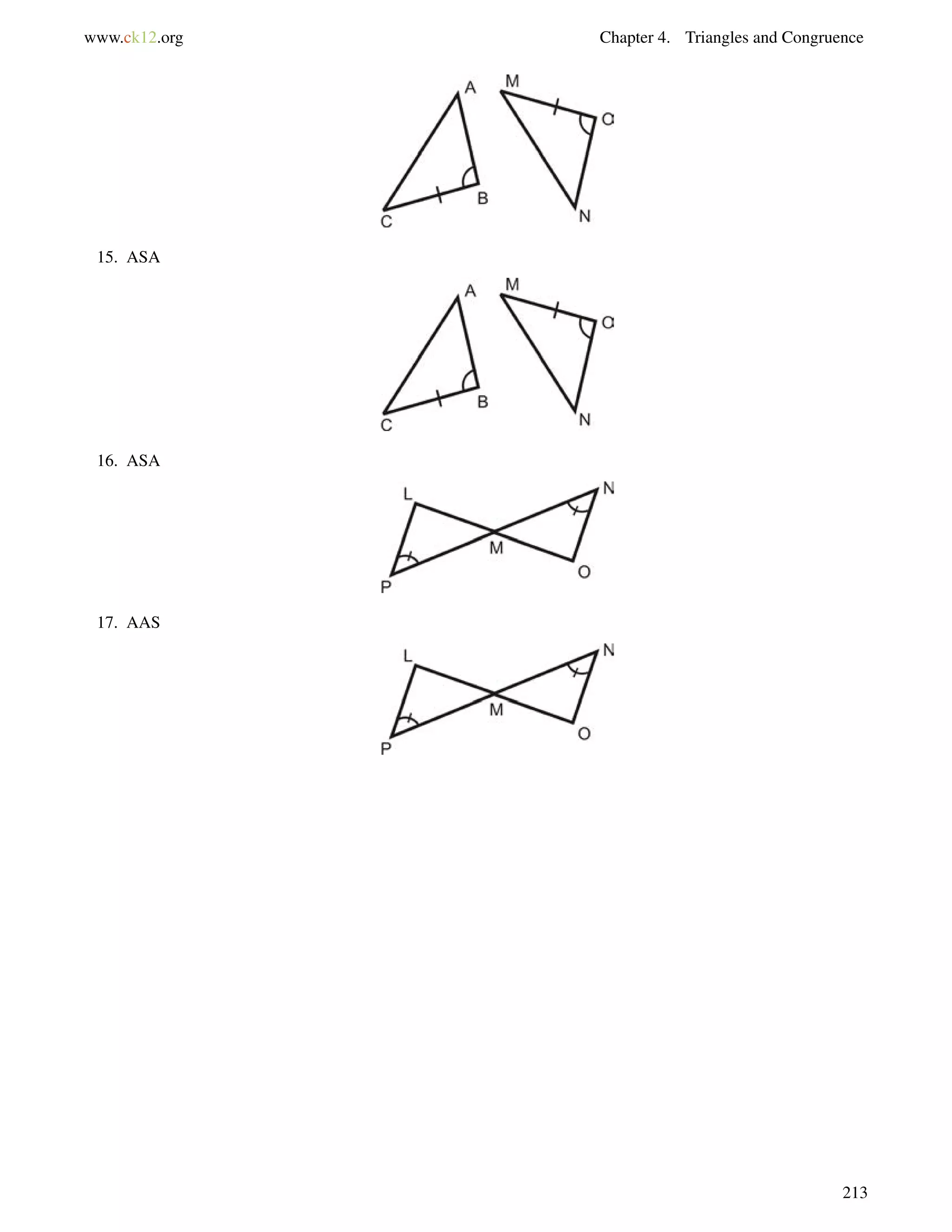
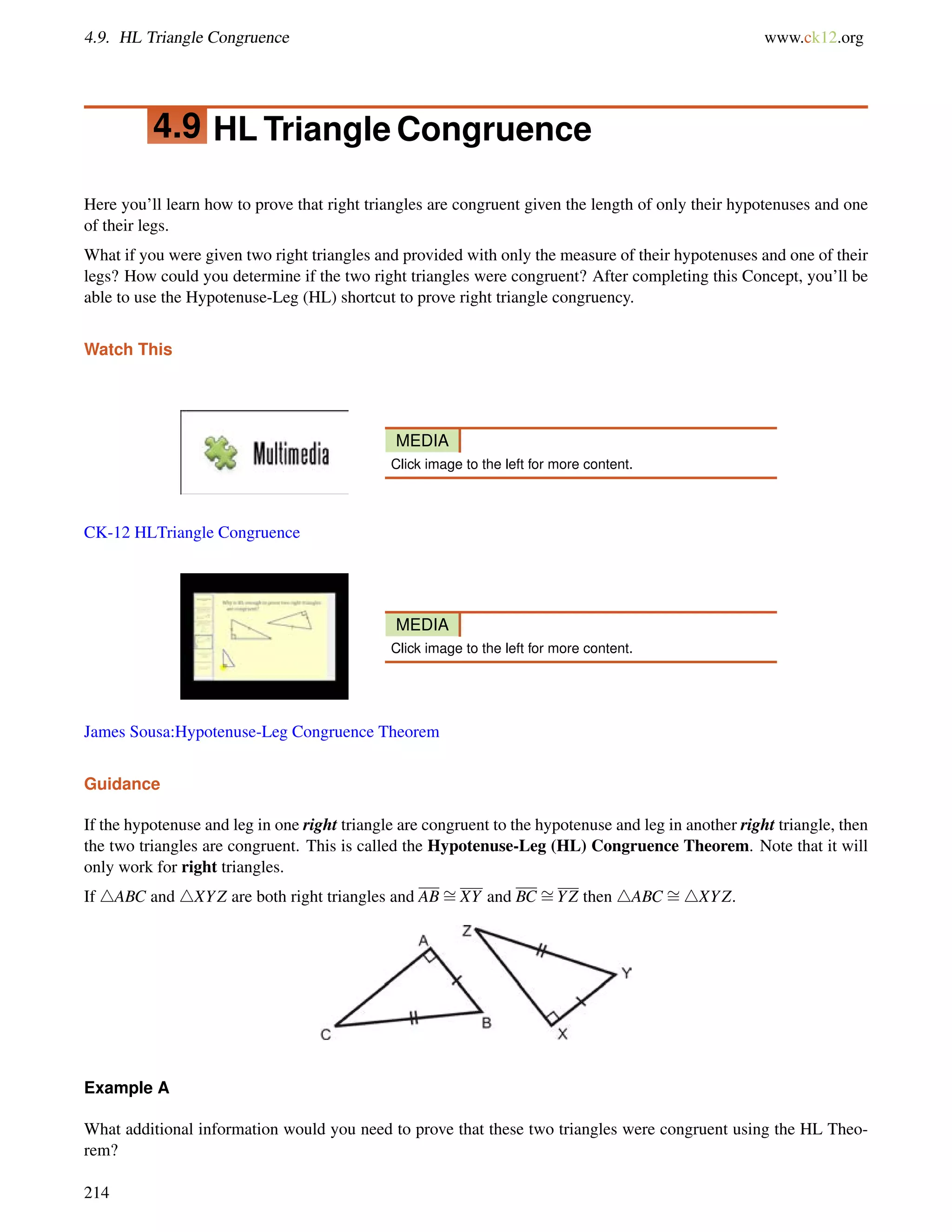
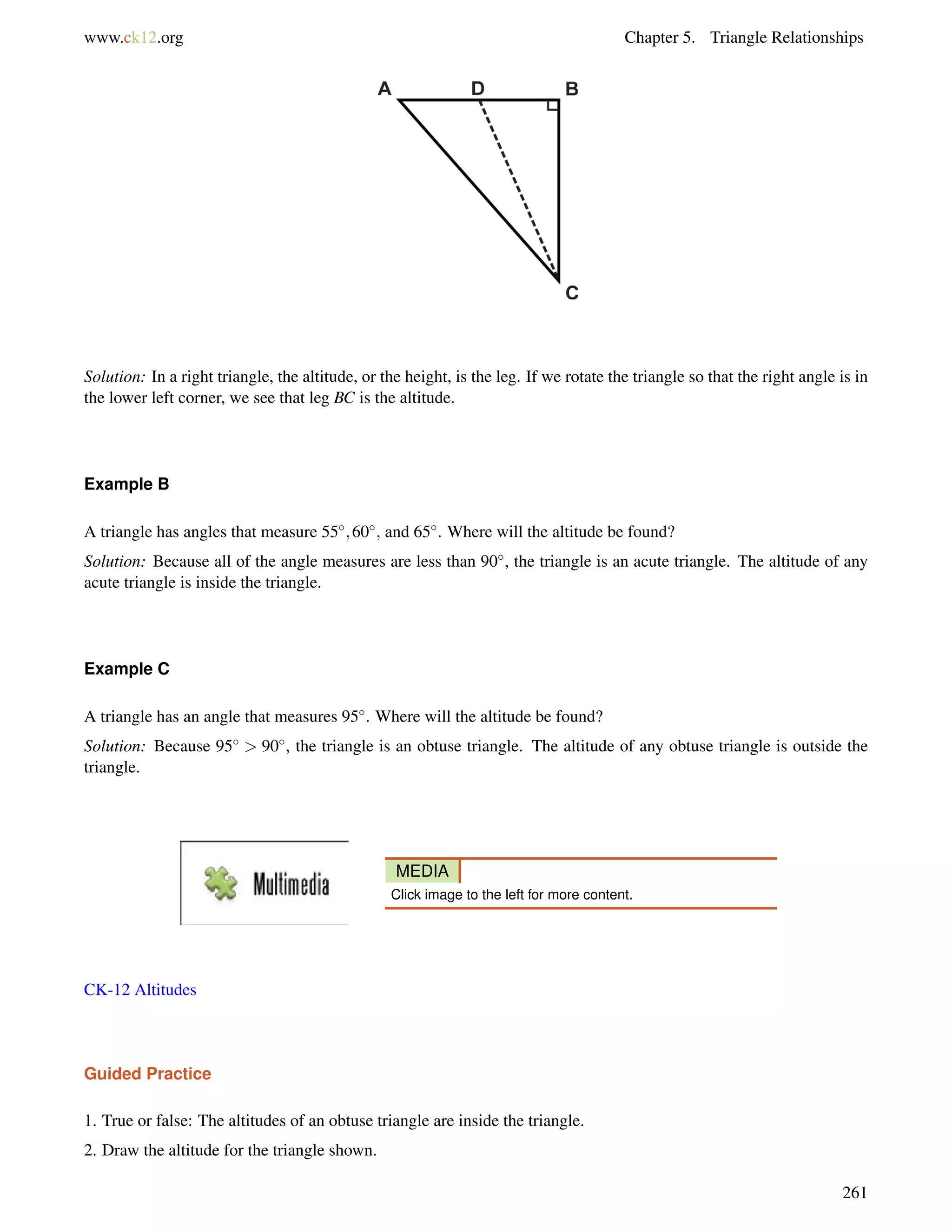
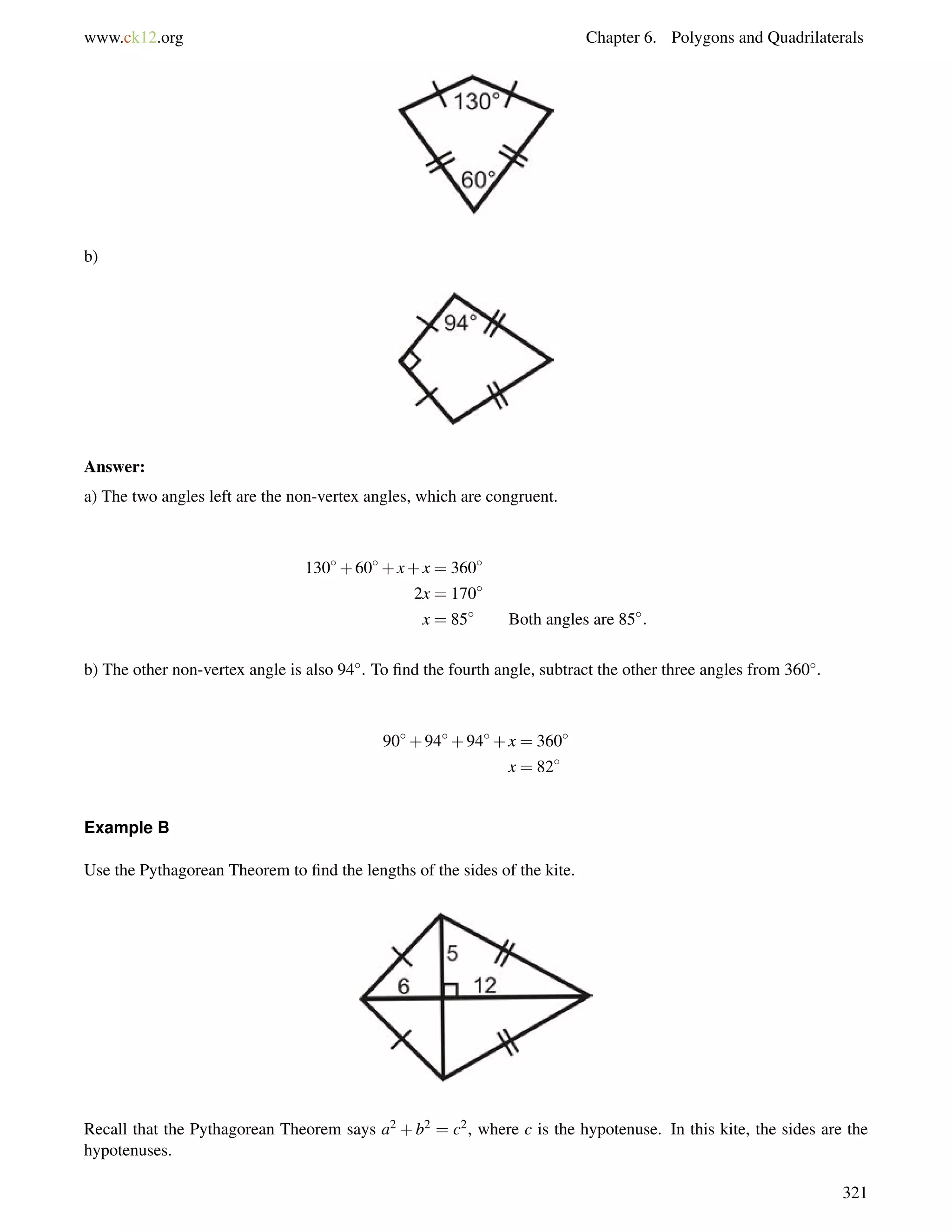
  • 451.
    www.ck12.org Chapter 8.Right Triangle Trigonometry a) sin78 = 0:97815 b) cos60 = 0:5 c) tan15 = 0:26795 Example B Find the value of each variable. Round your answer to the nearest tenth. We are given the hypotenuse. Use sine to find b, and cosine to find a. Use your calculator to evaluate the sine and cosine of the angles. sin22 = b 30 cos22 = a 30 30 sin22 = b 30 cos22 = a b 11:2 a 27:8 Example C Find the value of each variable. Round your answer to the nearest tenth. We are given the adjacent leg to 42. To find c, use cosine and use tangent to find d. cos42 = ad jacent hypotenuse = 9 c tan42 = opposite ad jacent = d 9 c cos42 = 9 9 tan42 = d c = 9 cos42 12:1 d 27:0 445
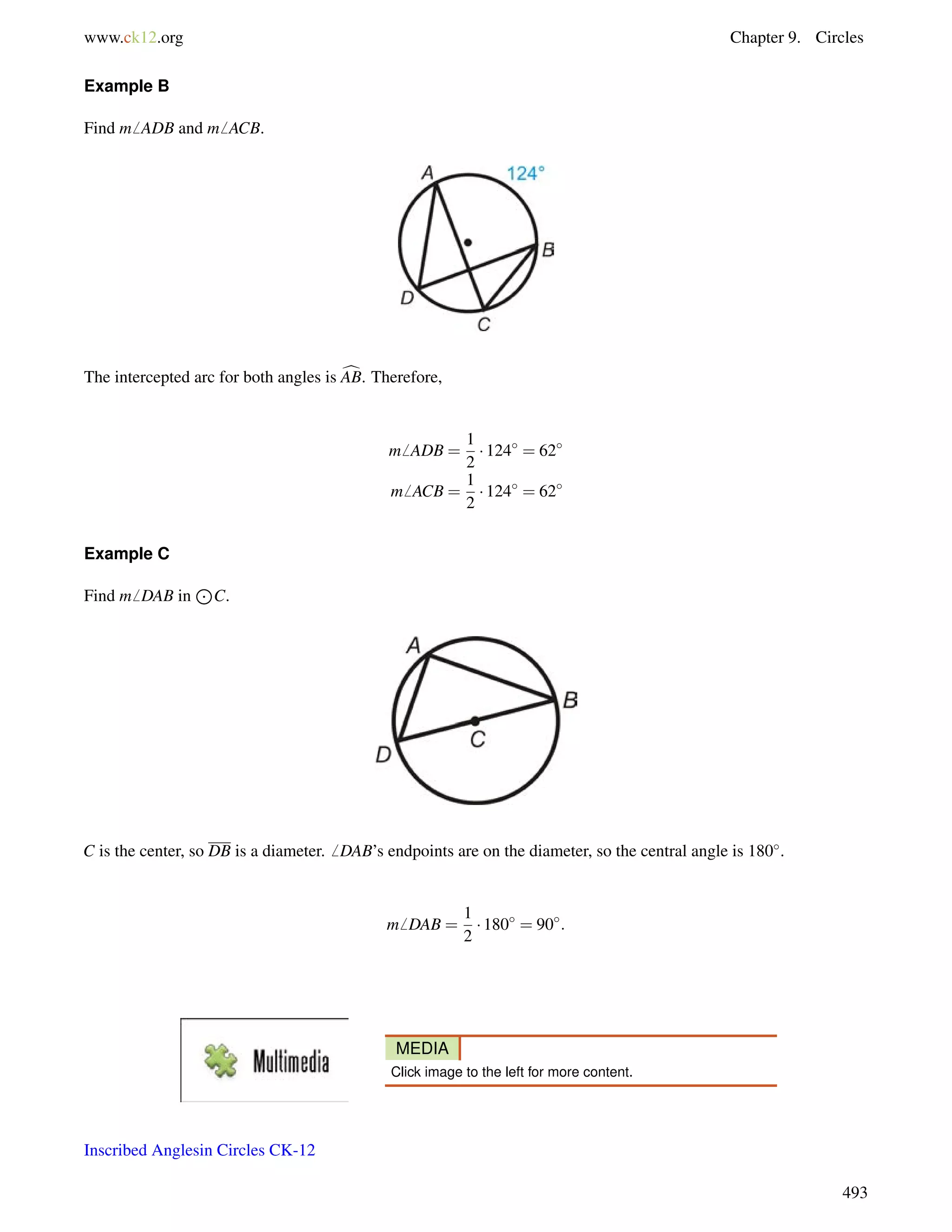
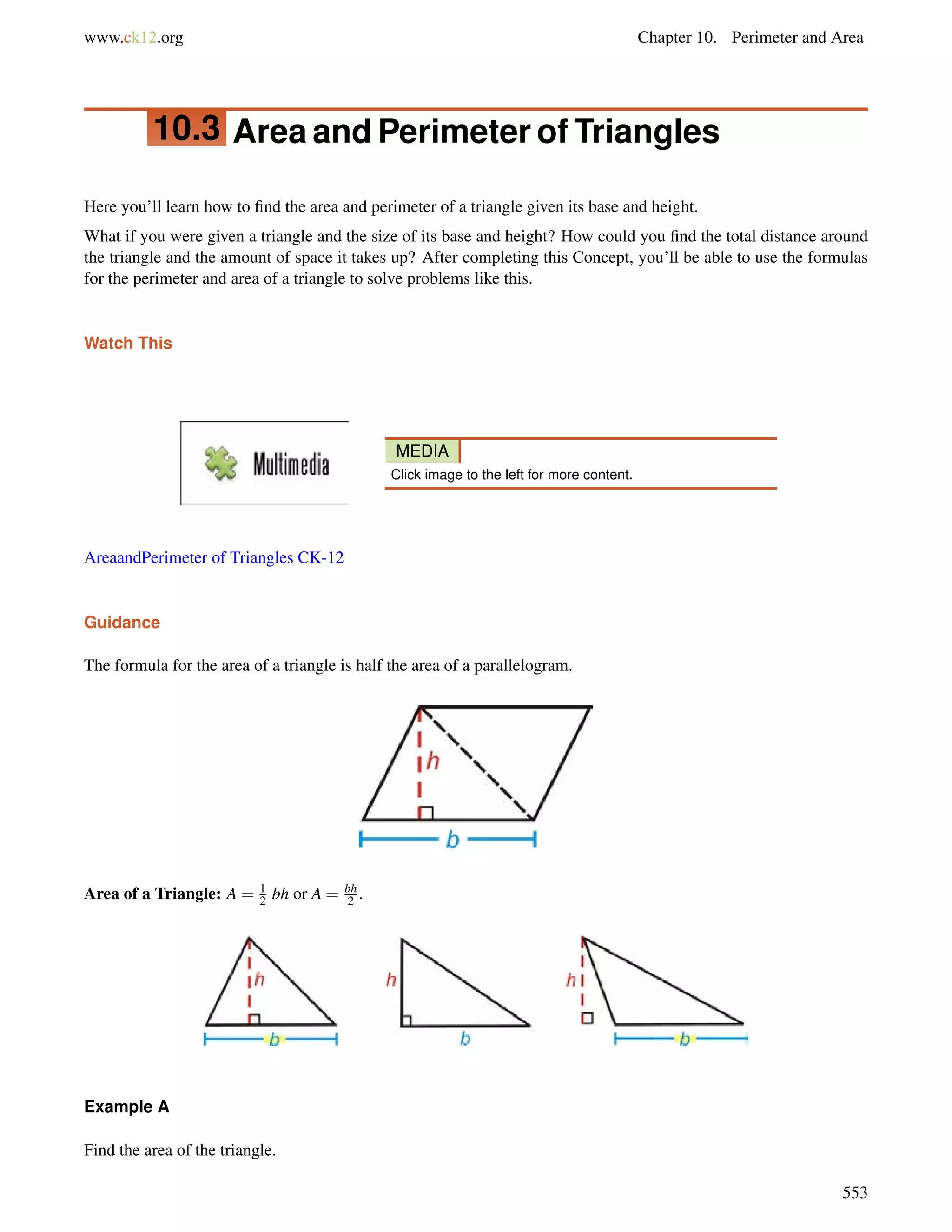
  • 452.
    8.8. Trigonometric Ratioswith a Calculator www.ck12.org Any time you use trigonometric ratios, use only the information that you are given. This will result in the most accurate answers. MEDIA Click image to the left for more content. CK-12 Foundation: The Trigonometric Ratios with a Calculator Guided Practice 1. What is tan45? 2. Find the length of the missing sides and round your answers to the nearest tenth: . 3. Find the length of the missing sides and round your answers to the nearest tenth: . Answers: 1. Using your calculator, you should find that tan45 = 1? 2. Use tangent for x and cosine for y. tan28 = x 11 cos28 = 11 y 11 tan28 = x 11 cos28 = y x 5:8 y 12:5 3. Use tangent for y and cosine for x. 446
  • 453.
    www.ck12.org Chapter 8.Right Triangle Trigonometry tan40 = y 16 cos40 = 16 x 16 tan40 = y 16 cos40 = x y 13:4 x 20:9 Practice Use your calculator to find the value of each trig function below. Round to four decimal places. 1. sin24 2. cos45 3. tan88 4. sin43 5. tan12 6. cos79 7. sin82 Find the length of the missing sides. Round your answers to the nearest tenth. 8. 9. 10. 11. 447
  • 454.
    8.9. Trigonometry WordProblems www.ck12.org 8.9 TrigonometryWord Problems Here you’ll learn how to solve word problems using the trigonometric ratios. What if you placed a ladder 10 feet from a haymow whose floor is 20 feet from the ground? How tall would the ladder need to be to reach the haymow’s floor if it forms a 30 angle with the ground? After completing this Concept, you’ll be able to solve angle of elevation and angle of depression word problems like this one. Watch This MEDIA Click image to the left for more content. CK-12 Foundation: Trigonometry Word Problems First watch this video. MEDIA Click image to the left for more content. James Sousa:SolvingRight Triangles- The Basics Then watch this video. MEDIA Click image to the left for more content. James Sousa:SolvingRight Triangles- Applications Guidance One application of the trigonometric ratios is to find lengths that you cannot measure. Very frequently, angles of depression and elevation are used in these types of problems. Angle of Depression: The angle measured down from the horizon or a horizontal line. 448
  • 455.
    www.ck12.org Chapter 8.Right Triangle Trigonometry Angle of Elevation: The angle measured up from the horizon or a horizontal line. Example A A math student is standing 25 feet from the base of the Washington Monument. The angle of elevation from her horizontal line of sight is 87:4. If her “eye height” is 5 ft, how tall is the monument? We can find the height of the monument by using the tangent ratio. tan87:4 = h 25 h = 25 tan87:4 = 550:54 Adding 5 ft, the total height of the Washington Monument is 555.54 ft. Example B A 25 foot tall flagpole casts a 42 foot shadow. What is the angle that the sun hits the flagpole? 449
  • 456.
    8.9. Trigonometry WordProblems www.ck12.org Draw a picture. The angle that the sun hits the flagpole is x. We need to use the inverse tangent ratio. tan x = 42 25 tan1 42 25 59:2 = x Example C Elise is standing on top of a 50 foot building and sees her friend, Molly. If Molly is 30 feet away from the base of the building, what is the angle of depression from Elise to Molly? Elise’s eye height is 4.5 feet. Because of parallel lines, the angle of depression is equal to the angle at Molly, or x. We can use the inverse tangent ratio. tan1 54:5 30 = 61:2 = x MEDIA Click image to the left for more content. 450
  • 457.
    www.ck12.org Chapter 8.Right Triangle Trigonometry CK-12 Foundation: Trigonometry Word Problems Guided Practice 1. Mark is flying a kite and realizes that 300 feet of string are out. The angle of the string with the ground is 42:5. How high is Mark’s kite above the ground? 2. A 20 foot ladder rests against a wall. The base of the ladder is 7 feet from the wall. What angle does the ladder make with the ground? 3. A 20 foot ladder rests against a wall. The ladder makes a 55 angle with the ground. How far from the wall is the base of the ladder? Answers 1. It might help to draw a picture. Then write and solve a trig equation. sin42:5 = x 300 300 sin42:5 = x x 202:7 The kite is about 202:7 feet off of the ground. 2. It might help to draw a picture. cos x = 7 20 x = cos1 7 20 x 69:5 . 3. It might help to draw a picture. cos55 = x 20 20 cos55 = x x 11:5 f t . Practice 1. Kristin is swimming in the ocean and notices a coral reef below her. The angle of depression is 35 and the depth of the ocean, at that point is 250 feet. How far away is she from the reef? 451
  • 458.
    8.9. Trigonometry WordProblems www.ck12.org 2. The Leaning Tower of Piza currently “leans” at a 4 angle and has a vertical height of 55.86 meters. How tall was the tower when it was originally built? Use what you know about right triangles to solve for the missing angle. If needed, draw a picture. Round all answers to the nearest tenth of a degree. 3. A 75 foot building casts an 82 foot shadow. What is the angle that the sun hits the building? 4. Over 2 miles (horizontal), a road rises 300 feet (vertical). What is the angle of elevation? 5. A boat is sailing and spots a shipwreck 650 feet below the water. A diver jumps from the boat and swims 935 feet to reach the wreck. What is the angle of depression from the boat to the shipwreck? 6. Standing 100 feet from the base of a building, Sam measures the angle to the top of the building from his eye height to be 50. If his eyes are 6 feet above the ground, how tall is the building? 7. Over 4 miles (horizontal), a road rises 200 feet (vertical). What is the angle of elevation? 8. A 90 foot building casts an 110 foot shadow. What is the angle that the sun hits the building? 9. Luke is flying a kite and realizes that 400 feet of string are out. The angle of the string with the ground is 50. How high is Luke’s kite above the ground? 10. An 18 foot ladder rests against a wall. The base of the ladder is 10 feet from the wall. What angle does the ladder make with the ground? 452
  • 459.
    www.ck12.org Chapter 8.Right Triangle Trigonometry 8.10 Inverse Trigonometric Ratios Here you’ll learn how to apply the three inverse trigonometric ratios, the inverse sine, the inverse cosine, and the inverse tangent, to find angle measures. What if you were told the tangent of6 Z is 0.6494? How could you find the measure of6 Z? After completing this Concept, you’ll be able to find angle measures by using the inverse trigonometric ratios. Watch This MEDIA Click image to the left for more content. CK-12 Foundation: The Inverse Trigonometric Ratios MEDIA Click image to the left for more content. James Sousa:Introduction toInverseTrigonometric Functions Guidance In mathematics, the word inverse means “undo.” For example, addition and subtraction are inverses of each other because one undoes the other. When we we use the inverse trigonometric ratios, we can find acute angle measures as long as we are given two sides. Inverse Tangent: Labeled tan1, the “-1” means inverse. tan1 b a = m6 B and tan1 ab = m6 A. Inverse Sine: Labeled sin1. 453
  • 460.
    8.10. Inverse TrigonometricRatios www.ck12.org sin1 bc = m6 B and sin1 ac = m6 A. bc ac Inverse Cosine: Labeled cos1. cos1 = m6 B and cos1 = m6 A. In most problems, to find the measure of the angles you will need to use your calculator. On most scientific and graphing calculators, the buttons look like [SIN1]; [COS1], and [TAN1]. You might also have to hit a shift or 2nd button to access these functions. Now that you know both the trig ratios and the inverse trig ratios you can solve a right triangle. To solve a right triangle, you need to find all sides and angles in it. You will usually use sine, cosine, or tangent; inverse sine, inverse cosine, or inverse tangent; or the Pythagorean Theorem. Example A Use the sides of the triangle and your calculator to find the value of6 A. Round your answer to the nearest tenth of a degree. In reference to6 A, we are given the opposite leg and the adjacent leg. This means we should use the tangent ratio. tanA = 20 25 = 45 . So, tan1 45 = m6 A. Now, use your calculator. 45 If you are using a TI-83 or 84, the keystrokes would be: [2nd][TAN] [ENTER] and the screen looks like: m6 A 38:7 Example B 6 A is an acute angle in a right triangle. Find m6 A to the nearest tenth of a degree. a) sinA = 0:68 b) cosA = 0:85 c) tanA = 0:34 Answers: a) m6 A = sin1 0:68 42:8 b) m6 A = cos1 0:85 31:8 c) m6 A = tan1 0:34 18:8 454
  • 461.
    www.ck12.org Chapter 8.Right Triangle Trigonometry Example C Solve the right triangle. To solve this right triangle, we need to find AB;m6 C and m6 B. Use only the values you are given. AB: Use the Pythagorean Theorem. 242+AB2 = 302 576+AB2 = 900 AB2 = 324 AB = p 324 = 18 m6 B: Use the inverse sine ratio. sinB = 24 30 = 4 5 sin1 4 5 53:1 = m6 B m6 C: Use the inverse cosine ratio. cosC = 24 30 = 4 5 !cos1 4 5 36:9 = m6 C MEDIA Click image to the left for more content. CK-12 Foundation: The Inverse Trigonometric Ratios Guided Practice 1. Solve the right triangle. 455
  • 462.
    8.10. Inverse TrigonometricRatios www.ck12.org 2. Solve the right triangle. 3. When would you use sin and when would you use sin1? Answers: 1. To solve this right triangle, we need to find AB;BC and m6 A. AB: Use the sine ratio. sin62 = 25 AB AB = 25 sin62 AB 28:31 BC: Use the tangent ratio. tan62 = 25 BC BC = 25 tan62 BC 13:30 m6 A: Use the Triangle Sum Theorem 62+90+m6 A = 180 m6 A = 28 2. The two acute angles are congruent, making them both 45. This is a 45-45-90 triangle. You can use the trigonometric ratios or the special right triangle ratios. Trigonometric Ratios tan45 = 15 BC sin45 = 15 AC BC = 15 tan45 = 15 AC = 15 sin45 21:21 456
  • 463.
    www.ck12.org Chapter 8.Right Triangle Trigonometry 45-45-90 Triangle Ratios BC = AB = 15;AC = 15 p 2 21:21 3. You would use sin when you are given an angle and you are solving for a missing side. You would use sin1 when you are given sides and you are solving for a missing angle. Practice Use your calculator to find m6 A to the nearest tenth of a degree. 1. 2. 3. 4. 5. 6. Let6 A be an acute angle in a right triangle. Find m6 A to the nearest tenth of a degree. 457
  • 464.
    8.10. Inverse TrigonometricRatios www.ck12.org 7. sinA = 0:5684 8. cosA = 0:1234 9. tanA = 2:78 10. cos1 0:9845 11. tan1 15:93 12. sin1 0:7851 Solving the following right triangles. Find all missing sides and angles. Round any decimal answers to the nearest tenth. 13. 14. 15. 16. 17. 18. 458
  • 465.
    www.ck12.org Chapter 8.Right Triangle Trigonometry 19. 20. 21. Summary This chapter begins with a review of how to simplify radicals, an important prerequisite technique for working with the Pythagorean Theorem. The Pythagorean Theorem, its converse, and Pythagorean triples are discussed in detail. Applications of the Pythagorean Theorem are explored including finding missing lengths in right triangles. The chapter then branches out into applications of special right triangles, namely 45-45-90 and 30-60-90. The connection between trigonometry and geometry is explored through trigonometric ratios, trigonometry word problems and inverse trigonometric ratios at the end of this chapter. 459
  • 466.
    www.ck12.org CHAPTER 9Circles Chapter Outline 9.1 PARTS OF CIRCLES 9.2 TANGENT LINES 9.3 ARCS IN CIRCLES 9.4 CHORDS IN CIRCLES 9.5 INSCRIBED ANGLES IN CIRCLES 9.6 INSCRIBED QUADRILATERALS IN CIRCLES 9.7 ANGLES ON AND INSIDE A CIRCLE 9.8 ANGLES OUTSIDE A CIRCLE 9.9 SEGMENTS FROM CHORDS 9.10 SEGMENTS FROM SECANTS 9.11 SEGMENTS FROM SECANTS AND TANGENTS 9.12 CIRCLES IN THE COORDINATE PLANE Introduction First, we will define all the parts of circles and explore the properties of tangent lines, arcs, inscribed angles, and chords. Next, we will learn about angles and segments that are formed by chords, tangents and secants. Lastly, we will place circles in the coordinate plane and find the equation of and graph circles. 460
  • 467.
    www.ck12.org Chapter 9.Circles 9.1 Parts of Circles Here you’ll learn all the vocabulary associated with the parts of a circle. What if you drew a line through a circle from one side to the other that does not pass through the center? What if you drew a line outside a circle that touched the circle at one point? What would you call these lines you drew? After completing this Concept, you’ll be able to name circle parts such as these. Watch This MEDIA Click image to the left for more content. Parts ofCirclesCK-12 Watch the first half of this video. MEDIA Click image to the left for more content. James Sousa:Introduction toCircles Guidance A circle is the set of all points in the plane that are the same distance away from a specific J point, called the center. The center of the circle below is point A. We call this circle “circle A,” and it is labeled A. Important Circle Parts Radius: The distance from the center of the circle to its outer rim. 461
  • 468.
    9.1. Parts ofCircles www.ck12.org Chord: A line segment whose endpoints are on a circle. Diameter: A chord that passes through the center of the circle. The length of a diameter is two times the length of a radius. Secant: A line that intersects a circle in two points. Tangent: A line that intersects a circle in exactly one point. Point of Tangency: The point where a tangent line touches the circle. The tangent ray ! TP and tangent segment TP are also called tangents. Tangent Circles: Two or more circles that intersect at one point. Concentric Circles: Two or more circles that have the same center, but different radii. Congruent Circles: Two or more circles with the same radius, but different centers. Example A Find the parts of J A that best fit each description. a) A radius 462
  • 469.
    www.ck12.org Chapter 9.Circles b) A chord c) A tangent line d) A point of tangency e) A diameter f) A secant Answers: a) HA or AF b) CD; HF, or DG c) ! BJ d) Point H e) HF ! f) BD Example B Draw an example of how two circles can intersect with no, one and two points of intersection. You will make three separate drawings. Example C Determine if any of the following circles are congruent. 463
  • 470.
    9.1. Parts ofCircles www.ck12.org From each center, count the units to the outer rim of the circle. It is easiest to count vertically or horizontally. Doing this, we have: Radius of K A = 3 units Radius of K B = 4 units Radius of K C = 3 units From these measurements, we see that J A= J C. Notice the circles are congruent. The lengths of the radii are equal. MEDIA Click image to the left for more content. Parts ofCirclesCK-12 Guided Practice 1. If the diameter of a circle is 10 inches, how long is the radius? 2. Is it possible to have a line that intersects a circle three times? If so, draw one. If not, explain. 3. Are all circles similar? Answers: 1. The radius is always half the length of the diameter, so it is 5 inches. 2. It is not possible. By definition, all lines are straight. The maximum number of times a line can intersect a circle is twice. 3. Yes. All circles are the same shape, but not necessarily the same size, so they are similar. Practice Determine which term best describes each of the following parts of J P. 464
  • 471.
    www.ck12.org Chapter 9.Circles 1. KG 2. ! FH 3. KH 4. E ! 5. BK ! 6. CF 7. A 8. JG 9. What is the longest chord in any circle? Use the graph below to answer the following questions. 10. Find the radius of each circle. 11. Are any circles congruent? How do J you know? 12. Find all the common tangents for B and J C. 13. J C and J E are externally tangent. What is CE? 14. Find the equation of CE. 465
  • 472.
    9.2. Tangent Lineswww.ck12.org 9.2 Tangent Lines Here you’ll learn two theorems about tangent lines: 1) the Tangent to a Circle Theorem that states tangents are perpendicular to radii; and 2) the Two Tangents Theorem that states two tangents drawn from the same point will be congruent. What if a line were drawn outside a circle that appeared to touch the circle at only one point? How could you determine if that line were actually a tangent? After completing this Concept, you’ll be able to apply theorems to solve tangent problems like this one. Watch This MEDIA Click image to the left for more content. Tangent Lines CK-12 First watch this video. MEDIA Click image to the left for more content. James Sousa:TangentLines to a Circle Now watch this video. MEDIA Click image to the left for more content. James Sousa:TangentLines to a Circle Example Problems Guidance There are two important theorems about tangent lines. 466
  • 473.
    www.ck12.org Chapter 9.Circles 1) Tangent to a Circle Theorem: A line is tangent to a circle if and only if the line is perpendicular to the radius drawn to the point of tangency. ! BC is tangent at point B if and only if ! BC ? AB. This theorem uses the words “if and only if,” making it a biconditional statement, which means the converse of this theorem is also true. 2) Two Tangents Theorem: If two tangent segments are drawn to one circle from the same external point, then they are congruent. BC and DC have C as an endpoint and are tangent; BC = DC. Example A CB is tangent to J A at point B. Find AC. Reduce any radicals. CB is tangent, so AB ?CB and 4ABC a right triangle. Use the Pythagorean Theorem to find AC. 52+82 = AC2 25+64 = AC2 89 = AC2 AC = p 89 467
  • 474.
    9.2. Tangent Lineswww.ck12.org Example B Using the answer from Example A above, find DC in J A. Round your answer to the nearest hundredth. DC = ACAD DC = p 895 4:43 Example C Find the perimeter of 4ABC. AE = AD; EB = BF; and CF =CD. Therefore, the perimeter of 4ABC = 6+6+4+4+7+7 = 34. J G is inscribed in 4ABC. A circle is inscribed in a polygon if every side of the polygon is tangent to the circle. MEDIA Click image to the left for more content. Tangent Lines CK-12 Guided Practice 1. Find AB between J A and J B. Reduce the radical. 2. Determine if the triangle below is a right triangle. 468
  • 475.
    www.ck12.org Chapter 9.Circles 3. If D and C are the centers and AE is tangent to both circles, find DC. 4. Find the value of x. Answers: 1. AD ? DC and DC ?CB. Draw in BE, so EDCB is a rectangle. Use the Pythagorean Theorem to find AB. 52+552 = AB2 25+3025 = AB2 3050 = AB2 AB = p 3050 = 5 p 122 2. Again, use the Pythagorean Theorem. 4 p 10 is the longest side, so it will be c. 469
  • 476.
    9.2. Tangent Lineswww.ck12.org Does 82+102 = 4 2 ? p 10 64+1006= 160 4ABC is not a right triangle. From this, we also find that CB is not tangent to J A. 3. AE ? DE and AE ? AC and 4ABC 4DBE by AA Similarity. To find DB, use the Pythagorean Theorem. 102+242 = DB2 100+576 = 676 DB = p 676 = 26 To find BC, use similar triangles. 5 10 = BC 26 !BC = 13: DC = DB+BC = 26+13 = 39 4. AB= CB by the Two Tangents Theorem. Set AB =CB and solve for x. 4x9 = 15 4x = 24 x = 6 Practice Determine whether the given segment is tangent to J K. 1. 2. 3. 470
  • 477.
    www.ck12.org Chapter 9.Circles Find the value of the indicated length(s) in J C. A and B are points of tangency. Simplify all radicals. 4. 5. 6. 7. 8. 9. A and B are points of tangency for J C and J D. 471
  • 478.
    9.2. Tangent Lineswww.ck12.org 10. Is 4AEC 4BED? Why? 11. Find CE. 12. Find BE. 13. Find ED. 14. Find BC and AD. J A is inscribed in BDFH. 15. Find the perimeter of BDFH. 16. What type of quadrilateral is BDFH? How do you know? 17. Draw a circle inscribed in a square. If the radius of the circle is 5, what is the perimeter of the square? 18. Can a circle be inscribed in a rectangle? If so, draw it. If not, explain. 19. Draw a triangle with two sides tangent to a circle, but the third side is not. 20. Can a circle be inscribed in an obtuse triangle? If so, draw it. If not, explain. 21. Fill in the blanks in the proof of the Two Tangents Theorem. = Given: AB and CB with points of tangency at A and C. AD and DC are radii. Prove: ABCB 472
  • 479.
    www.ck12.org Chapter 9.Circles TABLE 9.1: = Statement Reason 1. 1. 2. ADDC 2. = 3. DA ? AB and DC ?CB 3. 4. 4. Definition of perpendicular lines 5. 5. Connecting two existing points 6. 4ADB and 4DCB are right triangles 6. 7. DBDB 7. 8. 4ABD= 4CBD 8. 9. AB= CB 9. 22. Fill in the blanks, using the proof from #21. a. ABCD is a _____________ (type of quadrilateral). b. The line that connects the ___________ and the external point B __________6 ABC. 23. Points A; B; and C are points of tangency for the three tangent circles. Explain why AT = BT = CT. 473
  • 480.
    9.3. Arcs inCircles www.ck12.org 9.3 Arcs in Circles Here you’ll learn the properties of arcs and central angles and use them to find the measure of arcs. What if a circle were divided into pieces by various radii? How could you find the measures of the arcs formed by these radii? After completing this Concept, you’ll be able to use central angles to solve problems like this one. Watch This MEDIA Click image to the left for more content. Arcsin Circles CK-12 Guidance A circle has 360. An arc is a section of the circle. A semicircle is an arc that measures 180. [EHG and dEJG are semicircles A central angle is the angle formed by two radii with its vertex at the center of the circle. A minor arc is an arc that is less than 180. A major arc is an arc that is greater than 180. Always use 3 letters to label a major arc. The central angle is6 BAC. The minor arc is cBC. The major arc is dBDC. An arc can be measured in degrees or in a linear measure (cm, ft, etc.). In this concept we will use degree measure. The measure of a minor arc is the same as the measure of the central angle that corresponds to it. The measure 474
  • 481.
    www.ck12.org Chapter 9.Circles of a major arc is 360 minus the measure of the corresponding minor arc. The measure of the arc formed by two adjacent arcs is the sum of the measures of the two arcs (Arc Addition Postulate). mcAD+mcDB = mdADB Example A Find mcAB and mdADB in J C. mcAB = m6 ACB. So, mcAB = 102. mdADB = 360mcAB = 360102 = 258 Example B Find the measures of the minor arcs in J A. EB is a diameter. 475
  • 482.
    9.3. Arcs inCircles www.ck12.org Because EB is a diameter, m6 EAB = 180. Each arc has the same measure as its corresponding central angle. mcBF = m6 FAB = 60 mcEF = m6 EAF = 120 !18060 mcED = m6 EAD = 38 !1809052 mcDC = m6 DAC = 90 mcBC = m6 BAC = 52 Example C Find the measures of the indicated arcs in J A. EB is a diameter. a) m[FED b) m[CDF c) m[DFC Use the Arc Addition Postulate. a) m[FED = mcFE +mcED = 120+38 = 158 b) m[CDF = mcCD+mcDE +mcEF = 90+38+120 = 248 c) m[DFC = mcED+mcEF +mcFB+mcBC = 38+120+60+52 = 270 MEDIA Click image to the left for more content. Arcsin Circles CK-12 Guided Practice 1. List the congruent arcs in J C below. AB and DE are diameters. 476
  • 483.
    www.ck12.org Chapter 9.Circles 2. Are the blue arcs congruent? Explain why or why not. a) b) 3. Find the value of x for J C below. Answers: 1.6 ACD= 6 ECB because they are vertical angles.6 DCB= 6 ACE because they are also vertical angles. cAD=cEB and cAE = cDB 2. a) cAD= cBC because they have the same central angle measure and are in the same circle. 477
  • 484.
    9.3. Arcs inCircles www.ck12.org b) The two arcs have the same measure, but are not congruent because the circles have different radii. 3. The sum of the measure of the arcs is 360 because they make a full circle. mcAB+mcAD+mcDB = 360 (4x+15)+92+(6x+3) = 360 10x+110 = 360 10x = 250 x = 25 Practice Determine whether the arcs below are a minor arc, major arc, or semicircle of J G. EB is a diameter. 1. cAB 2. dABD 3. dBCE 4. dCAE 5. dABC 6. dEAB 7. Are there any congruent arcs? If so, list them. 8. If mcBC = 48, find mcCD. 9. Using #8, find mdCAE. Find the measure of the minor arc and the major arc in each circle below. 10. 11. 478
  • 485.
    www.ck12.org Chapter 9.Circles 12. 13. 14. 15. Determine if the blue arcs are congruent. If so, state why. 16. 17. 479
  • 486.
    9.3. Arcs inCircles www.ck12.org 18. Find the measure of the indicated arcs or central angles in J A. DG is a diameter. 19. cDE 20. cDC 21. dGAB 22. cFG 23. [EDB 24. dEAB 25. [DCF 26. [DBE Find the measure of x in J P. 27. 28. 480
  • 487.
    www.ck12.org Chapter 9.Circles 29. 481
  • 488.
    9.4. Chords inCircles www.ck12.org 9.4 Chords in Circles Here you’ll learn four theorems about chords in circles and how to apply them to find missing values. What if you were given a circle with two chords drawn through it? How could you determine if these two chords were congruent? After completing this Concept, you’ll be able to use four chord theorems to solve problems like this one. Watch This MEDIA Click image to the left for more content. Chords in Circles CK-12 Guidance There are several important theorems about chords that will help you to analyze circles better. 1) Chord Theorem #1: In the same circle or congruent circles, minor arcs are congruent if and only if their corresponding chords are congruent. In both of these pictures, BE = CD and cBE = cCD. 2) Chord Theorem #2: The perpendicular bisector of a chord is also a diameter. 482
  • 489.
    www.ck12.org Chapter 9.Circles If AD ? BC and BD= DC then EF is a diameter. 3) Chord Theorem #3: If a diameter is perpendicular to a chord, then the diameter bisects the chord and its corresponding arc. If EF ? BC, then BD= DC and cBE = cEC. 4) Chord Theorem #4: In the same circle or congruent circles, two chords are congruent if and only if they are equidistant from the center. = The shortest distance from any point to a line is the perpendicular line between them. If FE = EG and EF ? EG, then AB and CD are equidistant to the center and ABCD. Example A Use J A to answer the following. a) If mcBD = 125, find mcCD. b) If mcBC = 80, find mcCD. Answers: 483
  • 490.
    9.4. Chords inCircles www.ck12.org = a) BD =CD, which means the arcs are congruent too. mCD c= 125. b) mCDcmBD cbecause BD =CD. mcBC+mcCD+mcBD = 360 80+2mcCD = 360 2mcCD = 280 mcCD = 140 Example B Find the values of x and y. The diameter is perpendicular to the chord. From Chord Theorem #3, x = 6 and y = 75. Example C Find the value of x. Because the distance from the center to the chords is equal, the chords are congruent. 6x7 = 35 6x = 42 x = 7 484
  • 491.
    www.ck12.org Chapter 9.Circles MEDIA Click image to the left for more content. Chords in Circles CK-12 Guided Practice 1. Find the value of x and y. 2. BD = 12 and AC = 3 in J A. Find the radius. 3. Find mcBD from #2. Answers: 1. The diameter is perpendicular to the chord, which means it bisects the chord and the arc. Set up equations for x and y. (3x4) = (5x18) y+4 = 2y+1 14 = 2x 3 = y 7 = x 2. First find the radius. AB is a radius, so we can use the right triangle 4ABC with hypotenuse AB. From Chord Theorem #3, BC = 6. 32+62 = AB2 9+36 = AB2 AB = p 45 = 3 p 5 485
  • 492.
    9.4. Chords inCircles www.ck12.org 3. First, find the corresponding central angle,6 BAD. We can find m6 BAC using the tangent ratio. Then, multiply m6 BAC by 2 for m6 BAD and mcBD. tan1 6 3 = m6 BAC m6 BAC 63:43 m6 BAD 2 63:43 126:86 mcBD Practice Fill in the blanks. 1. = DF 2. cAC = 3. cDJ = 4. = EJ 5.6 AGH = 6.6 DGF = 7. List all the congruent radii in J G. Find the value of the indicated arc in J A. 8. mcBC 9. mcBD 486
  • 493.
    www.ck12.org Chapter 9.Circles 10. mcBC 11. mcBD 12. mcBD 13. mcBD 487
  • 494.
    9.4. Chords inCircles www.ck12.org Find the value of x and/or y. 14. 15. 16. 17. AB = 32 18. 488
  • 495.
    www.ck12.org Chapter 9.Circles 19. 20. 21. 22. AB = 20 23. Find mcAB in Question 17. Round your answer to the nearest tenth of a degree. 24. Find mcAB in Question 22. Round your answer to the nearest tenth of a degree. In problems 25-27, what can you conclude about the picture? State a theorem that justifies your answer. You may assume that A is the center of the circle. 25. 489
  • 496.
    9.4. Chords inCircles www.ck12.org 26. 27. 490
  • 497.
    www.ck12.org Chapter 9.Circles 9.5 Inscribed Angles in Circles Here you’ll learn the Inscribed Angle Theorem, which states that the measure of an inscribed angle is half the measure of its intercepted arc. You’ll also learn other inscribed angle theorems and you’ll use them to solve problems about circles. What if you had a circle with two chords that share a common endpoint? How could you use the arc formed by those chords to determine the measure of the angle those chords make inside the circle? After completing this Concept, you’ll be able to use the Inscribed Angle Theorem to solve problems like this one. Watch This MEDIA Click image to the left for more content. Inscribed Anglesin Circles CK-12 Guidance An inscribed angle is an angle with its vertex on the circle and whose sides are chords. The intercepted arc is the arc that is inside the inscribed angle and whose endpoints are on the angle. The vertex of an inscribed angle can be anywhere on the circle as long as its sides intersect the circle to form an intercepted arc. The Inscribed Angle Theorem states that the measure of an inscribed angle is half the measure of its intercepted arc. m6 ADC = 12 mcAC and mcAC = 2m6 ADC 491
  • 498.
    9.5. Inscribed Anglesin Circles www.ck12.org Inscribed angles that intercept the same arc are congruent. This is called the Congruent Inscribed Angles Theorem and is shown below. 6 ADB and6 ACB intercept cAB, so m6 ADB = m6 ACB. Similarly,6 DAC and6 DBC intercept cDC, so m6 DAC = m6 DBC. An angle intercepts a semicircle if and only if it is a right angle (Semicircle Theorem). Anytime a right angle is inscribed in a circle, the endpoints of the angle are the endpoints of a diameter and the diameter is the hypotenuse. MEDIA Click image to the left for more content. 6 DAB intercepts a semicircle, so m6 DAB = 90.6 DAB is a right angle, so cDB is a semicircle. Example A Find mcDC and m6 ADB. From the Inscribed Angle Theorem: mcDC = 2 45 = 90 m6 ADB = 1 2 76 = 38 492
  • 499.
    www.ck12.org Chapter 9.Circles Example B Find m6 ADB and m6 ACB. The intercepted arc for both angles is cAB. Therefore, m6 ADB = 1 2 124 = 62 m6 ACB = 1 2 124 = 62 Example C Find m6 DAB in J C. C is the center, so DB is a diameter.6 DAB’s endpoints are on the diameter, so the central angle is 180. m6 DAB = 1 2 180 = 90: MEDIA Click image to the left for more content. Inscribed Anglesin Circles CK-12 493
  • 500.
    9.5. Inscribed Anglesin Circles www.ck12.org Guided Practice 1. Find m6 PMN; mcPN; m6 MNP; and m6 LNP. 2. Fill in the blank: An inscribed angle is ____________ the measure of the intercepted arc. 3. Fill in the blank: A central angle is ________________ the measure of the intercepted arc. Answers: 1. Use what you’ve learned about inscribed angles. m6 PMN = m6 PLN = 68 by the Congruent Inscribed Angles Theorem: mcPN = 2 68 = 136 from the Inscribed Angle Theorem. m6 MNP = 90 by the Semicircle Theorem: m6 LNP = 1 2 92 = 46 from the Inscribed Angle Theorem. 2. half 3. equal to Practice Fill in the blanks. 1. An angle inscribed in a ________________ is 90. 2. Two inscribed angles that intercept the same arc are _______________. 3. The sides of an inscribed angle are ___________________. 4. Draw inscribed angle6 JKL in J M. Then draw central angle6 JML. How do the two angles relate? Find the value of x and/or y in J A. 5. 494
  • 501.
    www.ck12.org Chapter 9.Circles 6. 7. 8. 9. Solve for x. 10. 495
  • 502.
    9.5. Inscribed Anglesin Circles www.ck12.org 11. 12. 13. 14. Fill in the blanks of the Inscribed Angle Theorem proof. 12 Given: Inscribed6 ABC and diameter BD Prove: m6 ABC = mAC cTABLE 9.2: Statement Reason 1. Inscribed6 ABC and diameter BD 1. m6 ABE = x and m6 CBE = y 2. x+y = m6 ABC 2. 3. 3. All radii are congruent 4. 4. Definition of an isosceles triangle 5. m6 EAB = x and m6 ECB = y 5. 6. m6 AED = 2x and m6 CED = 2y 6. 7. mcAD = 2x and mcDC = 2y 7. 8. 8. Arc Addition Postulate 9. mcAC = 2x+2y 9. 496
  • 503.
    www.ck12.org Chapter 9.Circles TABLE 9.2: (continued) 12 Statement Reason 10. 10. Distributive PoE 11. mAC c= 2m6 ABC 11. 12. m6 ABC = mAC c12. 497
  • 504.
    9.6. Inscribed Quadrilateralsin Circles www.ck12.org 9.6 Inscribed Quadrilaterals in Circles Here you’ll learn about inscribed quadrilaterals and how to use the Inscribed Quadrilateral Theorem to solve prob-lems about circles. What if you were given a circle with a quadrilateral inscribed in it? How could you use information about the arcs formed by the quadrilateral and/or the quadrilateral’s angle measures to find the measure of the unknown quadrilateral angles? After completing this Concept, you’ll be able to apply the Inscribed Quadrilateral Theorem to solve problems like this one. Watch This MEDIA Click image to the left for more content. Inscribed Quadrilateralsin Circles CK-12 Guidance An inscribed polygon is a polygon where every vertex is on the circle, as shown below. For inscribed quadrilaterals in particular, the opposite angles will always be supplementary. Inscribed Quadrilateral Theorem: A quadrilateral can be inscribed in a circle if and only if the opposite angles are supplementary. If ABCD is inscribed in J E, then m6 A+m6 C = 180 and m6 B+m6 D = 180. Conversely, If m6 A+m6 C = 180 and m6 B+m6 D = 180, then ABCD is inscribed in J E. 498
  • 505.
    www.ck12.org Chapter 9.Circles Example A Find the values of the missing variables. a) b) Answers: a) x+80 = 180 y+71 = 180 x = 100 y = 109 b) z+93 = 180 x = 1 2 (58+106) y+82 = 180 z = 87 x = 82 y = 98 Example B Find x and y in the picture below. 499
  • 506.
    9.6. Inscribed Quadrilateralsin Circles www.ck12.org (7x+1)+105 = 180 (4y+14)+(7y+1) = 180 7x+106 = 180 11y+15 = 180 7x = 74 11y = 165 x = 10:57 y = 15 Example C Find the values of x and y in J A. Use the Inscribed Quadrilateral Theorem. x+108 = 180 so x = 72. Similarly, y+88 = 180 so y = 92. MEDIA Click image to the left for more content. Inscribed Quadrilateralsin Circles CK-12 Guided Practice Quadrilateral ABCD is inscribed in J E. Find: 1. m6 A 2. m6 B 3. m6 C 4. m6 D 500
  • 507.
    www.ck12.org Chapter 9.Circles 12 12 Answers: First, note that mAD c= 105 because the complete circle must add up to 360. 1. m6 A = mBD c= (115+86) = 100:5 2. m6 B = 12 mcAC = 1 2 (86+105) = 95:5 3. m6 C = 180m6 A = 180100:5 = 79:5 4. m6 D = 180m6 B = 18095:5 = 84:5 Practice Fill in the blanks. 1. A(n) _______________ polygon has all its vertices on a circle. 2. The _____________ angles of an inscribed quadrilateral are ________________. Quadrilateral ABCD is inscribed in J E. Find: 3. m6 DBC 4. mcBC 5. mcAB 6. m6 ACD 7. m6 ADC 8. m6 ACB Find the value of x and/or y in J A. 9. 10. 501
  • 508.
    9.6. Inscribed Quadrilateralsin Circles www.ck12.org 11. Solve for x. 12. 13. 502
  • 509.
    www.ck12.org Chapter 9.Circles 9.7 AnglesOnand Inside a Circle Here you’ll learn how to use the Chord/Tangent Angle Theorem and the Intersecting Chords Angle Theorem to solve problems containing angles that are on or inside a circle. What if you were given a circle with either a chord and a tangent or two chords that meet at a common point? How could you use the measure of the arc(s) formed by those circle parts to find the measure of the angles they make on or inside the circle? After completing this Concept, you’ll be able to apply the Chord/Tangent Angle Theorem and the Intersecting Chords Angle Theorem to solve problems like this one. Watch This MEDIA Click image to the left for more content. Angles On and Insidea Circle CK-12 Guidance When we say an angle is on a circle, we mean the vertex is on the edge of the circle. One type of angle on a circle is the inscribed angle (see Inscribed Anglesin Circles). Another type of angle on a circle is one formed by a tangent and a chord. Chord/Tangent Angle Theorem: The measure of an angle formed by a chord and a tangent that intersect on a circle is half the measure of the intercepted arc. m6 DBA = 12 mcAB If two angles, with their vertices on the circle, intercept the same arc then the angles are congruent. An angle is inside a circle when the vertex lies anywhere inside the circle. Intersecting Chords Angle Theorem: The measure of the angle formed by two chords that intersect inside a circle is the average of the measures of the intercepted arcs. 503
  • 510.
    9.7. Angles Onand Inside a Circle www.ck12.org m6 SVR = 1 2 mcSR+mcTQ = mcSR+mcTQ 2 = m6 TVQ m6 SVT = 1 2 mcST +mcRQ = mcST +mcRQ 2 = m6 RVQ Example A Find m6 BAD. Use the Chord/Tangent Angle Theorem. m6 BAD = 12 mcAB = 1 2 124 = 62. Example B Find a; b; and c. 50+45+m6 a = 180 straight angle m6 a = 85 504
  • 511.
    www.ck12.org Chapter 9.Circles m6 b = 1 2 mcAC mcAC = 2 m6 EAC = 2 45 = 90 m6 b = 1 2 90 = 45 85+45+m6 c = 180 Triangle Sum Theorem m6 c = 50 Example C Find mdAEB. Use the Chord/Tangent Angle Theorem. mdAEB = 2 m6 DAB = 2 133 = 266. MEDIA Click image to the left for more content. Angles On and Insidea Circle CK-12 Guided Practice Find x. 1. 505
  • 512.
    9.7. Angles Onand Inside a Circle www.ck12.org 2. 3. Answers: Use the Intersecting Chords Angle Theorem to write an equation. 1. x = 129+71 2 = 200 2 = 100 2. 40 = 52+x 2 80 = 52+x 28 = x 3. x is supplementary to the angle that is the average of the given intercepted arcs. We call this supplementary angle y. y = 19+107 2 = 126 2 = 63 x+63 = 180; x = 117 Practice Find the value of the missing variable(s). 1. 506
  • 513.
    www.ck12.org Chapter 9.Circles 2. 3. 4. 5. 6. 7. y6= 60 Solve for x. 507
  • 514.
    9.7. Angles Onand Inside a Circle www.ck12.org 8. Fill in the blanks of the proof for the Intersecting Chords Angle Theorem 12 Given: Intersecting chords AC and BD. Prove: m6 a = mDCc+mAB cTABLE 9.3: Statement Reason 1. Intersecting chords AC and BD. 1. 2. Draw BC 2. Construction 3. m6 DBC = 1 2 mcDC m6 ACB = 1 2 mcAB 3. 12 12 4. m6 a = m6 DBC+m6 ACB 4. 5. m6 a = mDCc+ mcAB 5. Fill in the blanks. 9. If the vertex of an angle is _______________ a circle, then its measure is the average of the _____________- _____ arcs. 10. If the vertex of an angle is ________ a circle, then its measure is ______________ the intercepted arc. 508
  • 515.
    www.ck12.org Chapter 9.Circles 9.8 Angles Outside a Circle Here you’ll learn how to use the Outside Angle Theorem to solve problems containing angles that are outside a circle. What if you were given a circle with either two secents, two tangents, or one of each that share a common point outside the circle? How could you use the measure of the arcs formed by those circle parts to find the measure of the angle they make outside the circle? After completing this Concept, you’ll be able to apply the Outside Angle Theorem to solve problems like this one. Watch This MEDIA Click image to the left for more content. Angles Outside aCircle CK-12 Guidance An angle is outside a circle if its vertex is outside the circle and its sides are tangents or secants. The possibilities are: an angle formed by two tangents, an angle formed by a tangent and a secant, and an angle formed by two secants. Outside Angle Theorem: The measure of an angle formed by two secants, two tangents, or a secant and a tangent from a point outside the circle is half the difference of the measures of the intercepted arcs. m6 D = mcEFmdGH 2 , m6 L = m[MPNmdMN 2 , m6 Q = mcRSmcRT 2 Example A Find the value of x. 509
  • 516.
    9.8. Angles Outsidea Circle www.ck12.org x = 7222 2 = 50 2 = 25. Example B Find the value of x. x = 12032 2 = 88 2 = 44. Example C Find the value of x. First note that the missing arc by angle x measures 32 because the complete circle must make 360. Then, x = 14132 2 = 109 2 = 54:5. MEDIA Click image to the left for more content. Angles Outside aCircle CK-12 Guided Practice Find the measure of x. 1. 510
  • 517.
    www.ck12.org Chapter 9.Circles 2. 3. Answers: For all of the above problems we can use the Outside Angle Theorem. 1. x = 12527 2 = 98 2 = 49 2 = 80 2 = 40 2. 40 is not the intercepted arc. The intercepted arc is 120; (36020040). x = 200120 3. Find the other intercepted arc, 360265 = 95x = 26595 2 = 170 2 = 85 Practice Find the value of the missing variable(s). 1. 511
  • 518.
    9.8. Angles Outsidea Circle www.ck12.org 2. 3. 4. 5. 6. 7. Solve for x. 512
  • 519.
    www.ck12.org Chapter 9.Circles 8. 9. 10. Fill in the blanks of the proof for the Outside Angle Theorem Given: Secant rays ! AB and ! AC Prove: m6 a = 12 mcBCmcDE TABLE 9.4: Statement Reason ! ! 1. Intersecting secants AB and AC. 1. 2. Draw BE. 2. Construction 3. m6 BEC = 1 2 mcBC m6 DBE = 1 2 mcDE 3. 12 4. m6 a+m6 DBE = m6 BEC 4. 5. 5. Subtraction PoE 6. 6. Substitution 7. m6 a = mBCcmDE c7. 513
  • 520.
    9.9. Segments fromChords www.ck12.org 9.9 Segments fromChords Here you’ll learn the relationship that exists between two chords when they intersect to solve for unknown circle values. What if you were given a circle with two chords that intersect each other? How could you use the length of some of the segments formed by their intersection to determine the lengths of the unknown segments? After completing this Concept, you’ll be able to use the Intersecting Chords Theorem to solve problems like this one. Watch This MEDIA Click image to the left for more content. Segmentsfrom ChordsCK-12 Guidance When we have two chords that intersect inside a circle, as shown below, the two triangles that result are similar. This makes the corresponding sides in each triangle proportional and leads to a relationship between the segments of the chords, as stated in the Intersecting Chords Theorem. Intersecting Chords Theorem: If two chords intersect inside a circle so that one is divided into segments of length a and b and the other into segments of length c and d then ab = cd. 514
  • 521.
    www.ck12.org Chapter 9.Circles Example A Find x in each diagram below. a) b) Use the formula from the Intersecting Chords Theorem. a) 12 8 = 10 x 96 = 10x 9:6 = x b) x 15 = 5 9 15x = 45 x = 3 Example B Solve for x. a) 515
  • 522.
    9.9. Segments fromChords www.ck12.org b) Use the Intersecting Chords Theorem. a) 8 24 = (3x+1) 12 192 = 36x+12 180 = 36x 5 = x b) (x5)21 = (x9)24 21x105 = 24x216 111 = 3x 37 = x Example C Ishmael found a broken piece of a CD in his car. He places a ruler across two points on the rim, and the length of the chord is 9.5 cm. The distance from the midpoint of this chord to the nearest point on the rim is 1.75 cm. Find the diameter of the CD. Think of this as two chords intersecting each other. If we were to extend the 1.75 cm segment, it would be a diameter. So, if we find x in the diagram below and add it to 1.75 cm, we would find the diameter. 4:25 4:25 = 1:75 x 18:0625 = 1:75x x 10:3 cm; making the diameter10:3+1:75 12 cm; which is the actual diameter of a CD. 516
  • 523.
    www.ck12.org Chapter 9.Circles MEDIA Click image to the left for more content. Segmentsfrom ChordsCK-12 Guided Practice Find x in each diagram below. Simplify any radicals. 1. 2. 3. 517
  • 524.
    9.9. Segments fromChords www.ck12.org Answers For all problems, use the Intersecting Chords Theorem. 1. 15 4 = 5 x 60 = 5x x = 12 2. 18 x = 9 3 18x = 27 x = 1:5 3. 12 x = 9 16 12x = 144 x = 12 Practice Fill in the blanks for each problem below and then solve for the missing segment. 1. 20x = 518
  • 525.
    www.ck12.org Chapter 9.Circles 2. 4 = x Find x in each diagram below. Simplify any radicals. 3. 4. 5. Find the value of x. 6. 7. 519
  • 526.
    9.9. Segments fromChords www.ck12.org 8. 9. Suzie found a piece of a broken plate. She places a ruler across two points on the rim, and the length of the chord is 6 inches. The distance from the midpoint of this chord to the nearest point on the rim is 1 inch. Find the diameter of the plate. 10. Fill in the blanks of the proof of the Intersecting Chords Theorem. Given: Intersecting chords AC and BE. Prove: ab = cd TABLE 9.5: Statement Reason 1. Intersecting chords AC and BE with segments 1. a; b; c; and d. 2. 2. Congruent Inscribed Angles Theorem 3. 4ADE 4BDC 3. 4. 4. Corresponding parts of similar triangles are propor-tional 5. ab = cd 5. 520
  • 527.
    www.ck12.org Chapter 9.Circles 9.10 Segments fromSecants Here you’ll learn the relationship between the segments that are created when two secants intersect outside a circle. You’ll then use this relationship to solve for unknown circle values. What if you were given a circle with two secants that intersect outside the circle? How could you use the length of some of the segments formed by their intersection to determine the lengths of the unknown segments? After completing this Concept, you’ll be able to use the Two Secants Segments Theorem to solve problems like this one. Watch This MEDIA Click image to the left for more content. Segmentsfrom Secants CK-12 Guidance When two secants intersect outside a circle, the circle divides the secants into segments that are proportional with each other. Two Secants Segments Theorem: If two secants are drawn from a common point outside a circle and the segments are labeled as below, then a(a+b) = c(c+d). Example A Find the value of x. 521
  • 528.
    9.10. Segments fromSecants www.ck12.org Use the Two Secants Segments Theorem to set up an equation. 18 (18+x) = 16 (16+24) 324+18x = 256+384 18x = 316 x = 17 5 9 Example B Find the value of x. Use the Two Secants Segments Theorem to set up an equation. x (x+x) = 9 32 2x2 = 288 x2 = 144 x = 12; x6= 12 (length is not negative) Example C True or False: Two secants will always intersect outside of a circle. This is false. If the two secants are parallel, they will never intersect. It’s also possible for two secants to intersect inside a circle. MEDIA Click image to the left for more content. Segmentsfrom Secants CK-12 Guided Practice Find x in each diagram below. Simplify any radicals. 1. 522
  • 529.
    www.ck12.org Chapter 9.Circles 2. 3. Answers: Use the Two Secants Segments Theorem. 1. 8(8+x) = 6(6+18) 64+8x = 144 8x = 80 x = 10 2. 4(4+x) = 3(3+13) 16+4x = 48 4x = 32 x = 8 3. 523
  • 530.
    9.10. Segments fromSecants www.ck12.org 15(15+27) = x 45 630 = 45x x = 14 Practice Fill in the blanks for each problem below. Then, solve for the missing segment. 1. 3( + ) = 2(2+7) 2. x = 8( + ) Find x in each diagram below. Simplify any radicals. 3. 4. 524
  • 531.
    www.ck12.org Chapter 9.Circles 5. 6. Fill in the blanks of the proof of the Two Secants Segments Theorem. Given: Secants PR and RT Prove: a(a+b) = c(c+d) TABLE 9.6: Statement Reason 1. Secants PR and RT with segments a; b; c; and d. 1. Given 2.6 R= 6 R 2. Reflexive PoC 3.6 QPS= 6 STQ 3. Congruent Inscribed Angles Theorem 4. 4RPS 4RTQ 4. AA Similarity Postulate 5. a c+d = c a+b 5. Corresponding parts of similar triangles are propor-tional 6. a(a+b) = c(c+d) 6. Cross multiplication Solve for the unknown variable. 7. 525
  • 532.
    9.10. Segments fromSecants www.ck12.org 8. 9. 10. 526
  • 533.
    www.ck12.org Chapter 9.Circles 11. 12. 13. 14. 527
  • 534.
    9.10. Segments fromSecants www.ck12.org 15. 528
  • 535.
    www.ck12.org Chapter 9.Circles 9.11 Segments fromSecants and Tangents Here you’ll learn the relationship that exists between the segments that are created when a secant and tangent intersect on a circle. You’ll then use this relationship to solve for unknown circle values. What if you were given a circle with a tangent and a secant that intersect outside the circle? How could you use the length of some of the segments formed by their intersection to determine the lengths of the unknown segments? After completing this Concept, you’ll be able to use the Tangent Secant Segment Theorem to solve problems like this one. Watch This MEDIA Click image to the left for more content. Segmentsfrom Secants and Tangents CK-12 Guidance If a tangent and secant meet at a common point outside a circle, the segments created have a similar relationship to that of two secant rays. Tangent Secant Segment Theorem: If a tangent and a secant are drawn from a common point outside the circle (and the segments are labeled like the picture below), then a2 = b(b+c). Example A Find the length of the missing segment. 529
  • 536.
    9.11. Segments fromSecants and Tangents www.ck12.org Use the Tangent Secant Segment Theorem. x2 = 4(4+12) x2 = 4 16 = 64 x = 8 Example B Fill in the blank and then solve for the missing segment. = (4+5) x2 = 4(4+5) x2 = 36 x = 6 Example C Find the value of the missing segment. 530
  • 537.
    www.ck12.org Chapter 9.Circles Use the Tangent Secant Segment Theorem. 202 = y(y+30) 400 = y2+30y 0 = y2+30y400 0 = (y+40)(y10) y =H4HH0;10 MEDIA Click image to the left for more content. Segmentsfrom Secants and Tangents CK-12 Guided Practice Find x in each diagram below. Simplify any radicals. 1. 2. 3. 531
  • 538.
    9.11. Segments fromSecants and Tangents www.ck12.org Answers: Use the Tangent Secant Segment Theorem. 1. 182 = 10(10+x) 324 = 100+10x 224 = 10x x = 22:4 2. x2 = 16(16+25) x2 = 656 p x = 4 41 3. x2 = 24(24+20) x2 = 1056 p x = 4 66 Practice Fill in the blanks for each problem below and then solve for the missing segment. 1. 102 = x( + ) Find x in each diagram below. Simplify any radicals. 532
  • 539.
    www.ck12.org Chapter 9.Circles 2. 3. 4. 5. Describe and correct the error in finding y. 10 10 = y 15y 100 = 15y2 20 3 = y2 2 p 15 3 = y y is not correct Solve for the unknown variable. 533
  • 540.
    9.11. Segments fromSecants and Tangents www.ck12.org 6. 7. 8. 534
  • 541.
    www.ck12.org Chapter 9.Circles 9. 10. 11. 535
  • 542.
    9.11. Segments fromSecants and Tangents www.ck12.org 12. 13. 14. 536
  • 543.
    www.ck12.org Chapter 9.Circles 15. 537
  • 544.
    9.12. Circles inthe Coordinate Plane www.ck12.org 9.12 Circles in the Coordinate Plane Here you’ll learn how to find the standard equation for circles given their radius and center. You’ll also graph circles in the coordinate plane. What if you were given the length of the radius of a circle and the coordinates of its center? How could you write the equation of the circle in the coordinate plane? After completing this Concept, you’ll be able to write the standard equation of a circle. Watch This MEDIA Click image to the left for more content. GraphingCirclesCK-12 MEDIA Click image to the left for more content. James Sousa:Write the Standard Formof a Circle Guidance Recall that a circle is the set of all points in a plane that are the same distance from the center. This definition can be used to find an equation of a circle in the coordinate plane. 538
  • 545.
    www.ck12.org Chapter 9.Circles Let’s start with the circle centered at (0, 0). If (x;y) is a point on the circle, then the distance from the center to this point would be the radius, r. x is the horizontal distance and y is the vertical distance. This forms a right triangle. From the Pythagorean Theorem, the equation of a circle centered at the origin is x2+y2 = r2. The center does not always have to be on (0, 0). If it is not, then we label the center (h;k). We would then use the Distance Formula to find the length of the radius. r = q (xh)2+(yk)2 If you square both sides of this equation, then you would have the standard equation of a circle. The standard equation of a circle with center (h;k) and radius r is r2 = (xh)2+(yk)2. Example A Graph x2+y2 = 9. The center is (0, 0). Its radius is the square root of 9, or 3. Plot the center, plot the points that are 3 units to the right, left, up, and down from the center and then connect these four points to form a circle. Example B Find the equation of the circle below. 539
  • 546.
    9.12. Circles inthe Coordinate Plane www.ck12.org First locate the center. Draw in the horizontal and vertical diameters to see where they intersect. From this, we see that the center is (-3, 3). If we count the units from the center to the circle on either of these diameters, we find r = 6. Plugging this into the equation of a circle, we get: (x (3))2 +(y 3)2 = 62 or (x+3)2+(y3)2 = 36. Example C Determine if the following points are on (x+1)2+(y5)2 = 50. a) (8, -3) b) (-2, -2) Plug in the points for x and y in (x+1)2+(y5)2 = 50. a) (8+1)2+(35)2 = 50 92+(8)2 = 50 81+646= 50 (8, -3) is not on the circle b) (2+1)2+(25)2 = 50 (1)2+(7)2 = 50 1+49 = 50 540
  • 547.
    www.ck12.org Chapter 9.Circles (-2, -2) is on the circle MEDIA Click image to the left for more content. GraphingCirclesCK-12 Guided Practice Find the center and radius of the following circles. 1. (x3)2+(y1)2 = 25 2. (x+2)2+(y5)2 = 49 3. Find the equation of the circle with center (4, -1) and which passes through (-1, 2). Answers: 1. Rewrite the equation as (x3)2+(y1)2 = 52. The center is (3, 1) and r = 5. 2. Rewrite the equation as (x(2))2+(y5)2 = 72. The center is (-2, 5) and r = 7. Keep in mind that, due to the minus signs in the formula, the coordinates of the center have the opposite signs of what they may initially appear to be. 3. First plug in the center to the standard equation. (x4)2+(y(1))2 = r2 (x4)2+(y+1)2 = r2 Now, plug in (-1, 2) for x and y and solve for r. (14)2+(2+1)2 = r2 (5)2+(3)2 = r2 25+9 = r2 34 = r2 Substituting in 34 for r2, the equation is (x4)2+(y+1)2 = 34. Practice Find the center and radius of each circle. Then, graph each circle. 1. (x+5)2+(y3)2 = 16 2. x2+(y+8)2 = 4 3. (x7)2+(y10)2 = 20 541
  • 548.
    9.12. Circles inthe Coordinate Plane www.ck12.org 4. (x+2)2+y2 = 8 Find the equation of the circles below. 5. 6. 7. 8. 9. Is (-7, 3) on (x+1)2+(y6)2 = 45? 10. Is (9, -1) on (x2)2+(y2)2 = 60? 542
  • 549.
    www.ck12.org Chapter 9.Circles 11. Is (-4, -3) on (x+3)2+(y3)2 = 37? 12. Is (5, -3) on (x+1)2+(y6)2 = 45? Find the equation of the circle with the given center and point on the circle. 13. center: (2, 3), point: (-4, -1) 14. center: (10, 0), point: (5, 2) 15. center: (-3, 8), point: (7, -2) 16. center: (6, -6), point: (-9, 4) Summary This chapter begins with vocabulary associated with the parts of circles. It then branches into theorems about tangent lines; properties of arcs and central angles; and theorems about chords and how to apply them. Inscribed angles and inscribed quadrilaterals and their properties are explored. Angles on, inside, and outside a circle are presented in detail and the subsequent relationships are used in problem solving. Relationships among chords, secants, and tangents are discovered and applied. The chapter ends with the connection between algebra and geometry as the equations of circles are discussed. 543
  • 550.
    www.ck12.org CHAPTER 10Perimeter and Area Chapter Outline 10.1 AREA AND PERIMETER OF RECTANGLES 10.2 AREA OF A PARALLELOGRAM 10.3 AREA AND PERIMETER OF TRIANGLES 10.4 AREA OF COMPOSITE SHAPES 10.5 AREA AND PERIMETER OF TRAPEZOIDS 10.6 AREA AND PERIMETER OF RHOMBUSES AND KITES 10.7 AREA AND PERIMETER OF SIMILAR POLYGONS 10.8 CIRCUMFERENCE 10.9 ARC LENGTH 10.10 AREA OF A CIRCLE 10.11 AREA OF SECTORS AND SEGMENTS Introduction Now that we have explored triangles, quadrilaterals, polygons, and circles, we are going to learn how to find the perimeter and area of each. 544
  • 551.
    www.ck12.org Chapter 10.Perimeter and Area 10.1 Area and Perimeter of Rectangles Here you’ll learn how to find the area and perimeter of a rectangle given its base and height. What if you were given a rectangle and the size of its base and height? How could you find the total distance around the rectangle and the amount of space it takes up? After completing this Concept, you’ll be able to use the formulas for the perimeter and area of a rectangle to solve problems like this. Watch This MEDIA Click image to the left for more content. AreaandPerimeter of RectanglesCK-12 Guidance To find the area of a rectangle, calculate A = bh, where b is the base (width) and h is the height (length). The perimeter of a rectangle will always be P = 2b+2h. If a rectangle is a square, with sides of length s, then perimeter is Psquare =2s+2s=4s and area is Asqaure =s s=s2. Example A Find the area and perimeter of a rectangle with sides 4 cm by 9 cm. 545
  • 552.
    10.1. Area andPerimeter of Rectangles www.ck12.org The perimeter is 4+9+4+9 = 26 cm. The area is A = 9 4 = 36 cm2. Example B Find the area and perimeter of a square with side 5 in. The perimeter is 4(5) = 20in and the area is 52 = 25 in2. Example C Find the area and perimeter of a rectangle with sides 13 m and 12 m. The perimeter is 2(13)+2(12) = 50 m. The area is 13(12) = 156 m2. MEDIA Click image to the left for more content. AreaandPerimeter of RectanglesCK-12 Guided Practice 1. The area of a square is 75 in2. Find the perimeter. 2. Draw two different rectangles with an area of 36 cm2. 3. Find the area and perimeter of a rectangle with sides 7 in and 10 in. Answers: 1. To find the perimeter, we need to find the length of the sides. A = s2 = 75 in2 s = p 75 = 5 p 3 in From this, P = 4 5 p 3 = 20 p 3 in. 2. Think of all the different factors of 36. These can all be dimensions of the different rectangles. 546
  • 553.
    www.ck12.org Chapter 10.Perimeter and Area Other possibilities could be 66;218, and 136. 3. Area is 7(10) = 70 in2. Perimeter is 2(7)+2(10) = 34 in. Practice 1. Find the area and perimeter of a square with sides of length 12 in. 2. Find the area and perimeter of a rectangle with height of 9 cm and base of 16 cm. 3. Find the area and perimeter of a rectangle if the height is 8 and the base is 14. 4. Find the area and perimeter of a square if the sides are 18 ft. 5. If the area of a square is 81 f t2, find the perimeter. 6. If the perimeter of a square is 24 in, find the area. 7. The perimeter of a rectangle is 32. Find two different dimensions that the rectangle could be. 8. Draw two different rectangles that haven an area of 90 mm2. 9. True or false: For a rectangle, the bigger the perimeter, the bigger the area. 10. Find the perimeter and area of a rectangle with sides 17 in and 21 in. 547
  • 554.
    10.2. Area ofa Parallelogram www.ck12.org 10.2 Area of a Parallelogram Here you’ll learn how to find the area of a parallelogram given its base and height. What if you were given a parallelogram and the size of its base and height? How could you find the amount of space the parallelogram takes up? After completing this Concept, you’ll be able to use the formula for the area of a parallelogram to solve problems like this one. Watch This MEDIA Click image to the left for more content. CK-12 Guidance A parallelogram is a quadrilateral whose opposite sides are parallel. To find the area of a parallelogram, make it into a rectangle. From this, we see that the area of a parallelogram is the same as the area of a rectangle. The area of a parallelogram is A = bh. The height of a parallelogram is always perpendicular to the base. This means that the sides are not the height. 548
  • 555.
    www.ck12.org Chapter 10.Perimeter and Area Example A Find the area of the parallelogram. A = 15 8 = 120 in2 Example B If the area of a parallelogram is 56 units2 and the base is 4 units, what is the height? Solve for the height in A = bh. 56 units = 4h 14 units = h Example C If the height of a parallelogram is 12 m and the area is 60 m2, how wide is the base? Solve for the base in A = bh. 60 units = 12b 5 units = b MEDIA Click image to the left for more content. CK-12 549
  • 556.
    10.2. Area ofa Parallelogram www.ck12.org Guided Practice Find the area of the following shapes. 1. 2. 3. A parallelogram with a base of 10 m and a height of 12 m. Answers: 1. Area is 15(6) = 90 un2. 2. Area is 32(12) = 672 un2. 3. Area is 10(12) = 120 m2. Practice 1. Find the area of a parallelogram with height of 20 m and base of 18 m. 2. Find the area of a parallelogram with height of 12 m and base of 15 m. 3. Find the area of a parallelogram with height of 40 m and base of 33 m. 4. Find the area of a parallelogram with height of 32 m and base of 21 m. 5. Find the area of a parallelogram with height of 25 m and base of 10 m. Find the area of the parallelogram. 6. 550
  • 557.
    www.ck12.org Chapter 10.Perimeter and Area 7. 8. 9. 551
  • 558.
    10.2. Area ofa Parallelogram www.ck12.org 10. 11. 12. 13. If the area of a parallelogram is 42 units2 and the base is 6 units, what is the height? 14. If the area of a parallelogram is 48 units2 and the height is 6 units, what is the base? 15. If the base of a parallelogram is 9 units and the area is 108 units2, what is the height? 16. If the height of a parallelogram is 11 units and the area is 27:5 units2, what is the base? 552
  • 559.
    www.ck12.org Chapter 10.Perimeter and Area 10.3 Area and Perimeter of Triangles Here you’ll learn how to find the area and perimeter of a triangle given its base and height. What if you were given a triangle and the size of its base and height? How could you find the total distance around the triangle and the amount of space it takes up? After completing this Concept, you’ll be able to use the formulas for the perimeter and area of a triangle to solve problems like this. Watch This MEDIA Click image to the left for more content. AreaandPerimeter of Triangles CK-12 Guidance The formula for the area of a triangle is half the area of a parallelogram. Area of a Triangle: A = 12 bh or A = bh 2 . Example A Find the area of the triangle. 553
  • 560.
    10.3. Area andPerimeter of Triangles www.ck12.org To find the area, we need to find the height of the triangle. We are given two sides of the small right triangle, where the hypotenuse is also the short side of the obtuse triangle. 32+h2 = 52 9+h2 = 25 h2 = 16 h = 4 A = 1 2 (4)(7) = 14 units2 Example B Find the perimeter of the triangle in Example A. To find the perimeter, we need to find the longest side of the obtuse triangle. If we used the black lines in the picture, we would see that the longest side is also the hypotenuse of the right triangle with legs 4 and 10. 42+102 = c2 16+100 = c2 c = p 116 10:77 The perimeter is 7+5+10:77 22:77 units 12 Example C Find the area of a triangle with base of length 28 cm and height of 15 cm. The area is (28)(15) = 210 cm2. MEDIA Click image to the left for more content. 554
  • 561.
    www.ck12.org Chapter 10.Perimeter and Area AreaandPerimeter of Triangles CK-12 Guided Practice Use the triangle to answer the following questions. 1. Find the height of the triangle. 2. Find the perimeter. 3. Find the area. Answers: 1. Use the Pythagorean Theorem to find the height. 82+h2 = 172 h2 = 225 h = 15 in 2. We need to find the hypotenuse. Use the Pythagorean Theorem again. (8+24)2+152 = h2 h2 = 1249 h 35:3 in The perimeter is 24+35:3+17 76:3 in. 3. The area is 1 2 (24)(15) = 180 in2. Practice Use the triangle to answer the following questions. 1. Find the height of the triangle by using the geometric mean. 555
  • 562.
    10.3. Area andPerimeter of Triangles www.ck12.org 2. Find the perimeter. 3. Find the area. Find the area of the following shape. 4. 5. What is the height of a triangle with area 144 m2 and a base of 24 m? In questions 6-11 we are going to derive a formula for the area of an equilateral triangle. 6. What kind of triangle is 4ABD? Find AD and BD. 7. Find the area of 4ABC. 8. If each side is x, what is AD and BD? 9. If each side is x, find the area of 4ABC. 10. Using your formula from #9, find the area of an equilateral triangle with 12 inch sides. 11. Using your formula from #9, find the area of an equilateral triangle with 5 inch sides. 556
  • 563.
    www.ck12.org Chapter 10.Perimeter and Area 10.4 Area of Composite Shapes Here you’ll learn how to find the area of a figure that can be broken down into shapes you’ve already learned. What if you drew a basic house with a triangle on top of a square? How could you find the area of this composite shape? After completing this Concept, you’ll be able to calculate the area of irregular shapes that are made up of two or more shapes you already know. Watch This MEDIA Click image to the left for more content. Areaof Composite ShapesCK-12 Guidance Perimeter is the distance around a shape. The perimeter of any figure must have a unit of measurement attached to it. If no specific units are given (feet, inches, centimeters, etc), write “units.” Area is the amount of space inside a figure. If two figures are congruent, they have the same area (Congruent Areas Postulate). A composite shape is a shape made up of other shapes. To find the area of such a shape, simply find the area of each part and add them up. Area Addition Postulate: If a figure is composed of two or more parts that do not overlap each other, then the area of the figure is the sum of the areas of the parts. Example A Find the area of the figure below. 557
  • 564.
    10.4. Area ofComposite Shapes www.ck12.org Divide the figure into a triangle and a rectangle with a small rectangle cut out of the lower right-hand corner. A = Atop triangle+ArectangleAsmall triangle A = 1 2 +(9 15) 6 9 ( 1 2 3 6 A = 27+1359 A = 153 units2 Example B Divide the shape into two rectangles and one triangle. Find the area of the two rectangles and triangle: Rectangle #1: Area = 24(9+12) = 504 units2 Rectangle #2: Area = 15(9+12) = 315 units2 Triangle: Area = 15(9) 2 = 67:5 units2 558
  • 565.
    www.ck12.org Chapter 10.Perimeter and Area Example C Find the area of the entire shape from Example B (you will need to subtract the area of the small triangle in the lower right-hand corner). Total Area = 504+315+67:5 15(12) 2 = 796:5 units2 MEDIA Click image to the left for more content. Areaof Composite ShapesCK-12 Guided Practice 1. Divide the shape into two triangles and one rectangle. 2. Find the area of the two triangles and rectangle. 3. Find the area of the entire shape. Answers 1. One triangle on the top and one on the right. Rectangle is the rest. 2. Area of triangle on top is 8(5) 2 = 20 units2. Area of triangle on right is 5(5) 2 = 12:5 units2. Area of rectangle is 375 units2. 3. Total area is 407:5 units2. Practice Use the picture below for questions 1-4. Both figures are squares. 1. Find the area of the outer square. 559
  • 566.
    10.4. Area ofComposite Shapes www.ck12.org 2. Find the area of one grey triangle. 3. Find the area of all four grey triangles. 4. Find the area of the inner square. Find the areas of the figures below. You may assume all sides are perpendicular. 5. 6. Find the areas of the composite figures. 7. 560
  • 567.
    www.ck12.org Chapter 10.Perimeter and Area 8. 9. 10. 11. 561
  • 568.
    10.4. Area ofComposite Shapes www.ck12.org 12. Use the figure to answer the questions. 13. What is the area of the square? 14. What is the area of the triangle on the left? 15. What is the area of the composite figure? 562
  • 569.
    www.ck12.org Chapter 10.Perimeter and Area 10.5 Area and Perimeter of Trapezoids Here you’ll learn how to find the area and perimeter of a trapezoid given its two bases and its height. What if you were given a trapezoid and the size of its two bases as well as its height? How could you find the total distance around the trapezoid and the amount of space it takes up? After completing this Concept, you’ll be able to use the formulas for the perimeter and area of a trapezoid to solve problems like this. Watch This MEDIA Click image to the left for more content. AreaandPerimeter of TrapezoidsCK-12 Guidance A trapezoid is a quadrilateral with one pair of parallel sides. The parallel sides are called the bases and we will refer to the lengths of the bases as b1 and b2. The perpendicular distance between the parallel sides is the height of the trapezoid. The area of a trapezoid is A = 1 2h(b1+b2) where h is always perpendicular to the bases. Example A Find the area of the trapezoid below. 563
  • 570.
    10.5. Area andPerimeter of Trapezoids www.ck12.org A = 1 2 (11)(14+8) A = 1 2 (11)(22) A = 121 units2 Example B Find the area of the trapezoid below. A = 1 2 (9)(15+23) A = 1 2 (9)(38) A = 171 units2 Example C Find the perimeter and area of the trapezoid. Even though we are not told the length of the second base, we can find it using special right triangles. Both triangles at the ends of this trapezoid are isosceles right triangles, so the hypotenuses are 4 p 2 and the other legs are of length 4. P = 8+4 p 2+16+4 p 2 A = 1 2 (4)(8+16) P = 24+8 p 2 35:3 units A = 48 units2 564
  • 571.
    www.ck12.org Chapter 10.Perimeter and Area MEDIA Click image to the left for more content. AreaandPerimeter of TrapezoidsCK-12 Guided Practice Find the area of the following shapes. Round your answers to the nearest hundredth. 1. 2. 3. Answers Use the formula for the area of a trapezoid. 1. (18)(41+21) = 558 units2. 12 2. 1 2 (7)(14+8) = 77 units2. 3. 12 (5)(16+9) = 62:5 units2. Practice Find the area and perimeter of the following shapes. Round your answers to the nearest hundredth. 565
  • 572.
    10.5. Area andPerimeter of Trapezoids www.ck12.org 1. 2. Find the area of the following trapezoids. 3. Trapezoid with bases 3 in and 7 in and height of 3 in. 4. Trapezoid with bases 6 in and 8 in and height of 5 in. 5. Trapezoid with bases 10 in and 26 in and height of 2 in. 6. Trapezoid with bases 15 in and 12 in and height of 10 in. 7. Trapezoid with bases 4 in and 23 in and height of 21 in. 8. Trapezoid with bases 9 in and 4 in and height of 1 in. 9. Trapezoid with bases 12 in and 8 in and height of 16 in. 10. Trapezoid with bases 26 in and 14 in and height of 19 in. Use the given figures to answer the questions. 11. What is the perimeter of the trapezoid? 12. What is the area of the trapezoid? 566
  • 573.
    www.ck12.org Chapter 10.Perimeter and Area 13. What is the perimeter of the trapezoid? 14. What is the area of the trapezoid? 15. What is the perimeter of the trapezoid? 16. What is the area of the trapezoid? 567
  • 574.
    10.6. Area andPerimeter of Rhombuses and Kites www.ck12.org 10.6 Area and Perimeter ofRhombuses and Kites Here you’ll learn how to find the area and perimeter of a kite or a rhombus given its two diagonals. What if you were given a kite or a rhombus and the size of its two diagonals? How could you find the total distance around the kite or rhombus and the amount of space it takes up? After completing this Concept, you’ll be able to use the formulas for the perimeter and area of a kite/rhombus to solve problems like this. Watch This MEDIA Click image to the left for more content. AreaandPerimeter of Rhombuses and Kites CK-12 Guidance Recall that a rhombus is a quadrilateral with four congruent sides and a kite is a quadrilateral with distinct adjacent congruent sides. Both of these quadrilaterals have perpendicular diagonals, which is how we are going to find their areas. Notice that the diagonals divide each quadrilateral into 4 triangles. If we move the two triangles on the bottom of each quadrilateral so that they match up with the triangles above the horizontal diagonal, we would have two rectangles. So, the height of these rectangles is half of one of the diagonals and the base is the length of the other diagonal. 568
  • 575.
    www.ck12.org Chapter 10.Perimeter and Area The area of a rhombus or a kite is A = 12 d1d2 Example A Find the perimeter and area of the rhombus below. In a rhombus, all four triangles created by the diagonals are congruent. To find the perimeter, you must find the length of each side, which would be the hypotenuse of one of the four triangles. Use the Pythagorean Theorem. 122+82 = side2 A = 1 2 16 24 144+64 = side2 A = 192 units2 side = p 208 = 4 p 13 P = 4 4 = 16 p 13 p 13 units Example B Find the perimeter and area of the rhombus below. In a rhombus, all four triangles created by the diagonals are congruent. Here, each triangle is a 30-p 60-90 triangle with a hypotenuse of 14. From the special right triangle ratios the short leg is 7 and the long leg is 7 3. P = 4 14 = 56 units A = 1 2 14 14 p 3 = 98 p 3 units2 569
  • 576.
    10.6. Area andPerimeter of Rhombuses and Kites www.ck12.org Example C The vertices of a quadrilateral are A(2;8);B(7;9);C(11;2), and D(3;3). Show ABCD is a kite and find its area. After plotting the points, it looks like a kite. AB = AD and BC = DC. The diagonals are perpendicular if the slopes are negative reciprocals of each other. mAC = 28 112 = 6 9 = 2 3 mBD = 93 73 = 6 4 = 3 2 The diagonals are perpendicular, so ABCD is a kite. To find the area, we need to find the length of the diagonals, AC and BD. d1 = q (211)2+(82)2 d2 = q (73)2+(93)2 = q (9)2+62 = p 42+62 = p 81+36 = p 117 = 3 p 13 = p 16+36 = p 52 = 2 p 13 Plug these lengths into the area formula for a kite. A = 1 2 3 p 13 2 = 39 units2 p 13 MEDIA Click image to the left for more content. AreaandPerimeter of Rhombuses and Kites CK-12 Guided Practice Find the perimeter and area of the kites below. 1. 570
  • 577.
    www.ck12.org Chapter 10.Perimeter and Area 2. 3. Find the area of a rhombus with diagonals of 6 in and 8 in. Answers: In a kite, there are two pairs of congruent triangles. Use the Pythagorean Theorem in the first two problems to find the lengths of sides or diagonals. 1. Shorter sides of kite Longer sides of kite 62+52 = s21 122+52 = s22 36+25 = s21 144+25 = s22 s1 = p 61 units s2 = p 169 = 13 units P = 2 p +2(13) = 2 61 p 61+26 41:6 units A = 1 2 (10)(18) = 90 units 2. Smaller diagonal portion Larger diagonal portion s = 252 202+d2 202+d2 l = 352 d2 s = 225 d2 l = 825 ds = 15 units dl = 5 p 33 units A = 1 2 15+5 p 33 (40) 874:5 units2 P = 2(25)+2(35) = 120 units 3. The area is 1 2 (8)(6) = 24 in2. 571
  • 578.
    10.6. Area andPerimeter of Rhombuses and Kites www.ck12.org Practice 1. Do you think all rhombi and kites with the same diagonal lengths have the same area? Explain your answer. Find the area of the following shapes. Round your answers to the nearest hundredth. 2. 3. 4. 5. 6. 7. 572
  • 579.
    www.ck12.org Chapter 10.Perimeter and Area Find the area and perimeter of the following shapes. Round your answers to the nearest hundredth. 8. 9. 10. 11. For Questions 12 and 13, the area of a rhombus is 32 units2. 12. What would the product of the diagonals have to be for the area to be 32 units2? 13. List two possibilities for the length of the diagonals, based on your answer from #12. For Questions 14 and 15, the area of a kite is 54 units2. 14. What would the product of the diagonals have to be for the area to be 54 units2? 15. List two possibilities for the length of the diagonals, based on your answer from #14. Sherry designed the logo for a new company, made up of 3 congruent kites. 16. What are the lengths of the diagonals for one kite? 17. Find the area of one kite. 18. Find the area of the entire logo. 573
  • 580.
    10.6. Area andPerimeter of Rhombuses and Kites www.ck12.org 574
  • 581.
    www.ck12.org Chapter 10.Perimeter and Area 10.7 Area and Perimeter of Similar Polygons Here you’ll learn that the ratio of the perimeters of similar figures is equal to their scale factor and that the ratio of their areas is equal to the square of their scale factor. What if you were given two similar triangles and told what the scale factor of their sides was? How could you find the ratio of their perimeters and the ratio of their areas? After completing this Concept, you’ll be able to use the Area of Similar Polygons Theorem to solve problems like this. Watch This MEDIA Click image to the left for more content. AreaandPerimeter of Similar Polygons CK-12 Guidance mn mn Polygons are similar when their corresponding angles are equal and their corresponding sides are in the same proportion. Just as their corresponding sides are in the same proportion, perimeters and areas of similar polygons have a special relationship. Perimeters: The ratio of the perimeters is the same as the scale factor. In fact, the ratio of any part of two similar shapes (diagonals, medians, midsegments, altitudes, etc.) is the same as the scale factor. Areas: If the scale factor of the sides of two similar polygons is , then the ratio of the areas is 2 (Area of Similar Polygons Theorem). You square the ratio because area is a two-dimensional measurement. Example A The two rectangles below are similar. Find the scale factor and the ratio of the perimeters and verify that the two results are the same. 575
  • 582.
    10.7. Area andPerimeter of Similar Polygons www.ck12.org The scale factor is 16 24 = 2 3 . Psmall = 2(10)+2(16) = 52 units Plarge = 2(15)+2(24) = 78 units 78 = 23 The ratio of the perimeters is 52 . Example B Find the area of each rectangle from Example A. Then, find the ratio of the areas and verify that it fits the Area of Similar Polygons Theorem. Asmall = 10 16 = 160 units2 Alarge = 15 24 = 360 units2 The ratio of the areas would be 160 360 = 49 . The ratio of the sides, or scale factor is 23 and the ratio of the areas is 49 . Notice that the ratio of the areas is the square of the scale factor. Example C Find the ratio of the areas of the rhombi below. The rhombi are similar. Find the ratio of the sides and square it. 3 5 2 = 9 25 576
  • 583.
    www.ck12.org Chapter 10.Perimeter and Area MEDIA Click image to the left for more content. AreaandPerimeter of Similar Polygons CK-12 Guided Practice 1. Two trapezoids are similar. If the scale factor is 34 and the area of the smaller trapezoid is 81 cm2, what is the area of the larger trapezoid? 2. Two triangles are similar. The ratio of the areas is 25 64 . What is the scale factor? 3. Using the ratios from #2, find the length of the base of the smaller triangle if the length of the base of the larger triangle is 24 units. Answers: 1. First, the ratio of the areas is 3 4 2 = 9 16 . Now, we need the area of the larger trapezoid. To find this, set up a proportion using the area ratio. 9 16 = 81 A !9A = 1296 A = 144 cm2 2. The scale factor is r 25 64 = 58 . 3. Set up a proportion using the scale factor. 5 8 = b 24 !8b = 120 b = 15 units Practice Determine the ratio of the areas, given the ratio of the sides of a polygon. 1. 35 2. 14 3. 72 4. 6 11 Determine the ratio of the sides of a polygon, given the ratio of the areas. 5. 1 36 6. 4 81 7. 49 9 8. 25 144 577
  • 584.
    10.7. Area andPerimeter of Similar Polygons www.ck12.org This is an equilateral triangle made up of 4 congruent equilateral triangles. 9. What is the ratio of the areas of the large triangle to one of the small triangles? 10. What is the scale factor of large to small triangle? 11. If the area of the large triangle is 20 units2, what is the area of a small triangle? 12. If the length of the altitude of a small triangle is 2 p 3, find the perimeter of the large triangle. 13. Find the perimeter of the large square and the blue square. 14. Find the scale factor of the blue square and large square. 15. Find the ratio of their perimeters. 16. Find the area of the blue and large squares. 17. Find the ratio of their areas. 18. Find the length of the diagonals of the blue and large squares. Put them into a ratio. Which ratio is this the same as? 19. Two rectangles are similar with a scale factor of 47 . If the area of the larger rectangle is 294 in2, find the area of the smaller rectangle. 20. Two triangles are similar with a scale factor of 1 3 . If the area of the smaller triangle is 22 f t2, find the area of the larger triangle. 21. The ratio of the areas of two similar squares is 16 81 . If the length of a side of the smaller square is 24 units, find the length of a side in the larger square. 22. The ratio of the areas of two right triangles is 4 9 . If the length of the hypotenuse of the larger triangle is 48 units, find the length of the smaller triangle’s hypotenuse. Questions 23-26 build off of each other. You may assume the problems are connected. 23. Two similar rhombi have areas of 72 units2 and 162 units2. Find the ratio of the areas. 24. Find the scale factor. 25. The diagonals in these rhombi are congruent. Find the length of the diagonals and the sides. 26. What type of rhombi are these quadrilaterals? 578
  • 585.
    www.ck12.org Chapter 10.Perimeter and Area 10.8 Circumference Here you’ll learn how to find the distance around, or the circumference of, a circle. What if you were given the radius or diameter of a circle? How could you find the distance around that circle? After completing this Concept, you’ll be able to use the formula for circumference to solve problems like this one. Watch This MEDIA Click image to the left for more content. Circumference CK-12 Guidance Circumference is the distance around a circle. The circumference can also be called the perimeter of a circle. However, we use the term circumference for circles because they are round. Circumference Formula: C = pd where the diameter d = 2r, or twice the radius. So C = 2pr as well. p, or “pi” is the ratio of the circumference of a circle to its diameter. It is approximately equal to 3.14159265358979323846... To see more digits of p, go to http://www.eveandersson.com/pi/digits/. You should have a p button on your calculator. If you don’t, you can use 3.14 as an approximation for p. You can also leave your answers in terms of p for many problems. Example A Find the circumference of a circle with a radius of 7 cm. Plug the radius into the formula. C = 2p(7) = 14p 44 cm 579
  • 586.
    10.8. Circumference www.ck12.org Example B The circumference of a circle is 64p units. Find the diameter. Again, you can plug in what you know into the circumference formula and solve for d. 64p = pd 64 units = d Example C A circle is inscribed in a square with 10 in. sides. What is the circumference of the circle? Leave your answer in terms of p. From the picture, we can see that the diameter of the circle is equal to the length of a side. C = 10p in. MEDIA Click image to the left for more content. Circumference CK-12 Guided Practice 1. Find the perimeter of the square in Example C. Is it more or less than the circumference of the circle? Why? 2. The tires on a compact car are 18 inches in diameter. How far does the car travel after the tires turn once? How far does the car travel after 2500 rotations of the tires? 580
  • 587.
    www.ck12.org Chapter 10.Perimeter and Area 3. Find the radius of circle with circumference 88 in. Answers: 1. The perimeter is P = 4(10) = 40 in. In order to compare the perimeter with the circumference we should change the circumference into a decimal. C = 10p 31:42 in. This is less than the perimeter of the square, which makes sense because the circle is inside the square. 2. One turn of the tire is the circumference. This would be C = 18p 56:55 in. 2500 rotations would be 2500 56:55 in approx141;375 in, 11,781 ft, or 2.23 miles. 3. Use the formula for circumference and solve for the radius. C = 2pr 88 = 2pr 44 p = r r 14 in Practice Fill in the following table. Leave all answers in terms of p. TABLE 10.1: diameter radius circumference 1. 15 2. 4 3. 6 4. 84p 5. 9 6. 25p 7. 2p 8. 36 9. Find the circumference of a circle with d = 20 p cm. Square PQSR is inscribed in J T. RS = 8 p 2. 10. Find the length of the diameter of J T. 11. How does the diameter relate to PQSR? 581
  • 588.
    10.8. Circumference www.ck12.org 12. Find the perimeter of PQSR. 13. Find the circumference of J T. For questions 14-17, a truck has tires with a 26 in diameter. 14. How far does the truck travel every time a tire turns exactly once? What is this the same as? 15. How many times will the tire turn after the truck travels 1 mile? (1 mile = 5280 feet) 16. The truck has travelled 4072 tire rotations. How many miles is this? 17. The average recommendation for the life of a tire is 30,000 miles. How many rotations is this? 582
  • 589.
    www.ck12.org Chapter 10.Perimeter and Area 10.9 Arc Length Here you’ll learn how to use a circle’s circumference to find the length of an arc. What if you were given the angle measure of a circle’s arc? How could you find the length of that arc? After completing this Concept, you’ll be able to find an arc’s length, or its portion of a circle’s circumference. Watch This MEDIA Click image to the left for more content. Arc Length CK-12 Guidance One way to measure arcs is in degrees. This is called the “arc measure” or “degree measure” (see Arcsin Circles ). Arcs can also be measured in length, as a portion of the circumference. Arc length is the length of an arc or a portion of a circle’s circumference. The arc length is directly related to the degree arc measure. Arc Length Formula: The length of cAB = mcAB 360 pd or mcAB 360 2pr. Example A Find the length of cPQ. Leave your answer in terms of p. 583
  • 590.
    10.9. Arc Lengthwww.ck12.org In the picture, the central angle that corresponds with cPQ is 60. This means that mcPQ = 60. Think of the arc length as a portion of the circumference. There are 360 in a circle, so 60 would be 1 6 of that 60 360 = 1 6 . Therefore, the length of cPQ is 1 6 of the circumference. length of cPQ = 1 6 2p(9) = 3p units. Example B The arc length of a circle is cAB = 6p and is 1 4 the circumference. Find the radius of the circle. If 6p is 1 4 the circumference, then the total circumference is 4(6p) = 24p. To find the radius, plug this into the circumference formula and solve for r. 24p = 2pr 12 units = r Example C Find the measure of the central angle or cPQ. Let’s plug in what we know to the Arc Length Formula. 15p = mcPQ 360 2p(18) 15 = mcPQ 10 150 = mcPQ MEDIA Click image to the left for more content. Arc Length CK-12 Guided Practice Find the arc length of cPQ in J A. Leave your answers in terms of p. 1. 584
  • 591.
    www.ck12.org Chapter 10.Perimeter and Area 2. 3. A typical large pizza has a diameter of 14 inches and is cut into 8 pieces. Think of the crust as the circumference of the pizza. Find the length of the crust for the entire pizza. Then, find the length of the crust for one piece of pizza if the entire pizza is cut into 8 pieces. Answers: 1. Use the Arc Length formula. cPQ = 135 360 2p(12) cPQ = 3 8 24p cPQ = 9p 2. Use the Arc Length formula. cPQ = 360260 360 2p(144) cPQ = 5 18 288p cPQ = 80p 3. The entire length of the crust, or the circumference of the pizza, is 14p 44 in. In 1 8 of the pizza, one piece would have 44 8 5:5 inches of crust. 585
  • 592.
    10.9. Arc Lengthwww.ck12.org Practice Find the arc length of cPQ in J A. Leave your answers in terms of p. 1. 2. 3. 4. Find PA (the radius) in J A. Leave your answer in terms of p. 5. 6. 586
  • 593.
    www.ck12.org Chapter 10.Perimeter and Area 7. Find the central angle or mcPQ in J A. Round any decimal answers to the nearest tenth. 8. 9. 10. 587
  • 594.
    10.10. Area ofa Circle www.ck12.org 10.10 Area of a Circle Here you’ll learn how to find the area of a circle given its radius or diameter. What if you were given the radius or diameter of a circle? How could you find the amount of space the circle takes up? After completing this Concept, you’ll be able to use the formula for the area of a circle to solve problems like this. Watch This MEDIA Click image to the left for more content. Areaof a CircleCK-12 Guidance MEDIA Click image to the left for more content. To find the area of a circle, all you need to know is its radius. If r is the radius of a circle, then its area is A = pr2. We will leave our answers in terms of p, unless otherwise specified. To see a derivation of this formula, see http://w ww.rkm.com.au/ANIMATIONS/animation-Circle-Area-Derivation.html, by Russell Knightley. Example A Find the area of a circle with a diameter of 12 cm. If d = 12 cm, then r = 6 cm. The area is A = p 62 = 36p cm2. 588
  • 595.
    www.ck12.org Chapter 10.Perimeter and Area Example B If the area of a circle is 20p units, what is the radius? Plug in the area and solve for the radius. 20p = pr2 20 = r2 r = p 20 = 2 p 5units Example C A circle is inscribed in a square. Each side of the square is 10 cm long. What is the area of the circle? The diameter of the circle is the same as the length of a side of the square. Therefore, the radius is 5 cm. A = p52 = 25p cm2 MEDIA Click image to the left for more content. Areaof a CircleCK-12 Guided Practice 1. Find the area of the shaded region from Example C. 2. Find the diameter of a circle with area 36p. 3. Find the area of a circle with diameter 20 inches. Answers: 1. The area of the shaded region would be the area of the square minus the area of the circle. 589
  • 596.
    10.10. Area ofa Circle www.ck12.org A = 10225p = 10025p 21:46 cm2 2. First, use the formula for the area of a circle to solve for the radius of the circle. A = pr2 36p = pr2 36 = r2 r = 6 If the radius is 6 units, then the diameter is 12 units. 3. If the diameter is 20 inches that means that the radius is 10 inches. Now we can use the formula for the area of a circle. A = p(10)2 = 100p in2 . Practice Fill in the following table. Leave all answers in terms of p. TABLE 10.2: radius Area circumference 1. 2 2. 16p 3. 10p 4. 24p 5. 9 6. 90p 7. 35p 8. 7p 9. 60 10. 36 Find the area of the shaded region. Round your answer to the nearest hundredth. 11. 590
  • 597.
    www.ck12.org Chapter 10.Perimeter and Area 12. 13. 591
  • 598.
    10.11. Area ofSectors and Segments www.ck12.org 10.11 Area of Sectors and Segments Here you’ll learn how to find the area of a circle portion that is bounded by either two radii or a chord. What if you were given a circle with two radii in which the region between those two radii was shaded? How could you find the area of that shaded region of the circle? After completing this Concept, you’ll be able to use the formula for the area of a circle’s sector to solve problems like this one. Watch This MEDIA Click image to the left for more content. Areaof Sectors and SegmentsCK-12 Guidance A sector of a circle is the area bounded by two radii and the arc between the endpoints of the radii. If r is the radius and cAB is the arc bounding a sector, then the area of the sector is A = mcAB 360 pr2. A segment of a circle is the area of a circle that is bounded by a chord and the arc with the same endpoints as the chord. The area of a segment is Asegment = Asector A4ABC Example A Find the area of the blue sector. Leave your answer in terms of p. 592
  • 599.
    www.ck12.org Chapter 10.Perimeter and Area In the picture, the central angle that corresponds with the sector is 60. 60 is 16 of 360, so this sector is 16 of the total area. area o f blue sector = 16 p82 = 32 3 p Example B The area of a sector is 8p and the radius of the circle is 12. What is the central angle? Plug in what you know to the sector area formula and then solve for the central angle, which we will call x. 8p = x 360 p122 8p = x 360 144p 8 = 2x 5 x = 8 5 2 = 20 Example C Find the area of the blue segment below. 593
  • 600.
    10.11. Area ofSectors and Segments www.ck12.org The area of the segment is the area of the sector minus the area of the isosceles triangle made by the radii. If we split the isosceles triangle in half, each half is a 30-60-90 triangle, where the radius is the hypotenuse. The height of p p 4ABC is 12 and the base is 2 12 3 = 24 3. Asector = 120 360 p 242 A4 = 1 2 24 p 3 (12) = 192p = 144 p 3 The area of the segment is A = 192p144 p 3 353:8 units. MEDIA Click image to the left for more content. Areaof Sectors and SegmentsCK-12 Guided Practice 1. The area of a sector is 135p and the arc measure is 216. What is the radius of the circle? 2. Find the area of the shaded region. The quadrilateral is a square. 3. Find the area of the blue sector of J A. 594
  • 601.
    www.ck12.org Chapter 10.Perimeter and Area Answers: 1. Plug in what you know to the sector area formula and solve for r. 135p = 216 360 pr2 135 = 3 5 r2 5 3 135 = r2 225 = r2 !r = p 225 = 15 2. The radius of the circle is 16, which is also half of the diagonal of the square. So, the diagonal is 32 and the sides would be p32 2 p p2 2 = 16 p 2 because each half of a square is a 45-45-90 triangle. Acircle = 162p = 256p p 2 Asquare = 16 2 = 256 2 = 512 The area of the shaded region is 256p512 292:25 3. The right angle tells us that this sector represents 1 4 of the circle. The area of the whole circle is A = p82 = 64p. So, the area of the sector is 1 464p = 16p. Practice Find the area of the blue sector or segment in J A. Leave your answers in terms of p. Round any decimal answers to the nearest hundredth. 1. 2. 3. 595
  • 602.
    10.11. Area ofSectors and Segments www.ck12.org 4. 5. Find the radius of the circle. Leave your answer in terms of p. 6. 7. 8. Find the central angle of each blue sector. Round any decimal answers to the nearest tenth. 9. 596
  • 603.
    www.ck12.org Chapter 10.Perimeter and Area 10. 11. 12. Find the area of the sector in J A. Leave your answer in terms of p. 13. Find the area of the equilateral triangle. 14. Find the area of the segment. Round your answer to the nearest hundredth. 15. Find the area of the sector in J A. Leave your answer in terms of p. 16. Find the area of the right triangle. 17. Find the area of the segment. Round your answer to the nearest hundredth. Summary This chapter covers perimeter and area of all the basic geometric figures. Perimeter and area are compared and calculated for rectangles, parallelograms, triangles, and then for composite shapes of those figures. The chapter then branches into perimeter and area for other special geometric figures, namely trapezoids, rhombuses, and kites, as well as similar polygons. The chapter continues with the circumference of circles and arc length followed by the area of a circle and the area of sectors and segments. The chapter wraps up with area and perimeter of regular polygons. 597
  • 604.
    www.ck12.org CHAPTER 11Surface Area and Volume Chapter Outline 11.1 POLYHEDRONS 11.2 CROSS-SECTIONS AND NETS 11.3 PRISMS 11.4 CYLINDERS 11.5 PYRAMIDS 11.6 CONES 11.7 SPHERES 11.8 COMPOSITE SOLIDS 11.9 AREA AND VOLUME OF SIMILAR SOLIDS Introduction In this chapter we extend what we know about two-dimensional figures to three-dimensional shapes. First, we will define the different types of 3D shapes and their parts. Then, we will find the surface area and volume of prisms, cylinders, pyramids, cones, and spheres. 598
  • 605.
    www.ck12.org Chapter 11.Surface Area and Volume 11.1 Polyhedrons Here you’ll learn what a polyhedron is and the parts of a polyhedron. You’ll then use these parts in a formula called Euler’s Theorem. What if you were given a solid three-dimensional figure, like a carton of ice cream? How could you determine how the faces, vertices, and edges of that figure are related? After completing this Concept, you’ll be able to use Euler’s Theorem to answer that question. Watch This MEDIA Click image to the left for more content. Polyhedrons CK-12 Guidance A polyhedron is a 3-dimensional figure that is formed by polygons that enclose a region in space. Each polygon in a polyhedron is a face. The line segment where two faces intersect is an edge. The point of intersection of two edges is a vertex. Examples of polyhedrons include a cube, prism, or pyramid. Cones, spheres, and cylinders are not polyhedrons because they have surfaces that are not polygons. The following are more examples of polyhedrons: 599
  • 606.
    11.1. Polyhedrons www.ck12.org The number of faces (F), vertices (V) and edges (E) are related in the same way for any polyhedron. Their relationship was discovered by the Swiss mathematician Leonhard Euler, and is called Euler’s Theorem. Euler’s Theorem: F +V = E +2. Faces+Vertices = Edges+2 5+6 = 9+2 A regular polyhedron is a polyhedron where all the faces are congruent regular polygons. There are only five regular polyhedra, called the Platonic solids. 1. Regular Tetrahedron: A 4-faced polyhedron and all the faces are equilateral triangles. 2. Cube: A 6-faced polyhedron and all the faces are squares. 3. Regular Octahedron: An 8-faced polyhedron and all the faces are equilateral triangles. 4. Regular Dodecahedron: A 12-faced polyhedron and all the faces are regular pentagons. 5. Regular Icosahedron: A 20-faced polyhedron and all the faces are equilateral triangles. Example A Determine if the following solids are polyhedrons. If the solid is a polyhedron, name it and find the number of faces, edges and vertices its has. a) 600
  • 607.
    www.ck12.org Chapter 11.Surface Area and Volume b) c) Answer: a) The base is a triangle and all the sides are triangles, so this is a triangular pyramid, which is also known as a tetrahedron. There are 4 faces, 6 edges and 4 vertices. b) This solid is also a polyhedron. The bases are both pentagons, so it is a pentagonal prism. There are 7 faces, 15 edges, and 10 vertices. c) The bases are circles. Circles are not polygons, so it is not a polyhedron. Example B Find the number of faces, vertices, and edges in an octagonal prism. There are 10 faces and 16 vertices. Use Euler’s Theorem, to solve for E. 601
  • 608.
    11.1. Polyhedrons www.ck12.org F +V = E +2 10+16 = E +2 24 = E Therefore, there are 24 edges. Example C A truncated icosahedron is a polyhedron with 12 regular pentagonal faces, 20 regular hexagonal faces, and 90 edges. This icosahedron closely resembles a soccer ball. How many vertices does it have? Explain your reasoning. We can use Euler’s Theorem to solve for the number of vertices. F +V = E +2 32+V = 90+2 V = 60 Therefore, it has 60 vertices. MEDIA Click image to the left for more content. Polyhedrons CK-12 Guided Practice 1. In a six-faced polyhedron, there are 10 edges. How many vertices does the polyhedron have? 2. Markus counts the edges, faces, and vertices of a polyhedron. He comes up with 10 vertices, 5 faces, and 12 edges. Did he make a mistake? 3. Is this a polyhedron? Explain. 602
  • 609.
    www.ck12.org Chapter 11.Surface Area and Volume Answers: 1. Solve for V in Euler’s Theorem. F +V = E +2 6+V = 10+2 V = 6 Therefore, there are 6 vertices. 2. Plug all three numbers into Euler’s Theorem. F +V = E +2 5+10 = 12+2 156= 14 Because the two sides are not equal, Markus made a mistake. 3. All of the faces are polygons, so this is a polyhedron. Notice that even though not all of the faces are regular polygons, the number of faces, vertices, and edges still works with Euler’s Theorem. Practice Complete the table using Euler’s Theorem. TABLE 11.1: Name Faces Edges Vertices 1. Rectangular Prism 6 12 2. Octagonal Pyramid 16 9 3. Regular Icosahedron 20 12 4. Cube 12 8 5. Triangular Pyramid 4 4 6. Octahedron 8 12 7. Heptagonal Prism 21 14 8. Triangular Prism 5 9 Determine if the following figures are polyhedra. If so, name the figure and find the number of faces, edges, and vertices. 603
  • 610.
    11.1. Polyhedrons www.ck12.org 9. 10. 11. 12. 13. 604
  • 611.
    www.ck12.org Chapter 11.Surface Area and Volume 11.2 Cross-Sections and Nets Here you’ll learn different ways of representing three-dimensional objects in two dimensions. In particular, you’ll learn about cross-sections and nets. What if you were given a three-dimensional figure like a pyramid and you wanted to know what that figure would look like in two dimensions? What would a flat slice or an unfolded flat representation of that solid look like? After completing this Concept, you’ll be able to use cross-sections and nets to answer questions like these. Watch This MEDIA Click image to the left for more content. Three Dimensionsin Two Dimensions CK-12 Guidance While our world is three dimensional, we are used to modeling and thinking about three dimensional objects on paper (in two dimensions). There are a few common ways to help think about three dimensions in two dimensions. One way to “view” a three-dimensional figure in a two-dimensional plane (like on a piece of paper or a computer screen) is to use cross-sections. Another way to “view” a three-dimensional figure in a two-dimensional plane is to use a net. Cross-Section: The intersection of a plane with a solid. The cross-section of the peach plane and the tetrahedron is a triangle. Net: An unfolded, flat representation of the sides of a three-dimensional shape. It is good to be able to visualize cross sections and nets as the three dimensional objects they represent. 605
  • 612.
    11.2. Cross-Sections andNets www.ck12.org Example A What is the shape formed by the intersection of the plane and the regular octahedron? a) b) c) Answer: a) Square b) Rhombus c) Hexagon Example B What kind of figure does this net create? 606
  • 613.
    www.ck12.org Chapter 11.Surface Area and Volume The net creates a rectangular prism. Example C Draw a net of the right triangular prism below. The net will have two triangles and three rectangles. The rectangles are different sizes and the two triangles are the same. There are several different nets of any polyhedron. For example, this net could have the triangles anywhere along the top or bottom of the three rectangles. Click the site http://www.cs.mcgill.ca/ sqrt/unfold/unfolding.html to see a few animations of other nets. MEDIA Click image to the left for more content. Three Dimensionsin Two Dimensions CK-12 607
  • 614.
    11.2. Cross-Sections andNets www.ck12.org Guided Practice 1. Describe the cross section formed by the intersection of the plane and the solid. 2. Determine what shape is formed by the following net. 3. Determine what shape is formed by the following net. Answers: 1. A circle. 2. A cube. 3. A square-based pyramid. Practice Describe the cross section formed by the intersection of the plane and the solid. 1. 608
  • 615.
    www.ck12.org Chapter 11.Surface Area and Volume 2. Draw the net for the following solids. 3. 4. 5. 6. 7. 8. Determine what shape is formed by the following nets. 609
  • 616.
    11.2. Cross-Sections andNets www.ck12.org 9. 10. 11. 12. 610
  • 617.
    www.ck12.org Chapter 11.Surface Area and Volume 11.3 Prisms Here you’ll learn what a prism is and how to find its volume and surface area. What if you were given a solid three-dimensional figure with two congruent bases in which the other faces were rectangles? How could you determine how much two-dimensional and three-dimensional space that figure occupies? After completing this Concept, you’ll be able to find the surface area and volume of a prism. Watch This MEDIA Click image to the left for more content. Prisms CK-12 Guidance A prism is a 3-dimensional figure with 2 congruent bases, in parallel planes, in which the other faces are rectangles. The non-base faces are lateral faces. The edges between the lateral faces are lateral edges. This particular example is a pentagonal prism because its base is a pentagon. Prisms are named by the shape of their base. Prisms are classified as either right prisms (prisms where all the lateral faces are perpendicular to the bases) or oblique prisms (prisms that lean to one side, whose base is a parallelogram rather than a rectangle, and whose height is perpendicular to the base’s plane), as shown below. 611
  • 618.
    11.3. Prisms www.ck12.org Surface Area To find the surface area of a prism, find the sum of the areas of its faces. The lateral area is the sum of the areas of the lateral faces. The basic unit of area is the square unit. Sur f ace Area = B1+B2+L1+L2+L3 Lateral Area = L1+L2+L3 Volume To find the volume of any solid you must figure out how much space it occupies. The basic unit of volume is the cubic unit. For prisms in particular, to find the volume you must find the area of the base and multiply it by the height. Volume of a Prism: V = B h, where B =area of base. If an oblique prism and a right prism have the same base area and height, then they will have the same volume. This is due to Cavalieri’s Principle, which states that if two solids have the same height and the same cross-sectional area at every level, then they will have the same volume. Example A Find the surface area of the prism below. 612
  • 619.
    www.ck12.org Chapter 11.Surface Area and Volume To solve, draw the net of the prism so that we can make sure we find the area of ALL faces. Using the net, we have: SAprism = 2(4)(10)+2(10)(17)+2(17)(4) = 80+340+136 = 556 cm2 Example B Find the surface area of the prism below. This is a right triangular prism. To find the surface area, we need to find the length of the hypotenuse of the base because it is the width of one of the lateral faces. We can use the Pythagorean Theorem to find this length. 613
  • 620.
    11.3. Prisms www.ck12.org 72+242 = c2 49+576 = c2 625 = c2 c = 25 Looking at the net, the surface area is: SA = 28(7)+28(24)+28(25)+2 1 2 7 24 SA = 196+672+700+168 = 1736 units2 Example C You have a small, triangular prism-shaped tent. How much volume does it have once it is set up? First, we need to find the area of the base. B = 1 2 (3)(4) = 6 f t2: V = Bh = 6(7) = 42 f t3 Even though the height in this problem does not look like a “height,” it is because it is the perpendicular segment conecting the two bases. MEDIA Click image to the left for more content. Prisms CK-12 Guided Practice 1. The total surface area of the triangular prism is 540 units2. What is x? 614
  • 621.
    www.ck12.org Chapter 11.Surface Area and Volume 2. Find the volume of the right rectangular prism below. 3. A typical shoe box is 8 in by 14 in by 6 in. What is the volume of the box? Answers: 1. The total surface area is equal to: A2 triangles+A3 rectangles = 540 The hypotenuse of the triangle bases is 13, p 52+122. Let’s fill in what we know. A2 triangles = 2 1 2 = 60 5 12 A3 rectangles = 5x+12x+13x = 30x 60+30x = 540 30x = 480 x = 16 units The height is 16 units. 2. The area of the base is (5)(4) = 20 and the height is 3. So the total volume is (20)(3) = 60 units3 3. We can assume that a shoe box is a rectangular prism. V = (8)(14)(6) = 672 in3 615
  • 622.
    11.3. Prisms www.ck12.org Interactive Practice Practice 1. What type of prism is this? 2. Draw the net of this prism. 3. Find the area of the bases. 4. Find the area of lateral faces, or the lateral surface area. 5. Find the total surface area of the prism. 6. How many one-inch cubes can fit into a box that is 8 inches wide, 10 inches long, and 12 inches tall? Is this the same as the volume of the box? 7. A cereal box in 2 inches wide, 10 inches long and 14 inches tall. How much cereal does the box hold? 8. A can of soda is 4 inches tall and has a diameter of 2 inches. How much soda does the can hold? Round your answer to the nearest hundredth. 9. A cube holds 216 in3. What is the length of each edge? 10. A cube has sides that are 8 inches. What is the volume? Use the right triangular prism to answer questions 11-15. 11. Find the volume of the prism. 12. What shape are the bases of this prism? What are their areas? 13. What are the dimensions of each of the lateral faces? What are their areas? 14. Find the lateral surface area of the prism. 15. Find the total surface area of the prism. 16. Describe the difference between lateral surface area and total surface area. 17. Fuzzy dice are cubes with 4 inch sides. 616
  • 623.
    www.ck12.org Chapter 11.Surface Area and Volume a. What is the volume and surface area of one die? b. What is the volume and surface area of both dice? Find the volume of the following solids. Round your answers to the nearest hundredth. 18. bases are isosceles trapezoids 19. 20. 21. Find the value of x, given the surface area. 22. V = 504 units3 617
  • 624.
    11.3. Prisms www.ck12.org 23. V = 2688 units3 618
  • 625.
    www.ck12.org Chapter 11.Surface Area and Volume 11.4 Cylinders Here you’ll learn what a cylinder is and how to find its volume and surface area. What if you were given a solid three-dimensional figure with congruent enclosed circular bases that are in parallel planes? How could you determine how much two-dimensional and three-dimensional space that figure occupies? After completing this Concept, you’ll be able to find the surface area and volume of a cylinder. Watch This MEDIA Click image to the left for more content. Cylinders CK-12 Guidance A cylinder is a solid with congruent circular bases that are in parallel planes. The space between the circles is enclosed. A cylinder has a radius and a height. A cylinder can also be oblique (slanted) like the one below. 619
  • 626.
    11.4. Cylinders www.ck12.org Surface Area Surface area is the sum of the area of the faces of a solid. The basic unit of area is the square unit. Surface Area of a Right Cylinder: SA = 2pr2+2prh. 2pr2 | {z } + |2{pzr}h area of length both of circles rectangle To see an animation of the surface area, click http://www.rkm.com.au/ANIMATIONS/animation-Cylinder-Surface- Area-Derivation.html, by Russell Knightley. Volume To find the volume of any solid you must figure out how much space it occupies. The basic unit of volume is the cubic unit. For cylinders, volume is the area of the circular base times the height. Volume of a Cylinder: V = pr2h. If an oblique cylinder has the same base area and height as another cylinder, then it will have the same volume. This is due to Cavalieri’s Principle, which states that if two solids have the same height and the same cross-sectional area at every level, then they will have the same volume. Example A Find the surface area of the cylinder. 620
  • 627.
    www.ck12.org Chapter 11.Surface Area and Volume r = 4 and h = 12. SA = 2p(4)2+2p(4)(12) = 32p+96p = 128p units2 Example B The circumference of the base of a cylinder is 16p and the height is 21. Find the surface area of the cylinder. We need to solve for the radius, using the circumference. 2pr = 16p r = 8 Now, we can find the surface area. SA = 2p(8)2+(16p)(21) = 128p+336p = 464p units2 Example C Find the volume of the cylinder. If the diameter is 16, then the radius is 8. V = p82(21) = 1344p units3 621
  • 628.
    11.4. Cylinders www.ck12.org MEDIA Click image to the left for more content. Cylinders CK-12 Guided Practice 1. Find the volume of the cylinder. 2. If the volume of a cylinder is 484p in3 and the height is 4 in, what is the radius? 3. The circumference of the base of a cylinder is 80p cm and the height is 36 cm. Find the total surface area. Answers: 1. V = p62(15) = 540p units3 2. Solve for r. 484p = pr2(4) 121 = r2 11in = r 3. We need to solve for the radius, using the circumference. 2pr = 80p r = 40 Now, we can find the surface area. SA = 2p(40)2+(80p)(36) = 3200p+2880p = 6080p units2 Practice 1. Two cylinders have the same surface area. Do they have the same volume? How do you know? 622
  • 629.
    www.ck12.org Chapter 11.Surface Area and Volume 2. A cylinder has r = h and the radius is 4 cm. What is the volume? 3. A cylinder has a volume of 486p f t:3. If the height is 6 ft., what is the diameter? 4. A right cylinder has a 7 cm radius and a height of 18 cm. Find the volume. Find the volume of the following solids. Round your answers to the nearest hundredth. 5. 6. Find the value of x, given the volume. 7. V = 6144p units3 8. The area of the base of a cylinder is 49p in2 and the height is 6 in. Find the volume. 9. The circumference of the base of a cylinder is 34p cm and the height is 20 cm. Find the total surface area. 10. The lateral surface area of a cylinder is 30p m2 and the height is 5m. What is the radius? 623
  • 630.
    11.5. Pyramids www.ck12.org 11.5 Pyramids Here you’ll learn what a pyramid is and how to find its volume and surface area. What if you were given a solid three-dimensional figure with one base and lateral faces that meet at a common vertex? How could you determine how much two-dimensional and three-dimensional space that figure occupies? After completing this Concept, you’ll be able to find the surface area and volume of a pyramid. Watch This MEDIA Click image to the left for more content. PyramidsCK-12 Guidance A pyramid is a solid with one base and lateral faces that meet at a common vertex. The edges between the lateral faces are lateral edges. The edges between the base and the lateral faces are base edges. A regular pyramid is a pyramid where the base is a regular polygon. All regular pyramids also have a slant height, which is the height of a lateral face. A non-regular pyramid does not have a slant height. 624
  • 631.
    www.ck12.org Chapter 11.Surface Area and Volume 12 Surface Area Surface area is a two-dimensional measurement that is the total area of all surfaces that bound a solid. The basic unit of area is the square unit. For pyramids, we will need to use the slant height, which is labeled l, to find the area of each triangular face. Surface Area of a Regular Pyramid: If B is the area of the base, and n is the number of triangles, then SA = B+ nbl. The net shows the surface area of a pyramid. If you ever forget the formula, use the net. Volume 13 To find the volume of any solid you must figure out how much space it occupies. The basic unit of volume is the cubic unit. Volume of a Pyramid: V = Bh where B is the area of the base. Example A Find the slant height of the square pyramid. The slant height is the hypotenuse of the right triangle formed by the height and half the base length. Use the Pythagorean Theorem. 625
  • 632.
    11.5. Pyramids www.ck12.org 82+242 = l2 640 = l2 l = p 640 = 8 p 10 Example B Find the surface area of the pyramid from Example A. The total surface area of the four triangular faces is 4 1 2 bl = 2(16) 8 = 256 p 10 p 10. To find the total surface area, we also need the area of the base, which is 162 =256. The total surface area is 256 p 10+2561065:54 units2. Example C Find the volume of the pyramid. V = 13 (122)12 = 576 units3 MEDIA Click image to the left for more content. PyramidsCK-12 Guided Practice 1. Find the surface area of the regular triangular pyramid. 626
  • 633.
    www.ck12.org Chapter 11.Surface Area and Volume 2. If the lateral surface area of a regular square pyramid is 72 f t2 and the base edge is equal to the slant height. What is the length of the base edge? 3. Find the height and then volume of the pyramid. 4. Find the volume of the pyramid with a right triangle as its base. 5. A rectangular pyramid has a base area of 56 cm2 and a volume of 224 cm3. What is the height of the pyramid? Answers: 1. “Regular” tells us the base is an equilateral triangle. Let’s draw it and find its area. B = 12 8 4 p 3 = 16 p 3 627
  • 634.
    11.5. Pyramids www.ck12.org The surface area is: SA = 16 p 3+ 12 3 8 18 = 16 p 3+216 243:71 2. In the formula for surface area, the lateral surface area is 12 nbl. We know that n = 4 and b = l. Let’s solve for b. 1 2 nbl = 72 f t2 1 2 (4)b2 = 72 2b2 = 72 b2 = 36 b = 6 f eet 3. In this example, we are given the slant height. Use the Pythagorean Theorem. 72+h2 = 252 h2 = 576 h = 24 V = 1 3 (142)(24) = 1568 units3. 4. The base of the pyramid is a right triangle. The area of the base is 1 2 (14)(8) = 56 units2. V = 1 3 (56)(17) 317:33 units3 5. Use the formula for volume and plug in the information we were given. Then solve for the height. V = 1 3 Bh 224 = 1 3 56h 12 = h Practice Fill in the blanks about the diagram to the left. 628
  • 635.
    www.ck12.org Chapter 11.Surface Area and Volume 1. x is the ___________. 2. The slant height is ________. 3. y is the ___________. 4. The height is ________. 5. The base is _______. 6. The base edge is ________. For questions 7-8, sketch each of the following solids and answer the question. Your drawings should be to scale, but not one-to-one. Leave your answer in simplest radical form. 7. Draw a square pyramid with an edge length of 9 in and a 12 in height. Find the slant height. 8. Draw an equilateral triangle pyramid with an edge length of 6 cm and a height of 6 cm. What is the height of the base? Find the slant height, l, of one lateral face in each pyramid. Round your answer to the nearest hundredth. 9. 10. Find the surface area and volume of the regular pyramid. Round your answers to the nearest hundredth. 11. 12. 629
  • 636.
    11.5. Pyramids www.ck12.org 13. 14. 15. 16. 17. A regular tetrahedron has four equilateral triangles as its faces. a. Find the height of one of the faces if the edge length is 6 units. b. Find the area of one face. c. Find the total surface area of the regular tetrahedron. 18. If the surface area of a square pyramid is 40 f t2 and the base edge is 4 ft, what is the slant height? 19. If the lateral area of a square pyramid is 800 in2 and the slant height is 16 in, what is the length of the base edge? 20. If the lateral area of a regular triangle pyramid is 252 in2 and the base edge is 8 in, what is the slant height? 21. The volume of a square pyramid is 72 square inches and the base edge is 4 inches. What is the height? 22. The volume of a triangle pyramid is 170 in3 and the base area is 34 in2. What is the height of the pyramid? 630
  • 637.
    www.ck12.org Chapter 11.Surface Area and Volume 11.6 Cones Here you’ll learn what a cone is and how to find its volume and surface area. What if you were given a three-dimensional solid figure with a circular base and sides that taper up towards a vertex? How could you determine how much two-dimensional and three-dimensional space that figure occupies? After completing this Concept, you’ll be able to find the surface area and volume of a cone. Watch This MEDIA Click image to the left for more content. Cones CK-12 Guidance A cone is a solid with a circular base and sides that taper up towards a vertex. A cone is generated from rotating a right triangle, around one leg. A cone has a slant height. Surface Area Surface area is a two-dimensional measurement that is the total area of all surfaces that bound a solid. The basic unit of area is the square unit. For the surface area of a cone we need the sum of the area of the base and the area of the sides. Surface Area of a Right Cone: SA = pr2+prl. 631
  • 638.
    11.6. Cones www.ck12.org Area of the base: pr2 Area of the sides: prl Volume To find the volume of any solid you must figure out how much space it occupies. The basic unit of volume is the cubic unit. Volume of a Cone: V = 1 3pr2h. Example A What is the surface area of the cone? First, we need to find the slant height. Use the Pythagorean Theorem. l2 = 92+212 = 81+441 l = p 522 22:85 The total surface area, then, is SA = p92+p(9)(22:85) 900:54 units2. 632
  • 639.
    www.ck12.org Chapter 11.Surface Area and Volume Example B Find the volume of the cone. First, we need the height. Use the Pythagorean Theorem. 52+h2 = 152 h = p 200 = 10 p 2 V = 1 3 (52) 10 p 370:24 units3 p 2 Example C Find the volume of the cone. We can use the same volume formula. Find the radius. V = 1 3 p(32)(6) = 18p 56:55 units3 MEDIA Click image to the left for more content. Cones CK-12 633
  • 640.
    11.6. Cones www.ck12.org Guided Practice 1. The surface area of a cone is 36p and the radius is 4 units. What is the slant height? 2. The volume of a cone is 484p cm3 and the height is 12 cm. What is the radius? 3. Find the surface area and volume of the right cone. Round your answers to 2 decimal places. Answers: 1. Plug what you know into the formula for the surface area of a cone and solve for l. 36p = p42+p4l 36 = 16+4l When each term has a p; they cancel out: 20 = 4l 5 = l 2. Plug what you know to the volume formula. 484p = 1 3 pr2(12) 121 = r2 11 cm = r 3. First we need to find the radius. Use the Pythagorean Theorem. r2+402 = 412 r2 = 81 r = 9 Now use the formulas to find surface area and volume. Use the p button on your calculator to help approximate your answer at the end. SA = pr2+prl SA = 81p+369p SA = 450p SA = 1413:72 634
  • 641.
    www.ck12.org Chapter 11.Surface Area and Volume Now for volume: V = 1 3 pr2h V = 1 3 p(92)(40) V = 1080p V = 3392:92 Practice Use the cone to fill in the blanks. 1. v is the ___________. 2. The height of the cone is ______. 3. x is a __________ and it is the ___________ of the cone. 4. w is the _____________ ____________. Sketch the following solid and answer the question. Your drawing should be to scale, but not one-to-one. Leave your answer in simplest radical form. 5. Draw a right cone with a radius of 5 cm and a height of 15 cm. What is the slant height? Find the slant height, l, of one lateral face in the cone. Round your answer to the nearest hundredth. 6. Find the surface area and volume of the right cones. Round your answers to 2 decimal places. 635
  • 642.
    11.6. Cones www.ck12.org 7. 8. 9. If the lateral surface area of a cone is 30p cm2 and the radius is 5 cm, what is the slant height? 10. If the surface area of a cone is 105p cm2 and the slant height is 8 cm, what is the radius? 11. If the volume of a cone is 30p cm3 and the radius is 5 cm, what is the height? 12. If the volume of a cone is 105p cm3 and the height is 35 cm, what is the radius? 636
  • 643.
    www.ck12.org Chapter 11.Surface Area and Volume 11.7 Spheres Here you’ll learn what a sphere is and how to find its volume and surface area. What if you were given a solid figure consisting of the set of all points, in three-dimensional space, that are equidistant from a point? How could you determine how much two-dimensional and three-dimensional space that figure occupies? After completing this Concept, you’ll be able to find the surface area and volume of a sphere. Watch This MEDIA Click image to the left for more content. Spheres CK-12 Guidance A sphere is the set of all points, in three-dimensional space, which are equidistant from a point. The radius has one endpoint on the sphere and the other endpoint at the center of that sphere. The diameter of a sphere must contain the center. A great circle is the largest circular cross-section in a sphere. The circumference of a sphere is the circumference of a great circle. Every great circle divides a sphere into two congruent hemispheres. 637
  • 644.
    11.7. Spheres www.ck12.org Surface Area Surface area is a two-dimensional measurement that is the total area of all surfaces that bound a solid. The basic unit of area is the square unit. The best way to understand the surface area of a sphere is to watch the link by Russell Knightley, http://www.rkm.com.au/ANIMATIONS/animation-Sphere-Surface-Area-Derivation.html Surface Area of a Sphere: SA = 4pr2. Volume 43 To find the volume of any solid you must figure out how much space it occupies. The basic unit of volume is the cubic unit. To see an animation of the volume of a sphere, see http://www.rkm.com.au/ANIMATIONS/animation-S phere-Volume-Derivation.html by Russell Knightley. Volume of a Sphere: V = pr3. Example A The circumference of a sphere is 26p f eet. What is the radius of the sphere? The circumference is referring to the circumference of a great circle. Use C = 2pr. 2pr = 26p r = 13 f t: Example B Find the surface area of a sphere with a radius of 14 feet. Use the formula. SA = 4p(14)2 = 784p f t2 638
  • 645.
    www.ck12.org Chapter 11.Surface Area and Volume Example C Find the volume of a sphere with a radius of 6 m. Use the formula for volume: V = 4 3 p63 = 4 3 p(216) = 288p m3 MEDIA Click image to the left for more content. Spheres CK-12 Guided Practice 1. Find the surface area of the figure below, a hemisphere with a circular base added. 2. The surface area of a sphere is 100p in2. What is the radius? 3. A sphere has a volume of 14;137:167 f t3. What is the radius? Answers: 1. Use the formula for surface area. SA = pr2+ 1 2 4pr2 = p(62)+2p(62) = 36p+72p = 108p cm2 2. Use the formula for surface area. 639
  • 646.
    11.7. Spheres www.ck12.org SA = 4pr2 100p = 4pr2 25 = r2 5 = r 3. Use the formula for volume, plug in the given volume and solve for the radius, r. V = 4 3 pr3 14;137:167 = 4 3 pr3 3 4p 14;137:167 = r3 3375 r3 At this point, you will need to take the cubed root of 3375. Your calculator might have a button that looks like 3 p , or you can do 337513 . 3 p 3375 = 15 r . Practice 1. Are there any cross-sections of a sphere that are not a circle? Explain your answer. 2. List all the parts of a sphere that are the same as a circle. 3. List any parts of a sphere that a circle does not have. Find the surface area and volume of a sphere with: (Leave your answer in terms of p) 4. a radius of 8 in. 5. a diameter of 18 cm. 6. a radius of 20 ft. 7. a diameter of 4 m. 8. a radius of 15 ft. 9. a diameter of 32 in. 10. a circumference of 26p cm. 11. a circumference of 50p yds. 12. The surface area of a sphere is 121p in2. What is the radius? 13. The volume of a sphere is 47916p m3. What is the radius? 14. The surface area of a sphere is 4p f t2. What is the volume? 15. The volume of a sphere is 36p mi3. What is the surface area? 16. Find the radius of the sphere that has a volume of 335 cm3. Round your answer to the nearest hundredth. 17. Find the radius of the sphere that has a surface area 225p f t2. Find the surface area and volume of the following shape. Leave your answers in terms of p. 640
  • 647.
    www.ck12.org Chapter 11.Surface Area and Volume 18. 641
  • 648.
    11.8. Composite Solidswww.ck12.org 11.8 Composite Solids Here you’ll learn what a composite solid is and how to find its volume and surface area. What if you built a solid three-dimensional house model consisting of a pyramid on top of a square prism? How could you determine how much two-dimensional and three-dimensional space that model occupies? After completing this Concept, you’ll be able to find the surface area and volume of composite solids like this one. Watch This MEDIA Click image to the left for more content. Composite SolidsCK-12 Guidance A composite solid is a solid that is composed, or made up of, two or more solids. The solids that it is made up of are generally prisms, pyramids, cones, cylinders, and spheres. In order to find the surface area and volume of a composite solid, you need to know how to find the surface area and volume of prisms, pyramids, cones, cylinders, and spheres. For more information on any of those specific solids, consult the concept that focuses on them. This concept will assume knowledge of those five solids. Most composite solids problems that you will see will be about volume, so most of the examples and practice problems below are about volume. There is one surface area example as well. Example A Find the volume of the solid below. This solid is a parallelogram-based prism with a cylinder cut out of the middle. Vprism = (25 25)30 = 18;750 cm3 Vcylinder = p(4)2(30) = 480p cm3 The total volume is 18750480p 17;242:04 cm3. 642
  • 649.
    www.ck12.org Chapter 11.Surface Area and Volume Example B Find the volume of the composite solid. All bases are squares. This is a square prism with a square p pyramid on top. First, we need the height of the pyramid portion. Using the Pythagorean Theorem, we have, h = 252242 = 7. Vprism = (48)(48)(18) = 41;472 cm3 Vpyramid = 1 3 (482)(7) = 5376 cm3 The total volume is 41;472+5376 = 46;848 cm3. Example C Find the surface area of the following solid. This solid is a cylinder with a hemisphere on top. It is one solid, so do not include the bottom of the hemisphere or the top of the cylinder. SA = LAcylinder +LAhemisphere+Abase circle = 2prh+ 1 2 4pr2+pr2 = 2p(6)(13)+2p62+p62 = 156p+72p+36p = 264p in2 “LA00 stands for lateral area: 643
  • 650.
    11.8. Composite Solidswww.ck12.org MEDIA Click image to the left for more content. Composite SolidsCK-12 Guided Practice 1. Find the volume of the following solid. 2. Find the volume of the base prism. Round your answer to the nearest hundredth. 3. Using your work from #2, find the volume of the pyramid and then of the entire solid. Answers: 1. Use what you know about cylinders and spheres. The top of the solid is a hemisphere. Vcylinder = p62(13) = 468p Vhemisphere = 1 2 4 3 p63 = 144p Vtotal = 468p+144p = 612p in3 2. Use what you know about prisms. Vprism = B h Vprism = (4 4) 5 Vprism = 80in3 644
  • 651.
    www.ck12.org Chapter 11.Surface Area and Volume 3. Use what you know about pyramids. Vpyramid = 1 3 B h Vpyramid = 1 3 (4 4)(6) Vpyramid = 32in3 Now find the total volume by finding the sum of the volumes of each solid. Vtotal =Vprism+Vpyramid Vtotal = 112in3 Practice Round your answers to the nearest hundredth. The solid below is a cube with a cone cut out. 1. Find the volume of the cube. 2. Find the volume of the cone. 3. Find the volume of the entire solid. The solid below is a cylinder with a cone on top. 4. Find the volume of the cylinder. 5. Find the volume of the cone. 6. Find the volume of the entire solid. 645
  • 652.
    11.8. Composite Solidswww.ck12.org 7. 8. 9. You may assume the bottom is open. Find the volume of the following shapes. Round your answers to the nearest hundredth. 10. 11. 646
  • 653.
    www.ck12.org Chapter 11.Surface Area and Volume 12. 13. A sphere has a radius of 5 cm. A right cylinder has the same radius and volume. Find the height of the cylinder. The bases of the prism are squares and a cylinder is cut out of the center. 14. Find the volume of the prism. 15. Find the volume of the cylinder in the center. 16. Find the volume of the figure. This is a prism with half a cylinder on the top. 17. Find the volume of the prism. 18. Find the volume of the half-cylinder. 19. Find the volume of the entire figure. Tennis balls with a 3 inch diameter are sold in cans of three. The can is a cylinder. Round your answers to the nearest hundredth. 647
  • 654.
    11.8. Composite Solidswww.ck12.org 20. What is the volume of one tennis ball? 21. What is the volume of the cylinder? 22. Assume the balls touch the can on the sides, top and bottom. What is the volume of the space not occupied by the tennis balls? 648
  • 655.
    www.ck12.org Chapter 11.Surface Area and Volume 11.9 Area and Volume of Similar Solids Here you’ll learn that the ratio of the surface areas of similar solids is equal to the square of their scale factor and that the ratio of their volumes is equal to the cube of their scale factor. What if you were given two similar square prisms and told what the scale factor of their sides was? How could you find the ratio of their surface areas and the ratio of their volumes? After completing this Concept, you’ll be able to use the Surface Area Ratio and the Volume Ratio to solve problems like this. Watch This MEDIA Click image to the left for more content. Similar Solids CK-12 Guidance Two shapes are similar if all their corresponding angles are congruent and all their corresponding sides are propor-tional. Two solids are similar if they are the same type of solid and their corresponding radii, heights, base lengths, widths, etc. are proportional. Surface Areas of Similar Solids In two dimensions, when two shapes are similar, the ratio of their areas is the square of the scale factor. This relationship holds in three dimensions as well. Surface Area Ratio: If two solids are similar with a scale factor of a b , then the surface areas are in a ratio of ab 2. Volumes of Similar Solids ab Just like surface area, volumes of similar solids have a relationship that is related to the scale factor. Volume Ratio: If two solids are similar with a scale factor of , then the volumes are in a ratio of ab 3. Summary TABLE 11.2: Ratios Units Scale Factor ab in, ft, cm, m, etc. Ratio of the Surface Areas a b 2 in2; f t2;cm2;m2, etc. Ratio of the Volumes ab 3 in3; f t3;cm3;m3, etc. 649
  • 656.
    11.9. Area andVolume of Similar Solids www.ck12.org Example A Are the two rectangular prisms similar? How do you know? Match up the corresponding heights, widths, and lengths. small prism large prism : 3 4:5 = 4 6 = 5 7:5 The congruent ratios tell us the two prisms are similar. Example B Two similar cylinders are below. If the ratio of the areas is 16:25, what is the height of the taller cylinder? First, we need to take the square root of the area ratio to find the scale factor, r 16 25 = 4 5 . Set up a proportion to find h. 4 5 = 24 h 4h = 120 h = 30units Example C Two spheres have radii in a ratio of 3:4. What is the ratio of their volumes? If we cube 3 and 4, we will have the ratio of the volumes. 33 : 43 = 27 : 64. 650
  • 657.
    www.ck12.org Chapter 11.Surface Area and Volume MEDIA Click image to the left for more content. Similar Solids CK-12 Guided Practice 1. Determine if the two triangular pyramids are similar. 2. Using the cylinders from Example B, if the area of the smaller cylinder is 1536p cm2, what is the area of the larger cylinder? 3. If the ratio of the volumes of two similar prisms is 125:8, what is the scale factor? 4. Two similar triangular prisms are below. If the ratio of the volumes is 343:125, find the missing sides in both triangles. Answers: 1. Match up the corresponding parts. 68 = 3 4 = 12 16 however, 8 12 = 2 3 . These triangle pyramids are not similar. 2. Set up a proportion using the ratio of the areas, 16:25. 16 25 = 1536p A 16A = 38;400p A = 2400p cm2 3. Take the cube root of 125 and 8 to find the scale factor. 651
  • 658.
    11.9. Area andVolume of Similar Solids www.ck12.org 3 p 125 : 3 p 8 = 5 : 2 4. The scale factor is 7:5, the cube root of 343:125. With the scale factor, we can now set up several proportions. 7 5 = 7 y 7 5 = x 10 7 5 = 35 w 72+x2 = z2 7 5 = z v y = 5 x = 14 w = 25 72+142 = z2 z = p 245 = 7 p 5 7 5 = 7 p 5 v !v = 5 p 5 Practice Determine if each pair of right solids are similar. 1. 2. 3. 4. 5. Are all cubes similar? Why or why not? 6. Two prisms have a scale factor of 1:4. What is the ratio of their surface areas? 7. Two pyramids have a scale factor of 2:7. What is the ratio of their volumes? 8. Two spheres have radii of 5 and 9. What is the ratio of their volumes? 9. The surface area of two similar cones is in a ratio of 64:121. What is the scale factor? 10. The volume of two hemispheres is in a ratio of 125:1728. What is the scale factor? 652
  • 659.
    www.ck12.org Chapter 11.Surface Area and Volume 11. A cone has a volume of 15p and is similar to another larger cone. If the scale factor is 5:9, what is the volume of the larger cone? 12. The ratio of the volumes of two similar pyramids is 8:27. What is the ratio of their total surface areas? 13. The ratio of the volumes of two tetrahedrons is 1000:1. The smaller tetrahedron has a side of length 6 cm. What is the side length of the larger tetrahedron? 14. The ratio of the surface areas of two cubes is 64:225. What is the ratio of the volumes? Below are two similar square pyramids with a volume ratio of 8:27. The base lengths are equal to the heights. Use this to answer questions 15-18. 15. What is the scale factor? 16. What is the ratio of the surface areas? 17. Find h;x and y. 18. Find the volume of both pyramids. Use the hemispheres below to answer questions 19-20. 19. Are the two hemispheres similar? How do you know? 20. Find the ratio of the surface areas and volumes. 21. The ratio of the surface areas of two similar cylinders is 16:81. What is the ratio of the volumes? Summary This chapter presents three-dimensional geometric figures beginning with polyhedrons, regular polyhedrons, and an explanation of Euler’s Theorem. Three-dimensional figures represented as cross sections and nets are discussed. Then the chapter branches out to the formulas for surface area and volume of prisms, cylinders, pyramids, cones, spheres and composite solids. The relationship between similar solids and their surface areas and volumes are explored. 653
  • 660.
    www.ck12.org CHAPTER 12Rigid Transformations Chapter Outline 12.1 REFLECTION SYMMETRY 12.2 ROTATION SYMMETRY 12.3 GEOMETRIC TRANSLATIONS 12.4 ROTATIONS 12.5 REFLECTIONS 12.6 COMPOSITION OF TRANSFORMATIONS 12.7 TESSELLATIONS Introduction The final chapter of Geometry transforms a figure by moving, flipping, or rotating it. First, we will look at symmetry, followed by the different transformations. 654
  • 661.
    www.ck12.org Chapter 12.Rigid Transformations 12.1 Reflection Symmetry Here you’ll learn what reflection symmetry is and how to find lines of symmetry for a figure. What if you you had a six-pointed star, you drew a line down it, and then you folded it along that line? If the two sides of the star lined up, what would that mean about the line? After completing this Concept, you’ll be able to draw the lines of symmetry for a figure like this one. Watch This MEDIA Click image to the left for more content. Reflection Symmetry CK-12 Guidance A line of symmetry is a line that passes through a figure such that it splits the figure into two congruent halves such that if one half were folded across the line of symmetry it would land directly on top of the other half. Reflection symmetry is present when a figure has one or more lines of symmetry. These figures have reflection symmetry: These figures do not have reflection symmetry: 655
  • 662.
    12.1. Reflection Symmetrywww.ck12.org Example A Find all lines of symmetry for the shape below. This figure has two lines of symmetry. Example B Does the figure below have reflection symmetry? Yes, this figure has reflection symmetry. Example C Does the figure below have reflection symmetry? 656
  • 663.
    www.ck12.org Chapter 12.Rigid Transformations Yes, this figure has reflection symmetry. MEDIA Click image to the left for more content. Reflection Symmetry CK-12 Guided Practice Find all lines of symmetry for the shapes below. 1. 2. 3. 657
  • 664.
    12.1. Reflection Symmetrywww.ck12.org Answers: For each figure, draw lines through the figure so that the lines perfectly cut the figure in half. Figure 1 has eight, 2 has no lines of symmetry, and 3 has one. 1. 2. 3. Practice Determine whether each statement is true or false. 1. All right triangles have line symmetry. 2. All isosceles triangles have line symmetry. 3. Every rectangle has line symmetry. 4. Every rectangle has exactly two lines of symmetry. 5. Every parallelogram has line symmetry. 6. Every square has exactly two lines of symmetry. 7. Every regular polygon has three lines of symmetry. 8. Every sector of a circle has a line of symmetry. Draw the following figures. 9. A quadrilateral that has two pairs of congruent sides and exactly one line of symmetry. 658
  • 665.
    www.ck12.org Chapter 12.Rigid Transformations 10. A figure with infinitely many lines of symmetry. Find all lines of symmetry for the letters below. 11. 12. 13. 14. 15. Determine if the words below have reflection symmetry. 16. OHIO 17. MOW 18. WOW 19. KICK 20. pod Trace each figure and then draw in all lines of symmetry. 21. 22. 659
  • 666.
    12.1. Reflection Symmetrywww.ck12.org 23. Determine if the figures below have reflection symmetry. Identify all lines of symmetry. 24. 25. 26. 660
  • 667.
    www.ck12.org Chapter 12.Rigid Transformations 12.2 Rotation Symmetry Here you’ll learn what rotational symmetry is and how to find the angle of rotation for a figure. What if you you had a six-pointed star and you rotated that star less than 360? If the rotated star looked exactly the same as the original star, what would that say about the star? After completing this Concept, you’ll be able to determine if a figure like this one has rotational symmetry. Watch This MEDIA Click image to the left for more content. RotationSymmetry CK-12 Guidance Rotational symmetry is present when a figure can be rotated (less than 360) such that it looks like it did before the rotation. The center of rotation is the point a figure is rotated around such that the rotational symmetry holds. For the H, we can rotate it twice, the triangle can be rotated 3 times and still look the same and the hexagon can be rotated 6 times. Example A Determine if the figure below has rotational symmetry. Find the angle and how many times it can be rotated. The pentagon can be rotated 5 times. Because there are 5 lines of rotational symmetry, the angle would be 360 5 =72. 661
  • 668.
    12.2. Rotation Symmetrywww.ck12.org Example B Determine if the figure below has rotational symmetry. Find the angle and how many times it can be rotated. The N can be rotated twice. This means the angle of rotation is 180. Example C Determine if the figure below has rotational symmetry. Find the angle and how many times it can be rotated. The checkerboard can be rotated 4 times. There are 4 lines of rotational symmetry, so the angle of rotation is 360 4 = 90. 662
  • 669.
    www.ck12.org Chapter 12.Rigid Transformations MEDIA Click image to the left for more content. RotationSymmetry CK-12 Guided Practice Find the angle of rotation and the number of times each figure can rotate. 1. 2. 3. 663
  • 670.
    12.2. Rotation Symmetrywww.ck12.org Answers: 1. The parallelogram can be rotated twice. The angle of rotation is 180. 2. The hexagon can be rotated six times. The angle of rotation is 60. 3. This figure can be rotated four times. The angle of rotation is 90. Practice 1. If a figure has 3 lines of rotational symmetry, it can be rotated _______ times. 2. If a figure can be rotated 6 times, it has _______ lines of rotational symmetry. 3. If a figure can be rotated n times, it has _______ lines of rotational symmetry. 4. To find the angle of rotation, divide 360 by the total number of _____________. 5. Every square has an angle of rotation of _________. Determine whether each statement is true or false. 6. Every parallelogram has rotational symmetry. 7. Every figure that has line symmetry also has rotational symmetry. Determine whether the words below have rotation symmetry. 8. OHIO 9. MOW 10. WOW 11. KICK 12. pod Find the angle of rotation and the number of times each figure can rotate. 13. 14. 15. Determine if the figures below have rotation symmetry. Identify the angle of rotation. 664
  • 671.
    www.ck12.org Chapter 12.Rigid Transformations 16. 17. 18. 665
  • 672.
    12.3. Geometric Translationswww.ck12.org 12.3 Geometric Translations Here you’ll learn what a translation is and how to find translation rules. What if you were given the coordinates of a quadrilateral and you were asked to move that quadrilateral 3 units to the left and 2 units down? What would its new coordinates be? After completing this Concept, you’ll be able to translate a figure like this one in the coordinate plane. Watch This MEDIA Click image to the left for more content. Transformation: Translation CK-12 Guidance A transformation is an operation that moves, flips, or otherwise changes a figure to create a new figure. A rigid transformation (also known as an isometry or congruence transformation) is a transformation that does not change the size or shape of a figure. The rigid transformations are translations (discussed here), Transformation: Reflection, and Transformation: Rota tion. The new figure created by a transformation is called the image. The original figure is called the preimage. If the preimage is A, then the image would be A0, said “a prime.” If there is an image of A0, that would be labeled A00, said “a double prime.” A translation is a transformation that moves every point in a figure the same distance in the same direction. For example, this transformation moves the parallelogram to the right 5 units and up 3 units. It is written (x;y) ! (x+5;y+3). 666
  • 673.
    www.ck12.org Chapter 12.Rigid Transformations Example A Graph square S(1;2);Q(4;1);R(5;4) and E(2;5). Find the image after the translation (x;y)!(x2;y+3). Then, graph and label the image. We are going to move the square to the left 2 and up 3. (x;y)!(x2;y+3) S(1;2)!S0(1;5) Q(4;1)!Q0(2;4) R(5;4)!R0(3;7) E(2;5)!E0(0;8) Example B Find the translation rule for 4TRI to 4T0R0I0. Look at the movement from T to T0. The translation rule is (x;y)!(x+6;y4). 667
  • 674.
    12.3. Geometric Translationswww.ck12.org Example C Show 4TRI = 4T0R0I0 from Example B. Use the distance formula to find all the lengths of the sides of the two triangles. 4TRI 4T0R0I0 q TR = (32)2+(36)2 = p 34 T0R0 = q (38)2+(12)2 = p 34 RI = q (2(2))2+(68)2 = p 20 R0I0 = q (84)2+(24)2 = p 20 TI = q (3(2))2+(38)2 = p 26 T0I0 = q (34)2+(14)2 = p 26 Since all three pairs of corresponding sides are congruent, the two triangles are congruent by SSS. MEDIA Click image to the left for more content. Transformation: Translation CK-12 Guided Practice 1. Triangle 4ABC has coordinates A(3;1);B(7;5) and C(2;2). Translate 4ABC to the left 4 units and up 5 units. Determine the coordinates of 4A0B0C0. 668
  • 675.
    www.ck12.org Chapter 12.Rigid Transformations Use the translation (x;y)!(x+2;y5) for questions 2-4. 2. What is the image of A(6;3)? 3. What is the image of B(4;8)? 4. What is the image of C(5;3)? Answers: 1. Graph 4ABC. To translate 4ABC, subtract 4 from each x value and add 5 to each y value of its coordinates. A(3;1)!(34;1+5) = A0(1;4) B(7;5)!(74;5+5) = B0(3;0) C(2;2)!(24;2+5) =C0(6;3) The rule would be (x;y)!(x4;y+5). 2. A0(4;2) 3. B0(6;3) 4. C0(7;8) Practice Use the translation (x;y)!(x+5;y9) for questions 1-7. 1. What is the image of A(1;3)? 2. What is the image of B(2;5)? 3. What is the image of C(4;2)? 4. What is the image of A0? 5. What is the preimage of D0(12;7)? 6. What is the image of A00? 7. Plot A;A0;A00; and A000 from the questions above. What do you notice? The vertices of 4ABC are A(6;7);B(3;10) and C(5;2). Find the vertices of 4A0B0C0, given the translation rules below. 8. (x;y)!(x2;y7) 9. (x;y)!(x+11;y+4) 669
  • 676.
    12.3. Geometric Translationswww.ck12.org 10. (x;y)!(x;y3) 11. (x;y)!(x5;y+8) 12. (x;y)!(x+1;y) 13. (x;y)!(x+3;y+10) In questions 14-17, 4A0B0C0 is the image of 4ABC. Write the translation rule. 14. 15. 16. 17. Use the triangles from #17 to answer questions 18-20. 670
  • 677.
    www.ck12.org Chapter 12.Rigid Transformations 18. Find the lengths of all the sides of 4ABC. 19. Find the lengths of all the sides of 4A0B0C0. 20. What can you say about 4ABC and 4A0B0C0? Can you say this for any translation? 21. If 4A0B0C0 was the preimage and 4ABC was the image, write the translation rule for #14. 22. If 4A0B0C0 was the preimage and 4ABC was the image, write the translation rule for #15. 23. Find the translation rule that would move A to A0(0;0), for #16. 24. The coordinates of 4DEF are D(4;2);E(7;4) and F(5;3). Translate 4DEF to the right 5 units and up 11 units. Write the translation rule. 25. The coordinates of quadrilateral QUAD are Q(6;1);U(3;7);A(4;2) and D(1;8). Translate QUAD to the left 3 units and down 7 units. Write the translation rule. 671
  • 678.
    12.4. Rotations www.ck12.org 12.4 Rotations Here you’ll learn what a rotation is and how to find the coordinates of a rotated figure. What if you were given the coordinates of a quadrilateral and you were asked to rotate that quadrilateral 270 about the origin? What would its new coordinates be? After completing this Concept, you’ll be able to rotate a figure like this one in the coordinate plane. Watch This MEDIA Click image to the left for more content. Transformation: RotationCK-12 Guidance A transformation is an operation that moves, flips, or otherwise changes a figure to create a new figure. A rigid transformation (also known as an isometry or congruence transformation) is a transformation that does not change the size or shape of a figure. The rigid transformations are Transformation: Translation, Transformation: Reflection, and rotations (discussed here). The new figure created by a transformation is called the image. The original figure is called the preimage. If the preimage is A, then the image would be A0, said “a prime.” If there is an image of A0, that would be labeled A00, said “a double prime.” A rotation is a transformation where a figure is turned around a fixed point to create an image. The lines drawn from the preimage to the center of rotation and from the center of rotation to the image form the angle of rotation. In this concept, we will only do counterclockwise rotations. While we can rotate any image any amount of degrees, 90;180 and 270 rotations are common and have rules worth memorizing. Rotation of 180: (x;y)!(x;y) 672
  • 679.
    www.ck12.org Chapter 12.Rigid Transformations Rotation of 90: (x;y)!(y;x) Rotation of 270: (x;y)!(y;x) Example A A rotation of 80 clockwise is the same as what counterclockwise rotation? There are 360 around a point. So, an 80 rotation clockwise is the same as a 360 80 = 280 rotation counter-clockwise. Example B A rotation of 160 counterclockwise is the same as what clockwise rotation? 673
  • 680.
    12.4. Rotations www.ck12.org 360160 = 200 clockwise rotation. Example C Rotate 4ABC, with vertices A(7;4);B(6;1), and C(3;1), 180 about the origin. Find the coordinates of 4A0B0C0. Use the rule above to find 4A0B0C0. A(7;4)!A0(7;4) B(6;1)!B0(6;1) C(3;1)!C0(3;1) MEDIA Click image to the left for more content. Transformation: RotationCK-12 Guided Practice 1. Rotate ST 90. 674
  • 681.
    www.ck12.org Chapter 12.Rigid Transformations 2. Find the coordinates of ABCD after a 270 rotation. 675
  • 682.
    12.4. Rotations www.ck12.org 3. The rotation of a quadrilateral is shown below. What is the measure of x and y? Answers: 1. 676
  • 683.
    www.ck12.org Chapter 12.Rigid Transformations 2. Using the rule, we have: (x;y)!(y;x) A(4;5)!A0(5;4) B(1;2)!B0(2;1) C(6;2)!C0(2;6) D(8;3)!D0(3;8) 3. Because a rotation produces congruent figures, we can set up two equations to solve for x and y. 2y = 80 2x3 = 15 y = 40 2x = 18 x = 9 Practice In the questions below, every rotation is counterclockwise, unless otherwise stated. 1. If you rotated the letter p 180 counterclockwise, what letter would you have? 2. If you rotated the letter p 180 clockwise, what letter would you have? 3. A 90 clockwise rotation is the same as what counterclockwise rotation? 4. A 270 clockwise rotation is the same as what counterclockwise rotation? 5. A 210 counterclockwise rotation is the same as what clockwise rotation? 6. A 120 counterclockwise rotation is the same as what clockwise rotation? 7. A 340 counterclockwise rotation is the same as what clockwise rotation? 8. Rotating a figure 360 is the same as what other rotation? 9. Does it matter if you rotate a figure 180 clockwise or counterclockwise? Why or why not? 10. When drawing a rotated figure and using your protractor, would it be easier to rotate the figure 300 counter-clockwise or 60 clockwise? Explain your reasoning. Rotate each figure in the coordinate plane the given angle measure. The center of rotation is the origin. 11. 180 677
  • 684.
    12.4. Rotations www.ck12.org 12. 90 13. 180 14. 270 15. 90 678
  • 685.
    www.ck12.org Chapter 12.Rigid Transformations 16. 270 17. 180 18. 270 679
  • 686.
    12.4. Rotations www.ck12.org 19. 90 Find the measure of x in the rotations below. The blue figure is the preimage. 20. 21. 680
  • 687.
    www.ck12.org Chapter 12.Rigid Transformations 22. Find the angle of rotation for the graphs below. The center of rotation is the origin and the blue figure is the preimage. Your answer will be 90;270, or 180. 23. 24. 681
  • 688.
  • 689.
    www.ck12.org Chapter 12.Rigid Transformations 28. 683
  • 690.
    12.5. Reflections www.ck12.org 12.5 Reflections Here you’ll learn what a reflection is and how to find the coordinates of a reflected figure. What if you were given the coordinates of a quadrilateral and you were asked to reflect that quadrilateral over the yaxis? What would its new coordinates be? After completing this Concept, you’ll be able to reflect a figure like this one in the coordinate plane. Watch This MEDIA Click image to the left for more content. Transformation: Reflection CK-12 Guidance A transformation is an operation that moves, flips, or otherwise changes a figure to create a new figure. A rigid transformation (also known as an isometry or congruence transformation) is a transformation that does not change the size or shape of a figure. The rigid transformations are Transformation: Translation, reflections (discussed here), and Transformation: Rota tion. The new figure created by a transformation is called the image. The original figure is called the preimage. If the preimage is A, then the image would be A0, said “a prime.” If there is an image of A0, that would be labeled A00, said “a double prime.” A reflection is a transformation that turns a figure into its mirror image by flipping it over a line. The line of reflection is the line that a figure is reflected over. If a point is on the line of reflection then the image is the same as the preimage. Images are always congruent to preimages. While you can reflect over any line, some common lines of reflection have rules that are worth memorizing: Reflection over the yaxis: (x;y)!(x;y) 684
  • 691.
    www.ck12.org Chapter 12.Rigid Transformations Reflection over the xaxis: (x;y)!(x;y) Reflection over y = x: (x;y)!(y;x) Reflection over y = x: (x;y)!(y;x) Example A Reflect 4ABC over the yaxis. Find the coordinates of the image. 685
  • 692.
    12.5. Reflections www.ck12.org 4A0B0C0 will be the same distance away from the yaxis as 4ABC, but on the other side. Hence, their x-coordinates will be opposite. A(4;3)!A0(4;3) B(7;1)!B0(7;1) C(2;2)!C0(2;2) Example B Reflect the letter “F00 over the xaxis. 686
  • 693.
    www.ck12.org Chapter 12.Rigid Transformations When reflecting the letter F over the xaxis, the ycoordinates will be the same distance away from the xaxis, but on the other side of the xaxis. Hence, their y-coordinates will be opposite. Example C Reflect the triangle 4ABC with vertices A(4;5);B(7;1) and C(9;6) over the line x = 5. Find the coordinates of A0, B0, and C0. The image’s vertices are the same distance away from x = 5 as those of the preimage. 687
  • 694.
    12.5. Reflections www.ck12.org A(4;5)!A0(6;5) B(7;1)!B0(3;1) C(9;6)!C0(1;6) MEDIA Click image to the left for more content. Transformation: Reflection CK-12 Guided Practice 1. Reflect the line segment PQ with endpoints P(1;5) and Q(7;8) over the line y = 5. 2. A triangle 4LMN and its reflection, 4L0M0N0 are below. What is the line of reflection? 3. Reflect square ABCD over the line y = x. 4. Reflect the trapezoid TRAP over the line y = x. 688
  • 695.
    www.ck12.org Chapter 12.Rigid Transformations Answers: 1. P is on the line of reflection, which means P0 has the same coordinates. Q0 is the same distance away from y = 5, but on the other side. P(1;5)!P0(1;5) Q(7;8)!Q0(7;2) 2. Looking at the graph, we see that the corresponding parts of the preimage and image intersect when y = 1. Therefore, this is the line of reflection. 689
  • 696.
    12.5. Reflections www.ck12.org If the image does not intersect the preimage, find the midpoint between the preimage point and its image. This point is on the line of reflection. 3. The purple line is y = x. Fold the graph on the line of reflection. A(1;5)!A0(5;1) B(0;2)!B0(2;0) C(3;1)!C0(1;3) D(4;4)!D0(4;4) 4. The purple line is y = x. You can reflect the trapezoid over this line. T(2;2)!T0(2;2) R(4;3)!R0(3;4) A(5;1)!A0(1;5) P(1;1)!P0(1;1) Practice 1. If (5, 3) is reflected over the yaxis, what is the image? 2. If (5, 3) is reflected over the xaxis, what is the image? 690
  • 697.
    www.ck12.org Chapter 12.Rigid Transformations 3. If (5, 3) is reflected over y = x, what is the image? 4. If (5, 3) is reflected over y = x, what is the image? 5. Plot the four images. What shape do they make? Be specific. 6. Which letter is a reflection over a vertical line of the letter “b00? 7. Which letter is a reflection over a horizontal line of the letter “b00? Reflect each shape over the given line. 8. yaxis 9. xaxis 10. y = 3 691
  • 698.
    12.5. Reflections www.ck12.org 11. x = 1 12. xaxis 13. yaxis 692
  • 699.
    www.ck12.org Chapter 12.Rigid Transformations 14. y = x 15. y = x 16. x = 2 693
  • 700.
    12.5. Reflections www.ck12.org 17. y = 4 18. y = x 19. y = x 694
  • 701.
    www.ck12.org Chapter 12.Rigid Transformations Find the line of reflection the blue triangle (preimage) and the red triangle (image). 20. 21. 695
  • 702.
  • 703.
    www.ck12.org Chapter 12.Rigid Transformations 12.6 Composition of Transformations Here you’ll learn how to perform a composition of transformations. You’ll also learn several theorems related to composing transformations. What if you were given the coordinates of a quadrilateral and you were asked to reflect the quadrilateral and then translate it? What would its new coordinates be? After completing this Concept, you’ll be able to perform a series of transformations on a figure like this one in the coordinate plane. Watch This MEDIA Click image to the left for more content. Composing Transformations CK-12 Guidance Transformations Summary A transformation is an operation that moves, flips, or otherwise changes a figure to create a new figure. A rigid transformation (also known as an isometry or congruence transformation) is a transformation that does not change the size or shape of a figure. The new figure created by a transformation is called the image. The original figure is called the preimage. There are three rigid transformations: translations, rotations and reflections. A translation is a transformation that moves every point in a figure the same distance in the same direction. A rotation is a transformation where a figure is turned around a fixed point to create an image. A reflection is a transformation that turns a figure into its mirror image by flipping it over a line. Composition of Transformations A composition (of transformations) is when more than one transformation is performed on a figure. Compositions can always be written as one rule. You can compose any transformations, but here are some of the most common compositions: 1) A glide reflection is a composition of a reflection and a translation. The translation is in a direction parallel to the line of reflection. 697
  • 704.
    12.6. Composition ofTransformations www.ck12.org 2) The composition of two reflections over parallel lines that are h units apart is the same as a translation of 2h units (Reflections over Parallel Lines Theorem). 3) If you compose two reflections over each axis, then the final image is a rotation of 180 around the origin of the original (Reflection over the Axes Theorem). 4) A composition of two reflections over lines that intersect at x is the same as a rotation of 2x. The center of rotation is the point of intersection of the two lines of reflection (Reflection over Intersecting Lines Theorem). Example A Reflect 4ABC over the yaxis and then translate the image 8 units down. 698
  • 705.
    www.ck12.org Chapter 12.Rigid Transformations The green image to the right is the final answer. A(8;8)!A00(8;0) B(2;4)!B00(2;4) C(10;2)!C00(10;6) Example B Write a single rule for 4ABC to 4A00B00C00 from Example A. Looking at the coordinates of A to A00, the xvalue is the opposite sign and the yvalue is y8. Therefore the rule would be (x;y)!(x;y8). Example C Reflect 4ABC over y = 3 and then reflect the image over y = 5. 699
  • 706.
    12.6. Composition ofTransformations www.ck12.org Order matters, so you would reflect over y = 3 first, (red triangle) then reflect it over y = 5 (green triangle). Example D A square is reflected over two lines that intersect at a 79 angle. What one transformation will this be the same as? From the Reflection over Intersecting Lines Theorem, this is the same as a rotation of 2 79 = 178. MEDIA Click image to the left for more content. Composing Transformations CK-12 Guided Practice 1. Write a single rule for 4ABC to 4A00B00C00 from Example C. 700
  • 707.
    www.ck12.org Chapter 12.Rigid Transformations 2. 4DEF has vertices D(3;1);E(8;3), and F(6;4). Reflect 4DEF over x = 5 and then x = 1. Determine which one translation this double reflection would be the same as. 3. Reflect 4DEF from Question 2 over the xaxis, followed by the yaxis. Find the coordinates of 4D00E00F00 and the one transformation this double reflection is the same as. 4. Copy the figure below and reflect the triangle over l, followed by m. Answers: 1. In the graph, the two lines are 8 units apart (3(5) = 8). The figures are 16 units apart. The double reflection is the same as a translation that is double the distance between the parallel lines. (x;y)!(x;y16). 2. From the Reflections over Parallel Lines Theorem, we know that this double reflection is going to be the same as a single translation of 2(1(5)) or 12 units. 701
  • 708.
    12.6. Composition ofTransformations www.ck12.org 3. 4D00E00F00 is the green triangle in the graph to the left. If we compare the coordinates of it to 4DEF, we have: D(3;1)!D00(3;1) E(8;3)!E00(8;3) F(6;4)!F00(6;4) 4. The easiest way to reflect the triangle is to fold your paper on each line of reflection and draw the image. The final result should look like this (the green triangle is the final answer): Practice 1. Explain why the composition of two or more isometries must also be an isometry. 2. What one transformation is the same as a reflection over two parallel lines? 3. What one transformation is the same as a reflection over two intersecting lines? Use the graph of the square to the left to answer questions 4-6. 702
  • 709.
    www.ck12.org Chapter 12.Rigid Transformations 4. Perform a glide reflection over the xaxis and to the right 6 units. Write the new coordinates. 5. What is the rule for this glide reflection? 6. What glide reflection would move the image back to the preimage? Use the graph of the square to the left to answer questions 7-9. 7. Perform a glide reflection to the right 6 units, then over the xaxis. Write the new coordinates. 8. What is the rule for this glide reflection? 9. Is the rule in #8 different than the rule in #5? Why or why not? Use the graph of the triangle to the left to answer questions 10-12. 703
  • 710.
    12.6. Composition ofTransformations www.ck12.org 10. Perform a glide reflection over the yaxis and down 5 units. Write the new coordinates. 11. What is the rule for this glide reflection? 12. What glide reflection would move the image back to the preimage? Use the graph of the triangle to the left to answer questions 13-15. 13. Reflect the preimage over y = 1 followed by y = 7. Draw the new triangle. 14. What one transformation is this double reflection the same as? 15. Write the rule. Use the graph of the triangle to the left to answer questions 16-18. 704
  • 711.
    www.ck12.org Chapter 12.Rigid Transformations 16. Reflect the preimage over y = 7 followed by y = 1. Draw the new triangle. 17. What one transformation is this double reflection the same as? 18. Write the rule. 19. How do the final triangles in #13 and #16 differ? Use the trapezoid in the graph to the left to answer questions 20-22. 20. Reflect the preimage over the xaxis then the yaxis. Draw the new trapezoid. 21. Now, start over. Reflect the trapezoid over the yaxis then the xaxis. Draw this trapezoid. 22. Are the final trapezoids from #20 and #21 different? Why do you think that is? Answer the questions below. Be as specific as you can. 23. Two parallel lines are 7 units apart. If you reflect a figure over both how far apart with the preimage and final image be? 24. After a double reflection over parallel lines, a preimage and its image are 28 units apart. How far apart are the parallel lines? 25. Two lines intersect at a 165 angle. If a figure is reflected over both lines, how far apart will the preimage and image be? 26. What is the center of rotation for #25? 27. Two lines intersect at an 83 angle. If a figure is reflected over both lines, how far apart will the preimage and image be? 705
  • 712.
    12.6. Composition ofTransformations www.ck12.org 28. A preimage and its image are 244 apart. If the preimage was reflected over two intersecting lines, at what angle did they intersect? 29. A preimage and its image are 98 apart. If the preimage was reflected over two intersecting lines, at what angle did they intersect? 30. After a double reflection over parallel lines, a preimage and its image are 62 units apart. How far apart are the parallel lines? 706
  • 713.
    www.ck12.org Chapter 12.Rigid Transformations 12.7 Tessellations Here you’ll learn what a tessellation is and how to tell whether or not a regular polygon can tessellate. What if you were given a hexagon and asked to tile it over a plane such that it would fill the plane with no overlaps and no gaps? Could you do this? After completing this Concept, you’ll be able to determine if a figure tessellates. Watch This MEDIA Click image to the left for more content. Tessellations CK-12 Guidance A tessellation is a tiling over a plane with one or more figures such that the figures fill the plane with no overlaps and no gaps. You have probably seen tessellations before. Examples of a tessellation are: a tile floor, a brick or block wall, a checker or chess board, and a fabric pattern. The following pictures are also examples of tessellations. Notice the hexagon (cubes, first tessellation) and the quadrilaterals fit together perfectly. If we keep adding more, they will entirely cover the plane with no gaps or overlaps. We are only going to worry about tessellating regular polygons. To tessellate a shape, it must be able to exactly surround a point, or the sum of the angles around each point in a tessellation must be 360. The only regular polygons with this feature are equilateral triangles, squares, and regular hexagons. Example A Draw a tessellation of equilateral triangles. In an equilateral triangle each angle is 60. Therefore, six triangles will perfectly fit around each point. 707
  • 714.
    12.7. Tessellations www.ck12.org Extending the pattern, we have: Example B Does a regular pentagon tessellate? First, recall that there are 540 in a pentagon. Each angle in a regular pentagon is 540 5 = 108. From this, we know that a regular pentagon will not tessellate by itself because 108 times 2 or 3 does not equal 360. Example C How many squares will fit around one point? First, recall how many degrees are in a circle, and then figure out how many degrees are in each angle of a square. There are 360 in a circle and 90 in each interior angle of a square, so 360 90 = 4 squares will fit around one point. MEDIA Click image to the left for more content. Tessellations CK-12 708
  • 715.
    www.ck12.org Chapter 12.Rigid Transformations Guided Practice 1. How many regular hexagons will fit around one point? 2. Does a regular octagon tessellate? 3. Tessellations can also be much more complicated. Check out http://www.mathsisfun.com/geometry/tessellation. html to see other tessellations and play with the Tessellation Artist, which has a link at the bottom of the page. Answers: 1. First, recall how many degrees are in a circle, and then figure out how many degrees are in each angle of a regular hexagon. There are 360 in a circle and 120 in each interior angle of a hexagon, so 360 120 = 3 hexagons will fit around one point. 2. First, recall that there are 1080 in a pentagon. Each angle in a regular pentagon is 10808 = 135. From this, we know that a regular octagon will not tessellate by itself because 135 does not go evenly into 360. Practice 1. Tessellate a square. Add color to your design. 2. What is an example of a tessellated square in real life? 3. Tessellate a regular hexagon. Add color to your design. 4. You can also tessellate two regular polygons together. Try tessellating a regular hexagon and an equilateral triangle. First, determine how many of each fit around a point and then repeat the pattern. Add color to your design. 5. Does a regular dodecagon (12-sided shape) tessellate? Why of why not? 6. Does a kite tessellate? Why or why not? Do the following figures tessellate? 7. 8. 709
  • 716.
  • 717.
    www.ck12.org Chapter 12.Rigid Transformations 13. 14. Summary This chapter discusses transformations of figures in the two-dimensional space. It begins with an explanation of reflection and rotation symmetry. The chapter then branches out to discuss the different types of transformations: translation (sliding a figure to a new position), rotation (rotating a figure with respect to an axis), and reflection (flipping a figure along a line of symmetry). Now that the different types of basic transformations are discussed, the composition of these actions to create a new type of transformation is explored. The chapter wraps up with a detailed presentation of tessellations and regular polygons. 711