Notation and Algebra of Functions
Exercise. A. Simplify the following expressions with the given
functions.
                                 2 + 3x – 1
                                                             2x – 1
f(x) = 2 – 3x         g(x) = –2x              h(x) =          x–2
1. f(2) + f(3)       2. 2f(3)      3. 2g(0) + g(1)          4. [h(2)]2
5. f(0) + g(0) + h(0)                6. 3h(1) – g(–2 )
7. 3h(1) – g(–2 )                   8. f(2)/3 + f(3)/2
9. 2f(–3) – 2g(–1)                  10. [f(3)]2 – [g(3)]2
11. f(0) + g(0) + h(0)              12. [f(3) – g(3)]2
13. h(1) / h(–1 )                    14. [h(1/2)]2
15. [f(1/2)]2                       16. [g(1/2)]2
17. g(f(0))                  18. f(g(0))           19. g(h(0))
20. h(g(0))                 21. f(h(0))            22. h(f(0))
Notation and Algebra of Functions
Exercise. B. Simplify the following expressions
with the given functions.
                                                                x–1
f(x) = 3 + 2x         g(x) = –x2 + 3x – 2    h(x) =              x–2
23. f(2a)           24. g(2a)           25. 2g(a)          26. h(2a)
27. 2h(a)           28. f(3 + b)         29. g(3 + b)      30. h(3 + b)
31. f(3 + b) – f(b)       32. g(3 + b) – g(b)        33. h(3 + b) – h(b)
34. f(3 + b) – f(3 – b)              35. g(3 + b) – g(3 – b)
36. g(x) + 3f(x)           37. 2g(x) + [f(x)]2        38. g(x) / h(x)
39. a. Peanuts cost $9.00/box, what is the cost of x boxes of peanuts?
b. Cashews cost $12.00/box, what is the cost of x boxes of cashews?


c. Let x = the number of boxes in one order. We have coupons for $7
off for one order of x boxes of peanuts.
What is the cost P(x) for x boxes peanuts with the coupon?
Notation and Algebra of Functions
c. Let x = the number of boxes in one order. There is a surcharge
(special tax) of $5 per cashew–order for x boxes of cashews. What is
the cost C(x) for an order of x boxes cashews?
d. Let x = the number of boxes in one order.
Simply 2P(x) + 3C(x). What does this function represent?
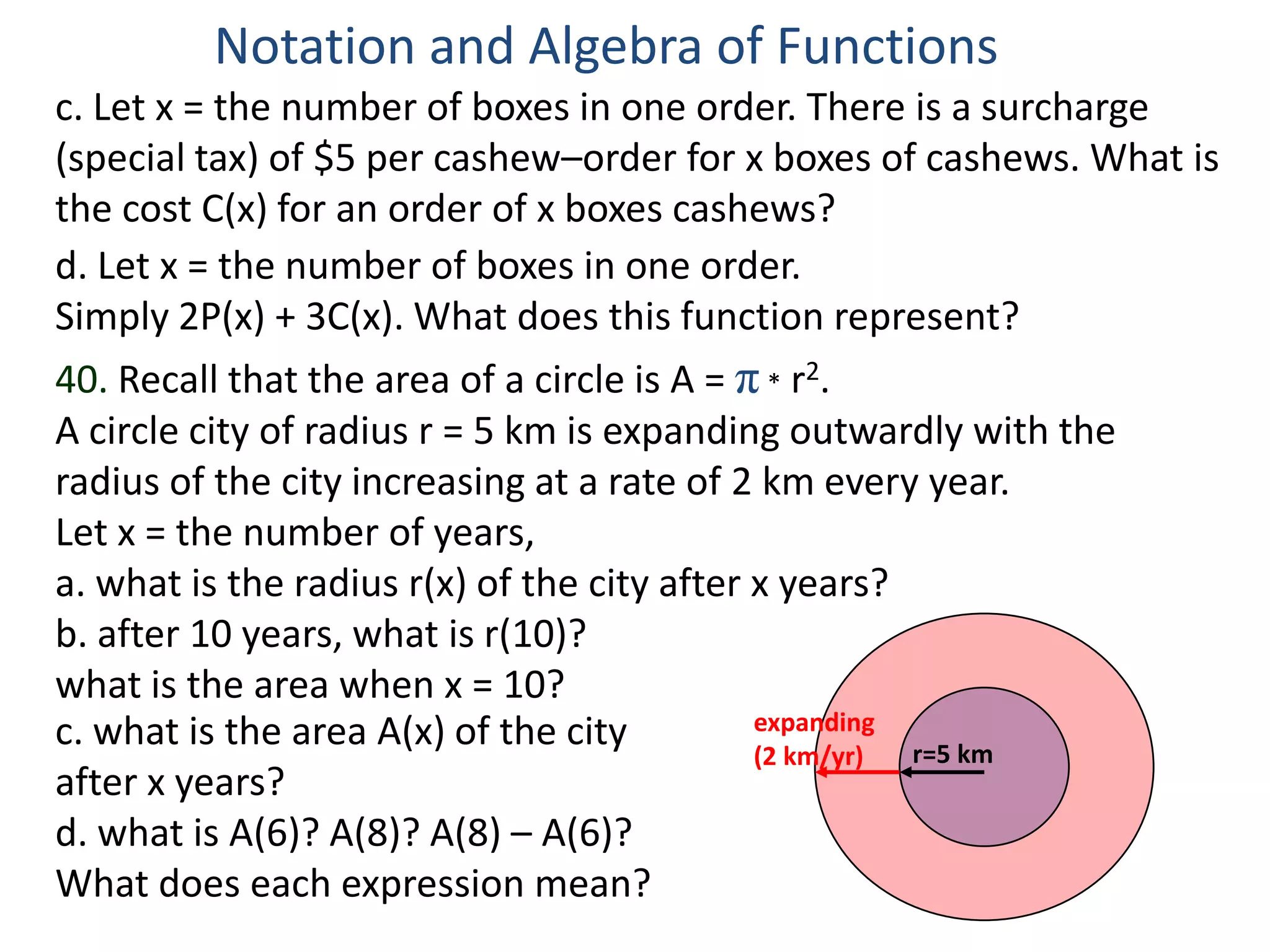
40. Recall that the area of a circle is A = π * r2.
A circle city of radius r = 5 km is expanding outwardly with the
radius of the city increasing at a rate of 2 km every year.
Let x = the number of years,
a. what is the radius r(x) of the city after x years?
b. after 10 years, what is r(10)?
what is the area when x = 10?
c. what is the area A(x) of the city         expanding
                                             (2 km/yr) r=5 km
after x years?
d. what is A(6)? A(8)? A(8) – A(6)?
What does each expression mean?

Exercise 2

  • 1.
    Notation and Algebraof Functions Exercise. A. Simplify the following expressions with the given functions. 2 + 3x – 1 2x – 1 f(x) = 2 – 3x g(x) = –2x h(x) = x–2 1. f(2) + f(3) 2. 2f(3) 3. 2g(0) + g(1) 4. [h(2)]2 5. f(0) + g(0) + h(0) 6. 3h(1) – g(–2 ) 7. 3h(1) – g(–2 ) 8. f(2)/3 + f(3)/2 9. 2f(–3) – 2g(–1) 10. [f(3)]2 – [g(3)]2 11. f(0) + g(0) + h(0) 12. [f(3) – g(3)]2 13. h(1) / h(–1 ) 14. [h(1/2)]2 15. [f(1/2)]2 16. [g(1/2)]2 17. g(f(0)) 18. f(g(0)) 19. g(h(0)) 20. h(g(0)) 21. f(h(0)) 22. h(f(0))
  • 2.
    Notation and Algebraof Functions Exercise. B. Simplify the following expressions with the given functions. x–1 f(x) = 3 + 2x g(x) = –x2 + 3x – 2 h(x) = x–2 23. f(2a) 24. g(2a) 25. 2g(a) 26. h(2a) 27. 2h(a) 28. f(3 + b) 29. g(3 + b) 30. h(3 + b) 31. f(3 + b) – f(b) 32. g(3 + b) – g(b) 33. h(3 + b) – h(b) 34. f(3 + b) – f(3 – b) 35. g(3 + b) – g(3 – b) 36. g(x) + 3f(x) 37. 2g(x) + [f(x)]2 38. g(x) / h(x) 39. a. Peanuts cost $9.00/box, what is the cost of x boxes of peanuts? b. Cashews cost $12.00/box, what is the cost of x boxes of cashews? c. Let x = the number of boxes in one order. We have coupons for $7 off for one order of x boxes of peanuts. What is the cost P(x) for x boxes peanuts with the coupon?
  • 3.
    Notation and Algebraof Functions c. Let x = the number of boxes in one order. There is a surcharge (special tax) of $5 per cashew–order for x boxes of cashews. What is the cost C(x) for an order of x boxes cashews? d. Let x = the number of boxes in one order. Simply 2P(x) + 3C(x). What does this function represent? 40. Recall that the area of a circle is A = π * r2. A circle city of radius r = 5 km is expanding outwardly with the radius of the city increasing at a rate of 2 km every year. Let x = the number of years, a. what is the radius r(x) of the city after x years? b. after 10 years, what is r(10)? what is the area when x = 10? c. what is the area A(x) of the city expanding (2 km/yr) r=5 km after x years? d. what is A(6)? A(8)? A(8) – A(6)? What does each expression mean?