The Geologic Time Scale
The Geologic Time Scale is a
record of life forms and geologic
events in Earth’s history.
**Key Concept: Because the time span of
Earth’s past is so great, geologists use the
geologic time scale to show Earth’s
history.
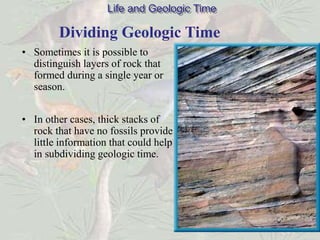
• Sometimes it is possible to
distinguish layers of rock that
formed during a single year or
season.
• In other cases, thick stacks of
rock that have no fossils provide
little information that could help
in subdividing geologic time.
Dividing Geologic Time
Life and Geologic Time
The Geologic Time Scale
• Earth has a very long history. Years and
centuries are not very helpful for such a long
history. So scientists use the geologic time
scale for Earth’s history.
• The geologic time scale is a record of how
Earth and its life forms have changed through
time. For example, the scale shows when life
first appeared on Earth.
• In the geologic time scale, time is divided into
bigger blocks than years or centuries. The scale
begins when Earth formed 4.6 billion years
ago and goes to the present.
Divisions of Geologic Time
The geologic time scale is divided into eons,
eras, periods, and epochs. Unlike divisions
of time such as days or minutes, the
divisions of the geologic time scale have no
fixed lengths. Instead, they are based on
changes or events recorded in rocks and
fossils.
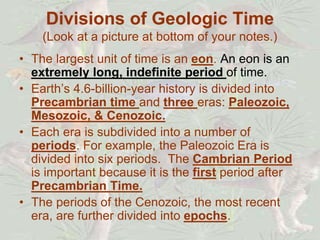
Divisions of Geologic Time
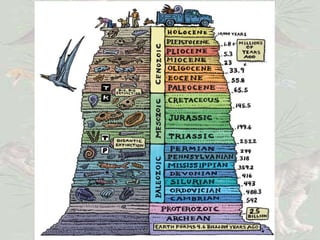
(Look at a picture at bottom of your notes.)
• The largest unit of time is an eon. An eon is an
extremely long, indefinite period of time.
• Earth’s 4.6-billion-year history is divided into
Precambrian time and three eras: Paleozoic,
Mesozoic, & Cenozoic.
• Each era is subdivided into a number of
periods. For example, the Paleozoic Era is
divided into six periods. The Cambrian Period
is important because it is the first period after
Precambrian Time.
• The periods of the Cenozoic, the most recent
era, are further divided into epochs.
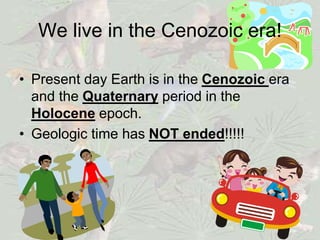
We live in the Cenozoic era!
• Present day Earth is in the Cenozoic era
and the Quaternary period in the
Holocene epoch.
• Geologic time has NOT ended!!!!!
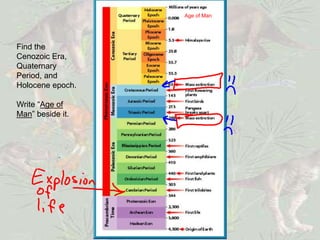
Find the
Cenozoic Era,
Quaternary
Period, and
Holocene epoch.
Write “Age of
Man” beside it.
Age of Man
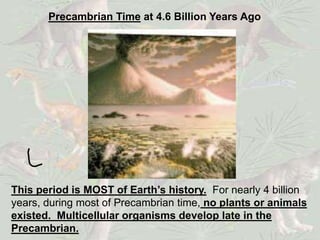
Precambrian Time at 4.6 Billion Years Ago
This period is MOST of Earth’s history. For nearly 4 billion
years, during most of Precambrian time, no plants or animals
existed. Multicellular organisms develop late in the
Precambrian.
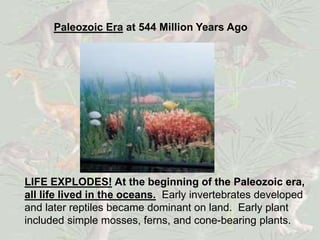
Paleozoic Era at 544 Million Years Ago
LIFE EXPLODES! At the beginning of the Paleozoic era,
all life lived in the oceans. Early invertebrates developed
and later reptiles became dominant on land. Early plant
included simple mosses, ferns, and cone-bearing plants.
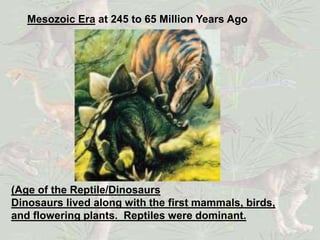
Mesozoic Era at 245 to 65 Million Years Ago
(Age of the Reptile/Dinosaurs
Dinosaurs lived along with the first mammals, birds,
and flowering plants. Reptiles were dominant.
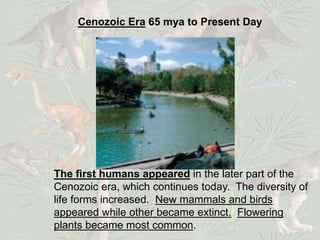
The first humans appeared in the later part of the
Cenozoic era, which continues today. The diversity of
life forms increased. New mammals and birds
appeared while other became extinct. Flowering
plants became most common.
Cenozoic Era 65 mya to Present Day
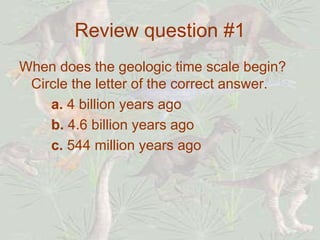
Review question #1
When does the geologic time scale begin?
Circle the letter of the correct answer.
a. 4 billion years ago
b. 4.6 billion years ago
c. 544 million years ago
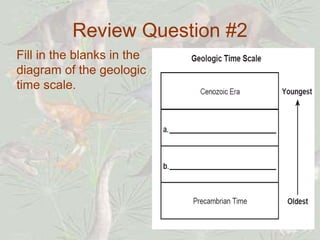
Review Question #2
Fill in the blanks in the
diagram of the geologic
time scale.
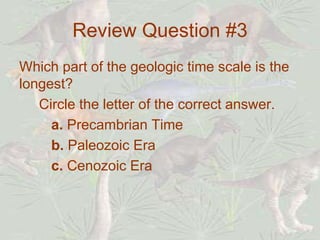
Review Question #3
Which part of the geologic time scale is the
longest?
Circle the letter of the correct answer.
a. Precambrian Time
b. Paleozoic Era
c. Cenozoic Era
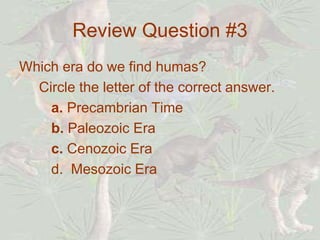
Review Question #3
Which era do we find humas?
Circle the letter of the correct answer.
a. Precambrian Time
b. Paleozoic Era
c. Cenozoic Era
d. Mesozoic Era
Review Question #3
Which era do we find dinosaurs?
Circle the letter of the correct answer.
a. Precambrian Time
b. Paleozoic Era
c. Cenozoic Era
d. Mesozoic Era
Review Question #4
Geologic time is divided into units based on
______.
a. geologic changes
b. fossils and rocks
c. types of life-forms living during certain
periods
d. all of these

Geologic Time Scale.ppt

  • 1.
    The Geologic TimeScale The Geologic Time Scale is a record of life forms and geologic events in Earth’s history. **Key Concept: Because the time span of Earth’s past is so great, geologists use the geologic time scale to show Earth’s history.
  • 2.
    • Sometimes itis possible to distinguish layers of rock that formed during a single year or season. • In other cases, thick stacks of rock that have no fossils provide little information that could help in subdividing geologic time. Dividing Geologic Time Life and Geologic Time
  • 3.
    The Geologic TimeScale • Earth has a very long history. Years and centuries are not very helpful for such a long history. So scientists use the geologic time scale for Earth’s history. • The geologic time scale is a record of how Earth and its life forms have changed through time. For example, the scale shows when life first appeared on Earth. • In the geologic time scale, time is divided into bigger blocks than years or centuries. The scale begins when Earth formed 4.6 billion years ago and goes to the present.
  • 4.
    Divisions of GeologicTime The geologic time scale is divided into eons, eras, periods, and epochs. Unlike divisions of time such as days or minutes, the divisions of the geologic time scale have no fixed lengths. Instead, they are based on changes or events recorded in rocks and fossils.
  • 5.
    Divisions of GeologicTime (Look at a picture at bottom of your notes.) • The largest unit of time is an eon. An eon is an extremely long, indefinite period of time. • Earth’s 4.6-billion-year history is divided into Precambrian time and three eras: Paleozoic, Mesozoic, & Cenozoic. • Each era is subdivided into a number of periods. For example, the Paleozoic Era is divided into six periods. The Cambrian Period is important because it is the first period after Precambrian Time. • The periods of the Cenozoic, the most recent era, are further divided into epochs.
  • 6.
    We live inthe Cenozoic era! • Present day Earth is in the Cenozoic era and the Quaternary period in the Holocene epoch. • Geologic time has NOT ended!!!!!
  • 8.
    Find the Cenozoic Era, Quaternary Period,and Holocene epoch. Write “Age of Man” beside it. Age of Man
  • 9.
    Precambrian Time at4.6 Billion Years Ago This period is MOST of Earth’s history. For nearly 4 billion years, during most of Precambrian time, no plants or animals existed. Multicellular organisms develop late in the Precambrian.
  • 10.
    Paleozoic Era at544 Million Years Ago LIFE EXPLODES! At the beginning of the Paleozoic era, all life lived in the oceans. Early invertebrates developed and later reptiles became dominant on land. Early plant included simple mosses, ferns, and cone-bearing plants.
  • 11.
    Mesozoic Era at245 to 65 Million Years Ago (Age of the Reptile/Dinosaurs Dinosaurs lived along with the first mammals, birds, and flowering plants. Reptiles were dominant.
  • 12.
    The first humansappeared in the later part of the Cenozoic era, which continues today. The diversity of life forms increased. New mammals and birds appeared while other became extinct. Flowering plants became most common. Cenozoic Era 65 mya to Present Day
  • 13.
    Review question #1 Whendoes the geologic time scale begin? Circle the letter of the correct answer. a. 4 billion years ago b. 4.6 billion years ago c. 544 million years ago
  • 14.
    Review Question #2 Fillin the blanks in the diagram of the geologic time scale.
  • 15.
    Review Question #3 Whichpart of the geologic time scale is the longest? Circle the letter of the correct answer. a. Precambrian Time b. Paleozoic Era c. Cenozoic Era
  • 16.
    Review Question #3 Whichera do we find humas? Circle the letter of the correct answer. a. Precambrian Time b. Paleozoic Era c. Cenozoic Era d. Mesozoic Era
  • 17.
    Review Question #3 Whichera do we find dinosaurs? Circle the letter of the correct answer. a. Precambrian Time b. Paleozoic Era c. Cenozoic Era d. Mesozoic Era
  • 18.
    Review Question #4 Geologictime is divided into units based on ______. a. geologic changes b. fossils and rocks c. types of life-forms living during certain periods d. all of these