428
GEOCHEMICAL CONDITIONS AND ENVIRONMENTAL POLLUTION
FROM HYDROTHERMAL WATERS OF THE ANTHEMOUS BASIN,
THESSALONIKI DISTRICT, N. GREECE
M.K. NIMFOPOULOS1, S.A. HADJISPYROU2,
D.A.POLYA3, K.M. MICHAILIDIS4, G. TRONTSIOS4
ABSTRACT
The Anthemous basin of the Stip Axios belt, is a graben covered by Miocene-
Pliocene, Pleistocene and Holocene sediments. Hydrothermal springs in the graben
margins, discharge through WNW-ESE faults and deposit metalliferous (rich in As,
Fe, REE, Ti, Cu, Zr, Rb, Ba, Sr, Li and Au) sediment and travertine (enriched in
As, Fe, Ba and P) at their aprons. Spring waters have T 23-28ºC, pH 6.2-7.3, Eh
-0.21 to -0.88 mV, E.C. 7.9-10.9 mS.cm-1, TDS up to 5850 ppm and H2S (60-70
vol%), CH4 (0-30 vol%) and CO2 (0-20 vol%) in the gas phase. They are saturated
in H2S, Na, K, Cl, F, Br, B and HCO3, enriched in pollutants (NO2, As, Mn), and
Si, Li and depleted in Fe, Cu, Zn and other metals due to prior sulphide
deposition. The spring waters have an alkali-chloride-bicarbonate composition.
Keywords: Anthemous, hydrothermal, water, travertine, geochemistry, pollution
I. INTRODUCTION AND GEOLOGICAL SETTING
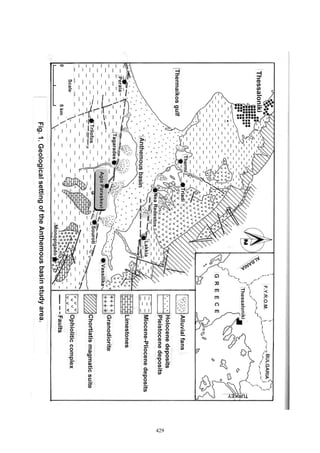
The Anthemous basin is located some 15 km SE of the Thessaloniki town
(latitude 40º30', longitude 2300') and encloses the Anthemous river and the
villages Thermi, Souroti, Agia Paraskevi, besides those of Tagarades, Vasilika,
Monopigado, Lakkia, Nea Redestos and Triadi (Fig. 1) and extends SE up to
Chalkidiki district (Vavdos village). The former areas contain natural springs
which have been used for curative purposes or for water bottling in the past 30
years period (Minissale et al., 1989).
The reasearch area geotectonically belongs to the Stip Axios belt. The
Anthemous Neogene-Quaternary basin formed over a graben with a NW-SE alignment
and overlies Mesozoic metamorphic rocks, gabbroic intrusive bodies, ultrabasic
rocks and a Late Jurassic limestone, which forms a considerable hydrogeothermal
reservoir. The basin is dominated by Holocene (loose sediments: grit),
Pleistocene (terrace, fanglomerates) and Late Miocene-Pliocene, 500-600 m thick
terrestrial to marine sediments (conglomerates, red clays, sandstones, marls,
clayey limestones of terrestrial, fluvial or lacustrine origin, travertine and
sandstones-marls. The faulting of the basin strikes N-S, NE-SW and WNW-ESE
(IGME, 1978; Shterev and Meladiotis, 1993).
The studied geothermal springs (T 23-28ºC) eject through chemical sediments
of travertine composition and are closely related to the active WNW-ESE trending
faults. In the spring pool of Agia Paraskevi, a black metalliferous mud has
precipitated containing abundant framboidal pyrite and minor chalcopyrite
(Michailidis et al., 2000).
The aim of this paper is to determine the geochemical conditions which have
prevailed during hydrothermal activity and how these affected the quality of
srpring and groundwaters by enriching them in pollutants and other elements.
II. SAMPLING AND ANALYSIS
Over 5 metalliferous sediment (ore mud), 20 travertine sediment samples and
20 geothermal water samples (including dissolved gases) from 5 established sites
(area of Agia Paraskevi to Souroti) were collected in different seasons in order
1 IGME, Division of Geochemistry and Environment, 1 Fragon street, 546-26
Thessaloniki, Greece
2 Aristotle University, Chemical Engineering Department, Laboratory of Inorganic
Chemistry, 540-06 Thessaloniki, Greece
3 The Victoria University of Manchester, Earth Sciences Department, Manchester
M13 9PL, England, U.K.
4 Aristotle University, School of Geology, Department of Mineralogy-Petrology-
Economic Geology, 540-06 Thessaloniki, Greece
429
430
to reveal any significant seasonal variations in the spring water composition.
In addition, more than 30 water samples from basinal irrigation boreholes were
collected from the center of the basin (Holocene deposits in the area enclosed
by Tagarades, Souroti, Nea Redestos and Lakkia; Fig. 1) in order to compare
geothermal water composition with that of irrigation water from the basin.
Thin sections and XRD diagrams were made of the chemical sediments in order
to normalize their chemical composition with that of the contained minerals.
Water and chemical sediment samples were analyzed by Atomic Absorption
Spectrophotometry-Graphite Furnace (AAS-GF) and High Performance liquid
chromatography-Ion chromatography (HPLC-IC), the dissolved gases in hydrothermal
waters by Gas Chromatography-Thermal Conductivity Detection (GC-TCD), the
chemical metalliferous sediment by Inductively Coupled Plasma-Atomic Emission
Spectrometry (ICP-AES) and the quantitative valency determination of As in the
hydrothermal waters by the new method of Ion Chromatography-ICP-Hexapole
Collision Cell-Mass Spectrometry (IC-ICP-HEX-MS) (Polya et al., 2002).
Temperature, pH, electric conductivity, as well as Ca2+, HCO3
- NH4
+ and SiO2 were
determined in the field, since these chemical species may undergo precipitation
(calcite, amorphous silica), or oxidation in the case of ammonium. Besides field
analysis, the above parameters and elements were re-analyzed in the lab to check
possible changes during storage.
III. RESULTS
III.A. Metalliferous sediment
The metalliferous sediment (Table 1) from the bottom of the spring pool
contains sulphides (framboidal pyrite, chalcopyrite) and actually represents a
chemical-clastic material containing skeletal crystals of calcite, quartz,
feldspar and mica. It is chemically enriched in Si (up to 23.23 wt%), Ca (up to
10.21 wt%), Al (up to 6.89 wt%) and Fe (up to 3.95 wt%). Fe and As (up to 160
ppm) are mainly contained in pyrite. Significant contents of Zr (up to 174 ppm),
Cs (up to 37 ppm), Rb (up to 78 ppm), a series of other metals (e.g. Hf, Th) and
Rare Earth Elements (REE) also occur.
TABLE 1. REPRESENTATIVE CHEMICAL ANALYSES OF THE METALLIFEROUS SEDIMENT
Major elements (wt%)
n=5 SiO2 Al2O3 CaO FeO Fe2O3 Na2O K2O TiO2 MgO MnO P2O5 LOI
mean 49.19 11.87 13.36 1.18 3.94 1.76 1.61 0.61 0.91 0.05 0.72 13.83
min 48.93 10.50 11.80 1.22 3.74 1.62 1.44 0.49 0.83 0.04 0.11 11.64
max 49.71 13.02 14.29 1.31 4.19 1.83 1.72 0.67 0.98 0.05 1.05 15.65
Trace elements (ppm)
n=5 As Ba Sr Zr Cr Ni Cu Pb Zn Rb Ce Nd La Sc Cs Th V
mean 147 916 329 168 82 53 35 17 46 51 56 30 28 17 20 10 25
min 140 358 274 162 35 24 17 13 20 7 45 20 22 10 3 8 3
max 160 998 384 174 135 99 68 24 76 78 66 40 35 25 37 15 66
Note: Also found Au(=195 ppb), Co(mean 13 ppm), Li(mean 12 ppm), Y(=31 ppm),
Hf(=4 ppm), U(=2 ppm), W(=5 ppm), Sm(=7 ppm) and Be(=3 ppm).
Det. limits: major elements=0.01 wt%; trace elements=0.1-1 ppm, Pb-Rb=2 ppm
III.B. Travertine chemical sediments
Travertine is mainly composed of variably crystalline calcite, aragonite,
amorphous silica and Fe-oxides in variable proportions, depending on sample
location. Representative analyses of the travertine chemical sediment (Table 2)
reveal variable Si, directly related to Al, reflecting the presence of
431
aluminosilicates (kaolinite) and silica against calcite. Ca is negatively
correlated to Fe, reflecting the presence of amorphous Fe-oxides instead of
CaCO3. The presence of higher Fe-contents in travertine rather than in the
metalliferous sediment is somewhat erroneous. However, this can easily be
explained by the presence of abundant amorphous Fe-oxides (determined by a
background rise at ~10-18°2θ in the XRD patterns) in the travertine samples.
Thus, in contrast to the metalliferous sediment, the main Fe-content in
travertine is in the oxidised form (Fe3+) and the total Fe-oxide (FeO+Fe2O3)
content can be as high as 19.45 wt%. Na, K, P, Li and base metal contents are
directly related to silica, while As shows a preference to the carbonate phase.
TABLE 2. REPRESENTATIVE CHEMICAL ANALYSES OF THE TRAVERTINE
Major elements (wt%)
n=20 SiO2 Al2O3 CaO FeO Fe2O3 Na2O K2O TiO2 MgO MnO P2O5 LOI
mean 5.79 0.73 45.07 0.58 5.96 0.35 0.12 bd 0.26 0.06 1.09 39.45
min 0.65 0.00 28.00 0.14 1.13 0.03 0.01 bd 0.18 0.03 0.23 34.85
max 15.98 1.15 53.40 1.36 18.08 0.65 0.25 bd 0.38 0.10 3.27 43.00
Trace elements (ppm)
n=20 As Ba Li Cr Ni Cu Pb Zn Rb Co V Sb
mean 235 1000 18 13 7 6 8 21 14 2 2 1
min 180 50 5 8 2 4 6 5 2 bd bd bd
max 270 2000 47 19 15 12 10 98 54 6 5 4
Note: bd=below detection
Det. limits: major elements=0.01 wt%; trace elements=0.1-1 ppm, Pb-Rb=2 ppm
III.C. Spring water characteristics
Spring waters (Table 3) have T 23-28ºC, relatively low pH (6.2-7.3) and Eh
(-21 to -88 mV), high E.C. (7.9 to 10.9 mS.cm-1) and TDS (up to 5850 ppm),
characteristic smell of hydrogen sulphide, and contain H2S (60 to 70 vol.%), CH4
(0 to 30 vol.%) and CO2 (0 to 20 vol.%) in the gas phase. They are saturated in
Na (0.11 to 0.16 wt%), K (58 to 88 ppm), Cl (1507 to 2445 ppm), F (0.7 to 2.0
ppm), Br (60 to 480 ppb), NO2 (up to 24.4 ppm), B (69 to 105 ppm) and HCO3 (805
to 1037 ppm) which are several times above the E.U. drinking limits of potable
water (HGN, 2001). They are also enriched in toxic elements, such as As (up to
50 ppb) and Mn (up to 295 ppb), Si (up to 27 ppm SiO2) and Li (up to 5 ppm),
while, in contrast to irrigation water (Table 4), Fe, Cu, Zn, and the other
metals have probably been removed by the process of sulphide precipitation
(Michailidis et al., 2000). Al was also detected.
During the dry season, the Na, Cl, F, As, Mn and NO2 contents increase to
maximum levels in the spring waters (Table 3), thus causing further degradation
of their quality and environmental pollution to the surrounding ecosystem. This
shows that there may be an important influx of shallow meteoric water in the
springs in the wet period by a process of water mixing in the fault zones near
the surface and dilution of the spring water. In order to study this in more
detail, water samples from a geothermal borehole (>500 m) were collected and
analysed. They have lower pH (6.02-7.29), and Fe (3-12 ppb), Mn (10-15 ppb), Cu
(9-14 ppb), Zn (up to 21 ppb), Al (<5 ppb), SO4 (<0.1 ppm), F (0.22-0.60 ppm)
and NO3 (<0.1-3.0 ppm) contents, but higher T (32ºC), E.C. (10.5-11.0 mS.cm-1),
TDS (0.6 to 1.17 wt%), and Ca (161-533 ppm), Mg (85-135 ppm), Na (2930-3320
ppm), K (175-200 ppm), HCO3 (1635-3315 ppm), Cl (4201-4963 ppm), Br (250-300
ppb), NO2 (24.5-28 ppm), NH4 (0.36-16.00 ppm), As (60-85 ppb), Li (4.2-8.5 ppm)
and SiO2 (95-110 ppm) contents. A similar geochemistry has been observed in
active geothermal fields elsewhere (Karpov and Naboko, 1990). The high NO2
contents reflect either the oxidation of the emitted N2 gas from the hot water
(Karpov and Naboko, 1990) or high concentrations of organic substances. Spring
432
water and borehole water composition is alkali-chloride-bicarbonate. The
composition of borehole water strongly resembles to that of an undiluted
hypogene (hydrothermal) fluid possibly heated by the geothermal field of the
Monopigado granodiorite (Michard et al., 1998) or by thermal gradient (3C/100
m). It probably originated from the Late Jurassic limestone (Fig. 1) and the
underlying ultrabasic rocks (Traganos and Bibou, 1989) and had previously
deposited its metal load at depth. On the contrary, the composition of hot
spring water designates a process of element scavenging during its ascending
cource and infiltration through the overlying host rocks (sandy conglomerate-red
clays-sandstones-marls).
TABLE 3. REPRESENTATIVE CHEMICAL ANALYSES OF THERMAL SPRING AND BOREHOLE WATERS
SPRING
n=20 T pH Eh E.C. TDS Ca Mg Na K Σcat. T.H Σanion.
unit C pH units mV μS/cm ppm ppm ppm ppm ppm ppm ppm ppm
mean 26 7.15 -55 8900 5325 124 34 1314 74 1546 423 3026
min 23 6.20 -21 7900 4760 67 24 1084 58 1324 290 2747
max 28 7.30 -88 10900 5850 160 49 1606 88 1860 532 3271
BOREHOLE
n=5 T pH Eh E.C. TDS Ca Mg Na K Σcat. T.H Σanion.
unit C pH units mV μS/cm ppm ppm ppm ppm ppm ppm ppm ppm
mean 32 6.60 -91 10750 8800 347 110 3120 190 3767 820 7081
min 31 6.02 -82 10500 6000 161 85 2930 175 3500 751 6600
max 32 7.29 -99 11000 11660 533 135 3320 200 3850 850 7545
SPRING
n=20 HCO3 Cl SO4 NO3 NO2 F NH4 PO4 B SiO2 Br Mn Fe As Cu Sb Li
unit ppm ppm ppm ppm ppm ppm ppm ppm ppm ppm ppb ppb ppb ppb ppb ppb ppm
mean 956 2055 1.4 14 12.1 1.2 .17 .70 86 26 168 119 138 36 15 2 2
min 805 1507 bd 8 tr. 0.7 .11 .42 69 24 60 10 20 15 10 1 0
max 1037 2445 1.9 21 24.4 2.0 .21 .99 105 27 480 295 450 50 25 5 5
BOREHOLE
n=5 HCO3 Cl SO4 NO3 NO2 F NH4 PO4 B SiO2 Br Mn Fe As Cu Sb Li
unit ppm ppm ppm ppm ppm ppm ppm ppm ppm ppm ppb ppb ppb ppb ppb ppb ppm
mean 2500 4580 bd 1 26.3 0.5 8.1 .80 115 102 280 13 10 70 11 2 7
min 1635 4201 bd bd 24.5 0.2 0.4 .60 72 95 250 10 3 60 9 1 4
max 3315 4963 bd 3 28.1 0.6 16.0 .90 160 110 300 15 12 85 14 5 9
Note: bd=below detection, tr.=traces of element were detected. Al and Zn are
also present. Al is present in spring waters only.
Det. limits: Cl, SO4, NO3, and NO2 = 10 ppb; all other elements = 1 ppb.
III.D. Irrigation water characteristics
Irrigation waters were sampled from different depths (80 to 250 m) by using
farmers’ boreholes during the irrigation period. These waters have higher pH (up
to 8.15), but much lower electric conductivity (up to 2060 mS.cm-1). They
generally contain much less Na, K, B, Cl and NO2, less Ca, HCO3, F, Mn, PO4 and
SiO2 but more SO4 and Fe (Table 4). This has been probably caused by mixing and
433
dillution of the ascending hydrothermal water with descending meteoric fresh
water in the fault zones at phreatic levels. On the other hand, SO4 and Fe
contents are higher because no prior sulphide precipitation took place from the
meteoric irrigation water, in contrast to spring water.
IV. DISCUSSION
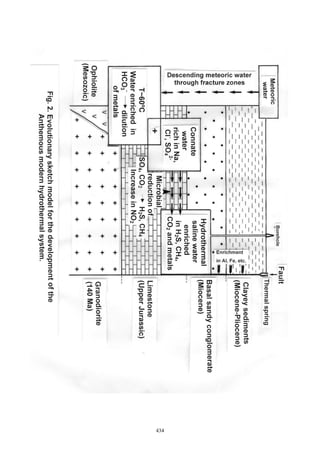
The borehole water is probably the initial hydrothermal fluid which
originates through the process of descending meteoric waters from fracture zones
in the, 500-800 m thick, Late Jurassic Katsika limestone formation and the
underlying pre-Alpine ultrabasic metamorphic basement (Jackelen et al., 1986;
Traganos and Bibou, 1989). In the Anthemous basin, this process takes place at
depths below 1-1.5 km, while between 0.5 and 1 km depth, a 200-600 m thick basal
Miocene sandy conglomerate exists and may have acted as a reservoir containing
huge volumes of geothermal water with T 30-60ºC (Fytikas and Taktikos, 1988).
TABLE 4. REPRESENTATIVE CHEMICAL ANALYSES OF IRRIGATION GROUNDWATERS
n=30 T pH Eh E.C. TDS Ca Mg Na K Σcat. T.H Σanion.
unit C pH units mV μS/cm ppm ppm ppm ppm ppm ppm ppm ppm
mean 18 7.88 80 710 380 75 43 63 3 184 350 531
min 16 7.75 60 440 275 24 11 15 1 80 260 433
max 19 8.15 110 1640 460 127 91 122 6 230 440 756
n=30 HCO3 Cl SO4 NO3 NO2 F NH4 PO4 B SiO2 Al Mn Fe As Zn Sb Li
unit ppm ppm ppm ppm ppm ppm ppm ppm ppm ppm ppb ppb ppb ppb ppb ppb ppm
mean 384 82 58 7 0.01 0.4 0.05 0.50 1 21 40 100 290 tr. 180 tr. tr.
min 222 23 30 1 tr. 0.2 tr. 0.16 tr. 6 tr. tr. 10 tr. 18 tr. tr
max 600 152 365 20 0.02 0.7 0.35 1.85 4 28 300 400 830 tr. 900 tr. tr.
Note: tr.=traces of element. The element I is also present (50-820 ppb).
Det. limits: Cl, SO4, NO3, and NO2 = 10 ppb; all other elements = 1 ppb.
This clastic rock and the Late Jurassic limestone have probably controlled the
composition of the hosted hydrothermal water.
In places where active faults cross these reservoirs, at WNW-ESE direction
(borders of the tectonic depression), an ascending course of the reservoir hot
water begins and hot springs may discharge at surface. Before reaching the
surface, the hot water appears to deposit a large part of its metallic content,
probably along fracture zones at depth, as it is evident by its very low
sulphate content. Spring waters contain significant gas concentrations such as
H2S, CH4 and CO2. Hydrogen sulphide originates probably from organic matter
reduction of sulphate contained in the salty connate waters, which flooded the
carbonate Jurassic reservoir and the overlying Neogene clayey sediments during
the Neogene marine transgression (Shterev and Meladiotis, 1993). The elevated
values of nitrites in spring waters (Table 3) also suggest the organic matter
sulphate reduction. Methane and carbon dioxide are the reduced and oxidised form
of carbon, which predominates in the carbonate reservoir. At pH >6, CO2 favours
the enrichment of spring waters in bicarbonates by which Ca, Na, Mg and Fe, Mn,
Zn, Pb, Cu and other elements are transported. This has also been observed in
the karst environment of Kato Nevrokopi, where the mobilities of the above
metals have also been studied (Nimfopoulos, 1988). The presence of CH4 and CO2 in
the spring water indicates favourable conditions for base metal- Au deposition
(Naden and Shepherd, 1989), as it is evident from the metalliferous sediment.
In the course of approaching the surface, the reservoir hot water is
restricted to follow active faults at the margins of the basin (Fig. 2). Thus,
it interacts with the Miocene-Pliocene clayey sediments, dissolving Al, Fe, Mn
and other metals, which brings to the surface (hot springs). At the same time, a
434
435
process of spring water dilution begins to take place at the phreatic level by
progressive mixing with shallow meteoric water, cooling, and oxidation of part
of the contained hydrogen sulphide to sulphate. This explains the sulphate
enrichment of irrigation water contrary to the hydrothermal borehole water.
Acknowledgements
We would like to thank the Director General of IGME for his permission to
publish this paper, Professors Ananias Tsirambides and Georgios Karakaisis for
assistance with the presentation and two anonymous referees of the 6th Congress
of the Geographical Society of Greece for constructive critisism.
V. REFERENCES
FYTIKAS, M. and TAKTIKOS, S. (1988) Geothermal resource assessment of Greece. In
HAENEL, R. and STAROSTE, E. (eds): Atlas of the geothermal resources of the
European Community, 25-28.
HGN (2001) Quality of water for human consumption: In accordance with the
Directive 98/83/EC of the Council of the EU (3/11/1998). Hellenic Government
Newspaper (HGN), Section 2, Sheet 892, 10865-10880.
IGME (1978) Geological map to Greece-Scale 1:50000, Sheet Vasilika.
JACKELEN, H.P., LOEHNERT, E.P. and PAPAKONSTANTINOU, A. (1986) Natural tracers
in groundwaters of the western Chalkidiki Peninsula. 5th International
Symposium on underground water tracing, Athens, 59-73.
KARPOV, G.A. and NABOKO, S.I. (1990) Metal contents of recent thermal waters,
mineral precipitates and hydrothermal alteration in active geothermal
fields, Kamchatka. Journal of Geochemical Exploration, 36, 57-71.
MICHARD, A., FEINBERG, H. and MONTIGNY, R. (1998) The chalkidiki supra-
ophiolitic formations, and their bearing on the Vardarian obduction process.
Bull. Geol. Soc. Of Greece, 32(1), 59-64.
MICHAILIDIS, K.M., NIMFOPOULOS, M.K., ANAGNOSTOPOULOS, A. and HADJISPYROU, S.A.
(2000) Present day framboidal pyrite deposition from the active geothermal
system in the Agia Paraskevi area, Thessaloniki, N. Greece. In PANAYIDES,
I., XENOPHONTOS, C. and MALPAS, J. (eds): Poster of the 3rd International
Conference on the Geology of the Eastern Mediterranean (ICGEM), Geological
Survey of Cyprus, 12 pp.
MINISSALE, A., DUCHI, V., KOLIOS, N. and TOTARO, G. (1989) Geochemical
characteristics of Greek thermal springs. J. Volcan. Geotherm. Research, 39,
1-16.
NADEN, J. and SHEPHERD, T.J. (1989) The role of methane and carbon dioxide in
gold deposition. Nature, 342, 793-795.
NIMFOPOULOS, M.K. (1988) Manganese mineralization near Kato Nevrokopi, Drama,
Greece. Ph.D. thesis, Victoria University of Manchester, 259 pp.
POLYA, D.A., LYTHGOE, P.R., ABOU-SHAKRA, F., GAULT, A.G., BRYDIE, J.R., WEBSTER,
J.G., BROWN, K.L., NIMFOPOULOS, M.K. and MICHAILIDIS, K.M. (2002) IC-ICP-MS
and IC-ICP-HEX-MS determination of arsenic speciation in surface and
groundwaters: Preservation and analytical issues. Mineralogical Magazine,
66(4), 52 pp. (In press).
SHTEREV, K. and MELADIOTIS, J. (1993) Thermomineral waters and hydrothermal
resources in the western part of the Chalkidiki Peninsula. Geol. Balcanica,
23(6), 73-85.
TRAGANOS, G. and BIBOU, C. (1989) The present situation and the geothermal
research prospects in the basin of Thessaloniki. Tech. Chamb. Greece,
Congress (In Greek), Athens, April 1989.

Geochemical_conditions_and_environmental

  • 1.
    428 GEOCHEMICAL CONDITIONS ANDENVIRONMENTAL POLLUTION FROM HYDROTHERMAL WATERS OF THE ANTHEMOUS BASIN, THESSALONIKI DISTRICT, N. GREECE M.K. NIMFOPOULOS1, S.A. HADJISPYROU2, D.A.POLYA3, K.M. MICHAILIDIS4, G. TRONTSIOS4 ABSTRACT The Anthemous basin of the Stip Axios belt, is a graben covered by Miocene- Pliocene, Pleistocene and Holocene sediments. Hydrothermal springs in the graben margins, discharge through WNW-ESE faults and deposit metalliferous (rich in As, Fe, REE, Ti, Cu, Zr, Rb, Ba, Sr, Li and Au) sediment and travertine (enriched in As, Fe, Ba and P) at their aprons. Spring waters have T 23-28ºC, pH 6.2-7.3, Eh -0.21 to -0.88 mV, E.C. 7.9-10.9 mS.cm-1, TDS up to 5850 ppm and H2S (60-70 vol%), CH4 (0-30 vol%) and CO2 (0-20 vol%) in the gas phase. They are saturated in H2S, Na, K, Cl, F, Br, B and HCO3, enriched in pollutants (NO2, As, Mn), and Si, Li and depleted in Fe, Cu, Zn and other metals due to prior sulphide deposition. The spring waters have an alkali-chloride-bicarbonate composition. Keywords: Anthemous, hydrothermal, water, travertine, geochemistry, pollution I. INTRODUCTION AND GEOLOGICAL SETTING The Anthemous basin is located some 15 km SE of the Thessaloniki town (latitude 40º30', longitude 2300') and encloses the Anthemous river and the villages Thermi, Souroti, Agia Paraskevi, besides those of Tagarades, Vasilika, Monopigado, Lakkia, Nea Redestos and Triadi (Fig. 1) and extends SE up to Chalkidiki district (Vavdos village). The former areas contain natural springs which have been used for curative purposes or for water bottling in the past 30 years period (Minissale et al., 1989). The reasearch area geotectonically belongs to the Stip Axios belt. The Anthemous Neogene-Quaternary basin formed over a graben with a NW-SE alignment and overlies Mesozoic metamorphic rocks, gabbroic intrusive bodies, ultrabasic rocks and a Late Jurassic limestone, which forms a considerable hydrogeothermal reservoir. The basin is dominated by Holocene (loose sediments: grit), Pleistocene (terrace, fanglomerates) and Late Miocene-Pliocene, 500-600 m thick terrestrial to marine sediments (conglomerates, red clays, sandstones, marls, clayey limestones of terrestrial, fluvial or lacustrine origin, travertine and sandstones-marls. The faulting of the basin strikes N-S, NE-SW and WNW-ESE (IGME, 1978; Shterev and Meladiotis, 1993). The studied geothermal springs (T 23-28ºC) eject through chemical sediments of travertine composition and are closely related to the active WNW-ESE trending faults. In the spring pool of Agia Paraskevi, a black metalliferous mud has precipitated containing abundant framboidal pyrite and minor chalcopyrite (Michailidis et al., 2000). The aim of this paper is to determine the geochemical conditions which have prevailed during hydrothermal activity and how these affected the quality of srpring and groundwaters by enriching them in pollutants and other elements. II. SAMPLING AND ANALYSIS Over 5 metalliferous sediment (ore mud), 20 travertine sediment samples and 20 geothermal water samples (including dissolved gases) from 5 established sites (area of Agia Paraskevi to Souroti) were collected in different seasons in order 1 IGME, Division of Geochemistry and Environment, 1 Fragon street, 546-26 Thessaloniki, Greece 2 Aristotle University, Chemical Engineering Department, Laboratory of Inorganic Chemistry, 540-06 Thessaloniki, Greece 3 The Victoria University of Manchester, Earth Sciences Department, Manchester M13 9PL, England, U.K. 4 Aristotle University, School of Geology, Department of Mineralogy-Petrology- Economic Geology, 540-06 Thessaloniki, Greece
  • 2.
  • 3.
    430 to reveal anysignificant seasonal variations in the spring water composition. In addition, more than 30 water samples from basinal irrigation boreholes were collected from the center of the basin (Holocene deposits in the area enclosed by Tagarades, Souroti, Nea Redestos and Lakkia; Fig. 1) in order to compare geothermal water composition with that of irrigation water from the basin. Thin sections and XRD diagrams were made of the chemical sediments in order to normalize their chemical composition with that of the contained minerals. Water and chemical sediment samples were analyzed by Atomic Absorption Spectrophotometry-Graphite Furnace (AAS-GF) and High Performance liquid chromatography-Ion chromatography (HPLC-IC), the dissolved gases in hydrothermal waters by Gas Chromatography-Thermal Conductivity Detection (GC-TCD), the chemical metalliferous sediment by Inductively Coupled Plasma-Atomic Emission Spectrometry (ICP-AES) and the quantitative valency determination of As in the hydrothermal waters by the new method of Ion Chromatography-ICP-Hexapole Collision Cell-Mass Spectrometry (IC-ICP-HEX-MS) (Polya et al., 2002). Temperature, pH, electric conductivity, as well as Ca2+, HCO3 - NH4 + and SiO2 were determined in the field, since these chemical species may undergo precipitation (calcite, amorphous silica), or oxidation in the case of ammonium. Besides field analysis, the above parameters and elements were re-analyzed in the lab to check possible changes during storage. III. RESULTS III.A. Metalliferous sediment The metalliferous sediment (Table 1) from the bottom of the spring pool contains sulphides (framboidal pyrite, chalcopyrite) and actually represents a chemical-clastic material containing skeletal crystals of calcite, quartz, feldspar and mica. It is chemically enriched in Si (up to 23.23 wt%), Ca (up to 10.21 wt%), Al (up to 6.89 wt%) and Fe (up to 3.95 wt%). Fe and As (up to 160 ppm) are mainly contained in pyrite. Significant contents of Zr (up to 174 ppm), Cs (up to 37 ppm), Rb (up to 78 ppm), a series of other metals (e.g. Hf, Th) and Rare Earth Elements (REE) also occur. TABLE 1. REPRESENTATIVE CHEMICAL ANALYSES OF THE METALLIFEROUS SEDIMENT Major elements (wt%) n=5 SiO2 Al2O3 CaO FeO Fe2O3 Na2O K2O TiO2 MgO MnO P2O5 LOI mean 49.19 11.87 13.36 1.18 3.94 1.76 1.61 0.61 0.91 0.05 0.72 13.83 min 48.93 10.50 11.80 1.22 3.74 1.62 1.44 0.49 0.83 0.04 0.11 11.64 max 49.71 13.02 14.29 1.31 4.19 1.83 1.72 0.67 0.98 0.05 1.05 15.65 Trace elements (ppm) n=5 As Ba Sr Zr Cr Ni Cu Pb Zn Rb Ce Nd La Sc Cs Th V mean 147 916 329 168 82 53 35 17 46 51 56 30 28 17 20 10 25 min 140 358 274 162 35 24 17 13 20 7 45 20 22 10 3 8 3 max 160 998 384 174 135 99 68 24 76 78 66 40 35 25 37 15 66 Note: Also found Au(=195 ppb), Co(mean 13 ppm), Li(mean 12 ppm), Y(=31 ppm), Hf(=4 ppm), U(=2 ppm), W(=5 ppm), Sm(=7 ppm) and Be(=3 ppm). Det. limits: major elements=0.01 wt%; trace elements=0.1-1 ppm, Pb-Rb=2 ppm III.B. Travertine chemical sediments Travertine is mainly composed of variably crystalline calcite, aragonite, amorphous silica and Fe-oxides in variable proportions, depending on sample location. Representative analyses of the travertine chemical sediment (Table 2) reveal variable Si, directly related to Al, reflecting the presence of
  • 4.
    431 aluminosilicates (kaolinite) andsilica against calcite. Ca is negatively correlated to Fe, reflecting the presence of amorphous Fe-oxides instead of CaCO3. The presence of higher Fe-contents in travertine rather than in the metalliferous sediment is somewhat erroneous. However, this can easily be explained by the presence of abundant amorphous Fe-oxides (determined by a background rise at ~10-18°2θ in the XRD patterns) in the travertine samples. Thus, in contrast to the metalliferous sediment, the main Fe-content in travertine is in the oxidised form (Fe3+) and the total Fe-oxide (FeO+Fe2O3) content can be as high as 19.45 wt%. Na, K, P, Li and base metal contents are directly related to silica, while As shows a preference to the carbonate phase. TABLE 2. REPRESENTATIVE CHEMICAL ANALYSES OF THE TRAVERTINE Major elements (wt%) n=20 SiO2 Al2O3 CaO FeO Fe2O3 Na2O K2O TiO2 MgO MnO P2O5 LOI mean 5.79 0.73 45.07 0.58 5.96 0.35 0.12 bd 0.26 0.06 1.09 39.45 min 0.65 0.00 28.00 0.14 1.13 0.03 0.01 bd 0.18 0.03 0.23 34.85 max 15.98 1.15 53.40 1.36 18.08 0.65 0.25 bd 0.38 0.10 3.27 43.00 Trace elements (ppm) n=20 As Ba Li Cr Ni Cu Pb Zn Rb Co V Sb mean 235 1000 18 13 7 6 8 21 14 2 2 1 min 180 50 5 8 2 4 6 5 2 bd bd bd max 270 2000 47 19 15 12 10 98 54 6 5 4 Note: bd=below detection Det. limits: major elements=0.01 wt%; trace elements=0.1-1 ppm, Pb-Rb=2 ppm III.C. Spring water characteristics Spring waters (Table 3) have T 23-28ºC, relatively low pH (6.2-7.3) and Eh (-21 to -88 mV), high E.C. (7.9 to 10.9 mS.cm-1) and TDS (up to 5850 ppm), characteristic smell of hydrogen sulphide, and contain H2S (60 to 70 vol.%), CH4 (0 to 30 vol.%) and CO2 (0 to 20 vol.%) in the gas phase. They are saturated in Na (0.11 to 0.16 wt%), K (58 to 88 ppm), Cl (1507 to 2445 ppm), F (0.7 to 2.0 ppm), Br (60 to 480 ppb), NO2 (up to 24.4 ppm), B (69 to 105 ppm) and HCO3 (805 to 1037 ppm) which are several times above the E.U. drinking limits of potable water (HGN, 2001). They are also enriched in toxic elements, such as As (up to 50 ppb) and Mn (up to 295 ppb), Si (up to 27 ppm SiO2) and Li (up to 5 ppm), while, in contrast to irrigation water (Table 4), Fe, Cu, Zn, and the other metals have probably been removed by the process of sulphide precipitation (Michailidis et al., 2000). Al was also detected. During the dry season, the Na, Cl, F, As, Mn and NO2 contents increase to maximum levels in the spring waters (Table 3), thus causing further degradation of their quality and environmental pollution to the surrounding ecosystem. This shows that there may be an important influx of shallow meteoric water in the springs in the wet period by a process of water mixing in the fault zones near the surface and dilution of the spring water. In order to study this in more detail, water samples from a geothermal borehole (>500 m) were collected and analysed. They have lower pH (6.02-7.29), and Fe (3-12 ppb), Mn (10-15 ppb), Cu (9-14 ppb), Zn (up to 21 ppb), Al (<5 ppb), SO4 (<0.1 ppm), F (0.22-0.60 ppm) and NO3 (<0.1-3.0 ppm) contents, but higher T (32ºC), E.C. (10.5-11.0 mS.cm-1), TDS (0.6 to 1.17 wt%), and Ca (161-533 ppm), Mg (85-135 ppm), Na (2930-3320 ppm), K (175-200 ppm), HCO3 (1635-3315 ppm), Cl (4201-4963 ppm), Br (250-300 ppb), NO2 (24.5-28 ppm), NH4 (0.36-16.00 ppm), As (60-85 ppb), Li (4.2-8.5 ppm) and SiO2 (95-110 ppm) contents. A similar geochemistry has been observed in active geothermal fields elsewhere (Karpov and Naboko, 1990). The high NO2 contents reflect either the oxidation of the emitted N2 gas from the hot water (Karpov and Naboko, 1990) or high concentrations of organic substances. Spring
  • 5.
    432 water and boreholewater composition is alkali-chloride-bicarbonate. The composition of borehole water strongly resembles to that of an undiluted hypogene (hydrothermal) fluid possibly heated by the geothermal field of the Monopigado granodiorite (Michard et al., 1998) or by thermal gradient (3C/100 m). It probably originated from the Late Jurassic limestone (Fig. 1) and the underlying ultrabasic rocks (Traganos and Bibou, 1989) and had previously deposited its metal load at depth. On the contrary, the composition of hot spring water designates a process of element scavenging during its ascending cource and infiltration through the overlying host rocks (sandy conglomerate-red clays-sandstones-marls). TABLE 3. REPRESENTATIVE CHEMICAL ANALYSES OF THERMAL SPRING AND BOREHOLE WATERS SPRING n=20 T pH Eh E.C. TDS Ca Mg Na K Σcat. T.H Σanion. unit C pH units mV μS/cm ppm ppm ppm ppm ppm ppm ppm ppm mean 26 7.15 -55 8900 5325 124 34 1314 74 1546 423 3026 min 23 6.20 -21 7900 4760 67 24 1084 58 1324 290 2747 max 28 7.30 -88 10900 5850 160 49 1606 88 1860 532 3271 BOREHOLE n=5 T pH Eh E.C. TDS Ca Mg Na K Σcat. T.H Σanion. unit C pH units mV μS/cm ppm ppm ppm ppm ppm ppm ppm ppm mean 32 6.60 -91 10750 8800 347 110 3120 190 3767 820 7081 min 31 6.02 -82 10500 6000 161 85 2930 175 3500 751 6600 max 32 7.29 -99 11000 11660 533 135 3320 200 3850 850 7545 SPRING n=20 HCO3 Cl SO4 NO3 NO2 F NH4 PO4 B SiO2 Br Mn Fe As Cu Sb Li unit ppm ppm ppm ppm ppm ppm ppm ppm ppm ppm ppb ppb ppb ppb ppb ppb ppm mean 956 2055 1.4 14 12.1 1.2 .17 .70 86 26 168 119 138 36 15 2 2 min 805 1507 bd 8 tr. 0.7 .11 .42 69 24 60 10 20 15 10 1 0 max 1037 2445 1.9 21 24.4 2.0 .21 .99 105 27 480 295 450 50 25 5 5 BOREHOLE n=5 HCO3 Cl SO4 NO3 NO2 F NH4 PO4 B SiO2 Br Mn Fe As Cu Sb Li unit ppm ppm ppm ppm ppm ppm ppm ppm ppm ppm ppb ppb ppb ppb ppb ppb ppm mean 2500 4580 bd 1 26.3 0.5 8.1 .80 115 102 280 13 10 70 11 2 7 min 1635 4201 bd bd 24.5 0.2 0.4 .60 72 95 250 10 3 60 9 1 4 max 3315 4963 bd 3 28.1 0.6 16.0 .90 160 110 300 15 12 85 14 5 9 Note: bd=below detection, tr.=traces of element were detected. Al and Zn are also present. Al is present in spring waters only. Det. limits: Cl, SO4, NO3, and NO2 = 10 ppb; all other elements = 1 ppb. III.D. Irrigation water characteristics Irrigation waters were sampled from different depths (80 to 250 m) by using farmers’ boreholes during the irrigation period. These waters have higher pH (up to 8.15), but much lower electric conductivity (up to 2060 mS.cm-1). They generally contain much less Na, K, B, Cl and NO2, less Ca, HCO3, F, Mn, PO4 and SiO2 but more SO4 and Fe (Table 4). This has been probably caused by mixing and
  • 6.
    433 dillution of theascending hydrothermal water with descending meteoric fresh water in the fault zones at phreatic levels. On the other hand, SO4 and Fe contents are higher because no prior sulphide precipitation took place from the meteoric irrigation water, in contrast to spring water. IV. DISCUSSION The borehole water is probably the initial hydrothermal fluid which originates through the process of descending meteoric waters from fracture zones in the, 500-800 m thick, Late Jurassic Katsika limestone formation and the underlying pre-Alpine ultrabasic metamorphic basement (Jackelen et al., 1986; Traganos and Bibou, 1989). In the Anthemous basin, this process takes place at depths below 1-1.5 km, while between 0.5 and 1 km depth, a 200-600 m thick basal Miocene sandy conglomerate exists and may have acted as a reservoir containing huge volumes of geothermal water with T 30-60ºC (Fytikas and Taktikos, 1988). TABLE 4. REPRESENTATIVE CHEMICAL ANALYSES OF IRRIGATION GROUNDWATERS n=30 T pH Eh E.C. TDS Ca Mg Na K Σcat. T.H Σanion. unit C pH units mV μS/cm ppm ppm ppm ppm ppm ppm ppm ppm mean 18 7.88 80 710 380 75 43 63 3 184 350 531 min 16 7.75 60 440 275 24 11 15 1 80 260 433 max 19 8.15 110 1640 460 127 91 122 6 230 440 756 n=30 HCO3 Cl SO4 NO3 NO2 F NH4 PO4 B SiO2 Al Mn Fe As Zn Sb Li unit ppm ppm ppm ppm ppm ppm ppm ppm ppm ppm ppb ppb ppb ppb ppb ppb ppm mean 384 82 58 7 0.01 0.4 0.05 0.50 1 21 40 100 290 tr. 180 tr. tr. min 222 23 30 1 tr. 0.2 tr. 0.16 tr. 6 tr. tr. 10 tr. 18 tr. tr max 600 152 365 20 0.02 0.7 0.35 1.85 4 28 300 400 830 tr. 900 tr. tr. Note: tr.=traces of element. The element I is also present (50-820 ppb). Det. limits: Cl, SO4, NO3, and NO2 = 10 ppb; all other elements = 1 ppb. This clastic rock and the Late Jurassic limestone have probably controlled the composition of the hosted hydrothermal water. In places where active faults cross these reservoirs, at WNW-ESE direction (borders of the tectonic depression), an ascending course of the reservoir hot water begins and hot springs may discharge at surface. Before reaching the surface, the hot water appears to deposit a large part of its metallic content, probably along fracture zones at depth, as it is evident by its very low sulphate content. Spring waters contain significant gas concentrations such as H2S, CH4 and CO2. Hydrogen sulphide originates probably from organic matter reduction of sulphate contained in the salty connate waters, which flooded the carbonate Jurassic reservoir and the overlying Neogene clayey sediments during the Neogene marine transgression (Shterev and Meladiotis, 1993). The elevated values of nitrites in spring waters (Table 3) also suggest the organic matter sulphate reduction. Methane and carbon dioxide are the reduced and oxidised form of carbon, which predominates in the carbonate reservoir. At pH >6, CO2 favours the enrichment of spring waters in bicarbonates by which Ca, Na, Mg and Fe, Mn, Zn, Pb, Cu and other elements are transported. This has also been observed in the karst environment of Kato Nevrokopi, where the mobilities of the above metals have also been studied (Nimfopoulos, 1988). The presence of CH4 and CO2 in the spring water indicates favourable conditions for base metal- Au deposition (Naden and Shepherd, 1989), as it is evident from the metalliferous sediment. In the course of approaching the surface, the reservoir hot water is restricted to follow active faults at the margins of the basin (Fig. 2). Thus, it interacts with the Miocene-Pliocene clayey sediments, dissolving Al, Fe, Mn and other metals, which brings to the surface (hot springs). At the same time, a
  • 7.
  • 8.
    435 process of springwater dilution begins to take place at the phreatic level by progressive mixing with shallow meteoric water, cooling, and oxidation of part of the contained hydrogen sulphide to sulphate. This explains the sulphate enrichment of irrigation water contrary to the hydrothermal borehole water. Acknowledgements We would like to thank the Director General of IGME for his permission to publish this paper, Professors Ananias Tsirambides and Georgios Karakaisis for assistance with the presentation and two anonymous referees of the 6th Congress of the Geographical Society of Greece for constructive critisism. V. REFERENCES FYTIKAS, M. and TAKTIKOS, S. (1988) Geothermal resource assessment of Greece. In HAENEL, R. and STAROSTE, E. (eds): Atlas of the geothermal resources of the European Community, 25-28. HGN (2001) Quality of water for human consumption: In accordance with the Directive 98/83/EC of the Council of the EU (3/11/1998). Hellenic Government Newspaper (HGN), Section 2, Sheet 892, 10865-10880. IGME (1978) Geological map to Greece-Scale 1:50000, Sheet Vasilika. JACKELEN, H.P., LOEHNERT, E.P. and PAPAKONSTANTINOU, A. (1986) Natural tracers in groundwaters of the western Chalkidiki Peninsula. 5th International Symposium on underground water tracing, Athens, 59-73. KARPOV, G.A. and NABOKO, S.I. (1990) Metal contents of recent thermal waters, mineral precipitates and hydrothermal alteration in active geothermal fields, Kamchatka. Journal of Geochemical Exploration, 36, 57-71. MICHARD, A., FEINBERG, H. and MONTIGNY, R. (1998) The chalkidiki supra- ophiolitic formations, and their bearing on the Vardarian obduction process. Bull. Geol. Soc. Of Greece, 32(1), 59-64. MICHAILIDIS, K.M., NIMFOPOULOS, M.K., ANAGNOSTOPOULOS, A. and HADJISPYROU, S.A. (2000) Present day framboidal pyrite deposition from the active geothermal system in the Agia Paraskevi area, Thessaloniki, N. Greece. In PANAYIDES, I., XENOPHONTOS, C. and MALPAS, J. (eds): Poster of the 3rd International Conference on the Geology of the Eastern Mediterranean (ICGEM), Geological Survey of Cyprus, 12 pp. MINISSALE, A., DUCHI, V., KOLIOS, N. and TOTARO, G. (1989) Geochemical characteristics of Greek thermal springs. J. Volcan. Geotherm. Research, 39, 1-16. NADEN, J. and SHEPHERD, T.J. (1989) The role of methane and carbon dioxide in gold deposition. Nature, 342, 793-795. NIMFOPOULOS, M.K. (1988) Manganese mineralization near Kato Nevrokopi, Drama, Greece. Ph.D. thesis, Victoria University of Manchester, 259 pp. POLYA, D.A., LYTHGOE, P.R., ABOU-SHAKRA, F., GAULT, A.G., BRYDIE, J.R., WEBSTER, J.G., BROWN, K.L., NIMFOPOULOS, M.K. and MICHAILIDIS, K.M. (2002) IC-ICP-MS and IC-ICP-HEX-MS determination of arsenic speciation in surface and groundwaters: Preservation and analytical issues. Mineralogical Magazine, 66(4), 52 pp. (In press). SHTEREV, K. and MELADIOTIS, J. (1993) Thermomineral waters and hydrothermal resources in the western part of the Chalkidiki Peninsula. Geol. Balcanica, 23(6), 73-85. TRAGANOS, G. and BIBOU, C. (1989) The present situation and the geothermal research prospects in the basin of Thessaloniki. Tech. Chamb. Greece, Congress (In Greek), Athens, April 1989.