13th ANNUAL WORKSHOP 2017
GEN-Z AN OVERVIEW AND USE CASES
Greg Casey, Senior Architect and Strategist Server CTO Team
March, 2017
DellEMC
OpenFabrics Alliance Workshop 2017
WHY PROPOSE A NEW BUS?
 System memory is flat or shrinking
• Memory bandwidth per core continues to decrease
• Memory capacity per core is generally flat
• Memory is changing on a different cadence compared to the CPU
 Data is growing
• Data that requires real-time analysis is growing exponentially
• The value of the analysis decreases if it takes too long to provide insights
 The industry needs an open architecture to solve the problems
• Memory tiers will become increasingly important
• Rack-scale composability requires a high bandwidth, low latency fabric
• Composability is the ability to utilize resources in an efficient manner
• Must seamlessly plug into existing ecosystems without requiring OS changes
2
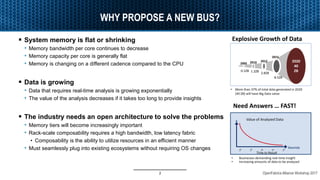
Explosive Growth of Data
• More than 37% of total data generated in 2020
(40 ZB) will have Big Data value
2020
40
ZB
2005 2010 2012
2015
8.5ZB
2.8ZB1.2ZB0.1ZB
• Businesses demanding real-time insight
• Increasing amounts of data to be analyzed
Seconds
Value of Analyzed Data$
10
-2
10
0
10
2
10
4
10
6
Time to Result
Need Answers … FAST!
OpenFabrics Alliance Workshop 2017
OBLIGATORY MEMORY PYRAMID SLIDE
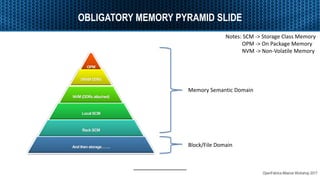
OPM
DRAM DDRx
NVM (DDRx attached)
Local SCM
Rack SCM
And then storage…….
Notes: SCM -> Storage Class Memory
OPM -> On Package Memory
NVM -> Non-Volatile Memory
Memory Semantic Domain
Block/File Domain
OpenFabrics Alliance Workshop 2017
MEMORY/STORAGE CONVERGENCE: THE MEDIA REVOLUTION
3DXPointTM
Memory
Memory
Storage
Today
DRAM DRAM
Disk/SSD
SCM* SCM*
DRAM/OPM**
Disk/SSD
DRAM/OPM**
SCM*
*SCM = Storage Class Memory
Disk/SSD
Disk/SSD
**OPM = On-Package Memory
Memory Semantics will be pervasive in Volatile AND Non-
Volatile Storage as these technologies continue to converge. HMC
HBM MRAM
RRAM PCM
Managed
DRAM
Low
Latency
NAND
New and Emerging Memory Technologies
OpenFabrics Alliance Workshop 2017
HARDWARE SERVER REALITIES
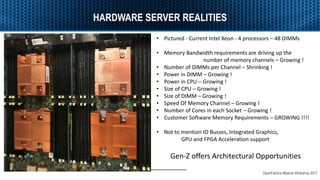
• Pictured - Current Intel Xeon - 4 processors – 48 DIMMs
• Memory Bandwidth requirements are driving up the
number of memory channels – Growing !
• Number of DIMMs per Channel – Shrinking !
• Power in DIMM – Growing !
• Power in CPU – Growing !
• Size of CPU – Growing !
• Size of DIMM – Growing !
• Speed Of Memory Channel – Growing !
• Number of Cores in each Socket – Growing !
• Customer Software Memory Requirements – GROWING !!!!
• Not to mention IO Busses, Integrated Graphics,
GPU and FPGA Acceleration support
Gen-Z offers Architectural Opportunities
OpenFabrics Alliance Workshop 2017
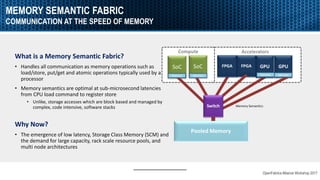
MEMORY SEMANTIC FABRIC
COMMUNICATION AT THE SPEED OF MEMORY
What is a Memory Semantic Fabric?
• Handles all communication as memory operations such as
load/store, put/get and atomic operations typically used by a
processor
• Memory semantics are optimal at sub-microsecond latencies
from CPU load command to register store
• Unlike, storage accesses which are block based and managed by
complex, code intensive, software stacks
Why Now?
• The emergence of low latency, Storage Class Memory (SCM) and
the demand for large capacity, rack scale resource pools, and
multi node architectures
Accelerators
GPU
Compute
SoC SoC
Memory Semantics
Pooled Memory
Memory
FPGA FPGA
Memory
Switch
GPU
Memory Memory
OpenFabrics Alliance Workshop 2017
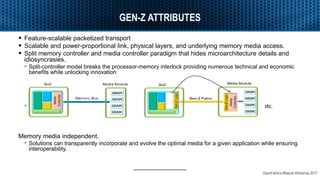
GEN-Z ATTRIBUTES
 Feature-scalable packetized transport
 Scalable and power-proportional link, physical layers, and underlying memory media access.
 Split memory controller and media controller paradigm that hides microarchitecture details and
idiosyncrasies.
• Split-controller model breaks the processor-memory interlock providing numerous technical and economic
benefits while unlocking innovation
• Enables transparent caching solutions to reduce load-to-use latency, mitigate NVM latencies, etc.
Memory media independent.
• Solutions can transparently incorporate and evolve the optimal media for a given application while ensuring
interoperability.
OpenFabrics Alliance Workshop 2017
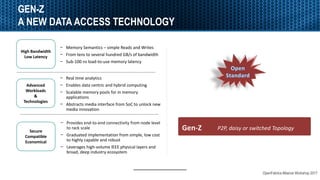
GEN-Z
A NEW DATA ACCESS TECHNOLOGY
− Provides end-to-end connectivity from node level
to rack scale
− Graduated implementation from simple, low cost
to highly capable and robust
− Leverages high-volume IEEE physical layers and
broad, deep industry ecosystem
− Real time analytics
− Enables data centric and hybrid computing
− Scalable memory pools for in memory
applications
− Abstracts media interface from SoC to unlock new
media innovation
High Bandwidth
Low Latency
− Memory Semantics – simple Reads and Writes
− From tens to several hundred GB/s of bandwidth
− Sub-100 ns load-to-use memory latency
Advanced
Workloads
&
Technologies
Secure
Compatible
Economical
P2P, daisy or switched TopologyGen-Z
OpenFabrics Alliance Workshop 2017
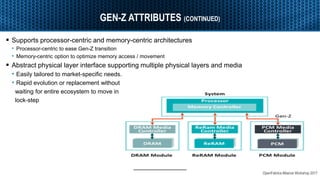
GEN-Z ATTRIBUTES (CONTINUED)
 Supports processor-centric and memory-centric architectures
• Processor-centric to ease Gen-Z transition
• Memory-centric option to optimize memory access / movement
 Abstract physical layer interface supporting multiple physical layers and media
• Easily tailored to market-specific needs.
• Rapid evolution or replacement without
waiting for entire ecosystem to move in
lock-step
OpenFabrics Alliance Workshop 2017
GEN-Z ATTRIBUTES (CONTINUED)
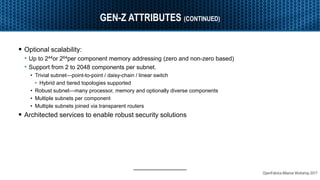
 Market-driven packaging and fabric topologies
• Single or multi-link point-to-point topologies
• Switched fabric topologies—component-integrated or discrete
 Common data transport with application semantic overlays to support diverse component
types—processors (variety of types), memory, I/O, storage, network, FPGA, DSP, graphics,
etc.
 Workload and environmentally-driven optional capabilities
• Asymmetric interfaces and links
• Real-time dynamic interface width and link width
• Memory persistency
• Hardware-based differentiated communication services.
• Advanced and vendor-defined operations.
• Messaging services for any-to-any communications between diverse component types
 Strong data integrity combined with transparent end-to-end packet error recovery.
 Operating system (OS) and processor independence.
OpenFabrics Alliance Workshop 2017
GEN-Z ATTRIBUTES (CONTINUED)
 Optional scalability:
• Up to 244or 264per component memory addressing (zero and non-zero based)
• Support from 2 to 2048 components per subnet.
• Trivial subnet—point-to-point / daisy-chain / linear switch
• Hybrid and tiered topologies supported
• Robust subnet—many processor, memory and optionally diverse components
• Multiple subnets per component
• Multiple subnets joined via transparent routers
 Architected services to enable robust security solutions
OpenFabrics Alliance Workshop 2017
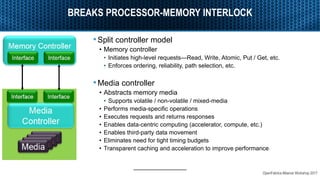
BREAKS PROCESSOR-MEMORY INTERLOCK
•Split controller model
• Memory controller
• Initiates high-level requests—Read, Write, Atomic, Put / Get, etc.
• Enforces ordering, reliability, path selection, etc.
•Media controller
• Abstracts memory media
• Supports volatile / non-volatile / mixed-media
• Performs media-specific operations
• Executes requests and returns responses
• Enables data-centric computing (accelerator, compute, etc.)
• Enables third-party data movement
• Eliminates need for tight timing budgets
• Transparent caching and acceleration to improve performance
OpenFabrics Alliance Workshop 2017
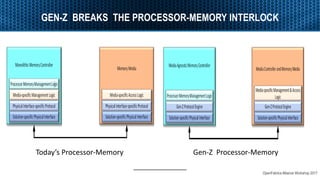
GEN-Z BREAKS THE PROCESSOR-MEMORY INTERLOCK
Today’s Processor-Memory Gen-Z Processor-Memory
OpenFabrics Alliance Workshop 2017
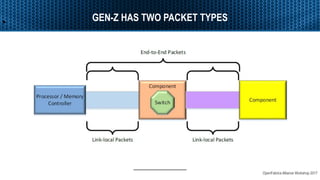
 GEN-Z HAS TWO PACKET TYPES
OpenFabrics Alliance Workshop 2017
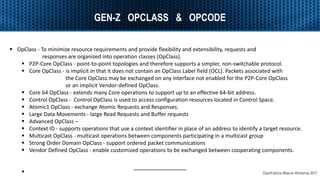
GEN-Z OPCLASS & OPCODE
 OpClass - To minimize resource requirements and provide flexibility and extensibility, requests and
responses are organized into operation classes (OpClass).
 P2P-Core OpClass - point-to-point topologies and therefore supports a simpler, non-switchable protocol.
 Core OpClass - is implicit in that it does not contain an OpClass Label field (OCL). Packets associated with
the Core OpClass may be exchanged on any interface not enabled for the P2P-Core OpClass
or an implicit Vendor-defined OpClass.
 Core 64 OpClass - extends many Core operations to support up to an effective 64-bit address.
 Control OpClass - Control OpClass is used to access configuration resources located in Control Space.
 Atomic1 OpClass - exchange Atomic Requests and Responses.
 Large Data Movements - large Read Requests and Buffer requests
 Advanced OpClass –
 Context ID - supports operations that use a context identifier in place of an address to identify a target resource.
 Multicast OpClass - multicast operations between components participating in a multicast group
 Strong Order Domain OpClass - support ordered packet communications
 Vendor Defined OpClass - enable customized operations to be exchanged between cooperating components.

OpenFabrics Alliance Workshop 2017
CACHE COHERENCY PROTOCOL
 Gen-Z supports a set of operations to allow coherent communications
• Invalidate and Writeback, Write with Target Cache, Read Modified, Read Exclusive, etc.
 Cache coherency protocols are customized to a given processor ISA
• Source of innovation and differentiation
• Standard coherency protocol would require a per ISA translation bridge chip adding
solution cost / latency / complexity
 Off-chip coherency protocols are difficult to efficiently scale
• Requires complex coherency schemes, e.g., directories
• Requires complex error and resiliency schemes to avoid cascade failures
OpenFabrics Alliance Workshop 2017
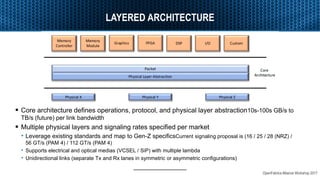
LAYERED ARCHITECTURE
 Core architecture defines operations, protocol, and physical layer abstraction10s-100s GB/s to
TB/s (future) per link bandwidth
 Multiple physical layers and signaling rates specified per market
• Leverage existing standards and map to Gen-Z specificsCurrent signaling proposal is (16 / 25 / 28 (NRZ) /
56 GT/s (PAM 4) / 112 GT/s (PAM 4)
• Supports electrical and optical medias (VCSEL / SiP) with multiple lambda
• Unidirectional links (separate Tx and Rx lanes in symmetric or asymmetric configurations)
OpenFabrics Alliance Workshop 2017
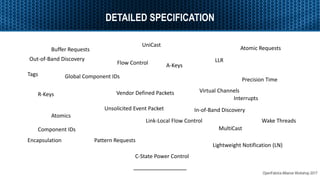
DETAILED SPECIFICATION
Tags
Virtual Channels
Component IDs
Flow Control
Link-Local Flow Control
LLR
Encapsulation
Wake Threads
Precision Time
Lightweight Notification (LN)
Vendor Defined Packets
Pattern Requests
Buffer Requests Atomic Requests
Interrupts
R-Keys
A-Keys
C-State Power Control
Unsolicited Event Packet
Global Component IDs
UniCast
MultiCast
Out-of-Band Discovery
In-of-Band Discovery
Atomics
OpenFabrics Alliance Workshop 2017
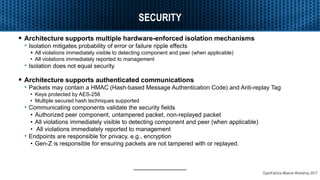
SECURITY
 Architecture supports multiple hardware-enforced isolation mechanisms
• Isolation mitigates probability of error or failure ripple effects
 All violations immediately visible to detecting component and peer (when applicable)
• All violations immediately reported to management
• Isolation does not equal security
 Architecture supports authenticated communications
• Packets may contain a HMAC (Hash-based Message Authentication Code) and Anti-replay Tag
• Keys protected by AES-256
• Multiple secured hash techniques supported
• Communicating components validate the security fields
• Authorized peer component, untampered packet, non-replayed packet
• All violations immediately visible to detecting component and peer (when applicable)
• All violations immediately reported to management
• Endpoints are responsible for privacy, e.g., encryption
• Gen-Z is responsible for ensuring packets are not tampered with or replayed.
OpenFabrics Alliance Workshop 2017
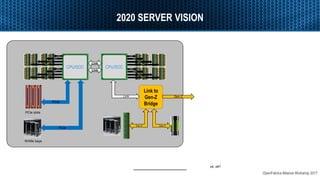
2020 SERVER VISION
CPU/SOC
Link
Link
CPU/SOC
DDR5
DDR5
DDR5
DDR5
DDR5
DDR5
DDR5
DDR5
DDR5
DDR5
DDR5
DDR5
DDR5
DDR5
DDR5
DDR5
PCIe
PCIe
PCIe slots
NVMe bays
x4, x8?
Link to
Gen-Z
Bridge
Gen-ZLink
Gen-ZGen-Z
OpenFabrics Alliance Workshop 2017
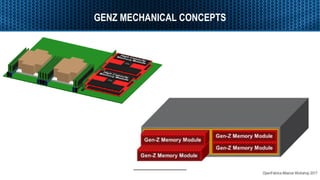
GENZ MECHANICAL CONCEPTS
OpenFabrics Alliance Workshop 2017
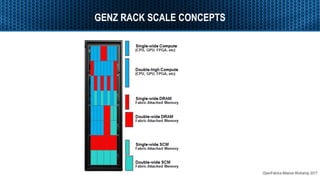
GENZ RACK SCALE CONCEPTS
OpenFabrics Alliance Workshop 2017
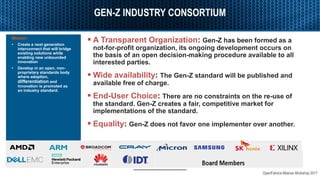
GEN-Z INDUSTRY CONSORTIUM
 A Transparent Organization: Gen-Z has been formed as a
not-for-profit organization, its ongoing development occurs on
the basis of an open decision-making procedure available to all
interested parties.
 Wide availability: The Gen-Z standard will be published and
available free of charge.
 End-User Choice: There are no constraints on the re-use of
the standard. Gen-Z creates a fair, competitive market for
implementations of the standard.
 Equality: Gen-Z does not favor one implementer over another.
Mission
• Create a next generation
interconnect that will bridge
existing solutions while
enabling new unbounded
innovation
• Develop in an open, non-
proprietary standards body
where adoption,
differentiation and
innovation is promoted as
an industry standard.
OpenFabrics Alliance Workshop 2017
GEN-Z SUMMARY
 Scalable, universal system interconnect and protocol
 Optimized for memory-semantic communications
• Highly-extensible and easily customized
• Delivers transparent aggregation and resiliency services
 Breaks processor-memory interlock
• Increases solution agility and innovation opportunities
 Enables and optimizes hybrid and data-centric computing
 Opportunity to simplify / reduce software overhead and complexity
 Unmodified OS support
 Scales across solution segments—mobility-to-client-to-server-to-
enterprise-to-cloud
 Common modular connector and mechanical form factors—memory, I/O,
storage, etc.
 …and much, much more
OpenFabrics Alliance Workshop 2017
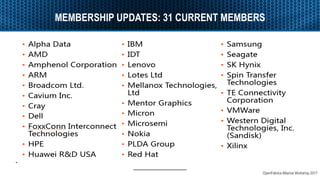
MEMBERSHIP UPDATES: 31 CURRENT MEMBERS
13th ANNUAL WORKSHOP 2017
THANK YOU
Greg Casey, Senior Architect and Strategist Server CTO Team
DellEMC

GEN-Z: An Overview and Use Cases

  • 1.
    13th ANNUAL WORKSHOP2017 GEN-Z AN OVERVIEW AND USE CASES Greg Casey, Senior Architect and Strategist Server CTO Team March, 2017 DellEMC
  • 2.
    OpenFabrics Alliance Workshop2017 WHY PROPOSE A NEW BUS?  System memory is flat or shrinking • Memory bandwidth per core continues to decrease • Memory capacity per core is generally flat • Memory is changing on a different cadence compared to the CPU  Data is growing • Data that requires real-time analysis is growing exponentially • The value of the analysis decreases if it takes too long to provide insights  The industry needs an open architecture to solve the problems • Memory tiers will become increasingly important • Rack-scale composability requires a high bandwidth, low latency fabric • Composability is the ability to utilize resources in an efficient manner • Must seamlessly plug into existing ecosystems without requiring OS changes 2 Explosive Growth of Data • More than 37% of total data generated in 2020 (40 ZB) will have Big Data value 2020 40 ZB 2005 2010 2012 2015 8.5ZB 2.8ZB1.2ZB0.1ZB • Businesses demanding real-time insight • Increasing amounts of data to be analyzed Seconds Value of Analyzed Data$ 10 -2 10 0 10 2 10 4 10 6 Time to Result Need Answers … FAST!
  • 3.
    OpenFabrics Alliance Workshop2017 OBLIGATORY MEMORY PYRAMID SLIDE OPM DRAM DDRx NVM (DDRx attached) Local SCM Rack SCM And then storage……. Notes: SCM -> Storage Class Memory OPM -> On Package Memory NVM -> Non-Volatile Memory Memory Semantic Domain Block/File Domain
  • 4.
    OpenFabrics Alliance Workshop2017 MEMORY/STORAGE CONVERGENCE: THE MEDIA REVOLUTION 3DXPointTM Memory Memory Storage Today DRAM DRAM Disk/SSD SCM* SCM* DRAM/OPM** Disk/SSD DRAM/OPM** SCM* *SCM = Storage Class Memory Disk/SSD Disk/SSD **OPM = On-Package Memory Memory Semantics will be pervasive in Volatile AND Non- Volatile Storage as these technologies continue to converge. HMC HBM MRAM RRAM PCM Managed DRAM Low Latency NAND New and Emerging Memory Technologies
  • 5.
    OpenFabrics Alliance Workshop2017 HARDWARE SERVER REALITIES • Pictured - Current Intel Xeon - 4 processors – 48 DIMMs • Memory Bandwidth requirements are driving up the number of memory channels – Growing ! • Number of DIMMs per Channel – Shrinking ! • Power in DIMM – Growing ! • Power in CPU – Growing ! • Size of CPU – Growing ! • Size of DIMM – Growing ! • Speed Of Memory Channel – Growing ! • Number of Cores in each Socket – Growing ! • Customer Software Memory Requirements – GROWING !!!! • Not to mention IO Busses, Integrated Graphics, GPU and FPGA Acceleration support Gen-Z offers Architectural Opportunities
  • 6.
    OpenFabrics Alliance Workshop2017 MEMORY SEMANTIC FABRIC COMMUNICATION AT THE SPEED OF MEMORY What is a Memory Semantic Fabric? • Handles all communication as memory operations such as load/store, put/get and atomic operations typically used by a processor • Memory semantics are optimal at sub-microsecond latencies from CPU load command to register store • Unlike, storage accesses which are block based and managed by complex, code intensive, software stacks Why Now? • The emergence of low latency, Storage Class Memory (SCM) and the demand for large capacity, rack scale resource pools, and multi node architectures Accelerators GPU Compute SoC SoC Memory Semantics Pooled Memory Memory FPGA FPGA Memory Switch GPU Memory Memory
  • 7.
    OpenFabrics Alliance Workshop2017 GEN-Z ATTRIBUTES  Feature-scalable packetized transport  Scalable and power-proportional link, physical layers, and underlying memory media access.  Split memory controller and media controller paradigm that hides microarchitecture details and idiosyncrasies. • Split-controller model breaks the processor-memory interlock providing numerous technical and economic benefits while unlocking innovation • Enables transparent caching solutions to reduce load-to-use latency, mitigate NVM latencies, etc. Memory media independent. • Solutions can transparently incorporate and evolve the optimal media for a given application while ensuring interoperability.
  • 8.
    OpenFabrics Alliance Workshop2017 GEN-Z A NEW DATA ACCESS TECHNOLOGY − Provides end-to-end connectivity from node level to rack scale − Graduated implementation from simple, low cost to highly capable and robust − Leverages high-volume IEEE physical layers and broad, deep industry ecosystem − Real time analytics − Enables data centric and hybrid computing − Scalable memory pools for in memory applications − Abstracts media interface from SoC to unlock new media innovation High Bandwidth Low Latency − Memory Semantics – simple Reads and Writes − From tens to several hundred GB/s of bandwidth − Sub-100 ns load-to-use memory latency Advanced Workloads & Technologies Secure Compatible Economical P2P, daisy or switched TopologyGen-Z
  • 9.
    OpenFabrics Alliance Workshop2017 GEN-Z ATTRIBUTES (CONTINUED)  Supports processor-centric and memory-centric architectures • Processor-centric to ease Gen-Z transition • Memory-centric option to optimize memory access / movement  Abstract physical layer interface supporting multiple physical layers and media • Easily tailored to market-specific needs. • Rapid evolution or replacement without waiting for entire ecosystem to move in lock-step
  • 10.
    OpenFabrics Alliance Workshop2017 GEN-Z ATTRIBUTES (CONTINUED)  Market-driven packaging and fabric topologies • Single or multi-link point-to-point topologies • Switched fabric topologies—component-integrated or discrete  Common data transport with application semantic overlays to support diverse component types—processors (variety of types), memory, I/O, storage, network, FPGA, DSP, graphics, etc.  Workload and environmentally-driven optional capabilities • Asymmetric interfaces and links • Real-time dynamic interface width and link width • Memory persistency • Hardware-based differentiated communication services. • Advanced and vendor-defined operations. • Messaging services for any-to-any communications between diverse component types  Strong data integrity combined with transparent end-to-end packet error recovery.  Operating system (OS) and processor independence.
  • 11.
    OpenFabrics Alliance Workshop2017 GEN-Z ATTRIBUTES (CONTINUED)  Optional scalability: • Up to 244or 264per component memory addressing (zero and non-zero based) • Support from 2 to 2048 components per subnet. • Trivial subnet—point-to-point / daisy-chain / linear switch • Hybrid and tiered topologies supported • Robust subnet—many processor, memory and optionally diverse components • Multiple subnets per component • Multiple subnets joined via transparent routers  Architected services to enable robust security solutions
  • 12.
    OpenFabrics Alliance Workshop2017 BREAKS PROCESSOR-MEMORY INTERLOCK •Split controller model • Memory controller • Initiates high-level requests—Read, Write, Atomic, Put / Get, etc. • Enforces ordering, reliability, path selection, etc. •Media controller • Abstracts memory media • Supports volatile / non-volatile / mixed-media • Performs media-specific operations • Executes requests and returns responses • Enables data-centric computing (accelerator, compute, etc.) • Enables third-party data movement • Eliminates need for tight timing budgets • Transparent caching and acceleration to improve performance
  • 13.
    OpenFabrics Alliance Workshop2017 GEN-Z BREAKS THE PROCESSOR-MEMORY INTERLOCK Today’s Processor-Memory Gen-Z Processor-Memory
  • 14.
    OpenFabrics Alliance Workshop2017  GEN-Z HAS TWO PACKET TYPES
  • 15.
    OpenFabrics Alliance Workshop2017 GEN-Z OPCLASS & OPCODE  OpClass - To minimize resource requirements and provide flexibility and extensibility, requests and responses are organized into operation classes (OpClass).  P2P-Core OpClass - point-to-point topologies and therefore supports a simpler, non-switchable protocol.  Core OpClass - is implicit in that it does not contain an OpClass Label field (OCL). Packets associated with the Core OpClass may be exchanged on any interface not enabled for the P2P-Core OpClass or an implicit Vendor-defined OpClass.  Core 64 OpClass - extends many Core operations to support up to an effective 64-bit address.  Control OpClass - Control OpClass is used to access configuration resources located in Control Space.  Atomic1 OpClass - exchange Atomic Requests and Responses.  Large Data Movements - large Read Requests and Buffer requests  Advanced OpClass –  Context ID - supports operations that use a context identifier in place of an address to identify a target resource.  Multicast OpClass - multicast operations between components participating in a multicast group  Strong Order Domain OpClass - support ordered packet communications  Vendor Defined OpClass - enable customized operations to be exchanged between cooperating components. 
  • 16.
    OpenFabrics Alliance Workshop2017 CACHE COHERENCY PROTOCOL  Gen-Z supports a set of operations to allow coherent communications • Invalidate and Writeback, Write with Target Cache, Read Modified, Read Exclusive, etc.  Cache coherency protocols are customized to a given processor ISA • Source of innovation and differentiation • Standard coherency protocol would require a per ISA translation bridge chip adding solution cost / latency / complexity  Off-chip coherency protocols are difficult to efficiently scale • Requires complex coherency schemes, e.g., directories • Requires complex error and resiliency schemes to avoid cascade failures
  • 17.
    OpenFabrics Alliance Workshop2017 LAYERED ARCHITECTURE  Core architecture defines operations, protocol, and physical layer abstraction10s-100s GB/s to TB/s (future) per link bandwidth  Multiple physical layers and signaling rates specified per market • Leverage existing standards and map to Gen-Z specificsCurrent signaling proposal is (16 / 25 / 28 (NRZ) / 56 GT/s (PAM 4) / 112 GT/s (PAM 4) • Supports electrical and optical medias (VCSEL / SiP) with multiple lambda • Unidirectional links (separate Tx and Rx lanes in symmetric or asymmetric configurations)
  • 18.
    OpenFabrics Alliance Workshop2017 DETAILED SPECIFICATION Tags Virtual Channels Component IDs Flow Control Link-Local Flow Control LLR Encapsulation Wake Threads Precision Time Lightweight Notification (LN) Vendor Defined Packets Pattern Requests Buffer Requests Atomic Requests Interrupts R-Keys A-Keys C-State Power Control Unsolicited Event Packet Global Component IDs UniCast MultiCast Out-of-Band Discovery In-of-Band Discovery Atomics
  • 19.
    OpenFabrics Alliance Workshop2017 SECURITY  Architecture supports multiple hardware-enforced isolation mechanisms • Isolation mitigates probability of error or failure ripple effects  All violations immediately visible to detecting component and peer (when applicable) • All violations immediately reported to management • Isolation does not equal security  Architecture supports authenticated communications • Packets may contain a HMAC (Hash-based Message Authentication Code) and Anti-replay Tag • Keys protected by AES-256 • Multiple secured hash techniques supported • Communicating components validate the security fields • Authorized peer component, untampered packet, non-replayed packet • All violations immediately visible to detecting component and peer (when applicable) • All violations immediately reported to management • Endpoints are responsible for privacy, e.g., encryption • Gen-Z is responsible for ensuring packets are not tampered with or replayed.
  • 20.
    OpenFabrics Alliance Workshop2017 2020 SERVER VISION CPU/SOC Link Link CPU/SOC DDR5 DDR5 DDR5 DDR5 DDR5 DDR5 DDR5 DDR5 DDR5 DDR5 DDR5 DDR5 DDR5 DDR5 DDR5 DDR5 PCIe PCIe PCIe slots NVMe bays x4, x8? Link to Gen-Z Bridge Gen-ZLink Gen-ZGen-Z
  • 21.
    OpenFabrics Alliance Workshop2017 GENZ MECHANICAL CONCEPTS
  • 22.
    OpenFabrics Alliance Workshop2017 GENZ RACK SCALE CONCEPTS
  • 23.
    OpenFabrics Alliance Workshop2017 GEN-Z INDUSTRY CONSORTIUM  A Transparent Organization: Gen-Z has been formed as a not-for-profit organization, its ongoing development occurs on the basis of an open decision-making procedure available to all interested parties.  Wide availability: The Gen-Z standard will be published and available free of charge.  End-User Choice: There are no constraints on the re-use of the standard. Gen-Z creates a fair, competitive market for implementations of the standard.  Equality: Gen-Z does not favor one implementer over another. Mission • Create a next generation interconnect that will bridge existing solutions while enabling new unbounded innovation • Develop in an open, non- proprietary standards body where adoption, differentiation and innovation is promoted as an industry standard.
  • 24.
    OpenFabrics Alliance Workshop2017 GEN-Z SUMMARY  Scalable, universal system interconnect and protocol  Optimized for memory-semantic communications • Highly-extensible and easily customized • Delivers transparent aggregation and resiliency services  Breaks processor-memory interlock • Increases solution agility and innovation opportunities  Enables and optimizes hybrid and data-centric computing  Opportunity to simplify / reduce software overhead and complexity  Unmodified OS support  Scales across solution segments—mobility-to-client-to-server-to- enterprise-to-cloud  Common modular connector and mechanical form factors—memory, I/O, storage, etc.  …and much, much more
  • 25.
    OpenFabrics Alliance Workshop2017 MEMBERSHIP UPDATES: 31 CURRENT MEMBERS
  • 26.
    13th ANNUAL WORKSHOP2017 THANK YOU Greg Casey, Senior Architect and Strategist Server CTO Team DellEMC