HOW INTEREST GROUPS PURSUE THEIR GOALS?
Guardian of Islamic Republic of Iran and their
influence on the politic.
Samin VossoughiRad
4th
Year Student of American University for Humanities
Lobbying and Decision-making
01 July 2015
Interest groups chase a varied range of policy goals. In their efforts to realize these goals, groups
may lobby politicians, approach the media and engage in protest activities. This article
investigates the strategies of influence utilized by the “Guardian of Revolution” in Iran.
How the Guardians of Islamic Republic of Iran influence
politic in Iran
How interest groups pursue their goals?
Interest groups chase a varied range of policy goals. In their efforts to realize these goals, groups
may lobby politicians, approach the media and engage in protest activities. This article investigates
the strategies of influence utilized by the “Guardians of Revolution” in Iran. This particular group
has and is influencing all aspects of not only international relations of Iran but also the life of all
the Iranian population inside an outside the country. So who is this specific group which has so
much power and control over everything? And what is their principal goal?
To understand the political structure of Iran, I should first explain briefly where Iran is situated
and how and when the” Guardians of Revolution” were created and with what purpose.
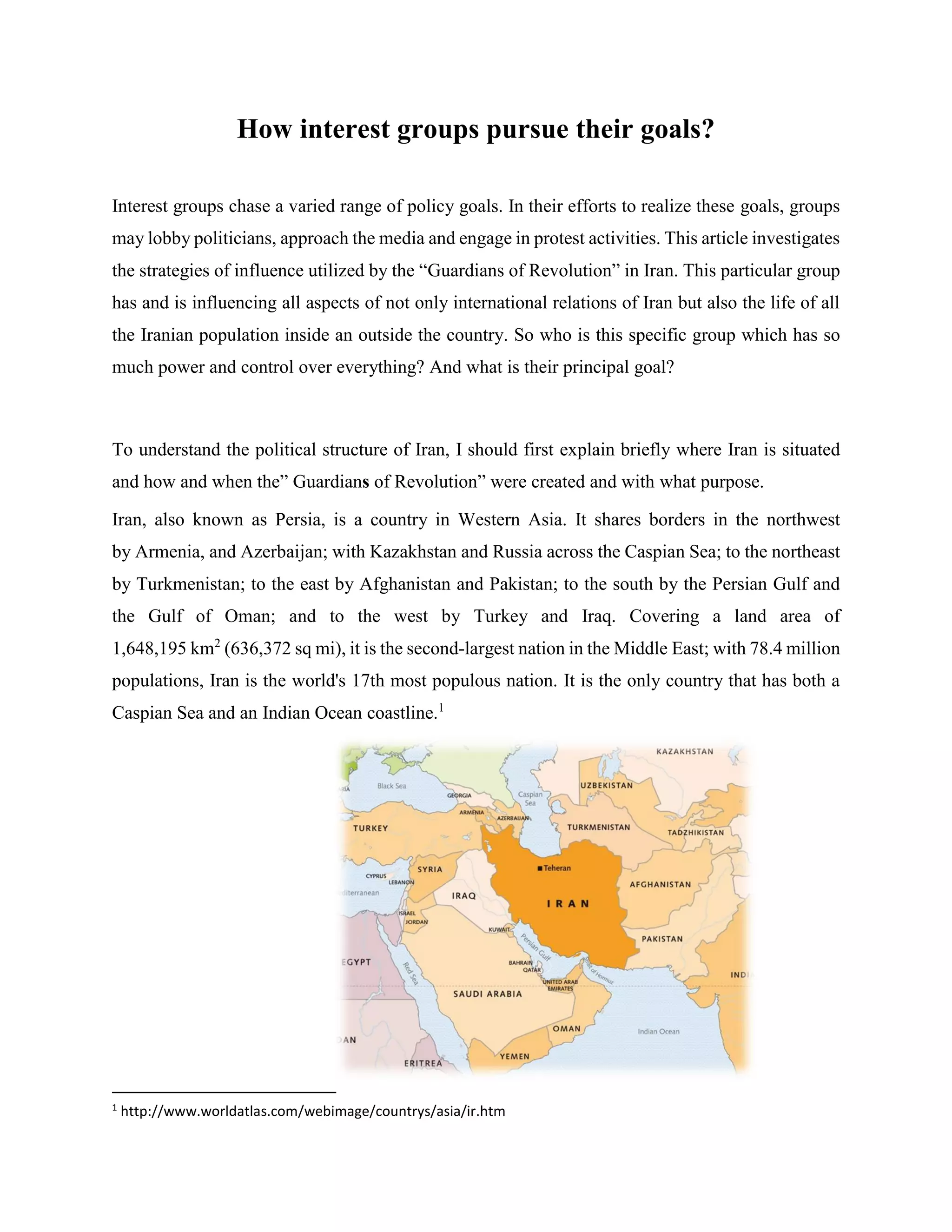
Iran, also known as Persia, is a country in Western Asia. It shares borders in the northwest
by Armenia, and Azerbaijan; with Kazakhstan and Russia across the Caspian Sea; to the northeast
by Turkmenistan; to the east by Afghanistan and Pakistan; to the south by the Persian Gulf and
the Gulf of Oman; and to the west by Turkey and Iraq. Covering a land area of
1,648,195 km2
(636,372 sq mi), it is the second-largest nation in the Middle East; with 78.4 million
populations, Iran is the world's 17th most populous nation. It is the only country that has both a
Caspian Sea and an Indian Ocean coastline.1
1
http://www.worldatlas.com/webimage/countrys/asia/ir.htm
According to Stephen Kinzer, author of the book “All the Shah’s Men”, Rashidun Muslims
invaded Persia / Iran in 633 AD, and conquered it by 651 AD, Iran thereafter played a vital role in
the subsequent Islamic Golden Age, producing many influential scientists, scholars, artists, and
thinkers. The emergence in 1501 of the Safavid dynasty, which promoted Twelver Shi'a Islam as
the official religion, marked one of the most important turning points in Iranian and Muslim
history2
. The Persian Constitutional Revolution of 1906 established the nation's first parliament,
which operated within a constitutional monarchy. Following a coup d'état originated by the U.K.
and the U.S. in 1953, Iran gradually became very close allies with the US and the rest of the West,
remained secular, but grew increasingly autocratic. Growing dissent against foreign influence and
political repression ended in the 1979 Revolution, which led to the establishment of an Islamic
republic on 1 April 19793
. Since 1979, “Guardians of revolution”, a group created by Ayatollah
Khomeini4
, the revolutionary leader, are influencing all aspects of the private and public sectors
in the country.
Founded on the 5th
May 1979, their main responsibility was to
defend Iran's borders and maintains internal order and to protect
the country's Islamic system.
An essential raison-d’être for interest groups is to pursue policy
goals. This particular group has been politically active since 1979
because they want to see their goals fulfilled. But what is this goal
exactly?
The Revolutionary Guards state, as I mentioned, that their role in protecting
the Islamic system is preventing foreign interference as well as coups by the
military or "deviant movements".
With more than 15 million employees and volunteers, the guard of
revolution are present everywhere. Within 35 years, the group has been
2
Iran’s history: http://www.bbc.com/news/world-middle-east-14542438
3
Iran: https://en.wikipedia.org/wiki/Army_of_the_Guardians_of_the_Islamic_Revolution
4
Khomeini: http://www.biography.com/people/ayatollah-ruhollah-khomeini-13680544
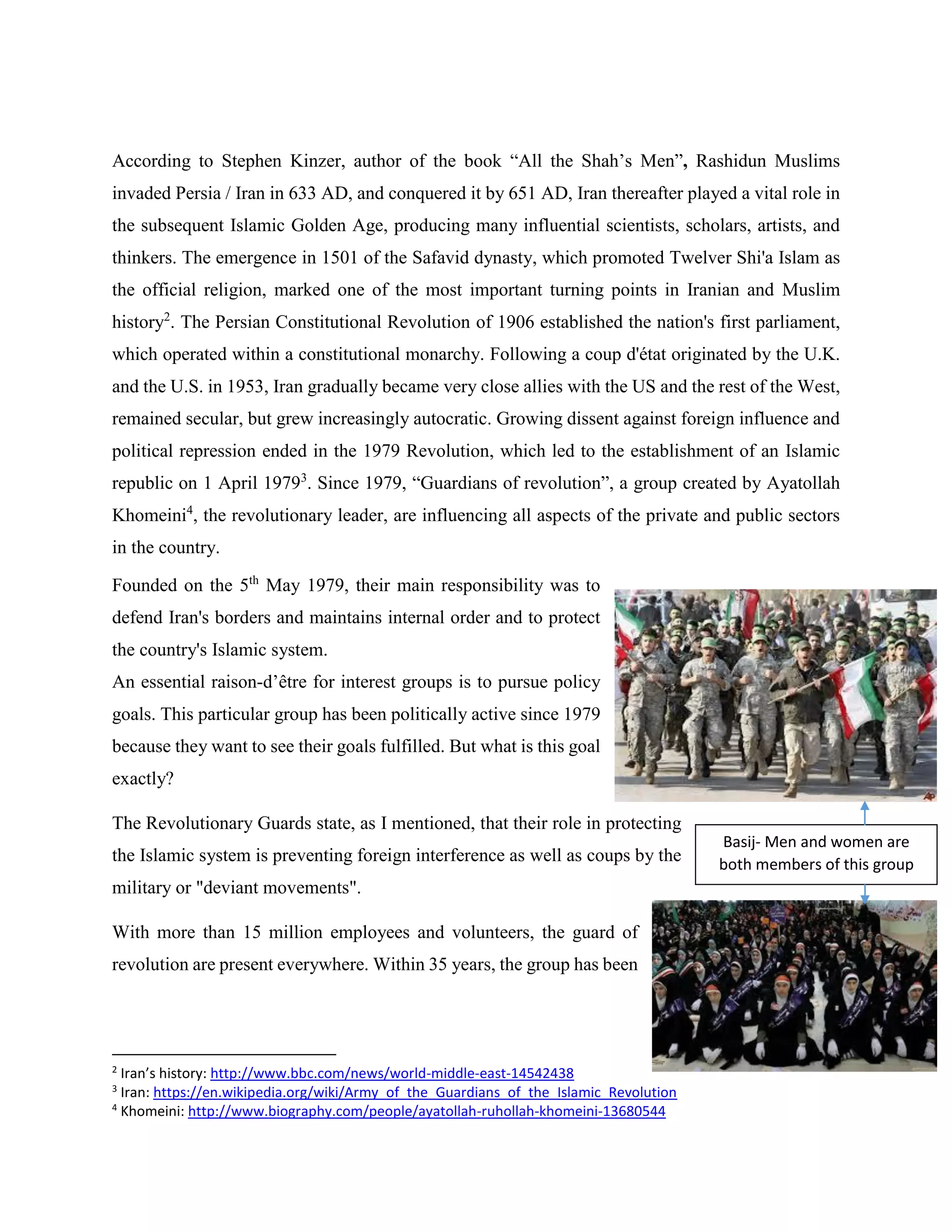
Basij- Men and women are
both members of this group
created and divided into 5 different subgroup as the Basij, who is the paramilitary volunteer militia
serving as an auxiliary force engaged in
activities such as internal security as well as law enforcement auxiliary, the
providing of social service, organizing of public religious ceremonies, and
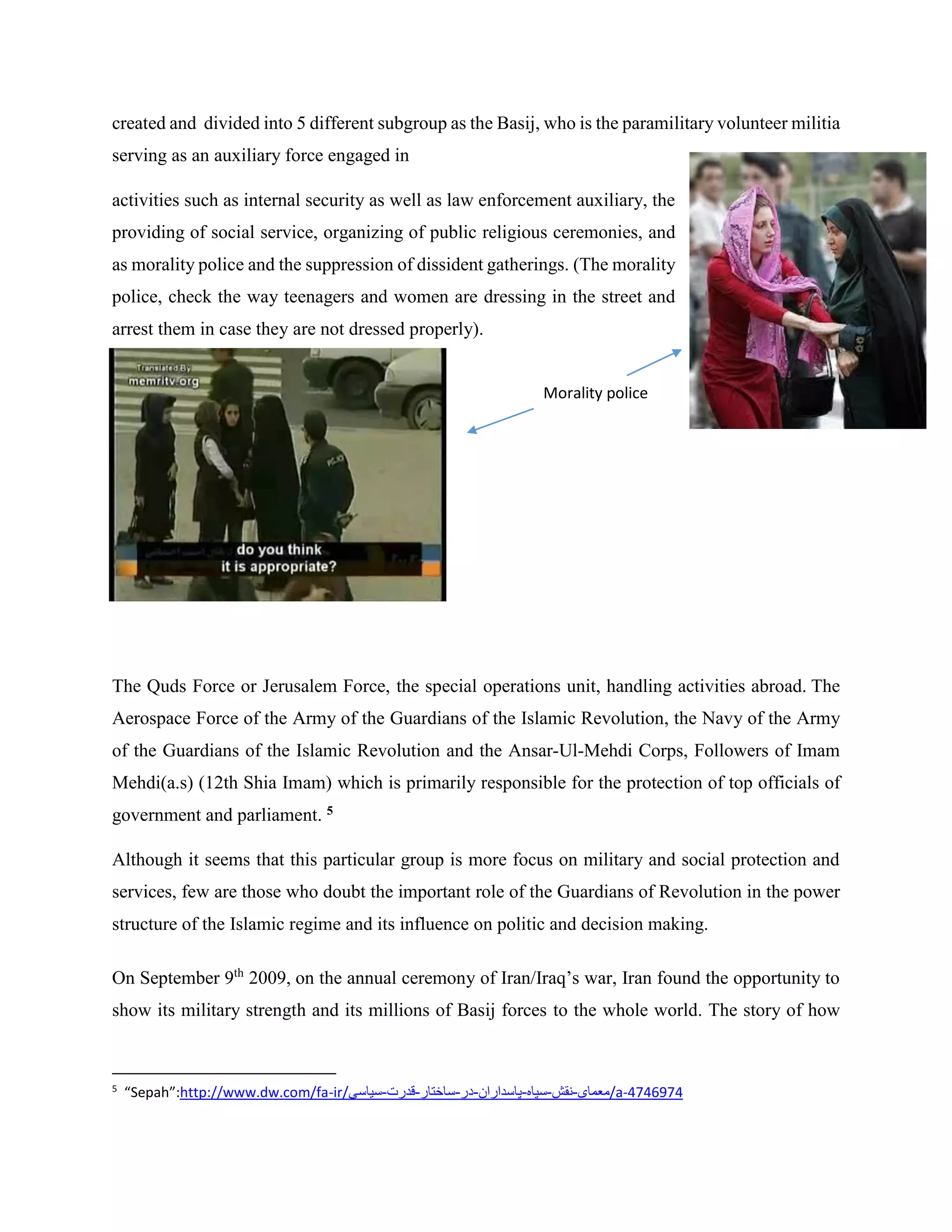
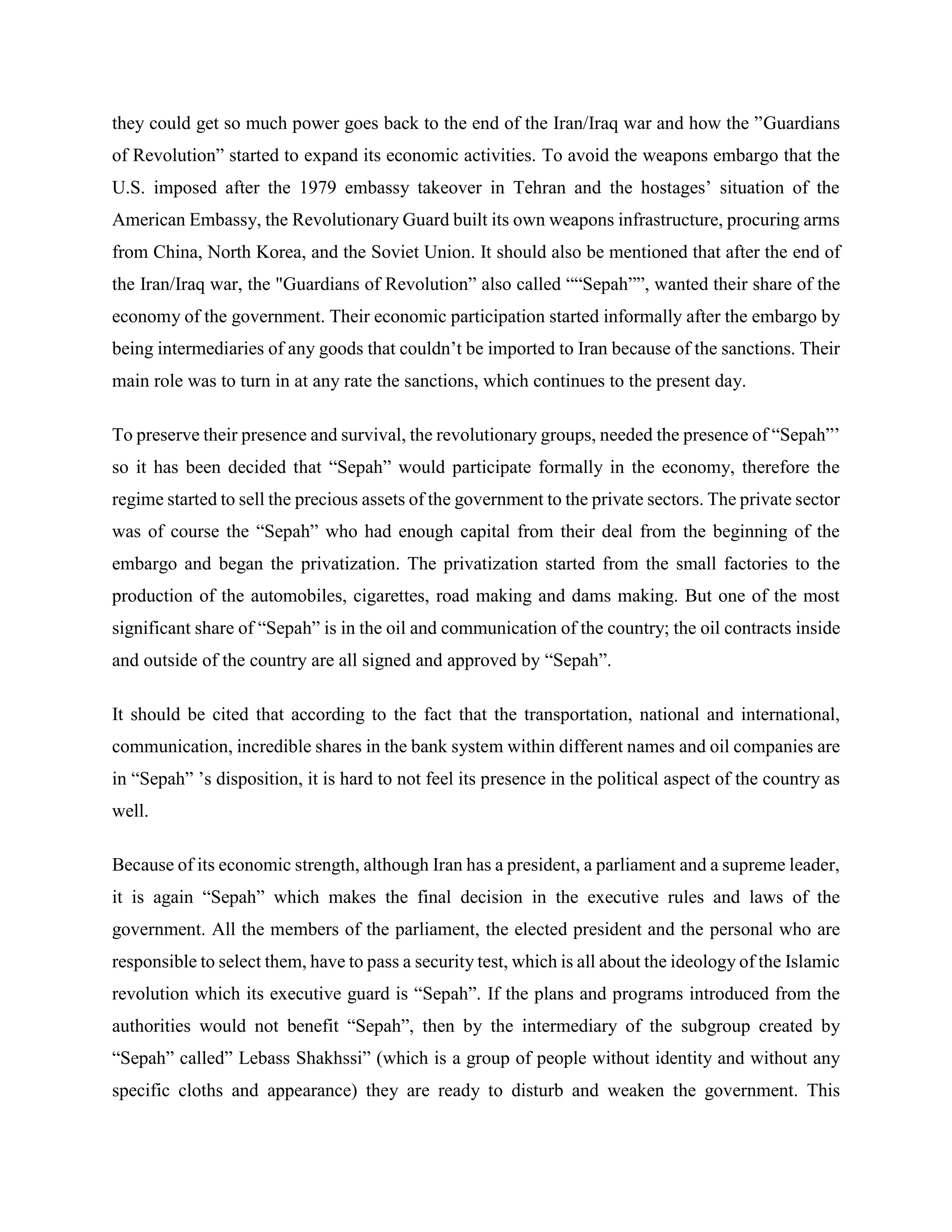
as morality police and the suppression of dissident gatherings. (The morality
police, check the way teenagers and women are dressing in the street and
arrest them in case they are not dressed properly).
The Quds Force or Jerusalem Force, the special operations unit, handling activities abroad. The
Aerospace Force of the Army of the Guardians of the Islamic Revolution, the Navy of the Army
of the Guardians of the Islamic Revolution and the Ansar-Ul-Mehdi Corps, Followers of Imam
Mehdi(a.s) (12th Shia Imam) which is primarily responsible for the protection of top officials of
government and parliament. 5
Although it seems that this particular group is more focus on military and social protection and
services, few are those who doubt the important role of the Guardians of Revolution in the power
structure of the Islamic regime and its influence on politic and decision making.
On September 9th
2009, on the annual ceremony of Iran/Iraq’s war, Iran found the opportunity to
show its military strength and its millions of Basij forces to the whole world. The story of how
5
“Sepah”:http://www.dw.com/fa-ir/‫/معمای-نقش-سپاه-پاسداران-در-ساختار-قدرت-سیاسی‬a-4746974
Morality police
they could get so much power goes back to the end of the Iran/Iraq war and how the ”Guardians
of Revolution” started to expand its economic activities. To avoid the weapons embargo that the
U.S. imposed after the 1979 embassy takeover in Tehran and the hostages’ situation of the
American Embassy, the Revolutionary Guard built its own weapons infrastructure, procuring arms
from China, North Korea, and the Soviet Union. It should also be mentioned that after the end of
the Iran/Iraq war, the "Guardians of Revolution” also called ““Sepah””, wanted their share of the
economy of the government. Their economic participation started informally after the embargo by
being intermediaries of any goods that couldn’t be imported to Iran because of the sanctions. Their
main role was to turn in at any rate the sanctions, which continues to the present day.
To preserve their presence and survival, the revolutionary groups, needed the presence of “Sepah”’
so it has been decided that “Sepah” would participate formally in the economy, therefore the
regime started to sell the precious assets of the government to the private sectors. The private sector
was of course the “Sepah” who had enough capital from their deal from the beginning of the
embargo and began the privatization. The privatization started from the small factories to the
production of the automobiles, cigarettes, road making and dams making. But one of the most
significant share of “Sepah” is in the oil and communication of the country; the oil contracts inside
and outside of the country are all signed and approved by “Sepah”.
It should be cited that according to the fact that the transportation, national and international,
communication, incredible shares in the bank system within different names and oil companies are
in “Sepah” ’s disposition, it is hard to not feel its presence in the political aspect of the country as
well.
Because of its economic strength, although Iran has a president, a parliament and a supreme leader,
it is again “Sepah” which makes the final decision in the executive rules and laws of the
government. All the members of the parliament, the elected president and the personal who are
responsible to select them, have to pass a security test, which is all about the ideology of the Islamic
revolution which its executive guard is “Sepah”. If the plans and programs introduced from the
authorities would not benefit “Sepah”, then by the intermediary of the subgroup created by
“Sepah” called” Lebass Shakhssi” (which is a group of people without identity and without any
specific cloths and appearance) they are ready to disturb and weaken the government. This
particular subgroup, protected by “Sepah” is present everywhere, even in abroad, to spread the
revolution and has the right to have any demonstration at any time.
2008- A date to remember- A date which could bring Iran close to a democratic country and save
the country from the misery it was placed in. By 2004, Ahmadinejad was elected with the support
of the Supreme Leader, Khamenei, and the “Sepah”. During 4 years, they brought the most awful
social and economic restrictions into the country. By the time of the election campaign of 2008,
suddenly a huge door of social freedom gets open to everyone; books from oppositions are being
published, journals and newspapers who were closed by the authorities for four years they get the
right to open and publish again, in universities that usually students did not have the right to sit
together in groups of more than 5 persons, they had the right to start opposition activities against
the authorities and even girls and boys could finally sit in the same group and work together.
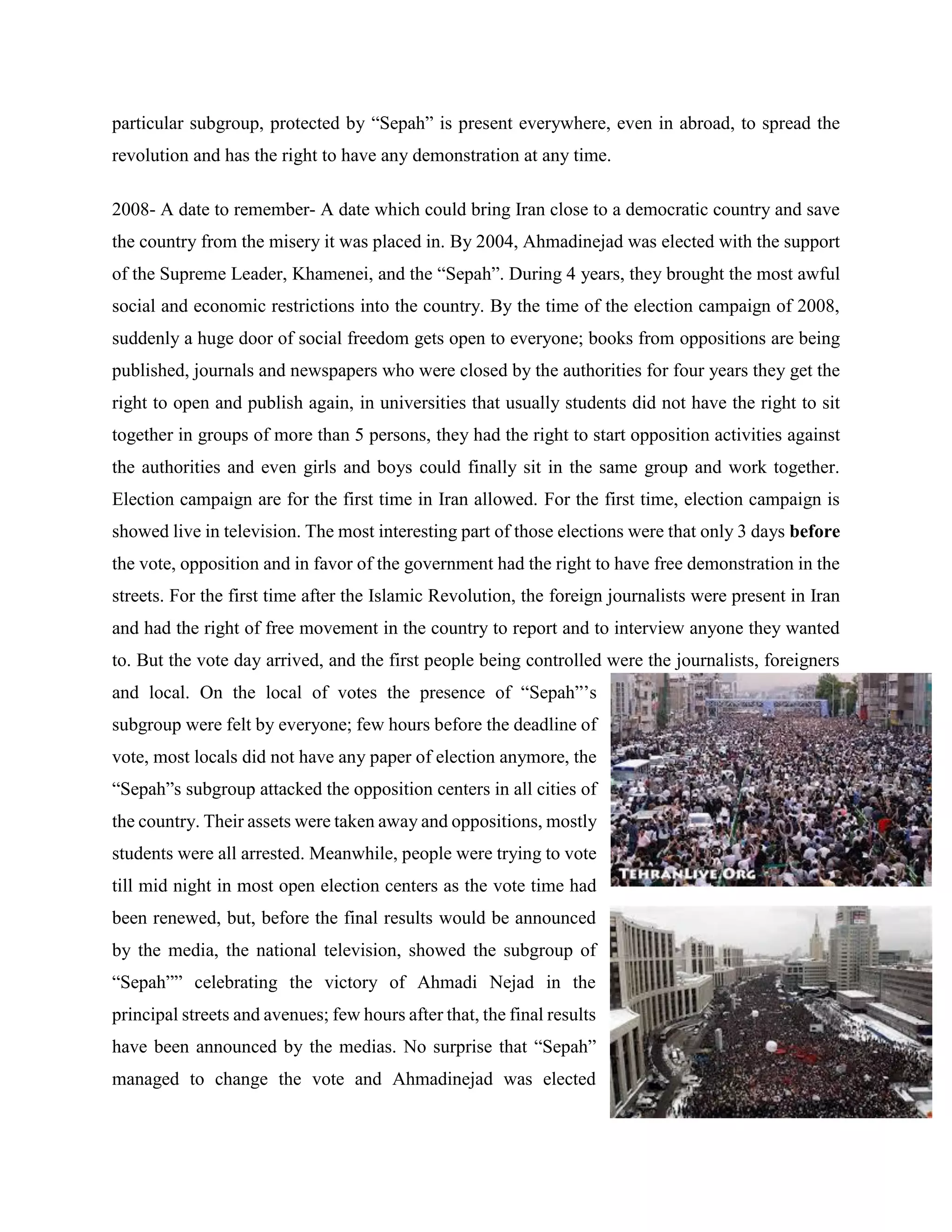
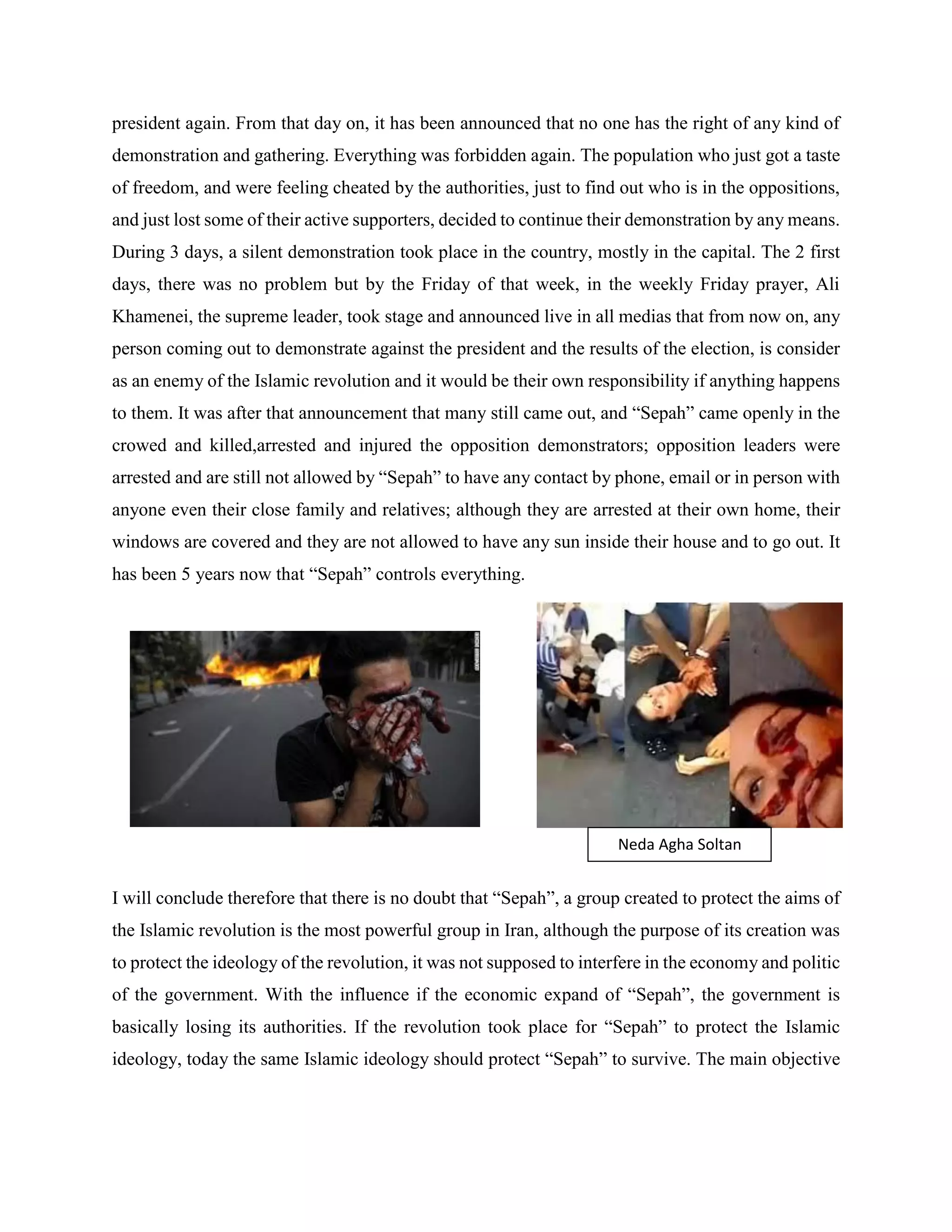
Election campaign are for the first time in Iran allowed. For the first time, election campaign is
showed live in television. The most interesting part of those elections were that only 3 days before
the vote, opposition and in favor of the government had the right to have free demonstration in the
streets. For the first time after the Islamic Revolution, the foreign journalists were present in Iran
and had the right of free movement in the country to report and to interview anyone they wanted
to. But the vote day arrived, and the first people being controlled were the journalists, foreigners
and local. On the local of votes the presence of “Sepah”’s
subgroup were felt by everyone; few hours before the deadline of
vote, most locals did not have any paper of election anymore, the
“Sepah”s subgroup attacked the opposition centers in all cities of
the country. Their assets were taken away and oppositions, mostly
students were all arrested. Meanwhile, people were trying to vote
till mid night in most open election centers as the vote time had
been renewed, but, before the final results would be announced
by the media, the national television, showed the subgroup of
“Sepah”” celebrating the victory of Ahmadi Nejad in the
principal streets and avenues; few hours after that, the final results
have been announced by the medias. No surprise that “Sepah”
managed to change the vote and Ahmadinejad was elected
president again. From that day on, it has been announced that no one has the right of any kind of
demonstration and gathering. Everything was forbidden again. The population who just got a taste
of freedom, and were feeling cheated by the authorities, just to find out who is in the oppositions,
and just lost some of their active supporters, decided to continue their demonstration by any means.
During 3 days, a silent demonstration took place in the country, mostly in the capital. The 2 first
days, there was no problem but by the Friday of that week, in the weekly Friday prayer, Ali
Khamenei, the supreme leader, took stage and announced live in all medias that from now on, any
person coming out to demonstrate against the president and the results of the election, is consider
as an enemy of the Islamic revolution and it would be their own responsibility if anything happens
to them. It was after that announcement that many still came out, and “Sepah” came openly in the
crowed and killed,arrested and injured the opposition demonstrators; opposition leaders were
arrested and are still not allowed by “Sepah” to have any contact by phone, email or in person with
anyone even their close family and relatives; although they are arrested at their own home, their
windows are covered and they are not allowed to have any sun inside their house and to go out. It
has been 5 years now that “Sepah” controls everything.
I will conclude therefore that there is no doubt that “Sepah”, a group created to protect the aims of
the Islamic revolution is the most powerful group in Iran, although the purpose of its creation was
to protect the ideology of the revolution, it was not supposed to interfere in the economy and politic
of the government. With the influence if the economic expand of “Sepah”, the government is
basically losing its authorities. If the revolution took place for “Sepah” to protect the Islamic
ideology, today the same Islamic ideology should protect “Sepah” to survive. The main objective
Neda Agha Soltan
of “Sepah” is to be able to spread the revolution in other countries and be the supreme leader of
Muslims in the world.
Sources
1- Iran’s border- world atlas website- access July 01, 2015
http://www.worldatlas.com/webimage/countrys/asia/ir.htm
2- “All the Shah’s Men”, by Stephen Kinzer- Published July 18, 2003
3- Iran’s History- bbc.com website-Published on 25 November 2014
http://www.bbc.com/news/world-middle-east-14542438
4- Army of Guardians of Islamic Revolution- Wikipedia website- Published on July 2010 –
https://en.wikipedia.org/wiki/Army_of_the_Guardianss_of_the_Islamic_Revolution
5- Ayatollah Ruhollah Khomeini. (2015). The Biography.com website. Published on Jul 01,
2015
http://www.biography.com/people/ayatollah-ruhollah-khomeini-13680544
6- “Sepah” Pasdaran- DW.com website- Published 30.09.2009
http://www.dw.com/fa-ir/‫/معمای-نقش-سپاه-پاسداران-در-ساختار-قدرت-سیاسی‬a-4746974
7- Revolutionary guards- by Alireza Nader, co-author of "Mullahs, Guards, and Bonyads:
An Exploration of Iranian Leadership Dynamics."- Published on the website:
http://iranprimer.usip.org/resource/revolutionary-guards
8- Fars News Agency- access July 01, 2015
9- The purpose of the creation of Sepah- Basij News website-Published April 2015-
http://basijnews.ir/fa/news/8513472/‫هدف-اصلی-سپاه-پاسداری-از-انقالب-اسالمی-است‬
10- Sepah and Ahmadinejad- Bultan News website- Published March 2011-
http://www.bultannews.com/fa/news/45463/‫چه-نیازى-به-تأسیس-سپاه-پاسداران-بود‬

How interest groups pursue their goals

  • 1.
    HOW INTEREST GROUPSPURSUE THEIR GOALS? Guardian of Islamic Republic of Iran and their influence on the politic. Samin VossoughiRad 4th Year Student of American University for Humanities Lobbying and Decision-making 01 July 2015 Interest groups chase a varied range of policy goals. In their efforts to realize these goals, groups may lobby politicians, approach the media and engage in protest activities. This article investigates the strategies of influence utilized by the “Guardian of Revolution” in Iran.
  • 2.
    How the Guardiansof Islamic Republic of Iran influence politic in Iran
  • 3.
    How interest groupspursue their goals? Interest groups chase a varied range of policy goals. In their efforts to realize these goals, groups may lobby politicians, approach the media and engage in protest activities. This article investigates the strategies of influence utilized by the “Guardians of Revolution” in Iran. This particular group has and is influencing all aspects of not only international relations of Iran but also the life of all the Iranian population inside an outside the country. So who is this specific group which has so much power and control over everything? And what is their principal goal? To understand the political structure of Iran, I should first explain briefly where Iran is situated and how and when the” Guardians of Revolution” were created and with what purpose. Iran, also known as Persia, is a country in Western Asia. It shares borders in the northwest by Armenia, and Azerbaijan; with Kazakhstan and Russia across the Caspian Sea; to the northeast by Turkmenistan; to the east by Afghanistan and Pakistan; to the south by the Persian Gulf and the Gulf of Oman; and to the west by Turkey and Iraq. Covering a land area of 1,648,195 km2 (636,372 sq mi), it is the second-largest nation in the Middle East; with 78.4 million populations, Iran is the world's 17th most populous nation. It is the only country that has both a Caspian Sea and an Indian Ocean coastline.1 1 http://www.worldatlas.com/webimage/countrys/asia/ir.htm
  • 4.
    According to StephenKinzer, author of the book “All the Shah’s Men”, Rashidun Muslims invaded Persia / Iran in 633 AD, and conquered it by 651 AD, Iran thereafter played a vital role in the subsequent Islamic Golden Age, producing many influential scientists, scholars, artists, and thinkers. The emergence in 1501 of the Safavid dynasty, which promoted Twelver Shi'a Islam as the official religion, marked one of the most important turning points in Iranian and Muslim history2 . The Persian Constitutional Revolution of 1906 established the nation's first parliament, which operated within a constitutional monarchy. Following a coup d'état originated by the U.K. and the U.S. in 1953, Iran gradually became very close allies with the US and the rest of the West, remained secular, but grew increasingly autocratic. Growing dissent against foreign influence and political repression ended in the 1979 Revolution, which led to the establishment of an Islamic republic on 1 April 19793 . Since 1979, “Guardians of revolution”, a group created by Ayatollah Khomeini4 , the revolutionary leader, are influencing all aspects of the private and public sectors in the country. Founded on the 5th May 1979, their main responsibility was to defend Iran's borders and maintains internal order and to protect the country's Islamic system. An essential raison-d’être for interest groups is to pursue policy goals. This particular group has been politically active since 1979 because they want to see their goals fulfilled. But what is this goal exactly? The Revolutionary Guards state, as I mentioned, that their role in protecting the Islamic system is preventing foreign interference as well as coups by the military or "deviant movements". With more than 15 million employees and volunteers, the guard of revolution are present everywhere. Within 35 years, the group has been 2 Iran’s history: http://www.bbc.com/news/world-middle-east-14542438 3 Iran: https://en.wikipedia.org/wiki/Army_of_the_Guardians_of_the_Islamic_Revolution 4 Khomeini: http://www.biography.com/people/ayatollah-ruhollah-khomeini-13680544 Basij- Men and women are both members of this group
  • 5.
    created and dividedinto 5 different subgroup as the Basij, who is the paramilitary volunteer militia serving as an auxiliary force engaged in activities such as internal security as well as law enforcement auxiliary, the providing of social service, organizing of public religious ceremonies, and as morality police and the suppression of dissident gatherings. (The morality police, check the way teenagers and women are dressing in the street and arrest them in case they are not dressed properly). The Quds Force or Jerusalem Force, the special operations unit, handling activities abroad. The Aerospace Force of the Army of the Guardians of the Islamic Revolution, the Navy of the Army of the Guardians of the Islamic Revolution and the Ansar-Ul-Mehdi Corps, Followers of Imam Mehdi(a.s) (12th Shia Imam) which is primarily responsible for the protection of top officials of government and parliament. 5 Although it seems that this particular group is more focus on military and social protection and services, few are those who doubt the important role of the Guardians of Revolution in the power structure of the Islamic regime and its influence on politic and decision making. On September 9th 2009, on the annual ceremony of Iran/Iraq’s war, Iran found the opportunity to show its military strength and its millions of Basij forces to the whole world. The story of how 5 “Sepah”:http://www.dw.com/fa-ir/‫/معمای-نقش-سپاه-پاسداران-در-ساختار-قدرت-سیاسی‬a-4746974 Morality police
  • 6.
    they could getso much power goes back to the end of the Iran/Iraq war and how the ”Guardians of Revolution” started to expand its economic activities. To avoid the weapons embargo that the U.S. imposed after the 1979 embassy takeover in Tehran and the hostages’ situation of the American Embassy, the Revolutionary Guard built its own weapons infrastructure, procuring arms from China, North Korea, and the Soviet Union. It should also be mentioned that after the end of the Iran/Iraq war, the "Guardians of Revolution” also called ““Sepah””, wanted their share of the economy of the government. Their economic participation started informally after the embargo by being intermediaries of any goods that couldn’t be imported to Iran because of the sanctions. Their main role was to turn in at any rate the sanctions, which continues to the present day. To preserve their presence and survival, the revolutionary groups, needed the presence of “Sepah”’ so it has been decided that “Sepah” would participate formally in the economy, therefore the regime started to sell the precious assets of the government to the private sectors. The private sector was of course the “Sepah” who had enough capital from their deal from the beginning of the embargo and began the privatization. The privatization started from the small factories to the production of the automobiles, cigarettes, road making and dams making. But one of the most significant share of “Sepah” is in the oil and communication of the country; the oil contracts inside and outside of the country are all signed and approved by “Sepah”. It should be cited that according to the fact that the transportation, national and international, communication, incredible shares in the bank system within different names and oil companies are in “Sepah” ’s disposition, it is hard to not feel its presence in the political aspect of the country as well. Because of its economic strength, although Iran has a president, a parliament and a supreme leader, it is again “Sepah” which makes the final decision in the executive rules and laws of the government. All the members of the parliament, the elected president and the personal who are responsible to select them, have to pass a security test, which is all about the ideology of the Islamic revolution which its executive guard is “Sepah”. If the plans and programs introduced from the authorities would not benefit “Sepah”, then by the intermediary of the subgroup created by “Sepah” called” Lebass Shakhssi” (which is a group of people without identity and without any specific cloths and appearance) they are ready to disturb and weaken the government. This
  • 7.
    particular subgroup, protectedby “Sepah” is present everywhere, even in abroad, to spread the revolution and has the right to have any demonstration at any time. 2008- A date to remember- A date which could bring Iran close to a democratic country and save the country from the misery it was placed in. By 2004, Ahmadinejad was elected with the support of the Supreme Leader, Khamenei, and the “Sepah”. During 4 years, they brought the most awful social and economic restrictions into the country. By the time of the election campaign of 2008, suddenly a huge door of social freedom gets open to everyone; books from oppositions are being published, journals and newspapers who were closed by the authorities for four years they get the right to open and publish again, in universities that usually students did not have the right to sit together in groups of more than 5 persons, they had the right to start opposition activities against the authorities and even girls and boys could finally sit in the same group and work together. Election campaign are for the first time in Iran allowed. For the first time, election campaign is showed live in television. The most interesting part of those elections were that only 3 days before the vote, opposition and in favor of the government had the right to have free demonstration in the streets. For the first time after the Islamic Revolution, the foreign journalists were present in Iran and had the right of free movement in the country to report and to interview anyone they wanted to. But the vote day arrived, and the first people being controlled were the journalists, foreigners and local. On the local of votes the presence of “Sepah”’s subgroup were felt by everyone; few hours before the deadline of vote, most locals did not have any paper of election anymore, the “Sepah”s subgroup attacked the opposition centers in all cities of the country. Their assets were taken away and oppositions, mostly students were all arrested. Meanwhile, people were trying to vote till mid night in most open election centers as the vote time had been renewed, but, before the final results would be announced by the media, the national television, showed the subgroup of “Sepah”” celebrating the victory of Ahmadi Nejad in the principal streets and avenues; few hours after that, the final results have been announced by the medias. No surprise that “Sepah” managed to change the vote and Ahmadinejad was elected
  • 8.
    president again. Fromthat day on, it has been announced that no one has the right of any kind of demonstration and gathering. Everything was forbidden again. The population who just got a taste of freedom, and were feeling cheated by the authorities, just to find out who is in the oppositions, and just lost some of their active supporters, decided to continue their demonstration by any means. During 3 days, a silent demonstration took place in the country, mostly in the capital. The 2 first days, there was no problem but by the Friday of that week, in the weekly Friday prayer, Ali Khamenei, the supreme leader, took stage and announced live in all medias that from now on, any person coming out to demonstrate against the president and the results of the election, is consider as an enemy of the Islamic revolution and it would be their own responsibility if anything happens to them. It was after that announcement that many still came out, and “Sepah” came openly in the crowed and killed,arrested and injured the opposition demonstrators; opposition leaders were arrested and are still not allowed by “Sepah” to have any contact by phone, email or in person with anyone even their close family and relatives; although they are arrested at their own home, their windows are covered and they are not allowed to have any sun inside their house and to go out. It has been 5 years now that “Sepah” controls everything. I will conclude therefore that there is no doubt that “Sepah”, a group created to protect the aims of the Islamic revolution is the most powerful group in Iran, although the purpose of its creation was to protect the ideology of the revolution, it was not supposed to interfere in the economy and politic of the government. With the influence if the economic expand of “Sepah”, the government is basically losing its authorities. If the revolution took place for “Sepah” to protect the Islamic ideology, today the same Islamic ideology should protect “Sepah” to survive. The main objective Neda Agha Soltan
  • 9.
    of “Sepah” isto be able to spread the revolution in other countries and be the supreme leader of Muslims in the world.
  • 10.
    Sources 1- Iran’s border-world atlas website- access July 01, 2015 http://www.worldatlas.com/webimage/countrys/asia/ir.htm 2- “All the Shah’s Men”, by Stephen Kinzer- Published July 18, 2003 3- Iran’s History- bbc.com website-Published on 25 November 2014 http://www.bbc.com/news/world-middle-east-14542438 4- Army of Guardians of Islamic Revolution- Wikipedia website- Published on July 2010 – https://en.wikipedia.org/wiki/Army_of_the_Guardianss_of_the_Islamic_Revolution 5- Ayatollah Ruhollah Khomeini. (2015). The Biography.com website. Published on Jul 01, 2015 http://www.biography.com/people/ayatollah-ruhollah-khomeini-13680544 6- “Sepah” Pasdaran- DW.com website- Published 30.09.2009 http://www.dw.com/fa-ir/‫/معمای-نقش-سپاه-پاسداران-در-ساختار-قدرت-سیاسی‬a-4746974 7- Revolutionary guards- by Alireza Nader, co-author of "Mullahs, Guards, and Bonyads: An Exploration of Iranian Leadership Dynamics."- Published on the website: http://iranprimer.usip.org/resource/revolutionary-guards 8- Fars News Agency- access July 01, 2015 9- The purpose of the creation of Sepah- Basij News website-Published April 2015- http://basijnews.ir/fa/news/8513472/‫هدف-اصلی-سپاه-پاسداری-از-انقالب-اسالمی-است‬ 10- Sepah and Ahmadinejad- Bultan News website- Published March 2011- http://www.bultannews.com/fa/news/45463/‫چه-نیازى-به-تأسیس-سپاه-پاسداران-بود‬