American University For Humanities
Tbilisi Campus
Samin VossouighiRad
&
Adebayo tayo temitope
International Relations
Law of Diplomacy
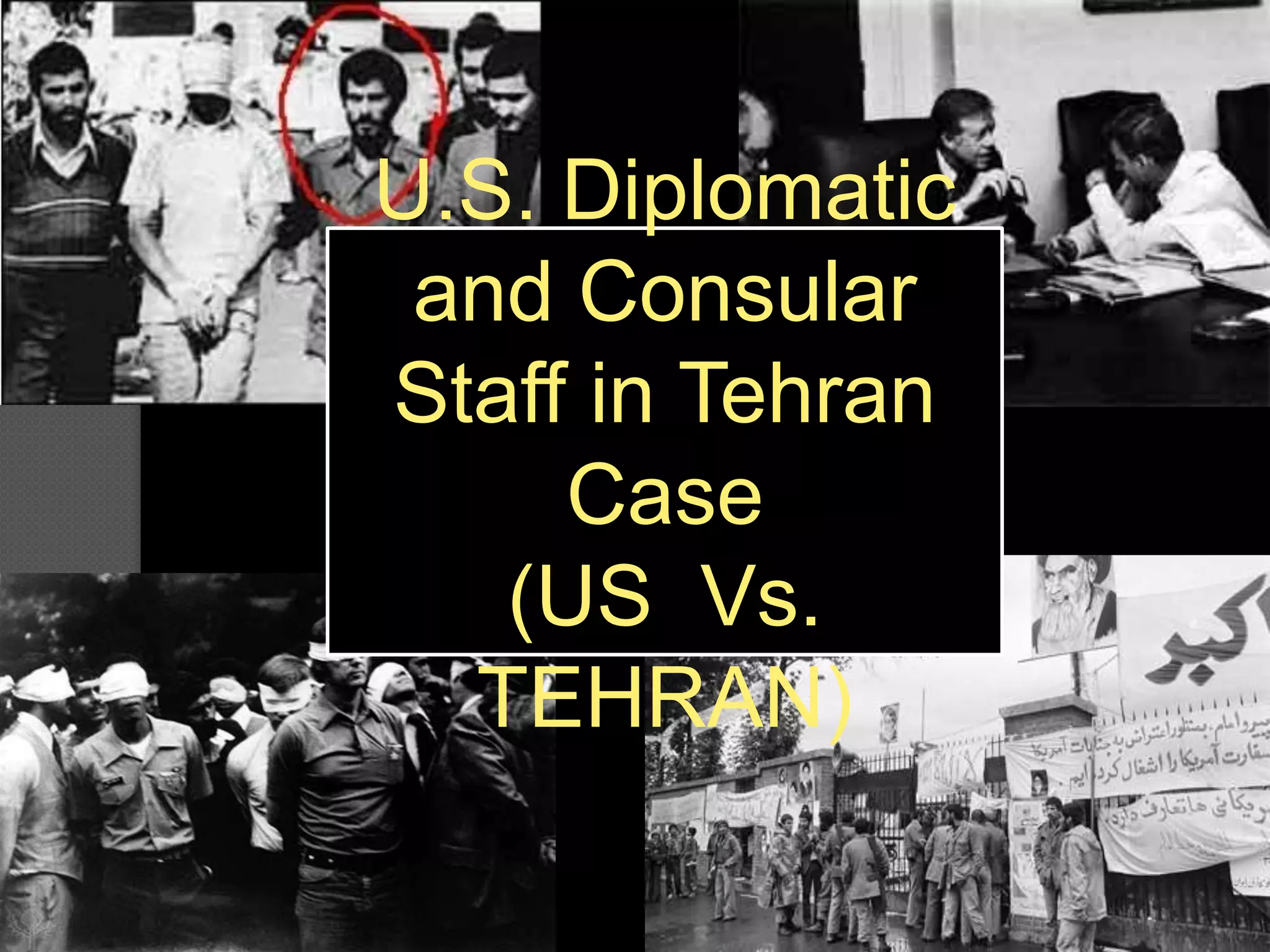
U.S. Diplomatic and
Consular Staff in
Tehran Case
(US Vs. TEHRAN)
INTRODUCTION
 The purpose of diplomatic immunity:
 Ensure effective performance by
diplomatic agent and it will protect the
diplomatic agent’s person and dignity
 Vienna Convention On Diplomatic
Relations (VCDR) - 1961
 The Vienna Convention on Consular
Relations (VCCR) - 1963
U.S. Diplomatic
and Consular
Staff in Tehran
Case
(US Vs.
TEHRAN)
OUTLINE OF CASE
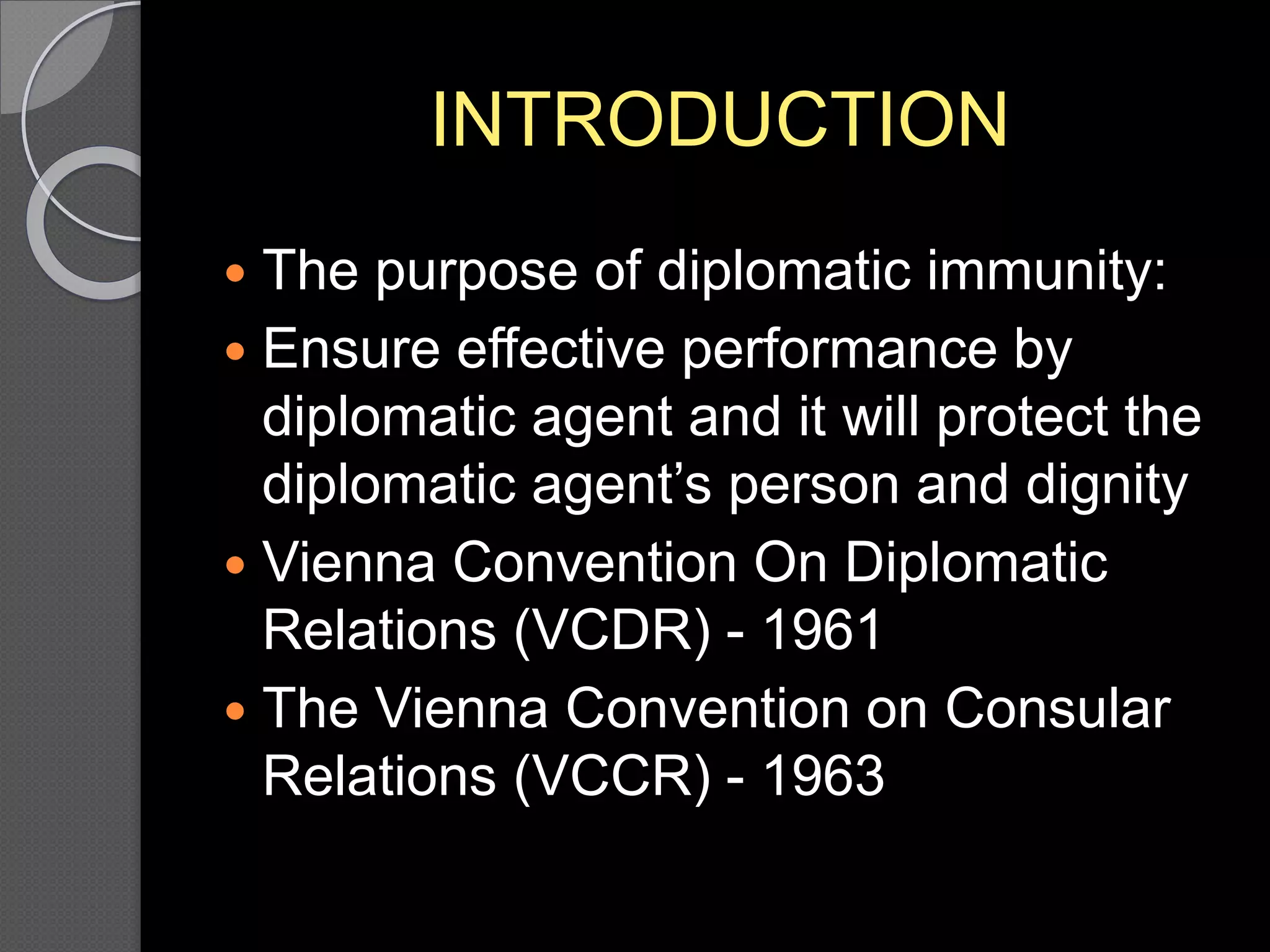
 Hostage : US citizens, diplomatic &
Consular staff
 444 days : 4 November 1979 until 20
January 1981
 Algiers Accord : 19 January 1981
 Was brought to ICJ : dissatisfaction on
the under protection of the embassy
staffs
BACKGROUND OF CASE
 Shah Reza : 1941
 “White Revolution”
 Personalized development
 50,000 Americans stayed & worked in
Iran
 1953: Operation of TPAJAX
 The coup: Mohammad Mossadegh
(1953)
 Shah Reza return to Iran from exile
 Savak (Iran Secret Service)
Parties Involved
 US Embassy seized by Iranian
militants & Tehran University students.
 Seized diplomats, consuls, marine
personnel.
 US request for provisional measures
to preserve the rights of US
government.
US SIDE : Request
 Government of Iran should immediately
release all hostages of US nationals and
facilitate prompt and safe departure from
these person and all other US officers with
dignity and humane.
 Government of Iran should clear all the
premises of US embassy and restore the
control of embassy.
 Government of Iran must ensure the
protection of diplomats, consuls and other
US personnel are provided and full freedom
for them to carry out their functions within
Iran.
 Government of Iran cannot place a
trial to any person that attached with
US embassy and refrain from such
trial that be implementing towards US
personnel.
 Government of Iran must also ensure
no action taken by them in respect to
US rights based on Court decision
which might threaten lives of the
IRAN SIDE:
HUMAN RIGHTS
 The militants and Iran authorities have
asserted that the hostages have been
well treated.
 In additions, they allowed special visits
from religious and International Red
Cross representatives for the
hostages.
COURT PROCEEDING
 The government of Iran filed no pleadings and was
not represented in the oral proceedings.
 However, the position that had been taken by the
Iranian government was firm and defined in a letter
to the Court by its Minister of Foreign Affairs.
 The letter urging the Court no to take notice of the
case and attempted to excuse the events as only:
“a marginal and secondary aspect of an
overall problem [involving] more than 25
years of continual interferences by US in
internal affairs of Iran, the shameless
exploitation of our country…contrary to and
in conflict with all international and
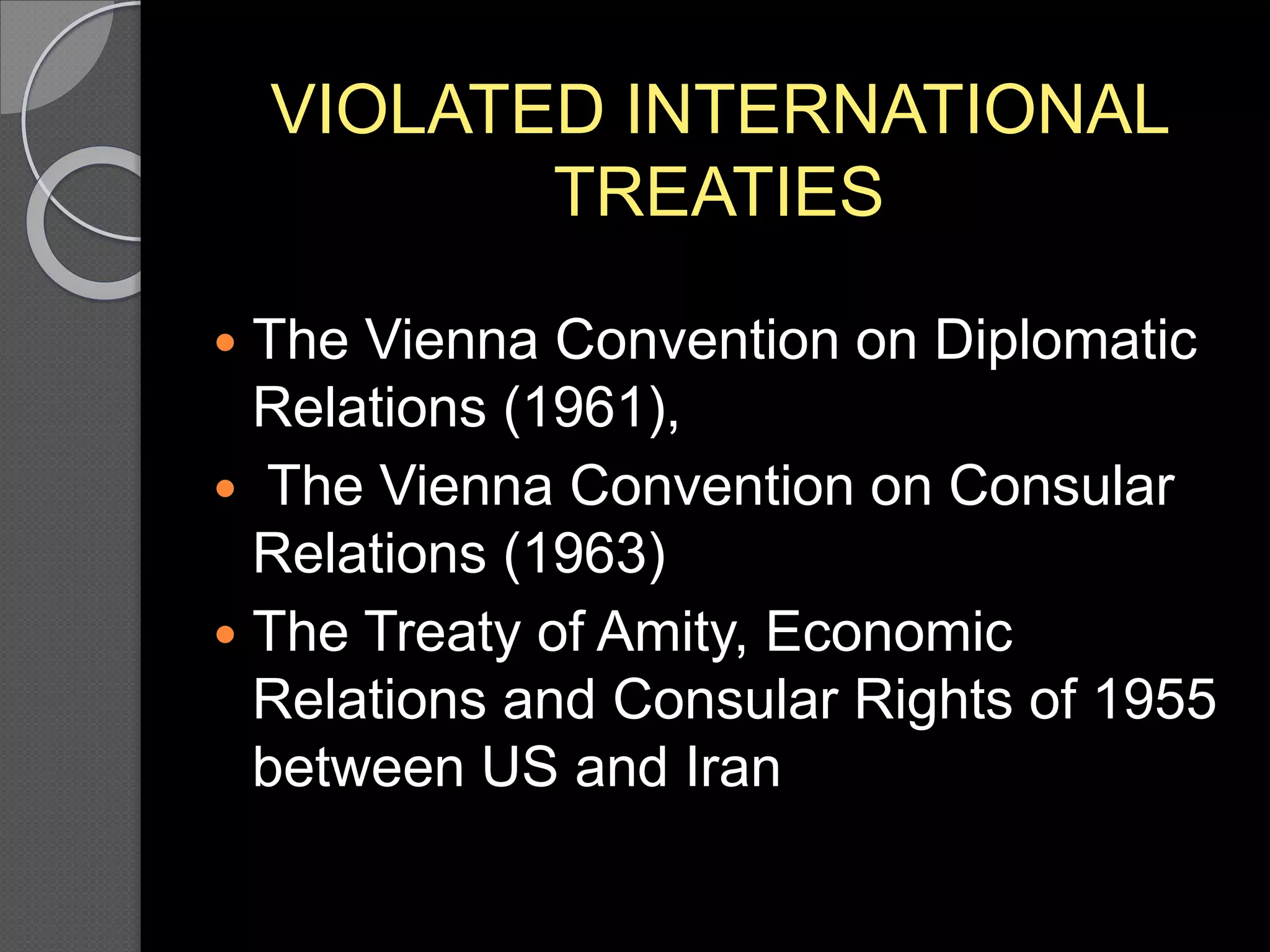
VIOLATED INTERNATIONAL
TREATIES
 The Vienna Convention on Diplomatic
Relations (1961),
 The Vienna Convention on Consular
Relations (1963)
 The Treaty of Amity, Economic
Relations and Consular Rights of 1955
between US and Iran
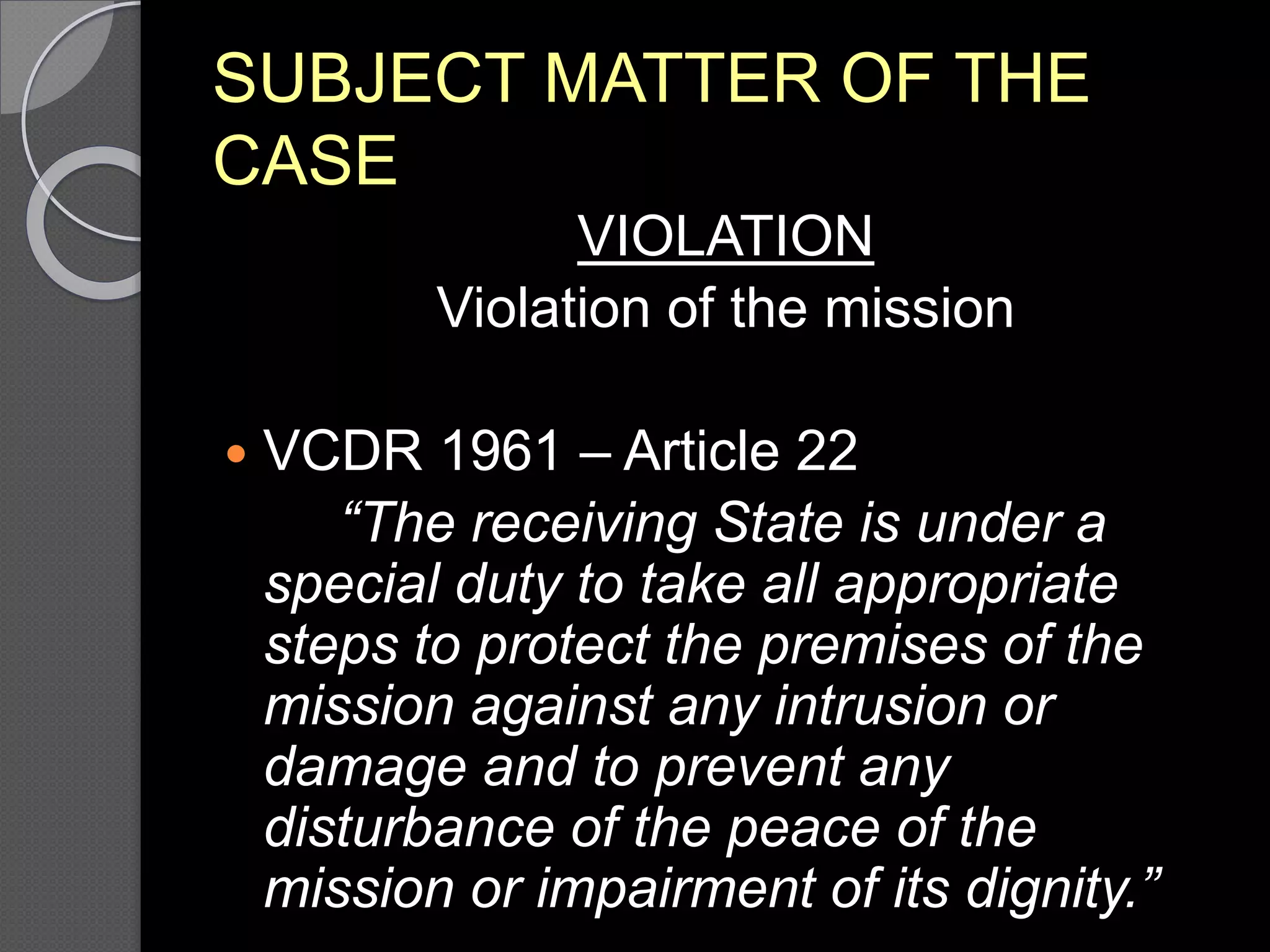
SUBJECT MATTER OF THE
CASE
VIOLATION
Violation of the mission
 VCDR 1961 – Article 22
“The receiving State is under a
special duty to take all appropriate
steps to protect the premises of the
mission against any intrusion or
damage and to prevent any
disturbance of the peace of the
mission or impairment of its dignity.”
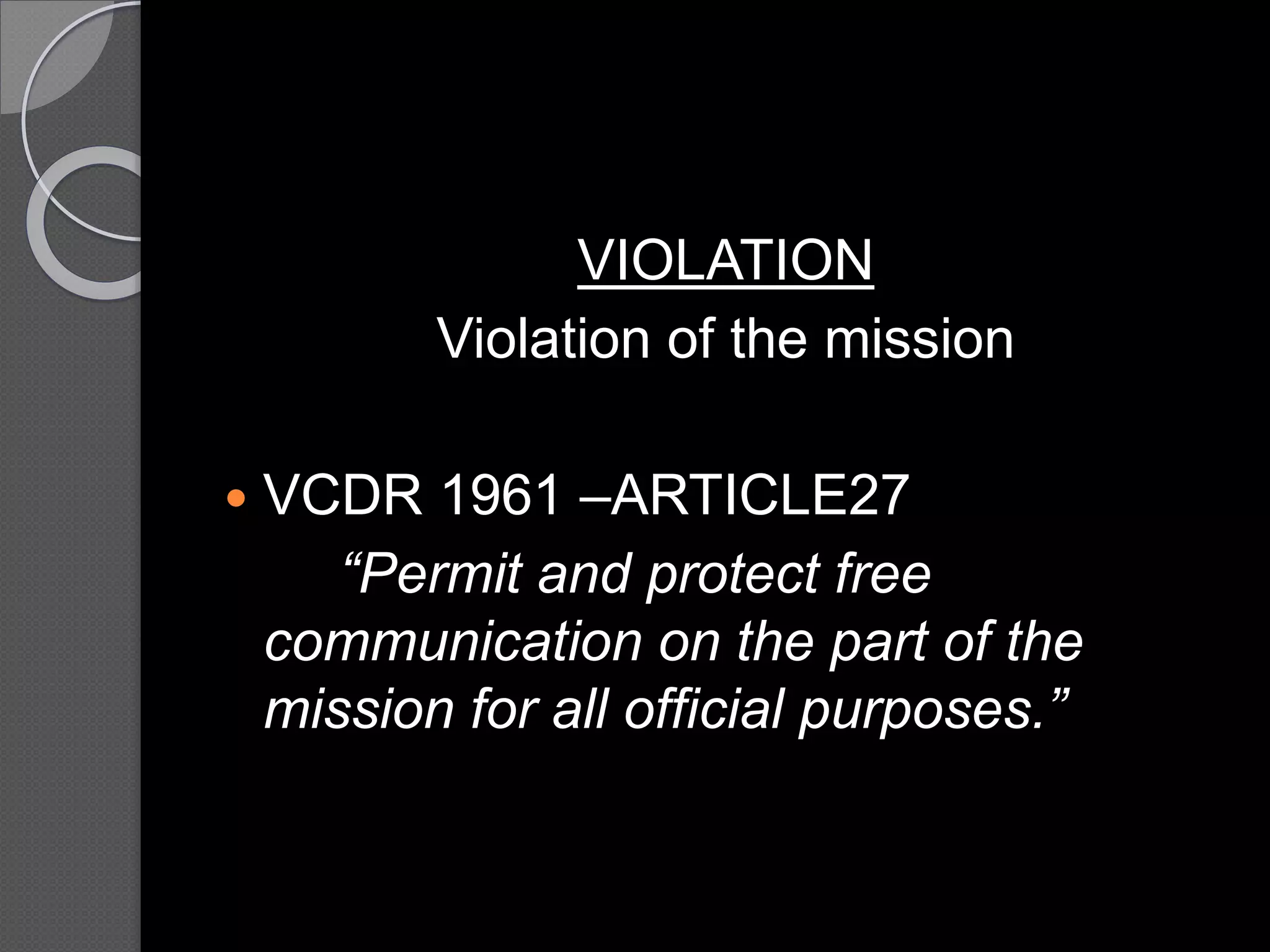
VIOLATION
Violation of the mission
 VCDR 1961 –ARTICLE27
“Permit and protect free
communication on the part of the
mission for all official purposes.”
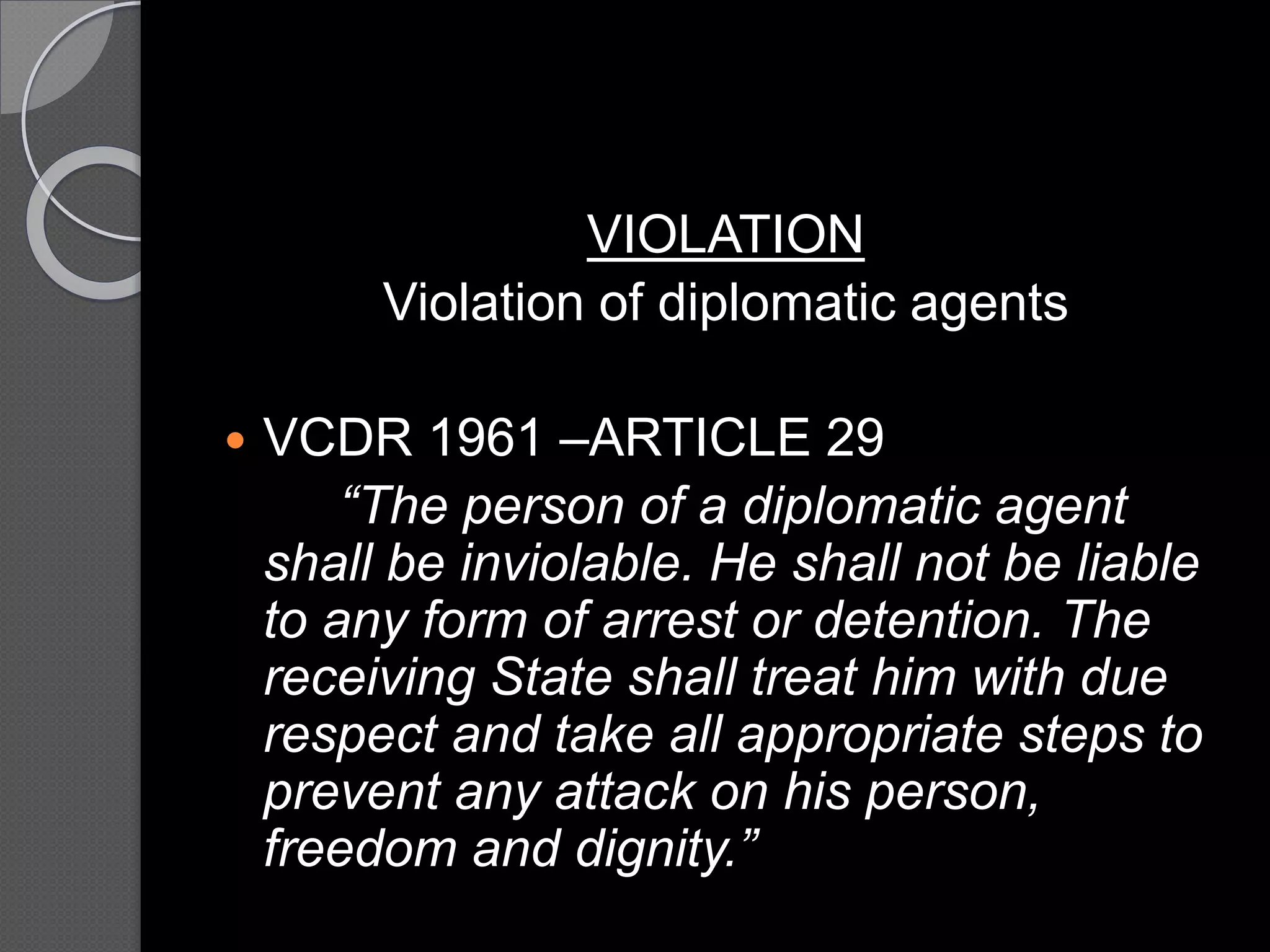
VIOLATION
Violation of diplomatic agents
 VCDR 1961 –ARTICLE 29
“The person of a diplomatic agent
shall be inviolable. He shall not be liable
to any form of arrest or detention. The
receiving State shall treat him with due
respect and take all appropriate steps to
prevent any attack on his person,
freedom and dignity.”
VIOLATION
Vienna Convention of 1961 and 1963
without mention also another facts of:
Treaty of Amity, Economic
Relations and Consular Rights of 1955
Between US and Iran
COURT DECISIONS
COURT DECISION
 On 24 May 1980, the International
Court of Justice was conducted to
justify the dispute settlement for both
sides:
By thirteen votes to two
 Government of Iran has violated in
several aspects of its international
obligations
& the violation of the general rules of
international law.
COURT DECISION
By thirteen votes to two
 The Court of Justice decided that
violation of these obligations engage
the responsibility of Iranian
government towards US under
international law.
COURT DECISION
Unanimously
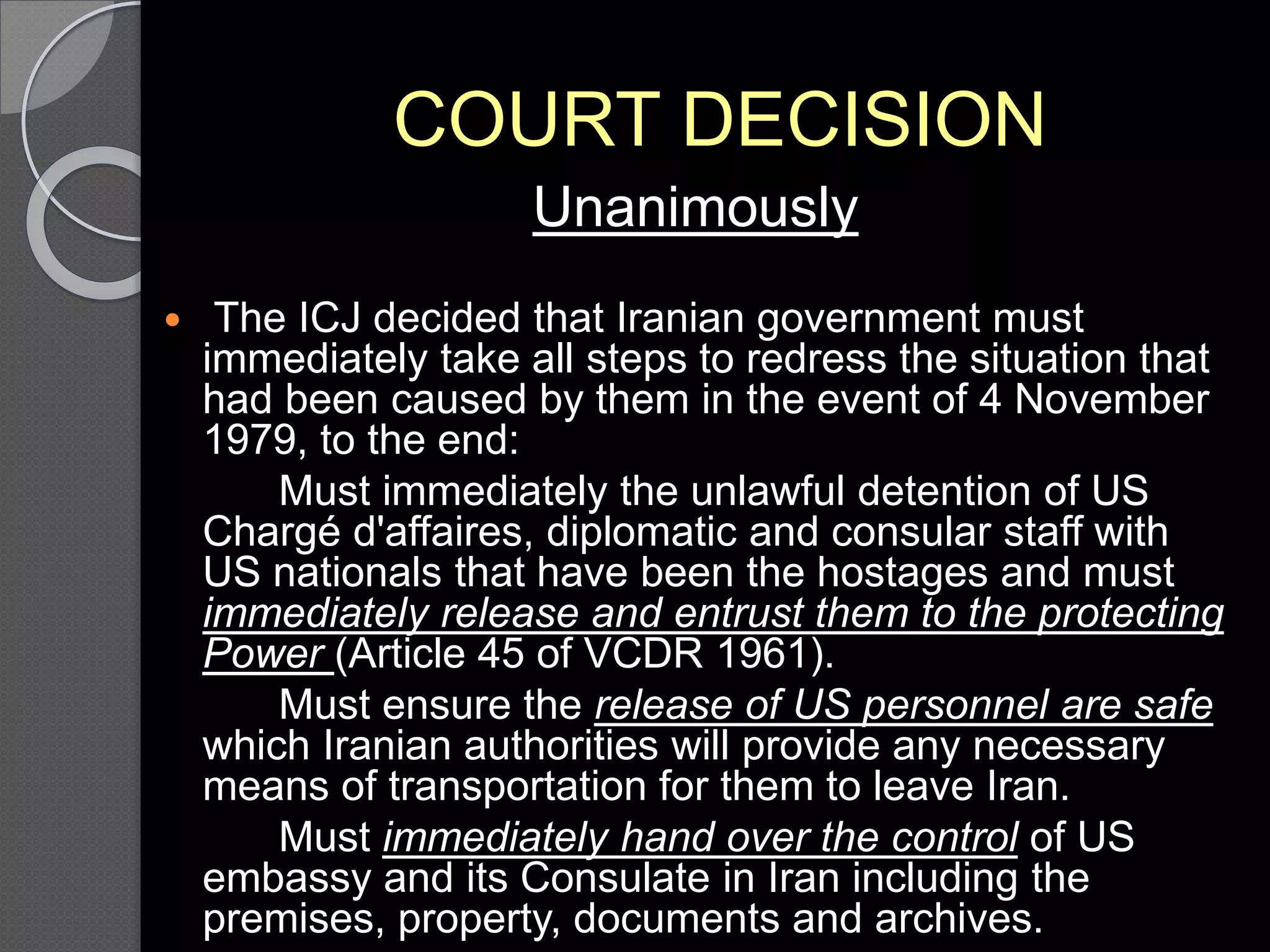
 The ICJ decided that Iranian government must
immediately take all steps to redress the situation that
had been caused by them in the event of 4 November
1979, to the end:
Must immediately the unlawful detention of US
Chargé d'affaires, diplomatic and consular staff with
US nationals that have been the hostages and must
immediately release and entrust them to the protecting
Power (Article 45 of VCDR 1961).
Must ensure the release of US personnel are safe
which Iranian authorities will provide any necessary
means of transportation for them to leave Iran.
Must immediately hand over the control of US
embassy and its Consulate in Iran including the
premises, property, documents and archives.
COURT DECISION
Unanimously
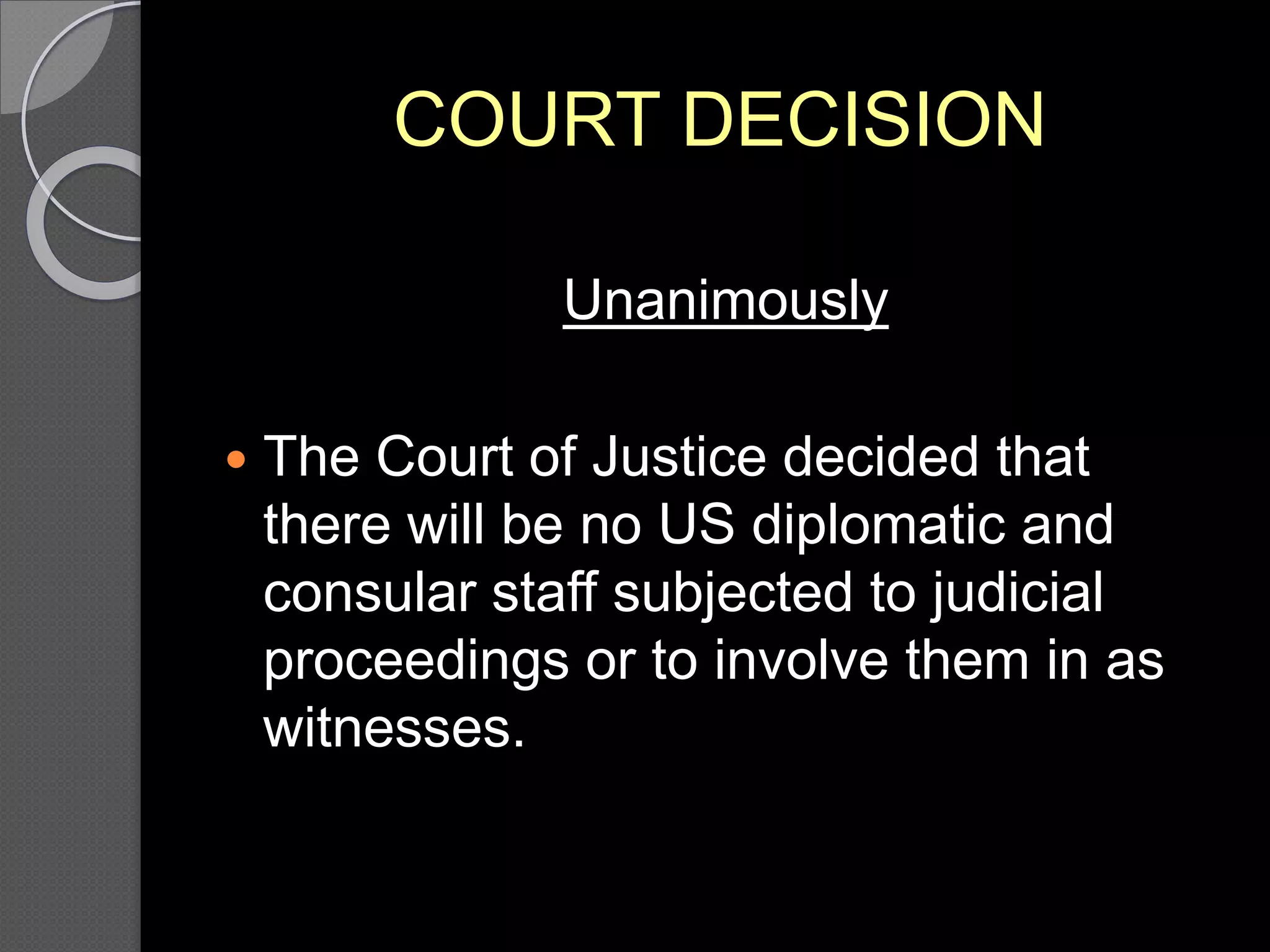
 The Court of Justice decided that
there will be no US diplomatic and
consular staff subjected to judicial
proceedings or to involve them in as
witnesses.
COURT DECISION
By thirteen to three
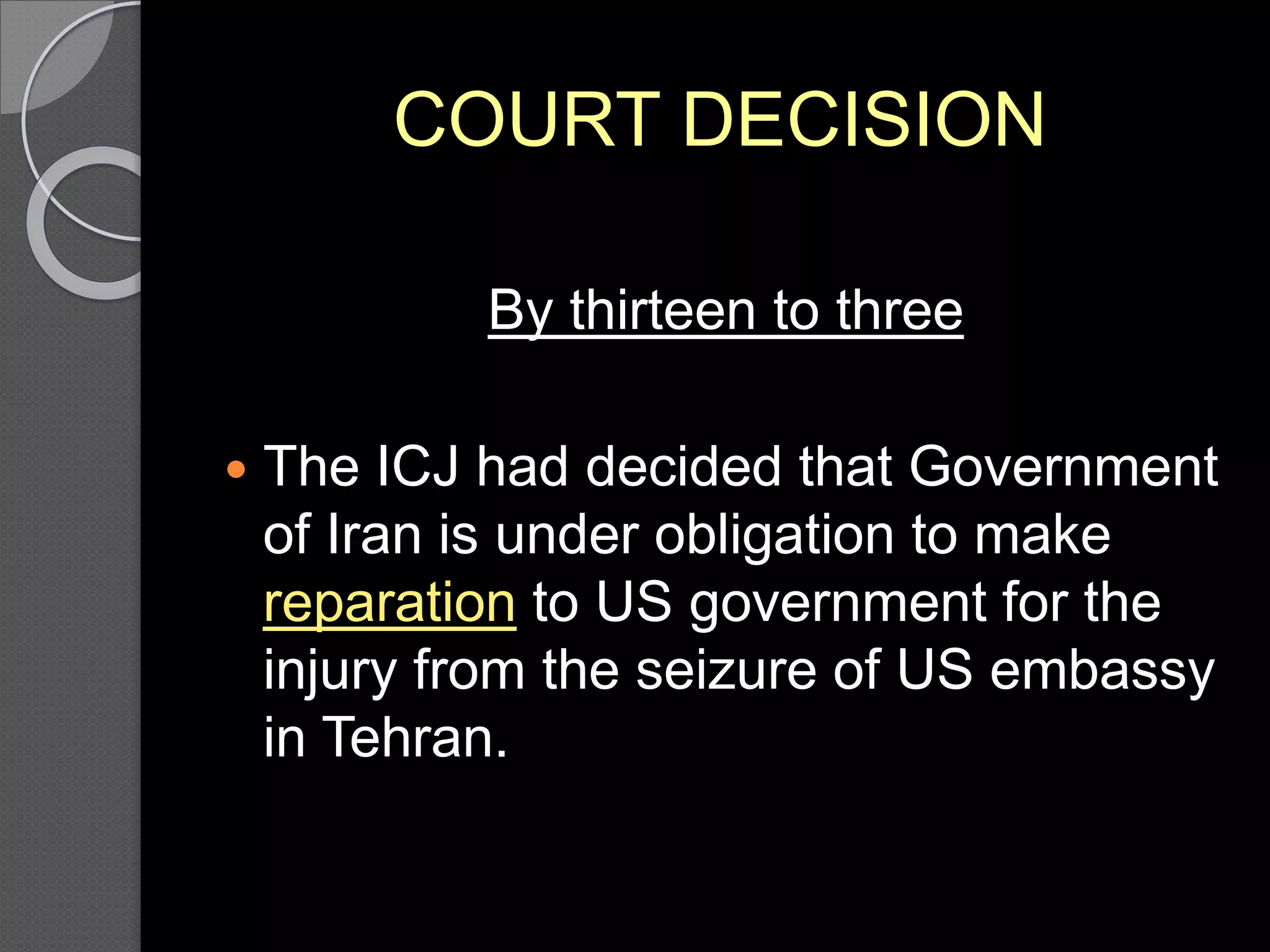
 The ICJ had decided that Government
of Iran is under obligation to make
reparation to US government for the
injury from the seizure of US embassy
in Tehran.
COURT DECISION
By fourteen vote to one
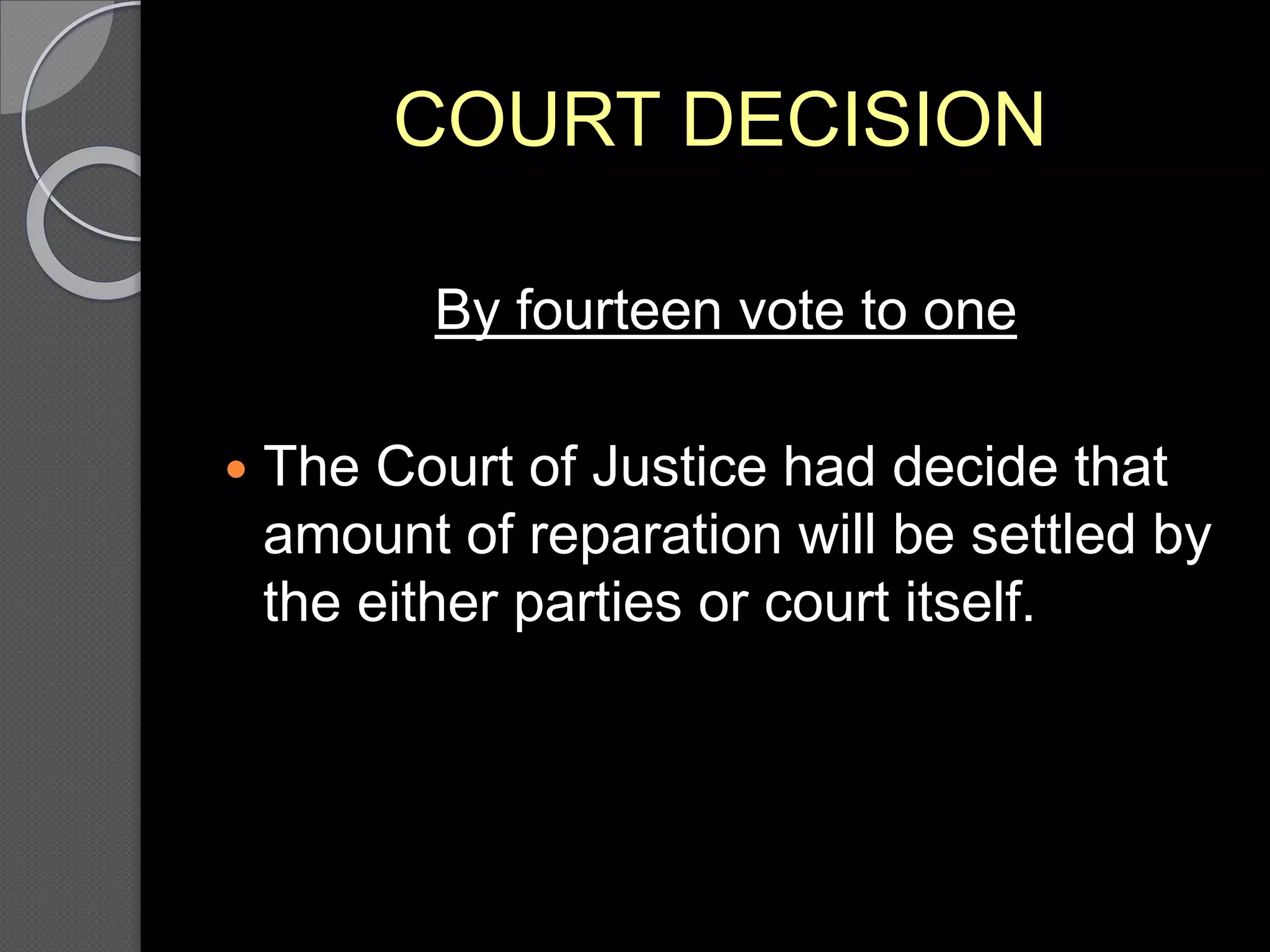
 The Court of Justice had decide that
amount of reparation will be settled by
the either parties or court itself.
CONCLUSION
 The ICJ decided that Iran must
release the hostages, return the
possession of US embassy and its
related documents.
 Iran must make reparations to the US,
the form and amount thereof settled
by the parties or the Court. Iran did not
comply with Court’s judgment
immediately however the matter
solved through negotiation between
US and Iran in Algiers Accord.
 US President Carter had frozen the
asset of Iranian government in US which
estimate more than $13 billion. Hence,
US-Iran Claims Tribunal was established
to set fund from portion of Iran frozen
assets to settle claim of reparations.
 There three separate bank used was
also be set up, two in Bank of England
and the other one is in Central Bank of
Netherlands. Therefore, the US
diplomatic and consular staff in Tehran
case resolved.
There are no formal diplomatic relations between
Iran and the United States.
There is no exchange of ambassadors, Iran
maintains an interests section at the Pakistani
Embassy in Washington DC. while Switzerland
represents the interest of USA in Iran
The Court expresses regret that Iran did not appear
before it to put forward its arguments. The absence of Iran
from the proceedings brought into operation Article 53 of
the Statute, under which the Court is required, before
finding in the Applicant's favor, to satisfy itself that the
allegations of fact on which the claim is based are well
founded.
In that respect the Court observes that it has had available
to it, in the documents presented by the United States, a
massive body of information from various sources,
including numerous official statements of both Iranian and
United States authorities. This information, the Court
notes, is wholly concordant as to the main facts and has
all been communicated to Iran without evoking any denial.
The Court is accordingly satisfied that the allegations of
fact on which the United States based its claim were well
founded.

Resources
http://www.britannica.com/EBchecked/topic/293359/Iran/32184/Rise-of-Reza-Khan
http://www.bloomberg.com/news/2014-03-29/iran-names-1979-u-s-embassy-hostage-taker-its-un-
envoy.html
http://avalon.law.yale.edu/imt/judviol.asp
http://en.wikipedia.org/wiki/Treaty
http://www.parstimes.com/law/iran_us_treaty.html
http://www.icj-cij.org/docket/index.php?p1=3&p2=3&case=64
http://www.icj-cij.org/docket/index.php?sum=334&p1=3&p2=3&case=64&p3=5
www.icj-cij.org/docket/files/64/6293.pdf
http://www.icj-cij.org/docket/index.php?sum=334&p1=3&p2=3&case=64&p3=5
http://www.icj-cij.org/docket/index.php?p1=3&p2=3&case=64&p3=90
http://en.wikipedia.org/wiki/Case_Concerning_United_States_Diplomatic_and_Consular_Staff_in_T
ehran
http://prezi.com/bcfbz0awy-bq/copy-of-the-violation-of-immunity-by-diplomat-in-violation-of-vcdr/
http://legal.un.org/avl/ha/vcdr/vcdr.html
http://books.google.ge/books?id=AhaMjFEzZQ8C&pg=PA28&lpg=PA28&dq=VCDR+violation&so
urce=bl&ots=uW7ii80qmL&sig=S7jSxH0b087W0_st3Q_7MlH_nPY&hl=en&sa=X&ei=mjyDU5a
RCYjGPND8gPgK&redir_esc=y#v=onepage&q=VCDR%20violation&f=false
THANK YOU

Hostages case of iran 1979

  • 2.
    American University ForHumanities Tbilisi Campus Samin VossouighiRad & Adebayo tayo temitope International Relations Law of Diplomacy U.S. Diplomatic and Consular Staff in Tehran Case (US Vs. TEHRAN)
  • 3.
    INTRODUCTION  The purposeof diplomatic immunity:  Ensure effective performance by diplomatic agent and it will protect the diplomatic agent’s person and dignity  Vienna Convention On Diplomatic Relations (VCDR) - 1961  The Vienna Convention on Consular Relations (VCCR) - 1963
  • 4.
    U.S. Diplomatic and Consular Staffin Tehran Case (US Vs. TEHRAN)
  • 5.
    OUTLINE OF CASE Hostage : US citizens, diplomatic & Consular staff  444 days : 4 November 1979 until 20 January 1981  Algiers Accord : 19 January 1981  Was brought to ICJ : dissatisfaction on the under protection of the embassy staffs
  • 6.
    BACKGROUND OF CASE Shah Reza : 1941  “White Revolution”  Personalized development  50,000 Americans stayed & worked in Iran  1953: Operation of TPAJAX  The coup: Mohammad Mossadegh (1953)  Shah Reza return to Iran from exile  Savak (Iran Secret Service)
  • 7.
    Parties Involved  USEmbassy seized by Iranian militants & Tehran University students.  Seized diplomats, consuls, marine personnel.  US request for provisional measures to preserve the rights of US government.
  • 8.
    US SIDE :Request  Government of Iran should immediately release all hostages of US nationals and facilitate prompt and safe departure from these person and all other US officers with dignity and humane.  Government of Iran should clear all the premises of US embassy and restore the control of embassy.  Government of Iran must ensure the protection of diplomats, consuls and other US personnel are provided and full freedom for them to carry out their functions within Iran.
  • 9.
     Government ofIran cannot place a trial to any person that attached with US embassy and refrain from such trial that be implementing towards US personnel.  Government of Iran must also ensure no action taken by them in respect to US rights based on Court decision which might threaten lives of the
  • 10.
    IRAN SIDE: HUMAN RIGHTS The militants and Iran authorities have asserted that the hostages have been well treated.  In additions, they allowed special visits from religious and International Red Cross representatives for the hostages.
  • 11.
    COURT PROCEEDING  Thegovernment of Iran filed no pleadings and was not represented in the oral proceedings.  However, the position that had been taken by the Iranian government was firm and defined in a letter to the Court by its Minister of Foreign Affairs.  The letter urging the Court no to take notice of the case and attempted to excuse the events as only: “a marginal and secondary aspect of an overall problem [involving] more than 25 years of continual interferences by US in internal affairs of Iran, the shameless exploitation of our country…contrary to and in conflict with all international and
  • 12.
    VIOLATED INTERNATIONAL TREATIES  TheVienna Convention on Diplomatic Relations (1961),  The Vienna Convention on Consular Relations (1963)  The Treaty of Amity, Economic Relations and Consular Rights of 1955 between US and Iran
  • 13.
    SUBJECT MATTER OFTHE CASE VIOLATION Violation of the mission  VCDR 1961 – Article 22 “The receiving State is under a special duty to take all appropriate steps to protect the premises of the mission against any intrusion or damage and to prevent any disturbance of the peace of the mission or impairment of its dignity.”
  • 14.
    VIOLATION Violation of themission  VCDR 1961 –ARTICLE27 “Permit and protect free communication on the part of the mission for all official purposes.”
  • 15.
    VIOLATION Violation of diplomaticagents  VCDR 1961 –ARTICLE 29 “The person of a diplomatic agent shall be inviolable. He shall not be liable to any form of arrest or detention. The receiving State shall treat him with due respect and take all appropriate steps to prevent any attack on his person, freedom and dignity.”
  • 16.
    VIOLATION Vienna Convention of1961 and 1963 without mention also another facts of: Treaty of Amity, Economic Relations and Consular Rights of 1955 Between US and Iran
  • 17.
  • 18.
    COURT DECISION  On24 May 1980, the International Court of Justice was conducted to justify the dispute settlement for both sides: By thirteen votes to two  Government of Iran has violated in several aspects of its international obligations & the violation of the general rules of international law.
  • 19.
    COURT DECISION By thirteenvotes to two  The Court of Justice decided that violation of these obligations engage the responsibility of Iranian government towards US under international law.
  • 20.
    COURT DECISION Unanimously  TheICJ decided that Iranian government must immediately take all steps to redress the situation that had been caused by them in the event of 4 November 1979, to the end: Must immediately the unlawful detention of US Chargé d'affaires, diplomatic and consular staff with US nationals that have been the hostages and must immediately release and entrust them to the protecting Power (Article 45 of VCDR 1961). Must ensure the release of US personnel are safe which Iranian authorities will provide any necessary means of transportation for them to leave Iran. Must immediately hand over the control of US embassy and its Consulate in Iran including the premises, property, documents and archives.
  • 21.
    COURT DECISION Unanimously  TheCourt of Justice decided that there will be no US diplomatic and consular staff subjected to judicial proceedings or to involve them in as witnesses.
  • 22.
    COURT DECISION By thirteento three  The ICJ had decided that Government of Iran is under obligation to make reparation to US government for the injury from the seizure of US embassy in Tehran.
  • 23.
    COURT DECISION By fourteenvote to one  The Court of Justice had decide that amount of reparation will be settled by the either parties or court itself.
  • 24.
    CONCLUSION  The ICJdecided that Iran must release the hostages, return the possession of US embassy and its related documents.  Iran must make reparations to the US, the form and amount thereof settled by the parties or the Court. Iran did not comply with Court’s judgment immediately however the matter solved through negotiation between US and Iran in Algiers Accord.
  • 25.
     US PresidentCarter had frozen the asset of Iranian government in US which estimate more than $13 billion. Hence, US-Iran Claims Tribunal was established to set fund from portion of Iran frozen assets to settle claim of reparations.  There three separate bank used was also be set up, two in Bank of England and the other one is in Central Bank of Netherlands. Therefore, the US diplomatic and consular staff in Tehran case resolved.
  • 26.
    There are noformal diplomatic relations between Iran and the United States. There is no exchange of ambassadors, Iran maintains an interests section at the Pakistani Embassy in Washington DC. while Switzerland represents the interest of USA in Iran
  • 27.
    The Court expressesregret that Iran did not appear before it to put forward its arguments. The absence of Iran from the proceedings brought into operation Article 53 of the Statute, under which the Court is required, before finding in the Applicant's favor, to satisfy itself that the allegations of fact on which the claim is based are well founded. In that respect the Court observes that it has had available to it, in the documents presented by the United States, a massive body of information from various sources, including numerous official statements of both Iranian and United States authorities. This information, the Court notes, is wholly concordant as to the main facts and has all been communicated to Iran without evoking any denial. The Court is accordingly satisfied that the allegations of fact on which the United States based its claim were well founded. 
  • 28.
    Resources http://www.britannica.com/EBchecked/topic/293359/Iran/32184/Rise-of-Reza-Khan http://www.bloomberg.com/news/2014-03-29/iran-names-1979-u-s-embassy-hostage-taker-its-un- envoy.html http://avalon.law.yale.edu/imt/judviol.asp http://en.wikipedia.org/wiki/Treaty http://www.parstimes.com/law/iran_us_treaty.html http://www.icj-cij.org/docket/index.php?p1=3&p2=3&case=64 http://www.icj-cij.org/docket/index.php?sum=334&p1=3&p2=3&case=64&p3=5 www.icj-cij.org/docket/files/64/6293.pdf http://www.icj-cij.org/docket/index.php?sum=334&p1=3&p2=3&case=64&p3=5 http://www.icj-cij.org/docket/index.php?p1=3&p2=3&case=64&p3=90 http://en.wikipedia.org/wiki/Case_Concerning_United_States_Diplomatic_and_Consular_Staff_in_T ehran http://prezi.com/bcfbz0awy-bq/copy-of-the-violation-of-immunity-by-diplomat-in-violation-of-vcdr/ http://legal.un.org/avl/ha/vcdr/vcdr.html http://books.google.ge/books?id=AhaMjFEzZQ8C&pg=PA28&lpg=PA28&dq=VCDR+violation&so urce=bl&ots=uW7ii80qmL&sig=S7jSxH0b087W0_st3Q_7MlH_nPY&hl=en&sa=X&ei=mjyDU5a RCYjGPND8gPgK&redir_esc=y#v=onepage&q=VCDR%20violation&f=false
  • 29.