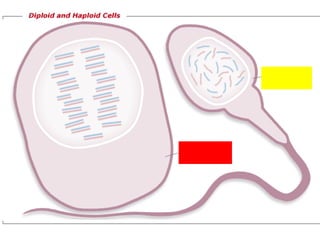
#1 #2 #3  What is happening here?  These are called ______ _________ #4 #5 Diploid or Haploid ? #6 Diploid or Haploid?
Completely Random!!!!!!
Genes – determine the characteristics of an organism. Alleles – alternate forms of genes Ex. Gene = seed color Green or Yellow    Alleles *Remember* Only  1  allele for  each  trait is passed on to the offspring from each parent!
 
The Terms… Genotype – genetic make-up of an individual Ex. T T =  genotype (letter combination) Each letter is inherited from different parents. Dad  Mom T  T
 
Genotype Possibilities Homo zygous (purebred)  An organism with genes that are  alike .  Ex.   BB  or  bb Hetero zygous (hybrid)  An organism with genes that are  different Ex.   B b
DOMINANT TRAITS!!! Homozygous  Dominant  Genotype -Both alleles are the same.  -Both are  capital  letters. Ex.  TT Heterozygous Genotype - Different  alleles. Ex.  T t
Recessive Traits  recessive genotype Both alleles are the same Both represented by  lower case  letters Example =  tt **For an organism to show a recessive phenotype, the genotype must be homozygous recessive. Example:  tt = short
Mendel’s 1 st  Law Law of Segregation Hereditary characteristics are determined by factors called genes. For each characteristic, an offspring gets 2 genes, one from each parent. The 2 genes of each pair segregate from each other and end up in separate gametes.
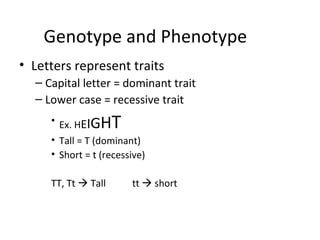
Genotype and Phenotype Letters represent traits Capital letter = dominant trait Lower case = recessive trait Ex. H E I G H T Tall = T (dominant) Short = t (recessive) TT, Tt    Tall  tt    short
Gene Expression Phenotype Expression of an individual’s genes…what it  looks like . Ex. Tall = phenotype (physical appearance)
Ww 2 wings
 
Solving Genetics Problems If you know the genotype of the parents, it is possible to predict the likelihood of an offspring inheriting a particular phenotype. - Probability – the chance that a given event will occur - Punnett Square – named for R.C. Punnett, British biologist and mathematician - Probability is shown through monohybrid crosses – genetic cross involving only 1 trait of the parents.
Examples Homo zygous  tall  plant (TT) with  homo zygous  short  plant (tt). 100% Tt 100% Tall heterozygous tall
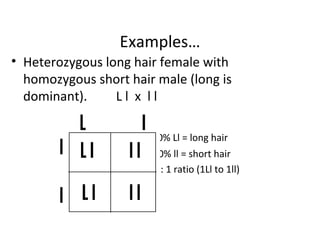
Examples… Heterozygous long hair female with homozygous short hair male (long is dominant).  L l  x  l l 50% Ll = long hair 50% ll = short hair 1 : 1 ratio (1Ll to 1ll)

Genetics

  • 1.
  • 2.
  • 3.
    #1 #2 #3 What is happening here? These are called ______ _________ #4 #5 Diploid or Haploid ? #6 Diploid or Haploid?
  • 4.
  • 5.
    Genes – determinethe characteristics of an organism. Alleles – alternate forms of genes Ex. Gene = seed color Green or Yellow  Alleles *Remember* Only 1 allele for each trait is passed on to the offspring from each parent!
  • 6.
  • 7.
    The Terms… Genotype– genetic make-up of an individual Ex. T T = genotype (letter combination) Each letter is inherited from different parents. Dad Mom T T
  • 8.
  • 9.
    Genotype Possibilities Homozygous (purebred) An organism with genes that are alike . Ex. BB or bb Hetero zygous (hybrid) An organism with genes that are different Ex. B b
  • 10.
    DOMINANT TRAITS!!! Homozygous Dominant Genotype -Both alleles are the same. -Both are capital letters. Ex. TT Heterozygous Genotype - Different alleles. Ex. T t
  • 11.
    Recessive Traits recessive genotype Both alleles are the same Both represented by lower case letters Example = tt **For an organism to show a recessive phenotype, the genotype must be homozygous recessive. Example: tt = short
  • 12.
    Mendel’s 1 st Law Law of Segregation Hereditary characteristics are determined by factors called genes. For each characteristic, an offspring gets 2 genes, one from each parent. The 2 genes of each pair segregate from each other and end up in separate gametes.
  • 13.
    Genotype and PhenotypeLetters represent traits Capital letter = dominant trait Lower case = recessive trait Ex. H E I G H T Tall = T (dominant) Short = t (recessive) TT, Tt  Tall tt  short
  • 14.
    Gene Expression PhenotypeExpression of an individual’s genes…what it looks like . Ex. Tall = phenotype (physical appearance)
  • 15.
  • 16.
  • 17.
    Solving Genetics ProblemsIf you know the genotype of the parents, it is possible to predict the likelihood of an offspring inheriting a particular phenotype. - Probability – the chance that a given event will occur - Punnett Square – named for R.C. Punnett, British biologist and mathematician - Probability is shown through monohybrid crosses – genetic cross involving only 1 trait of the parents.
  • 18.
    Examples Homo zygous tall plant (TT) with homo zygous short plant (tt). 100% Tt 100% Tall heterozygous tall
  • 19.
    Examples… Heterozygous longhair female with homozygous short hair male (long is dominant). L l x l l 50% Ll = long hair 50% ll = short hair 1 : 1 ratio (1Ll to 1ll)