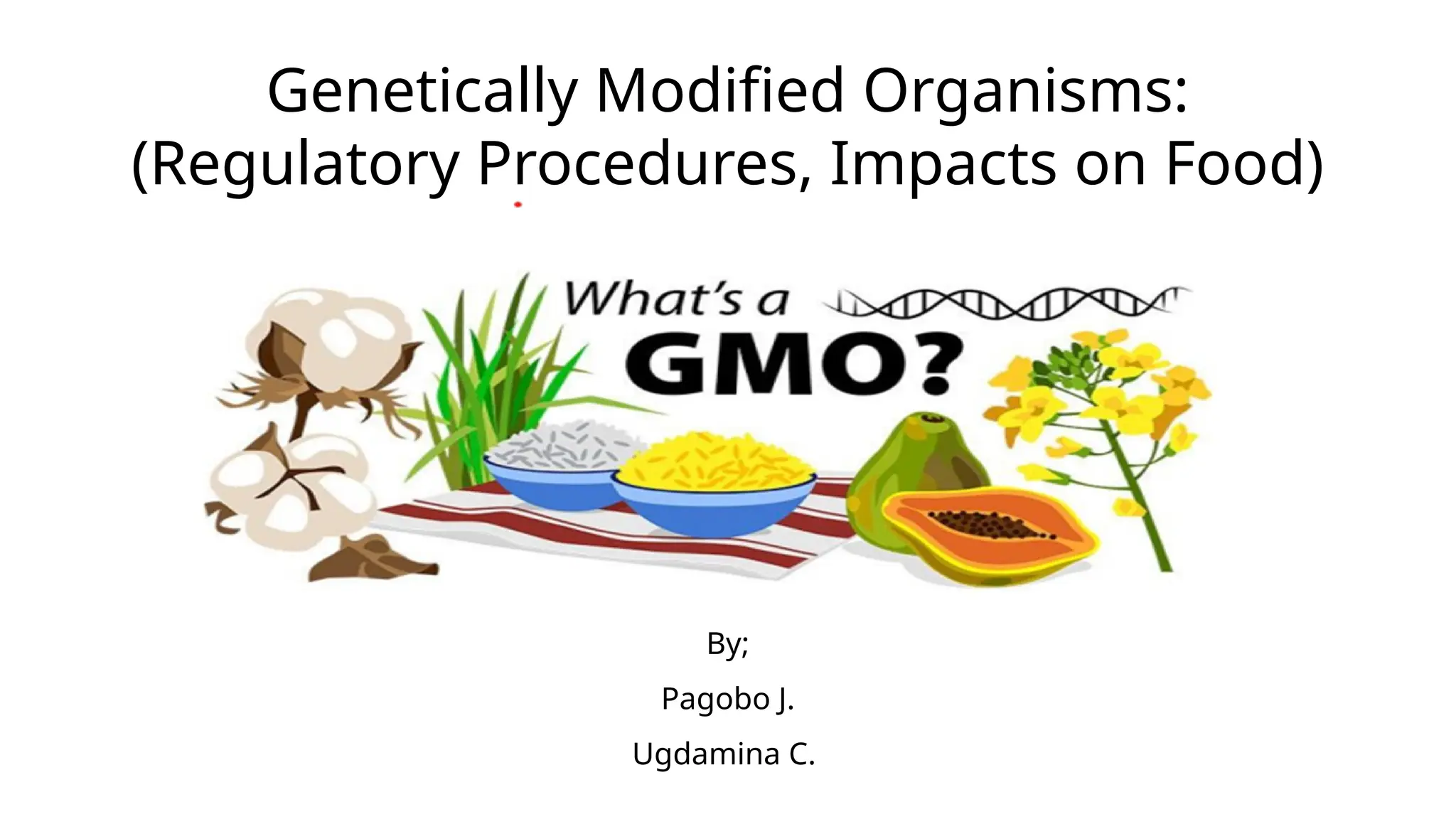
Genetically Modified Organisms:
(Regulatory Procedures, Impacts on Food)
By;
Pagobo J.
Ugdamina C.
Objectives:
 Identify what is Genetically Modified
Organisms;
 Enhance knowledge about the regulatory
processes and procedure of GM0;
 Describe the impacts of GMO to food
quality and quantity
Pre-Test
What is GMO? 5pts
Give the Acronym of the following:
GMO -
DNA -
FDA -
EPA -
USDA-
GMO
 A genetically modified organism is an animal, plant,
or microbe that contains DNA that has been altered
using genetic engineering. Genetically modified
animals are mainly used for research purposes, while
genetically modified plants are common in today’s
food supply.
 Including the transfer of specific DNA from one
organism to another
An example of a genetically modified organism
Most GMO plants are used to make ingredients that
are then used in other food products, for example,
cornstarch made from GMO corn or sugar made from
GMO sugar beets. Corn: While a lot of GMO corn goes
into processed foods and drinks, most of it is used to
feed livestock, like cows, and poultry, like chickens.
The first genetically engineered plants to be produced
for human consumption were introduced in the mid-
1990s. Today, approximately 90 percent of the corn,
soybeans, and sugar beets on the market are GMOs.
The purpose of genetically modified organisms
 Genetically modified crops (GM crops) are those engineered to
introduce a new trait into the species. Purposes of GM crops
generally include resistance to certain pests, diseases, or
environmental conditions, or resistance to chemical treatments
(e.g. resistance to a herbicide).
 Genetically engineered crops produce higher yields, have a longer
shelf life, are resistant to diseases and pests, and even taste better.
These benefits are a plus for both farmers and consumers.
For example, higher yields and longer shelf life may lead to lower
prices for consumers, and pest-resistant crops means that farmers
don’t need to buy and use as many pesticides to grow quality crops.
The Story on GMOs
GMO stands for Genetically Modified Organism. Let’s break
it down word by word. Genetically refers to genes. Genes
are made up of DNA, which is a set of instructions for how
cells grow and develop. Second is modified. This implies
that some change or tweak has been made. Lastly, we have
the word Organism. When it comes to GMOs, many people
only think of crops. Yet an ‘organism’ isn’t just a plant; it
refers to all living things, including bacteria and fungi.
The Many Uses of GMOs
When farmers plant their crops they generally worry about
three things that could prevent a good yield: insects, weeds
and weather. When it comes to insects, there are genetically
modified plants that can repel only the very particular type of
insect that feeds on it. With some crops, this has significantly
lowered the need to apply pesticides. Other GM plants have
been developed to be resistant to certain herbicides thus
making weed control more straightforward and less
expensive.
 Today, those who directly see the most benefits from
GMOs are farmers and agricultural companies.
 Plants aren’t the only type of GMO that we use.
GMOs are also used to produce many medicines and
vaccines that help treat or prevent diseases.
The Regulatory Process
Food regulation is far more complex and detailed than most
people imagine. This encompasses the production process
(how it is grown or made), trade (where your food comes from
and how it gets to where it’s going), quality (ensuring that your
food is unadulterated), labeling and more.
Food regulation exists to make sure that the food we eat is
safe and of an adequate quality.
Labeling is only a small part of food regulation but it gets a lot
of attention because it’s how people can judge what’s in their
food and make decisions about what they want to eat.
Labels provide the identity of the food, the amount in the
package, cooking instructions, serving size, safety concerns
(like allergens) and nutritional facts.
GMOs: Government Regulation and Your Safety
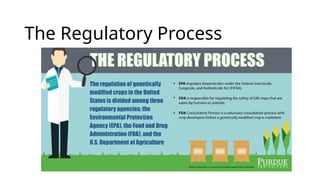
Three federal agencies within the U.S. government work
together to regulate most GMOs
U.S. Food and Drug Administration (FDA)
U.S. Environmental Protection Agency (EPA) and;
U.S. Department of Agriculture (USDA)
 Ensure that GMOs are safe for human, plant, and animal
health.
 These agencies also monitor the impact of GMOs on the
environment.
U.S. Food and Drug Administration
The FDA is responsible for ensuring the safety and proper
labeling of all plant-derived food and feed, including those
developed through genetic engineering. All food and feed,
whether imported or domestic and whether derived from
crops modified by conventional breeding techniques or by
genetic engineering techniques, must meet the same
rigorous safety standards. Under the Federal Food, Drug,
and Cosmetic Act, it is the responsibility of food and feed
manufacturers to ensure that the products they market are
safe and properly labeled. In addition, any food additive,
including one introduced into food or feed by way of plant
breeding, must receive FDA approval before marketing.
U.S. Environmental Protection Agency
EPA is responsible for protecting human health
and the environment, which includes regulating
pesticides. EPA regulates the safety of the substances
that protect GMO plants, referred to as plant-
incorporated protectants (PIPs), that are in some
GMO plants to make them resistant to insects and
disease. EPA also monitors all other types of
pesticides that are used on crops, including on GMO
and non-GMO crops.
 The EPA through a registration process regulates the sale,
distribution and use of pesticides in order to protect health,
and the environment, regardless of how the pesticide was
made or its mode of action. This includes regulation of those
pesticides that are produced by an organism through
techniques of modern biotechnology. The Biopesticides and
Pollution Prevention Division of the Office of Pesticide
Programs, under the Federal Insecticide, Fungicide and
Rodenticide Act (FIFRA), regulates the distribution, sale, use
and testing of pesticidal substances produced in plants and
microbes.
U.S. Department of Agriculture
The USDA Animal and Plant Health Inspection
Service (APHIS) protects agriculture in the United
States against pests and disease. APHIS sets
regulations to make sure GMO plants are not harmful
to other plants, and USDA’s Biotechnology Regulatory
Services implements these regulations.
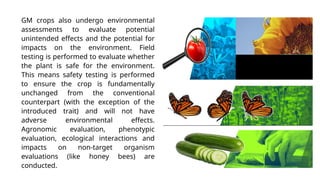
GM crops also undergo environmental
assessments to evaluate potential
unintended effects and the potential for
impacts on the environment. Field
testing is performed to evaluate whether
the plant is safe for the environment.
This means safety testing is performed
to ensure the crop is fundamentally
unchanged from the conventional
counterpart (with the exception of the
introduced trait) and will not have
adverse environmental effects.
Agronomic evaluation, phenotypic
evaluation, ecological interactions and
impacts on non-target organism
evaluations (like honey bees) are
conducted.
GMO’s Impacts on Food
Engineers design plants using genetically modified
organisms (GMOs) to improve taste, and nutritional content.
Most of the currently available GMO foods are plants,
such as fruit and vegetables.
GMO foods are likely to become a crucial tool in feeding
the world’s growing population, especially in areas with
harsh climates. However, there have been concerns about
possible risks.
Now we discuss the advantages and
disadvantages of GMO crops, including their potential
effects on human health and the environment.
Advantages
Increased attractiveness to consumers, for
example, apples and potatoes that are less
likely to bruise or turn brown.
 Enhanced flavor
 Longer shelf life.
 Greater resistance to viruses and other diseases, which
could lead to less waste and increased food security.
 Greater tolerance to herbicides, making it easier for
farmers to control weeds.
 Increased nutritional value which can boost the health
of people.
 Greater resistance to insects, allowing farmers to
reduce pesticide use.
 Ability to thrive in a harsh climate, such as drought
or heat
 Ability to grow in salty soil.
 Growing plants that are more resistant to diseases
spread by insects or viruses will likely result in higher
yields for farmers.
Disadvantages of GM Foods to Humans
 Allergic reaction.
 Production of toxins
 Reduced nutritional value.
 Release of toxins to soil.
 Resistance of pests to toxins.
 Disruption of biodiversity.
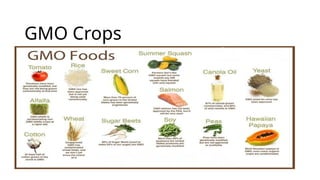
GMO Crops
End
of
Presentation
Thank
you..

genetically modified organism: regulatory procedures.pptx

  • 1.
    Genetically Modified Organisms: (RegulatoryProcedures, Impacts on Food) By; Pagobo J. Ugdamina C.
  • 2.
    Objectives:  Identify whatis Genetically Modified Organisms;  Enhance knowledge about the regulatory processes and procedure of GM0;  Describe the impacts of GMO to food quality and quantity
  • 3.
    Pre-Test What is GMO?5pts Give the Acronym of the following: GMO - DNA - FDA - EPA - USDA-
  • 4.
    GMO  A geneticallymodified organism is an animal, plant, or microbe that contains DNA that has been altered using genetic engineering. Genetically modified animals are mainly used for research purposes, while genetically modified plants are common in today’s food supply.  Including the transfer of specific DNA from one organism to another
  • 5.
    An example ofa genetically modified organism Most GMO plants are used to make ingredients that are then used in other food products, for example, cornstarch made from GMO corn or sugar made from GMO sugar beets. Corn: While a lot of GMO corn goes into processed foods and drinks, most of it is used to feed livestock, like cows, and poultry, like chickens. The first genetically engineered plants to be produced for human consumption were introduced in the mid- 1990s. Today, approximately 90 percent of the corn, soybeans, and sugar beets on the market are GMOs.
  • 6.
    The purpose ofgenetically modified organisms  Genetically modified crops (GM crops) are those engineered to introduce a new trait into the species. Purposes of GM crops generally include resistance to certain pests, diseases, or environmental conditions, or resistance to chemical treatments (e.g. resistance to a herbicide).  Genetically engineered crops produce higher yields, have a longer shelf life, are resistant to diseases and pests, and even taste better. These benefits are a plus for both farmers and consumers. For example, higher yields and longer shelf life may lead to lower prices for consumers, and pest-resistant crops means that farmers don’t need to buy and use as many pesticides to grow quality crops.
  • 7.
    The Story onGMOs GMO stands for Genetically Modified Organism. Let’s break it down word by word. Genetically refers to genes. Genes are made up of DNA, which is a set of instructions for how cells grow and develop. Second is modified. This implies that some change or tweak has been made. Lastly, we have the word Organism. When it comes to GMOs, many people only think of crops. Yet an ‘organism’ isn’t just a plant; it refers to all living things, including bacteria and fungi.
  • 8.
    The Many Usesof GMOs When farmers plant their crops they generally worry about three things that could prevent a good yield: insects, weeds and weather. When it comes to insects, there are genetically modified plants that can repel only the very particular type of insect that feeds on it. With some crops, this has significantly lowered the need to apply pesticides. Other GM plants have been developed to be resistant to certain herbicides thus making weed control more straightforward and less expensive.
  • 9.
     Today, thosewho directly see the most benefits from GMOs are farmers and agricultural companies.  Plants aren’t the only type of GMO that we use. GMOs are also used to produce many medicines and vaccines that help treat or prevent diseases.
  • 10.
  • 11.
    Food regulation isfar more complex and detailed than most people imagine. This encompasses the production process (how it is grown or made), trade (where your food comes from and how it gets to where it’s going), quality (ensuring that your food is unadulterated), labeling and more. Food regulation exists to make sure that the food we eat is safe and of an adequate quality. Labeling is only a small part of food regulation but it gets a lot of attention because it’s how people can judge what’s in their food and make decisions about what they want to eat. Labels provide the identity of the food, the amount in the package, cooking instructions, serving size, safety concerns (like allergens) and nutritional facts.
  • 12.
    GMOs: Government Regulationand Your Safety Three federal agencies within the U.S. government work together to regulate most GMOs U.S. Food and Drug Administration (FDA) U.S. Environmental Protection Agency (EPA) and; U.S. Department of Agriculture (USDA)  Ensure that GMOs are safe for human, plant, and animal health.  These agencies also monitor the impact of GMOs on the environment.
  • 13.
    U.S. Food andDrug Administration The FDA is responsible for ensuring the safety and proper labeling of all plant-derived food and feed, including those developed through genetic engineering. All food and feed, whether imported or domestic and whether derived from crops modified by conventional breeding techniques or by genetic engineering techniques, must meet the same rigorous safety standards. Under the Federal Food, Drug, and Cosmetic Act, it is the responsibility of food and feed manufacturers to ensure that the products they market are safe and properly labeled. In addition, any food additive, including one introduced into food or feed by way of plant breeding, must receive FDA approval before marketing.
  • 14.
    U.S. Environmental ProtectionAgency EPA is responsible for protecting human health and the environment, which includes regulating pesticides. EPA regulates the safety of the substances that protect GMO plants, referred to as plant- incorporated protectants (PIPs), that are in some GMO plants to make them resistant to insects and disease. EPA also monitors all other types of pesticides that are used on crops, including on GMO and non-GMO crops.
  • 15.
     The EPAthrough a registration process regulates the sale, distribution and use of pesticides in order to protect health, and the environment, regardless of how the pesticide was made or its mode of action. This includes regulation of those pesticides that are produced by an organism through techniques of modern biotechnology. The Biopesticides and Pollution Prevention Division of the Office of Pesticide Programs, under the Federal Insecticide, Fungicide and Rodenticide Act (FIFRA), regulates the distribution, sale, use and testing of pesticidal substances produced in plants and microbes.
  • 16.
    U.S. Department ofAgriculture The USDA Animal and Plant Health Inspection Service (APHIS) protects agriculture in the United States against pests and disease. APHIS sets regulations to make sure GMO plants are not harmful to other plants, and USDA’s Biotechnology Regulatory Services implements these regulations.
  • 17.
    GM crops alsoundergo environmental assessments to evaluate potential unintended effects and the potential for impacts on the environment. Field testing is performed to evaluate whether the plant is safe for the environment. This means safety testing is performed to ensure the crop is fundamentally unchanged from the conventional counterpart (with the exception of the introduced trait) and will not have adverse environmental effects. Agronomic evaluation, phenotypic evaluation, ecological interactions and impacts on non-target organism evaluations (like honey bees) are conducted.
  • 18.
    GMO’s Impacts onFood Engineers design plants using genetically modified organisms (GMOs) to improve taste, and nutritional content. Most of the currently available GMO foods are plants, such as fruit and vegetables. GMO foods are likely to become a crucial tool in feeding the world’s growing population, especially in areas with harsh climates. However, there have been concerns about possible risks.
  • 19.
    Now we discussthe advantages and disadvantages of GMO crops, including their potential effects on human health and the environment. Advantages Increased attractiveness to consumers, for example, apples and potatoes that are less likely to bruise or turn brown.  Enhanced flavor
  • 20.
     Longer shelflife.  Greater resistance to viruses and other diseases, which could lead to less waste and increased food security.  Greater tolerance to herbicides, making it easier for farmers to control weeds.  Increased nutritional value which can boost the health of people.  Greater resistance to insects, allowing farmers to reduce pesticide use.
  • 21.
     Ability tothrive in a harsh climate, such as drought or heat  Ability to grow in salty soil.  Growing plants that are more resistant to diseases spread by insects or viruses will likely result in higher yields for farmers.
  • 22.
    Disadvantages of GMFoods to Humans  Allergic reaction.  Production of toxins  Reduced nutritional value.  Release of toxins to soil.  Resistance of pests to toxins.  Disruption of biodiversity.
  • 23.
  • 24.